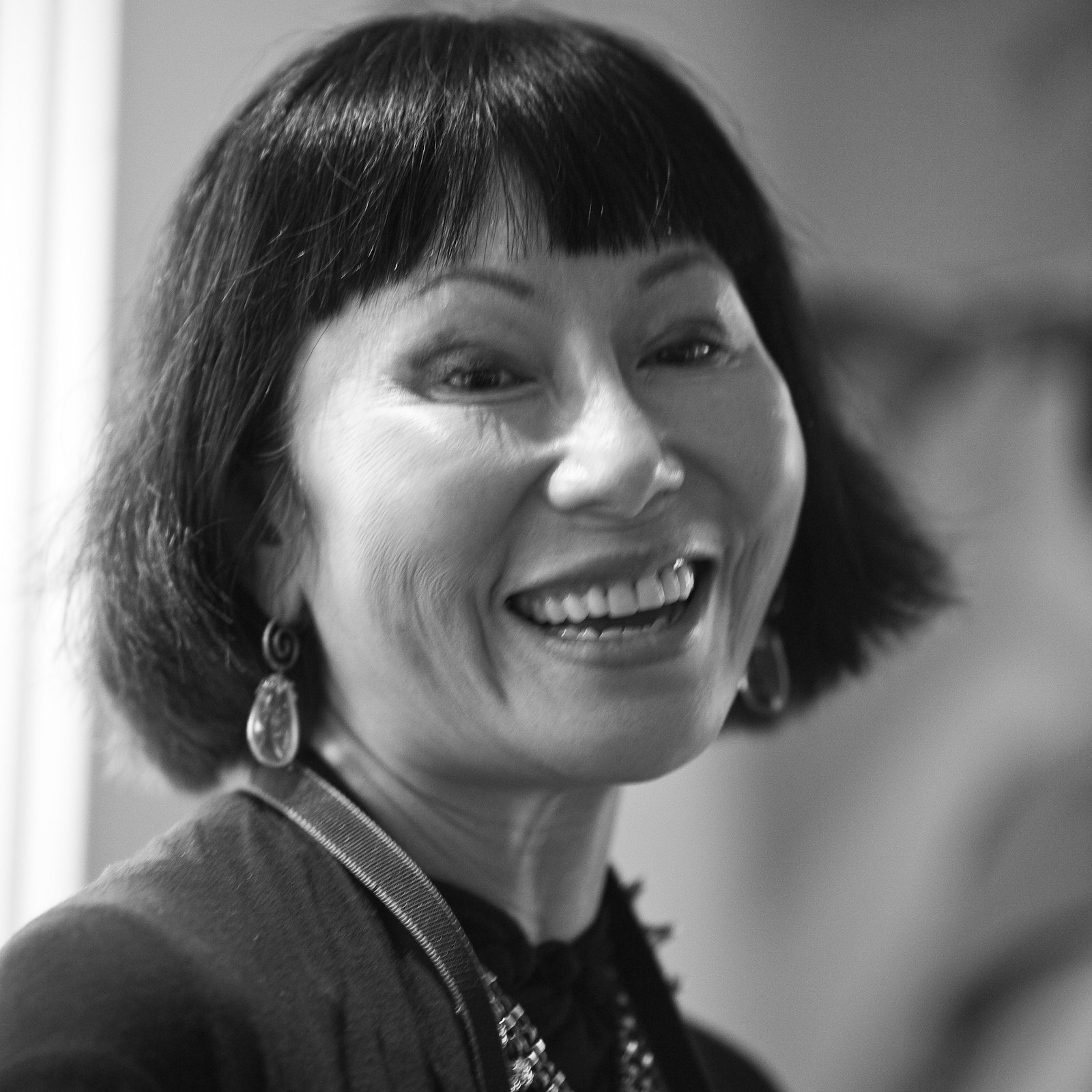
Scientists at the American Museum of Natural History in New York decided to name a species of leech after author Amy Tan, who mentions jungle leeches many times in her hilarious novel Saving Fish from Drowning. Curator of invertebrate zoology at the museum, Mark Siddall, said that “Tan is a long supporter of the work we do here [and] someone we knew would consider it an honor, not an insult, to have a leech named for her.”
The small Australian leech has been named Chtonobdella tanae and is the first microscopic soft-bodied critter to be described with CT scanning. The work was recently published in Zoologica Scripta, and opens for studying soft-bodied animals, from worms to jelly fish, in a non-invasive way.
Tan said she was thrilled to be immortalized through the leech, and excited about the new possibilities for identifying “legions of tiny organisms that have thus far lived in obscurity.” She added: “ I am now planning my trip to Queensland, Australia, where I hope to take leisurely walks through the jungle, accompanied by a dozen or so of my namesake feeding on my ankles.”
Both Tan and The American Museum of Natural History celebrated the occasion on Twitter.
New leech species named after me. First to slide across new scientific threshold–ID'd by CTscan w/o being squished.pic.twitter.com/lqOZnDD1jy
This is not the first time a species or discovery has been named after an author. There’s the Bagheera kiplingi, a spider named after Rudyard Kipling’s character Bagheera from The Jungle Book, Nabokovia, a butterfly named after the well documented butterfly enthusiast Vladimir Nabokov, Livyatan melvillei, an extinct whale species named after Herman Melville, and even 25924 DouglasAdams, an asteroid named after the author of Hitchhikers Guide to the Galaxy, to name a few.
Sigal Samuel’s debut novel, The Mystics of Mile End, set in Montreal’s part Hasidic, part hipster neighborhood, tells the story of a dysfunctional Jewish family growing dangerously obsessed with the Kabbalah’s Tree of Life. Samuel — who is a playwright, a journalist, an essayist, an editor for the Forward, and also much too young to be so accomplished — has been compared to Nicole Krauss, Anne Tyler, Myla Goldberg, and even Sholem Aleichem.
The Mystics of Mile End was hailed as a “standout debut” by Publishers Weekly and called “outstanding,” and “heart-stopping,” by The Library Review. It is an ambitious first novel, remarkable not just in its effective use of four distinct and richly drawn voices, or the intricate, expansive plot it weaves, but also because it explores enormous topics first-time authors are likely cautioned against tackling, topics like religion, mysticism, and mental illness.
Sigal and I met at a literary reading in Vancouver a few years ago. In a city where very few Jews looked like me, she stood out. We have followed each other’s careers over the next few years, as I moved to Toronto and Sigal to Brooklyn. We chatted via email while visiting our prospective homes, she in Montreal, and me in Tel Aviv.
Ayelet Tsabari: You were recently back home in Montreal for the holidays. How does it feel to be home? Does Montreal still feel like home?
Sigal Samuel: Montreal always feels like home, even though I left in 2009 to do my MFA in creative writing. I realized recently that I love this city because of its preference for multiplicity over unity. You can’t take two steps without your mind being forced into a kind of split-think, a bifurcated vision, a double consciousness.
You see this most obviously in terms of language. When you’re getting on a bus or walking into a store, you can’t just assume that the bus driver or shopkeeper is going to speak to you in English. Hence Montrealers’ ubiquitous weirdo greeting, “Bonjour-hi,” a linguistic choose-your-own-adventure that you use to suss out whether the other person prefers to continue the conversation in English or French.
I love that destabilization and think it shapes a lot of the cultural products that come out of Montreal. Our writers favor a doubling-up not only in terms of language (sometimes code-switching between English/French in a single sentence) but also in terms of highbrow/lowbrow (Michel Tremblay wrote in joual, working-class French slang, about pretty intellectual stuff), sacred/profane (think Leonard Cohen) and personal/political (Mordecai Richler, Heather O’Neill, Zoe Whittall come to mind).
If a city could have a motto, Montreal’s would be, “Why have one when you can have many?”
If a city could have a motto, Montreal’s would be, “Why have one when you can have many?” and that’s a mentality that always feels homey to me, because it suits my psychological temperament. This city is the best location for a certain kind of person and a certain kind of novel.
AT: Can you tell readers who don’t know a little more about Mile End specifically and what inspired your fascination with it and made you set your story in it?
SS: Maybe more than any other neighbourhood in Montreal, Mile End captures that quality I was just talking about. Its most visible populations are hipsters and Hasidic Jews (picture a grittier version of Brooklyn’s Williamsburg) and on the streets you’ll also hear Italian and Polish and Greek and Portuguese. All these identities and ethnicities overlap and intersect, like an awesomely messy Venn diagram.
In The Mystics of Mile End, all my characters are outsiders who don’t fit snugly into any box, instead perpetually walking (and tripping over) the fine lines between conventional identities. This is as true of the main Meyer family — an atheist professor dad, his devout son, and his daughter swinging dangerously between both poles — as it is of their neighbors, who span the gamut from SETI scientists to Talmud teachers. So it felt natural to locate them and their struggles in Mile End. In fact, that setting did half the work of plot and theme for me.
AT: You grew up Orthodox. Can you talk about that? How Orthodox were you and your family? And what happened? When and how did you become disenchanted with religion?
SS: As a kid, I was the nerdiest Orthodox Jewish girl you could ever hope to meet. “National Bible Quiz Winner” is an actual title that I hold, thank you very much. In my early twenties I wanted to become a rabbi, so I went to study in yeshiva (religious seminary). Then a funny thing happened: the more I engaged in serious study of religion, the more I came to understand that I loved this stuff not as law, but as literature. The Good Book was just that for me, a really good book, and I felt “obligated” by it to the same extent that I felt “obligated” by, say, Brothers Karamazov.
But I never became disenchanted with religion! I am as enchanted as ever with Judaism’s texts and myths, only rather than embracing them as a set of laws I have to live by, I see them as cultural products that I can use to enhance my life (and give depth and dimension to my fiction) how and when I like. Basically, I treat religion like I treat thrift shopping at Goodwill: Here are a bunch of weird and old and cool and interesting things — try them on, take what suits you, leave the rest for someone else who’ll love it better!
AT: What place does this religion or spirituality have in your life today? Or in other words: So many of your characters are seeking meaning. Where do you seek yours?
Fiction is religion to me, and religion is really, really, really good fiction.
SS: In fiction. Both reading it and writing it. Fiction is religion to me, and religion is really, really, really good fiction. That’s not a diss, by the way — it’s the ultimate compliment. When I said a second ago that I feel obligated by the Bible like I feel obligated by a Dostoevsky novel, what I mean to say is: a lot!
Just like millennia-old religious texts, great fiction offers us rich and well-considered points of departure for rethinking our lives. I take those seriously, and I think other devoted fiction readers do, too. Why else would we read?
AT: You wrote before that you were exposed to Kabbalah, the ancient Jewish mystic discipline, as a child, which is unusual. For me, growing up Jewish in Israel, Kabbalah was shrouded in mystery, and even a touch of danger. So I was impressed by your choice to take it on and write an entire novel about it and do it in such a confident way. It is ambitious, courageous, and almost subversive. Did you have any concerns about writing about Kabbalah? How did people react to it? And what part, if any, does Kabbalah play in your life?
SS: My dad was a professor of Kabbalah, and he exposed me to Jewish mystical texts when I was a young girl, so I’m sort of weirdly knowledgeable about this stuff. It didn’t feel courageous to write about it, though it did feel subversive, mostly for gender reasons: Traditionally, women aren’t supposed to study Kabbalah, and the Kabbalistic texts themselves are pretty sexist.
The funniest reactions to my book have come from Orthodox Jewish men who can’t seem to help mansplaining Kabbalah to me. They love to say, “I think you got X detail wrong, did you know that Y?” Yes, dude. Yes, I did know.
For me, the act of writing fiction feels like a Kabbalistic practice.
In terms of what role Kabbalah plays in my life now, this is going to sound weird, but: For me, the act of writing fiction feels like a Kabbalistic practice. The medieval mystics’ meditations, which included letter permutations and automatic writing, were basically techniques for achieving altered states of consciousness. That’s exactly what writing fiction is for me. It’s an altered state in which I let my subconscious take over (and then later, of course, I go back and edit with my conscious mind, which is where the hard work comes in). This is maybe not so surprising when you consider that there’s a long history of artists experimenting with automatic writing and drawing — just look at what the Surrealists were doing from Paris to Montreal in the 1940s.
AT: Around this time last year you went on a trip to India in search of your Jewish Indian family past. What inspired the trip, what did you discover, and are you considering writing about it in fiction?
SS: OK, so here’s the weird thing: I wrote a whole novel about a family of Kabbalists who are all terrible communicators…only to later discover that I come from exactly such a family.
Upon hearing about the novel I’d just finished writing, my grandmother and father said: “It’s so funny that you wrote such a book.” When I asked why, they said, “Didn’t you know that your great-great-grandfather was a famous Kabbalist in Mumbai? That the Jews of the city would come to study mysticism with him? That his home was known as Beit Kabbalah, the House of Kabbalah? That legend has it he died when someone interrupted him in the middle of a dangerous Kabbalistic meditation practice?”
Well, no, I didn’t know — because nobody told me!
I decided to fly to Mumbai to see if I could track down my family’s mystical secret society. After ten days there, I didn’t manage to find any tangible traces of my great-great-grandfather’s House of Kabbalah, but I did find out that my great-grandfather had been a Freemason — and probably also a Theosophist.
They ended up initiating me into their society, calling me “Sister Sigal” and asking me to recite blessings in Hebrew.
The Theosophists are a secret society that blends the mystical traditions of many religions, putting a heavy emphasis on Kabbalah. I crashed one of their meetings and, though they initially tried to shoo me away, they were impressed when they heard about my ancestry. They ended up initiating me into their society, calling me “Sister Sigal” and asking me to recite blessings in Hebrew.
It was the most surreal experience of my life: Writing my novel not only led me to discover my own family’s roots — it also led me on an obsessive Kabbalistic search that eerily resembles the search of my fictional characters.
As for whether I’ll write about Jewish India in my fiction, the truth is, I did come back from that trip with an idea for a novel. But it’s still percolating.
AT: When asked in an interview why, as a Jew of Mizrahi (Sephardic/Arab) background, you chose to depict Ashkenazi (Eastern European) Jewish characters you said you “only recently realized I was even allowed to write about Sephardic Jews.” Why is that? Is that something you are going to do in your next work?
SS: I’m so happy that you asked me this question, Ayelet, because now I get to reveal to you that it was your book that made me realize I could write about Sephardic and Mizrahi Jews! I read and reviewedThe Best Place On Earth when it came out in Canada in 2013, and it was a major revelation/liberation for me, because I think it was the first time I’d seen people like me (Arab Jews) represented in English-language fiction.
…I have to acknowledge that I still feel a huge amount of (unspoken, invisible) pressure to cater to the dominant image of what “Jewish” means to most American readers…
Now that I’ve had this writerly political awakening, will my next work reflect it? It’s hard to say, for a couple of reasons. First, if I’m being honest, I have to acknowledge that I still feel a huge amount of (unspoken, invisible) pressure to cater to the dominant image of what “Jewish” means to most American readers: the white, neurotic, bagel-munching, Woody Allen type. To borrow a phrase from Claire Vaye Watkins, it’s tempting to pander to the market by writing toward these readers instead of challenging them.
But the bigger issue is this: I don’t believe in didactic writing. I would never write about Sephardic Jews just to make some political point; I’d only do it if that’s what the story I’m dying to write calls for. In Mystics, I was writing about a place that happens to have a very Eastern European, Yiddish-speaking Jewish pedigree. It wouldn’t really make sense to put Arabic-speaking Moroccan or Iraqi or Indian Jews in Mile End. Whether I’ll depict those characters in a future novel depends entirely on what sort of idea grips me next.
AT: Wow. That’s amazing. I’m honoured! And I totally get what you say about not believing in didactic writing; that’s something I bumped against when I wrote The Best Place on Earth. You actually addressed it yourself in said review, saying, “as any fiction writer will tell you, demanding that an author include certain types of characters in her stories is likely to backfire; if they don’t flow naturally from the author’s interests and experiences, they’re apt to come off the page all wrong.” And like you said, in Mystics, it wouldn’t have worked. I also believe a writer can write about whatever she wants, though there seems to be an expectation from writers of color to write about their heritage and their heritage only.
At the same time, I’d like to challenge the idea that you should only write about Mizrahi Jews because the story calls for it, because so often the depiction of Jews is by default Ashkenazi, regardless of what the story calls for. I think your characters can be Mizrahi because why not? We never question why white or Ashkenazi characters are white and if it serves a purpose. I’m not sure if there’s a question there. I guess I’m just putting it out there.
SS: Yes! So, I actually totally agree, and that’s why I was careful to craft the main characters in Mystics so that they can be read either way. There are little hints in the text that suggest the family is Mizrahi; for example, in the little boy’s list of “Things That Make My Sister Sad,” number five is “How her hair gets frizzy when it’s hot out.” Readers like us will see a line like that and, I hope, immediately recognize ourselves and laugh in sympathy. I also purposely chose a family name — Meyer — that could be either Mizrahi or Ashkenazi (after rejecting other possible surnames for being too definitively Ashkenazi).
…wherever I can build into the text an opportunity for non-white readers to see themselves represented, I’m going to do that rather than force them to read characters as white unnecessarily.
My feeling is that, wherever I can build into the text an opportunity for non-white readers to see themselves represented, I’m going to do that rather than force them to read characters as white unnecessarily. This reminds me of J.K. Rowling’s recent tweet about race in the Harry Potter books. “Canon: brown eyes, frizzy hair and very clever. White skin was never specified. Rowling loves black Hermione.”
AT: As opinion editor at the Forward, you declared 2015 The year of the Arab Jew. Many people are not familiar with this term, and many others are not comfortable with it. You and I have spoken before about identifying as Arab Jews and how heated the discussion around it can get. Why do you think people react so strongly to this term? Why was it important to you to write that column and how do you feel about the year now that it’s concluded?
SS: People love to think of “Jews” and “Arabs” as separate enemy camps. In the context of the Israeli-Palestinian conflict, it serves certain political interests to construct those two groups as Others relative to one another. How inconvenient, then, that there are people who embody both those identities at once!
I think that in 2015, the idea of Arab Jews really picked up steam. Exhibit A: The Jewish Book Council awarded your story collection (pretty much entirely about Arab Jews) the prestigious Sami Rohr prize! Exhibit B: Every month, it seems, a new Jewish band pops up with music that borrows heavily from the Arabic melodies of our grandparents’ generation. People are getting more and more comfortable reclaiming their dual Arab-Jewish heritage.
This resonates really strongly for me because over the past few years I’ve been in the process of shedding a lot of the damaging racial assumptions I grew up with, especially the false equations “Jewish = white” and “Jewish = non-Arab.” It’s important to do that sort of reckoning because it gives us permission to be our more whole, more complex selves — and for us writers, it can also make our art way more honest and interesting, because it means we’re no longer censoring major parts of ourselves. This reckoning is an ongoing process for me.
AT: I’ve been interested these days in the ways in which our identity — the multiplicities of it — shape who we are as writers, not only in terms of content but style as well. For example, as a Jew of Yemeni background, I wonder if my love for narrative summary comes from a tradition of oral storytelling, and as an Israeli, I wonder if my fondness for intensity, conflict, and drama in fiction is a result of growing up a war-torn country. How does your background, your identity, inform your work?
SS: I’ve thought a lot about how my fiction is very, very allusive and how I probably have the ancient rabbis to blame/thank for that. I mean, the Talmud is nothing if not an endless series of callbacks and allusions, a lace of hyperlinks that is endlessly self-referential and infinitely entertaining. The way the Talmudic rabbis take a biblical verse and interpret it, twist it, reimagine it to mean something wildly different or flat-out contradictory to its original meaning — I love that, and because I grew up loving it, I think I do a lot of it in my own writing, both consciously and unconsciously.
A really intricate self-referential web gives me the sense that I’m inhabiting a densely imagined world.
Mystics contains allusions to ancient Jewish texts and also to Leonard Cohen and also to Arcade Fire and also to a million other things, including itself. The novel is told in four different voices, and you won’t understand something in, say, the dad’s section until you get to the daughter’s section and then you’ll have that “Aha!” moment and flip backward, and so on. My favorite TV shows are likewise ones that make me do this sort of mental running-around — “Arrested Development” being the best example. A really intricate self-referential web gives me the sense that I’m inhabiting a densely imagined world. And it gives me the subliminally comforting feeling that I’m living inside a fractal.
AT: Related to that last point, what is Jewish fiction to you and do you feel comfortable being placed in that category?
SS: I feel comfortable with my work being labeled “Jewish fiction” to the same extent I feel comfortable with it being labeled “Montreal fiction” or “LGBT fiction.” It’s all those things at once, and labels are okay insofar as they provide entry points for people of X identity to get excited about your work. But it’s not just any one of those things.
AT: In Mystics you wrote a lot about “what you know.” When did you feel outside your comfort zone and wrote what you didn’t know? What posed a challenge? What made you want to throw the manuscript against a wall?
SS: Funny that you say that, because the most challenging parts were the parts when I was writing “what I (ostensibly) know”! I’m talking about the quarter of the book that’s written in the voice of the daughter, Samara, a twenty-something queer woman — on the surface, the character that most resembles me. I was too close to that voice, too intimate with it, so I struggled a lot with everything from structure to killing my darlings. It was much easier to write the other voices. There’s something liberating about inhabiting bodies and minds that are so unlike your own — you’re more able to let go of How Things Really Are and just let your imagination do its job.
AT: What question do you wish people would ask you?
SS: I wish people would talk to me about the fact that one of my protagonists is a queer woman — and ask what role queer politics plays in a novel that’s largely about religion. I find it telling that the book hasn’t been reviewed in the queer press yet. Our publishing ecosystem is very used to thinking of LGBT books as coming-out stories. But what happens when you have a novel that features a queer protagonist whose main struggle is not about her queerness? I was hungry for more books like that, and so I wrote one. And I would love to talk to people about it.
AT: Would you like to elaborate about it? Please do! I’m asking: what role does queer politics play in a novel that’s largely about religion?
Just because you’re queer doesn’t mean you’re exempt from spiritual hunger…
SS: Ha! Now I actually have to formulate an answer for the first time! I guess I’d say that I think we often assume an allegiance between “queer” and “secular” — but one doesn’t necessarily entail the other. There’s no reason queerness and religiousness need to be antithetical. Just because you’re queer doesn’t mean you’re exempt from spiritual hunger — hell, maybe you’re more attuned to it, because you’re strenuously seeking some form of unconventional intimacy. Maybe part of the reason Samara is more successful than any other character at climbing the Kabbalah’s Tree of Life is that she’s more of an outsider.
In the past month or so, I’ve participated in three book clubs as they discussed Mystics. In two out of three groups, readers flat-out refused to believe that Samara is gay, despite clear evidence in the text (um, basically the entire book). They said to me: “What I don’t understand is, why did Samara have to have that dalliance with that other girl? I mean, we all know she’s going to end up with Alex in the end, right?” The “dalliance” they referred to is the long-term relationship between Samara and her girlfriend, who lives/sleeps/makes out with her on the page. Alex is a male friend.
For a while, I was sort of flabbergasted by this impulse to read against the obvious meaning of the text (a very Talmudic impulse, I guess you could say!). Then I thought: Maybe the reason some readers just can’t believe Samara is gay is because she’s just…so…goddamn…religious. She spends months obsessively trying to become one with God — that’s her main struggle in the book — and for some readers it doesn’t compute that you can have that kind of struggle and also be really, really gay. But I think my character can be all those things and more because, as you said, why not?
Despite being one of the most beloved and respected American writers of 20th century, Flannery O’Connor’s work hasn’t really made the jump from the page to the screen many times save for John Huston’s strange retelling of her first novel, Wise Blood. On this latest episode of Ryder + Flye, Jason Diamond talks with South Towards Home author Margaret Eby about the possible reasons why O’Connor’s work might not be right for movies, being Catholic in the South, 70s cinema, Harry Dean Stanton, and much more.
PEN America announced that this year’s PEN/Allen Foundation Literary Service Award will go to Harry Potter author J.K. Rowling for her efforts to fight inequality and censorship. In addition to noting Rowling’s contributions to imagination, empathy, and love of reading (and her journey from single mother to literary star), PEN also credited Rowling’s humanitarian work, including the founding of Lumos, a nonprofit organization dedicated to supporting children in institutions worldwide, and The Volant Charitable Trust, which works towards alleviating social deprivation and researching treatments for Multiple Sclerosis.
Rowling told the AP that she was “deeply honored” and “humbled” by the award. She also said that she has “long been a supporter of PEN, which does invaluable work on behalf of imprisoned writers and in defense of freedom of speech.”
Previous recipients of the Literary Service Award include Salman Rushdie, Toni Morrison, and Tom Stoppard.
In a statement released earlier today, PEN President Andrew Solomon elaborated on the organization’s decision to honor Rowling: “Through her writing, Rowling engenders imagination, empathy, humor, and a love of reading, along the way revealing moral choices that help us understand ourselves. Through their experiences with Rowling both on and off the page, countless children have learned not only the power of speaking their own minds, but the critical importance of hearing others. A gifted storyteller, fierce opponent of censorship, advocate for women’s and girls’ rights, and staunch defender of access to education, Rowling uses all of the tools at her disposal to create a better and more just world for our children.”
PEN also announced that its 2016 Publisher Honoree would be Michael Pietsch, CEO of Hachette Group. Pietsch has worked as an editor for David Foster Wallace, James Patterson, Donna Tartt, among others. PEN Executive Director Suzanne Nossel praised Pietsch for having “painstakingly reaffirmed literature as more than a consumer good: as a cultural currency in need of vehement protection.”
The recipient of this year’s PEN Freedom to Write Award, which annually recognizes an imprisoned writer, has yet to be named.
The awards will be handed out on May 16th at the PEN America Literary Gala. Last year’s Gala, as you may recall, was a hotbed of controversy after PEN awarded the PEN/James and Toni C. Goodale Freedom of Expression Courage Award to the staff of Charlie Hebdo, sparking a debate about freedom of expression, satire, ethnic caricature and religious tolerance.
This year’s recipient of the Goodale Award has yet to be announced. There will, however, be at least one connection to Charlie Hebdo at this year’s Gala. PEN noted that in January, under Pietsch’s helm, Hachette published Open Letter: On Blasphemy, Islamophobia, and the True Enemies of Free Expression, a posthumous book from slain Charlie Hebdo editor, Charb.
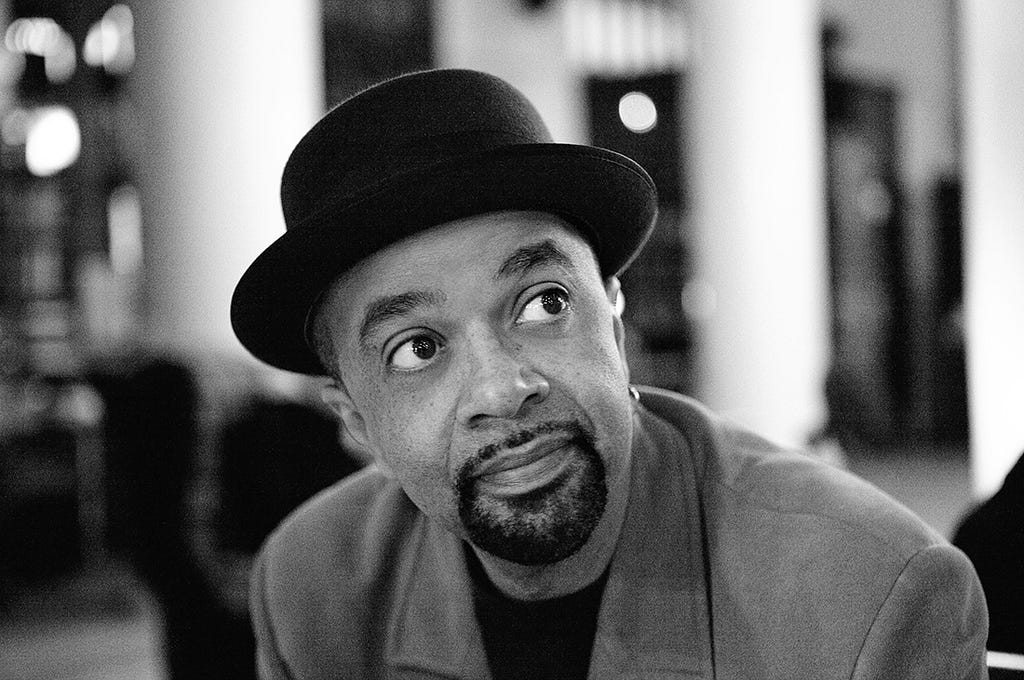
Before The Color of Water came out, I did a lot of stuff that failed. I worked in musical theater and I failed in that. If you put my musical theater resumé together, I would look like a pretty promising composer, but it wasn’t like Stephen Sondheim was spinning around in bed at night worrying about me. Neither was Wynton Marsalis. Or Tom Wolfe or Kurt Vonnegut.
I didn’t know what a memoir was when I wrote Water. I didn’t pay any attention to the label of memoir versus nonfiction versus fiction. I just thought it was a good story and I had to tell it.
I don’t really care what anyone else does. I don’t follow the careers of other writers. I work with blinders on. I know what I have to do. The book I wrote as a memoir might be the kind of thing another writer would write as fiction.
I don’t follow the careers of other writers. I work with blinders on. I know what I have to do.
Water started with a magazine piece I wrote for the Globe back in the early eighties. I was talking to an editor there, and somehow or other the subject of my mother came up. I mentioned that I was pretty sure she was Jewish, and he said, “You should follow up on that.” So I did, and I found out that she was; and I wrote about what I learned, and it was published in the Globe and the Philadelphia Inquirer on Mother’s Day.
After that I started writing a book based on the magazine piece. I worked on it a little at a time. I went to Africa. I did my work for the Globe. I worked on the book when I could. The finished book might feel like the writing of it was immediate, but it wasn’t. It happened over time, in bursts, and most of the time I spent on it was research.
The older I got, the more I began to appreciate who my mother was. I did the work because I started to see that my mother was very interesting. It was kind of an evolutionary process that happened as I was maturing into my late twenties, early thirties. I was starting to see the world a little more clearly. I started to see that in the world at large, the stuff we hadn’t considered very important was actually incredibly important: race, religion, money, power.
But I didn’t have any specific aspirations when I wrote Water. I just wanted to get the rest of the advance. I don’t really find my musings to be strong enough to justify my writing a memoir. I don’t have that kind of patience. I just don’t think I’m that interesting.
Lean times, lean book
Water came out in 1996. At the time I was a full-time musician, traveling a lot, playing a lot of crummy clubs, eating bad food. I was struggling, really. And the leanness of that life probably had an impact on that work in the sense that I wanted it to be done, and I didn’t want to be driven by the kind of angst that was kicking me around in those years.
The narrative of the book was as thin and as muscled as my life was at that time. You know, with every story you do, you’re trying to shove a lot of things into the keyhole and drag the reader with you. You have to narrow the focus of the story so it has the push of a creek in a narrow spot.
Struggling is good for writing
My life is still a struggle — just a different kind.
A year ago I started a music program in the church my mother and father founded in the same housing project where I was born. It’s a lot of work. If I could retire and do nothing else I’d probably just do that. It means so much to me to do it. There’s a lot of struggle involved in getting these kids into church and into this music program.
I think that kind of struggle is important for a writer. I think it’s a mistake for a writer to sit around coffee shops musing about bullshit. I think it’s a waste of time and I never do it.
I think it’s a mistake for a writer to sit around coffee shops musing about bullshit.
The people I work with in the church don’t know I’m a National Book Award winner. They don’t know about The Color if Water. Most of them haven’t read any of my books. Many of the older ones knew my mother, or knew of her. We’re connected in that way.
I don’t like sitting around talking about work. Invariably it ends up with, “I didn’t like this book for that reason; I didn’t like this one for that reason.” A writer can’t be too negative. You have to have a little bit of innocence to be a good writer. Whatever you have to do to preserve that innocence-the “is that so?” element — you should do it. You can’t be someone who knows everything-”been there, done that.” If you know every thing you shouldn’t be a writer. You should be God.
You need that sense of discovery as a writer, and part of that comes from the attitude you have. You have to stay away from people and places that foster cynicism and bitterness.
If I work hard at anything, it’s that. I still take the bus. I still move around in circumstances where people don’t know who I am. Because I ain’t nobody, really. I’m still the same person. When I started writing, I didn’t really know what writers did. I thought they sat around drinking coffee and sleeping with one another, then writing about it. I’m more of a writer now than I was then, but I’m still not one of those kinds of people. I don’t go to writers’ conventions or do big writer talks.
Ready, aim, don’t fire
When you’re writing a memoir, you have to be careful because you don’t want to bruise people too much. You have to give people the benefit of the doubt.
It’s really not beneficial on the page or through a blog or through any sort of written public word to blast people, unless they are truly deserving. A scamming lawyer or politician yeah, you can aim your bazooka on them directly, and drop the hammer on them, and sleep tight.
But most of us don’t deserve that kind of treatment. If someone’s a racist or a sexist or a homophobic idiot, you have to kind of leave them to God. Just show them as they are, but don’t blast away. Because everyone is capable of change.
Writing a memoir, you have to keep that in mind. You can’t use a book as a kind of “I’m going to get back at them” exercise. You’re not writing it for that reason. You write a memoir for the same reason you write a song — to help someone feel better. You don’t write it to show how smart you are or how dumb they are. You’re trying to share from a sense of humbleness. It’s almost like you’re asking forgiveness of the reader for being so kind as to allow you to indulge yourself at their expense.
You write a memoir for the same reason you write a song — to help someone feel better. You don’t write it to show how smart you are or how dumb they are. You’re trying to share from a sense of humbleness.
When I was writing Water I was very careful to respect my mother’s family. I was very cognizant that most of those people didn’t know me or any of my siblings. I didn’t want to tommy gun them. They had no choice about what happened. My mother did something that wasn’t that cool, given where she came from. She broke free from the constraints of her life. I was raised to believe that everyone is different. The things that work for you may not work for other people. So I was careful to change their names to protect their privacy.
I kept my siblings out of the book as much as I could. With regards to my own privacy, I didn’t dramatize it or soft pedal it. I played it straight. I didn’t really like divulging some of my activities as a high school kid. I’m ashamed of that stuff. I was not real pleased about putting it on the page, but I did it. And I did it without mentioning my friends who were involved.
Postracial publishing? Not so much
Publishers love the idea of a black person who’s showing they were a thug doing dope and crack-the whole business of “I was lost but now I’m found; I was blind but now I see.” This is a real problem for black writers. The industry is accustomed to black writers writing about pain and struggle. I can think of a half dozen white writers who write about the same things and never had to deal with being marginalized. They’re just seen as writers, period.
There’s very little room in the publishing industry for minority writers. I don’t know if that’s anyone’s fault. The industry tries to address the problem, but essentially it’s a personal one. Each of us has to do what we can personally do to inch things forward just a little bit.
Another problem for black writers is that black people simply don’t read enough. If you say that, people get insulted, but it’s true. I have tons of black readers now, but when Water came out most people who came to the early readings were white women and white Jewish women, and I was thankful they showed up.
I happen to think that a good black writer is the one who writes a book anyone will like. If a writer’s good, readers will read those books and feel illuminated. That’s the only way our industry will continue to grow. We have to embrace writers who are different just like we embrace a president who’s different. If we don’t, as a society we’ll wither on the vine.
I wouldn’t say it’s getting better for writers of color. There are better and better writers of color, but they’re not getting a shot. A lot of really good Asian American writers are starting to publish, like Chang-rae Lee, but I have yet to see a plethora of books by Americans of other hues.
To make our industry relevant we need really good editors who aren’t looking for the next Hemingway, but for the next Tupac Shakur.
It’s not just a function of prejudice. The publishing industry is under so much pressure. A writer gets a book deal, and the book gets trotted out for six weeks, and if it doesn’t sell, it’s gone. So many young writers go through that. They don’t have a shot at a second or third book. That’s a real problem that’s industry-wide for all writers.
To make our industry relevant we need really good editors who aren’t looking for the next Hemingway, but for the next Tupac Shakur.
It’s bigger than a publishing problem. We have a great black president, but what would happen if we had a great black vice president? A great black Speaker of the House? Why is it okay to have one black neighbor, but when ten black families move in, the neighborhood changes and stores close down-the kinds of problems that Detroit has right now?
Compared to the problems most people have, these are good problems. I don’t want to bellyache about them.
Blah, blah, blog
In this world of blogging and telecommuting and Twitter, memoirists have to speak to deeper things.
We’re writing memoirs 140 characters at a time, which means we’re basically writing nothing. If you’re writing nothing maybe you’re living nothing. Before you put your story down, first change the manner in which you’re living. If you do that, you won’t find yourself writing a Broadway show with five minutes of spiritual uplift and then everyone goes home.
If you walk around with earplugs in, that won’t give you something to say. Nothing you’re going to write will be of import. Put those earbuds away and join the Peace Corps in Peru. That’ll give you something to work with.
James McBride’s Wisdom for Memoir Writers
If I were an aspiring memoirist, the first thing I’d do is go visit my grandparents for a couple of months. Drop everything and stay with them. Cook their food. Deliver their groceries. Go to bingo night with them. Let them pull you backwards into their lives. Whatever they have to say is a bankbook for you as a memoirist. You’ll see yourself in everything they do, even if they drive you nuts.
Know that the writing will lead you into places you can’t imagine you’ll go. In my experience, writing comes from a place beneath intellectual consciousness. The only way to get to that place is by writing. Trust the magic of that process.
Be wildly ambitious about your writing, and forget the stuff connected to writing.To use a sports metaphor: keep your eye on the ball. Publishing is not the ball. Getting an agent is not the ball. Winning the National Book Award is not the ball. The writing is the ball.
Spend a lot of time figuring out what your story wants to say.Then figure out who the central characters are that you need to visit.Then report the hell out of it. You have to research your own life. Go back to the old ‘hood; walk by your old house. You count the rooms, you eat the food, you drink the coffee, you sit in the bar, you go to the gas station and ask for directions. You have to breathe the air. Nothing might come of any of it, but you can’t train just one muscle. You have to train the whole body.
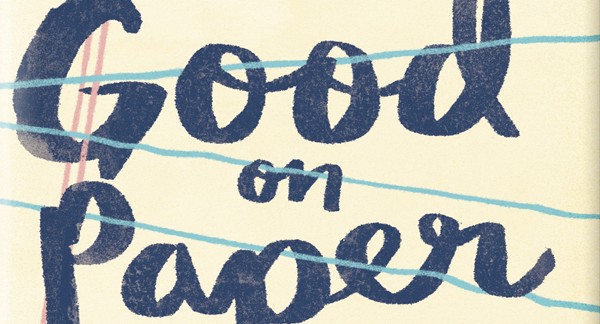
In the opening section of Good on Paper, the protagonist, Shira, receives a mysterious fax. She anxiously assumes it is from her estranged mother (“Damn it, I thought. Thirty-five years in and still you do this to me?”) but then it turns out to be a once-in-a-lifetime professional opportunity to translate a Nobel Prize-winning poet’s upcoming release. She crumples it up into a ball and throws it on the floor, thus establishing Shira’s near-debilitating fear of change and abandonment. In defending her refusal to believe this opportunity as valid, readers see the emotional prism through which Shira views the world: People don’t change, and Shira doesn’t want change, even with this glorious “door number two” opening right before her. This attitude effects all of her relationships and emotional reactions, especially when she finds herself being pushed through door number two.
Since dropping out of her PhD program, where Shira studied Dante’s La Vita Nuova, she skipped around from temp job to temp job, living in New York with her daughter Andrea (Andi for short) and Ahmad, a gay professor who serves as a father figure for Andi while also offering a welcoming home for an underemployed single mom. His school pays for the apartment, which is much bigger than it would otherwise be for a single professor: “By Manhattan and possibly other standards, it was enormous: come the revolution, it would be divided among three, if not four, proletariat families.” (Sidenote regarding the occasional apocalyptic references: The story takes place in the year 1999, and aside from faxes serving as plot points, there’s a nice, pervasive note of paranoia sung throughout by those certain that Y2K will bring the apocalypse. This paranoia fits in seamlessly, providing a general fear of change as backdrop.)
Shira calls their luxurious apartment “the Den of Propinquity” — “joking, because the place was large, not joking, because some days it seemed hardly large enough.” It’s clear that despite its size, she still struggles with the forced intimacy: At times, she threatens to move on from Ahmad’s, though she prevents herself from having the means to do so by job-hopping and not buying household goods.
“I’ve never invested much in things: any day, or so the theory went, we might move on.”
It’s a unique domestic setting with inevitably awkward dynamics, particularly with regard to Ahmad’s relationship with Andi and his tenuous status as a part of their family. The awkwardness of his more than avuncular relationship is only exacerbated by Shira’s fear of change, as she, given her abandonment complex, finds his undefined support perfect for her prolonged mid-life stasis. Following that, when she starts to translate the poet’s work, her life increasingly revolves around her simple comforts; she turns to a doll kept in Ahmad’s study that she talks to in trying times, and spends increasingly more time at her neighborhood standbys.
There’s Cuppa Joe’s, where she downs half-caffs, nods to the regulars, and replays her favorite lines with the local panhandler (“Can I offer you some change? … No, thanks, I’m fine the way I am.”). There’s Cohn’s Cones, where she takes Andi and they take turns thinking of Cohn’s Cones koans; and then there’s People of the Book, the local bookshop, where she hates the unstable young female clerks but enjoys the company of Benny Jablonsky, the owner of the store and an old, rabbinic literary friend. Shira visits these spots constantly while treading through the middle of her translation project. The poet’s new work is an updated version of Dante’s La Vita Nuova, centered on the autobiographical narrator’s obsessive love, Esther, who is now hospitalized (which is based on Dante’s intense obsession with Beatrice, established in Nuova).
But as Romei, the poet, sends her new portions of the epic poem, thickly stacked parallels between Dante, Romei, and Shira quickly amass. For example, when discussing Dante’s obsession in the original, Shira points out to Romei that Dante intentionally maintains a distance with Beatrice so that she can remain an untested ideal: “Beatrice isn’t real, so she doesn’t have to change. An idea can be perfect forever.” This line comes to mind again when Shira mentions that she never sought out details regarding her mother’s strange departure during her childhood — her mother remains an idea to her, an idea that can be whatever she needs it to be at a given moment. The parallels, brilliant in their subtlety and orchestration, cover a wide range in emotional and literary depth, and sometimes the overlap goes beyond those three as Cantor shows great control in her ability to create relatable characters.
However, Shira’s own personal relationships strain under the weight of her rediscovered if still erratic professional obsession; as a result, it strains her own absolute desire to not become too involved in anything, or with anyone except Andi. She is often very loyal to her fears, then overcompensates for her misplaced loyalties in hindsight. Yet she maintains a good sense of humor throughout. In other words, she’s an impeccably funny, down to earth, realistic narrator. And in documenting her struggles, Cantor finds a charming way to portray the character’s ability to engage in high-brow intellectualism — chiasmus, as a word itself as well as a poetic device, is casually used maybe a dozen times — using her exceeding talent to create a genuine, low-brow character in Shira. Perhaps nothing makes this more evident than the cultural crossroads depicted when Shira, rummaging through old boxes, looking for her copy of La Vita Nuova, comes across an old Tinky Winky toy sitting on top of a stack of Italian dictionaries —
“Are you in exile again? Just like Dante!”
This is hardly a throwaway bit, as Shira’s own self-imposed exile of sorts parallels not only Dante’s and Tinky Winky’s, but also Ahmad’s complex personal history as well as her mysterious mother’s. Cantor combines a detailed web of characters with her humor, carefully arranging the emotionally impactful moments as well as the wordplay and comical sense of domesticity. Dante and Tinky Winky may still be in exile, but by combining their forces, Cantor pulls off a well balanced and entertaining novel.
Joyce Carol Oates, five-time finalist for the Pulitzer Prize for Fiction and recipient of a National Book Award and a National Humanities Medal, among many other honors, is one of the United States’ most prolific living writers, having published nearly eight dozen novels and short story collections in five decades, in addition to essays, novellas, and poetry collections. And that’s just the books she’s written under her own name.
Oates’s latest is a novel called The Man Without a Shadow (Ecco, 2016), which follows the lives of neuroscientist Margot Sharpe and her prize patient, amnesiac Elihu Hoopes (or “E.H.”), who can only remember events for 70 seconds at a time. It’s a fascinating novel that explores the meaning of memory, loss, and the possibility of loving and building a history with someone who can never remember you.
I had the pleasure of a lengthy conversation by phone with Joyce Carol Oates, who is currently teaching in Berkeley, the week before her new novel was released. We talked about the development of her writing over many decades, the role of obsessions and social engagement in a writer’s life, and the many mysteries of the human brain.
CL:How did The Man Without a Shadow start for you?
JCO: The Man Without a Shadow began as a short story, a long short story. It was about thirty pages long, that became thirty-five pages, and then forty pages, and I kept building on it. I perceived it as a work that a woman is recollecting in her own memory. She is now somewhat of an elderly woman perhaps. Or she’s retired and she’s much older. She’s outlived the love affairs, and she has outlived most of her career. She’s a very famous neuroscientist. She’s now in the phase of her career where she’s winning awards. She’s receiving lifetime achievement awards, and she’s giving lectures and talks and so forth in different parts of the country. She’s sort of remembering — that’s what the novel is, she’s remembering these things.
We move through the novel in a chronological way, and we’re with her as she is accumulating these memories. But in the very beginning, like the first page, basically, of the novel, the romance is over, because at that point her lover has died. So all this has to be put into a form, and the form is very challenging and intriguing to the writer.
CL:I was wondering about your decision to write The Man Without a Shadow in the present tense. It’s such a great choice for your character Elihu Hoopes, who can only recall new experiences for 70 seconds at a time and really just lives in the present tense.
We all suffer short-term memory loss all the time.
JCO: Yes, when people who have normal brains get older, their short-term memory starts to deteriorate. We all suffer short-term memory loss all the time. We write down numbers, we write down telephone numbers, we don’t trust our memory, even though, supposedly, most of us have normal brains. The man in The Man Without A Shadow is someone who has suffered very definite brain damage, but it’s not ultimately that different from, say, an Alzheimer’s sufferer — if you know anyone in your family, and I did know someone in my family, who suffered from this deterioration of memory– Eli, he’s not that different. One could fall in love with this man because he seems to exude normality. It’s only after a while they start to realize that he’s not remembering anything. I have been with people — always older people, even friends — where you tell them something and then a few moments later they’ll actually have forgotten. They weren’t listening, or they were distracted or something. They ask you the question again, and it almost doesn’t matter how old they are, because students forget things, too — they can forget things within a matter of minutes. So in writing about this particular person, I wasn’t really writing about experiences so different from what many of us have had.
CL:As I was reading the book it seemed to me that, in many ways, Margot and Eli aren’t that different — there is selective memory happening as well on the part of Margot. This idea of creating your own past, and how much control you have over that…
JCO: Yes, we all have selective memory. I see it in myself. I know it’s there, so maybe that’s why I recognize it. Many people don’t recognize it, the selective memory — literally just completely forgetting something that is unpleasant or that you don’t really want to do, and then realizing that you haven’t done it. And sometimes people have actually forgotten– there’s a purpose to that. I can see that — and I don’t feel I’m quite like Margot — Margot is trying to deny certain things. She’s not considering them at all, and of course she starts drinking, which definitely causes a deterioration of memory.
CL:Yeah, there’s definitely some dishonesty with self that happens in your novel, and it brings up a couple of questions, like, what is reality, and who is defining what reality is, ever?
JCO: That’s so true.
CL:Well, who does define what reality is?
JCO: When Margot’s professor is being accused of moral turpitude and scientific misconduct, it’s a subject I know quite a bit about because my husband wrote an article about it for The Nation magazine, and he was reading all these books and so forth. But scientific misconduct is so uncommon. It’s very scandalous and usually kept quiet when it involves famous people — they maybe just retire precipitously from Harvard or something, which happened not so long ago. But Margot either doesn’t want to acknowledge that, or she actually doesn’t think he did it. He was exploiting her and he did exploit some of his other assistants. But he also rewarded them, and he was also a wonderful and brilliant man. These are the kinds of people you meet in real life, especially in science, they’re charismatic, they’re brilliant, and they have a whole cadre of graduate students, younger people, who they are training and sending out in the world. But then at some point they may just be exploiting these students, and they’re not really in the lab as much as they used to be, because they’re in Washington doing something. So Margot just defends him absolutely. She says no, he never did anything like that, she really denies that. But the reader knows that really she does know that he’s done that. But it’s not clear that she’s lying. It’s more that she stubbornly is not going to say anything negative about him.
When all of us talk about some friend or parent or something, we usually use superlative adjectives — she’s this wonderful this and that– and we’re deliberately not acknowledging that maybe once or twice this person was not so perfect, because we are selecting the details we’re giving to other people. Reporters and police officers never believe anything that people tell them because they know that it’s not going to be perfectly true. Anyway, it’s very normal to do this, and I’m not suggesting that people who do this are immoral in any way. It’s just very natural.
The famous scientist in The Man Without a Shadow is based on a composite of several great neuroscientists. Since my husband is a neuroscientist, I know all of these people. I know them by name, from his stories about them. It was really lots of fun to write about these people, because everything in the novel is basically true in some way.
CL:Your initial interest in the subject matter when you started this novel is clear, but then what kind of research went into writing the novel? There’s so much detail in The Man Without a Shadow.
JCO: I had several books. I acknowledge them in the acknowledgement page. Mostly Suzanne Corkin’s book about the most famous amnesiac in the history of neuroscience: Permanent Present Tense: The Unforgettable Life of the Amnesiac Patient H.M. She just retired recently from M.I.T.; she’s a friend of my husband. And then there is this younger professor, a neuroscientist at Princeton — his name is Nicholas Turk-Browne. I acknowledge him also. There was a long article about Nick in the New Yorker about eight months ago. He’s working with a severe amnesiac who got amnesia from brain damage caused by encephalitis. That’s maybe a little more like my character, who has brain damage from encephalitis, probably caused by a mosquito bite up in the Adirondacks. He didn’t get the proper treatment. It’s terrible to think that this could happen from a little mosquito bite, but it can. So I did that research, and I did some general reading. Then my husband read the manuscript and he pointed things out that I should explain or I needed to put more in. And then he read it again when it was all finished and offered some suggestions. His library is just filled with all these books, many, many books, including books by Darwin — Charlie is interested in the history of neuroscience also. So I had access to a lot of books — I basically was just reading a lot.
CL:I’m amazed how mysterious the brain really is, still.
JCO: I know, it’s so fascinating, just the dreams that we have. Almost every night, our dreams are so astonishing. Sometimes they don’t seem to make any sense, and sometimes they do make some sense. But nobody really understands them.
CL:I remember a scene in the book, among the various experiments that take place, where the amnesiac patient is woken up in the middle of sleep and asked to recall his dreams. This idea of recollection in dreams…
…when you’re alone, or when you’re married to someone who doesn’t really know your background, you just start drifting into all these memories that are sort of half confabulated, and half real…
JCO: Confabulation is something that we all do, and those are experiments that are done with normal people. Say, you’re wearing something, like right now you have a wristwatch on or something, and somebody says, “Oh where did you get that?” You don’t really remember where you got it. So you make up a plausible answer. You say, “Well, my mother gave it to me.” Or something like that. That’s confabulation. It’s not really lying. It’s supplying a plausible answer because you’ve forgotten where you got something. So then, the next time you’re asked the same question, you just give that answer. So within families there are all these stories, and then it turns out that someone remembers, “Oh, that’s not from your mother, that’s my watch!” Or something. That happens all the time in families because people are confabulating constantly. But in a family you have somebody who can check you. If I said something that was just wrong, my husband might not know about it, but my brother would. So when you’re alone, or when you’re married to someone who doesn’t really know your background, you just start drifting into all these memories that are sort of half confabulated, and half real. And there’s nobody to check you, especially people who live all alone.
CL:Hearing you talk about that makes me think of Margot, who has this attraction to this man, her amnesiac patient, who knows nothing or will remember nothing about her.
JCO: I was thinking how wonderful it would be to talk to some person who maybe could give you good advice in the moment, but then wouldn’t remember. I know a number of people who would never go to a psychiatrist or a therapist, because they don’t want their problems to get out. You don’t really want to talk about your problems to anybody because they may write a memoir, they may go online. You can’t trust anyone. But if the therapist had…
CL: A memory problem?
JCO: …then they could give good advice and then just forget it. They wouldn’t remember; it would be such a solace.
CL:I think you’ve discovered a new profession for amnesiacs.
JCO: Yeah. I do know people who would never go to a therapist even though maybe they would benefit from it, because they’re really terrified that it would get out. I remember years ago I was reviewing a book for the New YorkTimes, a biography of Anne Sexton, and there it was: her psychoanalyst had actually revealed her fantasies, and notes from their sessions. I thought that was extremely unprofessional. Because she was dead, but her children were still alive. It’s very hurtful. So most people are afraid of therapists revealing and behaving unprofessionally.
CL: That’s interesting. The Sexton book is different of course because it’s a biography, but do you think that writers have a responsibility to be engaged politically or socially? Do you have any opinions on that?
JCO: It all depends on who the person is, obviously. There are very activist people who go out in the world, like Walt Whitman, who was working with wounded soldiers in the Civil War, and his contemporary, Emily Dickinson, basically was a recluse who stayed in the house. They’re both great poets. I wouldn’t say that one was more ethical than the other; they’re just very different. Some people are extremely involved in the world, but those are people who may not be comfortable staying at home, they may be restless at home. And then there are people who can only work in a quiet way, they have to schedule their lives very carefully because they need all their energy to focus on something. So, we’re all extremely different people.
I do have friends who are quite active — animal activists and women’s rights activists. Ecologically and environmentally involved people. But then I have friends who are poets and who are really quiet, who just like to lead quiet lives.
CL:You’ve taught at Princeton and elsewhere since 1978. How does the experience of teaching affect your own reading and perhaps your own writing?
JCO: I teach a large variety of works of fiction. I teach a story by Hemingway, by Faulkner, by James Joyce, Virginia Woolf, many, many different styles. It’s the attentiveness to sentences and to the construction of a short story. Usually I teach short stories. So it’s a sort of attentiveness that we pay in a workshop to the way that a story is structured. What does the title mean, what is the first sentence, and what is the last sentence? How is it paragraphed? There are formal things that we look at in a writing workshop that most people, when they’re reading, are hardly aware of, except perhaps subliminally. Most people could never tell you, or they wouldn’t be interested in, what the paragraphing is in a story by Hemingway.
But when you’re writing a story you have to make all these decisions that seem, to other people, trivial. But they’re part of the building of the world.
But when you’re writing a story you have to make all these decisions that seem, to other people, trivial. But they’re part of the building of the world. It’s put together like a wall or a mosaic, it has to be put together. And as soon as people start to write they realize that you don’t just write in one long paragraph. You are breaking up into different sections, doing things of a spatial nature. We spend a good deal of time on those things in my workshops.
CL:You mention constructing a wall or a mosaic. What is the impetus for you for a story or a novel, and how do you build on that? For yourself, in your writing practice, is there a spark that says, this is an idea I want to explore?
JCO: Well, certainly one does get an idea. You have to have some emotional connection with a story, with characters, with a scene, with a setting. I really like to place my fiction in very definite settings. Usually I do spend a good deal of time describing places visually. I may not leave all of that in the prose, but I do that for my own purposes. Setting a scene is very exciting, and part of writing. It’s partly like a person making a movie. Let’s say it’s set in a natural setting, and the nature and the background are part of the emotional tone of the movie — and if it were set somewhere else, or interior, it would be quite a different experience. So I spend a good deal of time setting these things up. As I said, maybe not all of it gets into the final version. I may take some material out, or I may develop it or enhance some material.
CL: You’ve written so much over several decades. Has your own practice of writing or your own approach to writing changed in this time?
JCO: Oh, yes I think very much. When I first began writing, my first several books, I narrated by a literary voice. I basically narrated. But my more recent novels, maybe recent like the past ten or even twenty years, are more mediated voices. The characters are speaking more. The characters’ vocabularies and idiomatic ways of speech are the style of the novel, whereas when I started writing it was more like a literary style that was narrated. Now I have more people talking, more characters. The Man Without a Shadow is very much in the voice of Margot, and, to some extent, Eli’s voice. There’s no place in the novel where Joyce Carol Oates starts talking about these people. Basically they are presenting themselves through their memories and dialogue.
I had a very interesting time with the experiments in the book because they are all based on real experiments. Some of them are famous experiments.
CL:I can see that it would be really interesting to play with experiments like you did in the novel. To have these characters you are exploring in your writing, and to be able to put experiments on them…
A con man is someone who is trying to sway us. But other people, particularly normal people, are trying to impress one another.
JCO: Yeah, people are conditioning one another all the time. Politicians, when they give speeches, are trying to condition the people, they are trying to sway them. A con man is someone who is trying to sway us. But other people, particularly normal people, are trying to impress one another. When a man and a woman are in a romantic situation, it goes into high gear, because they are both trying to impress one another. The woman puts makeup on, or she has a nice dress on, or the man has shaved. And all these things are so much like an experiment. They are basically setting the terms of the experiment. The real people may not even be like that. I sort of joke about my husband, that when I first met him he was a certain person, and I never saw that person again. You start seeing the older clothes and the worn out shoes. A person hasn’t shaved or something. Real life starts to come forward when you get to know someone, which can be really wonderful. But it’s not really like the original meetings, which are more like these formal experiments.
CL:That is something that I wanted to ask you about, this exploration of the male-female dynamic in the book. Margot makes this comment: “To be female is to be weak, and to squander time. To be female is a second choice.” And yet she seems to yearn for a romantic relationship with a man and all the possibilities there.
The laboratory situations are just fraught with these kinds of emotions, because everybody is looking to the principal investigator — he’s the boss, he’s the patriarch.
JCO: Well, especially with that man. There may be other men around she’s not so interested in. But she falls in love with her professor, her mentor, her dissertation advisor. He is a very charismatic and handsome man. She falls in love with him in a kind of adulatory way. She’s not his equal; she doesn’t imagine that she’s his equal. And he looks around the laboratory and sees who the women are and how they are gazing at him. The laboratory situations are just fraught with these kinds of emotions, because everybody is looking to the principal investigator — he’s the boss, he’s the patriarch. Usually, they are men. And so there’s sibling rivalry and the desire to please him. And if he likes you, he helps you get promoted, he helps you get your book published. There’s so much he does for you that it is just fraught with all these emotional stretches and strains.
Also, when Margot first meets Eli, she’s really surprised at how attractive and well dressed he is, because, with many people with brain damage, you can tell that they’re brain damaged, there’s something wrong with them. Eli seems to even recognize her, he does remember someone like her, whom he knew before his brain damage, and so he’s just kind of looking at her and smiling, being very charming. And because he has that attraction to her, she has an attraction to him. That’s how romances are. If you know that somebody is attracted to you, you like that person a little better, and you’re flattered and happy because somebody values you. Somebody that you might not have even looked at, if you know that person really likes you, you start liking him, and as time goes on, you might end up liking him more than he likes you. It’s a conditioning, a psychological mechanism that happens all the time. Anyway, these things are very interesting.
CL:There seems to be so much material here that you could dive into, with psychological experiments and whatnot. Do you think this is something you’ll continue exploring?
JCO: Oh no, I’m actually working on other things. I think this is probably it. But I’m interested in it, just intellectually.
CL:Do you think that humans can live without a shadow?
JCO: Well, what I mean by shadow is just a sense of one’s identity and of the past. I think we all live in different ways. Some people don’t look back; some people dwell on the past. They are surrounded by mementos and pictures of the past. Other people don’t want to do that. It really depends on who you are. I think the whole literature of the Holocaust, and films and so forth, is testament to the great gravitational pull of the past to give people their identity. If you’re descended from Holocaust victims, for instance, part of the gravity of your existence is to look back. But somebody else who doesn’t have that might have virtually no interest in his grandparents, or there might not be a particularly good reason to have any special interest, so that person’s more looking towards their future. As I said, we are all different. I’ve had a number of Jewish students at Princeton, and they have written profoundly about their grandparents’ experiences, because there was nothing else like that in their lives: the profound experience of having survived the Holocaust. A boy who is twenty years old is writing about something that happened in 1939 or 1940, because he’s mesmerized by it, because it involves his own family. But another boy who is twenty years old maybe doesn’t have that at all, he’s maybe writing science fiction or something different.
CL:There are things that are embedded inside us or not. Are there certain obsessions of your own that you think you continue to come back to again and again?
JCO: I do come back to a rural background and childhood. The family unit. I often write about families. This time was a little different — it’s mostly just about two people. Yeah, I often write about families, family life, and the countryside. Not always, but sometimes. I don’t know how obsessional it is. Most writers write about their own background.
CL:Right, obsession is kind of a loaded word.
Well, the great writers of all time tend to be obsessive.
JCO: Well, the great writers of all time tend to be obsessive. Proust wrote about his own life, obsessively, James Joyce wrote about his own life, D.H. Lawrence. Hemingway often wrote about his own life. But then Shakespeare didn’t. Shakespeare’s a great anomaly, because he never wrote about himself — not in any way that one can discern. Again, it just depends on who you are. Most novels, I think, people begin writing about their own backgrounds. That’s conventional. Some writers like Erica Jong and John Updike and Phillip Roth, through their whole careers they’ve written about themselves. And Saul Bellow. But then Norman Mailer didn’t write about himself at all. I’m just saying in a kind of haphazard way that we are all different.
CL:Is there anything that you’ve read recently that you particularly enjoyed or would recommend to people?
JCO: Well, I’m reviewing a novel now for the New York Times Book Review, which I like very much, but I can’t actually say what that is, I’m not supposed to talk about that yet. I liked the Joan Didion biography that I reviewed for the New York Review of Books by Tracy Daugherty. It was quite a wonderful biography. There’s a biography of Ted Hughes by Jonathan Bate, that’s excellent.
CL:A couple of biographies there.
JCO: Yes.
CL:Can I ask what you are working on now?
JCO: Oh, sure. This is really a family novel, it’s about two families. I want to present a sort of portrait of America, very divided, on the abortion issue, for instance. There’s one family in which the father is an abortion doctor. And another family that’s very evangelical Christian, and they are very opposed to abortion. And then how these two families interact. The father in one family basically assassinates the abortion doctor. The two families are compared; the novel spends time with both families. I did a fair amount of research into abortion providers, especially in the Midwest. And then the anti-abortion movement, which is very interesting. So it’s sort of volatile, I feel that probably somebody’s going to be angry with me. Or both sides will be angry at me, because I present the characters sympathetically. People get very angry about these issues.
CL:Well, that’s what writers do.
JCO: That novel will come out in 2017. It’s called A Book of American Martyrs.
CL: A Book of American Martyrs?
JCO: Yeah, it’s the same as a book called A Book of Martyrs, a Protestant book, I don’t remember when it was published — let’s just say the fifteenth century or whatever, could be sixteenth century, I’m forgetting. Anyway, my novel takes that title and makes it the book of American martyrs.
CL:You mention that you’ll probably get people angry from both sides there. Do you care about that reaction?
JCO: No, I can’t really think about it. It’s possible nobody will even read the novel. I think anti-abortion people will probably not read it. Pro-choice people might read the novel. Basically it is a pro-choice novel — I mean, I’m a pro-choice person — so it sort of comes down on the side of pro-choice. But I don’t make the other side into villains or idiots, you know. It’s not a satire; I’m not making fun of the other side. I try to show both sides sympathetically. Why are the anti-abortion people so impassioned? Who are these Christians, and where do they come from? Not all Christians are anti-abortion at all, by any means. It’s just sort of looking at their background, and trying to let them talk. I said before that my characters do a lot of talking, rather than my talking. Having them talk is one of the things I do in my writing.
CL:Right. I feel like it’s the role of the writer to have an empathy or sympathy of some kind with your characters, whether or not they’re like yourself. If you are judging your characters or presenting them with a certain bias, that’s a difficult thing.
JCO: I think that’s true. And when I started writing, I probably didn’t have as many subjects. It was so long ago, I was just in my early twenties. Now that I’m older, and as years have gone by, I’ve become interested in more subjects, and I’m not just writing about my own background. I’m wanting other people to be represented.
When I was 23 years old, in 1986, I decided that I was going to become a fiction writer. There was no reason to believe that I would be successful at it. I had taken up reading fiction only recently, after I had flunked out of the University of Idaho and spent a year or two wandering around the country imagining that I might become an actor, a vocation for which I had no apparent skills or prospects, either. I was living in the French Quarter in New Orleans and working as a bellman.
It was part of my morning routine then to read TheTimes-Picayune in Jackson Square. One day, I found in the calendar a literary event that seemed interesting. The author in question was a guy I’d barely heard of — at that time I was familiar with only one or two contemporary authors. But someone at some point had shoved a copy of the most recent Best American Short Stories in my hands, and there was one story in it that I really liked, called “Communist,” which was about the kind of people I’d grown up around in Idaho. The author of “Communist” was doing something called a “book signing” at Maple Street Books, which was Uptown off the streetcar line. I’d never heard of a book signing and didn’t really know what it might entail, but, since I planned on becoming a writer myself, I thought it might be a good idea to meet one. Might as well begin with this guy, whose name was Richard Ford.
…since I planned on becoming a writer myself, I thought it might be a good idea to meet one. Might as well begin with this guy, whose name was Richard Ford.
It started pouring rain while I was on the streetcar — a New Orleans rain, the kind that floods the gutters and jumps the curb in a heartbeat — and I was soaked through by the time I reached the bookstore a block or two from the streetcar stop. I had expected — I don’t know — lines spilling out the door, a bank of photographers, angry cops trying to quell a riot by restless lovers of literature. What I found was the author and his wife settled behind a foldout table with a few stacks of paperback books on it. Other than the clerk behind the counter, there was no one else in the store.
I wasn’t sure if I should just walk on in and introduce myself, but, meeting no resistance, that’s what I did. I’m sure other people must have wandered in and spoken to Mr. Ford and bought books and had them signed, but I don’t remember it. I remember the rain outside the windows and how quiet it was in the store, how it seemed like a place of refuge.
I think I talked to Richard Ford and his wife for about 15 or 20 minutes. She was kind enough to find me a towel so that I could dry my hands and face. It turned out that Richard Ford and I had a lot in common, or at least I imagined we did. We were both born in Mississippi. We both had an interest in sports — my father was a football coach and Mr. Ford had been a sportswriter. I’d spent most of my life in Idaho, he’d lived in Montana and written a book set in Wyoming. I was living in the French Quarter, and he and his wife were thinking of buying or renting a place there. He was the author of the short story “Communist,” and I wanted to be the author of a story just like that.
I must have figured out by that point that the purpose of a book signing was for the author to sell and sign books, so I used what little money I had to buy two — a recently published novel called The Sportswriter, featuring a character named Frank Bascombe, and an earlier novel that Mr. Ford recommended called The Ultimate Good Luck (maybe the title reflected what he thought I’d need to fulfill my authorial dreams), which he signed for me. He and his wife were gracious and warm, and I don’t remember, even once, either of them stifling a laugh or rolling their eyes at me. I got the impression that writers were decent, caring people who did important work. At times, now, when I start to wonder if that’s true, I try to remember that day. I left the store with the feeling that, concerning my future, I wanted to do exactly what Mr. Ford did.
I got the impression that writers were decent, caring people who did important work. At times, now, when I start to wonder if that’s true, I try to remember that day.
Thirty years later, with my fifth book of fiction, I’m fortunate to have a publisher who has agreed to send me on a book tour of the type that’s steadily disappearing — the type that brought me into contact with Richard Ford at that out-of-the-way shop in New Orleans. All authors have their own horror stories to tell about the old-fashioned bookstore appearance — in San Francisco, I once read to an audience that consisted of my wife, the bookstore manager, and an undergraduate who had to do a report on a reading and chose me because mine was the last available author event of the semester — and I suspect the signing in New Orleans that day might have been one of those for Richard Ford (remember the time with the torrential downpour when no oneshowed up except that crazy, half-drowned kid?). But I also know that no blog, no website, no online interview, no podcast, no Amazon author page, no Goodreads giveaway — none of the more cost-effective marketing methods that publishers are steering toward — can take the place of the kind of interaction I was fortunate to share with Mr. Ford that day.
When my first short story collection was published, a reviewer for The Believer called me “the heir to Richard Ford.” I was prouder than the reviewer could have known. A few years later, when I had become a professor at Clemson University, I was honored to host Mr. Ford as a guest of our literary festival. He didn’t remember me, of course, but I was able to tell him how much that brief encounter 25 years earlier had meant to me, and we hit it off just as well as we had the first time. Before he left, he re-signed that same copy of The Ultimate Good Luck.
There are still plenty of festivals, still plenty of colleges hosting visiting authors, still some indie bookstores doing their damnedest to bring writers into contact with readers, but the days of the book tour are numbered, it seems. If this is my last time out, I’ll try my best to be grateful, no matter what size the crowd, and I’ll remember to stay on the lookout for someone walking sheepishly through the door on a rainy afternoon, someone a lot like me.
Hello, and welcome to my week-by-week review of the world. Today I am reviewing a calculator.
Walgreens is having a sale on calculators. I didn’t need one because I see math problems as an opportunity to engage nearby pedestrians or call up a friend. Math is a social activity, not something to be done in isolation. However, I’m never one to pass up a good sale!
It was the last calculator left on the shelf so I snatched it up quickly. I could tell other customers were envious of me as I passed by. This was sure to be an awesome calculator.
When the clerk said I owed $7.46 I was confused. The original price was $9.99 before the 12% discount. Sales tax is 6.25%. I asked to double check the clerk’s math on my new calculator and suggested we could do it together, but he told me I couldn’t open the package until I paid for it. And also that he didn’t want to do any math with me. I agreed to pay the $7.46 and took the calculator home.
The sticker on the package explained the calculator was powered by the sun. I liked the idea that the sun could power my calculator but it is an admittedly inconvenient gimmick. I had to stay up all night waiting for the sun to rise.
Once the calculator was up and running I was excited to try it out. I couldn’t think of any math problems I didn’t already know the answer to, so I asked around the neighborhood to see if anyone needed any solved.
Marty, a guy standing around outside the library asked me how many miles it was to Walmart. I knew where the Walmart was but there was no way to enter this query into my calculator. Marty, who says he has several calculators at home also couldn’t figure it out. My calculator was useless and it was a bright, sunny day.
I figured perhaps I could try a simple arithmetic to test the calculator’s capabilities. When I tried the calculate pi, the calculator stopped at only eight places after the decimal point. I know for a fact that’s wrong. There are humans who can do way more than eight. And they can do it at nighttime! What a piece of crap this calculator turned out to be.
I brought the calculator back to Walgreens for a refund but was told clearance items are not available for a refund. So I took the calculator outside, placed it into the street, and waited for a car to drive over it. When a car finally came, the driver stopped the car, got out, picked up the calculator and left with it. That driver is going to be really disappointed.
BEST FEATURE: 58008 typed out spells “boobs” when turned upside down. WORST FEATURE: Literally everything else about it.
Please join me next week when I’ll be reviewing Bob Marley.
Sign up for our newsletter to get submission announcements and stay on top of our best work.
YOUR INBOX IS LIT
Enjoy absorbing fiction from Recommended Reading on Mondays, strange, diverting work from The Commuter on Wednesdays, and a roundup of our best work of the week on Fridays. Personalize your subscription preferences here.