Margaret Atwood Is Writing a Superhero Comic Book

Angel Catbird cover

Margaret Atwood, a prolific writer of poetry, fiction, non-fiction and children’s literature, is tackling a new genre: comic books. Atwood will be penning a new comic series for Dark Horse Comics called Angel Catbird.

The hero of the tale is a genetically-spliced bird-cat hybrid creature in tight feather pants, judging by the cover. Atwood explained her hero’s anatomy: “I have concocted a superhero who is part cat, part bird. Due to some spilled genetic Super-Splicer, our hero got tangled up with both a cat and an owl; hence his fur and feathers, and his identity problems.” The choice of cat and bird imagery was important to Atwood, whose goal is helping animals by publishing Angel Catbird in association with the Keep Cats Safe and Save Bird’s Life initiative, which is led by Nature Canada.

Angel Catbird will be released in the fall of 2016, each of the three volumes will cost $10.99 and be in full color. Illustrations will be done by Johnny Christmas, who said he is “tremendously excited to work with one of the great contemporary novelists,” and promised heart, humor, and action from the series. Hope Nicholson, owner of Bedside Press, will be the consulting editor of the series. Nicholson previously worked with Atwood on the Kickstarter funded anthology The Secret Love of Geek Girls. She announced the good news about their continued collaboration in this tweet:

With Angel Catbird, Atwood is becoming a part of a budding trend of literary writers writing comics. Novelist Benjamin Percy has been writing Green Arrow and Ta-Nehisi Coates was hired to write the new Black Panther Series as we wrote about earlier this fall.

Midweek Links: Literary Links from Around the Web (December 9th)

Looking for some interesting reading to get you through the week? Here are some literary links from around the web to check out:

The 10 best British books of all time, as picked by non-UK critics

Purity, A Little Life, and the other books the critics loved to hate in 2015

Lit Hub offers up a crash course in flash fiction from Lydia Davis, Ben Loory, and others

An eclectic list of favorite 2015 books from Entropy Mag

How Jane Vonnegut turned Kurt Vonnegut into the writer we all know and love

Why everyone should memorize poetry

Tor looks at explosions in space opera SF

Tor also has a new short story by Kim Stanley Robinson (read our interview with Robinson here)

How social media has changed how we read

Haruki Murakami’s leaked library records have caused a scandal in Japan

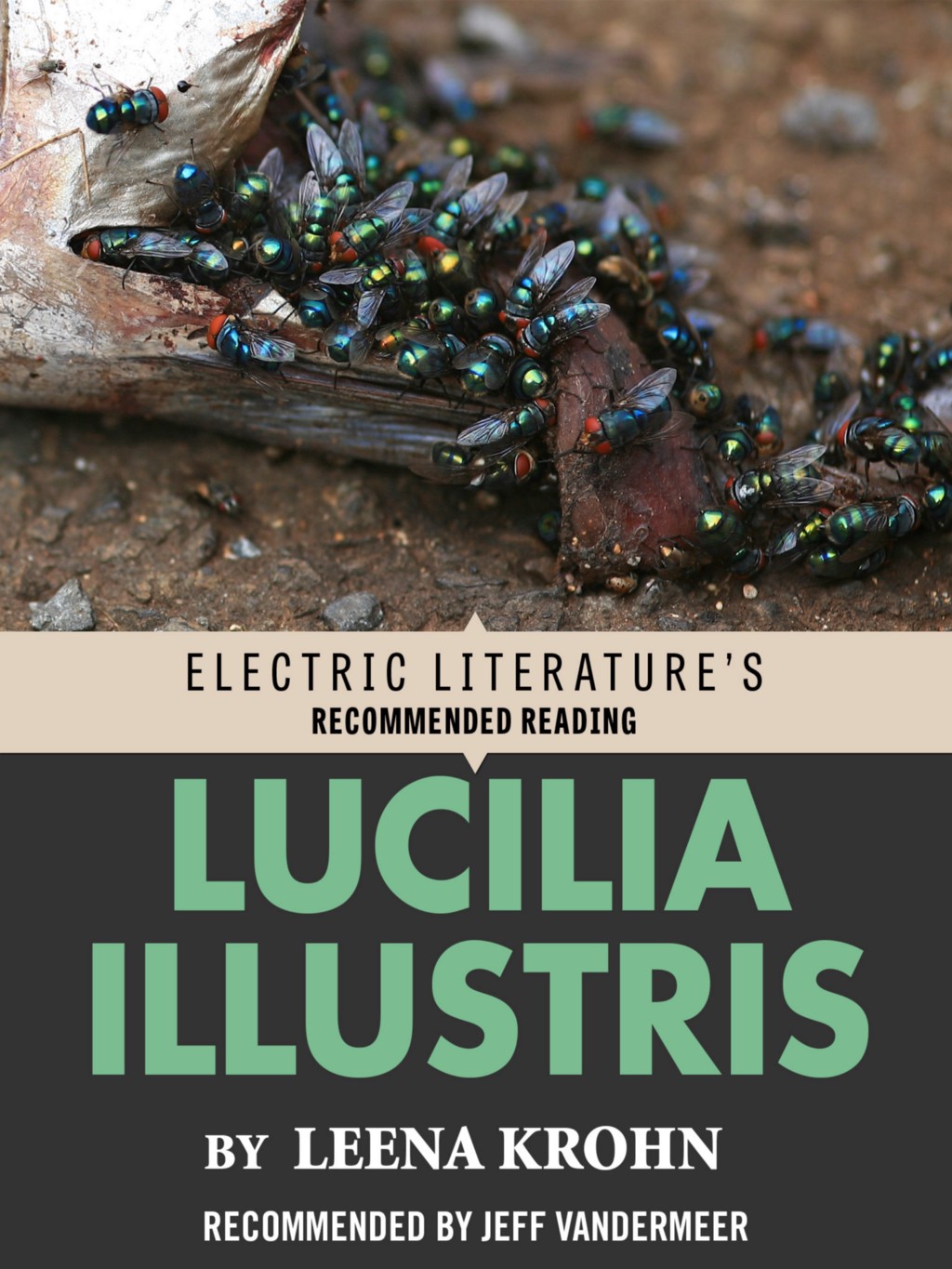
Lucilia Illustris

by Leena Khron

Translated by Viivi Hyvönen
Do you remember, my love, the object we saw, on that temperate summer morn:

-Charles Baudelaire
The unused sidetrack led to an overgrown yard of a derelict factory. This was the Ultima Thule of the city, the kind of neighborhood people moved into only if they had no alternative. It had housing projects, a supermarket, a primary school, two kiosks, a bus terminus, some paint factories and National Railways’ storage areas.

The last thing to have been manufactured in the low factory halls were Christmas ornaments, and if you bothered to look in through one of the broken windows you could still see a length of silver tinsel glimmering on the dusty floor.

I know this, because I looked in — because I saw that forgotten glimmer.

Behind the barracks that had served as a canteen, the yard sloped down steeply and soon crumbled into a sandpit.

The neighborhood residents used the sandpit as an unauthorized dump. All the usual junk had been thrown in: fridges, tires and hubcaps, defective office equipment, corroded oil containers, and leaky canisters, the contents of which were best forgotten. There were parts of things so far removed from their original form that it was no longer possible to guess their function. A living room suite in plush was covered in stains not only of mold but also of wine and sperm spilled at some party, decades ago.

In summer, mayweed and willowherb and mugwort seemed to do all they could to hide the things discarded by people, but it was not enough by far.

And it was summer. One of the armchairs of the suite had been placed on the rusty tracks. It looked as if it had been brought there for a performance, a bluff, a cheap jest. As if the onlooker was supposed to think of it as a private vehicle that might, at any moment, speed away southward, to where the old sidetrack met with the main line, and still onward, all the way to the railway station in the city.

Behind the armchair, between a burned Datsun and a Strömberg electrical stove, there was something else. Admittedly it was peculiar that it had lain unobserved for so long. Now it was the center of all our attention.

A cotton blanket, which had once been yellow and flower patterned, was wrapped around it tightly and bound repeatedly with plastic cord. The blanket was already partially decomposed, it had been soaked both in rain and in the fluids secreted by its contents.

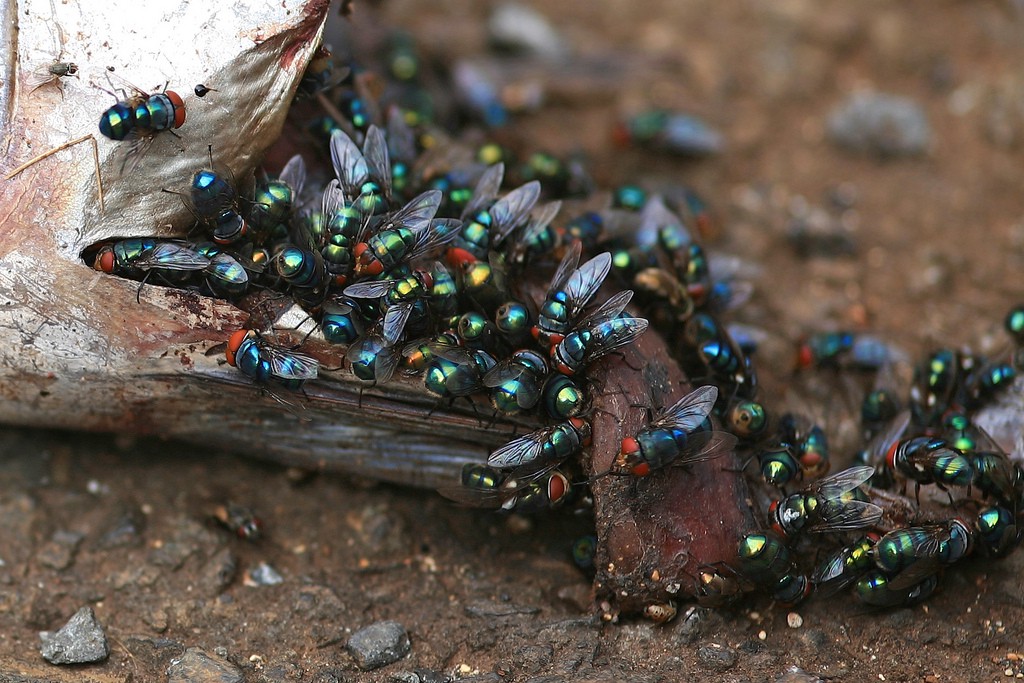
Not even the highest of fevers in a living being can rise as high as the heat of decomposition. Its furnace had consumed not only its very source but also the blanket covering it. The colors had faded and merged, the patterns could barely be guessed at, only fuzzy blotches remained. But the havoc was not wreaked by bacterial activity alone. Insects, too, flies and their larvae, beetles and many other species, had participated in the destruction.

Summer was at its peak, the morning so early that the city had not yet woken. A bird I didn’t know chirped on the bank of the sandpit in an elder shrub, its berries already reddening. Some sand slid down as if under someone’s steps. I looked up, but there was no one. The sand shifted by itself.

The shutter of a camera clicked repeatedly. The photographer performed a complicated choreography around his subject, crouching down, shooting a short hand-held series, setting up his pedestal in a new spot, and shooting again.

The rest of us — the inspector and I, and the two patrolmen, who had been alerted to the scene by an anonymous phone call — looked at the bundle in silence, without an objective, until one of the patrolmen retched. At that moment, as if in mutual agreement, all the men moved, almost started, back, away from the source of the stench.

I could not. I was already pulling on rubber gloves. On the contrary, I had to step closer and bend down over the roll. I had to do my due. Despite having felt weary as soon as I saw the bundle. It meant weeks of toil.

– A fucked up job, one of the patrolmen said in a thick voice.

I glanced at him coldly and opened my tool bag to choose the right pincers.

Although I would gladly have sat down in the worn armchair, where someone had read quietly on winter nights long gone by. I would have sought the hidden switch to make it shoot forward, dug my head deep into the headrest, and sped away from the officials and the unknown cadaver, as far as the tracks went.

But soon I forgot the armchair and was captivated by the wrapped up world, which emitted a buzzing tune. I didn’t open the package yet. It wasn’t time to open it yet. The others were already too far, they didn’t hear the tune, and had they heard it, it would have driven them even further. I have never been able to close my ears from it. It was the sound of decomposition, which is the sound of life in death.

Once a man, a poet of sorts himself and my lover at the time, read the poem “A Carcass” by Charles Baudelaire aloud to me while drunk with whisky. I had not heard of it before.

– It’s for you, he said, — remember it always.

I will. I can estimate that the corpse that the narrator of the poem and his lover saw at a bend in the path, on a bed sown with gravel, had lain dead for no more than a few days. It had reached the second stage of putrefaction, was soon to reach the third, for it reeked and the inner gases still distended it, but its skin was already starting to tear: “opened her stench-swollen belly.”

I have also heard the sound Baudelaire writes about, “a curious music,” which resembles the wind, or a stream, or the rustle of grains. Its source is the movement of insects, the overlapping of sheets of insects, their swarming, digging, feeding, breeding, hatching, growing, and preying.

When I first heard its tune, my innards almost overturned. Now it doesn’t have this effect on me anymore.

I’m an entomologist. In my youth my studies took me to many countries. In one small town, the name of which I have forgotten, I had lunch in an untidy café. On the wall of the ladies’ room someone had written in a swift, sketchy hand: Time is nature’s way of preventing everything from happening at once.

To me it seemed odd that graffiti of such consequence was to be found in the restroom of such an inconsequential lunch bar. When I read those words it was as if they had been written just for me. I was unable to imagine the person who had written them. I only saw the hand that wrote.

I have kept both the poem and this sentence in mind all these years.

Timing — that is my task. The wall of the restroom told the truth: If time didn’t exist, everything would happen at once. There would be no separate cause and effect. There would be no infinite chains of causality. But now: things follow each other in a definite order so that the effect never comes before the cause. This applies not only to life but to dying and death, too.

You may want to ask: Why do you state the obvious? I answer you: Because in it lies the real secret.

As a side job I participate in forensic examinations. I am called whenever a body is found whose time of death needs to be narrowed down and who, usually, has died of unnatural causes. This occurs four or five times a year. I have to resist, overcome, or at least set aside my revulsion, my pity, my fear, and my grief. Yet it would be foolish to think that I’ve become free of them over the years. They remain, but I can act in spite of them.

I am summoned to the scene as soon as the body is discovered. I travel around the country carrying a bag with tens of small boxes. They’re for the insects. In them I collect all the insects I can find on the surface of the body and in its vicinity.

Only then is the body taken to the forensic department. There I resume my examination: I go, so to say, deeper than skin, I take samples, analyze insects, determine their species, and relative amounts, and stages of development. Of course, all the other routine tests that the pathologists consider necessary are also performed at the department. Only when I am finished and they are will the remains be handed over to the next of kin and the mortician.

Most of the victims are women or girls. Some are homeless men. Once I had to analyze an already mummified body of an infant.

In a sense my position is similar to that of the meteorologist. The further into the future the weathermen have to forecast, the less accurate their predictions become. It is like moving away from a radio station: the static increases until the transmission is lost altogether. This happens very quickly: even a month away is too far to predict. The countless different variables turn estimates into mere guesses.

I “predict” backwards and my task is the easier of the two: the timing of a single phenomenon, the death of a certain organism. Still, my observations are subject to the same laws. The longer the body has been left to lie, the less accurately can I state its time of death. If the body is found in four or even five days, my accuracy is within hours. If it is found after weeks, then we are speaking of days, if months, then weeks.

And there comes a time when I hold my peace.

I work neither for the prosecutor nor for the defense attorney. But my expertise can be used to prove both the guilt of the guilty and the innocence of the innocent. As an entomologist, though, I am not interested in matters of guilt and innocence.

All I want is to answer the question: When?

To the deceased I say: Tell me when you died so that they may know who killed you.

Some childish person once asked me: Don’t the victims come to haunt you?

Why in god’s name would they haunt me? I didn’t kill them. I don’t fear them. I may fear and despise the ones who have brought their bodies into the state in which I find them. But the victims I hardly even pity. They have felt blind terror and unbearable pain, but now it’s over. It’s truly over. No, they are no longer where I see them. They are not the ones to fret over whether their remains lie in a family grave under a block of granite behind a wrought-iron fence, or rot nameless among the trash of a landfill.

The victims don’t rise from their graves like the horror characters of B movies as seething, mottled shapes with beetles for eyes, their noses devoured into a single cavity, their skin — or what once was skin — shifting in slow waves to the pulse of an armada of maggots.

Those who have met a violent end do not differ from those who have died of so-called natural causes. All death is violence.

But if another person has brought about the end, the aftermath lasts longer. Sorrow cuts more excruciatingly, tears stay hot longer. And the burning furnace of fury. Its is a heat very different from the fumes of decomposition that cleanse, loosen, and, in the end, renew.

Decay is the prerequisite for all spring.

Still, nothing is more abhorred and recoiled from as decay when it concerns our own material: human flesh.

The different stages of decomposition vary depending on the temperature and the surroundings. I have to be well versed not only in taxonomy and the duration of the various stages of insect life, but also in the circumstances and conditions of each scene. As they say, a body cools after death. But before long, although the warmth of life has left the skin, the body’s inner temperature begins to rise. As I said: Not even the highest of fevers in a living being can be as high as this afterglow, the fire of rot.

And now begins life in death and after death, although — as it has been said — everything doesn’t happen at once. It should be understood that the insects come in waves, which follow one another in a predictable order. Although decomposition is a continuous process, to facilitate the investigation it is best divided into several stages.

In my investigations I follow the five-stage system of M. Lee Goff.

At the fresh stage, which lasts between a day and a week depending on the surroundings and the weather, the first wave arrives. How swift they are! How, in fact, do they know? I don’t have the expertise to answer. I doubt anyone has. Blowflies land in just ten minutes, before a human nose could detect even the faintest of odors. The process has begun. From then on the activity is incessant. Such thorough, meticulous and methodical purification is nowhere else to be found.

The first wave insects, which are mostly none other than blowflies, are sometimes called “the garbage men.” They assault and swiftly destroy the soft tissues. They are interested in all body orifices, the eyes, the ears, the nose, the mouth. As they toil, they make way to the ones that come after and prefer cartilage or dry skin.

The next phase of decomposition is the bloated stage, in which the temperature of the body rises and the inner gases cause it to swell. Still, flies and maggots are the prevailing species.

Only in the third phase of decomposition, the decay stage, does the body start to reek perceivably. The body wrapped inside the blanket is in this stage. Its skin tears and the gases are released. At this stage the maggots are at their most numerous both on the surface and on the inside of the carcass. Before long, though, they give way to an army of beetles. In this phase all flesh is consumed and only skin, cartilage, and bone remain.

During the first stages of decomposition, predatory insects emerge to prey on the aforementioned, and the parasites and the omnivores, who feed on both the cadaver and other insects, make their appearance.

There is one more group of insects that do not really have anything to do with the matter at hand: those who stray onto the carcass by coincidence, inadvertently, and gain nothing of it. You might think these insects have nothing to tell me. But this assumption is false. Sometimes I find insects that do not naturally occur at the scene.

What can I conclude from this? A fact that is of utmost interest to the police: that the body has been brought to the scene from somewhere else. All in all, there can be eight or nine separate waves of insects. At certain stages of decomposition several hundreds of different species of insect may be found on the body.

The process is unfaltering in its course, even though the duration of its stages varies from one case to the other. The lengths of these periods depend on the environmental circumstances, the temperature and its variations during the time. But the proliferation of insects, the maturation of eggs, the development of larvae into adult individuals also occurs according to the same laws. Note this: NATURE NEVER MISSES A STEP AND IT NEVER TURNS BACK. Never, nowhere. Or, to be more cautious, let us say: nowhere here, never in time.

And we can do nothing, absolutely nothing to make it miss a step any more than turn back. It is capable of neither. The most we can do is to regulate the circumstances so that the processes are slowed down or sped up.

A crop is not harvested in spring. A child turns into an adult only through puberty, and an insect only becomes an imago once it has passed through the pupal stage. No stage is missed and every stage occurs in a designated order. In the right and unwavering order. In the only possible order.

Upon this fact all my certainty and uncertainty is founded.

As the waves follow one another, the post-decay stage is soon reached when even skin and cartilage disappear. Only the durable parts remain, the ones that may keep for centuries, even millennia: bones and hair.

Then everything is finished. Liquids and gases have evaporated, the temperature has come down, the slime has dried, the stench has vanished. Everything is clear and irrevocable. Cold and dry, clean and brittle. We look at the remains calmly and without disgust.

The insects have left, and I, too, am long gone. Everything is finished. If something remains, it is invisible even as grief and the soul are invisible.

Sometimes they are unable to answer even who the deceased was while still alive. Such was the case with this woman. She had been left to lie where she was for three weeks in the middle of high summer. Thus the insects had labored for a long time, and I could give no more than a rough estimate.

The police went to a lot of trouble to identify her. But very little was learned. She had traveled to that part of town on the day she was killed, taking the last night bus. She had been alone, and if anyone had spoken to her, the bus driver hadn’t noticed. She was a foreigner, but from which country, no one knew. As far as I know, her identity was never verified.

Who was she? And what does it really mean? Officially it means a name, an address, a place and a time of birth, height, hair color, and distinctive features, if any. To be even more specific it also means the names of parents, occupation, and marital status. Once these facts have been established, we suppose to know who she was

We saw her brown hair, her size, her bare feet, the already torn skin under which seethed the living sheet of insects.

The cup was her body. The spirit had left it, making room for other forms of life. It was no longer alive, but it had life. Life that may seem despicable and disgusting to us but is nevertheless indispensable.

The rains and the fermentative secretions of the cadaver had soaked the bundle and stiffened it. But the person who had been violated was long gone.

Lucilia illustris. Necrophobus vespillo. Emus hirtus. Insects are not individuals. They are, so to say, statistical beings. They do not know what they do. They only know what they want, which is what they must do: feed, mate, breed, flee death as long as they possibly can. But in addition to this — no, in doing this — they perform a wonderful, essential function, the only true catharsis.

To purify. To equalize. To return. To unite. This is the goal, which the insects themselves know nothing of but which they show to whomever willing to see. For this universal unity they toil while trying to preserve and continue their own petty, statistical existence.

How tempting it would be to believe that human beings, just by being what they are, as wholly as possible, elaborate and faithful to themselves, would fulfill a more important task, of which they know as little as insects of human life.

I rarely have to deal with the victims’ families. Or with those who were suspected, or those who actually killed. What would I have to do with them? This dead woman was an exception.

– Are you aware that I’m suspected of her death?

Startled, I took my eye off the ocular of a microscope. A man I didn’t know stood at the door of my office, his gaze stern and demanding.

– What do you want, and who are you? I asked, rather harshly. His steps had been so soundless that I hadn’t noticed him until he spoke.

He told me his name and repeated his question. He was no bum. He dressed smartly and his phrasing was refined. I had heard his name mentioned in the investigation. He had been questioned, but there had been no arrest, and what I knew of the hearings anyone could read in the tabloids. Just that this man had been on the same bus with the victim and had gotten off at the same stop.

– My only concern is to determine the developmental stages of insects. I am not an officer of the law.

– But you do know?

This I admitted to, albeit reluctantly. — Why do you come to me? What does it matter if I’ve heard your name or not?

I fell silent and looked at him, expectant and somewhat suspicious. He was fairly young, tall, and blonde. Was this person trying to affect me and was the timing of the woman’s death of consequence to him?

He lowered his gaze and said glumly: — I was just asking.

– I ascertain the species and age of the insects. When I know them, I can give a rough estimate of the time of death.

I have no idea why I didn’t end the conversation, why I told this stranger about the requirements of my office.

– I work neither for the prosecutor nor for the defense attorney, I went on. — It’s for others to make the final conclusions. Flies don’t lie. Undoubtedly, other truths than theirs exist, but they are no concern of mine.

– What will happen to me?

– It depends on what you did.

– If everyone dies anyway, he said — and in manners that are all more or less cruel, why is it so horrifying that it should happen by someone else’s hand? Perhaps they are only put out of their misery, who knows.

– Is this a confession? I asked and stood up. The conversation had started to horrify me.

– Quite the opposite, he said quickly. — I didn’t do it.

– But why do you come here to philosophize? I said, suddenly angry. I felt myself stiffen and blush. — You speak rubbish and you know it. If you have anything real to impart on this subject, go to the police.

– How do you know the murderer didn’t do her a favor?

– Do you still go on? Men love their yoke, I told him. — Hasn’t it been said that evil must come, but woe to him by whose hand it does? Go to the police.

– Now you think I’m guilty, admit it. I didn’t even know her. I didn’t speak a word to her.

– So what? Not all murderers know their victims. You must have something to relate about this matter, or you wouldn’t have come. But I am not police, surely you understand that.

– Are you going to tell them about this conversation?

– I don’t need to, I said. — You will tell them all they need to know.

Why was I so sure? He glanced at me and was about to say something more, but changed his mind for some reason.

– Well? I have work to do, as you can see, I said and gestured at my desk.

He turned and left the office without saying goodbye.

As a matter of fact I think there is nothing but life. Many forms of life. It is called birth, growth, and death.

People who have looked upon their deceased sometimes say: “Then I saw that there is no resurrection. That there can be none. Nothing as lifeless as that can ever have been alive.”

You might think that someone who has seen death in all its — not nakedness, but in its wealth, diversity, activity, intensity — would see things in the same way. That someone like that, if anyone, would be predestined to the most severe form of materialism.

The idea of resurrection is foreign to me, too. But always when I witness the absoluteness of the change that occurs in death, and its irrevocable consequences, I cannot help but wonder. As anyone would, I keep repeating the question: What happened to the life that was here just a moment ago? Where is the self that only yesterday aspired, desired, loved and remembered?

How could one, who has seen what I have seen, so closely, not believe in perpetuity? For if it exists in matter, how could it not exist in spirit?

The spirit is like the queen of an anthill. No one sees it, for it lives in the most hidden cave. Yet its effect is what keeps the body healthy, whole, intact. It moves the body. It alone makes the nest alive. When the queen is removed, the nest disintegrates with unbelievable rapidity. Soon it is only dust.

Yet the queen itself may remain inviolate.

I saw the man who had come to my room one more time. I saw him outside a movie theater, with a party of friends engaged in lively conversation, and I recognized him at once. He wore the same clothes as when last we met.

He said something to a woman, who glanced at me with curiosity and then turned away. He came to me.

– Yes? I said.

– You still do what you used to?

– Still. That is my office, you see, I said.

– I hear the incident last summer was never solved, he said. — A pity.

– Yes, I said. — It’s a pity.

He hesitated and glanced at his companions, who had fallen silent and seemed to be waiting for him. Then he said: — I just wanted to apologize for intruding into your office so rudely back then. But the hearings had put me slightly off balance. It is not every day one is suspected of murder.

– Most certainly not, I said. — But I never did understand why you came.

– It was just a whim. Coincidence, really, he said. — Someone mentioned your name, and what you do. I was intrigued.

– Really? Is your opinion still the same?

– About what? he asked.

– You philosophized about the justification of killing.

– Is that what I said?

Now he seemed to panic a little. Maybe he regretted coming to me.

– I was a little drunk. Please forget about it.

I looked at him and considered whether I should have reported the conversation to the police after all.

– I hate to think that her killer is still on the loose, he said.

His name was called. The movie was about to begin. He nodded, joined his party, and disappeared into the lobby of the theater. At the door I saw him turn back and look at me, as though expecting or even inviting me to follow him. As if he was slightly disappointed that I didn’t.

I can picture the past, translucent form of your hands, their slenderness instead of this current shape. Only dry, blackened tatters of skin that don’t even cover your finger bones.

Who knows whether you were killed by a man you once loved, whom you trusted more deeply than anyone on earth. Or did that blonde stranger follow you from the bus stop, did he grab you and throw you down, hit you, hit you, over and over again, kick you, rape you and finally strangle you.

– You lived, I said in my mind to this eaten, emptied shape. — You lived like I live now. Where did you go now that you are no longer there? Where will I go when I’m no longer here?

Her hair still had vigor, it shone amid the twigs and the dry hay, even though her skin was already torn, even though her face had bloated and blackened beyond recognition.

But still I see a look on the face. That look — I have seen the same look on the faces of other dead, at the first or second stage of decomposition. How can it be described?

It is a seriousness devoid of all moral judgment. No hatred, no fear, no pain. Concentration, that is the right word. Such complete concentration can only be seen in the eyes of very small children or, sometimes, at a moment of ecstasy, in someone listening to music. Something that is left as proof of what is and what may persist. As if something crucial had been revealed to them.

It is the look of knowledge. The mouth half open. And the eyes, most of all — they are open. The vitreous humor is of course less clear than that of a living person. The eyes never blink and the mouth will not tell what they have seen. Still they keep the knowledge that no longer seeks or needs to be expressed. It will stay to trouble the onlooker as an inextinguishable question.

I would like to know what she looked at. Not at her murderer any more. What happened to her no longer interested her. It had already happened, was over at last. The worst had happened. All had happened that could happen to her on Earth.

What were her eyes in fact fixed on at that final moment, when all her muscles slackened from their frantic convulsion? On a branch of a tree, at the edge of the pit, that kept swaying gently, incessantly even as the hands closed around her throat? The wind, forever roaming the Earth, brushed the tops of the bushes as well as both their foreheads. “Still, the moor-wind remains…”

Where she was dumped and hidden, whence she was carried, the first snow now falls. The rusty tracks, the car tires, the oil containers will soon be covered under the humble forms of the snowdrifts. The armchair on the tracks will get a luminous cushion. How unresisting and at the same time irresistible is the on-going snowfall. The meadow fescues, which yellowed and flattened under her ravaged corpse, are coated in snowflakes. When they rise again in the spring, no trace of the shape of her body will be visible.

Queen, where did you go?

The 10 Best British Novels (According to the Rest of the World)

Often you need a little distance to objectively judge something. So to pick the best British books of all time, BBC culture surveyed 82 book critics from outside of the UK. Each critic was asked to pick the 10 best British novels from any time period. The top 10 most voted books include three novels by Charles Dickens and two novels by Virginia Woolf, among classics by the Brontës, Mary Shelley, and George Eliot. Here is the top 10:

1. Middlemarch by George Eliot (1874)

2. To the Lighthouse by Virginia Woolf (1927)

3. Mrs Dalloway by Virginia Woolf (1925)

4. Great Expectations by Charles Dickens (1861)

5. Jane Eyre by Charlotte Brontë (1847)

6. Bleak House by Charles Dickens (1853)

7. Wuthering Heights by Emily Brontë (1847)

8. David Copperfield by Charles Dickens (1850)

9. Frankenstein by Mary Shelley (1818)

10. Vanity Fair by William Makepeace Thackeray (1848)

Middlemarch apparently won “by a landslide” and the top 10 features a majority of women writers. You can check out the entire top 100 here. Anything you think the critics missed?

Shifting Selves: Holding Two Flags

Just outside, a cherry tree bloomed in the schoolyard; bright red cherries ripened then burst in the sun, some rotted on weighted limbs before their time. “Janet Jackson?” my friend Antoinette asked as she began to chew on her beef patty and coco bread. A crosshatch of shadows folded and unfolded on her smooth, brown face, creating seemingly permanent creases. We were sitting cross-legged on the veranda of the science block where we often spent our lunch hour. These were some of the sweetest moments of our lives in sixth form: gossiping, studying for A-Levels, or complaining about our new responsibilities as prefects — an expectation that neither of us felt qualified for since it involved policing students in the lower school. At sixteen, we were girls expected to parade with the posture and attitudes of grown women, little headmistresses in training, our features shocked into scowls. We were to admonish the younger girls for things like wearing no slips under their uniforms, not having their white socks folded just above the ankles, or having anything other than the standard black clips in their hair and polished black shoes on their feet. It was this reprimanding expression that my friend gave me, Janet Jackson’s new 1997 album, The Velvet Rope, between us. It rendered me speechless, made me bite my tongue and suck on the salty, metallic taste of my blood.

“Ah weh yuh ah tell me seh, Nicole?” Her hand was suspended, the food halfway to her mouth. The fact that she said this in Patois — a language forbidden by our uptown school — made her disbelief and looming disapproval even more apparent. In her dark eyes I saw the conditions of our friendship burning like the heat that pricked our skin, dwindling with my growing silence as she awaited my response. The surrounding red hibiscuses bent toward us like listening ears as though they knew what was at stake. In that one minute that I debated whether to come out to my friend or not, I knew the risks. I remember the feel of the uniform material that day — a double-breasted gray button-up blouse and burgundy pencil skirt that fell just below the knees — stiff with all the starch from ironing. How proud I was to wear it. Until then, when I felt reproached by it. I was already an outcast at the school, being one of the few dark-skinned girls from a working class family amidst my mostly lighter complexioned upper-middle class peers in the conservative, elite all-girls high school in Kingston. Anything that would further separate me would be social suicide. Worse, to admit what I was was to betray what I had been taught it means to be Jamaican. Of course I could have retracted and explained to Antoinette that my crush on Janet Jackson might have been pure admiration — she was a beautiful woman, more beautiful than any woman we had ever seen who dared to wear a red, curly afro, her skin the same as ours. And when she sang in that sweet, wispy voice it sounded confessional and strangely forbidden. Yet, I could not say anything at all. I swallowed my spit and blood and truth.

Like other young Jamaicans, guilty of skidding outside well-drawn lines, I waited eagerly for any hint of the Holy Spirit to redeem me.

My secret sifted like ash, dulling my days and my spirit. Because in hushed voices I used to hear the stories carried in urgent winds over our heads as children about the funny people; felt the silent tug of my parents when they thought we were near one of them; was told to be vigilant since they liked to touch little children. I began to associate funny with a foul stench that needed to be eradicated — the way they incited people’s faces to twist. So when I heard of the deaths and witnessed the apathy in the form of “Dem batty boy an’ sodomite deserve it,” I joined a church and a Christian dance troupe, hoping to ease my depression. Under the heat of God’s imagined scrutiny I stumbled into an identity that wasn’t my own. Like other young Jamaicans, guilty of skidding outside well-drawn lines, I waited eagerly for any hint of the Holy Spirit to redeem me. I looked for ways to muster hope, the way a prisoner might, reaching for something from the outside to assure me that there was a world beyond the cage. I looked to an imagined future in which I could acknowledge the self I knew intimately.

I looked to America.

In 1999 I boarded a plane to the United States with a one-way ticket. I had acquired US citizenship via my father, who was here before me, so it was relatively simple to settle in my new home. I came out as a lesbian as soon as I enrolled in college at Cornell University. Coming out was like slowly exhaling after holding my breath for an eternity. I still felt the need to be cautious. It was a struggle, given the internalized homophobia I’d acquired as a result of being raised in a country that deemed my feelings unnatural. Though I became more comfortable with this new setting, which was independent of cultural restrictions, I found myself hindered by fear, stuck like a stunned mouse who had just narrowly escaped a trap. It took some time for that fear to thaw and for me to foster relationships with women without guilt attached. For a while, I was oblivious to the other mammoth of a social construct that would push me toward the margins: race. However, what I quickly learned was that there was a performance of blackness on campus that silenced many of the other LGBT students of color. I existed in a schizophrenic realm.

Audre Lorde, in her collection Sister Outsider, describes this experience, stating, “I usually find myself a part of some group defined as other, deviant, inferior, or just plain wrong.” In white circles I could — mostly — be my lesbian self (complete acceptance remained elusive, despite the university’s purported liberal, rainbow-colored umbrella). Meanwhile in black circles, my sexuality was muted. Had to be muted. In American blackness I became aware of a deeper struggle, a history uprooted and made manifest in confederate flags still flown high. Once again, I found myself having to choose.

It wasn’t a coincidence that the books I read during those days had characters that were also trying to reconcile parts of their identities with their current situation or place in society. Toni Morrison’s Sula, Paule Marshall’s Brown Girl Brownstone, Shay Youngblood’s Black Girl in Paris, and Rebecca Walker’s Black, White and Jewish — her memoir — were just a few stories in which I saw myself. Though my pre-writer self did not have the right words for what I was going through, I pinpointed similar struggles with identity and gained strength to free myself, knowing that I was not alone. Sula, for example, was extremely unapologetic. As a black woman living in the early twentieth century, she stood firmly in her own contradictions and her refusal to conform to societal expectations of her as a woman, specifically as a black woman. Moreover, I realized later — within the last year — that existing on the margins is what informs my work as a writer, because from those lines I am able to observe and write truthfully. Perhaps I was never meant to belong, but to question, to challenge societal norms.

Perhaps I was never meant to belong, but to question, to challenge societal norms.

But before all this — before I landed in America, before I learned to be cautious in a country that would scrutinize my blackness, before I began marching in Pride parades, and later, holding placards that read “Black women’s lives matter too.” Before all that, I was in an airplane, journeying across the ocean, above clouds, suspended between selves.

Seventeen years after I arrived in the United States, the US Supreme Court ruled that same-sex marriage is a human right in every state in the United States. I was elated. But, quietly, a feeling of melancholy crouched in the corners of the cozy Washington cottage where I happened to be at the time when the news broke. Even as an out, married lesbian, this victory is bitter-sweet. I can’t help but look to the LGBT community in the country I left behind — a country I abandoned, blinded by a need to escape — who cannot celebrate this way. Because my marriage to my wife made history when we decided to have our fairytale wedding ceremony in Jamaica, we inadvertently became the face of Jamaican LGBT Pride. Though there was a recent Pride celebration held in Kingston — the first — they still have no rights or protection. So on that momentous day of the Supreme Court’s ruling, messages poured in from gay and lesbian Jamaicans, congratulating us once again on the victory — a victory they watched from afar even as so many hide at home with hope like tiny gems inside their pockets, their bodies crouched in postures of love behind closed doors.

“Celebrate for them!” My African-American wife and friends said as their own battered identities ambled outside margins. “Carry the Jamaican flag along with the rainbow one!”

In American I can live freely as an out, married lesbian, but not as black. In Jamaica, I can be black — conditionally — but not gay (unless, of course, I’m in the right class — a social construct as antiquated and traumatizing as the buggery law, which is still at large, looming like the old, officious stench of colonialism). A proud lesbian and a proud Jamaican. So simple, I think, to hold two flags in two different hands.

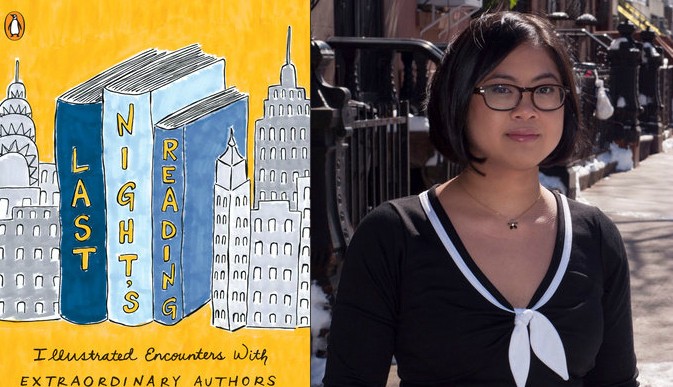
Catching The Beautiful Moments: An Interview With Kate Gavino, Author Of Last Night’s Reading

If you’ve recently been to a reading in New York, you’ve probably been in the same room as Kate Gavino; there’s scarcely a bookish event she hasn’t attended. Gavino is the pen behind the notable tumblr Last Night’s Reading, which is packed with portraits of literature’s most quotable. She’s chronicled authors from every corner of the literary world: Eileen Myles, Valeria Luiselli, Adam Johnson, Daniel José Older — you have a favorite writer, and he or she is likely immortalized in Gavino’s distinctive marker next to a brilliant soundbite.

Sit down with Gavino like I did in a Park Slope coffee shop, and she’s quick to tell you that she’s the stereotypically quiet literary type — more of an observer than anything. That Gavino is a seasoned onlooker, however, is why we’re so lucky to have her silently sketching, chronicling among the seats — she always seems to catch the most poignant moments that sometimes pass by the rest of us. Gavino discussed with me her new book, naturally titled Last Night’s Reading (Penguin Books 2015), a topography-in-quotes of New York’s literary scene over the last few years.

Meredith Turits: I don’t know the story behind Last Night’s Reading — how did you come to start drawing your first portrait?

Kate Gavino: I started out going to readings because they were free, and I loved spending time in bookstores. I’ve always been a doodler, too, so while I was at them, I’d always have a notebook to take notes — but I’d just be doodling. Doodling helps me focus.

I was at a Junot Díaz reading in 2013 and he’s already such a quotable person, but that reading just had so many quotable moments. The quote that really stuck out to me was the one that I eventually used as my first post, which was about the importance of bearing witness to what you see. I’m a pretty quiet person, and I’m always observing, and he talked about the importance of telling people what you’ve seen — it sounds pretty simple, but it can be a lot more important when it’s put in the right context. That spoke to me, because I’m always observing.

I starting posting drawings of the authors, which is what I was doodling while I was at the readings anyway, and it kind of snowballed from there. It seemed to get a good response, so it’s thanks to Junot Díaz in the end!

MT: How did you build your audience on tumblr?

KG: Rachel Fershleiser built such an amazing literary community there, and [they] seemed to immediately embrace it. It also helped that a lot of the authors I draw embraced it, too. They seemed really happy to be drawn! I’m always really worried I’ll draw their nose wrong or something, but I haven’t gotten that response yet.

MT: When you are sitting at a reading, does one quote pop out to you, or do you scribble several down? Do you visualize a line?

KG: I usually scribble a couple of lines down. Sometimes, I’ll record an event. I usually don’t go listen to it unless I’m stumped for a quote, which isn’t necessarily a bad thing — sometimes I’ll find really good quotes that were buried in a long paragraph. For the most part, I usually know what quote I’m going to use right when I hear it. With authors like Junot Díaz, I’ll have pages and pages of things scribbled down — it’s nice to be able to have a lot of choices at the end of the night!

MT: Has the way you attend readings changed, now that you’re something of an archivist, rather than just a spectator?

You really notice the same type of people who go to book readings, and a weird, unspoken etiquette you have to follow.

KG: I don’t think it’s changed too much, and that’s something I really like because it means I can still enjoy going to three or four readings each week — it never feels like work. While I’m there, there are so many other things going on, which is something else I wanted to include in the book. You really notice the same type of people who go to book readings, and a weird, unspoken etiquette you have to follow. I really like having a routine, so the fact that book readings are very unique but at the same time very similar — I like that. It’s probably a good thing that I don’t feel like I’m doing work when I go to them.

MT: There is, of course, some criticism regarding the fact that literary scenes, especially in New York, can be very clique-y. What’s your relationship to the New York literary scene and readings in general?

There’s certainly the “literary fiction” crowd, and they all follow each other on Twitter, but they don’t represent all of the readers in New York. I can’t really see myself as part of just one crowd.

KG: I can understand that criticism, but I mostly just see myself as a reader, and I go to readings because I like that author or that book. I read pretty widely — I’ve been to Comic Con or romance novel readings or fantasy novel readings, and I like seeing all of those mini-subcultures. Sci-Fi fans are totally different than YA fans, so when I see it that way, I don’t really see one “scene.” There’s certainly the “literary fiction” crowd, and they all follow each other on Twitter, but they don’t represent all of the readers in New York. I can’t really see myself as part of just one crowd.

MT: With your foot in so many literary worlds, how do you choose which events you go to and whom you’re going to document?

KG: It’s all based on authors and books I love. Sometimes I will see an author whose books I haven’t read, but who I think is interesting. I haven’t really read a lot of Salman Rushdie, but I’ve seen him three times because I think he’s really interesting, even though I might not always agree with him. There are definitely authors who are really entertaining, who I might see multiple times, because they talk about their work in a funny or interesting way. Sometimes, I’ll pick a reading because I love the bookstore or the particular location, too.

MT: There’s the perpetual question that hangs over literature: Is a reading the best way for an author to present his or her work? I wonder what you think of the answer.

KG: It depends on the author. I’ve seen amazing authors have really boring readings where they’re not connecting with the audience at all or not interested in trying to, but there are other authors where it’s really the best way to reach their audience, because they love interacting with them. I’ve seen some authors, like Chuck Palahniuk, who really makes an effort to make his readings different than your standard format. He’ll have props, weird segues — things like that. That’s fun, too. I’ve been to a lot of really traditional readings — reading from your book then Q&A — but it was super-entertaining because the author puts a lot of thought into their answers and respects the audience’s questions.

I can understand that writers are stereotyped as an introverted group, and maybe they’re not that into crowds and stuff — I’m exactly the same way — but I think a lot of them do appreciate the fact that people are reading their books, and want to connect with them. Right now, readings are a good format for that.

MT: You’ve been to more readings than… well, maybe anyone in New York! You’ve seen a lot of writers. What stereotype of a writer do you think is deserved?

…I think it’s more important to focus on a love of reading, no matter what format.

KG: There are some writers that actively hate anything remotely new like social media that’ll help them promote their books. They think it’s tacky to start a Twitter account. They have a distain for anything new, like e-readers or e-books. They have a very romantic notion for loving books for the way they smell, and I think it’s more important to focus on a love of reading, no matter what format.

MT: Is there one stereotype that you’ve seen dispelled over an aggregation of readings?

KG: I see a lot of “chick lit” writers who brush up against that title who recently have embraced the stereotype because in the end, that is their desired audience. Those are the people who are going to pay money for their books. Those are the people who genuinely enjoy their books, and there’s nothing wrong with that. So, a lot of writers who get stereotyped for writing “trashy fiction” or “airport books” and some mystery authors, too, they don’t really care that some people look down on them because they’ve reached their audience of the people who genuinely love their books. I come from the literary fiction world, so I had that kind of snobbery at first, but when I saw those kinds of authors, I appreciated their work so much more.

MT: On that note, what do you think you appreciate more from about readings because you chronicle them the way you do?

Some of the best quotes I record are when the authors are just rambling a little bit, but they somehow say something beautiful…

KG: [The fact that authors can always] think of things to say off the cuff all the time, because I’m horrible at that. Some of the best quotes I record are when the authors are just rambling a little bit, but they somehow say something beautiful and that’s a talent that I don’t have — and something I really admire. That’s one of my favorite part of going to readings — catching moments like that.

MT: When you were putting together the book, did you have to choose between portraits you’d done, or is this a compendium of everything you’ve drawn?

KG: I got to choose my favorites, but I wanted to make sure that this was at least 50 percent new content. I doubled the number of readings I went to a week, which sounds really intense, but I ended up getting to see a lot of my favorite authors again. I would go to a reading and draw two portraits from that event, and use both in the book. I made the book in about nine months, and in that time I probably doubled my usual workload, because I was really adamant about having new content in the book.

MT: How long does it take you to do a portrait?

KG: Not very long. While I’m at the reading, I’ll do a bunch of sketches, and when I get home, that’s when I’ll do the final portrait. Usually on the subway ride home, I’ve already decided what quote I want to use. Usually it’ll take me 20 or 30 minutes.

MT: Do you reference photos or is it purely from memory?

KG: Only if I had a horrible seat! Usually, it’s just from my sketches.

MT: What do you hope that people will feel, think, or take away from your book when they flip through it?

KG: The most important thing I want people to do is appreciate bookstores more. The book is full of author portraits, but they wouldn’t be there if the bookstores didn’t have those readings. I love seeing my favorite authors, but what I love the most is spending every night in a bookstore. I really wanted the book to be a love letter to those stores. At this point, they feel like a second home to me.

Wally Lamb’s New Novel Is an App

by Melissa Ragsdale

Wally Lamb,#1 New York Times best-selling author of She’s Come Undone and I Know This Much Is True, is breaking into new digital territory by publishing his new book, I’ll Take You There, exclusively as an app. This will be the first original book app produced by the company Metabook.

Coming in Spring 2016, Lamb’s I’ll Take You There follows a film professor as he recounts the women who have had in impact on his life, using film as a lens for the feminine ideals and feminist realities. In addition to the written text of the novel, the app will feature an original soundtrack, a full cast audio drama narrating the story, and a documentary about Lamb, shot in the movie theater that inspired the novel.

This new type of publishing opens an exciting array of new possibilities for reader interaction. Founded last year by publisher and author Ken Siman, Metabook’s debut work was an app version of John Berendt’s Midnight in the Garden of Good and Evil. The app features a full cast audio recording (starring Laverne Cox), crime scene photographs, clips of interviews from Berendt’s research, commentary by Berendt, an interactive timeline paired with the story, and a 3-D panoramic view of the story’s setting.

What makes Lamb’s app especially unique is that the project is premiering before the publication of a hardcover or traditional e-book edition of I’ll Take You There. The app will only be available from the iTunes app store, meaning that only iOS devices will be able to run it. While this exclusivity has its disadvantages, the project is a huge marker in the digital publishing revolution.

“Welcome to the future of reading,” said Lamb in a press release. “Metabook blows past the boundaries of traditional publishing to create an exciting new reading adventure that’s interactive, multimedia, and visually stunning. Book consumption has never been such an all-encompassing experience, and I’m pleased to be penning an original novel for this innovative company.”

Life-in-progress: Submission by Michel Houellebecq

François, Michel Houellebecq’s narrator in his novel, Submission, is a middle-aged professor of literature at the Sorbonne III. His life is mostly devoid of meaningful human interaction, save for the students he sleeps with each year; his propensity for visiting YouPorn and prostitutes allows him his solitude while testing the strength of his libido. Houellebecq paints a picture of François’ mundane life: lecturing to disinterested students, microwaving TV dinners, and thinking constantly about the 19th century author Huysmans, François’ specialty and obsession. But François lives in the near-distant future, 2022, where France’s political system is in crisis. Following election tampering, France’s new Muslim party allies itself with the Socialists, and sweeps the presidential election. The result is France under religious law. Immediately, life changes drastically: women must be veiled, polygamy becomes legal, education is segregated by sex, and the Sorbonne is privatized. Jews flee to Israel. Non-Muslims — François included — lose their teaching positions. Houellebecq’s Submission is a work that defies characterization by one genre label, yet the author revels in exploring and exploiting fear.

Some have called Submission satire, others a dystopia. Is it a warning cry, a near-reality to be feared, or a conception of the darkest fears of the ignorant? The truth lies somewhere in between. Houellebecq himself — interviewed extensively following the novel’s now-infamous publication on the date of the Charlie Hebdo massacre — said in a September interview with The Guardian, “The role of a novel is to entertain readers, and fear is one of the most entertaining things there is.” Houellebecq’s work is emblematic — a re-spinning of — the fear-driven headlines that sell magazines and newspapers and keep TVs tuned to 24-hour news commentary. By distilling the traditionally hysterical language of news into the very plausible and mundane life of his narrator, Houellebecq forces his readers — of every ilk — to consider the effect of the stories we tell ourselves daily in 2015. Fear is a powerful seductress, and Houellebecq, with his description of a disconnected, academic life, understands that the most powerful way to explore something is to put it into the context of the ordinary.

Submission’s structure parallels its narrator’s obsession with Huysmans, the 19th century novelist who converted to Catholicism late in life, establishing the idea that there will be a conversion question for François. Houellebecq quotes En route in his invocation: “I am haunted by Catholicism,” Huysmans says, and thus is François haunted by Islam. Submission is rooted in just enough current history as to be plausible, though political events are secondary to the pedestrian detail and impotence of François’ life. He is surrounded by a cadre of academics and governmental workers, people that are happy to explain government, religion, and political change to him. Though some of these speeches border on overtly expository, they’re helpful in contextualizing the unrest in François’ world. François feels the changes of society, but only as inconveniences. “I was overcome by a feeling that everything would disappear,” he says at one point, yet when the stabilizing forces in his life — his girlfriend, or his job — do disappear, he carries on. “I was right where the Muslim candidate wanted me,” he says, “in a state of free-floating doubt. Not only did none of this sound scary, none of it sounded especially new.” François, who is not especially interested in history, who is not especially connected to any other people or any other immediate consequences of political upheaval, is Houellebecq’s analog for the unobservant masses. His life is not about anything particularly compelling, and yet he moves through change because it does not affect him enough. His life remains, both before and after the election, pretty much the same.

It is impossible, though, to discuss Submission without referencing its treatment of women. In her New York Times review, Rachel Donadio called Submission’s women “supine, in all senses of the word” — women in François’ life are subservient, unquestioning objects. “A woman is human,” he remarks, “obviously, but she represents a slightly different kind of humanity.” Whether Houellebecq’s (and François’) depiction of women as subservient is secondary, or central, to portraying François’ moral emptiness and disconnection is something readers will have to ask themselves. Several characters in the novel draw parallels to submissive relationships as exemplary of man’s relationship to God:

“‘It’s submission,’ Reidiger [François’ superior] murmured, ‘The shocking and simple idea, which had never been so forcefully expressed, that the summit of human happiness resides in absolute submission. I hate to discuss the idea with my fellow Muslims, who might consider it sacrilegious, but for me there’s a connection between woman’s submission to man […] and the Islamic idea of man’s submission to God.’”

Though the assertion of the male-female relationship as exemplary of man’s relationship to God is nothing new, taken in light of François’ dismissive and objectifying behavior — and ever-increasing penchant for using women — this is a more sinister argument. By the time this conversation occurs, late in the novel, François’ only use for women is in servitude to his basest needs. Houellebecq clearly means for us to consider how François uses women against the context of the new religious law — law which, consequently and without subtlety, subjugates women.

Houellebecq has said it’s not the content of Islam that concerns him, but the fear that surrounds it. Submission takes that fear and contextualizes it, and the fact that Houellebecq does this through the life of an unlikeable, disconnected, and misogynistic character makes it seem both ordinary and plausible. (Humans of every type are unlikeable, too.) Though Submission presents, at times, a dark view of humanity, and a skeptical view of established religion and government, Houellebecq’s provocative work asks important questions even as it offends. Submission is the kind of novel that spurs its reader to think critically. You should read this novel because it will disturb you.

Prayers to the Emptiness: Bright Scythe by Tomas Tranströmer

by Zack Hatfield

How does one review Tomas Tranströmer? Many have tried, and done well, yet his poems evade analysis in their sheer attempt, and triumph, at conducting a certain shift of emotion in their reader, both seismic and molecular. If that sounds contradictory, that’s because it is — Tranströmer’s work is full of paradox in its themes, imagery and form.

Do not arrive to the poetry of Tomas Tranströmer soliciting answers. That is not to say you will leave empty-handed, but that Tranströmer’s work strays from the absolute. He is, first and foremost, a chronicler of the interstice, his poetry a patient crowbar between the thresholds we inhabit: night and day, asleep and awake, living and dying. They require no context but life itself. Bright Scythe, a collection of his work newly translated from the Swedish by Patty Crane, is a literary panorama with work from 1954 to 2004, and deftly traces the poet’s quiet interrogation with life’s phenomena.

In 2011, Tranströmer was awarded the Nobel Prize, specifically “because, through his condensed, translucent images, he gives us fresh access to reality.” And so I approached Bright Scythe expecting a kind of mirror or kind of lake, reflecting perhaps the many endlessnesses of Scandinavia’s darkest winters. What I did not expect was how Tranströmer defined “reality,” and how he gives us “access” not through detailed truths, but through his ability to translate the somnambulance and total strangeness of life into a better understanding of what it means, simply, to be.

Tranströmer’s poems are written in free verse, their stanzas averaging little over an inch in width in the beginning years. The five decades of output we’re given in Bright Scythe gives us insight to how his poetry and outlook changed over time, but it seems that Tranströmer’s plangent subject matter — the seasons, memory, dreams, art and oblivion — never changed with his form. Though the centerpiece of Bright Scythe is his epic saga “Baltics,” his shorter works find more urgency, often trading enjambment for terser sentences that end with periods on each line.

The poet, who suffered a life-changing stroke in 1990 and died earlier this year, populates his poems with curious metaphors. Consider “April and Silence,” from The Sorrow Gondola (which was written in 1996 and is translated in its entirety here):

Spring lies forsaken.

The velvet-dark ditch

crawls by my side

without reflections.

The only thing that shines

are yellow flowers.

I am cradled in my shadow

like a fiddle

in its black case.

The only thing I want to say

glimmers out of reach

like the silver

at the pawnbroker’s.

The unexpectedness of these lines, the “shadow / like a fiddle / in its black case” and the pawnbroker’s silver, are representational of Tranströmer’s ability to meld imagery and convey truth through ambiguous and idiosyncratic comparison. In other poems a “moment darkens / and remains like an axe-scar on a trunk.” A “clear sky has leaned against the wall” and it is like “a prayer to the emptiness.” “Moths settle on the windowpane: / small pale telegrams from the world.” Dark pavilions “glow like TV screens.” This beautiful awkwardness abounds in the collection, rewarding patience with glitches in expectation.

Crane, whose work presents the original jagged Swedish on the opposite page of her translations, stays close to the source. She measures with finesse each syllable and simile much like the three Roberts that have approached the Swedish poet’s work before — Robert Haas, Robert Bly and Robin Robertson, though her balanced and less strictly literal approach is closest to Robertson’s. This decision to not completely remake Tranströmer’s poems, to preserve the poet’s distinct timbre, is admirable but also necessary; after reading a few interpretations of Tranströmer’s poems, one feels not that the translators’ work reads too much like translated work, but that Tranströmer’s verse itself reads as though translated from some distant text, a message given, perhaps, to only him, his prayer to the emptiness. Therein lies the stark sublimation. Interestingly, Crane was able to spend some time with Tranströmer and his wife in the poet’s later years, time that presumably imparted a more cultural and personal element than prior interpretations were able to achieve.

It is no coincidence that prayer is found frequently in his poems. Like his work, they too rely on a kind of contradiction — a secret confession. They may be prayers to emptiness, but, as this book insists, they must not go unanswered.