François, Michel Houellebecq’s narrator in his novel, Submission, is a middle-aged professor of literature at the Sorbonne III. His life is mostly devoid of meaningful human interaction, save for the students he sleeps with each year; his propensity for visiting YouPorn and prostitutes allows him his solitude while testing the strength of his libido. Houellebecq paints a picture of François’ mundane life: lecturing to disinterested students, microwaving TV dinners, and thinking constantly about the 19th century author Huysmans, François’ specialty and obsession. But François lives in the near-distant future, 2022, where France’s political system is in crisis. Following election tampering, France’s new Muslim party allies itself with the Socialists, and sweeps the presidential election. The result is France under religious law. Immediately, life changes drastically: women must be veiled, polygamy becomes legal, education is segregated by sex, and the Sorbonne is privatized. Jews flee to Israel. Non-Muslims — François included — lose their teaching positions. Houellebecq’s Submission is a work that defies characterization by one genre label, yet the author revels in exploring and exploiting fear.
Some have called Submission satire, others a dystopia. Is it a warning cry, a near-reality to be feared, or a conception of the darkest fears of the ignorant? The truth lies somewhere in between. Houellebecq himself — interviewed extensively following the novel’s now-infamous publication on the date of the Charlie Hebdo massacre — said in a September interview with The Guardian, “The role of a novel is to entertain readers, and fear is one of the most entertaining things there is.” Houellebecq’s work is emblematic — a re-spinning of — the fear-driven headlines that sell magazines and newspapers and keep TVs tuned to 24-hour news commentary. By distilling the traditionally hysterical language of news into the very plausible and mundane life of his narrator, Houellebecq forces his readers — of every ilk — to consider the effect of the stories we tell ourselves daily in 2015. Fear is a powerful seductress, and Houellebecq, with his description of a disconnected, academic life, understands that the most powerful way to explore something is to put it into the context of the ordinary.
Submission’s structure parallels its narrator’s obsession with Huysmans, the 19th century novelist who converted to Catholicism late in life, establishing the idea that there will be a conversion question for François. Houellebecq quotes En route in his invocation: “I am haunted by Catholicism,” Huysmans says, and thus is François haunted by Islam. Submission is rooted in just enough current history as to be plausible, though political events are secondary to the pedestrian detail and impotence of François’ life. He is surrounded by a cadre of academics and governmental workers, people that are happy to explain government, religion, and political change to him. Though some of these speeches border on overtly expository, they’re helpful in contextualizing the unrest in François’ world. François feels the changes of society, but only as inconveniences. “I was overcome by a feeling that everything would disappear,” he says at one point, yet when the stabilizing forces in his life — his girlfriend, or his job — do disappear, he carries on. “I was right where the Muslim candidate wanted me,” he says, “in a state of free-floating doubt. Not only did none of this sound scary, none of it sounded especially new.” François, who is not especially interested in history, who is not especially connected to any other people or any other immediate consequences of political upheaval, is Houellebecq’s analog for the unobservant masses. His life is not about anything particularly compelling, and yet he moves through change because it does not affect him enough. His life remains, both before and after the election, pretty much the same.
It is impossible, though, to discuss Submission without referencing its treatment of women. In her New York Times review, Rachel Donadio called Submission’s women “supine, in all senses of the word” — women in François’ life are subservient, unquestioning objects. “A woman is human,” he remarks, “obviously, but she represents a slightly different kind of humanity.” Whether Houellebecq’s (and François’) depiction of women as subservient is secondary, or central, to portraying François’ moral emptiness and disconnection is something readers will have to ask themselves. Several characters in the novel draw parallels to submissive relationships as exemplary of man’s relationship to God:
“‘It’s submission,’ Reidiger [François’ superior] murmured, ‘The shocking and simple idea, which had never been so forcefully expressed, that the summit of human happiness resides in absolute submission. I hate to discuss the idea with my fellow Muslims, who might consider it sacrilegious, but for me there’s a connection between woman’s submission to man […] and the Islamic idea of man’s submission to God.’”
Though the assertion of the male-female relationship as exemplary of man’s relationship to God is nothing new, taken in light of François’ dismissive and objectifying behavior — and ever-increasing penchant for using women — this is a more sinister argument. By the time this conversation occurs, late in the novel, François’ only use for women is in servitude to his basest needs. Houellebecq clearly means for us to consider how François uses women against the context of the new religious law — law which, consequently and without subtlety, subjugates women.
Houellebecq has said it’s not the content of Islam that concerns him, but the fear that surrounds it. Submission takes that fear and contextualizes it, and the fact that Houellebecq does this through the life of an unlikeable, disconnected, and misogynistic character makes it seem both ordinary and plausible. (Humans of every type are unlikeable, too.) Though Submission presents, at times, a dark view of humanity, and a skeptical view of established religion and government, Houellebecq’s provocative work asks important questions even as it offends. Submission is the kind of novel that spurs its reader to think critically. You should read this novel because it will disturb you.
How does one review Tomas Tranströmer? Many have tried, and done well, yet his poems evade analysis in their sheer attempt, and triumph, at conducting a certain shift of emotion in their reader, both seismic and molecular. If that sounds contradictory, that’s because it is — Tranströmer’s work is full of paradox in its themes, imagery and form.
Do not arrive to the poetry of Tomas Tranströmer soliciting answers. That is not to say you will leave empty-handed, but that Tranströmer’s work strays from the absolute. He is, first and foremost, a chronicler of the interstice, his poetry a patient crowbar between the thresholds we inhabit: night and day, asleep and awake, living and dying. They require no context but life itself. Bright Scythe, a collection of his work newly translated from the Swedish by Patty Crane, is a literary panorama with work from 1954 to 2004, and deftly traces the poet’s quiet interrogation with life’s phenomena.
In 2011, Tranströmer was awarded the Nobel Prize, specifically “because, through his condensed, translucent images, he gives us fresh access to reality.” And so I approached Bright Scythe expecting a kind of mirror or kind of lake, reflecting perhaps the many endlessnesses of Scandinavia’s darkest winters. What I did not expect was how Tranströmer defined “reality,” and how he gives us “access” not through detailed truths, but through his ability to translate the somnambulance and total strangeness of life into a better understanding of what it means, simply, to be.
Tranströmer’s poems are written in free verse, their stanzas averaging little over an inch in width in the beginning years. The five decades of output we’re given in Bright Scythe gives us insight to how his poetry and outlook changed over time, but it seems that Tranströmer’s plangent subject matter — the seasons, memory, dreams, art and oblivion — never changed with his form. Though the centerpiece of Bright Scythe is his epic saga “Baltics,” his shorter works find more urgency, often trading enjambment for terser sentences that end with periods on each line.
The poet, who suffered a life-changing stroke in 1990 and died earlier this year, populates his poems with curious metaphors. Consider “April and Silence,” from The Sorrow Gondola (which was written in 1996 and is translated in its entirety here):
Spring lies forsaken.
The velvet-dark ditch
crawls by my side
without reflections.
The only thing that shines
are yellow flowers.
I am cradled in my shadow
like a fiddle
in its black case.
The only thing I want to say
glimmers out of reach
like the silver
at the pawnbroker’s.
The unexpectedness of these lines, the “shadow / like a fiddle / in its black case” and the pawnbroker’s silver, are representational of Tranströmer’s ability to meld imagery and convey truth through ambiguous and idiosyncratic comparison. In other poems a “moment darkens / and remains like an axe-scar on a trunk.” A “clear sky has leaned against the wall” and it is like “a prayer to the emptiness.” “Moths settle on the windowpane: / small pale telegrams from the world.” Dark pavilions “glow like TV screens.” This beautiful awkwardness abounds in the collection, rewarding patience with glitches in expectation.
Crane, whose work presents the original jagged Swedish on the opposite page of her translations, stays close to the source. She measures with finesse each syllable and simile much like the three Roberts that have approached the Swedish poet’s work before — Robert Haas, Robert Bly and Robin Robertson, though her balanced and less strictly literal approach is closest to Robertson’s. This decision to not completely remake Tranströmer’s poems, to preserve the poet’s distinct timbre, is admirable but also necessary; after reading a few interpretations of Tranströmer’s poems, one feels not that the translators’ work reads too much like translated work, but that Tranströmer’s verse itself reads as though translated from some distant text, a message given, perhaps, to only him, his prayer to the emptiness. Therein lies the stark sublimation. Interestingly, Crane was able to spend some time with Tranströmer and his wife in the poet’s later years, time that presumably imparted a more cultural and personal element than prior interpretations were able to achieve.
It is no coincidence that prayer is found frequently in his poems. Like his work, they too rely on a kind of contradiction — a secret confession. They may be prayers to emptiness, but, as this book insists, they must not go unanswered.
“Who was in front of me in the truck?” Mohamedou Ould Slahi asks the other detainees, on their first morning in Guantánamo. “He kept moving, which made the guards beat me all the way from the airport to the camp.” The line, from Slahi’s Guantánamo Diary (Little Brown, 2015) reads like the finish to a grim and weary joke. To beat one detainee is a cruelty; to beat the wrong one is nonsense.
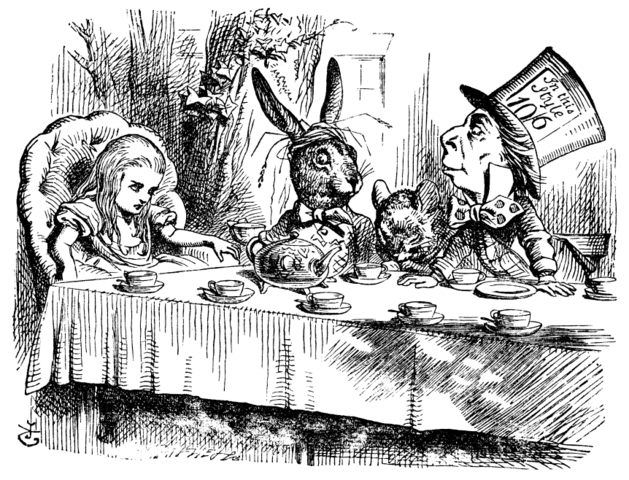
Guantánamo’s non-sense draws comparisons to Kafka and Orwell, but to me the touchstone is Lewis Carroll. Alice’s Adventures in Wonderland, which had its 150th anniversary on November 26, and Through the Looking Glass capture the ambitious inversions of Gitmo, where the iguanas that skitter out of the jungled camps enjoy more legal protection than the men inside. As a young attorney fresh to the ‘Guantánamo bar,’ I heard counsel for the Uighur detainees tell that one at a fundraiser: if your jeep hits an iguana, you risk a $10,000 fine under the Endangered Species Act on a road where the Constitution doesn’t apply.
No, that can’t be right at all, I thought. This was 2009 and I’d just joined the legal team representing one of the Tunisian detainees. I was prepared to confront all sorts of sinister systems, but not horsefeathers. Assume black is white and white black in that legal twilight zone — “every writer may adopt his own rule,” writes Charles Dodgson, the Oxford logician better known as Lewis Carroll, “provided it is consistent with itself and the accepted facts of Logic.”
Courts and lawyers take refuge in Carroll, whose nonsense books so profoundly champion logic. The Queen of Hearts’ famous theory of due process — “sentence first, verdict afterwards!” — has become a judicial shorthand for injustice, cited alongside Galileo’s heresy trial and the Salem witchcraft trials. In 2008, in one of the most important Gitmo precedents, a federal appeals court riffed on Carroll in rejecting the government’s theory that classified, second-hand evidence was reliable where it appeared in three different intelligence reports: “Lewis Carroll notwithstanding, the fact that the government has ‘said it thrice’ does not make an allegation true.”
Certainly, there is something satisfying in ridiculing Guantánamo. Slahi’s Diary, for one, shows a terrific eye for irony: the guards who torture him, but consider him their friend; the sign in the detainee interrogation room, “Honor bound to defend freedom”; the Mauritanian “Secret Police” who are more easily recognized than regular police forces. “The authorities,” says Slahi, “should think about a new nomenclature, something like ‘The Most Obvious Police.’” There is power in puncturing the War on Terror’s saturnine rhetoric as nonsense.
This is how those with no leverage — children against adults, prisoners against their wardens — resist arbitrary power through the force of principle.
But more important, I think, is Alice, and her simple insistence on logic in the face of absurdity: “Stuffand nonsense! The idea of having the sentence first!” she shouts at the Knave’s Trial. This is how those with no leverage — children against adults, prisoners against their wardens — resist arbitrary power through the force of principle. “Common sense dictates,” writes Slahi, “that after three years of interrogating me and depriving me of my liberty, the government at least owes me an explanation of why it’s doing so.” This is the shape of justice’s painfully long arc in Gitmo: in 2010, after eight years of detainees, lawyers, and courts insisting on basic rule of law and due process, Slahi would get his explanation. He is still detained.
What is it to read Alice, a century and a half after its creation, in the era of Guantánamo? For me, it is to understand ‘nonsense’ not as children’s fantasy but as a riptide in the human mind, which drags us further off course the more violent or conceited or certain we are. It is to articulate what is so wrongheaded in Gitmo — to acknowledge men serving thirteen years of sentence before any verdict, and to insist on simple principle in the face of sophisticated explications.
“Nonsense!” said Alice, very loudly and decidedly, and the Queen was silent.
***
“Please, your Majesty,” said the Knave, “I didn’t write it, and they can’t prove that I did: there’s no name signed at the end.”
“If you didn’t sign it,” said the King, “that only makes the matter worse. You must have meant some mischief, or else you’d have signed your name like an honest man.”
There was a general clapping of hands at this: it was the first really clever thing the King had said that day.
“That proves his guilt, of course,” said the Queen: “so, off with — ”
“It doesn’t prove anything of the sort!” said Alice. “Why, you don’t even know what they’re about!”
– Alice’s Adventures in Wonderland, Chapter XII
Guantánamo’s defenders assured us that anything unsavory that happened in the camp was justified; it kept us safe. In this sense, to leave high-value detainees untortured is negligence: it would mean leaving life-saving intelligence on the table and risking more deaths for the sake of fusspot scruples. Coming from a military family, I was more prepared than most to believe this. But in reading Slahi’s Guantánamo Diary, the only thing that shocked me more than the harsh details of his interrogation was its incompetence.
Slahi’s interrogations read like amateur hour. At one point, his American interrogators forge a letter from his brother, but get the brother’s name and address wrong, and misspell Slahi’s name. “What a jackass,” Slahi keeps thinking of his guards. They stand Slahi in a frigid room walled in photos of arsenals, fighter jets, and George W. Bush, while the National Anthem blasts: “We’re the greatest country in the free world,” the guard insists, “and we have the smartest president in the world.”
It’s just embarrassing. Next to the sinister expertise of the Jordanian secret police, we seem like dilettantes, like the King of Hearts trying gamely to parse meaning from nonsense verses. Here’s a gem from Slahi’s American interrogation:
“What do you mean by tea and sugar?”
“I mean tea and sugar.” I cannot tell you how many times the U.S. asked me, and made other people ask me, this question.
(Canadian intelligence had once intercepted a call in which Slahi discussed tea, and passed it on to the United States.)
“What the fuck do you mean, tea or sugar?”
“I just meant what I said, I was not talking in code.”
“Fuck you!”
Slahi supposes the Americans were so impressed with their Jordanian allies’ practice of torturing suspects, they started to try their hands at it, “though shyly.” But they were awful at it. The result of all their Jack Bauer playacting was intelligence of little to negative value, since they toldSlahi what to say. “We want you to give evidence linking _______ to the Millenium Plot,” his Gitmo handler explains, “Things like, he supports the Mujis or believes in Jihad are good, but not good enough to lock him up the rest of his life.” Predictably, this resulted in false accusations, then bungled prosecutions: whoever ________ was, he was released unconditionally in 2005.
And yet clumsiness is its own method of domination. There’s a reason stupidity is sometimes called invincible.
Stupidity like this breeds cynicism. At one point, the Mauritanian director of intelligence admits to Slahi he knows Slahi had nothing to do with 9/11, but is rendering him to Jordan anyway, at the U.S.’s request; when Slahi asks why Mauritania won’t protect its citizen from injustice, the director shrugs: “America is a country that is based on and living with injustice.” “Who cares for you?” Alice says to the Queen of Hearts: “You’re nothing but a pack of cards!”
And yet clumsiness is its own method of domination. There’s a reason stupidity is sometimes called invincible. “I wish you’d make a mistake, any mistake, so I can strike,” one guard says to Slahi while performing “corny fake martial arts” moves outside his cell. “You call me Master, OK?” Irrationality declares it is not confined by logic or even self-interest. The King of Hearts does not actually care about truth-finding, only about feeling clever and powerful. But this isn’t safety. How much time, resources, and credibility did we waste on pumping bad intel into and out of Slahi? Especially today, in the wake of deadly terrorist attacks in Paris and Beirut, it’s grotesque to pretend this is national security.
“When I use a word,” Humpty Dumpty said, in rather a scornful tone, “it means just what I choose it to mean — neither more nor less.”
“The question is,” said Alice, “whether you can make words mean so many different things.”
“The question is,” said Humpty Dumpty, “which is to be master — that’s all.”
– Through the Looking Glass, Chapter VI
Lewis Carroll’s riff on linguistic empiricism in Through the Looking Glass remains one of the most popular ways for judges to insult each other’s statutory interpretations as strained and self-serving. There’s mischief, we suspect, in semantic arguments: a way of talking our way out from under the truth. The War on Terror’s novel vocabulary has done little to convince us otherwise. Isn’t it obvious “unlawful combatant” was ginned up to sidestep the Geneva Conventions? What about that Bond-villain locution, “enhanced interrogation”?
Euphemizing this as “special” or “enhanced” interrogation is indeed “making a word do a lot of work,” as Humpty Dumpty puts it.
Call a spade a spade: Slahi’s “special interrogation plan” was torture. The interrogators beat him; sexually humiliated and assaulted him; shackled him in stress positions for hours; subjected him to months of sleep deprivation through 24-hour interrogations, blasting music, light strobes, and frigid temperatures; stood him in the cold room naked or soaked in ice water; forced him to drink saltwater; and staged a mock rendition that terrified even his interrogator. Euphemizing this as “special” or “enhanced” interrogation is indeed “making a word do a lot of work,” as Humpty Dumpty puts it.
But Carroll the logician agreed with his egghead: “any writer of a book is fully authorised in attaching any meaning he likes to any word or phrase he intends to use,” he stated in Symbolic Logic. Language is contingent; a word doesn’t have any necessary, definite meaning. “Torture” is defined one way in statute, another way in dictionaries. People disagree over whether water-boarding is torture and there is no empirical way for either side to win their argument.
In law school, I had the unnerving honor of debating John Yoo, author of the “torture memos,” on the definition of torture. He sat as a practice judge for our international law moot court team, an impossibly gracious gift of his time, considering the prompt that year was whether we should throw him in prison for crimes against humanity. The competition may as well have captioned its case Republic ofAdova v. Schmon Schmoo. I cited my treaties and precedents — there are a lot of them — to argue cold rooms and stress positions fit the Torture Convention’s standard for severe pain or suffering, and Professor Yoo countered with the question at the heart of the Bybee memo: where is the line? What is severe enough cold? 49 degrees? What about 53, or 55 degrees? Is four hours in a cold room torture? Three? Two?
My response was correct and unsatisfying: We can identify torture without deciding its precise boundaries. “I don’t know exactly where my nose ends and my forehead begins,” I said, “but I know my nose isn’t my forehead.” That even sounds like Alice — sensible, stubborn, stumped. Yoo was not impressed. I’m pretty sure he knows just where his forehead starts; he went to Yale.
The most egregious problem about Yoo’s torture memo is not necessarily its analysis, but its conception. The military interrogators wanted to know exactly how far they could push coercive physical and mental suffering, so they could go right up to that line. Yoo’s analysis attempted to cabin the word “torture,” to “master” it. “This is a case where people want the law to provide answers, to dictate with certainty what you are and are allowed to do,” Yoo told PBS Frontline in 2005. “The one thing I think we don’t want is for the government to be hamstrung […] because we have so much disagreement about what those phrases mean.” But courts can make the word mean so many different things. So can the media; so can the public. Semantics are democratic. There’s glory for you.
Isn’t that how we want it to be? Ambiguity here has a useful deterrent effect. I don’t particularly want to live in a country where people who beat and humiliate another human being don’t have to worry they might be committing torture. Maybe they feel what they do is necessary — maybe they know, like one of Slahi’s guards admitted, that they’re going to hell for what they’re doing. Whatever the case, they should be afraid of an unmastered word.
“Well, it’s no use your talking about waking him,” said Tweedledum, “when you’re only one of the things in his dream. You know very well you’re not real.”
“I am real!” said Alice, and began to cry.
“You won’t make yourself a bit realer by crying,” Tweedledee remarked: “there’s nothing to cry about.”
“If I wasn’t real,” Alice said — half-laughing through her tears, it all seemed so ridiculous — “I shouldn’t be able to cry.”
“I hope you don’t suppose those are real tears?” Tweedledum interrupted in a tone of great contempt.
– Through the Looking Glass, Chapter IV
Guantánamo housed the “worst of the worst,” supposedly.Slahi arrived in August 2002 and was early on treated as the camp’s No. 1 high-value detainee, accused of coordinating the 9/11 hijackers; at different times, the U.S. alleged he masterminded the Millenium Plot to bomb LAX airport and/or was a senior recruiter for Bin Laden. But by the time a federal court reviewed Slahi’s detention, in 2010, the U.S. alleged only he was “part of” al Qaeda, and lost. The D.C. Court of Appeals then loosened the standard for what being “part of” al Qaeda means, and the case remains pending.
Like Alice in the Red King’s dream, the Slahi in detention is a dreamed figure, a dark fantasy projected on to a body that was at hand.
Like Alice in the Red King’s dream, the Slahi in detention is a dreamed figure, a dark fantasy projected on to a body that was at hand. He is the terrorist mastermind, the shadow’s shadow, the shape of our post-9/11 fears and vulnerability. “Stop praying, Motherfucker,” a guard screams at Slahi, punching him in the mouth, “you’re killing people!” The nightmare Slahi is so powerful, his mere prayers are deadly.
The narrative arc of Guantánamo Diary — indeed, its very existence — is Slahi’s attempt to assert his own identity against his captors’ hallucinations: “I was eager to let my predator know I am, I am.” His diary, its carefully documented suffering, fear, and longing, is a desperate argument for his existence outside the government’s narrative. Like Alice says: “If I wasn’t real, I shouldn’t be able to cry.”
Perhaps sensing this, his interrogators’ persistent threat is to wipe him from their database and disappear him to “a hole where nobody knows about you.” (“You’d be nowhere,” Tweedledee tells Alice, if the Red King left off dreaming of her; “you’d go out — bang! — just like a candle.”) The goal of Slahi’s physical and psychological torture is to make him confess to the crimes that the U.S. has convinced itself he’s done. Until then, every protestation of innocence is his lack of cooperation, his demands for a trial are a cynical exploitation of our freedoms, and his suffering is cunning crocodile tears. At one point, the censors editing his diary literally redact his tears:
When he said that I couldn’t help breaking in ____. … Just one soothing word in this ocean of agony was enough to make me cry.
Of the Red King’s dream, Bertrand Russell wrote, “A very instructive discussion, from a philosophical point of view. But if it were not put humorously, we should find it too painful.”
It is painful to read Slahi’s words. It makes me feel like an asshole, because I had my own dream of him while working on Gitmo: He was the rat who mucked up his fellow detainees’ cases with false accusations, in exchange for a VCR, a PlayStation console, and a “gilded cage.” Now that I understand what he endured up to his breaking point, I can’t resent him. I don’t know who Slahi really is and I never will, but in his Diary I have an alternate figment, a man of simple principles, keen ironies, and strange lyricisms: “my street clothes had become so loose,” Slahi writes, “that I looked like a small cat in a big bag.” Dreams and dreaming haunt him. In one brutal recurring dream, his illusory family tries to persuade him his dream is reality, and the waking nightmare is finally over:
“Am I with you for real, or is it a mere dream?”
“No, you’re really at home!”
For thirteen years, Mohamedou Ould Slahi has lived within Guantánamo’s dream of him, while his Diary places Guantánamo in his own narrative — another dream, the U.S. would argue, with its own lies and misperceptions. Which dreamed it? Carroll asks us at the end of Through the Looking Glass, and, as with Slahi and his captors, we’ll never truly figure it out.
Nonsense has no resolution; absurdity is only the last step of the logical proof that demonstrates a rotten premise. I had to leave my own Gitmo case with no resolution, although happily, my guy was ultimately released. Slahi was not — he remains part of the one hundred and twelve trapped in that morbid American dream, charged with nothing but suspected of anything.
In a Wonderland they lie, Dreaming as the days go by, Dreaming as the summers die.
Hello, and welcome to my week-by-week review of the world. Today I am reviewing Tokyo.
This is part one of a multi-part review, after I mistook a cargo ship for one of those hip neighborhoods where everyone lives in shipping containers. I realized my mistake when I noticed all the guys had beards but none had any babies. It was too late to turn the ship around and I’m a weak swimmer, so I went to Japan instead of the supermarket.
Tokyo is enormous, so the best way to see it all is by hot air balloon. Unfortunately, that’s not allowed. No company offers such a service, and there isn’t even a cool new on-demand hot air balloon startup. I tried starting my own on-demand hot air balloon service but didn’t have the appropriate permits, or funding, or business plan. To be honest, my heart wasn’t really in it. I wasn’t hungry enough.
Having to remain on the ground turned out to be a blessing in disguise. I found all sorts of tiny alleys and little shops that I never could have seen from the sky, unless the hot air balloon also came with a set of binoculars.
One of my favorite spots was a restaurant called Whoopi Goldburger. It’s a little bit of false advertising because Whoopi Goldberg doesn’t work there. They don’t even have a photo of her anywhere. I ordered the Kevin Bacon Burger, which may or may not be made out of Kevin Bacon. I sort of hope so because I’ve always wanted to taste human flesh without being held accountable or having to dismember someone on my own. I’m scared to look up whether Kevin Bacon is still alive.
After this, I went to a coffee place called Bear Pond. The man and woman working there must have received some very upsetting news just before I entered, because they were incredibly rude to me. I’m sure they’re normally quite polite and friendly to customers. I apologized for upsetting them and decided to leave and never return. I wouldn’t want them to ever see my face again and have to associate it with whatever happened to them.
The rest of the people of Tokyo were so nice and polite! It was heavenly. Even the drunk businessman who tried to pull me out of a taxi did it very politely. A woman I held the door for insisted I go through first, despite the fact that she was bleeding severely and trying to get into the ER that I was leaving. It turns out I’m allergic to pig ovaries.
BEST FEATURE: Despite being such a large city, Tokyo is surprisingly warm and cozy. I felt so at home that it was a shock when immigration kicked me out. WORST FEATURE: Bear Pond Coffee. I felt like crying but I resisted because I think that’s what they wanted.
Please join me next week when I’ll be reviewing a monkey.
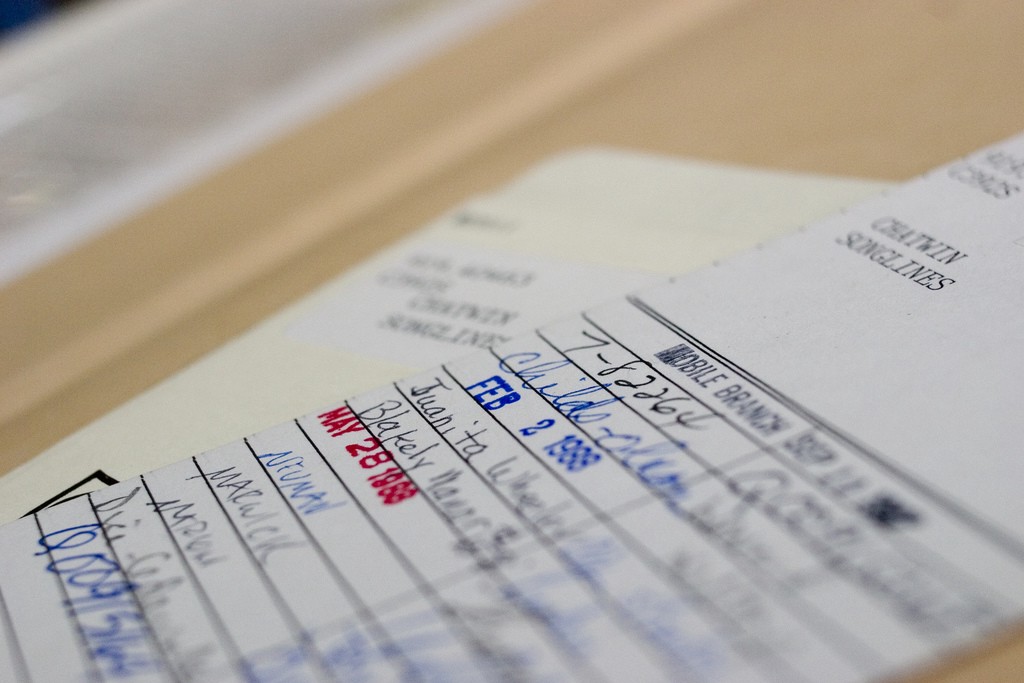
Last week, Japanese newspaper Kobe Shimbun published a photo of library borrowing records taken from the legendary author Haruki Murakami’s high school. The photos revealed that as a student Murakami had checked out books by French author Joseph Kessel. In response, the Japanese Library Association is up in arms, claiming in a report that revealing Murakami’s (or any person’s) records is an extreme violation of privacy.
But the editors at Kobe Shimbun stand by their choice, saying that because of his literary status, Murakami’s reading choices are of public interest. “Mr. Murakami is a person whose work and how he developed his literature is a subject for scholarly study,” commented Hideaki Ono, the paper’s assistant managing editor. “He is known to have profound knowledge of British and American literature. But [the cards] showed he also explored French literature in his younger days.”
The records themselves were found by a library volunteer, who discovered them in a stack of old books being discarded by Murakami’s alma mater. Murakami gave no consent to their publication, and as of now has made no comment on the matter.
Infused in this controversy is the idea of public ownership: Where do we draw the line between an author’s legacy and their humanity? In the digital age, with information increasingly accessible, it is an issue that bears incredible importance.
Donald Trump has a reputation for confusing and bewildering speeches. Humorist Hart Seely argues that this is what makes Trump so fascinating. And, apparently, what makes him a poet. Seely has dug through Trump’s speeches and statements going all the way back to the 1980’s to compile a book of almost 200 poems, all created out of direct quotes from Trump. Here’s a taste from “Freedom Tower”:
I.
Worst pile of crap Architecture I’ve ever seen.
II.
The terrorists win. It’s that bad.
The book is titled Bard of the Deal: The Poetry of Donald Trump, and will be in bookstores from December 15. For $15.99, it’s a great Christmas present for Trump haters and lovers alike.
Seely says he is no poetry expert, but he spent six weeks combing through material for the poetry book. “I’ve spent way too much time thinking about Trump. He’s clearly a brilliant man. He goes to all of these speeches and talks about how smart he is, though.” Seely went on to say that Trump’s ego would eat him alive, were he to become president. But perhaps that’s what makes him poet? On that note, here are his musings on criticism:
It’s best to avoid criticizing anyone. Compliments work better, And sometimes silence is The best form of criticism available.
I’ve known people who have said Bad things to and about me Who cannot take criticism themselves. Most people are one-way streets.
And it’s better not to spend your time Dodging head-on traffic. If you stay silent, people will eventually Make fools of themselves without your help.
We’ve asked some of our favorite international authors to write about literary communities and cultures around the globe. We’re bringing you their essays in a new series: The Writing Life Around the World. The next installment is by the poet and playwright, Nathalie Handal.
I sit by the window and wait for her to finish her story. She has the posture of a ballerina. Her honey-colored eyes against her hot magenta headscarf offer a striking contrast. We are on a bus at the Bethlehem checkpoint en route to Jerusalem. The anthology of Arabic verse I’m carrying inspired the exchange. She tells me that each time she enters Damascus Gate she recreates the day that changed her forever. Then adds that she has eleven versions so far. I don’t know what she is speaking about and for a second the sky’s paleness distracts us.
She explains: I memorize. I’m addicted to memorizing. I memorize the exact pitch in the voice of the kaak seller, the gleam in my sister’s eyes when she meets the sun by the window, the circumference of the circular window. I memorize Al-Mutanabbi. I just memorized the face in the red Toyota Corolla that passed by us. I memorize street numbers, abandoned neckties, books. I memorize him. His charcoal eyes. His full lips. Square chin. White teeth. I forget him. I keep re-memorizing him. Together we wrote poetry. Threw the fear in the mountains we never could get to.
I forget he memorized with me. Once we memorized Jabra Ibrahim Jabra’s work, and as we started Ghassan Kanafani’s stories, the half-moon insisted we memorize it first. We were happy in our craziness. We ached. I memorize the way my hands get cold and my heart beats aimlessly as if it’s broken. I forget I remember him. And his Lifta. Forget the rain caught in the yellow light of night. I forget the pen he gave to me. The one I left with him so that he could keep giving it to me each time we met. I forget I never saw him again. Forget why he didn’t memorize the world and stayed with me — a strange soul who memorizes to keep the empty rooms in every blank page of my notebook away.
I just memorized the twenty-three cars that passed by us since we started this bus ride. I won’t bore you with their colors or the expressions on their faces. I’m not speaking of the drivers or passengers. The faces beneath the faces. Everyone here is a grave. And a pulse.
Once we get to Damascus Gate, I will begin a new version. I will forget the version when I walked by the vendor selling grape leaves and radios, dates and multi-cultured spices. When the merchandise dangling above was like the colorful pages of books of all sizes, when two girls were playing with their ponytails and a boy was holding his father’s hand. When a man with a beaten wooden cart of lemons was heading out as I moved towards the fork in the street. I will forget that version. The version when he didn’t come. And the clouds clustered together were a reflection of the bodies beneath them. I will forget that version. I will memorize only the versions that came after that one.
*
A year later. Four o’clock. Another blaze in the distance. My eyes unable to shut. It’s unbearable to keep re-seeing the ruins of small bodies. A roar under a cry. A sea beyond a heart. Shadows beneath shadows. Boots pressing the air out of rooftops. The threat is everywhere, even in the stack of papers in front of me. I can’t sleep because the fear combined with the interminable vigor to resist it leaves me no time for caution; and time is outside of time here. We find unusual ways to survive each scar as night tries to escape the death it will awake to. The girl on the bus comes back to me–she reminds me to wait for the adhan, the call to prayer. The sun to rise. The church bells to ring. I’m in Bethlehem.
No one can reach grief on time to grieve properly. I’m sitting by the window where I’ve been sitting for hours. I lose track of how many. The stack of papers on the table in front of me is untouched.
Jesus was born here. But I haven’t seen Jesus for a while, something to do with not having a permit. It’s summer 2014. The third Israel-Gaza war in six years is going on. We want one minute to stop our hearts from racing. Just one minute. But here, one minute is a lifetime. No one can reach grief on time to grieve properly. I’m sitting by the window where I’ve been sitting for hours. I lose track of how many. The stack of papers on the table in front of me is untouched. I feel what I once felt standing in the middle of a grove in Jaffa, holding two oranges, one in each hand: a sensation that turned into a voice, a voice that mapped a past. From the corner of my eyes, I glimpse the cloud flirting with the sun, on and off of my face. I start writing about Lifta.
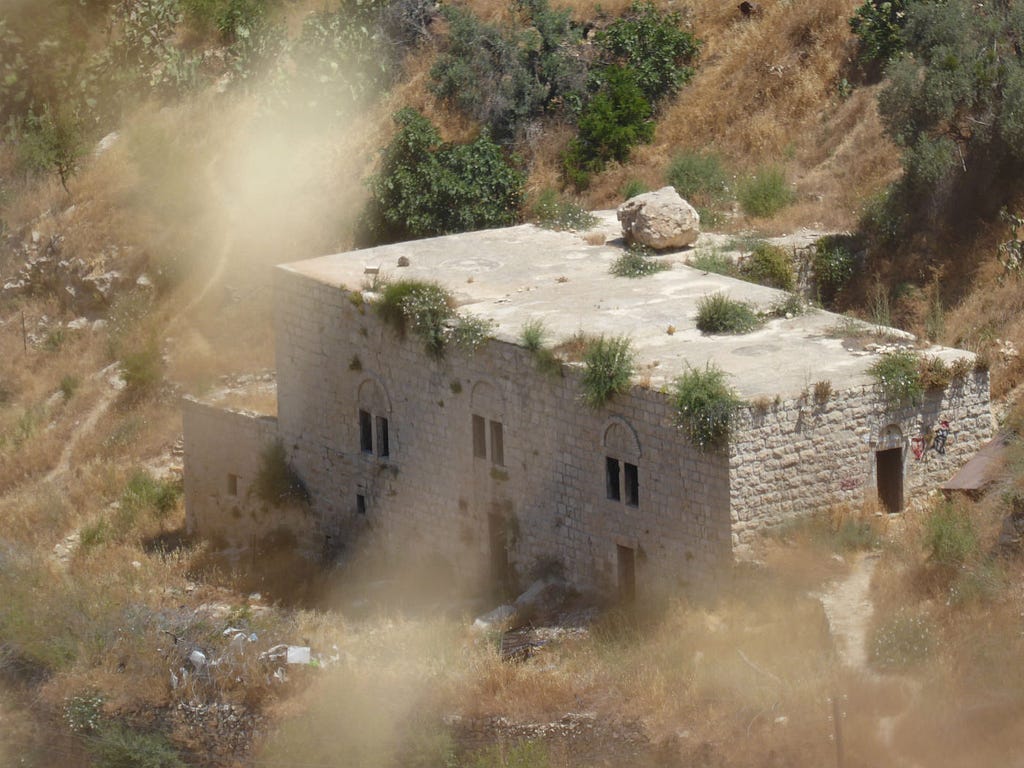
It’s one of my favorite places, and one of the most stunning pre-1948 Palestinian villages in the District of Jerusalem. Lifta’s inhabitants were either expelled, or they fled. Earlier in the summer, before the Israel-Gaza war began, I asked a few writers and theatre makers to meet me there so we could ruminate on a play about the pre-1948 Palestinian village. What remains of the village is under constant threat of being razed.
Not long before our meeting, one of the Palestinian writers, currently residing in London, was denied entry into the country. No reason given. Then the one living in Haifa but originally from the hilltop village of Iqrit, in northern Galilee, had clashes to deal with. For a few years now, Iqrit descendants have been trying to reclaim their ancestral village. They confront a colony of jarring obstacles. Iqrit’s inhabitants were forced to leave their homes in 1948 when the new Israeli army alleged the area was dangerous. They were never permitted to return. Today, descendants are still not allowed back, even those who are Israeli citizens.
Can writers create in such a ceaseless twister of interruptions, barricades and heartaches?
This left one other person in Jerusalem. On my way to Lifta, I got a call saying that there were clashes in East Jerusalem preventing her from joining me. This is common in Palestinian life. I’ve written about it before. There is no easy way to explain. The restrictions on freedom and movement are interminable: checkpoints, the Green Line, Areas A, B, and C, or whatever identity card or passport they hold. Gazans aren’t permitted into the West Bank or anywhere. West Bank residents can’t go to the 1948 territories unless given a special permit, and those are rare. Palestinians with Israeli citizenship can’t live in the West Bank, and Palestinians in the diaspora are refugees and can’t live in Israel, the West Bank, or Gaza due to Israeli laws. And Jerusalem blue-card holders are under constant threat of losing their residency. Wherever Palestinians are dispersed in Israel, the West Bank, Gaza, in refugee camps in the Arab world, or displaced worldwide, they are confined to the particularities of whatever boundaries — national or physical, psychological or emotional — they were dealt after 1948. Can writers create in such a ceaseless twister of interruptions, barricades and heartaches? For nearly seven decades, Palestinian writers’ oeuvres have contributed to Palestinian, Arabic, and other letters, and left notable and cherished poetry collections, novels, plays, and memoirs. But I can’t help imagining how much more they could have created.
*
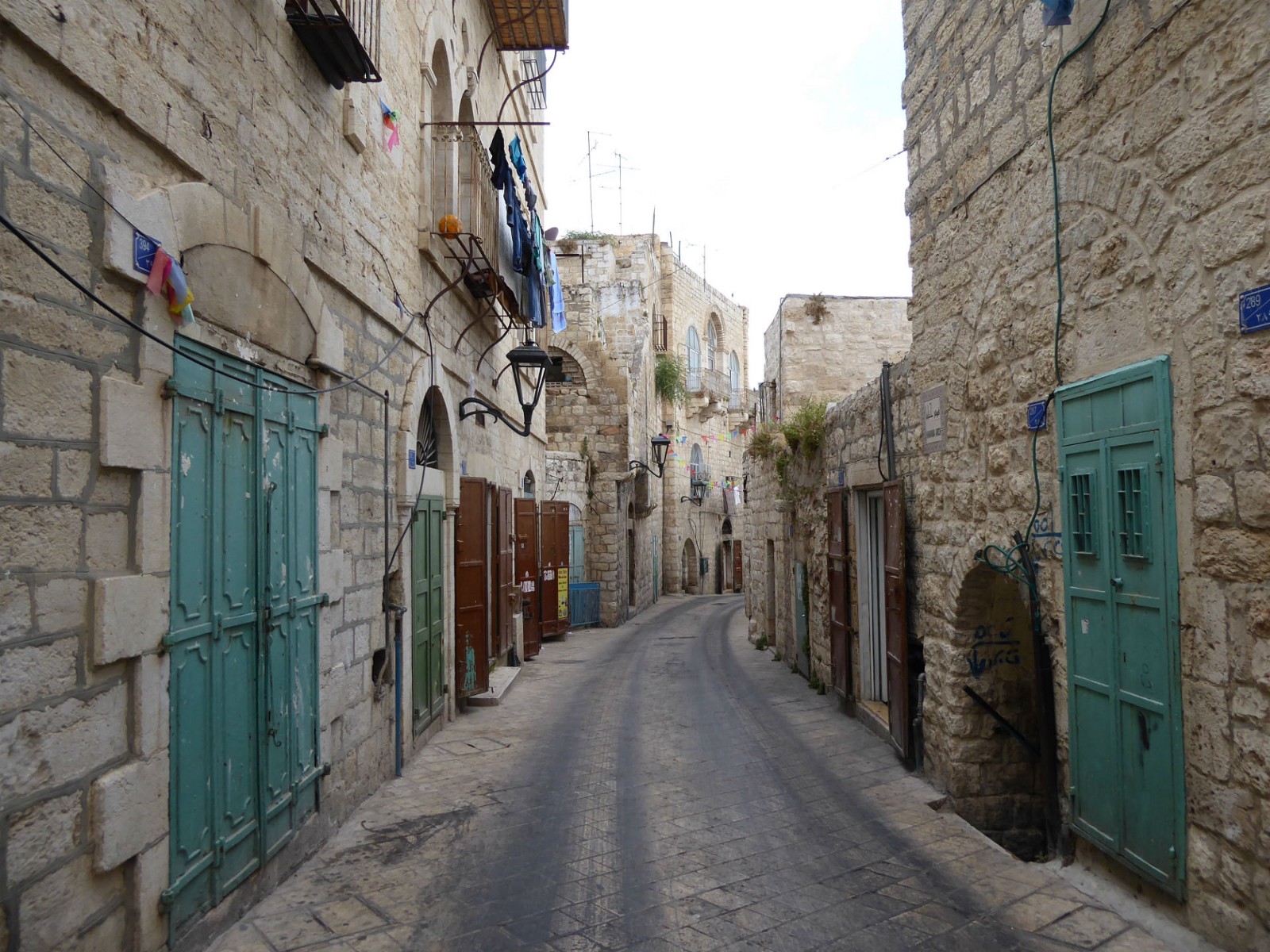
I don’t make it to Lifta until the following year, when I hike the steep slopes with my friend from Jerusalem. We allow the stones, like cascades of stars, to guide us. We stay silent. What could be said amidst such beauty, such horror, such grief, such love. The wild flowers speak to us. The jasmine and lavender speak to us. The empty old stone houses, gems of our heritage, identity and culture, speak to us. The olive trees speak to us. The mill speaks to us. The ancient spring speaks to us. The ghosts roaming the village speak to us. The bride and the groom from 1947, who haven’t aged a day, speak to us. And we listen. We mostly listen. What we hear: although there is nothing more to lose, no power has ever been able to steal memory.
The dry patches in between like sheets of hay, rough and songful. And the girl on the bus comes to guide me as I memorize Lifta.
Writers safeguard memories. We spot a Palestinian sunbird. It has orange tufts at the sides of the breast. My friend tells me as a child she would look for them, and that this one is a male sunbird, because its black feathers are lustrous blue in the sunlight. A blue so electric it mystifies us like a poem does when it mysteriously appears on the page. We sit under one of the arches of the old houses; we lean on the stones, cooling. The village is a perfect symphony of mystical green. The dry patches in between like sheets of hay, rough and songful. And the girl on the bus comes to guide me as I memorize Lifta.
My mind veers. I think of the expropriated Jerusalem houses not far away, in the neighborhoods of Talbiyah, Qatamon and Musrara, the ones that my sister so painfully researched and powerfully unfurled in her interactive web documentary art, “Dream Homes Property Consultants”.
Then I stop. Beauty is a scar. History is a room. Longing is a gale.
*
Was I really a young girl when I saw absence and recognized its broken lyric, now more riven? Was I really in my twenties in 1997 when Mahmoud Darwish asked me to interview Allen Ginsberg for his journal al-Karmel. The American beat poet spoke about being offended as a Jew at violent Zionists, and said, “The Israelis have fucked up with Netanyahu. They won’t have peace unless they have peace.” Is it 2015 and Netanyahu is still around? But would it make a difference if he weren’t? Would that stop Palestinians in the West Bank from being subjected to what the United Nations Office for the Coordination of Humanitarian Affairs (OCHA) calls a “complex system of physical and administrative” control that includes “physical obstacles” (the Barrier, checkpoints, roadblocks, earth mounds, ditches) and “bureaucratic constraints” (permits, Area C, military zones), which “impede access to services and resources, disrupt family and social life, undermine livelihoods and compound the fragmentation of the [West Bank]”? Would the Mediterranean Sea be open to Palestinians, North to South, East to West? For now, the sea will continue to miss us.
Five o’clock. Summer 2015. A year has passed since the 50-day Israel-Gaza war and Israel’s annexation, only a few days after the Gaza ceasefire, of nearly 1,000 acres of West Bank land in a Jewish settlement bloc near Bethlehem, which the international press called “the biggest land grab in a generation.” The telephone rings, the voice says, “Look outside of your window.” I do. “Look down,” he adds. It could have been a Romeo and Juliet scene except the tired curves on his face tell me he can’t entertain even the illusion of our hearts. Who can, when seven miles is a long distance journey? The once sister cities, Bethlehem and Jerusalem, are now separated by a wall and love needs a permit issued by an occupying power.
This is where I understand myself best, amidst these limestones, these slender streets, in these hoshs, in these hundred stairs of the old city, under these arches, with Jerusalem before me and this person beside me.
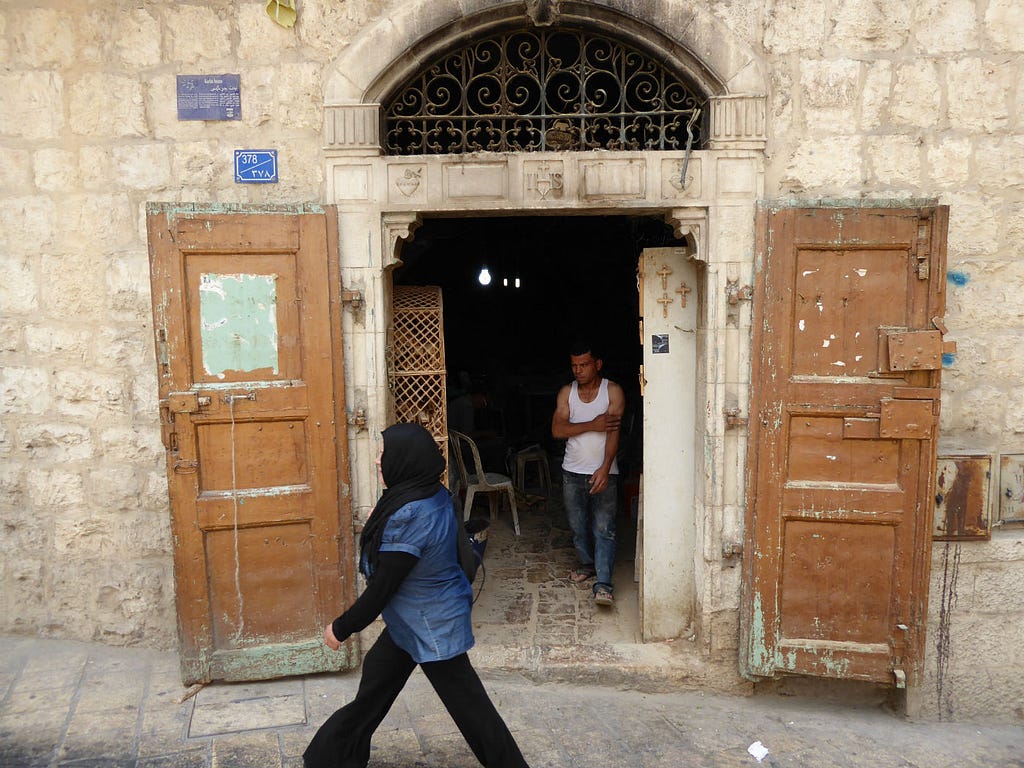
We manage to smile and drive through the old city before it awakes. We pass through my mother’s quarter, Harat Al-Tarajmeh. I see my grandmother’s school, the former ateliers of the mother-of-pearl artisans, and the stone houses of close and extended families. This is where I understand myself best, amidst these limestones, these slender streets, in these hoshs, in these hundred stairs of the old city, under these arches, with Jerusalem before me and this person beside me.
We end up where we often do, having a conversation by the Nativity Church. Casa Nova, to be precise. Not long afterwards, we exit our hearts as we exit our bodies. We never reach our wounds nor get to our words on time. I memorize his hand instead of saying goodbye.
*
It’s now December. Every year, Christians worldwide celebrate Christmas. Some will come to Bethlehem. They will be told not to buy anything in the birthplace of Jesus because the natives are dangerous and untrustworthy — even best to leave their wallets altogether. While they pray, the natives will apply for permits to enter religious sites. Few visitors will discover what OCHA reports: that “more than ‘85% of Bethlehem governorate is designated as Area C, the vast majority of which is off limits for Palestinian development, including almost 38% declared as ‘firing zones,’ 34% designated as ‘nature reserves,’ and nearly 12% allocated for settlement development.” That Bethlehem along with Beit Jala and Beit Sahour are surrounded on three sides by the segregation wall. That “farmers in at least 22 communities across the governorate require visitor permits or prior coordination to access their privately owned land located behind the Barrier or in the vicinity of settlements.” That “over 100,000 Israeli settlers reside in 19 settlements and settlement outposts across the governorate, including in those parts de facto annexed by Israel to the Jerusalem municipality.” While they pray the systematic and discriminatory policy of revoking the residency of Palestinians in Jerusalem will continue. While they pray, writers will warn. Hearts will hurt. Rivers will be ruins. Words will be wounds. While they pray, love will ask the Song of Songs for love. While they pray, the daily, painful execution will continue. While they pray.
About the Author
Nathalie Handal’s recent collections include The Republics, lauded as “one of the most inventive books by one of today’s most diverse writers”; The Invisible Star; Poet in Andalucía; and Love and Strange Horses, which The New York Times says “trembles with belonging (and longing).” Handal is a Lannan Foundation Fellow, winner of the Gold Medal Independent Publisher Book Award, the Alejo Zuloaga Order in Literature, the Virginia Faulkner Award for Excellence in Writing, and an Honored Finalist for the Gift of Freedom Award, among other honors. She is a professor at Columbia University and writes the literary travel column The City and the Writer for Words without Borders.
Ashley Farmer’s work is unusual, beautifully so. In the author’s 2014 collection, Beside Myself, (from Pank’s Tiny Hardcore Press), characters would only briefly mention specifics of traditional narratives like place, yet the cascade of images and sentiments expressed by Farmer’s narrators created an overall stability in the book. Delicacy of strange images defines Farmer’s writing. With Beside Myself, short, difficult-to-define pieces straddle a line between flash fiction and poetry, Farmer established herself as a writer whose work is meant to be read holistically and experientially.
Such is also the case with Farmer’s new book, The Farmacist, from Jellyfish Highway Press. In The Farmacist, Farmer’s narrator struggles to untangle herself from the Facebook game, Farm Town, as her actual life unfolds around her. The juxtaposition of virtual versus real, Farmer’s mining of Farm Town for metaphor, and the duality of the narrator’s desires make The Farmacist, told in the author’s trademark short, mysterious, and glimmering prose.
The Farmacist begins with Farmer’s narrator addressing the omniscient presence looking over her shoulder — is this someone playing the game, the computer, or the reader? Farmer’s narrator is observed by all three. “You are with me,” she says, “though the acres are ending, all of it evaporating like anti-magic.” This sets the tone for a hyper-aware, meta-narrative.
There’s joy and irreverence in Farmer’s imagery each time she blends the vocabulary of Farm Town with that of the flesh-and-blood American experience. She says —
The farm makes you remember the Fourth of July, conjures the family portrait burning, the secret handshakes of senators, chrysanthemums on a banquet table for which you got paid a semi-wage, icy freeways or summer roads littered with locusts, and the ghost of Ted Kennedy drinking on the lawn.
Though at times the reader doesn’t have traditional narrative footholds, Farmer guides through a pastiche of things — both digital and worldly.
Farmer’s poetic voice shines in The Farmacist, and is demonstrated in her singular attention to details like sound. Lines like “Bundled, blue, and warm, I was their incident, their accident” underscore the broader scope of the story — one where a woman finds herself through digital creation — with the idea that meaning can be found anywhere, even in virtual realities. “I’ve stayed small against seasons,” the narrator says, speaking equally of farm and self. Farmer reminds us of the never-ending call from the digital world, emblematic of our deepest anxieties: “In bed, I will separate wheat from the chaff and make progress. I’ve added acres to my sleep and the profit from it: immeasurable.”
“I wait to go where I’m supposed to go,” says Farmer’s narrator —
some place ridiculous and waiting. Which is to say: I miss the world I knew. I embrace my worst impulse involving bed and drapes and sunny-sunny days. I realize some loves of my life are gone. I sense the farm is a long, fake waste.
As The Farmacist unfolds, its narrator loses control over both farm and reality. As she burns her candle at both ends, the narrative’s sense of panic — of not being able to stem the tide of digital problems — increases. Farmer’s narrator complicates her story (interestingly) by inserting philosophical ideals into the story. She runs Freud by her farm, and Jung. Her parents. As she brings the real world and points of view about the nature of existence into the same realm as the digital farm, we see how it is both absurd and absurdly important. Farmer’s work is sly commentary on the way we give away our power to computers, their feigned significance. She says, “I’m surrounded: chemical light sonnets and armies of alarms on a single block.”
“Failing at one world means nothing in another,” Farmer’s narrator says in a chapter called “Daily Lottery.” Though her digital farm is analogous to so many things that take up our attention, Farmer makes The Farmacist theater of the absurd in the digital age. Yes, this is a book about a Facebook game. But the author proves it’s a book about a Facebook game with something to say about humanity.
Frederik Peeters is better known in his native Switzerland than he is here in the U.S., but thanks to publishers like SelfMadeHero he is quickly finding an audience in the English-speaking world. His comic debut was the memoir Blue Pills: a Positive Love Story, about his relationship with a mother and son who are both HIV positive. Blue Pills was the first of Peeters’ books to be nominated at Angoulême, the Cannes Film Festival of comics, and he has since received four additional nominations in both the best book and best series categories. He often bounces back and forth between writing for himself and collaborating with others, and has worked with such talent as the French documentary filmmaker Pierre Oscar Lévy on their twilight zone inspired comic, Sandcastle.
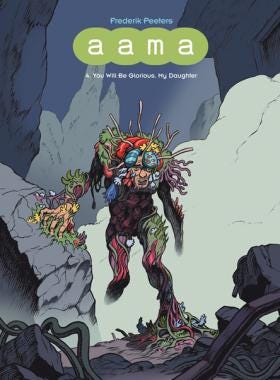
His latest book, Aama, is about an amnesiac’s search for his past while on an expedition in a rapidly evolving alien world. The fourth and final volume, You Will Be Glorious, My Daughter (SelfMadeHero 2015), was released this past September, so I thought it a good time to ask a few questions of Peeters regarding sci-fi lit, technology’s impact on the future, and the differences between the American and European comic book audiences.
Matthew Laoisa: Dystopic regimes and post-apocalyptic wastelands are becoming a repetitive sub-genre within science fiction. Did you purposely avoid those tropes?
Frederik Peeters: Like you say, they’re sub-genres. I really wanted to do a pure SF story, in the classical sense of the term. And anyway, it’s ideas–visions–that drive the story. I always try to do things a bit differently, to really listen to my personal tastes, and for me it’s impossible to even contemplate the post-apocalyptic since The Road by Cormac McCarthy.
ML: What made you want to utilize the diary as a framing device? Did a specific author or book inspire the use of that technique?
FP: At first, I wanted to construct the story with an unseen narrator, with a system of flashbacks. Then I started to like the idea of a character who wakes up with amnesia and who rediscovers his memories by reading his own writing, so the very same view he had of himself at a given moment in time. But the principle of the diary-book is obviously an homage to the great travel writers of the 19th century, like Joseph Conrad, Henri de Monfreid (whom my grandfather adored), Stevenson, Stendhal, Jack London, etc. This is in keeping with Verloc who lives anachronistically within that mythology.
ML: Much like a protagonist from a Philip K. Dick novel, Verloc Nim suffers from a loss of memory. Why do you think memory and identity are common themes in sci-fi lit?
FP: Well, the answer is in the question there. You have to know your history to know who you are. That holds true for one person as it does for a whole people. Think of the film Memento, where the character tattoos his memories on his skin, turning his life into something concrete he can wear like a costume. But in the case of Aama, the memory loss is due to a kind of reboot of his character, the moment when his internal software is altered. But, I must admit, above all it’s an excellent way to get your hooks into the reader at the beginning of the story, too.
ML: Outside of Verloc Nim’s antique shop, books seem to be almost non-existent.
FP: Basically, objects made of printed paper have disappeared from his world.
ML: Where do you see the future of the printed book?
FP: It will probably be the same as it is for vinyl records. Only a few passionate collectors will bother. Maybe it will be the same for all the objects that encompass or express forms of artistic beauty. Ugliness, the absence of memory and vulgarity are winning the day. But we shouldn’t imagine either that once upon a time, everyone read beautiful books. Appreciating Beethoven requires an education the likes of which people don’t have time for anymore, and when Proust was published, he only sold a few thousand copies. So maybe vulgarity has always won. But if one thing is for certain, it’s that people’s concentration span is getting shorter every day. I’m sure that no one will read this interview all the way to the end.
ML: In volume one of Aama we learn that the government outlaws religion. What was the idea behind that, and what impact and/or relevance do you think religion will have on the future?
I’m very pessimistic, because the only thing that I have to propose is a life based on balance, doubt, philosophy, science, pleasure, art and love.
FP: Ach, I’m no guru. Religions and religious people scare me, always have done. I was raised in an atheist family and milieu. In Aama, I left that problem behind me. I imagined a scientific society, which had replaced wholesale the worship of intangible gods with the worship of technology, networks and communication; the worship of tradition with the worship of meaningless action. Obviously, that isn’t necessarily a better option. I won’t lay out here all the catastrophes brought about by fundamentalism, be it Muslim, Jewish, Christian, Hindu or capitalist fundamentalism, which denies the ecological and population catastrophes that we’re living through, but I believe that all belief, whatever it may be, contains a form of violence, because it tends to exclude everyone else. I’m very pessimistic, because the only thing that I have to propose is a life based on balance, doubt, philosophy, science, pleasure, art and love. That looks a lot like the basic plan of the first communists, and we can see what happened next there. No, man is imperfect, and I doubt our situation will improve.
ML: Not having kids of my own, I can only imagine the fear that goes into having a child, especially when there are genetic traits within a family tree to worry about such as insanity or disease. Verloc and his partner Silika decide to have a baby naturally even though artificial insemination and genetic manipulation are the norm in this society. Was having a child a fear in your own relationship for one reason or another? Are there pros and cons to gene selection or is the only possible outcome for this technology a future like Gattaca or Brave New World?
FP: That’s a question that’s potentially too personal, one I’m going to avoid answering in too much detail. The question behind all that is: do we absolutely have to give people what they ask for? Do we have to make rotten films because that’s what people want to see? Do we have to remake Star Wars for 150 years? If I were offered technology capable of ensuring my child’s good health, would I only be able to resist the temptation because that’s not the kind of society in which I want to live? I believe in beauty and that life is naturally hard. I think that we have to hold on to some of the unexpected, something of tragedy in order to be able to live a full life. Our Western lives are already much less demanding and much more comfortable than those of our ancestors, who died young and lived intense lives. Unfortunately, we’re choosing the path of a kind of deathly dull immortality.
ML: In your future humans are wirelessly connected through implants. Verloc voluntarily lives without this connection and is therefore more adjusted to the solitude he finds on the uninhabited planet of Ona(ji). However, his brother Conrad has difficulty dealing with the technological and social isolation. The Internet has made an obvious impact on the way we are able to communicate with people from around the globe, but do you think the experiences gained from virtual communities in any way change the way we interact on a person-to-person level?
FP: To respond in a credible way, I should really be active in online communities and social networks myself. I don’t see big changes, but I’m badly placed to do so. I’m very solitary, I’ve been with the same woman for 15 years, I like to travel to see people in real life. I only use email, texts, I have a tumblr without any comments, and I only go on the internet once a day, in the evening at home, because my phone isn’t online and I don’t have internet at the studio, on purpose, so that I can concentrate better. But don’t get me wrong– it’s not that I hate the internet, it’s a fantastic tool that has turned most of our habits on their heads, but I try to see it just as a tool, as a vehicle. I consider how I use my car: I’m not going to spend all day long in it, that’d be horrible. I try to think about my relationship with all technologies like this, in the hope of maintaining an inner life and existential freedom.
ML: Throughout the series you incorporate dreams into the narrative, and that seems to be something you’ve been exploring your entire career. What is it about dreams that attract you, and is there something about the comic book medium that enables the depiction of dreams in a way that a novel or movie can’t accomplish?
It’s a way of diving in at the deep end of my inner landscapes, which are sometimes disturbing. And the stuff of dreams is also a way to bring out poetry.
FP: Yes, I like to push the boundaries of reality and dreams, I’ve always liked that, the idea that the way in which we see the world is perhaps not unique, that we can sidestep it and open other doors to new perceptions. It’s also why drugs have always had an appeal to me. I use my dreams, others’ dreams and visions that emerge when I’m half asleep that I can just about get a handle on. It’s a way of diving in at the deep end of my inner landscapes, which are sometimes disturbing. And the stuff of dreams is also a way to bring out poetry. Ultimately, it’s just that: drawing and literature, another outlook on the world, a poetic, off-beat, bird’s-eye view that is infinitely personal. That’s the big difference with cinema. Literature and drawing are by definition personal art forms. And comics are the meeting of the two. Cinema is an expensive collective artform, and that hinders poetry most of the time. You have to be a dictator or a genius–often both at the same time–to make poetry for the cinema.
ML: I read that in your comic Blue Pills you didn’t use any preliminary drawing, and inked everything in one attempt without correcting mistakes. Did you still thumbnail your page layouts? Did you use a similar process in Aama? It seems like that process would be a lot more challenging in a science fiction setting filled with futuristic and alien designs.
FP: There was no layout for Blue Pills, it was pure improvisation. It was for that reason that the book started with a series of abstract images– the time it took for my brain to warm up. But yes of course, such a process could only apply to a linear subject that required no research or preparation. With Aama, as with all my books, I kept one part improvised, but I also wrote out ahead of time all the lives of the main characters, and made a general plan so that I wouldn’t get lost in multiple flashbacks. Then I thought in advance about the society that would frame the story, a future that was at the same time possible and mythological, without forgetting a series of very strong mental pictures that came to me very early on in the work, and which stayed with me right through to the end: Churchill, the end with Verloc and his daughter, the robots skinning the humans, etc. The rest of the story came together with the decoupage and the drawing. But I never do the full layout of a story, I tend to leave room for real-life events to change the course of the narrative, which they did. I need to be able to adapt to stay sharp.
ML: In other interviews you mentioned that you write and draw at the same time. I was wondering if you could elaborate on your process because the first three books have a consistent page length and all have satisfying episodic conclusions. How are you able to pull that off?
You have to have confidence in your self and accept living with imperfection.
FP: I don’t really know. I’ve always done that, ever since I was little. Writers of novels do that all the time. They write with each stroke of the pen, they build their story as they write it, they never write a trial run before the real thing. Except maybe in the case of screenwriters, who do construct plots that are neat and predictable to be adapted for film. That’s become my language, I feel it, I control it, I know how to play with it. When you see a pianist improvise and always land on his feet, you don’t ask how he does it, you know that it’s just how he works. It’s the same for me. That said, the fourth book is longer than the others– so I don’t always manage it, you see. And there are many more details that I wasn’t able to use for lack of space and time. You have to have confidence in your self and accept living with imperfection.
ML: The best comics are a marriage of good art and good story. Do you consider yourself a better artist or writer, or do you consider the two inseparable? Is there less pressure when you collaborate with another writer?
FP: I can’t separate the two. Not in my work, anyway. And yes, it’s easier for me to draw someone else’s script. It’s a more technical pleasure; I put all my energy into making the narrative clear, to the point, measuring out the emotions, etc…But that demands less in the way of personal investment. For Aama, I lived like a monk for four years, delving into the deepest corners of my mind, turning in on myself. I played with ghosts and fears, which was troubling at times, in order to bring my unconscious images and feelings up to the surface. It’s work that demands a great deal of energy, and cuts me off from the world a bit.
ML: Franco-Belgian comics are referred to as bandes dessinées, which literally means, ‘drawn strip.’ To my knowledge, this term does not classify books by page length or genre. In the U.S. we call our longer format comics graphic novels, but some creators consider this a false label since the word implies a certain amount of embarrassment. How are books like Watchmen labelled in Franco-Belgian comic book shops? Are they categorized with other bandes dessinées? Is there a term you prefer?
FP: Actually, we have the same problem. Bande dessinée refers traditionally to a hardback, full-colour comic book, like Tintin, The Smurfs, Spirou, etc. We would apply that to all genres bar manga, which is always just thought of as manga. But in reality, we’d talk about sub-genres: Franco-Belgian BDs, graphic novels, indie BDs, fanzines, manga, manwha, American comics, etc. For me, Watchmen is really a comic book, even if it’s an excellent comic book. I’m old enough to know that those books were original published in the US in comic book form, like Frank Miller’s Batman, Mazzuchelli, Sandman, etc.
ML: I work at a comic book shop in Atlanta, Georgia and I ran into a friend who had never read or had any interest in reading a comic. I handed him a copy of Asterios Polyp by David Mazzucchelli, and he was blown away. He said, he thought all comics were basically ‘BAM — ZOOM — POW’ stories, and he didn’t know that a comic could be such an incredible tool for storytelling. What do you think can be done to help broaden people’s preconceived notions of the comic book?
All that I can do from my end is make the most beautiful books I can–the most complex, the most thought-provoking, the most adult.
FP: All that I can do from my end is make the most beautiful books I can–the most complex, the most thought-provoking, the most adult. I have to make books that I would like to read myself, and put all of my energy into them, in order to construct a global oeuvre. It isn’t my job to know how to sell the result. The solution lies in other media, those that can send it on its way. And maybe that’s a good thing. I mean, leaving BD in a ghetto to one side has some advantages. We remain free and endlessly innovative. Too much noise and too much money rarely makes for interesting art. But nonetheless it seems to me that the ghetto walls are getting lower and lower. There are graphic novels which are real world-wide successes, and more and more countries are open to the medium, from Brazil to Eastern Europe…
ML: The European comic book market is also growing within the U.S. due to publishers like SelfMadeHero, Humanoids, and now Delcourt going digital, but I think it is still largely a niche market. What steps can be made to get more readers interested in English translations of bandes dessinées? Are there any bandes dessinées that you think deserve a wider exposure to American audiences?
FP: Of course, there are lots–new ones, classics–there are lots of beautiful images produced in Europe at the moment. Young artists are often connected to a great secular pictorial tradition, particularly in France and Italy. There are real authors’ works, things that are personal and pressing. The problem is that the whole world is used to receiving external cultural influences, which were once very often American, and to interpreting and mixing them together. American popular culture benefited from the hegemony of a country that won the second world war and then the cold war. Conversely, I often maintain that the American public is particularly impermeable to other cultures. Of course the country is made up of layers of immigrants from all over, but the dominant common culture is extremely uniform. For example, the film industry prefers to make remakes than to disseminate original works, because the audience doesn’t like to change its habits. The same goes for books. That said, manga has managed to break into the American market. So Europeans have to take some responsibility. Europeans have lost their taste for winning since the two world wars, and maybe it’s better that way. I don’t think we’re very good in business, either.
ML: Lastly, there are still a few of your books unavailable in English. Can we expect translations of Lupus, R.G., and/or Ruminations anytime soon?
FP: Ruminations is a collection of stories from my youth. It’s really for the fans, and I doubt there will be very many of them in the US. R.G. is a real French-style crime thriller, based on the recollections of a real special agent in the French police, with lots of cultural references. I’d love to see it translated, but I think it’s very specifically French. As for Lupus, it’s about to be translated and published by Top Shelf, to my total delight!
Heaven knows he’s miserable now. Morrissey, the favorite for the 23d Literary Review Bad Sex in Fiction Award, went all the way to the top, winning for his debut novel, List of the Lost. Morrissey released his first book earlier this year, to some harsh reviews, especially concerning its sex scenes:
Eliza and Ezra rolled together into one giggling snowball of full-figured copulation …with Eliza’s breasts barrel-rolled across Ezra’s howling mouth and the pained frenzy of his bulbous salutation extenuating his excitement as it whacked and smacked its way into every muscle of Eliza’s body except for the otherwise central zone.
The winner was announced last night in London, at the In and Out Club in St. James Square, London. Morrissey was unable to attend the event, and the prize was unveiled by columnist Nancy Dell’Olio, immediately followed by this tweet by The Literary Review.
"In an ideal world this award would be received by Morrissey. Or someone who publishes Morrissey. Or someone who likes Morrissey." #BadSex
The goal of the Bad Sex Award is, according to Literary Review, to “to draw attention to poorly written, perfunctory or redundant passages of sexual description in modern fiction, and to discourage them.” The award is popular on social media, and winners and nominees are routinely and gleefully mocked. Not everyone is as amused as Literary Review though. Peter Bradshaw from The Guardiancalled the award “a terribly English display of smug, gigglingly unfunny, charmless, and spiteful bullying.” For more perspective on the difficulty of writing good sex in fiction, and perhaps why the Bad Sex in Fiction Award is less than necessary, check out this article.
The following authors were shortlisted for the award along with Morrissey: Lauren Groff for Fates and Furies, Richard Bausch for Before, During After, Thomas Espedal for Against Nature, Erica Jong for Fear of Dying and George Pelecanos for The Martini Shot.
Excerpts from the other nominees and more about the Bad Sex in Fiction Award are here.
DON’T MISS OUT
Sign up for our newsletter to get submission announcements and stay on top of our best work.
YOUR INBOX IS LIT
Enjoy strange, diverting work from The Commuter on Mondays, absorbing fiction from Recommended Reading on Wednesdays, and a roundup of our best work of the week on Fridays. Personalize your subscription preferences here.