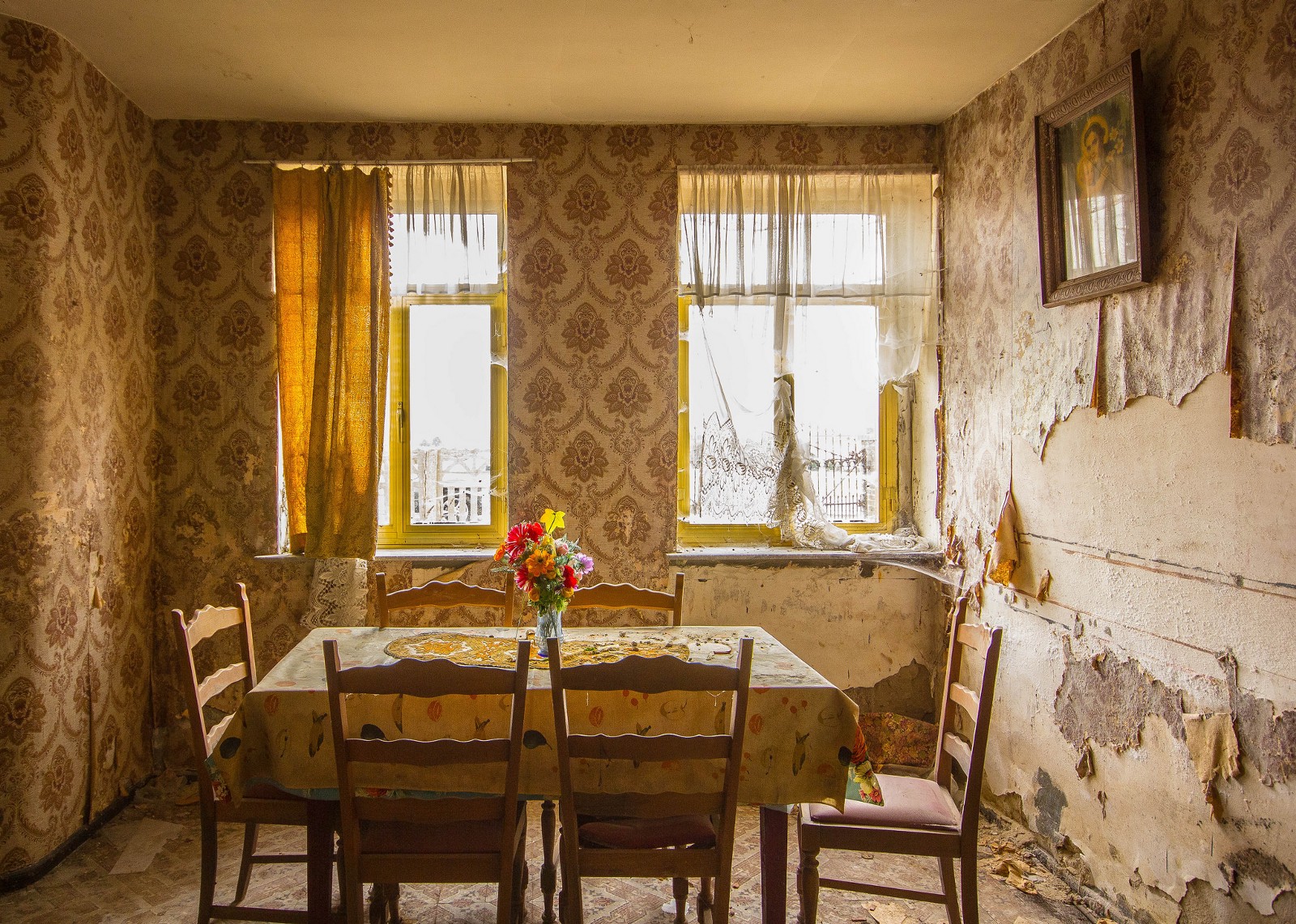
On a downtown street lined with modern buildings, we find an old, abandoned house. The front garden contains a white fountain decorated with angels. It’s separated from the sidewalk by a wrought-iron fence: a succession of rusted spears joined by two horizontal bars. The faded pink exterior is covered in dirt and greenish grime. The windows are hidden behind dark shutters. This unassuming house holds great interest for the few people, myself among them, who know its secrets and have fallen under its influence.
LITTLE MEN
A piece of pipe sticks out a few centimeters from the wall in one of the rooms. With luck or patience you may be able to see the little men, around eleven centimeters tall, peek their tiny heads out of the pipe. They observe for a moment, like someone seeing the open ocean for the first time through a ship’s porthole. Then they begin to extract themselves from the pipe, with some difficulty. They must first lie face up, grab onto the top edge of the pipe, and use their arms and legs to shimmy their bodies out.
A little man hangs from the edge of the pipe. He gets nervous as he looks down and sees the huge hole in the floor directly below him. Evidently the little men’s repeated antics have damaged the already rotten floor. Soon the small round eyes of the next little man can be seen inside the pipe as he anxiously awaits his turn. He hangs on for as long as possible, then finally he takes a deep breath, as if preparing for a dive, releases his hands from the edge of the pipe, and falls and falls.
After about a second you may think that you hear something. But those accustomed to the spectacle know that you really can’t hear anything. Some imagine a soft sound, like the bounce of a rubber ball. Others, a dry crunch of bone. The more imaginative hear a small explosion (like the striking of a match, but without the subsequent flame). There are those who have talked of implosion; they think they hear the sound of a light bulb burning out. Others claim to have clearly perceived the breaking of glass.
We’ve checked the basement, but its perimeter doesn’t seem to match up exactly with the house. We haven’t found any hole in the ceiling that could correspond to the hole in the floor through which the little men disappear. We worry that there might be a growing pile of tiny cadavers somewhere and we are anxious to find it. I have my own theory, although there’s no evidence to support it. I don’t think that the little men die when they fall and also, I believe that there are just a few little men who endlessly repeat the jump from the pipe.
SPIDERS
One of the things that seemed curious to the discoverers and first fans of the house was the absence of spiders. You have everything else you could want in an abandoned house, but the classic spiders seemed completely uninterested in such an appropriate place. This incorrect assumption was revised upon first visit to the pantry, a room attached to the kitchen. It’s full of spiders. There are all varieties of species, shapes, sizes, colors, ages, and habits. Their webs fill the entire room with a sponge-like stuffing. If you look closely you will see that there’s not a single web that respects its due distance from the web of a rival spider. It’s permitted (it seems to be an accepted norm) to use a neighboring web as the starting point for a new one.
Perfect tranquility reigns over the pantry. The bugs wait, some in the centers of their webs, others on the periphery, others scout the ceiling or walls. It’s not particularly interesting for the spectator. The biggest spiders don’t have webs but instead a kind of nest on the floor. They can only be seen on very hot days, or on certain nights, or at random times that we can’t find any explanation for. We think the spiders stay in the pantry because the conditions are extremely favorable; they seem to be opposed to leaving at all. We’ve observed some hesitating in the doorway. We’ve seen others step out, only to immediately rush back inside, as if pulled by an irresistible force or driven by panic. The group of webs is a lovely sight which becomes more beautiful with the changes in light from a small window as the day advances and dies. The humidity of the room affects the beauty of the webs, as does the mood of the spectator, and other inconceivable factors.
An insect falls into one of the many traps: everything vibrates. Sometimes we release flies from jars to initiate the spectacle, but in general we prefer to wait for the conditions to emerge by chance. First there’s a slight buzzing, almost imperceptible, produced by the insect in the web. The bug becomes more and more anxious and its attempts to free itself are increasingly violent. The movement is transmitted through the system of webs. A rhythmic motion radiates outward and then returns: it’s like throwing a rock into a pond but observing the effect in three dimensions.
The spiders react: first the owner of the web that has trapped the insect approaches the victim and begins the usual routine. The neighboring spiders watch closely. This quick and delicate movement, this chore, produces a pronounced effect in the group of webs. All the other spiders, who have felt their webs vibrate but haven’t located the victim, begin to search frantically, peering into other webs, furious when they find nothing there. Then the show really gets good. We are spellbound, in a kind of trance. Some of us dance (because there is a rhythm, increasingly insane), others cover their eyes because they can’t take it. I have personally had to stop someone who, hypnotized, tried to enter the pantry. I found out they committed suicide a while later, at night, in the sea. I’ve said that it’s hard for the spiders to leave the pantry and that they never go very far or for very long. There are exceptions, which we’ll see later.
PICNICS
We discovered by accident that underneath the pink wallpaper in the bedroom, there was another wallpaper pattern. Immediately a team formed, led by Ramirez. Over several nights of careful work the pink was totally removed and the next layer was exposed: greens predominate. It’s a beautiful rural landscape, impressively realistic: we can almost smell the fresh country air. The damaged parts of the wallpaper were expertly restored by Alfredo. He’s a quiet guy with a mustache and we didn’t suspect that he had any talent whatsoever.
Influenced by the uncovered wallpaper we felt the need to organize Sunday picnics. We got up early and brought baskets and folding chairs. Juancito, who works at a grocery store, got us a Coca-Cola ice chest. There was red wine, a battery-powered record player, kids with nets to catch butterflies, butterflies — provided by an entomologist friend on the condition that they be returned unharmed — brightly-colored dresses, couples, ants, a few small spiders (that we took from the pantry for a little while) and other things.
The main attraction was one of Chueco’s inventions. He’s a construction worker in his free time and was able to build us a gas grill that miraculously eliminates smoke. Although it serves no practical purpose, the tree that Alfredo fashioned from a synthetic material was also highly praised. I sat on the floor, in a corner, drinking mate. I don’t like picnics, but the show entertained me.
Something pulses, something grows in the attic.
It’s suspected to be green, it’s feared to have eyes.
It’s presumed to be strong, soft, translucent, evil.
We can’t, we shouldn’t, we mustn’t look at it.
To speak of it we use only adjectives and we don’t make eye contact.
We don’t climb the creaky stairway; we don’t stop to listen at the door; we don’t turn the doorknob; we don’t enter the attic.
LITTLE WOMEN
To see the little men that jump from the pipe we have to wait and wait. On the other hand, all we have to do is fill up the bathroom sink with warm water, turn on the faucet, and in under a minute the little women start to flow out. They are very small and they are naked. They don’t cover themselves when they see us. They swim freely, play in the water. They climb up onto the plastic soap dish that we’ve placed there and they stretch out as if they were sunbathing. They are beautiful without exception; their bodies are magnificent and exciting. They dive into the water and swim and splash and climb back up on the soap dish to stretch out.
When they get bored they work together to pull up the sink stopper and they let themselves slide down the drain. There’s one with green eyes that’s always the last to go. She looks at me, almost with regret, before she plunges down the drain.
AN EXCEPTION
One afternoon we had been investigating the superimposed wallpapering in the big bedroom. It was Ramirez, accountant at a fairly important factory, who was able to make out the fifth layer. He correctly deduced the total number of layers, as we proved later upon uncovering five square centimeters of wallpaper. I won’t go into detail on the last layer (let me remind you that there are ladies among us) but I can assure you that it was an erotic scene, practically pornographic. This discovery leads us to believe that the abandoned house once functioned as a brothel.
On his way home that evening an elderly woman ran behind Ramirez for quite a while. She eventually caught up with him and explained, panting and upset, that he had a huge black spider on the back of his jacket, almost five centimeters in diameter. We phoned him repeatedly to invite him to the abandoned house but Ramirez made up excuses not to come. Finally, he explained what had happened and we understood. He says that when the old lady told him about the spider, he didn’t have the wherewithal to take off his jacket. He simply fled from the coat’s interior and the article of clothing hovered for an instant in the air, empty. Ramirez claims that a half block away he heard the soft sound that his jacket made when it fell heavily to the ground.
COLLAPSE
Much of what attracts me to the house is its serene and diligent collapse. I measure the cracks and confirm their advance. The blackish borders of the water stains extend. Pieces of plaster come loose from the walls and ceiling, and the entire structure has a slight, almost imperceptible, leftward slant. It is an inevitable and beautiful collapse.
THE GARDEN
We can’t come to an agreement on the size of the garden. We do agree that viewed from the street, or from the path that leads to the house, it appears to be about eighty square meters (8m x 10m). The trouble begins from the moment we step in among its weeds, its ivies, its flowerless plants, its insects, the lines of ants, the vines and giant ferns, the rays of sun that filter through the canopy of the tall eucalyptus trees, the bear tracks, the chatter of the parrots, the snakes coiled around the branches that raise their heads and whistle when we pass, the unbearable heat, the thirst, the darkness, the roar of the leopards, the falls of the machete that clears the way, the tall boots we wear, the humidity, our helmets, the luxurious vegetation, the night, the fear, the fact that we can’t find the way out, the fact that we can’t find the way out.
THE HUNT
None of us are able to shake the suspicion that the house must hold an old and fabulous treasure, composed of precious stones and heavy gold coins. There are no maps, nor clues of any kind. I count myself among the most skeptical, although I have often allowed myself to daydream and I even imagine clever unsuspected corners where the treasure might be hidden. The fact that I don’t participate in the official treasure hunts sets me apart from the rest. I don’t even search when I’m alone (as I know many do).
I thoroughly enjoy these hunts. I lie in a lounge chair that I bring from my house especially for the occasion and I place it in an appropriate location, generally in the main living room. I watch, drinking mate and smoking cigarettes, as they spread out methodically — the women through the house, the men in the basement — and they search. The ladies in their happy dresses rummage in the rubble or dig inside the furniture coverings. I smile when I see them search the pieces of furniture that they know we brought in ourselves to feed the hurricanes. The men, in their blue uniforms, tap the walls of the basement looking for a sound that is hollow or different. But all the sounds are hollow, and different from one another. The tapping makes music; it reminds me of the sounds made from bottles filled with different levels of liquid. Soon it seems that everything fits together and the music becomes rhythmic and the women go up and down and it looks like they’re dancing and I think again of the musical bottles, now containing liquors of all different colors, all transparent and sweet.
EARTHWORMS
It had to be a woman, Leonor, that neurotic old maid, who turned on the taps of the bidet. I don’t know why she joined our group (she’s afraid of the house). Everyone knows that there is no running water and that it’s dangerous to go around turning on faucets without warning. The little women come out of the sink. And then there’s the rubbery yellow thing in the bathtub. It blows up like a balloon and doesn’t stop getting bigger until you turn off the faucet. Then it comes loose and floats around us for a little while. Then it rises up and sticks to the ceiling and stays there until one day we come in and it’s gone. If you flush the toilet, by pulling the long chain with a wooden handle, you hear a tremendous, hair-raising scream. It’s so loud we worry about complaints from the neighbors.
We heard a scream and we confused it with the shriek of the toilet but no, it was Leonor, running and pointing toward the bathroom. We followed her and discovered a long thin earthworm crawling out of the bidet. More and more of the earthworm kept appearing; it seemed to go on forever. It was already a meter and a half long, easily. We waited to see when it would end but it kept getting longer and longer as it dragged itself across the floor, heading towards the other rooms.
We cut it into pieces but each new section remained fully alive; the new earthworms escaped in all directions. We had to sweep them up and throw them down the drain. The first worm kept coming out and soon new black spots began to peek out from other holes. We tried to turn off the faucet but it was stuck. No one was brave enough to change the washer, let alone call a plumber. We began to think that we’d have no other choice but to close up the bathroom and be forever deprived of the spectacular little women. Leonor was accused of having done it on purpose. Finally, someone had the idea (and the courage) to force each of the earthworm heads into the drain of the bidet itself. This seemed fine with the earthworms. They continued to crawl in and out of the bidet. They’re still at it now, a continuous and never-ending movement. Someone who doesn’t know the story of the bidet would look at it and see a strange horizontal rain of shiny black water.
HURRICANE
There’s a shake of ashes and cigarette butts in the dining room fireplace. Then it’s best to leave, or lock yourself in the bedroom, or as a last resort, stay pressed into the corner with your head between your knees and your hands over your head.
Dirt, papers, objects begin to twirl slowly in the center of the room like autumn leaves. There is a brusque drop in temperature and the wind blows harder. Then everything lifts into the air and swirls towards the center. The furniture is pulled in and the walls shake, loosening the flakes of plaster. The dirt suffocates us and irritates our eyes and makes us thirsty. If the hurricane catches you by surprise you could become trapped in its funnel, twirling round and round, sometimes spit out against a wall, violently, only to bounce back to the center again and again until you die and even after you’re dead.
Once calm is restored, I leave the corner and I walk amongst the rubble, the broken vases, the overturned furniture. Everything is beautifully out of place. The dining room seems exhausted, as if after a fit of vomiting. It seems to breathe easier.
THE UNICORN
We think the grass attracts it but we’re not sure and our theories don’t have the slightest scientific basis. But it’s interesting to observe some facts. We have classified the grass (a job carried out by Angel, the vegetarian) as a variety of St. Augustine called Martynia louisiana, native to North America. It seems to grow only in this garden. It has large flowers, yellow with purple spots. It bears fruit once a year: a pointed capsule shaped like a horn. Hence its popular name, Unicorn Plant, and from there, according to us, the annual visit of the animal to our garden. Despite patient vigilance we’ve never actually seen it. But we have noticed the grass cut by teeth. We’ve discovered holes in the dirt, as if produced by the twisted point of an umbrella in the elevated bank of a mud puddle. We’ve seen hoof prints; we’ve found fresh manure. One night the sound of a soft whinny reached us. The next morning we found Luisa. She was sixteen years old and had joined our group only days prior. Her chest was punctured by an enormous uni-hole; she was naked, monstrously raped.
YOU
You are a door-to-door salesman. You peddle books or memberships to medical societies. You knock on all the doors. You try to get into all the houses. It’s late afternoon. You see a wrought-iron fence and you hesitate for an instant. But you are determined, and an unkempt garden does not dissuade you. You push open the gate. You walk up the path that divides the garden in two; you stop directly in front of the door and you look for the doorbell. You don’t find it, but you see a bronze doorknocker. It’s shaped like a hand, with long thin fingers. There’s a ring on the largest finger and the index finger is missing two phalanges. The finger did not break but was intentionally designed this way. You pause. But you remember your lessons from salesman school, and some previous experience of your own, and you pluck up your courage. You lift the knocker, making it turn on its hinge, and you let it fall: one, two, three times against its base, also bronze. The sound booms through the house.
You are confused. We know all too well from our sad experiments that the knocker causes many strange sounds to echo through the house. You will inevitably think you hear a dry, hoarse voice. It insists that you open the door and come in. Your confusion lasts a few seconds but in the end your hope gets the better of you and you make the grave mistake.
When we arrive we find only your briefcase, on a chair, or on the floor. We don’t need to open it to determine your line of work. We gather in the dining room for a moment of silence. Someone invariably sheds a tear. Someone always suggests that we report the case to the authorities. We convince them that we would gain nothing and we would surely lose the house. Then someone pipes up to suggest that we hang a warning sign on the front door. The older members of the group have to explain, once again, that this only increases the number of victims and that sooner or later the string of curious idiots will get us kicked out of the house.
We finally agree that these incidents are regrettable but we can do nothing to prevent them. Tired of the sorrow, guilty consciences, and useless arguing, we decide to take the issue a little more lightly. After all, we agree, there are too many door-to-door salesmen in the world anyway. Later, someone takes your briefcase and throws it unceremoniously into the well in the back yard.
ANTS
In the garden there is, of course, a variety of ants. Periodically, we’re pleased to find a new ant bed where we plant a red flag. We’ve noticed that the ants march along the cracks towards a location under the house, in the foundation. We think this contributes to the slow collapse.
We take care of the most important plants, pruning them and giving the discarded leaves to the ants. The philosopher objects. He says that we are contributing to the weakening of the species by making their tasks easier and gradually reducing their capacity for work. There is one lady who thinks we should simply exterminate them with ant poison but we know this method doesn’t work.
What happens in the house is different. The few ants that live inside don’t seem to have any work to do. They wander around lost in thought, half-heartedly pacing a wall or floorboard. We’ve discovered that they live alone, in some isolated crack or corner, and they feed on small things that they find. We’ve never seen them gathering or storing food. Occasionally they are spotted in pairs, but the relationships appear to be unstable.
There’s one ant that we identify by a little bit of white paint on her backside. She spends several days gathering sticks and other small objects, never once stopping to rest as she completes her construction. We don’t know what it is but it’s not a nest and does not appear to serve any practical purpose for the ant. She crawls all over it in ecstasy for a while, then she forgets about it and returns to her contemplative state. If by accident or clumsiness the structure is destroyed, even partially, the ant becomes infuriated and walks around crazed for hours.
Archie, the engineer, who has done a detailed study of the ant’s construction, concludes that it’s a major feat of engineering. He says that it would be impossible to complete such a project without advanced knowledge of mathematics. He has taken some notes which he thinks will revolutionize modern bridge-building techniques. He believes that the ant is acting out of instinct, building bridges where they’re not needed.
I don’t think they’re bridges. I have my own ideas on the matter. Everyone takes out magnifying glasses; they focus in on the details, applauding the complexity of the work and the symmetry of the sticks. I prefer to look at the structure as a whole. I think that it’s beautiful and that its shape reflects, in a way, an ant.
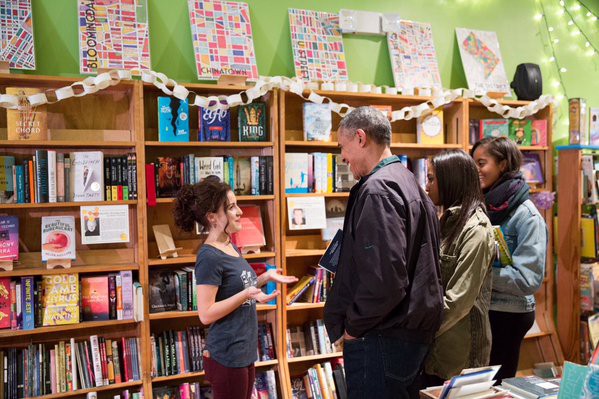
This weekend, President Obama took his teenage daughters, Sasha and Malia, shopping at D.C. bookstore Upshur books. Together, they picked up books with the help of the store manager, Anna Thorn.
The following titles, spanning genres from children’s literature to YA and adult fiction, were in their shopping bags: Purity by Jonathan Franzen; Two Years Eight Months and Twenty-Eight Nights by Salman Rushdie; Cynthia Voigt’s Elske: A Novel of the Kingdom, On Fortune’s Wheel, and Jackaroo: A Novel of the Kingdom; A Snicker of Magic by Natalie Lloyd; Stargirl by Jerry Spinelli; Diary of a Wimpy Kid: Hard Luck, Book 8 by Jeff Kinney; and Dork Diaries 1: Tales from a Not-So-Fabulous Life by Rachel Renée Russell.
Both Nathalie Lloyd and Salman Rushdie tweeted in response to the shopping trip, with Lloyd saying she couldn’t stop smiling and Rushdie responding to journalist Jeffrey Goldberg tweeting about the political implications of Obama purchasing Two Years Eight Months and Twenty-Eight Nights.
The president has been supporting Small Business Saturday for years already, but the past three years he has done his shopping at Politics and Prose in Northwest Washington. Perhaps the choice of newly opened Upshur Books this year was due to their offerings of cupcakes, drinks, and visits by local authors.
Need another reason to join us for #SmallBizSaturday ? Homemade cupcakes!!! Bookseller tested and approved.pic.twitter.com/7obak6sslX
The Indianapolis Museum of Art has an outdoor venue called 100 Acres. It features large-scale works that interact with the natural environment, including an enormous skeleton spread out across a field. (You may have seen this in the film version of The Fault in Our Stars.) My favorite is an installation called Park of Laments by Chilean artist Alfredo Jaar. You enter the park by going down a ramp, giving you the sense you’re entering a football stadium to the cheering of thousands. But when the ramp curves upward and deposits you in the park itself, there is an eerie quiet. You stand in the center of a carefully tended lawn. Enclosing the park are what look like the ramparts of a castle. You walk around the park, inspecting the ramparts for some sort of message, unable to shake the sense you are waiting for something.
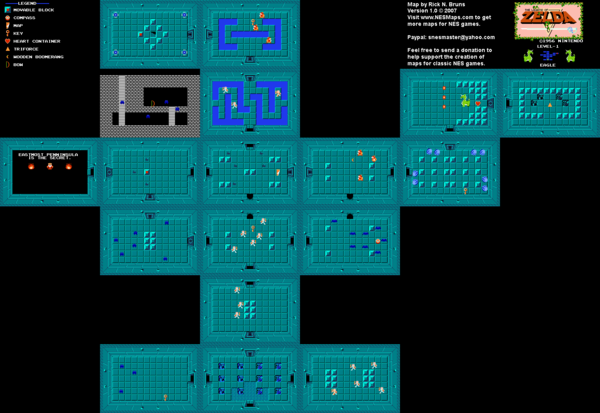
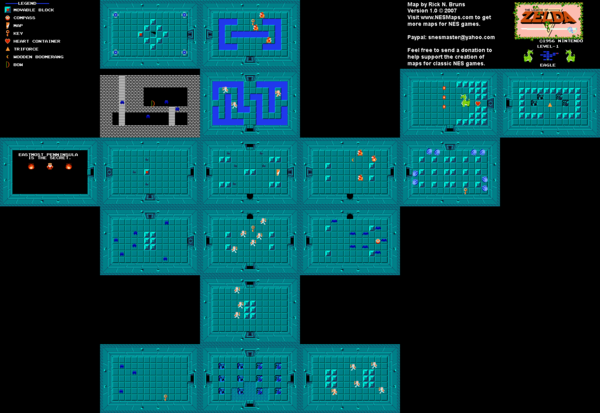
Jaar intended Park of Laments to be a space of seclusion where one could contemplate historical trauma — far from an abstraction for someone whose native country was overthrown in a military coup. The first time I visited, however, my thoughts were not quite so lofty. The space reminded me of The Legend of Zelda. My anxious calm was similar to how I’d felt the moment before a boss battle, checking inventory one last time before Ganon stormed out of one of the paintings on the walls, riding a red-eyed horse.
This sensation was one I often felt when playing video games in my mediated adolescence, encountering the world through controllers and screens. The feeling was a reaction to a physical environment: the haunted houses of Super Mario World, the Esper Factory of Final Fantasy III. Video games provide an aesthetic experience, and the effects they produce in this consumer most closely resembled the silent awe I feel in the presence of the most powerful architecture, sculpture and installation art. It sounds counterintuitive, since video games are often constructed from temporal elements — one level to the next, racing against the clock. But they strike me as an essentially spatial medium.
…in the ongoing argument that would claim video games as an authentic, legitimate art form, the medium’s narrative aspects have been overemphasized while its structural aspects go neglected.
Of course, video games, like movies, are an amalgam of many different media. Some lean on the time-based pleasures of narrative while others resemble the spatially-oriented work found in galleries and museums, visual and plastic arts that bend and shape the space surrounding them. But in the ongoing argument that would claim video games as an authentic, legitimate art form, the medium’s narrative aspects have been overemphasized while its structural aspects go neglected.
Why is this the case? Blame Steven Spielberg. In an interview from 2004, Spielberg was asked when and how video games might reach their maturity as a medium of renown and prestige. He said, “I think the real indication will be when someone confesses that they cried at level 17.” Shedding tears upon reaching a particular point in a game? Sounds an awful lot like a movie, and a Spielberg movie at that. Why Spielberg was deemed the ideal critic for assessing the progress of video games is a mystery, since he infamously gave his approval to the E.T. video game produced for the Atari 2600 in the early 80s, which is now widely regarded as one of the worst games ever made. He’s a symptom more than a cause, however. Cinema is the ubiquitous medium of our culture, training our responses to so many aspects of reality. A book that transports our imagination is “cinematic,” the footage of natural disasters on CNN is said to “look like a movie.” It’s inevitable that video games would be judged by the same yardstick.
So what other critical tools could we use to consider the experience of playing games? What vocabularies could we consult to formulate a theory of videographic space?
Forget movies. Let’s look at fiction, the medium made of nothing more than words.
***
In postwar France, the theorist Gaston Bachelard wrote a study called The Poetics of Space. It examines various physical structures, the house in particular, as they have been depicted in literature. Like the best Continental theory, it draws on disciplines ranging from philosophy to psychology to physics as it describes seemingly familiar environments:
For our house is the corner of the world. As has often been said, it is our first universe, a real cosmos in every sense of the word. If we look at it intimately, the humblest dwelling has beauty. . . . In short, in the most interminable of dialectics, the sheltered being gives perceptible limits to his shelter. He experiences the house in its reality and in its virtuality, by means of thought and dreams. It is no longer in its positive aspects that the house is really “lived,” nor is it only in the passing hour that we recognize its benefits. An entire past comes to dwell in a new house.
I can’t tell you how many times I reached a level-end boss for the first time only to have the sensation I’d been there already, a room in a house I’d forgotten I’d visited.
Space in video games is not, strictly speaking, physical. It’s made of pixels on a screen, and the movement of objects within it are governed by the algorithms of its central processing unit. This artificiality has the ironic effect of making the world inside of a video game more immediately familiar than the world beyond our living rooms, as if the game is a memory we didn’t know we had. I can’t tell you how many times I reached a level-end boss for the first time only to have the sensation I’d been there already, a room in a house I’d forgotten I’d visited.
Fiction is well suited to representing space in this cosmic-domestic sense, as Bachelard points out. It’s a feature that dovetails with space in video games. Several writers of the last decade or so have drawn on this connection, creating worlds that feel like levels of a video game stripped of goals and objectives. Perhaps the most direct example could be found in Dennis Cooper’s God Jr., a novel whose protagonist literally enters a video game.
Jim, the main character, was in a car accident that killed his teenage son Tommy. His friends and family tell Jim not to blame himself, but they don’t know the truth. Jim was stoned, having smoked up with his son beforehand, and the resulting disorientation caused him to crash his car into a telephone pole, flinging Tommy through the windshield. Jim’s grief and guilt find an unusual expression. Perusing the teenage detritus of Tommy’s bedroom, he finds a notebook containing sketches of a strange, elaborate structure. Jim treats them as blueprints and hires contractors to build the ungainly structure of uncertain function in his backyard.
As work on the structure nears completion, one of Tommy’s friends comes to visit. She recognizes the structure. It’s from a video game, she says, a secret level whose entrance Tommy spent hours trying to find, to no avail. Desperate for answers, Jim plays the game, picking up where Tommy left off. It’s here that the story becomes truly weird. Jim’s consciousness somehow inhabits the game’s protagonist, a shambling bear that recalls Banjo Kazooie, the 3-D platformer for the Nintendo 64. He makes his way through the game, speaking to enemies and anthropomorphic plants, all of them convinced he is a god. But being regarded as a deity still doesn’t allow Jim to enter the secret level that so intrigued Tommy, leading him to wonder about the level’s origin:
What if this game started life as a very different product? What if it were a real work of art that would have changed the gaming world forever? What if it totally freaked Nintendo out? What if they had spent millions of dollars to redo it into something more commercial? What if this monument was part of the old game that nobody noticed until it was too late? What if they just locked the door, rendered these rocks around it, and hoped no one would notice? Maybe it’s a whole world in there like, say, Zion in The Matrix. Or maybe I am just stoned and it’s just a bunch of fucked-up pixels.
Only a building that exists not in physical but virtual space can contain his guilt and shame.
Jim misses his son so desperately that he’s led to build the monument in the outside world, but even this can’t fully express his grief. What offers him closure, or, failing that, finality, is the artificial, immaterial construct as it exists in the game. Only a building that exists not in physical but virtual space can contain his guilt and shame. There’s a kind of transcendence at play as the game exceeds its design to give shape to a father’s grief, bending the space within the game into shapes that neither the native enemies nor the interloping Jim can fully perceive.
This trope of a video game-like environment surpassing its function is one that’s played out in the work of many younger writers with an experimental streak. Think of Blake Butler, whose fiction seems to portray video game characters after they’ve run out of lives. His recent novel 300,000,000 is about a serial killer known as Gretch Gravey pursued by a detective named Flood. Flood searches the basement of Gravey’s house and passes through a portal leading into a counter-America of ash and empty fast food joints, like a video game that’s all background, with no bonus points or power-ups. Matt Bell’s In the House Upon the Dirt between the Lake and the Woods portrays a father who builds the titular house for his wife so they can raise a family there, but when she is unable to conceive, the father must journey into the woods to confront an enormous bear. It’s the best Nintendo 64 game that never got made. And the work of Amelia Gray features houses and basements that taunt their characters with unsolvable puzzles, a sort of existential Maniac Mansion.
The declarative sentence, high-resolution graphics: in the hands of artists, these are tools for portraying inner space, the peaks and valleys, houses and monuments that dot the landscape of the imagination. Sure, story is an important component of both books and games but I’ve often found that my favorite books and games allow me to stop and look around, strolling through paragraphs or pixels like they were coliseums, always with the sense that some part of me has been here before. Bachelard described what we could call this sense of the spatial uncanny like this:
Memories of the outside world will never have the same tonality as those of home and, by recalling these memories, we add to our store of dreams; we are never real historians, but always near poets, and our emotion is perhaps nothing but an expression of a poetry that was lost.
Are video games poetry? The very question sounds like the setup for a joke. But jokes have a habit of being prophetic. Perhaps this one’s time has come.
Here’s are some pointers to look at before sitting down to write your next essay, blog post, or novel. The infographic was created by Raphael Lysander.
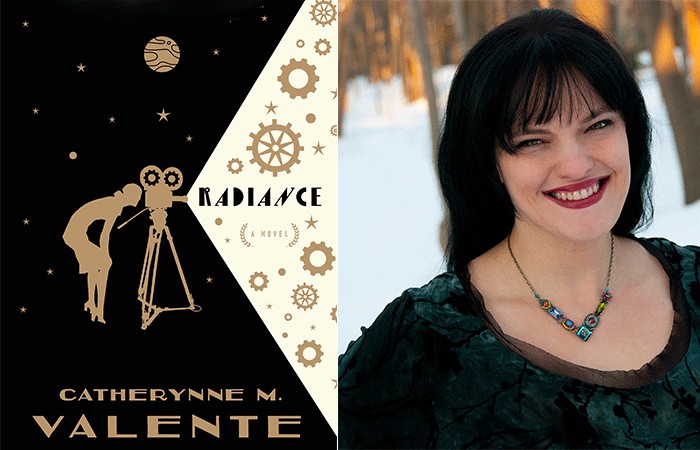
To say that Catherynne M. Valente’s fiction eludes easy classification would be the very definition of an understatement. She’s written a hallucinatory novel of a city that spreads via a tattoo (Palimpsest), a decades-long epic encompassing Russian folklore and the Stalinist era of the Soviet Union (Deathless), and an acclaimed series for middle-grade readers, the Fairyland books. And her latest novel is unlike anything that’s come before: Radiance(Tor Books 2015), a novel that blends aspects of space opera, cinematic history, and alternate history.
Radiance is set in a world where space travel began much earlier than in our world, where humans have colonized the solar system, and where massive Venusian creatures called callowhales prompt mystery and obsession. At the center of the novel is a documentary filmmaker named Severin Unck, daughter of an acclaimed director, who vanishes while making a film under particularly mysterious circumstances. The story of her life, her disappearance, and her world is told through an array of ornately arranged storytelling devices; the result is a stunningly structured narrative. I spoke with Valente about the process of writing Radiance, her cinematic inspirations, and how her childhood fondness for horror fiction inspired aspects of the book.
Tobias Carroll: In Radiance, there’s a lot of discussion of film, and in the acknowledgements, you mentioned being the daughter of a filmmaker. Where do your own tastes in film fall?
Catherynne M. Valente: Oh, all over the place. My parents met at UCLA, where my dad was in film school. When I was born–I was a happy accident–he went into advertising instead of continuing with a film career. But really, nobody will make kids watch movies like someone who comes from that background. So my siblings and I had such an incredibly diverse film education from the time we were very young. I had no real censors. The rule was, if you’re scared, just say so, and the movie will stop. So I saw everything. And I loved it all, from Freaks to Ridley Scott’s Alien and everything in between. I’m very omnivorous.
TC: There are a couple of epigraphs in the novel from filmmakers in our world. When you were writing the book, were you looking at it as a case where these people also existed in that world, or was it not so much of a one-to-one correlation?
CMV: I wanted to leave it ambiguous, whether the alternate history was alt enough that Mary Pickford and Charlie Chaplin and George Eastman would exist in that world, or whether they’re being replaced by my characters. Every one of the epigrams–and I love epigrams, I got to indulge that in a way that I hadn’t yet in this book…Every one of the epigrams has a filmmaker or photographer, an actor, and then, usually, something that is neither–Homer or Ovid or something of that nature. I would like to believe that there could be a Charlie Chaplin, but also that there are my various characters as well. Alternate history is a tricky thing like that. If the timeline is so completely altered that space travel is possible in the 40s, was someone named Charles Chaplin ever actually born? Who can say?
TC: Did you come up with the broad strokes of the alternate timeline first, or did you have more of a specific sense of what was and what was not different on Earth?
CMV: I started out with the core of the idea, that I wanted to have space travel in the 20s and 30s and 40s. One of the most enjoyable afternoons that I have ever spent–a couple of my friends who are obsessed with late 19th century and early 20th century history came to my house, and we formed a circle, and for about six hours discussed how history would fork if space travel began around 1870. And how the various political entities would behave in that situation, who would survive, who wouldn’t, of the colonial powers, and how the colonized countries would be affected by that. In 1870, you’re talking about the frontier in America and the political revolutions of 1848, but not up to the big empire-ending 20th century. So I did have it all worked out, very specifically, before writing the book.
TC: Is this a world that you can see yourself returning to for other works?
CMV: I would love to return to this world. I don’t have any particular ideas for it at the moment. Without spoilers, I think that in the ending, there are a lot of hints of where things are going to go in the future of this universe and this timeline. If I ever have an idea that necessitates going back to it, I would love to. I love this world, and I love this culture, and I love the characters. I would love to return to it at some point, but I don’t have any plans for it right now.
TC: When you’re describing the first trip into space, I found myself thinking of Georges Méliès’s A Trip to the Moon. What first drew you to that particular vision of space travel?
I had these two ideas: I wanted to write something about film, and I wanted to write something with a watery Venus…
CMV: I’m not actually sure that I completely remember, other than that steampunk was really popular when I was just starting to write it at night. I had these two ideas: I wanted to write something about film, and I wanted to write something with a watery Venus, the way a lot of the pulp writers had many, many decades ago. When I started thinking about the kind of culture that I wanted to place in that story, and who I wanted to go to those worlds, I think the popularity of steampunk probably got in the back of my head. I wanted to do something alternate-history but different from what was being done. I wasn’t as interested in Victorian England as a lot of people were. The 20s have been a favorite period of mine for a long time. The action of the book takes place in the 40s, but almost everyone in the book grew up during the 20s, and that very much affects their lives and their outlooks. It really fit perfectly for me.
I wrote the short story that this is based on in 2008. By now, seven years later, it seems perfectly natural that Radiance is an Art Deco book–how could it ever have been anything else? I don’t really remember the thought process, other than wanting to look at other periods of history and punkifying them. Metropolis is another one that was a huge influence on me, film-wise.
TC: In the opening, with scenes of images flickering over bodies, I was reminded of some of the imagery that you used in Palimpsest, and in the way that the film takes on a metafictional element, I was reminded of aspects of The Habitation of the Blessed. Did you see this book as a way to approach certain themes and ideas from a different angle than you had previously?
…Radiance is a departure in that it focuses on visual storytelling, rather than words.
CMV: I certainly think that Radiance is a departure, in a lot of ways. There are all kinds of things that I hadn’t done before in a novel. In a strange sense, it’s more realistic than a lot of the books I’ve written. There’s murder and jealousy and very straightforward storytelling, rather than some of the more abstract and oblique things that I’ve done before. But of course, every writer returns to certain images that they find fascinating. I certainly find the intersection of the body and storytelling to be something that I return to a lot. Hopefully, that I return to it in different ways. But I think that Radiance is a departure in that it focuses on visual storytelling, rather than words. Even down to the calligraphy, the building blocks of putting the story together, the strokes of the letters–I’ve written about that, and to some extent fetishized it, in all of my books, I think. This is the first time I’ve turned it around and made it about a completely different medium, one that I don’t work in. Obviously, I’ve never made a movie, and it’s not as intimately connected to me as writing is. But in a different way, it’s very intimately connected to me. I do think it’s different.
TC: You use the screenplay format for a few of the segments in Radiance. How did you find the right balance between different styles of storytelling, and translating one medium into another?
CMV: It was really hard, and there are a lot of failures on my hard drive. If you’re writing a book about moviemaking, you don’t want it to sound like you’d rather be writing a movie. I went around and around about how to communicate that, not only how the films in this universe are very different from the films in our universe, but to communicate the number of films that are part of the narrative in this book. I kept coming back to wanting to make a narrative of what was on the screen; I kept thinking that was really the way to do it, in a lot of ways. And that’s what I ended up with for the core narrative, of Severin’s father trying to make this film about what happened to his daughter and going through all of the genres, and trying to find some…not factual truth, but narrative truth, of a mystery that he can’t solve.
TC: I really enjoyed the interstitial moments: the radio dramas, the advertisements that ran before films that suggested an even greater depth to this universe. How did you fit each of those into the right place?
CMV: Those were some of the most fun things to write. Essentially–it may seem like there are a lot of different types of storytelling thrown at the wall, but it’s not the case. Each part is actually quite tightly structured, in the order of the types of storytelling. There are four main narratives: Severin, Anchises, Mary, and Erasmo. And within their storylines are interspersed these ephemera from the culture, and–yeah, I used them for exposition, because exposition is always difficult, and it’s more fun if you can use an animated whale to give the exposition.
I thought about what I wanted to explore as a storyteller. I knew, from the beginning, that I wanted to have a popular radio play in it. That was one of the first things that I wanted to do. I love radio plays, and how completely over-the-top and melodramatic they are. You carry a huge amount of cultural information without being aware of it. I thought that that was extraordinarily useful. I would rather read about the Invisible Hussar and get information about colonizing Venus from that than a huge infodump, so it seemed like a good way to go.
TC: How did the structure of the book come about? Did you try something more conventional and realize that it didn’t fit the story, as opposed to this very tightly-plotted, intricately-structured approach?
CMV: I tried to write it initially all from Anchises’s point of view, a straightforward, omniscient narrative, and it just wasn’t working. There was so much that I couldn’t even talk about when keeping to one person’s perspective. It also felt like robbing Severin of her own voice, a little bit. I kept feeling confined in my own skin with that. It just seemed small. But when I started opening it up to…not only to other voices, but to other types of storytelling–the radio plays, the advertisements, the interrogation that runs throughout the book, Erasmo’s debriefing–it seemed to pick up energy and to open up into a book that felt as big as the world did, at least to me.
TC: One of the interesting details for me in the novel was the way that the alien wildlife was named–how sometimes, they would share a name with an animal on Earth, but it would soon be clear that they didn’t resemble their namesake at all.
CMV: That comes from real life. I’ve been traveling to Australia quite a bit since the first time I went, to go to WorldCon in 2010. On that first trip, I went to the National Gallery in Melbourne, and there were many paintings done by early settlers in Australia. Not only did they call trees that were absolutely not elms and oaks and birches elms and oaks and birches, but in painting the Australian landscape, they couldn’t even conceive of the trees as they were. They looked like some sort of love child of eucalyptuses and elms, because they were so fixated on their own cultural experience of what a tree looked like. I found that completely fascinating, and I thought, this is absolutely what would happen if we started colonizing other planets. We would call things familiar things, as we always have.
It’s very natural and very unsettling and sinister that the human tendency is to look at something that they can’t categorize and slap a name that they’re completely familiar with on it so that they don’t feel quite so uncanny about it.
When one nation colonizes another, there are always very strange naming crossovers that probably should not have been crossed over like that. There are birds called magpies all over the world that are not all the same bird; they’re not even related, some of them. So I really wanted to do that. I certainly have very clear images in my own head of what those creatures look like. I mean, I crocheted a callowhale for the winner of a contest that the store that I’m doing the book launch at is doing. So you can kind of see what I imagine the main alien as being. It’s very natural and very unsettling and sinister that the human tendency is to look at something that they can’t categorize and slap a name that they’re completely familiar with on it so that they don’t feel quite so uncanny about it.
TC: I was going to ask about callowhales–throughout the book, because they’re so vast, it’s difficult for people to perceive them in total. So that struck me as I was reading the book, whether you intended for them to have a definite form.
I could never have anything in my book that I didn’t have fully-formed in my head.
CMV: I thought about, at one point, including a speculative diagram, like naturalists used. But I’m not a good enough artist. I’m just good enough to do the children’s drawings towards the end of the book, but not nearly good enough for a naturalist. But I have very clear ideas about what a callowhale looks like, and what its structure is. At least for me, I have to. I’m a very visual person, so I see it all in my head, completely realized, and the task is translating that scene onto the page. I could never have anything in my book that I didn’t have fully-formed in my head.
TC: I read Deathless a few years ago, and I was curious when reading this if any of the research you had done there into Russia in the 1940s affected the scenes in this set in Russia during a similar time?
CMV: A little bit. The thing is–one of the very first scenes in the book is the World’s Fair in 1944 being held in Moscow, and the Tsar and his wife standing on a balcony. So you can see pretty clearly that the timeline is not normal. Because of the discovery of space travel, there are a lot of major political things that either didn’t happen or happened in a very different way or, more commonly, were just delayed by the spaces involved in traveling between planets, the distances. But certainly, all of that research into life in the 40s and the political situation and all of that… It was so much research that I can’t imagine that there will be anything I write for ten years that doesn’t have some portion of that in it. Certainly, that first scene of the rocket taking off in front of the Kremlin–I think I wrote that at the same time that I was writing Deathless.
TC: Something else that you mentioned in the acknowledgements was that Roger Zelazny had been an influence on this book…
I wanted to go back to that Golden Age sensibility of, it cold be anything. It could be anything in the world.
CMV: Particularly “The Doors of His Face, The Lamps of His Mouth.” It’s a Hemingway-esque fishing story that’s set on Venus, where they’re fishing for this big beast. It’s so incredibly evocative and lovely. It was a bit of a touchstone for me–my Venus also has a lot of water on it. I loved those stories of the planets in our solar system, the pulp science fiction stories from before we were absolutely certain that none of those planets could support life in any way that was meaningful to us. There was a sort of wildness of imagination before we could look at very recent probe photos and see…incredible things, amazing things, extraordinary things; the Pluto footage is incredible. But it does limit us a little bit in what we imagine finding there. I wanted to go back to that Golden Age sensibility of, it cold be anything. It could be anything in the world.
TC: Are there any other contemporary works that you’d say are working in a similar vein?
CMV: One that came out as I was writing Radiance–and I went, “That’s interesting; I hope we didn’t cover any of the same territory”–was 2312 by Kim Stanley Robinson. And of course, we did not cover much of the same territory at all. 2312–I think it’s incredible, for one thing. I think it’s the best thing he’s ever written, and I wish that more people read it, because it is a masterwork. It also takes place over an inhabited solar system, and is a vast journey. It’s set in a future where terraforming has made those planets inhabitable to some extent. It is, very much based in what we think could happen now. It’s a completely wild and wonderful book. It also uses little bits of ephemera. I can’t possibly recommend it highly enough. It’s what comes to mind as something that hovers in the same atmosphere as Radiance, although it’s very different.
TC: You’ve now written several books in the Fairyland series; has writing those had any effect on your other fiction, or do they remain fairly separate?
CMV: It was really interesting to go back to writing adult books. With the Fairyland series having taken off in 2011, just after Deathless came out, I’ve been focused on that for quite a while. I hadn’t written an adult novel since Deathless. It was a relief to remember, “Oh! I can say ‘fuck’ again!” “I can have a sex scene! That’s okay.” I have learned a lot, I think, from writing Fairyland, and those lessons will be in every book of mine going forward. I am absolutely going to continue writing at the middle-grade level as well.
I think I’ve certainly learned a lot about writing a tight plot. Children have much less patience for meandering around the narrative than adults do. I got much more accustomed to writing tight, turning plots that have mysteries and solutions, that I hadn’t really been doing before in that sense.
TC: There is a metafictional element, in terms of the film that Severin’s father is making, atop the already rich and vast setting of Radiance. Was that something that you had planned from the outset?
Our universe is getting pretty science fictional. We always want more; we always want there to be real magic, we always want there to be real monsters.
CMV: If what you mean by metafictional is that Percival Unck makes speculative fiction in that universe, and Severin makes realistic documentaries, and that being something of a commentary on how we deal with those in our own universe–that was in it from the very beginning. It’s in the short story. It’s something that I’ve been fascinated with for a while: what is speculative fiction in a science fictional universe? Which is something we’re starting to have to deal with in a real way. Our universe is getting pretty science fictional. We always want more; we always want there to be real magic, we always want there to be real monsters. Even in a world like Radiance, where there are wonders everywhere, where there are aliens on these worlds that we can travel to, I think that people who make stories will always want something more fantastic. Longing for the fantastic is a human constant, I think.
TC: To bring it back around to the callowhales–on a very basic level, I’m fascinated and terrified by animals that are too vast to comprehend. Is that something that you also find about yourself, or were the callowhales more a case of the most fantastical creature possible in this universe?
CMV: I definitely have similar feelings. I grew up reading horror; I was obsessed with it. I started reading Stephen King when I was about nine. I found a box of Stephen King and John Saul and Dean Koontz and V.C. Andrews paperbacks in the garage; they were my stepmother’s books. I started reading them when I was about nine, which is sort of an inappropriate age to be reading those, but I loved them. Whenever I went to a bookstore, I made a beeline to that sea of black spines; you couldn’t publish a horror novel in the 80s and not have a black cover. Those were always things I was both revulsed by and thrilled by, the huge creatures beyond space and time and comprehension–Lovecraft and Stephen King’s It. There’s probably a German word for the feeling of being safe in your home but terrified of the great and deathless beyond. I definitely wanted to recapture that feeling with the callowhales.
TC: Are you working on something new now?
CMV: I’m always working on new things. I’m working on my next novel, which is a post-apocalyptic Western. I’m working on my next middle-grade novel, which is called The Lords of Glasstown, and it’s about the Brontë children. And I’m working on a superhero project as well. I’m working on a lot of things.
TC: What are you reading right now? Do you find that your reading habits change when you’re in the middle of a project?
You can’t just put internet comments and Twitter feeds into your head and expect good writing to come out.
CMV: Right now I’m reading Kat Howard’s Roses and Rot, which isn’t out until next year, and Seth Dickinson’s The Traitor Baru Cormorant. Reading while I’m writing is actually very important to me. If I’m not reading a novel, all I’m reading is the internet, and that’s not good. What goes in comes out. You can’t just put internet comments and Twitter feeds into your head and expect good writing to come out. So I try to always have a novel on hand when I’m reading.
Yesterday, NBA star Kobe Bryant announced that this season will be his last through a self-authored poem. The poem, titled “Dear Basketball,” was published on the athlete-run site The Players’ Tribune and hard copies were given out at the Staples Center during the Lakers v. Indiana Pacers game. While this has been a turbulent and injury-laden season for Bryant, the Lakers star has had a remarkable career spanning 20 years and numerous awards.
“Dear Basketball” is Bryant’s love letter to the sport, beginning with his first experiences as a six-year-old “shooting imaginary/Game-winning shots.” Written in free-verse, the ode is a testament to how much of himself Bryant has given to the sport. He describes his experience playing basketball as one of opportunity and forward motion, saying ‘I never saw the end of the tunnel./ I only saw myself/Running out of one.”
In the middle of the poem, Bryant says his farewell:
You gave a six-year-old boy his Laker dream And I’ll always love you for it. But I can’t love you obsessively for much longer. This season is all I have left to give. My heart can take the pounding My mind can handle the grind But my body knows it’s time to say goodbye.
Especially in a world where professional athletes are so often type-cast as inarticulate, Bryant’s decision to announce through poetry is a refreshing reminder of poetry as a universal power of expression. “Dear Basketball” demonstrates the form’s unique ability to capture seemingly-elusive feelings and bring them to tangible life.
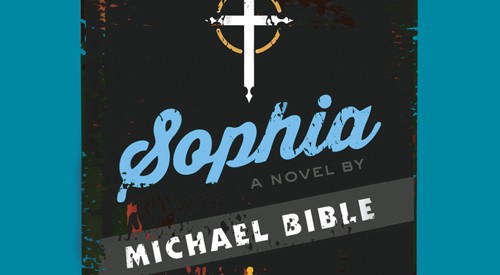
If literature is the attempt to weave chaos into a semblance of meaning, then Michael Bible’s debut novel is not literature. At least not at first glance, since the form Sophia quickly assumes is that of a disjunctive series of insular vignettes, of isolated paragraphs that shift through the life of degenerate pastor, Alvis T. Maloney. These paragraphs depicting his wanton existence are always separated by a double space, as if the young Mr. Bible is emphasizing the disconnection between the often-hilarious events they recount, as if defying the reader to tease out the significance that might unite their discontinuity. Yet gradually, it becomes apparent that even if they don’t congeal into an obvious moral or message, they complement the pastor’s inability to locate the sense in his life, his inability “to find a way to die with honor.” As such, the novel’s sense leaks out despite itself, and amid the sharp, laconic prose that its structure facilitates, Bible emerges as one of the most interesting and exciting new novelists in years.
This is no understatement, since the first thing that has to be said about Sophia is that it’s superbly written. Initially, its atomistic style might have the tendency to disorient the reader, demanding that she read a handful of its disembodied paragraphs before she can glimmer that the novel is about a one Pastor Maloney and his various misadventures through intoxication, debauchery and outright criminality. However, once the bearings are gathered, the short, punchy nature of the book imbues each of its micro-episodes with greater weight and resonance than they would have had if they’d been threaded immediately together into one continuous yarn.
On the one hand, this pointillistic punchiness serves to emphasize the abject quality of Maloney’s disaffection and depravity. One early paragraph abruptly ends with the observation, “The best thing for your health is to never have been born.” Another refers to how a love interest by the name of Tuesday hit him with a damning observation: “In the confessional Tuesday says I am emotionally crippled.” At many similar points, an impression of dejection, helplessness and powerless is strongly evoked, outlining the pastor as the passive victim of his life rather than its active master, as someone who has little control over its events and little power to stitch them together according to a particular vision of the good.
Indeed, his numerous references to the absence of such a vision provides Sophia with one of its main themes. In the latter half of the novel, he says to best-friend Eli, “Eli, there is nowhere to preach the gospel, no gospel left to preach. No sun I can see.” Elsewhere, he frankly tells this same friend, “I have no answers,” possibly admitting that he’s a man of religion only because he’s renounced all hope of improving his existence himself, in the here and now.
Yet if this nihilism and desolation threatens to become a tad wearing at times, and if the non-disclosure of why exactly he’s so disenchanted with life arguably prevents a full sympathizing with him, the terse, concentrated format of the novel works to reinforce the dryness and darkness of Bible’s caustic wit. For example, one memorable paragraph consists simply in the declaration, “Things are so bad and then I remember the secular saints: Beethoven, van Gogh, the drummer from Def Leppard.”
Moreover, this example and its zen-like brevity introduces another major virtue of Sophia, which is that it often fudges the boundaries between prose and poetry. Almost every paragraph reads like a sample of free verse, with its cloistered fragmentation suggestively withholding just enough information so that several interpretations are possible of curt lines like, “Women apply lipstick in the reflection of the butcher shop window.”
Sure, there have been many ‘verse novels’ and other works which have blurred poetry and prose (e.g. Autobiography of Red by Anne Carson, Pale Fire by Nabokov), but what qualifies Sophia as a more attractive prospect for the rhyme-averse is that its cast of vibrant characters are eminently relatable in their failings, failures, and foibles. Maloney is a jaded priest who openly acknowledges his humanity, peppering the book with such unabashed confessions as, “I have a dream about Tuesday wearing nothing but a magician’s hat.” His closest friend Eli is an unlikely chess genius, as well as fellow drunkard-romantic who introduces himself to his Chinese sexagenarian sweetheart by telling her that he’s in the mood for some strip chess (to which he receives the reply, “Set up the board, she says. Your move.”). Meanwhile, their Mississippian hometown is populated with a chessboard of oddballs and outliers, people like the bullhorn-playing “Finger,” the cosplaying Malchows, and the book-stealing “Darling.”
As colorful as they all are, it’s undoubtedly Maloney whose predicament proves the most universal. Unable to catch a break with the ladies, and terrorized by the “the fifth graders with their piss balloons,” he’s most of all plagued by a lack of direction in his life and by the failure to square it with great expectations. Aside from the fractured makeup of the novel, this lack is underscored by several resonant motifs and metaphors. For one, he lives on a “small filthy yacht,” a boat on which he floats and drifts in much the same way that he seems to drift haphazardly through life, without any particular endpoint and without the ability to govern where precisely he’s going. Added to this, there are the recurring visits a feminized Holy Ghost often pays to his dreams, where her performance of certain favors stand as a lewd promise of the divine favor he would obtain if only he knew how “to continue life in a noble way.”
He has a faint idea of how he might attain such nobility, insofar as he suspects it involves some saintly act of self-sacrifice: “I want so bad to be a saint but I’m a coward and barely Christian, I say.” Unfortunately for him, Sophia raises the demoralizing possibility that, because “the beer is still delivered and the cars are waxed and people still fall in and out of love,” these same people aren’t interested in pursuing any grand objectives, in making the world a better place, or in having anyone become a saint on their behalf. Hence, Maloney’s quest for a noble, selfless life is fatally undermined from the very beginning. What’s more, because of this, the novel abounds in professions of aimlessness, impotence and frustration, professions like, “Turn your hand off the wheel of time slowly.”
Yet, for all its despondency, and even though it appears to take the stance that a person’s life unfolds predominantly by chance, Sophia ultimately reveals itself as a life-affirming novel. Its schismatic passages gradually evolve into a decentralized narrative of love and new beginnings, and in fact this very same schismatic format paints Maloney as someone who just about has the ability to appreciate each divided moment as an end in itself, without always worrying too much about how to connect these moments together. Yes, its capsule-like segmentation may militate against a complete investment in its eccentric characters and scattered plotting, and yes, its blend of poetry and prose may edge its occasional surrealism to the point where the reader can’t distinguish reality from unreality. Nonetheless, it has a sharp, snappy charm that somehow makes its characters and plotting more engaging than they would have been in a more conventional novel, and its sporadically absurdist tone is perfectly in line with an absurdist world that obstructs almost every attempt of its inhabitants to find meaning within it.
As for that meaning, it does eventually arrive, after 13 chapters of “rotten peaches,” “playing chess” and “drinking gin.” Without giving away the particular form it assumes, it can be teased that the novel’s title has something to do with it, and that it, like pretty much everything else in Maloney’s haphazard life, befalls the pastor more or less as an accident. However, what certainly isn’t an accident is the remarkable literature that Michael Bible has put together for his first novel, a rich yet entirely unpretentious debut that, just as its conclusion marks a promising new start for its cast, marks a very promising start for its author.
I write fiction, novels mainly, but also some stories and essays. I am late to the party, but I want to start a blog. The advice that I have collected and synthesized suggests that small blog posts do the best to draw commentary, medium-length posts are better if I want them shared over social networks, and that longer posts are better when it comes to search engine indexing and returns. I write long, and, based on the suggested word counts, I thought that a target of 2000 words per post would be the best for me, and I envision posting entries twice per week.
However, in addition to asking your opinion about the above, I’m now even more interested in asking you a question that arose while I was researching ideal blog post lengths. Those who claim expertise in the blog genre write, again and again, that blogs should have a clear purpose and consistent focus that helps the writer’s audience solve their problems. Furthermore, they write that readers don’t want to read about me. And this is the rub.
As a writer, the entire purpose of the blog, in my mind, is to pimp myself and my own writing. I anticipate writing on topics like music, television series, books, some visual art, and the craft of writing and reading, both; but my intention is to do this by writing posts in the creative nonfiction vein (tall tales rooted in small truths) that frame the aforementioned topics within absurd stories about an over-the-top parody of myself. I envision the blog that I would write as way to showcase my writing abilities. I don’t intend to hold myself to the level of posting entries of publishable quality, but I do intend for them to demonstrate my ability to write work of publishable quality.
Is the intended purpose of my blog off-putting? Do I need a more specific focus? And, if I can post about subjects ranging from paintings by Pieter Brueghel the Elder to a William Gaddis novel to the new album by Neko Case, should I aim for a predictable rotation of the genres that I’ll discuss? Do I need to find a way to “help” my readers solve problems? Do I need to remove the “I” from the subject material? Do I need to write shorter or longer? Am I overthinking this to avoid writing?
Please, tell me all of the things wrong with my intended approach — including whether or not starting a blog at this point in the Internet’s evolution is an asinine idea.
NW
Hi NW,
As it happens, my day job is in the SEO and content marketing industry, managing a corporate blog that gets close to a million visits per month. From time to time, marketers and small business owners ask me for advice on getting readers and links to their sites, and I almost always recommend that they blog. There are lots of compelling business reasons to do so. The question is, do you and your writing constitute a business?
In the business world, your blog strategy is determined by your goals. Your stated goal is basically to use the blog as a marketing tool — you want to “pimp” your writing. But I perceive an unstated goal in your letter — I think you want a free place to write. By “free” I mean free of restrictions, word count requirements, hard deadlines, editorial oversight — free of pressures to solve problems and remove the authorial “I.” A blog may allow you to accomplish both, but it could also end up feeling like a burden and a waste of time.
I recently had an enlightening conversation with a woman who is both a pastor and the author of a couple of best-selling memoirs. She said that middle-aged women frequently approach her and say they too want to become pastors. She is far from blanketly encouraging their desires. Instead she draws a distinction between the internal call and the external call. What these women are experiencing is an internal call, but that alone doesn’t mean you should become a pastor. There should also be an external call — in other words, people seek you out for help, wisdom, and guidance. This suggests you would have something unique to offer your congregation (and that there’d be one in the first place).
I think this paradigm applies beautifully to writing. Writers often feel entitled to being published, but getting your work into magazines or a book isn’t a human right. It’s the result of that external call — not only does the writer want to write, readers also want to read that writing.
Sometimes writing is about meeting a demand for your work — see George R.R. Martin’s clamoring fanbase — and sometimes it’s about creating demand for your work. Other times, of course, there is no demand; maybe you’re a genius and “the hoi polloi just can’t roll,” to quote a friend of mine, or maybe your writing is boring, offensive or otherwise awful and therefore nobody wants to read it, in which case, hey, you can always get better.
Now, here’s where I get to the blogging advice, but I need you to do an honest self-assessment on the internal vs. external call up front so you can choose your path:
If there is no external demand for your writing and you don’t care to create one…
Do whatever you want! Write 5000 words about Neko Case’s new album or the word “I” 78 times in a row. It’s your blog and there is certainly pleasure just in the act of writing and the ability to make it public instantly, even if very few people ever see it. It’s possible that you’ll discover people do want to read what you happen to be writing for your own pleasure. That would be awesome, right?
If there is no external demand for your writing, and you DO want to create one…
This is probably where most writers who blog or have toyed with the idea of blogging sit, but they don’t know how to create that demand. If this is where you’re at, you’ll benefit from the same advice I would give to a small business owner like a wedding photographer or a marketer at a software company:
Figure out what your “thing” will be — some unique value you can provide that people want and might not be finding or getting elsewhere.
In business speak this is the “value proposition” of your “content.” And it sounds like you already have a niche carved out in your mind — a take on art/entertainment reviews, but couched within absurd self-parodic tall tales. Without seeing an example I can’t tell you how appealing this concept would be to the masses, but it’s certainly better as an elevator pitch for a blog than just “music reviews.”
If you want to get a sense of whether anyone is interested in this stuff before you bother to create a blog and commit to doing it biweekly, you could write one or two and try to place them on a site that already has a built-in audience. (More on this later.)
Use SEO (search engine optimization) as a way to connect your writing with its intended audience.
Solving problems is an excellent use case for blogs, but it makes more sense if you’re trying to use your blog to “generate leads” (i.e. get people to sign up for your writing classes or consulting services or whatnot); it’s a way to demonstrate expertise in your work area and make more people aware of what you offer. Since you just want more readers of your creative writing, I’m not sure there’s a huge benefit in answering questions like, say: “How do I find an agent for my novel?”
Regardless, you can do keyword research to help you find topics to blog about that people would actually be searching for. Keyword tools can show if anyone is searching for “Brueghel reviews” or “essays on Neko Case.” Pro-tip: With a brand new blog, you’re better off targeting niche, long-tail (i.e. more specific) search phrases than something competitive like “Star Wars reviews” where you have to compete with the New York Times and Buzzfeed and everyone else. As an example, one of the most popular posts of all time on my mostly defunct blog answered the question “Was Mary on Downton Abbey date-raped?” (She was.) Another was called “Why I don’t want to get married.” (I did anyway.)
Of course, SEO for blogs is a gigantic topic of its own, so I won’t get into too much detail here (though I welcome follow-up questions). But to speak to your comment about post length — I don’t really agree with the advice you’ve received about short vs. medium vs. long posts. There are a lot of other factors at play. It depends to some extent on your niche. (People don’t expect album reviews to be super long.) Stuff like the quality of your headlines and images could make more of a difference than word count for both rankings and how likely people are to share them.
And while I’m disagreeing with the advice you’ve found: I don’t think it’s necessarily true that people don’t want to read about you on your blog. There’s a writer named Molly Laich who blogs about her own life — sad-funny, kind of confessional anecdote-essay things. I’ve never met her, but I really love them. It’s like when people say, “I’d listen to her sing the dictionary.” If there’s a writer whose voice I truly love, I’d read them writing the dictionary.
Promote what you write.
Aside from making sure people can find your blog through search, social media is the best way to get readers for what you write. If you don’t have a big following on any social networks, you can try to get amplification through people and sites that have bigger networks than you. For example, if you wrote a review of a painting by a living artist, you’d want to tag them on Twitter/Facebook/etc. so they’d be sure to see it, and hopefully promote it in turn. Letting a few targeted people know about a new post by email isn’t amiss either.
Pay attention to what does well.
One cool thing about blogs is that they come with data. You can easily see how many people are reading what you post and where they’re coming from. If you try something that really resonates (i.e. gets a lot of traffic, links, comments, and shares) that’s the “external call” telling you to do more of that.
If there IS an external demand for your writing…
There’s no big mystery to figuring this out: People will come right out and ask you. Where can I read more of your writing? When is your book coming out? When will you blog again? Please blog again! If that’s already happening, congrats! You can probably do whatever you want and get readers anyway. (But to maximize your audience, you should still look for ways to promote your work through social media and SEO.)
But wait — is blogging a totally asinine idea?
The glory days of the personal blog may be past us, but I don’t think they’re completely dead; I can think of a few writers off the top of my head that have popular Tumblr’s. There are, however, some pretty clear advantages to contributing to an existing site rather than starting your own blog. You don’t have to create an audience from scratch or manage the whole infrastructure yourself. So unless you’re highly motivated to own the whole shebang and enjoy complete creative freedom, consider looking around for existing sites/markets that might publish the type of thing you want to write.
In other words, why “demonstrate your ability to write work of publishable quality” when you could just cut out the middle man, write some work of publishable quality and get it published? Blogs are a nice option when you want to talk about something without doing the work of writing a publishable essay (these days, I use Twitter for that), but I question the validity of using unpublishable writing as an advertisement for publishable writing that your readers won’t have access to. Writing two 2000-word blog posts a week is a time-consuming way to avoid writing.
Andrew and Evan go to a store. Not any store, but one with desirable goods that aren’t locked away: REI, Marc Jacobs. Andrew and Evan know that their eBay buyers want purses and jackets and tents, nothing that requires trying on, like jeans.
Andrew, the charming southern boy, handles the clerks. He understands how to placate them. He asks to see something expensive from the display case. He asks technical questions that require the help of another clerk: is there a longer lasting battery, what does the warranty cover? He bellyaches, charmingly, over his options.
Andrew and Evan look good. They are dressed in high-end clothing, sweaters and slacks. They both wear glasses, which only Andrew needs in order to see. Evan calls his glasses his Clark Kents. They look like clean-cut white boys.
Evan feigns exasperation with Andrew’s persnickety shopping and walks away to browse. He carries shopping bags from other stores that appear full but contain only tissue paper. As Andrew puts on his show, Evan selects merchandise, the items he’s targeted on a previous visit or on the internet, removes security tags with tools he purchased at an arts and craft store, and fills his shopping bags. He hides any excess tissue paper by stuffing it in the sleeves of jackets still hanging on the rack.
If Andrew is running his flirting game, he will try on a pair of pants and ask the store clerk to remove the security tag from his waistband so he can wear the pants out of the store. The clerk gets flustered when reaching into Andrew’s pants and over his boxers to remove the security device. The money Andrew pays for the pants is immaterial considering the tens of thousands of dollars the partners will make by reselling the spoils of a few good jobs.
Andrew and Evan are good at what they do, and they’ve been doing some version of this together for over five years, separately for much longer. They travel the country to steal, rolling shopping carts full of tents and rainproof jackets out of your local outdoor supply store.
As hard as it is for me to imagine living like Andrew and Evan, I’m sure it’s just as hard for them to imagine living like me: cooking soup, living in a cheap basement apartment, settling down (if settling down is indeed what I’m doing). Sometimes I feel I could fall back into a wild life, the life I was living when I first met them: young and crawling across New York City in the search of trouble I’d started at puberty, sleeping with piles of people in strange beds, living off my credit cards, and closing down bars. But I never could do what Andrew and Evan do; fearing repercussions, I stopped stealing when I came of age.
As you might have guessed, Andrew and Evan aren’t their real names.
Andrew is easier to love than Evan. He is the face of their game for good reason. He’s tall and appears docile, even though they are both fighters. He drives a shiny new truck and returns south every year for his family’s reunion. When Andrew became a professional thief, he did it to pay for architecture school.
When they sell the goods online, eventually the retailers ask for proof of purchase. Companies don’t want to serve as a fence for thieves. Sometimes Andrew and Evan politely submit receipts for items they purchased and then returned. When they’re eventually locked out of their resale accounts, they get a cheap new computer, a new IP address, and use public internet connections. They open new accounts using fake identities. Evan handles this part of the work.
Evan is the one most at risk of being caught, the one who leaves the store with the goods and sets up fake accounts. He enjoys his status as a criminal. He cultivates his outlaw persona, sometimes wearing it like a fedora tipped to the side: jaunty, combative, intimidating, charming in his own way. Like Andrew, Evan’s a family guy. He says that his little brother, the artist, got all the talent in the family.
There are lots of ways to get caught doing what they do, and Andrew and Evan have come close. They spend a night in jail and some time in court before getting off. Evan once served six months. They both have states they can no longer visit because of outstanding warrants. Andrew quit architecture school.
They don’t pay taxes, and when I worry about them, I worry that the IRS is looking for them. Do they make up anecdotes from imaginary workplaces for acquaintances and family members? I’ve always been the type to have a job that sounds official, something to fool me into a sense of worth. I envy that Andrew and Evan seem not to succumb to this need for approval, this conformity. They probably do, and I’d rather romanticize the lives of professional thieves than admit we’re all susceptible to the petty day-to-day — rent and bills and food, if not job evaluations. Both Andrew and Evan, like me, are around 30. Do they miss being able to stay in one place, to go without an alias? Andrew’s old friend once told me he felt like he’d lost a friend. I want my friend back, he said.
Andrew moves regularly. The last time he had to flee the state, he lost a girlfriend and their apartment. He has a new girlfriend. He’s stopped talking about returning to school.
Recently, Evan got serious about a girl. Despite his awkwardness, he’s usually covered in beautiful women who want to tell their friends they once had a brief thing with an outlaw. Evan moved to this girl’s city, a place where he’s got a clean record, and they got an apartment together. He drove around the country to turn himself in wherever he was wanted. He served a little time, never over a month, paid fines (with money from his thefts), and did community service.
He was trying to find work. But without regular employment history and in a struggling job market, it was hard. Some of his friends agreed to falsify jobs for his resume.
For Evan, a boss and 20 bucks an hour doesn’t come naturally. He was trying to get a life more like mine, and I want to tell him that sometimes I wish I could run from my friends and work, even my husband, that sometimes I wonder if it’s worth it to follow the rules. When Andrew calls Evan up and says, Let’s work, meet me in the next city, Andrew gets in his truck, and Evan gets on a plane. He buckles his seatbelt, like most passengers, when instructed. I wonder when the outlaw life becomes intolerable. I wonder if he looks around the plane, just like all the men in the suits or just like me, momentarily wishing to be someone else.
DON’T MISS OUT
Sign up for our newsletter to get submission announcements and stay on top of our best work.
YOUR INBOX IS LIT
Enjoy strange, diverting work from The Commuter on Mondays, absorbing fiction from Recommended Reading on Wednesdays, and a roundup of our best work of the week on Fridays. Personalize your subscription preferences here.