TED WILSON REVIEWS THE WORLD: SPACE THANKSGIVING

★★★★☆

Hello, and welcome to my week-by-week review of the world. Today I am reviewing Thanksgiving in space.

Space Thanksgiving is what the astronauts celebrate aboard the International Space Station. It’s a little bit creepy, knowing they are up there above us, looking down unseen, as we eat our Thanksgiving meals — sort of like they are Thanksgiving gods, though according to the Pilgrims no such gods existed.

On earth turkeys can’t fly, but in space they can at least float. I assume astronauts receive training that explains when they get to space, the things that are floating are not because of ghosts. The first astronauts must have thought space was super haunted.

Carving a turkey in space is much easier than on earth. Rather than having to force a knife through the meat, you can hold the knife out and let the turkey do the work as it spins around in mid air. This saves a lot of time and energy. Another things is that the turkey comes as a freeze-dried turkey powder, so even a dull butter knife is pretty effective.

The real mess comes with the gravy. That stuff just gets everywhere in space. This is probably super annoying to those astronauts who don’t celebrate Thanksgiving. There is a lot of resentment because the Americans get the day off while everyone else has to keep doing space experiments.

For safety reasons, astronauts aren’t allowed to bring their family members on space missions. Like the time Mae Jemison brought her dad into space and he got hit by an asteroid. This precautionary measure means Space Thanksgiving lacks the family camaraderie typical for the holiday.

I think a lot of family members wouldn’t want to travel all the way into space even if they were allowed to anyway. Having to drive a couple of hours seems off-putting enough to people. If there was a rocket trip alone I bet a lot would just say never mind and stay home.

One of my favorite Thanksgivings was one where I fell asleep at the table and when I woke up everyone was gone. In space, if you wake up and everyone is gone, you know there was a terrible accident. It could be that everyone got sucked out an airlock or an alien is hiding on board and slowly killing everyone. Whatever the cause, this is not how you want to spend your Thanksgiving.

BEST FEATURE: The relatives you don’t want to show up are definitely not going to.
WORST FEATURE: The freeze-dried leftovers are indistinguishable from one another.

Please join me next week when I’ll be reviewing a turnip.

Now You Can Get Short Stories from a Vending Machine

In the town of Grenoble, France, they’ve installed new vending machines that print short stories. Instead of snacks, you can get stories printed out that take 1, 3 or 5 minutes to read. The stories are free and conveniently print on thin receipt paper, making them easy to discard or store.

Christophe Sibieude and Quentin Peple founded the project together. Sibieude created the start up Short Édition, whose app has 140 000 subscribers. The subscribers upload their fiction, poetry and experimental writing to the app, and these writings are then distributed through the vending machines.

Sibieude said the idea came to him as he was standing in front of a vending machine selling chocolate bars and candy: “We said to ourselves that we could do the same thing with good quality popular literature to occupy these little unproductive moments.”

The project has even got the mayor of Grenoble, Eric Piolle, on board, who said: “We are trying to re-imagine the city center as a place of shared experiences. We are trying to launch a revolution, and the objective is to build a wider and calmer downtown area.”

At the moment the machines can only be found in Grenoble, but the hope is that Short Édition will be shipping the machines anywhere they’re wanted as soon as they’ve worked out their costs. Peple said they have already gotten requests from “all over,” so hopefully we can all fight boredom with fiction very soon.

Five Fusty Excerpts from Archaic “Nonfiction” Texts

by Julia Elliott

Eons ago in grad school, I spent obscene amounts of time reading Medieval and Renaissance lit, writing obscure essays on gender politics: women as angelic air bodies in the erotic poetry of John Donne, monstrous pregnancies in Jacobean drama, the serpentine “nether parts” of Sin in Paradise Lost. During my scholarly period (I’m now a fiction writer), I read a slew secondary texts on theology, monsters, witchcraft, medicine, madness, anatomy theaters, gynecology, obstetrics, and other riveting subjects.

Many of these fusty old books, including the medical texts, blur the boundaries between realism and fabulism, science and fiction, Earth and Heaven and Hell. In Bald’s Leechbook (9th Century), you can find cough syrup recipes along with ingredients for salves that ward off “nocturnal goblin visitors.”

Here are five fascinating samples from archaic “non-fiction” texts, the originals of which would’ve been bound in goatskin, shaved calfskin, or maybe even “uterine vellum” (parchment made from the silky hides of stillborn animals).

The Book of Rota, 13th Century

The Trotula, a three-volume 12th century Latin text on women’s health, derives from the name of Trota of Salerno, a real physician who supposedly wrote medical texts. In Medieval Europe, “Trotula” personified female gynecological and obstetric knowledge, and several Middle English works claim to be translations of the great Trota’s original words. This excerpt from The Book of Rota explains how to determine whether infertility is the man or the woman’s fault:

Take a lytyll earthen pott newe and put therin the mans uryn and cast therto an handfull of bran and stere it fast with a sticke about and take another newe erthen pott and put therin the womans uryne and put bran therto and ster it as the other, and let it stande so nine days or ten and loke than in whether pott that yow fynde wormes in. Ther ys the defaute that is baren, be yt the man or the woman, for the baren wyll be full of wormes. The vessel that the baren uryn is in wyll stynke.

“Treatise on the Angels,” Summa Theologica, Thomas Aquinas, 1265–1274

Thomas Aquinas, a Dominican friar and scholastic theologian, reputedly levitated during rap sessions with the Virgin Mary. His three-volume Latin tome covers theological subjects with the mind-numbing thoroughness of a legal document. Although he didn’t calculate the number of angels that “can dance on the head of a pin,” he came close in his “Treatise on the Angels,” which discusses all things angelic, from the way spiritual creatures sport air-bodies when hanging out on Earth to the way they chat with each other via telepathy. Aquinas also gives us the dirt on angelic sin and demons. In this English translation of “Reply to Objection 6” or “Whether the angels exercise functions of life in the bodies assumed,” he answers the burning question: can an incubus knock up a mortal woman?

Still if some are occasionally begotten from demons, it is not from the seed of such demons, nor from their assumed bodies, but from the seed of men taken for the purpose; as when the demon assumes first the form of a woman, and afterwards of a man; just as they take the seed of other things for other generating purposes . . . , so that the person born is not the child of a demon, but of a man.

Venerabilis Agnetis Blannbekin, 13th/14th Century

For visionary writing from the Middle Ages, you can’t beat female mystics, women who hid out in convents and hermitages and received visions from Christ, the Virgin Mary, angels, and the occasional trickster demon. These mystics either wrote their own accounts or described their experiences to scribes. Some of them took the whole nun-as-the-bride-of-Christ thing to heart, eroticizing the spiritual marriage and obsessing over Jesus’s body — fetishizing his foreskin, for example. Catherine of Sienna claimed that when she and Jesus tied the knot, he slipped a ring made from his own circumcised foreskin onto her finger. Bridget of Sweden and Agnes Blannbekin both described the pleasures of eating the “holy prepuce.” Blannbekin dictated her account to an anonymous confessor, and this excerpt is from an English translation of a German version of the original Latin:

And behold, soon she felt with the greatest sweetness on her tongue a little piece of skin alike the skin of an egg, which she swallowed. After she had swallowed it, she again felt the little skin on her tongue with sweetness as before, and again she swallowed it. And this happened to her about a hundred times. And when she felt it so frequently, she was tempted to touch it with her finger. And when she wanted to do so, that little skin went down her throat on its own. And it was told to her that the foreskin was resurrected with the Lord on the day of resurrection. And so great was the sweetness of tasting that little skin that she felt in all [her] limbs and parts of the limbs a sweet transformation.

Ambroise Paré, Des Monstres et prodiges, 1573

Ambroise Paré, a French Barber Surgeon, anatomist, and forensic pathologist, attended the bodies of Kings and developed novel techniques for treating battle wounds. Despite his practical know-how, he wrote Des Monstres et prodiges, a sensationalist “science” text that describes wondrous creatures of the earth, putting rhinos and sea crabs right alongside freaks like “a marine monster resembling a Bishop in his pontifical garments.” A significant number of Paré’s monsters come from women’s bodies, reflecting early modern anxiety about female reproductive anatomy. Back then, women didn’t ovulate, for example, but ejected a cold, clammy “seed,” an inert glop of slime that men ignited with their own fiery spunk to forge a viable embryo. The wrong combo or quantity of seed could cause a host of issues, and imagination could also affect a fetus: a pregnant woman startled by a frog might end up with a frog-faced child. Eating the wrong foods could cause “monstrosities,” as could the mischief of demons and sorcerers. The following description of a monstrous birth is from the 19th century English translation, On Monsters and Marvels:

. . . with great effort she delivered a formless mass of flesh, having on each side handles the length of an arm, which moved and had life, like sponges. Afterward there came out of her womb a monster having a hooked nose, a long neck, sparkling eyes, a pointed tail, and very active feet. . . . [H]e began to hum loudly and fill the whole chamber with whistlings, running here and there to hide himself, upon which [monster] the women threw themselves and suffocated him with pillows. In the end, the poor woman, completely exhausted and torn, gave birth to a male child so racked and tormented by this monster that he died as soon as he had received baptism.

The Anatomy of Melancholy, Democritus Junior, aka Robert Burton, 1621

In his two-volume study, proto-psychologist Robert Burton explores the mental effects of the darkest bodily humor — black bile — an excess of which supposedly caused melancholy.

Too much black bile could turn a person into a mopey poet who sulked alone in dark forests, but melancholy could also wax into illnesses like lycanthropia, or “Wolf-madness, when men run howling bout graves and fields in the night.” In his exhaustive study, Burton explores the causes and cures of various forms of melancholy, devoting his third partition to “Love-Melancholy.” This section not only discusses causes and cures, but contains some vivid (and uncharitable) descriptions of love-sick men and women. Here’s his take on old guys in love:

How many decrepit, hoary, harsh, writhen, bursten-bellied, crooked, toothless, bald , blear-eyed, impotent, rotten, old men shall you see flickering in every place! One gets him a young wife, another a courtisan, and when he can scarce lift his leg over a sill, and hath one foot already in Charon’s boat, when he hath the trembling in his joints, the gout in his feet, a perpetual rheum in his head, a continuate cough, his sight fails him, thick of hearing, his breath sinks, all his moisture is dried up and gone, may not spit from him, a very child again, that cannot dress himself, or cut his own meat, yet he will be dreaming of, and honing after wenches, what can be more unseemly?

***Burton’s descriptions of “unseemly” women are even more ruthless.

Sources (in order of appearance):

The Book of Rota. Women’s Writing in Middle English. Ed. Alexandra Barratt. London: Longman, 1992: 38.

Aquinas, Thomas. Summa Theologica, Volume 1. Hayes Barton Press, 1862: 488.

Wiethaus, Ulrike. Agnes Blannbekin, Viennese Beguine: Life and Revelations. The Library of Medieval Women. Ed. Jane Chance. DS Brewer, 2012: 35.

Paré, Ambroise. On Monsters and Marvels. Trans. Janis L. Pallister. Chicago: U of Chicago Press, 1982: 58

Burton, Robert. The Anatomy of Melancholy, Volume 2. Kila: Kessinger Publishing Company, 1991: 657

Ben Lerner Is Apprehensive: John Freeman Profiles The Newly Minted MacArthur Fellow

by John Freeman

Just before news broke that Ben Lerner was among the 2015 winners of a MacArthur “Genius Grant,” John Freeman sat down with the novelist to discuss his body of work, his fears for the future of American discourse, and the newest changes coming to his life.

IN SEPTEMBER OF 2001, Ben Lerner was living in a profoundly unclean house in West Providence with his childhood friend Cyrus Console. The two poets were finishing their graduate studies at Brown University, living like young bohemians. They drank a lot of green wine–the nearby liquor store being run by a Portuguese man–and whiskey at night. Console fed red meat to the bats which circled their back yard in the small hours. “I don’t think we ate a vegetable the whole time we were there,” Lerner remembers. “We did manage to finish our first books in that very, very, very cold house.”

It was also in that cold house, on the morning of September 11th, that Console woke Lerner to watch the news of the attacks on the World Trade Center. They saw a lot of news in the days to come. Among the circulating stories was an item from a major news network about the face of Satan appearing in the smoke of a burning tower. “That moment of the faces wasn’t an end of innocence about American empire,” Lerner says now, “it was a realization that the forces of empire no longer even had to pretend to speak a discourse of reason…that the debasement of the language had reached a new level.”

But when Lerner opens his mouth and begins talking about the phenomenology of an unequal and uncertain future, or the unsustainability of our lifestyle, it becomes clear that these are more than just phrases to him.

Lerner tells me this in an email, but the remarkable thing about this novelist is he speaks this way in person, too, without sounding, well, like he’s on a panel at the Brooklyn Book Festival. Sitting outside of a Park Slope cafe which sells $4 flat whites and gluten free cakes, he looks every bit the Brooklyn cliché: retro trainers and glasses, a large iced-tea in his hand. His smashed-screen iPhone sits by his side, buzzing every few moments. But when Lerner opens his mouth and begins talking about the phenomenology of an unequal and uncertain future, or the unsustainability of our lifestyle, it becomes clear that these are more than just phrases to him. That if we are going to examine the morality of privilege in this present moment, a need to reclaim language and its precision is paramount.

The reason we’re sitting here at all is not Lerner’s poetry, which has won him awards and made him the youngest National Book Award finalist in recent memory, or the recent MacArthur “Genius Grant” he won, but a novel he wrote “by accident”: Leaving Atocha Station. Named after the Spanish rail station that was bombed by terrorists in 2004, the book tells the story of a young poet named Adam who travels to Spain on a Fulbright Grant, as Lerner did. Adam spends his days wandering around museums, smoking hash, chasing two different women. From page to page he flails in a sea of self-doubt and feelings of his own fraudulence.

The book might have long since been relegated to the slag heap of novels about loser writers if it weren’t so funny and acidly observant. Adam’s self-loathing torques constantly around his American insularity. Yoked into the company of various groups of Spaniards, who are busy protesting, Adam tunnels ever deeper into his own neuroses, fantasizing and wishing that another bomb would go off and imagining, if it did, his “friends from the U.S., their amazement and envy at the death I had made for myself, how I’d been contacted by History.”

Ultimately, Leaving Atocha Station is a profound study of two linked questions. The first, as Lerner explains, is whether you can “ground your relationship to art in anxiety about your inauthenticity.” Adam has gone to Spain in order to write an epic poem on the Civil War, yet he writes barely a word. He becomes convinced poetry is useless. This thrashing around the idea of poetry’s supposed power is an issue that Lerner has given a lot of thought to. Not long ago in the London Review of Books, Lerner laid out the ways in which poetry, to be poetry, must fail, for the idea of the poem in the writer’s head is never fully achieved. A book version of the essay will appear next year.

The novel’s bigger question, though, concerns American power and the peculiar morality of privilege and self-identification in this present moment. As Lerner says, “it’s about how you reencounter the American in terms of violence and assimilation and capital, even going abroad. And so you have this weird way of both reinventing yourself but also getting your news about the bombing right next to you from reading the New York Times.”

Outside the Park Slope café, I ask Lerner when these preoccupations originated with him, and his answer is as clear as it is unexpected. It throws a wrench into anyone seeking to relegate the United States to a monolith with a useless fly over region at its center. “I grew up in a lefty Jewish family in a very red state with an outspoken feminist mom and had been a student of political theory and the left tradition,” he says, “so my sense of the politics of language–or the debasement of the language in the context of capital and empire–was there growing up in the 80s and part of what drew me to poetry in the first place.”

In other words, he learned it in Topeka, Kansas.

* * *

A BRIEF DETOUR here is necessary. There are parts of Kansas which are well-known pockets of liberal life, such as Lawrence, where William S. Burroughs lived out his later years in walking distance of the University of Kansas, and with its coffee shops and gay nightlife. Or Wichita, which recently voted to decriminalize marijuana possession down to a $50 fine.

Topeka is not one of them. The city is better known for racial strife. It was home to the first black kindergarten west of the Mississippi and it is where Oliver Brown, a welder in the Santa Fe railroad, participated in a class action suit against the U.S. government to argue that the “separate but equal” segregation of schools was unconstitutional. He won and a whole new chapter in America’s race war began. Topeka is the state capital, but drive a few miles outside of town and there are huge skies.

“It was a fine place to grow up,” Lerner says. “It was just very open…The Kansas poet William Stafford talks about a ‘treasured unimportance’ about Kansas….There was no exclusivity, in good and bad ways. There were no fine arts…but there was also…kind of an openness.”

Lerner’s parents were both family psychologists, and worked at the Menninger Clinic, a psychiatric institute founded in the prairie in 1925. In addition to being a clinical psychologist, Lerner’s mother is a writer and author of the influential The Dance of Anger, which was a New York Times bestseller and the first book in the United States on the subject of female anger.

The Lerners had dinner together most nights and encouraged their sons to talk and be expressive. “It wasn’t group therapy,” Lerner explains, “but [family life] was really, really verbal. It was…about sharing feelings and not withholding stuff.”

Cyrus Console, the Providence housemate who grew up in Topeka a few years ahead of Lerner, remembers his friend’s verbal skills as beyond precocious: “In high school he was something of a ‘tough guy’ but also of course one of the nation’s all-time greatest champions in debate and extemporaneous speaking.” Console isn’t exaggerating. Lerner was the state extemporaneous speaking champion all four years he was in school and national champion his final year of high school. He is the all-time national points leader in forensic debate. This is not just a nerdy version of glory days. It was in these dusty high school gymnasiums in tiny towns–watching competitors ‘spread’ a debate by raising the maximum number of arguments, however silly, forcing their opponents to reply to each and every one– that Lerner glimpsed a frightening vision of American political discourse.

At nights following debates Lerner would attend beery house parties and switch to another primary discourse of the time–hip-hop–and participate in freestyle rap battles. A comical image given that nearly all of them were white and upper middle class. Several years ago Lerner wrote a piece in Harper’s Magazine that spelled out how this unlikely collision of speaking modes formed the person he is today:

“When I was in my Dillard’s suit spewing arguments in a largely empty school, when I was a belligerent little wankster rhyming in a basement, when I was an ignorant undergrad abandoning the clichés of my macho midwestern romanticism for the clichés of poetic vanguardism, I was, in all my preposterousness, responding to a very real crisis: the standardization of landscape and culture, a national separation of value and policy, an impoverished political discourse (“There you go again”) that served to naturalize our particular cultural insanity. I was a privileged young subject — white, male, middle class — of an empire in which every available identity was a lie, but when I felt the language breaking down as I spoke it — as it spoke me — I felt, amid a general sense of doom, that other worlds were possible.”

Two of Lerner’s high school mentors, Ed Skoog and Eric McHenry, were former Topeka debaters and through their guidance Lerner began to look to poetry as a way to at once meaningfully connect and rescue language from its increasing degradation. Then luck intervened. At sixteen, Lerner was browsing in a Topeka Barnes & Noble and picked up a John Ashbery book off a prize-winners section. “I was baffled, dizzied,” he remembers. “I had no sense of liking it or disliking it–I was initially just caught up in the strange machine of it.”

Lerner wasn’t alone in this drift toward poetry. Console was writing his own verse, as were a striking number of other local poets. In fact enough poets emerged from Topeka in that decade that one could label them a school, were it not for their aesthetic differences.

Many of these poets stayed in Topeka. Lerner knew he wouldn’t. “I was always going to leave Topeka for college and did not feel trapped there,” he wrote in the Harper’s piece. So he followed his brother Matt to Brown. The university then, as now, was particularly known for its deep roster of experimental writers, from the novelist Robert Coover to the poets Michael Harper and Keith Waldrop, both of whom have won the National Book Award.

Lerner started out studying political theory and his first poetry class was with Harper, of whom he was terrified. The modus operandi was hands off. “They didn’t really teach, you know?” he says of the Brown faculty. “They were just kind of examples of living artists who had opinions, and you would read books that mattered to them.”

“I saw the Waldrops read,” he says referring to Keith Waldrop and his wife Rosemarie, who is one of the most prolific and important translators in post-war America. “And I was like, who is this weird, wizardly couple and what is this avant-garde nonsense that also has a kind of power over me?…They had this house, which was incredible — I mean, they let everybody go there, and when you’re an undergrad you can pretend to be a writer, and they would listen to you and be non-judgmental and act like you had something to say.”

In his third year, the wizardry rubbed off, and in one night Lerner wrote ten sonnets. They became the basis of his first book, The Lichtenberg Figures, a series of playful and aggressively associative fourteen line poems that zoom between the language of intimacy to advertising to the apocalypse. “Could this go/on forever in a good way?” one poem asks in a grim way.

* * *

BY THE TIME The Lichtenberg Figures was published, Lerner was out of Brown and had decamped to Spain, where he was spending a year on a Fulbright. “It was a mixture of contingencies and desires,” he says. “I wanted to learn Spanish, but I also wanted to go to Morocco and Portugal; I had been to Spain before a couple of times. I was interested in the way the Spanish Civil War had been such an international catalyst for a literary left.”

Lerner’s time in Spain was similar to and different than Adam’s. He did spend a lot of time going to museums and being confused, but his style of writing fiction isn’t necessarily life writing, like Adam’s. “I’m more interested in what’s left out,” he says. “I think of the Adam Gordon character really as a kid…And I have a tenderness towards him because he shares some of my anxieties. He’s a version of me even though there are huge differences. And I think of him as this kid kind of testing out his relationship to his art and thinking through his parents’ mortality.”

In fact Lerner spent a lot of his time in Spain alone writing his second book of poems, Angle of Yaw, which takes its title from the angle of a spacecraft’s ascent when seen from above. The submerged political critique in The Lichtenberg Figures becomes externalized in its successor. “All across America, from under- and aboveground, from burning bulginess and deep wells, hijacked planes and collapsed mines,” runs one of the book’s prose poems, “people are using their cell phones to call out, not for help or air or light, but for information.”

“I wasn’t aware that I was writing a novel,” he says of that period…”I think it’s useful to say, I’m not doing whatever it is I’m doing in order to avoid a certain kind of pressure.”

When Angle of Yaw came out Lerner was living in Berkeley, California with his wife Ari, who was working on a Ph.D. in education. When she finished, they moved to Pittsburgh for teaching jobs, bought a house, and for the first time Lerner began to feel restless for a new form. An essay he was writing on Ashbery and poetics kept growing and expanding. “I wasn’t aware that I was writing a novel,” he says of that period. “I was resistant to the idea that I was writing a novel for a long time. I think it’s useful to say, I’m not doing whatever it is I’m doing in order to avoid a certain kind of pressure.”

Lerner was less interested in remembering the time, than in characterizing the oblique nature of experience against the backdrop of larger forces. Ashbery, whom Lerner refers to as the enabler and threat, is like the book’s godfather. “He has that phrase that I thought about a lot in my novel, the experience of experience. His poems aren’t about particular experiences. They’re the experience of experience, which is the kind of definition of abstraction.” In many ways Leaving Atocha Station approaches Lerner’s time in Spain with a similar refractory power.

The novel also tries in its own way to reclaim the form’s radicalism. There are photographs throughout the book, poems, an extended chat message sequence between Adam and his friend Cyrus, who witnesses a drowning in Mexico. “You know, like Moby Dick — it’s gonna have a play, and it’s gonna have whaling textbooks, and it’s gonna often be written in iambic pentameter,” Lerner says. “And that heteroglossia of the really ambitious, experimental novels appeal to me even though the books I’m writing aren’t anything like that, obviously.”

One of the strengths of Leaving Atocha Station is how it absorbs these radical impulses without compromising narrative shape and speed. Upon publication the book was an immediate critical success. It wound up on a dozen end-of-year lists, has sold somewhere in the neighborhood of 30,000 copies after a small paperback first print run, won the Believer Book Award, and is fast becoming a secret handshake among young writers wrestling with feelings of political frustration and guilt over their seeming inability to say something new about that frustration.

Jonathan Franzen, who was one of the books early proponents, admires it still for its attempt to ground anxiety within a broader context. “Politically, what impressed me about it was its tangential approach to the bombing at Atocha Station, which shadows the whole book and adds — to the misery of a narrator whose native anxiety is so intense that it fosters extreme self-involvement and demands almost ceaseless self-medication — a miserable awareness of his American parochialism amid global political turmoil,” Franzen wrote in an email. “In that sense, the book is kind of a highbrow version of Girls: both of them critique privileged American self-involvement precisely by reveling in it.”

* * *

IF THERE HAS BEEN ANY resistance to Leaving Atocha Station, it comes from the perception of self-absorption being the topic rather than the delivery mode of ideas. Lorin Stein, the editor of The Paris Review, which has published Lerner’s poetry and sections of his second novel, 10:04, is surprised of the mislabeling of Lerner’s work.

“It surprises me that critics so rarely describe Ben as a political novelist,” Stein says. “His books aren’t just deeply engaged with politics — they raise the question how serious or funny a realistic American novel could be that *didn’t* notice changes in the political and economic landscape (or the landscape landscape, for that matter).”

Lerner seems to agree with this assessment of not just realism, but the novel in general, and what it requires in today’s America. “It doesn’t seem right to write a novel set in the contemporary that isn’t shot through with all this craziness,” Lerner says.

More important, however, this blending — of perception and politics — comes right out of how Lerner sees the world in real life. In the wake of Leaving Atocha Station, Lerner and his wife returned to New York, and as he walked around he realized he had all the inspiration for craziness in front of him.

“There’s the remaking of the city in the image of finance where you feel like wherever you go you are already there. And then there’s climate change, but the uncanny way in which it’s everywhere and nowhere if you’re in a position of privilege. You know, California’s out of water but you can still get your avocados at the co-op for a while. So this gap — the question of, it’s everywhere but where is it experienced? Where is the locus of experience of all this galvanic change?”

All of these questions and more are poured into 10:04, Lerner’s most recent novel, which on the surface has a lot of similarities to Leaving Atocha Station. The main character is an unnamed writer who has just signed a large book deal following the surprising success of his first novel. The opening scene takes place on New York City’s High-Line, where the narrator celebrates with an expensive meal of octopus that have literally been massaged to death so he can eat them.

Very quickly, however, the novel detours from Lerner’s earlier work. Where Leaving Atocha Station skewered poetry and art for its impossibilities, and its narrator for his inability to connect, 10:04 meditates on what Lerner calls “places of possibility, amidst a system which is out of control.” The main character, who may or may not have a serious medical condition, agrees to help a female friend conceive a child on her own. He works at a Brooklyn produce co-op where he meets a Middle Eastern woman whose life has been buffeted by the course of History.

Where Leaving Atocha Station would burrow ever inward to Adam’s self-absorption, 10:04 moves consistently sideways into a new scene. Lerner describes these transitions as “passing the mic.” So a series of characters tell their stories within the story. Lerner talks about Virginia Woolf and modernism and the problem of dialogue before settling on a simpler explanation for this newer structure: “For me what’s problematic is the idea that you have perfect access to other minds.”

Even if the structure of 10:04 has solved Lerner’s narration problem — by turning the narrator from an orienting consciousness to a mediating one — a lingering issue of what can be told exists. “I don’t know how to write from a position that isn’t a version of myself,”Lerner says, “but I also don’t know how to write firm, unmediated lived experience with whatever that would mean.”

In many ways one gets the sense that Lerner believes deeply that these spaces are where the American polis can rebuild and work against the forces he has been writing against.

The novel threads a line between these mutually reinforcing problems by turning outward, by keeping moving. 10:04 is a walking novel, and almost all of it takes place in public spaces: on the streets, where the narrator walks, regarding the city, in bars racing to be more studiedly retro, in a school where he volunteers in helping a young boy, in museums where he takes the kid after school. In many ways one gets the sense that Lerner believes deeply that these spaces are where the American polis can rebuild and work against the forces he has been writing against.

“The co-op is easily mockable and full of shit,” Lerner says, still sipping on his tea, “and totally contradictory, but it also is a space where labor practices are better and where a story like this can happen because of this work, even if the work is also silly.”

The novel dovetails neatly with Lerner’s third poetry collection, Mean Free Path, which takes its title from a term in physics about the trajectory of particles that collide in space. The book collects a series of love poems that seek to create a space of love in an environment of violence and destruction.

“They are both Ari books,” Copper Canyon editor Michael Wiegers notes, remarking on how both are dedicated to Lerner’s wife, “as if he needs to address larger notions of empire and power in order to fully engage the language of marriage and the freedom to love without relying upon love’s more reductive, traditional idioms. The political opens a path for the personal, just as the personal urges him to engage the political.”

* * *

AS OUR CONVERSATION WINDS DOWN, it becomes clear Lerner will be spending a lot of his next year living this space, not just thinking about it. On the day we meet, his wife is exactly one week away from a scheduled C-section. She arrives to pick up Lerner for one final lunch as a couple before their life changes again. She is huge and beaming, and Lerner is apprehensive, if not skeptical of any pretense at wisdom.

“I experience it mainly as this huge betrayal of [our daughter],” he says, referring to their first child, Lucia, “even though it’s this great thing for her, because it’s really hard to imagine…loving another kid as much as I love her, and I can’t decide if it’s gonna be a whole other love, or if it’s one love that envelops them both. It’s some sort of fundamental problem of division.

“But I don’t know, it’s kind of an unreal thing to me, still. I think it stays unreal — I used to think the unreality was a sign of oppression or denial, and now I think the unreality is actually an attribute of the experience.”

After things die down, he has a notion of another novel. It’s growing inside of him like a dream. “I’ve written some things,” he says, “and it’s not that I think they’re bad so much as I don’t think they’re parts of anything. They’re more like sketches. Like I woke up and I was like I have an idea for a novel, and then I realized that my idea was just that I would like to have a novel.”

Your Body Is a Jewel Box

“Your Body Is a Jewel Box”
by Kay Boyle

The rain was falling just as it did every day at this time of the year, great handfuls of it flung hard on the windows, and when Olive got out of bed she saw that Mildred was sitting on the roof again, holding her knees in her bare arms and crying in the rain.

“For heaven’s sake,” said Olive, opening the window, “come in, Mildred. Don’t sit there like that. Come in, now, do,” she said, reaching her hand out to her sister. The two of them were in their nightgowns still, the dark girl on the roof and the yellow-haired girl standing inside the bedroom. “Come in now, Mildred, and we’ll go down to the fire and get dry.”

But Mildred only raised her head from her arms and looked in what might have been grief at her sister. But in spite of the tears that ran out of her eyes, it was not grief, for there was no look of sorrow in her face; only the black inhuman look of a wounded beast, even in pain, the small, suspicious, weary eye. Her nightdress was so thin and it clung to her so with the wet that the shape of her breasts and her thighs could be clearly seen. Her short hair was in wringing curls all over her head, and down the lower side of her cheek and jaw sprang a little growth of darkness, as on a youth’s still virgin face.

“Come in, now, do,” said Olive at the window, and it was as if an evil, black-eyed man were sitting there on the roof, looking distrustingly at the blond young girl in her nightdress as she leaned out into the rain. “You have no right to do like that!” Olive cried out. “If you catch your death, who is it that has to nurse you through? You don’t think of anyone. I’m cold here, I’m catching cold.”

“I’m not cold,” said Mildred, and the animal-dark, animal-wounded eyes looked at Olive, and she drew her knees up closer. The shaking of her flesh could be seen, her quivering, dark-haired arms, and the shaking shape of her rain-wet thighs.

“I’m going to call everyone, then,” Olive said, hugging herself in her arms for warmth. “I’m going to fetch Dr. Peabody over.”

Mildred put her head down on her arms again and she did not answer, and Olive went running downstairs in the little old house. The kitchen was warm, with the fire already red in the kitchener, and Olive ran in and stood shaking in her nightgown with her bare feet on the linoleum floor. The father was eating his breakfast in the kitchen, and the mother was filling the teapot with water from the kettle on the stove.

“Mildred’s out on the roof again,” she said, rubbing her bare arm in the palms of her hands. Her face was wet from the rain and there were drops of it clinging still in her light, uncombed hair.

“For heaven’s sake,” said the mother, putting the kettle down, and the two of them ran upstairs after Olive: the mother shaking her short, little hands from her wrists, and the father with egg on his mustaches.

“Come in now, Mildred, do,” said the father, standing at the window and looking at his daughter sitting there in the rain. “Come in to us, now, there’s a good girl,” he said. His hair was gray, but in his mustaches there was still a shade of russet left, like the flash of a fox’s tail. He had not put on his collar yet, and there was a brassy collar button holding his striped shirt together at the neck. His eyes, pale and innocently blue, were wide open on his daughter.

“Come in now to your dad,” said the mother with her full neck shaking. “Mildred, lovey, this is no way to do.”

“I’m going to fetch Dr. Peabody over,” Olive shouted out impatiently at the window, but Mildred did not lift her head. Olive put on her stockings, pulling them up over her plump, hairless legs and twisting them savagely above her knees. Downstairs, she put on her Wellingtons and her raincoat and ran down the path to the gate. Every house in the block was the same, and the same little pieces of garden ran from the front doors to identical gates on the narrow, quiet street. Dr. Peabody’s house was on the other side, set apart in the grounds, with trees around it. He did not lose a moment, and in spite of his sixty years he hurried as fast as Olive across the street and into the house where Mildred was sitting on the roof overlooking the back yards.

“Now, Mildred,” he said, standing among the members of the family at the window, “I know you want to please us, Mildred. I know you want to be a good girl, don’t you? So you’re going to make us all happy, and you’re going to come in out of the rain.”

Mildred looked up at the sound of his voice, her head quickly lifted and a little cocked to one side, as a dog might at the sound of a whistle he knew. But still she had no intention of coming to them.

“I like it here, Dr. Peabody,” she said with the rain falling over her face. Her neck was strong and short, like a man’s, and broad, with the Adam’s apple riding thick and slow in it as she spoke. “I’m not cold, whatever you say. Like this I don’t get time to think about other things. I feel hot when I’m lying in bed. I don’t feel sick out here in the air like I do closed up in a room. Dr. Peabody.”

Dr. Peabody, Dr. Peabody, save me, said the eyes in the thwarted, manlike face. Let there be some words for the fire in me, that it be suffocated, that it expire. Dr. Peabody, Dr. Peabody, asked the black, mistrusting eyes, and Dr. Peabody answered:

“Look at your mother and father here, Mildred, look how you’re worrying them. Why don’t you make up your mind you’re not going to act like this any more? Think how happy they’d be if you didn’t act like this, Mildred. They’ve got everything they need to make for happiness in this life, and so have you. Health, and work, and a nice home to live in.” Dr. Peabody stood at the window, leaning his old hands on the sill and talking in his equable voice of these things to her: of health and happiness, of tranquility and love, as if the sound of these words of the sane would draw her back from the brink of where she was. “Come back, Mildred,” he said. “You’re freezing to death out there, my dear. You mustn’t try to make us think you’re not. You mustn’t try to deceive us, you know. Now, be a good girl and come along.”

“I’m not trying to deceive you, Dr. Peabody,” said Mildred, with her black, hard, animal eye on him in distrust. “I’m not trying to deceive anybody. Only I don’t think I’m a girl. I think something’s happening to me. I don’t think I’m a girl any more.”

“Of course, you’re a girl,” said Dr. Peabody. He looked at the mother’s and father’s faces and smiled in gentle sympathy as he quietly shook his head. “Enough of this now, Mildred,” he said in a brisker tone. “You come right in now and we’ll get you warm and dry, and I’ll give you a warm drink that’ll send you off to sleep for a little while.”

“No,” said Mildred, putting her head down again on her bare shaking arms. “I want to stay here.”

It was as well the time of year for the birds to be flying, and there was a great movement of them now through the rain. There were small black birds of one kind or another passing over the roofs with quick, unswooping strokes of the wing, and these came, as if in curiosity, to settle on the wires that stretched through the back gardens, and now at the windows of the houses behind there were other onlookers gathering. The family could see the shirt sleeves and the aprons of their neighbors moving with guilt behind the curtains of their kitchen or back bedroom windows, watching the sight of Mildred, wearing nothing but a nightgown, sitting on the roof in the rain.

In a little while, the father had to go off to work, and Dr. Peabody left the house to telephone the police station and tell the constables to come. The last time it had been the fire department that came when Mildred set fire to the rug in the dining room. The mother stayed at the window, talking in a low, loving, tremulous voice to her daughter, but Mildred never answered.

“Leave her be, why don’t you?” said Olive in anger as she dressed quickly in the bedroom before the constables would come. She put her corsets on over her soft, white, apple flesh, and snapped her stockings fast. “She’s just doing it on purpose,” she said over her bare shoulder to her mother. She could not bear to think of the neighbors watching the scene on the roof from their houses. “She ought to be ashamed,” she said. She was wondering which of the constables would be sent. She combed her hair out quickly and rolled it into a bun at the back of her neck, and then she put on her brown wool dress. Her face was round and sweet-looking in the glass before her, and she put on her brooch with care. “She ought to be ashamed,” she said to her mother bitterly, “sitting there showing her legs and everything like that.” She looked a good, pure, healthy girl standing there fixing her hair before the mirror, with her backside shaped out broad and soft in her dress.

The mother turned back from the window and looked at Olive with her little eyes.

“I read a thing in the paper last night,” she said, and she clasped her swollen little hands together. “Maybe it would bring her to her senses, Olive. You run and get me the paper. I don’t know what to do.”

She had a blue apron tied around her, and her spectacles were on her nose, and when Olive brought her the paper from the kitchen, she stood pressing herself against the sill of the open window, reading the poem out loud to Mildred on the roof.

“Listen to this, Mildred,” she said. “You listen, lovey, to what it says. It goes: ‘Your body is a jewel box, Given to you to hold A gift that is more precious Than rubies, pearl, or gold.’ That’s pretty, isn’t it, now, Mildred?” Olive stood with her back to the window, angrily fastening on her low, brown shoes. “‘Guard it from marauders,’” the mother’s voice went on, reading out loud, “‘Let nothing sordid soil it. No smirch of soot or coal. Your body is a jewel box,’” said the mother’s shaking voice, and she could see the neighbors watching slyly from their windows. “’The jewel is your soul.’”

The mother put down the paper, and there were tears standing underneath her spectacles. She said:

“That means you oughtn’t to let all those strange people look at you, Mildred, lovey. You ought to be too proud to let them see you haven’t got anything on.”

The breath was coming short in her breast, and suddenly the constable’s head moved up beyond the rain gutter. There were his helmet and his face just above the rain gutter, and then the tops of his shoulders in his waterproof could be seen. He was standing on a ladder, waiting to be told what to do. Dr. Peabody and another constable came up the stairs without ringing the doorbell and came into the bedroom. Olive saw it was the young constable, and she looked swiftly at her reflection in the glass.

“Mildred,” said Dr. Peabody from the window, but Mildred gave no sign. “I’ve called some friends of mine here to persuade you to come in and put some clothes on. But I know you’re going to come along without making any more fuss about it.”

But in a little while there was nothing for the young constable to do but to squeeze himself through the window and start making his way across the roof in the rain to where Mildred was sitting.

“If she makes a jump for the edge, you get her,” he called out to the other constable, who was waiting on the ladder. He was holding on to the rain pipe now and he nodded his head. The young constable slid cautiously along toward the seated girl, and as he came close to this dark, strange, inhuman creature, a rush of excitement filled his heart. He could see everything clearly through her thin white nightdress, and even the color of her flesh where the cloth clung fast.

All the neighbors were watching from their back windows quite openly now, and some of them were laughing as the constable moved along the sloping roof until he had come between Mildred and the edge. There was just place for him there to squat down, with his hands holding on to the rain-wet shingles.

“Come on, now, Miss,” he said, squatting before her in his raincoat. “You must be cold sitting there like that. You don’t want to do a thing like that, you know.”

Mildred sat with her face hidden in her arms and the rain falling thick and fast upon her, and in every line of her body, in the naked, dark-haired arms, and the shape of the legs revealed, there was a terrible power that roused and impelled him. And yet he felt that he would be sick if he had to touch her with his hands.

“Just help her up here to the window, Constable, please,” said Dr. Peabody, leaning out in the rain. The young constable stood up and moved forward toward Mildred, and put his fingers, a little hesitant, underneath her arm. The skin was cold and wet, and he felt his soul recoil within him, and yet she seemed to him a marvelously strange, marvelously evil thing.

“Come along, now, Miss,” he urged with a husky voice, and without a word Mildred rose and went with him back up the roof and in through the open window. She stood in the middle of the bedroom, and Dr. Peabody, was her anguish saying, Dr. Peabody, save me from the down springing up on my face and the heaviness in my groins that I cannot give away. There was no sign of it in her wary eyes as she stood with the rain dripping from her, looking in distrust from one face to the other, looking at her own mother and at her sister and at the doctor and the constable, as if she could never comprehend them as long as she lived.

II

The rain had drawn off for a little in the afternoon, but Olive and Mildred were wearing their raincoats when they left the house. The doctor’s double-seated car was stopped by the curb, with the light-tan top up over it and the isinglass curtains fastened all around, and because the doctor could not get off that afternoon, his nephew was sitting in the driver’s seat. Beside him sat his friend, the chemist’s son, a responsible young man, whom the doctor had asked to go. As the girls came down the front walk to the little gate, the young constable, wearing plain-clothes now, got out from the back seat and opened the door of the car for them.

“Mildred’s very glad to be going for a ride this afternoon,” said Olive, looking the young constable full in the face. The color ran up from under his collar and into his ears as he helped Olive in. The two young men in the front seat of the car lifted their hats and said good afternoon to her. “We’ve been telling Mildred how nice it was of you to ask us driving,” she said, and she gave a sly, quick glance out the open door to the sight of Mildred standing there with her head averted.

“I don’t want to go,” said Mildred, scarcely aloud.

“Of course, you want to come,” said Olive, and she leaned forward and smiled wisely at the young men. “We’re just going for a little ride, Mildred. You know that’s all we’re going to do.”

“You help Mildred in, now, Fogarty,” said the doctor’s nephew, nodding to the constable. The mother was standing in the sitting-room bay, watching them, with her handkerchief up to the side of her face. She saw the young constable help Mildred in, and then follow her into the car, and close the door behind them. When the car started down the street, she waved her handkerchief and the tears fell down her face, but no one in the doctor’s car looked out through the yellowing, misted glass.

“I don’t want to go,” said Mildred. She had a white felt hat on, and her hair stood out dark and bushy from underneath the brim. Her nose was small and pinched in her face and her cheeks were as white as candles. She was holding her bare hands clenched between her legs.

“You’re fine and dandy here now, Mildred,” said Olive, looking across her to the young constable in his plain brown suit sitting on the other side. “You know it was nice of these young men to ask us out, now, wasn’t it, Mildred?” she said, and her mild, blue, wide-set eyes were on the constable.

“I know where you’re taking me,” said Mildred. The car took the corner of the street and set out fast on the highway.

“We’re taking you for a little drive, Mildred,” said the doctor’s nephew, looking around from the wheel. “You ought to be tickled to death,” he said.

He winked at Olive, and she gave him a broad, quick smile.

“All you have to do is to lean back and stop worrying,” said the chemist’s son.

“I don’t want to go there,” said Mildred. She was riding with her hands pressed down between her legs and her eyes fixed on the soiled, worn bit of carpet on the floor. The constable had folded his arms across his chest and he rode with his face turned away from Mildred, his eyes staring straight at the dark isinglass through which nothing could be seen. The air was beginning to fill with the smell of the girls’ rubber coats as the five of them rode in the curtained-in, swaying car.

“Everything’s going to be all right, you’ll just see,” said Olive. She looked, half smiling with pleasure, at the two heads and the shoulders of the young men riding before them, and then she glanced at the constable sitting on the other side. “Mildred’s being a very good girl, isn’t she, Mr. Fogarty?” she said.

“Yes,” said the young constable with a start, and then his voice stopped in his throat.

“I don’t want to go there,” said Mildred, and he could feel her flesh beside him. Their thighs were pressed close in the unwieldy, shaking car, their knees withdrawn, their feet apart, and he sat looking into the strange afternoon of yellow isinglass, his heart stirred by the wild power of her hidden flesh. It might have been the most beautiful woman of all riding there beside him, for the terrible, the unbearable love he had for her as he looked into the isinglass. But when his gaze slid sideways to her face, he saw there was nothing of beauty about her, but only her youth, and something like perversion in her body or mind, and this appetite that was starving in her, and crying for food whenever he turned away.

“We’re not taking you anywhere, Mildred,” said the doctor’s nephew, looking around from the wheel again and smiling at Olive. “You just trust us and there won’t be any trouble.”

“I think Mildred ought to be very grateful to you for taking the afternoon off like this, Mr. Fogarty,” said Olive, looking across her sister to the young constable. Suddenly Mildred turned her head and looked straight at her sister with her small, black, wary eyes.

“Don’t take me there, don’t take me there,” she said quickly. Her two hands were held down tight between her knees. “Don’t do it. Don’t do it to me,” she said. “Don’t do it, Olive.”

“Come on now, Mildred,” said the chemist’s son. He turned halfway around in his seat and looked at Mildred. “Look here, we’re all good friends of yours,” he said. “You know me, and Kingdom and Jim Fogarty riding there beside you. We wouldn’t do anything to do you any harm.”

“Don’t take me there,” said Mildred in a low, quick voice. She looked with her small, inhuman eyes at the chemist’s son, at the back of the other man at the wheel, and then she turned to the constable, who sat with his arms folded over beside her. “Please don’t take me there,” she said.

The road was running now along the edge of the lake, and through the glass of the windshield they could see the quiet waters, wide and black and still, as the deep waters of the sea might be. The constable could not bring himself to look into her face, and he sat watching the toes of his shoes on the carpet near the long, black-strapped shoes of the girl who rode beside him in the car. She was so near to him that he thought his heart would burst with his desire, but then when his gaze slid to the side of her face, he saw there was nothing in it to draw a man: there was nothing in the pinched, white nostril, and in the piece of the hard, thick, manlike neck that showed.

They had been an hour driving, and the doctor’s nephew turned around from the wheel
and nodded.

“It won’t be much longer now,” he said.

At the sound of his voice, Mildred started up as if from sleep and her thigh in the raincoat pressed hard against the constable’s leg.

“I don’t want to go there,” she said, and Olive, with her hands folded over in her lap, smiled at the chemist’s son.

“Let’s have a song,” she said. She looked toward the constable. “I’m sure you have a
good singing voice, Mr. Fogarty,” she said.

“I never sing, I can’t sing,” said the constable, and the color ran into his neck.

“Oh, I’m sure you’re a fine singer, Mr. Fogarty,” said Olive, smiling. “I always think a good song makes the time pass quicker, don’t you?”

“Well, anyone can sing “Tipperary” or anything like that,” said the chemist’s son. They had finished the stretch of country now and were coming into a town.

“Here’s Sloughcombe,” said the doctor’s nephew, and Mildred said:

“Don’t do it. Don’t do it to me, Olive.”

The darkness was beginning to come, and here and there along the city street a few of the windows were lighted.

“Getting ready for Christmas,” said the doctor’s nephew above the sound of the car rattling over the cobbles. There were festoons of green and red paper, and strings of tinsel, strung across a stationer’s and a toyshop’s glass. In a moment they were out of the town and mounting the hill on the other side, and Mildred said:

“Please don’t do this to me.”

Her voice came out of the dark to them, small and cold, without entreaty or despair. The doctor’s nephew leaned forward and turned on the headlights of the car, and on one side of the road the hedges stood up, as green as if flooded with sunlight.

“We’re coming to it now,” said the chemist’s son under his breath, and the doctor’s nephew slowed down the car to take the curve at the gateway. As they drove up the private road of the grounds, they could see the lighted windows of a building hidden in the darkness and trees before them, and Olive took a pair of gloves out of her raincoat pocket and drew them over her hands.

“Put your hat on straight,” she said quickly to Mildred.

The car came to a stop at the steps of the building. There were bars at the windows, and an attendant in a white coat opened the door to let them in.

III

It was seven o’clock at night by the time they had settled everything for Mildred. They left her sitting on a chair in the big hall, and they went out and got in the car again and drove away.

“Well, it all went off without any trouble, after all,” said the doctor’s nephew at the wheel.

“She was meek as a lamb, wasn’t she?” said Olive. She was sitting in the back seat alone with the constable now. He sat far from her, in the other corner, and she could just make out the shape of him, sitting erect, with his arms folded over, swaying with the motion of the car.

“We ought to be thankful it passed off the way it did,” said the chemist’s son. “The time I went there with Weston’s brother, it took four of us to hold him down. You never knew what he was going to do next. But that was shell shock. That wasn’t the same thing.”

“You ought to be glad she’s where she’s off your hands,” said the doctor’s nephew, driving. “She’ll be better off there than anywhere else. When they’re like that, it’s all the same to them. They don’t know if they’re home or where they are. They’re living on another plane, you know.” He said this easily and with authority, for he was studying to be a doctor himself. “You only have to look at her eyes to know she’s not like everybody else,” he said, watching the road before him. “There’s no use trying to reason with them when they’re that way.”

The lights of the town were coming up before them, and just within the paved street the chemist’s son said:

“Why don’t we stop and have a drink?”

“That’s just what I need,” said the doctor’s nephew.

Olive glanced at the constable as the car drew up at the curb before the public house. She could see his profile outlined clearly against the dim, glowing curtain of isinglass. His nose was short, like an Irishman’s nose, and his lip was long, and his underjaw was square and firm. Under his brows there was a fringe, and this was the curving brush of his lashes thrusting thick and ferny against the yellow light.

“Come in and have a drink, Olive,” said the chemist’s son, opening the door of the car. But Olive shook her head.

“I’ll wait here,” she said, smiling at them. The young constable made no move to get out of the car.

“You drink, Fogarty?” asked the doctor’s nephew.

“No,” said the constable, shifting a little. “I don’t care about having a drink.”

“Don’t you think you ought to have one after a ride like this?” said Olive, looking toward his corner.

“No, thank you,” said the constable, uneasily. Olive watched the other two go through the door to the public bar.

“I thought the weather was going to clear,” said Olive, turning her head again toward Fogarty. “The radio said last night it was going to clear.”

“It looks as if it might rain now,” said the constable, looking into the isinglass. He cleared his throat, and recrossed his legs. Olive smoothed the front of her raincoat out.

“Well, it passed off very well, didn’t it?” she said in a moment.

“Yes,” said the constable, starting as he spoke.

“It was the first time I was ever inside an asylum,” said Olive, looking toward him brightly. “I suppose it was the first time you were ever inside an asylum, Mr. Fogarty? I think it was a very interesting experience to have.”

The two young men came out of the public house and climbed into the car again.

“It certainly sets you up to have a drink like that,” said the doctor’s nephew. “Fogarty, you and Olive would feel better if you had. We’ve a long way to go and we won’t get home till late.”

“You see, I don’t like going in,” said Fogarty.

“Oh, you’re all right without your uniform, aren’t you?” said the chemist’s son. “Look,” he said as the motor started, “I’ll run in and get you each a drink. What’ll it be, Fogarty?” He opened the front door of the car again and jumped down into the street. “I don’t mind having another myself,” he said. “What’ll it be, Olive?”

“Oh, I’ll just have a little whisky,” said Olive, “with a splash of soda in it.”

“I’ll have the same thing,” said the constable from the corner of the car.

“Nobody’s going to get ahead of me,” said the doctor’s nephew. He turned the motor off and followed the other man into the bar. Olive and Fogarty sat waiting for their drinks to come.

“They’re a pair, the two of them!” said Olive, laughing. But the constable was thinking that if he were a man with a wife there would not be this fear and trembling in him. He was scared of his life that Olive would sit nearer to him, or that she would reach out and touch him with her hand. “I feel as if a weight had been lifted off me,” Olive was saying. “We’ve been talking for months now about taking Mildred to the asylum, and Dr. Peabody has been urging us to do it. Of course, Mom and the rest of us were against it all the time. But I know it’s all for the best, and she’ll be in good hands there.”

The constable sat erect in the corner of the car, with his arms folded over, not daring to turn his head to her, to speak, not daring to see her, for fear that she stir him as Mildred had done. But even as he took down his drink, and the car started off, even then he could feel her turned toward him in the dark. He could see her face, wide and peach-colored under her felt hat, the yellow hair rolled up from her neck in back, and her lips half open.

“I’m sure we’ve done the right thing for Mildred,” she was saying, and the doctor’s nephew looked back from the wheel and said:

“Oh, you don’t have to worry about that.” He talked with authority to her over his shoulder. “They’ve got good men there,” he said. “The kind of methods they put into operation ought to bring anyone around if there’s any hope for them. I wouldn’t be surprised to see Mildred walk out of there as sane as you and me at the end of a couple of years.”

“I know,” said Olive, looking toward the constable in the dark.

“Look, there’s a pub along here in a minute,” said the chemist’s son. “What do you say we all pop in and have a drink?”

“That’s a good idea,” said the doctor’s nephew.

This time the four of them went in, and the constable stood a little apart from the others, tall and clean-looking in his plain brown suit, drinking his whisky quickly down. They had two drinks each, and Olive stood at the bar, laughing, with the two young men. The constable saw her pure-white throat, laughing and bare in the collar of her coat, and the color that was shining on her face. He watched the chemist’s son put his arm around her as they went out the door. When they got to the car, he said:

“Say, I’m going to join you two in back, Olive. I think you need a chaperon.”

“Ha, ha, ha,” laughed Olive, getting into the car, as she sat down, gasping with laughter, between Fogarty and the chemist’s son. As the doctor’s nephew took his place at the wheel and started the motor she began singing: I’m in the Mood for Love.

“It’s a shame I’ve got to drive this car,” said the doctor’s nephew, looking around at her. The chemist’s son put his arm around her again.

“You watch the road, Kingdom!” he called out. “You’ve got enough to keep you busy driving in this rain.”

Fogarty could feel Olive’s body close to him on the seat. He could feel the pressing of her heavy thigh in the raincoat beside him, and the seeking of her legs for his while she lay in the other man’s arms. She was trying to sing, with her head pulled away from the other man in the corner, and he could feel her eyes, and her legs, and her body turning toward him and seeking him out.

But, as if riding in the car with them, there was Mildred as well: the figure bowed double in the raincoat, the hat that was not white any longer, and the voice saying, the voice repeating. He could see the side of the nostril, the down dark on the jawbone, and the manlike neck descending, bone by bone, to where the small breasts sprang. In a moment, he saw that they had stopped again, and the light from another public house was blurring the yellow isinglass.

“Get us a drink, you, Fogarty,” said the chemist’s son. “I’m not moving from where I am.”

“Come along in with me, Fogarty,” said the doctor’s nephew. “We’ll bring those two their drinks outside.”

The constable walked into the bar behind Kingdom and began drinking very fast. He drank three whiskies, and then he carried the two glasses out to Olive and the man in the car. He stood on the sidewalk, waiting while they drank, not looking in at them, but lifting his face like a blind man to the fine, fast-falling rain. Kingdom was still drinking when he went back into the bar with the empty glasses, and Fogarty had another glass with him. When he climbed into the back seat of the car again he was thinking of Mildred and how they had left her sitting in the insane-asylum hall.

“Don’t, don’t, please, don’t,” came Olive’s voice out of the darkness.

“Some chaps have all the luck,” said Kingdom from the front seat, jerking his head toward the chemist’s son. “You better come up for air, Geoffrey,” he said as he started the motor.

“Mind your own business, Kingdom,” said the chemist’s son in a muffled, tight voice from the depths of the seat of the car.

“I’ll call a policeman if you try anything like that,” said Olive, laughing. She drew away from him and closer to Fogarty.

“Come on, now, come on,” wooed the chemist’s son. He was trying to draw her down again into the darkness of the seat. “Come on, come on, now,” came his soft whispering, wooing voice as the car went rattling, racing on through the dark and the falling rain.

Fogarty sat upright in the corner, holding his hands fast under his folded arms. Olive’s legs were feeling for his, softly, yearningly closing on his as she pulled away from Geoffrey. And if he had a wife, Fogarty was thinking, if he had a wife of his own the fire would not be burning like this in his body. Deeper and deeper, and wilder and wilder burned his blood until he felt that his bones themselves were utterly burned away.

“Say, you chaps back there,” said the doctor’s nephew with a whine, “you’ve got all the luck. Who wants to drive this car and let me have a chance?”

“Come on back,” Olive called out. “There’s always room for one more!”

Suddenly she turned around on the seat and faced the constable in the corner. His leg was running to wax against her, and he could hear the breath in her mouth. The whisky, or madness, or love was swinging in his head as he put his arms in agony around her, and her mouth came wet and moaning to his mouth.

“Hey, Fogarty — “ shouted the chemist’s son, and Kingdom looked back, whining, from the wheel.

“Say, I’ve been among the onlookers just about long — “ he began, but he did not finish. What they took for a sudden downpouring of the rain hit the glass of the windshield like a wave, and the lights went out with it, without terror, and without sound. The movement of the car had ceased as if a hand had closed upon it in the dark.

It was not until the next afternoon that anyone thought of looking into the lake for the doctor’s car, and there it was, sure enough, with the marks showing clearly where it had left the road. The four corpses were sitting in it, the four young people, just as death had found them, inside the curtains of isinglass.

Hemingway’s Ode to Paris Becomes a Bestseller Following Attacks

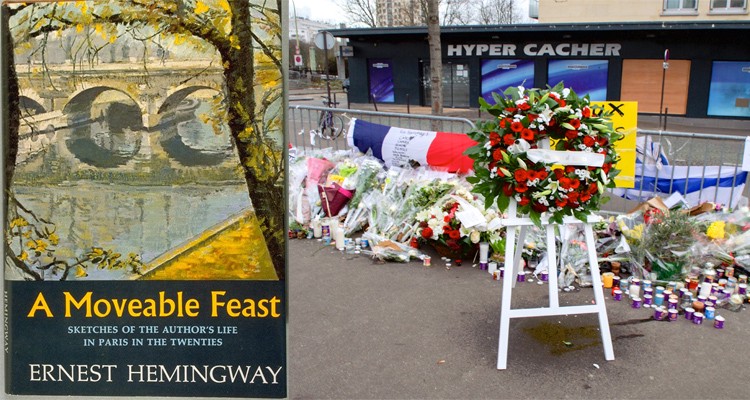
In the weeks since the attacks on Paris on November 13, Ernest Hemingway’s A Moveable Feast has become a symbol of defiance and resilience in France. And it’s selling out of bookstores. Among the candles and flowers that are being left on the sites of the attacks, Parisians are also leaving copies of the 1964 book.

A Moveable Feast is based on Hemingway’s experiences living in Paris in the 1920’s, which he remembers fondly: “We ate well and cheaply and drank well and cheaply and slept well and warm together and loved each other.” Since the attacks, which targeted restaurants, Parisians have been reclaiming their café-culture with hash tags like #TousAuBistro, and #JeSuisEnTerrasse, meaning “everyone to the bar” and “I’m at the terrace.” In light of this, it makes sense that a book celebrating the nightlife and culture of Paris would become important to its people.

Indeed, the rise in sales for A Moveable Feast has been incredible, with French publisher Folio claiming the book went up from 10 to 15 sales per day to 500. The publisher is printing 20,000 additional copies. The book is also No. 1 on French Amazon.

Some claim the book’s surge in popularity is owed to a TV-interview with a woman only identified as Danielle, who said that just as important as bringing flowers for the dead was leaving copies of A Moveable Feast, or Paris Est Une Fête (Paris is a Party) as the book is titled in French. Danielle went on to say that France is an old civilization that will uphold it’s values. Danielle’s interview has become a viral sensation in France.

No matter what the reason for the books popularity, it is lovely that Parisians are using it to remember what’s great about their city in the midst of these terrorist attacks.

Geek Reads: The Disney Empire Strikes Back

In advance of the release of Episode VII in December, an avalanche of new Star Wars books has begun. Have you felt it? There are novels and comic books, with many more illustrated histories and sticker books for fans of every age demographic on the way. The marketing juggernaut is impressive, most impressive. I’m not sure that I’m going to read every new book, but I’m also not sure that I’m not going to.

When it comes to Star Wars, I am an unabashed and unapologetic fan even with the full knowledge that I am being manipulated with cheap nostalgia. I’m OK with that, because I’m also being entertained by stories I wholeheartedly enjoy. As I’ve written elsewhere, the first Star Wars toys were vitally important to the beginnings of my own writing life. So too will the new stories and tie-in products inspire a generation of writers. I’m sure of it.

At their best, the Star Wars stories participate in the age-old tradition of epic storytelling. Since the clay tablets of Gilgamesh, humanity has told and retold the tale of a hero who leaves home to face tough challenges, make friends, and defeat the bad guy before returning safely (albeit having undergone some transformation) to Uruk, Ithaca, 7 Eccles St., the Shire, or Tatooine.

Since the clay tablets of Gilgamesh, humanity has told and retold the tale of a hero who leaves home to face tough challenges, make friends, and defeat the bad guy before returning safely (albeit having undergone some transformation) to Uruk, Ithaca, 7 Eccles St., the Shire, or Tatooine.

The basic tropes and archetypical characters of the canonical Star Wars stories (wizard and child warrior, pirate and princess) feel familiar to anyone who has read Tolkien or Rowling, Martin or Greek mythology; the tale is timeless and every generation gets its own version. For me and many Americans who grew up in the 1970s, I first encountered the hero’s journey — as Joseph Campbell called it — in a movie that was at first called Star Wars and has since been rebranded as Star Wars: Episode IV — A New Hope.

What has changed, even in the few short years since Tolkien’s time, is evident in that new and ungainly title: commercial marketing.

As a property of the Walt Disney Company, Star Wars is above all else a commercial entity with the sole purpose of making money — that is, of taking money out of my wallet and giving it to Disney shareholders. It would be easy to be cynical and believe that the countless, profitable, and officially-licensed BB-8 toys are what really matter to Disney and the stories only exist to keep the droid factories pumping out more products.

At this particular moment in time, however, 23 days before The Force Awakens hits theaters, I still believe that the movies — unlike the three prequels — are going to be glorious. That the Disney Empire is going to continue to tell timeless stories and update them with exciting new wrinkles. My hope is that they will also become more inclusive and culturally sensitive, and the new movie posters indicate that that’s happening. Some of the new stories will likely be better than others, but it’s also true that some of the Gilgamesh tablets are terribly dull.

Star Wars aftermath

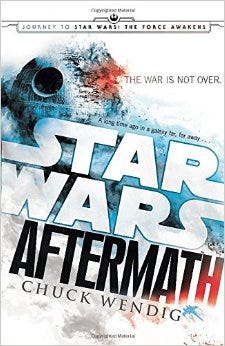
To pass the time until opening night, and for the sake of this column, I will be reading many of the new Star Wars novels, comic books, and whatever other literary (or to some snooty critics like myself, pseudo-literary) publications I find. The first book in the pump priming “Journey to Star Wars: The Force Awakens” series is the novel Star Wars Aftermath by Chuck Wendig (Del Ray, 379 pages, $28). There exists no literary criterion by which I could call this a great novel — and yet I enjoyed it tremendously. Considering that I read it in two sittings, the problem is with my own critical faculties and not with the book. That’s a topic I will look at in future columns.

There exists no literary criterion by which I could call this a great novel — and yet I enjoyed it tremendously.

Set right after Return of the Jedi, the plot of Aftermath sounds a bit like a rewritten episode of the excellent cartoon series “Star Wars Rebels.” It follows the odd-couple adventures of a former Rebel pilot and a former Imperial officer who team up in an attempt to prevent the Galactic Empire from re-forming after the death of Emperor Palpatine. Wendig does a nice job of keeping the plot moving and making enough familiar references to previous Star Wars characters and events to sound authentic, and he does so despite what I can only imagine was a very difficult assignment.

As I understand it, there exists a new Lucasfilm Story Team whose job it is to create a new, consistent canon within the Star Wars universe. I wonder if that means that Wendig and authors of future books are handed the basic plot outlines and given the tough task of bringing them to life. To complicate that further, because the book is set between two movies (in this case Return of the Jedi and The Force Awakens) readers can be fairly confident that very little of real substance is going to happen. We know that all the important events will be depicted instead in the movies, which will have vastly larger audiences. That aside, it turns out that the real reason for Star Wars fans to read Aftermath is the series of short interludes set throughout the galaxy and featuring characters old and new. Those are excellent and might be hinting at some things to come in Episode VII and beyond.

Aftermath does manage to fill in some details about characters we haven’t yet seen on the big screen, but it’s not going to spoil anything for us. The book has to be captivating without really saying much of anything — and it is. In terms of storytelling, that’s a tough tightrope to walk and I have an enormous amount of respect for Wendig and any writer who can sustain my interest so elegantly in such circumstances.

What Women Can Learn From Reading Sexist Male Writers

The other night, a fellow novelist leaned over and confessed to me, in the hushed tones of one confessing to a murder, that she liked Jonathan Franzen. Liked his books, that is. She eyed me nervously and braced herself for the feminist smackdown that, she feared, I was about to unleash.

Instead I laughed and said, “Don’t worry, it’s okay — I like him, too!” She smiled with relief. Professing your love for Franzen’s books — even if you simultaneously acknowledge his personal shortcomings re: Jennifer Weiner interactions, baffling bird obsessions, anti-technology curmudgeonliness — feels like a risky move these days. Especially in progressive literary Brooklyn.

Then she told me how, after reading The Corrections, she posted a status on Facebook calling the book a masterpiece. She wanted to push back against all the criticism of Franzen’s supposed sexism, even though she worried that female friends might ostracize her for it. “I know this sounds silly,” she recounted, “but doing that felt like a brave act — like political activism.”

Her story confirmed something I’ve been suspecting for a long time: We’ve created a literary climate where women are scared to admit that they enjoy a male writer’s work, because some other women have accused him of sexism.

I’d already heard stories along these lines from friends who’d been castigated for reading Philip Roth. But Franzen? Franzen, whose character Denise’s storyline in The Corrections is among the best depictions I’ve encountered of queer female desire? Whose first 50 pages in Freedom form one of the strongest indictments of rape culture I’ve ever read? When he has “woman trouble,” I can’t help thinking that our liberal bubble has become so ideologically rigid that we’ve stiffened into a profoundly illiberal stance.

Take feminist writer Rebecca Solnit, who recently published a piece in Literary Hub titled “80 Books No Woman Should Read.” Solnit suggests with some self-aware hyperbole that, as a woman, I should swear off reading a slew of male authors, from Ernest Hemingway to Charles Bukowski to Henry Miller to, yes, Franzen. She places a bunch of literary heavy-hitters in her “no-read zone” because “some books are instructions on why women are dirt or hardly exist at all except as accessories or are inherently evil and empty.”

To be fair, Solnit is riffing off the Esquire list “80 Best Books Every Man Should Read,” which really is terrible. She foregrounds her piece by saying “of course I believe everyone should read anything they want.” Her tone is tongue-in-cheek; she’s clearly presenting a rhetorical construct. Still, she’s using that construct to make a real argument about not reading sexist writers, and it’s an argument with which I wholeheartedly disagree, on feminist grounds.

First off, you can read an author, judge him sexist, and still learn something valuable about the human condition from his book. It’s pretty insulting to women’s intelligence to imply that we’re incapable of separating out the good from the bad in these works. I’ve read Bukowski and Miller and have had no trouble taking the wheat and leaving the chaff. I suspect most women are the same way. We almost can’t help but become experts in this sort of literary winnowing, precisely because 99% of the books humanity has thrown at us contain that chaff.

This is especially true for those of us with multiple marginalities. I am a queer, non-white, Jewish young woman. If I had to excise from my library every book whose writer was homophobic, racist, anti-Semitic and/or misogynist, my shelves would be pretty much empty. Everything from the Bible to Heidegger would land in the trash. Hell, I’d even have to toss out a writer Solnit admires, F. Scott Fitzgerald — remember Meyer Wolfsheim, the Jewish gangster who stalks the pages of The Great Gatsby wearing cufflinks made from human teeth?

But I haven’t thrown out these books, because I actually believe that we women have something to gain from reading sexist male writers.

Genuinely sexist works can give us insight into the history and logic of sexism. That’s important, because you can’t defeat something without first understanding what it is you’re fighting. Plus, these books help us understand the forces that shaped women of a certain time and place. Reading Miller gives me a window onto the sorts of attitudes his lover, Anais Nin, had to contend with — and also sheds light on the flaws in her own writing (see under: gender essentialism).

If reading sexist male writers is recommended for women readers, it’s downright compulsory for women writers. We need to be intimately aware of that language, need to speak it backward and forward, so that we can make our own books relevant and, ideally, cleverly subversive to boot. If I hadn’t spent years growing up in the Orthodox Jewish world and becoming fluent in that religion’s deeply misogynistic ancient texts, I’d never have been able to turn the misogyny on its head by having my female protagonist best her dad at Kabbalah in my novel, The Mystics of Mile End.

Adelle Waldman, author of The Love Affairs of Nathaniel P., has told audiences that she was able to channel her sexist male protagonist’s voice in part because she’s read so many books by sexist male writers. (Incidentally, she likes Roth and Franzen.) She subverts her character’s sexism by revealing it subtly, page by page, allowing him to incriminate himself and the male literary establishment he represents.

Waldman has also pointed out in interviews that “there are things that men can’t say in their novels because they would be accused of misogyny, but I can say them.” That raises a worrisome question: Do we give women more latitude when it comes to writing sexism, offering them the benefit of the doubt even as we jump to excoriate men, who often get conflated with their male characters? And if so, isn’t that the opposite of progressive?

Which brings me to another reason for reading male writers accused of sexism: Sometimes they’re not really sexist — they’re actually in on the joke.

Junot Díaz is a case in point. When his collection This Is How You Lose Her came out in 2012, many accused him of sexism because his young Dominican narrator, Yunior, spewed it on nearly every page. But others leapt to Díaz’s defense, arguing that the author is trusting us, the readers, to deconstruct the sexism of the text as we read. And that may just be profoundly feminist of him.

I’m in the camp of those who read Díaz sympathetically — I actually believe he did a brilliant job of revealing and critiquing sexism, without being didactic — but I still think it’s valid when people argue that, no, he only revealed sexism, he didn’t properly critique it. What’s not valid is when people hear that so-and-so author is sexist and, without so much as reading a page, ship him off to this indefensible place, “the no-read zone.”

The Most Revealing Thing I Can Say: An Interview With Mary-Louise Parker, Author of Dear Mr. You

I may as well play with my cards face-up here: I’m something of a devotee of Mary-Louise Parker’s; devotee sounding somehow more mature to my ear than, say, “superfan.” I was a freshman in high school when Weeds premiered, and I had a suspicion, just from watching the pilot, that it would come to mean a great deal to me over time. And it has. (I even have a tattoo on my wrist that is the title of my favorite episode, “Go,” in which Nancy Botwin, inspiringly, burns down her house; a reminder to myself to burn down all the figurative houses I need to.) As the only child of a single mother, it was extremely meaningful for me to see a single mother in celluloid portrayed with such humanity — flawed, surely, but never vilified for it. My mother and I would laugh at how eerily similar Nancy Botwin’s relationship to her oldest son, Silas, was to the relationship we had. (Though, I should say that my mother never dealt marijuana nor did she ever marry a Mexican drug kingpin.) By the time the series ended, I was a senior in college, and I remember vividly how much I wept during the final scene, which is, for my money, one of the great endings in TV. I’ve also had the good fortune to see Parker on Broadway, in stellar productions of Ibsen’s Hedda Gabbler and Sarah Ruhl’s Dead Man’s Cell Phone.

So, suffice it to say that when I heard Parker was releasing a book of essays, I was ecstatic. I had high hope and high expectations, and Dear Mr. You more than exceeded them. It’s a stunning, accomplished work, gigantic-hearted and wise and acerbic and vulnerable. The sentence-level writing is staggeringly good, too, and after having read it three times now, my primary impression is that it’s deeply unfair and greedy for one person to be this skilled at so many things. Written as a series of letters to men — including letters to her father, a cabdriver, an orderly at a hospital, and three exes she addresses as Cerberus, among many others — Dear Mr. You is expertly crafted, unforgettable, and hopefully only the beginning of Mary-Louise Parker’s publishing career.

Having the chance to speak with Parker over the phone was nothing short of euphoric. She was so gracious with her time, and so thoughtful in her answers. If you want to see this chat continue in person — and also happen to live in or around Austin — I’ll be in conversation with Parker at Bookpeople, January 12th, at 7pm. She also has tour dates in New York, Boston, Iowa City, D.C., San Francisco, L.A., and Dallas.

Vincent Scarpa: I was so excited when I saw Dear Mr. You had a release date. And then I read Mary Karr’s gorgeous blurb and was doubly excited. After reading it three times, I just can’t say enough good things about it. I think many are going to be stunned by how brilliant a book it is — not “good as far as celebrity memoirs go,” but brilliant far beyond that distinction. But I myself had high expectations going in because I saw you speak with Ryan Adams at the New York Public Library in 2009 and thought, Anyone who knows the importance of Elizabeth Bishop’s “In The Waiting Room” knows what’s up. And I knew, too, that you’d read one of my very favorite stories of all time, Amy Hempel’s “In The Cemetery Where Al Jolson is Buried,” for the audiobook of David Sedaris’s anthology Children Playing Before a Statue of Hercules. So, in my mind, you’d always been in the literary crowd, and I’d always been awaiting the arrival of this book, well before it was announced. All that to say: I’m wondering how exactly this book came to be. How long ago and in what context were you approached?

Mary-Louise Parker: People had approached me a couple of times over the years, but I think they wanted me to write a different kind of book. I think they wanted it to be more typical, and more about me, and I wasn’t really interested in writing about me at all. The fact that I wrote about me as much as I did in the book was really surprising in the end, but that’s the book that evolved out of what I thought were these two related pieces I’d written for Esquire. They asked me to write about men and it came out as a letter and I really enjoyed writing it. I felt like I could’ve kept writing that letter for about a decade, forever, for the rest of my life. And then they asked me to write about my father and that initially, oddly, came out in letter form, too. I thought there was something to that direct addressing of the male. Different people started occurring to me, so I wrote a few more. And I was trying to figure out how it would be a book.

I kept meeting with literary agents and not really connecting with them. And then I met Eric Simonoff and he was just like this zen master. He just said all the right things. I didn’t know anything about publishing. In fact, when we got responses from publishers and I was talking to them, the only way I could understand it was by asking, you know, “If Journey was a publisher and Tom Waits was a publisher, or, if Barbara Streisand was a publisher and Rickie Lee Jones was a publisher, which one would this be?” I had to be told, you know, this is the Elvis Costello of publishing, this is the Tom Waits of publishing. Treating it that way made things very clear to me, and it’s still the easiest way for me to understand the individual publishing houses.

VS: I’d love to talk about the form of the book. I don’t believe I’ve ever read a memoir-in-letters before. If one even exists, I don’t know about it. What about the idea of an addressee — the notion of writing for or toward someone — was liberating for you in the process of writing and putting together the book? Conversely, did that constraint ever feel like it was limiting you in any way?

…if I know what the framework is then I know how to make it my own.

MLP: Never, no, it was completely liberating. I’m someone who likes to have really clear boundaries so that I can break them, or twist them, or whatever, but if I know what the framework is then I know how to make it my own. Much of my existence has been very driven by my awareness of men — where they fit into my life and where I fit into theirs — but it was really just about humanity in general, how we sift through our memories. It’s funny, the people that remain. It’s not always the people you would expect. There are people that were hugely important in my life that I wanted to write a letter to, but that letter didn’t necessarily come. There were very obvious people, also, but I felt I’d already said everything to them. But then, you know, some guy I knew at a health food store thirty years ago — for some reason he just loomed really present to me, really specific. He was sort of iconic in my life and stood for a lot of things, and that time period stood for a lot of things.

A lot of it I didn’t understand until I wrote it. Like the letter to my movement teacher in college. There were teachers at school who I was really connected to and who I loved and who I had stronger relationships with, but that relationship affected me the most, in a way, because it was someone who didn’t like me. And I learned from it. I learned from him letting me change his mind about me. So, yeah, it wasn’t always the people who you’d think but it was very, very freeing, to answer your question.

VS: Was that the case with “Dear Popeye,” which is one of my favorite letters in the book?

MLP: “Popeye” was more like a rush. It was almost more of an orgasm in a way. Or orgasmic, not orgasm. It came out like sex.

VS: And it’s one of the best-written sex scenes I’ve read, truly. They’re incredibly hard to write.

MLP: Thank you! They really are. I loved writing about sex, the same way that I like acting it, because it’s something that’s usually so generalized, but the more specific you get with it, the more interesting it gets.

VS: I’m assuming that none of these letters were ever sent, so I’m wondering if you see publication as a sort of stamp on all of them, sending them all out into the world at once?

MLP: Oh, what a good question. Yes, in a way, but obviously with some of the most important ones, that person might not necessarily recognize it’s them. I think some of the other ones deliberately won’t be read. “Dear Neighbor” I gave to my neighbor for his birthday and he loved it. I gave “Dear Abraham” to Abraham — he’s the only one in the book whose actual name I used. I didn’t know what else to call him and he just said, “Call me that!” I told him today that I got a note from someone who said they’d read the book and that “Dear Abraham” made them cry and he said, “What a load!”

VS: Memoirs written by the famous are often turned to with expectations that they will be “revealing.” No one is so enlightened, I don’t think, as to be immune to gossip or juicy details. I know that I personally bought Catherine Deneuve’s diaries solely because I’d read that she discussed the turmoil of working with Bjork on Dancer in the Dark, and I obviously needed to read about that. But I think what’s so amazing about this book is that, yes, some of the content is “revealing,” but it’s really at the level of language where you’re at your must vulnerable and risk-taking. I’m wondering if you ever felt a pressure toward disclosure of a variety that you weren’t interested in; it seems like you’ve been approached to write that kind of book. I love what you say at the end of “Dear Mr. Cabdriver”: “It was, in the end, much worse and more necessary than I would be willing to reveal, which is probably the most revealing thing I can say.”

The things that are omitted — some are omitted because I didn’t want to write about them, and then some are omitted because I wasn’t inspired to write about them. But I was in control of it.

MLP: I think you’re right. That statement is one of the most revealing things about me, because it’s basically saying, “I’m not going to tell you anything I don’t want to tell you, and the things I don’t tell you are far more revealing about me than the things that I do.” The things that are omitted — some are omitted because I didn’t want to write about them, and then some are omitted because I wasn’t inspired to write about them. But I was in control of it. So were I writing about my life, it would be a much different book. And were I writing a memoir about my life that I wanted a lot of people to buy, because it was salacious or something — and I couldn’t do that — I think it would be a very interesting book for people who wanted to read that kind of thing. But that kind of stuff is not in this book. In fact, when my agent sent out some of the pieces, he sent them out blind, without telling the publishers who wrote it, and they had no idea it was me, or that it was even an actress necessarily.

VS: The way that you write about your children is so beautiful, so moving. Maybe my favorite line in the book is when your son says, in response to a woman in the park who has called you stupid, “Mean lady, you are the F word.”

MLP: Isn’t that hysterical? And you know what, the other day I found my journal from back then and they also called her “a dammit.” I wish I’d seen that journal, I could’ve put that in! My daughter said, “You are a dammit!” In the audiobook, my son says that line. He came into the studio and read it.

VS: That was actually one of my questions, whether or not you were reading the audiobook for this.

MLP: I didn’t want to and I kept absolutely refusing before I’d even finished the book. I said, “Just so you know, I’m not reading the audiobook.” And I famously say, “I’m unequivocally never doing this,” and then cut to me completely doing it and saying, “Oh, this isn’t so bad!” I didn’t think I’d be able to read “Dear Oyster Picker” [the final essay] without crying. But I think it came out all right.

VS: You say you tend to gravitate more toward poetry and the short story. I wonder if you might rattle off some practitioners of either form whose work you feel fed or known by. Who should we not fail to read?

MLP: My absolute favorite is Mark Strand. He was my guy. That was a big blow when we lost him. I loved him so, so much. Who else? Wallace Stevens. Kevin Young — I just read Book of Hours, which I thought was beautiful. I like Sharon Olds. I like this guy Andrew Zawacki. I like Phillip Levine a lot; I have one of his poems stenciled on my wall. And I actually have a Stanley Kunitz poem on my wall in the country as well. I like Charles Simic. I love Tory Dent’s What Silence Equals. I love Galway Kinnell — his poem about 9/11 (“When The Towers Fell”) is one of my favorite poems. One of my favorite lines of a poem ever is in the midst of that poem when he says “Sorry, sorry, good luck, thank you.” I love Bob Hicock — he has a great poem called “Duh.” You should look that up, I think you’ll like it.

For short stories, well, I love Lorrie Moore, but I guess everyone loves Lorrie Moore, don’t they? I love Edna O’Brien. I love Deborah Eisenberg. I love Primo Levi; people don’t talk about him enough. I loved This is How You Lose Her.

And they’re not stories, they’re essays, but I just loved The Empathy Exams. It’s just so great. I love a writer where sometimes I feel like they’re shouting a little bit. I can tell when she’s quiet, when she’s confused, and when she’s getting louder, like in that essay “The Grand Unified Theory of Female Pain.” I mean, god! She’s spectacular.