I Know It’s Only Science Fiction, But I Like It

Science fiction became rock and roll for me when I was seventeen, in the summer of 1999. Just before heading into my senior year of high school, I was pulling shifts at a big-box bookstore in Phoenix, Arizona, where I’d close the place four nights a week with my manager and personal hero at the time, Captain Space Pirate.

Outrageously handsome, thirtyish, with a dark mop of hair and a beard, and always dressed all in black, Captain Space Pirate was basketball-player tall, but hunched over in the way he’d probably done since burying his nose in books in grade school. This gave his handsomeness an Ichabod Crane resemblance. I didn’t know about Space Pirate Captain Harlock — the anime character — at the time, but that visage plus a beard isn’t far off. He drove a motorcycle to work and wore a black leather jacket, which, when taken off, revealed his black button-up and black skinny tie. He was a superhero mash-up of the Hamburg leather-wearing Beatles you see in those really old photos and the clean-cut Beatles on Ed Sullivan. And because he was the only person back then who knew more about Star Trek and Star Wars than I did, Captain Space Pirate was about as rock and roll as it got.

This might not be exactly proof that he was cool, but my mom totally had a crush on him. Though I usually drove myself to work in my 1987 Gold Dodge Ram 50 pickup truck — complete with an X-Wing fighter window decal, unironically affixed above a sticker for the band Oasis — one day I was forced to carpool with my mom so she could take my truck on some other errand after dropping me off. On that day, she went out of her way to go into the bookstore and give my boss, Captain Space Pirate, a hug. “It’s the smile,” she’d say when talking about him later. “He smiles like Indiana Jones.”

Captain Space Pirate told me he’d long ago dated one of the actresses from Buffy the Vampire Slayer before she was famous, but wouldn’t tell me which one. He told me he’d seen eleven different cuts of Blade Runner the year it was released. He told me that the novel version of Star Wars: From the Adventures of Luke Skywalker, by George Lucas, was really written by a guy named Alan Dean Foster, even though Lucas’s screenplay came first. Captain Space Pirate’s girlfriend was only a little bit older than I was and I thought their age gap was terribly odd, but I internalized it all as part of what made my manager great. At that point, his girlfriend knew more about vampires than anyone I’d known.

He also gave me a break. Technically, Captain Space Pirate shouldn’t have hired me at this bookstore at all, because it was against the larger company policy to take on anyone under eighteen. But he’d given me a job because I’d consistently attended the geeky gaming nights and Star Wars book club stuff since the age of fourteen. When I got the job, I couldn’t believe my luck: I was getting paid to read books and talk about Star Wars all day long. I was beginning my rock-and-roll fantasy of living in the protected world of geeky stuff I loved, surrounded only by people who “got it.” And, prepare to be shocked: plenty of my co-workers claimed that they did in fact “get it.”

The year 1999 was a very good one for hot-blooded geeks getting their ire up about all the things they hated to love and all the things they loved to hate. If you’ve seen High Fidelity, then you’re familiar with a certain amount of overly informed pseudo-intellectual banter that pervades a place where people are way more into the things than the people they’re selling them to. Jack Black’s character, Barry, epitomizes this in High Fidelity: someone who is such a snob that he won’t sell a certain record to a patron because the patron doesn’t like it the “right” way. At my bookstore, we had four sci-fi Barrys on any given shift, all quick to cut me down to size about my severely underdeveloped opinions on everything from Star Trek to Babylon 5 to the death of Superman to whether or not the Dune series is inherently ruined by virtue of the fact that it’s read at all. Back then (and occasionally, shamefully, now) I was sometimes that guy, too, the snob accidentally lecturing someone about the “real” Buck Rogers or why a certain interpretation of Batman or Sherlock Holmes “sucks.”

Captain Space Pirate, however, was too soft, too sweet, to correct me the way some of the other angry clones would. He wasn’t bitter or jaded, but instead steady and tolerant of my nerd-rage outbursts. If I wanted to pretend to know everything about the history of werewolf films, Captain Space Pirate would simply allow me to embarrass myself on my own, letting me stick my own monster-clawed foot into my ignorant young mouth.

Notably, for complicated hormonal, contrarian reasons, I’d decided to come out as an iconoclast and pretend like I totally hated the at- the-time-brand-new movie The Matrix, even though, objectively speaking, it was awesome. In case you forgot: The Matrix is a 1999 movie in which Keanu Reeves lives an ordinary, boring life, only to learn his real life is fake and everyone in the world is actually strapped into a big old computer program being controlled by aliens. And the jam is, once Keanu is in the good part of “the Matrix” he can do all sorts of crazy kung fu stuff and essentially turn into a rapid-punch video game character while listening to songs from Rob Zombie, Marilyn Manson, or — wait for it — Rage Against the Machine. And very lazily, I hated it. I told myself that this whole Matrix thing was messy and filled with bad angsty music, which made it all way too close to home. The Matrix was science fiction, but because I personally couldn’t actually escape into it, I decided it didn’t do science fiction “the right way” and overreacted by telling all my fellow Barrys that it was “crap.” The easiest way to do this was to make claims leaning on a fake sense of superiority and imagined sci-fi education I affected that I already possessed. I’d say things like “it’s not original” and then sort of just imply that everyone knew there must be some sort of crusty old sci-fi text from which The Matrix ripped off all its good ideas. To be clear: I wasn’t actually sure this was true, but chose to act like I was right anyway. It’s backward science: here’s my hypothesis, don’t bother checking my research, and now, let me get mad that you don’t agree! I guess I figured everyone else was totally full of shit, too, and since no one was really keeping track of this stuff, it probably didn’t matter if I was right or wrong about The Matrix. The thing to do was to have an opinion, and if you were a true geek, the default opinion was probably always going to be negative. This, more than anything, explains the painful popularity of the character of Comic Book Guy on The Simpsons, who is always dismissively declaring everything the WORST THING EVER!

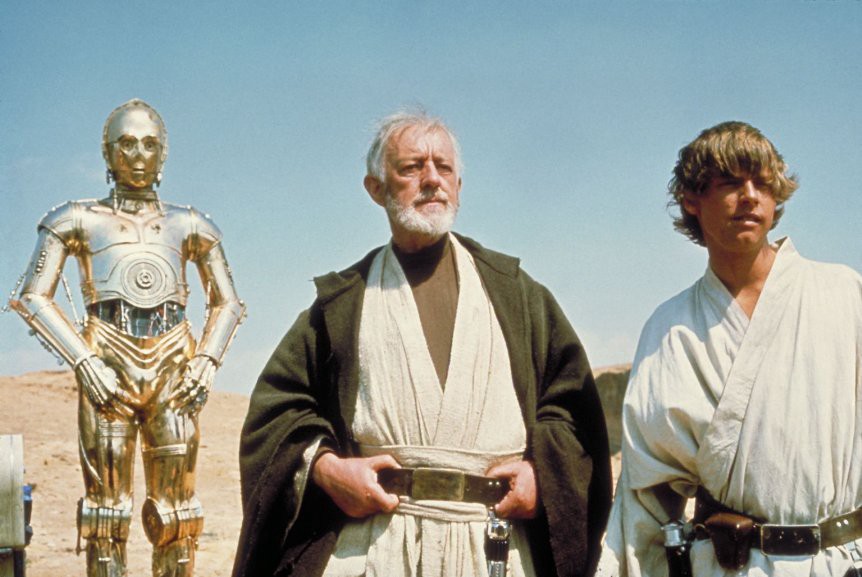
I imagine I made life very difficult for Captain Space Pirate with all of my bullshit back then. Probably one of the reasons Luke Skywalker is such a compelling character is because Mark Hamill plays him so specifically without irony in the first Star Wars film. Luke alternates between eager to please one minute and whiny and questioning the next. It might seem like an inconsistency in his character, but it’s beautifully accurate to what it’s like to be young and a “rebel without a cause.” Even before the Imperial Stormtroopers murder Luke’s family, he’s a frustrated, angry person. Once his aunt and uncle are reduced to smoking skeletons, he’s got an excuse, but most of us don’t have that. We’re just pissed-off adolescents. Maybe you were, but I was, definitely. There’s a great Louis C.K. joke about how guys on first dates try on “all kinds of other guys,” while attempting to figure themselves out, and I think that’s what Luke Skywalker is doing in his first outing, and I think that’s what a lot of us do as teenagers. Regurgitating half-baked opinions from things we’ve read, while trying to piece together what kind of person we might be. Luke had Obi-Wan Kenobi to steer him in the right direction, and I had Captain Space Pirate.

As far as actual work-in- the-bookstore stuff went, Captain Space Pirate didn’t run a tight ship at all, and I often got the impression that he was under a lot of pressure from his corporate superiors to get his merry band of disaffected nerds to actually shelve the books properly. You’d think the Star Wars books would be organized. And because I was generously assigned to organize the science fiction and fantasy book section, you’d think that I would have made sure everything there was tops. Instead, it was a mess. An unruly joke factory, a bookseller’s nightmare combined with the kind of disorganization necessitating hypnosis for librarians to repress.

I’ll never know if Captain Space Pirate sabotaged his motorcycle that one night, or whether it genuinely wouldn’t start, but the net result was that I had to give him a ride home, and we had to load his motorcycle into the back of my pickup truck. Captain Space Pirate lived forty-five minutes away in a housing community where he was that guy on the urban- planning board who would wonder aloud why they wouldn’t let him paint his house all black. We talked about this a little on the drive, but also about work. This is when he asked me why my section wasn’t really as organized as it could be.

“So what’s the deal with the Star Wars books?” he said, and my memory has added that he’s holding a cigarette, even though he really didn’t smoke.

“What do you mean?” I said, merging onto the U.S. 60 while turning down “One Headlight,” by the Wallflowers, on the radio.

“It’s a fucking mess, man.”

“Is it?”

“Yeah,” he said. “And you know, I don’t really care, but I thought you’d at least try a little harder when it came to the things you’re actually interested in. I mean, of all the people that work there, you’re the most qualified to make that section look better.”

“But nobody cares, man,” I said, feeling guilty, and doing what all teenagers do when they’re guilty: fight back.

“Well, I care.”

When Captain Space Pirate threw a Luke Skywalker quote back in my face, I knew something needed to change. I realized something right then that would inform how I viewed not just my own adult life, but science fiction and fantasy specifically. The angry nerds we worked with at the bookstore might not care if the Star Wars books were organized properly, and the average customer might not give a damn either, but Captain Space Pirate noticed and I should, too. Just because something is silly, or is involved with dubious standards of legitimacy — like science fiction and fantasy — doesn’t mean you don’t take it seriously. Which is exactly like real rock and roll.

Living a rock-and-roll lifestyle sometimes means sex, drugs, and being irresponsible, but people have to take their music seriously to actually exist, to matter. You know, to be rock stars. Being angry or contrarian about sci-fi and fantasy wasn’t enough. My friend and mentor was holding me to a higher standard, one that meant I wouldn’t devolve into being someone who just started arguments by declaring something was or was not “the worst thing ever.” Being rock and roll means a little more than just breaking guitars on a stage, since you’ve got to know how to play that guitar in the first place. And thanks to Captain Space Pirate, I realized a lot of our buddies were just breaking guitars without knowing what to do with them. Science fiction and fantasy was our rock and roll and it was up to us to do it right.

By the time I turned eighteen, that particular corporate bookstore had an incompressible magazine section, a ridiculously mis-shelved philosophy section, and a self-help section that would actually cause people to have new emotional breakdowns. But the science fiction/fantasy section was now meticulous. In an era before Wikipedia could guide me, I’d created subgenres other branches of our chain bookstore wouldn’t have dreamed of, and within a specific author section, the book titles were no longer shelved alphabetically. No, no, no. Now, those titles were shelved in publication order, meaning back then, we had The Chronicles of Narnia in what many today would consider the “right” order.

When it came to the Star Wars books, though, doing it by author or publication order made zero sense, and here, Captain Space Pirate was super-impressed with what I’d come up with. Back then, when the Internet was more like a bad special effect than something pervading our real life, I’d put the Star Wars books in an order I’m fairly confident existed only in a handful of other places at the time. Just as John Cusack’s Rob organizes his records “autobiographically” in High Fidelity, I put the Star Wars books in a specific reading order; each section told the specific biography of a particular character. There was a small Han Solo section; a section for books that were more Princess Leia–centric; a section for some of the anthologies out at the time that focused on the minor, briefly seen characters; a Chewbacca section; plus larger stretches of shelves for Luke, and his dad, Darth Vader.

Meanwhile, was I right about The Matrix? Well, as a real adult, I’ve come up with a fairly comprehensive Matrix rip-off list, including a good chunk on William Gibson’s cyberpunk stuff and the famous 1967 Harlan Ellison story “I Have No Mouth and I Must Scream.” In that particular short story, people are tortured by a gleefully malevolent computer program that hates them. The story ends with a dude literally being turned into a blobby thing that doesn’t have a mouth, like Keanu losing his mouth at the start of The Matrix.

I’ve never lost my big mouth, but I did figure out having one wasn’t the thing that made science fiction like rock and roll. Instead, you had to really be cool to be cool. Like Captain Space Pirate, I figured out the best way to look at this stuff is to wear your leather jacket over your button-down and tie, and to talk about science fiction like it is the only thing that matters, but know your stuff, too. Even if you loved Star Wars, you probably wouldn’t have noticed my bizarrely nuanced shelving system, which evokes that age-old question: if you can speak perfect Ewokese but there’s not an Ewok around to hear it, does it still count as perfect? I think Captain Space Pirate knew the answer, and after that summer, so did I.

This essay is excerpted from Luke Skywalker Can’t Read: And Other Geeky Truths, which will be published this week by Plume.
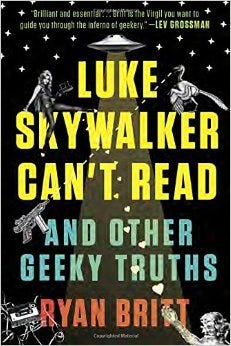
Ryan Britt book

Fortunes and Flaws: The Weight of Things by Marianne Fritz

There’s a moment, in certain works of fiction, where certain pieces fall into place. It’s a difficult thing to pull off: it can leave a reader bewildered for long stretches of time, wondering why, exactly, certain information hasn’t been revealed, or why certain narrative quirks exist. The Weight of Things, Marianne Fritz’s first novel (and her first to be translated into English), begins in what seems to be familiar territory, following a group of young Austrians in 1945. We know that their fortunes have been shaped, and will continue to be shaped, by their nation’s absorption by Nazi Germany and participation in the Second World War. But the approach that Fritz takes in this novel is anything but naturalistic: it’s a stylized book with numerous horrors at its core, both national and personal.

In an afterword, translator Adrian Nathan West discusses Fritz’s literary works and the reception they received over the course of her life. (Elfriede Jelinek and W.G. Sebald were admirers; Thomas Bernhard was not.) And West delves into Fritz’s wrangling with Austria’s history in the 20th Century, from the First World War and on towards the rise of Nazism. “To Fritz,” West writes, “fidelity was to be found instead in the minute recreation of a society down to its very fundaments, and to this end, nothing was irrelevant.”

From the novel’s opening lines, that recreation is visible. “Of all of the events of 1945, there was one Wilhelmine recalled with particularly painful clarity,” the novel begins–but the event in question is one of romantic entanglement, rather than any of the larger geopolitical issues that played out in Austria following the defeat of Nazi Germany. And in the second sentence, we learn that the source of Wilhelmine’s distress is, in fact, the action of a man named Wilhelm. Clearly, we’re headed into a more stylized territory here. A rough dynamic establishes four characters: Wilhelm; a young woman named Berta; Wilhelmine, who resents Wilhelm for choosing Berta rather than her; and a distant figure named Rudolf, stationed at the front as the book opens. That sense of stylized repetition will occur again later in the book, as a child named for Rudolf becomes a significant part of the narrative.

From its opening, the novel leaps through time, sometimes jarringly. Rudolf is dead in the war; Rudolf and Wilhelm are young men together. Wilhelm is working as a “chauffeur and Come-hither-boy” in post-war Austria; Wilhelm is married to Wilhelmine. And the flashes of information the reader is given about Berta can be difficult to process; the points at which she’s encountered do not, at least initially, seem to have a clear narrative line. The novel leaps around in time, from 1945 to 1963 to 1958, revealing fragments of these lives, even as the sense of repetition and duplication continue. It’s dizzying, but there’s a narrative reason for that disorientation, though it takes much of the novel’s (admittedly short) length to pay off.

Throughout the novel, there are also moments of terrifying surrealism, unfolding with a (sometimes literal) nightmare logic. Berta dreams of her son, bewildered and crucified, with a phantasmagorical array of figures below.

After the headless figure had spoken, the scattered groups merged into a single human mass. All of them had their heads at their sides, holding them in their heads and resting them on their hips. Each head was the same as the others. And all the heads resembled helmets.

It’s a bizarre and horrifying image, both terrifying and transgressive. It’s also one of the few moments in the novel where the war is directly acknowledged, and it echoes a later scene that flashes back to Wilhelm and the elder Rudolf’s time in the war.

Fritz’s novel slowly extracts how each of these deeply flawed characters came to be that way–a flashback to the childhood of young Berta provides some grounding for a series of harrowing sequences involving her later in the novel. The idiosyncrasies of The Weight of Things are numerous–though, based on West’s account, they seem relatively minor compared to the “neologisms, intentional misspellings, and readiness to violate the rules of grammar” that would turn up in her later work. It’s a fragmented, halting, somewhat broken narrative reflecting a society trying to reassemble itself after being complicit in some of the worst horrors in living memory. A more concise tone may have made for an easier read, but it wouldn’t have been as appropriate for the period in history that The Weight of Things chronicles.

A Pupa Wraps its Mitten of Fur Around the Word — New Poems by Kiik A.K

POETRY: Three by Kiik A.K.

about the author

Kiik A.K. does not perform often. But when he does it is an awful performance. We would like him to get out more or even leave his bedroom. But his bedroom is where pornography is. Especially a naked cowboy riding a green tractor. Pricing is customized to your needs. Under normal circumstances something happens that obligates him to give your money back. Contact Kiik for weddings, baptisms, funerals, circumcisions. But please never in that order. His limits may surprise you. As you watch a man die his foreskin turns to rust. The dust convulsing off a moth’s bulb paints the spirit in a thin gold film.

about the author

Kiik A.K.’s first book of poems made no impact whatsoever. The critics were not pleased by it saying we have no knowledge or record of her whatsoever. Kiik usually is a man. Unless no record of him exists in which case he is a woman. She was winner of The Youth Haemophiliacs Hospital Raffle. Kiik lives here lives in this room. When you run out the lights he comes in through the window and eats out of the garbage. Since he’s eaten garbage mostly for seven years it is quite accurate if you say Kiik is mostly garbage. When the lights come on Kiik gets himself real small and crawls inside this tiny box. A pupa wraps its mitten of fur around the word. The mouth of flour rubs its ghost over the flute. The angel of steam raises its palm flush to the barrel.

about the author

Kiik A.K. was born in a carwash atop a little wad of foam. For thirty-five years he was a curtain and a mitten. A robotic arm bullwhipped him while he rubbed his naked body into the spittle and jetsam of filthy mechanical wagons. He made millions. Later Kiik was promoted to bullwhip. He worked as a wrist loop, a thong, a fall and a cracker. He made millions. In his sixties, he retired from being a cracker and stayed at home to raise a family. He sealed up his family in his basement. When he was not busy being a family man, he paid for someone with massive arms to visit his home and choke him until he fell unconscious. He made millions. He died at the age of eighty-three having never attempted a single poem. His genitals were a mollusk plucked and dissolved like a little star of borax in the black seltzer of heaven.

These pieces are dedicated to the writer and humorist Jon P. Hoffer.

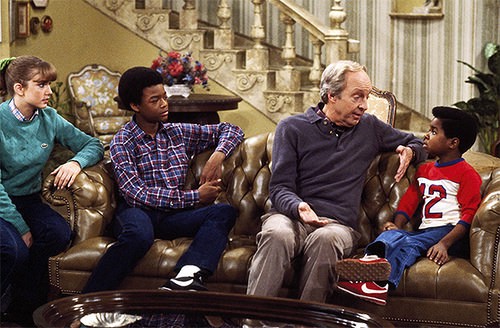
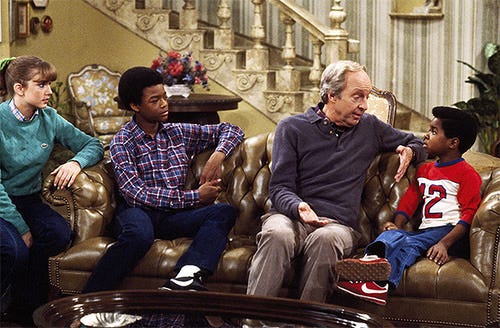
Diff’rent Strokes for Different Folks: How the 80s Approached What TV is Afraid to Talk About Today

by Ayize Jama-Everett

“Yo, Dudley a faggot!”

“What happened?”

“Some white dude did Dudley up the butt.”

“For real? Arnold too?”

“’Course not. But Dudley gay now.”

“It’s only gay if you like it. Dude that did Dudley was a grown-up?”

“Yup. A white dude who owned a bike shop. He was all friendly to Mister Drummond and shit, but then he was giving them drinks and showing them pornos. Arnold left. But Dudley was all about taking his shirt off and shit. Man, Dudley a faggot.”

“Man, if a grown up fucks a kid, it’s not the kid’s fault. It’s a pedophile. Dudley is only gay if he likes it and is like doing it with, like, Arnold or something.”

“Whatever, man. Dudley gay.”

That’s what my childhood friend got out of the very special two-part episode of “The Bicycle Man” on Diff’rent Strokes. I’m going from memory, rather than re-watching the episode on YouTube because I want to talk about how the show impacted two black kids living in the city where the show itself took place. Diff’rent Strokes often put episodes in front of us we were supposed to watch as a family. But not all families are the same.

The Harlem youth that we were — civilized in the best gifted and talented programs the public schools of New York could offer — simply could not understand why Dudley would allow himself to be alone with some old white man.

I clearly remember the conversation happening on the playground of P.S. 125, which borders Columbia University’s campus in Harlem, New York. The landscapes of Harlem and of popular culture have both changed since 1983, when the episode first aired. And just as the communal nature of Harlem’s black community has given way to capitalist market demands in the form of gentrification, so, too, the prime-time family slot on television has ceded its inelegant approach to societal issues to more commercially viable reality television.

The degree to which the producers were successful is, to me, almost irrelevant; without that episode of Diff’rent Strokes I’d never have had an opportunity to discuss my own sexual abuse. As a child, I’d been sexually abused by a black male babysitter. I never repressed the memory and as a result was fortunate enough to contextualize it as something wrong that happened to me that I wasn’t excited to talk about. Understand, that position was better than thinking it was my fault and obsessing about how to assert my masculinity, or completely repressing it and then wondering why I continued to get into unhealthy relationships. I treated it like one of the many beatdowns I faced as a geeky black kid living in a community that didn’t prize education. So when Omar called Dudley “faggot” it raised my hackles. Not because there was anything wrong being a faggot — in ’80s Harlem kid-speak, a faggot was just a particularly flamboyant gay man — but because he was wrong. Someone having sex with you didn’t change how you chose to act. I had a friend whose father was gay and knew that it only meant he loved another man. And I knew that what I experienced, what Dudley experienced, had nothing to do with pleasure. I knew I was right. I knew I could advocate for Dudley, and by proxy, myself.

I didn’t change Omar’s mind. In fact, he told everybody that I wanted to do Dudley “up the butt.” People came to me and laughed, then asked questions about the difference between pedophilia, homosexuality, rape . . . and somehow, incest got into the conversation. I wondered then and still do now, how many of those kids had been molested, but then I didn’t have the words, the sense of safety, or the support to talk about it. I hear even Todd Bridges, Willis on the show, felt awkward about the episode due to his own molestation.

I didn’t have all the answers. And I definitely had no answer for why the hell Dudley would stay with the old white dude in his basement watching porn with his shirt off, and expect nothing to happen. I still think that’s probably one of the most problematic components of that episode. But what I praise the writers and producers of the show for is presenting at least one young black male not as a sexual predator, but as a victim of one. I appreciate what the Norman Lears of the time attempted, in trying to set up ongoing conversations about real issues that most programs weren’t able to address. They didn’t fall into the hole that “nonWestern-scripted reality television” has left us in today: vapid narratives populated by “real” people afraid to speak about the real world harms and joys that we, as communal creatures, face every day.

For that, Bud Yorkin, Norman Lear, et al., I thank you.

(For a detailed breakdown of the two-part episode “The Bicycle Man” I refer you to The A.V. Club’s masterful roundtable.)

The Multitudes: The Tsar of Love and Techno by Anthony Marra

Last year at a Selected Shorts reading, Salman Rushdie told the captivated Symphony Space audience, “Literature begins at the level of the sentence.” It is suggestive of a more minute and intimate approach to writing. It’s perhaps the best way to quantify the work of Anthony Marra, with his turns of phrase and the way he can upend your expectations in a single sentence. While A Constellation of Vital Phenomena illustrates this beautifully, Marra’s mastery of the sentence is more apparent in his new short story collection, where with less space, the construction of the sentence becomes even more crucial.

The Tsar of Love and Techno continues the themes of Marra’s novel, an interwoven narrative containing multitudes beyond what is written on the page itself. Each character has a past, present, and future, and while Marra doesn’t zoom out of the moment to reveal a glimpse of the character’s future, like he did in Constellation, the future is unveiled in a later story.

While The Tsar of Love and Techno is primarily set in the nickel mining camp-turned-community Kirovsk, “a hundred kilometers north of the Arctic Circle” where “the moon belonged to the past,” Chechnya looms over the narrative through the presence (and absence) of a “minor work” of 19th century Chechen artist Pyotr Zakharov-Chechenets. Not much is to be found on the artist online, least of all the painting Marra focuses on, Empty Pasture in Afternoon. But perhaps this is appropriate since the story collection begins with a Soviet art censor in 1937.

“I am artist first, a censor second,” begins Roman Osipovich Markin, and with that, we are plunged into the oxymoronic world of Stalinist Russia, where Kafkaesque bleak humor lives. An example:

Last July I had the opportunity to correct one of my own paintings, a scene of the October Revolution oiled a decade ago, in 1927. Amind an ardent proletariat uprising, I had mistakenly included the figures of Grigory Zinoviev and Lev Kamensev, who couldn’t have been there, not after having been proven perfidious in a recent public trial. I replaced our villains with our hero; Stalin was there, is there, is everywhere.

“One is so rarely given second chances,” he dryly concludes. But as in any repressive regime, a step outside of protocol, or even the initial undetected flirtation with it, has deadly consequences. It is not the insertion of Roman’s traitorous brother Vaska into the paintings — such as Empty Pasture in Afternoon — which lands him in an isolation cell. It is his failure to completely obscure a prima ballerina from a portrait, leaving only her hand held aloft. Of course he must be a collaborator with her! the guards and officials inform him. To prove his guilt of plotting with Polish spices — and prove his loyalty to the USSR by confessing — Roman must be taught Polish by a former children’s teacher who can only legally teach Polish to suspected dissidents in the Kresty prison.

But it is Roman’s supposed betrayal of the Party of the People that unfolds into the eight remaining stories, each held together by the common thread of Zakharov-Chechenets’s painting, or the actual dacha and pasture portrayed in the painting: from Galina, the awkward and ungraceful granddaughter of the Roman’s censored ballerina to her first boyfriend, the heartbroken soldier-turned-gangster-turned-soldier-again Koyla; to the blind art restorer Nadya and her uneasy lover Ruslan, the deputy director of the Grozny Museum of Regional Art; and finally, to the the outer edges of the solar system.

Like Constellation, the characters of The Tsar of Love and Techno are often thrust into difficult and absurd situations, where the rules are never obvious, where improvisation is required for survival. And while the outlook seems bleak — and quite often in fact is — Marra’s work strives to illuminate the connections between people, good or bad, in the past, present and beyond, that signify our common humanity. He succeeds, brilliantly.

Click here to read an interview with author Of The Tsar of Love and Techno, Anthony Marra.

TED WILSON REVIEWS THE WORLD: MY WINTER HAT

★★★★★

Hello, and welcome to my week-by-week review of the world. Today I am reviewing my winter hat.

I got a new hat! I will do my best to describe it as accurately as possible here but if you’d like to truly experience it, I invite you to see it in person. You can schedule an appointment by calling me at (617) 379–2576.

First of all, I’m not trying to brag about my hat. I’m not one of those people who puts their life on the internet to show everyone else how great it is. But honestly, you don’t have a hat as good as mine. I’m sorry, but you don’t. Picture the best hat you’ve ever seen, and now picture mine next to it looking way better.

When I place my hat upon my head, I immediately transform from a balding man to a man who potentially might have a full head of hair under his hat if you don’t already know the truth! It’s amazing what a thin layer of knit yarn can do to a man.

I found the hat in the trunk of my car and I have literally no idea how it got there. Was it magic? Well, I don’t believe in magic, but I’ve been wrong before, like the time I thought celery was a fruit. It turned out I was thinking of carrots. The point is, if magic put that hat in my car, then it happened for a reason and I’m not going to try and step in the way of fate. That’s why whenever I’m wearing the hat and someone asks me a question, I always answer yes, even if it’s not a yes or no question. I want to be the path of least resistance and see where my hat takes me.

So far it’s taken me to a pond, a backyard a few blocks away, and a different backyard that looked pretty much the same. I think the hat may be testing me out, to see if I am truly willing to accept it. I feel that I have proven myself to the hat and I am anxiously waiting to see what it asks of me. Hopefully it doesn’t ask me to do anything I’m uncomfortable with.

Not only is my hat possibly magic — although probably not — but it’s quite simply beautiful. I took some photos of it to share with you but I haven’t picked them up from the developer yet. Let me describe the hat. Now please close your eyes and imagine the following:

Because of my age, my visions has gotten worse over the years. So I don’t know if the color of my hat is the result of ocular degeneration, or if it actually occupies some in-between space in the visual spectrum that has resulted in a brand new color man has never witnessed before. The color is kind of red but kind of pink but also at the same time it’s not even close to either of those. It’s impossible to describe. Can you picture that in your head?

The shape is basically similar to a human head, but without a chin or ears or a face. So basically just the top portion of the head. It’s larger though, so it is able to fit on the outside, rather than the inside. I’ve already got a skull on the inside so any hat would be redundant in there.

There are no fancy tassels or accoutrements to my hat. It doesn’t bother with those. What it does have, is a single stripe circling around the entire perimeter. Not only is the stripe stylish, but it reflects the circular nature of existence, showing both a nod toward fashion and toward the inevitable bleakness of everything. Few hats do that.

People seem to love my hat. One man loved it so much he stole it, but in his attempt to escape he was fatally hit by a bus. Was this a random accident, or had the hat taken the man’s life because he was not deserving enough to wear it? I couldn’t wear my hat for a long time after that until one day when it was really cold out and I just needed a hat regardless of who had died in it.

In an effort to learn more about the hat, I ran it through a series of rigorous scientific tests. First, I looked at it under a microscope. As near as I could tell, it just looked like a zoomed in picture of thread. Then I looked at it from really far away with a pair of binoculars, and it basically looked like it did when I was just holding it.

Next I took it to my hospital and asked them to put it through an x-ray machine and an MRI. It turns out hospitals will do this if you over them a pretty substantial amount of cash on the spot. It was a waste of money though, because these tests resulted in nothing out of the ordinary for a hat.

I haven’t learned yet what makes my hat so special. The truth is I may never know, but I’m okay with that. My experiences with the hat are what matter most, not the how or why. You can open your eyes now.

BEST FEATURE: It smells like the best flowers ever, mixed with cotton candy.
WORST FEATURE: Roughly half a dozen people have died wearing it.

Please join me next week when I’ll be reviewing a fork.

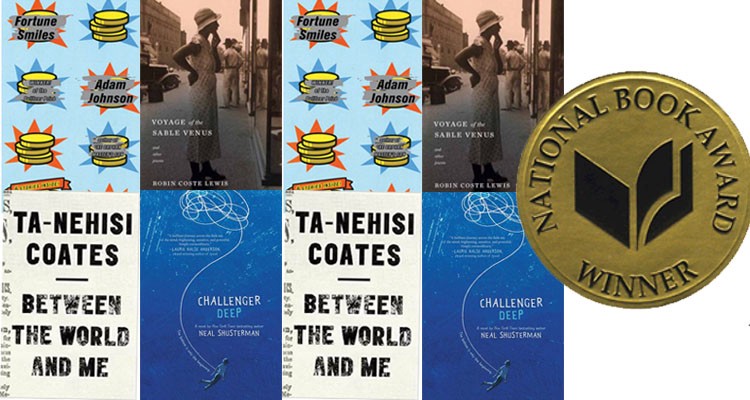
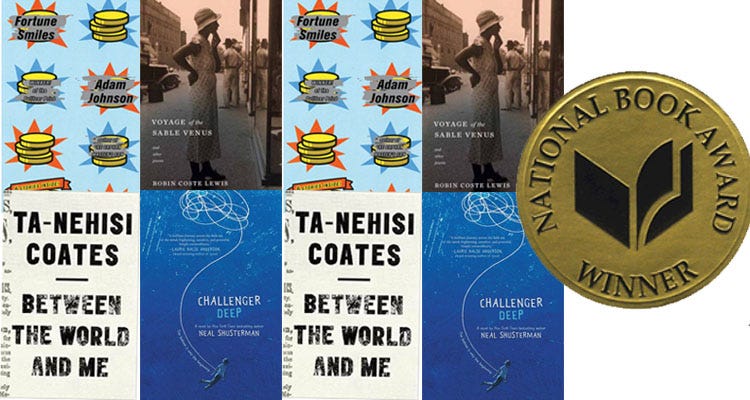
Ta-Nehisi Coates and Adam Johnson Among 2015 National Book Award Winners

by Melissa Ragsdale

Last night, the National Book Foundation announced the winners of the 66th Annual National Book Awards. In nonfiction, Ta-Nehisi Coates won for Between the World and Me. In fiction, Adam Johnson won for his short story collection Fortune Smiles. In poetry, Robin Coate Lewis won for Voyage of the Sable Venus. In young people’s literature, Neal Shusterman won for Challenger Deep. James Patterson received the Literarian Award for Outstanding Service to the American Literary Community and Don DeLillo received the medal for Distinguished Contribution to American Letters.

Fiction Winner: Adam Johnson, Fortune Smiles

Fiction finalists: Karen E. Bender, Refund; Angela Fourney, The Turner House; Lauren Groff, Fates and Furies; Hanya Yanagibara, A Little Life

This is the second year in a row that the fiction medal has been awarded to a short story collection. “I think the short story is a machine, and it has lots of gears that turn: voice, style, architecture, chronology, scene selection,” Johnson said in his acceptance speech. “I think they’re difficult, but they can be very perfect and powerful — I missed them, working on a novel for many years.”

Nonfiction winner: Ta-Nehisi Coates, Between the World and Me

Nonfiction finalists: Sally Mann, Hold Still; Sy Montgomery, The Soul of an Octopus; Carla Power, If the OCeans Were Ink: An Unlikely Friendship and a Journey to the Heart of the Quaran; Tracy K. Smith, Ordinary Light

“I’m a black man in America. I can’t punish that officer…I can’t secure the safety of my son. I can’t go home and tell him at night that ‘It’s going to be okay, you’re not definitely not going to end up like Prince Jones.’ I just don’t have that right. I just don’t have that power, “ Coates said in his acceptance speech, “But what I do have the power to do is to say, ‘You won’t enroll me in this lie. You won’t make me part of it.’ And that was what we did with Between the World and Me.”

Poetry finalists: Ross Gay, Catalog of Unabashed Gratitude; Terrance Hayes, How to be Drawn; Ada Limón, Bright Dead Things; Patrick Phillips, Elegy for a Broken Machine

Voyage of Sable Venus was Lewis’ first book. In her acceptance speech, she thanked her teachers first, saying “In my own mind, I have fashioned countless statues of writers who have honored me with their attention and time…Their exquisite generosity is one of the reasons I am standing here tonight.”

Young People’s Literature winner: Neal Shusterman, Challenger Deep

Young People’s Literature finalists: Ali Benjamin, The Thing About Jellyfish; Laura Ruby, Bone Gap; Steve Sheinkin, Most Dangerous: Daniel Elsberg and the Secret History of the Vietnam War; Noelle Stevenson, Nimona

Challenger Deep is inspired by Shusterman’s own son, Brendan’s, experiences with mental illness. During his acceptance speech, Shusterman recounted that “In the depth of his illness [Brendan] told me, ‘Sometimes it feels like I’m at the bottom of the ocean screaming at the top of my lungs and no one can hear me.’ ”At the end of Shusterman’s acceptance speech, he pulled Brendan on stage to share the spotlight.

When the Ghosts Peel Our Eyes Closed: Reconsolidation: Or it’s the ghosts who will answer you by…

Janice Lee’s Reconsolidation: Or it’s the ghosts who will answer you drops the reader into the fissure created by unexpected loss. Writing a mere four months after the death of her mother, Lee recalibrates what we think we know about loss and memory. We, the still living, want to hold onto that which has gone, but with each act of remembering, we run the risk of reshaping, misremembering. Lee examines both rifts: the loss of the person, and the less obvious one, that of the slipperiness of recollection.

In a lesser writer, tackling this material without some distance could have gone awry, but Lee uses immediacy to good advantage. She writes, “I haven’t been able to escape her in my dreams,” something that began only with her mother’s passing. She then posits the idea that “dreams are closer to the real than one thinks,” that perhaps what comes to us in our sleep, because it is unfiltered, might have its own kind of honesty. She offers these dreams up for our examination, not as some message from beyond or even a call from her self-conscience, but rather as some alternate version of truth.

(T)here’s only one dimension that matters, the dimension we’re able to access when the ghosts peel our eyes closed and remind us of the past events we so viciously try to tuck away.

Instead of drawing attention to her grief, Lee has us share in her bewilderment. While describing the early morning phone call from the hospital, Lee shifts abruptly to the neurological aspects of memory accumulation.

Consolidation is the neurological process that stores memories after an experience. Reconsolidation occurs when a memory is reactivated and therefore destabilized. As previously consolidated memories are recalled, they enter a vulnerable state and are actively consolidated again.

We speak of memory as something like a palimpsest or an erasure. But what if it is a bubbling morass? This jelly-like state may well be where misremembering is born. Consider reconstituted foods: they are similar, but not the same. Or, as in some cases, the process makes them permanently altered, barely palatable.

Recalling a memory during these stages of inadequacy, repentance, sought-after impossibilities, recalling a memory under these conditions may be dangerous. The memory, a symbol for a strange form of affliction and permanence of love, may be changed forever.

It is only after this pause, that we learn that Lee’s mother has had an aneurism, is brain-dead, and being kept alive on respirators until the family can arrive. We are with Lee, sorting, knowing we are being watched.

It was the family that was on display, how we were taking it, whether we were crying, how we were dealing with the situation, their sympathy and pity pouring out of their eye sockets.

As Lee is, we are in the last moments we spent with a loved one, fantasizing that we might like a do-over, wanting that person to know one more fact about us or us about them. Consider the premise that death might be worse for the living.

I don’t know what the afterlife is like for others, but for me, it is the period after a life, after the life of that woman who brought me into this world.

Many memoirists urge the reader to know the writer’s loss by sharing what they recall feeling, wanting the reader to know what it was like to experience their specific loss. Lee, however, interrogates her own memories and dreams, trusting nothing. She assures us, “False memory is a normal phenomenon,” which is no assurance whatsoever.

A gaping hole I cannot understand:

Is this what trauma feels like?

Brevity and an objective stance serve the author’s purpose well. This lean and muscular text is best ingested in one shot, not unlike the way we experience pivotal events. An uninterrupted read allows for an accumulation of the quick changes from the author’s experience to critique of the machinations of memory and back again. This layering and interrupting, asserting and questioning, felt authentic to the experience of sorting out trauma. It is a piercing wail rather than a protracted weep.

I’m afraid one day I won’t be able to remember her face at all. Or even worse, the face I remember won’t be hers.

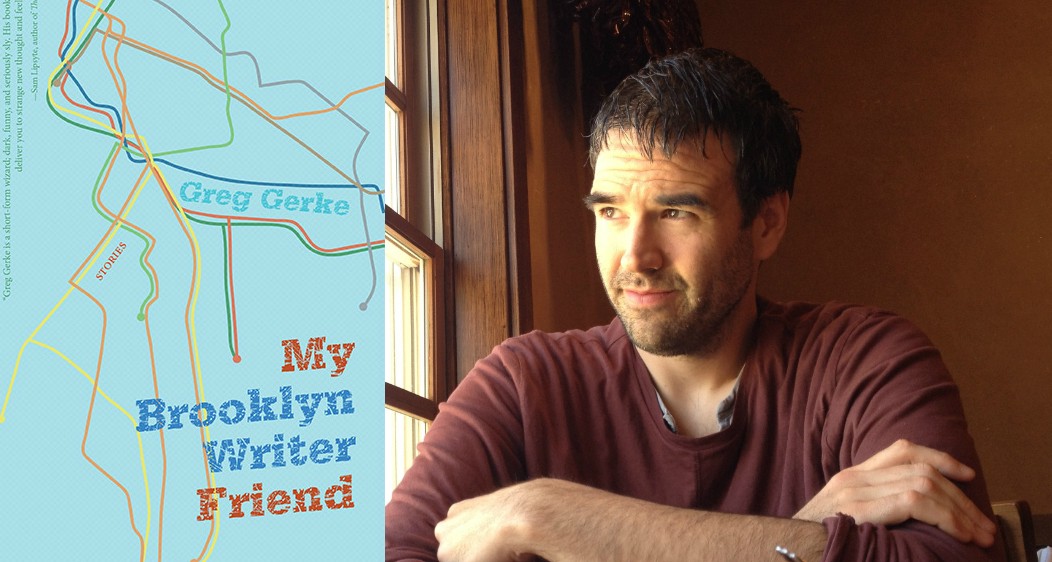
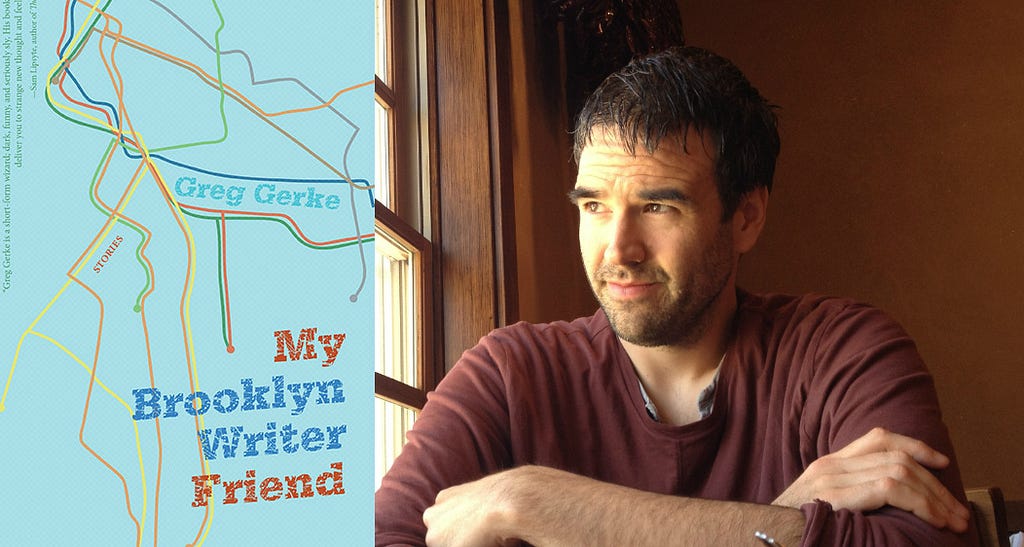
Friction Makes The Best Comedy: An Interview With Greg Gerke, Author Of My Brooklyn Writer Friend

by Ravi Mangla

The hapless narrators of My Brooklyn Writer Friend (Queen’s Ferry Press 2015) struggle to navigate the turbulent waters of love and art. The thirty-eight stories contained in this collection pendulum deftly between the comic and the heartbreaking. Despite its title, the borough of Brooklyn remains at the periphery, its presence felt most keenly through the anxieties of its characters. These pieces venture beyond the simple task of spinning a good yarn, interrogating the very process through which stories are created and told. John Haskell describes it this way: “Greg Gerke writes like an anthropologist of love, or like a Brooklyn-based Sigmund Freud, walking down a Mobius boulevard, finding the truth as it flowers in the cracks of the sidewalk.”

RM: Writing about writers is treated as taboo. Students are cautioned against it. Journals can be dismissive of the practice. Yet plenty of canonical works of literature have been self-reflexive in nature. Even with their diminished standing in our culture, is there still value in creating stories about writers?

People who voluntarily face their own failure to measure up to Shakespeare, Cezanne, and Kubrick are pretty inspiring to me.

GG: If Virginia Woolf had written about things I see little value in, like the New York Yankees, the presidential election cycle, or cupcakes, I would have dropped everything to read it. The subject of a piece of writing doesn’t interest me nearly as much as the style. If the characters were janitors, would what I wrote be less true? Some people argue that all writing is autobiographical, and I agree. We are always writing what we know whether we like it or not. Everything we’ve sensed, felt, and experienced goes into the sentence, right? Scribbler or janitor, the feeling behind each, even if the details changed, would be relatively the same. I suppose it is easier to write about a writer, but I’m just more interested in creative-types, no matter their art. People who voluntarily face their own failure to measure up to Shakespeare, Cezanne, and Kubrick are pretty inspiring to me.

Maybe the taboos have been strengthened by all the overexposure of the self. Years ago, I was taught that there is the poet, the speaker of the poem, and the language itself, which is another thing altogether. Similarly in fiction, the character of the writer is many removes from the writer herself. Yet it took years to see that there are so many levels and relationships going on in writing all at the same time, to the point that it’s possible to sense the ghostly words, the ones that could have been used but weren’t, behind those on the page. It seems in any piece of writing there are multiple commentaries going on as the writer writes and many more for each particular reader as he or she reads. As to the writer as a subject, the genre-centric or themed view that dominates our habits from the bookstore, to the literary journal, to Netflix is just a construct. Now it’s de rigueur for a computer to give us a list of “cerebral” movies to watch (a word sometimes taking on the piss-poor connotation of David Lynchy) but how can that work with books? It just seems this fascination with putting everything in its own box is not doing much good, especially as it concerns human relations. It delimits our potential or that of an artwork.

RM: I agree that our tendency to partition texts into tidy categories proves counterproductive most of the time, though it seems the only tool we have to cope with the glut of entertainment and content hailing down on us. So assuming that you’d prefer to have your work defined more by its style than subject matter, how do you plan to respond when confronted (usually by some sweaty stranger at a dinner party) with the question dreaded by all fiction writers: What is your book about?

GG: Yes, a sweaty stranger. And usually they say, You’re a writer? Well, I’ve got some stories for you. Or, Oh yeah, I write too. The book? About? I prefer the Kubrick answer of, “I don’t think that writers or painters or filmmakers function because they have something they particularly want to say. They have something that they feel.” But if at gunpoint, I would say it’s about love, and the avoidance of it, no matter how cliché that sounds. There is no crime, murder, or superhero — it’s just emotion. And it came out in these short forms better than any other I could think to transmit in — now it’s more in essays and longer fictions. If someone really wants to know a writer, the answers are in what she writes. In interviews many are cautious and entertaining, like politicians. In person, secretive and calculating. But in the work, the emotions are uncensored. The work is the thing. The unconscious or muse or mixture of the two, in concert with what one has lived through, is as honest as we get. I don’t mean literal truths, but emotional ones. How they feel about the world and themselves. When Henry James writes, “Suffering, with Isabel, was an active condition; it was not a chill, a stupor, a despair; it was a passion of thought, of speculation, of response to every pressure,” in The Portrait of a Lady, he uses all the sounds of the language, especially the sss’s, to convey the feeling of feeling, of being an “active” agent in the world, but he also unveils what he himself is about — psychology.

RM: The humor in this collection is wonderfully sly and understated. It doesn’t seek to draw attention to itself or undermine the larger narrative. What influences shaped your comic sensibility?

I don’t think I could survive without satirizing, but in the midst of that, there has to be, for me, tenderness.

GG: It’s hard to think I have a comic sensibility. I feel that is one of those terms only another can bestow on you. Because whatever it is I’m doing, it feels like the most natural thing in the world. But I’m sure, early on, pre-2000 Woody Allen films inspired me, with that kind of erudite sarcasm, though for some years I didn’t get some of his references. Then reading Samuel Beckett must have done something. The fruitlessness of the characters’ situations were, as they say, tragicomic, which seems like the only way to be funny, especially in the face of what the world is really like. An uncle told me to read him when I was twenty, yet probably more than Allen and Beckett, it was this uncle’s sense of humor that I responded to. He had a kind of whimsy, laughing at life like it was all one big Magritte painting. Laughing at how our routines, repetitions, and the things we’ve created, like the ubiquitous ice cream truck jingle, can drive us crazy. I don’t think I could survive without satirizing, but in the midst of that, there has to be, for me, tenderness. Satirizing is a deflection of sorts akin to how we don’t want to think of certain things that then rear up with even more power. It seems that when we are most unaware and cavalier, we do the most damage, and in that we become closer to the people we want to keep away from us. Friction makes the best comedy because of the human hurt it constantly skirts the surface of. The work of Donald Antrim, Lydia Davis, Sam Lipsyte, and Gary Lutz also showed the way, as well as the films of Robert Altman, John Cassavetes, and Stanley Kubrick. I only read them after writing the pieces in the book, but the work of William Gaddis and Stanley Elkin cemented what comic sense I have, where many of their lines are punchlines.

RM: Do you find yourself resistant to books or films without a sense of humor, or artists who take themselves too seriously?

GG: Oh, no. If the tone fits the particular milieu of the art, I don’t think it matters if the work is ribald or solemn. There is little humor in Bergman and none in Antonioni and Bresson, yet all offer the ecstatic in their art. I think it comes down to worldviews, which do change with four seasons flying by every year. The works of artists that do offend me are the more didactic ones, who seem to feel they are doing the world the good service of presenting morality tales in which the deck is stacked in treacly politically correct ways, as the motion picture American Beauty perfectly exuded. This work and others like it are, not so surprisingly, more popular because their thinking is completed and sealed, delivered to the audience pre-packaged to preserve itself for a longer shelf life. True art is itself a question, not an answer. A family member recently counseled me to start writing romantic thrillers a la Gone Girl and Fifty Shades of Gray because of how easily they fit the public’s appetite. I know he was just making conversation, but coupled with this, I’ve thought about smaller presses and hence smaller audience books and how they are received. Still, I haven’t been dispelled of the notion that many people will not respect you if your books don’t make your living. Gilbert Sorrentino quoted Maurice Blanchot’s essay “Reading” in one of his last interviews, talking about the difference between literary books and nonliterary, of which Blanchot says, of the nonliterary:

Reading is not a conversation, it does not discuss, it does not question. It never asks the book — and certainly not the author — “What exactly did you mean?” . . .Only the nonliterary book is presented as a stoutly woven web of determined significations, as an entity made up of real affirmations: before it is read by anyone, the nonliterary book has been read by everyone. . .But the book whose source is art has no guarantee in the world, and when it is read, it has never been read before…

This seems to be a good answer to the conundrum. Commercial works and those didactic are closer in sensibility than many would care to admit. A writer like William Gaddis struggled with these questions all his life. I was particularly touched reading the first biography of Gaddis by Joseph Tabbi that just came out, Nobody Grew But the Business. The commercial failure of The Recognitions, now regarded as one of the best novels of the century, embittered him to no end, and these feelings colored the rest of his works, but he transmuted the bitterness into art (while certainly retaining the outrage at how we live) inserting his failures directly into his later novels, like his unproduced Civil War play he interpolates into his 1994 novel, A Frolic of His Own, thirty some years after it was written.

RM: The stylistic diversity (and sheer quantity) of the stories must have presented some challenges when it came to ordering the collection. What was the logic behind the architecture of the book? Are there any thematic threads you only became aware of during the assembly process?

I remember sitting on a bench in Prospect Park, looking at its Long Meadow covered in snow and ice, and writing these stories in longhand while gloved. It was a low point in my life…

GG: The funny thing was, I basically ordered them chronologically, and this is mirrored by the first section making reference to autumn and a later one to winter. It is a diary of sorts and few proper nouns are used after that first section. With a few exceptions, all of the stories after the first section were written within a few weeks of each other, during a very grueling winter. I remember sitting on a bench in Prospect Park, looking at its Long Meadow covered in snow and ice, and writing these stories in longhand while gloved. It was a low point in my life, reflected in the themes of the book. I don’t know why I started using the term “friend” in many of the stories — loneliness is the best but most obvious excuse. But I was very aware that they all boiled down to relationships and breakups, that’s why I call it a diary, but some writer’s diary or personae, not mine. When I looked at them all a few years later, I could clearly see that time in my life and the writer I was, and the overall disunion the former carried, though because it’s been lived it can be packaged as anecdote and youth while relaxing with an americano, but really it was necessary. Writing short pieces fit that time and I haven’t composed any since — it seemed like a farewell to flash fiction as well as a farewell to a psychology that would not help me find contentedness and happiness.

RM: Could you see yourself returning to flash in the future? Or has the form runs its course, so to speak? What do you have in the hopper?

GG: I’m not sure about a return, but it’s so hard to set a limit on which way your art will go. There might be one day when I wake up and all that I have to say are short things, or the rueful day when there might be nothing to say. In the hopper is a novel and a memoir of early life in thrall to Kubrick and the eventual break away to do one’s own work.