12 Last-Minute Non-Book Gifts for Writers

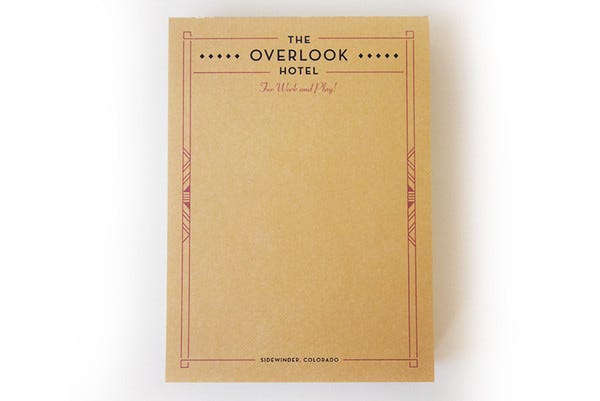
1) For the Writer Who’s All Work and No Play

Overlook Hotel Note Paper by Herb Lester Associates, $18.19

OLYMPUS DIGITAL CAMERA

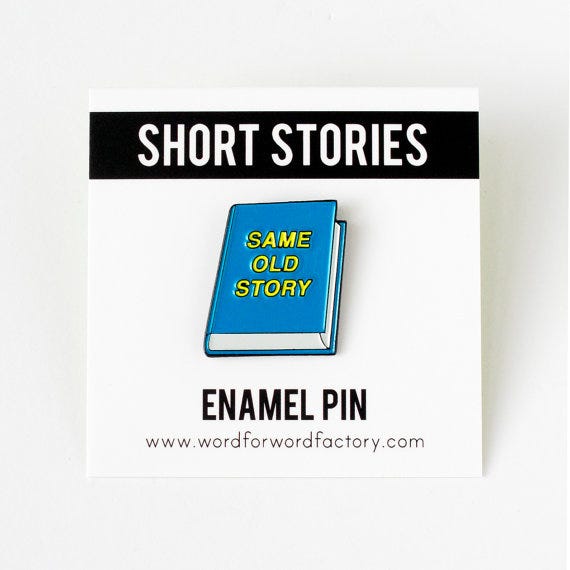
2) For the Writer Stuck In a Rut

Same Old Story Pin Enamel Pin by Word for Word Factory, $10

sameoldstory

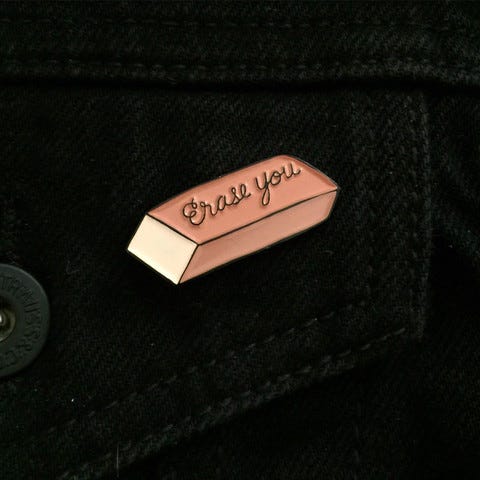
3) For the Revisionist

Erase You Enamel Pin by Tuesday Bassen, $10

EraseYou

4) For the Writer Who Thinks Every Draft is Shit

Fart of Darkness Matches by DippyLulu, $6.50

FartofDarkness

5) For the Female Writer (Any Genre)

Male Tears Patch by Weird Empire, $14

MaleTears

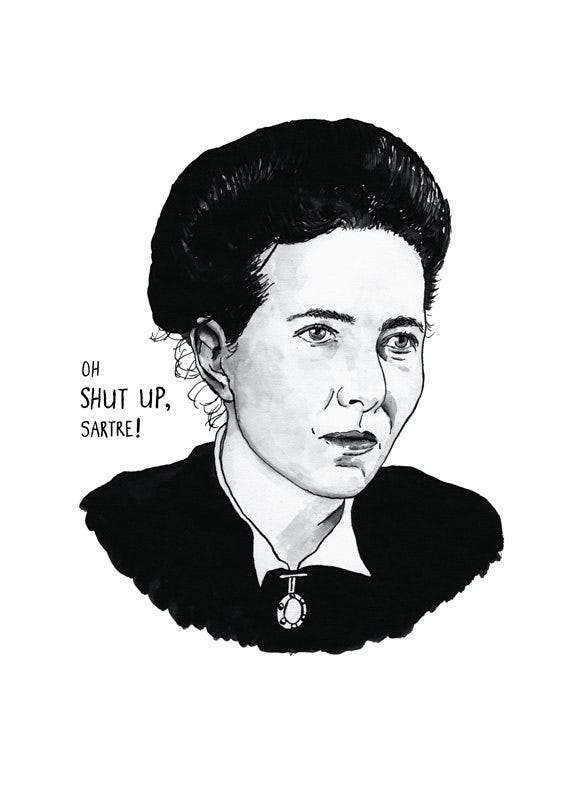
6) For the Writer Who Wants You to STFU

Simone de Beauvoir Literary Poster by Standard Designs, $27.83

de Beauvoir

7) For the Writer Who Needs to Set the Mood

Get Lit Candles (based on books by Saeed Jones, Lincoln Michel, Alexandra Kleeman, and others) by Hi Wildflower Botanica, $30

book candles

8) For the Cortázar Fanatic

Julio Cortázar Articulated Wooden Figure, $148

cortazar

9) For the Latinx Writer

Mexican Writers Tee by minimalista, $22

MexWriters

10) For the Writer Who Imagines a World Where Colleges have been established based on the philosophies of Marcus Garvey, Audre Lorde, Ida B. Wells, Harriet Tubman, George Washington Carver and James Baldwin.

School of Thought Collegiate Crew by Philadelphia Printworks, $37.50

CollegiateCrew

11) For the Writer Who Needs to Work Out a “Plot Twist”

Yoga for Writers poster $7

Yoga-Poster

12) For the Acerbic Coffee Drinking Writer

Go Faulkner Yourself Mug $15

trees_mug

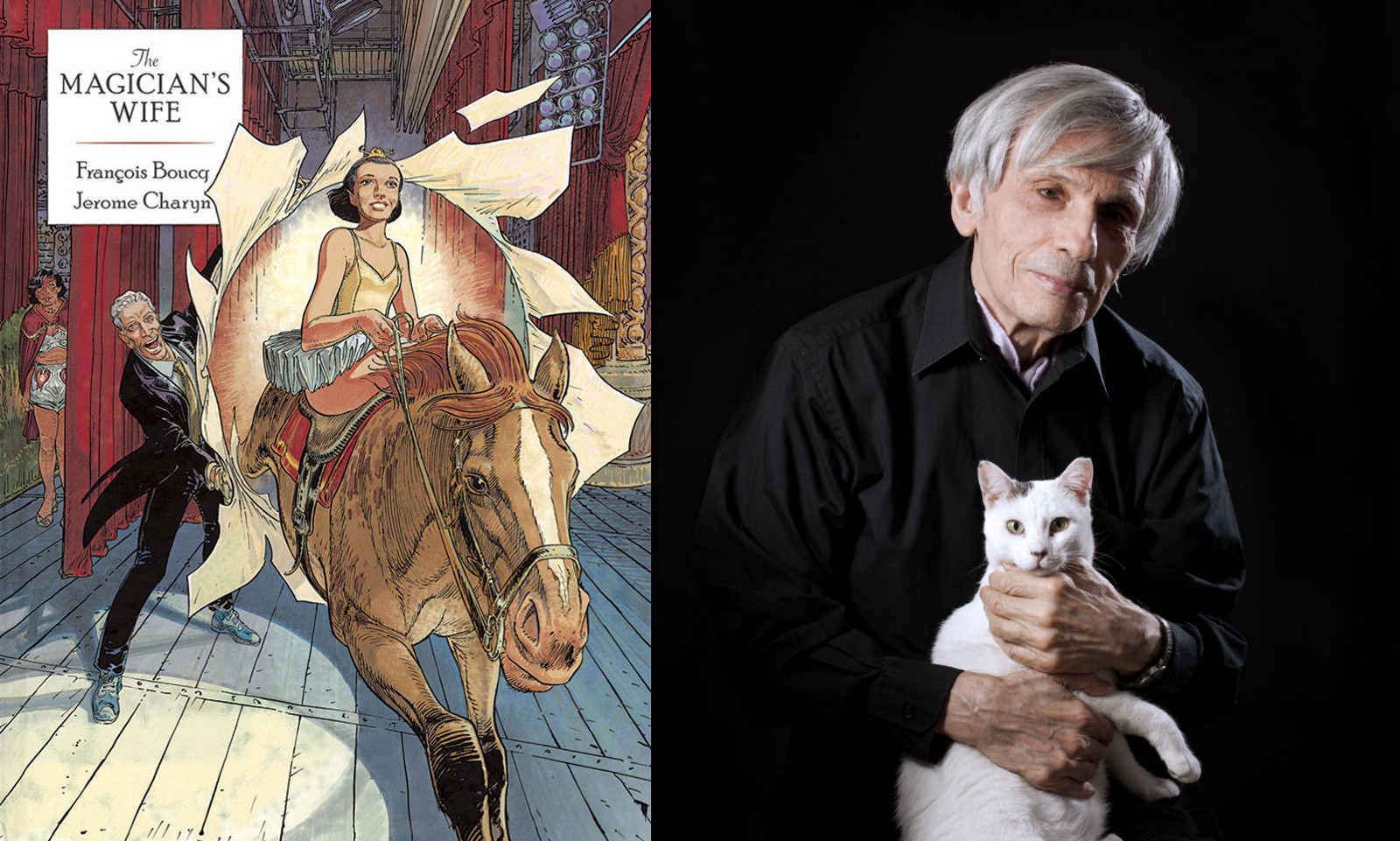
A Certain Kind of Slant: An Interview With Jerome Charyn

Literary chameleon, film professor, and ping-pong wizard are some of the labels that come to mind when thinking of American novelist Jerome Charyn, but one label that often slips people’s minds is graphic storyteller. Charyn may have no talent for drawing or painting, but that hasn’t barred him from collaborating with some of the most respected comic artists in the industry, including Francois Boucq, Jacques de Loustal, and Jose Muñoz. The recent re-release of The Magician’s Wife, published by Dover Graphic Novels, marks Charyn’s reintroduction into the American comic book world nearly thirty years after receiving the 1986 Prix Alfred Award at Angoulême for best graphic novel. Despite having many of his comics exclusively published in Europe, Charyn’s comics are written with the same love for NYC that he describes in his Bronx-centric crime fiction.

The Magician’s Wife tells the story of a woman and her turbulent relationship with a traveling Magician with powers that may go beyond simple illusion, and the lingering effects of her broken marriage. The book, masterfully brought to life by artist Francois Boucq, was released this past October and is the first of Charyn’s comics to be published by Dover, soon to be followed by the never-before translated, The Boys of Sheriff Street. Mr. Charyn was gracious enough to talk to me over Skype where we discussed the impact comics had on his early upbringing, his affinity with European artists, and where new talent in the medium may be discovered.

Matthew Laiosa: I’ve read that comics were a major part of your early education. What were some of the comics that inspired you at a young age, and how did those tastes mature into adulthood?

Jerome Charyn: Since I grew up in a very poor area of the Bronx there were very few books so I basically learned how to read from comic books. My favorite was Captain Marvel because even at an early age I felt there was something so unusual about the art. Superman was very realistic, so was Batman, but Marvel had a very strange almost surreal touch to the art and it really pulled me in. I read Donald Duck, the Disney comics, and also Classic Comics were very important to me. They took the place of books, but again the art wasn’t that interesting in the Classic Comics. It was only in Captain Marvel, and that’s why when I went to Europe and I saw some of the graphic art it was a revelation. I had never seen art of that quality in comics. It was a shock.

ML: Many consider you a great American novelist, but almost all of your comics were made in Europe. Why is that?

JC: I got involved with DC, and I did something for Paradox called Family Man, but DC was a real labyrinth. It was not an easy world to break into. I hadn’t done graphic novels here, and they didn’t really know anything about the graphic novels in Europe. There was a divorce between both worlds, and little rapport between one and the other. I offered to do a Batman, but I don’t know how good it would have been. That’s how much of a separation there was.

ML: It’s definitely improved, but some of that divorce still seems to linger considering that many of your comics have still never been translated from French to English.

JC: Most of them are coming out with Dover, and a few of them were published here earlier, but the craze for graphic novels in America is very recent. I think that the great European artists are finally being recognized, artists such as Bilal, Tardi, and Liberatore. I wanted to work with Liberatore, and at first we were going to do it, but then it was just too difficult. Anyway, I was more interested in the European artists. I did love V for Vendetta.

ML: So some of the British stuff?

JC: Yeah, the British stuff was quite good.

ML: The Magician’s Wife won the best book award at Angoulême in 1986. Do you think comics have changed much in that time in either Europe or the U.S.?

JC: I think we’ve seen a more personal approach to comics in the United States, and that’s in part because of Art Spiegelman and Raw Magazine. In fact, he won a special Pulitzer Prize. Art has done extraordinary work. He is a real author.

In France you have more of a tradition of the artist and the writer. You have some artists who do their own work, and others who work with writers, and I think you can create great art in both formats. I’m not sure whether Boucq could tell a long story on his own, but I think when he gets the right story he does extraordinary work. There’s nobody like him, nobody who has that sense of movement. It’s almost like a motion picture. It’s very powerful.

ML: After establishing yourself as a novelist for over twenty years what made you want to write The Magician’s Wife as a comic rather than a novel?

JC: I was in France, and I was interviewed by the magazine, À Suivre. It was a magazine that the Belgian publisher Casterman put out, and what it did was provide a showcase for its own artists by reprinting their graphic novels in the magazine. They happened to review one of my novels, so just out of the blue I wrote the editor of À Suivre and said, “I would love to do a comic, and can you find an artist for me?” They introduced me to Boucq, and I’d always wanted to work with Loustal, so I was able to work with Loustal. I was able to work with Muñoz, and there were others I would have worked with, but it wasn’t that easy to maneuver.

ML: Who were some of the artists you wished you had worked with?

JC: I would have liked to work with Tardi, but the occasion never arose. And there are a lot of Italian artists I would have liked to work with.

ML: Manara?

JC: Yeah. The erotic side would have been very interesting if I had done some kind of sadomasochistic story. (Laughter)

ML: So did any of your peers ever question why you were doing comics?

I think it’s a question of how you make the connection with an artist; that’s the most difficult thing to do.

JC: NO! They wanted to do it. I remember when Joyce Carol Oates read The Magician’s Wife she said she would have loved to do a graphic novel. It’s very powerful because you see the written word turned into images, and when the work is good its every bit as complicated as a novel. I think it’s a question of how you make the connection with an artist; that’s the most difficult thing to do.

ML: Even though you were writing comics for a European audience The Magician’s Wife feels quintessentially American.

JC: Yeah, all of my graphic novels in some part take place in the United States except for the one I’m doing now about Charlemagne, and what I’m going to do is see if we can get a co-production with Dark Horse, or Marvel. If it works out, I’ll have the script in English and I’ll just show some of the sample pages to Dark Horse and see what happens.

ML: What relationship does your comic Billy Budd, KGB, also illustrated by Francois Boucq, have in common with Herman Melville’s Billy Budd?

JC: I love Melville, so I wanted to find some way of using the hero of Billy Budd, KGB as some kind of Melvillian character, so the title is appropriate. I couldn’t use that title in France because the French wouldn’t have understood it. It was called Devil’s Mouth, or Bouche du Diable in French, and that’s just been reissued and it’s doing very well in France.

ML: How do you choose what stories to tell in comics and what stories to tell in prose?

Give me the location, and a few hints and I can put it together in my own way, in my own crazy way.

JC: If I remember, The Magician’s Wife was something I was going to do as a novel, and I realized that it probably wouldn’t work, so I already had the idea in mind. The graphic novel I’ve just done with Boucq, which will also be published by Dover, is called, Little Tulip, and I think it’s the best work we’ve done together. It came from an idea that Boucq had about the Gulag. It can work both ways. The idea can come from me, or from him. So if you give me something about the Gulag, and you want the hero to be an artist, then it’s not that difficult for me to put it together because I love to tell stories. Give me the location, and a few hints and I can put it together in my own way, in my own crazy way.

ML: A lot of your books exist in a sort of augmented reality. Even when you write prose it exists in an almost comic book world of extremes.

JC: I’m not interested in the quotidian, in everyday life: the raising of children, family problems, or ‘realistic stories.’ They just don’t interest me. I always have to deal with a kind of extreme. I like to work at the edge. There has to be a certain kind of slant.

ML: You have also written a few books of historical fiction. What attracts you to these different worlds?

I like heroes and villains. I like adventure, as if we’re telling children stories for adults.

JC: With historical fiction, I’m dealing with people I admire, such as Emily Dickinson and Abraham Lincoln. Johnny One-Eye was about the Revolution and George Washington. I like heroes and villains. I like adventure, as if we’re telling children stories for adults.

ML: Some argue that a comic is a kind of wannabe movie told in still images vs. moving pictures, but as a professor of film, are there certain storytelling capabilities unique to comics?

JC: That’s a good question. I think what you are able to do in a comic, let’s say that Boucq is the closest to action on the screen, but what’s unique to the medium is the stopped frame. In other words, you can stop the action and look at individual images, but you can’t do that in a movie because it exists in time. The propulsion forward is inevitable. There are only certain filmmakers who can slow down the frame, and do that with a constant skill. You look at the films today and they’re ninety-nine percent action, even the very best of them.

ML: And in comics between two panels you can fluctuate time from one second to millennia.

JC: Exactly. You can have a whole world between two panels and you can switch the landscape between the panels, which you can’t do as easily in film. But there is a real connection. Its no accident that comic book superheroes have worked so well in the cinema because it’s basically a very primitive art, and superheroes are just perfect. I’m not particularly interested in that, but in terms of the screen it works very well.

ML: You’ve written a number of non-fiction books including books on film. Have you ever been interested in writing a book on comics?

JC: Not really because I have a very distorted view of comics, and I’m not sure I would be able to tell the story accurately, and also it was like a childhood disease. I mean, there has been great work done with Batman, but that’s because the scripts are wonderful. And I’m not sure I’d be the right person to tell the history of comics.

ML: You have also written a few memoirs. For better or worse, the memoir-comic has become a popular genre within the medium. Are there any untold moments from your life you would want to tell in a comic book?

JC: I started out as an artist, and one reason why I’m so drawn to these European graphic artists is that I admired them and envied their skills. I wish I could do comics, I wish I could be a comic book artist and I could combine the novel with the image and that would be a perfect world, and then I probably would go into autobiography or I would range anywhere I wanted, but I don’t have the gift. I started out as an artist, and I have no talent whatsoever.

ML: You started as a painter right?

JC: Yeah, and there’s nothing I can do about it. On the other hand I’ve done some work for television and I thought I would be so pleased when I was able to hear the dialogue that I had written when it was on the TV screen, but it didn’t do anything for me at all. However, when I did Little Tulip, and saw what Boucq had done with the story, it was completely magical.

ML: What makes Boucq’s art so extraordinary?

JC: If he doesn’t have a good story you’re not going to get a good graphic novel, but if you give him a good story he is going to do a great comic because he can do anything. He can be satirical. He can be lyrical. He can be brutal. He has that gift, and that’s why it works.

ML: I think by being someone traditionally considered outside of comics you have a ‘rules-need-not-apply’ attitude. Do you think the comic book medium could benefit with greater participation from other novelists and/or storytellers outside of the medium? And if so what writer would you most like to see enter the comic book field?

JC: I would say rather than novelists, screenwriters would fit closer with the idea of writing scripts for graphic novels, but since they earn so much money working in film I’m not sure they would want to work in graphic novels. In the future, if someone like Tarantino came along, he would be able to do extraordinary work in the graphic novel. His films are almost like graphic novels in motion.

ML: You mentioned Joyce Carol Oates’ enthusiasm and interest in writing her own comic book, so what keeps her, or say someone like a Don DeLillo from scripting a comic book?

It’s not meant to be realistic. One reason why I love Krazy Kat is that the landscape changes from panel to panel and you never knew where you are going to be next

JC: It would be great if Don did a graphic novel, and maybe if he expressed a wish to do it I’m sure it would be done. I don’t know how interested he would be. I’d have to ask him. Remember it’s special to me because I grew up in this world and it’s how I learned to read. Also, if you look at my writing, it is very related to the graphic novel. The movement from sentence to sentence is like a graphic novel, and this is maybe why certain readers have such difficulty because it’s not realistic. It’s not meant to be realistic. One reason why I love Krazy Kat is that the landscape changes from panel to panel and you never knew where you are going to be next

ML: It’s more dreamlike.

JC: Yeah.

ML: I believe comics have the most potential for breaking new ground in changing the way stories are told, especially when you look at work such as Chris Ware’s, Building Stories, which uses fourteen separate printed components in order to tell a single story that can be read in any order. Where do you see the future of the book and where do you see the future of the comic book?

JC: First of all, you have very young readers who are growing up in a world with images and they’ll be able to deal with all the complexities. Now you need the genius to go along with the vision, and that’s always hard to deliver. You can’t tell where genius will come from. It could be a painter who turns to graphic novels, or it could be a songwriter. I would love to see a graphic novel with a story by Bob Dylan. It would be incredible. As far as books are concerned, it’s very difficult to say where the future lies. I don’t think anybody knows.

What We Talk About When We Talk About Elena Ferrante

“When you write to me and say you love her work, I have a moment where I think, “But … Elena is my friend! My private relationship with her, so intense and so true, is one that nobody else can fully know!” 

Claire Messud

To say that I have a few autobiographical similarities to the narrator of Elena Ferrante’s Neapolitan Quartet, also named Elena (“Lenu”) Greco, would be an understatement. Born into a close-knit yet violent (Italian) neighborhood that no one ever seemed to leave, I, like Lenu, fantasized about ‘getting out,” and used education as my primary propeller towards a different fate. Like Lenu, I became a writer, married a brainy introvert, raised children, struggled with the dichotomies between family life and making art, had a passionate affair, found myself constantly returning to the city I’d once sworn to escape, ultimately left my marriage… I could go on. Most significantly, at the heart of Ferrante’s series, I also had a childhood marked indelibly by my intimacy with a more beautiful, more charismatic and powerful girl who, despite her many gifts, seemed doomed: in Lenu’s case, her best friend Lila, and in mine, my same-aged cousin who lived next door to me, whose name coincidentally also begins with an L.

Of course, Ferrante (whose real remains unknown) writes of girlhood in 1950s Naples, whereas I came of age in Chicago in the 1970s and 80s. The turbulent political landscape of Italy during the some sixty years covered by the four novels is divergent in many ways from the (also turbulent) history of the United States, and the quintessential Italianness of the Quartet is integral to the fate of its characters. Whereas in my old neighborhood, boys growing to men in a state of hopeless poverty and stagnation often turned to gangs or became small-time workers for the Mob, those in Lenu and Lila’s world are as likely to become involved with Communism or Fascism, go on the run for political crimes, and attend political meetings in secret, as they are to become “gangsters” of sorts — in fact, the two things seem somewhat inextricable, in a way less true of organized crime in the United States, where politics and the Mob are more financial bedfellows than ideological ones.

The novels’ immersion in Italy — in particular Naples, and more specifically one poor, dialect-infused neighborhood in Naples — is crucial to the understanding of how intensely personal readers’ responses to Ferrante have tended to be. Because although I am Italian-American and grew up below the poverty line in a neighborhood quite similar to Lenu and Lila’s, that fact — or any other biographical fact — seems irrelevant when considering the fact that almost all Ferrante’s women readers seem to feel much as I do: as though these books were written for them, to them, about the insides of their own messy guts and brain. To love Ferrante has almost become akin to a secret handshake in certain circles (similar to Anne Carson but on an explosive scale), yet it is fair to extrapolate that many of her avid American fans had upbringings radically different from Lenu’s and Lila’s in Naples. What readers relate to most are her characters’ fearlessly naked, almost unfathomably nuanced interior lives and relationships.

You don’t have to be Italian, or poor, or have a “getting out” story, or ever to have known anyone in organized crime, to feel Ferrante’s novels read your mind and cut closer to the bone more than other books, and on the strength of word of mouth buzz, Ferrante has become Italy’s best known writer. In our era of social media accessibility, shameless self-promotion, and hot young celebrity culture, this is nothing short of astounding: an anonymous Italian woman of a certain age, of whom James Wood wrote, “Compared with Ferrante, Thomas Pynchon is a publicity profligate,” has managed to make droves of American readers feel the way one feels when a favorite indie band signs on a major label: wait, that’s my band — they were writing about and singing for me!

It’s difficult to talk about Ferrante without talking about gender. By anecdotal and critical evidence, her audience is almost entirely female, and even male critics who laud her see her work as highly gendered. Writes Wood, “Ferrante may never mention Hélène Cixous or French feminist literary theory, but her fiction is a kind of practical écriture feminine.” One certainly doesn’t have to be a woman to appreciate Ferrante…but to what extent might being one change the experience? When I was halfway through My Brilliant Friend, the inaugural novel in the series, I posted on Facebook that the book should be “required reading for anyone who wants to understand female psychology.” Having now finished the powerful finale of the four, The Story of the Lost Child, I would stand by the sentiment, but at the same time have grown wary of my own description. “Nothing quite like it has ever been published,” writes Meghan O’Rourke of the series in The Guardian: “four novels that make up a single book… a kind of quasi-feminist bildungsroman that also happens to be a history of Italy in the late 20th century.” What is clear is that these novels are profoundly ambitious literary feats, unique in tone, style and scope, when it often seems everything has already been done. Ferrante’s achievement — one novel, told in four luminous volumes — manages to also be written with a complete absence of what Claire Vaye Watkins recently discussed as “pandering” to the male literary establishment. If anything is clear from Lenu’s voice — from Ferrante’s writing across all her books — it is that she implicitly writes for the universal She. Her prose — passionate, intimate, urgent, confiding — show no aesthetic concern for courting either male literary traditions or, perhaps, even male readers as a means of legitimizing her art, and indeed, she hasn’t “needed” them. Still, she is so scarily good that I can’t help but wonder: why doesn’t she have them anyway?

The Neapolitan Quartet is arguably the deepest, widest and richest portrait of a lifelong friendship between two girls/women ever documented in literature. Ferrante often draws comparisons to Lessing in this regard, but the depth of her exploration of Lenu and Lila, over four books, truly has no rival. The critics, too, seem in overwhelming agreement on Ferrante’s merit, and that in the Neapolitan series, she is at the top of her game. That said, it is hard to imagine some of the ways she is discussed in reviews ever being applied to a male writer.. Her core focus on female friendship seems to have led some to approach the novels’ complexity and multiplicity as so genre-busting and defying of categorization that it can smack of patronizing cloaked in praise. Writes Elizabeth Lowry in the Wall Street Journal: “How should we classify Elena Ferrante’s magnificently complicated Neapolitan quartet? The three previous titles in the series — My Brilliant Friend (2012), The Story of a New Name (2013) and Those Who Leave and Those Who Stay (2014) — defy categorization. Are they genre or literary fiction? Soap operas? Political epics? Some form of memoir?” Though it is not in itself in any way an “insult” to have one’s novel seen as multidimensional or not conforming to one specific literary tradition, I find myself wondering whether a series of novels that explored the male psyche and relationships, while also involving politics, class issues, and a certain amount of meta exploration of literature itself, would be described as though its diverse themes were… so surprising. Didn’t Updike attempt much the same in his Rabbit series, and Roth through Zuckerman, and Elroy in his Los Angeles Quartet? Is serious fiction that chronicles characters over time and explores both the innermost depths of their intimate relationships, along with the political climate of the times and a profound interrogation of class struggles, truly such a confounding thing as to call into question whether we are reading a soap opera, or, as Lowry later invokes in her review, a thriller? Or does it only seem so because the focal characters are girls/young women for most of the pages?

If the lives of girls and young women are sometimes trivialized by the literary establishment (here and in Europe), they are treated with almost mythical devotion by Ferrante. Indeed, the one weakness of the Neapolitan Quartet may be that Ferrante devotes so little page time to Lenu and Lila as mature women. The singularly defining event of their lives (Ferrante’s titles are full of spoilers) occurs, in the final novel, when they are not yet forty, and the rest of their lives (especially once past fifty) are sped over in strokes so broad as to be positively un-Ferrantean. Here is a writer who can spend an entire thick novel on the every thought and deed of girls between the ages of six and sixteen, yet the same women, once menopausal, no longer seem to interest their author much. Likewise, Lenu’s daughters — three women with their own complicated history — are painted with none of the intricacy of the dozens of characters in her old neighborhood, and never rise above “types.”

Lenu’s lovers, as she ages, seem to merit no scenes; if she has close friends after she and Lila part ways forever, we don’t ever meet them. Perhaps Ferrante initially gave herself free reign and then, after some 1,000 pages, panicked and felt she had better wrap things up already. Whatever the reason, the final third of the final novel feels that thing one never feels when reading a Ferrante novel: rushed. While the first three books — and The Story of the Lost Child as well — have a quality of breathless emotional fervor, they also unapologetically languish on any detail or side plot that strikes the narrator’s fancy. Guns are delightfully introduced in Act I that are not fired by Act III — people drop away, major concerns shift. Ferrante’s Neapolitan novels, though full of returning characters and at times coincidences that strain at realism, follow the rhythms of a life, not a curated narrative arc. It is disappointing, therefore, when the author who specializes in reading women’s minds and hearts seems to indicate that said minds and hearts are inherently less engaging in advanced age.

Of course it is arguable that Lenu’s story simply becomes less relevant once she “gets out” — something it takes her until her fifties to fully do. Because as much as Lenu’s and Lila’s stories excavate iconic themes of womanhood, the Neapolitan series is also a quintessential rags-to-riches story, in which the two girls’ different ascents from abject poverty, and the both beautiful and abhorrent neighborhood that keeps its claws in them, are as crucial to the story as any feminist themes or as the characters’ elaborate personal lives. Ironically, a recent piece Buzzfeed on held Ferrante up as a great writer of The American Dream. Writes Alissa Quart, “Where is the American equivalent of Ferrante? […] The inequality novel that Americans will read in droves, that critics pay attention to? There was once The Great Gatsby, Bellow’s Augie March, Dreiser’s Sister Carrie and The Financier, even Raymond Carver’s working-class silent men of 30 years ago. Certainly those who claim the neorealist caption — Jonathan Franzen, recently dubbed an author of ‘failed-marriage razzmatazz’ by one critic — have neglected this story.” Though the claim that no American writers are writing novels interrogating social class and either upward or downward mobility seems unfounded (Junot Diaz comes to mind as exploring similar terrain as Ferrante on American soil; recently Helen Phillips’ The Beautiful Bureaucrat took on the hopelessness and stagnation of new adults trying to make their way in a numb, corporatized world without opportunities), Ferrante’s prowess as a chronicler of class, place and history are not to be overshadowed by her focus on female friendship and motherhood.

In the end, however, no single “topic” can fully explain Ferrante’s resonance. As Claire Messud writes —

Politics and feminism are compelling and important subjects but they won’t make readers long for the novels with the zeal of a nine-year-old. Only the human heart can do that, the emotionally truthful depiction of the complex web of love, desire, loathing, envy, compassion and pain that binds people over a lifetime. Ultimately, Ferrante has framed her magnum opus — for all its tremendous ambition, and in spite of the tumult of events that resounds through the pages at ever-greater, eventually exhausting, speed — as a simple love story. These books deal above all with the perpetually unrequited but never extinguished Platonic passion…

I would extend this further to say that Lenu and Lila’s relationship, though central, is not the only uncannily rich relationship propelling the books, and that character — characters in interaction with one another and, of course, with themselves — is Ferrante’s rarest of gifts. She seems capable of transmitting the untranslatable alchemy of human psychology onto the page in a whole other league from even other contemporary masters of character like Franzen. Accordingly, her audience identifies fiercely with what her characters feel about motherhood, ambition, jealousy, desire, justice, writing, aging — Ferrante writes so ferociously, so from the inside out, that we know the inhabitants of Lenu’s world more intricately than we could ever hope to know such a large ensemble cast in even our own lives. It is easy to emerge from the Neapolitan Quartet feeling slightly dazed, as though everything we have ever heard about “character development” was little more than a bullet point list in the hands of other writers.

And Lila, of course is both Ferrante’s and Lenu’s piece de resistance. As Lenu says of her friend, in a cross between rhapsody and lament, “She possessed intelligence and didn’t put it to use but, rather, wasted it, like a great lady for whom all the riches of the world are merely a sign of vulgarity. She stood out among so many because she, naturally, did not submit to any training, to any use, or to any purpose. All of us had submitted and that submission had — through trials, failures, successes — reduced us. Only Lila, nothing and no one seemed to reduce her.” In my own life, my “Lila” did not disappear without a trace at 66, leaving a wake of mystery behind, rendering herself forever my obsession. As people often will in real life, she instead kicked most of her self-destructive habits by her late 20s, settled down with a nice woman, became a police officer, bought a dog. In other words, in Lenu’s eyes, she was “reduced.” The Lila of the page — who is both one of the most multidimensional, characters in literature, yet also a metaphor, a riddle, a philosophical question with no answer — can never just resolve. “A hallmark of Ferrante’s writing,” O’Rourke says in The Guardian, “is [this] juxtaposition between matter-of-factness and metaphor, between hyperrealism and hallucinatory distortion.” Such is the magic of Lila, and of the series.

To commit to the Neapolitan Quartet is a rigorous and impassioned endeavor, not for every reader. For those who don’t go in for digressions, who don’t care for the distinction between live-wire emotional prose vs. sentimentality, who cannot be persuaded to care about the lives of girls and young women no matter how artfully and intelligently presented, the books would be an exercise in frustration, sure to be thrown across the room (where, heavy as they are, something would be broken, just as Lila might desire). For readers willing to be seduced, however, these four intoxicating novels comprise nothing less than a singular masterpiece.

Midweek Links: Literary Links from Around the Web (December 17th)

Looking for some interesting reading to get you through the week? Here are some literary links from around the web to check out:

Our Best Novels of 2015, Best Short Story Collections of 2015, and Best Nonfiction Books of 2015 lists have gone up!

An interview with book critic Michael Schaub

“I still think the men who can really be trusted are a minority” says Elena Ferrante

New Republic has asked writers to talk about Lolita on the famous novel’s 60th birthday

Marlon James is planning to write an “African Game of Thrones” fantasy epic

Entropy mag celebrates great literary advocates of 2015

Fader asks the writers of the year’s best books what their favorite books were

A guide to the fantasy works of Diana Wynne Jones

Why the UK’s biggest bookstore chain is doing better than Barnes & Noble

News reports that a Philly school banned Mark Twain are a little exaggerated

And a history of punctuation for the internet age

Narrative Magazine Is Selling a Fiction Craft Book for $225

by Kelly Luce

Few things can throw me into a rage. Mostly only gun nuts, racist email forwards, and men who tell me to smile. Add to that today’s I-just-barfed-in-my-mouth announcement of Narrative co-founder Tom Jenks’ 400-page, six (6)-chapter craft book, humbly titled A Poetics of Fiction, priced at $225. No, I didn’t misplace the decimal point.

Just in time for Christmas!

Jenks, whose magazine charges writers $23 to submit stories and yet fills many of its slots with solicitations, defends the book’s hefty cover price in this morning’s email blast: “It represents a relatively small amount compared to what I charge for material given in much smaller portions in workshops and tutorials. The book represents an extremely good value in terms of how it can help you across a lifetime of writing.”

What’s inside? Magic spells? An invitation to Yaddo? Roofies for agents and publishers?

Tom Jenks wants you to think he’s doing you a favor by charging only ten times the cost of a normal hardcover. And even though you’ve never heard of him, he’s clearly talented; just look at how he manages to type one-handed (the other hand is patting his own back) the following deluded self-love: “…the information in A Poetics of Fiction is more than useful — it’s essential and not readily available anywhere else.” The 1,523 books that searching “craft of writing” brings up on Powells.com must not cover, as Jenks’ book promises to, “diction, point of view, characterization, patterns of imagery, plot, and theme.”

This is such bullshit, and it’s offensive to writers who have written both critically acclaimed, beloved works of fiction as well as fine craft books — many of which discuss diction, point of view, characterization, patterns of imagery, plot, and theme. And they cost less than thirty bucks.

Jenks, interestingly, feels the need to justify himself further. “Over the years, I’ve received positive feedback from many students and authors,” he promises. He chooses as a lengthy example (the testimonial takes up almost half of the 1200-word announcement) praise from a student “who as an undergraduate at Princeton, studied with Toni Morrison.” Why is it important that she went to Princeton and, while there, studied with Toni Morrison?

It just is. Just like it’s important that he name-drop Raymond Carver in the third paragraph. Because if there’s one writer the poor suckers who have enough money to buy this book have heard of, it’s Raymond Carver, who died 27 years ago.

Save your money. Buy a plane ticket to see your mother instead. She misses you. And if you or the writer in your life is looking for a craft book, I leave you with this:

11 Essential Craft Books You Can Buy — All of Them, Together — for Less Than Tom Jenks’ Craft Book:

Reading Like a Writer, Francine Prose

On Writing, Stephen King

Writing Down the Bones, Natalie Goldberg

Making Shapely Fiction, Jerome Stern

The Writer’s Notebook: Craft Essays From Tin House

Burning Down the House, Charles Baxter

Writing Fiction: A Guide to Narrative Craft, Janet Burroway

Wonderbook, Jeff and Ann VanderMeer

Naming the World, Bret Anthony Johnston

Ron Carlson Writes A Story, Ron Carlson

How Fiction Works, James Wood

Huck Finn Wasn’t Banned from a Philly-Area High School. Here’s What Really Happened.

Yesterday, Electric Literature ran a story, which has been widely reported in other media, about Friends’ Central School in Wynnewood, PA removing The Adventures of Huckleberry Finn from their 11th grade American Literature syllabus. “That’s my high school!” I exclaimed, not expecting to see the Quaker institution where I received an excellent (and by all accounts liberal and tolerant) education in connection with a story about book banning.

FCS is the kind of school where teachers spend their entire careers, and having just reconnected with many of them when I was invited back to speak as a Distinguished Humanities Lecturer in December 2014, I got on the phone with Bill Kennedy, the 11th grade dean and one of the teachers of the American Literature class concerned here. (I took a nonfiction novel elective with him back my high school days, in which we read In Cold Blood and Nickel and Dimed. I did read Huckleberry Finn in another class, but I don’t remember much else about it.)

Right away, he wanted to clear up some misinformation that was circulating, much of which was reproduced in our article. “The book hasn’t been banned. It hasn’t been censored,” he began, and went on to clarify that it is still being offered as extra credit and will possibly be taught in elective seminar courses. He also clarified that The Adventures of Huckleberry Finn is not being replaced by Narrative of the Life of Frederick Douglass, an American Slave despite the reports. Both books have been taught alongside one another for many years at FCS. The book has only been removed from the American Literature course until a decision is made otherwise; it has not been banned from being taught elsewhere on campus, nor has it been removed from the school library. Kennedy noted that The Adventures of Huckleberry Finn has been dropped from the class in the past and reinstated: “This is not something that is unprecedented for us. But evidently the current climate is such that the decision was received in a different way than when we dropped it earlier.”

The gap left by Huck Finn in the syllabus will eventually be filled, and Claudia Rankine’s Citizen is among the titles the faculty is considering.

Here is another suggestion, from Okey-Panky Editor-in-Chief and novelist J. Robert Lennon.

But more important than the specifics of a particular syllabus at one particular high school, is that the reactionary response from many publications (Electric Lit included), fails to account for pedagogical concerns and practical responsibilities of a teacher. “As an English teacher, one of the things that I do, and one of the things that the other English teachers do here, is that we’re always evaluating and re-evaluating what we’re teaching,” Kennedy explained. “We’re also looking to add things that are new, things that might speak to a couple of other texts or speak to a theme in a different way.” In other words, in order to update a curriculum with contemporary and important books, other books must be put on the back-burner. To equate that necessary re-evaluation with book-banning or censorship is reductive at best.

“The fact that a book isn’t being taught doesn’t mean it’s a book we think isn’t worth being taught,” Kennedy concluded. “There are hundreds and hundreds of titles that I would love to teach.”

Electric Literature’s Best Novels of 2015

Each year, Electric Literature polls our staff and regular contributors to pick our favorite books of the year. For fairness sake, books by Electric Literature staff were disqualified (although we encourage you to check out Michael Seidlinger’s novel The Strangest and Lincoln Michel’s story collection Upright Beasts.) Otherwise, there were no restrictions, and the resulting list of nominated books was long and eclectic. We then collected the books that received the most nominations to make our final lists. You can also read our list of the Best Short Story Collections of 2015 and Best Nonfiction Books of 2015.

Below, in no particular order, are our favorite novels of 2015. The resulting 21 books include literary luminaries such as Kazuo Ishiguro and Michel Houellebecq alongside exciting debuts by the likes of Alexandra Kleeman and Sarah Gerard. These are stories of tooth auctioneers, figure skaters, talking crack cocaine, dragons, and much much more. Put them in your to-read pile if they aren’t already.

kleeman

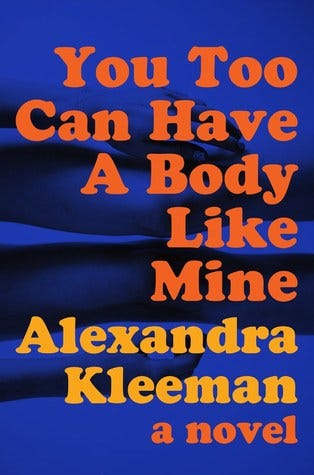
You Too Can Have a Body Like Mine by Alexandra Kleeman

Alex Kleeman, in her magnificently realized You Too Can Have a Body Like Mine, [contemplates] the yoke between individual body and singular self. As this story from the book reflects, not only are her characters shorn of even their names — they are, simply, A and C — but the world’s larger population has begun fleeing the demands of stress, and chores, and even love itself. And yet, she reminds us, even under such ascetic conditions, some things are irreducible… and perhaps the most irreducible fact of all, our physical selves, has become the foundation of an alimentary-industrial complex that feeds upon us daily.

Alex Kleeman’s work will likely stir the “gift-curse of recognition” (her typically tart phrase) within you. Happily, though, it should also have you laughing through the existential horror.

– Cal Morgan, former Executive Editor, Harper, introducing “Disappearing Dad Disorder,” excerpted from You Too Can Have a Body Like Mine in Electric Literature’s Recommended Reading no. 170

You can also read our review of You Too Can Have a Body of Mine and our interview with Kleeman.

hannaham

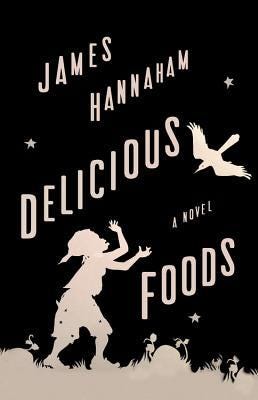
Delicious Foods by James Hannaham

Delicious Foods…begins in a swampy hell. Our hero, Eddie, who has no hands, struggles to drive a stolen car to a sweeter place off interstate 45, where his aunt lives, in order to escape a horrible series of events that are not revealed until the end of the story. Darlene, Eddie’s mother, is grief stricken by the sudden death of her black activist husband; her identity becomes entirely eclipsed by crack cocaine. Darlene is literally held captive and drugged by a sinister food chain, human trafficking operation. Although the book is primarily focused on desperate acts born out of grief, drug addiction and rough terrain, “Delicious Foods” is, on a larger scale, an ambitious story about systemic racism and self-destruction — traps that can lead us to our own demise.

– Antonia Crane from a list of books about addiction and recovery

You can also read our interview with James Hannaham.

ishiguro

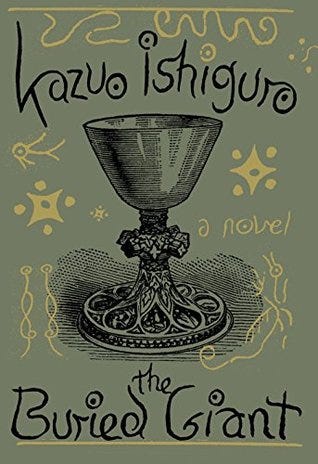
The Buried Giant by Kazuo Ishiguro

In The Buried Giant, an elderly couple sets off on a journey through a mythical England populated by ogres, dragons, knights and giants. Axl and Beatrice are in search of their son, whom they can’t quite remember how they lost. This is because the inhabitants of The Buried Giant’s mythical world suffer a collective amnesia, a ‘mist’ that keeps them from holding onto certain memories, both personal and historical. As we travel with Axl and Beatrice, the novel asks us what memory (and forgetting) means to a person, to a couple, to a society. In many ways, the book is surprising (The New York Times calls it ‘a departure’), but it also showcases some of Ishiguro’s most essential qualities as a writer: subtle prose, a dreamlike atmosphere, and powerful questions about loss and memory.

– Elysha Chang in her introduction to our interview with Ishiguro

shepard

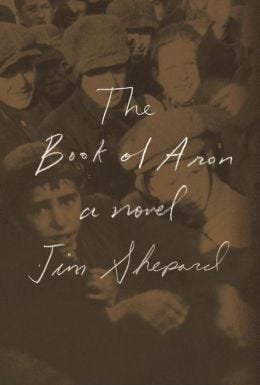
The Book of Aron by Jim Shepard

Like Schindler’s List, The Book of Aron is haunted by a great man, in this case, Janusz Korczak, the pediatrician famous throughout Europe and appointed caretaker for a set of Jewish orphans. Central to the lives of saints, the act of bearing witness — to Korczak, to the struggles of friends and family — is performed by a boy who is not a model of moral purity, even as the occupiers’ crimes dwarf his own. Wracked by guilt, Aron needs to believe in Korczak. And Korczak knows it.

Shepard’s no sap, and his hunger for certified historic fact is voluminous, practically what underlies his entire literary career. As in another of his most impressive works-to-date, a short story titled “The Netherlands Lives with Water” set in Holland of a not-so-distant-future, inundated by relentlessly climbing ocean levels, the characters in The Book of Aronfind themselves practicing “a sort of apocalyptic utilitarianism: on the one hand they were sure everything was going to hell in a handbasket, while on the other they continued to operate as if things could be turned around with a few practical measures.”

– J.T. Price in our review of The Book of Aaron

luiselli

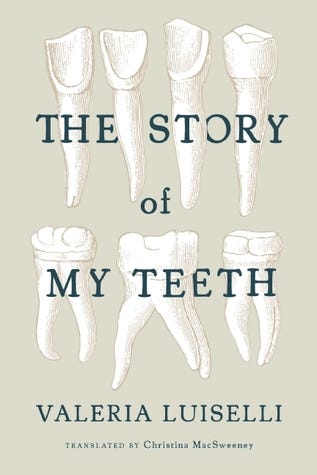
The Story of My Teeth by Valeria Luiselli

There is something astonishing that the Mexican novelist Valeria Luiselli has achieved across the space of her three books — Faces in the Crowd, Sidewalks, and her latest The Story of My Teeth — by writing into and out of relingos, the forgotten, inexplicable open spaces of Mexico City…Luiselli has a talent for satire. She puts us in the room with a pile of old teeth — as Siddhartha has put Highway’s old teeth in the Jumex Juice Factory Art Museum — and shows us how far people will go, how a story is the only thing that gives objects value. A book without a story is worthless paper, we know deep down. The pleasure of reading, and living, exists in traversing the passages of the labyrinth and not in discerning the route to its center.

– Geoff Bendeck in our review of The Story of My Teeth

You can also read our interview with Valeria Luiselli.

yuknavitch

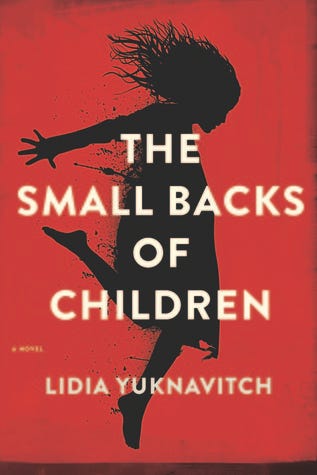
The Small Backs of Children by Lidia Yuknavitch

The Small Backs of Children requires the reader to let go and give into the prose and story. Why do the writer’s friends so determinedly latch onto the idea of saving the young girl and bringing her to the writer? Once I had finished the book, I knew I had read something brilliant…The Small Backs of Children is ultimately an examination of the spectrum of creation — whether of self or art — and how often creation can uneasily exist along with destruction.

– Sarah Galo from our review of The Small Backs of Children

july

The First Bad Man by Miranda July

This novel will be talked about for its ability to test boundaries, particularly the boundaries of sexual labels or forbidden love. But it’s worth mentioning the readability of July’s prose. Her success in carrying us through the strange world of Cheryl Glickman is a testament to her skill. This is a bizarre story, but an alluring one, and one that ends in a moment of satisfaction. July creates a character in Cheryl who elicits our empathy, but also a visceral response. Her conviction in her specific belief system makes her a character we want to understand, if not become. She understands herself, and she is most certain of the genesis of Kubelko Bondy. “I didn’t make him,” she acknowledges, “but I did each thing right so he would be made.”

– Heather Scott Partington from our review of The First Bad Man

houellebecq

Submission by Michel Houellebecq

Some have called Submission satire, others a dystopia. Is it a warning cry, a near-reality to be feared, or a conception of the darkest fears of the ignorant? The truth lies somewhere in between. Houellebecq himself — interviewed extensively following the novel’s now-infamous publication on the date of the Charlie Hebdo massacre — said in a September interview with The Guardian, “The role of a novel is to entertain readers, and fear is one of the most entertaining things there is.” Houellebecq’s work is emblematic — a re-spinning of — the fear-driven headlines that sell magazines and newspapers and keep TVs tuned to 24-hour news commentary. By distilling the traditionally hysterical language of news into the very plausible and mundane life of his narrator, Houellebecq forces his readers — of every ilk — to consider the effect of the stories we tell ourselves daily in 2015. Fear is a powerful seductress, and Houellebecq, with his description of a disconnected, academic life, understands that the most powerful way to explore something is to put it into the context of the ordinary.

– Heather Scott Partington from our review of Submission

glaser

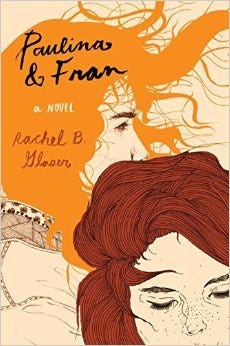
Paulina and Fran by Rachel B. Glaser

It is a fiercely intelligent work of fiction — often hysterically funny, often painstakingly reminiscent of my own college years — and, while reading, one knows oneself to be in the hands of an extremely gifted writer. I eagerly anticipate whatever Rachel B Glaser does next, and I know that when Paulina & Fran finds its audience, I will not be even remotely alone in that.

– Vincent Scarpa from his introduction to our interview with Rachel B. Glaser

gerard

Binary Star by Sarah Gerard

Sarah Gerard’s new novel Binary Star is an intense story about a young astronomy student struggling with anorexia and her relationship with a long-distance, alcoholic boyfriend. Together, the destructive couple takes a road trip around the United States and experiments with veganarchism. As she starves and purges, he consumes. The prose reflects the characters’ behavior. Sparse and lean, Gerard’s writing hurtles forward with a momentum that seems bent on burning up, much like the stars her protagonist studies. It’s a novel that takes risks, both in style and subject matter. Women are told that writing about eating disorders is cliché, or that if they write about their bodies or their own narcissism they won’t be taken seriously. Sarah Gerard refuses to let those experiences be devalued and instead puts them at the center of a serious literary work.

– Kristen Felicetti from her introduction to our interview with Sarah Gerard

o'neill

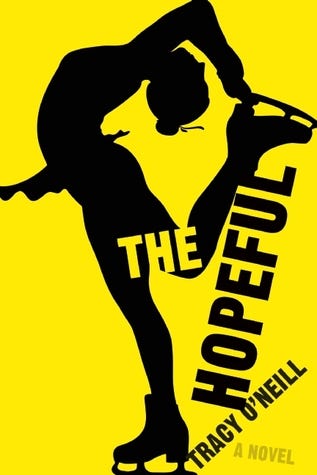
The Hopeful by Tracy O’Neill

Tracy O’Neill’s The Hopeful, set in the mind-warping world of competitive figure skating, ranks among the best, most transcendent sports novels in recent memory. Alivopro Doyle is a “hopeful,” one of thousands of girls skating endless hours at her local rink and dreaming of the Olympics. A fall breaks two vertebrae and launches her into a course of therapy, chemicals, and regret over one elusive jump, the triple Salchow. The book revels in physical elegance (skating as “flying without wings, contorting through the cold”), but its finest moments examine not achievement, but aspiration and disappointment: the moment before the jump, the ice after the fall, the stale locker rooms, the hospital beds. The novel, O’Neill’s first, earned her recognition as one of the National Book Foundation’s 5 Under 35 for 2015.

– Dwyer Murphy, Interviews Editor, electricliterature.com

beatty

The Sellout by Paul Beatty

Beatty’s fourth novel is another biting satire on race in America. Kiese Laymon in the Los Angeles Times called it “among the most important and difficult American novels written in the 21st century . . . It is a bruising novel that readers will likely never forget.” In the Wall Street Journal, Sam Sacks described it as “Swiftian satire of the highest order . . . Giddy, scathing and dazzling.” We call it one of the best novels of the year.

phillips

The Beautiful Bureaucrat by Helen Phillips

I told Helen Phillips that her novel, The Beautiful Bureaucrat, is an “existential thriller.” That might sound like an oxymoron: after all, existential literature is known for its lack of action. Existential texts are usually about being stuck: waiting for Godot, or trying to escape an insect’s body. The Beautiful Bureaucrat demands that you keep turning its pages to find out what happens. And yet Phillips’s book — absurd, uncanny, tinged with dread — owes more to Beckett and Kafka than to Lee Child or Stephen King. […] The Beautiful Bureaucrat is as much about the mysteries of marriage as those of human existence. Phillips has created an abstract world, but the see-saw of Josephine and Joseph’s relationship is realistic. Their essential connection gives meaning to the absurd landscape.

– Elliott Holt, Author of You Are One of Them, introducing “The Apartments of Strangers,” excerpted from The Beautiful Bureaucrat in Electric Literature’s Recommended Reading no. 169

You can also read our interview with Helen Phillips.

alcott

Infinite Home by Kathleen Alcott

Grief is a difficult home to leave, everything outside it seeming foreign and incomprehensible. Though it’s musky and poorly lit, at least this home is familiar, protected. At least it’s yours.

Most of the characters in Kathleen Alcott’s richly layered second novel, Infinite Home, are pacing the dusty corners of loss and estrangement, but they also share a literal roof, the brownstone where they all rent apartments from Edith, their elderly landlady who is descending into dementia. Edith’s tenants — Edward, a burned-out comedian, Thomas, an artist mournfully recovering from a stroke, Paulie, a young man with a rare neurodevelopmental syndrome, and Adeleine, a woman nostalgic for an era in which she never lived — slowly creep out of their private stagnations and into each other’s lives in surprising ways.

– Catherine Lacey, author of Nobody is Ever Missing, introducing an excerpt from Infinite Home in Electric Literature’s Recommended Reading no. 166

You can also read our interview with Kathleen Alcott.

novic

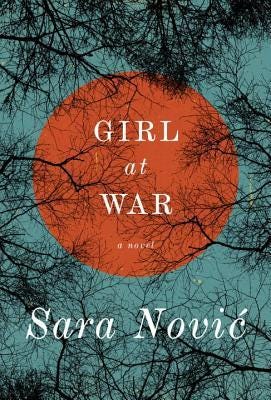
Girl at War by Sara Nović

Sara Nović has an agenda. The violent conflicts in Croatia, where she has many friends and family, and the complicated history of that region have been obsessions of Sara’s for many years. Her powerful debut novel Girl at War (Random House, 2015) tells the story of Ana, a 10-year-old girl who is living in Zagreb when war breaks out in the early 1990s. In telling Ana’s story, Sara hopes to shed light on a time and a place about which many people still know very little.

Sara’s novel gives us familiar childhood settings of school and play and family life, as well as harrowing scenes of civilian war and make shift armies, of teenagers-turned-soldiers in abandoned buildings called “safe houses,” where the inhabitants are playing cards one minute and shooting their enemies the next. We travel through this world with Ana, at an age where she is just starting to make sense of the world around her, while the world keeps refusing to make sense.

– Catherine LaSota from our interview with Sara Nović

groff

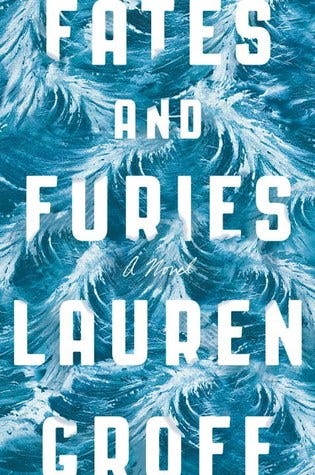
Fates and Furies by Lauren Groff

Cradle-to-grave novels require the kind of ambitious, ambiguous specificity Groff wields. Rather than describing every year of her characters’ lives, an ensemble of scenes, moments and memories are utilized to great effect. In the first half of the book, Fates, we follow Lancelot — ironically called “Lotto” — through a thicket of traumas and life-defining moments, starting with his birth during the eye of a hurricane in Florida. A boisterous college party introduces us to Mathilde, a lanky girl whose beauty relies on a magnetic oddness. She lurks in the background during this first part, though we can sense the galaxy of her love slowly colliding with Lotto’s, all through his aspiring and failed dreams of becoming an actor, and then his victorious triumph as a New York City playwright. […]

What rescues Fates and Furies are Groff’s sentences, as always lithe and poetic, unrolling like a glimmering carpet to the gray and uncertain territory of her characters’ inner conflicts. She wields an almost-wizardly command of language, specifically metaphor. Each page contains sumptuous pieces of imagery. “A tiger of light” prowls in a bedroom in the morning. Tree branches are “stunned as soldiers after an ambush.” Mathilde’s blood is “humming like a beehive.”

– Zack Hatfield from our review of Fates and Furies

You can also read our interview with Lauren Groff.

barry

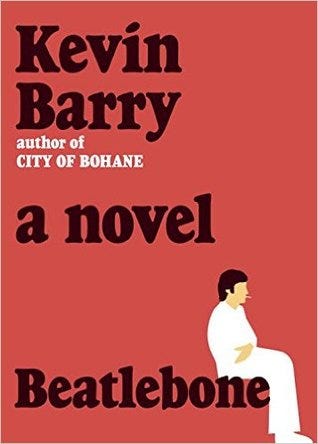
Beatlebone by Kevin Barry

Beatlebone tracks an imagined excursion taken by John Lennon in 1978 to Dorinish, his uber-remote private island off the Mayo coast. With the help of a philosophical local fixer named Cornelius, John evades the British tabloid press; falls down a psychological rabbit hole with a sinister communal trio of Primal Screamers inside an abandoned hotel; and considers his relationship with his wife and parents, his music and memory. All of this while trying desperately to make it to a gnarled, inhospitable piece of rock in the stormy Atlantic, where he can finally be alone with his thoughts.

– Dwyer Murphy from the intro to our interview with Kevin Barry

mohr

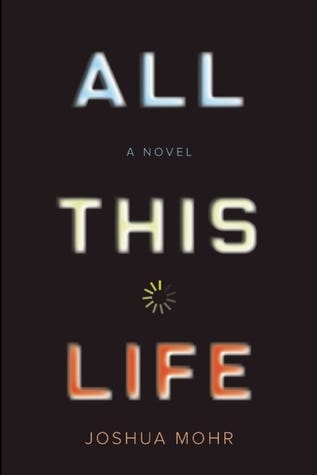
All This Life by Joshua Mohr

The news delivered in Joshua Mohr’s novel All This Life is captured by the second headline. Mohr’s bleak view of our wired present is clear from the opening scene, where we find the “Bluetooth chain gang” enduring rush hour traffic on the Golden Gate Bridge. The chain gang universally hates their jobs, and they long, Mohr tells us, for “a day to feel free. To be alive.” Why these emotions are any different than those felt by every commuter, in every age, is never explained, but what is explained is the reason for the unusually awful traffic: a brass band that has been marching across the bridge begins, one by to one, to jump into the bay, instruments and all. Paul and his teenaged son, Jake, are two of the commuters that witness the mass suicide, and Mohr describes Jake’s reaction with the following emoji: “a head with a can opener spinning around its crown and peeling up the skull and plucking out the brain and whirling it around on an index finger like a basketball.” Jake captures the entire scene on his phone, and then, like any modern teenager, he immediately uploads the video to YouTube. […]

The novel’s strength is that it dramatizes the implications of our online selves; Sara at one point refers to her video as her “digital, conjoined twin,” and this twin is definitely the evil sort, the kind that stalks you and makes your life miserable. We all have these digital twins, with varying degrees of evil depending on your browser history, and if you allow your mind to concoct worst case scenarios, we might all jump off a nearby bridge.

– Eric Howell from our review of All This Life

You can also read our interview with Joshua Mohr.

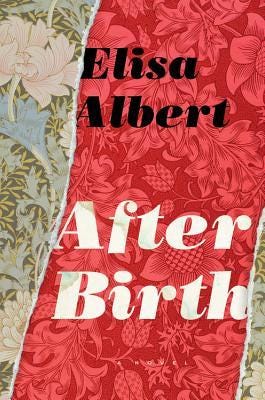
albert

After Birth by Elisa Albert

After Birth roars with the anger of betrayal. Albert is abrasive and sharp, intelligent and painfully real. There is no room for gentleness in her novel, no time to waste looking for a kinder way of speaking. It’s as if After Birth, while raging against the isolation of motherhood, wants to reverse it. […] After Birth comes twenty years too late to truly be Riot Grrrl literature, but something about it begs that you put on the new Sleater-Kinney, notch up the volume, and breastfeed (in public, why not) while you’re at it. Because After Birth is looking for a fight, it’s unladylike, it’s pissed off, and it’s going to tear everything you thought about birth and motherhood to shreds.

– Jeva Lange from our review of After Birth

You can also read our interview with Elisa Albert.

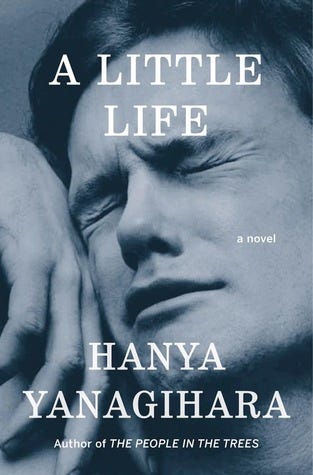
yanagihara

A Little Life by Hanya Yanagihara

A Little Life by Hanya Yanagihara is an unsparing novel that follows the lives of four college friends as they achieve the successes they once dreamed of and strived for. There is a fairy tale quality to the wealth and fame these men achieve, but like all fairy tales there is an underlying darkness. The darkness at the center of this novel emanates from Jude St. Francis, a successful lawyer by any measure, but a man who remains an enigma to friends and family nearly to the end. The reader bears witness to the aftermath of the childhood abuse Jude St. Francis suffered, and barely survived, with the understanding that the brutality of the witnessing cannot compare to the experience itself. Unable to heal himself, or be healed by others, Jude is a character that calls into question the redemptive narrative arc we too often expect from stories of trauma. Yanagihara would argue that this isn’t a story about trauma but about life. Either way, she asks the tough questions: how do we live, and why?

– Adalena Kavanagh from our interview with Hanya Yanagihara

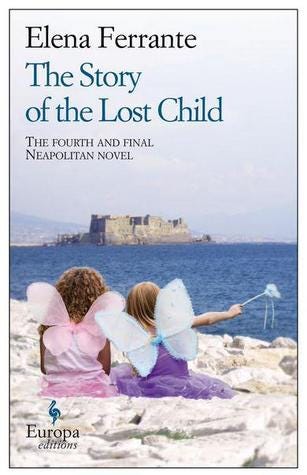
ferrante

The Story of A Lost Child by Elena Ferrante

The subtitle of The Story of the Lost Child, “The fourth and final Neapolitan Novel,” broadcasts to Ferrante devotees and momentous and bittersweet occasion: the conclusion of the emotional, intellectually stimulating, and, at times, soap-operatic saga of Lila and Lenù, and their lifelong friendship that begins and ends in a working-class neighborhood in Naples. The Neapolitan novels are habitually referred to as a story of female friendship, however that description, especially in light of this stunning fourth novel, has always felt reductive. They are less the story of female friendship that the story of female identity, particularly female intellectual identity, and how relationships — platonic, romantic, and maternal — threaten, challenge and shape that identity.

Readers are highly recommended to enjoy these books sequentially, beginning with My Brilliant Friend, but for those who can’t wait to dive into The Story of the Lost Child may refer to our study guide, “Previously on the Neapolitan Novels.”

– Halimah Marcus, Editorial Director, Electric Literature

A History of the Christmas Story: Not Altogether Christmas but Christmas All Together

by Kate Webb

Winter darkening brings its own intensities: snowdrifts on rooftops, red berries in the trees, and for the lucky few, maybe a pub fire roaring in the grate. As the nights draw in and the season’s grand finale approaches, many of us still brighten our world with carol singing, high street lights and Christmas stories — key ingredients in the mix of paganism, consumerism and religion we call Christmas. The stories we read now first appeared 150 years ago. Dickens established the modern form, publishing one in most years of the mid-nineteenth century, and soon everyone from Anthony Trollope to Louisa Alcott was trying their hand. Few could resist the temptation of sentimentality, and a reputation for the maudlin persists. “The very phrase Christmas story had unpleasant associations for me,” says Paul Auster’s narrator in “Auggie Wren’s Christmas Story” (1990), “evoking dreadful outpourings of hypocritical mush.” Despite this, Auster understands that though the Christmas story is a low form (a literary ‘turn’), it sets challenges few writers would run away from, which is why so many grandees (Tolstoy, Waugh, Spark, Updike) have bothered with it. Part of the attraction is that Christmas is one of the few events still bound by tradition, making the Christmas story — a thing of retrospection and repetition — peculiarly literary and self-conscious.

Christmas is one of the few events still bound by tradition, making the Christmas story — a thing of retrospection and repetition — peculiarly literary and self-conscious.

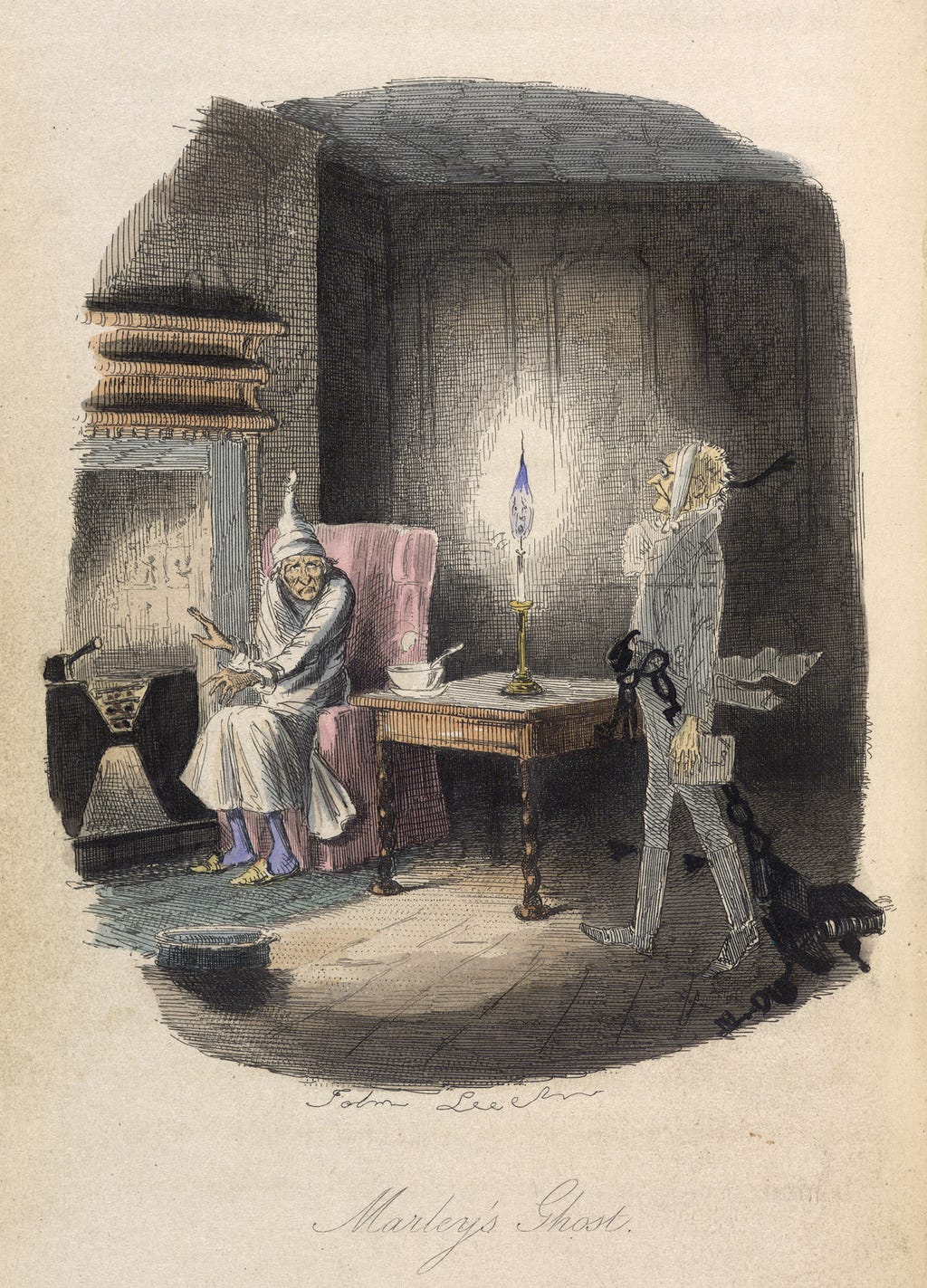
Christmas present, Dickens saw, always contains Christmas past (explaining why so many of its stories are inhabited by ghosts or children), and this gives rise to a moment of reckoning. In A Christmas Carol (1843), the accusation leveled at Scrooge is one of stinginess; the counting house turns men into creatures of rote, incapable of empathy or conviviality. Spiritedness is what matters, and even the poorest can revel in festivity. So on his ghost-flights Scrooge encounters miners, lamplighters and lighthousemen, all “blithe and loud” as they dance round fires and tell tales to one another. It was this lost spirit of Christmas that interested Washington Irving, whose sketches of customs that were dying out in England had first inspired Dickens. Irving included among these a lament about the disappearance of the Lord of Misrule — a figure older than the Anatolian Saint Nicholas, older even than the Dutch Sinterklaas or Nordic bearded elfman — who was outlawed during the English Civil War, along with the Christmas holiday and its twelve day riot of feasting and carousing.

No doubt it was Irving that Angela Carter had in mind when she wrote “The Ghost Ships” (1993), a fable about relations between the puritan New World and the superstitious old one. Even in Boston Bay, where Christmas was prohibited, citizens were still vulnerable to the witching hour. Into this permeable moment slip three ghost ships. One decorated in apple, holly, ivy and mistletoe. One fronted by a boar’s head, belching “swans upon spits and roast geese dripping hot fat.” And one carrying mummers and masquers, “large as life and twice as unnatural” (men dressed as women, bells jingling at their ankles) — the revenants of once Merry England. All three ships come sailing by and all are sunk by the puritans’ “awesome piety.” But something in their meaning will not be denied. As the Lord of Misrule falls into the Atlantic, he hurls a contraband pudding onto the shore. The next morning its plump raisins have scattered into the shoes of every child rising to pray in the “shivering dark.”

As the Lord of Misrule falls into the Atlantic, he hurls a contraband pudding onto the shore.

Inevitably, the struggle between Christianity and a barely-suppressed paganism is at the heart of many Christmas tales. Among the wintry Russians, Tolstoy and Chekhov produced stories in which Christian goodness prevails. But in “The Night Before Christmas” (1832), Gogol, writing in the folk tradition passed down to him by his Ukrainian mother, tells a wild tale that begins in the witching hour (literally, with a witch on a broomstick), where the devil gets his due. Gogol’s magic is not Christian (miraculous and didactic), but that of a trickster who steals the moon and hides it in his pocket. As in Dickens, a man is flown about by a spirit, but for the purpose of mischief-making rather than moral instruction.

A century later, Nabokov wrote two stories typical of his canon in their cunning and tenderness, while at the same time pinning the essential elements of the Christmas genre. “Christmas” (1925) is about a father visiting his country manor after the death of a beloved son, whom he remembers netting butterflies. When he moves one of his son’s pupae into the heat of the house it emerges unexpectedly, a rebirth as fantastic as the Resurrection itself. This is fiction as consoling and full of powerful magic as any religion. It is written wittingly, inside, and out of, tradition — Christian, rather than Gogol’s paganism — and, like the smartest of these tales, knows its place, even as it tries to usurp it.

Three years later in “A Christmas Story,” Nabokov conducted the discussion of a story’s “place” out in the open, pondering the fate of the imagination under tyranny and reconsidering the debate about puritanism. Wondering how to write fiction in a manner acceptable to Soviet Russia’s cultural commissars, an old writer, a novice writer, and a critic all discuss how Christmas can be viable in times that insist only on the real. Finally, the old man comes up with a story in which well-fed Europeans are mesmerized by a shop-window Christmas tree stacked with ham and fruit, all the while ignoring a body slumped “in front of the window, on the frozen sidewalk — ”. The sentence needs no completion: the winning formula has been found (decadent foreigners blind to the suffering of the poor). As one might expect from Nabokov, it is a knowing piece — the old writer struggling to describe Christmas in the critically-approved language (the “insolent Christmas tree,” the “so-called ‘Christmas’ snow”), and the critic, who writes for a journal called Red Reality, praising the novice’s depiction of peasant lust, but dismissing his portrayal of an intellectual because “There is no real sense of his being doomed…”

In the second half of the twentieth century writers continued to take the Christmas story apart, alerting readers to its dialogism; sometimes, as in Dylan Thomas’s unruly tale, “A Child’s Christmas in Wales” (1955), even granting them a walk-on part. Here, a memoirist channelling “distant speaking…voices” conjures a reader who queries his fantastic account of a time long ago when there were “wolves in Wales…and we chased, with the jawbones of deacons, the English and the bears.” Paul Auster’s tale comes less directly and innocently out of a folk tradition, but seems the most consummate of Christmas stories in the way it assembles and disassembles itself. There are multiple narrators and a story within a story; there is the “business about the lost wallet and the blind woman and the Christmas dinner”; notes to the reader about trusting the storyteller (“he knew exactly what he was doing”); lessons in the suspension of disbelief and fictional ‘truth’; and discussion of the “out-and-out conundrum” of the unsentimental Christmas story. Finally, there is a polite reminder to pay the piper.

For Grace Paley and Alice Munro the mystery is no longer a matter of miracle or spirit but a modern question of identity and doubt.

Other writers have reformulated the Christmas story by putting a new spin on the old tale. For Grace Paley and Alice Munro the mystery is no longer a matter of miracle or spirit but a modern question of identity and doubt. They find fresh perspectives with young girls as protagonists who speak distinctively in the first-person, though without a hint of Thomas’s orotundity or Auster’s complicity. Their stories, echoing the Teaching of the old story, are about education.

In Paley’s “The Loudest Voice” (1959), Shirley Abramowitz, child of the noisy Brooklyn street, is chosen to read the text in her school’s Christmas play. But she and her friends are Jewish immigrants and their involvement in a Christian drama creates tensions in a community divided in its views on assimilation. “This is a holiday from pagan times also, candles, lights, even Hannukah,” her papa says, arguing for his daughter’s inclusion, “So we learn it’s not altogether Christmas.” When the play is over, the parents debate in Yiddish, Russian, Polish. Why had so few American kids gotten big parts? “They got very small voices,” Shirley’s mother points out, “why should they holler? Christmas…the whole piece of goods…they own it.”

Munro’s heroine is too young to become a waitress so she takes a job as a turkey-gutter. “Are you educated?” is the first question anyone asks her in “The Turkey Season” (1980), and an education is precisely what she gets observing relationships in this family firm. She learns whose power is ostensible and who really runs the place; about the skill involved in dissecting a carcass; how seriousness and curiosity can overcome disgust (“Have a look at the worms…Now put your hand in”); even that there are some mysteries, “voluptuous curiosities,” such as the sexuality of her supervisor, which will not yield to scrutiny.

This one has a curmudgeon to match Scrooge — not in asceticism (she orders far and wide on the Internet) but in her refusal to get into the Christmas spirit.

In the twenty-first century, there has been a revival of the Christmas story, with examples from Jeanette Winterson, Will Self, A. L. Kennedy and Jackie Kay. One of the most attuned to the times is Ali Smith’s pointedly titled, “Do You Call That a Christmas Present?” (2008). This one has a curmudgeon to match Scrooge — not in asceticism (she orders far and wide on the Internet) but in her refusal to get into the Christmas spirit. What this woman wants for Christmas are comforters: wine and cake, socks and scarves; what she gets is a block of ice, a skeletal tree with dirty roots, a mad girl standing outside in the snow, serenading her. At first she is appalled, but her lover’s enthrallment to the season is infectious. Despite her cynicism, when a girl dressed as a boy soars through the air at the pantomime, she finds her face “wet with tears.” Soon she is watching Christmas films and singing Christmas songs. “Have yourself a merry little Christmas,” she hums and, at last, she is.

The whole piece is traditional as can be, hitched to “The Twelve Days of Christmas.” By the eighth day, she is “telling stories of Christmas past,” ones spent with lovers and family, and ones alone. She thinks about the old, old story (“no room at the inn”) and other exiled, lonely people. On the eleventh, she goes night-walking, marvelling at the snow’s “constellations” and the glistening, lit-up windows; she is already regretting the passing of the shortest day. Finally, on the twelfth, she shows her true love how much she has learned, giving her a present of logs and matches. Together they set a fire that throws “companionable shadows,” and sing to one another of the partridge and the pear tree.

As Irving and Dickens showed in their early attempts to resurrect the spirit of Christmas, and as Smith sees so clearly today, there is real, assayable value in the old traditions and great enjoyment to be had from them. Even in our prickly individualism, hemmed in by consumer goods, there are moments when we can escape from safe, homogenized lives to experience the tingling pleasures of heat and cold, of icy days and starry nights. The Christmas story reveals these freely available good things in front of us as it binds us to custom and continuity, drawing us back. Amid plenty and diversity it acts cohesively, bathing us in Platonic firelight and seating us at an imaginary hearth with ancestors for whom storytelling “in the light and the dark” was the greatest delight.

PODCAST: Jason Diamond and Jen Vafids Dissect the 1998 Great Expectations Adaptation

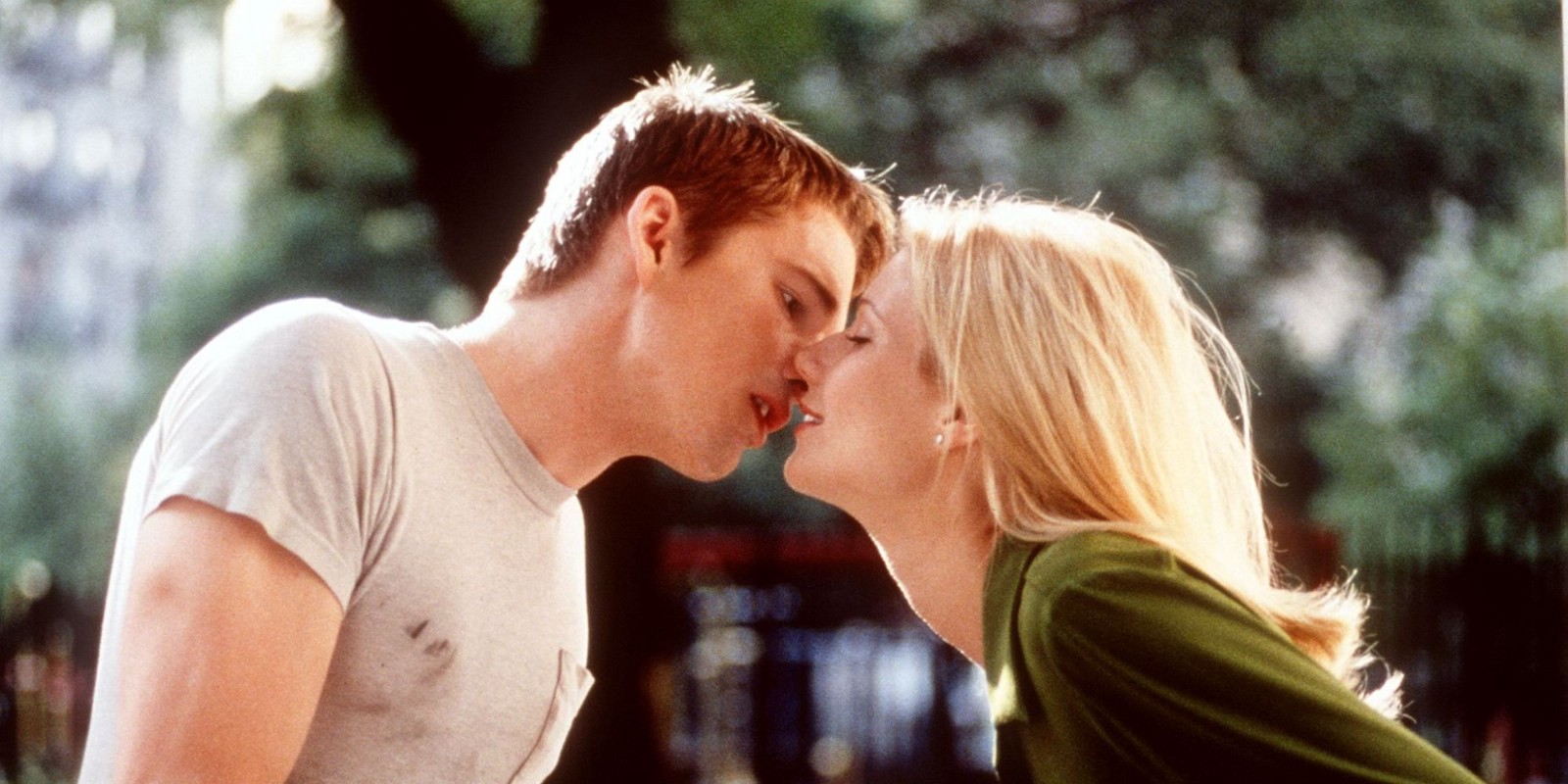
There are some films that are innovative and interesting takes on classic books, and then there is the 1998 adaptation of Great Expectations. Directed by and starring a bunch of people who won, or would go on to win Oscars, the movie is part of a trend in the 90s that attempted to take classic literature and give it a fresh and hip edge (think Clueless, Romeo + Juliet, Cruel Intentions), but as Jason Diamond and Jen Vafids discuss on this episode of Ryder + Flyte, the results are mixed at best.

Hole

by Jen Beagin

Excerpted from PRETEND I’M DEAD

He lived downtown, in a residential hotel called the Hawthorne, a six-story brick building sandwiched between a dry-cleaning plant and a Cambodian restaurant. When she arrived three Cambodian gang members were loitering in front of the restaurant. It was broad daylight and she felt overdressed in her black kimono shirt and slacks. She also felt whiter and richer than she was. The sixty bucks in her pocket felt like six hundred.

The lobby had the charm of a check-cashing kiosk. A security guard stood at the door and a pasty fat man sat in a booth behind thick, wavy bullet-proof glass. Mona slipped her ID through the slot.

“Who you here to see?”

She gave him Mr. Disgusting’s name.

“Really?” he asked, looking her up and down.

“Yeah, really,” she answered.

Mr. Disgusting came down a few minutes later, wearing gray postal-worker pants and a green t-shirt that said “Lowell Sucks.”

“You look nice,” she said.

“I scraped my face for you.” He took her hand and brought it to his bare cheek and then clumsily kissed the tip of her thumb. She blushed, glanced at the fat man behind the desk, who studied them with open disgust. “You get your ID back when you leave the building,” he said into his microphone.

They shared the elevator with a couple of crackheads she recognized from the neighborhood. Mr. Disgusting kept beaming at her as if he’d just won the lottery. For the first time in years, she felt beautiful, like a real prize. They got off on the third floor.

“It’s quiet right now, but this place is a total nuthouse,” he said.

“Doesn’t seem so bad,” she lied.

“Wait until dark,” he said, pulling out his keys.

His room smelled like coffee, cough drops, and Old Spice. All she saw was dirt at first, one of the main hazards of her occupation. She spotted grime on the windowsill and blinds, dust on the television screen, a streaked mirror over a yellowed porcelain sink. The fake Oriental rug needed vacuuming, along with the green corduroy easy chair he directed her to sit in.

Once seated, she switched off her dirt radar and took in the rest of the room. She’d expected something bare and cell-like, but the room was large, warm, and carefully decorated. He had good taste in lamps. Real paintings rather than prints hung on the walls; an Indian textile covered the double bed. He owned a cappuccino machine, an antique typewriter, a sturdy wooden desk, and a couple of bookcases filled with mostly existential and Russian novels, some textbooks, and what looked like an extensive collection of foreign dictionaries.

“Are you a linguist or something?” she asked.

“No, I just like dictionaries.” He sat directly across from her, on the edge of the bed, and crossed his legs. “I find them comforting, I guess. Most of these I found on the street.”

“You mean in the trash?”

He shrugged. “I’m a slut for garbage.”

“Your vocabulary must be pretty impressive,” she said. “Do you have a favorite word?”

He thought about it for a second. “I’ve always liked the word ‘cleave’ because it has two opposite meanings: to split or divide and to adhere or cling. Those two tendencies have been operating in me simultaneously for as long as I can remember. In fact, I can feel a battle raging right now.” He clutched his stomach theatrically.

She smiled. It was rare for her to find someone attractive physically and also to like what came out of their mouths.

“What’s your least favorite word?” he asked.

“Mucous,” she said.

He nodded and scratched his chin.

“I wasn’t born like this,” he said suddenly. “Moving into this hellhole did quite a number on me — you know, spiritually or whatever. I haven’t felt like myself in a long time.”
He’d lived there seven years. Before that, he owned a house in Lower Belvidere, near that guns and ammo joint. He’d had it all: a garage, a couple of cats, houseplants. She asked what happened.

“I was living in New York, trying to make it as an artist,” he said. “I had a couple shows, sold a few paintings, was on my way up. During the day I worked as a roofer in Queens.” He stopped, ran his fingers through his hair. “One night I was on my way home from a bar and I was shit-faced, literally stumbling down the sidewalk, and out of nowhere, two entire stories of scaffolding collapsed on top of me, pinning me to the concrete. A delivery guy found me three hours later. Broke my clavicle, left arm, four ribs, both my legs. Bruised my spleen. My fucking teeth were toast.
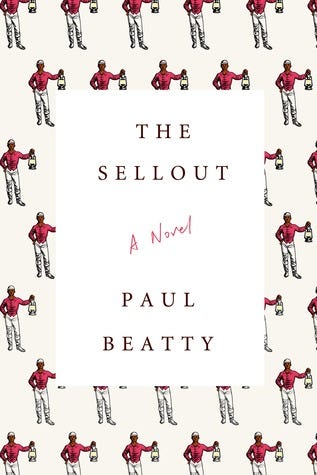
“After I got out of the hospital, I couldn’t exactly lump shingles as a roofer, so I crawled back to Lowell. Then I got this big settlement and was able to buy a run-down house, but one thing led to the other.” He pointed to his arm. “I pissed it away, made some bad decisions. I’ve been living in a state of slow panic ever since.”

“Sounds like you’re lucky to be alive.”

He shrugged. “Am I?”

She felt her scalp tingle. For as long as she could remember she’d had a death wish, which she pictured as a rope permanently tied around her ankle. The rope was often slack and inanimate, trailing along behind her or sitting in a loose pile at her feet, but occasionally it came alive with its own single-minded purpose, coiling itself tightly around her torso or neck, or tethering her to something dangerous, like a bridge or a moving vehicle.

Mr. Disgusting plucked a German pocket dictionary off the shelf and leafed through it. He was certainly a far cry from the last guy she dated, some edgeless dude from the next town over whose bookshelves had been lined with Cliffs Notes and whose heaviest cross to bear had been teenage acne.
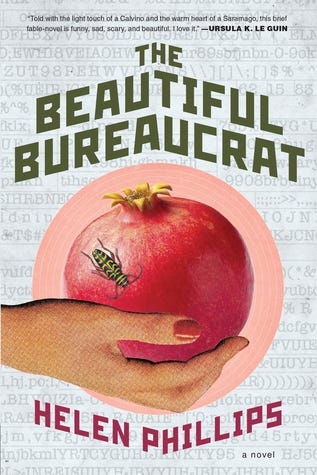
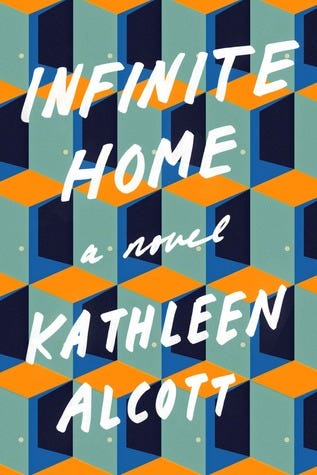
“Do you know any German words, Mona?” he asked, startling her. It was only the second time he’d said her name.

“Only one,” she said. “But I don’t know how to pronounce it.”

“What’s it mean?”

“World-weariness.”

“Ah, weltschmerz,” he said, smiling. “You have that word written all over you.”

“Thanks.”

He was beaming at her again. Where had he come from? He was too open and unguarded to be a native New Englander. She asked him where he was born.

“Germany,” he said.

According to his adoption papers, his birth mother was a French teenage prostitute living in Berlin. An elderly American couple adopted him as a toddler and brought him to their dairy farm in New Hampshire.

“They would’ve been better off adopting a donkey,” he said. “My mother was a drunk and my father danced on my head every other day.”

He ran away with the circus when he was seventeen. Got a job shoveling animal shit and worked his way up to drug procurer. It wasn’t your ordinary circus, though. It had all the usual circusy stuff, but everyone was gay: the owner, all the performers and clowns, the entire crew. Even the elephants were gay.

“What about you?” she asked.

“Straight as an arrow,” he said. After a short silence he asked, “Why, are you?”

She made a so-so motion with her hand.

“Wishy-washy,” he said. “You really are from L.A.”

She laughed.

“Well, I’m glad we got our sexual orientation cleared up,” he said. “Listen, there’s something else I need to get out of the way. Our future together depends on your reaction to this.” He smiled nervously.

“Fire away.”

She was ninety percent certain he was about to tell her he was positive.

But he didn’t say anything, just continued smiling at her, his upper lip twitching with the effort. She smiled back.

“What is this — a smiling contest?” she asked.

“Sort of,” he said.

“You win,” she said.

“Take a good look,” he said.

“Yeah, I’m looking. I don’t see anything.”

He walked over to the sink and filled a glass with water, and then he removed his teeth and dropped them into the glass.

“I’ve read Plato, Euripides, and Socrates, but nothing could have prepared me for the Teeth Police,” he said.

He held up the glass. The teeth had settled into an uneven and disquieting smile. She felt a sudden rawness in her throat, as if she’d been screaming all night.

“They’re grotesque — don’t think I’m not aware of that. I call the top set the Cathedral of Notre Dame. Notice the massive dome and flying buttresses.”

She smiled. The lump in her throat had shrunk, allowing her to swallow.

“What I really need to do is have the roof cut out of the damn thing. There’s this weird suction thing going on whenever I wear it.”

“It cleaves to the roof of your mouth,” she managed, and held her hand up for a high five.

“Precisely,” he said, slapping her hand. “Very uncomfortable.”

He set the glass on the sink and sat on the bed again, gazing distractedly out the window. She realized he was giving her a chance to study his face. He looked better without the teeth-more relaxed, more like himself somehow.

“Well,” she said. “It’s not like I’ve never seen false teeth before.”

“Yeah, but have you been in love with someone who has them?”

She felt her eyes widen involuntarily. “Who says we’re in love?”

“I do,” he said.

For the first time since setting foot in the building, she felt a twinge of fear. She imagined him throwing her onto the bed, gagging her with one of his socks.

“I’m kidding,” he said.

“How old are you?” she asked, changing the subject.

“Forty-four,” he said.

“I might be too young for you,” she said. “I’m only twenty-three.”

“That isn’t too young for me,” he said seriously.

“Of course it isn’t,” she said, and laughed. “What I’m trying to say is that you might be too old for me.”

He frowned. “I had a feeling the dentures would be a deal breaker.”

“It’s not that,” she said quickly. Or was it? She imagined him sucking on her nipples like a newborn, and then waited for a wave of repulsion to wash over her. Instead, she felt oddly pacified and comforted by the image, as if she were the one being breast-fed. “I’m thirsty,” she said.

He made Mexican hot chocolate with a shot of espresso. They sat side by side on his bed, sipping in silence. She noticed a notebook lying on the bed and resisted the urge to pick it up. He saw her looking at it. “That’s the notebook I write snatches of poetry and ridiculous ideas in,” he said.

“Good to know.”

“Do you have anything embarrassing you want to show me? A bad tattoo, perhaps?”

“My parents gave me away to a practical stranger, so my fear of abandonment feels sort of like a tattoo,” she said. “On my brain.”

He smiled. “You visit them?”

“Dad, never. Mom, rarely.”

Rather than a photo, Mona kept a list of her mother’s phobias in her wallet. She was afraid of the usual stuff — death, beatings, rape, Satan — but these commonplace fears were complemented by generalized anxiety over robbers, Russians, mirrors, beards, blood, ruin, vomiting, being alone, and new ideas. She was also afraid of fear, the technical term for which was phobophobia, a word Mona liked to repeat to herself, like a hip-hop lyric. Whenever Mona longed for her, or felt like paying her a visit, she glanced at that list, and then thought of all the pills and what happened to her mother when she took too many, and the feeling usually passed.

“My parents are addicts,” she said and yawned. “But I shouldn’t talk — I’ve been on my share of drugs. Psychiatric.”

“Antipsychotics?”

She laughed. “Antidepressants.”

“No shame in that,” he said. “I’m on four-hundred grams of Mellaril. My doctor said I could develop something called rabbit syndrome, which is involuntary movements of the mouth.” He twitched his mouth like a rabbit, and she laughed.

“What’re you taking it for?” she asked.

“Opiate withdrawal,” he said. “But they usually give it to schizophrenics.”

She nodded, unsure of what to say. He grinned at her and suddenly lifted his T-shirt with both hands. On his chest, a large, intricate, black-and-gray tattoo of an old-fashioned wooden ship with five windblown sails. The Mayflower, maybe, minus the crew. Above the ship, under his collarbone, a banner read “Homeward Bound” in Gothic script.

“Wow,” she said.

“One of the many useless things I purchased with my insurance money,” he said.

“Well, this is kind of embarrassing,” she said, “but I have some pretty big muscles. My biceps and calves are totally jacked. When I wear a dress — which is never — I look and feel like a drag queen.”

“Let’s see,” he said.

She hesitated and then pushed up her sleeve and made a muscle.

“What are these?”

He was pointing to the scars on her upper arm. They were so old she didn’t even see them anymore, but she looked at them now. There were four in that spot, about two inches long each. The cutting had started her sophomore year, immediately following her first dose of rejection by a boy she’d met at a Circle Jerks show.

“Teenage angst,” she said.

“Ah.”

“Maybe that’s more embarrassing than the muscles.”

He made a sympathetic noise and traced one with his finger. Usually she flinched whenever someone touched her arm, but she liked the feel of his hand. She felt something shift inside her — a gentle leveling, as if she’d been slightly out of plumb her whole life without knowing it.

He squeezed her bicep. “Are you a gym rat, love?”

“God, no,” she laughed. “I vacuum. I’m a cleaning lady.”

He blinked at her. “What — like a janitor?”

“Residential.”

“So you clean… houses.”

“Two or three a day,” she said. “In Belvidere, mostly.”

“You clean for a bunch of rich turds,” he said, finally wrapping his head around it.

“Basically,” she said. “Why the surprise?”

“I just think you’re a little above that kind of thing. Seems like a waste.”

She shrugged. “I’ve always felt a weird affinity for monotony and repetition.”

In fact, vacuuming was among her favorite activities. On applications she listed it as one of her hobbies. Even as a child she preferred vacuuming over things like volleyball and doll play. Her classmates had been forced to learn the cello and violin, but her instrument, and strictly by choice, had been a Hoover Aero-Dyne Model 51.

As a teenager she developed a preference for vintage Eurekas. Now she owned four: models 2087, 1458, an Electrolux canister vacuum, and a bright-red, mint-condition Hot Shot 1423, which she christened Gertrude. She’d found Gertrude in a thrift store. Love at first sight.

“Anyway, I’d much rather push Gertrude around someone’s house than sit in a generic office all day. I’ve always felt very relaxed in other people’s homes, and I like the intimacy involved, even though it’s not shared — these people don’t know the first thing about me. But yes, the rich turds, as you call them, can be a bitch to work for — it’s true. I think many of them struggle with the, uh, intimacy.”

“Why — are you sleeping with them?”

“Of course not,” she laughed. “I never see them. Many of them I’ve never met in person. But I know as much as a lover might — more, maybe — and they seem to resent me for that.”

“Ah,” he said. “You’re a snoop.”

“I’m thorough,” she said. “And… observant. You learn a lot about a person by cleaning their house. What they eat, what they read on the toilet, what pills they swallow at night. What they hold on to, what they hide, what they throw away. I know about the booze, the porn, the stupid dildo under the bed. I know how empty their lives are.”

“How do you know they resent you? Do they leave turds in the toilet?”

“They leave notes,” she said. “To keep me in my place. Funny you mention toilets — yesterday a client left me a note that said, ‘Can you make sure to scrub under the toilet rim? I noticed some buildup.’ And I was like, Oh wait a minute, are you suggesting I clean toilets for a living? Because I’d totally forgotten — thanks.”

He scowled. “I’m glad I don’t have to work for assholes.”

“Why don’t you?” she asked.

He smiled and told her he made his living as a thief.

Awesome, she thought. Well, he lived in a hotel so he was definitely small-time. She pictured him running through the streets, snatching purses.

“You don’t take advantage of old ladies, do you?” she thought to ask.

“I do, in a way,” he said matter-of-factly. “I mean, sometimes I do.”

“Well, are you going to elaborate, or do I have to guess?”

“I work for a flower distributor,” he said. “I supply him with pilfered flowers.”

“You’re a flower thief?” Now it was her turn to be baffled.

“That’s right. It’s seasonal work.”

Well, it explained the dirt under his fingernails and the scratches on his hands and arms.

“It’s hard work,” he said. “There’s a lot of driving and sneaking around. And I have to work the graveyard shift, obviously.”

“What kind of flowers do you steal?”

“Hydrangeas, mostly. Blue hydrangeas.”

“You just wander into people’s yards?”

He nodded. “Just me and my clippers! I can wipe out a whole neighborhood in under an hour,” he said, clearly pleased with himself.

She thought of the hacked bushes she’d seen in the Stones’ yard last week. “I think I’m familiar with your work, actually,” she said. “So what do you steal in the winter?”

“Why not ask me in December?” He winked.

“How’s the pay?”

“The guy I work for is a friend of mine. He pays me under the table for the hydrangeas, but he also keeps me on the payroll so I get benefits. It’s like a real job. Anyway, don’t look so upset. It’s not like I’m stealing money. They grow back.”

Against her better judgment, which had left the room hours ago and was probably on its way to the airport, she hung around. They continued talking and swapping war stories, sitting side by side on the bed. By the time the streetlights came on, he took the liberty of leaning in for their first kiss. It was just as she’d imagined it all those months-dry, sweet, a little on the solemn side.

It was like dating a recent immigrant from a developing nation, or someone who’d just gotten out of jail. They went out for dinner and a movie, usually a weekly occurrence for her, but Disgusting’s first time in over a decade. The last movie he’d seen in the theater was The Deer Hunter. At the supermarket she steered him away from the no-frills section and introduced him to real maple syrup, fresh fruit, vegetables not in a can, and brand-name cigarettes. He showed his thanks by silently climbing the fire escape at dawn, after his flower deliveries, and decorating her apartment with stolen hydrangeas while she slept. Easily the most romantic thing anyone had done for her, ever.

Besides the flowers, his first significant gift was a series of drawings he found in the basement of a condemned house. There were seven in total, about five by seven inches each, loosely strung together in the upper-left corner with magenta acrylic yarn. They were crudely drawn in black and red crayon, seemingly by a child. She liked them instantly but was much more fascinated with the captions scrawled across the top of each one. The captions read:

There was a house

A little girl

Two dogs

One Fat Fuck

It was a nice skirt

Fat Fuck was found with no hands

Fat Fuck is dead

He thought the best place to display them was the bathroom. “It’ll give us something to contemplate on the can,” he said. “We can come up with Fat Fuck theories.”

They decided to hang them side by side above the towel rack, and she stood in the doorway, watching him tap nails into the wall. She’d never been in a relationship with someone who owned a hammer. He was wearing a pair of checkered boxers and his Jack Kerouac T-shirt, which had a picture of Kerouac’s mug on the front, along with the caption “Spontaneous Crap.” He’d made the shirt himself and usually wore it during the annual Kerouac Festival, when Kerouac’s annoying friends and fans descended upon Hole to pontificate about the Beat Generation. He called himself president of the I-Hate-Jack-Kerouac Fan Club.

His teeth, she noticed, were resting on top of the toilet tank. As usual, the sight of them produced a buzzing in her brain, like several voices talking over one another. She wanted to put them back in his mouth, or in a jar, the medicine cabinet, a drawer. They needed some kind of enclosure.

“Ever been with a fat guy?” he asked.

She told him yeah, she’d gone to the prom with a fatty named Marty, a funny and friendless guy she knew from art class. He’d been a couple years older than her and, at age seventeen, had already been to rehab twice. Since his license was suspended, his mother had driven them to the prom in her Oldsmobile, and they’d sat in the backseat as if it were a limo.

“Did you wear a dress?” he asked.

“I did,” she said. “It was black and made of Spanish lace. I found it in a thrift store. It came with a veil, but Sheila wouldn’t let me wear that. In fact, she insisted I wear this really gay red flower in my hair.”

“I bet you looked like a hot tamale,” he said.

“I’ve always wanted to be more Spanish,” she admitted.

“How Spanish are you?”

“A quarter.”

“How was it being with a fat guy?” he asked. “Were you on top?”

She rolled her eyes. “Never happened.”

“Did you get loaded?”

“We split half a gallon of chocolate milk on the way there. Then he had a panic attack, so I fed him some of my Klonopin.”

He scratched his beard. “We should start a band called Klonopin.”

She brushed by him and retrieved an old canning jar from under the bathroom sink. She filled it with water and then dropped the dentures into the jar and placed it on the counter, next to her toothbrush. When she looked at him she was startled to see tears in his eyes.

“What’s wrong?”

“Nothing,” he said.

“It’s just a jar.”

He shook his head. “You’re the first woman to touch my teeth without wincing.”

“I clean toilets for a living,” she reminded him. “It’s hard to make me queasy.”

“Makes me want to marry you.”

She laughed. He’d been saying that a lot lately.

If only their sex life were less difficult. He referred to his organ as either “a vestigial, functionless appendage” or “the saddest member of the family.” As for hers, he paid it a lot of attention and talked about it as if it were his new favorite painting — how young and fresh; what extraordinary color and composition. “You have the most beautiful pussy I’ve ever seen in person,” he marveled. “And I’ve seen dozens. You can’t imagine the shapes they come in.” Since he’d taken care to qualify the compliment with “in person” — obviously, he’d seen more beautiful pussies in print or on film — she thought it must be true, and it popped into her mind randomly and without warning, while cleaning out someone’s refrigerator or vacuuming under a bed.

He made love to her primarily with his hands and mouth — like a woman would, he said — and also with his voice. She wasn’t read to as a child, which he considered an outrage, and so, after sex — or sometimes before — he read to her from Kipling’s The Jungle Books (his choice), which suited his voice perfectly, because if wolves could talk they would sound just like him, and then short stories by Hemingway, whom he called Uncle Hem, and Flannery O’Connor and Chekhov and some other people she’d never heard of.

On Sundays they climbed the fire escapes of the abandoned mills downtown — their version of hiking — and rolled around on the rooftops. If the weather was nice they smoked cigarettes and took black-and-white photographs of each other with her old Nikon. After one such expedition near the end of August, they were walking back to her apartment when Disgusting veered toward a large pile of garbage someone had left on the street.

“Mind if I sift through this stuff ?” he asked.

She waited on a nearby stoop. She heard someone exit the building behind her and blindly scooted over to let the person pass.

“Mona,” a voice said.

It was Janine Stromboni, an old acquaintance from high school, one of the few girls Mona had liked, even though they’d had zero in common. Janine looked much the same: huge hair, liquid eyeliner, fake nails, tight jeans.

“Wow,” Mona said. “You live here?”

“Just moved in,” Janine said, and sat down. “You still smoke?”

Mona fished two out of her bag and lit them both before passing one to Janine. They chatted for a few minutes and then Mr. Disgusting waltzed up carrying a green vinyl ottoman.

“A footrest for my footsore princess,” he said and gallantly placed it at her feet.

She introduced Disgusting to Janine. To Mona’s relief, he looked good that day, like your average aging hipster. He had a tan, recently dyed black hair, and was sporting a Mexican cowboy mustache. His denim cutoffs were a little on the dirty side, but his shirt was clean, and Janine would never know the shoes he was wearing had been retrieved from a Dumpster.

Janine, however, looked plainly disgusted by Disgusting, and for a split second she saw him through Janine’s eyes: an old dude with dirty hair and no teeth, what Janine would refer to as a “total creature.”

Janine bolted right after the ciggie. The encounter permanently altered Mona’s perception of Disgusting, and from that day forward, depending on the light and her angle of perspective, he alternated between the two versions — aging hipster, total creature, aging hipster, total creature — like one of those postcards that morphs as you turn it in hand.

Her feelings for him, however, didn’t change. If anything, she grew more attached. Like cancer, he had a way of trivializing the other aspects of her life. Things that had previously seemed important were now pointless and absurd, her college career in particular. So, when the time came to register for the fall semester, she blew it off. Her major, studio art with a concentration in photography, seemed like a joke now, especially in busted and depressing-as-hell Hole. If she was going to study art, she reasoned, didn’t it make more sense to go to a real art school in a city that inspired her?

“Fuck art school altogether,” Disgusting said. They were in bed, wearing only their underwear and listening to his collection of psychedelic records, which he’d brought over to her apartment on their fourth date and to which they’d been dancing ever since. Dancing, Disgusting maintained, was the key to salvation.

“I can see going to college for math or science,” he said. “But art? Waste of time. All you really need is persistence and good taste, which you already have. The other junk you can pick up from books.” He smiled and slipped his hand into the front of her underpants. She was wearing one of her days-of-the-week underwear, the green nylon ones with yellow lace trim, the word “Wednesday” stitched across the front in black cursive. It was Friday.

“You smell different today.” He removed his hand and thoughtfully sniffed his fingers. “You smell like… hope.”

“What do I usually smell like — despair?”

“Like a river,” he said. “A little-known river in Latvia.”

She pulled at the waistband of his boxers, but he stopped her. “Let’s leave my genitals out of this.”

“Why?”

“Too sad and disappointing.”

“But I like your sad and disappointing genitals,” she assured him. “Besides, they wouldn’t be so sad if you weren’t so mean to them.”

He kissed her hand and placed it on his chest and she traced the words “Homeward Bound” with her finger. “Move in with me,” she heard herself say.

He was silent for a minute. “I’m pretty high maintenance right now.”

“I can handle it.”

He cleared his throat. “Let’s embrace our lone-wolf status. Few people have what we have, which is true and total freedom. No parents, siblings, spouses. No offspring. Nothing to tie us down. We can roam the earth and never feel guilty for leaving anyone behind, for not living up to someone else’s expectations.”

“Sounds lonely,” she said.

“Don’t think of loneliness as absence. If you pay attention, it has a presence you can feel in your body, like hunger. Let it keep you company.”

“That’s not the kind of company I want.”

He kissed her mouth. “We’re lucky we found each other,” he said. “Two orphans.”

She visited him in his room at the Hawthorne twice a week. Once, after a reading session, he excused himself to go to the bathroom, located down the hall, and while he was gone she heard someone tap on his door with what sounded like acrylic fingernails.

“It’s me,” a female voice sang out.

Mona opened the door to a shapely woman with a pretty face and a crazy look in her eye. She looked American-Indian — brown skin, tall nose, long black hair parted down the middle — and was wearing a red button-down blouse with open-toed stilettos half a size too small. She’d apparently forgotten to put pants on, but had had the presence of mind to wear underwear. Mona wondered whether she was a prostitute, insane, or both.

“Is he here?” the woman asked.

“He’s in the bathroom,” Mona said.

“Are you a cop?”

“No.” Mona snorted. “Why, do I look like a cop?”

“Sort of.”

“Well, I’m not,” Mona said.

“Just slumming then, I guess,” the woman said, but not unpleasantly.

She shrugged. You may have bigger tits than I do, she thought, but otherwise we’re not so different. We both have jobs that require us to work on our knees.

“Well, tell him I came by,” the woman said as she walked away.

When Mr. Disgusting came back he launched into a story about his near suicide in Oaxaca, where he’d planned to shoot himself in the head with a gun he’d purchased in Mexico City, but had been too distracted by the scorpion on his pillow —

“Do you have a date tonight?” she interrupted.

“What?”

“Some chick came by looking for you.”

“What’d she look like?”

“A pantless Pocahontas.”

“Roxy,” Disgusting said. “She’s a sweetheart. You’d really like her.”

“Is she your girlfriend or something?”

“God, no,” he said. “I look after her and a couple of her friends.”

There was a silence while she turned this over in her mind. “Are you telling me you’re a pimp?” she asked. “Because that would be worse than having no teeth. Much worse.”

“I prefer ‘Gangster of Love,’” he said, somewhat smugly.

“Terrific.”

“It’s not what you think,” he said. “Since I work nights, I let them use my bed, provided they change the sheets. I give them a clean, safe place to conduct business. I consider it an act of kindness.”

“What do they give in return?”

“Beer money, actually.” He raised his shoulders in a so-sue-me gesture.

“But you’re sober now,” she reminded him.

“I know,” he said. “Look, this isn’t Taxi Driver, okay? These girls aren’t twelve years old. I’m not the one turning them out. They’d be doing it anyway, only they’d be out God knows where, in the back of a van — ”

“Dating a pimp isn’t what I envisioned for myself at this point,” she interrupted. “At any point,” she corrected herself.

“All I ask is that you try not to judge me.”

She sat there for a minute, trying.

“You can leave if you want,” he said. “I’m not holding you hostage here. We could end this right now, in fact. But I don’t think we’re done with each other yet, do you?”

“No,” she said morosely.

“Look, I’ll start packing tomorrow,” he said. “Okay? I’ll move in next week.”

Two days later, in the middle of a Thursday night, he called and said he was having trouble reading the writing on the wall. She knew what he meant, and replied that she, too, couldn’t always see what was right in front of her. She needed some distance from it, space —

“No, Mona, there’s actual writing on the wall, but I can’t read it,” he interrupted. She heard panic in his voice. “It’s only there when I turn the lights off and I hold a flashlight to it.”

“What’s it look like?” she asked.

“Like a swarm of bees, scribble-scrabbling.”

“Scribble-scrabbling?”

“Yeah, like, protecting the queen,” he said.

“Are you on mushrooms?”

“It’s ballpoint ink, strangely enough,” he continued, ignoring her. “Red
ballpoint.”

“Well, is it cursive, or what?” she asked, at a loss.

“Yeah, only it’s swimming backwards. It’s indescribable, really. Could you come over? Just for five minutes? I’m freaking out.”

She sneaked into the back of his building, ran up the stairs, and let herself in with the key he’d given her. He was passed out on his back with his mouth ajar, naked except for a hideous turquoise Speedo, clutching a flashlight against his chest like a rosary. She looked at the walls: nothing there, of course.

She figured he took one Mellaril too many, but in his nightstand drawer she found a dirty set of works surrounded by dirty cotton, and her head started spinning. His arms were bruise-free, but his hands and feet were swollen and she saw the beginning of an abscess on his ankle. He must have been putting it in his legs or feet. Fuck!

His notebook was lying open on his pillow and she read the open page:

I have renewed my travel visa to my favorite island. Now I can come and go without being stopped by the border police and accused of trespassing. It is pathetic how much I’ve missed this island’s scenery, its exotic food, its flora and fauna. Tonight I am in my little plane, flying around the island’s perimeter. To amuse myself, I perform tricks: triple corkscrews and low, high-speed flybys — my version of a holding pattern. But I’m running out of gas. The engine keeps cutting in and out, making little gasping noises. I’ll probably crash any minute now.

She was offended that she didn’t see her name in his diary. She tried nudging him awake, but he was out cold. No point in hanging around. She didn’t want to leave, though, without him knowing she’d been there. Rather than write a note, she removed her left shoe and then her purple sock, and slipped the sock over his bare foot. He flinched but never opened his eyes.

Over a week passed. He didn’t call and wouldn’t answer his phone. She waited for her back to go out, which was usually how her despair chose to manifest itself, but instead she became suddenly and bizarrely noise sensitive. At the supermarket she was so overwhelmed by the noise she had to clamp her hands over her ears and hum to herself, sometimes abandoning her shopping cart. After an embarrassing incident at Rite Aid, wherein she asked a woman if there was any way the woman could quiet her baby, who wasn’t even crying, just cooing, she had the bright idea to purchase earplugs, and took to wearing them whenever she left her apartment.

At work she raided people’s refrigerators, often taking breaks in the middle of the day to eat and lounge around in their living rooms, reading magazines or watching television. When there was nothing to eat, she raided medicine cabinets. Xanax, Valium, Vicodin, Darvocet — only one or two of whatever was on the menu, enough to take the edge off and still be able to vacuum. She’d always had a snooping policy — No Letters, No Diaries — but when she was high and itchy she read people’s diaries and personal papers. She read them hungrily, even if they were boring. And they were almost always boring. Afterward, she felt nauseated and ashamed, as if she’d eaten an entire birthday cake and then masturbated on their bed.

It was while reading Brenda Hinton’s weight-loss diary — full of body measurements, scale readings, and daily calorie intakes — that she finally broke down. That is, she had a coughing attack, which triggered a gripping back spasm, the likes of which she’d never felt before. She fell to her knees and lowered herself the rest of the way to the floor, where she lay for twenty minutes or so, staring at a water stain on the ceiling while Brenda Hinton’s dog, a miniature schnauzer with an underbite, calmly licked her elbow. Eventually she reached for the phone and called Sheila in Florida.

“What’s the matter?” Sheila asked.

“Back,” she said. “Muscle spasm.”

“Yoga, honey,” Sheila said.

“The downward dog isn’t going to help right now.” The schnauzer seemed to roll his eyes at her. She decided she didn’t like dogs with bangs.

“I never hear from you. What’s going on?”

She spilled the beans: she’d fallen for an addict, someone she met at the needle exchange. They were in a relationship. Yes, a romantic one. He’d been sober for six months. Now he wasn’t. “Blah, blah,” she said. “You’ve seen the movie a million times.”

To her relief, Sheila didn’t offer any banal Freudian interpretations.

“Maybe now you’ve finally hit bottom,” Sheila sighed. “I know you won’t go to Al-Anon, but it’s time to get on your knees and start talking to your H.P.”

“What’s that again?”

“Higher Power, babe.”

“Right,” she said. “Small problem: I don’t believe in God. As you know.”

“What happened to Bob?”

Bob had been her nickname for God when she was a child. She’d talked to Bob like an invisible friend. She’d mentioned this to Sheila in passing once, years ago, and Sheila never forgot it.

“Bob’s dead,” Mona said. “Prostate cancer.”

“He’s not dead, sweetie,” Sheila said sadly. “But forget about Bob. Your
H.P. can be anyone. It can be John Belushi or Joan of Arc or Vincent van Gogh. In fact, Van Gogh might be perfect for you. He was tortured by his emotions, never received positive feedback, and died without selling a single painting. If his spirit is out there, it can relieve you of your suffering. So, start now. Get on your knees and ask Vincent for help.”

She took three days off work, two of which she spent resting her back. On the third day she hobbled to the Hawthorne and let herself into his room. He was in the same position as last time, lying diagonally on his bed and wearing only his underwear. His room was trashed: he’d stopped doing laundry, emptying ashtrays, taking out the garbage.

She waved her hand in front of his face, snapped her fingers. He opened his eyes momentarily and whispered, “I’m gonna put my boots on and make something happen.” Then he nodded out again. She envied the blankness on his face.

Her presence never fully registered with him and she sat in the corner for twenty minutes, feeling as invisible as a book louse. It was worse than the way she felt at work, passing in and out of rooms, a ghost carrying a cleaning bucket.

Again, she wanted to let him know she’d been there. She removed an earring and placed it on his nightstand, along with some items from the bottom of her purse — a broken pencil, a ticket stub to a Krzysztof Kieślowski film, several sticky pennies.

It became a kind of ritual. Over the next several weeks she visited his room and left behind little tokens of herself: his favorite pair of her underwear, a lock of her hair, a grocery receipt. When she was feeling bold, she tacked a picture of herself onto the wall near his bed. But now he was never there when she was. She figured he was out and about, making something happen somewhere. Still, leaving the items made her feel less adrift, less beside the point. In fact, she was amazed by how much a few minutes spent in his room — marking her territory, as it were — seemed to straighten her out.

One day he surprised her by being not only there, but awake and lucid. She hadn’t seen him in three weeks and was startled by the amount of weight he’d lost, particularly in his face — his eyes were what they called sunken — and by the fullness of his beard, which he tugged on now as he sat on the edge of his unmade bed.

“Are you here to deliver one of your voodoo objects?”

She shrugged, embarrassed. “I guess I’m worried you’ll forget me.”

He nodded thoughtfully, as if she’d just said something really interesting. She noticed the loaded syringe parked on his nightstand, waiting for takeoff. “Looks like I’m interrupting your routine,” she said.

“I can wait until you leave.”

“Pretend I’m not here,” she said and felt her chin tremble. She’d missed his voice, his anecdotes, his eyes on her.

“I have to hop around on one leg to find a vein these days. It’s humiliating enough without an audience.” Apparently the feeling wasn’t mutual; he didn’t miss her eyes on him, or anything else about her. In fact, he barely looked at her. She sat down in the armchair.

“Why’d you relapse? Is it because we’re moving in together? If it freaks you out that much, we don’t have to do it.”

He shook his head. “It’ll sound stupid to you.”

“Try me,” she said.

He pursed his lips, shook his head again.

“What’s with the sudden reticence?” she asked. “I thought you were the show-and-tell type.”

He crossed his legs, lit a cigarette, blew smoke toward the ceiling. If she were one of those willful, high-maintenance girls, she’d be throwing a tantrum right now — stomping her feet, interrogating him, demanding answers. But then, a high-maintenance girl never would have set foot in the building in the first place, wouldn’t even be seen in the neighborhood. “You know, you’re lucky I’m so easygoing,” she said, stupidly.

“It was free,” he said after a minute. “And it hadn’t been free in twenty years. It’s hard to say no when something is free, especially for someone like me.”

“That’s your excuse?”

“It’s really as simple as that,” he said. “It has nothing to do with you.”

“Is that all you have left?” she asked, nodding toward his nightstand.

“For now,” he said.

“If I buy some more, can we do it together?” she asked. “I have a wicked backache.”

He studied her face for several seconds, finally acknowledging her, but it was quickly followed by indifference and his gaze returned to the floor.

Since he’d apparently chosen drugs over her, even after everything she’d shared with him — her mattress, her secrets, her so-called beautiful whatsit — it seemed only fair that she know what she’d been up against. She pulled forty dollars from her wallet. “Is this enough?” she asked,
placing the money on the bed.

“Cut it out,” he said, rolling his eyes.

“I’m serious,” she said.

He picked up the syringe and held it in front of her face. “This is this,” he said emphatically. “It isn’t something else. This is this.”

She blinked at him. “Is that a line from a movie?”

He crossed his arms. “Maybe.”

“You’re being slightly grandiose,” she said. “You know that, right?”

“Yeah, well, you’re not taking this shit seriously enough,” he said.

Twenty minutes later, they were sitting on his bed and he was inserting his only clean needle-the loaded one on his nightstand-into her arm. “That syringe looks really… full,” she said, too late.

“Believe me, it’s barely anything,” he assured her.

The next thing she knew she was lying on the floor of a stuffy attic. The air smelled like pencil shavings. A fan, some high-powered industrial thing, was on full blast, making a loud whirring noise and blowing a thousand feathers around. It was like the Blizzard of ’78. Then the fan clicked off and she watched the feathers float down, in zigzaggy fashion. They landed on her face and neck and she expected them to be cold but they were as warm as tears, and that’s when she realized she was crying and that the feathers were inside her. So was the fan. The fan was her heart. A voice was telling her to breathe. She opened her mouth and felt feathers fly out. There was a rushing noise in her ears, a mounting pressure in her head, a gradual awareness that something was attached to her. A parasite. She was being licked, or sucked on, by a giant tongue, a wet muscle. The sucking sensation was painful and deeply familiar, but there was no comfort in the familiarity, only dread, panic. She felt herself moving, flailing, trying to get away from it.

When she opened her eyes she felt a presence next to her on the bed. An exhausted female presence. She gasped, turned over, and found Mr. Disgusting sitting on the edge of the bed, scribbling in his little notebook.

“Ah, you’re back,” he said. “You had me worried for a minute.”

She tasted blood in her mouth. “Did something… happen?”

He closed his notebook, placed his pencil behind his ear. His pupils were pinned. “I lost you for a few minutes.”

“I passed out?”

“I think you must be allergic to amphetamines.”

“What?”

“You have a cocaine allergy,” he said patiently, as if he were a doctor. “You’re probably allergic to Novocain, too. And caffeine, maybe. Does coffee make your heart race?”

“I thought we were doing… heroin.”

“I mix them together,” he said. “I mean, nothing major — just a little pinch. It was meant for me, not you, and I’d forgotten about it.”

“Where are my boots?” she asked.

“You looked like a half-dead fish lying on the pier, just before it gets clobbered.”

“So what,” she said. “Who gives a shit?”

“I do,” he said. “That’s why I took such careful notes. I knew you’d want to know exactly what happened.”

“So what if I died while you were taking notes? You’re obviously too wasted to take me to the hospital.”

“Since when do you care about dying? Besides, I knew you wouldn’t die die. I was keeping my finger on your pulse the whole time. Your heart stopped beating for about five seconds and then it normalized. Let me ask you something: did you see anything? A white light? A tunnel? Dead people?”

“I was inside a vagina,” she said. “A giant vagina, it felt like, but then I realized it was regular sized and I was just really small.”

He smiled and nodded, as if he’d been there with her. “Whose was it?”

“My mother’s, probably.” She shuddered and hugged herself. “Is it cold in here?”

“You have a really weird expression on your face,” he said.

“Do you realize how shitty it is to be born?”

He did some slow-motion blinking.

“It’s excruciating — physically, I mean. There must be some mechanism in the brain that doesn’t allow you to remember, because if you had to live consciously with that memory… well, you’d never stop screaming.”

“It’s called birth trauma,” he said, nodding. “But I doubt it compares to other kinds of trauma. You know, like slavery. Or torture.” He gave her a significant look, but she was too nauseated to respond. She got out of bed, hobbled down the hall to the bathroom, locked the door behind her. There it was, her stupid face in the mirror.

Where’s your lipstick? she heard Sheila’s voice say. You look like hell. Why don’t you get on your knees — right here, right now — and talk to your H.P.?

She was on her knees two minutes later, vomiting into the already — filthy toilet. Puking was easy, almost pleasurable — like sneezing. She flushed, examined the ring around the bowl, imagined herself dumping Comet into it, scrubbing with a brush, spraying the lid with Windex, wiping it clean with toilet paper, moving on to the rest of the toilet-the tank, the trunk, the floor around it —

Detach, she ordered herself. Observe. Observe the dirt.

Someday, hopefully, she’d be able to enter a bathroom, even on drugs, and not envision herself on her hands and knees, scrubbing the baseboards with a damp sponge —

And that’s when she noticed Mr. Disgusting’s handwriting right next to the light switch:

If we had beans,

we could make beans and rice,

if we had rice.

Back in his room, he was still in bed, propped up against the filthy wall with a belt around his arm. His body was slack, his eyes half open. She wondered if he’d had more dope all along, or if he’d gotten it from one of his neighbors while she was in the bathroom.

“Sometimes I wish I were made of clay,” he mumbled.

He was miles away now, in his little plane, she imagined, flying around his favorite island. She put her boots on and he opened his eyes and said, “No, no, no — stay.” He patted the space next to him on the bed. “I’ll read you a story. Chekhov. ‘The Lady with the Dog.’”

“I’m sick of stories.”

In fact she felt a little like Anna Sergeyevna right now, after she and Gurov have sex for the first time. Disgraced, fallen, disgusted with herself. Aware that her life is a joke. Anna gets all moody and dramatic, but Gurov doesn’t give a fuck, and just to make it clear how bored he is by her display, the watermelon is mentioned. There it is on the table. He slices off a piece and slowly eats it, and thirty minutes tick by in silence.

Mona laughed.

“What’s funny?”

“That’s who you remind me of,” she said. “Gurov and his watermelon. You don’t really care about me. I’m just your boring mistress.”

He rolled his eyes. “Aren’t you at least a little high?”

“I read your diary,” she said.

“Of course you did,” he said. “And?”

“I’m not your favorite island.”

“There are better places to be sober,” he said, as if continuing an old conversation. “In the next life I’ll have an Airstream next to the Rio Grande, a silver bullet with yellow curtains. I’ll wash my clothes in the river and hang them on a clothesline. I’ll have vegetables to tend, books to read, a hammock, a little dog named Chek-”

He nodded off, his mouth still twisted around the word. His voice, she noticed, had lost its teeth. She crept over him on the bed, carefully unbuttoned his pants, worried her hand into his boxers. What the fuck are you doing, she asked herself. He’s gone, you fool. It’s over.