Keep Safe, Read Dangerously: Why We Need Provocative YA More Than Ever

by Lauren Saft

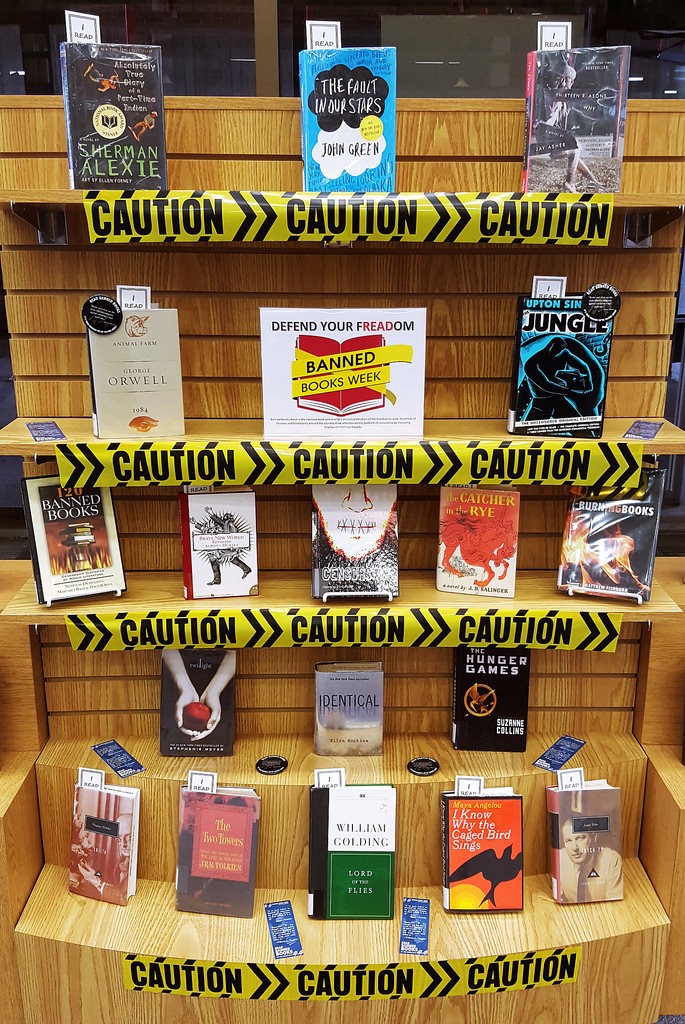
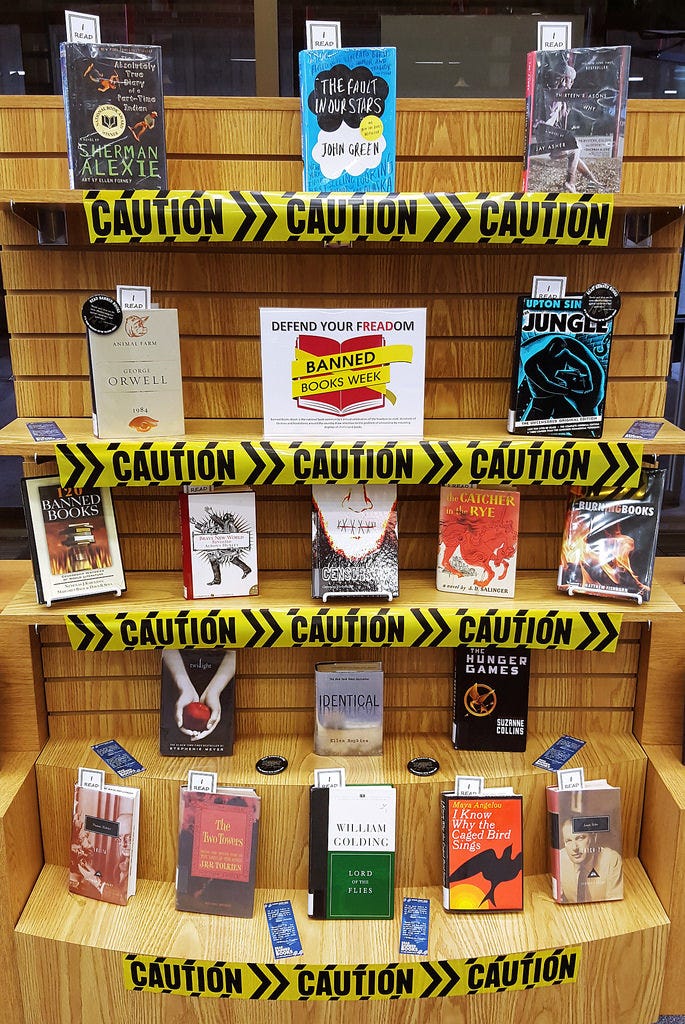
So it’s Banned Books Week, and I feel like I have heard more about banned books in the last three months than I have in the last ten years, which seems counterintuitive when you think about how time is supposed to be related to progress. In 2015, you’d think that banning books would be an adorable piece of nostalgia, entombed in cautionary tales about towns that don’t allow dancing, but alas, there is still a town in Kentucky that doesn’t allow dancing, and books are still being banned. Just this summer, Some Girls Are by Courtney Summers was banned at West Ashley High School in Charleston after one, yes one, mother penned a letter to the principle deeming it “smut.” And just within the last few weeks, New Zealand has banned Into the River by Ted Dawe on the grounds of “offensive language” and “gratuitous sexual imagery.” You know, things that are otherwise unavailable to kids who ever leave the house. Over the course of the last decade, a decade in which fame and fortune is found as a result of a sex tape — a universally available, downloadable sex tape — more than 5,000 books were challenged. There were 311 challenges reported to the Office of Intellectual Freedom in 2014 alone. In the same world where Kim Kardashian’s fully naked body is as easily accessed as the weather, the wisdom and words of prolific and important writers like Sherman Alexie, Toni Morrison, and Stephen Chobsky are being ripped from the hands of children.

In the same world where Kim Kardashian’s fully naked body is as easily accessed as the weather, the wisdom and words of prolific and important writers like Sherman Alexie, Toni Morrison, and Stephen Chobsky are being ripped from the hands of children.

Let me just state for the record that I do not have children. I, however, do write books, arguably provocative books, for young adults. I do this, and write articles like these, because I was once young and curious about and voraciously entertained by the salacious underbelly of adulthood that inevitably seeped up into my adolescence whether I was ready for it or not. Melanie MacDonald’s main argument for why Some Girls Are is not a valid summer reading choice is because it is “smut,” as if the word itself is synonymous with “dangerous.” For the record, it’s not. Smut’s actual definition is “a small flake of soot or other dirt.” That’s it. That’s what it actually means. It’s just a little bit of soot or dirt. The term that’s come to describe work that provokes outrage, ignites campaigns for its extermination — is actually, etymologically, something that never hurt anyone; something necessary, something inevitable, and something that kids are told to put their shiny screens down to play in. Dirt, as well as being innocuous, is also an unavoidable part of life on a planet covered in it. It’s natural; it happens, and really, is almost so on the nose as a metaphor that I feel puerile extrapolating it. By banning “smut” this women is saying that we should ban dirt, rather than take the time to teach children not to be scared of it, and thus how to deal with it by say, handing them a broom and a rag. Do I need to take this all the way by pointing out that banning dirt would be impossible and ridiculous? Good, I didn’t think so. Dirt, a.k.a. the unpleasant mess that existence makes, is inescapable, normal, and something that everyone will have to deal with eventually. Smut = dirt = shit happens = important things for kids to learn.

New Zealand didn’t use this exact word when banning Dawe’s book, but the idea that “offensive language” and “gratuitous sexual content” would be grounds for banning a book is equally as moronic when you break down the meanings of those words too. “Offense” is defined as either “a breach of a law or rule; an illegal act” — last time I checked, cursing wasn’t against the law, so not that one — or “annoyance or resentment brought about by a perceived insult to or disregard for oneself or one’s standards or principles” — so, that one. Okay, let’s break that down. A book has been banned because someone has been “annoyed” by someone else’s “perceived disregard for [their] standards or principles.” By this standard, slow walkers, Anne Hathaway, rap songs with children’s choirs in the background, inspirational quotes, adult women obsessed with pink, vaguely racist memes, and hashtags like #helikeditsoheputaringonit #immarryingmybestfriend! are all banned.

All you have to do is perceive insult to one’s standards or principles, and ban! Man, if only I’d known this rule sooner! Bye-bye duckface selfies and bread baskets served with cold butter — see ya never!

Second, Melanie Macdonald hadn’t even finished the book before she started her smear campaign! By page 74 of this award-winning novel, MacDonald had claimed that she “objected to the book’s depiction of underage alcohol and drug use, sexual assault, a lecherous male teacher, ‘body shaming about the size of the lead character’s breasts, and then a sexual reference so explicit that [she] will not reference it here.’”

At page 74, she’s seen about a corner of the author’s full painting. That’s like saying you hate a whole country when you haven’t even made it out of the airport.

The most serious item in her laundry list is her casual objection to the depiction of sexual assault. This is one of the matters of controversy in Dawe’s book too, and to me, this is where the idea of banning books crosses over from dumb to dangerous. What MacDonald fails to understand is that by depicting sexual assault at all, Summers and Dawe are taking a stand against it.

What MacDonald fails to understand is that by depicting sexual assault at all, Summers and Dawe are taking a stand against it.

We are so deeply drowning in our rape culture at this point that simply talking about it is a heroic act and should be applauded and lauded as positive for both young girls and boys. The worst and most dangerous part of the culture surrounding sexual assault (especially the high school brand) is the shame associated with it and that people are encouraged not to talk about it. Authors need to depict it, kids need to see it in pop culture, in books they read, in movies they watch to know that this happens and it is not your fault; you’re not alone. By introducing books and guided, educated conversation about sexual abuse into schools, kids learn that their teachers and parents are not afraid to talk about it — so they shouldn’t be, either.

She also objects to the depiction of “underage drinking, body shaming, lecherous teachers, and the sexual reference so explicit” she wouldn’t even dare grasp her pearls and utter such devilry (for the record, said devilry is a blow job). New Zealand had similar problems with “offensive language” in regards to topics like racism and bullying. This particular string of objections brings me to the idea of safety. Because isn’t that the big thing, parents? Safety? Isn’t that what parents ultimately want for children? I’m going to let all you parents in on a little secret: a book is the absolute safest place your child can wrestle with these topics.

You can ban all the books you want, put your parental controls on the cable and the Internet, keep your children ignorant of society’s evils, but you cannot stop these things from existing. You can try to stop your kids from hearing about these things, seeing these things, but you can’t stop them from existing, and realistically, you probably can’t really stop your child from seeing or hearing about them either. Even if your child knows better, has a stiff moral code, would never, could never, there will always be kids who drink, teachers who cross the line, assholes who will slut-shame and body shame and race shame your daughters and sons, and there will always be, and I’m gonna utter it, blowjobs. And of all the ways that your child could first encounter these things, of all the ways they could go about satiating their curiosity about these things, which despite your moral opposition to them, I promise you, they do have — isn’t a book your most appealing option? When asked about his book being banned, Dawe said, “There comes a stage in the life of a child where they make the transition to adulthood, they have to walk free of their family, have to walk into spaces which may be dangerous.”

A YA book is the first place a child can really be independent; it’s a place where they might see and hear about things that might scare them, but luckily for parents, it’s a place where a child literally cannot get hurt.

Summers’ book was replaced on the West Ashley reading list by A Tree Grows in Brooklyn, which is a gloriously wonderful book, and everyone should read it — but it was written in 1943 about a girl growing up in an immigrant community in the midst of the industrial revolution and World War I. This is a worthwhile book in many ways that still has much to teach us today, but there are a lot of things that kids today will face that are dealt with nowhere in this, I reiterate again, wonderful book. There is not only room, but a necessity for both books in today’s classrooms.

The final pillar of my opinion editorial here is that teenagers should be encouraged to read almost regardless of subject, particularly about matters and people they won’t ever encounter or don’t encounter in their daily lives. West Ashley said that what drove them to choose Summers’ book in the first place was its entertainment value and readability, and I applaud them for putting value in entertaining their students. Entertainment is a powerful tool, and can be used to education’s advantage. An institution dedicated to teaching should encourage kids to be curious, to find relatable characters, as well as ones with whom they have nothing in common, and will most likely never meet in real life. Through a book, a teenager who’s never left their mostly white high school in their mostly Christian town has the opportunity to meet a diverse group of people suffering from and reveling in experiences he or she might never have access to. That in itself is an education. In a Tumblr post responding to the ban, Summers said:

…gritty, realistic YA novels offer a safe space for teen readers to process what is happening in the world around them, even if they never directly experience what they’re reading about. This, in turn, creates a space for teens and the adults in their lives to discuss these topics. Fiction also helps us to consider lives outside of our own, which in turn makes us more empathetic toward others.

No novelist intends to write a How-To book — they write books to be windows; windows out which parents and teachers should look with their students and ask, What do you think? How does this make you feel? What is your opinion? How would you handle something like this? Insisting that books must teach is a red herring. Because all books, no matter the subject, do. Every book has something to say about someone else’s experience that we did not know before, and that in and of itself, is educational. If a book scares you, if a character’s experience in it makes you uncomfortable — all the more reason why it’s important to read.

So in conclusion, banning books is dumb and dangerous, as proved by the pure lexicon of its troubadours. I’d like to wrap up with a call to the kids out there to take a stand against banned books — read a book this week that someone told you not to! When you read it, think about why they didn’t want you to, what in it scared them, and what that means to you, going forward in a world where you know this scary thing exists. The adults in your life just want to keep you safe from harm, so look both ways when you cross the street, always wear a helmet when you ride your bike, and don’t be afraid to read dangerously, because it’s literally the safest thing you can do.

Watch Mia Alvar Get Zombified for the Electric Literature Genre Ball

The Electric Literature Genre Ball is less than a month away! Watch Mia Alvar, a Genre Ball host and author of In the Country, transform into a zombie with make-up by Nadxi Nieto. At the Genre Ball, zombify your costume at our #andzombies face painting booth, sponsored by Quirk Books, and tweet your photo to win a prize!

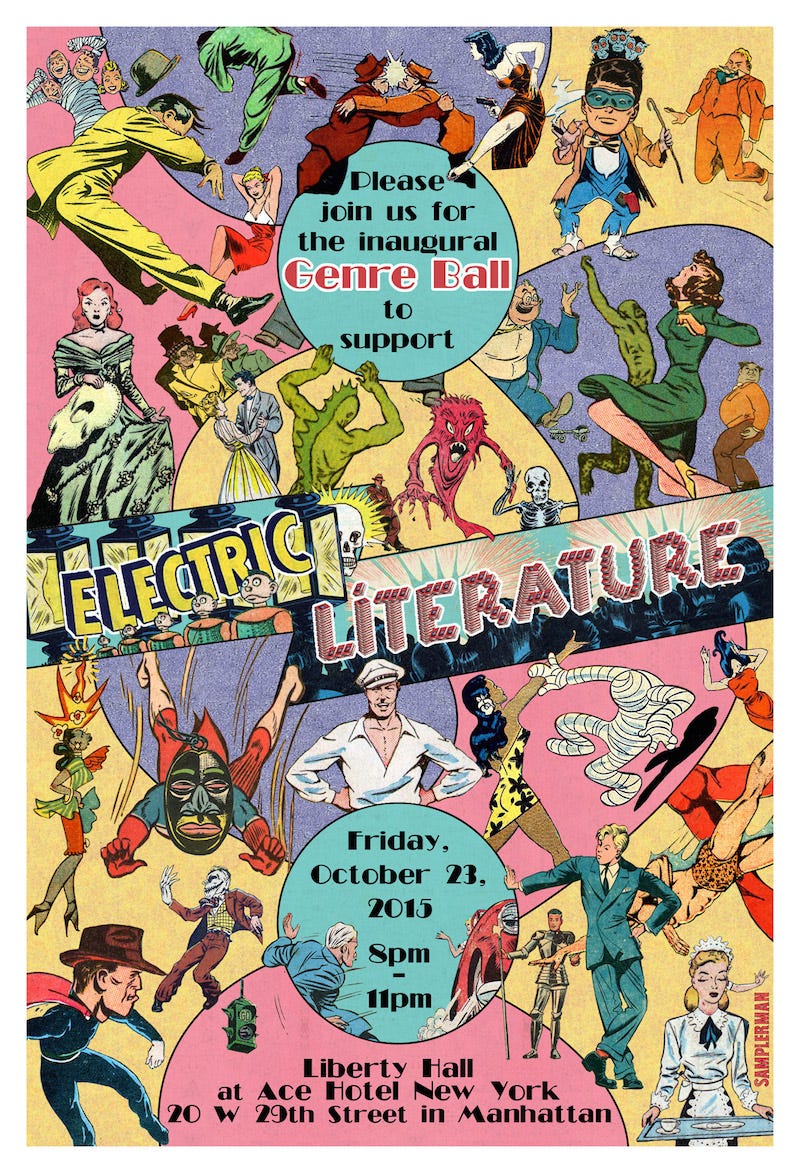
The ball will be held on October 23, 2015, in Liberty Hall at Ace Hotel New York, from 8–11pm. Get your ticket before they sell out! All proceeds benefit Electric Literature, a 501c3 nonprofit. More information and tickets to the ball can be found here.

Three levels of support available:

Partier15- - Circle

$150 — Very Important Partier

Attend the GenreBall at Liberty Hall at Ace Hotel New York and a VIP reception at the Electric Literature offices

Pariter100 - Circle

$100 — Partier

Attend the Genre Ball at Liberty Hall at Ace Hotel New York

Partier50 - Circle

$50 — Partier in Absentia

“I can’t come but I want to support the Ball.”

Genreball invitation

TED WILSON REVIEWS THE WORLD: SHERLOCK HOLMES

★★★★☆

Hello, and welcome to my week-by-week review of the world. Today I am reviewing Sherlock Holmes.

Sherlock Holmes is known as the world’s most famous detective. He’s more famous than Magnum P.I., CSI: Miami’s Horatio Caine, or the detective who tracks down cheating spouses in my neighborhood.

Sherlock Holmes never had to sit around in a Dodge Omni, eating french fries, and watching through his binoculars at people making out. In fact, I don’t think binoculars even existed when Sherlock Holmes was born. They only had uninoculars, also knows as telescopes, and one would have to be held to each eye at the same time. Only the richest people could afford this.

With Sherlock Holmes having recently entered the public domain, anyone is free to write their own stories about him, and those stories must be accepted as canon. Here’s mine which I’m about to write and make up as I go. I’ve also written it under my pseudonym.

* * * * * * * *

THE ADVENTURES of the INVISIBLE GLASS
By Sir Arthur Conan Doyle

Sherlock reached under his hat to remove his magnifying glass which was perfect for finding small clues and solving mysteries. Unfortunately, his magnifying glass was nowhere to be found. The only thing under his hat was a greasy scalp covered in dandruff because it was the 1800s and hygiene was not yet in full swing.

After looking under every hat he owned (he owned six), Sherlock gave up out of frustration. He summoned his sidekick, Watson something-or-other to aid him in finding the magnifying glass while Sherlock relaxed with his pipe. “Do not simply go out and buy a new one that looks identical,” Sherlock insisted.

Watson just bought a new one anyway and then said he found it behind the couch cushions. Sherlock had no idea he’d been lied to. At least, not until he tried to use the magnifying glass. The cheap replacement couldn’t handle sudden movements — it shattered just as Sherlock put it up to his eye, sending shards of glass through both eyeballs and blinding him forever. “Aaaaggghhhhhh,” Sherlock yelled louder than he needed to because he wanted to make a point.

Sherlock was pissed at Watson. Watson was fine with that because he’d always hated Sherlock’s stupid hat which he clearly just wore for attention. Their friendship was ruined.

THE END

* * * * * * * *

I wish I had killed Sherlock at the end of my story because then I would know whatever happened to him. As it stands, I have no idea.

One day I expect a new detective will replace Sherlock as the most famous detective in the world. It would be funny if that new detective were coincidentally named Sherlock Holmes.

BEST FEATURE: I think his name is his best feature. It’s one of those names no one else can have without bringing the original Sherlock to mind. Like Hitler or Bono.
WORST FEATURE: He was too perfect. I wish he had left a few more crimes unsolved. That would have given Robert Stack more material to work with for his show.

Please join me next week when I’ll be reviewing cyber bullying.

Applications are open for A Public Space’s Emerging Writers Fellowships for 2016

A Public Space is looking for emerging writers to award their fellowship to for 2016. Three writers will be selected for six-month fellowships, which will include: Mentoring from an established author, publication in the magazine, contributor’s payment of $1000, and the option of a free workspace in A Public Space’s Brooklyn offices.

Their focus when reviewing applications will be on: “finding writers who have not yet published or been contracted to write a book-length work and who would benefit from the time, space, and editorial attention the fellowships offer.” Previous recipients of the fellowships can be found here.

This year, in addition to the other application material, fellowship applicants are being asked to write about a place that has been important to their writing.

Are you an emerging writer with an essay or story ready to submit? Apply here within November 15!

Watch the Trailer for Upright Beasts by Lincoln Michel

Did you know that the editor of this very website, Dr. Professor Lincoln Michel M.D., has an excellent short story collection coming from Coffee House Press?

If you want to revolutionize your life in two easy steps, watch this trailer and then pick up Upright Beasts, out October 13. To tide you over in the meantime, here’s a story from the collection, “The Room Inside My Father’s Room,” on catapult.co.

Why The Martian Movie Is Poised to be Better than the Book

On the director’s commentary to the Blu-Ray of the 2012 film Prometheus, Ridley Scott aggressively compliments his own movie numerous times, usually punctuating certain scenes with phrases like “looks good, innit?” or “that’s brilliant.” This is real and it’s hilarious. But will Ridley be as happy of his own handiwork for his hotly anticipated new sci-fi flick, The Martian? I’m going to bet that he should be. Because there’s no way The Martian the film will be “worse” than The Martian the book.

No matter what you think of him or his films, there’s one thing Ridley Scott knows how to do in cinema: make us believe in real people in real danger. The popular novel The Martian? Not so much.

Disclaimer time. I do not dislike the novel The Martian. Nor do I disrespect the by-the-bootstraps story of the way author Andy Weir self-published the various installments and how that popularity gave rise to the existence of the novel and subsequent mainstream book deal. Good for him! Seriously. And also, compliments to him for writing a compelling page-turning story. I am not kidding. I’m not patronizing anyone. And I say this, because the next thing I’m going to say might be a little rowdy.

Ready?

The central character of the novel — Mark Watney — is fundamentally unrealistic to the point of almost preventing a thoughtful reader from finishing the book. Further, the popularity of the novel — and the reasons people overwhelming cite that it’s good — highlights the challenges science fiction still faces in terms of being taken seriously as literature.

If you do a Google search for “Martian Book Review,” you’ll find a deluge of breathless headlines all praising how wonderfully researched the science and engineering of the book seem to be. This kind of things leads people to say things like “Greatest Science Fiction Novel EVER!” because, apparently, the only way to have good science fiction is to have the science be damn near 100% accurate. I find this line of thinking not only patently closed-minded, but also hopelessly reductive. If we think a quotidian, well-researched tale of extraterrestrial survival which was 100% accurately researched is the only way to do good science fiction, then why even bother with the “fiction” part? Why not just watch science documentaries on real space travel? Or to put it another way, are salivating proponents of The Martian so narrow with their definition of science fiction, that they dismiss any story which gets something scientifically “wrong,” for the purposes of telling a good story? Should we stop reading Asimov all together because some of his information was out of date? I guess the original Star Trek is a waste of time since they incorrectly predicted the future of the 1990s? Now, I love Phil Plait’s blog Bad Astronomy as much as the next armchair science enthusiast, but science criticism is not the same a literary criticism. And if we’re talking about The Martian as a piece of literature — which may be admittedly very unfair — it fails.

The novel’s story is told primarily through diary entries of one Mark Watney, an astronaut who has been — through a series of unfortunate events — stranded on Mars. The only way to describe the “voice” of this character is to think of merging all the one-liners from Xander on Buffy the Vampire Slayer into one character who thinks in backchatty aphorisms all the time. For this reason, you might wonder why Joss Whedon wasn’t hired to adapt the screenplay. Mark even makes a “that’s what she said” style “joke” at one point. Even when the book does attempt to give Watney some humanist soul-searching, that kind of thing gets turned into a science lesson.

Here’s an example of what I mean. From Chapter 7 of the book:

“Mars is a barren wasteland and I am completely alone here. I already knew that, of course. But there’s a difference between knowing it and really experiencing it. All around me there was nothing but dust, rocks, and endless empty desert in all directions. The planet’s famous red color is from iron oxide coating everything. So it’s not just a desert. It’s a desert so old it’s literally rusting.”

Okay, so that’s a fairly cool detail. But, my problem with this kind of thing is that it’s super indicative of what this “character” is like throughout his isolation; absolutely fixated on giving us the mathematical and scientific facts to describe every, single thing that is happening, meaning that the book leaves almost no trace of philosophical doubt or existential musings about what it would feel like to be “completely alone.” To put it another way: after reading The Martian, I’m not any closer to understanding “the difference between knowing it and experiencing it.” If there was ever a book that needed a dose of the oldest and most annoying writing-workshop advice of “show don’t tell,” it’s this one. All Weir does is have Watney and others tell us what is going on rather than allowing us to experience their feelings. The epistolary form that pervades a good portion of the novel also doesn’t feel like real diary entries, but instead storyboards, describing scenes in a film in which a spaceman will need to crunch the numbers in order to get himself to survive.

To play devil’s advocate (or Martian’s advocate) I suppose one could claim that this fairly flat tact taken by Weir is actually brilliant. That argument might go like this: in this particular instance of isolation, this human being rises to the occasion by being a complete wise-ass who MacGyvers his way out of certain doom. Instead of being unrealistic or inhuman, Weir’s approach is post-modern and surreal. Some could say that this isn’t meant to be a representation of a “real person” and by calling the novel “The Martian,” the inhumanness of the isolation is actually made clear. And in fact, perhaps the intended message of the book is this: to be taken away from the cradle of Earth turns you into the type of person who only cares about numbers and speaks and behaves like a two-dimensional character fit only for a corny Hollywood blockbuster.

Naturally, I don’t think this was the intended goal of the novel. Instead, I think the intended goal of the novel is a book-length MacGyver adventure on Mars which is as scientifically accurate as possible. And if we hold up that criterion to praise it, then it succeeds. In fact, it probably out-MacGyvers even the most perfect Platonic form of MacGyver. Was Richard Dean Anderson unavailable for the movie adaptation? That seems unlikely.

So, the praise of this being a great science fiction novel pisses me off, because it’s a book where there’s simply no allegory or rumination of anything other than what we’re given. Rust is rust and air is air. If read as a text-based video game or television show without sound or pictures, The Martian is great. But, personally, I want something more out of novels, particularly science fiction novels. Because the most cliché complaint science fiction receives is that it sacrifices “real” characters for the sake of its concepts. And while that is a debate for another day, no one can deny that that perception — at least in various circles of literary criticism — does exist. And a book like The Martian does NOTHING but confirm the suspicions of those who assume science fiction is nothing but nerdy adventures populated by unrealistic people. In the finale of one of my favorite movies of all time — Contact — Jodie Foster’s character Ellie Arroway, upon being thunderstruck by the beauty of the cosmos says, “They should have sent a poet.” And that kind of Sagan-esque, magical humanist, whimsical notion, fused with a super-science-y narrative, to me, is the true sweet spot of science fiction.

Scores of real astronauts always say they were inspired to go into the space program by Star Trek, but it seems like The Martian could only inspire people who already are astronauts. I’m not saying all science fiction needs to contain the hyperbole of Star Trek, but if it only contains the science, I’d wager that’s not enough to function as great literature, nor as inspiration for real the next generation of scientists.

Positing The Martian as some kind of “breath of fresh air” for “hard science fiction,” is also a fairly ignorant thing to say critically, because it presupposes that no one has been writing science-heavy science fiction until this Andy Weir guy came along. This would mean everything Allen Steele did with his tales of colonization in Coyote never happened. It would discount Joe Haldeman’s excellent novels Marsbound, Stabound, and Earthbound, to say nothing of the great work of Kim Stanely Robinson. I say all of this not to pit science fiction writer against science fiction writer, but to simply point out that I think all of those authors do a considerably better job (than Weir) with creation of characters and of modulating the voices of those characters to participate seamlessly with their science fiction themes. Every good science fiction writer worth their salt will actually agree with most of what any good “regular” fiction writer believes about characters: they’re really important and probably more important than whatever your bid “idea” might be.

The Martian is a novel that largely doesn’t care about that. But luckily, when it comes to big blockbuster movies, we’re usually totally fine with that kind of thinking, too. If Matt Damon seems a little one-note in the film version of The Martian it’ll probably work, because it’s a big loud movie. If you cry because it seems like he’s never going to get home, that will work as well, mostly because it will have to homage Apollo 13 in some fashion. Andy Weir’s novel is perfect to become a certain kind of film, because films of this nature (i.e. Gravity) accomplish more with a spacesuit than they do with a line of dialogue.

In its basic form, the novel The Martian creates a plausible situation of life or death that takes place somewhere other than Earth. There’s little else going on in this book, but luckily for the film, we’ve been eating up those kinds of movies for years.

Say Your Life Broke Down: An Interview With Lori Ostlund, Author Of After the Parade

I first became familiar with Lori Ostlund’s work in college, when Jessica Treadway, a professor and writer I admired then and now, gave me a scanned copy of “Upon Completion of Baldness,” a story from Ostlund’s collection The Bigness of the World, which won the Flannery O’Connor Award for Short Fiction in 2008. It is the kind of story — like Michael Cunningham’s “White Angel,” like Joy Williams’s “Escapes,” like Laura van den Berg’s “Where We Must Be” — that makes you want to quit, give up writing altogether, because you know, you are certain, you will not write a story half as good as the one you’ve just finished. (We should be grateful for these stories, by the way; grateful for the invigoration that takes over once that crushing self-doubt subsides.) I immediately wrote Ostlund a fan letter and bought a copy of her collection, devouring the rest of it within a few days, shocked to find that each story was somehow as good as “Upon Completion of Baldness,” a story that, to this day, after having read it now dozens of times, still leaves me weeping with its last few paragraphs. (Sidenote: Scribner will be reprinting the collection in paperback in February of 2016.)

The day I received a galley of After the Parade (Scribner 2015), Ostlund’s first novel, I actually cancelled a first date so that I could instead stay up until the sunrise to devour the book in one sitting, a decision about which I have zero remorse. Not that chances at first dates are constantly coming my way — this is not at all the case — but even more rare is a book like After the Parade, an unforgettable novel of stunning grace and wisdom and wit that cements Lori Ostlund as one of the most gifted writers publishing today. She manages to crystallize what seems so ineffable, to make new and foreign the familiar. She digs deeper into every gesture, every line of dialogue, in search of the true origin and intention, going below the surface of language any writer would be proud of, in order to coax out even more. She is a writer in search of nuance, precision, and understanding, and she finds it on every page of this novel. If you don’t believe me, just ask The Center for Fiction, who shortlisted After the Parade for its 2015 First Novel Prize.

It was a privilege to speak with Lori about the novel.

Vincent Scarpa: I wonder if you can start by talking about how this novel came to be. I know you worked on it for quite some time — was it fifteen years, you said? Was it something that you abandoned and then returned to? Or was that simply the amount of time required to fully realize and render this world?

Lori Ostlund: I started writing the character of Aaron around 1999 or 2000, though even before that I had written sketches about an imaginary small town in Minnesota with a café and a hardware store and a possible main character who was very much like Bernice, the misanthropic baker who becomes Aaron’s best friend as a teenager. A part of me is quite drawn to misanthropes, but I quickly realized that I was more interested in creating a main character who leaves this small town, and I understood early on that Bernice did not have it in her to go out in the world.

In most things I take a quite rational approach and assume that if I sit down with a problem and work steadily at it, it will resolve itself, but when it comes to writing, that simply isn’t the case.

When I began writing Aaron, I had much different ideas for him because I was working with a concept, and concepts are rarely successful for me. I’ve never abandoned the book, but I did let it sit for long periods. I’m a big believer in letting things sit because sometimes my subconscious just needs time to work things out, which was hard for me to accept early on. In most things I take a quite rational approach and assume that if I sit down with a problem and work steadily at it, it will resolve itself, but when it comes to writing, that simply isn’t the case. I tend to know when something isn’t right — quite often the ending — but it generally takes me a long time to figure out how to make it right. During those thinking periods, I usually do other things — work on stories, take a lot of walks, travel, read, get on with life.

During this 15-year period, for example, I wrote my story collection The Bigness of the World, ran and then closed an Asian furniture store in New Mexico, moved to San Francisco and started a new life here, moved to Chapel Hill, North Carolina for two years, where I served as the visiting writer at UNC, and came back here to San Francisco. At the beginning of 2013, my very wise and patient agent said, “Okay, you need to finish the book by August.” I panicked because I was carrying a heavy teaching load at the time, but in May my load lightened, and I began spending around 70 hours a week in my writing dungeon. During those months, I was able to hold the whole book in my head and piece together the story from the hundreds of pages I had written over the years, trying to figure out who Aaron was and what his story would be.

VS: One of the many things that’s absolutely stunning about After the Parade is the expert weaving of time. The novel asks the reader to trust that all detours and digressions from the “now” of the novel are necessary, and it never ceased to surprise me, both times I read this book, how gracefully you move us along, nary a hiccup from past to present, from page to page. I wonder if you might talk a bit about how you went about structuring the novel. Did you know, setting out, that the scope would be this large — the size of Aaron’s life? And what, in your mind, is achieved or allowed in a nonlinear novel in which we’re boomeranging from past to present and back again?

LO: Thank you, Vincent. I have often described my writing style as digressive. I love tangents — particularly the idea of a story within a story within yet another story, for example — and I’m always interested in seeing how far I can digress before I lose the narrative thread completely and/or the reader’s good will. I’m also interested in what people don’t say and in thinking about how to render that on the page, and often digression, talking around a subject but never about a subject, is one of the ways to put on the page what isn’t being said. My first finished draft was over 500 pages, but I cut around fifty before my agent went out with it. Then, my editor, Liese Mayer at Scribner, helped me cut another hundred. She was so good at figuring out the places that digressions needed to be reined in.

When I started writing about Aaron, he was five years old, but I realized that I had a problem when I’d written perhaps 400 pages and he was just seven or eight. At that point, I set the book aside to think — when I went back to it, I started writing about him as an adult. I knew that he had a much older lover, so I wrote a lot about that, thinking that that might be a big part of the story, but ultimately I decided that the book’s baseline present would begin with when he leaves Walter, his lover, and moves to San Francisco, and the past would largely be childhood flashbacks. Structurally, I wanted the past and present together in order to mimic the way that memory works, particularly during moments of transition: though the book is told in third-person, it’s a close third, and I hoped to create the feeling that as Aaron attempts to move forward with his new life, everything around him triggers memories of his past. In the present, he is walking and teaching and sitting in his noisy garage apartment, but each of these activities leads him backward to his mother and childhood.

The book was written in pieces, and when I started to piece it together during the long summer of 2013, I decided to break the present into a six-month period beginning with his leaving of Walter. I spent a lot of time sifting through all of the pieces that I had written over the years and either discarding them or pasting them into this six-month timeline. In doing so, I cut back substantially on the middle years, those years that he spent with Walter, yet in many ways, those were the hardest pieces to place in terms of the arc of the novel.

VS: Something this novel seems to have under its lens is the notion of curiosity — about alternative ways one might live, about the way things might have been, the mysteries of an unsolved life — and the way in which that curiosity might activate dramatic action. That curiosity is part of the reason Aaron, at the beginning of this novel, leaves his own life with Walter to start anew. Not unlike his mother, Aaron fears stagnancy, fears settling. And yet we are reminded by Clarence, a dwarf with whom Aaron forges a connection as a child, that, “there’s something to be said for the security of the familiar, in all its confining glory.” What were you aiming to examine here?

In many ways, I believe that curiosity saved me, that and the fact that I didn’t see a place for myself where I grew up.

LO: On many levels, the idea of parallel lives is very personal for me. I grew up in a town of 400 people and left in 1983, as does Aaron, but I think that both he and I are drawn to those who cannot leave the familiar. In many ways, I believe that curiosity saved me, that and the fact that I didn’t see a place for myself where I grew up. I read constantly, and though I did not come out until I was in graduate school, I sensed on some level that I was different. My story collection dealt with this theme also, parallel lives and the reasons that some are drawn out into the world while others turn inward. For me, the ocean has always been the ideal metaphor: I first saw it when I was twenty-four, and I remember being struck, as I looked at it, by the enormity of the world. What I realized then was that there are those who feel overwhelmed by that bigness, by all that they do not know, and there are those who feel comforted by that bigness because they see that there is so much more to see and know. I feel a great affinity for those in the former camp, but I am firmly in the latter camp.

VS: Having Aaron be an ESL instructor in the novel makes for a brilliant fit, creating all kinds of narrative potential. Pamela Painter always told us in workshop that the character’s profession is a place from which so much meaning can be mined, and I think that’s never been truer than it is here. You write that his students so often asked, “What is the correct answer here in America?” because they “liked to believe there was a correct answer.” Situating Aaron, who has just made these drastic changes to his life, and who feels so unmoored, as one from whom answers, correct answers, might be sought — it creates such friction in the novel, and causes us to wonder about the way a life, like language, might translate, and what might get lost or bent in that translation. Can you tell me about that choice? I know you have experience as an ESL instructor yourself, and that you’ve written about it before.

LO: I’ve been a teacher for over 20 years, teaching ESL among numerous other subjects, so it felt very natural for me to make Aaron a teacher. When I develop a character, I always need to find some way in, and usually that happens by giving the character some of my traits or experiences. I also knew that there was potential for humor as well as misunderstanding because the ESL classroom is fraught with both. But I think you’ve put your finger on it, Vincent, when you note that the classroom is a place — the one place — where Aaron feels in control during this period of upheaval. He recognizes himself in the classroom, so early on I saw the potential to use the classroom as a hub of sorts — it’s the source of his daily contact with other human beings, a place where he strives to buck up and be his best self — so, of course, it’s also the place where we see him begin to fall apart. Finally, it’s there, at the ESL school, that he meets the detective who leads him back to his past.

VS: Aaron’s relationship to language is so strong and complex — he sees it as an anchor, as comfort, as a tool for defense and for self-evaluation. He wants the words to be right. In a letter to Walter, he writes of his, “fierce love of English — of its nuances and endless synonyms.” I found that to be one of the most moving elements of the novel, as someone who is constantly struggling with his own relationship to language and trying to decide if Maggie Nelson is right when she says “words are good enough.” Endless synonyms — meaning, there might be a hundred ways to say this — can be both blessing and trap, I think.

LO: For many years — really until I started traveling — I felt most comfortable inside my head and didn’t give the rest of my body much thought. I also am a tremendous believer in subtlety and restraint and generally feel uncomfortable with effusiveness, but I think that teaching ESL has forced me to become much more direct in my communication, to find the words that get the job done, even if nuance gets left behind. Once in Turkey, Anne and I were wandering around a village, admiring the snow, when a group of women came by and took us home with them. We had been communicating with people by using a phrase book, pointing to words since our pronunciation got us nowhere, but with these village women that was not an option because they were illiterate. They served us a big meal, which they watched us eat, and afterward they began to dance. At one point, as Anne and I were demonstrating “American dancing,” one of the women slapped my butt, and everyone laughed. I was flustered and turned red, but it occurred to me then that I had never before spent an entire afternoon with people communicating not with words but with gestures and laughter and good intentions.

I suspect that I will never stop believing that there is a perfect way to say everything, and believing this keeps me writing…

That said, I suspect that I will never stop believing that there is a perfect way to say everything, and believing this keeps me writing and, in particular, rewriting. Of the two — making your reader think and making your reader feel — the latter is far harder to accomplish: there must always be some backdoor to evoking emotion because saying directly that the character is sad or the moment is sad does not work. In fact, as a reader, I often feel less sad the more I am reminded to feel sad. This challenge — finding the backdoor image or scene or phrasing — is part of what keeps me writing, and I think that this is where my early life training in emotional restraint and avoidance of sentimentality has given me an advantage.

VS: You have such a gift for capturing conversation on the page. And it’s a kind of narrative charity that secondary, even tertiary characters are given the space to speak, to tell their stories. And what’s astounding is that each voice and mode of storytelling feels so distinct and so unique to that character. I’ve often thought no one wrote dialogue, wrote conversation, as well as Ann Beattie, but now I think you may have dethroned her. How did you go about nuancing each voice in the novel? And, similarly, what do you feel is the role of anecdote in a novel that’s very much concerned with the way we tell ourselves stories and the stories we tell about ourselves, the failures and gaps of memory?

LO: When I first started writing in my late teens, I diagnosed dialogue as my weakness and spent a lot of time reading plays to figure out how playwrights did it, accomplished everything — narration, tension, character development — through dialogue. In particular, I read Albee’s “The Zoo Story” over and over, maybe 20 or 30 times within a year. What I found myself most interested in was how dialogue could be used to reveal power shifts. In addition, I think that my early years working in my parents’ hardware store has had a profound effect on my dialogue: I was very shy as a child, but I spent a lot of time listening to rhythm and to what people talked about as well as all of the things that they did not talk about.

VS: There’s a poem by Richard Hugo — “Degrees of Gray in Philipsburg” — that comes up a few times in the novel. “You might come here Sunday on a whim,” it begins. “Say your life broke down.” What about this poem in particular resonated with you in writing After the Parade, so much so that you decided to include it in the text? I’d never read it, but my oh my is it a fine poem.

LO: Like Aaron, I grew up thinking that poetry was one thing — Longfellow, Joyce Kilmer, “Twas the Night Before Christmas” — and got to college, discovered what poetry really was, and learned that I loved poetry. One of the first poems that resonated with me deeply was this Richard Hugo poem. At the time, I memorized my favorite poems so that I could have them in my head to think about when I was just sitting somewhere, and I spent a lot of time thinking about this poem, about the way that Hugo captured a small, dying town, about the fact that people wrote poetry about small, dying towns. When I realized that Aaron also loved poetry, it felt natural to use a poem that had resonated with me when I was eighteen. Once the poem entered the novel, it just kept working its way into other scenes.

The Searcher That Segued: The TV Sutras by Dodie Bellamy

There’s that old folk statement of sincerity, “It’s turtles all the way down.” And maybe it is true — but, by turtles, what’s meant are cults.

Stories about cults are still of the moment, which may have something to do with the smartphone-orbited consumption of daily life, a cultic dynamic all its own: everyone attuned to a handheld obelisk created by the slim ones in black clothes. On the figurative playing field of recent cult-inflected narratives, Dodie Bellamy has dealt a wicked curve with The TV Sutras.

Written with the sort of artlessness that qualifies as artful when it comes to the pursuit of the authentic, the TV Sutras flips any expectations you might tote to it as a reader. “I do not attempt irony, cleverness or perfection,” relays the author in her introduction. “The TV Sutras are totally in-the-moment sincere, even if that sincerity makes me cringe afterwards.”

Curiously labeled an “essay” by ace indie publisher Ugly Duckling Presse, the book begins with 80 or so pages of unembellished sutra. That is, on each of these initial pages, you will find a single mandala (#1–78), beneath which Bellamy has created a textual excerpt using whatever she happened to find on her television one day in 2009.

Beneath the TV excerpt rests Bellamy’s sutra, an interpretive, mantra-like statement, or lesson, derived from her random media encounters. This practice began as performance art of a sort during meditation sessions over six months’ time, with the emphasis of her project on spontaneity and free-writing, the intense and the undiluted.

Much of that inclination has to do with Bellamy’s own experience, which involves, so she reports, having joined a cult as a young adult — a searcher who segued smoothly from pop culture enthrallment to abiding by the teachings of a charismatic master. Ultimately, this man’s contradictory exercise of authority and endless erotic bullying drove her away. Yet it was not an interval in her life that she could easily forget.

Like a character out of Beckett, Bellamy’s self-conception is stricken with the bodily machinery of belief. She is continuously fascinated as her own narrative coherence grinds and crumbles on the cusp of really finally getting somewhere: “The sutra process is the opposite of the stasis of accepting things as they are, highlighting instead the instability of knowing.”

Here and there, her interpretive sutras neatly parrot an excerpted source: “It’s never too late to begin,” reads sutra #61, whose commercial source is the voiceover of a man playing golf: “Twenty-two of those forty wins since turning forty.” Elsewhere a recognizable popular movie registers with unnerving humor: “Man loads rifle in gun store. Clerk says, ‘You can’t do that.’ Man blasts clerk with rifle.” “Be focused, tune into your true intentions, and proceed,” runs Bellamy’s commentary. Yes, here, she has identified with Arnold Schwarzenegger as The Terminator.

The second section of the TV Sutras is where Bellamy’s project generates true force as she openly defies easy bookselling categories. Here is the section that figures as the intended subject of the label “Essay.” (As opposed to the earlier, fleeting sutras, which might have been labeled “Self-Help.”) Unfolding as memoir, the latter half of the TV Sutras doubles as Bellamy’s self-declared novel, a labeling choice on her part that invites the question of her veracity. Novels, after all, arise from invention; invention whose ultimate goal is to probe truths hidden beneath the surface of the actual.

Bellamy’s personal commentary brought to mind David Foster Wallace’s walloping treatise on TV irony, “E Unibus Pluram.” And David Shields’s torch-mob provocations obsessed with smoking the novel from its castle. I thought of the auntie character in Arundhati Roy’s The God of Small Things, whose mind is swallowed whole by her TV set. I thought of Chris Kraus.

Taken at face value, Bellamy’s sutra-fied advice rates as solid, possibly even welcome, if frequently obvious: “Cultural labels and rules aren’t your true self.” “Be humble, but not passive.” “You’ll never get rid of distractions. The point is to return.” Yet interest here primarily stems from the gap between source and pronouncement, like that between a comedian’s premise and punch-line. She guides her reader through a cultic experience with the sutras — and then invites the reader to spend some time behind the curtain glimpsing fragments of her life experience. Bellamy goes so far as to draw overt parallels between the role of cult leader and that of her current occupation, writer of books and MFA workshop instructor.

Her prefacing remarks denying irony’s hold: Is that on behalf of the TV Sutras in its entirety? As if to say, No irony can be found in the TV Sutras, no, none at all…

Or does it figure as Bellamy’s very own cultic homily intended to relieve the reader of a sense of irony and contradiction? Is Bellamy, the author, like a cult leader, denying irony because the readiness to glean it in her dictates requires a reader to think for herself?

“Truth,” as the book’s epigraph goes, “is a pathless land.”

And however deep you go, expect turtles.

The TV Sutras

by Dodie Bellamy

Powells.com

Here Are This Year’s 5 Under 35 Honorees

Where are the best young writers in America publishing? Looking at this year’s 5 Under 35 Honorees, the answer is in the small presses. Four out of five of this year’s winners are on small or independent presses (Hawthorne Books, Ig Publishing, Black Cat / Grove Atlantic, and Dorothy). The five honorees this year, who were chosen by previous honorees, are a diverse group of writers from around the country. The five are:

  • Colin Barrett, author of Young Skins (Black Cat / Grove Atlantic), selected by Paul Yoon
  • Angela Flournoy, author of The Turner House (Houghton Mifflin Harcourt), selected by ZZ Packer
  • Megan Kruse, author of Call Me Home (Hawthorne Books), selected by Phil Klay
  • Tracy O’Neill, author of The Hopeful (Ig Publishing), selected by Fiona Maazel
  • Azareen Van der Vliet Oloomi, author of Fra Keeler (Dorothy, a publishing project), selected by Dinaw Mengestu

In a press release, the National Book Foundation said:

These five extraordinary writers will be honored at a ceremony hosted by LeVar Burton, Curator-in-Chief/Host of Reading Rainbow, on November 16, 2015 at powerHouse Arena in Brooklyn, NY. For the second year in a row, author Ben Greenman will emcee and columnist Rosie Schaap will guest bartend. 5 Under 35 is sponsored by Amazon Literary Partnerships, with additional event sponsorship from the New York Distilling Company. Each Honoree will receive a prize of $1,000 and will be invited to appear at a special event in Miami, FL in the Spring of 2016, in partnership with Miami Book Fair International.

“Over the past ten years, the National Book Foundation’s 5 Under 35 program has established itself as a hallmark of emerging literary talent,” said Harold Augenbraum, Executive Director of the National Book Foundation. “The writers we’ve recognized have established themselves among the most acclaimed and admired working today.”

5 Under 35 Honorees are writers under the age of 35 who have published one book of fiction — either a short story collection or novel — within the last five years. This year’s Honorees include a 2014 Whiting Award winner and have received fellowships from The MacDowell Colony, The Center for Fiction, and The Fulbright Program. Angela Flournoy’s The Turner House, is also currently longlisted for the National Book Award for Fiction.

Previous Honorees include Danielle Evans, Nam Le, Valeria Luiselli, Karen Russell, Kirstin Valdez Quade, Justin Torres, Claire Vaye Watkins, and Tiphanie Yanique, as well as past National Book Award Finalist Téa Obreht and 2014 National Book Award Fiction Winner Phil Klay.

Here are the bios of the five honorees:

Colin Barrett was born in 1982 and grew up in County Mayo, Ireland. In 2009 he was awarded the Penguin Ireland Prize. His stories have appeared in Stinging Fly magazine, A Public Space, Five Dials, and The New Yorker. Young Skins is his first book.

Angela Flournoy is a graduate of the Iowa Writers’ Workshop, where she received a Dean’s Fellowship, and the University of Southern California. She has taught writing at the University of Iowa and Trinity Washington University and has worked for the Washington, DC Public Library. She was raised in Southern California by a mother from Los Angeles and a father from Detroit. The Turner House is her first novel.

Megan Kruse grew up in the rural Pacific Northwest. She studied creative writing at Oberlin College and earned her MFA at the University of Montana. Her work has appeared widely in journals and anthologies, and she recently completed residencies at the Kimmel-Harding-Nelson Center for the Arts in Nebraska and the New York Mills Regional Cultural Center in Minnesota. She is the 2015–2016 Visiting Writer-in-Residence at Eastern Oregon University’s Low-Residency MFA program. She currently lives in Seattle. Call Me Home is her first novel.

Azareen Van der Vliet Oloomi is the author of Fra Keeler. She is the recipient of a 2015 Whiting Award, a MacDowell Fellowship, and a Fulbright Fellowship to Catalonia, Spain. She has lived in Italy, Spain, Iran, the United Arab Emirates, and now resides in the USA. She teaches in the MFA Program in Creative Writing at the University of Notre Dame and splits her time between South Bend, Indiana and Florence, Italy.

Tracy O’Neill lives in Brooklyn. In 2012, she was awarded a NYC Emerging Writers Fellowship by the Center for Fiction. Her novel The Hopeful was published in June 2015, and her short fiction has appeared or is forthcoming in Guernica, Granta, The Literarian, Vol. 1 Brooklyn, and Promethean. You can read her nonfiction in The Atlantic, Grantland, Bookforum, Rolling Stone, and newyorker.com. She currently teaches at the Fashion Institute of Technology and the City College of New York.

You can see the authors as baseball cards at Buzzfeed Books, which had the first announcement.

Here Are the 2015 Kirkus Prize Finalists

Any author who receives a starred review from Kirkus is eligible for the Kirkus Prize, but only six books in each category are finalists. The prize was started last year, and carries a very healthy $50,000 award per category. The winners will be awarded in mid-October. Congrats to all the finalists!

Fiction:

“The Incarnations” by Susan Barker
“A Manual for Cleaning Women” by Lucia Berlin (read our review)
“Fates and Furies” by Lauren Groff (read our review and an interview with Lauren Groff)
“The Story of My Teeth” by Valeria Luiselli; translated by Christina MacSweeney (our review and an interview with Valeria Luiselli)
“The Book of Aron” by Jim Shepard (our review)
“A Little Life” by Hanya Yanagihara (our interview with Hanya Yanagihara)

Nonfiction:

“Between the World and Me: Notes on the First 150 Years in America” by Ta-Nehisi Coates
“Whirlwind: The American Revolution and the War that Won It” by John Ferling
“H Is for Hawk” by Helen Macdonald (our interview with Helen Macdonald)
“The Deluge: The Great War, America and the Remaking of the Global Order, 1916–1931” by Adam Tooze
“Pacific: Silicon Chips and Surfboards, Coral Reefs and Atom Bombs, Brutal Dictators, Fading Empires, and the Coming Collision of the World’s Superpowers” by Simon Winchester
“The Invention of Nature: Alexander von Humboldt’s New World” by Andrea Wulf

Young Readers’ Literature:

“The New Small Person” by Lauren Child
“Lillian’s Right to Vote: A Celebration of the Voting Rights Act of 1965” by Jonah Winter; illustrated by Shane W. Evans
“Echo” by Pam Muñoz Ryan
“Funny Bones: Posada and His Day of the Dead Calaveras” by Duncan Tonatiuh
“The Game of Love and Death” by Martha Brockenbrough
“Shadowshaper” by Daniel José Older