It seems the films that withstand the test of time best are those that use well-written books as their source material. From classics like The Godfather, Fight Club, and Jaws, to pop culture phenomenons like the Marvel Cinematic Universe and The Hunger Games series, it’s always thrilling to see these stories take on new lives of their own with each and every iteration. In 2024 we saw the book world take over Hollywood once again with American Fiction—based on contemporary classic Erasure, by Percival Everett—winning the Oscar for Best Adapted Screenplay, and with fellow page-to-screen films like It Ends With Us, Dune, and now Wicked completely dominating popular culture.
Beloved books like Animal Farm, Klara and the Sun, and Frankenstein are just some of the books slated to receive screen adaptations in the coming year. Add them to your list and decide for yourself the answer to one of culture’s most hotly contested questions: which version was better, the book or the movie?
In Edward Ashton’s Mickey7, space colonist Mickey Barnes is an Expendable—meaning he is a disposable employee, sent on fatal missions that will likely end in death. But each time he dies, a new body is regenerated with most of his memories intact. While on a mission to colonize Niflheim, misplaced assumptions lead to the accidental creation of two Mickeys at once. The novel’s film adaptation, Mickey17, is scheduled for a theatrical release by Warner Bros. Pictures on April 18. The science fiction black comedy was produced, written, and directed by Parasite-director Bong Joon-ho, and stars Robert Pattinson, Naomi Ackie, Steven Yeun, Toni Collette, and Mark Ruffalo.
Longlisted for the Booker Prize and the Carnegie Medal in Fiction, Kazuo Ishiguro’s Klara and the Sun follows the solar-powered Klara, an Artificial Friend that carefully watches over Josie, a sickly child that chooses her to be her companion. Directed by Taika Waititi, and starring Jenna Ortega, Amy Adams, Mia Tharia, and Aran Murphy, this devastating sci-fi novel’s adaptation gives fans much to be excited about. The film is slated for a 2025 release.
George Orwell’s satirical allegorical classic novella follows a group of farm animals as they rebel against their farmers, in hopes of creating a society where all animals are equal. But of course, “some animals are more equal than others.” The film adaptation is set to be released on July 11, with Andy Serkis as its director.
The sensational French novel-turned contemporary classic follows self-absorbed Cécile, a seventeen-year-old girl who joins her widower father for a free-spirited two months just outside of Paris. While entangling herself in a blossoming relationship, Cécile teams up with her new lover to keep her father from his mistress. This sprawling and understated novel receives its second film adaptation, set for a theatrical release in summer 2025. The film stars Chloë Seveigny, Claes Bang, Lily McInerny, and Nailia Harzoune, and is Too Much and Not the Mood-writer Durga Chew-Bose’s directorial debut.
Mary Shelley’s English Gothic classic is set to receive its latest adaptation in the coming year. Directed by Oscar-winning Guillermo Del Toro, and with rising stars Oscar Isaac, Jacob Elordi, and Mia Goth, the film brings a fresh take to the timeless tale: while striving to bring life back from the dead, Victor Frankenstein creates a horrifying creature in the process.
Esi Eugyan’s Man Booker Prize finalist Washington Black follows eleven-year-old Washington “Wash” Black, an enslaved boy on a Barbados sugar plantation, when he is chosen to be the servant for his enslaver’s brother—who turns out to be an abolitionist. Tom Ellis and Sterling K. Brown (who just made waves in fellow page-to-screen adaptation American Fiction) are set to feature in the exciting TV mini-series adaptation. The series is set to release on Hulu in 2025.
Stephen King’s 1982 thriller is set in a dystopian 2025, where the United States’ economy is in shambles. The nail-biting novel follows Ben Richards, who participates in a reality show where contestants must evade a team of hitmen in order to win money. The film adaptation, produced and directed by Edgar Wright, and starring Glen Powell, Katy O’Brian, Daniel Ezra, and Michael Cera, is expected to bring a frightening new way to look at the year 2025. The film is scheduled for a November 21 release with Paramount Pictures.
A national bestseller and the third chapter in the Bridget Jones series, Mad About the Boy follows Bridget Jones as she confronts single-parenthood and the dating scene four years after the death of her husband. Now, the dating scene is much different—sexting, social media, and online dating are the new norm, and Jones’s new endeavors prove both hilarious and endearing. The film adaptation is scheduled to be released on Peacock on February 13, with Renée Zellweger reprising her role as Bridget Jones.
This spy thriller classic follows Charlie Heller, a quiet man who works as a cryptographer for the CIA, who seeks to find who murdered his fiancée when the Agency decides against looking into her case. This slick, edge-of-your-seat mystery is bound to make for a stunning film adaptation full of suspense, and is set to star Oscar-winning actor Rami Malek and Emmy-winning actress Rachel Brosnahan. The film is scheduled for an April 11th release through 20th-Century Studios.
In this 2018 graphic novel by Simon Stålenhag, a teenaged girl and her toy robot travel west, embarking on a cross-country mission that reveals a society disparaged by high-tech and virtual-reality systems. The dystopian science fiction tale is to be adapted into a Netflix film, set to be released on March 14th, 2025. The film will be directed by the Russo brothers—known for cultural juggernauts Avengers: Endgame and Avengers: Infinity War—and features a star-studded cast, including Millie Bobby Brown, Chris Pratt, Ke Huy Quan, and Anthony Mackie. Fans of this unsettling, electrifying tale have much to look forward to in the new year.
It’s been a crazy year. It feels like the world has turned upside down, right side up, and sideways…and as we compiled 2024’s most read issues from Recommended Reading, it became clear that you felt like that too. Of all 53 stories we published, these five have one thing in common—instability. They are stories about a world in flux. Sometimes that world is small, the size of one man’s ego as in the year’s most read piece, an excerpt from Jo Hamya’s novel about a father suddenly realizing his daughter knows far more about him than he thought.
At other times it’s enormous—the flicker of a lightbulb is enough for the protagonist of Kaveh Akbar’s Martyr! to sell all his shit, buy a camel, and start over. Radical changes can be a sign of confidence, but they can also be a sign of desperation and fragility as we see in Elif Batuman’s “The Board,” a Kafka-eyed view of the modern real estate market.
In another top read by Brian Evenson, life itself becomes unstable when a man’s mother insists that the childhood he remembers didn’t really happen. At that point, reality begins to flicker and horror ensues.
This excerpt from Jo Hamya’s The Hypocrite—which has landed on many of 2024’s most notable “best of” book lists—is Recommended Reading’s most read story of the year! Recommender David Nicholls describes tearing through it with “shoulders clenched” and it is indeed a nailbiter about love, sex, and the theatrical tragedy of family relationships. This excerpt follows a famous, self-satisfied author as he attends the opening of his daughter’s play—a performance which he quickly realizes—centers on his own sexual exploits. Slowly, it dawns on the man that his daughter “is aware of the possibility of his body existing unclothed, and that she has found it to be a problem in the world.” Moreover, “Sophia is aware he has a cock.”
“Good Night, Sleep Tight” is the titular, skin-crawling story from Brian Evenson’s latest collection. In it, a young father reflects on his mother’s disconcerting habit of scaring him as a child. Once in a while, without warning, she would tell him a terrifying story after dark. To this day, he can’t sleep in total darkness…and to this day she denies telling the stories. His nightmarish memories become more than an exercise in uncovering childhood trauma—although the man insists that “It hadn’t damaged him, he wasn’t traumatized, he didn’t need a therapist, he was ok, he was normal, he was”—when his mother requests that he, his wife, and his young son come to stay the night. As recommender Eric LaRocca puts it, the story’s disconcerting resonance comes from a penetrating question at its very heart: “Can we trust our loved ones? Moreover, should we trust our loved ones?”
Teenagedom is the period when children break out of their family’s protective shell—as the fifteen year old boy in this story tells his mother, “My life is happening as we speak. It’s here and now. And it’s all mine.” Yukiko Tominaga’s gorgeous (and gorgeously titled) debut novel, See: Loss. See Also: Love, is about all that and more. Following a single, immigrant mother, it brings an enormous amount of heart and honesty to the complex relationship she has with her son in crushingly expensive San Francisco. As recommender Weike Wang puts it, “the most beautiful thing about this book, and this particular story, is how surrounded by love she nonetheless is. Her son loves her. Her housemates, neighbors, friends. They share in her woes and her joys. They keep her close to the pulse of life and, from a place of enormous care, remind her of universal truths: ‘Kyoko, you know, dead people don’t get hurt. Only alive ones do.’”
Provoking a deluge of acclaim, poet Kaveh Akbar’s National Book Award Finalist debut novel, Martyr!, follows Cyrus Shams, a recovering addict, an unpublished poet, a young man haunted by death, God, and the meaning (or meaninglessness) of life. Of the novel, recommender Karen Russel writes “Akbar’s work already means so much to so many of us, and now he’s written one of the best novels I’ve ever read…From the lightning bolt surprise of its title to its expansive, transcendent final pages, Akbar remakes the form with a playfulness and a seriousness that feel inextricable.” This excerpt begins with Cyrus receiving a dubious sign from God and ends in a hospital exam room years later as he tests the social skills of fledgling doctors by acting out the pain of others. Russel captures the book best when she says, “Lifeward is where Martyr! leads us.”
“The Board” by Elif Batuman, recommended by Alina Ştefănescu
Who better to celebrate the hundredth anniversary of Franz Kafka’s death than Elif Batuman? “The Board,” included in the Kafka-anniversary celebrating anthology A Cage Went in Search of a Bird, takes an unmistakably Kafkaesque bureaucratic hellscape and twists it into a modern story about setting down roots (or not-setting-down-roots…) in an overpriced city. It’s a story about the “forever renter,” shrub-like real estate agents, and opaque, stuffy, possibly insane coop-boards. The brilliant feat, as Alina Ştefănescu describes it, is in Batuman’s “capacity to contemporize the distancing syntax that Kafka employed to estrange humans from their own claims and statements of fact” and create a “wobbling world” in which prime real estate is six or seven stories down an iron ladder.
Put your book smarts to use in this fun quiz, devised by the Electric Literature team. We’re challenging you to guess the book titles based on emojis! From classic novels to contemporary bestsellers, these emoji will give you a hint, but can you crack the code? If you’re stumped, don’t worry, scroll on to the very bottom for the answer key.
There’s no perfect metaphor for the experience of looking back on a year of The Commuter issues. It’s a little like holding a whole packet of loose M&Ms in your hand all at once. There’s an element of wandering through the mirror-room at the funhouse, but also The Commuter is way more fun than that because there are no rules when it comes to what makes a Commuter piece a Commuter piece. This collection of the year’s top five most read issues proves that: There are funny pieces, philosophical pieces, tearjerkers, and wacky stuff that doesn’t fit any category but is unmistakably brilliant (I’m looking at you, Mrs. Morrison!).
Yes, this has been an (expletive-here) year for a lot of people, but I think we can all come together around the fact that The Commuter makes the world brighter. More than 90% of the work published in TC comes from unsolicited submissions and debuting writers. It looks for the needles and funky flowers growing deep in the haystacks of whatever contemporary literature is. It’s a haven for experimental writing that actually pays its contributors. And so, as The Commuter gears up for its seventh year of publication, please consider donating to our year-end fundraiser by December 31st. Happy holidays, and enjoy The Commuter’s most popular pieces of 2024!—Willem Marx, Contributing Editor
The list starts with the most-read, continuing in descending order.
Part love song, part lullaby, part elegy for a lost child, Esther Hayes’ flash story has made waves this year—not only is it the most read piece on The Commuter, it was chosen by Carmen Maria Machado to win Selected Shorts’ 2024 Stella Kupferberg Memorial Short Story Prize. In it, a mother speaks across space and time to her child, describing rules for how to handle brooding hens, butcher pigs, and have children. “I know I sound cruel,” the narrator admits, “but please forgive me. Superstitions are all I have to protect you.”
“I loved you, and when you left, you left a Space. And I fell in love with that Space.” So begins Christopher Boucher’s poignant short story about heartbreak, love, and the eerie void that opens up when a relationship ends.
These are the “B”s excerpted from Sheila Heti’s phenomenal Alphabetical Diaries—a decade-long project that saw Heti pare down hundreds of thousands of words from her diaries and then organize each sentence alphabetically. The result is intimate, hilarious, raw, and sounds like this: “Because I am in debt and don’t know how I’m going to live. Because I am not writing. Because I am sad. Because I am with a man. Because I couldn’t leave, I tried to find the dinner party interesting, but I was unable to find anything interesting about Lemons’s new girlfriend. Because I had love until this weekend, I didn’t think money was important.”
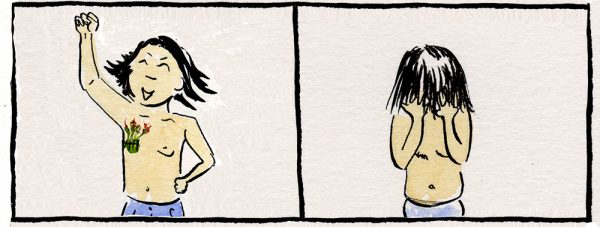
Beginning with a life-changing breast cancer diagnosis, this graphic narrative follows a woman as she faces the possible futures that suddenly feel all too real. She will grow old or she won’t. She will be an integral part of her grandchildren’s lives or she will be gone. “Can anyone be philosophical all the time? I can’t,” the story notes. Even though it’s impossible to always be pragmatic about tragedy, this is a piece about embracing life’s hard truths and its beautiful ones.
Making her literary debut in the pages of The Commuter, Kogan’s darkly humorous story imagines one Mrs. Morrison making a few pointed changes to the way she would like to be remembered: “Amelia Morrison, beloved [neglected] wife and [disappointed] mother, [also, a limber and enthusiastic lover to several of her husband’s grad students] passed away last night [which dear hubby only noticed today].”
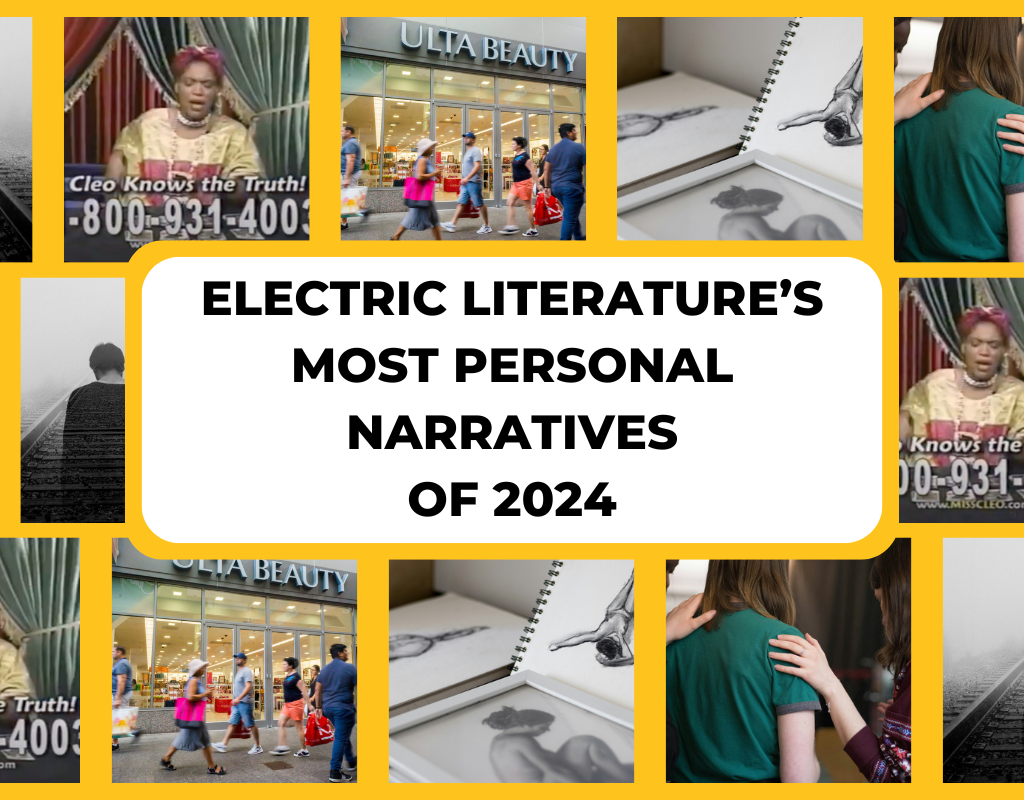
In 2023, we saw a widening gap in places publishing longform creative nonfiction, and we announced that Electric Literature would step in to help fill that space. The response was tremendous, and our first submission call for general creative nonfiction reached its cap in just 36 hours. This initiative ultimately became our Personal Narrative series, publishing a new essay every Thursday on our site.
We published our first Personal Narrative in January 2024, and it’s been so exciting to watch this series grow throughout the year. We wanted this to be a space for nonfiction about anything—from longer-form versions of work that weaves the personal with the cultural to general nonfiction tackling any subject or situation at all. We sought out formally experimental work to well-crafted traditional narratives, and everything in-between. In short, we hoped that EL’s Personal Narrative would feel expansive: a home for urgent and artful nonfiction of all kinds.
Looking at this year’s most-read Personal Narratives shows that we succeeded in that goal. The breadth is sweeping, ranging from a lyric description of grief and addiction to an essay excavating the links between writing workshops and a toxic social movement. They hone in on unique slices of life—modeling for life drawing classes, working as a phone psychic, learning the ins-and-outs of holiday retail—and use that lens, and a particular kind of writing magic, to craft an essay that becomes, by the end, more than the sum of its parts.
Opening our doors to Personal Narrative was exciting on its own. Discovering the excellent, fresh nonfiction we published this year has put ever-greater wind in our sails. The five essays below are our most popular of the year, starting with the most read. Read them, and you’ll see why this series has been so exciting for us to bring into the world, and why we can’t wait to continue to help it grow into 2025 and beyond.
—Katie Henken Robinson Associate Editor, Electric Literature
Editor’s note: The descriptions below were written by Jalen Giovanni Jones.
Adam Spiegelman recounts the difficult years he spent struggling with addiction alongside his friend Nick, who passed in 2021. The pair weren’t fast friends, nor were they a natural fit sexually—but what consistently kept them together was their dependency on drugs. As Spiegelman reflects on his days as a “junkie,” as he calls it, he recalls the addict’s precarious relationship with life and death, painting the identity as one that cradles between these two worlds. While smoothly weaving in references to literature on mourning from the likes of C.S. Lewis and Freud, Spiegelman forces us to reckon with friendship and mortality in entirely new ways.
Heidi Diehl transports readers to the summer of 2001, when she was hired to work under the infamous Miss Cleo as a psychic phone operator—without any of the psychic abilities or training. Despite its temporal distance, Diehl’s experiences serve as eerie premonitions for current social dilemmas: communal voicemail systems would serve as prototypes of social media, while early 2000s fads like Miss Cleo’s psychic services exploited voyeuristic compulsions that dominate our screens today. With stunning clarity, Diehl wrestles with the human urge to share and listen to stories. As she succinctly writes: “I wanted something impossible—to listen without the story touching me, to take someone else’s drama without revealing my own. But I wasn’t actually safe from the story. I was always part of it, even when it wasn’t mine.”
Excerpted from her debut essay collection American Bulk, Emily Mester recounts the time she was working her first job out of undergrad: as a retail worker for Ulta, in the rich part of town. Recollecting her months enduring entitled Karens and tiptoeing through workplace politics, Mester tackles head-on the exploitative relationship that customers of all tax brackets have with service workers, and vice versa. Weaving honesty with clever humor throughout, “Shrink” exposes the true cost that consumer culture has on our relationships with each other and ourselves.
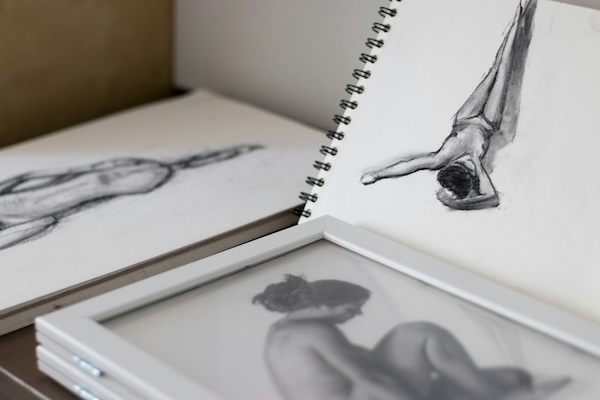
The essay starts with writer Dayna Mahannah in only sandals and a trench coat, before she takes them off and climbs onstage in front of a classroom of art students ready to draw her. It’s her first time doing this, and to her own surprise, she felt grand. But as we read, we learn she wasn’t always so comfortable with her body. Mahannah braids scenes of her first day as a life drawing model, with her experiences as an aspiring runway model between the ages of twelve to seventeen. Mahannah provides a sobering account of her battle with disordered eating and body image issues as she strived for the perfect body. With frankness and vulnerability, she reminds us of the autonomy we have over our own bodies, even in spite of its many possible interpretations.
Newly single and having just moved to a new town, Laura M. Martin is happy to indulge in a newfound freedom and unruliness. But when independence started to feel like isolation, they decided to find their community through Connection Games—group activities that attempt to streamline genuine, deep connections between strangers, as part of the trending “Authentic Relating” movement. Through nuanced reflections on the movement’s contradictory practices, Martin draws parallels to similar problematic practices in Iowa-Style Writing Workshops that have dominated the literary world for decades. “Who can work on self-improvement when they’re under attack?” Martin asks, of both the “Iowa Method” and of Connection Games. Through careful and measured reflections, Martin makes us reconsider what constitutes trust and true connection—in friendship, and in writing.
We’ve gleaned a lot about our readers from examining this year’s most purchased books on the site. It turns out you guys embrace a diverse range of genres and topics, whether it’s a cleverly self-aware murder mystery or a biting collection of feminist poems. Themes emerged, too: many of these titles share an appreciation of dark humor, a love of magical realism, an affinity for feminist and intersectional concerns, or an aspiration to make visible what is normally hidden. We’re especially proud to see so many small-press books here, given the comparably less space that is afforded to them in traditional media.
Nearly every type of reader will find a book that resonates with them, considering the talented and eclectic slate of writers. Jami Attenberg offers invaluable productivity tips for writers; Donika Kelly depicts mythological beasts with a razor-sharp poetic eye; Andrea Carlisle refuses to go gently into old age. These fifteen books represent just some of the exciting literary voices that we are honored to support.
Here are the most purchased books on Electric Literature this year, starting from the most popular:
Frances Adams has spent sixty years trying to prevent her own murder (as foretold by a fortune-teller), gathering intel on everyone she meets in her small town. But her efforts are in vain, and when she’s found dead, her great-niece Annie has to pick up where she left off solving the crime. This enthralling premise will hook you into the story, and Kristen Perrin’s careful plotting and witty dialogue will keep you rapt. As Perrin demonstrates, just because a book is about murder doesn’t mean it can’t be funny. How to Solve Your Own Murder promises a cozy evening of binge-reading before the highly anticipated sequel comes out in April!
Brenda Peynado’s glittering short stories wear the garb of fantasy but pack the punch of a political call-to-action. Her fabulistic stories, many of which center around young women coming of age, offer lenses into imaginative or troubling new worlds. “Thoughts and Prayers,” set in the aftermath of a school shooting, conjures a particularly lasting image, with adult characters who are paralyzed to do anything but pray to the hulking angels on their roofs. Throughout the collection, Peynado’s characters resist easy categorization into good and bad, right and wrong. Instead, she interrogates existing structures of power and imagines how they could be uprooted by magic.
George Singleton returns with another top-notch collection of short fiction centered around the landscape of the Carolinas and the eccentric, quick-witted men who live there. He savors the Southern terroir of his settings without relying on stereotypes or snap judgments, instead crafting characters who push against convention. They run into problems that are frequently absurd or outlandish, and each narrative twist leans headfirst into that stereotype. The seventeen stories that make up this collection are full of Singleton’s singular, gritty voice.
Our society is all too eager to let its older members fade into the background, but Andrea Carlisle refuses to be the silent old woman in the corner. Instead, in There Was an Old Woman, Carlisle dissects the ways ageism and misogyny meld to birth phenomena like the anti-aging industry. She considers historical portrayals of older women in literature and art and traces a line to the present-day media landscape. Her essays are also packed with tender personal anecdotes and observations of her beautiful natural surroundings. Andrea Carlisle is the ultimate literary companion for women entering their golden years.
Carmen Maria Machado’s debut collection of short fiction has achieved cult classic status by now, and for good reason. Machado’s work is particularly notable for the immediate, evocative way she writes about the female body: as queer, as erotic, as disfigured, as surviving patriarchal violence. From the biting feminist critique of “The Husband Stitch” to the otherworldly, transcendent mode of “Especially Heinous,” each of these stories captures a haunted, fantastical world in amber. Throughout, Carmen Maria Machado shows off her claustrophobic, vivid, and entirely unique fictional voice.
Donika Kelly’s debut book of poetry is populated by beasts of all manners, from mythological monsters like the minotaur to quotidian ones like the speaker’s father. She writes with a clear-eyed ferocity about nature, love, family secrets, and occupying her body as a Black woman in America.
Video games represent a form of storytelling that has become increasingly integral to culture and society. This anthology of essays proposes a collaborative spirit toward new media, and it was collaboratively edited over the pandemic by J. Robert Lennon and Carmen Maria Machado. These myriad authors detail their personal experiences with gaming and consider how the technology offers new possibilities and complications. It’s hard to go wrong with a book that includes new work by Hanif Abdurraqib, Nana Kwame Adjei-Brenyah, Tony Tulathimutte, Vanessa Angélica Villarreal, and more.
The Book of Disbelieving contains not just short stories but whole worlds painstakingly captured in David Lawrence Morse’s clear-eyed prose. He releases the reader gradually into each story, richly painting the fantastical realms and hinting at the secrets that lie within. In the especially surprising “Spring Leapers,” a parable-telling reverend observes his new village partaking in a bizarre annual tradition that soon turns deadly. Morse invokes curiosity with each of these tales, prompting the reader to reflect on mortality, memory, and human nature.
Mary Jones takes a scalpel to grief in this exquisitely crafted collection of short stories centered around life’s myriad goodbyes. She moves deftly between narrative moods as she showcases different aspects of love, loss, and letting go. These deeply felt, original stories have a way of sneaking into your heart and staying there.
The 1000 Words movement began at Jami Attenberg’s writing desk as she faced a looming deadline; she challenged herself to write one thousand words every day for two weeks, without second-guessing what she was putting down on the page. One viral hashtag later, and Attenberg is embracing this judgment-free perspective in a craft guide full of motivation and productivity tips. More than fifty other literary luminaries—including Camille Dungy, Lauren Groff, and Alexander Chee—contribute writing advice, making this one of the most inspiring craft books on the market.
The partition of India and Pakistan into two separate countries in 1947 caused the displacement and death of ordinary people on a massive scale. Yet decades later, the full scale of this event is still not well-understood. Urvashi Butalia addresses this gap with a careful documentarian’s approach, using oral interviews, diaries, and letters to understand the human impact of partition. Butalia pays particular attention to people on the margins—women, children, lower castes—resulting in a touching and personal account of history.
In LaPointe’s Coast Salish community, there is a belief in the power of music to heal. These virtuosic personal essays underscore that power and continue a documentary thread from LaPointe’s great-grandmother. The essays in Thunder Song showcase LaPointe’s fresh perspective and captivating intellect as they move through her family archives and the indigenous communities of the Pacific Northwest.
As a lifelong New Englander, I had never heard of the invasive species kudzu or its history in the American South, which Mimi Herman reimagines in this enchanting work of historical fiction. Fifteen-year-old narrator Mattie captured my heart immediately with her earnest enthusiasm and huge imagination. The Kudzu Queen is at once a tenderly wrought coming-of-age narrative and an irresistible historical drama.
Main character Khaki is desperate to disappear, whether into the thrum of the punk-rock music scene or into her codependent, questionably platonic relationship with childhood friend Fiona. As she considers whether to rekindle the friendship, Khaki ruminates on concerns about mental health, attachment, codependence, identity, and the racial dynamics of their relationship. The resulting debut novel sparkles with intellect, pathos, and a pounding bassline.
Claire is an introvert, an aspiring artist, a caustic wit grieving the recent death of her father—oh, and a part-time serial killer. When she suspects someone from her bereavement support group has witnessed her latest murder, Claire must scramble to prevent her macabre side-hustle from being exposed. This darkly comic thriller is packed with eccentric characters and deadly antics.
The holidays are the best time for reading: rare free time, chilly weather, and holiday sentimentality create a perfect storm of hygge, which I can only answer by burying my body under blankets and my nose in a book. This year, I found myself yearning for stories set during Christmastime and dissatisfied with the available options. This reading list arose out of my efforts to find a new favorite Christmas novel.
After all, there’s only so many times we can encounter children’s Christmas books like The Polar Express or How the Grinch Stole Christmas before the novelty begins to wear off. And for the modern-day reader seeking escapism, the lofty language of classic novels like A Christmas Carol can grate. Fortunately, there is a rising tide of modern and contemporary prose filling this publishing niche. The eight books on this list cover different genres and time periods (though all were published in the last twenty years), but they are united by their holiday settings. These books also play with a surprising variety of narrative moods—heartwarming, chill-inducing, tearful, starry-eyed—that are sure to satisfy every type of reader. So whether you prefer your Christmas stories with some intrigue or full of fluff, you’ll find new options here.
Brightly Shining by Ingvild Rishøi, translated by Caroline Waight
This short Norwegian novel, translated into English by Caroline Waight, has all the makings of a modern classic. Precocious, dreamy ten-year-old Ronja narrates this loose adaptation of The Little Match Girl. When their father’s drinking problems threaten to bankrupt the family, Ronja and her older sister attempt to take over his new job at a nearby Christmas tree farm. The resulting tale explores capitalism, caretaking, and loneliness with sparkling prose and a gorgeous Nordic setting. A film adaptation is reported to come out next holiday season, so this winter is the perfect time to familiarize yourself with Rishøi’s tragically beautiful world.
From the queen of cozy romance comes this tale of two very different sisters and an ancient bookshop that needs saving. After losing her job, Carmen moves in with her pregnant sister Sofia in Edinburgh, Scotland and tries to help one of Sofia’s clients rescue his bookstore from bankruptcy. Surprising herself, Carmen starts to repair the rocky relationships in her family as well as the bookshop’s finances—and finds not one but two love interests. My favorite parts of this book were the atmospherically written scenes set in the bookshop; I could practically picture the cheery displays in the windows.
In 1920, Jack and Mabel move to Alaska to start a homestead farm and distract themselves from their childlessness. During the first snowfall, they build a girl out of snow; the next morning, they discover a real child running through the woods. The magic-soaked novel that follows kept me hooked the whole way through. Ivey’s writing is tender and gauzy, infused with affection for the natural world and the people who inhabit it.
In the small town of Lower Lockwood, the Fairway Players are rehearsing their annual Christmas production when they find a dead body. Lawyers Femi and Charlotte from Hallett’s first novel The Appeal return to investigate the case, kicking off an unexpected romp through the eclectic community theater. I love how this mystery keeps me hooked on solving the murder while also making me laugh with ridiculous antics.
This Booker Prize shortlisted novella follows Bill Furlong, a hardworking father from humble origins, as Christmas approaches in their small Ireland town. The narrative moves forward subtly as Bill begins to challenge the status quo of the Catholic town leadership. Keegan’s prose stands out for its concise and sharp rendering of character detail. Her masterful command of tone and emotion makes this short tale engrossing.
Straight readers have had the monopoly on blissful, trope-heavy holiday romances for far too long; luckily, Allison Cochrun is here to correct the balance. Kiss Her Once for Me sees bisexual protagonist Ellie get snowed in at a fancy cabin with her fake-boyfriend-slash-boss and the woman who broke her heart last Christmas. Wintery hijinks abound, eventually forcing Ellie and her ex to talk about what went wrong between them. I loved this book for its rich characterizations that feel true to queer life, especially the Carhartt-wearing, chicken-coop-building butch glory of Ellie’s love interest.
Niall Williams returns to the fictional Irish village of Faha (as featured in This Is Happiness) in Advent of 1962. After the death of his beloved wife, Dr. Jack Troy and his daughter Ronnie ache to find some levity in their daily routine. After they discover an abandoned infant left out in the cold, Jack schemes to keep the child in his care, hoping it will bring Ronnie some purpose. This novel is a paragon of balance and restraint; Williams lets this quiet tale unfold gradually and rewards the reader for their patience.
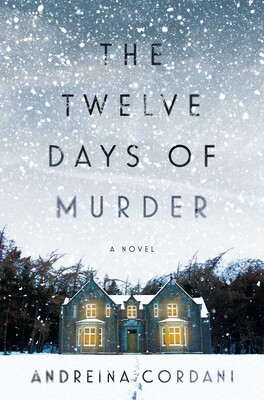
The Twelve Days of Murder by Andreina Cordani
Twelve years ago, a group of college friends ran a fictional Masquerade Murder Society—until the real disappearance of one of their members put a stop to their games. When the remaining members reunite deep in the Scottish Highlands for a Christmas Masquerade, misfortune and death are sure to follow again. The old friends desperately try to solve their predicament in a locked-room mystery reminiscent of Agatha Christie’s And Then There Were None, but with a modern twist. The high stakes, creepy suspense, and snowy setting sent a chill down my spine.
It’s fitting that Christmas should degenerate to this, its barest bones. The family has begun to seem to Therese like a pack of thespians anyway; everyone arrives, performs for one another, catches early flights out, to Logan or O’Hare. Probably it’s appropriate that a party game should literally appear and insert itself in the guise of a holiday tradition (which it isn’t). Usually, no one in Therese’s family expresses much genuine feeling anyway; everyone aims instead—though gamely!—for enactments.
Each year now, the stage is a new one—their aging parents, in their restless old age, buying and selling town houses, moving steadily southward from Maine. The real estate is Therese’s mother’s idea. Since he’s retired, Therese’s father has focused more on bird feeders; he is learning how to build them. “Who knows what he’ll do next?” Her mother sighs. “He’ll probably start carving designs into the side of the house.”
This year, they are in Bethesda, Maryland, near where Andrew, Therese’s brother, lives. Andrew works as an electrical engineer and is married to a sweet, pretty, part-time private detective named Pam. Pam is pixie-haired and smiley. Who would ever suspect her of discreetly gathering confidences and facts for one’s adversaries? She freezes hams. She makes Jell-O salad days in advance. She and Andrew are the parents of a one-and-a-half-year-old named Winnie, who already reads.
Reads the reading videos on TV, but reads.
Everyone has divided into teams, four and four, and written the names of famous people, songs, films, plays, books on scraps of wrapping paper torn off the gifts hours earlier. It is another few hours until Therese and her husband Ray’s flight, at 4:30, from National Airport. “Yes,” says Therese, “I guess we’ll have to forgo the ‘Averell Harriman: Statesman for All Seasons’ exhibit.”
“I don’t know why you couldn’t catch a later flight,” says Therese’s sister, Ann. She is scowling. Ann is the youngest, and ten years younger than Therese, who is the oldest, but lately Ann’s voice has taken up a prissy and matronly scolding that startles Therese. “Four-thirty,” says Ann, pursing her lips and propping her feet up on the chair next to her. “That’s a little ridiculous. You’re missing dinner.” Her shoes are pointy and Victorian-looking. They are green suede—a cross between a courtesan’s and Peter Pan’s.
The teams are divided in such a way that Therese and Ray and her parents are on one team, Andrew and Pam, Ann and Tad, Ann’s fiancé, on the other. Tad is slender and red-haired, a marketing rep for Neutrogena. He and Ann have just become engaged. After nearly a decade of casting about in love and work, Ann is now going to law school and planning her summer wedding. Since Therese worked for years as a public defender and is currently, through a fluky political appointment, a county circuit court judge, she has assumed that Ann’s decision to be a lawyer is a kind of sororal affirmation, that it will somehow mean the two of them will have new things in common, that Ann will have questions for her, observations, forensic things to say. But this seems not to be so. Ann appears instead to be preoccupied with trying to hire bands and caterers, and to rent a large room in a restaurant. “Ugh,” said Therese sympathetically. “Doesn’t it make you want to elope?” Therese and Ray were married at the courthouse, with the file clerks as witnesses.
Ann shrugged. “I’m trying to figure out how to get everybody from the church to the restaurant in a way that won’t wrinkle their outfits and spoil the pictures.”
“Really?” asked Therese. “You are?”
The titles are put in two big salad bowls, each team receiving the other’s bowl of titles. Therese’s father goes first. “All right! Everyone ready!” He has always been witty, competitive, tense; games have usually brought out the best and worst in him. These days, however, he seems anxious and elderly. There is a pain in his eyes, something sad and unfocused that sometimes stabs at them—the fear of a misspent life, or an uncertainty as to where he’s left the keys. He signals that his assigned name is a famous person. No one could remember how to signal that and so the family has invented one: a quick pompous posture, hands on hips, chin in air. Mustering up a sense of drama, Therese’s father does this well.
“Famous person!” Everyone shouts it, though of course there is someone who shouts “Idiot” to be witty. This time, it is Therese’s mother.
“Idiot!” she shouts. “Village idiot!”
But Therese’s father has continued signaling the syllables, ignoring his wife, slapping the fingers of his right hand hard on his left sleeve. The famous person has three names. He is doing the first name, first syllable. He takes out a dollar bill and points to it.
“George Washington,” shouts Ray.
“George Washington Carver!” shouts Therese. Therese’s father shakes his head angrily, turning the dollar around and pointing at it violently. It bothers him not to be able to control the discourse.
“Dollar bill,” says Therese’s mother.
“Bill!” says Therese. At this, her father begins nodding and pointing at her psychotically. Yes, yes, yes. Now he makes stretching motions with his hands. “Bill, Billy, William,” says Therese, and her father points wildly at her again. “William,” she says. “William Kennedy Smith.”
“Yes!” shouts her father, clapping his hands and throwing his head back as if to praise the ceiling.
“William Kennedy Smith?” Ann is scowling again. “How did you get that from just William?”
“He’s been in the news.” Therese shrugs. She does not know how to explain Ann’s sourness. Perhaps it has something to do with Ann’s struggles in law school, or with Therese’s being a circuit court judge, or with the diamond on Ann’s finger, which is so huge that it seems, to Therese, unkind to wear it around their mother’s, which is, when one gets right down to it, a chip. Earlier this morning, Ann told Therese that she is going to take Tad’s name, as well. “You’re going to call yourself Tad?” Therese asked, but Ann was not amused. Ann’s sense of humor was never that flexible, though she used to like a good sight gag.
Ann officiously explained the name change: “Because I believe a family is like a team, and everyone on the team should have the same name, like a color. I believe a spouse should be a team player.”
Therese no longer has any idea who Ann is. She liked her better when Ann was eight, with her blue pencil case, and a strange, loping run that came from having one leg a quarter of an inch longer than the other. Ann was more attractive as a child. She was awkward and inquiring. She was cute. Or so she seemed to Therese, who was mostly in high school and college, slightly depressed and studying too much, destroying her already-bad eyes, so that now she wore glasses so thick her eyes swam in a cloudy way behind them. This morning, when she’d stood listening to Ann talk about team players, Therese had smiled and nodded, but she felt preached at, as if she were a messy, wayward hippie. She wanted to grab her sister, throw herself upon her, embrace her, shut her up. She tried to understand Ann’s dark and worried nuptial words, but instead she found herself recalling the pratfalls she used to perform for Ann—Therese could take a fall straight on the face—in order to make Ann laugh.
Ann’s voice was going on now. “When you sit too long, the bodices bunch up. . . .”
Therese mentally measured the length of her body in front of her and wondered if she could do it. Of course she could. Of course. But would she? And then suddenly, she knew she would. She let her hip twist and fell straight forward, her arm at an angle, her mouth in a whoop. She had learned to do this in drama club when she was fifteen. She hadn’t been pretty, and it was a means of getting the boys’ attention. She landed with a thud.
“You still do that?” asked Ann with incredulity and disgust. “You’re a judge and you still do that?”
“Sort of,” said Therese from the floor. She felt around for her glasses.
Now it is the team player herself standing up to give clues to her team. She looks at the name on her scrap of paper and makes a slight face. “I need a consultation,” she says in a vaguely repelled way that perhaps she imagines is sophisticated. She takes the scrap of wrapping paper over to Therese’s team. “What is this?” Ann asks. There in Ray’s handwriting is a misspelled Arachnophobia.
“It’s a movie,” says Ray apologetically. “Did I spell it wrong?”
“I think you did, honey,” says Therese, leaning in to look at it. “You got some of the o’s and a’s mixed up.” Ray is dyslexic. When the roofing business slows in the winter months, instead of staying in with a book, or going to psychotherapy, he drives to cheap matinees of bad movies—“flicks,” he calls them, or “cliffs” when he’s making fun of himself. Ray misspells everything. Is it input or imput? Is it averse, adverse, or adversed? Stock or stalk? Carrot or karate? His roofing business has a reputation for being reasonable, but a bit slipshod and second-rate. Nonetheless, Therese thinks he is great. He is never condescending. He cooks infinite dishes with chicken. He is ardent and capable and claims almost every night in his husbandly way to find Therese the sexiest woman he’s ever known. Therese likes that. She is also having an affair with a young assistant DA in the prosecutor’s office, but it is a limited thing—like taking her gloves off, clapping her hands, and putting the gloves back on again. It is quiet and undiscoverable. It is nothing, except that it is sex with a man who is not dyslexic, and once in a while, Jesus Christ, she needs that.
Ann is acting out Arachnophobia, the whole concept, rather than working syllable by syllable. She stares into her fiancé’s eyes, wiggling her fingers about and then jumping away in a fright, but Tad doesn’t get it, though he does look a little alarmed. Ann waves her Christmas-manicured nails at him more furiously. One of the nails has a little Santa Claus painted on it. Ann’s black hair is cut severely in sharp, expensive lines, and her long, drapey clothes hang from her shoulders, as if still on a hanger. She looks starved and rich and enraged. Everything seems struggled toward and forced, a little cartoonish, like the green shoes, which may be why her fiancé suddenly shouts out, “Little Miss Muffett!” Ann turns now instead to Andrew, motioning at him encouragingly, as if to punish Tad. The awkward lope of her childhood has taken on a chiropracticed slink. Therese turns back toward her own team, toward her father, who is still muttering something about William Kennedy Smith. “A woman shouldn’t be in a bar at three o’clock in the morning, that’s all there is to it.”
“Dad, that’s ludicrous,” whispers Therese, not wanting to interrupt the game. “Bars are open to everyone. Public Accommodations Law.”
“I’m not talking about the cold legalities,” he says chastisingly. He has never liked lawyers, and is baffled by his daughters. “I’m talking about a long-understood moral code.” Her father is of that Victorian sensibility that deep down respects prostitutes more than it does women in general.
“‘Long-understood moral code’?” Therese looks at him gently. “Dad, you’re seventy-five years old. Things change.”
“Arachnophobia!” Andrew shouts, and he and Ann rush together and do high fives.
Therese’s father makes a quick little spitting sound, then crosses his legs and looks the other way. Therese looks over at her mother and her mother is smiling at her conspiratorially, behind Therese’s father’s back, making little donkey ears with her fingers, her sign for when she thinks he’s being a jackass.
Her mother is smiling at her conspiratorially, behind Therese’s father’s back, making little donkey ears with her fingers, her sign for when she thinks he’s being a jackass.
“All right, forget the William Kennedy Smith. Doll, your turn,” says Therese’s father to her mother. Therese’s mother gets up slowly but bends gleefully to pick up the scrap of paper. She looks at it, walks to the center of the room, and shoves the paper scrap in her pocket. She faces the other team and makes the sign for a famous person.
“Wrong team, Mom,” says Therese, and her mother says “Oops,” and turns around. She repeats the famous person stance.
“Famous person,” says Ray encouragingly. Therese’s mother nods. She pauses for a bit to think. Then she spins around, throws her arms up into the air, collapses forward onto the floor, then backward, hitting her head on the stereo.
“Marjorie, what are you doing?” asks Therese’s father. Her mother is lying there on the floor, laughing.
“Are you okay?” Therese asks. Her mother nods, still laughing quietly.
“Fall,” says Ray. “Dizziness. Dizzy Gillespie.”
Therese’s mother shakes her head.
“Epilepsy,” says Therese.
“Explode,” says her father, and her mother nods. “Explosion. Bomb. Robert Oppenheimer!”
“That’s it.” Her mother sighs. She has a little trouble getting back up. She is seventy and her knees are jammed with arthritis.
“You need help, Mom?” Therese asks.
“Yeah, Mom, you need help?” asks Ann, who has risen and walked toward the center of the room, to take charge.
“I’m okay.” Therese’s mother sighs, with a quiet, slightly faked giggle, and walks stiffly back to her seat.
“That was great, Ma,” says Therese.
Her mother smiles proudly. “Well, thank you!”
After that, there are many rounds, and every time Therese’s mother gets anything like Dom De Luise or Tom Jones, she does her bomb imitation again, whipping herself into a spastic frenzy and falling, then rising stiffly again to great applause. Pam brings Winnie in from her nap and everyone oohs and aahs at the child’s sweet sleepstreaked face. “There she is,” coos Aunt Therese. “You want to come see Grandma be a bomb?”
“It’s your turn,” says Andrew impatiently.
“Mine?” asks Therese.
“I think that’s right,” says her father.
She gets up, digs into the bowl, unfolds the scrap of wrapping paper. It says “Jekylls Street.” “I need a consultation here. Andrew, I think this is your writing.”
“Okay,” he says, rising, and together they step into the foyer.
“Is this a TV show?” whispers Therese. “I don’t watch much TV.”
“No,” says Andrew with a vague smile.
“What is it?”
He shifts his weight, reluctant to tell her. Perhaps it is because he is married to a detective. Or, more likely, it is because he himself works with Top Secret documents from the Defense Department; he was recently promoted from the just plain Secret ones. As an engineer, he consults, reviews, approves. His eyes are suppressed, annoyed. “It’s the name of a street two blocks from here.” There’s a surly and defensive curve to his mouth.
“But that’s not the title of anything famous.”
“It’s a place. I thought we could do names of places.”
“It’s not a famous place.”
“So?”
“I mean, we all could write down the names of streets in our neighborhoods, near where we work, a road we walked down once on the way to a store—”
“You’re the one who said we could do places.”
“I did? Well, all right, then, what did I say was the sign for a place? We don’t have a sign for places.”
“I don’t know. You figure it out,” he says. A saucy rage is all over him now. Is this from childhood? Is this from hair loss? Once, she and Andrew were close. But now, as with Ann, she has no idea who he is anymore. She has only a theory: an electrical engineer worked over years ago by high school guidance counselors paid by the Pentagon to recruit, train, and militarize all the boys with high math SAT scores. “From M.I.T. to MIA,” Andrew once put it himself. “A military-industrial asshole.” But she can’t find that satirical place in him anymore. Last year, at least, they had joked about their upbringing. “I scarcely remember Dad reading to us,” she’d said.
“Sure he read to us,” said Andrew. “You don’t remember him reading to us? You don’t remember him reading to us silently from the Wall Street Journal?”
Now she scans his hardening face for a joke, a glimmer, a bit of love. Andrew and Ann have seemed close, and Therese feels a bit wistful, wondering when and how that happened. She is a little jealous. The only expression she can get from Andrew is a derisive one. He is a traffic cop. She is the speeding flower child.
Don’t you know I’m a judge? she wants to ask. A judge via a fluke political appointment, sure. A judge with a reputation around the courthouse for light sentencing, true. A judge who is having an affair that mildly tarnishes her character—okay. A softy; an easy touch: but a judge nonetheless.
Instead, she says, “Do you mind if I just pick another one?”
“Fine by me,” he says, and strides brusquely back into the living room.
Oh, well, Therese thinks. It is her new mantra. It usually calms her better than ohm, which she also tries. Ohm is where the heart is. Ohm is not here. Oh, well.Oh, well. When she was first practicing law, to combat her courtroom stage fright, she would chant to herself, Everybody loves me. Everybody loves me, and when that didn’t work, she’d switch to Kill! Kill! Kill!
“We’re doing another one,” announces Andrew, and Therese picks another one.
A book and a movie. She opens her palms, prayerlike for a book. She cranks one hand in the air for a movie. She pulls on her ear and points at a lamp. “Sounds like light,” Ray says. His expression is open and helpful. “Bite, kite, dite, fight, night—”
Therese signals yes, that’s it.
“Night,” repeats Ray.
“Tender Is the Night,” says her mother.
“Yes!” says Therese, and bends to kiss her mother on the cheek. Her mother smiles exuberantly, her face in a kind of burst; she loves affection, is hungry and grateful for it. When she was younger, she was a frustrated, mean mother, and so she is pleased when her children act as if they don’t remember.
It is Andrew’s turn. He stands before his own team, staring at the red scrap in his hand. He ponders it, shakes his head, then looks back toward Therese. “This must be yours,” he says with a smirk that maybe is a good-natured smirk. Is there such a thing? Therese hopes.
“You need a consultation?” She gets up to look at the writing; it reads, “The Surrey with the Fringe on Top.” “Yup, that’s mine,” she says.
“Come here,” he says, and the two of them go back down the corridor toward the foyer again. This time, Therese notices the photographs her parents have hung there. Photographs of their children, of weddings and Winnie, though all the ones of Therese seem to her to be aggressively unflattering, advertising an asymmetry in her expression, or the magnified haziness of her eyes, her hair in a dry, peppery frizz. Vanity surges in her: surely there must have been better pictures! The ones of Andrew, of Ann, of Tad, of Pam and Winnie are sunlit, posed, wholesome, pretty. But the ones of Therese seem slightly disturbed, as if her parents were convinced she is insane.
“We’ll stand here by the demented looking pictures of me,” says Therese.
“Ann sent her those,” says Andrew.
“Really?” says Therese.
He studies her hair. “Didn’t your hair used to be a different color? I don’t remember it ever being quite that color. What is that color?”
“Why, whatever do you mean?”
“Look,” he says, getting back to the game. “I’ve never heard of this,” and he waves the scrap of paper as if it were a gum wrapper.
“You haven’t? It’s a song: ‘Geese and chicks and ducks better scurry, when I take you out in the surrey . . .’”
“No.”
“No?” She keeps going. She looks up at him romantically, yearningly. “ ‘When I take you out in my surrey, when I take you out in my surrey with the fringe on—’”
“No,” Andrew interrupts emphatically.
“Hmm. Well, don’t worry. Everyone on your team will know it.”
The righteous indignation is returning to his face. “If I don’t know it, what makes you think they’ll know it?” Perhaps this is because of his work, the technosecrecy of it. He knows; they don’t.
“They’ll know it,” Therese says. “I guarantee.” She turns to leave.
“Whoa, whoa, whoa,” says Andrew. The gray-pink of rage is back in his skin. What has he become? She hasn’t a clue. He is successfully top secret. He is classified information. “I’m not doing this,” he says. “I refuse.”
What has he become? She hasn’t a clue. He is successfully top secret. He is classified information.
Therese stares at him. This is the assertiveness he can’t exercise on the job. Perhaps here, where he is no longer a cog-though-a-prized cog, he can insist on certain things. The Cold War is over, she wants to say. But what has replaced it is this: children who have turned on one another, now that the gods—or were they only guards?—have fled. “Okay, fine,” she says. “I’ll make up another.”
“We’re doing another one,” announces Andrew triumphantly as they go back into the living room. He waves the paper scrap. “Have any of you ever even heard of a song called ‘The Surrey with the Fringe on Top’?”
“Sure,” says Pam, looking at him in a puzzled way. No doubt he seems different to her around the holidays.
“You have?” He seems a bit flummoxed. He looks at Ann. “Have you?”
Ann looks reluctant to break ranks with him but says, quietly, “Yeah.”
“Tad, how about you?” he asks.
Tad has been napping off and on, his head thrown back against the sofa, but now he jerks awake. “Uh, yeah,” he says.
“Tad’s not feeling that well,” says Ann.
In desperation, Andrew turns toward the other team. “And you all know it, too?”
“I don’t know it,” says Ray. He is the only one. He doesn’t know a show tune from a chauffeur. In a way, that’s what Therese likes about him.
Andrew sits back down, refusing to admit defeat. “Ray didn’t know it,” he says.
Therese can’t think of a song, so she writes “Clarence Thomas” and hands the slip back to Andrew. As he ponders his options, Therese’s mother gets up and comes back holding Dixie cups and a bottle of cranberry drink. “Who would like some cranberry juice?” she says, and starts pouring. She hands the cups out carefully to everyone. “We don’t have the wine glasses unpacked, so we’ll have to make do.”
“We’ll have to make do” is one of their mother’s favorite expressions, acquired during the Depression and made indelible during the war. When they were little, Therese and Andrew used to look at each other and say, “We’ll have to make do-do,” but when Therese glances over at Andrew now, nothing registers. He has forgotten. He is thinking only of the charade.
Ray sips his a little sloppily, and a drop spills on the chair. Therese hands him a napkin and he dabs at the upholstery with it, but it is Ann who is swiftly up, out to the kitchen, and back with a cold, wet cloth, wiping at Ray’s chair in a kind of rebuke.
“Oh, don’t worry,” her mother is saying.
“I think I’ve got it,” says Ann solemnly.
“I’m doing my clues now,” says Andrew impatiently. Therese looks over at Winnie, who, calm and observant in her mother’s arms, a pink incontinent Buddha who knows all her letters, seems like the sanest person in the room.
Andrew is making a sweeping gesture with his arm, something meant to include everyone in the room.
“People,” says Tad.
“Family,” says Pam.
Ann has come back from the kitchen and sits down on the sofa. “Us,” she says.
Andrew smiles and nods.
“Us. Thom-us,” says Ann. “Clarence Thomas.”
“Yes,” says Andrew with a clap. “What was the time on that?”
“Thirty seconds,” says Tad.
“Well, I guess he’s on the tip of everyone’s tongue,” says Therese’s mother.
“I guess so,” says Therese.
“It was interesting to see all those black people from Yale,” says Therese’s mother. “All sitting there in the Senate caucus room. I’ll bet their parents were proud.”
Ann did not get in to Yale. “What I don’t like,” she says, “is all these black people who don’t like whites. They’re so hostile. I see it all the time in law school. Most white people are more than willing to sit down, be friendly and integrated. But it’s the blacks who are too angry.”
“Imagine that,” says Ray.
“Yes. Imagine,” says Therese. “Why would they be angry? You know what else I don’t like? I don’t like all these gay men who have gotten just a little too somber and butch. You know what I mean? They’re so funereal and upset these days! Where is the mincing and high-spiritedness of yesteryear? Where is the gayness in gay? It’s all so confusing and inconvenient! You can’t tell who’s who without a goddamn Playbill!” She stands up and looks at Ray. It is time to go. She has lost her judicial temperament hours ago. She fears she is going to do another pratfall, only this time she will break something. Already she sees herself carted out on a stretcher, taken toward the airport, and toward home, saying the final words she has to say to her family, has always had to say to her family. Sounds like could cry.
“Good-bye!”
“Good-bye!”
“Good-bye!”
“Good-bye!”
“Good-bye!”
“Good-bye!”
“Good-bye!”
But first Ray must do his charade, which is Confucius. “Okay. I’m ready,” he says, and begins to wander around the living room in a wild-eyed daze, looking as confused as possible, groping at the bookcases, placing his palm to his brow. And in that moment, Therese thinks how good-looking he is and how kind and strong and how she loves nobody else in the world even half as much.
Novelist Jade Song writes that being queer is “like moving through water while everyone else is on land,” and writer Stephanie Monteith writes that “queer is finding we could breathe underwater all along.” Maybe there really is something queer about water, which resists boundaries and divisions and can flow from one vessel to another and from one form to another with ease. Perhaps that’s why a number of fantasy novels with queer themes are set in underwater worlds or landscapes where water is prominent. Water embodies the otherness/worldliness that people outside sexual and gender norms can sometimes feel, and the fluidity that can characterize their lives.
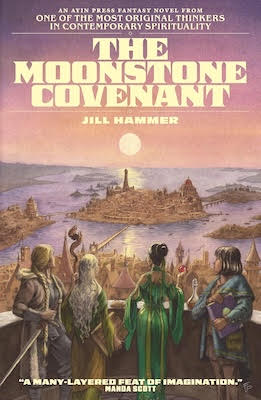
During the pandemic in 2020 when I began writing The Moonstone Covenant at night in my crowded apartment, the magic of water was foremost in my mind. The city I was creating in my novel was a multicultural archipelago, its islands surrounded by a river rushing down to the sea, its canals clogged with bookboats, gondolas, and floating liquor parlors—its vast Library, repository of the world’s wisdom, looking down on a bustling harbor. In designing Moonstone, I was inspired by other fantasy worlds where people live close to the water: Cherryh’s Merovingen, for example, or LeGuin’s Earthsea. And I was also inspired by my own island home of Manhattan, and other beloved places like Venice and Fire Island, all with their own intense relationship to water: rivers, bays, canals, shorelines.
My protagonist in my own watery landscape is Istehar Sha’an, a refugee forest prophet who’s brought her forest people downriver to the city of Moonstone to keep them safe now that invaders have destroyed their forest home. Though the city’s a refuge for them, it’s also a place of corruption and hostility, where her people’s magic is forbidden. In her time in the city, Istehar’s married three wives—a warrior librarian, an apothecary who’s trying to solve her parents’ murder, and a prince’s former concubine. Together, these women embark on a quest that will upend their lives and transform their city.
As I wrote about my four protagonists’ intertwined stories, I got to watch the characters weave around their water-rich landscape, using alleyways, gondolas, ferries, rowboats, bridges, and even swimming to get where they needed to go. Now that the book is complete, I’ve come to see that maybe my landscape and my characters are intertwined.
In this list of contemporary fantasy novels, queer characters inhabit watery landscapes: islands, underwater houses, magic wells, ocean depths, and more. In these queer waterworlds, water has so many ways it can manifest, including as an anthropomorphous presence and as a transformative force.
Meg Shields writes that water is “a liminal space where bodies are free to exist as they are.” So too, these novels explore water as a space where new and fluid ways of existing become possible.
The main characters in this charming fantasy (written almost entirely in the form of letters and in the tone of a Jane Austen novel) live in an underwater home called The Deep House, surrounded by the mystery and beauty of the ocean. E., a brilliant recluse, observes a strange and beautiful creature outside her window and starts up a correspondence with a scholar named Henerey to understand what she’s seen. The two fall in love and then vanish, leaving E.‘s sister Sophy and Henerey’s brother Vyerin to piece together what happened through their letters.
Set in a wuxia fantasy realm, The Water Outlaws follows the story of Lin Chong, a martial arts instructor with magical and spiritual powers that aid her in battle. Loyal to her country and emperor, she serves faithfully until a corrupt villain falsely accuses her of treason. Branded a criminal and targeted for assassination, she flees, and is recruited to become a bandit of Liangshan, joining other outlaw women in their rebellion against the empire’s corruption. These righteous bandits operate in a sprawling marsh, hiding in the borders between land and water. Queer and genderqueer characters fill the pages of this book, and there’s a queer love story—as well as intense loyalty, friendship, and camaraderie among women.
In The Deep, Yetu is the memory-keeper for her people, the wajinru— an undersea-dwelling merpeople who possess multiple sex organs and can self-determine their gender. These merpeople are descendants of pregnant women thrown off of slave ships, now living beneath the ocean. Their collective memories are so painful that the weight is entrusted to one person to hold. Yetu’s responsibilities, and the pain that comes with them, are so overwhelming that she flees to the ocean’s surface. There, she discovers the world her ancestors left behind them—and embarks on a queer romance. As the novel progresses, Yetu realizes her people must reclaim their memories and their identity in order to survive.
In this novel, Linus Baker, a case worker for the Department in Charge of Magical Youth, arrives on the magical island of Marsyas to evaluate an orphanage run by a man named Arthur Parnassus, and determine whether it should be shut down. The six children at the orphanage possess magical qualities: one is a shapeshifter, one a forest sprite, one a wyvern, one the Antichrist, and so on. As Linus investigates, he’s told about a terrible threat that exists, but also discovers he’s opening up to love. The novel contains a gay romance, and the motley family of magical children is as diverse as one might wish.
A young warrior named Collum arrives at Camelot, desperate to become a knight, but he’s too late. King Arthur died two weeks ago at the Battle of Camlann, along with many of the knights of the Round Table. Those who survived are not the great heroes of the legend, but rather the oddball members: a fool, a Saracen knight, Merlin’s disgruntled apprentice Nimue, and others. Collum bands together with these eccentric survivors and undertakes a great magical adventure to rebuild Britain, reclaim Excalibur, and heal their broken world. The Bright Sword makes explicit the queerness of King Arthur’s court, with gay and genderqueer characters who play a significant role in driving the narrative. Mysterious water sorcery is woven throughout the novel, featuring fairy lakes, otherworldly rivers, magic wells, and oceans that contain hidden treasures.
In The Legend of the White Snake, a xianxia fantasy novel, the love story at its heart begins in the West Lake, where the white snake Zhen saves prince Xian from drowning. Zhen swallows the spirit pearl that could have cured Xian’s mother of her fatal illness, allowing him to take on a human form. When Xian begins searching for a white snake to cure his mother, his journeys take him to a far-off city, where he encounters Zhen disguised as a stableboy, unaware that Zhen is the white snake who once saved him. Their budding romance is threatened by Zhen’s secret. Will the truth separate the lovers, in spite of their intense connection? This lush romance is a powerful queer retelling of a classic Chinese folktale.
Every year, the city of Ithaca condemns twelve young women to be hanged as an offering to the ocean god Poseidon as penance for the murder of the twelve maids of Penelope. This year, Leto, an orphan who sells prophecies, is chosen for the sacrifice. Instead of dying, Leto awakens on the shore of Pandou, now gifted with water magic and the power to become an aquatic creature. Melantho, the island’s keeper, tells her the way to break Poseidon’s curse: Leto must kill the last prince of Ithaca.
I started Tables of Contents in 2012 with a one-off dinner inspired by The Sun Also Rises—five courses paired with five different scenes in the book—and discovered that using literature as a creative jumping-off point for cooking was (as a writer-turned-chef) kind of my dream come true. Over the years TOC has grown beyond one-off meals and into an arts organization of its own, one that allows us to create really unique gatherings and collaborations digging into the intersection of food, literature, and culture. We’ve collaborated with over 250 artists, cooking meals inspired by novels, poetry, visual art, music, and more. Our reading series, held monthly in New York City, is the event we’re best known for, where we welcome three contemporary authors to read from recent work while we make dishes inspired by their readings.
In 2023 our friends Sammi Katz and Olivia McGiff joined us to bring literary cocktails to the monthly TOC experience, and as we were looking back on the year, we really wanted to try to share some of the food, drinks, and spirit of the reading series with a wider audience. So, with Olivia’s design and illustrations breathing life into our recipes, we made The TOC Digest, our first zine (and hopefully not our last!) featuring some of my dishes from the past year alongside dessert recipes from Tanya Bush and drinks from Sammi Katz. It’s the best way we’ve figured out, so far, to share the feeling of a TOC event outside of actually being at the readings.
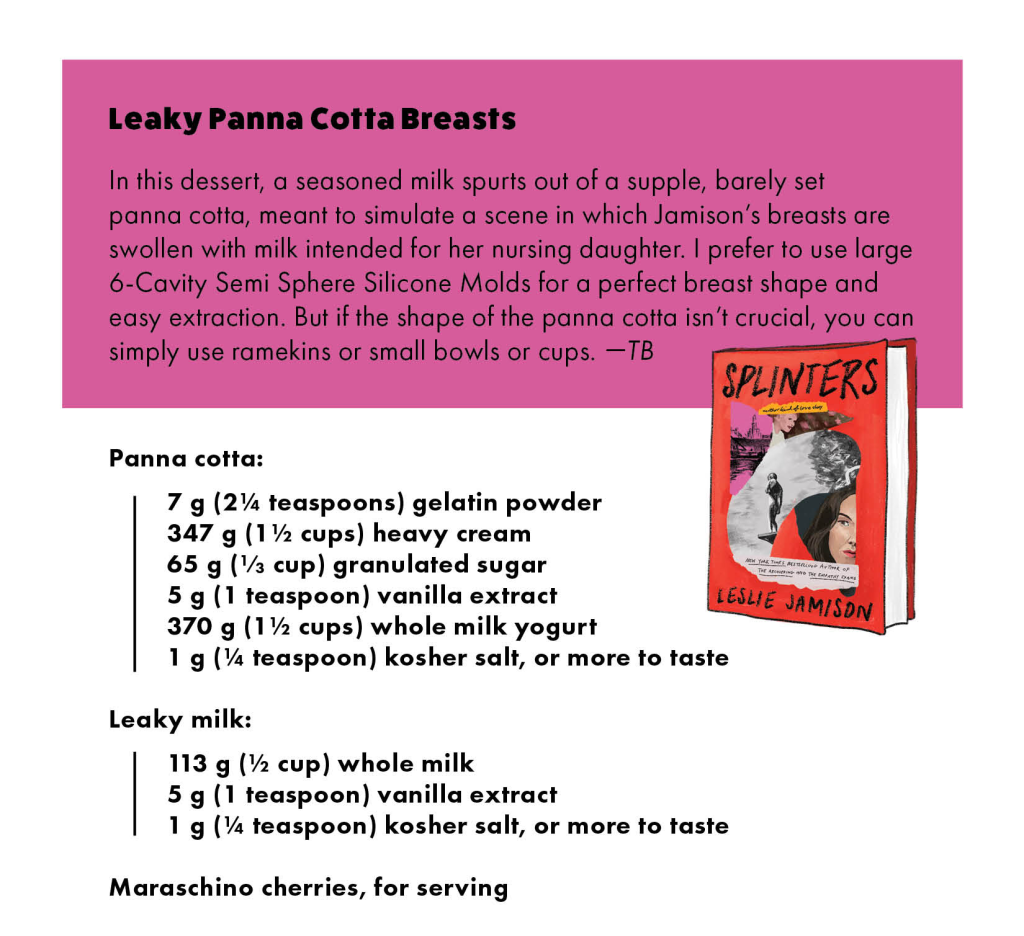
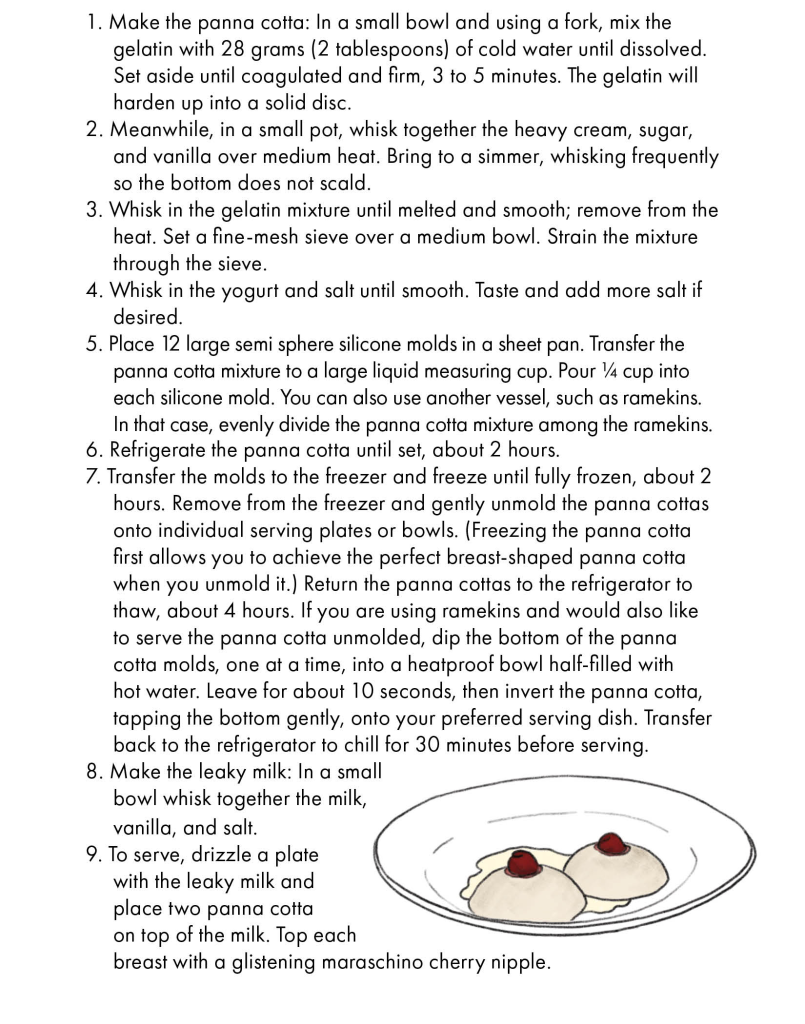
Leaky Panna Cotta Breasts Dessert recipe by Tanya Bush, inspired by Leslie Jamison’s memoirSplinters
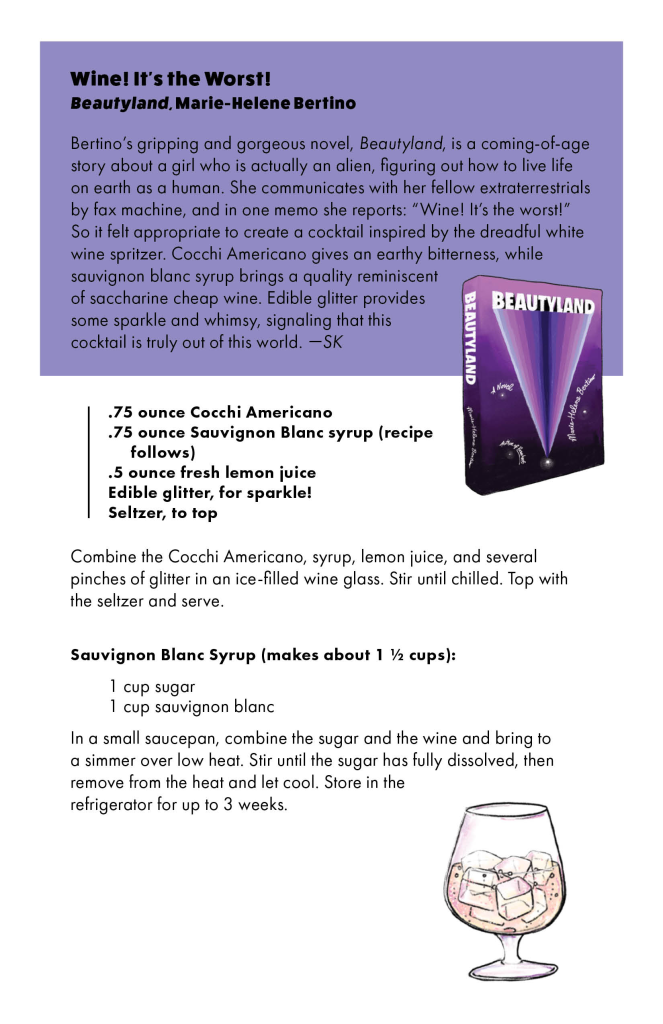
Wine! It’s the Worst! Cocktail recipe by Sammi Katz, inspired by Marie-Helene Bertino’s novel Beautyland
Click to enlarge
DON’T MISS OUT
Sign up for our newsletter to get submission announcements and stay on top of our best work.
YOUR INBOX IS LIT
Enjoy strange, diverting work from The Commuter on Mondays, absorbing fiction from Recommended Reading on Wednesdays, and a roundup of our best work of the week on Fridays. Personalize your subscription preferences here.