Luis Jaramillo on Fictional Witches and Real Ones

Luis Jaramillo’s novel The Witches of El Paso is rich, captivating, propulsive. Jaramillo has created a complex world that asks the reader from the very beginning to open their eyes to magic, to greater possibilities in our lives. Through two alternating timelines, Jaramillo introduces us to present-day Marta, an overworked attorney and mother who has been recently tasked with taking care of her great-aunt Nena in present-day El Paso. When Nena burns a mysterious hole in her kitchen, Marta wonders if it’s finally time to put Nena in a home for the elderly. No, Nena insists. She will never be put in a home again. What is Nena talking about, Marta wonders? It is only through Nena’s storyline, beginning in 1943 El Paso, Texas and traversing borders of time and space to colonial Mexico in 1792, that we learn of Nena’s magical, witchy youth, as well as the people she has left behind. 
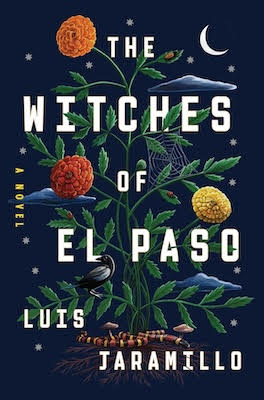
Jaramillo deftly alternates between present-day Marta and past-Nena, weaving a tantalizing story about the permeability of borders—both physical and otherworldly—as well as the force of family, love, land, legacy, and home. 

I corresponded with Jaramillo over the course of a few days about what called him to write about witches, El Paso, family, and the presence of magic-making in our world. 


Crystal Hana Kim: In The Witches of El Paso, Marta and Nena are given the powers of La Vista, which could be described as visions or simply, magic. These women, similarly, could be described in many terms—bruja, curandera, mystic, clarividente, guide—but you chose ‘witch.’ How did this title come to you?  

Luis Jaramillo: “Witch” is a word that provokes a response. When I told people I was writing about witches, I heard many variations on the question, “And these witches aren’t in Salem?” Throughout the novel, characters insist that they are not witches. “Witch” is a term that, until relatively recently, has been placed on women who were healers, midwives, brewers of beer, or even just women living their lives, while those in power used unjust laws to keep them in their places. El Paso, in the popular mind—to be simplistic—is a border city inundated with immigrants, right next door to Juarez, a city torn apart by cartel violence. The title, I hope, sets up some expectations that the book both plays with and subverts. El Paso is actually one of the safest big cities in the US, and though Juarez has issues with violence, the residents of Juarez are proud of where they live, insisting that El Paso is boring, lacking in culture. The Witches of El Paso was a working title that stuck. The book is in fact about witches and El Paso, and I liked having two strong nouns butting up against each other. 

CHK: Tell me about the writing process. Were there different iterations of the story?

LJ: There were so many versions of the story! Too many. When I began to write the book, I was most interested in telling stories about my grandmother and her sisters—I included some of these in the novel, like how my great-aunt Luz wanted to be a gangster’s moll when she was in high school. Even when she was old, Luz kept herself trim, her nails long and red. She wore tight dresses, also red in my memory, and she smoked in a way that looked fun. My grandmother was the eldest, the studious sister, and she seemed to know everyone in El Paso. While trying to figure out the plot, I wrote a deadly dull story about two children of El Paso, a U.S. Congressman and his cousin, a doctor accused of Medicare malpractice. Nothing was working until the character Nena appeared. She wasn’t modeled on anyone in my family, or anyone that I knew, but she arrived fully formed, with a voice and a lot of opinions. She was an old woman who didn’t want to lose her independence. She had a gift, able to see and talk to the dead, and she had a story to tell about what happened to her when she was young. If I ever felt like I was losing the thread, I made myself listen to what Nena had to say. The other main character in the story is Marta, a public interest lawyer and mother, who is facing down middle age. Initially, I had her begin an affair, but as I revised the book, I came to see that the central relationship  is between Marta and Nena. The plot started to make sense to me once I fit them into a kind of love plot—two unalike people who grow closer together, and more truly themselves, as they find connections. 

CHK: I love the way you describe La Vista throughout this book, as both “chaos and nature.” At first, both Marta and Nena thrill at their newfound power, the way it makes their bodies hum with music. They learn though, that La Vista has no moral center. It is power, undiluted. Where did the idea of this book, and its rootedness in magic, come from?

LJ: At first when Nena appeared, I was scared to really go for it with the magic. It seemed unserious, silly even, I guess because of how genre writing is so often seen as less-than. But growing up, books having to do with magic were basically all I read! As an adult, I’ve kept reading books of fantasy, magical realism, and other kinds of speculative works, and more and more I’ve felt that with certain topics realism doesn’t cut it, it’s too limiting, especially when a book is set in a place like El Paso. My dad’s side of the family has been in the region for hundreds of years, and there are old stories from Spain that are still told in the family that feature witches and fantastical creatures. In New Mexico, which shares a state border with El Paso, car license plates bear the motto “Land of Enchantment,” a tourism slogan, but also a phrase that communicates the beauty of the high desert, the harsh physical landscape that is a showcase of extremes. It’s amazing to be in the desert after a rain, when everything blooms at once. With the idea of magic, La Vista, I was also thinking about it as a metaphor for creativity, the force that exists in all of us. Like the creativity of sex and childbirth, but also the creativity of artmaking, especially writing. Anyone who writes knows that you have to be careful what you write about. Writing makes things happen. 

CHK: What is your own relationship with magic?

LJ: I’m a deeply skeptical person, but at the same time, I know that there are things that can’t be easily explained. When I was writing the book, ladybugs kept showing up on the windowsill next to the couch where I write, even though I live on a high floor of an apartment building in a busy part of New York. I did a google search about ladybugs, and on a New Age website I read, “Ladybug’s medicine includes the golden strand that leads to the center of the universe, past lives, spiritual enlightenment, death and rebirth, renewal, regeneration, fearlessness, protection, good luck, wishes being fulfilled, protection.” This seemed a bit much, but I also wanted all of these things for the book and for myself, so the ladybugs went in the book. A few years ago, I started asking other writers the same question you’ve asked me, but in a more pointed way—I wanted to know if any other writers identified as witches. It turned out that quite a few of us take magic very seriously. One poet I know has a Santeria chapel in his basement. A memoirist told me the story of performing a spell that involved freezing a cow tongue. I wanted to write an essay about writers and witchcraft, but I ran into a roadblock: all of the writers who told me their stories said that I couldn’t use their names. The practice of magic is, it turns out, a private thing, and it’s this protective quality around magic that I wanted to write about in the novel. To admit to believing in and performing magic not only opens you up to ridicule or worse, it also interferes with the mystery. As writers, we don’t want to mess with the muses. 

CHK: Going into the plot of the book a bit, you weave between present-day Marta, who is juggling a high-stress court case while beginning to experience visions for the first time, with Nena as she is time-travels from 1943 to 1742, where she learns to harness her powers in a convent and eventually, courts dangers and love. There’s a lot going on! I loved the way the ending ties these two narratives together—the final chapters made me cry. How did you work through the structure of this novel?

LJ: In the drafting, I usually worked on each timeline separately, making sure that the stories made sense without each other, so that when they were woven back together again, they vibrated next to each other, like they were in harmony. Like with any other thing I’ve ever written, I was trying to get to a central image, I don’t mean something visual exactly, but a feeling, a fundamentally indefinable state of being. As I revised, I alternately got farther away from and closer to the image that I wanted to share with the reader. Writing is always an act of translation, turning the language of the heart into English. The translation is never exactly right, which is frustrating, but also the reason I think I write, hunting for the words, sentences, and structures that communicate this image best. 

CHK: You explore borders in many forms, from the tenuous edges of space and time to the man-made border between the United States and Mexico. Altogether, you examine the way we create boundaries in order to tell the stories of ourselves. Do you think about these lines—real and unreal—between us often?

LJ: I think all the time about how we can’t really know anyone else. When we’re reading a book, we feel very close to the characters, and it seems like we can see into their heads. A character has consistently clear motivations and desires. Humans are way messier. That said, even if we can’t know exactly what someone else is thinking, we know that we share the same basic emotions. It’s paradoxical that this similarity is what can also be frightening about other people—it’s hard for us to see everyone else as fully human as we are. You can see how this plays out with something like immigration. People who are afraid of immigrants have to dehumanize them. How bad would it have to be in your life to make you uproot yourself and take a dangerous journey with no guaranteed outcome? To identify with someone else is to admit the possibility that what has happened to them might happen to you. Reading can give us insights into lives we haven’t lived, but I don’t think that reading teaches us empathy, at least not on its own.  I’ve known enough avid readers and gifted writers who are bad people.

CHK: Speaking of bad people, power, too, is a theme you seem very interested in. I’m thinking of this line: “Magic, or the idea of it, is a way for the powerless to imagine they can become powerful,” which is immediately contrasted with: “Marta knows where real power lives in this world, in money and blood.” How did you decide to root these questions of power in the characters of Nena and Marta?  

LJ: I was thinking about big forces in this book, patriarchy, colonialism, and capitalism. Marta, because she’s born two generations after Nena has completely different opportunities open to her. It’s unfair how Nena’s circumstances, and the circumstances of her sisters, limit what they could do with their lives. Marta, because she has more power—she’s a lawyer, she grew up in a different era, she’s studied inequality and injustice—can see these forces in an abstract way. But Nena’s experience is much more visceral. She doesn’t have the language to talk about them, she just knows that there are forces even stronger than the structures created by humans. Nobody escapes death. 

CHK: As a mother of two young children, I was drawn to your depictions of motherhood, especially the way you contrast the mundanity of parenting with the fear and love and incomprehensibility of legacy. Tell me about what family means to you.

LJ: I don’t have kids of my own, but I have nieces and nephews and godchildren, and I love being around kids. I remember being little, and being condescended to by adults, asked how old I was, what grade I was in, those dumb questions. Too often, in books and movies, children are depicted as cuteness-robots or monsters, with not much in between. But kids are just people, and, as you put it, there’s a lot of mundanity in parenting, just like there is at the office, or at school, or any other place where you have to be with other people for extended periods of time. But yes, I was thinking a lot about legacy and inheritance, where things come from and where they go. I’ve been lucky to have met a handful of babies the day they were born, and it’s incredible how there’s something there right away that is already them, and that as they grow up, that thing persists. What is that thing? What happens to it when we die? To get back to your question, one thing that I think about with family is that they are the people who have been the eyewitnesses to our lives, with all that implies. We know eyewitnesses are notoriously inaccurate in their recollections. But our families are the best we have. I always have an ear out for family stories. 

CHK: El Paso is itself a character in the novel. From El Paso’s proximity to Juarez right across the border, to the history of colonialization and conquest of the land, to current-day deportations, I felt the ways in which these characters were made by this rich, complicated history. What drew you to set your novel in El Paso, Texas?

LJ: My dad grew up in El Paso. I lived there when I was in first grade, and every year growing up, we visited in the summer and during holidays from California. In El Paso, everyone seemed to be some sort of a cousin, related through blood, marriage, or friendship. It was exciting to be in a place surrounded by extended family, and I always wondered what it would have been like if we had stayed there. I have such strong memories of the place, of playing in the sand dunes, of the food, of the incredible heat of the summer, of the luminarias set on the granite walls at Christmastime. I remember the market in Juarez, and the huge tower of the ASARCO smelter. When I was a kid, the newspaper ran a daily graphic on the front page that showed how many days had passed without rain, sometimes many months. When I was visiting El Paso on research trips, I was shocked by how much I’d retained from my childhood. I also learned so much about the place that I never knew, way too much to include in the novel. One detail that I just had to squeeze in is that Fort Bliss, the big Army base in El Paso, is about the size of Rhode Island. The base extends from the outskirts of town to the White Sands Missile Range in New Mexico. White Sands is three times bigger than Rhode Island. There was something about this vastness that I wanted to capture in the novel.   

CHK: Who were your literary inspirations for this novel?

LJ: I was for sure thinking about all of the YA fantasy and speculative fiction books I’ve read. I loved how Madeleine L’Engle had such strong characters, how she wrote about morality on a cosmic scale. In college, I took a class on Middle English that really affected my idea of storytelling. Sir Orfeo is a poem, a Breton lai to be exact, that retells the story of Orfeo and Eurydice, setting the events in England, where Orfeo is the king. His wife is abducted by a fairy king—the fairies are terrifying creatures—and after many trials, Orfeo is able to rescue her. Nena’s story is that of someone being taken away from home, returning with something fundamental changed about them. For Marta’s story, I was thinking about middle age and motherhood, and wishing I could be half the writer that Deborah Levy is. I was very far along in my process when I got to Lauren Groff’s Matrix about nuns in a medieval abbey, but boy do I love that book. I also read Ingrid Rojas Contreras’s memoir The Man Who Could Move Clouds after I turned in the book, but I saw in it so many of the Latin American authors who made me who I am as a writer, like Roberto Bolaño, Isabel Allende, and Jorge Luis Borges. 
I’ll Never Know the Whole Story of Papi’s Death

An excerpt from Mother Archive by Erika Morillo

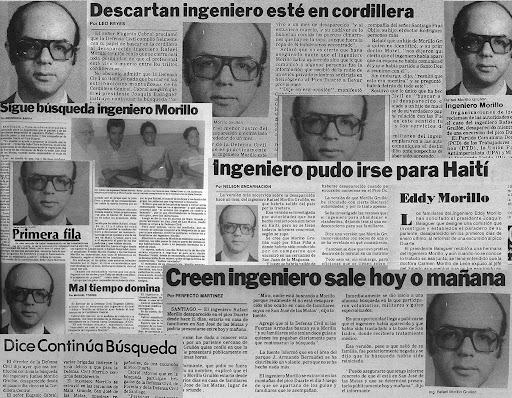
When Papi “disappeared,” my paternal grandfather paid Balaguer a visit to the presidential palace. He was allowed in only because as young boys, they had gone to school together in the city of Navarrete, the memories of those days softening the president into hearing Abuelo out.

“Señor Presidente, I came to ask for my son’s body. Please, I promise not to retaliate. I just want to see him and say goodbye.” I imagine their eyes watering as they spoke, their glasses a temporal wall concealing their distrust of each other. I picture them as boys, bright beyond the confines of their island, eating mangos on the side of the road, the trails of juice drying on their arms as they watch the cars speed by on the big road that leads to the sea in Puerto Plata. Two boys who would end up on opposite sides of their island’s history.

That day, Abuelo walked out of the palace without answers but with a promise of a thorough investigation into the disappearance, a promise both men knew was a lie.


Growing up without pictures of Papi fast-tracked my forgetting. You gave away all the slides of photos he took—mostly documenting our family’s celebrations and his trips out in nature—to el limpiabotas, the young boy who came to shine our leather shoes once a month in front of our home in Santiago. On the sidewalk, single file, our school shoes and several pairs of your pointed-toe pumps, next to a cardboard box filled with physical evidence of Papi’s sensibility. It eluded me why you felt that his photos outside our home, in the trash or in the hands of strangers, seemed more harmless than tucked away in a closet. Meanwhile, inside our home, large portraits of you hung on the walls, akin to those grandiose photos of communist leaders. The same size of the oil paintings of himself Trujillo forced el pueblo to buy and hang in their homes, captioned at the bottom in white letters: En esta casa, Trujillo es el jefe.

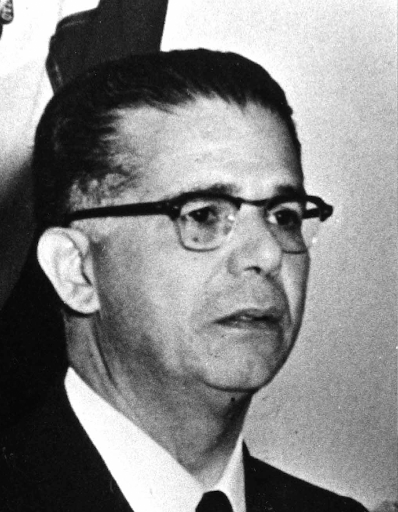
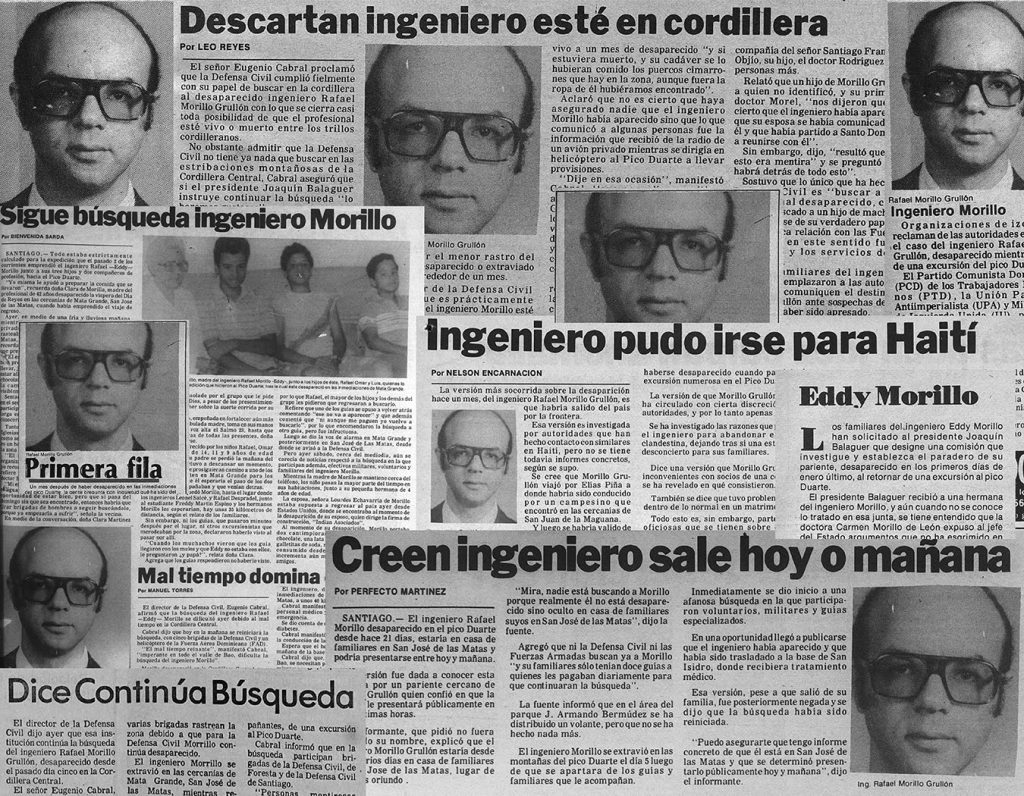
The absence of Papi’s image as I grew up made the five years we spent together vanish into a single memory: him watching TV late at night on the plaid reclining chair in his bedroom. The inky hues of this recollection show me sitting on his lap, holding a pink-and-white plastic toy iron, trying to plug the small suction cup at the end of the curly cord into the flat part of his bald head. As a child, I explained his disappearance to people with a rehearsed mantra: Papi es el ingeniero que se perdió en el Pico Duarte. I also memorized his achievements, collected from my relatives whom I pestered with my relentless questions. For example, I learned that he was a brilliant engineer who helped build the first cable cars in the Dominican Republic that traveled above the lush treetops in the coastal city of Puerto Plata. These were the facts I knew to be true, until the seventh grade when a boy in my social studies class asked out loud if my father was the man killed by Balaguer’s government in the Pico Duarte, setting off the first bout of anger I would direct toward you for concealing the truth from me.


Fig. 9 Morillo_.jpg, Courtesy of the Archivo General de la Nación (AGD).

Fig. 10 Morillo.jpg, © Erika Morillo

Abuelo spent all his adult life until his death in San José de las Matas, a small verdant city southwest of Santiago, where he was the town’s only doctor. When he studied medicine in la UASD in 1930, only a handful of Dominicans had graduated college on the island. The only medical textbooks available en la isla were written in French, meaning Abuelo had to learn a whole new language before he could study medicine. This persistence in obtaining an education against the odds was something he instilled in and also admired in Papi, an engineer, a college teacher, and his only son.

As a child, I explained his disappearance to people with a rehearsed mantra.

If you visit San José de las Matas today, you can find a bust of Abuelo in one of the city’s plazas, his face immortalized in white plaster with his name engraved below it: Dr. Rafael Morillo Burgos. Everyone remembers him for being the doctor who never took a penny from any of his patients. His medical practice was entirely pro bono, and the bust sits as a testament to the town’s gratitude. But the smaller, seemingly insignificant things Abuelo is remembered for are the ones I hold most tender. One of them was the projectile force and quickness of his injections, followed by the swift swipe of a cotton ball doused in alcohol. One second and no warning. Old school. Another was his disheveled appearance and the perpetually open zipper on his pants, probably due to the garments being ancient—Abuelo vehemently refused to spend money on things he considered frivolous. When his patients pointed out that his fly was open, he would pretend to be mad and reprimand them for looking at his crotch, chuckling to himself as they apologized for the intrusion.

But the one thing I hold closest, the one aspect that is evidenced in my body, is Abuelo’s dark skin—which I inherited only mildly due to your whiteness. The cinnamon of his skin was given to us by his mother, Teolinda, who was Haitian. Between your teeth, you mentioned her to me only once, almost inaudibly, like a shush. Yet, I want you to know that my great-grandmother is permanently lodged in the single curl at the nape of my neck, in the concave space behind my ears. You never informed me of my darkness unless it was a reprimand. “Saliste morena a los Morillo,” you would say, not milky white like the Echavarrías from your side.

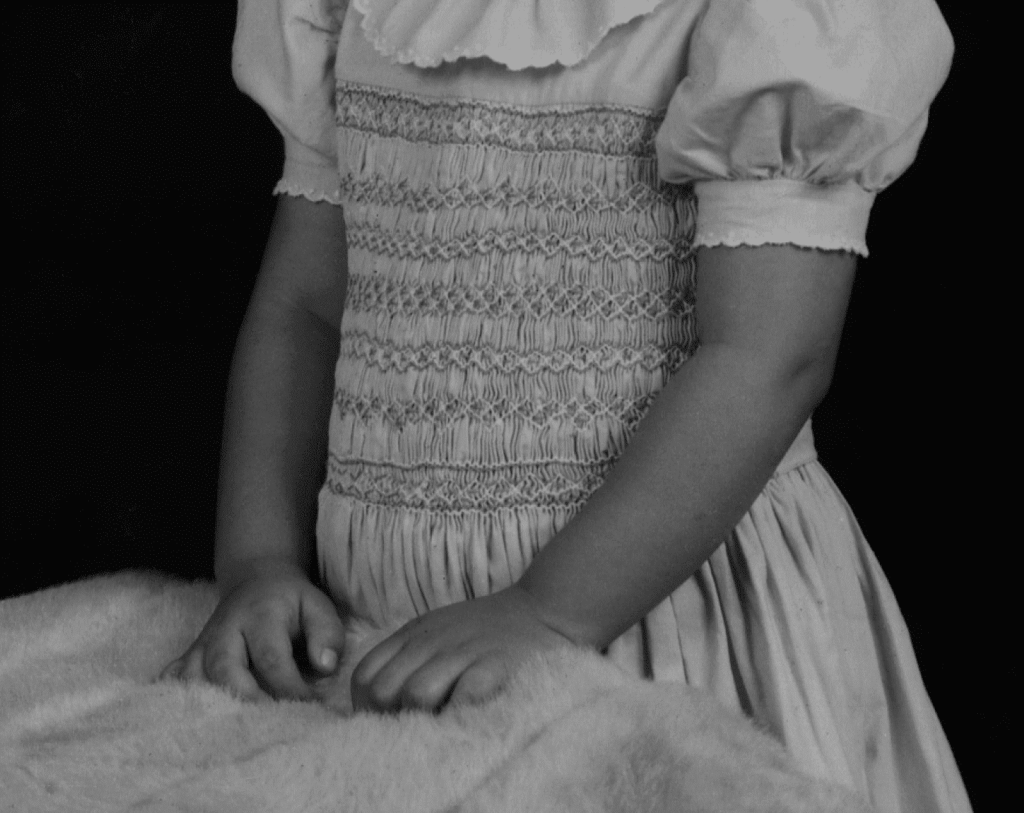
As soon as I turned two and my hair began growing into tighter curls, you started diligently swiping these traces of blackness out of me. My short brown curls in that photograph on my second birthday were straightened with bottles of coconut oil you got from the countryside and the scorching heat of the blow-dryer. In the surviving pictures of my childhood, I sport buzz cuts until the age of five, your answer for getting rid of el pelo malo to make room for el pelo bueno. In one of these photographs, a studio portrait of me, I’m wearing a blue linen dress you made after studying royal children in magazines from Spain. My hair is shiny with oil and heated into a perfect bowl cut, the crown you concocted for me. The girl in this photograph, your vision of beauty.

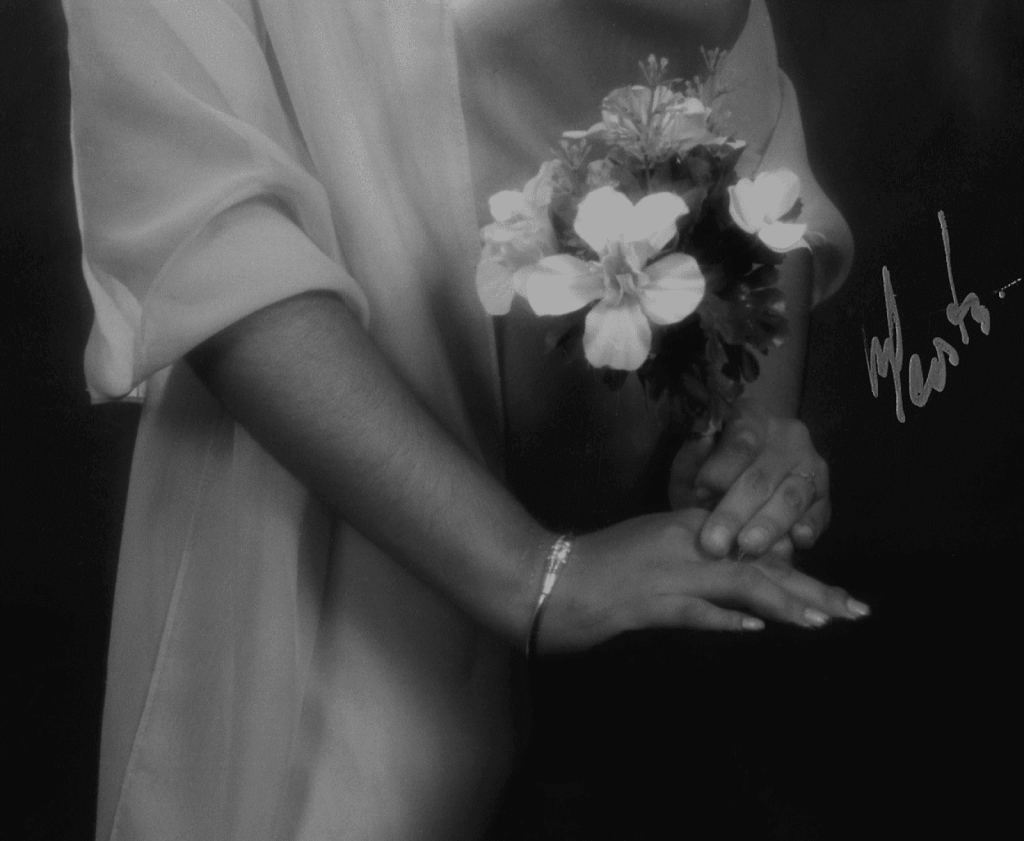
Later on, when I turned fifteen, you took me to the salón and gifted me your same peroxide-blonde highlights as a birthday present and arranged a studio portrait session at the mall in Santo Domingo. I had asked for a party for mis quince, but you gave me the portrait session with you instead. In the photos, I am wearing a champagne-colored dress that you chose for me. You asked the hairstylist to fashion my hair after yours, a stiff updo parted to the side and sticky with hairspray. The photographer gave me a bouquet of white plastic flowers to hold while you held me against the marbled blue studio background. We, an artifice from head to toe.

I know you did this lovingly, that making me look like you was your way of protecting me. How, en la isla, the vision of progress and sense of worth parents give to their children is often linked to identifying our

Fig. 11 Morillo.jpg, © Erika Morillo

Fig. 12 Morillo.jpg, © Erika Morillo

white bloodlines, looking for nuestros ancestros españoles in our last names, in our skin, in the shape of our nose. But I’d like to remind you, lovingly, that beyond the fading sensations of my bleached and burned scalp, I am still Teolinda’s great-granddaughter. Still black behind my ears. Still negra.


The one thing I hold closest, the one aspect that is evidenced in my body, is Abuelo’s dark skin.

Abuelo had been watering a bed of pink flowers in front of his home in San José de las Matas when a stranger approached him. It had been five years since his meeting with Balaguer, since Papi’s disappearance. Abuelo folded the green hose over itself to stop the water from leaking, giving the man his undivided attention. A retired military man, he had come to speak to Abuelo about what happened to Papi that January day in 1988 in the Pico Duarte. Cancer had taken over the man’s health, but what he kept quiet seemed to be killing him faster.

In the version we’ve known our whole lives of Papi’s last moments, he was hiking to the summit of the mountain with my brothers and a group of his friends when he felt lightheaded and decided to stay behind and rest for a moment. That was the last time anyone in my family ever saw him. But in the version the man told Abuelo, Papi woke up from his nap disoriented and took another route to the summit. On this detour, he encountered something he shouldn’t have seen, something being performed by military men in the mountains. His Minolta camera strapped across his chest—landscape photography was a favorite pastime of his—gave the wrongful impression that he was there to gather evidence. They hit him with the butt of a gun, only once at first, then repeatedly to get him to confess to things he had no knowledge of. They transported him, bruised and unconscious, to the military base of San Isidro, and when he died from his injuries a few days later, they tucked his body in a barrel and threw it into the sea. The man, who had been stationed at San Isidro at the time, had seen everything firsthand except what happened in the mountains, information the rest of the brigade kept from him. From inside Abuelo’s house, our family watched the two men speak their soundless words from the distance, from one dying man to another.


A few days before Abuelo died, he called me to his bedside and handed me a clear bag filled with coins. The air trapped under its tight knot shaped the bag like a balloon, like the temporary homes fish inhabit on their way out of the pet store. His throat cancer impeded him from speaking clearly, so I put my ear over his warm breath and heard him whisper, “Erika, I dreamt you were in danger and needed to make a phone call but didn’t have any coins to use the telephone. I want to give you these coins, to make sure you’ll always be able to get help.” The room was warm, and the small white table fan carried the cinnamon of his skin to my nostrils. He quickly fell asleep. His hands, dark and fragile over mine. The bag of coins, now so heavy on my lap.


Fig. 13 Morillo.jpg, Courtesy of the Archivo General de la Nación (AGD).

What Papi saw still remains a mystery. Eyes closed, I try to imagine what he saw in those mountains that cost him his life, but no images come to mind. Only a gaping black void. An empty space that now as an adult, I fill with everything I fear. With the light brown mole on my nose that I obsessively check to see if it’s cancerous; with the thought of Amaru going to college and keeping in touch only seldomly like American kids do when they leave home; with the ceiling lights in my kitchen that, despite the extensive electrical work that has been performed, still keep flickering.

Sound itself can be a form of violence, but silence can be the most violent of all.

I make sense of his void by imagining him. The clothes he was wearing when he was last seen: blue jeans, walking sneakers, a red polo shirt. On his wrist, a Bulova watch with black leather straps, with his birth date engraved on the round golden caseback, a gift from Tía M in Nueva York. I imagine the shades of rust that metal collects when submerged in seawater. Concrete is heavy, but the round watch is light and levitates away from the skin, and what will later become tendrils of moss starts out as tiny bubbles filling the space between his skin and the levitating watch. A floating circle resting on smaller ones, the geometry of my pain. I imagine the possibilities that can happen in the span of the two seconds it takes to hit someone with the butt of a gun and leave him unconscious. In the span of un golpe seco.

Two seconds. I replace the blow with the sound of Papi’s sneeze, with a sprinkling of sugar over my grapefruit, his way of getting me to eat it. Two seconds. Fat drops of tropical rain filling my inflatable plastic pool in our backyard, the clean slash of his machete cutting through coconut husk before turning it upside down to fill my glass, white speckles of coconut meat floating in the cloudy water.

Sound itself can be a form of violence, but silence can be the most violent of all. A void that continues to kill after death. I now think of my chanting for Balaguer during those days of campaigning as your strange legacy of silence, how the women in our family have been either silent or silenced. En la isla, a man’s mouth still the main instrument to inform, to legitimize, to kill.


From Mother Archive by Erika Morillo. Copyright © 2024 by Erika Morillo. All rights reserved. Published with permission of University of Iowa Press. 

8 Graphic Novels About Relationship Shifts Between Parents and Children

After my mum died, I decided I had to do something with her paintings. She’d painted as a hobby throughout her life, and they’d accumulated in drawers all over the house. I felt that if I didn’t do something with them, who else would? I imagined they’d eventually become my kids’ problem and they’d get quietly disposed of when they no longer had room to store them.

The thing about the paintings that I particularly loved was the stories they reminded me of. The way they were a backdrop to my childhood. I decided to write a graphic novel, using the paintings to illustrate moments from my family’s life. Putting the paintings into context in this way felt more real than exhibiting them in a gallery.

Sorting through the paintings helped me see how my relationship with her had changed over the years. How, despite leaving home and having my own children, I’d always felt partly like a child around her. How, when her health declined and she became less mobile, my sister and I had to take on a more caring role. 

This changing relationship with our parents as we, and they, age is familiar to many of us, and is a theme that occurs in lots of writing. I’ve chose to look specifically at comics and graphic novels as that’s the area I work in. All the examples below are written and drawn by a single creator, unlike the more well known superhero comics where a team of writers and illustrators may work on a single issue. The visual language of comics allows artists to present ideas, and communicate their message, in unique ways, differently to how a writer presents a work of prose or poetry. 

Eve by Una

Eve is a dystopian, fictional graphic novel set in an imaginary town in the north of England. It is a political book which raises questions about the polarization between the left and right, and how we respond to the climate emergency. The book discusses what it is to be a daughter and a mother, and how these roles change throughout life. Una also writes about how society views these roles and the problems that arise when confined to these expectations.

Fun Home and Are You My Mother? by Alison Bechdel

Alison Bechdel deals with her relationships with her parents in two autobiographical graphic novels—Fun Home focuses on her relationship with her father, and Are You My Mother? focuses on her relationship with her mother. The books work together as companion pieces, through which Bechdel explores her own sexual orientation and gender identity. The narrative structure of both books is non-linear—events are recalled in a similar way to how memories work – jumbled chronologically, connected by themes and ideas. As Bechdel’s parents age (and her father dies), she tries to come to terms with the effect they’ve had on her life—how her father’s closeted homosexuality, and her mother’s lack of affection left a psychological mark on her life. Bechdel discusses her relationship with her parents, particularly through adulthood, in an unflinching, honest way.

Where? by Simon Moreton

Where? started out as a series of zines combining prose, poetry, comics, illustrations, and photos. It was later collected into a book. Moreton began making Where? after his father passed away. The narrative threads that run throughout the work relate to his memories of his father and the landscape where his family lived in the 1980s and 1990s. Moreton writes about the relationships in his family and how these change over time, through childhood and into adulthood. He discusses his father’s cancer diagnosis and death in 2017, and the grief that the family experienced afterwards. Where? is a beautifully created tribute, told with love and compassion. It connects emotion to place.

Can’t We Talk About Something More Pleasant? by Roz Chast

Roz Chast is a New Yorker cartoonist, and this book is told using her familiar short strips and single page illustrations. These short anecdotes build up to create a picture of Chast’s relationship with her aging parents, and their relationship with each other—George, the father is anxious, and Elizabeth, the mother, is overbearing. Chast documents her parents’ decline in health and death, showing how she, as their child, takes on a more parental role in caring for them. She is honest in explaining the frustrations this entails. The comics are told with a sense of humor, which highlights the love the family shared despite the difficulties experienced during old age.

Mom’s Cancer by Brian Fies

This graphic novel, which began as a webcomic, documents the course of Brian Fies’ mother’s lung cancer. He shares his struggles with his mother’s treatment and the effects the experience has on him and his sisters. Fies intended the comics to be a way of sharing information and insights into the practical and emotional effects that serious illness can have on patients and their families. He talks honestly and with humanity about the pain and fear the family felt.

In by Will McPhail

In tells the story of a young man struggling to find his place in the world. Someone who has grown up and created a life and career for themselves, but still struggling to get to grips with adulthood. He is troubled by his mother’s illness, but not sure how to relate to her, trapped in his own ennui. When she passes away, he expresses regret that he didn’t get to know her better. A lot of the storytelling is done visually, relying on the artwork to communicate ideas with no text, mixing neat, black and white drawing with bold, colorful, surreal watercolors. This contrast in media is used to show the main character’s feelings of loneliness and isolation.

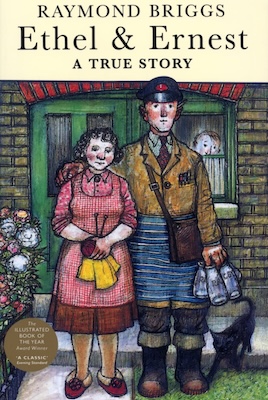
Ethel and Ernest by Raymond Briggs

Ethel and Ernest is subtitled “A True Story,” and depicts the lives of Raymond Briggs’ parents from their meeting until their passing. Their story is played out against a backdrop of a turbulent time in history—the second world war, the moon landing, the atomic bomb. Ethel and Ernest, however, live a quiet, working-class life—their ordinariness is celebrated through the dialogue and detail in the drawing. Although the narrative focuses less on Briggs’ relationship with his parents, the tenderness with which he tells their story is deeply moving, and the reason why the book has become a classic British graphic novel.

Fear of Mum Death and the Shadow Men by Wallis Eates

Fear of Mum Death and the Shadow Men is part of Wallis Eates’ Mumoirs project—a graphic memoir about growing up a single child to an unmarried mother in the 1980s. The book is made up of short stories about her memories of that time along with reflections from the present day explaining how the events in the comics have affected her later in life. The comics also contain annotations in red pen with further reflections as though Eates has revisited the stories at a later date. Eates is unflinching about her mothers’ mental health struggles and explains how her behaviour affected her own mental health. There is a mixture of art styles throughout the book along with the inclusion of childhood photographs. This gives the book a feeling of a child’s scrapbook or diary which complements the highly personal writing.

The Beauty and Audacity of Black Detroit

Detroit Public Library, Burton Historical Collection

Major flooding occurred in the lower levels of the Detroit Public Library–Main Library, during the torrential rain storm on June 25, 2021. Every room and area of the lower levels were impacted by the relentless downpour. —Detroit Free Press

The sky broke that summer
salt-swept the city, collapsed
the freeways' movement.
Some say they were cursed

anyway, those man-made roads
that crashed straight through
the parts of town
built by Black migrants.

This is not a poem about the freeways,
or the way the city emptied
when we arrived,
but if those roads filled like a pitcher,

we should have known
what would become
of the basements,
even Burton, monument

that it is. Was.
Photocopied maps.
Obituaries.
Property deeds.

Records of whole families
floating in a pool
of their own waste.

Black Out, August 2003, Detroit

It was one of the biggest power outages that the US ever saw. At first, people were worried it was an act of terrorism, but when the blackout was confirmed as merely a power outage, the mood shifted. —Michigan Radio Newsroom

The grills turn up. Somebody speakers
serenade all our porches, and we jam,
smoke-soaked and lawless, all open
hormones and this powerless field.
What is it about the end of the world,
makes you think you are owed
an explanation? From God. From
your mama. From the boy who ghosted
months ago, when the air became
more steam than breeze, his number
still memorized and half-dialed each evening.
You would chase him down, make him answer
to you while the streetlights are silent,
but this block, this city, don’t know
how to tell us apart in the daylight—
done swallowed whole bodies before
this night, ripe for disappearing.
First, the “man” of the house next door
swept clean off his mama’s porch.
Maria, a dandelion blown away
from the passenger seat of her new man's
custom Cutlass. My city give a fuck
about the proper order of things. She love
a malfunction. All them downed
wires. Mirrors broken in the street.
Our minivan, sat on stolen bricks
by thieves kind enough to leave the metal
skeleton stripped in the driveway. This block
hormone swoll, smelling herself. There is
no law. Sometimes, in May, it snows.

8 Books That Go Behind the Scenes of Publishing

Do you scrutinize the acknowledgements pages of the books you love? Do you peer between the lines to build a story in your mind of how those books were made? We’ve demolished the myth of the lone romantic genius madly scribbling in a garret until he is discovered and published to startling acclaim, but a new understanding hasn’t fully taken its place. Writers are often loath to talk about money and slow to credit the role of institutions in their artistic career.

Enter the editors. To get a full sense of how very social the act of publishing is, we need to look at the work of the editors who acquire manuscripts and sculpt them into their final shape. We might define an editor as a superb reader who has discovered a way to supercharge her reading, to make it useful in the service of the work. When I was researching my biography of Katharine S. White, the invisible hand behind The New Yorker from its founding in 1925 to her retirement in 1961, I was astonished to see how much else she did for her writers. She advanced money to Vladimir Nabokov before he published a single word with her. She introduced Jean Stafford to the man who became her third husband, reporter A.J. Liebling. She talked an alarming number of women writers through their divorces and breakdowns and helped them back to their typewriters. The letters between White and her authors testify, again and again, to one salient truth: the art of writing is truly only possible when you know there is a receptive reader on the other end of line, calling out your best work. How moving this is! Stories of sensitive editing show that reading can be an act of care, and penciling up a manuscript can be generative. 

I once heard a literary biographer anxiously muse that if all our biographies of writers vanished from our shelves, we’d be no poorer, because the revelation of a writer’s life doesn’t truly impact our interpretation of that writer’s work. Maybe, maybe not. But the work of a literary biography is to show how the writing life is possible—thereby making it possible for today’s readers to grow into tomorrow’s writers. Herewith, eight nonfiction books that tell stories of the behind-the-scenes relationships that have resulted in some of our most beloved books and magazines. May the reading of them open doors to future work.

The Lady with the Borzoi: Blanche Knopf, Literary Tastemaker Extraordinaire by Laura Claridge

Women have been editors since the founding of the American republic. Literature is one corner of the cultural landscape where women have been permitted to exercise their authority. Blanche Knopf was not, therefore, the first woman to hold power in a publishing firm, but for a long time her important work was shadowed by her husband and cofounder Alfred. He betrayed an agreement they made before they married by giving the house only his name when they founded it in 1915.

Laura Claridge’s biography gives a well-rounded portrait of Knopf, who was that rare creature: both a bookworm and a bon vivant. She could spot talent and also throw them a glittering dinner party. Even a partial list of authors she brought into print for American readers is jaw-dropping: Langston Hughes and Nella Larsen, Willa Cather and Elizabeth Bowen, Dashiell Hammett and Raymond Chandler, Simone de Beauvoir and Albert Camus. Her marriage to Alfred was acrimonious and her affairs and her adventurous overseas scouting trips turned some people against her, but Claridge recognizes that Knopf’s autonomy is what allowed her to excel at her job. She was a woman out of sync with her time who helped to bring about ours.

The Editor: How Publishing Legend Judith Jones Shaped Culture in America by Sara B. Franklin

Judith Jones was the first woman editor that Blanche Knopf hired, but not until 1957, and only after Jones had notched a significant victory over Knopf by publishing The Diary of Anne Frank with Doubleday. Jones learned how to manage her imperious boss, and though the two never bonded as the only women in the room, Jones was eventually given significant leeway to pursue her own editorial agenda. She worked at Knopf for over fifty years.

Jones understood her femininity in a different way that Knopf. She made an intellectual life out of women’s pursuits. Most famously, she learned to cook during a youthful year abroad in Paris and was therefore the perfect person to help shape Julia Child’s monumental Mastering the Art of French Cooking, a book which launched Child’s career but also Jones’ career as a cookbook editor. She went on to publish books by the finest chefs and food writers: Edna Lewis, Marcella Hazan, Madhur Jaffrey, M.F.K. Fisher, James Beard. Franklin’s sensitive and affectionate book—she knew Jones at the end of her life and cooked with her in Jones’s Upper East Side kitchen and Vermont country house—shows the interplay between an editor’s life and the books she was receptive to. Franklin writes, “Judith’s books embody the cultural tensions of her times, illuminating the friction between women’s private and public lives, and explore both the expectations foisted on them and their desires for themselves.” The Editor perfectly conveys the pleasure, intellectual excitement, and cultural importance of this job. Franklin says that for Jones to spend her life editing “is an act of devotion. Editing is more vocation than job.”

Dear Genius: The Letters of Ursula Nordstrom collected and edited by Leonard S. Marcus

Notice how often the word “genius” crops up in this list. For Ursula Nordstrom, the word applied not to herself but to her authors; she used it in so many of her lively, bolstering letters to the likes of Louise Fitzhugh, Margaret Wise Brown, and E.B. White. Oh how I would love to receive a letter from Nordstrom. Incredibly, she made it a policy never to turn away an unestablished writer or artist who came to her office with their portfolio. She was the definition of fair in her judgment and wildly enthusiastic when the judgment was in favor. 

Nordstrom was director Harper’s Department of Books for Boys and Girls from 1940 to 1973, part of the second generation of women to head children’s book departments at major publishers, but she reinvented the role. Nordstrom cut through the saccharine sentimentalism of her forebears and published, in her own words, “good books for bad children”—books that veered toward the edgy and even transgressive. Think of that chubby little penis in Maurice Sendak’s In the Night Kitchen. “I can assure you that this will be a work of genius. I can assure you that it will turn out well,” she wrote to Sendak when he doubted its inclusion, and then she went to war when librarians began putting a diaper on the boy with white paint.

A “high-strung, voluble, tartly witty woman,” Nordstrom was known as Ursula Maelstrom and Ursa Major, but she was beloved just the same. The daughter of two actors, she created her own persona—a lion who roared, but who also lived quietly with her long-time companion, Mary Griffith—and understood how much writers too needed a persona. This rich and lively collection of letters gives the reader so much delight in the very unchildlike personas behind now-canonical children’s books. Think of Shel Silverstein, who was writing for Playboy when he published The Giving Tree with Nordstrom. Watch as these fallible adults collude on the books that shaped your very childhood.

Furious Hours: Murder, Fraud, and the Last Trial of Harper Lee by Casey Cep

Sure, there’s are grisly murders and an unbelievably corrupt acquittal in this book, the stuff of cinema, but Furious Hours also contains a heartbreaking story about writing, not writing, and editing. 

In 1978, eighteen years after Tay Hohoff, the lone female editor at Lippincott, had published Harper Lee’s To Kill a Mockingbird and nineteen years after helping her friend Truman Capote research In Cold Blood, Lee began researching her own true crime novel, The Reverend, about the Alabama serial killer Reverend Willie Maxwell. She sat on the benches at Maxwell’s trial and spent more than a year researching the case. Cep portrays how Hohoff had gained Lee’s trust by working with her over several years to revise the original manuscript of Mockingbird, turning it into something quite different (as would be seen in 2015 when the original was published as Go Set a Watchman). Hohoff desperately wanted a second book from Lee but also guarded her against writing something commercial merely to capitalize on her fame. Hohoff died in her sleep in 1974, which devastated Lee, and when she began to think of Maxwell’s crime as her next book, she had no one to receive it. With astonishing detail, Cep portrays the not-writing that ensued, the gaping holes in Maxwell’s story that Lee would try to bridge in an unchanging routine of writing in longhand and typing the words up each night, an average of a page a day—a routine that was flooded with alcohol. No editor ever wrote Lee letters about her genius or penciled notes in the margins of her pages. The manuscript never appeared.

Max Perkins: Editor of Genius by A. Scott Berg

If there is a mythology of the editor, it begins here, with Berg’s 1978 portrayal of Scribners editor Maxwell Perkins, improbably turned into a movie starring Colin Firth in 2016. The editor is a nondescript man in plain gray suits who shuns the spotlight, but who works heroically behind the scenes to craft masterpieces out of messy, scribbled pages. Perkins was known as the most influential person in publishing who nobody knew. He wanted to keep it that way; when The New Yorker published a profile of him in 1944, Perkins consulted a lawyer about having it suppressed. It is perhaps because of him that editors ever since have largely defined their jobs as purposefully invisible.

Perkins tailored his approach to each author. To Nancy Hale, he counseled sustained periods of not writing when she had trouble with the blank page. “In fact I would be much more concerned if you did not have to go through periods of despair and anxiety and dissatisfaction,” he wrote to her. “I think the best ones truly do.” To F. Scott Fitzgerald, he gave a sensitive reader response to his first novel, describing his reactions to each part of the manuscript and noting when something wasn’t clear—for instance, his protagonist’s facial features. Fitzgerald marveled, “I myself didn’t know what Gatsby looked like or was engaged in & you felt it.” Fitzgerald repaid his editor’s acumen by introducing him to the reporter Ernest Hemingway. Perkins most famously edited Thomas Wolfe’s graphomania. He met with Wolfe twice a week to cut 90,000 words from Look Homeward, Angel and carved Of Time and the River out of three thousand manuscript pages, a process that Wolfe then wrote about in The Story of a Novel, further mythologizing Perkins. 

Avid Reader by Robert Gottlieb

The late Robert Gottlieb indulged in a bit of self-mythologizing of his long editorial career at Knopf and The New Yorker, and here the editor is not gray and nondescript but a nerdy, quirky genius. There he is, in the photo insert, intensely conversing with Joseph Heller across his messy desk, brandishing a copy of The Power Broker next to a very young Robert Caro, laughing with Toni Morrison at the National Book Awards, leaning over a stack of pages with Bill Clinton at Chappaqua. He gleefully quotes a long passage from a review of The Journals of John Cheever which praises Gottlieb’s heroic editorial scalpel by way of a comparison to Max Perkins.

This fleet, gossipy memoir proves that the author found his métier in publishing—like Blanche Knopf, he was both a book- and a people-person. He chronicles his friendships among fellow staffers as well as his growing stable of authors, though there are gaps. He has little to say of his colleague Judith Jones, for instance, calling her only “a calm and steady presence in the Knopf mix, unassertive except when pushed to the wall.” Nor does he provide much insight into the work of publishing, writing at one point, “I don’t keep track of my editorial interventions.” He does not add anything of substance to the much-chronicled story of his controversial—indeed, heavily protested—assumption of the editorship of The New Yorker after William Shawn retired or was forced out. But there are thumbnail portraits aplenty and lots of behind-the-scenes stories that make vaunted authors into real people. This is an important supplement to more staid accounts of the business of publishing. It was here that I learned, for instance, that Knopf as a literary powerhouse was fueled for decades by the runaway success of Khalil Gibran’s The Prophet, which sold as many as four hundred thousand copies a year without need of advertising, thus subsidizing the highbrow stuff and paying Gottlieb’s salary—which he spent on ballet tickets and an enormous collection of plastic handbags. 

About Town: The New Yorker and the World It Made by Ben Yagoda

The first history of the magazine to be written after its archive was made available to researchers, About Town in an essential read for understanding twentieth-century literary history. The New Yorker has been a different beast in each decade since its birth in 1925 as a scrappy comic weekly. Its ascension as a tastemaker and canon-maker was in no way foretold. Yagoda tells the story of its evolution largely through the personalities of the editors and writers who pushed on the magazine to make it bigger than Harold Ross’s original vision. 

So much of The New Yorker was idiosyncratic and so much of its success was counterintuitive. These pages will tell you why the magazine had no table of contents for decades, no masthead, no photography, and why it ran bylines at the end of essays and stories. As E.B. White wrote, “Commas in the New Yorker fall with the precision of knives in a circus act, outlining the victim,” and here you will discover the theory and practice of its bizarre grammar rules and strict editorial precepts. Yagoda beautifully depicts so many relationships between editors and writers, each one a novel in itself, and he charts the larger events that swung the magazine’s fortunes back and forth, from the drain on talent caused by the siren call of Hollywood, to the success of the “pony edition” of the magazine that was given free to soldiers in WWII, to the criticisms lobbed at the magazine by its writers (forever upset at what they perceived as a New Yorker formula) and by outsiders (Tom Wolfe’s infamous “Tiny Mummies” essay). The first issues of The New Yorker are remarkably similar to the magazine we know and love today, yet so much has happened inside and outside its pages, and this book tells it all. 

Genius in Disguise: Harold Ross of The New Yorker by Thomas Kunkel

Why, exactly, was The New Yorker so unlikely? Its founder, Harold Ross, was a high-school dropout and a former tramp reporter with no money and no credentials. He partnered with Raoul Fleischmann, heir to a yeast fortune, to start a rival to Smart Set, Vanity Fair, and Punch. His idea, which proved to be so accurate it transcended itself, is that a magazine with a hyperlocal focus on Manhattan would have a built-in readership and a built-in advertising base. Go small to go big. Arguably Ross’s biggest talent was assembling around him a staff who could themselves find and acquire and edit talent. Between Ross’s wife, reporter Jane Grant, and a core group of editors and writers including E.B. and Katharine White, James Thurber, and Wolcott Gibbs, plus an impressive group of artists and cartoonists, the tone of The New Yorker was set in place almost immediately. 

Ross was the stuff of legend in his own time for his profane mouth and wild head of hair. “How the hell could a man who looked like a resident of the Ozarks and talked like a saloon brawler set himself up as a pilot of a sophisticated, elegant periodical?” asked the playwright Ben Hecht. Ross was, in the term of sociologists, a “charismatic editor,” a figurehead who represented the organization and drew people to it. He did not acquire pieces of the magazine, but he did read them all with a pencil in hand, and his always fascinated and curious queries have outlived him. “Who he?” he would write if a character had not been properly introduced. “Where is New York?” he wondered, about the exact spot in Manhattan that marked the city in railway timetables. “Were the Nabokovs a one-nutcracker family?” he asked after reading a line about cracking walnuts in front of a fire. Kunkel portrays all the complexities of this man, how he inspired fanatical loyalty among his staff, and how his success arose from his very contradictions. Completists will also thoroughly enjoy Kunkel’s edited collection of Ross’s correspondence, Letters from the Editor, in which Ross’s voice comes through loud and clear and hilarious.

Eric Drooker Illustrates the Art of Survival

It’s been thirty-two years since Eric Drooker published his groundbreaking tale of destitution in the city, Flood! A surreal, wordless graphic novel, Flood! was inspired by the work of woodcut artists Frans Masereel and Lynd Ward, Jungian psychology, and the pitched battles Drooker witnessed in his native East Village between police and the working-class activists who would not be silenced. A 1988 Tompkins Square Park protest in which Drooker took part appears in the final pages of Flood!, where jazz musicians and a powerful barefoot woman face off against club-wielding police on horseback. 

After Flood!, Drooker collaborated with Allen Ginsberg on Illuminated Poems, drew the art for Howl: A Graphic Novel, and published Blood Song, a dreamlike account of a young woman’s journey from a jungle paradise to a dystopian urban world. Throughout his career, Drooker has stayed true to his activist roots. The latest in his long line of political posters, “Ceasefire!”, featuring a Palestinian child shouting for freedom, can be seen in apartment windows and shop doors around the San Francisco Bay Area. And in his thirty-five New Yorker covers, Drooker has tackled issues ranging from gun control to racism to climate change in his signature vivid, kinetic style.  

As Nick Hornby wrote of Blood Song in The New York Times, “You can try stopping to stare at the pictures, but their strength is their simplicity . . . maybe we need lessons in how to read books like this.” 

When I first met Drooker around 2010, at one of the spellbinding slideshows he puts on in the East Bay neighborhood we both call home, I tried to glean such a lesson from the artist himself. After the show I walked up to Drooker, introduced myself, and asked him to clarify an ambiguous plot point in Flood! “An author never tells,” Drooker responded coyly. 

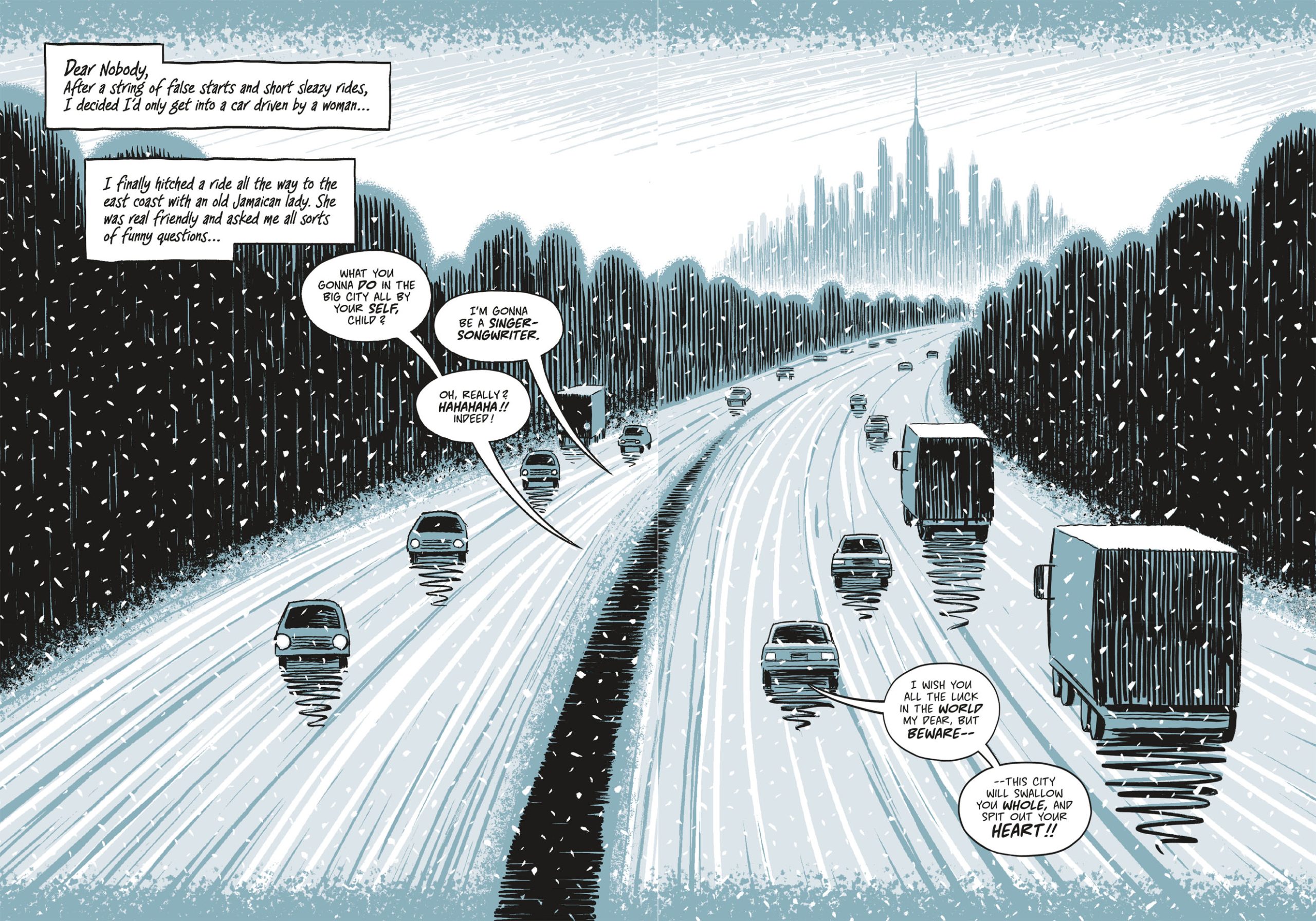
On a recent Saturday afternoon, I thought I’d try again to get a straight answer out of Drooker, this time about his latest graphic novel, Naked City, due out October 9 from Dark Horse Books. Told from the point of view of two wildly different creatives, Naked City follows a young Mexican-Italian singer-songwriter who hitchhikes to the big city searching for an audience and the genuinely-not-creepy male painter who hires her to model for his paintings. A tale of class struggle, artistic ambition, and unlikely friendship, Naked City breaks the mold of Drooker’s earlier work, incorporating dialogue throughout. In the small but airy upstairs office of his home near downtown Berkeley, Drooker was more forthcoming than before, talking about the role of the artist in an era saturated with images, the challenge of leaping into a perspective that’s not one’s own, and why the homeless window washer who calls himself Mr. Nobody is the wisest character in the book. 


Carli Cutchin: The genre of the graphic novel has undergone a transformation since Flood! and even since Blood Song. My kids basically only read graphic novels, and in the adult market, there are now academic studies devoted to the genre. How does it feel to be, well, ahead of your time? 

Eric Drooker: Yes, there are college curricula now studying the history of the graphic novel. In the last ten or fifteen years graphic novels have mushroomed into this legitimate art form. What makes it legitimate in our economy is that they’re selling lots of copies in bookstores. If you can find a brick and mortar bookstore, there’s a whole category for graphic novels. The art form is in a golden age.

My native tongue is pictures.

The term graphic novel wasn’t in circulation when Flood! came out thirty years ago. I would go into a bookstore and the store wouldn’t know where to put Flood! Superficially it looks like a comic book; it’s sequential art, but it’s not exactly a comic book because a comic book is this little floppy pamphlet, and Flood! was dealing with more adult things. Some bookstores would put it with science fiction; I would sometime find it in psychology. Some just put it in with the coffee table art books. Around the millennium, certainly by 2010, the graphic novel had become a category. 

Graphic novels all use pictures in a sequence. Most people use the term a little wrong, they think comics are the co-mixture of words and images, but what about all the examples of comics or graphic novels that use no words, but the book is three hundred pages long? What does that have in common with Peanuts or Superman or Wonder Woman? [The graphic novel] is a sequence of images telling a story, using words or not. 

CC: One of the preoccupations of Naked City is the status of images. The window washer Mr. Nobody laments to the Painter, “People prefer images over reality these days—Symbol over substance . . . But you can’t caress a symbol—You can’t eat money. Images are a dime a dozen in this town!” I thought his statement was interesting, given that your groundbreaking graphic novels Flood! and Blood Song are nothing but image, are completely wordless. In Naked City, you use dialogue to develop relationships between the characters the Painter, the singer-songwriter Izzy, and Mr. Nobody. Does your foray into words betray a loss of faith in the image?  

ED: When I’m in the middle of [creating a book] a lot is unconscious and I’m going along for the ride. My native tongue is pictures. I was drawing a few years before I learned to read and write. [Naked City] gets into the nature of pictures and asks, What’s the point? Our culture is super-saturated with images already—with illusions and things like that. What’s the point of creating any new images? [Pauses.] That’s an open question. 

CC: It’s always interesting when a work critiques its own medium, when it’s asking, What’s the status, what’s the purpose of what we’re doing here?

ED: What are we doing here?

CC: Right! 

ED: I felt like I’d explored to the limit, How much can you tell a story without using words? Another way [Naked City] is a departure is that it’s a comedy, a dark comedy, whereas the other [novels] were so heavy. Since we’re living in such heavy times in the twenty-first century, I wanted to create some comic relief. That part was conscious. Also to have it be more cartoony. There’s enough heaviness in the world and in my life up to now. 

CC: There’s this question of authenticity, too. The character of the Painter explicitly asks, Why am I creating art, what does it mean to make pictures for money? Who am I to be an artist? My question is, did you see yourself in the Painter? 

Survival is elevated to an art form in 21st-century America.

ED: It’s partly autobiographical, I suppose. The Painter resembles a younger, stupider version of myself. I am feeling a bit guilty about taking money for an artistic calling. Many artists go through this. It’s not that we’re doing it for the money. The landlord is demanding money. All the artists I know would be doing it anyway. [But] the art supplies are not free, the rent isn’t free, and the food sure the hell isn’t free. I make as much money from three New Yorker covers as for an entire book, to put it in perspective.

[Take] Mr. Nobody. He’s an artist of survival. Survival is elevated to an art form in twenty-first century America. There’s a whole permanent class of people called the homeless. Growing up in New York in the 1960s and 1970s we didn’t have [a significant] homeless population. I have a vivid memory that the word homelessness abruptly entered the language within months of Ronald Reagan becoming president. With Reagan, everything became deregulated very rapidly, including the real estate industry, which was allowed to raise prices to whatever the market would bear. Until then there were rent protections. [Suddenly] there were dozens of people walking up and down my block who didn’t have a place to stay. 

CC: As you describe it, it’s as if a diaspora happened.

ED: That’s right. Before Reagan, even the poorest people lived five or ten families crammed into one tenement apartment. This concept of living on the street in a cardboard box … we’re asked to accept a permanent underclass known as the homeless, as if they’ve always been with us and they’re always going to be with us. 

[But] the neoliberal era started very abruptly. Bust all the unions, deregulate all the industries, privatize everything, and offshore everything. For people who have been born and raised in [the current] era, there’s the illusion it’s always been this way. 

That’s one of the things this story is about. I wanted to show the cruelty of the economic system but also how absurd and unnecessary the whole thing is, and how comic it is in its absurdity. As we get into the final chapters, a shift takes place. We realize [Mr. Nobody] is the only one who has real perspective on what the function of art is in society. Is it of any value? Who is able to make it work for them? What is the relation of art to beauty, to economics? He says the most beautiful art he heard was down in the subway. He got that from me, I noted that years ago as a young man. The most exquisite music I ever heard was down in the Lexington Avenue train station. Subway musicians are sacred to me. It’s a form of high art. When I least expected it and most needed it, I would go down and hear this incredible music, some of the best musicians in the world since they’re rehearsing for twenty hours a day. When you least expect to hear music, that’s when people need it most. 

CC: There’s an interesting gender element to your work. As in Blood Song, in Naked City your primary protagonist is female, and you’re exploring issues of the female body and female empowerment. Why did you choose a young female protagonist who is—not you? 

This is the gig of any storyteller, it’s a leap of faith, a leap of imagination and a leap of empathy.

ED: In Flood the protagonist was very much like—well, was the artist, you see him at the drawing board and he has a striking resemblance to yours truly. I did that early on. [Telling the story from another perspective] is more of a challenge. This is the gig of any storyteller, it’s a leap of faith, a leap of imagination and a leap of empathy. Can you tell the story through the eyes of another person who’s not like yourself? 

CC: Yeah. Naked City is told from multiple perspectives, so there’s a question of, Do you want all these perspectives to be that of male Jewish artist? That could feel like navel gazing. 

ED: It’s more vivid storytelling if you have a few different characters who contrast. One of the principles of aesthetics is to have vivid contrast, even if it’s abstract art. In this story, I made the decision there would be not one but two protagonists. In [my first two] stories, we’re identifying with these single journeys of these single heroes, if you will. Here, the first person we’re introduced to is Isabel, this wannabe singer-songwriter, who hitchhikes to the big city. Shortly after coming to the big city, she encounters this artist who’s a little bit older, who’s native to the city. This was a device, now that I’m looking back on it, of maximum contrast. 

CC: Who are some of your favorite graphic novelists who have come on the scene in the last ten or fifteen years? 

ED: I have so many favorites now. If I had to boil down which ones influenced me the most—there’s Harvey Kurtzman, the creator of Mad Magazine; before it was a magazine it was a comic book. He’s not a household name but he’s one of the most influential people in our culture. There would be no Stephen Colbert, no Weird Al Yankovic, no Saturday Night Live or The Simpsons, there might not even be a Frank Zappa without that emphasis on satire and parody that Harvey Kurzman was a master of. He in turn influenced a whole generation of underground cartoonists like R. Crumb, who’s a major influence on me, and Kim Deitch, another first-wave underground cartoonist. Right now, there’s people like Dan Clowes. Kate Beaton, a working-class woman from Canada, put out a memoir called Ducks which I think is one of the best graphic [narratives] that anyone’s done yet. Emil Farris is brilliant; she just  put out of her second volume of My Favorite Thing is Monsters. Eleanor Davis wrote The Hard Tomorrow. Brilliant artwork and writing. This is a traditionally male-dominated form, comics, but the most innovative and expansive uses of the form are from women now.  

8 Books from South Africa You Should be Reading

In South Africa, novels have always been written in a society of fundamental divisions, in particular racial ones, and in a country where culture, language, land and other resources are perpetually contested. Most South African literature, especially since the mid-20th century, deals with colonialism and Apartheid and their aftermath, whether directly or indirectly. It was, and is, impossible to ignore the weight of history when it is still so present in people’s lives. Sometimes one may imagine you’re escaping it by setting your novel outside the country. Even then, though, the reprieve is partial and brief.

Because of the multiracial, multilingual and multicultural nature of the country, the idea of a great South African novel, one that would encompass a broad variety of South African experiences, is elusive. The perspective is always specific, always limited. 

For a small, young and relatively isolated literature, South Africa probably punches above its weight in producing interesting writers and good novels. In part, this is because the complexity of the social and political world in which South Africans live has always tended to heighten the intensity of human experience.

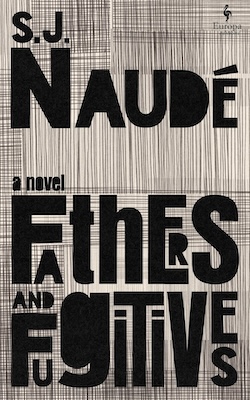
My novel Fathers and Fugitives follows a queer South African journalist living a lonely and drifting life in London. His father’s will compels him to visit a long-lost cousin on the old family farm in the Free State, deep in the South African hinterland. My book is about fatherhood and family, loyalty and betrayal, inheritance and belonging. The fraught history of colonialism and Apartheid forms a barely visible, but inescapable, backdrop. 

Here are 8 books from South Africa: 

This Life by Karel Schoeman

Schoeman, who as a young man was briefly a novice for the Franciscan priesthood in Ireland, was the kind of author who turned his back on the world to write. Both as a novelist and historian, he was enormously productive. In 2017, at the age of 77, he took his own life, leaving behind a manifest of sorts about dying with dignity. 

This Life is a novel about four generations of a white pioneer family in a barren and remote part of South Africa. The book is obsessed with the tough poetry of the landscape. It is narrated by an old woman, now all alone, who, it is suggested, was in love only once, secretly, with her sister-in-law. Now she is trying to finally collect and order her memories. The narrative is cyclical, wrestling with Africa and the place that someone of European descent may or may not have in it. The book may sound bleak, but the quality of the writing transforms it. 

In a Strange Room by Damon Galgut

This book by Galgut, the first South African author since J. M. Coetzee to win the Booker Prize, is an elegant and moving novel in three parts. The protagonist, Damon, remembers three journeys—to Greece, Africa and India. He is, respectively, the Follower, the Lover and the Guardian. For one reason or another, each journey ends in disaster. In an arresting formal innovation, the book alternates between a first and third person narrative (sometimes in a single sentence) to dramatise how close and real memories can be. No matter how far you travel, this book seems to say, you can never escape yourself.

The Book of Happenstance by Ingrid Winterbach

One of South Africa’s most interesting and talented contemporary novelists. In this delicate and hypnotic novel, a lexicographer assists a man working in a museum and who is collecting Afrikaans words that are no longer in use. Her treasured collection of shells are then stolen in a burglary. The subsequent search for her shells becomes intertwined with her work at the museum and the motley crew of people she encounters there, and a general survey of her life and its losses. Behind every loss there is an earlier loss, the narrator at one point muses. Part of what makes this book so moving is precisely the slippery, infinite regression of losses it suggests. It also, consolingly, relativises personal loss against cosmic events.

Agaat by Marlene van Niekerk

A magisterial novel by perhaps the foremost living novelist in Afrikaans. These days, Van Niekerk lives in the Netherlands and has apparently fallen silent, but this book could be the closest anyone has come to producing the Great South African Novel. Narrated by Milla, a white woman who has ALS and is bedridden, the book follows the story of the complex power shifts between her and Agaat, the mixed-race woman who is taking care of her. Milla took Agaat in as an abandoned child. Initially she treated her like her own child, but then she became a maidservant and nanny. Now immobile and increasingly unable to communicate, Milla has to reckon with not only her and Agaat’s own history, but by implication the entire country’s fraught history of the second half of the 20th century.

The Children’s Day by Michiel Heyns

Heyns is a highly accomplished South African novelist and the country’s foremost literary translator. He has written numerous surprisingly different novels, but his debut – a tender, unsentimental coming of age (and coming out) story, set in a small Free State town during the Apartheid years of the 60s – is a good place to start. The reader cannot be left unmoved by Simon, a bright, bookish and sensitive boy finding his way through the intrigues of childhood in the dusty streets of Verkeerdespruit. Heyns’s warm, understated humor adds to the satisfaction.

The Reactive Masande Ntshanga

Ntshanga is one of the most exciting young South African novelists. In this book, his debut, we follow a group of young friends adrift in a Cape Town awash with chemicals (they sniff glue, smoke crystal meth, gulp pain killers and observe the city through fresh eyes). Ntshanga has written two more books since his debut, and it turns out this disorienting and somewhat surreal account of young lives in post-Apartheid Cape Town, with its strange and beautiful twists and turns and arresting descriptions, was indeed a harbinger of good things to come.

Nineveh by Henrietta Rose-Innes

Rose-Innes is one of the very best South African novelists writing in English. Katya Grubbs, Rose-Innes’s protagonist in this novel, is in the business of pest relocation rather than extermination. This brings her to the attention of a property developer whose gated residential development outside Cape Town, Nineveh, has been rendered uninhabitable due to an infestation of strange insects. Katya takes up residence in the empty estate and is gradually drawn deeper into its chaotic urban wilderness, exposing the tensions between the natural and man-made worlds.

Disgrace by J M Coetzee

Disgrace is one of South Africa’s Nobel-prize winning author’s masterpieces. It is also a controversial work that has elicited much debate and discomfort, particularly in South Africa. Published in 1999, not long after democratisation in South Africa, it follows David Lurie, a divorced and middle-aged professor of communication and Romantic Poetry at a Cape Town university. Lurie has created a comfortable, if somewhat detached, life for himself. He teaches his classes and pays a weekly visit to a prostitute. When he seduces one of his students, the consequences however fundamentally disrupt his contentment, forcing him to retreat to his daughter’s smallholding, where an incident of violence and unspeakable terror occurs. This chain of events leaves Lurie humiliated and disgraced.

Douglas Unger Turns Rapacious Greed and Moral Slipperiness into High Literature

Forty years after the publication of Leaving the Land, Pulitzer Prize finalist Douglas Unger returns with his fifth novel, Dream City, an excoriating tale of hope, greed, and betrayal in Las Vegas. C.D. Reinhart is Unger’s fatally flawed protagonist, a failed actor bent on self-improvement who is forced to be the public face of his company when a construction worker dies in a terrible accident. 

Dream City stands out among contemporary novels for tackling the subject of money head on. In his brilliant portrayal, Unger reveals every level of casino economics, from the bottom to the top, and gives the reader a terrifying view of a world where the individual is always playing against the house, and the house is American finance. In doing so, Unger lays bare the role of illusion and greed in our system and proposes that people place risky bets so they can briefly experience the luxury of hope.

Douglas Unger presently teaches writing at the University of Nevada Las Vegas, where he is cofounder (with Richard Wiley) of the Creative Writing MFA. We met Unger decades ago when he taught in Syracuse University’s Creative Writing MFA program. In this conversation, we spoke to him about writing political fiction and how his Las Vegas novel is a cautionary tale about aspirational greed, the casino economy, and “a culture that puts a price tag on everything at the expense of humane values.”


Sorayya Khan & Laura McNeal: You describe your work as political fiction. How have your interests as a novelist developed over time, and are you surprised that your journey as a novelist has taken you from small town life in Leaving the Land and The Turkey Wars, to political strife in Argentina in Voices from Silence and El Yanqui, and now to Las Vegas in Dream City

Douglas Unger: It’s been twenty years since I’ve published a new book, so it’s nice to think there might be continuity with the others. I’m not surprised. I’ve always been drawn to books and plays about social changes and how they affect the characters, to stories written against something. Some reviewers tagged my early fiction as “political” with Leaving the Land, a novel that takes on the death of the family farm and its replacement by a macro-scale system of corporate owned farms (along with everything else). The Argentina novels, especially Voices from Silence, I wrote in deep pain at murderous injustice. I witnessed the rise of a brutal military dictatorship that “disappeared” two of my student-exchange brothers and subjected the surviving family I loved and many friends to horrific abuse. I’m experiencing PTSD right now as I follow the rise of violent fascism in the United States—all seems in place for a dictatorship here. I feel we must prepare, with no little urgency. That’s a future story, one I still hope won’t happen. 

Dream City takes on a system motivated by aspirational greed. The main character measures his self-worth by money, and by how far he climbs a corporate ladder. I hope his destiny set within the metaphor of Las Vegas and the casino economy acts as a kind of cautionary tale for a culture that puts a price tag on everything at the expense of humane values. Also, I mean to write against the usual Las Vegas-mobster story cliché. Dream City shines light on a Wall Street gang. Is it political? I hope so, but more importantly that it might be interesting.

SK & LM: What is Dream City saying about capitalism and morality? Is the novel an indictment of capitalism, or is it a story about a character, Curtis “C.D.” Reinhart, who is a flawed capitalist? Was the income inequality in the book inspired by things you see happening in the US now?

Douglas Unger: For years, I carried a copy of Thomas Piketty’s Capital in the Twenty-first Century on a Kindle and kept re-reading it, mindful also that what economist John Kenneth Galbraith predicted in The New Industrial State has already happened: the line between big business piracy and elected governments has disappeared. Early drafts of Dream City started about midway through what’s now the third major section—C.D. has lost his job and his money, and he’s stuck in the shock of that, like an existential illness. A stuck character examining his life, just thinking, is not the best beginning, so I rewrote the story more chronologically to develop the boom and bust straight into the crash. Las Vegas was one of the most devastated places in the nation by the Great Recession, with highest jobless numbers and foreclosures. The big casino-resorts fell into receivership or hovered at the edge. I know many people financially ruined, who lost jobs and homes, because of what? As books about that era make clear, Andrew Ross Sorkin’s Too Big To Fail, McDonald’s and Robinson’s A Colossal Failure of Common Sense, Michael Lewis’ The Big Short, our economy isn’t capitalism anymore, in the Adam Smith or Milton Friedman sense (whose lectures I attended at the University of Chicago). The economy became a pyramid-like betting scheme fueled by insidious greed of powerful people with large concentrations of wealth, backed by trick-and-trap practices of a banking culture that deceived and exploited hard-working people. With the Roberts’ Supreme Court rulings that trash financial regulations, similar three-card monte games are recycling around again. There’s no free market capitalism left except for a small business sector, farmers’ markets, maybe eBay. The whole system favors monopolies or cartels. C.D. senses this, though he doesn’t quite understand it as it’s happening all around him. He sets out to join a circle of rich and powerful pirates who inhabit his world. That he fails, after modeling himself after the business elite he knows, leaves him baffled, his whole life upended. His solution, I hope, might suggest a remedy: to renew basic human values that matter most—love, family, neighbors helping neighbors, and to leave the money-chasing delirium behind. 

SK & LM: Is Dream City an exposé of the Las Vegas casino business in the way that Upton Sinclair’s The Jungle was an exposé of the 20th-century meat industry? It felt, to us, like a brilliant form of muckraking. 

Douglas Unger: The Las Vegas in Dream City is a metaphor, meant to evoke the business ideologies of the 21st century not only for casino-resorts. In many ways, the casino industry is more honest than most other businesses—odds are against the players, but at least the odds are posted and available to anyone who asks. I’ve simplified and fictionalized some industry complexities. But, yes, Upton Sinclair’s The Jungle, Frank Norris’ The Octopus, Theodore Dreiser’s The Financier and The Titan, and Sinclair Lewis’ Babbitt, are influences. So is John Updike’s third novel in his trilogy of the boomer generation, Rabbit is Rich. Rather than muckraking, I mean one takeaway to suggest a vision similar to Hieronymus Bosch’s allegorical triptych painting, “The Haywain”; or a vivid scene in the baroque Spanish masterpiece novel by Luis Vélez de Guevara, El diablo cojuelo: the parade of Fortune, in which the unlucky or blithely unaware get crushed beneath the wagon wheels.

SK & LM: Tell us about the research that went into creating the scenes that give precise details about construction and finance in Las Vegas. 

Douglas Unger: Research for Dream City relied mainly on talking to people and listening: to casino-resort executives, ironworkers, electricians, teamsters, culinary workers, hotel designers, dealers, salespeople, and front desk clerks. Through my wife, Dr. Carola Raab, a professor in UNLV’s famed College of Hospitality, I frequently joined the “breakfast bunch” of her colleagues who met monthly on a Sunday, all of them experts in finance, marketing, gaming, management, and who had lived and worked in Las Vegas for decades. The book Super Casino, by Pete Earley, is influential; as is John L. Smith’s Sharks in the Desert, along with his columns about local issues, personalities, and books about the casino moguls. Sally Denton’s foundational The Money and The Power is a must-read about the origins of the at times shady business culture in Las Vegas. For theory and insight into what drives the place (and the country), I rely on the late great historian (and friend) Hal Rothman, his Neon Metropolis. Over the many years I’ve spent co-founding and building the Creative Writing International program at UNLV (why I moved to Las Vegas 33 years ago), we’ve depended on donors, and in the early years, on one generous donor especially who worked as a top casino executive. We established a nonprofit institute that funded readings, panels, Ph.D. fellowships, grants for journals and presses, and City of Asylum for dissident writers. All this morphed into the Beverly Rogers, Carol C. Harter Black Mountain Institute that has helped to grow a thriving literary culture in Nevada. The “donor cultivation” experience provided me glimpses into a circle of the Las Vegas wealthy and elite, as did my obsessive work with political campaigns. In my opinion, the best research for a novel, or at least the contemporary realist novel, is to talk to people and listen. Every scene or chapter based in finance, business or construction has its seed in a story told to me.  

Dream City fictionalizes certain figures and personalities, combining and recombining them into characters that are pure inventions. It does the same with some of the casino-resort corporations and their characters, reimagining them with made-up names. I’ve braided these inventions into a narrative alongside easily recognizable histories and tales of iconic casino-resorts and some powerful people drawn from the era of the 1990s through the Great Recession. Also, during the time-period of Dream City, the Las Vegas Sun published a series of exposés on the shocking deaths and safety deficiencies caused by shoddy, negligent practices in the construction industry, for which the newspaper won a Pulitzer Prize for Public Service. Worker safety is an important undercurrent in the larger story. I know ironworkers and members of trade unions who fought those battles. And I spent hour after hour researching statistics and facts: financial reports, gaming, real estate, banking, foreclosures, layoffs, worker safety. I had to simplify and omit so many complexities to make a readable story. I worry about oversimplification, what purists about Las Vegas might think about this. I also worry about too many facts. Advice to writers: do not attempt a novel based on so many facts! You risk getting lost in them! 

SK & LM: We both loved the novel’s reference to King Lear in Part Three: “In college, for a class in Shakespeare’s tragedies, one of C.D.’s assignments had been a close study of King Lear.” C.D. recalls that the class “learned how tragedy can happen in a conceptual space between nothing and never, everything in between becoming some otherworldly playing out of actions already doomed.” This seems like an excellent summing up of the novel and C.D.’s character. His awareness of his impending doom is what makes him pitiable. When did you decide C.D. would be a theater student and a failed actor—from the beginning, or later on? And can you tell us anything about the source of this scene?

Douglas Unger: This interpretation of Shakespeare’s King Lear is my variation on thoughts from the late great poet and dear friend, and teacher, too—my friends have always been my best teachers—Hayden Carruth. His essay “Lear” appears in his collection Suicides and Jazzers. Hayden and I talked about “King Lear” along with many other poems, books, plays, and writers, at his kitchen table or mine in upstate New York and when he visited in Las Vegas. He talked about “Lear” as Shakespeare’s longest poem. How it’s bookended between five repetitions each of the words “nothing” and “never” expresses an existential truth. Writing about the boom and bust Las Vegas economy when it crashed into bankruptcy, this concept summed up for me what had happened. The action moves directly downhill, no stops, from disaster to insanity to catastrophe.

Dream City started with a character, the failed actor, lost to himself, moving from role to role in his life. There’s a whole book of cut chapters about his theater studies, his fledgling career and failures, also what it is to be his type of sexually attractive male to so many women and men, and how he learns, painfully, to be more human. He represents for me how, in contemporary society, most men start out as lost, insecure beings who don’t really know what their social or cultural role should be anymore. They have a natural power, partly a sexual power, but they’re unsure how that power should be used. For some, this insecurity results in a tendency to withdraw and grow quiet, with simmering unhappiness; others act out through aggressive, too often abusive behaviors shunned by society, which is also unhappy, and can get dangerous. Or—as happens with C.D.—there’s a choice to pursue money as a substitute for self-worth, which is, sadly, the  most acceptable male role in American society. 

In his thoughtful book, Enigmas of Identity, scholar and theorist Peter Brooks suggests that a character’s search for identity is the motivating force in literary fiction. He asserts that most of us have at least two identities bound up in the same person: the identity we conceive ourselves to be and project to the world plus another one continually investigating, interrogating, and making unstable our conceived identity. I feel this is probably true. Still, I suspect Brooks’ theory applies better to male characters than female characters in stories. It seems to me that most women, also women characters in literature, are more secure about who they are, or at least they have more resources to draw upon to develop and nurture their identities. Of course, women have more external, difficult obstacles to overcome to self-actualize, all socially inflicted, most often by direct male oppression or by cultures of male hegemony (in addition to the natural pressures of motherhood or the choice or life circumstances not to be mothers). This identity principle feels important to Dream City, because, deservedly or not, the women in his life save C.D. from himself. I hope that rings true. In a larger sense, too, I hope I’ve done justice to the ever-shifting identities of Las Vegas. It’s been too long between books. I’m experiencing a bit of stage fright about this. Twenty years! Still, I’m grateful Dream City is out there now for anyone who might be interested. After so long, that feels so very good.

Exclusive Cover Reveal of “Leave: A Postpartum Account” by Shayne Terry

Electric Literature is pleased to reveal the cover of Leave: A Postpartum Account by Shayne Terry, which will be published by Autofocus Books on February 25, 2025. You can pre-order your copy here.

Shayne Terry’s fourth trimester is not going as planned. Instead of bonding with her new baby, she’s stuck on the couch with a third-degree tear, barely able to walk. When the women in her family show up to help, they come bearing family secrets and old wounds that also need repair. Begun as notes on Terry’s phone documenting a parental leave gone awry, Leave: A Postpartum Account examines a healing process complicated by capitalism, intergenerational trauma, and a healthcare system with a long history of devaluing women. This powerful postpartum account treats birth as a portal, one that can connect us to a lineage of pain, joy, death, and life. And at a time when our bodily autonomy is being stripped away, Leave is an urgent exploration of one woman’s experience recovering from birth in America.


Here is the cover, designed by Amy Wheaton:

Author Shayne Terry: “Early on in this project, I thought I was writing an essay. That essay grew longer and longer until I realized I might be working on a book. This was 2021 and I was spending a lot of time researching obstetric anal sphincter injuries, trying to understand what had happened to me by reading articles in medical journals and watching surgical repair instructional videos on YouTube. I was captivated by the line drawings I encountered in medical textbooks and how much they resembled botanical illustrations. I decided to include my own drawings in the project and imagined them as chapter headings or separating parts of the book. I am not, however, an artist, and I was never satisfied with my drawings, so eventually I abandoned them.

Fast forward to 2023, when I first spoke with Michael Wheaton at Autofocus about the book. Two things he said made me certain that Autofocus was the right home for this very personal story. The first: ‘This is a book that pretends to be about birth, but it’s really about death.’ He got it. The second thing he said was that his wife Amy, who does all the cover illustrations for Autofocus books, had experienced a similar injury. I understood immediately how meaningful it would be to work with Amy on the cover.

I suggested the medical textbook illustration style, and Amy took that direction and knocked it out of the park. I love that the cover gets in your face; this book is not for everyone, and a good cover enables readers to self-select. At the same time, the colors Amy chose serve to soften the body horror, in my opinion, just enough. The cover is subversive, bold yet gentle, and I know it will help the book find its people.”

Designer Amy Wheaton: “Shayne has taken this painful thing that happens to so many women and written about it in a way that makes me feel understood — as I know this work will do for so many others. I loved Shayne’s idea to do a medical drawing or a series of drawings of vaginal tears. I’ve long been interested in that style of illustration, and having torn badly myself during my first son’s birth, I thought it completely necessary to represent the book in this way. I thought about all those who will find community in her words. I wanted to represent her, them, and myself.

I looked through as many photos and medical illustrations as I could find—different degrees of tearing, stitching, episiotomies. I drew a series in-line with the style we’ve developed for Autofocus covers. I thought about Shayne’s experience, I thought of my own experience, the lack of research there is on female health, the treatment women of color experience in contrast. At first, I thought to use different skin tones on the illustrations, but instead opted for colors unnatural to the skin to show the female anatomy the way it is often treated in procedures like these, as a means-to-an-end for birth. I lined them up like numbers, leaving the last spot for sterile instruments, the inverse of the female anatomy.”

The Life of a Muse Is No Life at All

“Sophy” by Alysandra Dutton

1882

A year before she dies, Sophy has a visitor in the hospital. It is the renowned painter John Millais, of the pre-Raphaelite Brotherhood. He brings everything: paint, palettes, linseed oil, stretched canvas already prepped a soft brown, a stand, a jar full of brushes, a jar full of stuff to clean the brushes, palette knives, a change of clothes. Then he offers her a chagrined smile and leaves, these things in a heap, only to come back with more things: clothes for her to wear, a drop cloth for her floor, a crate for her to rest her arm on, should she choose to sit.

Sophy chooses to stand. 

The critics appear as he paints. It has been a long time since Sophy last saw them. The first one hovers at John’s shoulder and squints at Sophy. “So waifish,” he says.

“Absolutely none of the boldness that made her famous,” the second critic adds, materializing behind the first. 

“But that makes this rendition all the more intimate and sad,” the third critic says, having appeared in a corner. “And who better to render the heartbroken tragedy of her life than her brother-in-law?”

The first critic nods. “They always had a connection.”

“Look directly at me, Sophy,” John instructs. “As you did twenty-five years ago.”

He thinks he can hide the emaciation within her clothes, the thinness of her wrists in a dynamic pose. Her face is another story; her nose has suffered the loss of fat, its imperfections more pronounced. At least her lips and chin are the same, as full, as bold, as set in gorgeous disapproval as they were when she was a child. He paints into the night, pausing only to massage cramps out of his wrist. 


1873

The asylum is called Manor Farm House. During the first of Sophy’s admissions, she finds it a tolerable place to live; she plays piano and reads and sometimes takes visitors. James Caird, a well-to-do from her hometown in Perth, Scotland, comes three times. On the third, he asks her to marry him.

“You look splendid,” he says.

She does not. Her thinness has not read delicate since she was a child; now, she is emaciated, and her dress a decade out of fashion.

He never understood her fame, James tells her. He’s met a few of the pre-Raphaelites and found them to be jumped-up, sex-crazed, pompous windbags. James Caird prefers science. He wants to fund an expedition to Antarctica. He thinks Sophy’s family cares too much about what people think of their daughters, and that all Sophy needs to cure her hysteria is fresh air and sunshine. 

“And about your family,” James says. “You need solitude to recover your resilience. Once we are married, I don’t want you seeing them so much, especially that John.”

With this addendum, Sophy accepts on the spot.

Before their wedding, her sister Effie stands behind her at the vanity and pins Sophy’s hair. “Do you remember when you came to stay with me in London? I would tell Ruskin that I had to brush your hair just to have an excuse to get away from him.” Effie picks up limp sections of Sophy’s hair from her shoulders and lets them fall. “I was so jealous of it. But look how thin it is now.”

The first critic is there. He mutters to itself. “The hair,” he says. “Surely the crowning of Sophy’s sensuousness was her hair unbound. Millais’ portraits of Sophy’s other sisters always had their hair pinned and netted.”

Effie puts their faces together in the mirror. Her hair has begun to gray, her cheeks begun to line. Sophy, though a decade younger, has long since gone this way. Her hair is brittle and comes out in pieces.

“You can stay with me and John instead,” Effie says. “You must know that after all this time, we forgive you. No one even talks about it anymore. You needn’t be afraid to come back to society.”

The wedding is sedate and quiet, accompanied by hushed voices of people scared that a sudden sound might shatter the careful peace between Sophy’s parents, weeping with disapproval, and the bride, whose face hurts from smiling. When the ceremony is finished, she boards a sleeper train with her husband, James Caird. Only that night, in the cabin, does her mistake become obvious: as he enters her, James Caird says into her ear, “I saw ‘Portrait of a Young Lady‘ in a gallery ten years ago, and wanted you every day since.”

The three critics, crowded at the window of the compartment, smirk at this. The second points out, “A man of science is nearly always a man of art. You cannot separate the two.” But it is too late for Sophy to do anything else but endure, and bleed a little on the sheets, as she loses a long speculated-over virginity.


1869

The eve of her that first institutionalizing, Sophy plays the family piano in Bowerswell House for hours. Her mother cries. “It’s so beautiful,” she says to Sophy’s father. “Why can’t she speak to us like she speaks to those keys?”

Sophy is a woman of twenty-six, but still thin like a girl, with the same jutting collarbone and delicate wrists as when she sat for her most famous portrait. In the morning, John Millais arrives to escort her to the Manor Farm House. It is the least he can do, he assures her parents. He takes Sophy’s hand like it is as fragile as porcelain. 

“Dr. Tuke is very good,” he says. “He understands passionate people like you.”

They take the train all the way to Chiswick. Effie appears briefly, to kiss her sister and husband on the cheeks, before rushing off to a social engagement. She promises Sophy will feel so much better, so very soon. The Manor’s garden boasts a tangle of roses lining a neat, brick walkway. But when Sophy arrives, all the rosebuds are shorn to nubs, thick and bare and gray, waiting for warm weather to return. 

Dr. Tuke escorts Sophy to his office after the intake is over. The patient’s chair is close to the window, where she can look down at the garden. The critics follow her, but at a distance. She has gotten less interesting, lately.

‘Do you think your hysteria is down to your tendency to seduce men with wives?’ Dr. Tuke asks.

“Do you think your hysteria is down to your tendency to seduce men with wives?” Dr. Tuke asks. He pulls at his collar. “Is your anorexia nervosa so that you can maintain your sex appeal?”

It was a marvel how a rosebush could be cut nearly down to its roots, down to a stubble of branches, and still flourish in the next bloom.

“Were you the cause of the demise of your sister’s first marriage?”

On the pathway below, John Millais is leaving. Sophy watches him as he stoops to touch one of the pruned-off bushes, inspecting it like it might tell him whether it will grow taller, bloom more beautifully, than the rest. Dr. Tuke cranes his neck to see the path and harumphs into his mustache.

“It’s my advice you get married,” he says. “Perhaps in absenting the rumors about your relationship to your brother-in-law, you’ll feel better.”


1859

Sophy is sixteen, and at a party. Her portrait, which her family has rejected, has been sold to John’s friend George Price Boyce. She is invited to the unveiling. Effie and John are there; Sophy hasn’t seen them for three years. Boyce’s lover, Fanny Cornforth, is also present, her neckline shoved sloppily to one shoulder. Her portrait, sized the same, is displayed beside Sophy’s.

“Aren’t we gorgeous?” she asks by way of introduction, and kisses Sophy’s cheek.

Fanny’s portrait is called “Bocca Baciata”the mouth that has been kissed. Next to this rendering—Fanny’s parted lips, apple-cheeks, flushed skin—and in the matching gold frames Boyce has procured, Sophy’s portrait is all the more suggestive.

“You’re so quiet,” Fanny says, her arm snuck around Sophy’s girlish waist. “Isn’t she so quiet?”

Sophy-at-thirteen looks down on Sophy-at-the-party from the wall. 

The third critic appraises her. “She demonstrated so much erotic potential, so young.”

“Contextualized through display next to Boyce’s famously promiscuous mistress, you can’t help but imagine that this is how Millais intended her image be received all along,” the second critic says. “Passionately.”

“Don’t you look lovely, my muse?” Boyce asks, kissing Sophy’s hand.

“I wish your parents had kept it,” Millais says, kissing Sophy’s other hand. 

“I think you look terrible,” Effie says, and everyone, even the critics, laugh from their bellies. In every room Sophy enters the artists whisper and circle her, the reclusive muse of John Millais. Bursts of merriment echo into the hallway. She opens a door to another receiving room and finds Fanny kissing George Price Boyce, open-mouthed. The critics follow and crowd her wherever she goes. 

“One imagines she was an object of great lust in her time,” the first one says. 

“Even before ‘Portrait of a Young Lady,’ she exuded sexual charisma,” the second says.

They jog to keep up with her. The third critic is waiting behind the door when Sophy flings it wide. 

“Given Millais and Sophy’s obvious closeness,” he says, “one wonders about the timing of Sophy’s trip to London, and Effie’s subsequent failed marriage to John Ruskin.”

“Sensuous!” the first shouts down the street at Sophy.

“Coy!” the second shouts as Sophy buys a ticket for the train.

“Notorious!” the third shouts as her parents’ manservant meets Sophy at the Perth station.

The critics press their heads together at her childhood door and go on: what undeniable attraction she must have had for Millais to level such a gaze at him, what suggestive maturity she displayed by lifting her chin so. What about the rumors that Effie Gray banned them from seeing each other? How tragic, for John, to have two such noted loves of his life, and to only be allowed to choose one.

In the morning Sophy’s parents let themselves into her room to find the mirror, the pearl-inlaid brush, the canopy, and the vanity all cracked, broken, slashed, and dented. The critics chatter on, even when Sophy holds a pillow over her head and screams.


1857

John Millais has finally finished “Portrait of a Young Lady.” Before he reveals it to the world, he unveils it for Sophy’s family. The critics gasp three identical gasps, and then there is silence. Sophy’s mother begins to weep. Sophy’s little sister Alice oohs and aahs. Sophy’s father jumps to his feet, shouting, “What’s the meaning of this?!” Effie sits in brooding silence, her hand grips Sophy’s so tightly, white spots appear on Sophy’s skin. 

“Sophy is an incredible muse,” John says, admiring the portrait. “Her likeness stirs great emotion in all of us.”

“It’s pretty,” Alice says.

John nods serenely. 

The sitting had gone on so long, Sophy did not look at the painting afterward, only fell asleep and was carried to bed. Who is the woman in front of her? It captures her best, her most intimate, her deepest self plainly surfaced. She has not even had time to see this face in the mirror, yet. Sophy turns and sees her parents’ faces. They are aghast, pained.

She flees upstairs and sits for long hours at her vanity, while bursts of shouting sound below her.

Her father comes first, his face red and mustache bristled. “Your sister has worked so hard to escape the gossips, you know, after all that business with Ruskin.”

Sophy crosses to the bed and pulls the cover to her chin.

“We’ve given you and John a great deal of trust, you understand, letting him chaperone you in London, and all those portrait sittings. I’d hate to think you were acting against the interests of the family.”

A critic, probably the first, who knows her best, snuggles in next to her. “Masterpiece,” he whispers. 

“Remember your honor,” her father says, and leaves.

“Once-in-a-generation face,” the critic goes on. “Mature beyond her years.”

Effie comes next, once Sophy is already asleep, slamming the door open like a crack of thunder through a clear night. She seizes Sophy’s pearl-inlaid brush and uses it to wallop Sophy about the legs and shoulders.

“You slut,” she says. “You temptress. How could you do this to me again? You’re never going to see John again. I’ll never let you sit another portrait as long as I live.”

Another critic pets the angry red skin on Sophy’s thigh. “That penetrating gaze,” he sighs. “I wonder, what is the object of the desire spelled so clearly on her face?”

Effie yanks Sophy’s door so hard on the way out that it misses the latch and bangs right open again. 

John is the final visitor. Just before the light comes crawling back over the horizon, he comes crawling into her bed, a solid wall of man. “My dear, my sweet muse, don’t worry about all this fuss.” He captures sections of her hair in his big fingers and winds them into unthinking knots. “When I unveil your portrait to society it will achieve such acclaim that your family will see this as an embarrassing overreaction and not speak of it again.”

When I unveil your portrait to society it will achieve such acclaim that your family will see this as an embarrassing overreaction and not speak of it again.

He touches his fingers against the neck he bared to her family.

“Great art moves us all, but not always in the same direction,” he says. “Don’t worry about Effie. She’ll come around.”

“Immortal life through painting, the most beautiful girl in Scotland, a wonder, a triumph, a star,” John and the critics chant softly through the night. Finally, when the light turns blueish, John slips away, and Sophy collapses in sleep. 


1856

After John Millais marries Effie, she offers up Sophy to be his muse. “She owes me,” Effie says. “And I can’t bear the gossip from my divorce, I won’t be painted again.” John puts Sophy in two well-received, nostalgic portraits of the Scottish countryside: Autumn Leaves and Apple Blossoms

In London, society is beside themselves over the debut of this earnest new muse. Not only is she unusually beautiful—not at all waifish but strong, hale, and determined—Sophy is the little sister of Effie Gray, and society is not done discussing that scandalous divorce.

“She’s perfectly captured in a year of change,” a critic says. “The only autumn where Sophy will be both girl and woman. Look at the flush of her cheeks! It hints at imminent sexual maturity, the way a flower hesitates before unfurling.”

Effie and John take Sophy to galleries, to houses, to studios; she sits for sketches and plays piano, but John won’t let any other painter have her. “I alone can tell Sophy’s story,” he says. “She’s far too complex for the rest of you.” When she turns thirteen, he tells her to wear the green dress to bring out the red in her hair. 

“Have you noticed how impersonal a portrait is?” he asks, swiping charcoal on canvas like he is brushing away a fly. “How boring? How can you capture a person’s essence when you’re instructed to cover up this birthmark, do away with that mole, make larger the eyes and the lips. Infuriating. Not everyone has your natural beauty, Sophy.”

Finally, he paints, starting with her bold, upturned chin. It is a foundation on which to set her rouged lips, full and womanly and turned down not in a pout, but in knowing frankness. Her nose is imperfect; he includes the slight crooked curve of its bridge and sets her nostrils at a flare. Her cheeks—almost as red as her lips, stained with an inconsistent blush, and her hair—a mountain onto itself, or a river, maybe, made with red and brown and deepest black.

He works on her eyes late into night, until they cut through the portrait.

“It would ruin it if I knew what you were thinking,” he tells Sophy as he paints. “The allure is in what you restrain. But oh, how I wish.”

He sweeps his brush over the canvas. “How I wish, how I wish.”

Effie comes early in the morning to the room where Sophy is asleep upright and John is still painting, to bring him eggs. She looks at the painting, and looks at Sophy, and back at the painting, and back at Sophy. Her eyes narrow. John looks impossibly pleased with himself, nearly out of breath with the exertion of his talents. In the peripheries of the room, figures shift as if to move closer; critics, who can sense what Effie can sense, that this one is special. 


1854

But at first, the critics don’t care about Sophy. They care about Effie. When Effie and Ruskin divorce, they’re everywhere. They speculate about why the marriage has gone unconsummated for so many years. Perhaps she has an odor, perhaps she is deformed in an un-pleasing way, perhaps she menstruates more than a woman should.

“How could you possibly understand?” Effie asks Sophy, tucked under her sister’s thin little arm. “You’re just eleven. I’ll die if I have to go to that doctor, I’ll simply die.”

The doctor is to determine the credibility of rumors that Effie has retained her virginity through six years of marriage. It will be useful in arguments of annulment.

“All because he doesn’t like my hair,” Effie moans.

She does not mean the hair on her head. 

One morning, she wakes Sophy up in the hotel they are staying in in London for the months it takes to sort out Effie and Ruskin’s separation.

“You would do anything for me, right?” Effie asks. “Tell me you would. Don’t think I don’t know that you owe me.”

She gives Sophy a folded note and directions to John Millais’ studio.

“Don’t let them see you,” Effie says. She means the critics that follow her everywhere.

On the way, Sophy opens the note: Written: —and finally come together as one, my dear Mr. Millais, is it foolish to believe fate has allowed me to save myself for you? I await your hands along my sides, ache for them to—Sophy closes the note.

In the studio, Sophy sits and awaits his reply. While she waits, even her breath wanes, risking nothing from the humidity of her mouth. A stray blink, the lift of her collarbone with her breath, may distract Millais from his work. All around her, setting oil paint stretches and cracks as it dries. Millais presides in the center, busy in session.

“You have the most incredible patience,” he says, hours later, when he finally takes the note. Sophy says nothing, but her face more than makes up for it. 


1852

Sophy turns nine, and her behavior is so good, her letters so neat, that her parents decide she will make the perfect chaperone and companion for Effie, who has gotten so lonely in London that she is beginning to act out. They have concerns about Effie taking up painting and arguing with her husband and his friends. Ruskin is a complicated man, but undeniably improves the Gray family fortunes.

“Be good, Sophy,” her mother says. “Help to keep them together, if you can.”

Effie squeals when she sees Sophy on the train platform.

“We’ll be proper society ladies,” Effie says. “You’ll see. I have us in fittings all day. You deserve a fine hat for your trouble. And we don’t let a single boorish man hold us back, not even Ruskin.”

They go to parties where Effie is at the center of every room, clever witticisms leveled at London’s pre-Raphaelites until they are nearly all falling at her feet with adoration. Effie teaches Sophy to kiss a cheek properly, to critique a painting for symbolism of its colors, and all of her laughs. Short, amused titters behind a hand or a fan; delighted, gay peals with their heads thrown back; even the derisive snort, which Effie says must only be deployed against a nemesis. Outside Ruskin’s house, Effie is bright and lovely and loud. 

But inside, Sophy counts the taps of Effie’s fingers against a dinner table designed for twenty and used by three, until Ruskin reaches over and stills them.

When the sisters retire upstairs, Effie throws herself against Sophy’s big poster bed.

“Sophy, Sophy,” she wails. “Married five years and still a virgin. Could you even stand it?”

Effie flips herself to look at Sophy in the vanity mirror.

“When I was your age, I couldn’t keep him away. I’d half-fancy he likes little girls most of all. You stay away from Ruskin, Sophy, I don’t need the competition.” She throws a frilly little pillow at Sophy. “I don’t know what I’d do without you, though. You must never leave me.”

At the next party, Effie departs without Sophy, and Ruskin comes to her room with a book.

“I wrote this for your sister when she was young,” he says. “Do you want to know what happens?”

He sits in an armchair and pats his knee, draws little Sophy up into his lap with a hand around her waist. It’s a whimsical story, about a wicked brother and a kind one and their adventures through Austria. At the end, the wicked brother is turned to stone, and the kind one inherits their family’s lands. As he reads, Ruskin moves his hand all around; Sophy’s thigh, Sophy’s shoulder, Sophy’s thin little arm.

“Pretty little girls never stay that way,” he sighs. “I’d marry you, Sophy, but you’d only grow old on me.”

There are no critics in the room. There is no one to observe besides Sophy and Ruskin, not even to tell the story wrong.

“I don’t want to marry you,” says little Sophy.

“Shh,” answers Ruskin. “I’m thinking about the love you could give me, if I could only freeze you in time.” And he moves his hand around, all around.

At the train station when they leave London together, Effie cries into Sophy’s small shoulder, and Sophy stretches her arm to touch Effie’s hair, in a manner that might make up for what she has lost.


1882

Back to the asylum. John steps away from the canvas. He packs his paints, palettes, oil. The jars full of brushes and of stuff to clean the brushes. He folds the drop cloth. Sophy touches the back of her neck, which aches from holding still.

Her body will ache until she dies, which will be soon. The coroner will diagnose her death as a seventeen-year atrophy; rumors of suicide-by-starvation will be hard to substantiate. Effie will be in the room when it happens, firmly clasping Sophy’s cold hand between hers. She will bring a vase of flowers, news of her children, and before she leaves, touch Sophy’s face, to see if she can find something in there as expressive as what her husband put to canvas years ago. 

Breeze cuts through the heady aroma of paint. John takes Sophy’s arm and leads her around the easel, careful to keep her slightly shaking body steady.

“Well?” he asks. Brown paint dapples his forehead where he swipes the back of his hand to clear a sheen of sweat. Gray, from her clothes, mottles his fingers. 

The painting is simple and uninspired, the figure’s expression smiling and bland. “Disappointing,” a critic whispers. Sophy can’t see anything. Only black void at the center of the canvas, a nothingness her whole life has amounted to, her potential captured just once and given to the world before she could find it. She lifts her hand to reach to herself, in case herself is reaching back.

John smacks it away. 

“I don’t want you to ruin it,” he says.