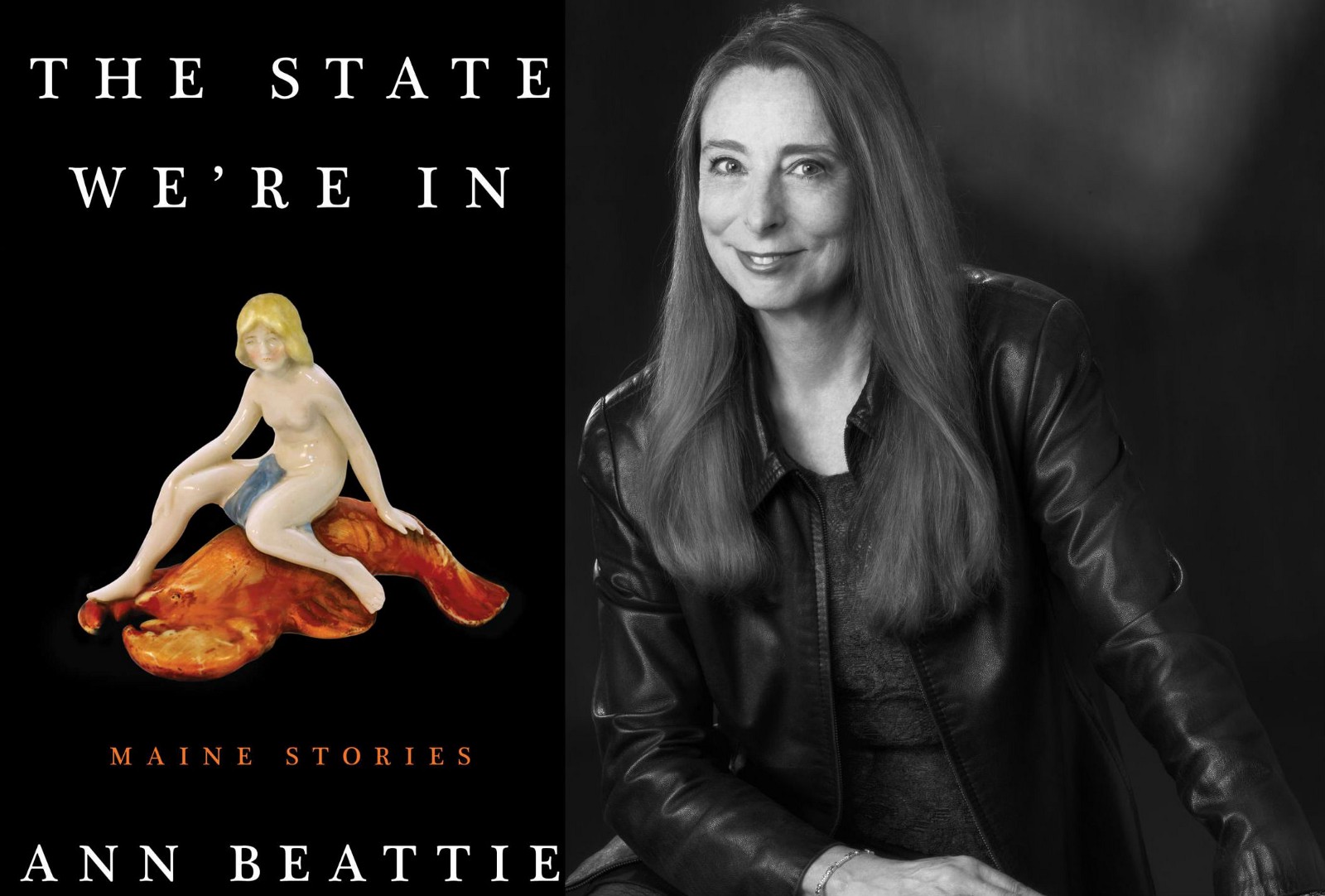
I suspect that in the near-fifty years she’s been writing stories, Ann Beattie has been asked everything. And what do you ask a woman who’s been asked everything? We discussed her new collection, The State We’re In, which every review points out is her first in a decade, and the state referred to in the title: Maine, where she and her husband split their time (they also have a place in Key West). Her new stories proclaim the Beattitudes anew: women look back on their youth, wonder about their marriages, reflect on failed or failing love. Her voice is classic Beattie, filled with the wry and keen observations that won her a following. We also talked about why she thinks people ask about the link between author and characters, and how she’s held to everything she’s said that’s in print.
(For more from Ann Beattie, check out her stint as guest editor of Electric Literature’s Recommended Reading.)
Claire Luchette: What are your feelings and inner dialogue like when a collection’s published? Is this time different, since these are the first new stories we’ve seen from you in a while?
I want to know how my book is going to be received, and I don’t want to know.
Ann Beattie: Well, things don’t all happen at once when a book is about to be published. There are many things going on all at once, out of the writer’s control, some of which you find out about by chance, some that somebody sends you the link to (usually with a wickedly funny joke message attached). You see (or miss) early reviews in PW, etc. But meanwhile, you’ve been photographed and haven’t seen the photos. You have no idea what the writer from the magazine will write, after spending an hour with you. My feelings ride a roller coaster. I want to know how my book is going to be received, and I don’t want to know. But publication takes on its own momentum, and at a certain point I’m just along for the ride.
CL: How do you know a story is finished and ready to be shared in final form?
AB: I pretty much know how much work will be necessary and also can make a good guess about how difficult revisions will be the minute I finish the rough draft of a story. Sometimes I’m wrong, but only sometimes. I think writers use a different part of their brain to compose and to revise. I try to be an outsider as much as possible as I re-work the story, and I also try to make sure I’m neither excluding my ideal reader nor writing only to that person. Then I give the final draft to my husband, and he tells me if it’s ready to submit or not.
CL: This collection has three stories that have overlapping characters, which I’ve decided to call “the Jocelyn stories.” Which of these came first, or were they all imagined around the same time?
AB: It’s a boring answer — one of those “You had to be there” answers — but initially all of Jocelyn’s story (in different form) was one big chunk. My husband said it didn’t work at the end. It was like dropping a boulder on the reader’s head. I agreed. I threw out about 20 pages of what I had and re-shaped the first, second, and third sections, writing new stuff and interspersing her story throughout the text. (Boring, huh?)
CL: Your stories are anchored by excellent dialogue and conversations. I find dialogue so difficult to write. How does a conversation come to you? Are you always listening to strangers and taking notes?
AB: Difficult to answer. I don’t think overheard dialogue is much help when writing fiction — at least, not for me. I suppose that because I feel my way into a story and don’t have a strong sense of the characters, who become simultaneously more developed and more mysterious as the story goes along (if I’m going to keep that character in the story at all), and because I believe that everyone is complex, I try to remain open to surprise . . . not so much by what direct questions might be asked in dialogue, but because I believe that anyone, when questioned enough, is likely to surprise you. And probably also to surprise themselves, more often than they’d like to admit. But I don’t think dialogue is best thought of as revealing something surprising, which can just be a lazy way of getting information into a story. I have to be present when the characters talk. Not actually there, but I have to imagine my way into the story, if the dialogue is anything more than a marker for time passing. My presence, if I manage it — the presence of an invisible third person — determines the dialogue, to some extent.
CL: Why do you think there’s a tendency for readers to look for the author in a story’s characters? Do you read that way?
…whatever one intends, the work takes on a life of its own.
AB: I hate to sound like I’ve got everything figured out when I don’t (and it doesn’t bother me when I do find ambiguity in a text; also, when questioned directly, I don’t feel I have to stop dead and explain exactly what I thought and did in the moment as the writer, or that I lose anything by not complying, because whatever one intends, the work takes on a life of its own). But, okay: for whatever reason, the “new criticism” told readers it was wrong to look for the autobiographical as an end in itself when analyzing fiction. I think that approach did temper a tendency toward the easy (and also lazy) tendency/desire on the part of the reader to assume that to know the writer’s biography meant that you could de-code the work. writers are not a bunch of spies writing code. But I suppose it’s another question about why readers tend to look for the writer’s presence in their fiction. Maybe because people resist artifice, and if the writer seems to be included, it’s more “life-like”? Maybe that’s also why many people like painting that is labeled “photorealism,” though time is never stopped, and to label, for example, Richard Estes this way, when actually he’s altered and idealized a seemingly perfect moment (meaning: the perfect moment for the painting), with no intention of functioning like a photographer, is a trick that’s open to many interpretations.
CL: What are your favorite stories to teach?
AB: Sometimes I used to teach what I’d just read the night before, if I liked it and was so excited or puzzled or whatever I was that I just had to talk to someone about it. But, in general: Alice Munro; Deborah Eisenberg; Joy Williams; Richard Ford; Thom Jones.
CL: In “Yancey” I loved that the novelist invites the man from the IRS to move in with her.
AB: This story was very loosely based on the story a friend — a writer, in fact — told me about the IRS coming to his apartment in the Village because they were questioning whether his wife’s tiny home office met their exact criteria for taking a deduction. That story had a punchline that was stunning: After my friend showed the IRS guy into the partitioned kitchen — where his wife was able to work about as happily as a mouse in a crowded cupboard — the deduction for home office space was disallowed. My friend asked whether, man-to-man, the IRS guy really, truly thought a scam was being pulled. No, answered the agent. Then why hassle me? asked my friend. The answer: “Mr. X, a bit of advice? If I had your money, I’d move out of the city.” Thirty-some years later, I wrote “Yancey.”
CL: The novelist also recommends the IRS man a book of poetry. How do you decide what works to suggest to friends or students? Is it based on how they write, or their preferences, or is it on characters/plots that remind you of them?
AB: It varies. Sometimes I think someone else has already worked that territory, and that the writer needs to know that — to know that he/she will be contextualized by a predecessor, whether they want to be or not. Other times, I do try to come up with something that seems to have been organized in a way that might be helpful to someone else’s story. If nothing else, this elicits such a fear reaction that it instantly clarifies the writer’s mind and they come up with a better solution.
CL: In “Duff’s Done Enough,” the writer-narrator says that “as any writer knows, once you have [the first draft] the going gets easier.” But I find the first draft is pretty easy, and it’s finding out a piece’s holes that’s challenging. What’s the hardest part, for you?
AB: I think I understand what you’re saying, but I don’t find the two things related in my own work. (Not to say I don’t have my own ongoing problems.) Every writer writes differently, and with different soft spots etc. If I don’t get a first draft that pleases me by the time I’m half, or ¾ through, it hits the trash. I don’t say this as advice to anyone.
CL: Do you feel each place you’ve lived has as many stories to offer as Maine?
AB: As many, and as few.
CL: You told The Paris Review a few years ago that you had “stopped trying to figure out Maine.” Could you explain what you meant by that?
Does print etch a person’s daily perceptions in stone?
AB: You’re always held to whatever you’ve once said if it appears in print. Does print etch a person’s daily perceptions in stone? How many people remember exactly what they thought yesterday? So… what did I mean about figuring out Maine? That I don’t live there in happy harmony with whatever place it is, though I also don’t believe that everything is a riddle to be solved.
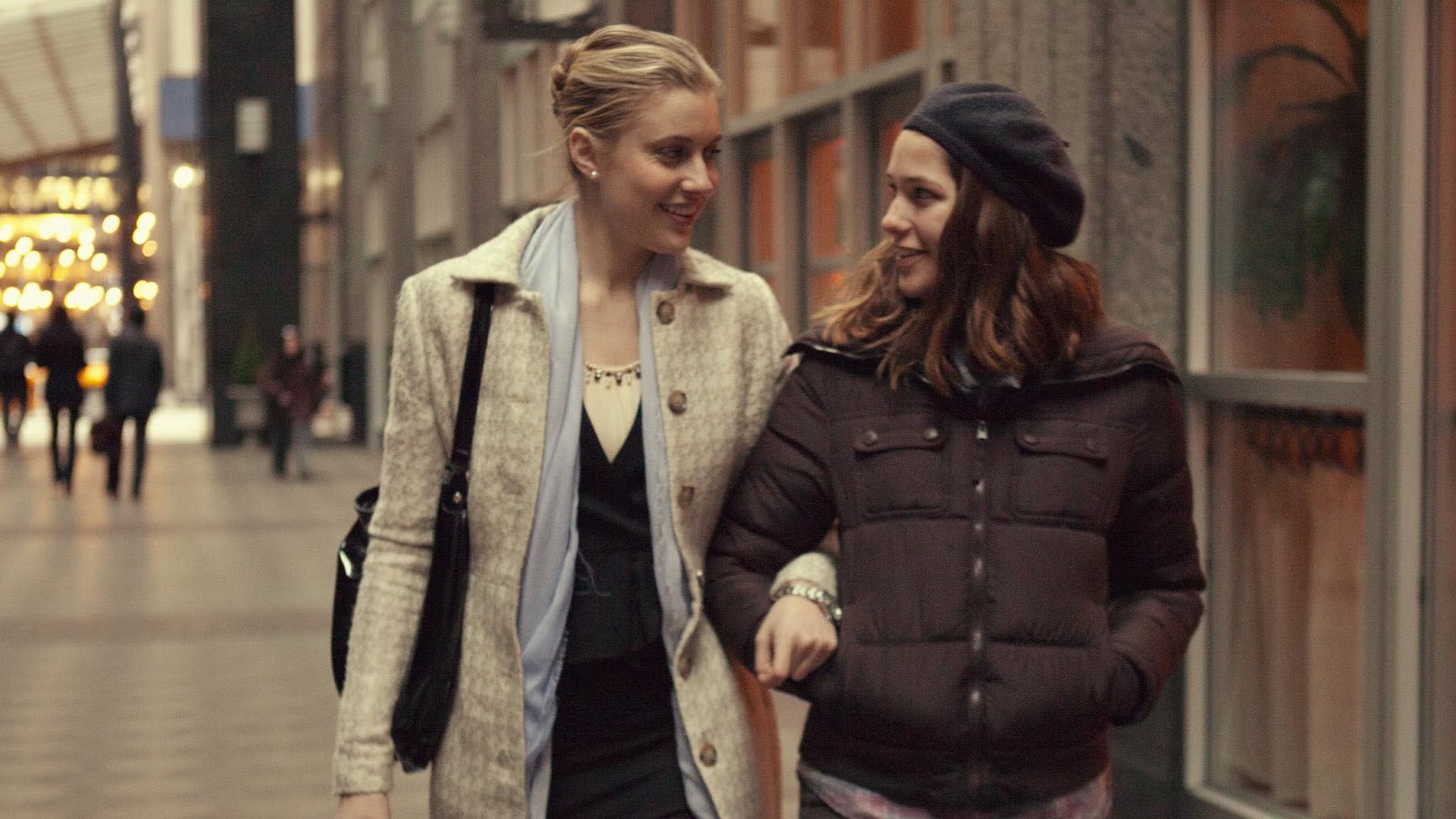
Mistress America, a new film directed by Noah Baumbach and co-written with Greta Gerwig, is an absolutely delightful, engaging, and thoughtful movie bursting with hilarious one-liners. Tracy (Lola Kirke) arrives at Barnard College with the dream of joining the school’s exclusive literary society, Mobius. Inductees are selected by the tweed-wearing literati who share the good news by waking new members in the middle of the night with a pie in the face. Though the pie trick is more 8th-grade-birthday-party than Paris Review, the skewering of her school’s literary culture is at once easy and satisfying. (When Tracy drops off her application at the Mobius office, one scowling member is seen playing jacks, and later, whittling a stick.)
The film is truly set into motion when Tracy meets Brooke (Greta Gerwig), her future sister-in-law, pending Tracy’s mother and Brooke’s father’s Thanksgiving nuptials. Brooke, who is more than a decade older than Tracy, welcomes her into her life with wildly gesticulating arms, taking her to dinner at Veselka, to a concert, an after party, and finally back to her apartment for a sister-sleep-over. From there, she treats Tracy as part assistant, part protégé, allowing her to tag along to “business meetings” (she is planning to open a restaurant), tutoring gigs, and hair appointments. Brooke is self-absorbed but also fascinating and charismatic. Her projects are numerous and half-baked (she freelances as an interior designer, teaches spinning, and says things like, “If you don’t know what you’re selling no one will know how to buy it.”) She carpet bombs ambition — for every idea she is equally enthusiastic and positive: “I would love to get into the app business,” she announces mid-conversation, apropos of nothing. Characteristically, she encourages Tracy to re-apply to Mobius after she was rejected. Invigorated, Tracy dives into a new short story about Meadow, Brooke’s thinly disguised fictional counterpart.
The earnestness of Tracy’s ambitions are touching — she wants to be a writer in that good-hearted, open way that is only found in people who have not yet begun actually trying to publish. While Brooke chats about her tweets as they pertain to her personal brand, Tracy is notably without a smartphone, or, seemingly, a social media account. Brooke is a 30 year-old of 2015 (conceived, no doubt, by Greta Gerwig), but Tracy is more like an 18 year-old of the 80s — a compassionate, honest version of Walt, Noah Baumbach’s alter ego from The Squid and The Whale, played by Jesse Eisenberg. (The soundtrack is also decidedly 80s.) Perhaps this is why I found myself identifying more with Tracy, though my age is the same as Brooke’s: besides the obvious writerly connection, she is timeless, delightfully uninterested in Snapchat and the like. (Justin Taylor’s recent story in The New Yorker, “So You’re Just What, Gone,” is a successful counterpoint example — it dives deep into the mind of a contemporary teenager, smartphone included.)
Of course Tracy is not only young but also female, a fact that seems to have little bearing on her identity as writer. Tracy writes about Brooke the way many talented 18 year-olds write, well, but mostly imitating the (male) writers she’s read in high school: Salinger and Fitzgerald, maybe Cheever if she’s precocious. Her observations quickly veer from wistfully affectionate to maudlin. Consider these lines, offered in voice over:
She lived exactly how a young woman should live, who wants to spend her youth well. She did everything, and nothing. Being around her was like being in New York City… Being around Brooke made you want to find life, not hide from it. She sang with the band and knew everyone and didn’t owe anyone anything, and couldn’t pay up, even if she did. She lived life the way I always intend to: purposefully.
And later, when it becomes clear Brooke’s restaurant endeavor will fail: “She carried around her youth like a carcass, and I, some how, had become the pallbearer.”
Compare this, if you will, to Nick Carraway’s description of Jay Gatsby in the first chapter of The Great Gatsby:
Gatsby, who represented everything for which I have an unaffected scorn. If personality is an unbroken series of successful gestures, then there was something gorgeous about him, some heightened sensitivity to the promises of life, as if he were related to one of those intricate machines that register earthquakes ten thousand miles away. This responsiveness had nothing to do with that flabby impressionability which is dignified under the name of the “creative temperament.” — it was an extraordinary gift for hope, a romantic readiness such as I have never found in any other person and which it is not likely I shall ever find again. No — Gatsby turned out all right at the end; it is what preyed on Gatsby, what foul dust floated in the wake of his dreams that temporarily closed out my interest in the abortive sorrows and short-winded elations of men.
Do you recognize, in Tracy’s lesser efforts, traces of Fitzgerald’s starry-eyed aggrandizing? Or Carraway’s submerging of himself in favor of telling the story of a more dazzling personality? There’s something gorgeous about Brooke too, she has Gatsby’s “extraordinary gift for hope,” and what preyed on Gatsby preys on her as well. (Hint: it’s America.)
But Tracy later faces what Nick never had to (and here we wade deeper into spoiler territory): the difficult confrontation that comes from her subject reading her work. Brooke is quite offended when she discovers the story — which is printed, improbably, on onion skin — and in a hilariously staged ensemble scene, bystander after bystander takes Brooke’s side. They accuse Tracy’s work of being anti-feminist (she portrays women as desperate), and derivative — accusations that I, upon reflection, would tend to agree with. But Tracy stands by her work, a decision that destroys her relationship with Brooke. The defense she gives is tenuous — what if Tennessee Williams couldn’t write about his friends? “I don’t care because I’m not friends with fucking Tennessee Williams!” — but her real defense, if she could have found the words for it, is strong. Her characterization of Brooke, though often critical, generalized, or exaggerated, has moments of touching clarity, and comes, ultimately, from a place of love. The act of love here is not flattery, but clear-eyed looking, seeing someone for who they are. Better, if you’re really good, than they can see themselves.
After her friendship with Brooke has crumbled, Tracy visits the bug-eyed, kindly psychic they had previously seen together. “Spirit says you’re not in your body,” he tells hers. If I am not in my body, where am I? Tracy wants to know. “Five feet to the left and unhappy,” says the psychic. It may be a new-agey punchline, but Tracy’s face twists painfully, because she knows it is true. And in the psychic’s answer may be the key to Tracy transforming from a young writer of promise to one of erudition: she needs to learn to inhabit herself and write from a place of familiarity, as well as curiosity.
The irony of all this controversy is that Duke University’s Common Experience Summer Reading Program is a voluntary one. In a statement, Duke’s Vice President for Public Affairs, Michael Schoenfeld, said: “With a class of 1,750 new students from around the world, it would be impossible to find a single book that that did not challenge someone’s way of thinking…”
In USA Today, Ibanca Anand, a student member of the committee responsible for choosing Fun Home, acknowledges that though it’s “not an easy” read, the difficult topics it addresses have an ability to provoke “conversations, which, in my opinion, is an integral component of a liberal arts education.”
One of the offended students, Brian Grasso, recently published an article in The Washington Post, where he defends his refusal to read Fun Home on the basis of moral and religious beliefs. “I’m not opposed to reading memoirs written by LGBTQ individuals or stories containing suicide,” he writes. “ I know that I’ll have to grapple with ideas I don’t agree with, even ideas that I find immoral.” After quoting the Bible, he asserts that “there is an important distinction between images and written words” and admits that “if the book explored the same themes without sexual images or erotic language, I would have read it.”
Therein lies a small contradiction. “Erotic language” is composed entirely of “written words.” And words are often wholly capable of evoking far more graphic images than pictures can. Although the article is eloquently written, Grasso’s argument still doesn’t quite make sense. He was by no means required to read the graphic novel, so the controversy seems entirely superfluous to me.
CNN reports that the other finalists for Duke’s Summer Reading Program included All the Light We Cannot See by Anthony Doerr and The Righteous Mind by Jonathan Haidt. I can only imagine those books (on World War Two, on psychology and ideology) might have spurred their own sort of controversy, too, because as Schoenfeld said above, it is indeed impossible to find a book that doesn’t challenge someone’s preexisting belief system.
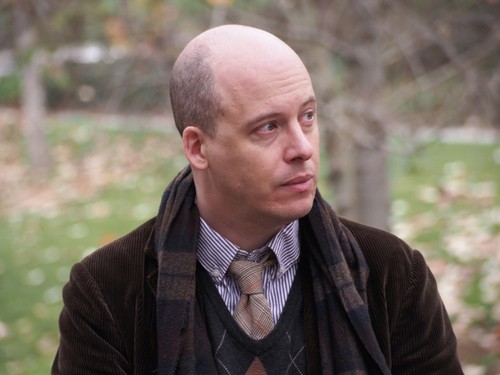
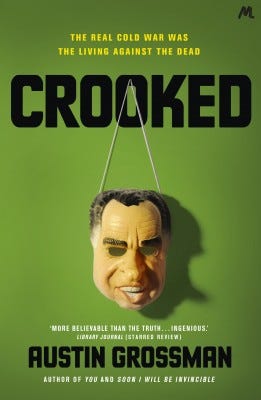
Historical fiction might be the realm of serious literary tomes like Hilary Mantel’s Wolf Hall or any number of books nominated for fancy awards every single year, but every once and a while a work of historical fiction also becomes a work of fantasy and phantasmagoria. If you’re thinking of Sense and Sensibility and Sea Monsters or Abraham Lincoln: Vampire Hunter, think again. Because Austin Grossman has just published Crooked, which is perhaps the most meditative literary/historical/genre mash-up in ages; the kind of cocktail combining two elements you might not put together: President Nixon and Black Magic.
Last week, I sat down with Austin Grossman to discuss the darkness of Nixon, the importance of autobiography in historical fiction and how to embrace any and all readers of one’s own work.
Ryan Britt:So in talking about this book in casual conversation I’ve been saying things like “So, you’re going to write a historical novel about Richard Nixon, imagine the angles you would go with that.” And so far, no one has guessed the angle you’ve gone with this. Why Black Magic with Nixon?
Austin Grossman: Well, there’s more than one answer. [Laughs] I guess I’m on the record there! Soon I Will Be Invincible (Grossman’s first novel) was a critical hit; it was not a sales hit. So, pitching a second novel was not the easiest thing to do when people were looking at the numbers…
Britt: But this is your third novel.
…any version of Richard Nixon has to deal with darkness.
Grossman: Right! But it’s the second of two book deal. You and Crooked. The point is: what’s the sexiest pitch I can make, but also feels like I can write from a real place. Then I thought, which is the most boring President I could write about? Probably Abraham Lincoln! Who’s the most interesting president I could write about? Richard Nixon. Who’s interesting to make into a hero? Richard Nixon. And then, you think about Richard Nixon and you think about the Cold War. And any version of Richard Nixon has to deal with darkness. Darkness that is hidden in that character somewhere; something drove him in a weird direction. What was the hidden thing? And I thought to myself what would be a fun hidden thing that would be as dark as Nixon as dark as the Cold War. And, you have to go to Lovecraft. You have to go to Black Magic. So explaining the fear and the paranoia [around Nixon] and the strange meltdowns…and once it hits you, it starts to work together really well. But without that, Nixon is very hard to make sense of.
Britt: Now, “petty” might be a little bit of a reductive word, but I like how you make Nixon so focused on what he needs. Early on in the book, you’ve got this scene where he’s chasing down Alger Hiss and he’s reading all this crazy magic stuff that Alger Hiss has written down and Nixon doesn’t care. He’s just like, “Oh, he said something about Soviets! Finally!” I laughed out loud at that point. You’ve succeeded in creating sympathy for Nixon in that moment. All he wanted to do was prove Hiss was a communist. He didn’t want any of this Black Magic crap! So, in terms of explaining Nixon’s paranoia: how much research did you do on Nixon? How much are we speculating on this thought process, his interior life?
Grossman: Well, I did a lot of research in terms of the actual historical record. But the thing about Nixon is, no one knows! He was sort of a cranky introvert who dominated the political scene for 30 years and was so calculated. Everything he said in public was so calculated, and I think to this day people don’t have a lot of insight into what sort of person he was. You could call him a centrist or pragmatist but that’s a way of saying he had no moral center whatsoever!
Britt: Later in the book, you’ve got this great scene with Tatyana [a secret KGB agent] and Nixon is pathetically saying, “You know I’m the president of the United States,” and she’s not impressed.
Grossman: Yeah. [Laughs] he’s pretty insecure.
Britt: Earlier you mentioned this was a book you could do honestly…?
Grossman: Yes. The question of Nixon, the character of Nixon was interesting to me. I couldn’t write a book just for money. This was the most money book I could do. Saying something I needed to say. Delving into the heart and into a place that I truly wanted to know about it. It was sort of like when I was working on Soon I Will Be Invincible, one of those happy moments when you think this is a book that gets at my heart, but this is also a book that can sell in the world of publishing.
Britt: Something Jim Shepard has said about historical fiction — I’m paraphrasing here — is that he finds the thing in the historical figure that is autobiographical for him. Was there something autobiographical for you about Nixon?
But past a certain point I was just using Nixon as a way to delve into autobiography.
Grossman: Absolutely! I mean I did research. But past a certain point I was just using Nixon as a way to delve into autobiography. To delve into dark impulses or the worst impulses. I thought I was writing Nixon as decent person who was making terrible decisions all the time. That there was just some sort of demonic element in his character to make the wrong call over and over. But, there’s no question that Nixon was just a way into autobiography. I mean I write in the first person and I don’t know another way to write than telling an autobiographical story through a mask of a given person. Which is why there’s a mask on the cover by the way…Actually, the Nixon mask is so iconic that that is just a happy accident.
Britt: Personally, I love talking about this book. But, I wonder, in your head; who is the readership of the book? Pretend I’m a bookseller. Who do I recommend this to?
Grossman: That’s a great question. You know, I always write novels that cross between categories, so that’s always a tricky question. Did you write this for history buffs? Did you write it for Lovecraft fans? Did you write it for spy novel fans? And either you wrote it for all those people or you wrote a book that has a perfect Venn Diagram of zero readers! [laughs] And you never know quite which it is. But, I tend to let that be other people’s problem. But it’s a fun idea. Someone must want it.
Britt: We were talking earlier about stuff like Abraham Lincoln:Vampire Hunter or books like that. But Crooked isn’t like that because you actually manage not to be camp. How did you accomplish that? Was that hard?
Grossman: Was it hard to write away from camp?
Britt: Yeah. I mean it’s such a high concept idea. And because Nixon is such a comical spoof figure.
Grossman: Right. But the question of Nixon is too deep. Too conflicted. The question of Nixon goes all the way to the bottom. I’m old enough to remember when he was President. He was the first public figure I was aware of. And right away, as a five-year-old, I could sense a conundrum. Why was this man President? And a joke? And evil? And it’s not a question that goes away when you grow up. It must have been terrible to have been Nixon; to have trapped himself in a bizarre series of contradictions while being the most visible person in the United States if not the western world. It simply goes too deep to be camp.
Britt: Right, so the average person wouldn’t associate a lot of darkness with say, Lincoln?
Grossman: Making a hero out of Lincoln isn’t much of a jump. Making a hero out of Nixon…you really have to imagine what it’s like to be trapped into being Nixon. And somehow have made that mistake and still somewhere inside there be aware of how bad the screw-up was, but having had reasons that at the time seemed valid and heroic.
Britt: I grew up in a Republican family and my late father was always defending Nixon and saying he was a good president and he got mixed up in the wrong thing. Do you think conservative propagandist would be excited about your book? You know, “Oh, Austin Grossman has finally revealed what we’ve known all along: Nixon was actually a heroic president!”
Grossman: I did become aware that at a certain point I was writing a novel whose heroes were Republican Presidents! [laughs] Which goes against my voting record if nothing else. There was nothing I could do about that! But, to be fair, Eisenhower and Nixon were not the Republicans we have today. The phrase “Military Industrial Complex,” comes from Eisenhower, from a speech he made as an outgoing President. I mean, Nixon created the Environmental Protection Agency. They were not ideological Republicans the way we have now.
Britt:In a way, isn’t a very liberal move for literary novelist to have a Republican protagonist?
Grossman: I only realized partway through that I’d stepped into that one. And honestly, the worst dodge in the book is putting some of the moral — most of the moral weight — onto Kissinger. Which lets Nixon off a little bit. I think that is the most meretricious element of the book.
Britt: Was it a conscious decision to basically do Nixon’s whole life through this lens?
Grossman: I felt like I had to start at the beginning. I felt like he had to stumble into it as a younger and more naïve man. There was some pressure to only write the Watergate years. I mean the book opens on the night of Watergate and the question is: in what seemingly inextricable steps did I get myself here? And I feel like I had to go back to the origins of the Cold War and the Red Scare, which was kind of the original sin of ambition that started it off. It made sense to do it that way.
Britt: Talk to me a little bit about the occult aspects of the book. The Black Magic. We talked about Lovecraft earlier. But what Black Magic did you invent? What was mashed-up? What was borrowed
Measuring it against the Hydrogen bomb, they would certainly weaponize Elder Gods. There was no question.
Grossman: You can’t really keep Charles Stross out of this. I came up with the idea myself, but when you Google Cold War+ Occult, you get Charles Stross. He’s written really good stuff on the subject. But I thought about Lovecraft and that if dark magic existed in the Cold War, it would have been weaponized. They would have done anything. They would clearly do the worst things. Measuring it against the Hydrogen bomb, they would certainly weaponize Elder Gods. There was no question. So then I thought “what is Black Magic?” And it is a series of contractual relationships with the native Elder Gods of particular regions of the world. And I liked that because you can write a lot of history around that. You can extend it in many directions. You can picture Napoleon as simply an expert contract lawyer whose expertise was masqueraded as generalship. You can write any number of alternate histories around that. Which I liked. It made something magical and dark at the heart of founding any nation state. I found really enjoyable. Because when you look at the 20th century: the disruptive thing there was the Russian Revolution. They tossed out the Czars and by doing so, they voided the old contracts [with magic and Elder Gods] and that begins to set things loose. And again, it made sense, given the unique awfulness of the 20th century, that that kind of disruption kicked it off.
Britt: Now, in your brother’s (Lev Grossman) book The Magician King, there’s some Elder Gods. Could Crooked take place in the same fictional universe?
Grossman: I don’t thinks so…because in his books magic has less of a moral rate. You can’t do magic in the world of Crooked without some kind of Faustian bargain. Whereas in The Magicians, it’s a craft. But Crooked actually emerges from a Soon I Will Be Invincible call-out. I’d actually forgotten that I’d mentioned a “Mage President Nixon,” in that novel. Maybe I intentionally had forgotten that.
Britt: So, Crooked is a miniature sequel to Soon I Will Be Invincible.
Grossman: Sure. I just got to expand a tidbit to novel-length.
Britt: At some point this does feel like a spy novel. You’ve got these great KGB agent characters.
Grossman: Well, I needed some characters that were my own. And characters that Nixon could talk too. Plus, making the only characters that Nixon could tell his secrets to be KGB agents was just too fun to resist! [Laughs]
Britt: Well, I like that because it’s like Nixon is still subordinate to these folks. Like he’s not cool enough for them. It’s funny.
Grossman: Well, trying to make Nixon the protagonist of a spy novel is inherently funny. I mean a spy novel/paranormal investigator Nixon has something inherently comical in it.
Britt: It is a funny book. I don’t think it’s a parody. But it has wit. How did that happen?
But when pen hits paper and I start writing the darkest most sincere parts of my being, it just ends up being funny…
Grossman: It’s just something I can’t get away from. You know I’d be like Marilynn Robinson if I could. But when pen hits paper and I start writing the darkest most sincere parts of my being, it just ends up being funny in a way that seems inexorable from the act of writing. When I was writing Soon I Will Be Invincible I was like “I’m writing the truth! It’s so true and dark, that I don’t know if people can handle it!” But then of course reading it back, it seems like fun. That’s just how my writing comes out. I ended up with the word Crooked as a metaphor, but it just doesn’t come out straight.
Britt: So you’ve got kids reading Abraham Lincoln: Vampire Hunter or League of Extraordinary Gentlemen or something like that or watching Penny Dreadful. If they went from that stuff to reading your book, would you be okay with that?
Grossman: I’d rather be in the game than out of it! I mean, I really enjoy the Alan Moore stuff. Crooked could comfortably live in that universe with no trouble. As far as readers: come from any direction! I was given very serious advice from someone when I worried about who would buy Crooked or how it would be marketed. And this person said: “Forget all of that. Just remember people bought Abraham Lincoln: Vampire Hunter.” It’s silly to be a snob. You’ve got to trust the reader. You can’t turn down a reader or what a reader can find in what you wrote. Enjoy whatever way a reader feels like enjoying it. You can’t say no to that.
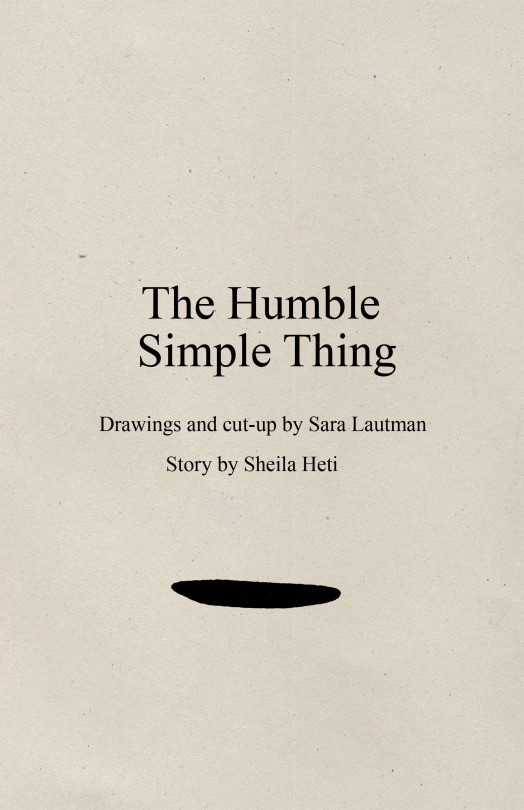
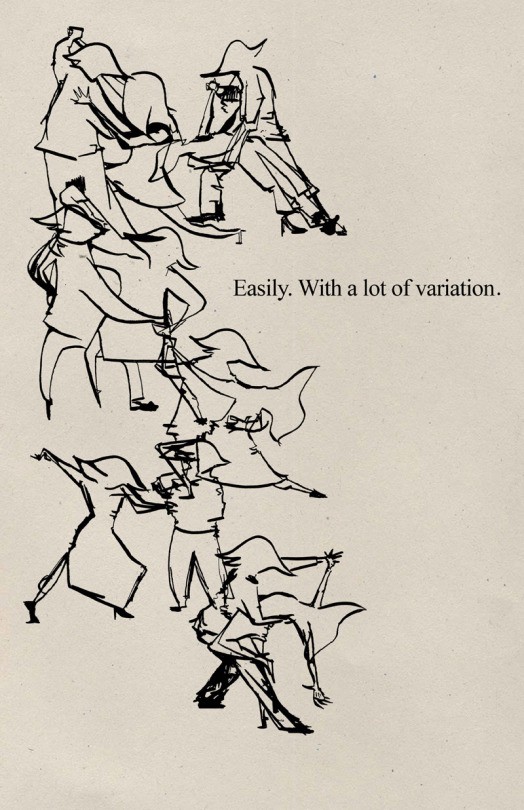
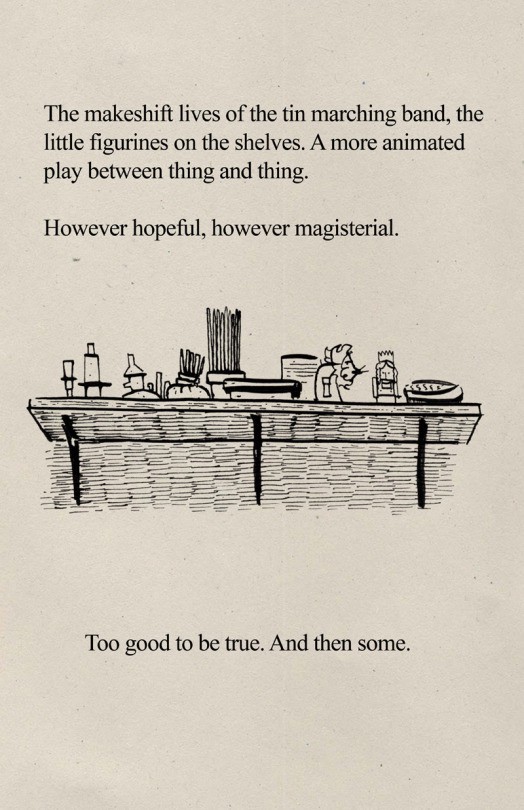
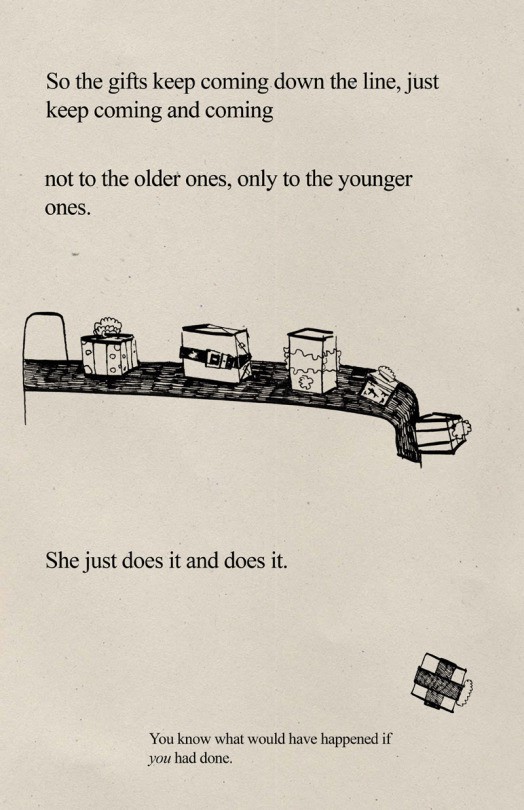
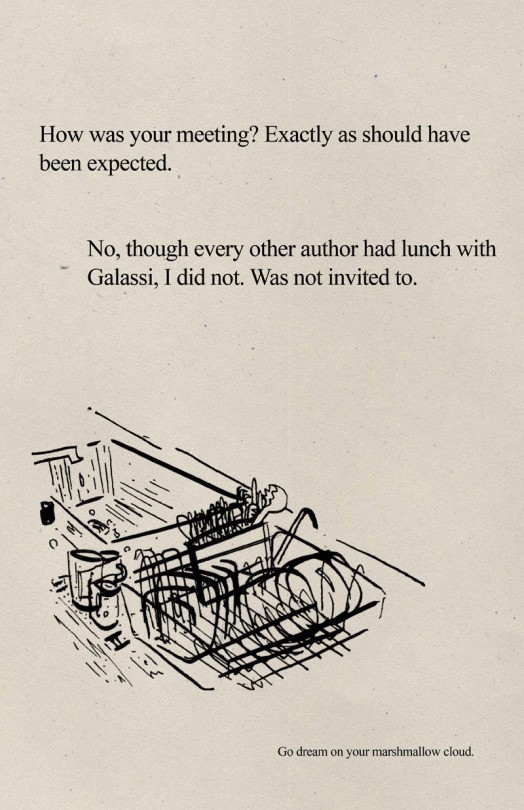
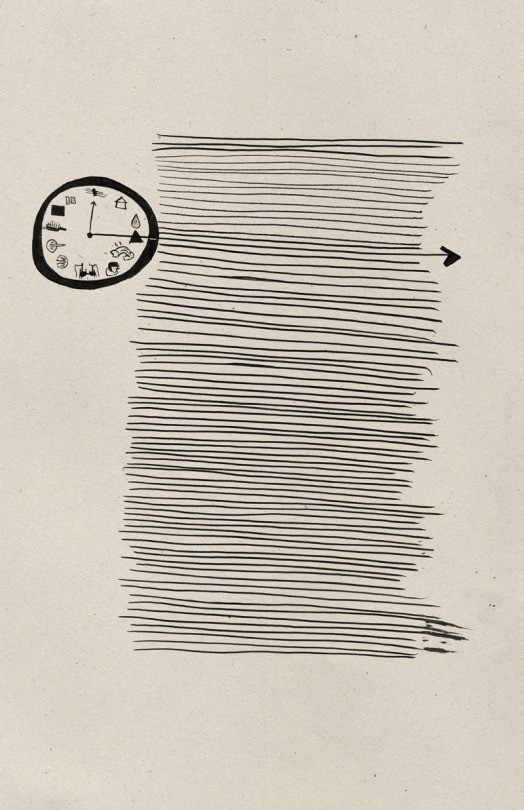
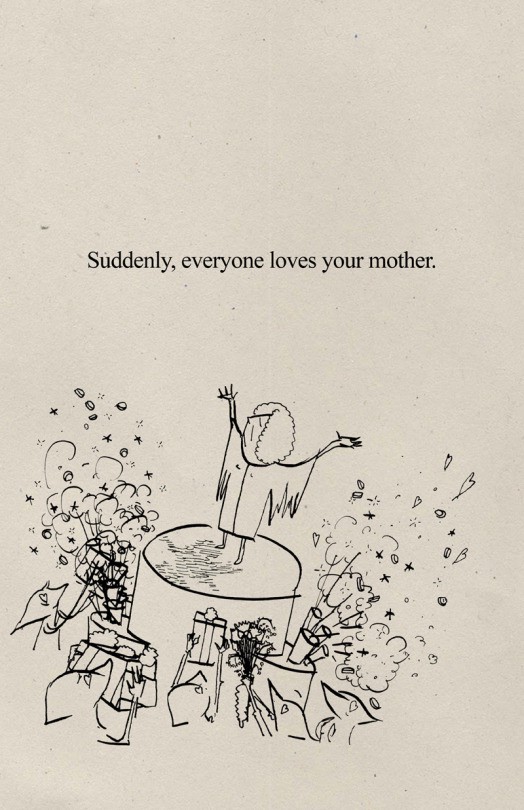
Read “The Humble Simple Thing,” a collaboration between Sheila Heti and Sara Lautman, in this week’s issue of our weekly fiction magazine, Recommended Reading.
Halimah Marcus: How do you two know each other?
Sara Lautman: I was the TA in a writing class at MICA, in Baltimore. Sheila came to speak as a visiting lecturer — a big lecture, open to students and the public. This was last year.
Sheila Heti: When I gave the talk, there was a small wiggly dog scampering around in the first row. I didn’t give a very good lecture. All I could think about was the dog. When I met Sara the next day, we liked each other immediately. She seemed smart and interesting and serious and I wanted to stay in touch.
SL: I had been reading and loving her books since The Middle Stories, which was published when I was a senior in high school. The day after the lecture, she came and spoke to our class. I asked if I could interview her for — nothing in particular. I was making illustrated essays and wanted to transfer that writing/drawing approach to interviews.
SH: Doing an interview didn’t seem so appealing to me at that moment.
SL: We ended up emailing back and forth about something else I could illustrate. I proposed a cut-up.
SH: I sent her a story that I had written very quickly, and never edited. It was about 1,500 words and called “R. Rose.”
HM: What was your process for collaborating on “The Humble Simple Thing”?
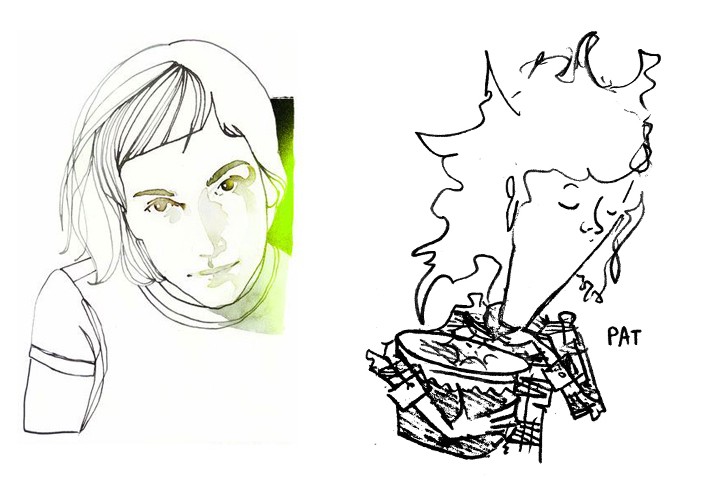
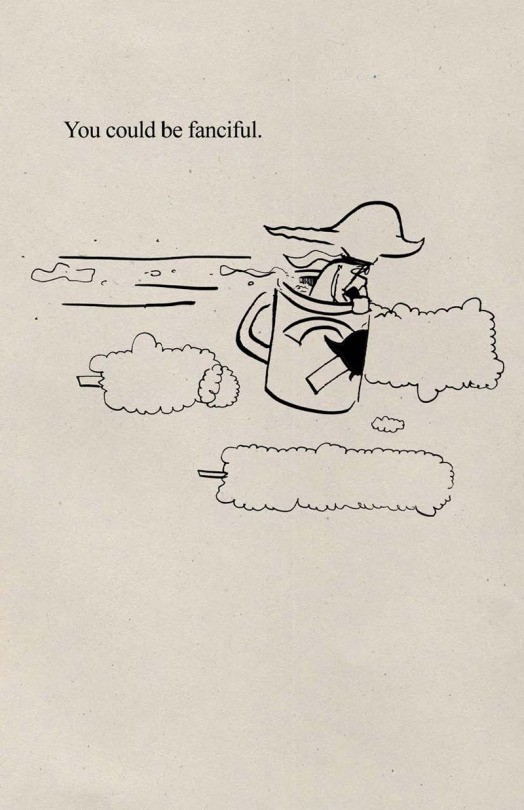
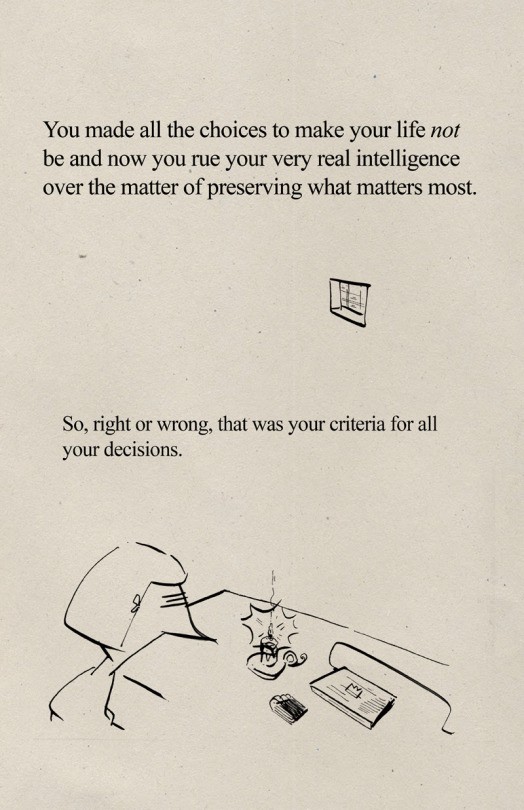
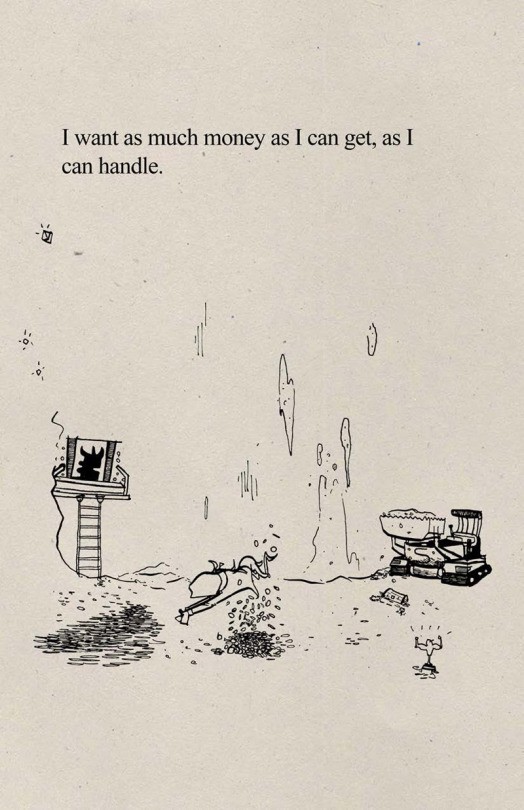
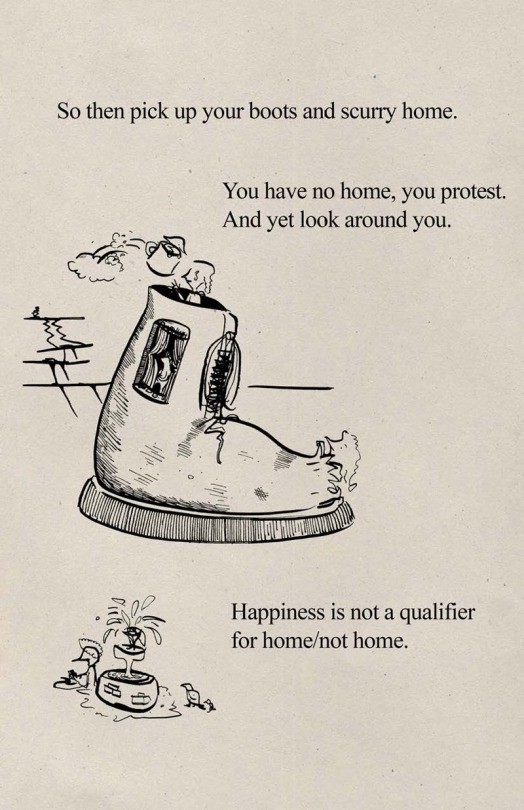
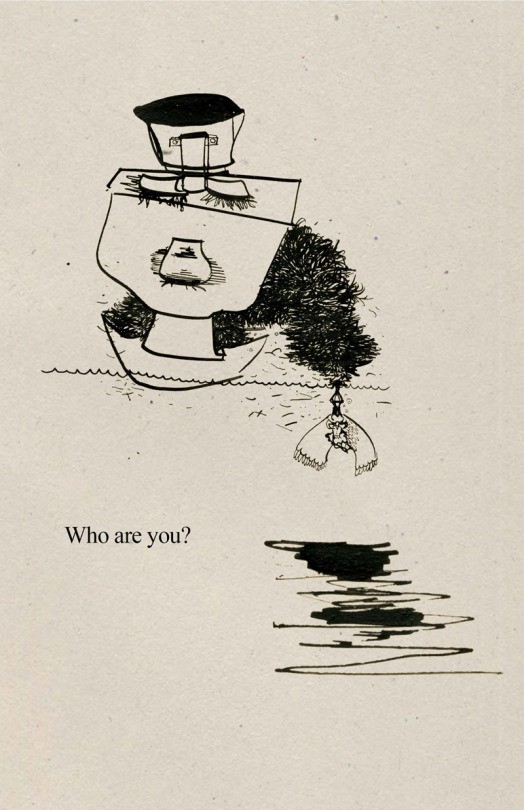
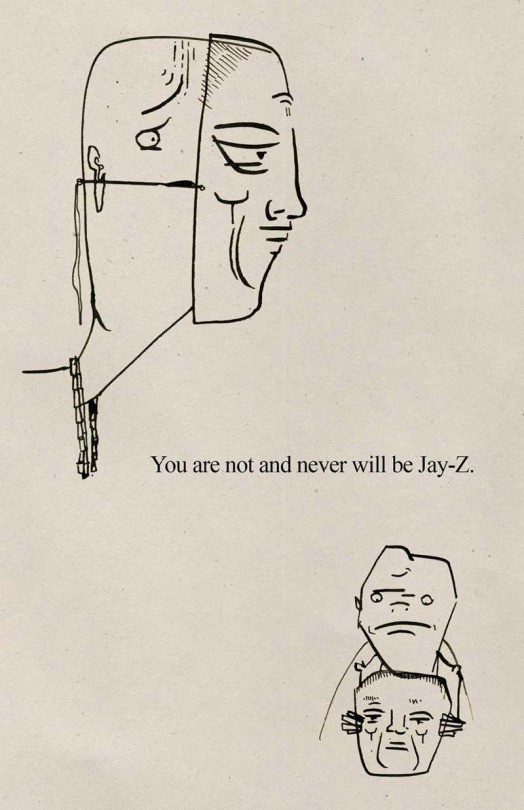
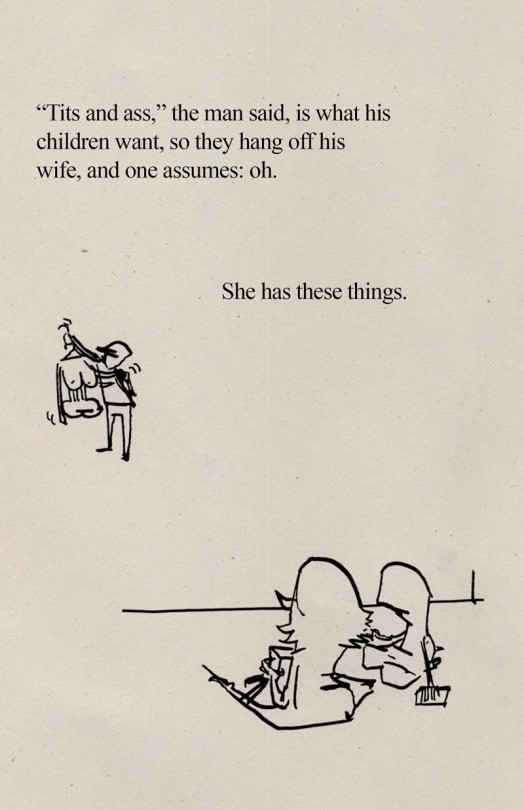
SL: Sheila sent me the story. I read it, went away from it for a day or so, then picked it back up and highlighted the parts I wanted to draw from. I made a word document with only those passages. That was the cut-up. I saw that there were many things to draw in it — many objects: gifts, chicken wings, a duck, Jay-Z. Those were toeholds. They made it easier to begin drawing emotional abstraction, which I ended up treating as kind of a play, with nonspecific silhouetted characters acting in metaphoric situations.
SH: I didn’t do anything.
SL: I drew a big stack of illustrations for the first selections. Then I put those in a sequence and selected some additional language. Then I drew more. That process repeated in littler cycles until I decided to be finished. It was a decision to be finished — there could have been many more pages.
SH: I don’t think I made many or any changes to the piece she ended up showing me. I was amazed and surprised by what she had made, and I thought it was wonderful.
HM: Sara, how did you decide what to cut and what to keep from Sheila’s original text?
SL: I cut a lot of stuff that was great and could have easily been kept. If my initial culling — the first favorites — had been different, the secondary, fill-in selection would have been different. Drawings dictate how the text needs to be edited. I decide how much information needs to be added and how much I can take away. Everything is contingent.
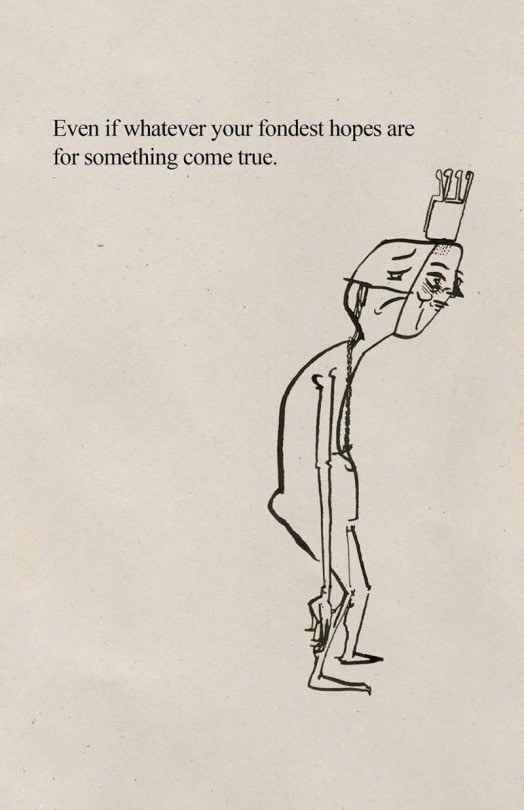
The piece itself — which, as I read it, is about personal standards in one sense, and, if you are making art, outside values placed on your work — felt close to what was on my mind at the time (and is still).
Then, of course, there are all the qualities I love about Sheila’s writing, and I already know them from being her reader — full frontal engagement with feelings, grasping the handles, tenacity mixed with compassion, gameness, trying to really solve problems.
HM: Sheila, how did it feel to be “cut-up” like that, and to see the final result?
SH: I recognize it as pieces of my brain. It still feels like me, like a distillation of what I was feeling at a particular time. But Sara also made new sense out of it. I don’t know Sara very well at all, in terms of sitting down and having coffee with her, or about the facts of her life, but on the other hand, I feel like I know her in a way I don’t know anyone else; to see your thoughts cut up and rearranged and illustrated — I see what of her is in this arrangement, which is not me. I feel like I’m her Frankenstein monster (or my words are) and that from how my words are behaving here, I know something about the Dr. Frankenstein whose hands sculpted it.
HM: Sara, can you talk a bit about your style as an artist, and how you shaped it to respond to Sheila’s words?
SL: I started drawing for “R. Rose” without planning anything. Some images worked, some didn’t, and I used the ones that worked as a guide for what to do next. I didn’t adjust my style in any premeditated way.
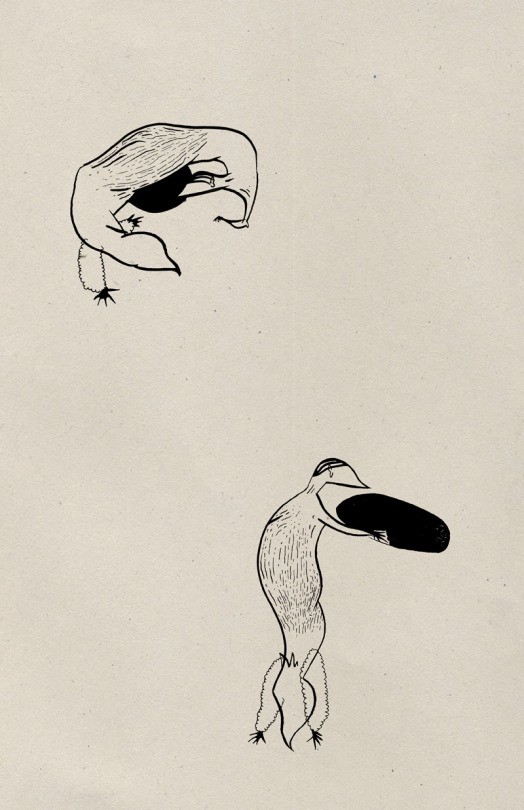
One change I remember: There were drawings early on with characters who had pupils on their eyes, and more detailed faces. They were overly characterized. Even though they were very minimal it felt like they were stealing focus.
After this project, and in between drafts, I ended up drawing these duck-headed figures a lot. I have another comic from around that time that’s just duck-heads miming the entire thing.
HM: Sheila, you mentioned you wrote the story that became “The Humble Simple Thing” quickly, without going back to edit it. Is that unusual for you? What is happening with the original story, “R. Rose,” now?
SH: I always write quickly. I didn’t edit this story because I didn’t feel like it would come to anything, even with editing. I gave it to Sara thinking she might be able to make something brand new from it. I imagine this piece will be its only life.
Sheila Heti’s most recent novel is How Should a Person Be? In the spring, McSweeney’s published her play, All Our Happy Days are Stupid. She is the author of five other books of fiction and non-fiction, including — with Heidi Julavits and Leanne Shapton — the New York Times bestseller, Women in Clothes. sheilaheti.net
Sara Lautman’s drawings and cartoons have appeared with The Pitchfork Review, Jezebel, The Awl, The Los Angeles Review of Books and many other places. The tenth collection of her comics, The Ultimate Laugh, will be published by Tinto Press in winter of 2015. Other recent collections, including Macrogroan6 and Lying and Cursing are available at Birdcage Bottom Books. saralautman.com
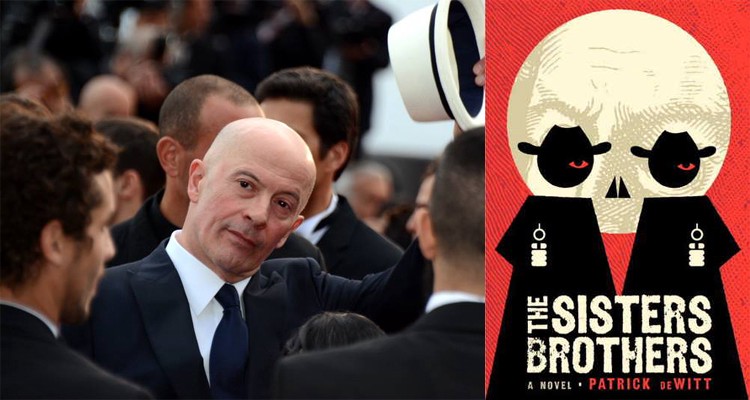
If you’re a fan of film director Jacques Audiard and/or novelist Patrick deWitt, this news is sure to whet your appetite: Audiard is currently working on an adaptation of deWitt’s The Sisters Brothers.
The novel is about Charlie and Eli Sisters, assassins sent on a mission to kill the prospector Hermann Warm after he’s accused of stealing from their boss. It’s set during California’s Gold Rush, which will certainly be a departure from Audiard’s previous films, including The Beat That My Heart Skipped, Un Prophète, and Rust and Bone (starring Marion Cotillard).
The Guardian reports that the film, which will be Audiard’s English-language debut, will star John C. Reilly.
In the meantime, if you’re thirsty for more deWitt, check out the recently-released trailer for his upcoming novel, Undermajordomo Minor, here.
People nodding along to their favorite podcasts or jamming out to their own personal playlists populate trains and buses in cities around the world. A symphony of high-volume, warring iPod songs often plague our daily commute. And yet, occasionally, we might glimpse someone paging through an actual novel (or, perhaps, you are that person…) In that instance, we rejoice: the book is not dead! Long live the book!
And now, finally, public transport users finally have a great reason to put away their headphones. In Cluj-Napoca — the second most populous city in Romania — travelers with their noses buried in a book were awarded free bus rides from June 4th-7th, 2015. Despite only being offered for an abbreviated time period, perhaps immensely positive reinforcements such as free rides will enforce a better reading habit. (Famous psychologist B.F. Skinner was on to something, wasn’t he?) We all know how hard it is to put down a good book!
We should all aim to emulate Cluj-Napoca’s recent movement. As The Independent reports, Victor Miron proposed the initiative to the city’s mayor, Emil Boc, in an effort to “encourage more people to read on public transportation.” The mayor then, amusingly, posted the idea on his Facebook page, which garnered a flurry of positive support. All we may need, then, is an enthusiastic, persistent champion of books to set this into motion in other cities around the world. An army of readers — instead of an army of vacant-eyed, head-boppin’ zombies with earbuds in — may soon populate your daily commute!
Social media, too, continues to play a big part in the promotion of literacy and the celebration of reading. (For example, I’m willing to bet you arrived at this Electric Literature article via Facebook or Twitter). According to The Independent, Miron is working hard to convince Facebook founder Mark Zuckerberg to participate in another of his reading-related campaigns: BookFace, which encourages Facebook users to change their profile picture to one of themselves reading. Because Zuckerberg recently launched “A Year of Books,” I’m optimistic that he’ll continue to align himself with the wonderfully lit-crazed demographic of his users.
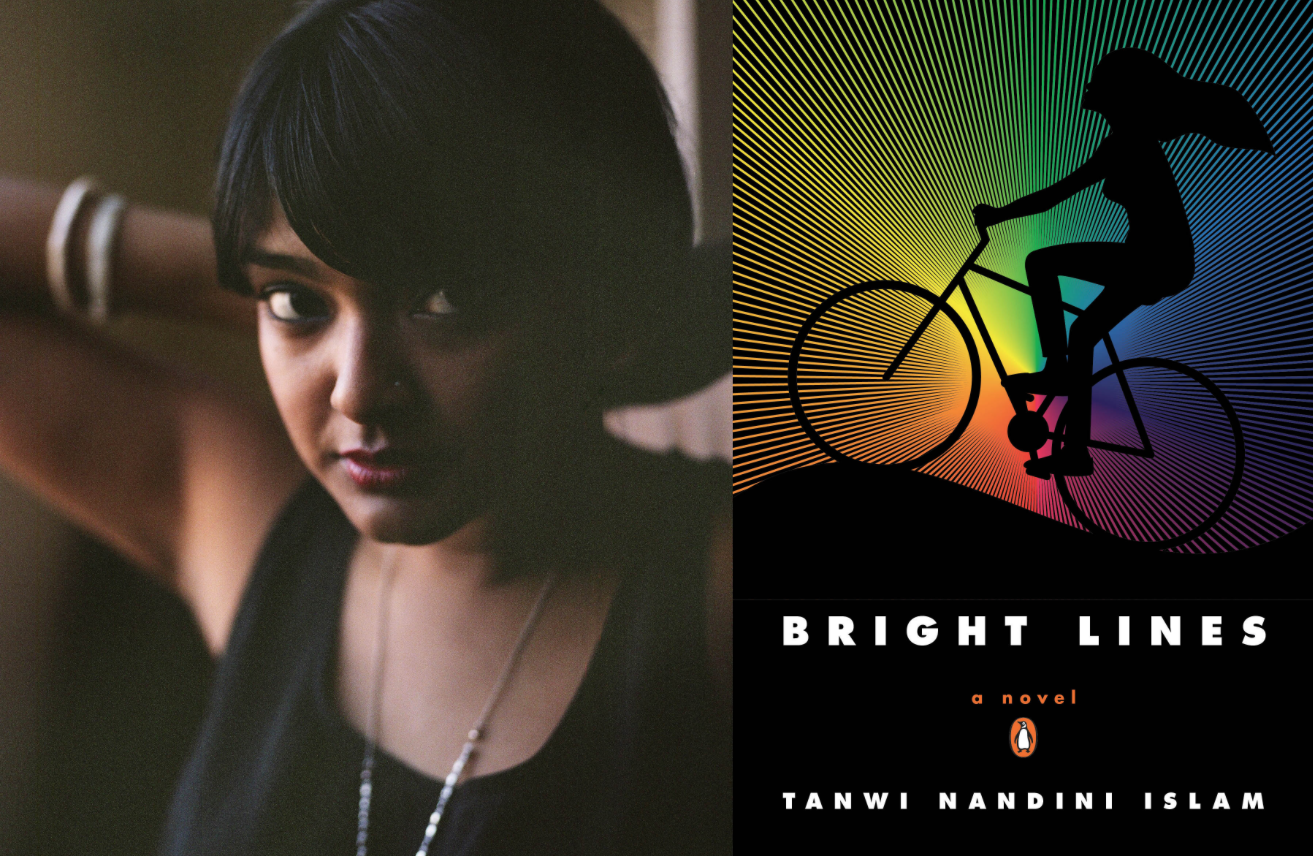
Brooklyn has seldom been so lushly and tenderly rendered as in Bright Lines, Tanwi Nandini Islam’s debut novel. We follow Anwar Saleem, his wife Hashi, their daughter Charu, and their niece, Ella, through the rich, summer streets of the city. They deal with traumas forgotten and questions of burgeoning identity, coming of age and coming of middle-age. Problems of the past and future. Questions like, “who have I become?” and “who will I become?”
Tanwi and I met in late July at her bustling studio, studded with tins of almost-finished candles. She was hard at work filling an order for Hi Wildflower, her line of botanical perfumes, candles, and skincare. We ran off for an iced tea around the corner and talked about hallucinations, sex scenes, and the artistic hustle.
Hilary Leichter: Can you talk a little bit about the process that went into putting the novel together? How did writing the book change over the course of a decade for you?
Tanwi Nandini Islam: So the book takes place in 2003 which was an electric year for me. It was super intense. I went to Kenya that year. I went to Cuba that year. I was in this Youth Solidarity Summer which is a South Asian radical youth education collective that was teaching us about social justice. It was all this stuff happening. That was also the same year that the blackout happened. You know? That whole year — and it was right after September 11th. So there’s a lot of stuff that people of color, especially South Asian and people of Muslim descent were dealing with. And those things all have stayed with me. When I started writing Bright Lines, it was in a totally different incarnation, but I was living in India, in Delhi, doing a fellowship, working with teenagers, which is what I did for a decade. And the roommates I was living with, we decided to go to Kashmir and hang out in Kashmir, because that’s what you do. But it was Ramadan when we went so it was super dead, there was nothing to do after the sun went down. So I said, oh, I’ll start working on some stuff. And it was the first iteration of a novel that I wanted to write. And I knew the way to buy some time was to go get an M.F.A. For me, I’m not a school person. I’m not even an M.F.A. person. But I felt that it was a way for me to say, I don’t work right now except on my M.F.A. and my part time job.
HL: To give yourself permission —
TNI: The years to do it. The two years. And so I submitted that to a bunch of M.F.A. programs. I just remember getting that email from Michael Cunningham and it was, “We would love for you to come to Brooklyn College,” and it’s Michael. Fucking. Cunningham. And I said, “I’m coming, Michael!” I couldn’t even talk to him on the phone because I was in India. Back then it was really hard to do things like that.
HL: Yes. Skype was not a major thing.
TNI: Yeah, it wasn’t major! So I think my dad called him and asked him all the questions I wanted to ask him. And my dad said, “He’s a fabulous man.” And I said, “Yeah, he is a fabulous man.”
HL: And this was the first draft of the book?
And I knew I wanted to write about the Brooklyn of that time that was so different than the Brooklyn we have now.
TNI: Yeah. But the POV that really solidified into Anwar’s POV came a few years into my M.F.A. And I was also in another country, living in France, and working for a Kashmiri guy. There’s this weird Kashmiri connection, I don’t know what it is. But I was working for a Kashmiri shawl seller, selling shawls in the French Riviera at a hotel, working from 8:00 AM to 8:00 PM for 150 Euros a day. And I was just devouring Toni Morrison, and Marquez, all these people who I feel have influenced me. Being stuck and reading, and reading out of boredom, and then having your imagination come alive, and that area is so colorful, and beautiful, and the houses are pastel, the beaches are made of rocks. It’s just gorgeous. And it’s tiny. You can go from one end of France to the other. I just felt so inspired, and I started working on the book. It was that summer of 2008. And I knew I wanted to write about the Brooklyn of that time that was so different than the Brooklyn we have now. And I was part of the wave of people that were coming into the city after college, and doing all of that stuff. But you know, we were sharing an apartment, paying $500 a piece, you know, living in the city. The year that I moved to Brooklyn, Dave Chappelle had his block party on the block I was living on. It was just, I feel, a golden age of the early aughts.
HL: At a certain point, did you make a decision to write a “Brooklyn” novel?
TNI: Well the first few drafts I thought, “I should make this in Queens,” because it’s more South Asian. And I thought fuck that, it’s not more South Asian! All the people who own these Muslim oil shops — that’s very much the inspiration for Anwar — these health food stores, these herbal shops…they’re from Bangladesh. Their owners are Bangladeshi people, the people who work there are Bangladeshi people, and it’s a character that I knew I wanted to write. Anything I write, I feel is very much about creative entrepreneurship and the hustle. You know, it’s always about our hustle. When I met you, you were like, “I’m selling bags for my mom!” We’re all just trying to make a dollar, you know?
HL: We were both vendors at the Brooklyn Night Bazaar! Could you talk a little bit about retail and art? And about how your business, Hi Wildflower, plays into your writing?
TNI: I’ve been thinking about Bright Lines for a decade. And that’s a really long time to think about something. And not having a full time job in a traditional sense, and a 401k plan, and all these things that we are told we should have. They are elusive for us. And I knew that I sacrificed that. Even up to last year, I was just freelancing as a writer, trying to get copywriting gigs. And then I saw there are all these brands doing beauty, and candles, and I’ve been so interested in anything to do with essential oils and botanicals, and all these things that I think get a kind of new-agey spin. But all of those texts that people reference are things that I’ve been interested in for decades. That’s what I’ve been into since I was a teenager. I really wanted to do something that connects back to the themes in the book, but it’s a continuation of the stuff that I’ve always been interested in. It’s just another iteration. Every candle has a little poem on it, and I’m writing all the copy for everything, everything is a story-spun-world within itself. Each candle is a little slice of that world. They’re interlinked stories almost, these little objects that I’ve been creating. So it’s all connected.
HL: Your book and your business are kind of twins?
TNI: Yeah, they’re totally mirror —
HL: — sisters?
Everyone’s trying to not be anyone else’s minion.
TNI: Yeah! One is the dark and depressed and solitary sister, and the other one’s kind of, you know, very social and money oriented! And that’s the hard thing, to make your art something that isn’t about money. And my business is about products and creating a sustainable life for myself, and being accessible to people. And getting into these Brooklyn stores, so many of the women that I’m working with are small business owners like me! Everyone’s trying to not be anyone else’s minion. We’re trying to be our own boss.
HL: And there’s value in that.
TNI: I think so! My parents said, “Okay, shouldn’t you get a job and health insurance?” And I said, “I have job!” And now they’re saying, “Okay, it’s real.”
HL: I was really taken with all of the dualities in your book. Anwar builds two of everything in their home. And there are two adopted sisters, Ella and Charu, who are very much two sides of the same coin. Was this something that you were thinking about when you were putting the story together?
We embroider, and embroider, and embroider, and then we just unravel everything and start some new shit.
TNI: I think that is just my being. Anyone who knows me really well will say, “You say one thing with such conviction and then you completely say the opposite, with the same amount of conviction!” That is the artistic process. We embroider, and embroider, and embroider, and then we just unravel everything and start some new shit. It’s completely the back and forth of building something up and breaking it down. I think duality is just a great continuum. We’re just sliding back and forth between poles. There’s no equilibrium. I mean, I’m a Libra, so I’m very much into the eternal balance. I think when we get bored or stagnant we want to shake things up. When we are really really depressed we want some light. I think that’s our natural inclination as human beings, to gravitate towards the thing that we’re lacking.
HL: At the end of your book, the idea of “misdirected love” comes up. Taboo love, long-shot love, doomed love. And that for me felt like a guiding principle for everything you were writing. Do you feel that way? Was that a central, unifying theme for your novel?
TNI: For sure, yeah, for every character. I like you, but you like them, and they like me, and these triangles that we’re all —
HL: And sometimes misguided triangles? And false starts? To me it felt like a beautiful metaphor for a writer trying to figure out who a character is going to be in a book, and how they will be, and those shifting roles that we create when we’re building narratives and discovering. And how that process of discovery actually just naturally happens in real life.
TNI: That, to me, was the guiding principle. There’s something about misdirected love where it’s, “It’s not you, it’s me.” And it completely is not about the other person. It’s literally about you. In the case of Anwar, in his misdirected love, it’s this fantasy he has of a person that lives upstairs. And the fantasy is actually as beautiful and vivacious and wonderful as he thinks it is.
HL: Yes, there is wish fulfillment in this book, but not necessarily with the caveat of “be careful what you wish for!” The consequences are proportional. And I feel that sometimes female characters in fiction, when they get something they desire, they’re instantly slammed and punished in some way.
TNI: There’s drama to counteract it.
HL: In your book, people get what they want, and then just deal with it. It felt very real.
TNI: I’m glad it felt real. There is this Chekhov quote: “The bourgeoisie loves so-called ‘positive’ types and novels with happy endings since they lull one into thinking that it is fine to simultaneously acquire capital and maintain one’s innocence, to be a beast and still be happy.” And my response to that was, well, sometimes realism is a deadly and ugly place. How many stories of young Muslim women have we read that are really torturous and upsetting and hurtful and tragic? I wanted to write something that does have very painful and dark things that deal with death and loss and the history of war, but to counteract that with these wishes that are completely feasible and tangible. All of these people get to experience that moment of euphoria. And they get to experience the crash that comes after, if they need to experience that. But most of the time it’s, “Finally, something good finally happened!”
HL: It is satisfying when something good happens to a character you care about.
TNI: Yeah, like, “You’re gonna get laid.” That’s a good thing! Everyone gets laid in this book.
HL: End of interview.
TNI: Yeah, that is the whole point! I think any book I ever write, everyone will get laid. I like writing sex scenes.
HL: The sex scenes felt very honest. I feel like there’s a trend right now to write honest sex scenes that are uncomfortable, or funny, or —
TNI: Not beautiful?
HL: Yes! But these scenes felt committed to both being honest and generous to the characters.
TNI: And just fun! I wanted it to feel playful. Like, there’s props involved! And there’s memories involved. I wanted it to be a complete sensory experience.
HL: Ella and Anwar plant a Linnean flower clock in their backyard, a garden of plants that open and close, timed throughout the day. I loved how it became an internal stopwatch for the book. But then it’s destroyed —
TNI: It’s burned. It’s totally destroyed. I’m not saving all my journals. I hoard certain things, and other things–-it’s over, I start over. Destroy. From scratch. When the family is dealing with the final showdown in part one of the book, with the fire, it is very much “Look, we need to rise from this moment by going through this really intense thing as a family. We’re not going to make it unless we do that.” And it actually gets worse until it gets better.
HL: I wonder if you could talk a little bit more about Ella and Anwar, our dual protagonists. They both experience life changing traumas. Anwar can remember his, and Ella can’t really remember hers. And the way their trauma manifests itself in the book is through hallucinations, which are stunning. As a result, I felt that Ella and Anwar were sort of the the book’s imagination, running on overdrive. I was wondering about your writing process, writing their hallucinations. What place did you have to go to get there? To get to those really freewheeling, amazing images?
People get hallucinations. Depression is a real thing. Psychological trauma is a real thing.
TNI: I think for me, thinking about Bangladesh and Brooklyn, the things from Bangladesh that I think are very present throughout the book — obviously plant life and botany, but there’s the ocean and the rivers and all this water imagery. The way that the characters are inundated with hallucinations is very much connected to times of day in which they’re occurring, and things they’re drawn to. Rezwan’s head is a hallucination that Anwar sees when he’s high. When he smokes pot, he’s not stuck in his life, at his apothecary, in his studio, in his home, he’s just chilling. And he’s free, and he’s seeing whatever he needs to see. But how sad, or how beautiful, that he gets to see his friend, in his severed state of death. Because that’s where he feels the most guilty. And I think for Ella, seeing the worlds that they’re creating, and the plants that are growing, and everything that’s coming alive in their gardening, that’s where she gets to be completely unfettered and liberated. It is a space of liberation for the characters. It is very much pushing away the repressive feeling that they both have grown up with either because of faith or family or expectations from Anwar’s wife Hashi, or Ella feeling like, “I’m a freak because of what I desire and who I am.” I didn’t want to make it so clinical. People get hallucinations. Depression is a real thing. Psychological trauma is a real thing. And in places like Bangladesh, for many people of color, for many societies where there’s been a war and a collective dealing with after, there is a collective, post-traumatic stress that people experience.
HL: All of the characters have a specific talent that transcends their everyday world. Whether it’s Hashi in her salon, or Ella in the garden, or Charu making her beautiful hijabs.
TNI: They’re very creative.
HL: Do you think there’s something about working with your hands that is important to the creative life?
TNI: It’s a desire to make your mark. In this particular family, it’s very much, “What’s my hustle? What’s the thing I bring to the world?” It is very tactile. For Charu, she’s an all-over-the-place, expressive, creative person, and this is her thing where she feels, “I’m good at this, and I’m going to make this into my business for my friends who don’t have a cool place to buy hijabs.” This wasn’t so much a post-9/11 book; I wasn’t writing it that way. But you have to write it that way. It is that. You can’t write about it as if it never happened. So she is doing something that’s subversive.
HL: Do you feel that your book is really committed to carving out a space for marginalized voices?
To me, I want people to read it and say, “I don’t know this world, but I feel this world. This is also my world.”
TNI: It’s not a conscious thing in that way but, you know, there is no white protagonist in this novel. That is a conscious thing. That’s just not what I’m writing about. But the fact that you can enter this story and find a connection to these characters no matter who you are as a reader, is saying there’s inherent universality in that. Because we are a country of people who come from all over the world. We’re all coming from these different points, and that’s what I think my book is trying to do. If you look at my friends, and if you look at the studio where we’re all working, we’re all different. And I think it’s a fallacy to think of this as an other-ing — we are all very much other, in our own quests. To me, I want people to read it and say, “I don’t know this world, but I feel this world. This is also my world.” It’s just human. I think about writing Bangladeshi characters, and what that means, especially because there are so many Indian writers that are well known. And there are a few Bangladeshi writers that are better known now, but I think we’re still writing stories that are distinctly different because of a distinct history. There’s a table. And it’s like, can I sit at the table with my story? And it’s not always easy to do that. Even the book cover was completely different. And it was totally wrong. And I was very vocal about it. I think the author isn’t just a passive voice. You have to be very active. What I ended up with, I think, has iconography that goes with this book. It goes with what I was trying to say.
HL: But you had to speak up about that?
TNI: Oh, yeah. I created a vision board. And I said, this is what I want it to feel like. What I had before, was a brown girl with pastel pink pants and a pastel blue background. And I said no, no, no, no. If you’re trying to make it iconic, I want you to think, who are the people at the core of this book? Even the title could mean so many things, but to me, it’s evocative of genealogy, expansion. The colors are very much connected to what Ella sees, her psychedelic vision of the world.
HL: The cover looks like it’s bursting.
TNI: And that is the word. A radius of light. To see this ascension, on a bike in silhouette, is a powerful thing.
HL: It’s an action. It’s active.
TNI: My publisher was great about this. They said, we want you to be happy about this. And they worked with me. And I thanked the artist. I said, you fucking nailed it!
HL: I felt reading this book that you gave so many voices a seat at the table.
TNI: This is emblematic of my friendships and my social circles and my life. Different genders, different races, different class backgrounds. We are all friends sitting at the same table.
HL: Would you say something that doesn’t show that experience is maybe not even realism?
TNI: It’s very limited. It doesn’t feel real, it feels almost real. And I think that’s the place of a book, to feel not exactly like reality. But it should feel like something that deepens your sense of reality.
HL: What are you working on now?
TNI: I have a new book that I’m working on. This book, Bright Lines, is sort of a time capsule of the past–-the recent past. And this is going to be a time capsule of the near future. It’s an alternating narrative that takes place in the 1920’s and a little bit after today. The couple is a perfumer and a scientist, and they are creating an interactive film about the oldest woman on earth. It’s not going to be sci-fi, but it’s definitely going to be an immersive, virtual-reality inspired story.
HL: And what are you reading right now that you’re excited about?
TNI: I have a whole stack of friends’ books! But right now I’m reading Celeste Ng’s book, Everything I Never Told You. There’s a novel called A Bad Character, by Deepti Kapoor, and she’s a friend, and I’m reading hers. And TheStar Side of Bird Hill by Naomi Jackson. We’re doing an event together. So those are some things I have on my stack. After my book is out, I’m going to sit on a beach and just devour everything.
For more on Tanwi Nandini Islam, read Jason Diamond’s essay, “How Literature Smells,” in Electric Literature.
DON’T MISS OUT
Sign up for our newsletter to get submission announcements and stay on top of our best work.
YOUR INBOX IS LIT
Enjoy absorbing fiction from Recommended Reading on Mondays, strange, diverting work from The Commuter on Wednesdays, and a roundup of our best work of the week on Fridays. Personalize your subscription preferences here.