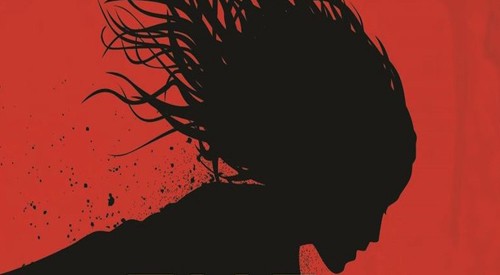
The Novel as Self: The Small Backs of Children by Lidia Yuknavitch

“Every self is a novel in progress. Every novel a lie that hides the self,” the unnamed writer central to Lidia Yuknavitch’s The Small Backs of Children tells us after cataloging a litany of personal traumas, disasters, and loves. The writer is conscious of the act of writing and aware of the reader, at times directly addressing us: “This, reader, is a mother-daughter story.”

But to simplify Yuknavitch’s novel to the writer’s prescription is to miss the wider picture. It’s important to remember how she speaks of the self: we are novels en media res, and this construction hides us, even as we create.

This is not what stood out initially when I read The Small Backs of Children earlier this month. My inability to fully understand what I had read weighed on me first. What seems like a straightforward, if not unusual, story based on the cover’s description is far more convoluted than any summary can explain. To start: there is a young girl — “no longer a child” — age six who walks into the snow a year “after the blast that has atomized her entire family in front of her eyes.” The girl observes a wolf chew off its own leg to free itself from a trap, and then “pisses” on the trap and the bloodied leg.

“This is how the sexuality of a girl is formed — an image at a time — against white; taboo, thoughtless, corporeal.”

And with this sentence, and the alarming image of an orphan creating and forming her perception of image, later art, at a site of violence, Yuknavitch lays out the thesis of her novel: life, sex, and violence collide to form something larger: art.

The nameless young girl isn’t the only practitioner. There is the photographer who takes the photo of the young girl escaping from her burning home: the photographer, an American, feels intrusive in a place where “none of this has made the news,” a stand-in for any number of recent conflicts in Eastern Europe. The photo will pass hands and gain the photographer recognition and awards, and fall into the hands of the unnamed writer — a former lover of the photographer. The photo resurfaces and unlocks the pain the writer keeps just below the surface — the birth of a stillborn child — dooming her to a hospital bed, lying depressed while she rests in the “vast whiteness” of memory and time.

The Small Backs of Children requires the reader to let go and give into the prose and story. Why do the writer’s friends so determinedly latch onto the idea of saving the young girl and bringing her to the writer? Once I had finished the book, I knew I had read something brilliant; I just could not quantify it, which is perhaps the wrong impulse. I read interviews with Yuknavitch, trying to read between the lines, and found something direct instead: Yuknavitch had had a stillborn daughter, which she addresses in her 2011 memoir The Chronology of Water. I read it, and the plot lines began to converge, so that I questioned who was the writer of The Small Backs of Children and who was the writer of The Chronology of Water?

While it’s an assumption to say that the writer is a stand-in for Yuknavitch, recall the writer’s lines: “Every self is a novel in progress. Every novel a lie that hides the self.” In that sense, Yuknavitch’s novel reads as the creative proof of her memoir: while she shies away from redemption narratives, she ends The Chronology of Water with this instruction: “Make up stories until you find one you can live with.” Yuknavitch’s personal journey towards that story — filled with “rituals of pain and pleasure” and art — is mirrored in her novel. The story of the writer’s friends uplifting her needs and caring for her in such a radical way is a brave act of family making. Yuknavitch notes at the end of her memoir that these families do not need to prescribe to any set heteronormative standards. It’s a serendipitous literary echo found in Maggie Nelson’s hybrid memoir The Argonauts, published this year by Graywolf press.

The Small Backs of Children is ultimately an examination of the spectrum of creation — whether of self or art — and how often creation can uneasily exist along with destruction.

The Small Backs of Children

by Lidia Yuknavitch

Powells.com

The Internal Adventures Of Urban Man As Murder Squad Detective: An Interview With John Burdett…

John Burdett is a British author whose vastly entertaining series of novels feature Sonchai Jitpleecheep, a half-Thai, half-American detective who bears the notable distinction of being the only honest cop in Bangkok. Featuring sardonic insight into both Thai and Western culture aplenty and plots which refuse to play by detective story rules, Burdett maneuvers us behind the eyes of Detective Jitpleecheep through Thailand’s City of Angels in all its durian-scented, haze-choked wonder.

The Jitpleecheep books are your antidote to the dumb Bangkok of Hangover II, the idealistic haze of backpacker legend, and the Orientalist exoticizing of a thousand forgettable pulps.

The latest Jitpleecheep book, The Bangkok Asset, was released this week by Knopf.

Court Merrigan: How accurate do you think your portrayal of the Thai milieu is? Is verisimilitude part of your aim? The language Jitpleecheep uses — I’m thinking of the numerous asides to “you, farang” — lend a certain authority to his view of Thai culture, cuisine, religion, etc. And then Jitpleecheep is himself half-farang. Would a Westerner debarking in Bangkok discover anything like Jitpleecheep’s world?

John Burdett: On the one hand I’ve been much encouraged by Westerners debarking in Bangkok and congratulating me on the accuracy of my descriptions. On the other hand, as a resident of the city with a Thai partner I am constantly reminded that my learning curve has not stopped climbing. Also, of course, Thai society is changing all the time. We tend to think of Western societies in a constant state of change, which is true to some extent but often exaggerated. On the other hand, the emergence from a Southeast Asian Buddhist Kingdom of the old kind into a modern state is dramatic and occasionally awesome. Then again there is the personality of Sonchai himself. He has one foot in both cultures and tends to describe one from the point of view of the other. This is deliberate. When asked I tend to describe him as Urban Man: he knows a great deal about the world from the Internet, is very smart, but has no political power himself and is at the mercy of forces — often criminal — beyond his control.

CM: So would you say you write “about” Thailand, the way Flannery O’Connor wrote “about” the American South, Ed Abbey the American West, Dickens London? Have many Thais read your work, and commented on your accuracy, as have Westerners?

I believe what I have done is adapt a stream of consciousness technique so that the city, the country and the man in the middle are all part of the same thing.

JB: I would not say I write ‘about’ Thailand — or anywhere else. To write ‘about’ somewhere is to use the very familiar subject/object approach. I believe what I have done is adapt a stream of consciousness technique so that the city, the country and the man in the middle are all part of the same thing. This is the inestimable advantage of first person narrative. Bangkok, in this context, is whatever is inside Sonchai’s head as he moves around. A literary type will immediately recognise a debt to James Joyce, which no doubt is true, but for myself I see this technique as a natural evolution from my interest in Buddhism, which, long before Joyce, pointed out that subject and object are an illusion created for the necessity of communication and survival. It is interesting, by the way, that this idea was first broached in the West by Ludwig Wittgenstein, a contemporary of Joyce, who was much influenced by Schopenhauer who was the first to bring Buddhist philosophy to the attention of the West.

Those Thais who read my books are of necessity fluent in English and therefore constitute a special class. They tend to fall into two categories: Thai women with long-term western partners, and Thai men who have been educated abroad. The first category tend to find my portrayals of Thai woman/Western man hilarious. The second are delighted by the extreme personalities of characters like Vikorn, whom they seem to recognise.

CM: Do you think Jitpleecheep’s ability to see into the past lives of others is a superpower? I mean, it makes sense in a Thai context where many are presumed to have the ability, but to the Western reader such a power seems quite otherworldly. If it’s not a superpower … what is it?

JB: In Buddhism there are no superpowers, there is simply an underlying reality to which we are largely blind. Because of his intensity and honesty Sonchai is able to lift the veil a little from time to time. He is certainly not fully enlightened but belongs to that category the Buddha called ‘enlightening beings.’ That is to say he is in the grip of an internal dynamic which reveals unexpected truths from time to time — at a cost, for he has still to survive in a humdrum and corrupt world ruled by the likes of Vikorn.

CM: I could pick out any one of dozens of Jitpleecheep’s asides, some of which have made me guffaw right into my coffee or bourbon (depending on the time of day), but this one has always stood out to me, from the first Jitpleecheep book, Bangkok 8:

There will be a massive shift of power from West to East in the middle of the twenty-first century, caused not by war or economics but by a subtle alteration in consciousness. The new age of biotechnology will require a highly developed intuition which operates outside of logic, anyway the internal destruction of Western society will have reached such a pass that most of your resources will be concentrated on managing loonies. There will TV news pictures of people fleeing from supermarkets and pressing their hands to their heads, unable to take the banality anymore. The peoples of Southeast Asia, who have never been poisoned by logical thought, will find themselves in the driver’s seat. It will be like old times, if your time line stretches back a few thousand years.

Anyone who’s ever stepped foot in a Whole Foods understands, I think! How literally are we take this aside? Clearly Jitpleecheep believes it, but should your reader?

In some ancient Buddhist traditions the fate of the small-minded was rebirth as insects.

JB: This is an amusing outburst by Urban Man as described above. Sonchai’s great resource is his humour and I think he keeps his tongue in his cheek during this harangue. But that does not mean he is not right in his analysis. With respect, I think you may have answered your own question here: Anyone who’s ever stepped foot in a Whole Foods understands. What will be the fate of a society committed to petty detail in the absence of any uplifting quest of the kind that drove our ancestors? What happens longer term when the great alluring horizons of yesterday have all shrunk to a shelf in a Wal-Mart? Surely nobody knows as yet. Like Sonchai, I would suggest the augurs are not good. In some ancient Buddhist traditions the fate of the small-minded was rebirth as insects. Or, one might support Sonchai’s reasoning by reference to history. Prior to modern times the best example of an empire governed exclusively by written law was the Roman. It was eventually superceded by the extremely fanciful, intuitive and organic medieval period best represented by St Francis of Assisi, who talked to birds and befriended wolves — and the troubadours of Aquitane.

CM: Thailand has certainly undergone massive changes since the Vietnam War; even since I first stepped foot in the Land of Smiles in 1998, the pace of change beggars belief. And yet, a core of “Thai-ness” seems to remain, from the ever-present scent of incense to the durian hawkers to the utter disregard for road safety. Is this because people who recall the old days just haven’t died out yet?

You still find Thai essence driving under the surface, even at the most sophisticated levels of society.

JB: Like any ancient society, including European ones, there is an essence at the center of the national character. A lot of the issues currently straining the European experiment can be understood as a conflict between national identity and the pressures of internationalism. Most Thais are not natives of Bangkok, even though they may work there, and come from a countryside where there has as yet been only minimal alterations in consciousness (despite that with social media and the Internet the pressure to change is high and despite the disruptions referred to in my first answer). You still find Thai essence driving under the surface, even at the most sophisticated levels of society. Also, Thais set great store by a feeling of well being (sabai) as opposed to the theoretical Western notion that: If I have a high enough standard of living I must be happy — right? Thais, still steeped in Buddhism, are likely to answer: Not necessarily, farang. My hope is that they will follow the Italian model by taking what they need from the new on an a la carte basis and keep the best of their traditions, especially the ones that make them feel good in the existential sense of the phrase, i.e. sabai.

CM: One of the best features of the Jitpleecheep books is the way concrete descriptions of Bangkok and environs stand side-by-side with Sonchai’s mystical experiences, such as his “superpower.” Seems to mirror the experience of being in Thailand to me. It also lifts your books out of strictly realist territory. How do you classify your Jitpleecheep books? Thrillers? Mysteries? Something else entirely? Or would you prefer to sidestep such classification?

JB: I don’t much like classifications simply because it seems to mislead people. From time to time a critic will complain that my plots do not follow the strict police procedural blueprint — there was one in the Washington Post years ago who seemed quite dogmatic about it and could not forgive my transgression. I need hardly say that to me this is incomprehensible nonsense and arises from the need to classify. If I had to put a label on the Sonchai series I would have to say something like “The Internal Adventures of Urban Man as Murder Squad Detective” — far too clumsy for a label I suppose but a tad more accurate that ‘police procedural’.

CM: I’ve often heard it said that books set in locales outside the United States stand little chance of gaining traction, yet each of the Jitpleecheep books have sold very well. To what do you attribute Jitpleecheep’s success?

JB: I have to return to my Urban Man theme. Sonchai reads the same news, follows the same stories, is interested in the same issues as so many other educated people today, all over the world. A struggling young person living alone or with a partner in a walkup in Brooklyn will have more in common with his counterparts in Bangkok or Buenos Aires than he does with a farmer in Arkansas or a millionaire in California. He also suffers from the same sense of ‘information without power’. I have received emails form readers in Latin America who say: Replace the Buddhism with Catholicism and you have my own home town, pollution and police corruption, overcrowding and heat included. I also believe there is a universalism in Buddhism that makes its central perceptions true and recognisable for everyone who takes the trouble to think about being alive.

CM: One of the critiques leveled at books featuring a recurring character is that the readers know that character will survive as long as the series does. What’s your method of building suspense and forward momentum in spite of this?

Maybe I transmit this schizoid tension.

JB: I think the critique is wrong. Readers demand that the central character live on to endure another trauma. Sherlock Holmes is a good example. Of course, he died in the end, but that was not the best episode. I think the whole point of this kind of series is the question in the Reader’s mind from the start of the book: How is he going to get out of this new jam? My technique is to make each jam very different, and probably more threatening. To be honest, as author I never know how I will extricate myself from the narrative headache I tend to give myself from the first chapter. I watch in disbelief as the subconscious comes up with the most amazing answers that, so to speak, I would never have thought of myself. Maybe I transmit this schizoid tension.

CM: At one point the movie rights for Bangkok 8 and other Jitpleecheep books were sold, but a world that could sorely use more Sonchai remains without a film version. Does the recent success of the radically unconventional MAD MAX movie give you any hope that Bangkok 8, very unconventional itself, will get made? Surely there’s room for more movies set in Bangkok besides the slapstick of HANGOVER II or the austere auteur’s vision of the city of ONLY GOD FORGIVES?

JB: The world of movies is a greater mystery to me than anything that happens to Sonchai. The options have been sold continuously for over ten years, presumably to people who intend to make a movie, but so far no one has managed it. I prefer to answer the question by confessing I keep my fingers crossed.

CM: How many more Jitpleecheep books can we look forward to?

JB: That would be telling.

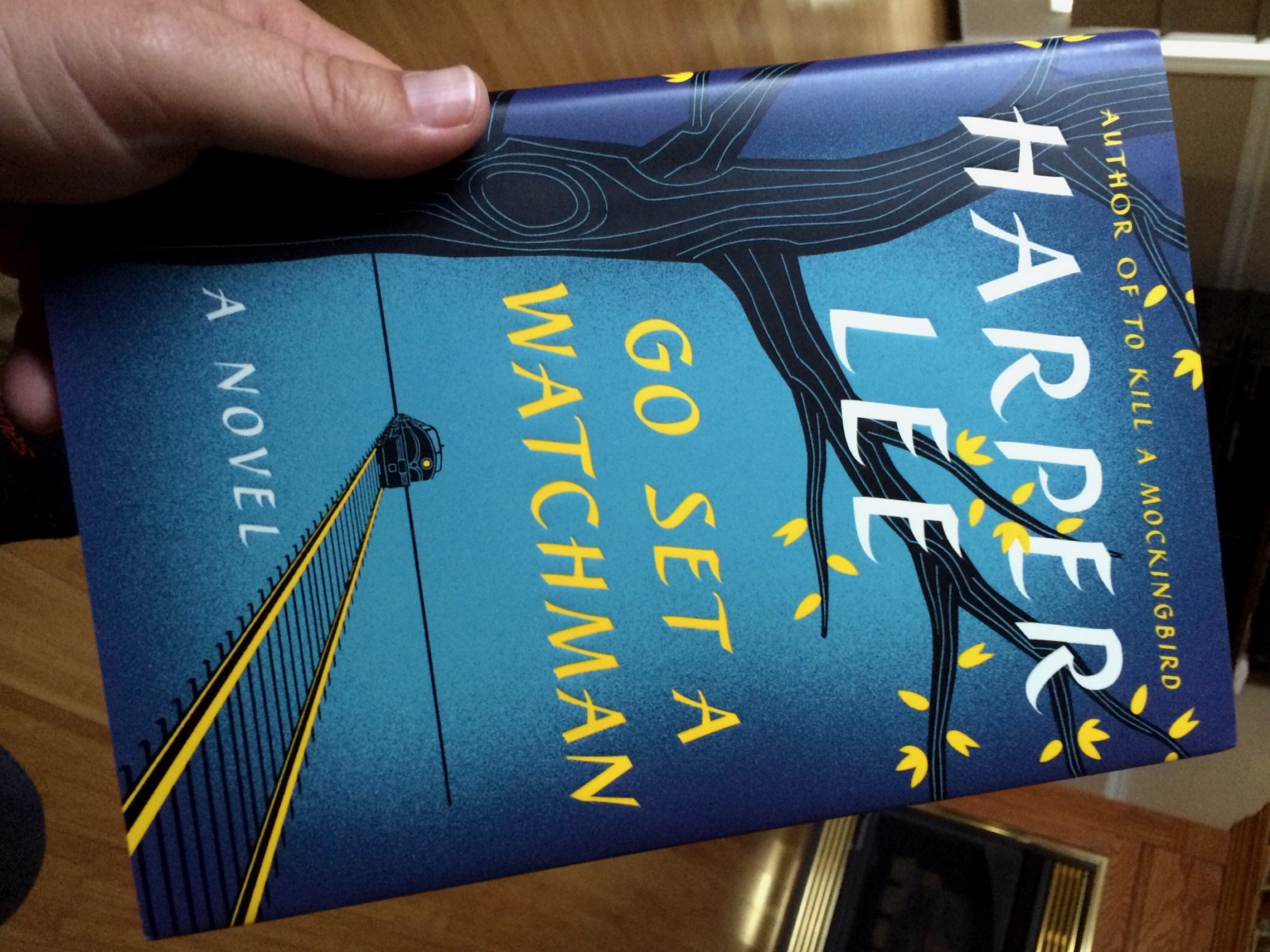
Should Go Set a Watchman Readers Get a Refund? One Bookstore Thinks So

In a move that other proprietors of independent bookstores might consider unthinkable, Peter Makin, the owner of Brilliant Books in Traverse City, Michigan, is offering refunds to customers disappointed with Harper Lee’s Go Set a Watchman.

The decision stems from Makin’s belief that, by marketing the book as “a nice summer novel” as opposed to an “academic insight,” he misrepresented the product and deceived his clientele. He writes, in a statement posted on the Brilliant Books website:

It is disappointing and frankly shameful to see our noble industry parade and celebrate this as ‘Harper Lee’s New Novel.’ This is pure exploitation of both literary fans and a beloved American classic (which we hope has not been irrevocably tainted). We therefore encourage you to view Go Set a Watchman with intellectual curiosity and careful consideration; a rough beginning for a classic, but only that.

Makin maintains that he and his team had been disappointed from the beginning with the way Watchman was marketed. He told Melville House, “We knew the history of Go Set A Watchman and it wasn’t congruent with the marketing: ‘Harper Lee’s New Novel’ ‘with many of your favorite characters from To Kill A Mockingbird’ … Maybe we’re cynical, but it all pointed to a desperate attempt to get folks to buy the book before they realized what it actually was.”

Some have taken issue with Makin’s argument. The Guardian’s Michelle Dean rejects the idea that a reader’s choice to buy Watchman was hampered by improper marketing:

[Watchman] always presented as a first draft of Mockingbird … The fact is that people wanted to read a new Harper Lee novel no matter what its provenance and no one truly wanted to get in the way of that … Readers bear some responsibility for that, I think. After all, the customers who now report being unhappy with the book still went into the store and bought it. And I can’t help but feel the reason they are wanting to return it has nothing, really, to do with a concern about exploitation or first drafts or literary merit at all … how many of these dissatisfied customers, I wonder, are especially angry or disappointed because of the unflattering portrait of an elderly, racist Atticus this book contained?”

Alex Heimbach, writing for Bustle, supports Makin’s logic:

Makin is hardly the first to point out the book’s complicated place in the literary canon, but his stand against ‘exploitation of both literary fans and a beloved American classic’ is impressive nonetheless. Although publishers are unlikely to stop putting out these kinds of lost books, perhaps Makin, and others like him, can convince publishers to be a bit more honest in marketing them.

Maybe so. But one can’t help but speculate that this news story, yet another log in the fire for the Watchman publicity maelstrom, will ultimately result in many more additional receipts issued than refunds given. Maybe even at Brilliant Books (now the subject of dozens of articles), which continues to sell the novel — albeit, with a disclaimer: “We do explain to folks what it is, so that they buy it with their eyes open.”

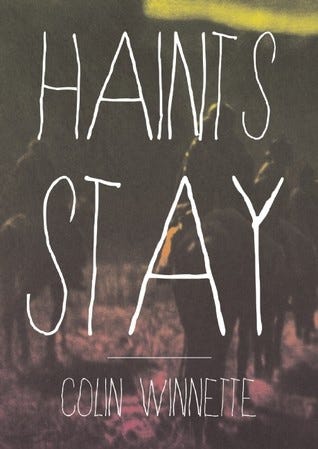
A Terrarium For The Imagination: A Conversation With Colin Winnette, Author Of Haints Stay

haints stay

The myth of the Old West still exerts an outsize pull on the American imagination, to both sublime and pernicious consequence. In Haints Stay, his fifth book of fiction, Colin Winnette doesn’t so much revise as remix the traditional Western, muting some elements while amplifying others to sometimes startling effect. He and I corresponded by email over the course of a few weeks about the new book, the tricky relationship between fiction and history, the compositional value of self-imposed restrictions, and the surprisingly astute depiction of our home state in Pee-wee’s Big Adventure.

Martin Seay: Your new novel, Haints Stay, is a Western. This seems beyond dispute — right from the first page we’re in a world defined by guns and gunmen, horses and the lack of horses, and wilderness scattered with outposts of human settlement — and yet its engagement with the tradition is idiosyncratic to say the least. It isn’t overtly hostile or reverential, but instead seems to use only what it needs; it doesn’t evince much interest in checking off genre boxes. The result is a pretty fundamental disruption of assumptions. In a weird way it reminded me of Sonic Youth’s approach to three-chord rock: We’ve heard this before, but not in this, um, tuning. So I’ll start by asking: Why a Western? Did you know it was a Western when (or before) you started writing it? The novel — like probably all worth-a-damn novels — has certain abiding concerns, and they seem well-matched to its genre, but which came first, the genre or the concerns?

CW: My best guess is that the concerns came first. There are a few things in this book that have appeared in every book I’ve written so far, in one way or another, so I guess I’ve been carrying around some of this stuff for a while. But all kinds of new questions and concerns cropped up while I was working on Haints Stay.

When I started writing, it was just Brooke and Sugar in the woods. I knew they were headed to a town, and my first thought was that the book would just follow these two characters as they were forced from one town to the next — and that’s what the book ultimately does. When I start a book, I’m looking for a setup that feels open. Fiction is one of the few places where I feel like my imagination can just take off and do whatever it wants to do, and I think my imagination is most articulate when it’s interacting with something, a set of rules maybe. Something other than itself. Any writer is working against or with a predetermined set of rules, whether we realize it or not, so I’ve always actively tried to set as many of the rules as I can on my own. I’ve talked about it elsewhere, but it’s an approach I pinched from the Oulipo, and from Jesse Ball.

Familiar touchstones inspire trust too, which makes it easier to play with expectations and get weird without losing folks.

I also have this idea that if you’re a reader or a listener or an audience member, it’s more engaging to watch someone else’s imagination interact with something familiar. Dreams are more interesting to hear about if you or some part of you is in them. It’s an easy trick to get people’s attention and part of why most movies and books are full of stock characters. Also why dialogue so rarely feels original or honest. Familiar touchstones inspire trust too, which makes it easier to play with expectations and get weird without losing folks. Which I like doing. This can be used to nightmarishly boring and depressing effect (Jurassic World), but not always (Twin Peaks, Jurassic Park). The Western genre gave me a set of rules to interact with that were interesting to me for a number of reasons, and familiar enough (without being culturally exhausted by the fashions of the decade, yet) to engage readers and keep them engaged when things got weird, hopefully. I also just thought it would be fun.

MS: It IS fun! And a bit harrowing at times! But it’s fun to be harrowed, right? It’s interesting that the Oulipo was an influence; I wouldn’t have guessed, but in retrospect I can see it. To the extent that the book seems to proceed according to its own inexorable, oblique, possibly non-human logic, Haints Stay has a vibe not unlike those of constraint-generated novels: Harry Mathews’ Cigarettes, e.g., or even Invisible Cities. What Haints Stay does NOT convey, at least for this reader, is the sense of moving amid clockwork that I get from a lot of Oulipian novels; it seems more fractal than circular, curving back but also spiraling outward in surprising ways. I think that’s cool. Can you say any more about the rules that shape Haints Stay? (I believe one of the precepts of the Oulipo is that one shouldn’t reveal too much about one’s restrictions, so “no” is an acceptable answer here.)

The Western is my instrument of choice for this bizarre concert.

CW: I can say this about the rules that govern Haints Stay: the majority of them are rules that many could argue go without saying. For me, though, it was important to think of them as rules. In my mind, it’s not a Oulipian novel, but it’s a novel that’s influenced by a Oulipian way of thinking. There’s an enjoyable tension, to me, in the novel taking place in a limited world. This isn’t sci-fi. This isn’t flarf. There are characters moving in a relatively set space, with comparatively few options as to how they might conduct themselves. And yet there’s a kind of chaotic energy behind all of that, pushing against the walls, sometimes breaking them down. If I’m interested in rules, it’s because I enjoy seeing them stressed, not because I enjoy seeing them articulated without interruption. I get very little satisfaction from that. It’s interesting you brought up Sonic Youth earlier. I was a musician for a long time, and when I was in college I was extremely interested in extended technique and noise. They opened a lot of doors for me, as far as how I thought about the world and art, etc. I hadn’t thought of it before, but now I think it’s fairly apparent in the book. The Western is my instrument of choice for this bizarre concert.

MS: Regarding the use of genre conventions to grab (and then mess with) readers, that is a great point. While I didn’t immediately pick up the Oulipo signal, Haints Stay DID remind me of a different set of mostly-European mid-century novels that use genre conventions to take readers into a kind of mythic or elemental space: nouveau roman takeoffs on thrillers — Duras’ L’Amante Anglaise, or Robbe-Grillet’s The Erasers — as well as Bataille’s even earlier Story of the Eye, which uses the rigid structure of pornography to explore the intrinsic hidden metaphorical weirdness of common objects and images. In Haints Stay, certain nouns (tooth, dirt, fabric, creature, etc.) recur, accrue significance, and almost seem to become characters in their own right. Am I way off-base in assuming that this framework of atavistic images is pretty closely related to the fundamental concerns that got you started?

CW: You’re not off base at all.

MS: Cool! That’s satisfying. You grew up in Texas (as did I), and when a writer from Texas publishes a Western, she or he can probably expect to field a bunch of questions about Texas. So let’s do this! You’re from Denton, which always struck me as simultaneously one of the most and least Texan of cities. (On one hand, it’s on the northern edge of the DFW metroplex — Larry McMurtry territory, the main locus of big-hair, big-oil, hat-and-boot culture — while on the other, it’s somewhat politically progressive, and home to UNT’s world-class jazz program, as well as a ton of mushroom-gobbling indie-rock bands.) Do you have deep roots in the state? Do you think the experience of growing up somewhere that (last time I checked) actually builds a bunch of Old West mythology into its public school curriculum made you any more likely to engage at some point with the Western genre? Now that you’ve been gone a while, what (if anything) about Texas stays with you, for better or worse?

CW: I was born and raised in Denton, like you said. My parents moved around a lot as kids, but eventually wound up in Texas, although I can’t remember when exactly. They met at UT in Austin; I know that. And they moved north some time after. That’s about as deep as my Texas roots go. Because they moved around a lot as kids, it was important to them that my sister and I stay put.

Like the Denton you describe, I was somehow both Texan and not at all Texan growing up. I was really ready to be done with Texas when I left for college, but it’s started creeping back into things slowly over time. But this book is really nothing like the Texas I knew. If anyone was concerned with verisimilitude, they’d be way better off looking at my other books, at least for anything coming close to my actual life in Texas. Even then, it’s a pretty warped representation.

Still, a lot stuck with me from growing up in Denton, but most of it was particular to Denton. I have the sort of small town smile-and-wave way about me, for better or worse. I grew up playing in bands because there were only about six things to do in Denton, like you said. I have the sort of Pee-wee’s Big Adventure sense of the rest of Texas. That scene when he shows up at the Alamo after all that time and it’s just a big piece of set dressing? That’s most of Texas to me.

MS: Yes! In a sense, Texas really CAN be a big piece of set dressing: a test case of where 180 years of believing your own bullshit will get you. The near-total lack of a verisimilar representation of the American West in Haints Stay was what struck me as MOST Texan about the book: the iconic blankness of its landscape, and the sense that everything can be erased and written over. (The few things that aren’t, like the spiral stairs in the burnt ruin of Jenny’s tavern in the opening pages, swiftly have their provenance forgotten.) There’s a great exchange early in the novel between Sugar, who identifies himself as “a student of history,” and his unnamed employer/adversary, who demurs that history is “slippery.” Without giving too much away, it’s the latter’s view that seems to prevail within the world of the book. Prior to reading it, I had assumed that the Western is always and inevitably a subset of the historical novel; Haints Stay — which, unless I’m mistaken, makes no reference to any real-world events or figures, even in passing — demonstrates not only that that’s not the case, but also that the desire to escape from history and into wildernesses of various sorts might be a MORE intrinsic aspect of the genre. (This goes for personal history as well as national history, of course.) Am I correct in taking history as one of the novel’s major concerns, expressed mostly through its conspicuous absence? Or am I looking through the wrong end of the telescope?

CW: We watched the Lonesome Dove mini-series for a week in my US History class. History has always been a fiction to me. Or maybe it’s more correct to say that I’m suspicious of anything that makes too strong a claim on historical accuracy, particularly in a novel, unless they’re using it to undo the very idea of even managing such a thing.

Typically, when I’m setting out to write something, I’m thinking more of what I don’t want to do than what I want to do. And I think “historical” novels are a little suspect. I’m drawn to works like Impressions of Africa that practically assault the idea of ever really being able to “know” anything, while both celebrating and stressing the imagination. By the same coin, I think it’s extremely important for us not to lose track of the past — of what we’ve done and how we got to be where we are. It’s not something I’ve fully settled within myself: my belief that what’s come before is an essential part of where we are and the fact that I’ve always felt completely dissatisfied with the way we think about and communicate history.

The world in this book is not the world we live in or have ever lived in.

What I do know is, the novel can be a terrarium for the imagination. The world in this book is not the world we live in or have ever lived in. I knew I wanted it to be similarly appealing, it needed to feel like our world at times… Or, more accurately, I wanted it to make readers feel — in the way that things in our world and stories of our world make people feel. I wanted people emotionally engaged in a real way. But any novel that claims to be “accurate” or close to what life might have been like during XYZ, any novel that claims to be anything other than an artful manipulation, is suspect.

MS: I found Haints Stay surprisingly moving, particularly as its characters stumble on these slippery questions of what to do with the past. The emotional impact is often ironic in the Greek-tragic sense: People get snared by their own blind spots, and certain silences become more and more deafening. One of the big ones is race: While the actual history of the American West is largely one of genocide, ethnic difference doesn’t seem to feature in the world of Haints Stay. I don’t believe that anyone’s ethnicity is ever specified in the book — its various communities are more concerned with the blurry divides between humans and “creatures,” civilization and wilderness — but there are hints that the reader ought to be thinking about such things, and maybe considering how patterns of ethnic violence are driven by individual impulses and confusions like those the book depicts. One such hint that I’m not sure how much weight to assign is the book’s eerie cover image, a 1904 photo of Navaho riders by Edward S. Curtis. Recognizing that authors typically get just about zero say in the design of their book covers, do you think that Two Dollar Radio’s design is a helpful interpretive aide, in addition to looking cool?

CW: I think if it helped you come to the thoughts you’ve just shared, it is an incredibly helpful interpretive aide.

MS: Speaking of Two Dollar Radio, they are — unless I’m mistaken — the fifth press you’ve worked with in your brief and productive career. Your previous books have been with Mutable Sound (Revelation, a 2011 apocalypse novel), Spork Press (Animal Collection, a 2012 bestiary), Atticus Books (Fondly, a 2013 pair of novellas), and Les Figues Press (Coyote, a sort of cubist domestic psychological thriller from earlier this year). The thriving indie-lit ecosystem seems to present a lot of prospects for building communities and working with a bunch of creative and committed people. How has this experience been for you? Have you found anybody’s editorial process to be particularly inspiring and/or nutty? Are there any presses out there that you haven’t worked with that are particularly impressing you with their output?

CW: Working with indie presses has been great. Like you said, they’re helmed by creative and committed people, and every book has been handled differently but with equal passion and care. For the most part, the editorial process was similar with each press. Les Figues stands out as being remarkably thorough. I couldn’t even tell you how many different people read Coyote and offered really attentive feedback during the proofreading process. It was interesting to have such attentive and engaged readers poking at every sentence, especially when the book is so full of ambiguity and strangeness and exaggeration and confusion. I had to defend every inconsistency or reality blur not only to myself but to a team of thoughtful readers ready to call me on my bullshit. It was really wonderful. As for other impressive indie presses, there are so many! There’s a relatively new press based in Dallas called Deep Vellum that’s putting out some really interesting (and beautiful) translations. Also, I’ve always loved Wave. Civil Coping Mechanisms has put out an astonishing number of solid books recently. I can’t imagine how hard they must be working. Coffee House has been killing it for the last couple of years too. Same with Graywolf. They’re both publishing some of the most important contemporary authors out there, and they’ve both managed to get a substantial national audience, which is extra impressive. They’re bridging a lot of gaps, and making room for translations and hybridity too. I could go on and on.

MS: And speaking of being productive… I have to ask, if you’re willing to answer: Have you been able to find homes for all of your finished manuscripts, or are there more of these still circling the runway, waiting for clearance to land? What does your writing/revising routine look like? What does your My Documents folder look like?

I spent way too much time picking at corpses when I was younger. These days, I try to go where the life is.

CW: Ooh, there are so many questions in this question! As far as manuscripts go, I’ve been lucky enough to find a home for every book-length work of literary fiction I’ve sent out — but I’ve thrown away a few book-length works as well without sending them out. If I get to the end of one and I don’t like it, I don’t really bother going back through it and trying to resuscitate it. I spent way too much time picking at corpses when I was younger. These days, I try to go where the life is.

My writing/revising routine is different with each book, but it involves writing a draft out to the end then making a list of things I might need to smooth out or make consistent. I read books aloud to myself. I share manuscripts with a friend or two, then I show them to my wife. She always gets the final read.

My Writing folder is an orderly mess of finished, unfinished, and broken work of different kinds. Lots of poetry I’ll never show you. Some that I will. A couple of kids’ books that kids will probably hate. A few longer works of fiction I’m picking away at right now. A bunch of ideas for nonfiction projects. I’m just… trying to keep myself interested.

MS: Finally, although you’ve already provided some great suggestions for further reading, is there anybody’s writing — or, hell, anybody’s work in any form or genre — that you’ve lately been obsessed with, envious of, or freaked out by?

CW: I’ll be honest, Martin. I’m having some trouble right now. I go through lulls… not for lack of incredible work out there. It could just be a mood thing, how receptive I am at a given time. I haven’t been hit, like really hit hard, by anything in a little while. I just finished Margarita Karapanou’s Rien Ne Va Plus, which I liked quite a bit, and I’ve talked elsewhere about a few books that excited me earlier in the year. But right now, at this very moment, I’m hungry for something I haven’t found yet. Ask me again tomorrow?

Midweek Links: Literary Links from Around the Web (August 5th)

Looking for some interesting reading to get you through the week? Here are some literary links from around the web to check out:

This will probably be baaaaahhhd, but someone is putting on a production of King Lear with sheep

A long lost F. Scott Fitzgerald short story has been found and published

Can writers write about ethnicities other than their own?

Ta-Nehisi Coates writes about 10 books he couldn’t live without

Jeff VanderMeer argues that Brazil’s Clarice Lispector is as much a genius as Vladimir Nabokov

Horror is still struggling under the dark shadow of H.P. Lovecraft

How women writers struggle for shelf space

Ten books you should stop pretending you’v read and actually finish!

How literary sexy talk has changed over the decades

Does the publishing world require too much socializing? One “introvert” writer thinks so

An Animal in Winter

by Annie McGreevy, recommended by Nouvella

Excerpted from Ciao, Suerte

Children on the street in Rosario with Alejandro’s white skin and floppy hair. A pre-adolescent volunteer at the hospital with Sabina’s languid gait; a girl on television, competing in Odol Pregunta, with her posture. Sometimes Beatriz spends hours watching boys play soccer to see if any of them have her son’s wooden legs or if their little faces redden with as much intensity as his did.

Children all over Argentina, it seems, who might be Beatriz’s grandchild. There are hundreds, maybe thousands.

In 1990, she is at the Monumento de la Bandera when she sees a group of schoolchildren playing and a teacher trying to wrangle them into line to return to school. Out of habit, she scans them quickly with her eyes, but none of them remind her of her son or daughter-in-law. Then from behind her she hears Alejandro’s voice as it was when he was a child — throaty, high, full of urgency and mischief.

Espera!” the voice calls. Wait up!

Beatriz spins around. A girl with dirty blonde hair is yanking her sagging knee socks and jogging to catch up to the group. She has an overconfident smile like the one Alejandro wore on his face until the day he was killed, probably, and the resemblance is so arresting that Beatriz actually reaches out and grabs the girl’s arm.

“What is your name?” she demands. The name won’t do her much good, Beatriz knows — she just wants to hear the girl’s voice again. The girl looks startled, but otherwise unafraid. She eyes Beatriz with an air of conspiracy, as though she likes this old woman’s boldness, and this — the fact that the girl seems begging for danger — is further reason to believe she could be Alejandro and Sabina’s daughter.

She sticks her tongue out at Beatriz. A teacher appears.

“What do you think you’re doing?” the teacher says as she pulls the girl free of Beatriz’s grip.

Beatriz opens her mouth to respond, but the teacher interrupts.

“Go with your sister,” she hisses to the girl. The girl slinks off and falls into line with another nearly identical to her; taller though, with the awkward hips and lumpy sweater of a body already playing a game of give and take with puberty. Impossible that she is Beatriz’s granddaughter then, as Sabina’s pregnancy when she was abducted was her first. And only. Beatriz mumbles an apology to the teacher and walks away.

There were other incidents before the girl at Monumento de la Bandera.

1984: Beatriz reads an article in Clarín in which General Ramón Camps tells the newspaper that he orchestrated thousands of murders and kidnappings. About the appropriation of newborns, he says: Subversive parents raise subversive children. Beatriz’s hands shake as she reads it, rage filling her. A system that she has never respected has killed her son for using his brain. For joining a group. For learning. All things Beatriz had encouraged him to do; things her own father had encouraged her to do. And now here was Camps talking — no, bragging about it on TV and in the newspaper. Alejandro and Sabina never killed anyone. They weren’t criminals. All they’d done was join a group. After reading the article, Beatriz gets into bed and doesn’t get out for over a week except to use the bathroom. The only other time she was still for so long was when she’d had her wisdom teeth removed as a teenager and her father said, Think of it like four separate gunshot wounds inside your mouth. That’s what you’re recovering from. Then he smiled. Time to take a break from talking, he’d teased. This is the same, Beatriz thinks now, thirty-five years later — it’s like bleeding inside my own head. But this will never end.

1985: Beatriz submits a blood sample to the Grandparents’ Index. The Madres y Abuelas de la Plaza de Mayo have support from abroad. They have powerful lawyers. Geneticists have taken an interest in their cause. They have found some adopted children of the disappeared and returned them to their biological grandparents. Beatriz is hopeful, and the hope pulses through her veins like a drug.

1986: Beatriz’s husband Giancarlo increases his campaign to try to convince her that their grandchild was never born. The man who never gets angry loses his temper with Beatriz one night after dinner. “You were a nurse!” he booms. “Don’t you know? They tortured her before they killed her. Pregnancy can’t withstand that!”

Beatriz knows he’s trying to spare her more pain. She knows he could certainly be right. But she can feel the slightest whisper of intuition telling her the opposite.

1988: Alejandro and Sabina are officially declared dead. Tell me something I don’t know, Beatriz thinks.

One more low after the incident in the art museum:

1992: Giancarlo leaves Argentina for Italy, something he’s been threatening to do for nearly thirty years. He tells her he’s going one night as they lie in bed. “I can’t stay here anymore,” he says. “I’ll die.”

“We’re dying anyway,” Beatriz says, though they’re not very old and have no real health problems. A cruel trick of nature, she thinks after their annual doctors’ visits. Maybe we’ll live forever. Maybe we’ll outlive the grandchild and its grandchild and the next generation of holocausts.

“Don’t you want to at least stay in our country?” Beatriz thinks that if their neighbors overheard them, they would think the two of them were discussing the weather, so drained of energy are their voices.

“It’s not a country anymore. It’s nothing.”

Beatriz stares at the ceiling. She has been living in this house for almost forty years, since she married Giancarlo. On so many nights, she has watched him sleep soundly beside her while she stayed up fretting: when Alejandro was just a baby, colicky and scrawny and refusing her milk (he had to do things his way even then); when she miscarried their second and third and fourth babies; when Alejandro met Sabina and would disappear with her for weeks at a time, coming back skinnier and skinnier and spouting off Che Guevara and Marxist-Leninist ideology; when the two of them took up with the Montoneros. And tonight, too, her husband is warm beside her, with this decision he clearly made some time ago. He can see a life for himself across the ocean, Beatriz thinks. A life of safety and forgetting. A life in which Alejandro’s picture is not on the mantle, in which he’ll never hear his wife wake up in the night saying his dead son’s name. The beginning of a new life for Giancarlo, and surely the end of something, but of what?

They’d first seen each other at the hospital when Giancarlo was finishing his residency. He’d been doing a round of night shifts in the pediatric ward, and there, too, was Beatriz, a nurse from a fine family. The rumor was that her father had raised his daughters like boys, had allowed them to go to university, taught them to shoot rifles in the country, and had even gotten Beatriz a job at this hospital. She was tall, handsome. Not exactly beautiful. A strange femininity that he couldn’t put his finger on. He got into the habit of watching her study her charts, which she did with as much concentration and consideration as if she were the doctor. She was a conscientious assistant, her movements swift, exact. One day she assisted him when he performed an appendectomy on a teenage girl, and her presence had made him more nervous than the director’s had. But it wasn’t until they ran into each other at the tennis courts one morning that he formally introduced himself. The jacarandas were in bloom, everything smelling of lilac, and fallen purple petals had been swept to the sides of the courts. They’d make a good match, he knew, but as he began courting her, the intensity of his attraction surprised him. She seemed older than she was, like she had made her peace with the complexities of life, and he liked talking to her and listening to her. Best of all, in those first months, there would be times when he would forget what she looked like; he would search and search in his mind, but not be able to put together a face for her, not exactly, so every time she appeared it was like seeing her for the first time, each occasion a new pleasure.

Their engagement had been short and their wedding formal. Soon after, even before they found their rhythm as lovers, Giancarlo began to feel that Beatriz was an extension of his body, like there was something inside of her, just underneath her skin, that he needed every day. He could get it from standing next to her or looking her in the eye, hearing her voice. And her laugh — she laughed so loud when they were alone.

Giancarlo is thinking about that laugh now, how he hasn’t heard it in decades, as they lay silently next to each other. He approaches it intellectually, because that’s how he approaches everything. Sure, she still laughs. It just isn’t like it used to be. When did he hear it last? Maybe when Alejandro was a teenager, comedic in his angst and over-seriousness? Maybe when Ale had met Sabina and joined the group and they would make jokes about it all to mitigate their worries? Giancarlo would like to put his finger on a date, an event, but he can’t. He looks over at Beatriz, but she’s closed her eyes.

They’d gotten pregnant right away, and her pregnancy with Alejandro had gone smoothly. He’d been a cranky baby, but by the time he was two they were ready to try again. Getting pregnant didn’t seem to be their problem. They’d always conceived within two or three months of trying. But when, six weeks into her second pregnancy, Beatriz bled so much she thought she was surely dying, she was devastated. They knew this happened all the time, that it was normal, even, but it still undid her. Giancarlo was there to soothe her. Half of being a good doctor, his mentor had told him, was having an organized mind. He’d arranged for his mother to take Ale (as they were calling him then) and he stayed home with Beatriz for three straight days, doing the cooking, holding her, all the while delivering kind, authoritative reminders that there was nothing wrong with her, that they would try again, that Ale would be a big brother soon enough.

The second time had been similar. Six weeks, the bleeding starting in the middle of the night, Giancarlo calm and Beatriz in pieces. She was twenty-nine and Ale was in school.

But the third one. It was something out of a horror movie. She was five months pregnant and it was at a doctor’s appointment that they realized there was no heartbeat, and that even though her belly was continuing to swell, the child inside her had been dead for days, maybe even weeks. Giancarlo had been devastated, but the humiliation he felt at not noticing the absence of movement when he put his hand to Beatriz’s belly three, four times day, was worse. They’d had to induce labor to extract the fetus, and while Beatriz was under anesthesia, Giancarlo had stayed in the room. He saw the fetus, half the size of a newborn baby, but fully formed, with purple bloated skin. A girl. She wore an expression that was half anguish, half disgust, as though she had fought whatever force that had tried to end her short life and died disappointed he had not done his part, that he had not understood how to save her.

The gynecologist who performed the procedure asked him if he wanted to hold the dead child, and he’d accepted only because he was speechless. The moment he spent with her in his arms was the most alarming of his life. It drove his own mortality into him worse than the death of his father would a decade later, and for months afterwards he directed his life with the intuition of an animal in winter.

It took Beatriz much longer to recover. By then, Ale was a chatterbox, a know-it-all with weak hand-eye coordination, exercise-induced asthma, and a penchant for memorizing things. For Beatriz he would perform the list of all the dinosaurs he knew, for Giancarlo every major city in Italy, all the bones of the body, the periodic table of elements, the names and statistics of every football player from Rosario, from Milan, from Saõ Paolo, and on and on and on. Giancarlo poured his energy into the boy, helping him with his homework, teaching him tennis, developing exercises for him to improve his athleticism and to alleviate his asthma. A year after the miscarriage he knew they would not have another child, and his love for Ale grew wilder. He became overprotective, proud of things that were not achievements. His only heir. The tragedy stripped him of his reason. He was more in love with his son than he had ever been with his wife.

Soon Beatriz was ready to try again, but by then Giancarlo had a plan. He learned her menstruation and tracked it on a calendar he kept in his locker at the hospital. It was simple. He didn’t initiate lovemaking, and gently rejected her advances when it was possible for her to get pregnant.

Soon, Giancarlo was attending conferences in Europe two, three times a year, and Ale had grown into a surly teenager who talked relentlessly about national politics, a topic Giancarlo found distasteful and fit only for dilettantes and armchair intellectuals.

The boy kept changing, growing angrier and less and less like himself. Giancarlo wanted to be mad at him, to be disappointed even, to threaten him. But he never could. He turned into one of those men he used to pity, hopelessly in unrequited love with a careless person. But Giancarlo never gave up hope that all of it — Sabina, dropping out of school, joining the group — was just a phase, and that soon enough he’d grow out of it and into the man Giancarlo wanted him to be.

The problem, Giancarlo thinks now, as he turns off the lamp on his nightstand and turns his back to Beatriz, is this country. With its dictators worse than those his parents had left Italy to escape. It made scrambling fools of even the best men. It turned women like Beatriz into — what did she think she was? A private investigator?

Once you knew the problem, the solution was never far behind, and the exactness of the solution to the problem of Argentina and Beatriz finally relaxes him: Valentina, Italy. A distant cousin of his he’d first made love to at fifteen. A trail of embarrassing divorces and dysfunctional children had unraveled behind her in the fifty years since. He’d gone back to her every now and then out of curiosity or stress or pity. He used to regard her as desperate, even pathetic. But sometime after her final divorce, the same time he retired and found himself staring across the table into Beatriz’s intensity far more often than he cared for, he began to see her as a way out. There was something comforting about her vulnerability, her self-deprecation. A peace to the low stakes of her life. She had been making room for him in her place in Bergamo for the past year, since they began making serious plans for him to leave.

He closes his eyes. Valentina, he says in his head, like a prayer. It will be good; it will be fine. He has come to the end of the line with Beatriz, with Argentina. But now everything must rearrange itself inside his imagination. Now it will be Valentina he lives with, sleeps with, touches every day, sees with her hair wet. And it will be Beatriz who exists only in his mind. It was a painful adjustment to relegate Alejandro to that space. The most difficult thing he ever had to do. But there is no room in his imagination for this mythical grandchild. Now, at the very least, Beatriz’s obsession with finding it will cease to infect the last years of his life. Giancarlo doesn’t want there to be a child — he hasn’t wanted there to be one for years. He just wants to start over.

“I want you to come with me,” Giancarlo says. But he doesn’t turn to face her. The invitation is a gesture. He knows that she’ll never leave Argentina until she finds the child.

And then — unexpectedly, miraculously — she does. It’s 2003. Beatriz is seventy-two years old. She is aging slowly, to her disappointment. She is sitting in her apartment when the phone call comes. It’s Mariela, the head of the Madres y Abuelas. A boy in Patagonia has been tested, and he is a match for Beatriz. They’ve found her grandson.

Un niño,” Beatriz says. All this time, she’d never been able to guess the child’s sex with any certainty. Imagining a girl, imagining a boy, always felt wrong.

Un niño?” Mariela’s voice sounds harsh over the phone. “He’s twenty-three years old.”

“I know how old he is,” Beatriz says hastily. “Where is he? When can I see him?”

Tranquila,” Mariela says. “We have his information, and we’re going to give it to you. But you have to be patient.”

“I’ve been patient for the last two decades. I want to see him.”

“It’s complicated. He didn’t consent to being tested — he didn’t even know he was being tested for anything besides steroids — and his parents have no idea. He’s an amateur athlete.” Mariela sighs from her desk in Buenos Aires and Beatriz presses her.

“What? How did you find out then? How can you be sure?”

“An Abuela working here at headquarters was sure a boy on the National Polo team was hers. She was wrong. But the entire team’s samples were tested and run against the Grandparents’ Index. That’s how.”

Beatriz can’t catch her breath. She stops pacing around her apartment and sits down at the dining room table. “What does this mean? Can I meet him?”

“I can’t tell you any more over the phone. Can you come to Buenos Aires?”

A few hours later, Beatriz is in Mariela’s office, a bag packed. She plans to leave Buenos Aires for wherever the boy — man, she corrects herself — is.

What they did was illegal, Mariela begins. They had to pay their way out of it. Luckily, the assistant coach, whom the Abuela had bribed in the first place, was able to be bribed again, this time for Beatriz’s sake. The organization was, of course, committed to the justice of reuniting grandparents with their biological grandchildren. But if Beatriz wanted to show her gratitude, a donation would certainly be appreciated.

For more, read Electric Literature’s interview with Annie McGreevy.

Suppression, Solidarity & Language In the Ukraine

Translated from the Ukrainian by Jennifer Croft

There’s a café in downtown Lviv near the Armenian church that takes its customers back to the 1980s: little tables on wobbly legs, cakes covered in bright buttercream frosting flowers, then-fashionable liqueurs lined up above the bar — not to mention the unusual way they have of brewing coffee. The woman at the bar taps out sugar and organic coffee into a special little long-handled pot to which she then adds water. Next she sets the pot atop a very anachronistic-looking contraption, a box in which tiny iron filings are heated up on a very low current. Paying absolute attention, she keeps the pot on the device until exactly the right moment, when she stirs its contents with a thin wooden stick. She meticulously monitors her clientele’s movements once the coffee’s served, delivering well-timed instructions to stir again or to pick up the little pot, or, finally to pour it into the little cup. The coffee’s foam must increase threefold before it can be considered ready.

It was here, in “the Armenian,” that the city’s bohemians would gather in the ’70s, ’80s, and part of the ’90s.

The particular flavor of this coffee is held dear by several generations of Lvivians. It was here, in “the Armenian,” that the city’s bohemians would gather in the ’70s, ’80s, and part of the ’90s. In those internetless days it was important to have a meeting point where you could regularly cross paths with key people — every day, if you wanted — and inform them of something, discuss something with them, or just sit and have coffee with them.

Just a little further down on the same street you’ll find Dziga, the first and still the most successful Lviv institution engaging in the business of culture. Every day Dziga hosts concerts, readings, exhibits, or just the regular get-togethers of book clubs and writing groups. It’s all so much more civilized now, deprived of its former wild Soviet charm, today only extant in the reminiscences of old-timers over coffee or a glass of wine.

Back then, too, at “the Armenian,” the little pot was delicately placed in iron filings, and the coffee was stirred with a little wooden stick and poured inside tiny white porcelain cups customers would take outside, setting them on the broad sills of the sturdy medieval buildings as they smoked and talked. Accustomed to this ritual, the waitresses would eventually come out to collect the empty cups and noiselessly ferry them back inside.

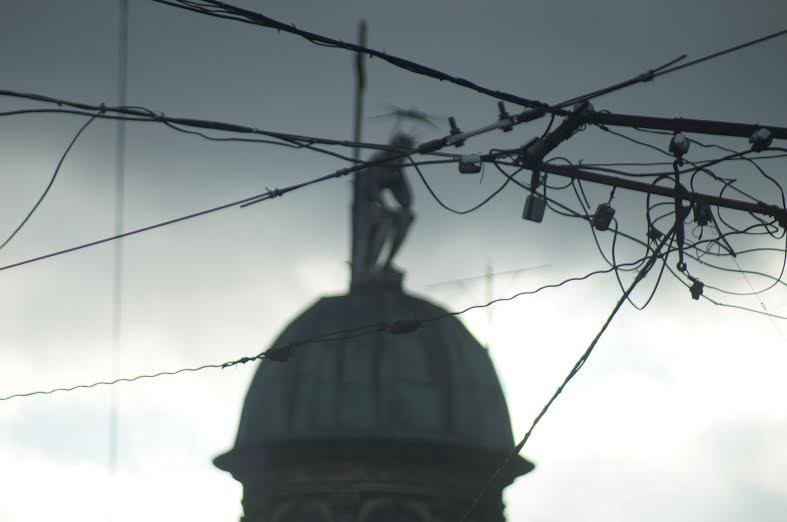
Sniadanko 4

The women behind the bar were always very important people here. They’ve been written about in novels, turned into TV shows, and had gigabytes upon gigabytes dedicated to them online. Now “the Armenian” has long since lost its role as social framework, frequented today by pot-bellied sexagenarian granddads who come to drink coffee with cognac, as was the fashion in their youth, and by ladies of the same age who chat over coffee and pieces of highly calorific, and similarly nostalgic, cake — and by tourists and TV crews. The women at the bar don’t allow anyone to take their picture — they’re famous enough as it is among tourists and on Facebook and Twitter. Their contemplative process of brewing coffee, on the other hand, may be filmed ad infinitum — though there always comes a point where the women can’t stand it anymore, breaking up the cameras as though their presence might interfere with their beverage preparation technology, which they will not have damaged for the sake of a pretty picture. “The Armenian” is said to be the last café of this style.

Sniadanko coffee

Ukrainian literature — or Ukrainian culture more broadly — employs the words “last” quite often: last territory, last bastion, the last issue of a magazine, the last books of a bankrupt publisher, the last Ukrainian-speaking readers, writers, translators. There is a well-known contemporary classic, a collection of essays by one of Ukraine’s best-known authors, Yuri Andrukhovych, called My Last Territory; there is an art management agency called Last Bastion. Because Ukrainian literature has been aware of being in a sort of intellectual ghetto at least since the 1920s, for a long time there was a program on local radio called “Music from the Ghetto.” Ukrainian literature had kept pace with all the European trends and traditions, arriving at modernism right on time in the early ’20s, but with the advent of Soviet rule in eastern Ukraine, intellectuals began to be shot and then slaughtered en masse, particularly writers, many of whom actually lived on the same street in a kind of cozy little writers’ colony in what was then the capital city, Kharkiv — a city now located just a few dozen kilometers from the Russian border, so that these days its residents wake up every morning and flip on the news to find out if the Russian invasion is underway yet or not.

With Russification, the Ukrainian language was reduced in the popular imagination to a “dialect” of Russian, unable to function on its own in the cultural sphere.

But in the ’20s, while Ukrainian intellectuals in the east were being murdered outright, Ukrainian intellectuals in Galicia — in western Ukraine, belonging to Poland at that time — were suffering from Polish persecution. Bans on the use of the Ukrainian language — both spoken and written — had been in effect for some time in territories annexed by the Russian Empire. In western Ukraine there had been no such prohibitions, but nor did the Ukrainian language ever have a chance to become a language of education and culture, or politics, or business. It was, nonetheless, the mass exterminations of Ukrainians, first and foremost of Ukrainian artists, that dealt the biggest blow to Ukrainian culture, along with forced Russification throughout the twentieth century and continuing into the twenty-first. With Russification, the Ukrainian language was reduced in the popular imagination to a “dialect” of Russian, unable to function on its own in the cultural sphere. An impoverished, ignorant, provincial discourse was artificially cultivated in Ukrainian literature, while more contemporary or cosmopolitan topics were condemned or banned. Even today the same false principles determine the selection of which Ukrainian books are to be read in schools. The field of Ukrainian linguistics was totally destroyed in the Soviet era, Ukrainian dictionaries undermined as words that had no direct equivalent in or obvious etymological similarity to Russian were simply discarded, replaced by blatant calques.

Sadly, this suppression of Ukrainian culture is still ongoing. The Soviet tradition of labeling all things Ukrainian as “nationalistic” is deeply rooted, and even now it is employed by Russian propaganda. Any attempt to protect the rights of the Ukrainian-speaking population is automatically seen as an infringement upon the rights of the dominant, Russian-speaking population. Such efforts, then, are dismissed out of hand. This creates a bizarre situation in which on the one hand Ukrainian men are being mobilized to fight a war against Russia, while on the other Ukraine continues to be dominated by Russian and Russophone culture. Russian and Ukrainian are used seemingly interchangeably on television that is officially Ukrainian; the apparently indiscriminate use of Russian without the provision of translations requires that Ukrainian audiences be at least bilingual.


The first Ukrainian publishing houses came into being right after Ukraine gained independence in 1991, but they mostly published classics of world literature that had been banned in the USSR, and mostly in Russian. Very occasionally they’d do a classic of Ukrainian literature taken from the school curriculum. Contemporary Ukrainian literature was barely published at all during this period. Any volume of new Ukrainian poetry or prose that did get published became a big event — not only because these works were of astonishing quality, but also because of how infrequently even amazing books were getting printed.

Many publishers are going out of business, and those that linger are still unable to permit themselves to publish debut authors…

After the Orange Revolution of 2004 there was a brief thaw, and a fashion for contemporary Ukrainian literature. The publishing industry picked up, and dozens of new names appeared. Aside from the biggest — although let’s face it: the only — Ukrainian book fair in Lviv, other, similar events were established in other cities. But the last few years, unfortunately, have seen a return to the harsh literary realities of the ’90s. Many publishers are going out of business, and those that linger are still unable to permit themselves to publish debut authors, opting instead and exclusively for famous names that can guarantee them sales.

To the above particularities of the Ukrainian book market we should also add the very high rate of piracy. Within a few weeks of its arrival in stores, any even moderately famous Ukrainian author’s book will turn up online, its contents available in their entirety for free. Pirate sites actually claim to support the Ukrainian language, and the vast majority of people who download these books really do believe that they are supporting Ukrainian. The rest do it because they have no other option: bookstores exist only in big cities, and even then, their selection is often considerably more limited than that of pirate sites.

And despite the military operations in eastern Ukraine, it is an essentially Russian cultural product, most often openly anti-Ukrainian, that continues to dominate the Ukrainian cultural market. Thus far, the Ukrainian government has also failed to make any even remotely convincing attempts at defending its own culture, despite the fact that a special Ministry of Information Policy was even created expressly for this purpose.

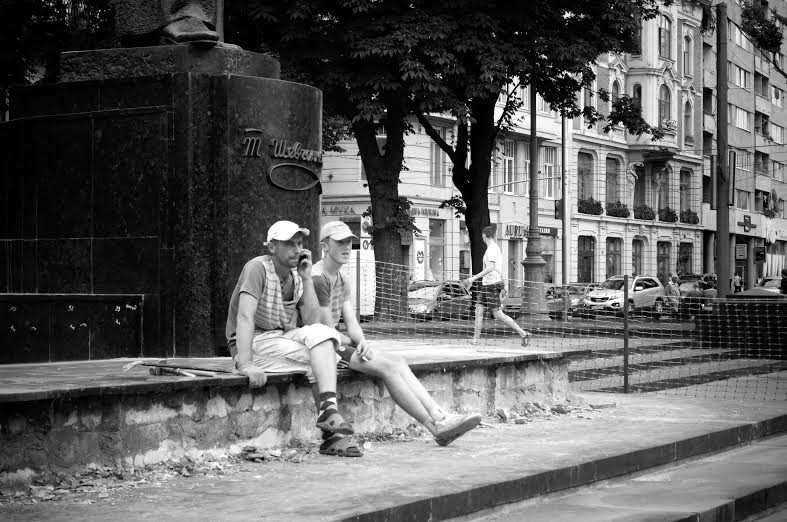
Sniadanko 2

Ukrainian media outlets — and not only the Russophone ones — are mostly Russian-owned, which results in the domination of their content by Ukrainophobic propaganda. The lion’s share of books sold in Ukraine are produced in Russia and imported into Ukraine duty-free, but most of these are also in Russian, especially commercial titles. The exceptions to this system — few, highly intellectual — merely prove the rule. Yet it is this intellectual niche and its intellectual production that earn recognition outside of Ukraine. This typically occurs without the participation of the state, on the initiative of foreign partners. Ukrainian writers are the people foreign commentators turn to first when Ukrainian politics become bewildering, and Ukrainian writers frequently take place in various roundtables abroad as provisional experts on everything, since, as opposed to Ukrainian officials, these writers are educated, speak foreign languages, and are able to articulate their own ideas and paint an informative picture of the state.

Sniadanko 5

Writers in Ukraine are usually political — often passionately so. When on November 30 of last year the first battles began on Kiev’s Maidan, I heard about it from the Facebook page of a friend, the writer Svitlana Povalyeva. Her post appeared barely thirty minutes after students were first beaten at 4:00 am. Only later did journalists’ and politicians’ posts begin to flood the internet. Svitlana and her husband and their two sons remained on the Maidan for all three of the ensuing months, from the first to the last day. Her son immediately volunteered for the army; he is now fighting in eastern Ukraine. Svitlana’s is not a unique, or even atypical, story.

Writers collect money for the army, for displaced persons, and for the wounded, organizing charitable reading tours in the eastern territories and in the ATO zone, as well as signing up for the army themselves. Whether they volunteer or are drafted, there are a number of writers in the east now writing very good literature inspired by their experiences, which they often publish in fragments over social media. I would love for them to come home and become the Ukrainian Remarques, Dos Passos, Hemingways.


Ukrainian literature is not only divided into Ukrainian-language and Russian-language, pro-west and pro-Russian, but also into official and independent. Official literature is produced by a sizeable state-sponsored Writers’ Union, which has central and regional offices with different facilities, staff, their own media channels — even resorts of their own for their summer vacations. But the literature of its members often exists more hypothetically than it does in actual fact. As a rule, its aesthetics are those of socialist realism — a holdover from Soviet times. These writers periodically receive government awards — officially for books that can’t be found in any bookstore, unofficially for being somebody’s relatives, colleagues, friends. They run the regional Writers’ Unions, get together for conventions, even publish the occasional newspaper — every so often, even a book. These papers and books rarely reach any readers: print runs are miniscule, and the books are essentially intended to serve as gifts for the same government officials who give out the awards.

Independent Ukrainian literature, meanwhile, makes do without any state support — no grants, no official organizations, no conferences, no awards, and no subsidized publications. There are no public or private programs to support independent Ukrainian writers and operating according to fair and transparent criteria; there is no program to represent Ukrainian literature abroad (as there is in most European nations); there is no institution for the protection of copyright. If a Ukrainian author is translated into a foreign language, it is usually the result of a happy coincidence, and of the efforts of self-driven, enthusiastic individual translators.

‘Professional’ writers who live solely off the work they publish in Ukraine simply do not exist.

I am often asked abroad how Ukrainian writers earn a living, given that there are no grants or awards or honorariums for readings or participating in festivals, and that payment for books with print runs in the tens of thousands is a few hundred dollars at best — payment for newspaper columns often comes out to less than fifteen dollars, if they pay at all — and I honestly never really know how to answer this question, except to say that somehow everything always ends up working out. For now, at any rate. Of course there are exceptions, and many people do give up on writing. Many emigrate. “Professional” writers who live solely off the work they publish in Ukraine simply do not exist. The lucky few not forced to earn their living through means other than writing do so thanks to foreign fellowships, residencies, and honorarium.


Really not having any way out seems to have a strange effect on literature. For the most part, it results in the pessimism you might expect. But sometimes unexpected things occur. For example, the remarkably active participation in literary events by the general public. Especially in the Russophone eastern regions of Ukraine — especially, in other words, in places where Ukrainian books are scarce. There is an unexpectedly high level of interest in Ukrainian culture on the front. Books often show up on army requisitions, and in fact writers often finance the acquisition of books for troops themselves.

I recently heard from one of those few publishers still in business that there is a new “trend” in Ukrainian publishing, namely, the translation into Ukrainian of world literature. This same publisher had previously claimed — like most of his colleagues — that translations into Ukrainian would simply never sell. And even more amazingly, publishers have become interested in contemporary — rather than classic — world literature. Most surprising of all is the fact that these translations appear to be immune to piracy. Although perhaps it’s not that surprising after all when you consider the low level of erudition on the part of the pirates.

Ours is a form of proletarian solidarity, but it is powerful and reliable.

The objective absence of a literary market, and with it the absence of any commercial motives, has had a surprisingly positive impact on Ukraine’s literary scene. For the most part, Ukrainian writers not only know each other, but are also genuinely friends, actively promoting and supporting one another. The infrequent conflicts between them are generally over political differences, unlike in other countries where petty jealousy can sometimes run amok. Ours is a form of proletarian solidarity, but it is powerful and reliable.

The number of women in Ukrainian literature is also steadily on the rise, although I’m not exactly sure why this is the case, whether because there are fewer literary prospects (in the Soviet era, being a writer was not only prestigious, but also lucrative, thanks to the state funding provided to those “loyal” to the regime), or because Ukraine is gradually shedding the vestiges of its old patriarchal system. This is happening very gradually, however: the word “feminist,” for example, is only used as an insult, whether it’s applied to men or to women. Successful women, including writers, are usually afraid of being labeled feminists, so they tend to try not to publicize their own successes. Writing remains incompatible with the personal lives of most women. Successful female authors are expected to be young and unwed: women in general have to choose between writing and having a family, as the equitable distribution of domestic responsibilities remains rare among Ukrainian families (not only literary ones).

Sniadanko 6

The landscape of Ukrainian literature is changing in unexpected ways. If in the ’90s the critical mass of writers was concentrated in the less Russified western territories of the country, now the majority of writers live in Kiev (though few are from there) or even further east. Ukraine is a country with considerable regional diversity, with a so-called “Kiev school of poetry,” “the Zhytomyr school” after the city in western Ukraine, or the “Stanyslaviv phenomenon,” named for the city of Ivano-Frankivsk, also in western Ukraine, and formerly known as Stanyslaviv. But today when writers (and others) move, it is almost always to Kiev — almost never, that is, from periphery to periphery. Instances of students from Kharkiv, for example, going to school somewhere other than in Kiev (or occasionally Lviv, which is closer to the west) are practically non-existent. Meanwhile, the largest publishers are concentrated in eastern Ukraine, almost at the Russian border — in Kharkiv, in fact, the very city where almost all Ukraine’s most famous writers lived during the 1920s, and the place where they were killed en masse. There is a term in Ukrainian literary criticism for this: “the Executed Renaissance.” The Ukrainians have been waiting for almost a century for a new kind of renaissance, which would encompass literature and more. But until that happens, we seek safety in literature as a kind of last bastion.


About the Author

Natalka Sniadanko has published eight books of fiction and numerous short stories, essays, and poems in newspapers and literary journals. She has appeared in English translation in The New York Times, The New Republic, Two Lines, and The Brooklyn Rail. She has translated Polish writers including Czesław Miłosz and Zbigniew Herbert and German writers including Franz Kafka, Günter Grass, Judith Hermann, and Stefan Zweig. She co-edits the trilingual online magazine RADAR. Her most recent novel, Frau Müller Does Not Wish to Pay More, was nominated for BBC Ukraine’s Book of the Year. In 2011, she was awarded the Joseph Conrad Literary Prize by the Polish Institute in Kiev.

About the Translator

This essay was translated from the Ukrainian by Jennifer Croft, to whom we owe a special thanks for her assistance in assembling The Writing Life Around The World. Croft is the recipient of Fulbright, PEN, and National Endowment for the Arts grants, as well as the Michael Henry Heim Prize, and her translations from Polish, Spanish, and Ukrainian have appeared in The New York Times, n+1, BOMB, Asymptote, Words Without Borders, and elsewhere. She holds a PhD from Northwestern University and an MFA from the University of Iowa. She lives in Buenos Aires and is a Founding Editor of The Buenos Aires Review. Her evolving novel, available in several languages, can be found at www.secretlanguagesoflight.com. Follow her @jenniferlcroft.

You can find all the essays from The Writing Life Around the World at Electric Literature.

Writing Life Around the World

Rendering The Texture Of A Woman’s Consciousness: A Conversation With Louisa Treger, Author Of The…

Virginia Woolf credited her with creating “the psychological sentence of the feminine gender.” According to May Sinclair, she invented “stream of consciousness” in her groundbreaking, critically-lauded 12-volume novel Pilgrimage, which is essentially about a young woman’s thoughts (published just before A Remembrance of Things Past). And yet the writer Dorothy Richardson died obscure and in poverty, Pilgrimage forgotten by all but about 14 Modernist academics.

I discovered the contemporary novelist Louisa Treger, one of these 14 other Richardson fans, via Twitter of all places. I’d written an essay about Dorothy Richardson and a few of my more Modernist Tweeps pointed out that Treger was publishing a novel about her. (See, Twitter is good for something other than procrastinating novel revisions!) Treger’s novel, The Lodger, is a sensitive, sensual, and beautifully-written reimagining of Dorothy’s overlapping affairs with the married writer HG Wells and the young suffragist Veronica Leslie-Jones. After reading this stunning debut novel I was dying to meet Treger and to talk Richardson over tea. But as she lives in London, and I live New York, this Q&A had to suffice.

Amy Shearn: I’m always curious about novelized biographies — it seems like such a challenging form. What made you want to write a novelization of Dorothy Richardson’s life, rather than a straight biography or a novel inspired by her work?

Louisa Treger: I love biographical fiction, because there is an interesting framework of facts on which to hang the story, yet enough wiggle room to imagine and create. I was particularly interested in the emotional lives of these characters, and to explore this aspect, I wanted to make use of the extra licence fiction affords. What did Dorothy feel like betraying her oldest friend (HG Wells’s wife, Jane) by sleeping with her husband? What turmoil accompanied the realisation she was bisexual at a time when homosexual acts were punishable by law and by social ostracism?

AS: Like me, you first discovered Dorothy Richardson while researching Virginia Woolf, who considered the now-forgotten Richardson an innovator of modernism. What made you actually seek out her novel Pilgrimage, and what struck you most about her writing?

Her aim, in her words, was to “produce a feminine equivalent of the current masculine realism.”

LT: I sought out Pilgrimage because it seemed Dorothy Richardson was someone little-known, who had tried to do something extraordinary. It was her originality and courage that struck me the most. Her aim, in her words, was to “produce a feminine equivalent of the current masculine realism.” She was fearless about smashing narrative conventions like plot, structure and narrator, and she created a new, fluid way of writing that rendered the texture of a woman’s consciousness as it records life’s impressions; life’s minute to minute quality.

Dorothy’s desire to fix experience in words as vividly as it is lived particularly resonated with me. As she says in The Lodger: ‘How could she catch that moment; how to make the words come alive on paper, exactly as they were lived, directly from the center of consciousness?’ That’s what I am striving for all the time.

AS: Real talk: Did you read all of Pilgrimage, and how long did it take you? (My confession is that I’ve been reading it for like ten years, because while I love it so much, I can only take so much at a time, particularly when my reading time is at night and I’m tired.)

LT: I did get to the end of Pilgrimage! I read it while I was writing a PhD on Dorothy; it probably took me a year! I too love her writing, but am only able to digest it in small bites. The later volumes, in particular, are challenging. The writing becomes increasingly introspective, complex and experimental.

AS: Occasionally this novel nods to Dorothy’s introspective, revelatory way of writing, like in the line “Dorothy was beginning to realize that one’s inmost self was lost and not found through close relationships.” But for the most part your prose is a lot more traditional than Dorothy’s. What was behind that decision? Do you feel like you understand why she wrote the way she did?

LT: I do feel I understand Dorothy’s desire to create a new way of writing that would imitate the movement of the female mind. However, while this was brave and original, it also makes for challenging reading. Pilgrimage is deliberately plotless, because plot was one of the narrative conventions Dorothy rejected. None of the usual threads of structure or characterization are given; we aren’t told anything that happens outside the protagonist’s mind. And it seemed to me these challenges are part of the reason Dorothy’s work isn’t better known. I wanted to tell her story, but it seemed important to write it in a way that was more accessible than Pilgrimage. And so I rejected stylistic innovations in favor of traditional storytelling.

AS: Why did you choose to write about this particular episode in her life? And: how did you give yourself permission to take such liberties with her story? For example, her love affair with Veronica is written in such a lush, erotic, and detailed way (they were some of my favorite passages of the book — you managed to make modernists really sexy!), but as you note in your afterword in Dorothy’s own writing the sexual nature of this relationship was only hinted at.

I was intrigued by the way Wells helped Dorothy find her voice as a writer — partly in opposition to his views.

LT: Perhaps, before I answer this question, I should describe the episode! My novel covers a brief, dramatic period in Dorothy’s life, during which she falls in love with HG Wells, explores her sexuality and independence, rejecting the conventions and restrictions of the age, and finds her voice as a writer. I chose it because it was one of the most eventful periods in Dorothy’s life. It was full of pivotal encounters that shaped everything that came after. I became particularly absorbed by her affair with H.G. Wells. He was such a complex and compelling man, not conventionally handsome, yet irresistible to women because of his intellect and the way he made them feel he was interested in all of them — their thoughts as well as their bodies. I was intrigued by the way Wells helped Dorothy find her voice as a writer — partly in opposition to his views.

As for taking liberties with Dorothy’s story, I thought of it as imagining and coloring in episodes that Dorothy was reticent about. This is where the extra license afforded by biographical fiction came in: I gave full reign to my imagination! For me, it was the most engrossing part of depicting Dorothy’s life.

AS: Do you think Dorothy would have fared better in today’s literary world? Given the love and patience people seem to have for writers like Karl Ove Knausgaard and Elena Ferrante?

LT: I don’t think any of the big publishing imprints would take Dorothy on today! I hope that a small literary imprint would fall in love with her writing and publish her. I still don’t think she has mainstream appeal: I can see her attracting a small band of devoted followers, which is pretty much what she did in her day.

AS: At one point in the book, Dorothy and HG Wells are having a discussion about literature. She says, “You know the huge difference between you and me?…To me, literature is an end in itself, a thing of beauty and wonder. To you, it’s a vehicle, a tool. It has a purpose.” Wells responds, “Of course it does. A book without a purpose is simply the writer’s impertinence.” Which side of this argument is Louisa Treger on?

LT: I am somewhere in the middle, but closer to Dorothy. It’s fine for a book to have a message, so long as it isn’t at the expense of a great story and strong, breathing characters one can identify with.

AS: Later in the book, Dorothy muses, “The reason women didn’t produce much ‘art’ was because they were pulled in different directions, torn and scattered by the unending multiplicity of their preoccupations and tasks, unable to do any one thing properly. It was a state of being unknown to men. Art demands what present-day society won’t give to women, she decided.” Do you think this has changed in the 100 years since? Will it ever?

…I do think there’s a physiological thread binding women to children that does not exist in men — mothers are rarely entirely free from their multiplicity of preoccupations.

LT: Women’s lot has improved in certain ways: we have more freedom now, more choices. But the pressures Dorothy describes certainly resonate with my life! This is partly a question of economics: we wouldn’t survive on what I earn from writing. For this reason, my husband’s work comes first, and I am the one who holds everything together on the home front. I don’t always have as much time as I’d like for writing, and there is a certain amount of fitting my work in around the family’s schedule. Although I wouldn’t trade places with anyone, there are parallels between my life and Dorothy’s. I believe that if a woman is the breadwinner in the family, she will focus more on her work, and either have a partner or paid help to take care of domestic life. However, I do think there’s a physiological thread binding women to children that does not exist in men — mothers are rarely entirely free from their multiplicity of preoccupations.

AS: Some time after this bohemian episode in the real Dorothy Richardson’s life, despite carefully constructing an independent life of her own (a topic explored in Pilgrimage), she married a man she ended up taking care of and supporting financially. Why do you think she would have done this? Did their partnership make her creative life easier or more difficult?

LT: When Dorothy and Alan met, he was desperately ill with tuberculosis. Dorothy married him reluctantly, believing he had only six months to live.

Ironically, Alan survived for many years and the marriage seems to have been a success. Alan was a strange combination of dependence and independence. In practical matters, he was as helpless as an infant. But in every other respect, he was a self-contained being, content to work single-mindedly on his stark black and white drawings and to lead his own interior life, which left Dorothy’s untouched.

Although Dorothy was able to retain her independent creative life, she took on the practical burden of looking after Alan. Not only was his health poor, but she had to manage all their expenditure and practical planning, as Alan was incapable of dealing with this side of life. She did all the housework and cooking as well. Alan’s drawings brought in a pittance, so Dorothy supported them both by taking on extra journalism. She blamed her failure to gain lasting recognition on the fact she couldn’t give her fiction single-minded attention. There is some truth in this, and it certainly gave Dorothy a convenient reason for rationalizing her lack of success. However, I do not believe it was the whole story, as I explained earlier when discussing the challenges Dorothy’s work poses.

AS: You are so diplomatic about how boring her writing can be! I love it. You’re very nice. I mean, I love her too, but I do know what you mean about the “challenges.”

One more question, mostly because I have young children and am always seeking this answer: You have three children. How do you manage to write? How does parenthood affect your writing?

LT: I was unable to write when my children were young — I admire anyone who does! I was working on a novel during my first pregnancy, and I could feel my brain turning to mush and the prose drying up as the pregnancy progressed. It was a strange and rather alarming sensation, but I guess my creative energies were being diverted in a different direction! I had twins and then a third child in quick succession, so their early years were fairly chaotic and everything revolved around them.

Once the children were in school and I had an allocated span of free hours every day, I went back to writing. Of course, there are still days when everything falls apart, like when a child is ill.

When writing takes over, I am scared of missing something important in the real world.

The fact there is finite time to write probably makes me more focused during working hours. While immersed in a story, I often feel guilty because I become preoccupied with it, and it takes me away from my family. Sometimes, my characters talk in my head so loudly that I don’t hear what my children are saying to me. When writing takes over, I am scared of missing something important in the real world. I might leave a child uncollected at school, or — worse still — not see the emotional needs of my nearest and dearest. I haven’t burnt the house down — yet — but I make scores of silly slips, like letting baths overflow, or forgetting to put dinner in the oven.

Being a parent changes your consciousness, so my writing has probably changed. I would like to say it’s richer and deeper now, but it may be scattered and woolly!

Around the Way Girl: A Personal History of Being Hit on by LL Cool J

The first time LL Cool J kicked it to me was at The Shark Bar on Amsterdam Avenue on the Upper West Side. It was my junior year in college and Lynai and I had driven down from Poughkeepsie to spend the night in “The City.” We were tired of the keg parties and dearth of eligible men on campus and wanted sophistication.

We were halfway through our meal when I saw him.

The Shark Bar had fancy soul food, strong cocktails, and a lenient carding policy. The restaurant was popular with the music industry crowd who would often turn it into a dance party after hours. We were halfway through our meal when I saw him. He sat at a table in the back, in a private section reserved for the better-known diners.

A lot of celebrities don’t look like their screen self when you see them in real life, but LL was instantly recognizable. A fitted charcoal sweater showed off his broad shoulders and muscular arms. Below the rim of his black Kangol hat, his sexy eyes made contact with mine. I gave a small smile and spent the rest of dinner doing my best to appear animated, fascinating, and thoroughly engaged in the conversation at my table.

He left his table before we did and as he approached ours, I let myself look up.

“How you doin’?” he asked.

“I’m alright,” I said.

“Would you and your friend like to join me at the bar when you’re finished with your dinner?”

Lynai kept her distance at the bar while LL and I talked. My hair was slicked back tight in a low bun and I was wearing platform heels, wide-legged, cream-colored slacks, and a gold tank top. I was hoping to look like I could have been cast in a music video, but had chosen to be a music executive. Eventually, one of LL’s friends came up and told him the car was outside. I was hoping we’d be invited to join them at whatever party they were headed to, but LL just asked for my number, said goodbye, and left.

He told me his real name — James Todd Smith — and that he had a Porsche, a BMW, an Audi, and a Benz. I had a silver Nissan Sentra hatchback.

LL called me the next night. I pitched my voice a little higher while also trying to sound sleepy — my attempt at sensuality. LL talked about his upcoming tour and answered my questions about what it was like to make Toys with Barry Levinson and Robin Williams. He told me his real name — James Todd Smith — and that he had a Porsche, a BMW, an Audi, and a Benz. I had a silver Nissan Sentra hatchback. We talked about how we both felt a kinship with Africa. I had grown up in Kenya and Zambia and he’d been crowned a chief in Ivory Coast. We talked for over an hour and then he said he had to go into the studio. Would I like to go out sometime? I said yes and he said he’d call me the next day.

He didn’t. But he did call three days later and this time we talked for 45 minutes, mostly about Baltimore, where I’d gone to high school, and Queens, where he was from, and Eddie Murphy’s Coming to America, the movie that had introduced me to Queens. Finally, he said he had to go see his grandmother, but that he’d call me the next day and we’d go out. I never heard from him.

Finally, he said he had to go see his grandmother, but that he’d call me the next day and we’d go out.

The second time LL Cool J kicked it to me was two years later. I was just out of college and living in Los Angeles. My home was a cockroach-infested studio apartment on Sepulveda and Venice with a landlord who used my bathroom when I wasn’t home, but I felt like I’d made it. I was writing script coverage and was an assistant to a filmmaker. My job mostly consisted of hanging out with him, forcing him to go to the gym, reading books that he might want to adapt, and making his actress girlfriend jealous, since she was sure there was something going on between the filmmaker and me. I tried to assure her that our relationship was professional and platonic, unable to tell her the one thing that would have convinced her — which was that when the filmmaker and I hung out, we were often joined by his boyfriend.

It was Grammys week. The filmmaker and his friend took me to the Four Seasons, Chateau Marmont, The Argyle, and the Mondrian. We sat at the bar and they’d flirt with each other while I sipped cocktails that cost as much as the bottles of vodka I’d buy at the corner liquor store. I was in my Michael Kors dress, a red, blue, and black print that I kept recycling. I was hoping to look like I could have been in movies, but had instead chosen to be a film executive.

I was doing a loop around the pool, pretending not to look for Madonna, when he and a group walked in.

I saw him at the Mondrian. I was doing a loop around the pool, pretending not to look for Madonna, when he and a group walked in. Our eyes met and I waited for the glimmer of recognition to cross his face. It didn’t. I returned to my seat at the bar and he had a dirty martini sent over. I raised it to him in thanks.

He came over to talk to me and I played along for a few minutes before reminding him that we actually had met before.

“Oh, yeah, yeah,” he said. “I knew I knew you from somewhere.”

I feigned hurt that he’d never called me back and he said, “Well, why don’t we fix that now?” He said he would call me that week.

I watched him on the Grammys the next night and felt special, as though I had somehow played a role in his fame.

LL called me a few days later and we talked for about half an hour, our conversation consisting mostly of me reminding him of everything we’d talked about last time. He suggested we go to the beach in Malibu that weekend. He’d take me to a little shack that sold the best fish tacos I would ever eat. He didn’t know if he could do Saturday or Sunday; he’d call me on Friday to let me know. I never heard from him.

He’d take me to a little shack that sold the best fish tacos I would ever eat.

The third time LL kicked it to me was a few years later, back in New York, in the Halcyon Lounge of the Rihga Royal Hotel on West 54th Street, across the street from my office at the William Morris Agency. I was wearing a black suit from Zara with a cornflower blue blouse underneath and Nine West flats — the uniform of the New York entertainment agency world. I was an assistant to a literary agent, and dressed, I hoped, to look like I was an agent.

Some fellow assistants and I were sharing a bottle of wine after another thirteen-hour day when LL walked into the lobby. He wore jeans and an un-tucked polo shirt and talked with a couple of guys while glancing around the room. Even behind his dark sunglasses, I could tell that we had caught eyes and I smiled and waved. He smiled and tilted his head and I knew that he had no idea who I was. Embarrassed, I put my hand down and turned back to my friends.

Even behind his dark sunglasses, I could tell that we had caught eyes and I smiled and waved. He smiled and tilted his head and I knew that he had no idea who I was.

In my peripheral vision, I saw him and the guys sit at a nearby table. They ordered drinks and I could sense his glance at me every now and then. A couple hours later, they had joined our table and I was, again, reminding him of the times we had met before. When my friends and I got up to leave, he asked for my number and, with great restraint, I said no. I had a boyfriend and, anyway, this back and forth felt too ridiculous to perpetuate.

The last time I saw LL Cool J was in LA in 2012. Austin Film Festival was hosting a panel with Buck Henry and it was the last event I would program for them before leaving my position as director and starting my MFA. The day after the event, I was eating lunch in a café at The Grove, jotting down changes I wanted to make in the next draft of my screenplay. I looked up and saw LL walking towards me. He was also by himself. I didn’t smile or wave, just watched him approach. He glanced at me, nodded, and walked on. I can’t say I was surprised. Almost ten years had passed since we’d last seen each other. Still…

As ego-rattling as it was to never be remembered by him, it had been flattering to be found flirt-worthy every time we’d seen each other. Had I aged out of the market? I’d recently seen him and his wife — turned out he’d been married all those years — interviewed on a talk show. Perhaps he had renewed his commitment to his marriage. Or maybe I had misinterpreted his gestures of friendship as flirtations. Either way, LL Cool J looked at me and kept walking.

What was he wearing? Some kind of pants and shirt combination, I assume. I remember what I was wearing, because it’s been my uniform for the past three years — jeans, a T-shirt, and Birkenstock sandals. I was a writer who just wanted to be a writer.

Remembering Alan Cheuse, Novelist, Critic, and Lifelong Literary Advocate

Alan Cheuse, beloved teacher, novelist, and longtime book reviewer for NPR’s All Things Considered, passed away at the age of 75 on July 31, 2015, from complications sustained from a car accident two weeks prior. Alan was surrounded by his family and treated with excellent care at the Santa Clara Medical Center.

Alan was driving from Squaw Valley, where he taught for several years, to Santa Cruz when he was in his car accident. He had been spending the past 30 summers at Santa Cruz writing; his daughter Sonya says that the Pacific Ocean was his muse.

He had published more than a dozen books, including fiction, nonfiction, and memoir, and his most recent novel, Prayers for the Living, was published by Fig Tree Books in March 2015. His short fiction appears in publications such as The New Yorker, The Antioch Review, Ploughshares, and The Southern Review.

In much of his fiction, Alan Cheuse incorporated real-life American historical figures. Talking about the process of writing fiction about figures out of history, Alan explained in a 2009 interview with Fiction Writers Review:

It’s a tricky business…You don’t want to betray any of the known truth about them, but at the same time you know, from living your own life, that so much of the deepest truths about life stay hidden from the eyes of researchers and historians…It’s that part of the life of the actual figure that you can build fiction upon, based on what you know about what they have written, or painted, or photographed, and what they said on the record about such matters. And in the blank spaces that make up the majority of the space even in the most public of lives — call it life’s dark matter — you can, given what you learn about them, imagine what should have or what, as the first critic, Aristotle said about the difference between history and poetry, what should have happened.

Alan was very close to his family, including his wife Kris O’Shee, son Josh Cheuse, and daughters Emma Cheuse and Sonya Cheuse, a dear friend of mine who spoke many times over the years about her father’s love of teaching. In addition to his teaching at Squaw Valley, Alan taught writing and literature at George Mason in Fairfax, VA since 1987.

The Cheuse family has been receiving an enormous number of emails and notes from former and current students, a testament to the number of lives he touched and the essence of who he was as a person. Teaching was one of the things Alan loved to do the most, and he never planned to retire. Recent Squaw Valley student Shelly King explained, “With his challenging questions, he helped me bring to the surface thoughts and feelings about the story I couldn’t get to on my own. He ended our workshop on a joyful note, asking all of us about the writers we loved, which reminded us why we go through what we go through to be better writers.”

Alan was a teacher outside of the classroom as well. In addition to sharing his love of books since the 1980s on All Things Considered, where he reviewed an estimated 1,600 books, Alan brought books to share everywhere he went, giving them away to friends, at dinner parties, and especially to his grandchildren, who received books from their grandfather every time he visited them.

Writing and reading is known in the Cheuse household as the “family business,” and Sonya’s earliest childhood memories are of waking up to the sound of her father typing on the typewriter. “My dad is the reason I love reading,” she says. “I can’t imagine the literary world without him.”

His family will hold a memorial in Washington, D.C. this fall and will share details with the public when they are available. For now, they have placed a statement on Alan Cheuse’s website that asks you to remember Alan Cheuse by raising a glass, telling a joke, and hugging someone that you love, continuing his legacy by living your life the way you want to, being good to your family, and reading a lot.