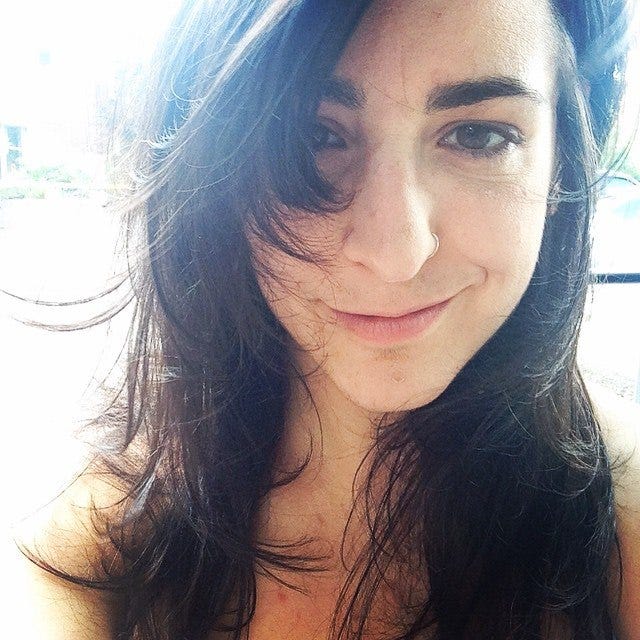
Introducing Our Newest Column: New Suns by Monica Byrne

Monica Byrne

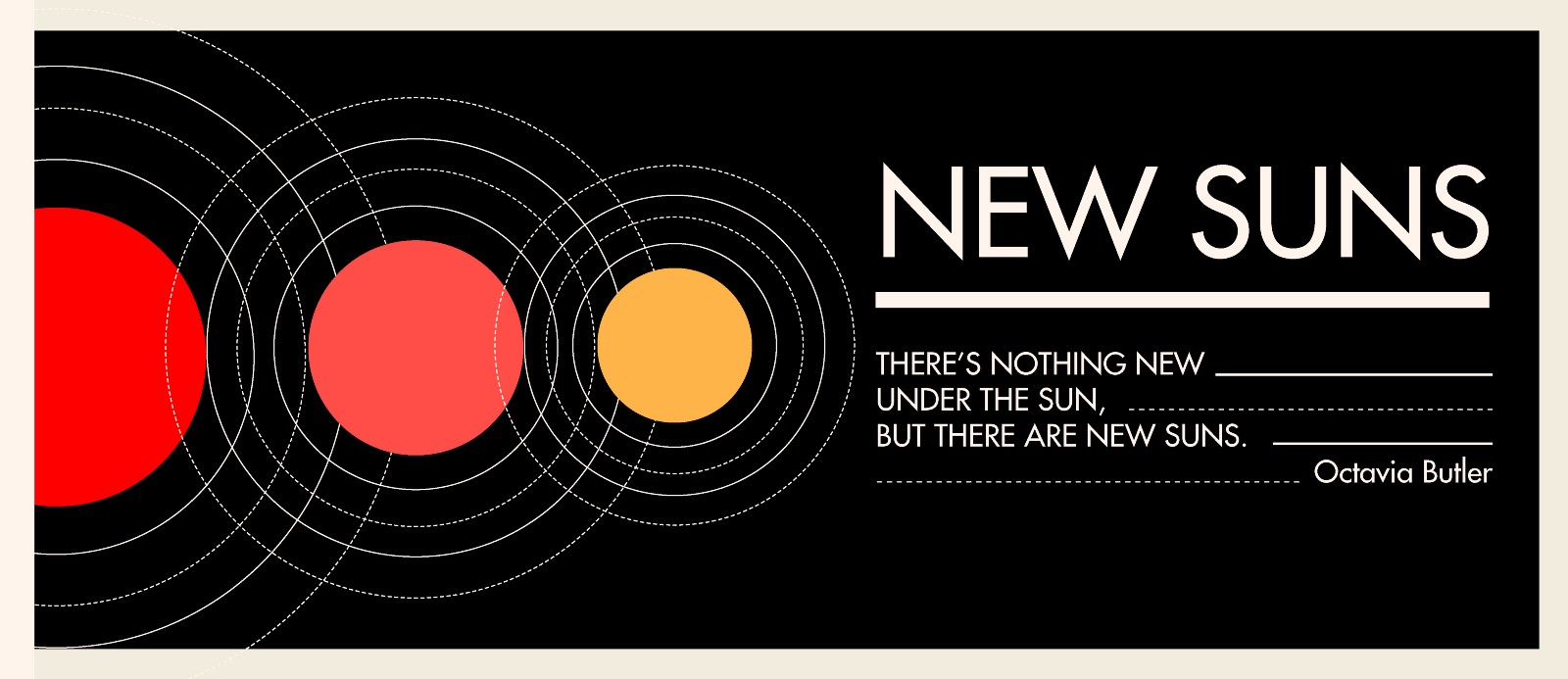
Electric Literature is excited to announce our newest column: New Suns by Monica Byrne. New Suns will be a culture column focused on expanding our understanding of pop culture. The column grew out of Byrne’s dissatisfaction with the narrow focus of mainstream culture coverage, as she details in a post on her website titled “I had a culture column at WIRED. And then I didn’t. Here’s what happened.

Monica Byrne is the author of New Suns, the first Patreon-funded culture column. She’s also the author of the novel The Girl in the Road and a playwright in residence at Little Green Pig Theatrical Concern in Durham, NC. You can find her on Twitter, Facebook, Instagram, and WordPress.

We talked with Byrne about the importance of pop culture, the future of crowd funding, and what readers can expect to find in New Suns. New Suns will debut this month.

Electric Literature: The other day, I saw you tweet that “pop culture isn’t trivial, it changes lives,” and mention how a pop song convinced you to first have sex.

Monica Byrne: Yes. “Sexual Revolution” by Macy Gray, on my Discman, on the bus ride from Boston back to Wellesley. Pop culture sets new norms, and it was precisely the new norm represented in “Sexual Revolution” — the generosity toward all kinds of people, all kinds of bodies — that convinced me there was nothing to be afraid of.

EL: When Wired changed their mind about your column, their reasoning was “we only do pop culture.” What do mainstream magazines like Wired get wrong about pop culture and its importance?

MB: I should first say that the editor at Wired said that to me very nicely, and even apologized for being “boring.” But when I came back with more ideas, I just got silence. Others in the industry have told me is common — and I know it is — but also, it’s the response that women and people of color disproportionately get. And I’d just had enough.

What mainstream magazines get wrong is that there was a time when telling one dominant cultural narrative was profitable, and now that time is coming to an end. The entire industry is hanging on by its fingernails now because the Internet offers so much more accessibility to the conversation to so much more of the population. Sometimes it’s hard to remember how young the Internet is. But that trend of access is only going to continue. Hiring and covering women and people of color proportionate to their presence in the human race is not only the moral thing for a magazine to do, but is in its best long-term financial interest. How that’s not the most obvious thing in the world, I don’t know.

Hiring and covering women and people of color proportionate to their populations in the human race is not only the moral thing for a magazine to do, but is in its best long-term financial interest. How that’s not the most obvious thing in the world, I don’t know.

EL: You’re primarily a playwright and novelist, but you got your start in journalism. How did that transition happen?

MB: My first job in Durham was producing The Story with Dick Gordon at WUNC. I loved the people there, and some are still dear friends, but I quit after four months. I hated the daily ritual of having to justify that my story ideas were important. I was like, “Important to whom? They’re important to me. That should be enough.”

I started writing stories, and liked that better. But I still write essays, too, and come up against “this isn’t newsworthy” all the time. I think “newsworthy” is often just code for “that which reinforces the dominant narratives.” My first column is probably going to be about artists in Belize who haven’t shown work anywhere but Belize. Why? Because it’s important to me. Because I choose, for a moment, to center the world around them. Because there’s no reason not to.

EL: One thing that really drew us to your column was how you said you wanted to help decide what counts as pop culture. It seems like so much of the current cultural conversation is about defining the same handful of films/books/shows — the “Is [Popular TV Character] a Feminist Icon?” and “10 Things [Popular Film] Gets Wrong about Science” kind of think pieces — instead of redefining what cultural products we should be talking about. What are you looking to change about the cultural conversation?

MB: You know, ever since I launched the Patreon with its manifesto, the more I try to interrogate the category “U.S. pop culture,” the more it comes up empty. The closest I can come to a definition is, “Art made in the U.S. that has the biggest money behind it.” There are exceptions, sure; but like with the sole woman in a superhero lineup, they function as tokens that make the existing structure more defensible[1].

And whose U.S., anyway? A bhangra party is as American as a bluegrass festival. Whose pop culture? Art moves freely across borders, and always has. (“Nation state” is also an empty category, but hey, I guess we’re still pretending they’re real.)

And whose U.S., anyway? A bhangra party is as American as a bluegrass festival. Whose pop culture? Art moves freely across borders, and always has.

What I want to change about the cultural conversation is the variety of voices speaking. This is already well underway. There are already so many brilliant cultural critics in particular — Roxane Gay, Janet Mock, Jenna Wortham, Ayesha Siddiqi, Britni Danielle — and I’m just following their lead.

But I’m also hoping to pioneer crowdfunding as an option for journalists, so we don’t have to sacrifice our ideals to be able to eat.

[1] Language and concept, Ayesha Siddiqi.

EL: Often it seems that the internet is great at expanding the conversation, but horrible at paying artists. However, you are funding the column through Patreon, where you’ve already racked up nearly 200 patrons. What role do you think crowdfunding can play in producing culture?

MB: Oh, I think it’ll be the new norm. I also think it’s the only way to replace the old power structure referred to above. Money is a driver, and will be, for as long as we have money; but to redistribute that power into the hands of millions? That’s the answer. Barack Obama changed the game with microdonations. Amanda Palmer changed the game with her Kickstarter and Patreon. (What I know about crowdfunding, I know from watching her.)

But it’s not a silver bullet. You have to lay groundwork. I’ve been writing, blogging, and networking for years up until this point, and that’s why I had a successful campaign. People knew and trusted me. This model isn’t free of prejudice — I’m privileged because of how I look, and because of my socioeducational background — but I sincerely believe crowdfunding will produce the culture of the 21st century. It already is. And ya know? Maybe that’ll lead us to a future of no mainstream culture at all. Just many streams, weaving and intertwining, like in a delta on its way to the sea.

EL: When it comes to the narrow scope of mainstream coverage, do you get the sense of how much it’s caused by the unwillingness of editors and critics to change, and how much is caused by financial pressures? Do you think editors would like to cover more diverse things but are too afraid of losing subscribers and clicks if they do?

MB: I honestly don’t know. I wish we had more data, and then we wouldn’t have to speculate.

I do know what passes for fact often melts away to “conventional wisdom,” which, itself, melts away to reveal plain prejudice. Like that people of color don’t read. (Daniel José Older calls bullshit here). Or that men won’t go see movies starring women. (Brooks Barnes covers that myth here).

I can’t imagine that there are still many editors who sit around saying aloud, “Women only write about soft fuzzy things and not even as well,” but I know they sit around saying “Financial pressures blah blah blah,” which is a mask for the bias they don’t want to face in themselves. They don’t have the vision or the will to change. So they need to be replaced. (Though sometimes you get a Francis, and sometimes you get a Benedict…)

EL: You’ve said that your Catholicism shapes how you see the world. Can you elaborate on that, and how it shapes the way you see culture?

MB: There’s that Bible verse, “The last shall be first and the first shall be last,” which my Dad always loves to quote to me. Catholicism instills a habit of radical inversion. That nothing is what you think it is, that love is stronger than death, that the most neglected people are actually the center of humanity. That’s why I hate language like “marginalized people.” According to whom? They’re at the center of their universe. And that’s how I want to approach all artists I talk with: they make their own world, on their own terms, under their own sun.

EL: In your Patreon, you tell your patrons that you’re committing to one year of the column. Why that specific time frame?

MB: First, because it’s less scary for patrons to commit to a finite time frame. Second, because this column is an experiment, and like any experiment worth doing, I don’t know if it’ll work.

Third, I worry about my relationship with power. Power corrupts. If my aim is really to redistribute power away from people who look like me, then I have to be prepared to give it up. A year seems like a good point to reevaluate my own usefulness.

If my aim is really to redistribute power away from people who look like me, then I have to be prepared to give it up. A year seems like a good point to reevaluate my own usefulness.

EL: What can we expect from the first few columns?

MB: Self-taught artists in Belize. Whether arts institutions should have auto-destruct sequences in their charters and “wills” for after their deaths. How to live with “split mind,” the dual awareness that living in colorist and sexist societies requires. Stendhal Syndrome. Prison abolition. Designer genders. Freelance temple whores. The circle gaze. Protest choreography. Open borders. Invented languages.

Watch this space.

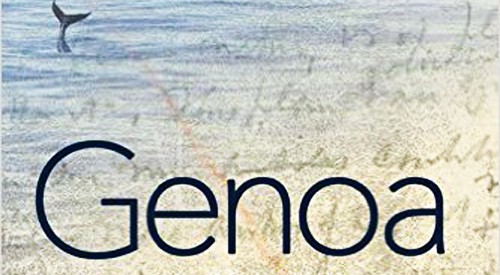
The Unyielding Sea: Genoa by Paul Metcalf

Though first published fifty years ago, Paul Metcalf’s Genoa: A Telling of Wonders can fit easily into a genre conversation that feels very current. If we’re going by traditional genre constraints and definitions, it is one of those experimental texts that’s both everything and nothing — called a novel, written with the first person voice of a fictional narrator, yet hardly telling a story at all; instead, it wrestles with a constant barrage of references and quotes, a Montagnian display of a mind searching on the page. Through the first couple of chapters, I was content to read it as a genre exercise, analyzing it’s hybridity, trying to trace the moments where the narrator’s back story shifts into a riff on a literary quote, decipher the ratio of imagined to autobiographical to researched. What’s the game here? Thankfully, the desire to define or quantify what was happening on the page soon slipped away.

Any great book — and yes, Genoa is emphatically great — transcends the tricks in how it was made. It’s hard to explain the unique power of what Metcalf has written; better, perhaps, to simply acknowledge that something powerful is happening. Case in point: I seem to have settled on writing whoa in the margins of many pages. And then, once: this is like Gilead on bad acid. Truth be told, though it wears its influences proudly, Genoa is unlike anything I’ve ever read, Metcalf was the great-grandson of Herman Melville, and that lineage, the weight of Melville’s ghost, is all over the narrative, along with many other literary and historical references, until the book becomes something of a modern Greek chorus.

Almost all of the present-tense action of the story takes place in the attic of an old house in Indianapolis where Michael Mills, the narrator, sits at his desk, reads, paces, remembers. That’s it. His children are downstairs. At a certain point his wife comes home. The narrative builds through fragmented memories to tell the story of Michael’s deeply troubled brother Carl. But as much as it is about Carl’s life and Michael’s relationship to it, it’s about Herman Melville’s life and writing, the diaries and letters of Columbus, and what it all means to Michael. It is also about the wonders, pleasures, and terrors of the human body, Michael often quoting from an anatomy textbook. How do these strands relate? Only in that Metcalf smashes them together. They are all born from one mind attempting to understand something about what it means to be alive in this world. Above all, Genoa is a reckoning.

Metcalf doesn’t lean on one central metaphor. Instead, everything is metaphor; each image in each book Michael’s reads can be a portal to new meaning. A quote from Moby Dick about the anatomy of a sperm whale — “Oh man! Admire and model thyself after the whale!” — transitions without explanation into a memory of Carl’s body — “Carl the wrestler fades, and his huge head approaches, blocking the sun” — and so Carl becomes Michael’s white whale: taunting, giant, submerged. Pages later, Michael’s act of thinking in his attic becomes a ship’s voyage, becomes an ejaculation as described in a textbook:

“I step back from the desk, gaining my sea-legs. I am braced, with one hand on the chimney. The house arches and shudders — an inverted hull, with kelson aloft against the weather. and the human sperm enters a reservoir, low in oxygen — an thence to the vas deferens, in the lowest, coolest scrotal area…”

At first, it’s difficult to find steady footing in Michael’s story when Metcalf will up and leave it, sometimes mid-sentence, to drop into a comparison of Melville and Columbus as fathers, or a riff on cannibalism and the nature of torture. I don’t think it’s an accident that a book so obsessed with voyages and storms, a book so tied to a customs inspector who remembered his own journeys and conjured up a character like Ahab, mimics a crashing, unyielding sea. As Metcalf himself would put it, the reader needs to get her sea-legs. But once you reconcile yourself to the waves, there is magic to be found. It’s a story about everything — life, death, fear, danger, fatherhood, legacy, the margins of America and the heart of it, too. A man in an old house in Indianapolis thinking, reading and remembering his way through a storm, can take us back centuries, to the lives of voyagers both historical and fictional, while also honing in on the significance of every tiniest motion, every bone in a body.

Early in the book, Metcalf writes:

“…for Melville, space and time are one. Later, he writes: Fusing with the amnion, becoming the amnion, turning all to gray and white, I am no longer Michael, but everyone — a particle in an explosion — all time and space — and therefore nothing.”

As much as any, these two sentences stick out as potential fragments of mission statement, giving a nod toward how to read the book without being prescriptive. This is a place where beginnings and endings are permeable, where what is read, what is imagined, and what is lived weave into a writer’s consciousness and can be channeled into something ineffable yet undeniably greater than the sum of its parts. Genoa is, indeed, a world of wonder.

Genoa

by Paul Metcalf

Powells.com

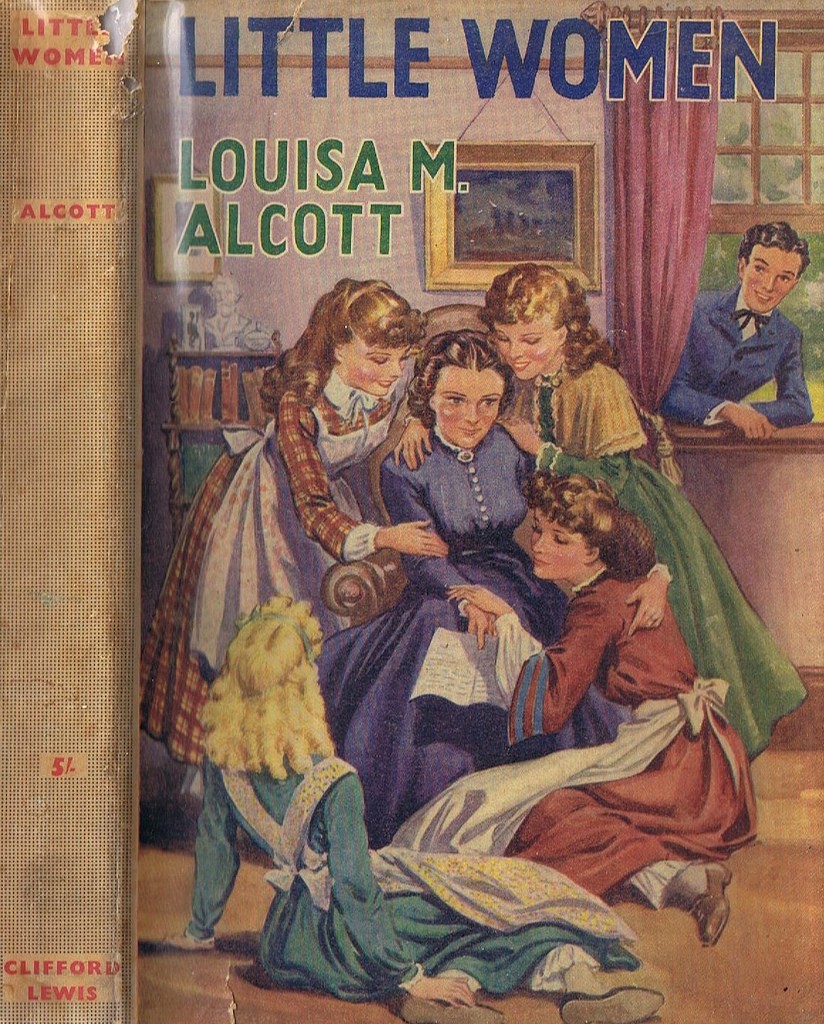
The CW is Developing a “Gritty” Adaptation of Little Women

Louisa May Alcott’s 1868 novel Little Women has been enchanting readers for decades. Multiple screen adaptations have been made, such as the 2004 film starring Winona Ryder, Kirsten Dunst, and Susan Sarandon. Although the March sisters — Jo, Beth, Meg, and Amy — certainly have their fair share of disagreements (including the famously horrifying scene where Amy burns Jo’s writing), one might not envision them duking it out Hunger Games style.

The CW, however, has other ideas. According to Deadline, the television network known for Gossip Girl and Jane the Virgin has begun to develop a new series based on Little Women.

Written by Alexis Jolly, the series is described as a “hyper-stylized, gritty adaptation” of the novel, in which “disparate half-sisters Jo, Meg, Beth, and Amy band together in order to survive the dystopic streets of Philadelphia and unravel a conspiracy that stretches far beyond anything they have ever imagined — all while trying not to kill each other in the process.”

Little Women, then, will soon join the ever-popular league of dystopian narratives. If this news excites you, Flavorwire recently compiled their dream-cast for the “millennial generation.”

Who else would you like to see take on the role of Jo or Amy as they navigate Philly’s “gritty” dystopian streets?

TED WILSON REVIEWS THE WORLD: MY MASCOT

★★★★☆

Hello, and welcome to my week-by-week review of the world. Today I am reviewing my mascot.

With the line between corporations and people becoming increasingly blurred, it’s difficult to tell where Walt Disney’s life ended and where it began. Did his corporeal being morph into a bunch of paperwork worth millions? If Disney the corporation is in fact Disney the man, that would make him/it the first person to have his own mascot — Mickey Mouse.

With over 7 billion corporations (people) in the world, it’s now more necessary than ever to stand out, and there’s only so much one can do with fonts and color palettes. That’s why I hired a branding agency to create a mascot that reflects my brand. Unfortunately, their Creative Director didn’t see me the way I see myself and none of the anthropomorphized cartoons they proposed were appropriate. Does a talking refrigerator say “Ted WIlson” to you?

I wanted something real — as real as me — so it made sense that my mascot should be a real person, just like how Scientology has Tom Cruise as their mascot. My mascot’s name is Jeffrey Sobieraj — a name that is sure to become synonymous with Ted Wilson. I don’t know anything about Jeffrey’s personal life, but if he has any loved ones, when they look at him they will only see me. In a way, it’s like his family will become mine and Jeffrey will cease to exist.

Jeffrey signed over all rights to his name and likeness, so if he wants to do anything I haven’t approved of, he’ll need to change his name and get plastic surgery. That is unless I rebrand myself, in which case the rights to Jeffrey’s face will revert to him.

Here’s a trailer for an upcoming Ted Wilson ad campaign featuring the Ted Wilson mascot.

I think it’s a pretty good mascot. It smiles, which is something I do a lot of. It’s also young, which I was once. It’s everything I am and never anything I’m not. Can you imagine Jeffrey wrapping his hands around the throat of a drifter and slowly strangling him to death? Because that’s something I would never do.

What do you think? Does it represent my brand well? Let me know your thoughts! I’ve invested a lot of money in this.

BEST FEATURE: Such clear skin!
WORST FEATURE: According to preliminary market research, it doesn’t appeal to women because of its neck.

Please join me next week when I’ll be reviewing a poodle.

Video filmed by Aralyn Beaumont.

New Literary Prize Celebrates Brooklyn Writers

Everyone loves some good, healthy competition, right?

In the wake of the Man Booker Prize’s 2015 Longlist announcement, literary communities around the world are already speculating about the eventual winner. While the Man Booker longlist features writers born in countries such as Morocco, Jamaica, and New Zealand, a new literary award a little closer to (our) home has been born, highlighting a small but mighty literary region: Brooklyn.

The Brooklyn Eagles Literary Prize “recognizes the best books of the past year and the authors who most embody Brooklyn’s ideals.” We’re excited about this new prize and its focus on dozens of brilliant Brooklynites.

Chosen by Brooklyn’s bookstores, the Brooklyn Eagles (supporters of the Brooklyn Public Library), and librarians, the 2015 fiction and nonfiction nominees include a multitude of books we’ve reviewed (Kate Bolick’s Spinster, Ben Lerner’s 10:04, Atticus Lish’s Preparation for the Next Life), authors we’ve interviewed (John Benditt, Emily Gould, Hanya Yanagihara, James Hannaham, Tiphanie Yanique) as well as authors we’ve featured in Recommended Reading (Marie-Helene Bertino). Ariel Schrag also kindly compiled a playlist of the music mentioned in his (nominated) novel Adam.

If the longlists don’t satisfy your craving, Brooklyn Magazine compiled a list of the “The 25 Best Brooklyn Books of the Decade (So Far).”

The New York Times describes Brooklyn as an “overgrown writer’s colony” and identifies the prize as a way to “codify the literary bona fides of a borough whose authors already regularly compete for coffee shop real estate, publishing advances, and Pulitzer Prizes.” So yes, perhaps there will be a little blood in the water as the declaration of a winner draws near; however, Brooklyn also boasts a tight-knit community of readers and writers who frequently assemble at Franklin Park (Crown Heights), Community Bookstore (Park Slope), Greenlight Books (Fort Greene), PowerHouse Arena (DUMBO), and Bookcourt (Cobble Hill) for readings and general merriment.

Because I reside on the Upper West Side of Manhattan, I often feel left out of the Brooklyn literary scene; journeying down to the bustling borough takes a hefty chunk of my time. If you’re a clueless Manhattanite like myself, you’ll love exploring Brooklyn’s many distinct neighborhoods using this handy literary guide.

The Illusionist as a Young Man: Wind/Pinball by Haruki Murakami

In April of 1978, Haruki Murakami went to a baseball game that would change his life forever. The facts of this story, like the preparations surrounding any stage illusion, are very specific. The story goes that during the first inning of the game, at the moment an American player, Dave Hilton, hit a double for the Yakult Swallows, “for no reason and based on no grounds whatsoever,” it struck Haruki Murakami that he could write a novel. This thought had not occurred to him before. He was 29 years old.

On his way home from the stadium, Murakami purchased some writing supplies, and, that very night, he began work on his first novel, Hear the Wind Sing. He produced a draft in four months, working at his kitchen table. When he finished, he sent the only handwritten copy of his manuscript to the Japanese magazine Gunzo, where, a little over a year after that baseball game, Murakami won a major literary contest, launching his career as a writer of fiction.

This year, for the first time in decades, a new English translation of Murakami’s first two short novels, Hear the Wind Sing and Pinball 1973, will be back in print as a single volume simply titled, Wind/Pinball. In the new introduction, Murakami reveals never-before-told details about his beginning as a young and inexperienced writer. But frustratingly, these facts tell little about the man himself, and Murakami’s explanations only lead to more questions. This should have come as no surprise; after consuming fifteen of his books (including his memoir) and reading all of his published interviews, Haruki Murakami’s basic existence continues to baffle me — and I assume I am not alone here. While he is for the most part forthcoming about himself to the media, something about him feels distant and otherworldly. Who is he? Not even Murakami himself seems to have a satisfying answer.

Very few writers have an origin story as mysterious or compelling as Murakami. Being a great writer traditionally takes a lot of hard work and planning. Take Martin Amis, for example. Amis was, like Murakami, born in 1949; Amis did extremely well in school, went to work for the Times Literary Supplement, published his first book by the time he was 24 and, despite his father’s long shadow, reached international fame by the time he turned 35. Another example, T.C. Boyle, who is a year older than Murakami: Boyle graduated with a history degree, got his MFA in 1974 from the University of Iowa and followed that degree with a PhD in 1977 (also from Iowa). He published his first collection of short stories at the age of 31.

My point here is that, like most great writers, Amis and Boyle would seem to have come to their success honestly and gradually — by being talented, by working hard and by making a series of well considered decisions. Lots of other writers do the same and yet, for whatever reason, their work never become famous or financially solvent. Success, for writers — to speak broadly — is often slow and nearly always uncertain. Murakami’s success was not slow, and, according to Murakami at least, it was not uncertain. In the introduction to Wind/Pinball, Murakami writes that the morning after he discovered Hear the Wind Sing had been chosen as a finalist, he went for a walk with his wife. Along the way, as he was in the process of rescuing a passenger pigeon with a broken wing (another baffling detail), a realization again hit him: “I was going to win the prize. And I was going to become a novelist who would enjoy some degree of success.” For Murakami, this logic defying certainly was a natural truth. But how he came to this understanding remains a mystery.

The story gets even more improbable: According to Murakami, Gunzo did not, as a practice, return rejected manuscripts. So, if Murakami had not won the very first literary contest he had ever entered, the only copy of his novel would have been lost, and by his own admission: “I never would have written another.”

Something here stinks of apocrypha. The story feels too neat, too convenient. As much as I want to believe it, the cynic in me rises up, but it makes no difference whether Murakami’s origin story is as he presents it, or if it is, like his books, a carefully crafted illusion. What matters is that his story fits his fiction in a way that is undeniable — his life resembles his stories, and he resembles his characters. Haruki Murakami is the mysterious cosmic wanderer of his own fictions, blessed by circumstance and guided by magic. Whether you buy the origin story or not, it seems fitting that author and character should walk in step.

Whenever Murakami releases a new book, it has become a tradition to compare it with his other works — to search for clues, draw parallels, and cook up parodies. Anyone who played the New York Times’ interactive Murakami bingo last year will know what I mean.

As readers, it is nice to see something familiar and consistent in an author’s new work, but reading Murakami this way, we can end up reading ourselves in a kind of bland Murakami infinity loop, where all the men cook “simple meals,” all the women are precocious and magical and all the elephants just disappear. It’s all in good fun, up to a point I suppose. And if you are reading Wind/Pinball, hoping for the phone to suddenly ring, don’t worry, it does.

It is also worth remembering that Wind/Pinball, like each of Murakami’s books, is a singular work — actually two singular works in this case. Both novels are worthy of appreciation on their own terms, and they do not need to be forced into an awkward conversation with Murakami’s other books to be enjoyed. As one character points out in Hear the Wind Sing: “What would be the point of writing a novel about things everyone already knows?”

What sets these novels apart from Murakami’s later, longer titles is the manic quality of the pacing and the speed with which Murakami moves through dialogue, dreams, memories, anecdotes, and stories–within-stories. These components fade, resolve and bang against one another rapidly, only to fly off somewhere, never to be mentioned again. Particularly in Pinball, this is the case — possibly a purposeful stylistic choice, intended to mirror the title’s image, or, possibly, these are the marks of a young writer struggling to control a narrative. Regardless of the cause, the final effect is electric. Murakami uses white space like Raymond Carver, and, in general, Murakami’s literary influences (American noir particularly) loom a little larger in both Wind and Pinball than they do in his later works.

At times, these short novels feel more like linked collections of flash fiction (a term that didn’t exist in 1978) than they do novels. And while the restlessness of the narrative might frustrate some readers, I have always preferred Murakami in shorter, more concentrated doses. Murakami’s shorter works, like the stories in After the Quake or The Elephant Vanishes, seem more attentive to sentence-level detail, to paragraph structure, and are more prone to surprising lyrical twists. I have always thought of Murakami as a prose stylist, and while many people disagree with me — some complain about his clichés, some blame his translators — I would say, here, particularly because of the delicate nature of these novels, Murakami succeeds on the sentence-level. While I can’t speak to the accuracy of Ted Goossen’s translation, what’s on the page ranks with Murakami’s strongest prose.

In an odd turn, near the end of Pinball 1973, the story’s protagonist delivers a eulogy to a piece of electronic equipment, his dead telephone switch panel. He begins by quoting Kant:

“The obligation of philosophy…is to dispel all illusions borne of misunderstanding…Rest in peace, ye switch panel, at the bottom of this reservoir.”

I picked up Wind/Pinball, hoping to dispel the illusion of Murakami with some good, old-fashioned intellectual commentary. I wanted to “get to the bottom” of him — whatever that meant. Often an author’s first works are awkward and revealing, like high school yearbook photos. I wanted to look at these novels and find a new Murakami, someone a little more fallible, someone I could understand.

Certainly, these novels are a bit rougher than Murakami’s more recent works. Like a cartoonist’s early sketches, the form is complete, but less polished, the hand less sure. But, for me, these novels don’t solve the underlying mystery of Murakami. And they only enhance the illusion he weaves around himself. Who begins a writing career “for no reason and based on no grounds whatsoever?” How does a man apparently so guileless and straightforward produce fictional worlds that, for so many people, describe the impossible experience of being alive? I read the book, and I still don’t know.

I would submit, however, that, at least in this case, Kant is wrong. There is nothing to be gained by dispelling Murakami’s illusions, by digging deeper into his origins or by looking for the imperfections in his fictional worlds. On the contrary, the joy of reading Murakami has always been the joy of being hypnotized by a master. For that to happen, both writer and reader must choose to embrace the illusion together. The two short novels in Wind/Pinball are more than a sample Murakami’s early work — these short works are among Murakami’s most carefully crafted offerings, full of raw talent, energy and magic, and totally worth getting lost in.

Wind/Pinball: Two Novels

by Haruki Murakami

Powells.com

Attacking Our Tendency To Feel Too Little: An Interview With Ben Marcus, Editor Of New American…

The first anthology Ben Marcus edited — The Anchor Book of New American Short Stories — was my textbook in my first undergraduate creative writing workshop, led by Kevin Miller at Emerson College. I was a freshman who had read Amy Hempel, Joy Williams, Laura van den Berg, and approximately no one else. So Marcus’ anthology was where I discovered many writers whom I now count among my favorites, writers like A.M. Homes, Deborah Eisenberg, Mary Gaitskill, William Gay, Anne Carson, Lydia Davis, Anthony Doerr, Diane Williams. The list goes on and on. I remember the collective horror of the class in reading Gay’s to-this-day-still-haunting “The Paperhanger,” and our collective awe at the character work done by A.M. Homes in her masterful “Do Not Disturb.” It was and remains an anthology I turn to often, and each time I return to it I feel such gratitude to Ben Marcus for gathering all of those wonderful stories into one book.

Anthologizing, I think, is a way of inviting all of these disparate, brilliant minds into one room, giving a party of sorts, and no one hosts a better party than Ben Marcus. Which is why I was delighted to see that, more than a decade since the Anchor anthology was released, Marcus would be coming out with another anthology: New American Stories, released by Vintage this month. (You can read Marcus’ introduction to the anthology here, on Electric Literature.) It is, unsurprisingly, another terrific party. I had the pleasure of seeing some newer work by favorites like Eisenberg, Doerr, and Gaitskill, as well as reading for the first time writers I’d never heard of. The stories are precisely selected, and not a single one failed to move me in some way, move me with language, emotion, thought, vulnerability. By the end, I had a whole new list of writers whose work I needed to seek out, and whose collections I needed to purchase — the true sign of a successful venture.

I had the pleasure of speaking with Ben Marcus over the phone to discuss the process of putting together this instantly necessary anthology.

Vincent Scarpa: Editing an anthology such as this seems like a total dream gig for story nerds like myself. It’s maybe all I want to do. But it’s also, I imagine, a ton of work, and fairly stressful, too. Can you talk a bit about the process?

Ben Marcus: At the technical level, the thing that would keep me from ever doing it again is just the world of permissions — getting approvals from publishers who seem to sometimes guard the property rights of these short stories as if they’re the Torah. But the other side of it, the big side, is the fun, long process of reading, and catching up on reading. You know, years go by and I hear about writers that I don’t have the time to check out, and so doing the anthology, in one way, was just about ordering hundreds of books, going online and getting PDFs, and having people send me stuff; just creating these huge shelves of stuff that I had been meaning to get to. That part is really amazing because you just get to read everything you can think of. The real chore is: who am I leaving out? Which is, of course, agonizing. I don’t even mean leaving out from the book, but leaving out from the larger consideration.

VS: How large was that pool at the beginning?

BM: I’m actually in my workspace right now and I’m looking at three shelves that each have about thirty collections of stories on them. And that isn’t even really half of it. You know, I’d write to friends who I know read short stories and pay attention, or sometimes former students who I know are really plugged in — so, a lot of what I ended up with were links to websites, or PDFs that people sent me. So how large is kind of a good question. I don’t really know.

VS: How long will it be before you start getting emails about inexcusable omissions?

BM: That’s already happened. And I can’t even laugh about it. It’s sort of horrible. As soon as the list of contributors was made available, some people were really upset and wrote to me directly about it. I don’t really know what to say about it. I mean, as writers, don’t we all constantly just feel excluded from everything good all the time? And I think my only real response is that this isn’t The Norton Anthology of All Stories That Are Good. It wasn’t my job to be comprehensive or to even say who matters. It’s a really subjective book. You know, one of my answers is: more people should do these books. I’d love to read someone else’s anthology, where they — let’s say with the rough parameter of ten years — looked at American short stories. I guess I vaguely understand if someone feels a terrible injustice has happened if they’re not in this book, but I also don’t think these books launch careers.

VS: I like what you say in your introduction: that it’s a sampler, not a museum piece. It doesn’t claim to be this all-encompassing anthology.

BM: Right. In the end, I was really just creating a book for myself. In a lot of ways, what it really came down to was: what set of stories could survive multiple, multiple, multiple rereads, and still fit into this vision I had for this book? So I guess that’s kind of a peculiar criteria. Because I could read lots of stories and be really astonished and full of admiration for the technique and just really in reverence of the work, and then if I kept looking at it and looking at it and found it didn’t fit or sort of resonate with the other stories, over time it would slowly get pushed to the side. And it wasn’t a dismissal of those stories at all.

Different things come into play. If I read five stories by five different writers that start to seem roughly artistically similar in their modes and their methods and their trajectory, the way they proceed — it’s harder for me to say I’m going to put all five in. When I start to notice variety, it matters to me. I like, in a way, thinking of stories that might almost refute each other a tiny bit and yet each still succeed.

I wish there was some way to have a shadow anthology of all the stuff that didn’t go in that I still really loved.

VS: Were there writers whose stories you’ve included in this anthology whose work, until compiling the anthology, you hadn’t come across before? For example, I’d never read Rachel Glaser before, but “Pee on Water” completely floored me and I thought, How have I not read Rachel Glaser?

BM: Isn’t that story so killer? A few different people recommended her to me. I hope I don’t get this wrong, but Blake Butler told me about her and so did Justin Taylor, I think. But there are others, too, whom I hadn’t read at all. I had not read Mathias Svalina, I had not read NoViolet Bulawayo, I had not read Said Sayrafiezadeh. I had read very little Lucy Corin and I love that piece, “Madmen.” I had not read Charles Yu, although I had his books and was excited to read them. I had not read Kyle Coma-Thompson and now I really worship that guy. And I hadn’t read Donald Ray Pollock! Which was just my oversight.

Some of these people I’d been hearing about for years and I’d own their books and intend to read them. I wanted to believe at the beginning of this project that I didn’t know who was going to go in. There might have been a small handful of writers who I have kept up with, whose work I would’ve been surprised not to include — just writers whose fiction I’m really enthralled by and really devoted to. But beyond that, I wanted to feel like it was really fair game. And I was especially excited if it was someone new to me.

VS: I wondered if you revisited the first anthology you edited in working on this one, or if that was that sort of just put aside and made separate from this project.

BM: I mean, not really. I can kind of do that in my head, I suppose. It’s funny, because some people are referring to this as a new version and it’s not. There was never, when I signed up to do this book, any sense that I was revising that one. And in fact, that one’s still available. You know, they’re just different. I thought at first that I would try not to repeat any contributors, but that then that seemed dishonest and a bit crazy. But when I did repeat a contributor, I thought quite a lot about real stylistic differences between what they had in the Anchor book and what they have in this book.

VS: The Tony Doerr story is a great example of that.

BM: Totally. And the Wells Tower story, “Raw Water.” I mean, you can hear Wells’s voice in that — it’s not like I wanted people to transform and become unrecognizable — but it’s a different kind of story for him. But whenever I had some criteria like that — like, “well, I won’t repeat a writer” — it just couldn’t hold. It started to seem preposterous. In the end, it was really about enduring enthusiasm, enduring fascination and curiosity. What stories stayed with me after I read them, and when I’m thinking about them in bed, which ones have resonated?

VS: I was really excited to see that Joy Williams story, “The Country,” in there. I worship that story.

BM: Oh, I know, right? Wait, did you and I talk once at Bookpeople after a reading of mine? And you were with Alexander Chee?

VS: Yes! That’s right.

BM: I feel like somehow that Anchor anthology came up and you and Alex said, you know, “I can’t believe Joy Williams isn’t in that.” And I thought, “Well, she is. Because I love her work.” And of course she wasn’t! And I still kind of don’t really know how that happened. You know what I mean? I love her work. So there was never any doubt that her stuff would go in here.

VS: You seem to always manage to talk about fiction, about stories, in new ways that actually make meaning. I think a lot of talk about craft is a bunch of BS — Dean Young, for example, has said, of poets, “we don’t build birdhouses, we build birds,” which sounds lovely, but I don’t think can actually be distilled down to something tangible or useful, and maybe it doesn’t have to be if it’s poetry and/or maybe I’m cranky — but your introduction to this anthology was extremely instructive and enriching to me. There’s a way in which fiction, stories especially, are malleable and elusive enough that any metaphor or analogy can work, anything can be stretched or bent to serve the writer’s thesis on how a story ought to function. And there’s also a part of writers — at least this writer — that will always get a little turned on by even the most general broad-stroke declarations of what a story is and isn’t, what it must and must not do. But you talk about stories the way I’ve longed to hear them talked about, and I don’t think anyone has put it better, truly — you say they are “strategies in language to attack our tendency to feel too little.” I love that.

BM: Thank you, that’s really nice to hear, because I really feel totally crippled in the face of writing introductions like those. It gets so bad that I end up kind of wanting to convince everybody that there shouldn’t even be an introduction, that it’s pretentious by default, that the whole thing is kind of doomed. I circle around the whole problem of getting in the way of the stories, and I think about the kind of introduction that kind of just enumerates the stories and somehow provides a little jacket copy on each one, and I can’t do that, so I guess in the end I exhaust all possibilities and end up really just trying to say, personally, what stories mean to me. And even that’s hard, because you resort to metaphors quickly. I don’t really know that I’m trying to present some kind of different vision of what stories are. In promoting a book like this — and it’s an anthology, obviously a minor pebble in the waters of publishing — invariably you’re asked to assert the importance of the short story, and I’m actually just fucking sick of it. We don’t say, “Why are songs important? What do we like about a song?” It’s like, fuck you. At a certain point, in the end, it’s just a conversation that’s meant to be had to ease someone’s commercial fear about what is or is not sellable. If you’re not somebody who can be physically felled by a short story, then fine. You’re not going to get persuaded into caring about one. But, to me, it’s one of the great art forms. There’s an amazing legacy of it. We have a tremendous long, rich, varied tradition. This idea that one has to prove the importance of the art form is just a huge snooze to me at this point.

Seeking Editorial Volunteers for Fall 2015

Though it feels like summer has just begun, August is just around the corner, which means it will soon be time to bid a fond farewell to our wonderful summer volunteers, Katie Barasch and Emma Adler.

Electric Literature’s volunteer positions introduce undergraduate and graduate students, and emerging writers to digital publishing and the New York literary scene. Because we are a small, not-for-profit publisher, we provide unique opportunities for professional development and resume-building.

As an Electric Literature volunteer, you are encouraged to become involved in any aspect of our work that interests you. Sure, you’ll go to the post-office, but you’ll also do things like contribute to editorial decisions, interview authors, write articles, and attend literary events.

Responsibilities:

  • Read submissions and participate in editorial discussions
  • Comb the web and social media for breaking literary news
  • Copy edit and proof read
  • Contribute content to electricliterature.com
  • Interview Recommended Reading authors
  • Staff events
  • Select images to pair with articles
  • Update contact databases
  • Assist in eBook production

Skills:

  • Knowledge of WordPress, Tumblr, and social media platforms
  • Familiarity with HTML
  • Basic understanding of Photoshop and inDesign
  • Firm grasp of grammar and spelling, with a sharp attention to detail

The ideal candidate:

  • Has an educational background in literature or creative writing
  • Participates in the contemporary literary scene
  • Regularly reads literary magazines and literary websites (including but not limited to Recommended Reading. Okey-Panky, and electricliterature.com)
  • Believes strongly in the Electric Literature mission: To amplify the power of storytelling with digital innovation
  • Is hard working, pays great attention to detail, and can work independently
  • Writes clearly and with personality
  • Has an eye for design and knows what images will grab reader’s attention

This is an unpaid, part time volunteer position (10–20 hours/week), with opportunities for hire. Candidates must be able to come to our office in the Flatiron district of Manhattan at least 2 days/week. We are happy to work with universities and MFA programs to provide course credit, though you do not need to be a student to apply. This 4 month position runs from September 1 though December 18 (exact dates are flexible). To apply, please send a cover letter and resume to editors@electricliterature.com by August 14, 2015.

Note: this post has been updated to clarify that the positions are volunteer positions. Electric Literature is a 501 (c) (3) non-profit.

Man Booker Prize Longlist Announced

As if you didn’t have enough reading weighing down your beach bag this summer, here it is: the longlist for the Man Booker Prize.

The panel in charge of awarding the prize, headed up by Princeton professor Michael Wood, considered 156 titles for the longlist, ultimately selecting thirteen to place on what is arguably one of the literary world’s most prominent chopping blocks.

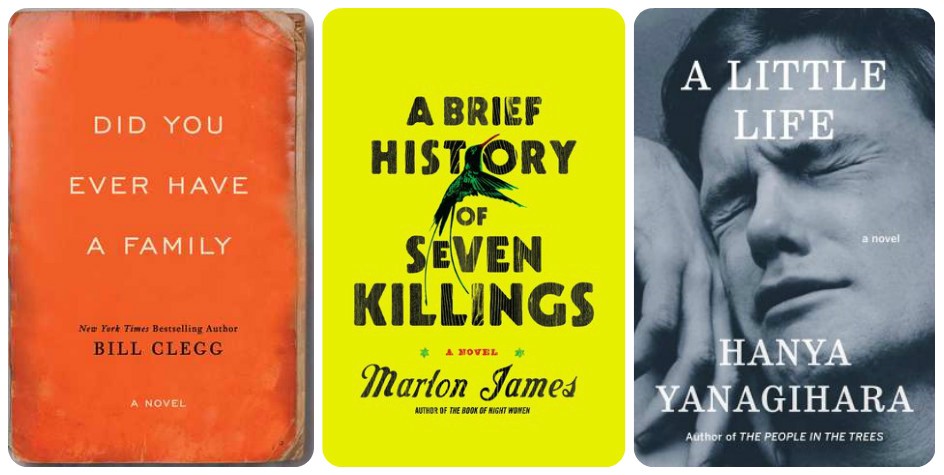
Until 2014, only writers hailing from the UK or the Commonwealth were eligible to receive the prize. An American writer has yet to emerge victorious (last year’s prize went to Australian writer Richard Flanagan for The Narrow Road to the Deep North), but this year they represent the largest national contingent on the longlist. Bill Clegg, whose 2010 memoir Portrait of an Addict as a Young Man earned him the rarified status of literary agent/author, is among the five Americans to make the cut. His debut novel, Did You Ever Have a Family, is the only nominated title that has yet to be released. It will compete with established successes like A Little Life, Hanya Yanagihara’s ambitious novel about gay men in America, and A Brief History of Seven Killings, which spans several decades of political tumult in writer Marlon James’s native Jamaica.

The remaining nominees represent a broad swath of the Commonwealth, hailing from New Zealand, India, Nigeria, Scotland, and England. Professor Wood said, of the selection process, “Discussions weren’t always peaceful, but they were always very friendly. We were lucky in our companions and the submissions were extraordinary. The longlist could have been twice as long, but we’re more than happy with our final choice.” Careful words from a man whom the conspicuously snubbed (Jonathan Franzen, Margaret Atwood, Salman Rushdie) might be crafting bespectacled voodoo dolls of at this very moment.

Who will triumph, joining the ranks of past winners like Yann Martel, Arundhati Roy, Kazuo Ishiguro, and Penelope Fitzgerald, and netting a cool £50,000? Your guess is as good as ours, but those looking to snag a copy not emblazoned with that bandwagon ensign, the Man Booker emblem, had best act fast — i.e. before the shortlist is announced on September 15.

The Longlist:

Bill Clegg (US) — Did You Ever Have a Family
Anne Enright (Ireland) — The Green Road
Marlon James (Jamaica) — A Brief History of Seven Killings
Laila Lalami (US) — The Moor’s Account
Tom McCarthy (UK) — Satin Island
Chigozie Obioma (Nigeria) — The Fishermen
Andrew O’Hagan (UK) — The Illuminations
Marilynne Robinson (US) — Lila
Anuradha Roy (India) — Sleeping on Jupiter
Sunjeev Sahota (UK) — The Year of the Runaways
Anna Smaill (New Zealand) — The Chimes
Anne Tyler (US) — A Spool of Blue Thread
Hanya Yanagihara (US) — A Little Life

“Scary Baby” Stories: An Interview with Adrienne Celt

Adrienne Celt’s upcoming novel The Daughters is excerpted in the most recent issue of Recommended Reading. In the interview below, Adrienne answers some questions regarding her writing process and her inspirations.

Katie Barasch: You capture the nuances of mother/daughter relationships so well in this excerpt from your novel The Daughters. Have you found this to be a recurring theme in your work? Do you find that the mother/daughter relationship is one of particular complexity?

Adrienne Celt: An interest in parenthood and children is definitely a recurring theme in my work — a good friend/treasured reader of mine calls these my “scary baby” stories, probably because I find there to be something uncanny about children, which I keep coming back to. (And I don’t mean that as a dig at children — really, I’m jealous of them.) I guess I would clarify, though, that what captures me most is the relationship between child and adult minds: how the fact that a single person can exist in these two very different states expresses something about the simultaneous permanence and transience of our identities. Children are so boundless in their energy and instincts: they haven’t hardened into any one narrative about their life the way that adults tend to. I look back very protectively on my childhood self, almost as though she was another person entirely.

That said, I do think there’s something particularly complex about the relationship between a mother and child, because the new mother is not only being forced to rethink her own identity, she’s also an intimate observer of the drama of the child’s developing mind. Here is this brand new person, unfolding as a unique being and interacting with the world for the very first time, and on the one hand the mother has critical distance because she’s an adult and she knows what’s going on. (By which I mean: discovering cause and effect by dropping a spoon over and over is not as mind-altering for the parent as the baby.) But in another way, every change is as deeply personal for the mother as the child — both because the baby is flesh-of-her-flesh, and because she understands more deeply than ever before that this is something she went through, too — that it’s what all human beings go through in the process of becoming.

Barasch: In The Second Sex, Simone de Beauvoir writes, “For the mother, the daughter is both her double and an other, the mother cherishes her and at the same time is hostile to her; she imposes her own destiny on her child: it is a way to proudly claim her own femininity and also to take revenge on it.” Do you see validity in this statement, and does it pertain to Lulu and her mother, Sara?

Celt: I feel like I should say, at this point, that I am not a mother. Maybe I will be, but my experience and fascination with children comes primarily from having known, for my whole life, that I had this possibility within my body, and that there was an expectation that I would fulfill it — which then kind of obsessed me. Did I want to have a child? What would it mean about me, and my dreams, and my personality, if I gave myself over to another person in that way? (All still open questions, obviously!)

All that is to say: I don’t claim to speak for women who are mothers, and can only bring to this conversation my experience as a daughter, as an aunt, and as a writer who has thought a lot about these issues on her characters’ behalf. But to answer your question: I guess I don’t know anymore. I think there was a time when I would’ve unquestioningly said that yes, the cherishing/hostile, loving/imposing dichotomy is correct, but now I’m not so sure — maybe because I read that statement as slightly hostile in and of itself. I do see some validity in the idea of a daughter as a double/other, because the child’s life, her body, literally comes from the mother’s life and body — and yet she is her own being. Certainly for Lulu and Sara, that is a tension. But overall, I prefer Maggie Nelson’s discussion in The Argonauts about pregnancy and motherhood as both radically queer and radically conformist, because I think that it points any hostility in the right direction: towards the strictures of social norms, and away from the individual intimate bonds between parent and child, self and other, body and identity.

Barasch: I was struck by this line: “Here is the thing you must understand: to know an opera you must be part of it. You must emerge into its world and lose yourself there with no hope of ever escaping completely. No matter where you go, the pitches and tones will follow you. The arias will pop up at inconvenient moments, and you’ll see the characters ducking into alleys years after you last met them onstage.” For me, this description evokes the immersive experience of reading a great novel. Were you thinking about that when you wrote these lines?

Celt: Art is immersive in all its forms, though every form has a different flavor, and one of the pleasures of writing about opera, for me, is that the performance is so physical — whereas reading and writing are mostly cerebral. You can be immersed in a book, but that experience comes from the intellect and the imagination, whereas music is actually engaging the body. I do think there are similarities, certainly, but it’s the differences that really intrigue me.

Barasch: Music plays an important role in this excerpt. As an author and as a human, how would you describe your relationship with music, including opera? Do you listen to music while you write?

Celt: I took voice lessons as part of my research for The Daughters, and as a writer it was important for me to get in touch with the physical discipline required of singer. I’ve always loved music — I played the flute semi-seriously in high school, I was a devotee of the mix tape until CDs and then MP3s took over — but my appreciation has mostly been that of a fan, not an artist, and it wanted for a bit of structure. I became interested in opera when I was living in Russia, where it’s often cheaper to see live music than to go to a movie. One night I went to see Verdi’s Macbeth, and they had a leaderboard with Russian subtitles to help you follow the Italian text, but I forgot my glasses, so it was all just a bright smear above the performers. And the great thing was — it didn’t matter. The music was so much more important than the words. That’s a transformative experience, for a writer, when the words suddenly don’t matter.

Normally I don’t listen to much music when I write, because it can be distracting (luckily, that’s not a problem with comics), but there are always a few pieces that get me in the right headspace, and which I play over and over again — lately it’s been Arvo Pärt’s “My Heart’s In the Highlands.” I tend to stumble on these pieces accidentally, so like all inspiration, the music that moves me has some relationship to kismet.