Falling Into the Unknown: An Interview With Quintan Ana Wikswo, Author Of The Hope of Floating Has…

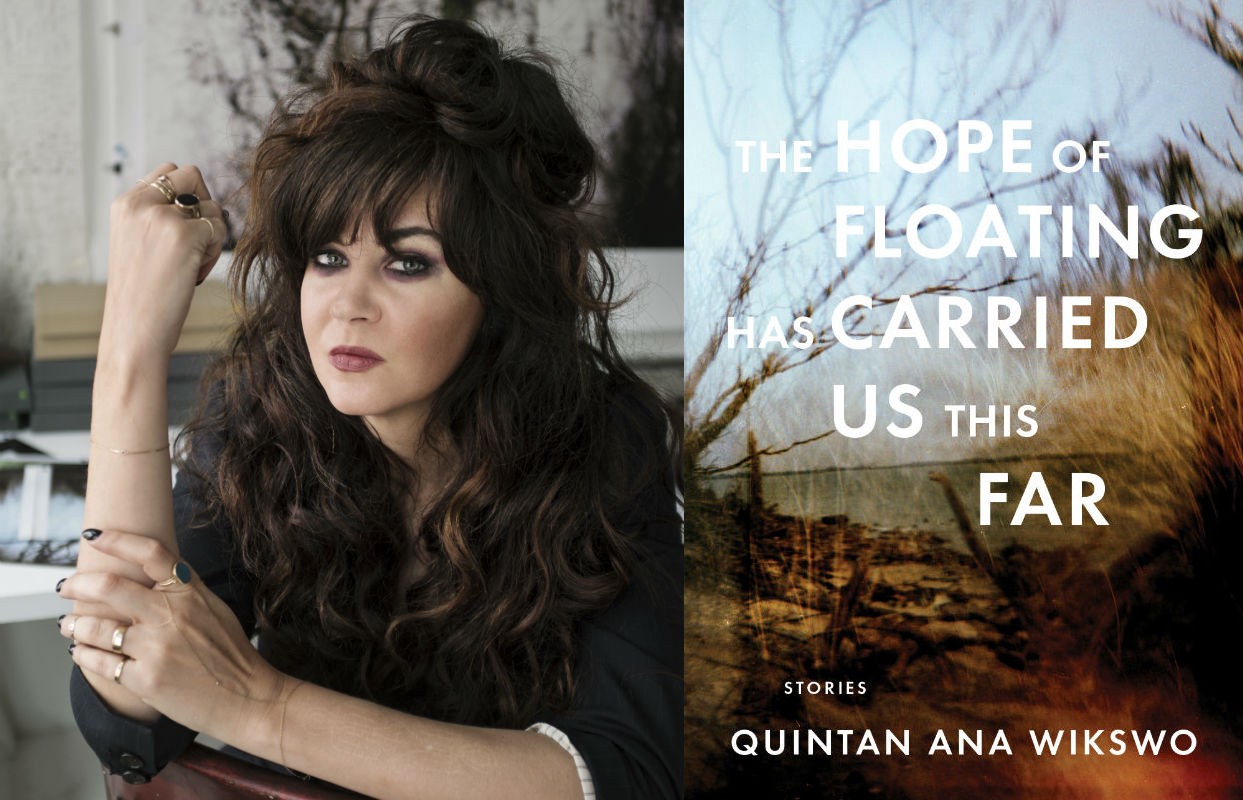
Quintan Ana Wikswo’s debut book of stories and images, The Hope of Floating Has Carried Us This Far, is an intoxicating read that feels at once universal and personal, comforting and jarring, ethereal and earthy, and after reading it once I read it immediately again. And then I read it again. And then I couldn’t stop recommending it to everyone I know.

And then I wanted to talk with Wikswo about how she managed to do all that.

A former human rights worker, Wikswo now uses salvaged government typewriters and cameras to navigate unexpected corners of the world — often seemingly mundane or obscure places where she reveals a multilayered complexity of time, space, and emotional history. Many locations are forgotten or overlooked sites where crimes against humanity have taken place. Wikswo writes stories from these places, attempting to put words to the places themselves and the peoples who’ve inhabited them, bridging in her work the liminality of human experiences, making stories that read like poems with images that don’t serve to illustrate the text, but to deepen a reader’s feel of it.

The Hope of Floating Has Carried Us This Far is a successfully ambitious bending of form that takes the reader beyond the expected in both literature and art. There’s a lot of bending in Wikswo’s work — time, form, genre, narrative, historical record — which encourages the reader to explore the territories we may not have encountered in more familiar forms of story collection. As she says, a “disruption in the familiar invokes a questioning of the habitual.”

A month after the release of her new book, and after a busy season of launch events, Wikswo took a moment to answer my pressing questions about her work.

Sarah Dohrmann: The Hope of Floating Has Carried Us This Far is an intriguingly unconventional story collection — in all ways, these stories defy the classification of a standard fiction text. There are painterly, abstract photographs, and the fiction often reads and looks more like poetry, with sometimes only one line or fragment of text on a page. The narrators and characters of the stories are nameless and their genders are undefined. This slipperiness conjures the reader into a dreamlike, abstract space that nonetheless grabs us with the conventional aspects of stories, like narrative, plot, emotion.

Quintan Ana Wikswo: I’m fundamentally obsessed with the way we humans actually experience story — the narrative of existence. This is a slightly different focus than priorities of “the craft of fiction.” For me, writing is the desire to convey the kinetic beauty of visceral, messy passions of our lives and experiences — the shifting abstractions of memory, the contradictions and disharmonies of shared reality, the awkward internal juxtapositions of trauma — where beliefs and feelings and perceptions are a tangle that defies the story arc.

Arguably, the conventional aspects of story are an attempt to organize the human psyche, to combat the disorganization of it that I find so compelling. Narrative, plot, and emotion are present when we walk to the corner bodega. But the rest is almost a secret lodged inside the mind that we will never adequately convey to another living being, and perhaps not even to ourselves. These secrets are fragments and wholes, fantasies and fears, and we might spend the rest of our day trying to make sense of what we felt on the way to the bodega. That’s the unconventional aspects of story — trying to accommodate all the messy bits that don’t fit into what’s expected.

Most of all, I find it rather horrifying to think of forcing a reader to perceive something — a place, an event, a person, a feeling — exactly as I see it. I’m devoted to the niceties within the art of writing, but can’t seem to bring myself to pin down the wings of the psyche.

SD: The forms of the stories themselves look different from most short stories, too — they look more like poems. In “Holdfast Crowbiter,” for example, the young woman is learning to bite the heads off birds as she stands alone hungry at a seashore without fish. Rather than approaching it as a traditional narrative, you’ve left wide empty spaces in between sets of lines. This is typical for all the pieces, and meanwhile images are interwoven throughout that create additional breaks and pauses in the narrative. What surrounds your choices to actively disrupt the expected structure and form?
Quintan Ana Wikswo

QAW: I am intrigued by artwork of any kind that leaves the participant ample space to create an idiosyncratic, intimate relationship to the conjured world. Not so much to step into a pair of shoes that are waiting for me at the lintel of the artwork, but to tread through it barefoot and unsure of the path. There’s something of mythos to that — to go into the unexpected without a map. Empty space does that. Disorientation forces us to orient ourselves. I think we are all capable of that, once we get over the surprise.

The Crowbiter is hungry, and yet there are no fish. She must orient herself to a disconcerting reality and locate new abilities within herself. And so she grows. She acquires a skill — a gory skill perhaps, but one which feeds her family which otherwise would have starved.

As she stands there on the shore, her mind goes blank at the lack of fish. At the failure of the expected. At the consequence of starvation if she does not go off her map of the known. There is an internal pause in the psyche when we must re-conjure a world. We hesitate with the choices and absences of choices when we must occupy an unexpected gap in our comfort or knowledge. I am curious about those internal moments of psychological arrest. These are pivot points where choices are made. Where we feel the ache of our ignorance, or the excitement of unforeseen possibility. The use of photographs are intentional pauses in the pace of the narrative, exactly so the one holding the book can be released from my language and have a personal adventure in the space left open.

Nowadays, much of human written expression is not so dissimilar to taking the nine hundredth trip to Disneyland. Maybe there’s a new ride? They changed the formula for the funnel cakes?

As for the rest of my choice — much accessible and lucrative literature has become codified by iterative commodification. We read the same forms and structures over and over again, forgetting that once upon a time the short story was scandalous. Poetry was reserved for oracles and prophets. Nowadays, much of human written expression is not so dissimilar to taking the nine hundredth trip to Disneyland. Maybe there’s a new ride? They changed the formula for the funnel cakes? Snow White has a different scarlet dye in the fabric of her costume? With all due respect to the sensory rewards of tradition, we can’t grow — either as a discipline or as people — without pushing beyond them. I’m not sure my book pushes beyond as much as reaches out towards a wider tradition that calls upon ancient forms of human expression. A handprint on a cave wall. These kinds of adventurous enigmas that we can ponder — the fertile liminal space between communication and perception.

SD: There’s a universality to the work, and yet the voices feel deeply personal and resonant. It’s a bit eerie, because the universal and the intimate are often places where we struggle to reconcile our reality with a broader one. These feel like your experiences and your stories, and yet they feel somehow mythic and parabalistic. I don’t know how else to phrase it, but to ask: How’d you do that? Was that intentional and if so, to what purpose?

QAW: In my list of fundamental obsessions, I believe in something I can only call speculative nonfiction. For years, I worked with conflicting testimonies and oral histories of survivors of genocide and crimes against humanity — they might each speak of the same event, and yet there was an intimacy to their own voice that challenged the universality of what they’d all experienced. Sometimes authorities would begin to question the “truthiness” of an oral history when this line between universality and individuality became too prominent. But I care deeply about how the private psyche navigates a common experience.

These stories are drawn from historical events — behind each allegedly fictional story is an event that truly occurred in time and space. “The Double Nautilus” was drawn from my own time spent in the early days of the building of the Hadron Particle Collider. This construction exists as fact and history, but it was also an experience in which I had my own idiosyncratic tragedies and triumphs. In between the commonality of history and the individual specificity of experiencing history is a huge mystery. I love that space. The individual within the machine, each snowflake melting into invisibility.

In the first story, “The Cartographer’s Khorovod,” I was interested in how to make a nonfiction story sound like fiction. I can tell you that everything in it is true. But it still reads like make-believe. I don’t support the lines drawn between genres in literature, or disciplines. We are simply not that tidy, nor are our lives.

If someone asks a combat veteran, “what was it like to kill someone in battle?” the soldier’s official answer is nonfiction. But the words that go through the soldier’s brain, if decanted, might seem more like a poem, or a dream, or a story. Remembered through fracture, through metaphor, through the language of dreams, or prismatic internal processing. That’s my territory. That’s what I care about.

SD: There’s also a stream-of-consciousness feel to the work, yet it feels highly controlled, too. What’s the relationship between these two elements — one that feels associative, even free, and the other that keeps time and place and historical record in order?

Our society has privileged the coherent as a means of establishing authority.

QAW: This is probably where my decades working in the field of human rights trauma probably comes into view. Our society has privileged the coherent as a means of establishing authority. Even on a more mundane, everyday level, when we talk to an emergency room nurse after an accident, or a police officer after a dispute, we experience simultaneously the immense difficulty of placing our perceptions into a coherent form, and the immense pressure to do so quickly and convincingly. Most of us are familiar with the look of distrust when our coherent story changes. We can identify with those split-second moments when we must adjust and calibrate our psyches to quickly fill in the right bubble on the standardized question of, “what happened?”

This is a cognitive, and a biological, and a social codification that begins in childhood. We are taught not to leave cause for confusion or contradiction. We are to be coherent at all times. People who cannot speak coherently are assumed drunk, or mentally ill, and are promptly placed in institutions of one kind or another. Yet each of us, every night, experiences dreams that defy coherence. Then we wake up, and button it up with our workday uniform.
Quintan Ana Wikswo

I’m interested in those buttons. The ones that we fasten without thinking, and the ones that we force ourselves to fasten. What happens to us when the buttons fall off. In The Hope of Floating, each character has come to the end of the line of what makes sense. All the characters are scientists who experience the failure of their map to describe their territory. I think scientists, like preachers, are fundamentally fascinating in their obsession with trying to explain and order the profound mysteries of existence.

A crisis of faith, or a failure of a hypothesis, is this breakdown in order versus conceptual association, or even chaos. Why did my child die? Why is the earth not flat? These points represent a schism of comfort and trust in the human psyche that I want to address in every way possible. What happens when we fall into the unknown? What lives in the fissure between the known and the unknown?

SD: I feel like a lot of noise is made about clever art — art that comments on itself or points and laughs at life’s idiosyncrasies, or it’s so abstract and intellectualized that it’s clever because it’s insider in some way. To my mind, this is an act of intellectualizing. Your stories are deeply emotional, touching on subjects that many readers would rather avoid: femicide, genocide, erotic exploitation, etc.. What’s it like to make work that challenges a reader to feel? What responsibilities are inherent to that task, if any? Can you talk a little about emotionality in art-making?

QAW: I don’t set out to make emotional art. I sally forth into the areas of our psyches that nobody wants to talk about, and in that terrain I stumble upon emotion. It has led me to suspect that I was wrong in thinking nobody wants to talk about these things — it’s that over thousands of years we’ve constructed a constrictive society in which the forums for vulnerability are dangerous places to inhabit. We spend huge parts of our limited incomes telling our secret suffering to a paid professional therapist — even that tiny opportunity has only existed for a hundred years or so, and still faces stigma. Before that, we told our priests, and were often rewarded by being told that we would burn in the hellfire of eternal damnation.

How public must we become in order to receive justice? Immensely public.

There are huge repositories of individual and collective pain in human society — something we are forced to acknowledge in situations such as Ferguson, or Emma Sulkowicz dragging her mattress through NYU for months on end. Where, exactly, are we supposed to take this kind of pain? How public must we become in order to receive justice? Immensely public. And yet it is in public that witch pyres were built, and lynch trees roped up. We have been conditioned to hide anything that might disrupt, dismay, disconcert, or discomfort. Us, them, whomever.

My first two solo museum shows were surprising to me because the work was so personal I was astonished that major public institutions would create space for it. Then I began making friends with museum guards, who would tell me that people would sit on the benches and cry. I was dismayed, and then the guards would say, “oh no, they come multiple times to cry there. They say it’s the place they feel comfortable doing it.”
Quintan Ana Wikswo

We need more opportunities in which we are able to express a broader range of human experience besides obedience, shopping, and escapism. I don’t know what those look like, or how they operate, but I know that it goes hand in hand with making changes to the brutality and punitive nature of our states. Is prison the best place for an emotionally devastated heroin addict to experience emotion? Should we all die with only our psychologists knowing who we truly are?

Perhaps my artwork is emotional because I create it in places where emotions were punitively destroyed. I sit for months at an execution range in rural Czech Republic and then I write, and I make pictures. I sit for weeks at a site where my neighbor was raped in the desert. I don’t go there looking for emotion — I go there looking to understand. And since these things are beyond understanding, beyond rationality, all that’s left is the inchoate presence of emotion. And that, perhaps, is what makes it onto the page.

SD: There’s a lot bending here — time, form, genre, narrative, historical record. What say you of all this bendiness? What do you hope the reader to get out of it?

QAW: I hope the reader is encouraged to take a vacation from familiar constraints. It may or may not be enjoyable, but I hope that a disruption in the familiar invokes a questioning of the habitual, and perhaps some encouragement to those who cannot find a place for themselves within the boxes built for our containment.

SD: In the back of the book are notes on the methodology behind each story, which is unusual for a work of fiction. Why did you decide to include these notes?

QAW: That brings us back to the situation in which the family is in the emergency room, and the nurse wants to know about the suspicious bruise, but there’s only room on the form to say, “accident.” Or when someone says, “I go shopping at Barney’s all the time and security never checks my bag on the way out.” Or “why can’t I sit on the subway with my legs open?”

Storytelling, like emotions, like trauma, like love, is rhizomatic. These are uncontained stories.

I create my work through an intricate process of fieldwork that involves hundreds of bystanders, each with their own stories, each contributing to the context of the site or the situation that has drawn me in. The methodology is for them. It’s also for me. In “The Kholodnaya Voina Club,” the story tells about cold war test pilots who have crashed into the ocean and died, and live as ghosts underwater. This is a perfectly self-contained story that has its own satisfactions. But my context was my grief over someone I loved who was a cold war test pilot, and crashed and died, and still lives as a ghost within me. That’s my context. Behind each story is another story. Behind each consequence is another consequence. Storytelling, like emotions, like trauma, like love, is rhizomatic. These are uncontained stories. The methodology is a testimony that all stories carry on their lives without us, beyond us — they allude and invoke qualities that are extend infinitely over time and space and inhabit the human psyche in ways that cannot be contained.

As a child, I remember white people going to the beautiful grounds and gardens of plantations to have picnics and get married. Context lives in its own terrain, often wrapped up in secrets and stigmas and silences. There are many silences in the book which I placed there to suggest that something is missing, something is unsaid. Because that’s how our lives operate. And yet I felt a responsibility to provide context, to provide a few clues for the pretty trees. For the gaps within the gaps between the spoken and unspoken.

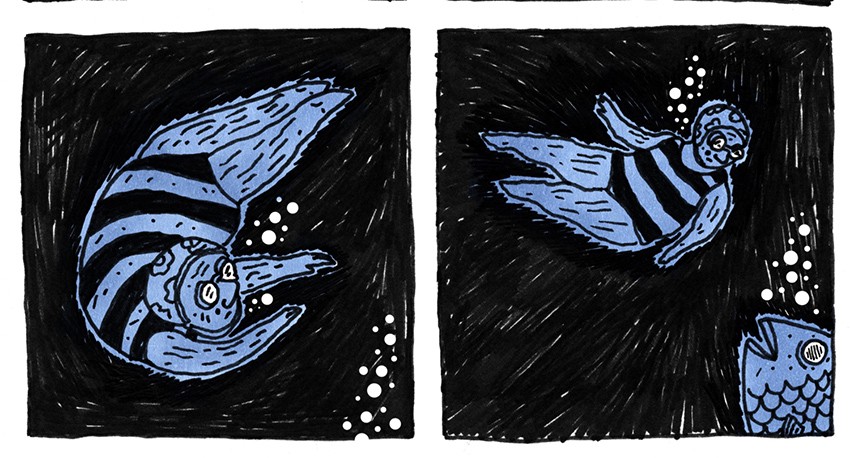
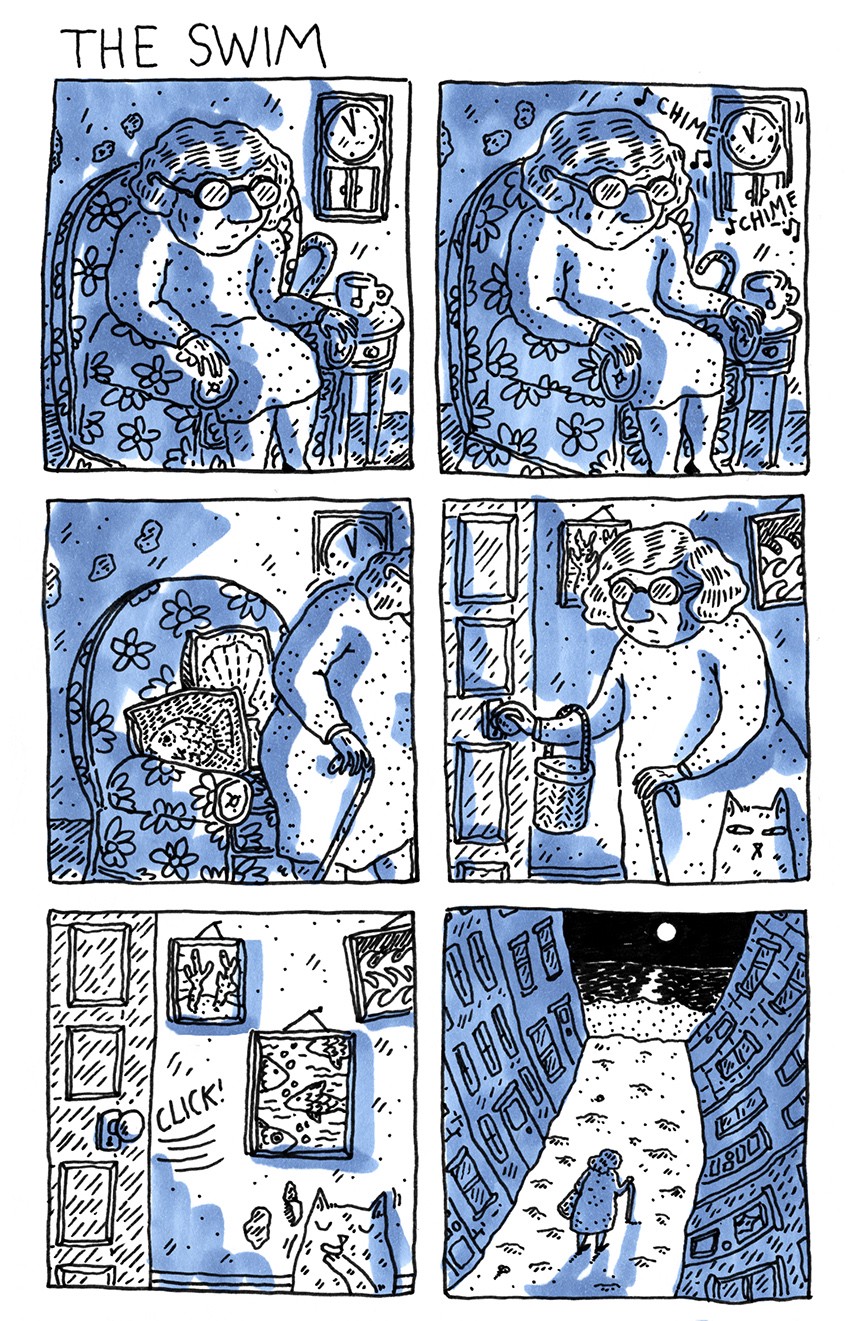
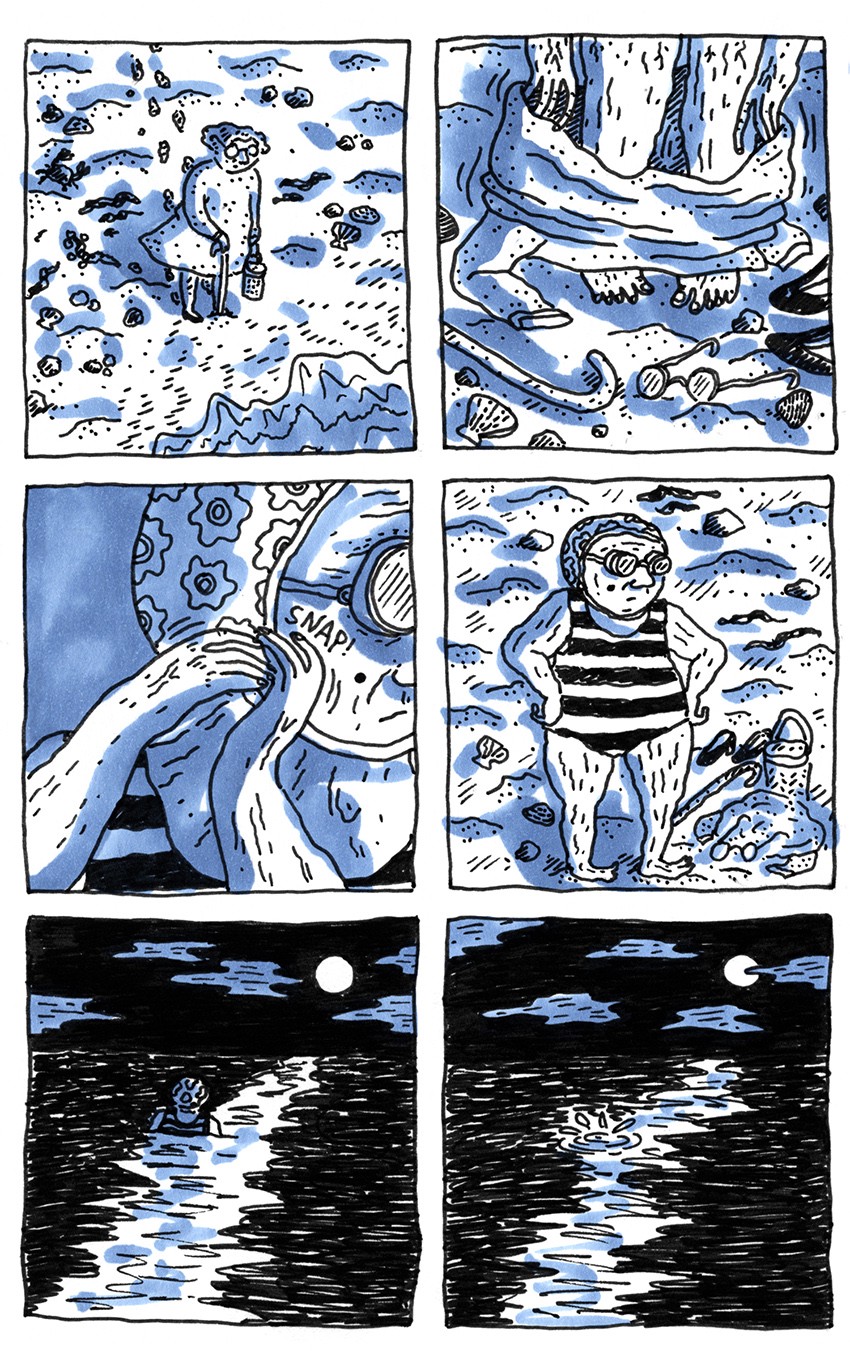
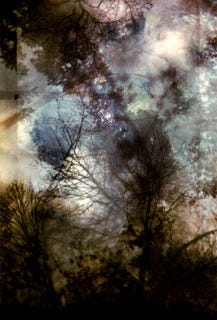
The images accompanying this interview are original artwork by Quintan Ana Wikswo and appear in The Hope of Floating Has Carried Us This Far (Coffee House Press).

Elena Ferrante Explains Why She Publishes Anonymously: “Books, Once They Are Written, Have No Need…

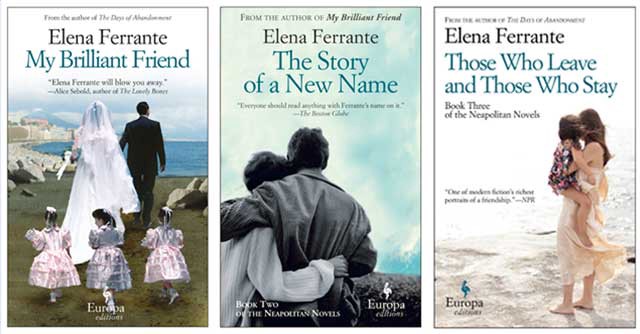
Hemingway did beer advertisements. Virginia Woolf spent a day puttering around London’s fashion houses for a spread in British Vogue. Legions of writers have held forth on Oprah Winfrey’s couch or Jon Stewart’s interviewee chair. But not Elena Ferrante, the pseudonymous Italian writer whom the NYTRB called “one of the greatest novelists of our time,” but who, since her first book was published in 1992, has clung stalwartly to her anonymity.

With the fourth and last of her acclaimed Neapolitan Novels due for release this September, Ferrante fever is at an all-time high. The jury remains hopelessly out on the author’s true identity, but, in a brilliant feat of anti-publicity publicity, Ferrante’s publisher Europa has released a letter to the London Review of Books written by the author in 1991 — prior to the publication of her debut novel Troubling Love— explaining her choice to shun the limelight.

Ferrante tells her publisher, Sandra Ozzola, that she will not do any publicity: “I’ve already done enough for this long story: I wrote it. If the book is worth anything, that should be sufficient.” She elaborates:

To explain all the reasons for my decision, is, as you know, hard for me. I will only tell you that it’s a small bet with myself, with my convictions. I believe that books, once they are written, have no need of their authors. If they have something to say, they will sooner or later find readers; if not, they won’t.

Tough luck for those kept up at night by Ferrante’s elusiveness. But in an age when the publicity campaigns for highly anticipated novels routinely reach onslaught proportions, and Man Booker Prize nominated novels boast their own Twitter accounts, it’s refreshing to see a writer committed to dodging the bandwagon at every turn.

You can read the entire letter on the Bookshop blog of the London Review of Books.

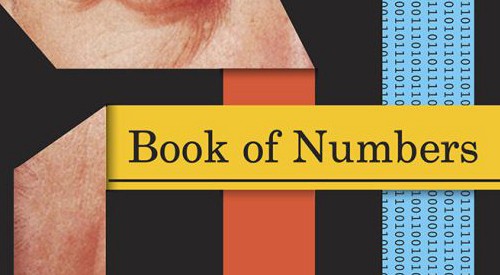
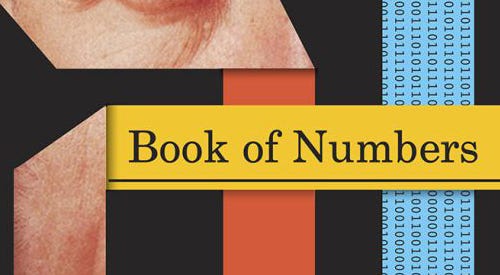
Voids and Fortunes: Book of Numbers by Joshua Cohen

by Zack Hatfield

We are all made of ones and zeroes; not atoms, viscera or memories, but assembled from differing yarns of binary code. Or so explains the narrator early on in Joshua Cohen’s latest novel, Book of Numbers (Random House), a sweeping opus concerning identity in the cyber era. “The ones our fortunes, the zeroes our voids, our blacker lacking places,” our narrator explains. It’s a poetic, if deeply nihilistic outlook that apotheosizes the book’s theme of how rooted modern technology has become in our lives.

The landscape of the Internet, like the mind, is complicated to map in fiction, its parameters immeasurable, its horizons always broadening. Its vast networks mirror the cerebral avenues Cohen sends us through in this story, which revolves around a novelist manqué ghostwriting a memoir for a “googlionaire” tech tycoon who shares his name (the book dubs him Principal, making confusion less likely). This doppelgänger — who may remind readers of Steve Jobs or other tech moguls — owns Tetration, a corporation comparable to Google and Apple. We follow the firm from its origins in programming counterculture as it moves from producing hardware to computers to phones, eventually creating surveillance technologies to monitor Americans. Fortunately, Book of Numbers refrains from full-blown Silicon Valley satire (too easy) or a type of Brave New Novel for our generation (too uninspired — see: The Circle), though the farcical gears gyrate throughout. Instead, Cohen evokes a panorama of everything leading up to the present with a constellation of topics that include the history of the search engine, the publishing industry, religion and art. It’s a work that, like much contemporary literary fiction, can be considered as much cultural criticism as a product of the imagination.

The extravagant altitude of Cohen’s authorial voice is one that requires acclimation. His language teems with digital argot, the sentences frequently run-ons, his paragraphs overflown and referential. At times the fictional data Cohen shoehorns into the novel threatens to freeze the bandwidth of the human cerebrum processing it. The salvo of neologisms, the jarring lyricism, the well-cadenced language steeped in self-indulgence all make comparisons to Pynchon and Wallace inescapable. Yet there’s also a humor in the vein of Phillip Roth or even Woody Allen. The distracted neurosis of the narrator reflects the paranoia and work ethic we’ve inherited in the digital age (“just completed an email, nonfiction,” he says when asked if he’s working on any writing). But just when one is beginning to become fluent in the rhythms of the ghostwriter’s thought pattern, his point of view is traded for hundreds of pages to the less interesting character Principal, who refers to himself in the first person plural and indulges in startup zen-speak while revealing his life story. Partly told in emails, code and transcripts between the two Cohens, the middle section lags. Following the liveliness of the first fifth of the novel, it feels like shifting down a few gears on Cohen’s information superhighway.

The thematic pursuit of Book of Numbers unravels when we consider its similarities to the Internet itself. Both testify to our vanishing attention spans, the paradoxes of communication made easier. They yield to the grammar of chaos. But throughout the weaker parts of the novel it can feel like there are too many tabs open. In the recent book Where I’m Reading From, critic and novelist Tim Parks writes that one flaw of the novel in the digital age “is not that it doesn’t participate in modern technology, can’t talk about it or isn’t involved with it,” but that there is a “slow weakening of the sense of being inside a society with related and competing visions of the world.” Culture is forsaken for accessibility. Parks’s diagnosis, that novels invest too much in universality, is reversed in Book of Numbers, whose broad cultural themes are made possible with prose that couldn’t care less about being accessible. A sacrifice is made as Cohen’s gratuitous language — simultaneously unreadable and virtuosic — is what imparts the disorder of the Digital Age so effectively. In a world where almost everything is at one’s fingertips, Cohen makes sure his writing isn’t.

Like many postmodernist and post-postmodernist endeavors, Book of Numbers struggles at times to find convincing pathos, both hamstrung and propelled by its tangle of pragmatisms and synaptic imagery. But as fictional Cohen’s cannabalistic ego is revealed (he blames the failure of his novel on 9/11, which occurred a day after his publication date) an emotional cavity in the book feels only necessary to reveal the vanishing humanity in an era avalanched with algorithms, of so many usernames and passwords, of endless pixels. As the reader wades through the narrator’s experiences across several timezones and mental states, it becomes painfully clear that in a technological world where it is impossible to be “plausibly alone,” as he claims, loneliness still abounds.

Book of Numbers alludes to the friction between the online world and the art of the novel; consider its opening line: “If you’re reading this on a screen, fuck off” (despite the sheer weight of the book’s nearly 600 pages, I felt guilty and got the physical copy). Although it could be understandably placed next to, say, Ben Lerner’s 10:04 on the shelf — both are bracingly of-their-time metanarratives that concern NYC novelists prone to self-conscious digressions — Cohen’s novel has much less poetic chemistry than Lerner’s, more complacent as a screed that helps unpack the post-9/11 world. Though it might prove a convincing time capsule, the book redeems because it’s ahead of its time. Cohen would probably scoff at those who call this an “Internet Novel,” and he’d be right to. With its acrobatic diction and ambition, it indicates that the Internet has infiltrated the matrix of our psychology, our culture and everyday lives. And what is the novel supposed to do if not provide insight into our minds and everyday existence? Despite its glitches, Book of Numbers earns its applause through a magisterial attempt to solve life’s grand equation, one that storytellers have been and will most likely be computing in every eon, with or without wifi.

Book of Numbers

by Joshua Cohen

Powells.com

PopSlate’s Nifty New Gadget: iPhone Case with E-Ink Screen

PopSlate has created the ultimate iPhone case: one that not only protects your precious phone, but also includes an E-ink screen on the back of the case.

E-Ink is known to have advantages over LCD displays when reading. It’s ideal for black and white text, and it also more closely resembles paper. Perhaps if we choose E-Ink over LCD when reading electronically, we can pretend we’re holding a real book made of real paper.

Plus, Gizmodo reports that E-Ink screens don’t need power to keep their images. Problem solved! We all know how terrifying it can be when our phones die — especially when we’re relying on it for one pertinent, timely piece of information. (Such as exact directions to a new neighborhood, or a short poem to impress a first date.)

You Should Never Go Home: Fiction and the Suburbs in Judy Blume and Karolina Waclawiak

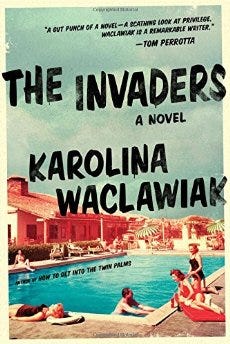
Recently I found myself driving around the suburbs I grew up in between reading Judy Blume’s 1978 “stunning debut in the world of adult fiction,” Wifey, and Karolina Waclawiak’s new novel, The Invaders. Cruising past my old high school and other places I have had no reason to revisit in over a decade between reading those two books seemed appropriate since both novels focus on female protagonists who’ve placed their faith in shoddy husbands and the faulty cure-all of suburban living. Passing streets I’d tried to forget reminded me just how bleak the suburbs can be when you feel like you don’t belong in them, something both Waclawiak and Blume explore in their books.

The Invaders book

“The less thinking you do the better off you’ll be,” Blume’s Sandy Pressman is told by her husband, Norman. 37 years later, the husband in Waclawiak’s book is sexually alienated from his wife, Cheryl; he doesn’t repeat what Norman says, but he and the rest of the people in the couple’s Connecticut neighborhood adhere to that train of thought. While Cheryl’s sex life is nonexistent, Sandy’s is regimented and boring. It happens on the same night every week (“unless I have my period”), it lacks passion, and Norman finds the idea of performing oral sex on his wife absolutely revolting.

Blume’s Emma Bovary-ish protagonist Sandy is a woman bored with her lackluster marriage — in need of an escape if only in the arms of other men; everything is falling apart around Waclawiak’s Cheryl, but she is paralyzed by it, and her lack of action could spell her downfall. Like the neighbors in Blume’s book, Cheryl’s neighbors in Little Neck Cove live with blinders on, in a way that sits perfectly between Shirley Jackson ominous and David Lynch askew — like you’re waiting for something bad to happen but don’t know exactly what.

Even though Blume’s book came out before Waclawiak was born, it feels just as contemporary. Reading both at the same time has me thinking it’s time for authors to get out of the city and start exploring the suburbs again. There’s real darkness out there just waiting to be mined for fictional gold.

Wifey Blume

The American suburbs as we know them, once considered the “borderlands” outside major cities, started to develop towards the middle of the 19th century before the beginning of the Civil War. They were suited to people who could find jobs outside of the metropolitan area, or who had money to make the commute back into places like Manhattan, Chicago, or Philadelphia. The places where Blume and Waclawiak’s characters live in the 20th and 21st century aren’t all that much different. They are filled with mostly white people who can afford to live somewhere picturesque and quiet. They don’t like outsiders: people of color aren’t welcome, are instead eyed suspiciously and called coded names when they come to clean the houses in Blume’s New Jersey neighborhood. They’re all trying to achieve that the American Dream, and a big part of attaining that it is by being as ignorant as possible. This is slyly skewered perfectly in The Invaders: When an old Mexican fisherman is caught urinating in the streets of Waclawiak’s town, it’s a sign of how supposedly unsafe things have become, and the neighbors decide to erect a physical wall to block out what they’ve already restricted in their minds.

I passed through one of the gated neighborhoods that I lived in as a child. The neighborhood association said gates kept non-members from using the pool, but everybody knew better. I had dinner with an old friend from high school and she told me that the place was like a ghost town following the 2008 financial crisis. People moved out, families broke apart, jobs were lost, and the housing market crumbled. Things have since picked up, but I wondered what happened to all the families I knew, the ones you smiled at and who smiled back at you, but who you always heard secrets whispered about when they weren’t around. Things are supposedly better now, a little more stable. But as I drove north to another neighborhood I also once lived in just outside of Chicago, one that was supposed to be the “next up-and-coming city” but had seen its best chances dry up when the businesses didn’t follow the housing developments, things felt darker. If I was a fiction writer, I thought to myself, this would make the perfect setting for a story or book with the closed chain stores, at-risk mom and pop businesses barely hanging on, and abandoned half-built townhouses that look like they’d been given up on a few years earlier. I passed my childhood movie theatre that was now shuttered, and empty storefronts where I had bought gym clothes. This emptiness is what will always be underneath the shiny façade of the suburbs.

This emptiness is what will always be underneath the shiny façade of the suburbs.

The suburbs were built to crumble. They’re places built on lies and kept up by blind eyes. Some fiction writers have explored this; maybe the most notable being John Cheever, who sometimes gets the tag “Chekhov of the suburbs.” But books like Wifey and The Invaders, although written and published with a few decades between them, don’t shy away from looking at what goes on behind closed doors. The suburbs are very dark, very real, and very indicative of contemporary American ennui. And although the big cities hold a million stories, authors who go to little towns where everything is supposed to be perfect but ultimately fall short return with unforgettable stories. Wifey is one of the truly underrated novels of the 1970s (although it sold well upon release, it has taken a backseat to Blume’s classics), and The Invaders is easily one of the best novels of 2015. Those two books alone prove that writers should make it out to the ‘burbs more often.

photo of Chicago suburbs via Flickr

Where The Story Starts: An Interview with Annie McGreevy

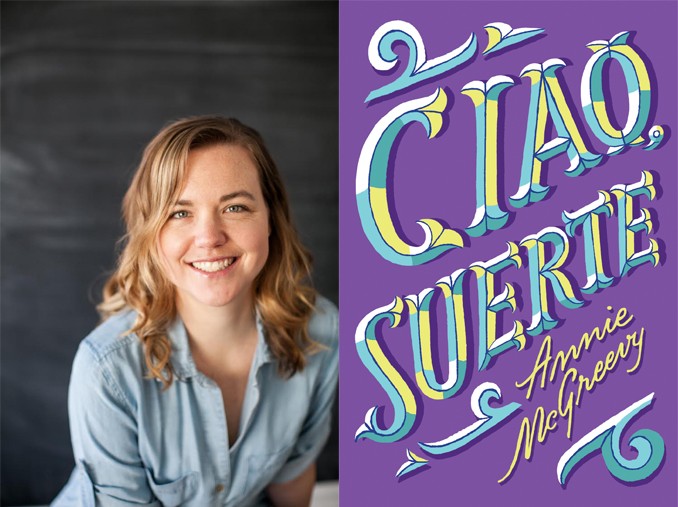
Annie McGreevy’s debut novella Ciao, Suerte is excerpted in the newest issue of Recommended Reading. In the interview below, McGreevy discusses her interest in the subjects broached by the novel, and the process by which the work came to fruition.

Emma Adler: According to Deena Drewis, who wrote the introduction to the excerpt, you started out writing your novella, thinking you were “doing it wrong” and that no one would ever see it. Is this an attitude that persisted until you finished the book, or did you reach a point, during the writing process, when you realized that you had something of potential value on your hands?

Annie McGreevy: The attitude that it was “just for me” and “just for fun” definitely persisted through the first real draft of it, until I showed it to anybody, yes. I’m part of a really supportive writing group where it’s easy to show up with a vulnerable draft, and once I workshopped it there and got some positive feedback, I realized it was workable.

I guess, on some level, I felt that it could get good at some point even in the early stages. I think this is a big part of what draws me to the writing process — feeling that something could go either way, get pretty good or fail really hard. I’ve got an embarrassing number of stories in drawers that have failed really hard.

Adler: Ciao, Suerte does not just span continents and decades, but also age groups, focusing on multiple generations of a family blown apart by war. How did your approach change, writing from the close-third perspective of an old woman, as compared to that of a young man in his twenties? As a young writer, what are the challenges of attempting to channel a character who is much older than yourself?

McGreevy: Beatriz, Giancarlo and Eduardo are the first elderly characters I’ve ever written seriously, and they did present real challenges. Beatriz has such clear goals, though, so I focused on those in order to manage her. Giancarlo was trickier, and I wrote tons of pages from his perspective that ended up getting cut.

The main difference in my approach to characters of different ages really had to do with time. Beatriz’s mission is on a timer; she wants to find her grandchild before she dies. Miguel and Inés are very young and carefree. I think this is reflected in the way the story is written and the things they do: hang out with no plans at all and blow off important things like final exams. Miguel is spending an entire year doing nothing at all.

Beatriz, Giancarlo, and Eduardo are all very in touch with their mortality and on missions to accomplish certain things during their lifetime, and I think that fact was ultimately driving their individual narratives: Beatriz wants to find the child, Giancarlo wants to get over the heartbreak of losing the child, and Eduardo wants to convince himself that he did the right thing. They’re all old enough that death creates an urgency for them. Miguel and Inés, because they’re in their early twenties, live their lives as though they’re immortal.

Adler: Ciao, Suerte is set against the historical background of the Dirty War in Argentina. How did you first become interested in this period of Argentinian history? Have you spent much time there?

McGreevy: I lived in Madrid from 2003–2007 and knew lots of Argentine people there. They have this really distinct way of speaking that’s lovely to listen to. Julio Cortazar was already one of my favorite authors and I quickly became a huge fan of Argentinean music, the yerba mate tea, and interested in the culture generally. In 2012, I read an article in The New Yorker that detailed the story of many of the illicitly adopted children of the Dirty War who were found through DNA tests and the efforts of Las Madres y Abuelas de La Plaza de Mayo, and reunited with their grandparents. The story was fascinating on a personal and political level.

I’ve never actually been to Argentina! I keep trying to go, and then life keeps getting in the way. Which is a problem I’d like to rectify ASAP.

Adler: The opening chapter of Ciao, Suerte (included in the Recommended Reading excerpt) describes the gradual breakdown of Beatriz and Giancarlo’s marriage following the death of their son. In a sense this is the tragedy after the tragedy, which includes the struggle to recover, move on, and achieve closure. How did you decide to begin the story at this point?

McGreevy: Well, there’s that old question about where to begin any story, using the example of the couple on the eve of their wedding: the guy has his bachelor party and orders a stripper, and both he and the stripper are extremely drunk. When they wake up in the morning, on the wedding day, he realizes that the stripper is the woman he’s about to marry. He, of course, had no idea that she was a stripper. This example is used to discuss the question of “When should this story start?” When they wake up, because that’s the most exciting part? Or the night before, so we can get to know the characters, and then be devastated when we realize they’re not who their partner thought they were?

I’m definitely of the opinion that we need to know the character before they lose something big. I wanted to start the story with Beatriz and her struggle, so that, when she finally meets Miguel later on, it would have more context and meaning.

During the editing process with Deena at Nouvella, Giancarlo worked his way into the story with more strength. I realized that couples are often not on the same page about the way to deal with a tragedy, and this was an opportunity to explore something more personal and less political.

TED WILSON REVIEWS THE WORLD: CLIFF HUXTABLE

★★★☆☆

Hello, and welcome to my week-by-week review of the world. Today I am reviewing Cliff Huxtable.

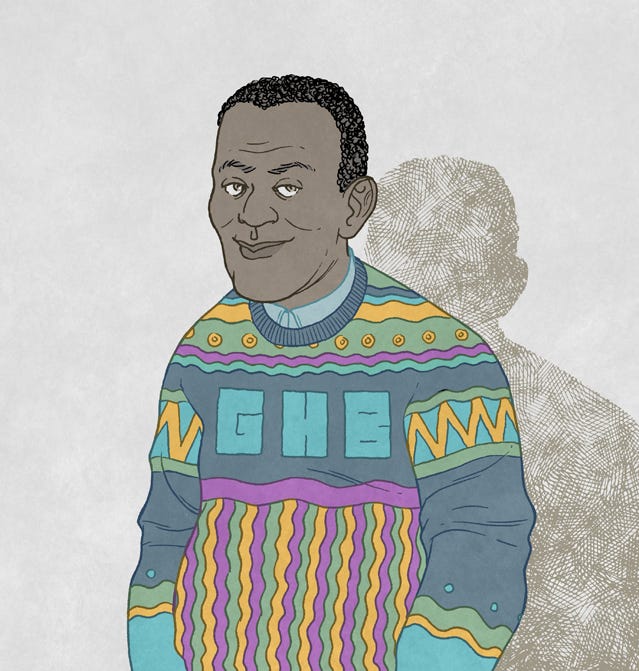
Cliff Huxtable was a fictional character in an old sitcom. He was a loving father, husband, and son, with a friendly disposition and thoughtful approach to life. The name ‘Huxtable’ sounds like ‘huggable’ and makes me feel warm and safe. He had no enemies. He would bring women into his basement to look at their vaginas.

One of his most notable traits was the amazingly large sweater collection he owned. Most people didn’t care much for the style of his sweaters, but he wasn’t swayed by popular opinion. He did whatever he wanted and no one could stop him. He had dozens and dozens of sweaters, dating back decades. In fact, he had so many sweaters that he could wear a different one each week for years on end without repeating any. That’s a guy who really loves sweaters.

Some might say his sweater collection bordered on obsession. Why did he need so many sweaters? Why couldn’t one sweater be enough? What drove him to buy sweater after sweater? In a way, it’s almost like he didn’t care about the sweaters, the way he would wear one and then discard it, immediately searching for his next sweater. What a complicated guy.

He probably needed a second closet devoted just to his sweaters. Most likely a secret closet or something hard to get to, to keep the sweaters safe. You can’t have that many sweaters without your wife finding out though, so she must have been okay with it. I don’t know if she ever tried to get him to quit it already with the sweaters, or if she was resigned to the whole thing.

cliff

If you want to watch videos of Cliff and his sweaters, you can find a lot online. When I watch the videos I can’t concentrate on the jokes. I get too distracted wondering where he is now. The show went off the air so does he still exist? He could be brought to life at any moment if they reboot the show. And because he’s just a character, anyone can play him. Like how different guys play Batman all the time. I’d like to see someone more comical in the role of Cliff Huxtable. Someone like Mike Tyson.

BEST FEATURE: Cliff is really funny from the neck up.
WORST FEATURE: At the heart of it all, something about him seems really passionless. As if he’s just going through the motions and is dead inside.

Please join me next week when I’ll be reviewing a race car.

Illustration by Jon Adams.

AUGUST MIXTAPE by Sarah Gerard

They Don’t Love You Like I Love You

My new chapbook “BFF” dissects my 17-year best friendship with someone who has since slipped into another life. Each of the songs in this playlist holds some significance in that context — these are not songs I was listening to while writing the book, but songs we listened to together or, importantly, didn’t. “BFF” is written as a direct-address to its subject, so this playlist is written in the same style. I hope you enjoy it.

1. No Doubt — Don’t Speak

“Tragic Kingdom” came out when we were in middle school and Gwen Stefani was the coolest woman in the world. She possessed all the confidence and style we wished we had. You came over to my house in the afternoons and we made music videos for every song on this album with my dad’s Sony camcorder.

2. Thee Oh Sees — Carrion Crawler

Time has passed. This is a song I’ve heard you like but we’ve never listened to it together. It’s a really good song — you’ve always had good taste in music. We used to share recommendations all the time. I spent entire nights making you mix CD’s with the cases and sleeves collaged. We drove around aimlessly for hours introducing each other to new bands. I miss it.

3. Johnny Cash — Ring of Fire

On the day I lied to you about being a fan of Johnny Cash when I had only just begun to familiarize myself with his work, you asked if I liked this song and I didn’t know which song you were talking about. You tried to sing it to me but you’re kind of a bad singer — sorry, it’s true. I didn’t recognize it.

4. Yeah Yeah Yeahs — Maps

The Yeah Yeah Yeahs were your favorite band for maybe too long. Maybe they still are. You would talk about Karen O like she was a personal friend of yours. I think you met her backstage at a show or two. You loved saying, “They don’t love you like I love you.” You started collecting maps.

5. Get Up Kids — Don’t Hate Me

We were the perfect age for emo when it was a thing. I bought the Get Up Kids’ “Something to Write Home About” and you got “Four Minute Mile” and we debated about which was better. I still think mine was better. But yours is grittier, and I think that’s appropriate.

GLT9-cover

6. Bob Marley — No Woman No Cry

You always loved Bob Marley, had a totally Jamaican-themed mind (you also loved Bad Brains), and not just because of the weed, but because Bob Marley sings about hardship, and you identified with hardship. In Bob Marley, you saw that despite your hardship, you could also live chill. Like “Your blues ain’t like my blues” — your tattoo, which you’ve since covered up — which contains the relaxation of the contraction in the midst of its strife. You told me you dated a Marley.

7. Car Bomb Driver — Brookwood Girls

Car Bomb Driver was our town’s punk band so you befriended Car Bomb Dave and talked about him whenever you saw the chance. This song was special to you, like he’d been thinking about you as a Brookwood girl, which you were. The chorus made you feel cool because you, too, were a rebellious teenage girl who couldn’t be controlled.

8. Gogol Bordello — Wonderlust King

This was the last show we went to together, at the Emerald. My hair was still short and I wore a cardigan and pants, and was so hot I was sweating. You took a picture of me from above, touching noses with our other friend, who didn’t speak to me for a year after you and I stopped speaking. You said, “I’d like to do a series of photos like these. I think it’d be swell.”

9. Joni Mitchell — A Case of You

I never knew Joni Mitchell meant anything to you. You liked this song somewhere on the Internet and I noticed and felt tricked. This was the song I played for my ex right before we broke up, and you and I stopped talking a few months later. It’s like you knew and were sending me a secret message, or a secret slap in the face.

10. MGMT — Kids

This was the era when you lived in the little gypsy boat apartment on the south side of downtown. You wore a long, grey, empire-cut cardigan with most everything, and you and your daughter shared a bed — you’d shared a bed for some time already. Once, you guilted me into coming to Ladies’ Craft Nite and I didn’t want to come. I was mad at you and pouted the whole time, and you said I’d disappointed you.

11. Blink 182 — Lemmings

When I bought “Enema of the State”, you’d already been listening to Blink 182 for two years. You told me “Dude Ranch” was better and it is, undeniably. It’s hard to choose which song on this album reminds me most of you, but I seem to remember this being the first song from it that you played for me, and I can imagine what it sounds like when you say the word lemming.

12. Goo Goo Dolls — Black Balloon

You fell in love with the Goo Goo Dolls the year we lost our virginity. I’m back in your bedroom listening to this song: the window overlooking the kitchen, your walk-in closet, your vanity mirror. You telling me you’d done whip-its with a group of kids whose names I’d never heard. By the end of that year, you were put in the girls’ home.

13. Beach House — Zebra

You’ve always been on the edge of cool. It’s scared me at times; I could never keep up with you, but never knew it until after the fact. Your taste was better than I gave you credit for. Better than mine. You knew hip, but I didn’t know you knew hip because you never made it work for you; you were always sabotaging yourself, always failing. To me it all sounded like bullshit. I should have listened better.

***

— Sarah Gerard is the author of the novel Binary Star (Two Dollar Radio), which NPR calls “a hard, harrowing look into inner space,” and two chapbooks, most recently BFF (Guillotine). Her short fiction, essays, interviews and criticism have appeared in the New York Times, New York Magazine’s “The Cut”, Joyland, the Paris Review Daily, BOMB Magazine, and elsewhere. She teaches writing and writes a monthly column on artists’ notebooks for Hazlitt.