Midweek Links: Literary Links from Around the Web (July 16th)

Looking for some interesting reading to get you through the week? Here are some literary links from around the web to check out:

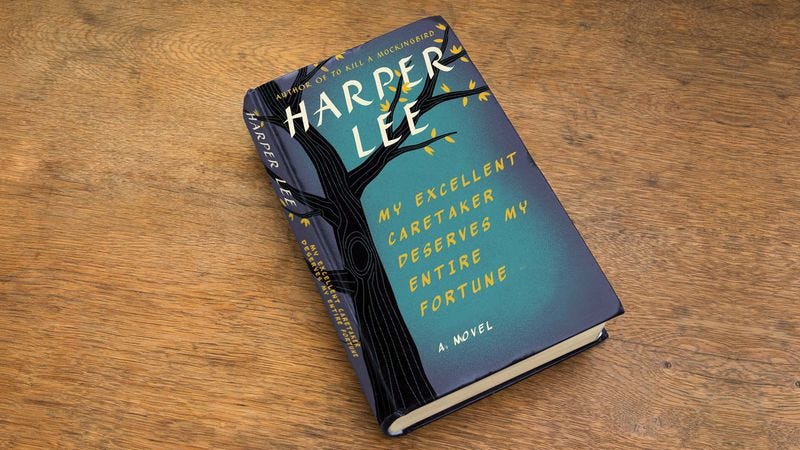
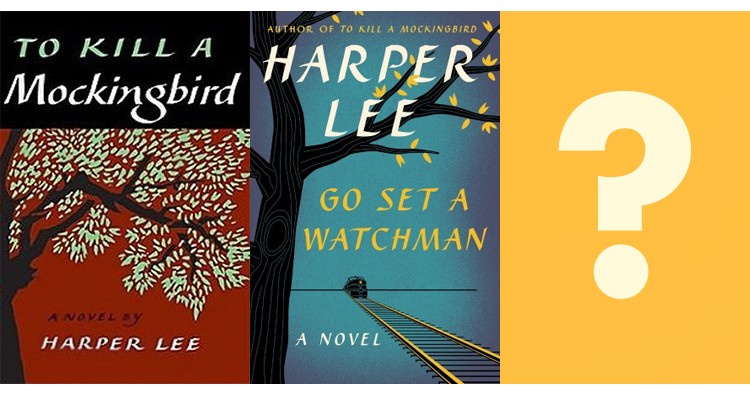
Harper Lee third book

The Onion has the scoop on the third Harper Lee novel (which actually may be a real thing)

Some fantastic fantasy series that you may not have heard of

and here are some science fiction books that will blow your mind

Why Alejandro Zambra is more than the new Roberto Bolaño

Great craft advice from Michael Kimball’s serialized One-Hour MFA book

First cyberpunk, then steampunk, and now… silkpunk?

Does “creative nonfiction” need a new name?

Tale of Genji still seduces readers centuries later

Speaking of Harper Lee, was her Atticus Finch always a racist? Scholars say yes

And publishers are scrambling to publish more “lost” literary sequels

Attempted LGBT Book Ban Fails in Texas

This week, the town of Granbury in Hood County, Texas is the site of yet another victory for LGBT rights.

Earlier this month, dozens of Granbury residents signed challenge forms at Hood County Library, protesting the inclusion of titles that promote tolerance of the LGBT community–Cheryl Kilodavis’s My Princess Boy and Gayle E. Pitman’s This Day in June–in the children’s section. Some asked that the books be relocated to a different section; others asked that they be barred from the library.

Library Director Courtney Kincaid resisted, assenting to moving This Day in June–which focuses on a Pride parade and LGBT history to the nonfiction section, but refusing to move My Princess Boy. Said Kincaid, “The books have color drawings and have some rhymes. Lesbians and gays are in this community, and they deserve to have some items in this collection.”

And yesterday, the Hood County Commissioner’s Court declined to say differently. Following a nearly three-hour-long public meeting–at which one Hood County resident accused the library of “[hiding] their contempt for Judeo-Christian values behind the right of free speech”–the Commission chose not to vote on the issue. They cited the advice of the county attorney, who said previous cases indicated that “removing, relocating, or in any way restricting access to the books would likely constitute unlawful censorship.”

Kincaid had some advice for her thwarted neighbors: “If you don’t want your children to read these books, don’t check them out.” A reasoned response–though we’d like to compel all of the challenge form writers to take a leaf out of Pitman and Kilodavis’s books.

Pope’s Climate Change Encyclical to be Published by Melville House

Pope Francis: spiritual leader, humanitarian, tango enthusiast, and now, indie press author.

An unlikely resume, perhaps, but one made possible by independent publisher, Melville House, which today acquired the rights to the Pope’s encyclical, On Care for our Common Home. The encyclical, released by Pope Francis in May, addresses climate control, with a particular focus on the consequences for poorer nations if greenhouse gas emissions are not reduced. (It also invoked the wrath of conservative pols across the nation. Quoth Rick Santorum: “leave science to the scientists.”) Though Melville House has published other institutional texts (last year’s CIA torture report was a big hit), this marks the first time that the Vatican has joined forces with a secular publisher.

Naomi Oreskes, the Harvard professor tapped to write an introduction for the book, views the encyclical as potentially momentous for global environmental policy. “Historians looking back often recognize turning points, but ordinary people living through them rarely do. Sometimes, however, a book catalyzes thought into action. Uncle Tom’s Cabin did this, and so did Rachel Carson’s Silent Spring. Like those works, Pope Francis’s Encyclical is a call to action.”

Those ready to heed the call will not have long to wait. Melville’s rush edition of the encyclical will be available August 4 — perfectly timed to anticipate the Pope’s visit to the United States this September, when he will address both houses of congress, and is expected to broach the topic of climate control.

Better Not Go Saying Too Much: Eduardo Halfon on Literature, Paranoia, and Leaving Guatemala

Just after I published my first novel in Guatemala, in 2003, I had a beer with the Salvadoran writer Horacio Castellanos Moya, who was living there at the time. We met at an old bar called El Establo. As soon as he saw me walk in, he raised his bottle of beer, congratulated me, smiled a crazyman’s smile, and then warned me to leave the country as soon as possible.

* * *

My entrance into the literary world had been both unexpected and unplanned. I was thirty-two years old and had never before published anything, anywhere. Not only did I know very little about the Guatemalan literary scene, I knew even less about Guatemala in general. I had left the country in 1981 — on the day of my tenth birthday — with my parents and brother and sister, had grown up in Florida and then studied engineering in North Carolina. At school, I was always the math kid. Never read books. Never even liked them. I finally returned to Guatemala in 1993, after spending more than twelve years in the United States, to a country I barely knew anymore, and with a minimal grasp of Spanish. I started working as an engineer in my father’s construction company and slowly began finding my way back into the country, and into my mother tongue — but always marred by an extreme sense of frustration or displacement, a sense of not belonging. Today I understand that this existential angst is more or less normal at that age, right after college, but back then I felt like a man without a country, without a language, without a profession (I was, quite literally, in my father’s), without a sense of who I was or what I was supposed to do. This lasted for the next five years, and only got worse. Until I finally decided to seek help. But my definition of help, being a rational and methodical engineer, was to look for answers not in psychology or even religion, but in philosophy. I went to one of the local universities, Universidad Rafael Landívar, and asked if I could enroll in a couple of philosophy courses, thinking that maybe there I’d find some kind of answer. But in Guatemala, as in much of Latin America, it’s a joint degree: Letras y Filosofía, Literature and Philosophy. If you want to study one, you have to study the other. And so I did. Within weeks I was smitten with literature. Within a year I had quit my job as an engineer and was living off of my savings and reading fiction full time, a book every one or two days, like some sort of literature junkie.

I wanted to write a story before I could write one good sentence.

A year later I started working at the university — as an assistant, then as a professor of literature — while at the same time I shyly, and secretly, started to write my first stories. All very bad, of course, very poorly written. I wanted to write a story before I could write one good sentence. I didn’t yet understand that typing isn’t writing; that writing is much closer to music, to breathing, to walking on water. But I was hungry to learn, and I was lucky to find the right teachers, particularly two: Ernesto Loukota and Osvaldo Salazar, both philosophers and colleagues of mine at the university. Ernesto Loukota taught me the craft of language. He would ask me to write a line about something — a tree, a dog, a chair — and the following day we’d get together at the university and go over that line, its grammar and punctuation. He’d then assign me a line about something else for the next day. And so on. Only one line, every single day. Like our own daily zen ritual. It was at least a month before he allowed me to write two lines. Osvaldo Salazar taught to me be my own reader. Every so often, I’d give him something I’d written and we’d study it together, take it apart, edit not its language, but its structure, its development and themes and overall content. If Ernesto Loukota taught me the craft of language, Osvaldo Salazar taught me how to be my own most demanding reader.

I was spending my days teaching, and reading books like some kind of addict, and learning to write as if my life depended on it (maybe my life did depend on it?), and before I knew what was happening I published my first novel. Just like that. Almost by accident. I stumbled onto books, and then fell into writing. But something was finally starting to make sense, about myself, about my country. And now I was being warned by a crazy Salvadoran writer that I should leave.

* * *

Guat collage

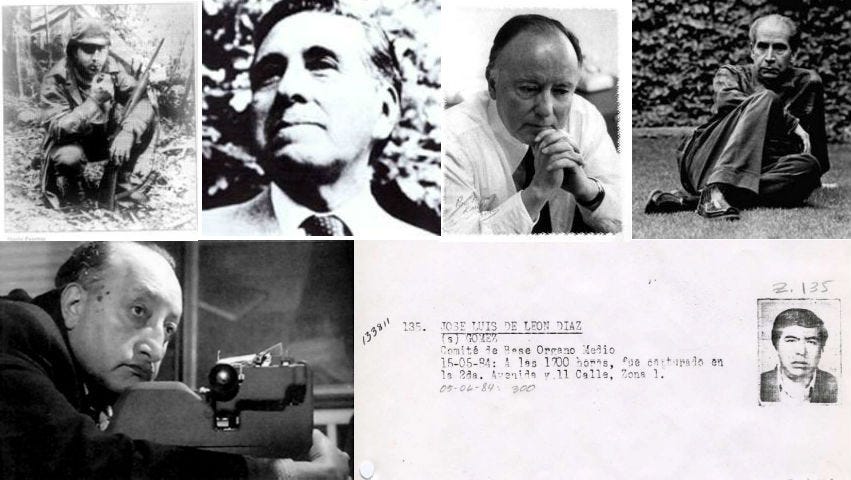
For the past century, Guatemalan writers have been writing, and dying, in exile. Miguel Ángel Asturias, who received the Nobel Prize for Literature in 1967, wrote his books about Guatemala while living in exile, in South America and Europe. He died in Paris, and is buried at Père Lachaise. The great short-story writer Augusto Monterroso, after being detained by the military forces of dictator Jorge Ubico, was forced to leave the country in 1944. He fled first to Chile, then to Mexico, where he lived the rest of his life, and where he wrote most of his stories, and where he’s now buried. Luis Cardoza y Aragón, arguably Guatemala’s most important poet of the last century, suffered a similar fate — he was also forced into exile in Mexico in the 1930s, where he wrote his poetry and where he, too, died. Guatemala’s greatest playwright, Carlos Solórzano, fled the country in 1939 — first to Germany, then to Mexico — and never returned. The writer Mario Payeras, a guerrilla commander in the 1970s, also wrote while exiled in Mexico, where he suddenly and mysteriously died (his remains were buried in a cemetery in the southwest of the country, but have since vanished). One of the most important Guatemalan novels of the last few decades, El Tiempo Principia en Xibalbá (Time Commences in Xibalbá), was written by the indigenous writer Luis de Lión, who in 1984 was kidnapped by military forces, tortured during twenty days, and then disappeared. His murder wasn’t confirmed until fifteen years later, in 1999, when his name and number appeared in the now infamous “Military Diary”, a haunting military document that secretly listed the fate of all the Guatemalans disappeared by the military forces between August of 1983 and March of 1985. Luis de Lión, born José Luís de León Díaz, is number 135. His novel was published posthumously, that most extreme of exiles.

* * *

Guatemalan writers, and Guatemalans in general, have lived for almost a century now in a climate of fear. If anyone dared to speak out, they either disappeared into exile, or disappeared literally. This fear is still prevalent, woven deep into the subconscious of the Guatemalan people, who over time have been taught to be silent. To not speak out. To not say or write words that might kill you.

Certain things in Guatemala are simply not spoken or written about.

The first consequence of this, of course, is overall silence. Certain things in Guatemala are simply not spoken or written about. The indigenous genocide in the 1980s. The extreme racism. The overwhelming number of women being murdered. The impossibility of land reform and redistribution of wealth. The close ties between the government and the drug cartels. Although these are all subjects that almost define the country itself, they are only discussed and commented in whispers, or from the outside. But a second and perhaps more dangerous consequence of a culture of silence is a type of self-censorship: when speaking or writing, one mustn’t say anything that puts oneself or one’s family in peril. The censoring becomes automatic, unconscious. Because the danger is very real. Although the days of dictators are now gone, the military is still powerful, and political and military murders are all too common.

How can a journalist be a journalist, then, if his or her life is at the mercy of the articles he or she writes? How can a novelist or a poet say anything truthful about their own people, about the social inequality, about the intolerable levels of racism and poverty, if their very life hangs on the words of those novels or poems? They can’t. The journalist can’t be a journalist. The novelist can’t allow him or herself to be truthful. And the poet simply ceases to be a poet. Unless, as recent history shows, and as I was told by a Salvadoran writer, they leave.

* * *

I started being followed. Or so I thought. It was a few months after my novel came out. At first I dismissed it as a coincidence, the black sedan always parked too close to my house, constantly appearing in my rearview mirror. But after a few days, coincidence gave way to paranoia, and I started doing all the things Guatemalans do in their normal, everyday psychotic state: frequently altering my route to work, avoiding dead-end streets and dark alleys, never driving alone at night (I have a friend who even bought a mannequin, and would sit it next to her in the passenger’s seat and pretend they were having a conversation as she drove). I also remember that one morning, during that time, while I was teaching at the university, a couple of guys just stood outside the classroom, and stared in at me through the window. They looked like thugs or maybe bodyguards. I went on teaching, trying my best to ignore them in the window, and after a few minutes they left. When I finished, I made sure to walk out with my students, in a group.

Days later, I was approached.

It was at a bookstore called Sophos. I was browsing some books on the table when an elderly man came over and introduced himself. He was dressed in a coat and tie. He said he had read my novel, and talked for a few minutes about his impressions. He then shook my hand again and, still holding on to it, said it had been a pleasure to meet me, that I should take care, be careful. I asked him careful about what. He just smiled politely and went on his way. I considered it strange, but didn’t give it much thought. Maybe he was just being nice? Maybe I misinterpreted his greeting (usted cuídese, you take care)? Anyway, I had almost forgotten about it until several weeks later, when I received a phone call.

The voice on the phone said that I didn’t know him, but that he was calling as a friend, to warn me about my enemies. What enemies? I had no enemies.

It was late at night. The voice on the phone said that I didn’t know him, but that he was calling as a friend, to warn me about my enemies. What enemies? I had no enemies. I’ve never had any enemies. He ignored me and chatted on and I couldn’t understand what he was referring to. Was it something I’d written in my novel? Something I’d said in one of the recent interviews? Some critical comment about the country, or its politics, or about Guatemalans in general? I suddenly got so nervous on the phone that I almost stopped paying attention. I barely heard what followed. And I’ve now forgotten most of what the man said. But I distinctly remember three things. One, thinking that his voice sounded familiar, as if I’d heard it somewhere before. Two, the sudden mention of my parents and siblings. And three, the last words he said to me: Mejor no andar hablando demasiado. Better not go saying too much. And then he hung up.

The next day I changed my cellphone number. I even changed my provider. But I started sleeping less. I lost weight. I now left my house only when absolutely necessary. I even cancelled two radio interviews I had scheduled, giving them some excuse about my work or my health. I had no idea what was going on, what I’d done or said or written about, but something was definitely going on. Or was it? And then, late one afternoon, someone showed up at my house.

Still today, for safety reasons, I can’t give too many details. But I knew him from before. So when I opened the front door and saw him standing there, I didn’t think anything of it. I did think it was weird, though, him showing up at my house. I knew him, but only casually. I hadn’t seen him in years. And he’d never before been to my place. He smiled and shook my hand and even said he was sorry to bother me at home. But he walked in without being asked, and immediately, as he sat down on one of the sofas, took out a big black gun and placed it loudly on the living room table. I was speechless. I sat down on the other sofa, across from him. And there the gun lay in all its metallic blackness, between us. He was wearing cowboy boots and a thick vest lined with pockets, like the ones used by photographers. He made some small talk, asked if I’d seen this friend or that, and then remained silent for a few seconds, which to me seemed liked minutes, before he started to talk about Hitler. I was lost. My head was reeling. I remember feeling the sweat rolling down my back. I couldn’t keep my eyes off the gun, although I was trying my best to be discreet and not stare at it. And he just kept talking about Hitler — to me, a Jew. He said that Hitler was one of his heroes. He said that Hitler was one of the greatest of men. He said that he admired how Hitler always knew exactly how to dispose of his enemies. He said that we should all learn from Hitler. He then asked me if I understood and I managed to stutter that I did and he grabbed his gun from the table, got up, and walked silently out of my house.

About the Author

Eduardo Halfon writes only in Spanish (except when he’s asked by Electric Literature to write a piece in English). He has published twelve books of fiction, of which The Polish Boxer and Monastery have been translated into English (Bellevue Literary Press). Although he’s been living in Nebraska for the last five years, where he rehabilitates diabetic cats, this fall he’ll be writer-in-residence at Baruch College, New York.

You can find all the essays from The Writing Life Around the World at Electric Literature.

Writing Life Around the World

Neighbors

“Neighbors”
by Anthony Tognazzini

We in town are not meddlesome, and as a rule we try not to gossip, but when someone new enters the community, we notice. It’s only natural to keep an eye out, to stay informed. We have jobs, wives, and husbands here.

Our first sighting was on Monday. She was coming out of the dry cleaner’s at a good clip, carrying a dress wrapped in plastic. She wore jeans and a black leather jacket, clothes that seemed strange to us. She got take-out from Thai Kitchen, and at the pet store bought what we assumed were tins of fancy cat food.

This woman looked different. She was tall, for one thing, with short hair and a flat, unflattering nose. Her walk was fluid, smooth, not harried and erratic like some of us in town. The way her heels clicked concrete was irksome. Even so, we offered the woman a smile, but she moved past without so much as a glance in our direction.

The police, who had stopped and questioned her as she waited for the bus, told us the woman’s name was Sheila. “Where do you live?” the police had asked. Sheila told them she lived on the outskirts of town, near the water tower. “You live alone?” the police had asked, and Sheila, in what the police informed us was a peevish tone, said yes. That Sheila chose to live alone on the outskirts seemed odd to us, when she might easily have chosen to live in town where the apartments are nicer, and where community areas encourage socializing.

We guessed that living alone in a one-bedroom apartment probably meant she was single, whereas most of us in town are married. “She might be a lesbian,” the police suggested. “Oh,” we said. The police added that Sheila got angry when they asked what she did for a living, and for how many hours a day, and when she finally told them, after repeated questioning, that she was an editor, they asked, “Which company?” and she said, “freelance.”

“Makes her own hours?” we said to each other. “Never goes to an office? Isn’t a team player?” We decided to go straight to her place of residence and investigate. The police told us we should respect Sheila’s privacy, then gave us her address. “Thanks,” we said. “Sure thing,” said the police.

That Sheila was able to afford an apartment by herself was impressive, and we wondered if she had received an inheritance or a private allowance, but we hadn’t ruled out the possibility that her job simply paid well and allowed her to be self-sufficient. These are modern times, after all, and independent women aren’t unusual, though they are unusual here in town.

The outskirts of town aren’t appealing, and we avoid them as a rule but we boarded the bus regardless and soon found ourselves milling around the sidewalk outside Sheila’s apartment. The building had five floors, and Sheila’s apartment was on the third, with front windows that were mostly blocked by trees, so we crept around to the back courtyard. We respect people’s freedom to do as they wish, but in the interest of the town’s collective wellbeing we peeked through her back window with binoculars.

We suspected she might be doing something inappropriate, something distasteful: she might be sprawled across the floor in a silk bathrobe, eating pineapple while masturbating to a lesbian fantasy. But through the binoculars we saw only a high-backed yellow armchair in which Sheila sat, fully clothed, reading. We felt relieved by this discovery, and strangely deflated.

Through the binoculars we also saw that the apartment had an eat-in kitchen, and was tastefully decorated with framed prints and objects that made her place seem fancier than any of our apartments in town. As the day wore on we noticed her apartment got excellent sun in the morning but none in the afternoon, which obstructed visibility and forced us to constantly change position in the courtyard. We climbed the trees to improve our view, but wind and the dangerous thinness of certain branches made our perches unstable, so we took the bus back to town and bought a ladder.

The ladder, it turned out, allowed us to remain concealed but to gain excellent vantage just below Sheila’s window. We saw her legs where the robe opened to reveal a caramel thigh, a sculptural ankle. We watched one foot slowly rub the other. Viewing was done in rotation: one of us stood on the top rung while the others waited below, holding the ladder in place.

We began then to study her in earnest, and record details in a log. She used a green emery board to file her nails. The tea she drank varied daily: vanilla jasmine, honey chamomile, Moroccan mint. Sometimes Sheila wore fuzzy slippers, and we wondered if this was part of some unspeakably perverted fetish.

Sheila did, in fact, have a cat: a gold tabby was curled in the armchair beside her. The presence of cats is rare enough in town, since we are dog people, plus Sheila’s cat was fat, lazy, and yawned a lot. We disliked it immediately, and recorded these feelings in the log.

With the help of the binoculars and the ladder we were able to more closely study Sheila’s face, which bore expressions that confounded us. Her mouth was full, and we sensed from the set of her jaw that she was driven by a purpose we couldn’t recognize or name. Sometimes if a thought amused her, or her tabby did something funny, she would smile, revealing bottom teeth that obviously had not been tended by a dentist. More often her face was thoughtful, preoccupied, as though she were thinking intently. We could not understand why she didn’t smile more, though we suspected it was, at least in part, because she did not have a husband and did not live in town.

The police pulled up outside Sheila’s apartment and asked us what we thought we were doing. When we told them, they offered to keep an eye on our encampment and help out any way they could. Our work began to feel important. We thought of ourselves as scientists, analyzing Sheila from a clinical distance, looking through her window as if through a microscope. We thought of ourselves as operatives, collecting intelligence for the sake of national security.

In the courtyard outside her building, we swapped ideas for alternate, healthier lives for Sheila. She might become a secretary in an office, we said, and learn to give delicate, professional handshakes. She might host Waffle Night at the rec center, and wear heels that allowed us to admire, at closer proximity, her supple calf muscles. We listed events we might invite her to — dog shows, fundraisers, parades — but could she put her past behind her?

As we set up tents in the courtyard, we talked among ourselves, assuring each other that the next day there’d be scenes with olive oil, restraints, and feathered costumes. We’re heterosexual, but we recited graphic fantasies about Sheila with another woman: their bodies smeared together, breath fogging the window, their hair a volcanic mess.

We became depressed, and complained to each other about Sheila’s behavior. “If you don’t like it, why don’t you just ignore her?” we said. “Why don’t you?” we said. We threw rocks at her building and ran.

The next morning, after rigging surveillance equipment along the window and feeding tiny microphones through lighting fixtures on snake tubes, we heard Sheila speak for the first time. Her voice was measured, confident, not grating or shrill like some of our voices in town. When Sheila spoke on the phone, she said things like, “I don’t think so,” and, “Goodbye, then,” which to us seemed odd. She also said, “Forget it,” and, “We’ll see about that.” We copied these words in the log, so we might study them later and learn.

Historically, things in our town have been harmonious. We’ve always mowed each other’s lawns, smiled incessantly, and been, by nature, cooperative. Even after Sheila arrived we helped each other on the ladder and cleared way so everyone could see, but soon we began to squabble about whose turn it was at the window, whose shift to watch the monitors. We pushed, and called each other names. “I don’t think so,” we tried saying out loud. “Forget it!”

The police escorted us back to our apartments. We struggled to stay calm, to breathe deeply on our sofas, but the next time Sheila came to town we couldn’t contain ourselves. We ran about jerkily, yelling, “She’s here! She’s here!”

She had on a sleeveless dress, blue high heels. Her black hair was cut close to her head. We were thrilled that she wasn’t behind glass, a creature in the zoo, that she was moving through our world now, one of us.

Standing in line behind her at the bank, we smelled her coconut shampoo. We followed her from the bank to the hardware store and there, in an aisle with hasps and ratchets, we approached, slowly. Her shoulder beckoned from her sleeveless dress, but we couldn’t bring ourselves to touch it. If we ever lost control and actually touched? No, we couldn’t let that happen.

We went into the street and cried. We shared Kleenex. We comforted each other because it was clear, finally, that Sheila would never move to the center of town, would never work in an office, would never marry a man. She had no intention of doing these things and her presence among us could only mean the worst. We understood that now.

Distraught, we punched each other hard, leaving welts. “I don’t think so!” we yelled, and, “Goodbye, then!”

An employee at the post office came by to inform us that a package had been delivered to Sheila’s apartment. Handguns? we wondered. Anthrax?

We took a bus to the outskirts, and scrambled up the ladder. Sheila was opening a box that contained dishtowels and cookies in Tupperware containers. We knew immediately the package was a decoy, and the real package, the one containing the materials with which Sheila intended to destroy us, was hidden in her apartment, in the closet maybe, or beneath the high-backed yellow armchair.

Clearly she was on to us, and knew she was being watched. We understood now that every move was a performance: the confident voice, the unsmiling mouth, the modesty thrown over her sexual threat like a sheet. We marveled at her genius. No outward sign of her mission, her intent to subvert, could be detected.

We stayed in the courtyard all night. We manned the surveillance feed, climbed up and down the ladder. We loved and resented her more than ever, jotting every detail in the log: mint tea, long hours at the computer, silk robe cinched tight, and beside her, purring contentedly, the fat, lazy tabby. We wanted to exterminate that cat. We wanted to dip that cat in boiling water.

We pushed each other off the chairs at the soundboard and multi-screen consoles, bitterly disappointed we’d never see bondage or leather whips now, wounds or humiliation; she was too smart for that. “Sheila,” we repeated to ourselves. “Sheila, Sheila, Sheila.”

What had to be done was clear, and we decided it would happen when she was next in town. We dismantled our equipment, and went home.

Two nights later word spread that Sheila had arrived and was outside the theater, buying a ticket to see Portrait of a Lady. We gathered in the street, astonished by her nonchalance. The police were with us, bus drivers, postal clerks. We bought tickets, followed her in, and sat three rows behind, fixated on the black outline of her hair. We hushed each other, and could barely catch our breath.

After the film, we trailed her to a bar, where she ordered a vodka martini. We ordered vodka martinis and studied her from across the room. The rim of Sheila’s cocktail glass was cloudy with lipstick prints, and by the time she set the glass on the bar, and walked through the front door toward the bus stop through the park, we were already hiding in the bushes, crouched low among the hydrangeas, sweating heavily.

Her heels clicked the concrete as she passed. Stealthily, at a distance, we followed. Leaves crunched underfoot. Sheila turned, saw us, and ran. We ran too, gaining on her.

When we reached out and grabbed, tackling her to the grass, Sheila’s face wrenched to the side, and her mouth, which we’d studied day after day like a difficult text, twitched with fear. “What do you want?” she whispered.

To our ears, her frightened voice was like a bell.

We put a hand over her mouth. We pushed our forehead into hers, pressing her against the earth. Our fingers traced cheekbones, lifted her skin, gripped her hips and throat. She tried to kick us off. A leg flailed. Teeth sank into our palm. Through shadows we saw her shoulder, the flash of her wide, dark eyes.

On the damp grass that receded toward darkness in every direction, we drew close to her ear and told her what we wanted:

We wanted her to leave town and take what she’d brought. We wanted to see her stripped bare in the circle of streetlight. We wanted fistfuls of her short, curly hair as she writhed under us, gasping. We wanted to go so deep inside that we disappeared, that we became her.

After Harper Lee’s Watchman, Publishers Announce Flurry of Discovered Sequels

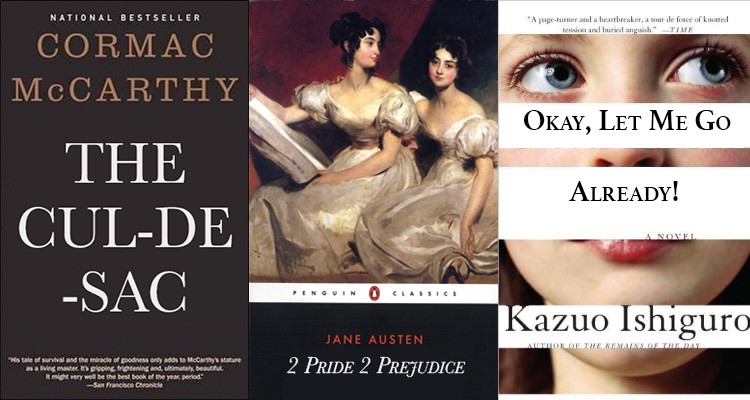
Harper Lee’s recently discovered sequel to To Kill a Mockingbird was published today, and it is already so successful that her Lawyer announced there might be a third “discovered” manuscript. Other publishers are jumping in on the sequel craze. Here are some discovered sequels to literary classics coming out this year:

Lunch at Tiffany’s by Truman Capote

The Cul-De-Sac by Cormac McCarthy

The Raisins of Wrath by John Steinbeck

Back with the Wind by Margaret Mitchell

Moby-Dick 2: The College Years by Herman Melville

The Great Gatsby 2: Dead and Loving It by F. Scott Fitzgerald

Mrs Dalloway 2: Space Dalloway by Virginia Woolf

Fatherless Bronx by Jonathan Lethem

Midnight’s Tweens by Salman Rushdie

A Remix of Ice and Fire by George R. R. Martin

Okay, Let Me Go Already! by Kazuo Ishiguro

2667 by Roberto Bolano

2 Pride 2 Prejudice by Jane Austen

Teaser Trailer for The Magicians is Finally Here!

Lev Grossman’s best-selling Magicians trilogy is being adapted for a 12-episode television series, which will premiere on SyFy sometime in 2016. If you missed the first trailer, treat yourself to an enticing look into Quentin Coldwater’s world at the magical Brakebills Academy. Jason Ralph (A Most Violent Year, Aquarius) stars as Quentin.

Grossman, a board member at Electric Literature, is as equally excited as his many fans about his story’s transition to screen: “Get ready; you’ve never seen anything like this.

After viewing this newest extended teaser — which premiered last weekend at San Diego Comic-Con — I can’t help but agree. It’s a suspenseful, exciting scene that left me drooling for more of Quentin’s magic.

Grief is Where We Live, an interview with Suzanne Scanlon, author of Her 37th Year

ScanlonCoverFINAL-2

The form of a novel is the artifice used to give shape to life. Suzanne Scanlon’s Her 37th Year, An Index, uses the form of the index to give shape to a messy year of ruminations on marriage, child rearing, desire, teaching, therapy, and the life of the mind and the decay of the body. Full of footnotes and humorous dead ends, this slim volume is not slight, and it encourages you to flip back and forth, to read the authors she references. Scanlon and I corresponded through e-mail over a month and discussed form, memory, female sexuality, confessional writing, and writers: Marguerite Duras, Jill Talbot, Sharon Olds, and David Foster Wallace.

Adalena Kavanagh: As I read it, your book Her 37th Year is a novel in the form of an index. Is this accurate? How did you come to the form for this book? What were the limits and possibilities of writing this book in this form?

Suzanne Scanlon: It is accurate, yes — though it is a very loose index. I like using various forms to shape a story. For my grad school thesis, I wrote a story that was in the form of a long exam. It’s not original, but I’ve done this a lot; it helps me to impose an external structure. That’s what happened here. Once I started, I wanted to keep going — & I might have, if it hadn’t been accepted for publication by Noemi so swiftly. The form was fun, and as with using footnotes — the system takes over, drives the narrative, becomes addictive (from the writing standpoint). I didn’t really notice limitations to it! Though, of course, I began with a very focused idea of what I wanted — one year in one woman’s life. That constraint was liberating.

Kavanagh: In what way was it liberating to have that particular constraint?

Scanlon: I often write in a very digressive, sprawling way, at least thematically. That can make it easy to get overwhelmed, and hard to finish a project. So, the structure contained my ability to do that.

The other constraint I added later, while shaping the book, was to narrow and heighten the story of the affair, this “one man” as a through line, the “man in boots”. My editor, Amanda Goldblatt, helped me with this. I think the singular thread of a romance, or an affair, however subtle, helped to contain the rest of the story.

Kavanagh: Is there one narrator or two narrators? I ask this because as I read the book I felt sure that it was one narrator, but she switches at times from second person to first person. Why?

I rarely find one narrative voice sufficient.

Scanlon: One narrator, but I can’t help but switch voice. I rarely find one narrative voice sufficient. This is a book about the self as a shifting construct, and I think people often see themselves in the first/second/third person. If I wanted to be smart about it, I would say that the book is about the many-layered, contracted and expanded self, and therefore requires more than one voice, or perspective. But it is also about the self in a sacred solitude, which remains necessarily in communion with the Other — the fiction of the Other, but the necessity, too. The individual is a myth, as Tony Kushner says. So, that was my way of pushing that idea, engaging the selves and others who make this woman’s life.

Kavanagh: What does the second person do for you? What do you think it does for the reader? From my point of view, it seems to be a way of distancing yourself from the text, but it can also be a way of making the text more universal. What do you think of that idea?

Scanlon: Yes, I think second person can do both of those things, depending on the reader. I find it more intimate, when it works.

Kavanagh: The footnotes and quotes and acknowledgements act almost like a syllabus of writers and ideas in addition to the narrator’s “story”. Taking this concept further, what is the course title, and what is the overarching thesis?

Scanlon: Ah, I like that idea! I remember hearing Jill Talbot read a story she wrote that was structured as a syllabus. This was after I’d written 37th Year, but I quite liked it, and I think there is an affinity there. As writers and teachers, we are overwhelmingly engaged with books and writers and our sense of self bleeds into this. The course title for Her 37th Year could be: Darling, You Die Alone No Matter What: The Erotics of Grief. Or, to use the Duras line: Grief: The Most Important Thing in my Life

I think our culture has a weird superficial interest in death and suffering as a character trait, but it’s not something (art, in general) that people want to be true. But for some of us, it is true — grief is where we live or have lived, and that means that we write. It’s not so simple, not so reductive, but it’s also not a pose; it’s not cultivated in order to be, you know, hip. I don’t think any one would choose this life of perseveration, obsession, longing. But it is often the stuff of life and art. And as a writer, you can’t deny it.

There’s the thesis then, for my imaginary class: Writing must be about standing over the void.

Kavanagh: Is the void the inevitability of death? If so, why must writing address this?

Scanlon: Not exactly, no. I’m thinking of Marguerite Duras’ narrator in The Lover:

Sometimes, I realize that if writing isn’t all things, all contraries confounded, a quest for vanity and void, it’s nothing. That if it’s not, each time, all things confounded into one through some inexpressible essence, then writing is nothing but advertisement.

As I understand Duras, she was a writer who obsessively rewrote her life, her self, in her work, which was about memory and the self. That didn’t mean it was autobiography, but it was truth. It was a search for truth, which is never finished. What I mean by the void is facing the self honestly. Writing is often a process of peeling back layers, trying to get to truth, to uncover defenses and lies. That space is the void. It might be death, or emptiness, or it might be life itself.

Kavanagh: It’s true that we have a superficial interest in death, especially in the deaths of our beloved writers, particularly when they commit suicide. In this book you talk about David Foster Wallace. I don’t want to jump to conclusions so I will ask: is he the “teacher” referenced in this book?

Scanlon: The teacher in this book is a composite, inspired by many teachers I’ve known. But yes, he was my teacher, and an important one.

Kavanagh: What is your relationship to David Foster Wallace as a reader and writer? More specifically, how does he inform your writing, particularly this book?

Scanlon: I was/am a reader of his work, and then he became my teacher. And I continued to read him. His death informed this book, in that he died just after I had a baby. Of course, his death reverberated culturally, but it was personal and particular for me. As death can be. His death brought him back to life, in a way. I thought about him a lot more than I had in the years before, and so had to revisit how I knew him and what he’d taught me and what I understood of what it meant to be a writer and a depressed person. I really admired him, though he’d hurt me, and so his suicide was complicated, to say the least.

Kavanagh: You said: “I really admired him, though he’d hurt me, and so his suicide was complicated, to say the least.” Suicides are always complicated for survivors — something that might be hard to understand if they are outsiders who want to extend their empathy to the one who commits suicide. How did the public’s reaction to Wallace’s suicide and the canonization of his work affect how you present him in this book?

Scanlon: I wouldn’t call myself a survivor. No. His wife, his family, has to cope in a way I can’t imagine. By the time of his death, he existed for me more in the realm of memory. He was somebody I used to know. Our last letter exchange was in 2006, I think, a kind of detente. I didn’t reread his work much. But then, after his suicide in 2008, my sense of him and my relationship to him shifted; I reconsidered all I knew and thought I understood about him. Having been through intense treatment for depression, I’ve known other suicides, but this was different, of course.

The renewed interest in his work was strange, if understandable. But creepy, too, in the way that a dead writer is always more palatable. I understand that. I just didn’t want to see it with someone I knew. Suddenly all my students knew who he was, and many were reading him; which hadn’t been the case before.

The week after his death I was teaching Creative Nonfiction, the class he’d taught when I was a student; I’d assigned the Best American Essays edition that he edited. And the next month, I happened to be back in Normal, Illinois, where I’d known him. It was uncanny.

In a way, his death made him more present in my life. I reconnected with others who knew him when I did. I remember a friend there saying, “A good death brings people together,” when I saw him, and it offended me. But it is true. His death has done that, in an amplified way — and not just those of us who knew him, but for the many others now connected around his work, and his life. It’s one of those paradoxes, that in a way, his death was also a gift. “Suicide as a Sort of Present,” as he titled one of his stories.

Kavanagh: As I was reading the book I admired how you wrote about female sexuality in a raw, nonintellectual way (though your book is very intellectual and full of references to authors and theory). Women are always sexualized, but there’s this idea in popular culture that after a certain age — late 30s — or life change — childbirth — women become less sexual. Your narrator clearly is not feeling that, but also struggles with reconciling her sensual feelings with the culture’s perception of women as they age. Why do you think these ideas about women (diminished sexuality, diminished desirability) persist in our culture despite evidence to the contrary?

It’s a way to silence and distract women, to convince us that we are less valuable after a certain age.

Scanlon: It’s a way to silence and distract women, to convince us that we are less valuable after a certain age. And of course we can spend all of our time and energy trying not to look our age, trying to have unlined skin etc. There’s a huge industry there, right? Which, for years I didn’t see through a critical lens; it was simply the air I breathed. The water we swim in. And if you don’t apply a critical lens to it — and even when you do — you are totally hosed, to quote Mr. Wallace again.

But I do think there are a lot of women willing to speak out about it — as Frances McDormand recently did, wonderfully — or simply to ignore the absurd cultural pressures, to focus on artistic practice. That’s what Sontag did, and so many of my heroes.

Kavanagh: Why is this about her 37th year? Is there significance to that particular age?

Scanlon: It is a reference to the Marianne Faithful song, The Ballad of Lucy Jordan, with the line “at the age of 37, she realized she’d never ride, through Paris in a sports car with the warm wind in her hair.” It’s one of my favorite songs, and it was used in that stunning road trip scene in Thelma and Louise. So, the double resonance moved me: a woman realizing she is at the end of a certain moment of possibility, and two women subverting dominant structures, finding transcendence.

Also, I was probably around (closer to) 37 when I wrote this book. It could have been 38 or 39; but the number 37 felt right. It had to do with the anticipation of turning 40 — which was, of course, much worse than actually turning 40.

Kavanagh: This book is a novel written as an index. The term “confessional” writing is almost always applied in a gendered way to women’s writing. Having written a book that some might call “confessional” — if not in act (it is not a memoir or autobiography), then in narrative tone, how would you answer potential critics who would diminish the work as being merely “confessional”? What do we as readers gain from work that is personal and concerned with the body and mind?

Art that has most moved me is linked to body and mind.

Scanlon: I don’t think there is anything “mere” about confession. I think we are currently celebrating Ben Lerner and Knaussgaard, yes? both of whom use something of the confessional in their fiction. That’s part of the power. As is, say, Louis CK’s TV show, or Amy Schumer’s comedy; it comes from life, from the experience of living in a certain body, in a certain time and place. I don’t know if there are critics diminishing work that way, but if they are, I don’t care. Art that has most moved me is linked to body and mind. I wanted to represent that: a life of the mind that is necessarily embodied.

Kate Zambreno recently asked me if my confessional writing was linked at all to having been raised Catholic, going to confession regularly, well into my twenties; and, it’s interesting, but I don’t think of it that way. I don’t even think of myself as a confessional writer. I think Sharon Olds once noted that her writing was not “confessional” but personal. There’s a difference.

Kavanagh: Going back to the teacher in this book, you must know that readers will intentionally or unintentionally conflate the teacher with David Foster Wallace. There is a scene in the book where the narrator has a sexual encounter with the teacher. With examples like that one you seem to be playing with boundaries here — even when you say the teacher is a composite (and I believe you, I am not saying I do not) — those boundaries of “taste” regarding female sexuality, and discussing what we are told should be kept quiet, as well as the boundaries relating to the ownership of memories of public people. Why play with those boundaries? What are you saying about those invisible boundaries?

Scanlon: I can’t control how people read the book. I think the book is about dissolving boundaries: between people, between the past and the present, between the living and the dead. I think teachers and students have complicated relationships, and always have. I always learned the most when I had a crush on my teacher. I’m not saying that’s “appropriate” but it’s true: I used to call them “academic crushes”. It was linked to my passion as a student and as a writer, finding these teachers. I’m not saying I admire Allen Ginsberg or others who slept with their students, as a matter of course — I’m not saying this prescriptively — but in the book I’m describing a truth of a relationship.

Harper Lee’s Lawyer Might Have Found Third Mockingbird Novel

Go Set a Watchman has yet to commence its inevitable mass exodus from bookstore shelves, but the much-hyped To Kill A Mockingbird sequel is already in danger of being eclipsed by yet another long lost Lee manuscript.

Yesterday, the Wall Street Journal published a piece by Harper Lee’s lawyer Tonja Carter, in which she reveals that the manuscript for Watchman sits in a safety deposit box “underneath a stack of a significant number of pages of another typed text.”

Carter claims not to have perused these pages, but speculates that they might contain yet another tract on the life of Jean-Louise Finch. “Was it an earlier draft of ‘Watchman’, or of ‘Mockingbird’, or even, as early correspondence indicates it might be, a third book bridging the two? I don’t know.”

According to Carter, we might have an answer soon, once experts — given Lee’s blessing — “examine and authenticate” all of the documents in the safety deposit box.

An exciting prospect for TKAM fans who, this time tomorrow, will have finished tearing their way through Watchman. But given the ambivalence that has characterized most reviews of the book (a “lumpy tale,” says Michiko Kakutani), perhaps it’d be best if the documents turn out to be something less incendiary — like a list of Illuminati members, or a treasure map for the Holy Grail.

(h/t The Guardian)