Iconic horror actor Christopher Lee passed away this week. The actor — who played Dracula, Saruman, and Count Dooku among other roles — was famous for his deep and theatrical voice. In the above video, listen to him read Poe’s classic poem “The Raven.”
Hello, and welcome to my week-by-week review of everything in the world. Today I am reviewing vaping.
The new thing that everybody is talking about that isn’t called cupcakes is called vaping. It’s when smoking is done using electronic cigarettes instead of boring old paper ones. What is an electronic cigarette, you ask? It’s the future of cigarettes. Picture a regular cigarette but made of metal, and it gets the internet. Objects that get the internet are becoming commonplace. I saw a thermostat that gets the internet — I guess so you can send your friends messages to tell them whether they should bring a sweater when visiting. When I was a kid, hosts would provide the sweaters.
Personally, I’ve never been a fan of smoking. It’s smelly and bad for you and a very expensive habit. Some people really enjoy it though. So much so that they smoke an entire pack a day. That’s like me with raisins! But I don’t smoke raisins, I eat them.
Anyway, electronic cigarettes are making smoking cool again. Only the elite can afford such high-end smoking devices, and boy do people who vape look classy! Poor people are still stuck using things like pipes or just putting a lit pile of tobacco in their hands and leaning over it.
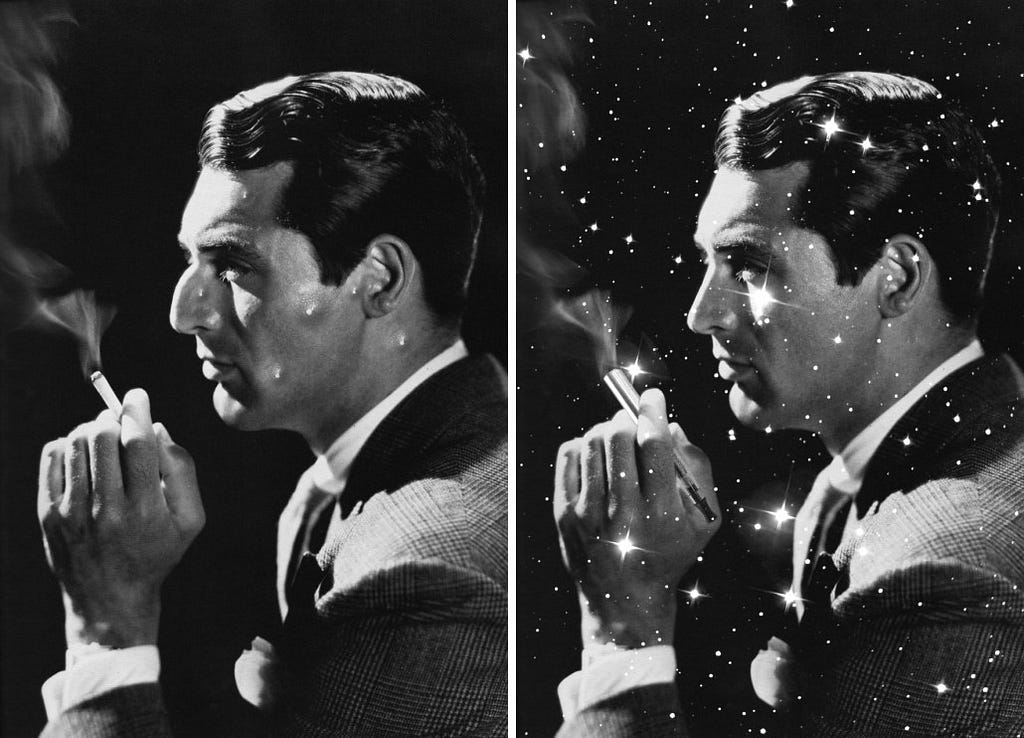
For evidence of how cool vaping is, look at this rendering of Cary Grant with a traditional cigarette versus with an electronic one.
I didn’t think Cary Grant could be cooler, but there you have it.
However, there are some real downsides to vaping. For one, you can’t put your electronic cigarette out in someone’s face if you get angry at them. More importantly, metal things rust, and electronic cigarettes are wet all the time from being sucked on. Now instead of cigarette butts on the street, we’re going to have rusty metal lying around and anyone who hasn’t had their tetanus shot is going to be in real trouble.
And even though I’m not a smoker, I’m going to be sad to see The Marlboro Man become a robot, because robot cowboys remind me of Yul Brynner in Westworld and he was scary.
BEST FEATURE: Exciting flavors beyond tobacco, such as rose, steak, and watermelon! WORST FEATURE: Everyone will want to try your electronic cigarette and you won’t get enough to yourself.
Please join me next week when I’ll be reviewing Dwayne ‘The Rock’ Johnson.
Not too long ago I made another mix, for Largehearted Boy, focusing on music that either inspired my new book, or best complemented it. But now it’s June and I need summer mixes to celebrate surviving the worst winter I’ve ever experienced. Below are some tracks to help me forget every one of those 100+ inches of snow that fell on Boston over the last 6 months. Like any good mix, these are meant to be listened to in order. Enjoy!
1. Hey Mami — Sylvan Esso
I like to ease into summer mixes with a breezy track that builds. Sonically this opening track off of Sylvan Esso’s eponymous debut serves that purpose perfectly — but lyrically it’s much more complex as it turns a depressingly ubiquitous story of sexual street harassment on its head across several verses. I love the paradox between content and tone in songs like this. Great for strutting on by as you too “pull on the eyeballs of all the kids standing tall.”
2. Cowboy Guilt — Torres
Off the brand-new album by Georgian singer-songwriter sensation, Torres, this song continues in the same vein of powerfully poppy music with a dark undercurrent. I could have just as easily chosen any song off this album, so why this one? I just threw a dart at my computer screen and this is the track it pierced right before destroying my laptop.
3. From Dog to God — Prayers
Just when I was feeling at a loss for this year’s fallback, go-to ultimate summer jam album I discover Prayers, with their irresistibly catchy and dark “cholo goth” movement. The marriage of gangster rap and new wave feels predestined in this song, with lyrics like: In and out of bad scenes / Always been a bad seed / Loyal to my family / Death Always chasin me / From Dog to God I’m alone in this world / I’m alone I’m alone I’m alone / I’m alone in this fuckin world. Both their albums, SD Killwave and Gothic Summer, are made for driving around with the top down while your black nail polish dries.
4. Queen — Perfume Genius
Off his third album, this track has it all. Soaring melodies, epic drum-ins, haunting backing chorus, and catchy synth chords all make you feel like you’re spinning around an endless luminescent shaft of pure light before the killer refrain, “no family is safe when I sashay,” stops you in your tracks like a death drop.
5. Hawaiian Death Song — Duke Garwood
I had the honor of performing with Duke recently in London, where we collaboratively improvised on stage at the Roundhouse Theatre. Duke belongs to that upper echelon of musicians whose mesmerizingly powerful live performances can barely be hinted at in recordings. This track gets about halfway there, which still makes it better than thousands of songs by other artists. Watching Duke’s fingers play across the guitar as effortlessly as if he were brushing the hair from his eyes, I couldn’t believe the powerfully evocative tones that sprang forth — laying a magickal backdrop for his low, spare vocals. Here’s to hoping Duke comes stateside soon and we all get to see him live.
6. Ha Ha Ha — The Julie Ruin
The latest project from riot grrrl godmother and third wave feminist Kathleen Hanna, The Julie Ruin is every bit as fierce and fun as her previous projects Le Tigre, and Bikini Kill. What summer mix would be complete without a song that ends by chanting “HA HA HA HA ARMAGEDDON” over and over and over again?
7. Let It Bleed — Goat
Buried at the heart of my hands-down favorite album of 2012, Let It Bleed is an unstoppable hybrid of afro-caribbean rythms, fuzzed-out garage riffs, blaring saxophone, and witchy lyrics — all from a group of Swedish musicians who wear masks on stage and insist they’re the latest incarnation of a lost voodoo lineage. In other words: it’s everything I love about all of Goat’s music, and what sets them apart from the sheep (see what I did there?). I can’t get through any season without picking them up and giving them a spin.
8. Wide Open — Growing
I once asked some colleagues what music they thought of when they read my poems, and one Black Ocean author named this track. Until then I had actually never heard it before, but I instantly fell in love and now it’s definitely something I aspire too. Every summer mix needs a song you can get stoned and completely lost in, and this buzzing, layered, complexly harmonic drone that clocks in just a few seconds under 16 minutes fits the bill. Turn out the lights, dilate your third eye and float up through the vastly deep and ever-expanding celestial ocean.
9. Hi-Five — Angel Olsen
I’ve spent numerous summers of my life getting over perennial spring breakups. Consequently every summer mix needs a breakup song, but not just any breakup song — a triumphant one that propels you off the couch, puts your back on your feet and in front of that next great love (or, you know, one-night-stand). Angels Olsen’s Burn Your Fire For No Witness is one of my favorite albums of 2014, and while every song on it cuts me open in way or another, this particular one sews me back up.
10. Lights On — FKA Twigs
Speaking of one-night-stands, what good is a summer mix if you can’t get freaky to it? FKA Twigs puts the “freak” back in “freaky,” as evidenced by every one of her unapologetically visionary music videos. If your partner isn’t DTF to FKA then s/he isn’t worth the F in the first place.
11. Close Your Eyes (And Count to Fuck) — Run The Jewels (feat. Zack De La Roche)
Summers are also about giving the finger to authority. Whether it’s throwing your textbooks out the window, or playing hooky from work so you can spend the day reminding yourself why being alive actually feels good as you soak up some critical vitamin D on the beach, you need a reliably anti-authoritarian jam. You know who hates authority more than you do? Rage Against The Machine’s Zack De La Roche. He makes a guest appearance on this track from the phenomenal sophomore release, Run The Jewels 2, and you can roll around the world all day to this while flipping every oppressive motherfucker both birds as hard as you possibly can.
***
— Janaka Stucky is the author of The Truth Is We Are Perfect (Third Man Books, 2015) and the Publisher of Black Ocean as well as its annual poetry journal, Handsome. He is also the author of two chapbooks: Your Name Is The Only Freedom and The World Will Deny It For You. He likes his whiskey neat and his music dirty.
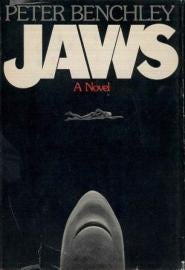
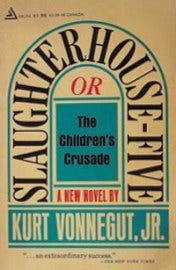
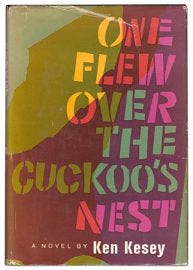
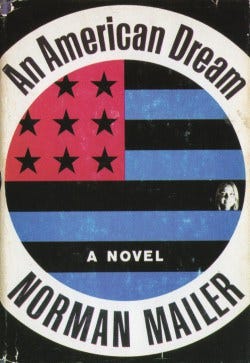
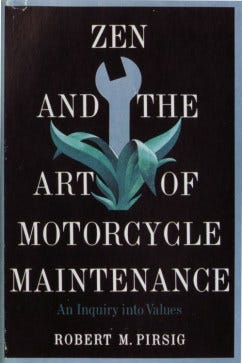
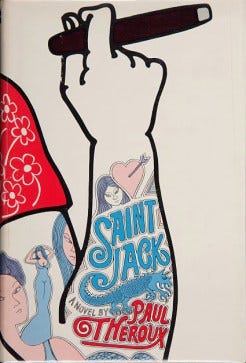
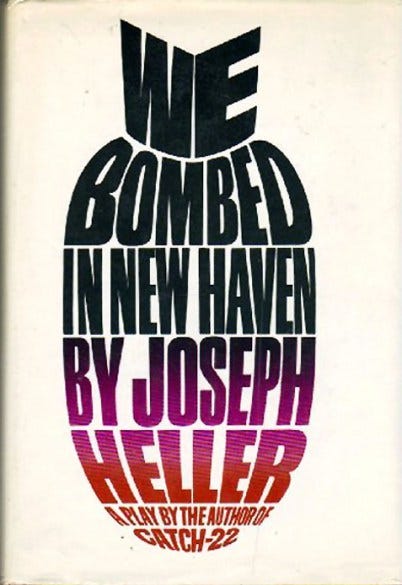
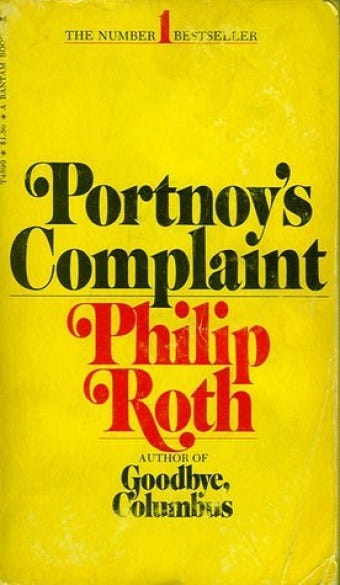
Paul Bacon, after an incredible career of more than 50 years, passed away in his Fishkill, NY home on Monday at age 91. Many of his 6,500 book cover designs are instantly recognizable and often iconic, including Joseph Heller’s Catch-22, Kurt Vonnegut’s Slaughterhouse Five, Philip Roth’s Portnoy’s Complaint, Ken Kesey’s One Flew Over the Cuckoo’s Nest, and Peter Benchley’s Jaws.
According to the New York Times, Bacon pioneered the design style known as “The Big Book Look” — bold and minimalist, featuring prominent lettering and a small conceptual image. His designs were all created by hand.
His career flourished following World War 2, where he’d served in China, Guam, and Guadalcanal. Bacon designed his first cover for Bill Westley’s Chimp On My Shoulder, published in 1950, and designed his last cover for Lindsay Hill’s Sea of Hooks, published in 2013.
When he wasn’t designing book covers, Bacon played in a jazz band and designed jazz album covers.
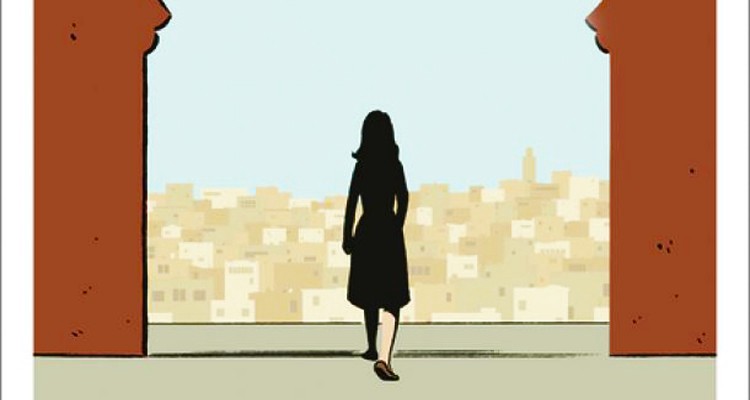
You board a plane to Morocco and sit next to an almost-handsome businessman. You look at photographs of your niece and your eyes tear up. You see a familiar woman sitting in front of you and quickly dodge her gaze. Within the first few pages of Vendela Vida’s The Diver’s Clothes Lie Empty, the reader learns that the main character (“you,” as it’s a second person narrative) has experienced what is described as “the horror of the last two months.” You (the character) are on a plane from Miami to Casablanca, though you (the reader) don’t know why. Suffice to say, right from the start, Vida has you hooked in and committed for the entire flight. She lays the groundwork for the rest of the novel, a gradual revelation of the details that comprise the “horror” that you have experienced.
While dropping clues about what you have undergone, the narrator leads you through a series of misadventures in Casablanca. Themes of identity, performance, and choice gradually emerge as someone steals your backpack and passport. You end up using other women’s credit cards and names. A secretary asks you to act as a body double in a film and you ultimately must choose how to extract yourself from the series of entanglements in which you’ve found yourself. As the plot develops, Vida asks her audience to consider what constitutes identity. She gives the reader a nameless protagonist with mysterious motivations. With limited information, the reader must piece together a portrait of this woman.
This information can be divided into past and present. First, the reader knows how the character acts as the story progresses. Secondly, there are the clues that Vida gives about the character’s history and the traumatic sequence of events that led up to her trip to Morroco. These clues don’t cohere until the end of the novel, by which time the reader has already formed a perception of this character’s probable identity. It’s impossible to escape the past, Vida suggests, as her protagonist runs into a woman in Morocco that she knew from her Florida hometown. Ultimately, though, it’s the details about the narrator’s present actions that create the reader’s most lasting impression. She’s a woman defined by her adventurous decision to leave for Morocco, her ability to win the trust of an actress and movie crew, charm the actress’s ex-boyfriend, and eventually leave them too once that escapade grows stale. Regardless of prior misery, the character recreates her identity through the decisions she makes moment-by-moment. Vida empowers her character with the ability to choose a new life and to shape her own identity.
Performance reveals itself as a key element of identity. You surmise that your twin sister’s “relationships were as well choreographed as her home.” Your sister cries on your shoulder in a “dramatic ploy” of manipulation. She designs her home like a theatrical set. Your sister’s tears and her color-coordinated throw pillows are all part of a larger performance. Something treacherous lies behind the façade she presents, which the reader soon discovers. This may be the most insidious instance of performance, but it isn’t always the case.
At one point, the Moroccan sky is compared to “the sky in a musical production for children.” Vida suggests that performance and the theatrical aren’t necessarily false or negative, but rather ubiquitous elements of our world, evident even in nature. Performance can also be liberating. While you film a scene in a mosque, you remember the details of the trauma that befell you before you left for Morocco. You begin crying, and the director commends you, saying that the famous American actress for whom you’re a stand-in can “take a few lessons from you on how to cry.” Performing has allowed a sense of release as acting in the film allows you to come to terms with the past and move on. On set, you are as genuine and honest as ever. Performance can both conceal and reveal the deepest of emotions. The manner in which a woman performs reveals volumes about her character and the identity that she chooses to construct.
Through her themes of identity and performance, Vida makes evident her belief in individual choice. No matter who or what other forces may try to influence you, you remain capable throughout of selecting your own destiny. This third theme, the persistence of individual choice despite difficulty, reveals itself in film titles, song lyrics, and poetry. A variety of art forms echo a belief in the individual spirit to recreate itself and triumph over adversity. The movie for which you’re a stand-in is called A Different Door, a nod to your character’s opportunity to take an alternative path in your own life. Vida embeds Patti Smith lyrics in the narrative, including “[t]ake my hand come undercover” and “we have the power,” certainly pertinent to a character who gives false names and struggles to find her own voice after years of passivity and submissiveness.
Finally, you read a Rumi poem called “The Diver’s Clothes Lying Empty,” also written in the second person, that gives the novel its title. The diver’s clothes, empty of the body that inhabited them, suggest abandonment. As the diver has left clothes lying on a beach, so too have you deserted your former life and self. The Diver’s Clothes Lie Empty relies on the “woman in a foreign land” set up that Vida has used in previous novels. By throwing her characters into strange situations, she gives them ample opportunity to redefine themselves and the trajectories of their lives. This new volume is compelling in its underlying mystery and its call for readers to explore their individual pasts and the opportunities they can take in pursuit of a fulfilling future. It’s never too late, the novel suggests, to begin anew. Vida’s prose is spare and suspenseful, moving the reader quickly toward the denouement. It’s a novel ripe for the summer season — a book you can read on your porch or at the beach, leaving your old self, like the diver’s clothes, behind.
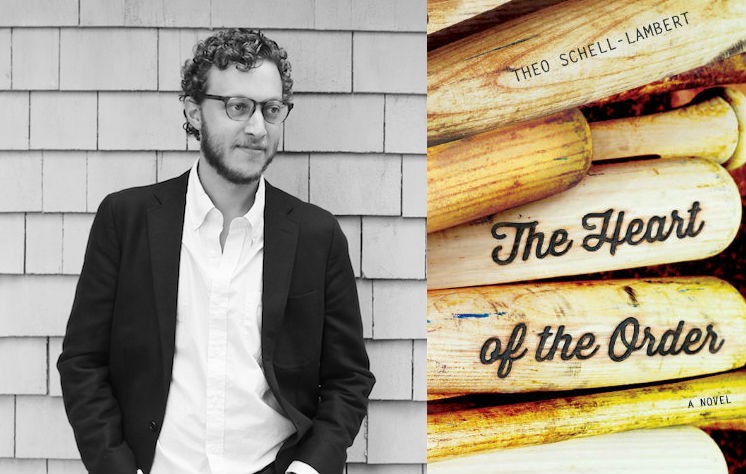
Theo Schell-Lambert’s debut novel, The Heart of the Order, is out next week from Little A. In it, we find the journal entries of Blake “Xandy” Alexander, a major league ballplayer with a blown-out knee, a summer of rehab work ahead of him, and an observant mind in desperate need of some stimulation. It’s a thoroughly imagined world. Each paragraph is packed with insight and personality. Reading it, I was, for a while, under the Sidd Finch style misimpression that the book was written by a genuine athlete-savant. After figuring out that I’d been fooled (that I’d fooled myself, that is), I thought I should talk with Schell-Lambert. We spoke a few weeks ago by Skype. He was at home in New Orleans, where he recently moved. We talked for an hour or so about stymied athletes, manic observation, Nabokov’s suburbia, and the enduring, overwhelming weirdness of the national pastime.
Dwyer Murphy: The diary conceit — we’re getting a series of journal entries written by a major league baseball player in the middle of his rehab — was one of the first things that struck me about The Heart of the Order. Was that always the way you intended to tell the story? Was it born out of some other attempt?
Theo Schell-Lambert: That wasn’t the plan on day one, but it became the plan very early. There are limitations to that kind of storytelling structure, but I think the limitations helped emphasize the loneliness and the isolation of this character, which was critical for the book. You have this guy who’s vibrant and infinitely engaged in everything around him, and he needed something that would force him to be an articulate observer and would also play up the sense of frustration he felt personally and emotionally. He’s this caged athlete, and I think the cage of the form played into that. It felt right. It ended up being a really productive constraint. I looked for other constraints, too. The timeline is another one. I knew the timeline of the story before I knew it would be restricted to journal entries. Obviously Xandy is out for the season, which is a defined period. But I also loved this idea of the arc of a baseball season, and I knew that could serve as the arc of a novel, too. There would naturally be a beginning, a middle and an end to the experience.
DM: The book is also relatively plotless. There are temporal benchmarks, as you said — the months, the rehab, the season — but not a lot of action driving the story forward. Yet it has momentum. Did you ever worry about that lack of plot? Were you up at night wondering if people would turn the page?
TSL: I had moments of concern. I’d made some failed attempts at short stories earlier in my twenties, but really I’d never even finished a short story, never mind a novel. I hadn’t trained in fiction. And I think what happened was, I both didn’t know what rules to play by (although you could argue that would make me more inclined to play by the traditional rules), and I was always looking for a guide, some work that was going to liberate me. The winter before I started working on this, I read the Nicholson Baker books. And reading him just really freed me up and showed me what I was allowed to pay attention to. He let me follow the threads I actually cared about. So I was coming fresh off The Mezzanine and Room Temperature, and I felt like I was allowed to do whatever I wanted in terms of plot. Now, Baker has plot and he’s extremely good at subtly bringing you back to it. He uses these little moments to anchor you. For me, the anchor was the setting, and having the narrator, Xandy, be very aware of the properties of his surroundings. I didn’t think I needed to plot it heavily, in a sense, as long as there was this concrete reality to the physical setting — he has a lagoon and a chair and a house, and they become his world. I felt like that invested the story with a lot of reality and authorized it to be about anything that happened in that setting.
DM: Why set it around Palm Beach? I know it’s a popular rehab area, but was there more?
TSL: No, other than that I wanted it to be set in a subdivision. I was always drawn to the suburban setting of Pale Fire: you’re behind a house in upstate NY and you have the most interesting things happening in this dead space of mid-day 1950’s home life. I just wanted a physical setting for the story that wasn’t a New York or San Francisco, something Xandy could project a little bit on. So it was really about a suburban environment. And I think this made-up East Palm Beach place seemed like a nice canvas for him. Also, it’s a small joke that plays up the fictionality, as does the conjoined “downtown Raleigh–Durham,” where Xandy’s team, the Carolina Birds, plays. What could be east of Palm Beach?
DM: While we’re talking about some of the books that influenced you, I was wondering which sports writing, in particular, you looked to?
TSL: I avoided reading baseball books, actually, until after I was done writing and editing the manuscript. I just recently read Bang The Drum Slowly, which was great. The book that played into it most was probably A Fan’s Notes by Frederick Exley, which I would recommend to anyone, and some of the early John McPhee sports writing, A Sense of Where You Are, about Bill Bradley. But I wouldn’t say stylistically this book is similar to those, or to what we think of as stereotypical sports writing.
What happens if you have an intense focus on all the little details of your life, but you’re also a jock?
We’re so used to reading about sports on ESPN, and I enjoy that as a fan of sports, but I really enjoy writing about sports from a different angle. Anything is interesting if you approach it from an atypical angle. So if you have a guy who is a pro athlete, who has, essentially, a Brooklyn way of thinking, immediately you have tension. What happens if you have an intense focus on all the little details of your life, but you’re also a jock? What happens to that combination? You end up writing about things that aren’t normally written about with neuroses or manic attention. But the conceit of it, I think, still connects. He’s an outfielder. He’s a professional observer.
DM: You mentioned McPhee’s A Sense of Where You Are. McPhee had Bradley, this elite, cerebral athlete who could guide him through the athletic experience, a world that most people don’t have access to. How did you get access? Were you an athlete yourself? Did you find somebody to guide you?
I had to take a leap of faith that I was allowed to try to figure it out, that I had access to those feelings and those sensations and could have a sense of what it would be like in that body.
TSL: I never played baseball seriously. I played and loved it until I was a freshman in high school, then switched to running. I think probably, this being a first novel, I was excited by the freedom to become whoever I wanted. That’s a very old fashioned mode of what fiction does for its author, I know — it allows you to dream. This wasn’t some failed baseball dream of mine, but it was very satisfying to say, “I was in a game and I did this or that.” It was simply very pleasurable. But I had to really construct that sensibility from thinking it through deeply, and thinking through what it would feel like to go through rehab or hit a ball in a game a certain way or travel with a major league baseball team. And I’m sure what I describe is completely inaccurate to the experience of a lot of baseball players, but I had to take a leap of faith that I was allowed to try to figure it out, that I had access to those feelings and those sensations and could have a sense of what it would be like in that body.
DM: To me, a lot of the small details rang true. Now I’m wondering if that’s just because I’m coming at it from the perspective of a failed, wannabe athlete in Brooklyn. The scales are falling from my eyes.
TSL: I don’t know if those details are true, either. I’m curious what someone who’s been through the major league experience would think of the book, especially someone who’s had to rehab for a season and knows about the weird things that brings out and has maybe gone through a quarter life crisis, like one that anyone at that age might go through. In a lot of ways, that’s what this book is about — the experiences of that age and the crises that come along during that period of life.
I’m curious what an athlete would think. They’d probably say that’s not what it’s like at all, but I think I would answer that I’m allowed to make this character not like you. There’s a pitcher on the Dodgers, Brandon McCarthy, he’s actually out for the season now, right around the same point that Xandy goes out, and he’s this very witty guy, a really clever tweeter. If anyone, maybe he’s the test. There’s also a pitcher named Burke Badenhop, a Reds reliever who wrote something great recently for Grantland, comparing the different MLB bullpens, that made me think that, at least for some players, I was closer than I thought.
DM: The idea of not just an athlete, but a rehabbing athlete, is central to the book. Why that state, in particular? The broken-down athlete, rather than the active one?
TSL: That’s just the way I started writing the book one day, before I had anything planned. I think it’s about the form. An injured athlete is a very stymied person, and someone who’s in a mode of frustration probably needs an outlet. An athlete who isn’t injured has his outlet on the field. A hurt athlete needs to transfer that energy to somewhere else, in this case, to a writing energy. It was a useful transferal. It invigorated the act of writing, I think. This guy needs to kind of put his heart and soul on the page. He needs to do it because it’s the time of day when he usually plays baseball. That seemed very important to me — that he be writing at the time of day he would normally be playing. He’s not just a guy reflecting. He’s transferring the experience of playing baseball into the experience of writing.
DM: Time is another central theme. Xandy pretty regularly meditates on the nature and the passage of time. Baseball, as a sport, seems to be particularly conducive to that kind of thinking.
TSL: There are a lot of strange things about being a baseball player that relate directly to time. You don’t get days off, so the way in which the game takes over your life must be very interesting. The football schedule is so much closer to our understanding, this idea that there is an event, and you prepare for that event. It’s something we can recognize about how big events work. Baseball players don’t even really practice once the season starts. They warm up. So the game becomes your life and sews itself into your existence in an amazing way. These guys are playing 13 out of 14 days. Essentially, the game and your life start to become inseparable. You’ve also got the archetype of a baseball season. You have Mr. October, Mr. September. I thought it would be fun to have a Mr. July, this guy who excels right at the middle of the season.
So I thought, you have this game that plays into narrative in such a direct way: you’re playing every day, and the months take on these meanings invested with history and tradition, and all those things conflate with what it means to be a young man about to turn thirty. I don’t want to give away the final pages of the book, but they relate to that crisis. You’re in your late 20s and you’re becoming an adult for sure. There’s no more arguing it. And I wondered how that must feel when, on paper, you’re extremely successful and you have money and fame, but you’re still that same person, at that same age. How does being a success square with being a regular person? Also, you’re playing a sport where you’re at your peak in your mid-20s, which adds a different wrinkle to the quarter-life crisis. You’re on the back-end of your career. There are youngsters coming to supplant you.
DM: The big debate in baseball now is about the pace of the game. Are you in favor of speeding it up? I’m a longtime fan and I’ll be honest, I find myself less and less capable of actually sitting through nine innings.
I think it’s basically misguided to erase weirdness in baseball wherever it happens.
TSL: I would say it’s ridiculous to mess with the pace of baseball. I enjoy the elegance of those pauses. I think it’s basically misguided to erase weirdness in baseball wherever it happens. I certainly think it’s misguided to make baseball exciting. It’s not. It’s glancingly exciting, which makes that excitement really fun. The natural, rhythmic boredom is what makes baseball interesting. I could have coaches visiting the mound again and again, because it’s just so weird. You’re watching this older guy walk out there, and technically they’re supposed to jog, and they hate jogging, so you’re also watching them be upset about jogging. I love the tie game in the 9th, but that’s not what makes baseball a good sport. It’s the weirdness that does it for me.
DM: The book also gets into the idea of fame. Baseball players have a strange experience of fame. They’re rich and on television all the time, but off-the-field, out-of-town, they’re not usually recognized.
TSL: That’s right, and to some extent, this probably isn’t the kind of fame Xandy would have chosen. Especially later in the book, as his position becomes more threatened, he thinks about whether this is really what he wanted. It’s such a difficult and enviable position to be in, playing professional baseball, but it also takes a lot from him. You could wonder the same about a piano prodigy. What does it feel like to be good at something young, something you might not necessarily want to do when you’re a little older? What does it feel like to have so much success in something that’s so physical? And what if it’s something you didn’t necessarily work for, something that you happened into, this physical gift?
DM: Let’s talk about sports equipment for a minute. Some of my favorite passages came when Xandy was writing about the gear — the bats, gloves, balls. That’s not really a question, is it? I just really want to talk sports gear, I guess.
TSL: It’s something we all get to experience when we’re younger. We all know how good a broken-in baseball glove feels. And I wondered if that romance exists for professional athletes, too. Is the nostalgia still there for a multimillionaire who’s used to all this? So I wrote this stuff about how even pro ballplayers were taught by their parents how to take care of their gloves. And I wondered, in this era of handing over your gear to an equipment manager, are these guys still going by the oil method they learned when they were ten? That was another spot where I deliberately didn’t over-research things. I don’t know how long a pro ballplayer keeps his glove. I just decided to take some license. And I certainly don’t know how players order their bats, even though I wrote an extensive section about ordering bats. I can guarantee you the process isn’t what I wrote.
Clearly this book is about difference, about noticing differences and caring about them, and baseball is a conceit that allows you to distinguish and to pay attention to anything. So the bat section was kind of a high mark of no two things ever being the same. There is always a way to care about something, to express a preference that says something about you.
DM: Do you worry about this being pigeonholed a sports book?
TSL: I’m sure it will be. I’m aware of that. And when I say that this book is not really about baseball, my version of not being about baseball is kind of a blown-out, over the top observation of baseball. It’s essentially so much about baseball that the book is really about mania, and we realize that baseball is kind of an addiction or a problem for this guy, and maybe writing as obsessively as he does about baseball bats is a way of avoiding and deflecting writing about a love interest, or who he is and what he wants in life. He can just wield his powers of observation and that ends up being the cop-out for him. It’s a story about that extreme observational mode, in a way, the pleasures and the failings of that mode.
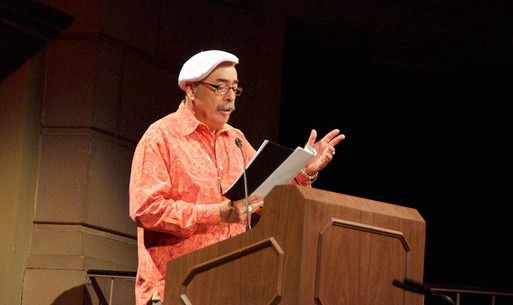
No high-ranking official has appeared on a balcony to pronounce it, but America has a new poet laureate. Hailing from Southern California, 66-year-old Juan Felipe Herrera is the first Latino poet to be appointed to the position. Perks of his new title include a $35,000 stipend, and the honor of joining the ranks of such hallowed former laureates as Elizabeth Bishop, Robert Frost, and Robert Lowell.
Herrera is an exceptionally eclectic wordsmith. His works frequently combine Spanish and English, and run the gamut from sonnets to litanies to protest poems to children’s book, from San Francisco’s Mission District to the San Joaquin Valley to Darfur. Educated at the Iowa Writers’ Workshop, Herrera spent ten years teaching at UC Riverside, and from 2012 to 2014 was poet laureate of California.
As de facto orator in chief, Herrera will arguably command the ear of the people more than any other poet in America. It seems like the perfect fit for a man who once stood on street corners in San Diego “with poems sticking out of my hip pocket, asking people if there was a place I could read poems,” and who is committed to tradition of oral performance that undergirds poetry. Says Herrera, “The audience is half the poem.”
I am merely posing for a photograph. Remember, when the Nomenclature stops you, tell them that — “Sirs, he was posing for my camera, that is all.” . . . yes, that may just work.
My eyes: clear, hazel like my father’s, gaze across the sea, my hands at my side, my legs spread apart in the wet sands, my pants crumpled, torn, withered, my shirt in rags, see-through in places, no buttons, what a luxury, buttons, I laugh a little, my tongue slips and licks itself, almost, I laugh, licks itself from side to side, the corners of my mouth, if only I could talk like I used to, giggle under moonlight, to myself, my arms destitute, shrunken, I hadn’t noticed, after so many years sifting through rubble stars, rubble toys, rubble crosses, after so many decades beseeching rubble breasts — pretend I came to swim, I am here by accident,
like you.
My face to one side. Listen to gray-white bells of rubble, the list goes on — the bones, hearts, puffed intestines, stoned genitalia, teeth, again I forget how to piece all this together, scraps, so many scraps, lines and holes.
The white gray rubble light blinds me, wait, I just thought — what if this is not visible, what if all this is not visible.
Listen here, closely: I am speaking of the amber thighs still spilling nectar on the dust fleece across Gaza, the mountains, the spliced wombs across Israel, Syria.
The amber serums cut across all boundaries, they smell incense, bread, honey — the color of my mother’s hands, her flesh, the shrapnel is the same color the propellers churn.
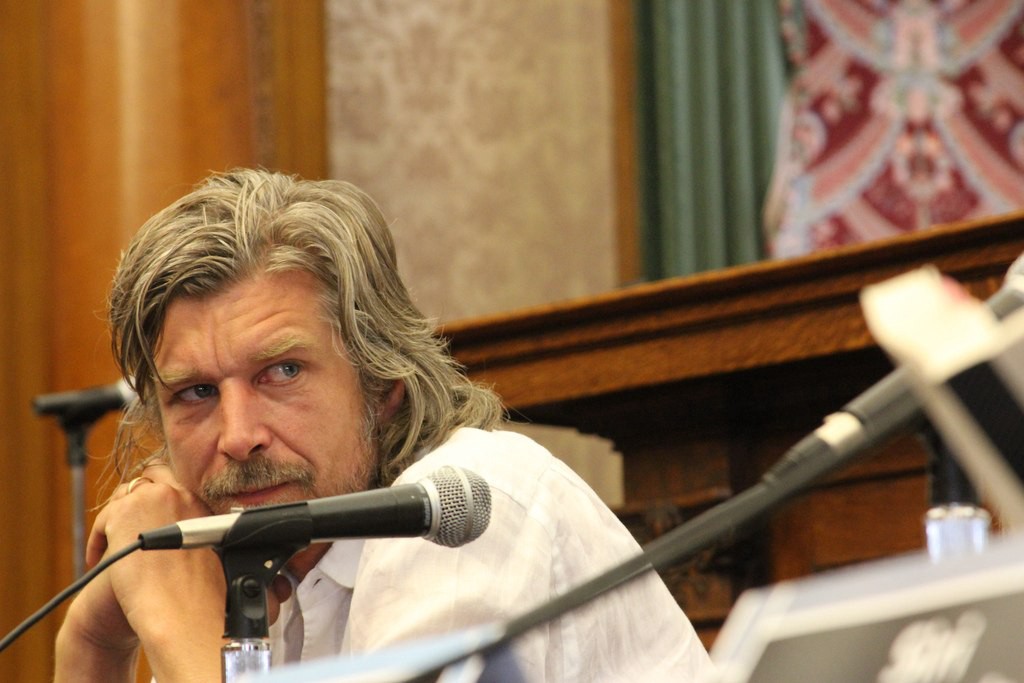
The history of the novel, as much as that of any other art, is a history of experimentation and change. And, after decades of post-postmodern confusion, the novel is finally in a new phase of form expansion. One of the authors helping to define the moment is Karl Ove Knausgaard, whose name is so ubiquitous it’s almost embarrassing to type.
What the gesture of My Struggle — an autobiographical megatome written in the key of memoir — seems to imply, at first glance at least, is that the novel is dead. It’s not our fault for thinking so. Knausgaard writes that he was “sick of fiction,” tired of finding “made-up people” everywhere. And, to shake off that falseness, he set out to write exclusively from his own life. Taken in that light, the project can seem to be a repudiation of imagination itself.
But when Knausgaard describes “fiction,” he includes things like the TV news. He includes newspapers. Narratives of events that actually took place. What’s more, year by year, we have access to more of his grand project in English: a six-volume, 3,600-page . . . novel. One of the great feats of imagination in our era — built from the kind of ephemeral detail that fills each moment but just as instantly disappears.
On May 9th I went to Knausgaard’s screening of Lars von Trier’s The Idiots (1998) at New York City’s Lincoln Center. He introduced the film and afterward discussed it with the audience. I’ve found before, for instance in his essay on Peter Handke’s A Sorrow Beyond Dreams, that Knausgaard lowers a shield when he talks about other people’s work and, in what he says, reveals more than usual about his own. It happened again at Lincoln Center. He clarified for me one of his quirky ways of thinking. And it all comes down — again — to the meaning of the word fiction.
In von Trier’s groundbreaking film, a circle of young Danes, living together commune-style in a borrowed house, makes forays into the world to play at being “Idiots.” With one or more assigned to the role of “minder,” or guardian — that is, even those acting normal are acting — they tour factories, eat at restaurants, and swim at the local pool, gruesomely pretending to be patients from a group home. Three years before releasing the film, von Trier co-authored a manifesto declaring Dogme 95, a new movement of filmmakers dedicated to “chastity” — which meant, in part, no artificial sets, no requisitioned props, and no pretense of a different time or place. Like the other films sanctioned by the movement, The Idiots dispenses with high-shine production values and goes for immediacy and rawness. This gives the scenes a documentary feel. The structure, too, imitates documentary — characters are “interviewed” after the breakup of their group, and these on-the-couch conversations punctuate the “footage” from their “spassing” missions and their days camped out in the house.
But, at root, there’s no mistaking that this is a fictional project — about people, characters, played by actors, who engage the world through an explicit fiction of their own. A play within a play.
Yet this, to Knausgaard, is the opposite of fiction. He first saw the movie while writing his novel Out of the World. “And I knew what I was doing wasn’t real. Compared to this.” The presence and immediacy of The Idiots made him reassess his own work. It sparked his frustration with whatever failed to break through the shell of habit, or failed even to try. This other, conventional, produced kind of storytelling he called “fiction.” His narrator Karl Ove says, in the famous anti-“fiction” paragraph in Book Two of My Struggle:
The nucleus of all this fiction, whether true or not, was verisimilitude and the distance it held to reality was constant. In other words, it saw the same. This sameness, which was our world, was being mass-produced. The uniqueness, which they all talked about, was thereby invalidated, it didn’t exist, it was a lie.
For someone who hasn’t seen the film, it will be difficult to imagine from my description how von Trier could be so revolutionary and — for an instant (which, as Knausgaard stresses, is all any burst of newness gets) — fresh. The film confuses us, disturbs us, disarms us with humor; it hurts us, makes us angry at times, until suddenly, in a few hammer strikes near the end, everything becomes shockingly, unexpectedly real: the game becomes a needed response to the world around them. We’re brought directly against the stuff of life — love, death — with such clarity it’s dizzying. “And to get there,” Knausgaard noted, “you have to go along for two hours.”
The key difference between fiction and its opposite — for Knausgaard, and I’m stealing his terms here, spoken the day before at the 92nd Street Y — is between displaying something, worrying about the presentation, and aiming instead for the presence of the thing above all other concerns.
Dogme 95 set out to eliminate everything fake. It rejected special effects, gave up the slow establishment of camera angles — it allowed “nothing that makes films wonderful,” as Knausgaard put it. But “if you want something real, you have to go outside those frames.”
The movement’s insistence on stripping away tricks inevitably doubles back on itself. This is art after all. Von Trier has the camera appear in the frame sometimes — which announces the film’s artifice, as Knausgaard noted. But the same moves also send the film deeper into artifice, by suggesting that we’re watching a rough-and-ready documentary.
The thing Knausgaard couldn’t bear any longer is the scrim that convention leaves between the reader (or viewer) and the world depicted. “Standards” run this risk also. “Cleverness and writing well is a protection, protects you from what you’re feeling,” he said. They, too, can be a fiction. But he’s quick to acknowledge that any rules artists set for themselves become old; they stop working; they become mannered, cliché. “That’s why,” he feels, “von Trier made only one Dogme film. Rules are very good, but you can only use them for a short time, and then you have to let them go.”
Knausgaard consistently calls My Struggle a novel. What he rejected was never fiction as we commonly use the term. It was the established, preordained ways of depicting.
Casually, as if nothing has changed, he will use the word fiction in the usual way. It happened at Lincoln Center when an audience member suggested that he must feel a strong connection with documentary film. No, he said; nothing about My Struggle made him feel particularly aligned with documentary. “It’s fictional even if it’s nonfictional. It’s not as if I’m trying to document anything. I’m looking for something within that material.”
He devised a new strategy for the novel, wanting to give readers the same kind of intimate presence — the gaze of a sensibility — that comes through so powerfully in The Idiots. As the narrator Karl Ove says in that same paragraph that has caused such misunderstanding, “What is a work of art if not the gaze of another person? Not directed above us, nor beneath us, but at the same height as our own. . . .”
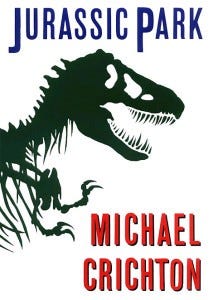
If you’re walking into the brand-new Jurassic World totally ignorant to the whole history of the Jurassic Park franchise, you might not believe me when I tell you that this frenetic summer blockbuster was actually born from a strange mishmash of cinematic and bookish origins. In the reality of the Jurassic novels and films, geneticists recreate dinosaurs by combining their DNA with other creatures or, as in the new movie, splice genes to create an uber-badass dino. But the existence of Jurassic Park as a massive cultural phenomenon is also the result of the splicing of both literary and filmic sensibilities. Here are a few essential details to help understand Jurassic Park’s unique narrative heritage.
Jurassic Park Was a Screenplay First, Then a Novel, Then a Screenplay
According to numerous interviews, Michael Crichton’s initial idea struck him in the early 1980’s. The best-selling novelist conceived of a story featuring cloned prehistoric creatures as a screenplay first. In this proto-version of Jurassic Park, a graduate student would create a genetically perfect pterodactyl in a lab. Now, it’s good to remember that it wasn’t super weird to think of Michael Crichton writing screenplays in the 80’s, nor was he any stranger to having his novels adapted into films prior to his success with Jurassic Park. His 1969 novel The Andromeda Strain was adapted into a 1971 film of the same name. (That movie’s screenplay was written by Nelson Gidding and directed by Robert Wise. Wise has the bizarre reputation of having directed both The Sound of Music and Star Trek: The Motion Picture).
But Crichton did his own screenplays too! In 1973, he both wrote and directed the movie Westworld about a robot-theme park populated by robot cowboys. The robots of this theme park end up going berserk and start killing people. Sound familiar? The point is, understanding the success of Jurassic Park (the film and the novel) starts with understanding that Michael Crichton was already a major power player in both publishing and in Hollywood way before 1990 happened. When he decided to turn Jurassic Park into a book and center it around a theme park of dinosaurs instead of his grad student in the lab, he sent an early draft of the book to his friend Steven Spielberg. Jurassic Park was optioned to become a film before Crichton even finished writing it. If you think the book occasionally read like the prose version of storyboards, there’s a reason for that.
There are A LOT of Character POVs in Jurassic Park and Many Terminate When the Character Dies
Probably the nightmare of many MFA professors, Jurassic Park features multiple close-third person POVs; easily more than ten! This includes everyone from John Arnold (Samuel L. Jackson in the movie) and random lawyers to characters who only appear for a second at the beginning of the novel, like a few scientists in a lab at Columbia University, a little girl on vacation on an island, and a nurse in Costa Rica. Once the novel gets going, the characters we stay with the most are the paleontologist Dr. Alan Grant, young Timmy, and often Jurassic Park badass Muldoon. In the film, this character (played by Bob Peck) is best remembered as the guy who says “clever girl” right before the raptors take him down.
While it’s not intended as a joke, the book does a weird job of giving us glimpses of many characters’ thoughts right before being killed by a dinosaur. These sections are odd, and it’s as though Crichton wrote the scenes to end with the words “and then he died,” but always deleted those words right afterward. The death of the villainous hacker Nedry is easily the best close-third-person death scene:
“Nedry fell to the ground and landed on something scaly and cold, it was the animal’s foot, and then there was a new pain on both sides of his head. The pain grew worse, and as he was lifted to his feet he knew the dinosaur had his head in its jaws, and the horror of that realization was followed by a final wish, that it would all be ended soon.”
Yet for whatever reason, Crichton decided not to give us any POVs with a dinosaur. Why, Crichton? Why?
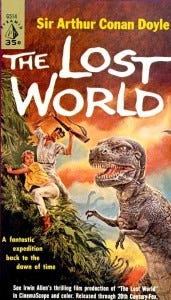
Michael Crichton’s Book Sequel — The Lost World — Was Encouraged by Steven Spielberg and Retconned His Original Novel
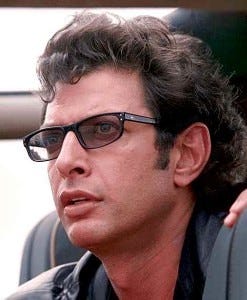
In the original Jurassic Park novel, the cantankerous chaos-theory-loving mathematician Ian Malcolm takes forever (pretty much half the book) to “die” after he’s severely wounded by a T-Rex. If you’re wondering why Jeff Goldblum sits around and sort of hangs out doing nothing but being laid up in the movie, that’s because the movie is a fairly close adaptation to the original book’s plot. Any reading of the novel tells us that Ian Malcolm does die in the book, but in a Conan Doyle-esque move, Crichton never gave us the body of Ian Malcolm. This allowed Ian Malcolm to be brought back to life in the second Jurassic Park novel, The Lost World. Here, Malcolm claims to only have been “partially” dead. Crichton didn’t really want to write a sequel to Jurassic Park, but was apparently encouraged by Spielberg, which probably led to the novelist retconning the death of this well-liked character. Just like with the formation of the first book, the world of cinema has always influenced the Jurassic Park novels.
Though the plot of Crichton’s The Lost World differs from the Spielberg sequel to Jurassic Park (called The Lost World: Jurassic Park), it’s still similar enough to be considered an adaption of sorts. Spielberg, however, added the idea of a T-Rex terrorizing San Diego into the end of the movie, a plot element not present in Crichton’s book. However, the idea of a dinosaur loose in a major city is probably a homage to the 1925 film version of The Lost World — itself an adaptation of a Sir Arthur Conan Doyle novel — in which a captured brontosaurus gets loose in London. This detail does not exist in the novel version of Conan Doyle’s Lost World, which instead featured an escaped pterodactyl in London, albeit briefly. The point is both Lost Worlds — Doyle’s and Crichton’s — have famous film adaptations which tack-on a finale featuring giant big dinosaurs on the loose in a major city.
Two of Jurassic Park’s Major Characters Are Specific Analogs to Real People
In both the novel and film versions of Jurassic Park there are dueling Doctors, one of mathematics (Dr. Malcolm) and one of paleontology (Dr. Grant). No matter what you might think of this story, the existence of these two characters is part of what makes the book (and film) work at all. In fact, the brand new Jurassic World actually suffers considerably from a lack of realistic scientific characters. Our beloved Dr. Wu from the original film and novel is actually bizarrely re-imagined as a mad-scientist villain in the new movie.
But in the book, Wu is a solid geneticist, Grant a calm paleontologist, and Malcolm an eccentric mathematical theoretician. Despite an occasionally slap-dash writing style of switching POVs constantly, Crichton does manage to bring out real voices from both Grant and Malcolm. And this was probably because there’s a considerable amount of reality in the DNA of these fictional people. According to Crichton, he based Alan Grant on prominent paleontologist Jack Horner. Meanwhile, the “chaos theory” which pervades Ian Malcolm’s ideology was derived from the real-life physicist Heinz Pagels. We tend to think of Dr. Ian Malcom only as Jeff Goldblum now, and in the novel, he’s very similar to Goldblum’s performance insofar as he’s eccentric and flippantly brilliant, though a little less flirtatious than his cinematic counterpart. Physically, he’s not Goldblum really at all. Meanwhile, the descriptions of Dr. Grant in the book sound more like Jeff Bridges as “The Dude” in The Big Lebowski than calm and sexy Sam Neil from the movie we all remember.
Jurassic Park is Bizarrely Both Pro-Science and Anti-Science at the Same Time
Throughout Jurassic Park, Ian Malcolm rants and raves about chaos theory and how science has failed mankind. His basic assertions are that science hasn’t made life any easier and has in fact made things worse. He says a lot of this while he’s laid up and pumped full of shitloads of morphine. It’s in these rants we get the idea that scientific progress is “rape of the natural world,” a line used in the original film. A lot of these assertions hew fairly hyperbolic, and it seems like Crichton intends for Malcolm’s ideas about science to be over-the-top, almost as an exercise in contrast. In the movie, Malcolm’s views are broadly reduced to Frankenstein-esque hand-wringing about “playing God,” but the book is both a little more subtle than that in some ways, and goes much further in others. Vacillating somewhere between cautionary tale and contemplative science fiction, Malcolm gets this nice speech in the second half of the book:
“You may create many of them [dinosaurs] in a very short time, you never learn anything about them, yet you expect them to do your bidding, because you made them and you therefore think you own them; you forget that they are alive, they have an intelligence of their own…”
This bit of philosophy didn’t make it into the 1993 movie, but an almost word-for-word version of it appears in Jurassic World, this time spoken by the hunky raptor-tamer Owen Grady (Chris Pratt).
Interestingly, despite Malcolm’s anti-science rants, Jurassic Park is a novel founded in science and explanations of science. Crichton often digresses to discuss what was in 1990, cutting-edge paleontology. The evolutionary link between birds and dinosaurs wasn’t common knowledge, and public perception of dinosaurs as slow and dumb was still, partially, the norm. So, through Grant, Crichton geeks out about the newish dinosaur theories. On the technical front, he’ll even give the reader a few pages of computer code to realistically convey what kind of hacker-conflicts John Arnold is facing at the hands of Nedry.
The pure research Crichton poured into the book encounters an interesting and somewhat insane push-back from Crichton’s own creation — Ian Malcolm — who is seemingly there to make fun of Crichton’s research and the science that makes the book tick in the first place. And it’s in this conflict where you can find Jurassic Park’s real soul. Sure, it’s a book about cloned dinosaurs running amok; that’s obvious and awesome. But it’s also a book that seems to be having a discussion with itself about the nature of discovery and how that relates to the power of creation.
But it’s also a book that seems to be having a discussion with itself about the nature of discovery and how that relates to the power of creation.
Even Mary Shelley’s Frankenstein isn’t an as on-the-nose “Frankenstein’s monster” story as people might claim. And Jurassic Park is similar. For all the “cautionary” aspects of this unique novel, its ultimate theme seems to exist more in a state of ponderous concern, alternating pleasantly with spectacular moment of sheer awe.
Sign up for our newsletter to get submission announcements and stay on top of our best work.
YOUR INBOX IS LIT
Enjoy strange, diverting work from The Commuter on Mondays, absorbing fiction from Recommended Reading on Wednesdays, and a roundup of our best work of the week on Fridays. Personalize your subscription preferences here.