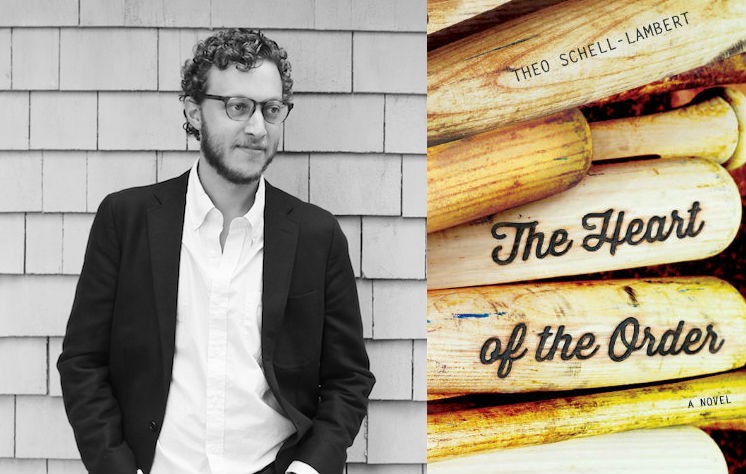
The Professional Observer, an interview with Theo Schell-Lambert, author of The Heart of the Order

Theo Schell-Lambert’s debut novel, The Heart of the Order, is out next week from Little A. In it, we find the journal entries of Blake “Xandy” Alexander, a major league ballplayer with a blown-out knee, a summer of rehab work ahead of him, and an observant mind in desperate need of some stimulation. It’s a thoroughly imagined world. Each paragraph is packed with insight and personality. Reading it, I was, for a while, under the Sidd Finch style misimpression that the book was written by a genuine athlete-savant. After figuring out that I’d been fooled (that I’d fooled myself, that is), I thought I should talk with Schell-Lambert. We spoke a few weeks ago by Skype. He was at home in New Orleans, where he recently moved. We talked for an hour or so about stymied athletes, manic observation, Nabokov’s suburbia, and the enduring, overwhelming weirdness of the national pastime.

Dwyer Murphy: The diary conceit — we’re getting a series of journal entries written by a major league baseball player in the middle of his rehab — was one of the first things that struck me about The Heart of the Order. Was that always the way you intended to tell the story? Was it born out of some other attempt?

Theo Schell-Lambert: That wasn’t the plan on day one, but it became the plan very early. There are limitations to that kind of storytelling structure, but I think the limitations helped emphasize the loneliness and the isolation of this character, which was critical for the book. You have this guy who’s vibrant and infinitely engaged in everything around him, and he needed something that would force him to be an articulate observer and would also play up the sense of frustration he felt personally and emotionally. He’s this caged athlete, and I think the cage of the form played into that. It felt right. It ended up being a really productive constraint. I looked for other constraints, too. The timeline is another one. I knew the timeline of the story before I knew it would be restricted to journal entries. Obviously Xandy is out for the season, which is a defined period. But I also loved this idea of the arc of a baseball season, and I knew that could serve as the arc of a novel, too. There would naturally be a beginning, a middle and an end to the experience.

DM: The book is also relatively plotless. There are temporal benchmarks, as you said — the months, the rehab, the season — but not a lot of action driving the story forward. Yet it has momentum. Did you ever worry about that lack of plot? Were you up at night wondering if people would turn the page?

TSL: I had moments of concern. I’d made some failed attempts at short stories earlier in my twenties, but really I’d never even finished a short story, never mind a novel. I hadn’t trained in fiction. And I think what happened was, I both didn’t know what rules to play by (although you could argue that would make me more inclined to play by the traditional rules), and I was always looking for a guide, some work that was going to liberate me. The winter before I started working on this, I read the Nicholson Baker books. And reading him just really freed me up and showed me what I was allowed to pay attention to. He let me follow the threads I actually cared about. So I was coming fresh off The Mezzanine and Room Temperature, and I felt like I was allowed to do whatever I wanted in terms of plot. Now, Baker has plot and he’s extremely good at subtly bringing you back to it. He uses these little moments to anchor you. For me, the anchor was the setting, and having the narrator, Xandy, be very aware of the properties of his surroundings. I didn’t think I needed to plot it heavily, in a sense, as long as there was this concrete reality to the physical setting — he has a lagoon and a chair and a house, and they become his world. I felt like that invested the story with a lot of reality and authorized it to be about anything that happened in that setting.

DM: Why set it around Palm Beach? I know it’s a popular rehab area, but was there more?

TSL: No, other than that I wanted it to be set in a subdivision. I was always drawn to the suburban setting of Pale Fire: you’re behind a house in upstate NY and you have the most interesting things happening in this dead space of mid-day 1950’s home life. I just wanted a physical setting for the story that wasn’t a New York or San Francisco, something Xandy could project a little bit on. So it was really about a suburban environment. And I think this made-up East Palm Beach place seemed like a nice canvas for him. Also, it’s a small joke that plays up the fictionality, as does the conjoined “downtown Raleigh–Durham,” where Xandy’s team, the Carolina Birds, plays. What could be east of Palm Beach?

DM: While we’re talking about some of the books that influenced you, I was wondering which sports writing, in particular, you looked to?

TSL: I avoided reading baseball books, actually, until after I was done writing and editing the manuscript. I just recently read Bang The Drum Slowly, which was great. The book that played into it most was probably A Fan’s Notes by Frederick Exley, which I would recommend to anyone, and some of the early John McPhee sports writing, A Sense of Where You Are, about Bill Bradley. But I wouldn’t say stylistically this book is similar to those, or to what we think of as stereotypical sports writing.

What happens if you have an intense focus on all the little details of your life, but you’re also a jock?

We’re so used to reading about sports on ESPN, and I enjoy that as a fan of sports, but I really enjoy writing about sports from a different angle. Anything is interesting if you approach it from an atypical angle. So if you have a guy who is a pro athlete, who has, essentially, a Brooklyn way of thinking, immediately you have tension. What happens if you have an intense focus on all the little details of your life, but you’re also a jock? What happens to that combination? You end up writing about things that aren’t normally written about with neuroses or manic attention. But the conceit of it, I think, still connects. He’s an outfielder. He’s a professional observer.

DM: You mentioned McPhee’s A Sense of Where You Are. McPhee had Bradley, this elite, cerebral athlete who could guide him through the athletic experience, a world that most people don’t have access to. How did you get access? Were you an athlete yourself? Did you find somebody to guide you?

I had to take a leap of faith that I was allowed to try to figure it out, that I had access to those feelings and those sensations and could have a sense of what it would be like in that body.

TSL: I never played baseball seriously. I played and loved it until I was a freshman in high school, then switched to running. I think probably, this being a first novel, I was excited by the freedom to become whoever I wanted. That’s a very old fashioned mode of what fiction does for its author, I know — it allows you to dream. This wasn’t some failed baseball dream of mine, but it was very satisfying to say, “I was in a game and I did this or that.” It was simply very pleasurable. But I had to really construct that sensibility from thinking it through deeply, and thinking through what it would feel like to go through rehab or hit a ball in a game a certain way or travel with a major league baseball team. And I’m sure what I describe is completely inaccurate to the experience of a lot of baseball players, but I had to take a leap of faith that I was allowed to try to figure it out, that I had access to those feelings and those sensations and could have a sense of what it would be like in that body.

DM: To me, a lot of the small details rang true. Now I’m wondering if that’s just because I’m coming at it from the perspective of a failed, wannabe athlete in Brooklyn. The scales are falling from my eyes.

TSL: I don’t know if those details are true, either. I’m curious what someone who’s been through the major league experience would think of the book, especially someone who’s had to rehab for a season and knows about the weird things that brings out and has maybe gone through a quarter life crisis, like one that anyone at that age might go through. In a lot of ways, that’s what this book is about — the experiences of that age and the crises that come along during that period of life.

I’m curious what an athlete would think. They’d probably say that’s not what it’s like at all, but I think I would answer that I’m allowed to make this character not like you. There’s a pitcher on the Dodgers, Brandon McCarthy, he’s actually out for the season now, right around the same point that Xandy goes out, and he’s this very witty guy, a really clever tweeter. If anyone, maybe he’s the test. There’s also a pitcher named Burke Badenhop, a Reds reliever who wrote something great recently for Grantland, comparing the different MLB bullpens, that made me think that, at least for some players, I was closer than I thought.

DM: The idea of not just an athlete, but a rehabbing athlete, is central to the book. Why that state, in particular? The broken-down athlete, rather than the active one?

TSL: That’s just the way I started writing the book one day, before I had anything planned. I think it’s about the form. An injured athlete is a very stymied person, and someone who’s in a mode of frustration probably needs an outlet. An athlete who isn’t injured has his outlet on the field. A hurt athlete needs to transfer that energy to somewhere else, in this case, to a writing energy. It was a useful transferal. It invigorated the act of writing, I think. This guy needs to kind of put his heart and soul on the page. He needs to do it because it’s the time of day when he usually plays baseball. That seemed very important to me — that he be writing at the time of day he would normally be playing. He’s not just a guy reflecting. He’s transferring the experience of playing baseball into the experience of writing.

DM: Time is another central theme. Xandy pretty regularly meditates on the nature and the passage of time. Baseball, as a sport, seems to be particularly conducive to that kind of thinking.

TSL: There are a lot of strange things about being a baseball player that relate directly to time. You don’t get days off, so the way in which the game takes over your life must be very interesting. The football schedule is so much closer to our understanding, this idea that there is an event, and you prepare for that event. It’s something we can recognize about how big events work. Baseball players don’t even really practice once the season starts. They warm up. So the game becomes your life and sews itself into your existence in an amazing way. These guys are playing 13 out of 14 days. Essentially, the game and your life start to become inseparable. You’ve also got the archetype of a baseball season. You have Mr. October, Mr. September. I thought it would be fun to have a Mr. July, this guy who excels right at the middle of the season.

So I thought, you have this game that plays into narrative in such a direct way: you’re playing every day, and the months take on these meanings invested with history and tradition, and all those things conflate with what it means to be a young man about to turn thirty. I don’t want to give away the final pages of the book, but they relate to that crisis. You’re in your late 20s and you’re becoming an adult for sure. There’s no more arguing it. And I wondered how that must feel when, on paper, you’re extremely successful and you have money and fame, but you’re still that same person, at that same age. How does being a success square with being a regular person? Also, you’re playing a sport where you’re at your peak in your mid-20s, which adds a different wrinkle to the quarter-life crisis. You’re on the back-end of your career. There are youngsters coming to supplant you.

DM: The big debate in baseball now is about the pace of the game. Are you in favor of speeding it up? I’m a longtime fan and I’ll be honest, I find myself less and less capable of actually sitting through nine innings.

I think it’s basically misguided to erase weirdness in baseball wherever it happens.

TSL: I would say it’s ridiculous to mess with the pace of baseball. I enjoy the elegance of those pauses. I think it’s basically misguided to erase weirdness in baseball wherever it happens. I certainly think it’s misguided to make baseball exciting. It’s not. It’s glancingly exciting, which makes that excitement really fun. The natural, rhythmic boredom is what makes baseball interesting. I could have coaches visiting the mound again and again, because it’s just so weird. You’re watching this older guy walk out there, and technically they’re supposed to jog, and they hate jogging, so you’re also watching them be upset about jogging. I love the tie game in the 9th, but that’s not what makes baseball a good sport. It’s the weirdness that does it for me.

DM: The book also gets into the idea of fame. Baseball players have a strange experience of fame. They’re rich and on television all the time, but off-the-field, out-of-town, they’re not usually recognized.

TSL: That’s right, and to some extent, this probably isn’t the kind of fame Xandy would have chosen. Especially later in the book, as his position becomes more threatened, he thinks about whether this is really what he wanted. It’s such a difficult and enviable position to be in, playing professional baseball, but it also takes a lot from him. You could wonder the same about a piano prodigy. What does it feel like to be good at something young, something you might not necessarily want to do when you’re a little older? What does it feel like to have so much success in something that’s so physical? And what if it’s something you didn’t necessarily work for, something that you happened into, this physical gift?

DM: Let’s talk about sports equipment for a minute. Some of my favorite passages came when Xandy was writing about the gear — the bats, gloves, balls. That’s not really a question, is it? I just really want to talk sports gear, I guess.

TSL: It’s something we all get to experience when we’re younger. We all know how good a broken-in baseball glove feels. And I wondered if that romance exists for professional athletes, too. Is the nostalgia still there for a multimillionaire who’s used to all this? So I wrote this stuff about how even pro ballplayers were taught by their parents how to take care of their gloves. And I wondered, in this era of handing over your gear to an equipment manager, are these guys still going by the oil method they learned when they were ten? That was another spot where I deliberately didn’t over-research things. I don’t know how long a pro ballplayer keeps his glove. I just decided to take some license. And I certainly don’t know how players order their bats, even though I wrote an extensive section about ordering bats. I can guarantee you the process isn’t what I wrote.

Clearly this book is about difference, about noticing differences and caring about them, and baseball is a conceit that allows you to distinguish and to pay attention to anything. So the bat section was kind of a high mark of no two things ever being the same. There is always a way to care about something, to express a preference that says something about you.

DM: Do you worry about this being pigeonholed a sports book?

TSL: I’m sure it will be. I’m aware of that. And when I say that this book is not really about baseball, my version of not being about baseball is kind of a blown-out, over the top observation of baseball. It’s essentially so much about baseball that the book is really about mania, and we realize that baseball is kind of an addiction or a problem for this guy, and maybe writing as obsessively as he does about baseball bats is a way of avoiding and deflecting writing about a love interest, or who he is and what he wants in life. He can just wield his powers of observation and that ends up being the cop-out for him. It’s a story about that extreme observational mode, in a way, the pleasures and the failings of that mode.

Juan Felipe Herrera Is America’s New Poet Laureate

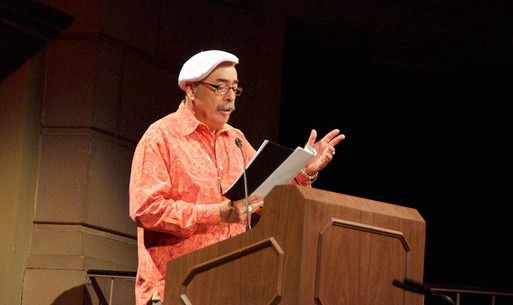
No high-ranking official has appeared on a balcony to pronounce it, but America has a new poet laureate. Hailing from Southern California, 66-year-old Juan Felipe Herrera is the first Latino poet to be appointed to the position. Perks of his new title include a $35,000 stipend, and the honor of joining the ranks of such hallowed former laureates as Elizabeth Bishop, Robert Frost, and Robert Lowell.

Herrera is an exceptionally eclectic wordsmith. His works frequently combine Spanish and English, and run the gamut from sonnets to litanies to protest poems to children’s book, from San Francisco’s Mission District to the San Joaquin Valley to Darfur. Educated at the Iowa Writers’ Workshop, Herrera spent ten years teaching at UC Riverside, and from 2012 to 2014 was poet laureate of California.

As de facto orator in chief, Herrera will arguably command the ear of the people more than any other poet in America. It seems like the perfect fit for a man who once stood on street corners in San Diego “with poems sticking out of my hip pocket, asking people if there was a place I could read poems,” and who is committed to tradition of oral performance that undergirds poetry. Says Herrera, “The audience is half the poem.”

For a taste of what the new poet laureate has to offer, here is a sample poem:

“I Am Merely Posing for a Photograph”

I am merely posing for a photograph.
Remember, when the Nomenclature
stops you, tell them that — “Sirs, he was posing
for my camera, that is all.” . . . yes, that may just work.

My eyes:
clear, hazel like my father’s, gaze across the sea, my hands at my side, my
legs spread apart in the wet sands, my pants crumpled, torn, withered, my
shirt in rags, see-through in places, no buttons, what a luxury, buttons, I
laugh a little, my tongue slips and licks itself, almost, I laugh, licks itself
from side to side, the corners of my mouth, if only I could talk like I used
to, giggle under moonlight, to myself, my arms destitute, shrunken, I
hadn’t noticed, after so many years sifting through rubble stars, rubble toys,
rubble crosses, after so many decades beseeching rubble breasts — pretend I
came to swim, I am here by accident,

like you.

My face to one side.
Listen to gray-white bells of rubble, the list
goes on — the bones, hearts, puffed intestines,
stoned genitalia, teeth, again I forget how
to piece all this together, scraps, so many scraps,
lines and holes.

The white gray rubble light blinds me,
wait, I just thought — what if this is not visible,
what if all this is not visible.

Listen here, closely:
I am speaking of the amber thighs
still spilling nectar on the dust fleece across Gaza,
the mountains, the spliced wombs across Israel, Syria.

The amber serums cut across all boundaries,
they smell incense, bread, honey — the color
of my mother’s hands, her flesh, the shrapnel is the same color
the propellers churn.

Knausgaard and the Meaning of Fiction

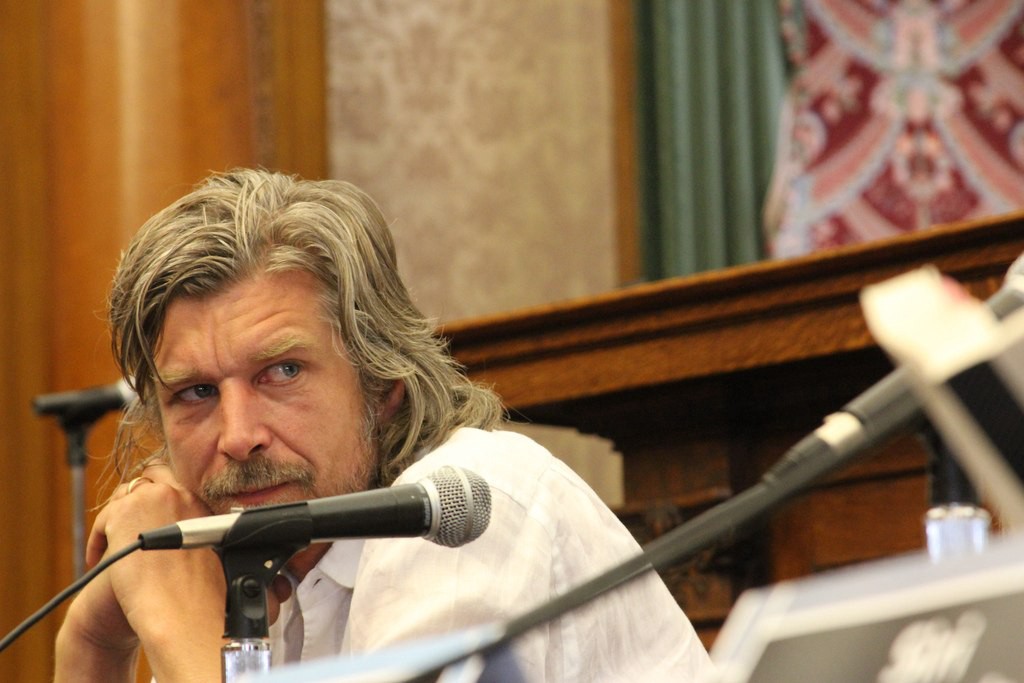
The history of the novel, as much as that of any other art, is a history of experimentation and change. And, after decades of post-postmodern confusion, the novel is finally in a new phase of form expansion. One of the authors helping to define the moment is Karl Ove Knausgaard, whose name is so ubiquitous it’s almost embarrassing to type.

What the gesture of My Struggle — an autobiographical megatome written in the key of memoir — seems to imply, at first glance at least, is that the novel is dead. It’s not our fault for thinking so. Knausgaard writes that he was “sick of fiction,” tired of finding “made-up people” everywhere. And, to shake off that falseness, he set out to write exclusively from his own life. Taken in that light, the project can seem to be a repudiation of imagination itself.

But when Knausgaard describes “fiction,” he includes things like the TV news. He includes newspapers. Narratives of events that actually took place. What’s more, year by year, we have access to more of his grand project in English: a six-volume, 3,600-page . . . novel. One of the great feats of imagination in our era — built from the kind of ephemeral detail that fills each moment but just as instantly disappears.

On May 9th I went to Knausgaard’s screening of Lars von Trier’s The Idiots (1998) at New York City’s Lincoln Center. He introduced the film and afterward discussed it with the audience. I’ve found before, for instance in his essay on Peter Handke’s A Sorrow Beyond Dreams, that Knausgaard lowers a shield when he talks about other people’s work and, in what he says, reveals more than usual about his own. It happened again at Lincoln Center. He clarified for me one of his quirky ways of thinking. And it all comes down — again — to the meaning of the word fiction.

In von Trier’s groundbreaking film, a circle of young Danes, living together commune-style in a borrowed house, makes forays into the world to play at being “Idiots.” With one or more assigned to the role of “minder,” or guardian — that is, even those acting normal are acting — they tour factories, eat at restaurants, and swim at the local pool, gruesomely pretending to be patients from a group home. Three years before releasing the film, von Trier co-authored a manifesto declaring Dogme 95, a new movement of filmmakers dedicated to “chastity” — which meant, in part, no artificial sets, no requisitioned props, and no pretense of a different time or place. Like the other films sanctioned by the movement, The Idiots dispenses with high-shine production values and goes for immediacy and rawness. This gives the scenes a documentary feel. The structure, too, imitates documentary — characters are “interviewed” after the breakup of their group, and these on-the-couch conversations punctuate the “footage” from their “spassing” missions and their days camped out in the house.

But, at root, there’s no mistaking that this is a fictional project — about people, characters, played by actors, who engage the world through an explicit fiction of their own. A play within a play.

Yet this, to Knausgaard, is the opposite of fiction. He first saw the movie while writing his novel Out of the World. “And I knew what I was doing wasn’t real. Compared to this.” The presence and immediacy of The Idiots made him reassess his own work. It sparked his frustration with whatever failed to break through the shell of habit, or failed even to try. This other, conventional, produced kind of storytelling he called “fiction.” His narrator Karl Ove says, in the famous anti-“fiction” paragraph in Book Two of My Struggle:

The nucleus of all this fiction, whether true or not, was verisimilitude and the distance it held to reality was constant. In other words, it saw the same. This sameness, which was our world, was being mass-produced. The uniqueness, which they all talked about, was thereby invalidated, it didn’t exist, it was a lie.

For someone who hasn’t seen the film, it will be difficult to imagine from my description how von Trier could be so revolutionary and — for an instant (which, as Knausgaard stresses, is all any burst of newness gets) — fresh. The film confuses us, disturbs us, disarms us with humor; it hurts us, makes us angry at times, until suddenly, in a few hammer strikes near the end, everything becomes shockingly, unexpectedly real: the game becomes a needed response to the world around them. We’re brought directly against the stuff of life — love, death — with such clarity it’s dizzying. “And to get there,” Knausgaard noted, “you have to go along for two hours.”

The key difference between fiction and its opposite — for Knausgaard, and I’m stealing his terms here, spoken the day before at the 92nd Street Y — is between displaying something, worrying about the presentation, and aiming instead for the presence of the thing above all other concerns.

Dogme 95 set out to eliminate everything fake. It rejected special effects, gave up the slow establishment of camera angles — it allowed “nothing that makes films wonderful,” as Knausgaard put it. But “if you want something real, you have to go outside those frames.”

The movement’s insistence on stripping away tricks inevitably doubles back on itself. This is art after all. Von Trier has the camera appear in the frame sometimes — which announces the film’s artifice, as Knausgaard noted. But the same moves also send the film deeper into artifice, by suggesting that we’re watching a rough-and-ready documentary.

The thing Knausgaard couldn’t bear any longer is the scrim that convention leaves between the reader (or viewer) and the world depicted. “Standards” run this risk also. “Cleverness and writing well is a protection, protects you from what you’re feeling,” he said. They, too, can be a fiction. But he’s quick to acknowledge that any rules artists set for themselves become old; they stop working; they become mannered, cliché. “That’s why,” he feels, “von Trier made only one Dogme film. Rules are very good, but you can only use them for a short time, and then you have to let them go.”

Knausgaard consistently calls My Struggle a novel. What he rejected was never fiction as we commonly use the term. It was the established, preordained ways of depicting.

Casually, as if nothing has changed, he will use the word fiction in the usual way. It happened at Lincoln Center when an audience member suggested that he must feel a strong connection with documentary film. No, he said; nothing about My Struggle made him feel particularly aligned with documentary. “It’s fictional even if it’s nonfictional. It’s not as if I’m trying to document anything. I’m looking for something within that material.”

He devised a new strategy for the novel, wanting to give readers the same kind of intimate presence — the gaze of a sensibility — that comes through so powerfully in The Idiots. As the narrator Karl Ove says in that same paragraph that has caused such misunderstanding, “What is a work of art if not the gaze of another person? Not directed above us, nor beneath us, but at the same height as our own. . . .”

photo via editrrix on Flickr

Revisiting Jurassic Park’s Tangled Bookish Roots

If you’re walking into the brand-new Jurassic World totally ignorant to the whole history of the Jurassic Park franchise, you might not believe me when I tell you that this frenetic summer blockbuster was actually born from a strange mishmash of cinematic and bookish origins. In the reality of the Jurassic novels and films, geneticists recreate dinosaurs by combining their DNA with other creatures or, as in the new movie, splice genes to create an uber-badass dino. But the existence of Jurassic Park as a massive cultural phenomenon is also the result of the splicing of both literary and filmic sensibilities. Here are a few essential details to help understand Jurassic Park’s unique narrative heritage.

Jurassic Park Was a Screenplay First, Then a Novel, Then a Screenplay

Jurassic Park

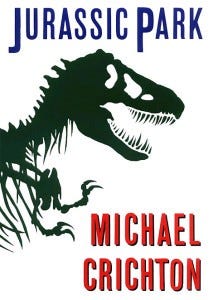
According to numerous interviews, Michael Crichton’s initial idea struck him in the early 1980’s. The best-selling novelist conceived of a story featuring cloned prehistoric creatures as a screenplay first. In this proto-version of Jurassic Park, a graduate student would create a genetically perfect pterodactyl in a lab. Now, it’s good to remember that it wasn’t super weird to think of Michael Crichton writing screenplays in the 80’s, nor was he any stranger to having his novels adapted into films prior to his success with Jurassic Park. His 1969 novel The Andromeda Strain was adapted into a 1971 film of the same name. (That movie’s screenplay was written by Nelson Gidding and directed by Robert Wise. Wise has the bizarre reputation of having directed both The Sound of Music and Star Trek: The Motion Picture).

But Crichton did his own screenplays too! In 1973, he both wrote and directed the movie Westworld about a robot-theme park populated by robot cowboys. The robots of this theme park end up going berserk and start killing people. Sound familiar? The point is, understanding the success of Jurassic Park (the film and the novel) starts with understanding that Michael Crichton was already a major power player in both publishing and in Hollywood way before 1990 happened. When he decided to turn Jurassic Park into a book and center it around a theme park of dinosaurs instead of his grad student in the lab, he sent an early draft of the book to his friend Steven Spielberg. Jurassic Park was optioned to become a film before Crichton even finished writing it. If you think the book occasionally read like the prose version of storyboards, there’s a reason for that.

There are A LOT of Character POVs in Jurassic Park and Many Terminate When the Character Dies

Probably the nightmare of many MFA professors, Jurassic Park features multiple close-third person POVs; easily more than ten! This includes everyone from John Arnold (Samuel L. Jackson in the movie) and random lawyers to characters who only appear for a second at the beginning of the novel, like a few scientists in a lab at Columbia University, a little girl on vacation on an island, and a nurse in Costa Rica. Once the novel gets going, the characters we stay with the most are the paleontologist Dr. Alan Grant, young Timmy, and often Jurassic Park badass Muldoon. In the film, this character (played by Bob Peck) is best remembered as the guy who says “clever girl” right before the raptors take him down.

While it’s not intended as a joke, the book does a weird job of giving us glimpses of many characters’ thoughts right before being killed by a dinosaur. These sections are odd, and it’s as though Crichton wrote the scenes to end with the words “and then he died,” but always deleted those words right afterward. The death of the villainous hacker Nedry is easily the best close-third-person death scene:

“Nedry fell to the ground and landed on something scaly and cold, it was the animal’s foot, and then there was a new pain on both sides of his head. The pain grew worse, and as he was lifted to his feet he knew the dinosaur had his head in its jaws, and the horror of that realization was followed by a final wish, that it would all be ended soon.”

Yet for whatever reason, Crichton decided not to give us any POVs with a dinosaur. Why, Crichton? Why?

Michael Crichton’s Book Sequel — The Lost World — Was Encouraged by Steven Spielberg and Retconned His Original Novel

Sherlock dinosaur

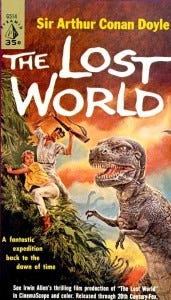
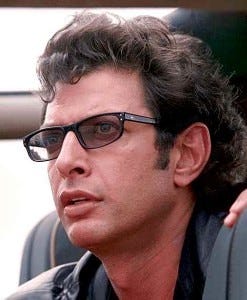
In the original Jurassic Park novel, the cantankerous chaos-theory-loving mathematician Ian Malcolm takes forever (pretty much half the book) to “die” after he’s severely wounded by a T-Rex. If you’re wondering why Jeff Goldblum sits around and sort of hangs out doing nothing but being laid up in the movie, that’s because the movie is a fairly close adaptation to the original book’s plot. Any reading of the novel tells us that Ian Malcolm does die in the book, but in a Conan Doyle-esque move, Crichton never gave us the body of Ian Malcolm. This allowed Ian Malcolm to be brought back to life in the second Jurassic Park novel, The Lost World. Here, Malcolm claims to only have been “partially” dead. Crichton didn’t really want to write a sequel to Jurassic Park, but was apparently encouraged by Spielberg, which probably led to the novelist retconning the death of this well-liked character. Just like with the formation of the first book, the world of cinema has always influenced the Jurassic Park novels.

Though the plot of Crichton’s The Lost World differs from the Spielberg sequel to Jurassic Park (called The Lost World: Jurassic Park), it’s still similar enough to be considered an adaption of sorts. Spielberg, however, added the idea of a T-Rex terrorizing San Diego into the end of the movie, a plot element not present in Crichton’s book. However, the idea of a dinosaur loose in a major city is probably a homage to the 1925 film version of The Lost World — itself an adaptation of a Sir Arthur Conan Doyle novel — in which a captured brontosaurus gets loose in London. This detail does not exist in the novel version of Conan Doyle’s Lost World, which instead featured an escaped pterodactyl in London, albeit briefly. The point is both Lost Worlds — Doyle’s and Crichton’s — have famous film adaptations which tack-on a finale featuring giant big dinosaurs on the loose in a major city.

Two of Jurassic Park’s Major Characters Are Specific Analogs to Real People

Jeff Goldblum in Jurassic Park

In both the novel and film versions of Jurassic Park there are dueling Doctors, one of mathematics (Dr. Malcolm) and one of paleontology (Dr. Grant). No matter what you might think of this story, the existence of these two characters is part of what makes the book (and film) work at all. In fact, the brand new Jurassic World actually suffers considerably from a lack of realistic scientific characters. Our beloved Dr. Wu from the original film and novel is actually bizarrely re-imagined as a mad-scientist villain in the new movie.

But in the book, Wu is a solid geneticist, Grant a calm paleontologist, and Malcolm an eccentric mathematical theoretician. Despite an occasionally slap-dash writing style of switching POVs constantly, Crichton does manage to bring out real voices from both Grant and Malcolm. And this was probably because there’s a considerable amount of reality in the DNA of these fictional people. According to Crichton, he based Alan Grant on prominent paleontologist Jack Horner. Meanwhile, the “chaos theory” which pervades Ian Malcolm’s ideology was derived from the real-life physicist Heinz Pagels. We tend to think of Dr. Ian Malcom only as Jeff Goldblum now, and in the novel, he’s very similar to Goldblum’s performance insofar as he’s eccentric and flippantly brilliant, though a little less flirtatious than his cinematic counterpart. Physically, he’s not Goldblum really at all. Meanwhile, the descriptions of Dr. Grant in the book sound more like Jeff Bridges as “The Dude” in The Big Lebowski than calm and sexy Sam Neil from the movie we all remember.

Jurassic Park is Bizarrely Both Pro-Science and Anti-Science at the Same Time

Throughout Jurassic Park, Ian Malcolm rants and raves about chaos theory and how science has failed mankind. His basic assertions are that science hasn’t made life any easier and has in fact made things worse. He says a lot of this while he’s laid up and pumped full of shitloads of morphine. It’s in these rants we get the idea that scientific progress is “rape of the natural world,” a line used in the original film. A lot of these assertions hew fairly hyperbolic, and it seems like Crichton intends for Malcolm’s ideas about science to be over-the-top, almost as an exercise in contrast. In the movie, Malcolm’s views are broadly reduced to Frankenstein-esque hand-wringing about “playing God,” but the book is both a little more subtle than that in some ways, and goes much further in others. Vacillating somewhere between cautionary tale and contemplative science fiction, Malcolm gets this nice speech in the second half of the book:

“You may create many of them [dinosaurs] in a very short time, you never learn anything about them, yet you expect them to do your bidding, because you made them and you therefore think you own them; you forget that they are alive, they have an intelligence of their own…”

This bit of philosophy didn’t make it into the 1993 movie, but an almost word-for-word version of it appears in Jurassic World, this time spoken by the hunky raptor-tamer Owen Grady (Chris Pratt).

Interestingly, despite Malcolm’s anti-science rants, Jurassic Park is a novel founded in science and explanations of science. Crichton often digresses to discuss what was in 1990, cutting-edge paleontology. The evolutionary link between birds and dinosaurs wasn’t common knowledge, and public perception of dinosaurs as slow and dumb was still, partially, the norm. So, through Grant, Crichton geeks out about the newish dinosaur theories. On the technical front, he’ll even give the reader a few pages of computer code to realistically convey what kind of hacker-conflicts John Arnold is facing at the hands of Nedry.

The pure research Crichton poured into the book encounters an interesting and somewhat insane push-back from Crichton’s own creation — Ian Malcolm — who is seemingly there to make fun of Crichton’s research and the science that makes the book tick in the first place. And it’s in this conflict where you can find Jurassic Park’s real soul. Sure, it’s a book about cloned dinosaurs running amok; that’s obvious and awesome. But it’s also a book that seems to be having a discussion with itself about the nature of discovery and how that relates to the power of creation.

But it’s also a book that seems to be having a discussion with itself about the nature of discovery and how that relates to the power of creation.

Even Mary Shelley’s Frankenstein isn’t an as on-the-nose “Frankenstein’s monster” story as people might claim. And Jurassic Park is similar. For all the “cautionary” aspects of this unique novel, its ultimate theme seems to exist more in a state of ponderous concern, alternating pleasantly with spectacular moment of sheer awe.

Midweek Links: Literary Links from Around the Web (June 10th)

Game of Thrones coloring book

Fantasy fans will finally have a new A Song of Ice and Fire book this fall… a coloring book

New Yorker looks at the history of duels in fiction

Science fiction publisher Tor gives into the Sad Puppies

Is Instagram the future of memoir?

The most evil children in literary history

Neil Gaiman and Kazuo Ishiguro talk about breaking genre boundaries

The teenage letters of Sylvia Plath

New Zadie Smith story for free online

The Millions argues that most of the great books in history have featured “audacious” prose

Mariachi

by Juan Villoro, recommended by George Braziller

“Should we do it?” asked Brenda.

I looked at her white hair, split into two silky blocks. I love young women with white hair. Brenda is 43 but her hair has been this way since she was 20. She likes to blame it on her first shoot. She was in the desert in Sonora, working as a production assistant, and she had to round up 400 tarantulas for some horror-movie genius. She pulled it off, but when she woke up the next morning she had white hair. I suppose it’s genetic. Anyway, she likes to see herself as a heroine of professionalism who went gray because of tarantulas.

Strangely, albino women don’t excite me. I don’t want to explain my reasons because when they’re made public I realize they aren’t really reasons. I had enough of that with the horse thing. Nobody has ever seen me ride one. I am the only mariachi star who has never in his life mounted a horse. It took the reporters nineteen video clips to catch on. When they asked me about it, I answered, “I don’t like transportation that shits.” Very banal and very stupid. They published a photo of my platinum BMW and my 4×4 with the zebra-skin seats. The Society for the Protection of Animals said they were ashamed of me. Plus, a reporter who hates me got his hands on a photo of me holding a high-powered rifle in Nairobi. I didn’t hunt any lions because I didn’t actually hit any, but there I was, all dressed up for safari. They accused me of being anti-Mexican for killing animals in Africa.

I made the horse declaration after singing until three a.m. in a rodeo arena at the San Marcos Festival. I was leaving for Irapuato two hours later. Do you know what it feels like to be fucked up and have to leave for Irapuato before the sun rises? I wanted to sink into a Jacuzzi, to stop being a mariachi. That’s what I should have said: “I hate being a mariachi, singing under a five-pound hat, tearing myself to pieces, swollen with the resentment earned on ranches without electricity.” Instead, I said something about horses.

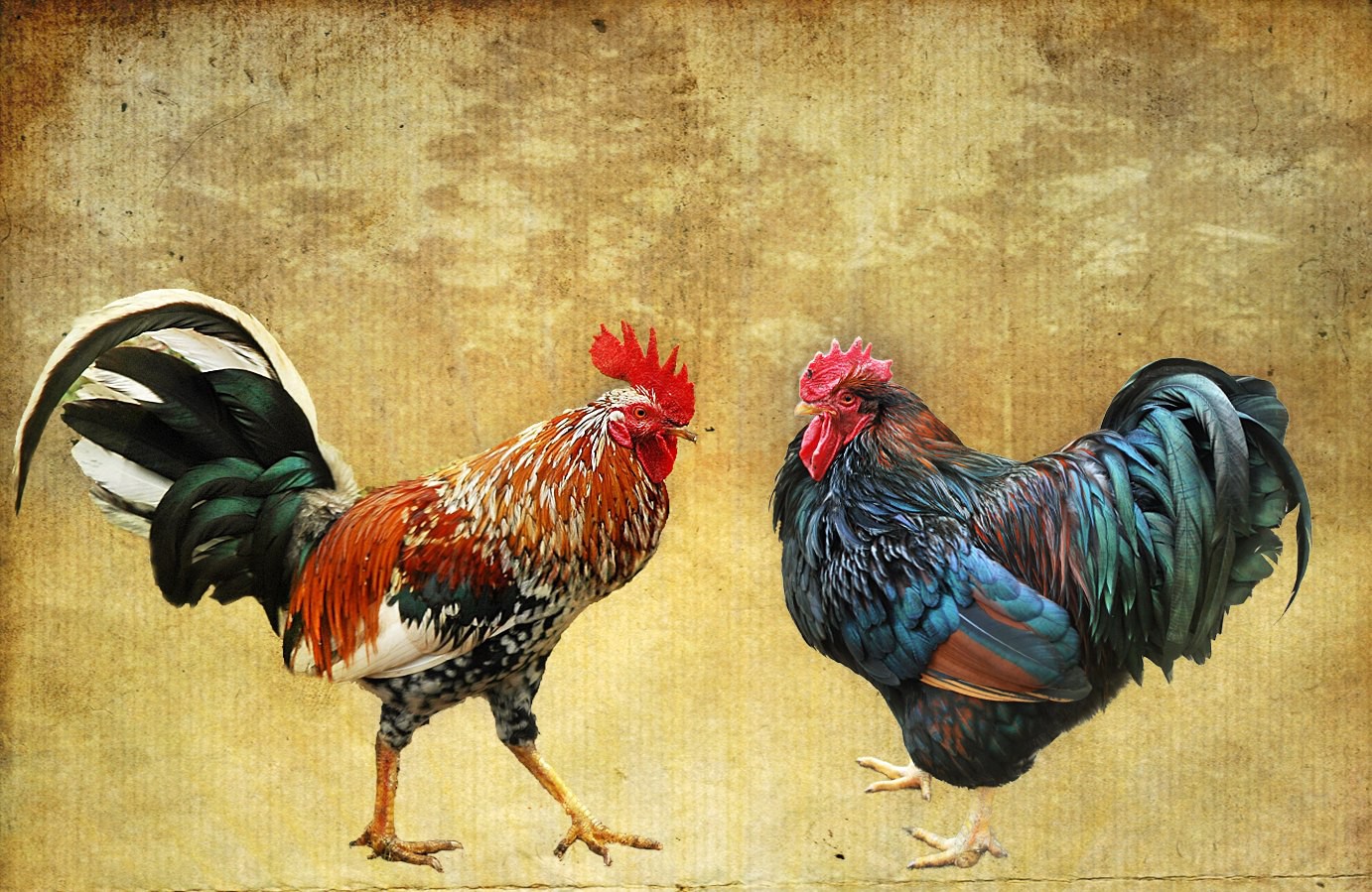
They call me El Gallito de Jojutla, the Little Rooster from Jojutla, because that’s where my father’s from. They call me little rooster but I’m not an early riser. The trip to Irapuato was killing me — one of the many things that were killing me.

“Do you think I’m too sexy to have been a neurophysiologist?” Catalina asked me one night. I said yes to avoid an argument. She has the mind of a porno screenwriter: she likes to imagine herself as a neurophysiologist, stirring up desires in the operating room. I didn’t tell her that, but we made love with extra passion, as if to satisfy three curious onlookers. Afterwards I asked her to dye her hair white.

Since I met her, Cata’s hair has been blue, pink, and cherry red. “Don’t be a jackass,” she answered. “There are no white dyes.” That’s when I understood why I like young women with white hair. They’re not on the market. I told Cata this and she went back to talking like a porno screenwriter: “What’s really going on here is that you want to fuck your mom.”

Those words helped me a lot. They helped me leave my therapist. He thought the same thing as Cata. I had gone to see him because I was sick of being a mariachi.

Before lying down on the couch, I’d made the mistake of looking at his chair: on the seat was an inflatable donut. Maybe it comforts some patients to know their doctor has hemorrhoids; someone intimate with suffering to help them confess their own horrors. But not me. I only stayed in therapy because my therapist was a fan. He knew all of my songs (the songs I sing: I haven’t written any), and he thought it extremely interesting that I was there, with my famous voice, saying I’m fucking fed up with ranchera music.

Around the same time, an article appeared where they compared me to a bullfighter who’d gone through psychoanalysis to overcome his fear of the ring. They described his most terrible goring: his intestines fell out onto the sand in the Plaza Mexico. He picked them up and managed to run to the infirmary. That afternoon, he had been wearing dark purple and gold. Psychoanalysis helped him get back in the ring with that same suit on.

My doctor flattered me so ridiculously, I loved it. I could fill Azteca Stadium — including the field — and get 130,000 souls to drool. The doctor drooled and I didn’t even have to sing.

My mother died when I was two years old. This is an essential piece of information for understanding why I can cry on cue. All I have to do is think about a photo. I’m dressed in a sailor suit, she’s hugging me and smiling at the man who would drive the Buick that flipped over. My father had drunk more than half a bottle of tequila at the rancho where they’d gone to eat lunch. I don’t remember the funeral, but they say he threw himself weeping into the grave. He got me into ranchera songs. He also gave me the photo that makes me cry. My mother smiles, in love with the man who’s taking her to a party. Outside the frame, my father snaps the shot with the bliss of the wretched.

It’s obvious I want my mother back, but I also like women with white hair. I made the mistake of telling my therapist about the theory Cata got from the magazine Contenido: “You are Oedipal. That’s why you don’t like albino women, that’s why you want a mommy with gray hair.” The doctor asked me for more details about Cata. If there’s one thing I can’t fight her on, it’s her notion that she’s extremely sexy. This titillated the doctor and he stopped singing my praises. I went to our last session dressed as a mariachi because I was coming from a concert in Los Angeles. He asked to keep my tricolor bow tie. Does it make sense to talk about your inner life with a fan?

Catalina was also in therapy. This helped her to “internalize her sexiness.” According to her, she could have been many things (almost all of them terrifying) because of her body. On the other hand, she believes the only thing I could have been is a mariachi. I have the voice, a face like an abandoned ranchero, and the eyes of a brave man who knows how to cry. Plus, I’m from here. Once I dreamed the reporters asked me, “Are you Mexican?” “Yes, but next time I won’t be.” This response, which in real life would have destroyed me, drove them wild in my dream.

My father made me record my first album at 16. I never went back to school or looked for another job. I was too successful for a career in industrial design.

I met Catalina the way I met my previous girlfriends: she told my agent she was available. Leo said Cata had blue hair and I figured she could probably dye it white. We started going out. I tried to convince her to bleach it, but she didn’t want to. Plus, authentic white-haired women are inimitable.

The truth is I’ve found very few young women with white hair. I saw one in Paris, in a VIP lounge at the airport, but I froze up like an idiot. Then there was Rosa, who was 28 with beautiful white hair and a diamond-encrusted belly button which I only knew about because of the swimsuits she modeled. I fell for her so hard it didn’t matter that she said “jillo” instead of “Jell-O.” She didn’t pay any attention to me. She hated ranchera music and wanted a blond boyfriend.

That’s when I met Brenda. She was born in Guadalajara but lived in Spain. She went there to get away from mariachis. Now she was back in Mexico with a vengeance. Chus Ferrer, a genius filmmaker I knew nothing about, was in love with me and wanted me in his next movie, no matter the cost. Brenda had come to round me up.

She got chummy with Catalina and discovered they hated the same directors who had ruined their lives — Brenda’s as a producer and Cata’s as an eternally aspiring character actress.

“Brenda has a nice figure for her age, don’t you think?” Cata said. “I’ll take a look,” I answered.

I had already looked. Catalina thought Brenda was past it. “A nice figure” was her way of applauding an old nun for being thin.

I only like movies with spaceships and children who lose their parents. I didn’t want to meet a gay genius who was in love with a mariachi who was, unfortunately, me. I read the screenplay so that Catalina would get off my fucking back. The truth is they only gave me bits and pieces, just the scenes in which I appeared. “Woody Allen does the same thing,” Cata explained to me. “The actors only figure out what the movie is about when they see it in the theater. It’s like life: you only see your own scenes and the big picture escapes you.” That idea seemed so accurate I thought Brenda must have told it to her.

I suppose Catalina was hoping they would give her a role. “How are your scenes?” she said every three seconds. I read them at the worst possible time. My flight to El Salvador was cancelled because there was a hurricane, and I had to go by private jet. Amid the turbulence of Central America, the role seemed incredibly easy to me. My character answered everything with “Heavy, man!” and let himself be adored by a gang of Catalonian bikers.

“What do you think about the scene with the kiss?” Catalina asked me. I didn’t remember it. She explained that I was going to “tongue kiss” a “really filthy biker.” She thought the idea was fantastic: “You’re going to be the first mariachi without complexes, a symbol of the new Mexican.” “The new Mexican kisses bikers?” I asked. Cata’s eyes lit up: “Aren’t you tired of being so typical? Chus’s movie is going to catapult you to another audience. If you keep doing what you’re doing, soon you’ll only be interesting in Central America.”

I didn’t respond because at that moment a Formula 1 race was starting and I wanted to see Schumacher. Schumacher’s life isn’t like a Woody Allen script: he knows where the finish line is. When I was moved that Schumacher had donated a huge sum to the victims of the tsunami, Cata said: “Do you know why he’s giving so much? He’s ashamed of having gone there for sex tourism.” There are moments like that. A man can accelerate up to 350 kilometers an hour, he can win and win and win, he can donate a fortune, and he can still be treated this way, in my own bed. I looked at the riding crop I go out on stage with (it’s good for whacking away the flowers they throw at me). Then I made the mistake of picking up the crop and saying, “I forbid you to say that about my idol!” In one instant, Cata saw both my gay and my sadomasochistic potential: “So you have an idol now?” She smiled longingly, as if waiting for the first lash. “Fuck, yes,” I said, and went down to the kitchen to make myself a sandwich.

That night I dreamed I was driving a Ferrari, running over sombreros until they were nice and flat, nice and flat.

My life was unraveling. My worst album, a series of ranchera songs composed by Alejandro Ramón, the hit maker from Sinaloa, had just gone platinum, and my concerts with the National Symphony at Bellas Artes had sold out. My face stretched out over four square meters on a billboard in the Alameda in Mexico City. I didn’t care about any of it. I’m a star. Forgive me for saying it again. I don’t want to complain, but I’ve never made a decision in my life. My father took charge of killing my mother, crying a lot, and making me into a mariachi. Everything else was automatic. Women seek me out through my agent. I fly a private jet when the commercial liners can’t take off. Turbulence. That’s what I depend on. What would I like? To float in the stratosphere, look down at Earth and see a blue bubble without a single sombrero.

I was thinking about that when Brenda called from Barcelona. I pictured her hair while she said, “Chus is flipping out over you. He put a hold on the house he’s buying in Lanzarote while he waits for your answer. He wants you to grow your fingernails out like a vamp. Perfect for a slightly seedy queer. Do you mind being a vamp mariachi? You’d look just adorable. I fancy you, too. I suppose Cata’s already told you.” It excited me immensely that someone from Guadalajara could talk like that. I masturbated after I hung up, without even opening the copy of Lord magazine I keep in the bathroom. Later, when I was watching cartoons, I thought about the last part of our conversation. “I suppose Cata’s already told you.” What should she have told me? And why hadn’t she?

Minutes later, Cata showed up to emphasize how great I’d be as a mariachi without prejudices (contradiction in terms: mariachis are a national prejudice). I didn’t want to talk about that. I asked her what she’d discussed with Brenda.

“Everything. It’s incredible how young she seems for her age. Nobody would ever think she’s 43.”

“What does she say about me?”

“I don’t think you want to know.”

“I don’t care.”

“She’s been trying to convince Chus not to hire you. She thinks you’re too naïve for a sophisticated role. She says that Chus has a chubby for you and she’s been asking him not to think with his dick.”

“That’s what she’s saying?”

“That’s how the Spaniards talk!”

“Brenda is from Guadalajara!”

“She’s been in Spain for decades, she defines herself as a fugitive from mariachis. Maybe that’s why she doesn’t like you.”

I paused, then told her what had happened:

“Brenda called a little while ago. She said she’s crazy about me.”

Cata responded like a stony angel:

“I’m telling you she’s super professional. She’ll do anything for Chus.”

I wanted to fight because I had just masturbated and didn’t feel like making love. But I couldn’t figure out how to offend her while she was unbuttoning her blouse. When she pulled off my pants, I thought about Schumacher, the master of mileage. That didn’t excite me, I swear on my dead mother, but it filled me with willpower. We banged for three hours, not quite as long as a Formula 1 race. (Thanks to Brenda, I had started using the Spanish: “to bang.”)

I finished off my concert at Bellas Artes with “Se me olvidó otra vez.” When I got to the line, “in the same city with the same people,” I saw the journalist who hates me in the front row. Every year on my birthday, he publishes an article “proving” my homosexuality. His main argument is that I’ve made it to another birthday without getting married. A mariachi should breed like a stud bull. I thought about the biker I was supposed to tongue kiss. I looked at the journalist and felt assured he would be the only one to write that I’m a fag. Everyone else would talk about how virile it is to kiss another man just because the script calls for it.

The shoot was a nightmare. Chus Ferrer told me Fassbinder had made his star actress lick the floor of the set. He wasn’t that much of a tyrant: he settled for smearing me with garbage to “muffle my ego.” I had it easier than the lighting crew: he kept screaming “neo-fascist plebs!” at them. Whenever he could, he grabbed my ass.

I had to wait for so long on set that I became a Nintendo prodigy. I was also growing more and more attracted to Brenda. One night we went out to dinner on a terrace. Luckily, Catalina smoked some hash and fell asleep on her plate. Brenda told me she had had a “very tumultuous” life. Now she led a solitary existence; it was necessary to satisfy Chus Ferrer’s production whims.

“You’re the latest.” She looked me in the eyes: “It took me so much work to convince you!”

“I’m not an actor, Brenda.” I paused. “I don’t want to be a mariachi, either,” I added.

“What do you want?”

She smiled in an alluring way. I liked that she hadn’t said: “What do you want to be?” It seemed to suggest: “What do you want now?” Brenda was smoking a small cigar. I looked at her white hair, sighed as only a mariachi who has filled stadiums can sigh, and said nothing.

One afternoon a porn star visited the set. “His penis is insured for a million euros,” Catalina told me. Brenda was standing beside me. She said, “The long shot million,” and explained that this had been the slogan for Mexico’s national lottery in the 70s. “You remember things from such a long time ago,” Cata said. Even though the phrase was offensive, they went off happily to get dinner with the porn star. I stayed behind for the tongue kiss scene.

The actor who was playing the Catalonian biker was shorter than me and they had to put him on a stool. He had taken ginseng pills for the scene. Seeing as I had already conquered my prejudices, I thought it sounded like a faggy thing to do.

I was paid the same amount for four weeks of shooting as I got for one concert in any remote ranch in Mexico.

On the flight back they gave us tomato salad and Cata told me about a trick of the trade she’d heard from the porn star. He ate lots of tomatoes because it improved the taste of his semen. The female porn stars appreciated it. I was intrigued. Did that kind of courtesy really exist in porn? I ate the tomatoes off of my plate and hers, but when we got back to Mexico she said she was dead tired and didn’t want to blow me.

The movie was called Mariachi Baby Blues. They invited me to the Madrid premier, and as I was walking the red carpet I saw a guy with his hands outstretched like he was measuring a yard. In Mexico that gesture would have been obscene. It was obscene in Spain too, but I only realized that after I saw the movie. There was a scene where the biker came close to touching my penis and a colossal member appeared onscreen, impressively erect. I thought that was why the porn star had visited the set. Brenda schooled me: “It’s a prosthetic. Does it bother you that the public thinks it’s yours?”

What does someone who has become an overnight genital phenomenon do? At the after-party, the queen of pink journalism gushed, “It’s so shamelessly raunchy!” Brenda told me about celebrities who had been surprised on nude beaches and revealed penises like fire hoses. “But those penises are theirs!” I protested. She looked at me as if she was imagining the size of mine and seemed disappointed, but she was terribly nice and said nothing. I wanted to caress her hair, to cry into the crook of her neck. But then Catalina arrived, with glasses of champagne. I left the party early and walked through the streets of Madrid until the sun came up.

The sky had begun to yellow when I passed by the Parque del Retiro. A man was holding five very long leashes attached to five huskies. He had cuts on his face and he was wearing cheap clothes. I would have given anything to have no obligations except walking rich people’s dogs. The huskies’ blue eyes seemed mournful, as if the dogs wished I’d take them away with me and knew I couldn’t.

I arrived at the Hotel Palace so tired I was barely surprised that Cata wasn’t in the suite.

The next day, all of Madrid was talking about my raunchy shamelessness. I thought about killing myself but it seemed wrong to do it in Spain. I would mount a horse for the first time and blow my brains out in the Mexican countryside.

When I landed in Mexico City with still no word from Catalina, I discovered that the country adored me in a very strange way. Leo handed me a press folder full of praise for my foray into independent film. The words “manliness” and “virility” were repeated as often as “film in its pure state” and “total filmmaking.” My take was that Mariachi Baby Blues was about a story inside a story inside a story, where at the end everybody was very content doing what they hadn’t wanted to do at the beginning. A great achievement, according to the critics.

My next concert — in the Auditorio Nacional, no less — was tremendous. Everyone in the audience had a penis-shaped balloon. I had become the stallion of the fatherland. They started to call me the Gallito Inglés, the Cocky Little Rooster; one of my fan clubs changed its name to Club de Gallinas, The Hen Club.

Catalina had predicted the movie would make me a cult star. I tried finding her to remind her of that, but she was still in Spain. I got offers from everywhere to show up naked. My agent tripled his salary and invited me to see his new house, a mansion in the Pedregal neighborhood — twice as big as my own. A priest was there. He held a mass to bless the house and Leo thanked God for putting me at his side. Then he asked me to go with him to the garden. He told me the actress Vanessa Obregón wanted to meet me.

Leo’s ambition knows no limits. It was in his own best interest for me to date the bombshell of banda music. But I could no longer be with a woman without disappointing her or having to explain the absurd situation the movie had created.
I gave thousands of interviews but no one believed I wasn’t proud of my penis. I was declared Sexiest Latino by a magazine in Los Angeles, Sexiest Bisexual by a magazine in Amsterdam, and Most Unexpected Sexpot by a magazine in New York. But I couldn’t take my pants off without feeling diminished.

Finally Catalina came back from Spain to humiliate me with her new life: she had become the porn star’s girlfriend. She told me this in a restaurant where I demonstrated the poor taste of ordering a tomato salad. I thought about the porn king’s diet, but I barely had time to distract myself with that irritation because Cata was asking me for a fortune in palimony. I gave it to her so that she wouldn’t talk about my penis.

I went to see Leo at two in the morning. He took me to the room he calls his “study” just because there is an encyclopedia in there. He ran his bare feet back and forth over a puma skin rug while I talked. He was wearing a robe with dragons on it, like an actor playing a lurid spy. I told him about Cata’s extortion.

“Think of it as an investment,” he told me.

That calmed me down a little, but I felt drained. When I got home, I couldn’t masturbate. A plumber had made off with my copy of Lord magazine and I didn’t even miss it.

Leo kept pulling strings. The limo that arrived to take me to the MTV Latino gala had first picked up a spectacular mulatta who was smiling in the back seat. Leo had hired her to accompany me to the ceremony and increase my sexual legend. I liked talking to her — she knew all about the guerrillas in El Salvador — but I didn’t try anything because she was looking at me with measuring-tape eyes.

I went back to therapy. I explained that Catalina was happy because of an actual big dick and I was unhappy because of an imaginary one. Could life be that basic? The doctor said this happened to 90 percent of his patients. I quit therapy because I didn’t want to be such a cliché.

My fame is too strong a drug. I need what I hate. I toured everywhere, threw sombreros into grandstands, got down on my knees and sang “El hijo desobediente.” I recorded an album with a hip-hop group. One afternoon, in the main square of Oaxaca, I sat down on a pigskin chair and listened to marimba music for a long while. I drank two glasses of mezcal, nobody recognized me, and I believed that I was happy. I looked at the blue sky and the white line left by a plane. I thought about Brenda and dialed her on my cell.

“It took you long enough,” was the first thing she said. Why hadn’t I looked for her sooner? With her, I didn’t have to pretend. I asked her to come see me. “I have a life, Julián,” she said in an exasperated voice. But she pronounced
my name like it was a word I had never heard before. She wasn’t going to drop anything for me. I canceled my Bajío tour.

I spent three terrifying days in Barcelona without being able to see her. Brenda was “tied up” in a shoot. We finally saw each other, in a restaurant that seemed to be designed for Japanese denizens of the future.

“You want to know if I know you?” she said, and I thought she was quoting a ranchera song. I laughed, just to react, and then she looked me in the eyes. She told me she knew the date of my mother’s death, the name of my ex-therapist, my desire to be in orbit. She had admired me since a time she called “immemorial.” It had all started when she saw me sweat on Telemundo. It took her an incredible amount of work to get together with me. She had convinced Chus to hire me, wrote my parts into the screenplay, introduced Cata to the porn star, planned the scene with the artificial penis to shake up my whole life. “I know who you are, and my hair is white,” she smiled. “Maybe you think I’m manipulative. I’m a producer, which is almost the same thing: I produced our meeting.”

I looked her in the eyes, red from sleepless nights on film shoots. I acted like a stupid mariachi and said, “I’m a stupid mariachi.” “I know.” Brenda caressed my hand.

Then she told me why she wanted me. Her story was horrible. She explained why she hated Guadalajara, mariachis, tequila, tradition, custom. I promised not to tell anyone. I can only say that she lived to escape that story, until she understood that escaping it was the only story she had. I was her return ticket.

I thought we would sleep together that night but she still had one more production:

“I don’t mean to tell you how to do your job, but you have to clear up the penis thing.”

“The penis thing isn’t my job: you all invented it!”

“Exactly, we invented it. A European cinematic trick. I had forgotten what a penis can do in Mexico. I don’t want to go out with a man stuck onto a penis.”

“I’m not stuck onto a penis, mine’s sort of little,” I said.

“How little?”

Brenda was interested.

“Normal little. See for yourself.”

But she wanted me to understand her moral principles.

“Your fans have to see it,” she answered. “Be brave enough to be normal.”

“I’m not normal: I’m the Gallito de Jojutla, even pharmacies sell my albums!”

“You have to do it. I’m sick of this phallocentric world.”

“But are you going to want my penis?”

“Your normal sort of little sort of penis?”

Brenda dropped her hand to my crotch, but she didn’t touch me.

“What do you want me to do?” I asked.

She had a plan. She always has a plan. I would appear in another movie, a ferocious criticism of the celebrity world, and I would do a full frontal. My audience would have a stark, authentic version of me. When I asked who would direct the movie, I got another surprise. “Me,” answered Brenda. “The film is called Guadalajara.”

She didn’t give me the whole screenplay, either. The scenes I appeared in were weird, but that didn’t mean anything. The kind of films I think are weird win prizes. One afternoon, during a break in shooting, I went into her trailer and asked, “What do you think will happen to me after Guadalajara?” “Do you really care?” she responded.

Brenda had tried harder than anybody else to be with me. Had I embraced her in that moment I would have burst into tears. I was afraid of seeming weak when I touched her but I was more afraid that she might never want to touch me. I had learned one thing from Cata, at least: there are parts of the body that can’t be platonic.

“Are you going to sleep with me?” I asked her.

“We have one scene left,” she said, caressing her own hair.

She cleared the set to film me naked. Everyone else left in a bad mood because the caterers had just arrived with the food. Brenda put me next to a table surrounded by an enticing scent of cold cuts.

She stood in front of me for a moment. She looked at me in a way I’ll never forget, as if we were about to cross a river. She smiled, and said what we were both waiting for:

“Should we do it?”

She got behind the camera.

On the buffet table, there was a plate of salad. I was a foot away from it.

Life is chaos but it has its signals: before I took off my pants, I ate a tomato.

Shonda Rhimes’s Debut Book Year of Yes Coming This Fall

“This is not a story I ever planned to share with anyone,” says famed showrunner Shonda Rhimes about her debut book, Year of Yes. Given that Rhimes signed a book deal with Simon & Schuster in 2013 — a year before the events of YoY take place — we might want to take this claim with a grain of salt. But temporal technicalities notwithstanding, Rhimes’s memoir is almost certain to follow in the footsteps of her network progeny Gray’s Anatomy and Scandal, and achieve bestseller status, STAT.

Slated for release this November, YoY chronicles a year in which Rhimes purportedly said “Yes” to every opportunity that came her way. Simon & Schuster vice president and editor Marysue Rucci gushes, “It’s easy to imagine this book inspiring a movement.” If Rhimes’ track record is any indication, this may very well be the case — particularly among the legions of fans who direct their movements towards their sofas each Thursday for ABC’s all-Shonda lineup.

New Game of Thrones Book Coming This Year… But It’s a Coloring Book

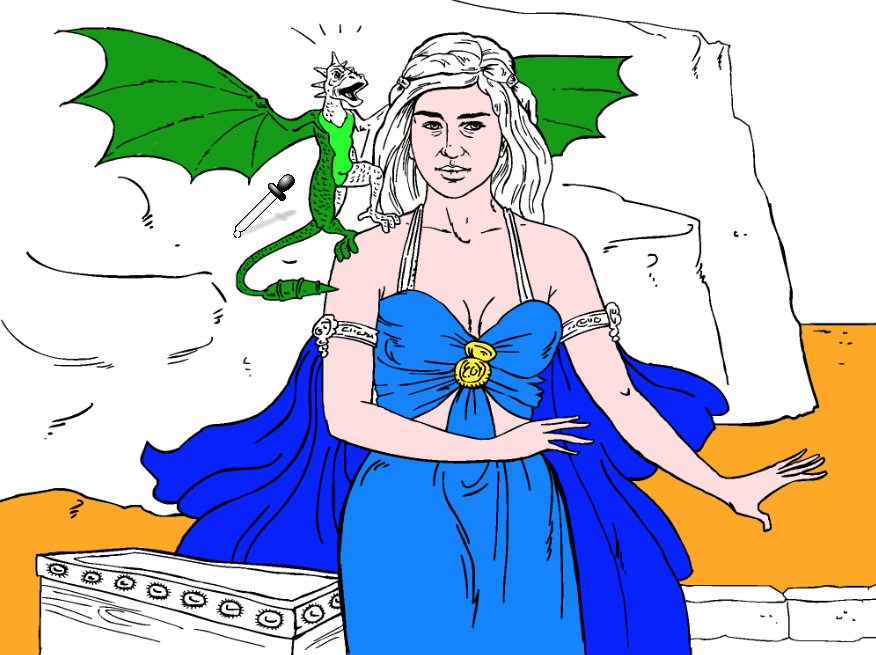
Fans of George R. R. Martin’s epic fantasy series A Song of Ice and Fire have been waiting for a new book for four years, and they are going to get one this fall! However, the new book probably won’t give us any updates on the fates of Stannis, Sansa, Jon, and the rest, as it will be a coloring book. The book, which will be overseen by George R. R. Martin, will feature 45 ASOIAF images drawn by Yvonne Gilbert, John Howe, Tomislav Tomic, Adam Stower, and Levi Pinfold. No word yet on what the images will be, but if they are true to the books they should include plenty of beheadings, dragon fire, zombies, and wolf attacks.

If you can’t wait until October, you can color ASOIAF images online on the free (and unofficial) gameofthronescoloringbook.com. (Above image taken from there.)

So, while book readers may have to accept that the TV adaptation Game of Thrones will officially pass the books, they can at least soothe their anger by drawing some scales on a few dragons.

(h/t LA Times)

We’re All Doomed Fools, a conversation with Cari Luna, author of The Revolution of Every Day

Cari Luna’s novel, The Revolution of Every Day, recently won the Ken Kesey Award for Fiction. A street’s eye view of life on the margins, Luna reveals a side of Manhattan that won’t ever make the Wall Street Journal.

Court Merrigan: Why this book? Why this story?

Cari Luna: I started the book in 2005, when I was pregnant with my first child and living in Brooklyn. I was preoccupied with what it would be like to raise a kid in New York, and how we would be able to afford it. Ultimately, we couldn’t, which is why we moved to Portland in 2007.

I was born in the Lower East Side in 1973 in a very different version of the city. You could still be middle class in New York back then and get by somewhat comfortably. By 2005, not so much. And so as my pregnancy changed the book and led me to explore questions of motherhood, my thoughts about New York led me to explore gentrification. If I was going to write about gentrification in New York, the squatters of the Lower East Side seemed like a good place to look.

Clearly, at that point, real estate values were more important than the well-being of the people.

The Revolution of Every Day is set in a community of squatted buildings on the Lower East Side. The period that it covers — 1994–1995 — was, to my mind, the tipping point in the neighborhood, the point when money won. The novel draws on the history of the LES squats, in particular the story of a group of squats that formed the East 13th Street Homesteaders Coalition to try to fight off the City’s attempts to evict them. After a year and a half of fighting in court, they lost and were evicted in a massive militaristic siege. That eviction played a big part in my desire to set the novel in the squats. The police brought SWAT teams, snipers, police in riot gear, mounted police, a helicopter and AN ARMORED TANK to evict forty people from two buildings. Clearly, at that point, real estate values were more important than the well-being of the people. That merited telling.

That said, this is truly a novel, truly fiction, and the characters are pure invention. I wrote about the actual history of the LES squats in Jacobin.

CM: I think there’s a tendency to think heavy-handed government tactics like we saw recently in Ferguson and Baltimore are a new phenomenon, when in fact around the time that an armored NYPD tank was evicting squatters in the Lower East Side, the ATF was massacring women and children in Waco, Texas. Is there a pattern here?

CL: My recollection of what happened in Waco in the 90s is shaky at best, but neither the squatters in the Lower East Side, nor the protesters in Ferguson and Baltimore were bunkered down with a large cache of weapons. The squatters had no weapons, yet were met with militaristic force. The protestors had no weapons, yet were met with militaristic force. It isn’t new, but it is increasingly common. The tank that the NYPD rolled down East Thirteenth Street in 1995 was shocking. Unfortunately, it wouldn’t be shocking today.

CM: So you had direct experience with squatters in New York in the 90s?

CL: I lived in the neighborhood at the time, but I was never a squatter. I was witness to a pretty key action in July 1995, but remained an onlooker. I went to college with a couple of former squatters, but never asked them much about their experiences. The squatting community was something that only caught my attention in hindsight. Since the book came out, I’ve become friends with a number of former squatters who were involved in the historical events that inspired the book. I’m so grateful that I didn’t get to know them until after the book was written, because I would have felt beholden to their versions of the story, and the book would have suffered. And even though they wouldn’t have expected it, I would have been unconsciously tempted to make them more heroic and less flawed — less human.

CM: How are the folks your characters are loosely based on faring these days? What happens to a squatter twenty years down the road?

CL: My characters are wholly invented. They aren’t based on any real people, even loosely. I’ve heard there’s some speculation in the neighborhood about which characters are based on which real squatters, and I’d like to officially go on the record as saying NONE. Honestly, none.

But the actual former squatters of the Lower East Side? They were a very varied group, so they’ve gone on to do all kinds of things. Some are still in the few remaining, now legalized squats. Some are teachers; some are working artists; some are scientists; many are parents. Some stayed in the city, others moved away. And life being life, quite a few have died. You can read about three of them in that Jacobin article I mentioned earlier.

CM: Is squatting still happening today? Are squatters still scrounging a living in buildings abandoned by New York City?

The New York I wrote about in the book no longer exists, which was a big part of what moved me to write it.

CL: The time when it was possible to take over an abandoned, city-owned building in New York and make a home in it — however fleetingly — is long, long gone. The real estate is now too valuable for landlords to walk away from, and so any empty properties are much more likely to be bank-owned as a result of foreclosure than titled to the city due to unpaid taxes, as happened in the 1970s and 80s. It’s a completely different proposition now. There have always been squatters in New York, by necessity, and I’m sure there are still people squatting very quietly in various corners of the city, but the time of squatting as a form of radical protest, as a community action to establish low-income housing in the city, is over. The New York I wrote about in the book no longer exists, which was a big part of what moved me to write it.

CM: I’m a dog-earing reader, always chasing perfectly-turned phrases and slashes of insight. I dog-eared a shit ton of pages in The Revolution of Every Day. Chasing a phrase like this one: “There are no half-measures at twenty-one, when time stretches out full and limitless, the momentum of the teen years still pushing like an insistent hand at your back.”

How many drafts did this book go through to get it to that pitch? How long have you been working on this book in one form or another?

CL: Oh, I love that! Thank you. Would you hate me if I said that line just came out like that and I didn’t touch it at all?

CM: A little.

CL: I’m very lucky in that language and voice come to me readily in first draft. It takes me many drafts to finish a book, but my revisions are never about language. Revising always seems to come down to plot and character development for me. Especially plot. That’s what comes the least naturally. Getting the words out in a way that sounds good is the easy part for me; it’s making them add up to something logical and well-supported that comes as a challenge. That’s why I always freewrite my first drafts. I let my brain do its language thing in first draft, without logic getting in the way. Then I go back in revisions and try to make it all take a coherent shape. A professor in grad school said I was an intuitive writer rather than an analytical one. I’m not entirely sure he didn’t mean it as an insult, but I’ll take it. I think it’s true.

CM: So, nitty-gritty: how many of these drafts did Revolution go through? Do you have beta readers, or are you a solo artist?

CL: Thirteen drafts from the beginning in 2005 to the final manuscript in 2012. Mind you, I had two babies in that time period, which slowed the process down considerably. No one can do it entirely alone, I don’t think. I’d be very distrustful of anyone who said they do. I have great, trusted draft readers who I rely on to call me on my shit. And Meg Storey, my editor at Tin House, was an incredible reader for me. She played a huge part in getting Revolution to where it is in the final version. She bought draft eleven and we went through two more rounds of revision before it was done.

CM: A line that in some respects sums up the “political” stance of your novel: “We don’t live in a police state, as long as you do what you’re told.” Care to expand on that? Is New York City a police state? Is America?

The main political stance, if I were to boil it down, would be PEOPLE OVER PROFITS.

CL: I disagree that it sums up the political stance of the novel. The novel is concerned with the rights and well-being of the people vs a government that increasingly functions in service of corporations. The main political stance, if I were to boil it down, would be PEOPLE OVER PROFITS. That said, I do stand by the statement in general, particularly because our increasingly militarized police forces have repeatedly demonstrated that property is valued over human life. Particularly if that human is a person of color.

CM: Two of the main characters run a bike shop where they set out tools where people can tune their own bikes, for free. Seems like they’d be getting ripped off all the time, but no mention is made of that. Most of the characters live like this, getting by on gettin’ by, as Jerry Jeff Walker would say. This insouciance in the teeth of the most capitalist town on the planet seems so brave as to be reckless. Are these folks, squatters among the ruins of Manhattan’s glamour, ultimately foolish and doomed?

CL: Manhattan wasn’t particularly glamorous back then, nor is it really all that glamorous now when you’re actually down in it rather than reading its press releases, and we’re all doomed fools. And yeah, the bike shop probably would have been ripped off occasionally, but not all the time. Because it was part of a community, providing a useful service to the people who lived there. The squatters weren’t foolish, though they were doomed. Idealistic, maybe. Gentrification destroys communities, changing them to cater to the desires of a more affluent population. The squatters, for the most part, fit themselves into the existing fabric of the neighborhood, respecting the culture that was already there. So yeah, they could teach the neighborhood kids to fix bikes, and they could set some basic tools out. The bike shop wasn’t about profit, it was about building community. So if a few tools were lost occasionally? So be it.

CM: Care tell us about the long process of getting The Revolution of Every Day into the world? You had an agent, and then you didn’t, and then you got in with the good folks at Tin House. I’m betting there were more steps along the way.

CL: Oof. Yeah. The Revolution of Every Day isn’t my first novel. I wrote another one first, and got a great agent for it, and she was shopping it around while I wrote Revolution. She shopped it for two years and couldn’t sell it and it went into the drawer. We went through a round or two of revisions on Revolution, but she just couldn’t get comfortable with it. She didn’t really get the squatters or what I was trying to do with the book. She’s a terrific agent and a wonderful person — she just wasn’t the right fit for the project. So we parted ways and I spent a year trying to get a new agent, with no luck. I came close a few times, but no one wanted to take a chance on it. It often came down to “Who cares about a bunch of squatters?”

Well, I did. I decided to submit it to independent presses on my own, and was lucky enough to sell it to Tin House Books rather quickly. Tin House turned out to be exactly the right home for it, so there’s a happy ending there. I’ve since signed with a new agent who’s a much better editorial fit for me.

CM: A reviewer on Amazon got under your skin recently when he used the label “Women’s Fiction” (whatever that means) as a pejorative to describe The Revolution of Every Day. How about a blow-by-blow rundown why.

CL: Ach. Okay. I usually privately kvell over the good reviews, because they feel good, and do my best to disregard the bad reviews, because they don’t help me and weren’t written for my eyes anyway. Honestly, it was probably a mistake to vent on Twitter and I hesitate to revisit it now. I’m breaking all kinds of rules of decorum by doing so. (Fuck rules of decorum.) There was one Amazon review recently. (Should we call them reader reviews? Civilian reviews? Anyway…) This guy on Amazon got to me because he said my book didn’t deserve the Ken Kesey Award because it, in his estimation, “bordered on Women’s Fiction.” By this, I can only assume that he means “considers women’s stories as central to the narrative.”

Women’s Fiction, when used as a marketing category, generally refers to commercial fiction written by women, where the main protagonist is a woman. The themes may or may not be domestic. It can be said fairly that commercial fiction seeks to do different things than literary fiction, and that it makes different promises to the reader, but the line can be hazy. “Women’s Fiction” (damn, I hate that term) sells better than literary fiction, so publishers are often eager to squeeze a novel written by a woman into the Women’s Fiction category by slapping a pink cover on it and tweaking the jacket copy. But when they do so, the literary merit of the book is instantly devalued, which means that a woman writer might sell more copies, but she will earn less respect for her work. A man can explore the same themes of family and domesticity with impunity.

What got to me about that review was that he used the term “Women’s Fiction” as a means of denigrating my work.

I don’t want to wade too deeply into the way books are marketed, and I don’t have anything to say on the topic that hasn’t been argued many times before. What got to me about that review was that he used the term “Women’s Fiction” as a means of denigrating my work. No marketer or publicist would call The Revolution of Every Day Women’s Fiction. He was using it as an insult, as a way of explaining why my book didn’t deserve the prize it had won. It didn’t deserve the prize, in his eyes, because three of the main characters are women, and they have stories and concerns of their own. He can’t, apparently, see the literary merit in that.

Of the five finalists for the award, two of us were women, and three were men. When the reviewer said he preferred other finalists’ books to mine, I have a strong guess as to which of those books he meant.

CM: I found the storyline of Cat, a former Manhattan wild child legend living on the last scraps of faded glory, to be incredibly sad. Is she in any sense a metaphor for the last rockin’ days of the city before the suits took over for good? I suspect Cat herself wouldn’t like the idea of being someone else’s allegory.

CL: No metaphor. Cat is Cat. She was the hardest character to write — she kept slipping away from me. But once I finally got a handle on her, I fell for her hard. I think she’s my favorite of the five main characters.

CM: It has come to my attention that, unlike me, you somehow don’t love the shredding artistry of Dire Straits. Fine, fine. Different strokes and all that. Who *do* you love, then? The Hold Steady, I hear? And do you listen to them when you work, or do you prefer silence?

CL: I do not love Dire Straits. I actively dislike Dire Straits. It’s true. I can’t work to music; I find it too distracting. But I listen to music in most every moment when I’m not writing, reading, or sleeping. It’s hugely important to me, and influences my work quite a bit. My favorite band of all time, if I have to choose, is The Velvet Underground, but yes, my favorite contemporary band is The Hold Steady. Full disclosure: Tad Kubler, the lead guitarist of The Hold Steady, is an old friend, and I sang backup on a song for their third album. (Okay, that sounds more glamorous than it was. I shouted on a shouting chorus for a song that got cut from their third album. But it was a B-side in the UK! And I get bonus points for waddling into the studio 8 months pregnant.) That said, if Tad weren’t a friend I would still love The Hold Steady. You’ve got some of the best guitar of our generation paired with Craig Finn’s often brilliant, novelistic lyrics and a delivery that you either love or hate. And there’s a fantastic tension between Craig’s lyrics and delivery and Tad’s composition… It’s just great, great stuff. Lyrics are very important to me. If I don’t like the lyrics, I find it hard to even tolerate the song, no matter how good the music might be. I also love Van Morrison, Neko Case, Neutral Milk Hotel, Joni Mitchell, The Long Winters, Aimee Mann, Laura Gibson, Jolie Holland…

CM: Speaking of music, Revolution is being made into an opera?!!? How did that come about?

CL: Crazy, right? I’ve known Anne Midgette, the classical music critic for the Washington Post, for years. She loved Revolution and passed it along to Daniel Felsenfeld, a composer she’s friends with who’s worked with prose writers before. He loved it and passed it along to Alexis Rodda, a soprano he’s worked with before, who he says is “fearless.” Alexis loved it (I had no idea this was all going on, by the way) and applied for a grant to commission and perform in an original opera based on the book. After she won the grant, she and Daniel approached me about writing the libretto.

CM: I’m picturing the barricade from Les Mis. Is that what this opera is going to be like? When and where will it run?

CL: Confession: I’ve never seen Les Mis on stage or screen, and have never managed to get very far into the book. The opera is going to run in New York at the end of the year, at Elebash Hall. We’re waiting on final confirmation of the date, but it’s looking like early December of this year.

CM: You’re writing the libretto. I imagine that’s something like writing a screenplay. Or a totally different beast?

CL: The libretto was really tough. I had one singer to work with — Alexis will be the only performer. So I had to adapt a novel told in third person, with lots of interiority and dialogue, into first-person monologue. No exposition, no dialogue. I decided to focus on the three female characters: Cat, Amelia, and Anne. It’s going to be up to Daniel and Alexis to figure out how to indicate point-of-view shifts. I can’t wait to see how they handle it. It’s not the whole novel, but sections of it put together to give the overall story arc, as well as tastes of the stories of each of the women.

CM: So what’s next?

CL: I just finished my next novel. It’s with my agent, soon to go out to editors. It’s very different from The Revolution of Every Day. It’s a (fictional!) first-person confession by a woman who creates a fake persona on Twitter, and uses it to lure in an ex-boyfriend. There’s a very strong erotica element. I’ll be very curious to see how fans of Revolution react to it.

Watch Matt Damon on Mars in The Martian

Andy Weir’s The Martian has had a hell of a journey. Originally self-published in 2011, the science fiction novel about an astronaut trapped on Mars became one of the rare self-publishing hits to break out into the larger literary world. It was republished in 2014 by Crown, and the film adaptation featuring Matt Damon will be released this fall. Check out the first teaser trailer above.