Goods

by Matthew Baker, recommended by Hayden’s Ferry Review
When my brother and I were children, our mother would take us to stores. My brother was a small blackhaired bucktoothed child who kept his hands clenched into fists. I was a small whitehaired bucktoothed child who kept his hands tucked into his underarms. We liked scowling. The game would begin when we entered the store. When we entered a store, we would choose things. My brother might choose a baseball. I might choose an umbrella. We would take them from their displays. As our mother led us through the store — loading cartons of eggs into our cart, boxes of tampons, bottles of pills — my brother would carry the baseball and I would carry the umbrella. We weren’t hoping our mother would buy us the baseball and the umbrella. Our mother couldn’t buy us the baseball and the umbrella. We knew that. That was the game. During our time in the store we would carry the baseball and the umbrella, and we would use them, like they were ours.

My brother would sniff the baseball. My brother would spit onto the baseball. My brother would pretend to pitch the baseball through an elderly shopper’s legs.

Meanwhile I would twirl the umbrella over my shoulder.

When we exited the store, we would leave our things there.

My brother and I liked when our mother took us to stores. We liked when our mother took us to stores because my brother and I didn’t own many things. We didn’t own a baseball. We didn’t own an umbrella. But when we were within a store’s walls, we could own a baseball and an umbrella. As customers of a store — as people who had the potential to buy any object within the store’s walls — we were given ownership, temporarily, of any object within that store. We could carry the objects with us wherever we wanted. They were ours.

My brother would kick his sneakers into our cart — clods of dirt scattering across the store’s floor — and yank rubber waders over his jeans and his socks.

I would wear unusual hats meant for the colorblind and the blind.

Once we owned skateboards.

Once we owned backpacks.

Once we owned calculators. My brother and I didn’t like calculators — even if our mother could have bought us calculators, we wouldn’t have wanted our mother to buy us calculators. We thought calculators were boring. But we had never owned calculators, so we carried calculators through a store, once — adding things, subtracting things, multiplying things until the calculators’ displays were maxed at nines — because we felt that that was an experience we needed to have. Felt that if we ever were to understand children who owned calculators, we ourselves would have to have owned calculators. Felt that if we ever were to understand anything about our country, first we would have to understand children who owned calculators.

My brother and I owned few things, when we weren’t within a store’s walls. In our neighborhood we were chased by children who owned calculators. The children would tackle us. The children would pin us against dumpsters. The children would use their calculators to tally our imaginary crimes.

Our mother would shout at us when we came home with split lips and bloody noses, like we had given them to each other. Our mother would sing while she scrubbed crusted yolk and crusted syrup from our plates, would use a wrist to tuck stray curls of hair behind her ear again, her hands dripping soapy water. Our mother would snore on the couch, an arm dangling onto the floor, fingernails glittering against the gray of the carpet. Our mother owned what nobody wanted: a job frying chicken, an apartment above a video store, a heart that didn’t like beating.

Once a fortuneteller had visited our school. The fortuneteller had told my brother and I that someday we would be hip hop superstars. The fortuneteller hadn’t been paid to visit our school — the fortuneteller had been trespassing. My brother and I hated hip hop. We didn’t know what we would become.

What we became were orphans. It didn’t matter if your heart was defective — what you were born with didn’t come with a warranty. Our mother owned a television. My brother and I were watching a television program with our mother. People we’d never met had been paid to have their laughs recorded — their laughs were replayed, again and again, during the television program. Our mother laughed with them. Then our mother’s heart stopped working.

My brother and I were older now. My brother was a spindly blackhaired bucktoothed youth who kept his sneakers heel-to-heel. I was a spindly whitehaired bucktoothed youth who kept his sneakers toe-to-toe. We liked blinking. They told us the name of the orphanage where they were taking us. Blink, blink, blink, was what we said.

My brother and I owned a few shirts, a few pairs of yellowed underwear, a jar of pencils whose bodies we had gnawed with our teeth. We took them with us. The youths at the orphanage said we weren’t actual orphans because of our father. The youths at the orphanage didn’t own calculators. A youth named Henri with reddish eyebrows and brownish hair lived at the orphanage. Henri sat on his cot, legs folded together, hands folded together, eyes closed. Henri’s from Pittsburgh, said the other youths. Henri’s from Wichita. Henri’s from Norfolk. Nobody knew where Henri was from. Henri never moved. Henri never spoke. Nobody knew if Henri ate. The others said Henri wasn’t an orphan. Said Henri had traveled to the orphanage in a trance. Said Henri’s parents were alive. Said someday Henri would emerge from his trance, and would speak the truth to us, and then would leave the orphanage.

Because Henri never moved, Henri was useful. My brother and I hid our jar of pencils between Henri’s legs, so nobody could take it. My brother and I owned the jar of pencils, but at the orphanage that was meaningless. Ownership is a belief, and without authorities to propagate a belief, the belief disappears. Beyond the orphanage’s walls, officers and judges and jailers propagated a belief in ownership. Within the orphanage’s walls, the belief wasn’t propagated. The orphanage was understaffed. Youths took whatever they wanted, whenever they wanted — like the orphanage was a store, where you could own whatever you could carry.

A minivan came to the orphanage. Our grandparents had come for us. We hadn’t known about grandparents. When my brother and I lifted Henri’s sweatshirt, our jar of pencils wasn’t between Henri’s legs. My brother slapped Henri’s face. I pinched Henri’s arm. We wanted Henri to speak the truth to us.

Our grandparents’ minivan smelled of toffees and mildew.

Our grandparents were as gaunt and as bony as we were.

Our grandparents had hated our mother, they said, but that didn’t mean they hated us.

My brother’s sneakers were heel-to-heel on the minivan’s floor. My brother’s hands were clenched into fists. My sneakers were toe-to-toe on the minivan’s floor. My hands were tucked into my underarms. Our grandparents’ radio sang hip hop.

My brother and I took a vow to invent our own language, so that those who overheard us couldn’t understand us.

My brother and I took a vow to visit the prison where our father was kept, so that we could ask our father a few questions.

My brother and I took a vow to dig our mother’s body from its grave, and to steal our mother’s body, and to burn our mother’s body to ashes, so that we could sprinkle the ashes in the stores where our mother had taken us.

Our grandparents lived in a neighborhood where all of the houses were alike, like the houses had been manufactured in a factory. Our grandparents’ house had yellow shutters, flower boxes, a basketball hoop cemented into the driveway. All of the houses had yellow shutters, flower boxes, basketball hoops cemented into their driveways. Our grandparents ate cereal with milk. Once a week our grandparents took us to a church where priests and choristers propagated a belief in a being who had created our universe. They said that what the being had created was good. They said that what we had created was bad. The church had yellow shutters.

At our grandparents’ house my brother and I owned things, but we didn’t like being there.

My brother and I went to stores.

Once stores had been the size of houses, but now stores were the size of neighborhoods. Leafy ferns grew along the stores’ walkways. Fountains hoarded copper and nickel coins the fountains couldn’t spend. Adults exercised together, walking the stores’ walkways in sweat suits and sweatbands. My brother and I spent whole days in the stores — playing videogames where the videogames were sold, napping on futons where the futons were sold, eating uneaten sandwiches we found on paper plates in the stores’ sunny plazas. We stalked the stores’ employees. We watered the stores’ ferns, if the ferns hadn’t been watered. We met other youths who preferred stores to their homes: Ana, a fatcheeked snubnosed youth who squirted her cardigans with the stores’ perfumes; Lucas, whose cheeks had been tattooed with the symbols of various currencies — ₩, ₵, ₦, ₭, ₡, ₲, ¥, ₮, $ — and who typed his manifestos on the stores’ computers; Gom and Benj, who played the stores’ guitars and who read the stores’ comics and who once threw a kegger in a store’s changing rooms.

Sometimes our grandparents would come to the stores — to buy themselves things, to buy us things. If our grandparents saw us, where my brother and I were standing in the wind of a row of pivoting fans, our grandparents would say hello.

We saw them at stores as often as we saw them at home.

Our grandparents kept their cupboards stocked with jars of jam, boxes of cookies, sacks of grapefruits and oranges, but my brother and I preferred what we ate at stores.

Our grandparents bought us paisley shirts, flannel shirts, brandname sweatshirts, but my brother and I didn’t wear them. We wore the same thing from our closets day after day — black jeans, black sweatshirts — then changed into the stores’ clothing once we were at the stores.

At our grandparents’ house we owned things, but at the stores we could own anything. If our grandparents bought us a paisley shirt, then we owned a paisley shirt — but at the stores we owned all paisley shirts. If our grandparents bought us the newest album by a certain band, then we owned that newest album by that certain band — but at the stores we owned all albums by that band. Owned all albums by any band. Owned multiple copies of every album. Perhaps that, more than anything, was why we preferred the stores: at the stores, my brother and I were unaffected by loss. We felt nothing, when something broke, because a hundred replacements were waiting, always, to replace what had been broken.

Once my brother and I took shovels from our grandparents’ garage and rode a bus into the city, through the billboards, to the graveyard where our mother was buried. We carried our shovels through the graveyard, reading the names on the graves, searching for the name of our mother. Water dripped from the trees. Pigeons cooed at other pigeons along the graveyard’s pathways. Headlights led taillights through the streets beyond the graveyard’s fences. Our mother’s name wasn’t there. Our mother wasn’t buried where our mother was buried. We sat on somebody’s grave. A whiskery skinsagging beggar came into the graveyard carrying a camouflage backpack. The beggar was shouting at something imaginary. The beggar was peeling the white from his fingernails with a knife. I’m going to destroy myself, the beggar shouted. You use me, you abuse me, you make me feel so cheap, the beggar shouted. I’m capitalism, I’m a market, the beggar shouted. The beggar stopped for a while and convulsed under a tree. Blink, said my brother. Blink, I said. The beggar kept coming. The beggar stopped where we were sitting. The beggar’s fingers were twitching. The beggar’s nostrils were twitching. The beggar asked us what we wanted. We told the beggar we wanted our mother’s body. The beggar told us that someday my brother and I would be supereminent physicists. Supereminent? my brother said. Physicists? I said. The beggar shouted the names of planets at us. The beggar shouted the names of chemicals at us. The beggar asked us for money. A droopeyed baldheaded beggar came into the graveyard carrying a polkadotted umbrella. I thought I lost you, said the beggar with the polkadotted umbrella. I was talking to my daughters, said the beggar with the camouflage backpack. I’m everywhere. You can’t lose me. The beggars bowed to us. The beggars trudged arm-in-arm together toward the graveyard’s gate. The beggar with the camouflage backpack shouted at the beggar with the polkadotted umbrella. This is my graveyard. This is my graveyard, and those are my streets, and the bridges and the undersides of the bridges and the empty alleyways, all of them, all of them, those are mine. The beggar with the polkadotted umbrella hushed the beggar with the camouflage backpack. The beggars crossed the street. My brother and I rode a bus to our grandparents’ neighborhood.

My brother briefly was bedridden with the flu.

I was suspended from school, briefly, for dissecting a fetal pig in the biology lab.

(I wasn’t taking biology.)

We kept stalking the stores’ employees.

Even with love, we preferred what we found in stores.

My brother had a crush on a plump mustached cashier who wore plastic watches with different superheroes on their faces and whose nametag said Ramon Vilkitsky III.

We would follow him through the stores’ walkways (as Ramon Vilkitsky III unknotted his uniform’s tie), through the stores’ entryway (as Ramon Vilkitsky III zipped himself into his jacket), through the trucks and the minivans and the sedans in the stores’ potholed lots (weaving through the cars, my brother’s hands clenched into fists, my hands tucked into my underarms, as Ramon Vilkitsky III shook his keys from his jacket), and stand and stare as Ramon Vilkitsky III lowered himself into a bumperless sedan and sputtered away from us.

When Ramon Vilkitsky III was working, my brother and I would watch him from within racks of sweaters.

My crush was on a lipringed buzzheaded shelfstocker who wore fishnet stockings with her uniform and whose nametag’s name had been scribbled black. She caught my brother and I watching her from within a display of umbrellas. She had been pricetagging plastic clocks. Why are you following me, she said. Because I love you, I said. He loves me too? she said. I said, He loves somebody named Ramon.

She said that she was dating somebody but that when she was working didn’t count. She pricetagged my brother’s face. She told me to meet her in a changing room.

In the changing room she made me feel like not a person but a thing.

We never kissed, when we would meet in the changing rooms.

She would unzip her uniform’s shorts. She would peel her fishnet stockings to her knees. She would spit in my hair. She would face away from me, toward the mirror, so that she could watch herself pounding me.

What’s your name, I said.

Don’t ask me that, she said.

I knew about sex now, but I still didn’t know about kissing.

Beyond the stores’ walls, bankers and cashiers propagated a belief that money wasn’t meaningless. Teachers and provosts propagated a belief that grades weren’t meaningless. Advertisers and fashionistas propagated a belief that skirt meant woman, that tie meant man.

Once our grandparents drove my brother and me to the prison where our father was kept. Our grandparents said our father was a monster. They had warned our mother, they said, but our mother had ignored them. Now they were warning us. The prison’s lot was like the stores’ lots — trucks and minivans and sedans. My brother and I whispered about Ramon. Our grandparents muttered about our father. In the prison we sat in an empty room. When you visited a prisoner you could have a contact visit or a noncontact visit. My brother and I wanted a contact visit. We couldn’t have it. A few days earlier our father had been caught under his cot with a hammer chipping a tunnel through the floor. Our father was restricted to noncontact visits for a year. His tunnel had been cemented. His tunnel hadn’t been a tunnel even. His tunnel had been a hole. It hadn’t been able to fit anything more than our father’s head — that’s how far our father had gotten. A noncontact visit meant we would meet our father face-to-face but separated by a pane of glass. They brought him into an empty room connected to our empty room. Our father was a freckly grayhaired bucktoothed adult with childsized hands. He wore an orange jumpsuit that said he didn’t own it. It said the prison owned it. It said the prison owned him. Our father put a black telephone to his face. My brother and I put black telephones to our faces. Our grandparents sat on chairs behind us muttering about our father. Our father stared at us. Don’t you have anything to say? he said. Blink, we said. This is it, here I am, this is what made you, here’s the other half of your genes, he said. Blink, we said. If your mother were alive she wouldn’t want you to be here, he said. Blink, we said. Aren’t you going to say anything? he said. My brother was nudging me to say something. I was pinching my brother to say something. More nudging. More pinching. We said something. We asked our father why he did what he did. You mean the tunnel? he said. Before that, we said. The same reason anybody in here or anybody out there do what they do, did what they did, he said. I wanted money. More things. Better things. Different things. More nudging. More pinching. We asked him what it was like in there. Not what I wanted, he said. Here I can’t have anything. I buy some magazines from my friend — they take them away from me. I buy some pills from my friend — they take them away from me. I buy a hammer from my friend — they take it away from me. Here nobody can have anything. All those empty rooms, it makes you anxious, jittery, demented, you understand? More nudging. More pinching. We asked him what we should know. You should know that your great-grandfather had a heart attack, and your great-uncle had a heart attack, and your uncle had a heart attack, so you’ll probably have heart attacks, I’ll probably have a heart attack, he said. You should know that your great-uncle suffered from pyromania, and your uncle suffered from pyromania, so you’ll probably suffer from pyromania, he said. You should know that your great-grandmother was bilingual, so you may be bilingual, he said. We told him we weren’t bilingual. They came for our father, but our father kept talking. They made our father stand, but our father kept talking. You should know that you have different fathers, he said, and that I’m neither of those fathers. And isn’t that how it is, for all of us? Aren’t mothers always the same, but fathers are always changing, are always different moment to moment? Even now, even here, can’t you see it happening? he said, and then they took him away and our grandparents drove us home.

My brother was hospitalized briefly with appendicitis.

I served on a jury, briefly, for a kidnapping trial.

(Guilty, the jury said.)

After that my brother and I began sneaking things into stores. We never talked about doing it, but we did it anyway. The next time we went to the stores, we took our grandparents’ bathrobes. The bathrobes smelled of sour breath and burnt coffee. The bathrobes were stiff with years of dried bathwater and dried sweat. We carried the bathrobes into a store. We found where the store’s bathrobes were sold. We hung our grandparents’ bathrobes there with the others. Then we went and napped on the store’s futons.

The next time we took our grandparents’ doormat.

The next time we took paintings from our grandparents’ hallways, took hangers from our grandparents’ closets, took spatulas and ladles and whisks from our grandparents’ kitchen.

We took price tags from other things, stuck them onto our grandparents’.

We didn’t know why we were doing it.

Ramon Vilkitsky III kissed my brother under the stores’ glittering chandeliers.

My crush was fired, but I found other employees to love — for every crush the stores fired, the stores hired a new employee to replace her.

Where our grandparents’ sofa had stood, the floor was marked with scuffs. Where our grandparents’ coats had hung, our grandparents’ knobs were empty. Where our grandparents’ paintings had hung, the wallpaper was brighter, in squares, where it hadn’t been bleached by the sun. Our grandparents might have been upset about their missing things, but our grandparents’ brains had broken years before. Our grandparents wandered their house, arguing about things that hadn’t happened, rearranging their cans of pears.

What do we do? my brother said. I don’t know, I said. My brother and I were older now. My brother was a bulky blackhaired bucktoothed adult who kept plastic glasses in his hair. I was a bulky whitehaired bucktoothed adult who kept plastic glasses on his face. We liked tugging our earlobes. We’ll take them with us, my brother said. We can’t take them with us, I said.

We didn’t live in our grandparents’ house anymore — we lived in the stores. Once stores had been the size of neighborhoods, but now stores were the size of cities. Lightpoles lit the stores’ avenues. Monorails hummed from station to station. Flags fluttered from the balconies of the stores’ hotels. Others, now, were playing our game. We lived together, in the stores, never leaving, marking the change of the seasons by the changing decorations. When snowflakes and reindeer were hung from the stores’ ceilings, Ramon Vilkitsky III and my brother celebrated their anniversary. Ramon Vilkitsky III and my brother had been married in the stores, in a sunny plaza, wearing the stores’ tuxedos.

Once my brother and I were aboard one of the stores’ yachts, where the yachts were sold, when an employee began shouting at us from the floor. We were wearing the stores’ newest swimsuits, reading a pile of the stores’ newest magazines. Hey, you, the employee shouted, his brownish hair trembling, his reddish beard bobbing with each of the words he shouted. Blink, my brother said. Blink, I said. Come down from there, the employee shouted. Onepiece swimsuits were fashionable that season. My brother’s swimsuit was white with black stripes. My swimsuit was black with white stripes. We stood on the floor with the employee among the stores’ yachts. The employee stared at our swimsuits. The employee was muttering something into his headset. The employee stopped muttering. We tugged our earlobes. I know you, the employee said. Do you remember me? the employee said. We lived together at the orphanage, the employee said. Blink, we said. Blink, blink, blink, we said. Henri? we said. Yes, it’s me, I’m afraid, Henri said, and I’d like to say that I’m sorry, because once I stole something from you. I would have these visions, sometimes for days, sometimes for weeks, and once, between visions, I felt someone doing something to my body, which wasn’t unusual, because the others at the orphanage were often doing things to me — knotting my arms together, greasing my hair with butter, carrying me around from floor to floor — but when I peeked, it was you, both of you, putting something between my legs. And I felt like it was an offering, like you were my first followers, because in those days I dreamed of becoming a prophet, of starting a new religion, or a new sect of an old religion, or a new order of an old sect of an old religion, so while you and the others at the orphanage slept, I took the pencils, and I hid the pencils, and I prayed to them sometimes, but what happened was that later, after the visions had stopped, and wouldn’t come, and wouldn’t come, and my dreams of becoming a prophet had become nightmares of becoming a nobody, a nothing, a nameless commonplace employee, which is what I have become, but, anyway, what happened was that later, as I was eating cereal with the other orphans, spooning it into my mouth, feeling queasy, feeling depressed, obsessing over my nightmares, one of the other orphans found the pencils where I had hidden them, and the orphans began talking about you, the two of you, and how you had been looking for the pencils, but hadn’t found them, and that’s when I understood that it hadn’t been an offering, what you had given me — understood that I had stolen your pencils from you. And then I felt even more queasy, and felt even more depressed, because I hadn’t meant to steal from you, and I was sorry that I had, but I couldn’t tell you that, because you didn’t live at the orphanage anymore. But don’t you think that’s why my visions were taken from me? Because I had become dishonest? Because I had taken what wasn’t mine?

Blink, we said.

So anyway I’m sorry, and although I carried the pencils with me for years and years, hoping to find you, I don’t have the pencils anymore, they were lost in a fire, Henri said. My brother’s hands were clenched into fists. My hands were tucked into my underarms. Somewhere the stores’ monorail was beeping. My brother and I brought Henri onto the yacht. We told Henri we had all of the pencils, now, that we could want. We told Henri it was better to be a nobody than a somebody. We asked Henri if he had ever seen either of us in his visions. Henri gripped the yacht’s rail. Henri’s wrists were marked with nicks and cuts. Henri’s undereyes were puffy. Once, yes, one of the last visions I ever had, Henri said. I saw that one day you would become notorious revolutionaries — that you would be executed for treason, but that after your deaths the people would sing your names, would carry flags of your faces — that you would be remembered as much for your good as for your bad. And were we buried with our mother? we said. Yes, Henri said. And were you part of our revolution? we said. Yes, yes, yes, Henri said, I was carrying one of your flags. And my brother and I stood on the yacht with Henri and watched people moving through the stores: watched people carrying blankets into unzipped tents, where the stores’ tents were sold; watched people emerging from the stores’ bathrooms, wiping their faces with the stores’ towels; watched people visiting the unsold hamsters, the unsold parrots; watched people kicking balls along the stores’ avenues; watched people stepping into pairs of the stores’ newest boots. And from where we stood it was impossible to tell the stores’ shoppers from the stores’ tenants. We almost could feel the stores’ walls expanding. Could feel the world beyond them shrinking. Could feel it disappearing more and more.
“Connections and luck do matter”: The Blunt Instrument on MFAs, Networking, and Ornamental Style.

The Blunt Instrument is a monthly advice column for writers. If you need tough advice for a writing problem, send your question to blunt@electricliterature.com.

Hi there, Blunt Instrument. I need your rough touch in my life. Here are my questions:

* Is it possible for an over-30, rural, broke, non-MFA’d person living far away from any big, literary city to have a successful writing career in 2015?

* What is so magical about an MFA? Does it provide networking/connections opportunities that are necessary to getting ahead?
Is it honestly who you know and not what you do that gets your foot in the door (in literary magazines and publishers)?

* Everyone always denies, denies, denies that any of this matters. But the evidence seems to contradict these denials, and I wish someone would just admit that these things matter — sometimes more than talent.

Thanks for reading.

Sincerely,
Over-30, Non-MFA’d Country Bumpkin

Dear Bumpkin,

People who deny that connections and luck matter to literary success probably have some measure of literary success themselves, and are therefore reluctant to admit — even to themselves — that anything other than talent might be involved. It’s a lie. Connections and luck do matter. Still, you absolutely can have a successful writing career if you’re over 30, rural, broke, and non-MFA’d, and I’ll say more on this later, but first, let’s talk about what’s so “magical” about an MFA:

* Getting an MFA puts you in a position to make connections that are conducive, if not strictly necessary, to getting ahead. This plays out in a number of ways, most of which are not particularly icky or nepotistic. For example:

a) You form a community of writer friends who you feel kinship with; you read and edit each other’s work; you encourage and challenge each other; you keep each other busy and honest; and, to some extent, you feel competitive with each other, which drives all of you to accomplish more. Some among you may even found magazines or become editors at existing journals and presses, and subsequently publish and promote each other.

b) You seek out mentorship. Working with a teacher you admire can be hugely influential and occasionally lead to opportunities you wouldn’t otherwise have.

* MFA programs also give writers more access to honest readership, so it’s a good way to find out if you’re writing stuff that has no market (i.e. nobody wants to read it). The relevant question here is not “Can creative writing be taught?” but “Can creative writing be learned?” I’ve been in both teacher and student roles, and it’s obvious to me that writers can get better, with guidance. If you don’t believe your writing can be improved, this may not work for you.

* Giving yourself two to three years of focused writing time (whether or not it is funded) can have transformative effects; it’s permissive and legitimizing and may help writers understand both how seriously they should be taking their art and how much work is involved to do it well. In other words, for many getting an MFA just redoubles their commitment to writing.

* Economically, some correlation is probably involved: If you can afford to get an MFA, then you can afford to play the game in general. Writing and reading and doing the rest of the administrative work required to get published take up a lot of time, most of which is uncompensated, especially at first.

You can do all of this (find a community, carve out dedicated writing time, etc.) without getting an MFA, but an MFA is a structured system that makes these things easier to achieve in a short time period. In my opinion, that’s what you’re paying for, more than the largely useless degree. And the connections in particular can be very helpful when it comes to publishing. Many of my early poems were published by people I met at readings. My first book was published by a press founded by a few of my MFA classmates. Things like this helped me get from zero visibility to some visibility, so that I could start to be known on my own terms.

But now I want to get to my real answer, which is this: Regardless of what advantages you do or don’t have, a successful writing career takes much more work than you expect. Even the lucky, rich, beautiful 23-year-olds in New York are very likely working harder than you think. When anyone achieves writing “fame,” they appear to have come out of nowhere, but that’s how it works by design: you can’t see all the hustling people are doing before they become famous because they’re not famous yet!

If you want to get published, do everything you can to mimic those MFA advantages in your no-MFA life. Read and write like you’re paying for it (you are). Get better; no matter where you’re starting from, you can be better, and no matter how connected you are, being a better writer helps. (Remember that “talent” doesn’t exist in a vacuum. You need an audience to judge your talent, and it will be judged differently by different audiences.) Find a community (online is almost as good!). Consider taking classes — there are lower-cost, lower-commitment options outside MFAs. Figure out your market — where would you publish if you could? (Start way, way below The New Yorker.) But most importantly, get perspective on what it takes to be a successful writer. Published writers may be luckier than you, but they’re probably also working harder.

Sincerely,

The Blunt Instrument

Hello,

I am glad you launched this advice column. Even though I am not much of a writer, I frequently dabble in the art after intense periods of inspiration, and I’m an avid reader of the classics. It appears to me that most people prefer easy, simple writing that doesn’t require the skill, patience, and appreciation needed to get through what I call ‘ornamental’ writing, which is literary prose with grand form and language. As a writer, should you appeal to people’s tastes and write simple prose — as some writers, such as Stephen King, preach — or should you aim for the beauty of form and language following in the trails of our great writers no matter what people think?!

Best regards,

rana faraj

Dear RF,

First let me establish that you’re presenting something of a false choice. As Electric Lit editor Lincoln Michel has noted, there is no one ideal reader. We need simple books for readers who like simple books and ornamental books for readers who like ornamental books. So the question is not what should writers do in general, but what should you, specifically, do when you write?

The answer to this second question depends somewhat on your intended audience. If you want to reach the widest possible audience, it may serve your goals to write simple prose, which tends to foreground things like plot and character (in fiction) and conveyance of information (in nonfiction) over the texture of the language itself. Most — but not all, of course — bestsellers follow the Stephen King model. (It’s worth noting that “simple” prose may be easier to read, but it’s not necessarily easy to write; we have to learn how to write with clarity and concision. Further, simple prose can be used to communicate complex ideas.) But I gather from your letter that simple prose is not the prose that speaks to you; you’re interested in “grand form” and “the beauty of language.”

The thing is, style isn’t something you apply after the fact, like an Instagram filter. The style comes out of the writing. So I’ll turn it around on you. What kind of prose do you want to write? There’s a contradiction in your self-description as someone who only “dabbles” in writing and yet experiences “intense periods of inspiration.” Intensity and dabbling don’t really go together. If you want to find your style, look to what you do when you’re intensely inspired, not what you do when you dabble.

Best of luck,

The Blunt Instrument

Lev Grossman’s The Magicians Picked Up By SyFy Channel

Best-selling author (and Electric Literature board member!) Lev Grossman is going to have his work hit the small screen. According to Deadline, the SyFy channel just picked up his popular Magicians trilogy for a 12-episode series. John McNamara (Prime Suspect) and Sera Gamble (Supernatural) wrote the pilot script and will also act as showrunners. The show will star Jason Ralph along with Stella Maeve, Hale Appleman, Arjun Gupta, and Summer Bishil.

Sometimes called Harry Potter for adults — although much of it actually homages/parodies Narnia — The Magicians trilogy follows a group of twenty-something wizards who enroll in a magician’s school in upstate New York called Brakebills College for Magical Pedagogy.

SyFy president Dave Howe said:

The Magicians pilot beautifully delivers a world filled with wonder, fantasy and intrigue. We can’t wait to delve deeper into the lives of Quentin and his college friends, as they struggle with the enormity of their burgeoning powers — and unleash them upon the world.

Congrats Lev!

Spiegelman, Bechdel, and Gaiman Among Those Replacing PEN 6 After Charlie Hebdo Protest

For the last week, the literary world has been embroiled in an at times bitter, at times illuminating controversy over the PEN America Center’s decision to give Charlie Hebdo a “courage” award at tomorrow’s annual gala. It started with six of the table hosts for the swanky gala publicly removing themselves. The six authors were Teju Cole, Rachel Kushner, Michael Ondaatje, Francine Prose, Peter Carey, and Taiye Selasi. (Boris Kachka has a good article on how this whole protest went down if you want to know more.) Many more PEN members (and non-members), including Junot Diaz and Lorrie Moore, signed a protest letter.

Although those names include many heavy-weights, they have been opposed by equally celebrated writers defending the award. And this weekend, the six withdrawing table hosts were replaced by Art Spiegelman, Alison Bechdel, Azar Nafisi, Alain Mabanckou, George Packer, and Neil Gaiman. (Spiegelman, Bechdel, and Gaiman all have comic backgrounds; Nafisi is Iranian and lived in Europe; Mabanckou is a Congolese-French novelist.)

Gaiman said this to the Times:

The Charlie Hebdo PEN award is for courage. The courage to work after the 2011 firebombing of the offices, the courage to put out their magazine in the face of murder. If we cannot applaud that, then we might as well go home…I’ll be proud to host a table on Tuesday night.

British-Iranian journalist Christiane Amanpour also weighed in this weekend on the award:

I am sure I was among many people who were puzzled and dismayed by the 6 PEN writers who have pulled out of next week’s Gala because of the award going to Charlie Hebdo. I am very glad to know that American PEN is standing up for what’s right by going ahead with the award, and as such I am glad I am still able to make available my video-taped contribution to the Gala, on behalf of one of our jailed colleagues, Khadija Ismayilova of Azarbaijan.

Amanpour went on to cite a Le Monde study showing that Charlie Hebdo did not focus on Islam nearly as much as many North Americans think.

Charlie Hebdo

(The above chart shows the targets of Charlie Hebdo covers over the last 10 years. Of 523 covers, only 38 targeted religion and of those 7 targeted Islam.)

Of course, only having 1% of your coverage be about Islam doesn’t mean that those handful of cartoons aren’t problematic, offensive, or racist.

In general, what has been frustrating about the Charlie Hebdo discussion is that most North Americans simply do not have the proper context to understand the cartoons whether they are praising or condemning them. Satire depends on cultural and political contexts and references, and different countries develop different visual languages for comics. (And most of the people protesting or think piecing seem to openly admit never having read an issue of Charlie Hebdo anyway.) Far too many people seem willing to either celebrate or damn Charlie Hebdo without even bothering to translate the few cartoons they’ve seen.

The PEN gala is tomorrow, and there are rumors of other protests planned, so there will likely be more think piecing and commentary served up this week.

Becoming Object: The Argonauts by Maggie Nelson

I. A Death

Maggie Nelson’s first book of nonfiction begins with a perfectly balanced sentence: “She had been shot once in the front and once in the back of the head.” Within that book — Jane: A Murder (2005) — the subject (she) and object (the gunshot head) set the coordinates. Jane: a wildly intelligent, fiercely independent grad school student. Jane: shot, strangled, and left shoeless in a backroad cemetery.

Written largely in unrhymed verse, Jane: A Murder juxtaposes its couplets and tercets amid a plotting of journal entries, personal letters, conversational snippets, news reports, and philosophical quotes, conjuring a vivid image of Nelson’s maternal aunt, Jane, a kindred spirit murdered by a serial killer four years before the author was born.

“The spectre of our eventual ‘becoming object’ — of our (live) flesh one day turning into (dead) meat — is a shadow that accompanies us throughout our lives,” Nelson writes in her ranging critical study, The Art of Cruelty (2011). The thud of that eventuality is far from the gradient transformation implied by the phrase ‘one day turning,’ and in the chapter “A Situation Of Meat,” Nelson reels from the crucifixions of Francis Bacon to the ruminations of Simone Weil to Kafka’s “In The Penal Colony,” staring flush at the brutal instantaneity wherein a sentient, subjective being becomes unminded, a penetrable sack of tissue flesh and flab.

“Sunlight shot around each black rind,” Nelson writes in Jane, imagining the twin bullet holes tunneled through her aunt’s head. “So that a long shaft of pale light cast out from the center of her forehead, and another shaft streamed behind her.”

The precarious nature of life isn’t merely Nelson’s most common subject matter; as she balances poetry with theory with observation with disclosure — transforming an absence into a presence — the moment of “becoming object” also represents the author’s most striking literary technique. Time and again Nelson yanks her readers from the crisply-articulated, rarified air of the text and thrusts them eye-level with scenes of bodyfail, bodywaste, or bodies mid-fuck, deploying these animal immediacies as a jolting memento mori.

II. Wittgenstein’s Mistress

“Before we met, I had spent a lifetime devoted to Wittgenstein’s idea that the inexpressible is contained — inexpressibly! — in the expressed.” So begins the second paragraph of Nelson’s latest book, The Argonauts. There may be some hyperbole shading this statement (a lifetime? devoted? really?) and I’m not entirely sure what it means (if the inexpressible is conveyed via the expressed, does it remain inexpressible? and if this inexpressible is not conveyed, how do we know it was there?); still, the philosopher’s shadow looms over The Argonauts as Nelson bypasses the sprawling critiques of The Art Of Cruelty and returns to the propositional form of her most well-known book, Bluets (2009).

Two-timing Wittgenstein, the plural subject of “before we met” is formed by artist Harry Dodge, the partner Nelson introduces in the book’s opening paragraph: “the words I love you come tumbling out of my mouth in an incantation the first time you fuck me in the ass, my face smashed against the cement floor of your dank and charming bachelor pad. You had Molloy by your bedside and a stack of cocks in a shadowy unused shower stall.”

Wittgenstein. Malloy. A disembodied stack of cocks around the bend while cheek and nose are meat-smashed to floor, upended in rectal penetration.

“You’re just a hole, letting me fill you up,” Dodge tells her, whispering sweet nothings.

While Nelson continues to balance headier flights with bits in which she toes the brink of objecthood, The Argonauts locates its center not around thingness or the shadow of death or even in the limitations of language (though the text sheds light on each, while also digressing on the work of Eve Kosofsky Sedgwick, the lives of George and Mary Oppen, homonormativity, sobriety, and ‘performative intimacy’). The book is, at heart, about the ongoing creation of family. Standard fare? Complicating the situation of meat in The Argonauts, Dodge prefers to let body and mind exist outside the traditional male-female binary. Plus, Dodge has a son from a prior relationship. Plus, Dodge and Nelson have a young child of their own.

2.033 Form is the possibility of structure.

4.1252 I call a series that is ordered by an internal relation a series of forms.

(From The Tractatus Logico-Philosophicus, by Ludwig Wittgenstein)

Midway through The Argonauts, Nelson compares her “more ‘personal’ writing” to the late ‘70’s Atari game Breakout (a sort of inverse-Tetrus, with the player manipulating a bouncing ball and pong-paddle to gouge and gouge through layers of colored brick): “The breakout is a thrill because of all the triangulation, all the monotony, all the effort, all the obstruction, all the shapes and sounds that were its predecessor. I need those colored bricks to chip away at, because the eating into them makes form. And then I need the occasional jailbreak, my hypomanic dot riding the sky.”

This metaphorical perspective is interesting because it so completely counters my own reading of Nelson. Rather than hammering away at a solid mass, I see her constellating in open space — using the internal logic of disparate connections to create form and suggest structure — with the sporadic, hot-blooded “jailbreak” bringing her feet firmly back to earth (or, perhaps slightly elevated, depending).

In an unspoken nod to Wittgenstein, among The Argonauts’ triangulations and repetitions, Nelson returns to the common textile net as a recurring motif: as the author and I approach her personal writing from opposite directions, I cannot say for sure who’s seeing the knots and who’s seeing the holes.

III. The One That Got Away

Nelson begins Bluets with a supposition: assume the author has fallen in love with the color blue. In numbered points, she then traces her collected shades — found and given mementos, musings on the history of indigo and ultramarine, the blues of Joni Mitchell, Billie Holliday, and Young Werther — creating a deep-hued outline that expresses the shape of the inexpressible: a broken heart. Crushing loss produces the gravity holding all the divergent blues in place, and from this absence Nelson conveys a moving presence.

“Emily retained her ghosts for years,” Nelson writes in Jane: A Murder, referring to her own older sister. “After our father died it became more acute — even as a teenager she dragged around stuffed animals, T-shirts, pillowcases, anything that smelled like the people she loved. Any object could become host to the scent of the dead or the invisible.”

Retaining talismans and ghosts of her own, Nelson directly addresses her bygone lover in Bluets as a second-person “you,” spiking the more abstract and commonplace propositions with flashes of raw sex, carnal imagery that carries the force of a slap from an unseen dimension. Stinging and abrupt, these couplings are negations, with Nelson — bereft — becoming object.

[Spoiler Alert: re-reading Bluets with an eye-trained toward those moments Nelson compels the mind/meat switcheroo is a very good way to spoil a re-reading of Bluets.]

“It was around this time that I first had the thought: we fuck well because he is a passive top and I am an active bottom,” she writes.

“I am interested in having three orifices stuffed full of thick, veiny cock in the most unforgiving of poses and light,” she writes.

“Last night I wept in a way I haven’t wept for some time,” she writes. “I wept until I aged myself.”

“Was it really some other person I was so anxious to discover, when I did all that looking,” says Kate, the woman left to live alone on earth in David Markson’s Wittgenstein’s Mistress. “Or was it only my own solitude I could not abide?”

IV. Union

Harry Dodge makes films, makes sculptures, makes art out of found household items. Where Nelson announces her commitment to Wittgenstein, Dodge counters with a long-held belief that language is fundamentally inadequate, believing words are “corrosive to all that is good, all that is real, all that is flow.” Between visual artist and writer — in love, wedded — this represents a philosophical difference of opinion.

From this ideological split, however, a prosaic complication arises — Dodge performs in a designated creative space, afterward returning to the private realm. Except this private realm happens to be where Nelson lifts the curtain and performs. Given their contradictory set of boundaries, Dodge compares the relationship with Nelson to “an epileptic with a pacemaker being married to a strobe light artist.”

Reading an early draft of The Argonauts, Dodge has neither a seizure nor a coronary — in response to the work, Nelson describes Dodge’s mood as one of “quiet ire.” Nelson recognizes that via her writing she has produced a “terrible feeling” in her spouse, and the pair then “go through the draft page by page, mechanical pencils in hand.”

The Argonauts is a book of bodies in transformation — surfaces are altered by pregnancies and hormone treatments and illnesses, these reshaped exteriors tending to work in tandem with some form of internal change. Flux and motion provide the book’s title, with Nelson pointing out that over time a seagoing vessel such as The Argo can have all of its structural parts replaced and the ship will nonetheless remain ‘The Argo.’ As The Argonauts proceeds, revised, Nelson employs her vast array of materials and expertise not to create an image but to obscure one: rather than turn an absence into a presence, she sets about doing the opposite.

“Why can’t you just write something that will bear adequate witness to me, to us, to our happiness?” Dodge asks (hypothetically), with Nelson playing her own devil’s advocate. “Because I do not yet understand the relationship between writing and happiness, or writing and holding.”

What you write, you transform. Writing about ghosts, writing about loss, Nelson maintained the sole freedom to shape what was no longer there. As she writes about Dodge — in the spirit of healthy marital compromise — we see the rare sight of Nelson stumbling on the page. Perhaps to refract her own gaze, perhaps resorting to a familiar tic, Nelson composes sections about her spouse in the same second-person address she employed in Bluets — only in that prior book, we understood the “you” to be gone, a lost lover she was addressing through us because that person was otherwise beyond reach.

Dodge, however, is still at hand — not only is Nelson not addressing Dodge through us, we’re aware that Dodge has already read each draft and revision of The Argonauts. The mediation and artifice of this second-person address — its awkward transitions and unsure cadence — are anything but flow. Instead, we are watching Nelson dance on her lover’s toes; we are watching her ply the eraser-side of a pencil to smear a sketch drawn from a rear-facing mirror. Knowing Dodge’s position, each time Nelson follows a discrete paragraph about Barthes or Sedgwick or sodomitical maternity with an image of her family at home, I recoiled. Unlike the bracing slap of the sex in Bluets, these disclosures carry the flustering bulk of being co-opted as a voyeur, with Nelson giving just enough to string matters along. And as we see in the side window, as one member of the family performs, the others bide their time until invading eyes retreat from the glass and stop prying.

V. And Baby Makes Four

“He is born and I am undone — feel as if I will / never be, was never born. // Two years later I obliterate myself again / having another child… for two years, there’s no me here.”

Interrogating the loss of identity brought on by maternity, Nelson quotes the above lines from Alice Notley, using the poem to reflect on what it means for an artist to cede elements (or the entirety) of selfhood to the needs of another. Rather than share Notley’s sense of total erasure, however, Nelson counters: “I have never felt that way, but I’m an old mom. I had nearly four decades to become myself before experimenting with my obliteration.”

[A Brief Personal Aside: I tended bar long past the age it could be considered a passing phase, and as that night life grew unsustainable, during my shifts I would cap off hours of mounting consumption with a shot I dubbed “The Ol’ Brain-Blower” — Fernet or Grand Marnier or Rumple Minz poured thick in a tumbler, aiming to annihilate any last trace of myself and leave a disembodied set of hands to plunge in the ice and ply the shaker, an autopilot mouth cracking easy quips and counting out change.]

I feel safe in saying that Nelson’s decision to bear a child at forty does not represent the author’s debut experiment with obliteration.

The act of childbirth, however, succeeds in bringing The Argonauts to heaving breathless hypomanic life. I offer this statement neither as patriarchal means of biological reductionism nor as a salvo in the Selfish, Shallow, and Self-Absorbed debate: strictly at the technical level, as Nelson writes about her contractions and labor in the book’s final third, all the academic diversions and mannered obfuscation give way to a jailbreak rush of superlative prose. Sharply-observed, profound, profane, and often funny as hell, the quality of The Argonauts’ final third comes not from Nelson’s newfound mom-ness but from her total ownership of the material: while others may be present, no one — no matter how committed — shares the pain of protracted labor.

But that is not all.

Parallel to this childbirth sequence, with Nelson deep in her own “pain cavern,” she simultaneously steps aside and offers space on the page for Dodge to write in the first person. Here, her partner writes of watching a parent’s slow death in hospice, the experience rendered in quiet awe, with self-effacing and sensory-rich prose. Words alone and it is good, it is real, it is flow.

To give birth is to become object — the body reduced to a primal function (as fetal delivery system) while the mind trips the rim of death (holy fuck the pain!). This exchange can be nothing more than a situation of meat, but it need not be. Death, the same. What may at one time appear a thud of instantaneity can be transformed, can be invested with something greater. In the interplay between Nelson’s and Dodge’s prose, birth and death are given dimension, plotted with a sense of past, present, and future, turning an absence into presence.

Form is the possibility of structure.

Not the promise of structure, not the guarantee of structure — the possibility. And structure, in turn, gives the possibility of meaning.

Ordered by internal relations, a series of forms can be identified as a family. Nelson, Dodge, their two boys — theirs is a loving family. They dance in the living room to Janelle Monáe; they share warm blankets and chocolate pudding; they endure the touchy struggles of step-parenting and the terror of serious medical scares. Significant health issues aside, nothing appears a more immediate threat to their family unit than Nelson’s determination to capture it on the page. But in a book of transformations, Nelson discovers a relationship between writing and holding — both sometimes require letting go, and so, she does.

The Argonauts

by Maggie Nelson

Powells.com

It’s May the 4th! Here’s 5 Things You Probably Didn’t Know About Star Wars Books

It seems like every day has been Star Wars Day lately, but today really is because “May the Fourth” sounds a little like the phrase “may the force…be with you.” And so, all around the world, for no reason whatsoever other than it’s a mildly clever pun, people are celebrating Star Wars Day. (And have been since 2011 ). For the bookish, this may seem like a day that leaves you out, since we all know Star Wars is just a cinema achievement of pop culture appropriation, special effects, and cheesy dialogue. But in book form, Star Wars is a juggernaut. Not only are there way more Star Wars books than there are movies, but the hours fans have spent reading those books probably outnumbers even the hours we’ve spent complaining about Jar-Jar Binks.

So, for May the 4th, check out five facts about Star Wars books which will either make you want to read them, re-read-them, or get back to writing your own sexy Ewok fan fiction.

The First Star Wars Book Published Six Months Before the Film Released, Confused Everyone

Star Wars novelization

Because Star Wars was initially supposed to be released in the winter of 1976, pre-release promotional materials were out in the world early. True, novelizations about popular films generally come out a month or two before the film they adapt, but back in 1976, having a novel titled Star Wars: From the Adventures of Luke Skywalker hanging out in bookstores a whole half a year prior to the movie coming out created a strange and unique phenomenon. The book was published in November of 1976 and by February of 1977 was already in its second printing. For some, this created the urban myth that Star Wars was a book “first,” which semantically speaking, in terms of public release, is sort of true. The novel’s author is “George Lucas,” which again, is true in a roundabout way since this book was based on his screenplay. However, the novelization was actually written by science fiction and tie-in-media giant Alan Dean Foster. Not shockingly, Foster had written several book-versions of Star Trek episodes prior to doing the Star Wars novelization, and to this day (in addition to his own work) continues to do novelizations of big movies. In 2009, the J.J. Abrams Star Trek film released a novelization of that screenplay. Guess who wrote that book?

The Second Star Wars Book Ever Was Written as a Low-Budget Possible Sequel

Splinter_of_the_Minds_Eye

While unsure if Star Wars was going to be a success, Ballantine/Del Rey books and Lucas had commissioned Foster to write a second Star Wars novel called Splinter of the Mind’s Eye, which was eventually published in 1978. This time, instead of hiding under George Lucas’s name, Alan Dean Foster was given full credit for his novel. This is was the first “original” Star Wars novel ever, and even attempted to “explain” how the Force worked by introducing an element called “the kaiber crystal.” These days, “kyber crystals” show up in the various canonized Star Wars cartoons and are part of how and why lightsabers supposedly “work.”

Weirdly awkward, and oddly slow, this novel was written partially to be a low-budget sequel to Star Wars, provided the film didn’t do well, which, really, no one thought it would. For this reason, there’s very little new technology introduced in the book, most of the action takes place on a swampy planet (fog is a cheap special effect), and Han Solo does not appear in it at all. Back then, Harrison Ford wasn’t sure if he was going to want to do other Star Wars movies, so having Han be absent in a sequel was essential. And to think now, all these years later, the one star of Star Wars everyone must see is Han Solo.

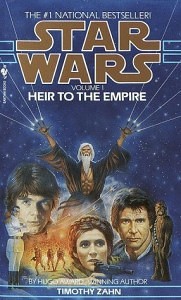
Timothy Zahn’s 1990 Novel Heir to the Empire Influenced George Lucas’s Writing of the Star Wars Prequels

star wars book

In 1990, well before any new film hype about Star Wars was brewing, science fiction author Timothy Zahn wrote a trilogy of books (starting with Heir to the Empire) set after the events of Return of the Jedi. While these introduced a ton of fan-favorite characters and events into the Star Wars fan consciousness, one particular element invented by Zahn actually made it into the real Star Wars movies later. Prior to these books and the prequel movies, it was implied that the Empire and Old Republic had operated from a central “capitol city” planet somewhere in the center of this made-up galaxy. Zahn gave this planet a name: Coruscant, which Lucas used outright in 1999’s The Phantom Menace. Even the descriptions of this planet were taken directly not only from Zahn’s books, but other Star Wars novels and comic books including the dark Dark Empire series, and the novel and comic book series Shadows of the Empire. In the subsequent Star Wars prequel films, a huge portion of the action takes place on Courscant, a planet that might not even have been invented if it weren’t for the Star Wars novels.

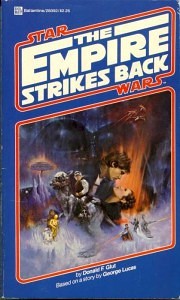
The Guy Who Wrote the Novelization for The Empire Strikes Back Runs a Website With Quasi-Dinosaur Porn and Has Partial Credit for Creating “He-Man”

Empire strikes back book

Comic book and animated television writer Donald F. Glut wrote the novelization for The Empire Strikes Back, which was published in May of 1980, a few months ahead of the movie. The book contains all sorts of Star Wars “errors,” including Vader with a blue lightsaber (instead of red), Yoda with blue skin (instead of green), and a less flirty Han Solo — mostly because so much dialogue was changed during filming. (For example, the infamous “I love you/I know” exchange would have never made it into this novelization since it happened on set, not in the script.) There’s also a scene here which suggests Yoda has some hand-written manuscripts, which totally flies in the face of a paperless Star Wars universe that we’re used to. (And which I can’t ever shut up about.) More fascinating than the novelization itself, is the novelization’s writer: Donald F. Glut. Not only did he write for the 80’s cartoon The Masters of the Universe, he tried to collect royalties on some of the characters when they were sold as toys, but lost to Mattel in court.

But the hands-down most bizarre thing about him is his own personal website called Don Glut’s Dinosaurs. Here, the author of the book version of The Empire Strikes Back shows off photographs of his personal collection dinosaur bones, dinosaur toys, and to-scale dinosaur statues. Most of these photographs are accompanied by nearly-naked women who look like they have stepped directly off the pages of the Playboys my dad had lying around the house when I was a kid in the 80’s. When you start to think Star Wars itself doesn’t make sense, just try to wrap your mind around Glut’s weird dino-porn. Star Wars itself starts to seem like a dry documentary after you hit up this website.

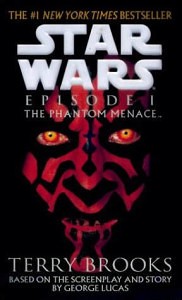
Famed Fantasy Novelist Terry Brooks Wrote the Novelization of The Phantom Menace (and Hook, Too!)

phantom menace book

That’s right, the author who wrote the famous Sword of Shannara series was asked to novelize the events of the most derided and hated Star Wars film of them all. Interestingly, this version starts with a hardcore podrace which rivals any action contained in the movie. Like many novelizations, this book did publish a few weeks before the film’s release, but it was issued as a full hardcover with several different alternate dust jackets available. The book also contains tons of background information about the Sith and why they’re so intent on getting their revenge. Brooks apparently had a long phone call with Lucas to sort all of this out. The novel also (possible intentionally) foreshadows specific events which wouldn’t be revealed until the subsequent two Star Wars films. In this way, The Phantom Menace novelization was 1999’s secret Star Wars Rosetta stone, only no one knew it at the time.

In 1999, getting Terry Brooks to write the novel version of the first new Star Wars movie in over a decade was a coup; he’s a super-popular writer who not only inspired a generation of fantasists, but literary stalwarts too. (Karen Russell gushes for Brooks in this New Yorker essay.) But Terry Brooks was no stranger to weird rabbit-holes of writing. In addition to penning the novelization of this prequel to the Star Wars film franchise, he also wrote the novelization of Hook in 1991. Hook of course is like a hardcore reboot of Peter Pan. This makes Brooks’s writing of the Hook novelization even stranger than his adaptation of The Phantom Menace. In fact, it may be the only writing act of its kind: adapting a screenplay into a book, but the screenplay is actually a remake/reimaging of a famous theatre play, which was also, at one point, a book.

There’s even more to love about crazy Star Wars books! But for now, just remember, even the most famous film series of all time would be very different if it weren’t thanks to the books that surround it, penetrate it, and somehow bind its galaxy together…

A Brighter Mirror, an interview with Colm Tóibín, author and Chairman of the PEN World Voices…

Colm Tóibín is an Irish novelist, short story writer, essayist, playwright, journalist, critic and poet whose work — as well as twice being shortlisted for the Man Booker Prize — has received the IMPAC Literary Award, the Costa Novel Award, the Los Angeles Times Novel of the Year Award, and the Irish PEN Award for contribution to Irish literature. His elegantly written, humane novels, which include The Blackwater Lightship, The Master, Brooklyn, and 2014’s Nora Webster, deal with Irish society, homosexual identity, the yearning for home, and the painful silences that can descend like an obscuring fog over families. Over the course of a career spanning a quarter of a century, Tóibín has been a staunch advocate for free expression and gay rights and has this year taken over the role of Chairman of the PEN World Voices Festival of International Literature. (The festival runs in New York from May 4–10.) From his office in Columbia University, where he is currently serving as the Irene and Sidney B. Silverman Professor of the Humanities, Tóibín spoke to me by phone about his hopes for the upcoming festival, Ireland’s referendum on gay marriage, the perils of taking a play to Broadway, and his fascination with Elizabeth Bishop.

Dan Sheehan: What does PEN, as an organization, mean to you as a writer? What made you decide to take on this public facing, ambassadorial role as Chairman of the World Voices Festival?

Colm Tóibín: PEN is an essential element in our culture. Anyone who has ever been brought up under censorship understands that it’s almost a barometer of the level of freedom in a society — what happens to books, what happens to writers, what happens to the written word. And what’s strange is that it isn’t merely books which are political, or that are directly political, that dictators and others who would want to control our lives worry about. They also worry about literature. It’s bad enough that a writer who would wish to express unpopular opinions or voice combative responses to government policy would be repressed, but that writers who would simply dream — who would write poetry or novels which ostensibly have nothing to do with politics… There are countries where that kind of work is simply unavailable. It’s a serious matter. It’s not a life and death matter in and of itself, but oddly enough in the places where it occurs you often find that other freedoms are restricted as well. PEN’s mission is not only to draw attention to this but to change it, to attempt to change the entire culture of restriction evident in so many places around the world. So for anyone who is a writer, for any one who is a reader, these are pressing and serious issues.

DS: One thing which struck me, in my brief time working with PEN, was that a great majority of the imprisoned recipients of the Freedom to Write Award [given annually to a writer who has fought courageously, in the face of adversity, for the right to freedom of expression], 36 out of 39 in fact, have been subsequently released. These figures must be quite heartening.

CT: They are, and while we are involved to an extent in defending free expression, the main focus of the World Voices Festival is to celebrate and honor the written word, so it’s a different mission, to some extent, to the daily business of putting pressure on governments and drawing attention to victims. Our work in the festival is a mirror of that, but it’s a brighter mirror. It seeks to introduce readers to work that might not automatically seem to be the most popular. It’s not a festival that tries to bring all the best selling writers in America together for one event. That would be fine, but it’s not our mission.

DS: For your first year as Festival Chairman, you’re presiding over a new curatorial approach, focusing specifically on the contemporary literary cultures across the African continent and its diaspora. Could you tell us a little bit more this?

…there will be enough new books and new writers whom you haven’t heard of to nourish you for a long time.

CT: Well Jakab Orsós is the director, so the day-to-day programming is his business, and he has come up with this absolutely marvelous program. What I always say is that if you come to this festival, it might keep you reading for a year. In other words there will be enough new books and new writers whom you haven’t heard of to nourish you for a long time. The priority for us this year is to focus it. If you just say “well, we’re bringing in all these writers from different places, and we hope you enjoy it,” that’s one thing, but it’s harder to put something like that together than it is to zero in on one particular region, in this case Africa. In a way it’s easier to capture someone’s imagination by putting this kind of focused program together. But it doesn’t mean of course that the festival is only about Africa. For example I think one of the biggest events is going to be Richard Flanagan in conversation with Claire Messud. Richard is not African, he’s from Tasmania, but I think that event, because he’s not somebody who has done a lot of readings in New York, and because he recently won the Booker Prize, is likely to draw a big audience.

DS: I wanted to ask you a bit about one event in particular: ‘Queer Features’ [a conversation with prominent African writers which will survey the landscape of African Gay Rights movements]. As somebody who has written beautifully about gay relationships and identities in your fiction, what does an event like this, at a high profile festival like this, mean to you?

We have some very interesting and intense writing by gay people which has arisen from repression, from their efforts to imagine a world outside of the one in which they’re living.

CT: It means a great deal to me. I think anyone who has been brought up gay in a country which doesn’t recognise gay rights, as I was, understands that it is something, much like the treatment of the written word we spoke about earlier, which almost becomes a barometer for other freedoms. If you want to repress gay people, you usually want to do quite a number of other things too. But of course, out of that can come all sorts of strangeness. And if you look at the novels written by gay people over the last twenty or thirty years, you realize that literature comes from strange places. You can set up a writing school and bring in a host of talented people, but you won’t automatically get the best books from that. Often literature grows in very barren places. It often comes from the ways in which the dreaming life or the imaginative life is suppressed, or the essential elements in our being are suppressed. Out of that pressure, a certain tone in literature can come. We have some very interesting and intense writing by gay people which has arisen from repression, from their efforts to imagine a world outside of the one in which they’re living.

DS: Did you find that to be the case for yourself in your own early writing?

CT: I think the best description of this comes from the American poet Adrienne Rich, who talked about the idea of looking in the mirror as a gay person and finding no one there. Of there being no images available of other gay people. You were almost alone. In other words, Jewish people or Irish people or Palestinian people or Native American people can actually understand their own oppression because it’s a history that’s passed on from generation to generation. But gay people, they’re alone. So the effort to find images that match your experience is often very difficult. Yet out of that exploration can come something very interesting. It is, if you’re a writer, almost nourishing, although I wouldn’t wish it on anybody. But it’s not necessarily all damaging. Though it is a particularly pressing issue in some African countries at the moment.

DS: Along the same lines, it’s been quite heartening to see the immensely positive response, especially among younger demographics, to the upcoming gay marriage referendum in Ireland. You’ve talked about the historical lack of positive images of gay identity for young people to turn to in Ireland. Is there a sea change happening at the moment?

CT: Well, It’s really quite difficult to interpret these opinion polls. The suggestion is that the referendum will be passed, but we have had opinion poles leading up to referenda in previous years which have turned out to be misleading. So we just don’t know. What’s interesting of course is that it’s quite difficult to oppose this referendum openly. Some people are doing that, but they’re not many, and that’s good in the sense that there is an overwhelming public support at the moment for the referendum. What people will do in the privacy of the ballot box is a different matter. It may end up being fine, but it’s worrying still. I think everyone is concerned about it.

DS: Absolutely. We’ve seen before the kind of disproportionate influence organizations like The Iona Institute [a socially conservative Catholic advocacy group based in Ireland] can have.

CT: Yes, but that’s democracy in the sense that you have to have an argument, you can’t just have everyone singing from the same hymn sheet. They turned out to be the opposition because the Catholic Church is in hiding. They [the clergy] have their heads firmly planted in the sand, so you have to have some group that’s willing to make the argument against gay marriage in order for there to be some sort of debate.

DS: A persistent, and oft-discussed, theme in your work is the longing for home. Can you talk a little bit about that?

One of them is that people miss home and then make a new home and then aren’t sure what home is anymore.

CT: Well, it’s one of those things that is a feature of the history of Ireland. Over the last one hundred and fifty years a great number of people have emigrated from the country and that’s an experience that comes in all sorts of shapes. One of them is that people miss home and then make a new home and then aren’t sure what home is anymore. It becomes quite a complicated thing that maybe only a novelist can handle. I feel it every time I arrive at JFK to go to Dublin and I start seeing Irish people wandering around the airport. “How do you know they’re Irish?” I don’t know, I just know that they are (laughs). Then there’s that sense of being home on the plane. It’s a very funny feeling. I’m not sure how long exactly it lasts but for me it’s palpable, it’s worth dramatizing.

DS: I’ve often wondered that myself, is it the kind of thing that ever really goes away? You’ve travelled extensively and you’ve taught all over the US, is that feeling something you take with you or is it a fixed idea of home that waits for you at the airport?

CT: It’s not fixed, so you can never tell what you’re going to feel like. Sometimes it’s amazing being away, and then other times you think, “I’d love to be in Dublin on a Saturday morning.” That feeling of getting up and buying the papers, finding somewhere to have your breakfast and meeting somebody. That lovely relaxed Dublin. No subways.

DS: Can I ask you now about your most recent book, On Elizabeth Bishop? What influence has her writing had on your own?

CT: She writes a lot about home, which is a difficult and gnarled sort of problem for her. She was from Nova Scotia — which of course is Northern and maritime, like the landscape of Wexford [ed. — where Tóibín grew up] — but she travelled a lot and lived in Florida and Brazil, so she was always caught between two or three things. She wrote very slowly, it took her ages to do anything, and she was a perfectionist. She also had a sort of a melancholy austerity in her tone. So all of that began to interest me, and it has interested me for a long time. Then when Princeton asked me what author I might like to write a book about I think they thought I might want to write about Joyce or Yeats, someone Irish you know, but I said I’d like to write about Elizabeth Bishop and they said that was cool, that they would commission that. Oddly enough it was quite a pleasure to write. I enjoyed those days, when I got to work on my Bishop Book. It’s not like it was ever going to be made into a movie or become a best seller, so it turned out to be a lovely sort of private work.

DS: You could take the commercial concerns out of the equation and just enjoy it for what it was.

CT: Exactly.

DS: Although, having said that, Bishop was a pretty interesting character. I think I would watch a movie about her life.

CT: You would watch a movie about her life, but trying to get anyone to invest in that movie would be something else entirely.

DS: And you’ve had some experience recently with work that has been artistically very well received but which also proved to be a difficult commercial sell. Could you tell us a bit about the experience of bringing The Testament of Mary [Tóibín’s monologue play which later became a novella] to Broadway.

CT: Well it didn’t really work there, but it is doing very well in Spain at the moment. It’s been running for a long time, since last July actually, and it’s going to go on running and move down into South America. The play has opened in all sorts of funny places since it closed on Broadway. The Broadway episode was strange, you know, it was up and then it was down, but that particular production went on to London where it was very successful.

DS: Going back to Elizabeth Bishop and her perfectionist streak, the time she took to get things just right, you started your most recent novel, Nora Webster, in 2000, is that right?

CT: (laughs) I did. I mean, I didn’t work on it every day but I thought about it every day. I would write some of it every year and then in the last few years I decided I had better finish it.

DS: Was it a case of the book coming together big by bit until you hit a sweet spot?

CT: It was a case of not being able to work out how to structure it. I put in the bits I knew, and then I had all of those and I realized that I had better concentrate on the bits I still had to work out. I thought that if I couldn’t figure out a structure for it at that point I would just do a chronological structure, scenes occurring in ordered time, to see if that might work, so that’s what I did.

FICTION: Amazing by Erin Fitzgerald

Your story takes place in a recent but extinct era, in which people’s lives aren’t complicated by handheld telecommunication or in­-depth classification of mental health issues.

There are two characters in your story who do not conform to the others’ standards. Thanks to the lack of handheld telecommunication and mental health support services, these characters are easy for the others to identify and shun.

Your story is set in Mayberry. It’s set in Gowanus. It’s set in Croatia. It’s set in Hogsmeade, which you have made a point of calling something else. Your story’s key scenes are in a town square. There are also scenes at a dive bar, and in a farmer’s field where the height of the corn hides the action from supporting characters. This is where some of the fucking happens. The rest happens on a beat­-up mattress in a dingy apartment. All of the fucking is unhappy fucking. Your story also has scenes at a church. No one is bored at the church, except for the two shunned characters.

Your story’s language is rich in a style that is illuminating or florid, depending on how you tip it in the light. Your story has sentences that look like run­-on sentences but aren’t, and sentences that don’t look like run­-on sentences but are. Your story has one phrase in a foreign language that is moderately easy to Google. It has Roman numerals, from I to XIV.

Your story has direct references to alcohol, probably rye, maybe bourbon, but no amaretto. Your story has indirect references to meth, molly, LSD, or heroin. It has no references to acetaminophen, lisinopril, paroxetine, or bisacodyl. Your story has no guns because those affect tension and pacing. It has a broken bottle and a filthy steak knife.

Your story is told in present tense until the first supernatural or magical element appears. Then it needed to be edited into past tense, and that brought a fog of knowing weariness to all of its characters.

Your story had angels who made clever observations, but had no wings. Your story’s ghosts ice skated, they walked down halls, they wept. All without sound, because they never spoke to you.

There was an eleven year old girl in your story. She did not learn anything about herself until an adult did not meet her expectations. That was when you realized why your story had a cornfield, a church, a broken bottle, an angel, a ghost, and rye.

It took longer for you to make the connection than it should have. But that realization will happen more quickly for the next story. You know it will, and so does everyone who reads it.

Sunday Sundries: Literary Links from Around the Web (May 3rd)

Looking for some Sunday reading? Here are some literary links from around the web that you might have missed:

David Abrams and Viet Thanh Nguyen on the lost art of the comic war novel

Ryan Britt lists some science fiction detectives

Couple sues after their photo is used on cover of erotic Patriots NFL novel

Hillary Kelly wants to bring back the serialized novel

Cat’s Cradle by Kurt Vonnegut is being made into a TV show

“What about all the giants in personal memory that you want to keep buried?” — interview with Kazuo Ishiguro

Art Spiegelman’s brilliant Maus gets banned in Russia

Some interesting facts about Catch-22

Lewis Carroll and the secret history of Wonderland

Kurt Vonnegut’s Cat’s Cradle to Be Adapted for TV

Cat’s Cradle, one of Kurt Vonnegut’s most beloved novels, may soon be coming to the small screen. According to The Hollywood Reporter, IM Global Television has optioned the novel to be executive produced by Brad Yonover and Sandi Love of Elkins Entertainment. No word yet on what actors or directors might get involved.

Published in 1963, Cat’s Cradle was Vonnegut’s fourth novel and also one of his favorites. As The A.V. Club points out, Cat’s Cradle and Slaughterhouse-Five were the only works that Vonnegut himself gave an A-plus rating to: