When we paired up, we always paired up together. History projects, and math exams, and charades by the fence after the bell rang. We weren’t the only girls in our friend group. It was like do and re. There were other notes, sure, but you couldn’t forget the first two.
She held my feet, her hands on top of my dirty Keds. Kneeling in front of me while I faced the ceiling, my elbows out like chicken wings and fingers cupping my ponytail. I waited for the whistle, the gym floor cold under my back.
And when it came, I pulled my stomach muscles in and curled. And curled. My breath left me every time I got to the top. Her eyes crossed on my first rep. She pressed down on my feet, and I felt myself push her away and give in as I completed the circuit again. Her tongue caught between her teeth when I pulled up again.
My stomach tightened. It was supposed to, though.
We’d done the chin-ups the class before, stood at the end of the line making up lies about presidents doing their own test. “Calvin Coolidge won the presidency because of his mile time,” I said.
“And Rutherford Hayes was stacked, like a log cabin.”
“The B stood for built. I read that.”
“Abraham Lincoln squatted the big blue ox,” she said.
“That was Paul Bunyan,” I said.
“They were lovers,” she said, and again, that peek of tongue between her lips, but suddenly it was my turn. I did a single pull-up and lost my will to continue. She hung like a wet towel from the bar until they told her she could get down. She never wanted to be seen failing. She quit games of chess halfway through when she saw the end game coming.
“I disappointed our founding fathers,” she said. “I’m a bad patriot.”
I finished my crunches, and we switched positions. Her laces were pink and ridged. From this spot, I could see the line of her gym shirt skimming against her shorts and a half-inch of skin there.
Once, when we had a sleepover, all of us, do and re and mi and sol, split a bag of Starbursts and dared each other to unwrap them with our tongues. Kissing practice. Sol said she didn’t need to practice on candy, and we gasped for breath, laughing. This boy, that boy. Their names circulated through our melody, breaking up the rhythm for a few weeks. We knew those boys were practice for something bigger. Starbursts were practice for something better, sweeter, we hoped.
All the sex appeal was hypothetical. The wrappers came out wet and waxy and partially torn. I couldn’t use my tongue well enough and resorted to my teeth, and I caught her watching me as I took the paper out between my lips like the worst ATM.
“Gross,” she said, but she smiled. “We should try cherry stems,” she said, but she turned to the room when she said it. “We should try cherries next time.”
Yes, next time, they sang. We sang.
I waited for the whistle.
What if she crunched up, and I took that tongue in my mouth. If I leaned over her knees and held her there, her back arched up in a vee and my ponytail a mess.
But the whistle blew, and she stayed flat, the only motion her stomach rising and falling.
The rest of the gym was waves of bodies moving. Heads coming up, going down, until I almost lost my own breath. My own stomach hurt watching her lie there. Lay there. I never knew the difference. It was one of those things where, no matter what I put, it felt right and wrong at the same time. I rewrote the sentence so I never had to use it.
Finally, her head tilted, the arch of her chin tipping toward me. Her glance rested on my face, but she didn’t raise her head from the gym floor. Instead, a slice of tongue appeared between her lips. Pink and soft and soft and pink, I watched until I felt like I needed to salute, to put my hand over my heart and pledge something I didn’t know yet how to give.
It was one of my first CDs, Green Day’s American Idiot, that had made me want a guitar.
I was 10 years old, and already dreaming of sold-out shows and Led Zeppelin tattoos (one of which did find its way to reality). My parents indulged, getting me a Fender Squier for my birthday that year. I strapped it on, plugged it in, turned on the distortion, and strummed. It felt like a tool in my hands, amplifying the volume of a feeling, like a way to shout to the heavens without looking nuts.
I realized pretty quickly that doing anything with it besides just making noises was going to take some work, so I started up guitar lessons with a plucky old bluesman named Robert and first learned “Smoke on the Water” (as one does), followed by Clapton riff after Clapton riff.
I recall impatience with the process, a disinterest in pentatonic scales and even the basics of rhythm, really. I wanted to skip to the part where I was sticking it to the man like Billie Joe Armstrong on tunes like “Holiday” and “American Idiot,” shouting at the people in power so loudly and with so much style that they couldn’t argue back.
I was still a long way from my high school days — which would find me playing a show with a powerviolence band at a communist bookstore in downtown Portland — but I had an eager ear for music with attitude from a young age, and I still find myself dipping into the throes of angsty punk rock on days when it feels like there’s nothing to do about it all but shout.
I had an eager ear for music with attitude from a young age.
American Idiot came at a time when I was really just discovering music and my own taste. And the eponymous opener felt like it was made in a lab for 10-year-old me — a banging kick drum and ripping guitar riff with an F-bomb in the first 20 seconds? Say no more.
The vocal highlights between heavier instrumentals made the song ripe for belting in my room, and the lyrics shaking a fist at an unseen authority were right up the alley of a kid entering his angsty years. Armstrong looked and sounded like a guy who did not go to bed on time.
Welcome to a new kind of tension All across the alienation Everything isn’t meant to be okay -“American Idiot”
The album’s lyrics felt like they encapsulated my preteen experience in suburban Portland — giving permission to feeling uncomfortable and not knowing why — while somehow also singing to everyone else across the country who felt like something was wrong they couldn’t put a finger on.
American Idiot was Green Day’s seventh album, a self-dubbed punk-rock opera about a trio of characters on surreal adventures through their own inner demons. Released in the thick of the Iraq war, it played like a middle finger to the state of American politics over a soundtrack of alternating distorted guitar riffs and lamentful ballads, telling a story of loss and dysfunction that stretched wider than just the war.
Years later, I admire how honestly these songs sing of the ever-frustrating complacency of being an American citizen — sitting on our hands and going about our day jobs while the political power we are supposed to have a say in pours money out of our communities and into bombing someone else’s.
As a kid, most of that went over my head.
I tried to pluck along on a guitar and understand what he was saying about the world I was growing up in. Lyrics about the financial boons of war and the twisted manipulation of patriotism felt like bite-sized moments of understanding. But the lyrics about being misunderstood and unheard, and the anger in those words — that felt visceral and relatable.
I fell asleep while watching Spike TV After ten cups of coffee and you’re still not here Dreamin’ of a song, but somethin’ went wrong And you can’t tell anyone ’cause no one’s here -“Homecoming”
Though as well as Green Day does adolescent anger on this album, I think the really indelible songwriting lies in some of its softer numbers.
One of the album’s most ubiquitous tracks, “Wake Me Up When September Ends,” written about the death of Armstrong’s father, expresses a desire to fast forward through grief. “Give Me Novacaine” sings of a similar yearning for numbness.
Time feels like an unpredictable tool on these songs, with Armstrong wielding and being threatened by it in equal parts throughout the album. It’s used to cope, justify emotion, or just skip the most painful parts entirely.
I can’t take this feeling anymore Drain the pressure from the swelling This sensation’s overwhelming Give me a long kiss goodnight And everything’ll be alright Tell me that I won’t feel a thing -“Give Me Novacaine”
At 10, those concepts felt like an emotional depth I couldn’t yet reach or understand, reading as novelty filler from a band I was looking to as a head-banging outlet for fighting the power (or at least yelling at it). For them to have such sad, vulnerable feelings in the same space felt strange.
But as I’ve grown, these are feelings I understand more with each passing year. I have learned intimately in the interim decades how natural it is that grief is intermingled with feelings of anger and confusion. And as my 20s have waned, I have found the concept of sleeping through the worst of things a more and more relatable concept.
For them to have such sad, vulnerable feelings in the same space felt strange.
Which tells us what makes this album, or any piece of music, stand up to the weathering of time: I have found that different parts of it speak to me as the years go by and I mature, but it has never felt irrelevant.
This music ages like a grudge, a testament to the timelessness of angst. Bands like Green Day, Paramore, and blink-182 continue to tour, decades removed from some of the high school drama they still sing about on the hits. And new young artists have followed in their footsteps — most notably and gracefully, Olivia Rodrigo.
In the multi-generational opera about the death of the American Dream and the forever tragedy of growing up, Green Day plays the uncle who is so cool that you almost start to believe him when his beer-driven tirades dip into political conspiracy. Meanwhile, Rodrigo plays the younger sister who is more talented and smarter than you ever were at that age, up to speed in equal parts on fashion and which senator voted to increase military spending last week.
There are incongruencies in the sounds of their respective eras, but it feels like Rodrigo has added a missing harmony to the lexicon of American angst. To hear her work in playlists alongside those who were angry and young before her is to create a more full symphony on the terrors of living in a place where it feels like you have no say — big or small, in love or war. Despite aging into it decades apart, Green Day and Rodrigo both speak to a society that is fundamentally dysfunctional, and just a hard fucking place to be an adolescent.
Rodrigo’s second LP, GUTS, tells the story of a woman growing up in 21st-century America, chock full of fuck-yous to the patriarchy and mourning of the lies we tell ourselves every day. Musically diverse, she alternates between an early 2000s pop punk sound and the morose lyrical songwriting that has swept folk and indie in the 2010s — somehow holding hands with the angry millennials and the resigned Gen-Zers simultaneously.
I first came upon Rodrigo when the video for “drivers license” was released in 2021. I was taken with the songwriting, but maybe even more wrapped up in the layers of her influences. I could hear Lorde in her instrumentation, a dash of Phoebe Bridgers’s wittiness in her lyrics, and — when her louder singles came out — Paramore’s Hayley Williams in her presence as a frontwoman. It felt like seeing the Power Rangers turn into that big mechanized dude made up of all the little robot bits.
For the first time, I felt like the musicians I listened to growing up were the influence rather than the influenced. The phenomenon was akin to the realization your parents are real people or watching the athletes you once idolized begin to retire — a definitive moment of aging.
It’s a strange feeling to watch someone younger than you pick up the pieces your generation left scattered around — be it music, politics or technology — and explore them with the kind of curiosity that breeds innovation. Watching Rodrigo’s sound and career progress almost reassures, one of those welcome signs that there is still work to be done but that not everything that came before was wrong, or meant to be forgotten.
And despite Rodrigo, having been born just a year before American Idiot was released, I hear Green Day in her work too.
She sings eloquently about the ways we lie to ourselves to get through the day, month, or year.
“all-american bitch” kicks off GUTS with the same fanfare as “American Idiot.” The melodic dissonance between the chorus and verses mirrors the tone of the lyrics — a cutting satire dripping with venom. It’s a boppy fuck-you (a sound becoming her decadent bread and butter) to a world that’s asking her to be more things than any one person is capable of.
When she sings “I got class and integrity, just like a goddamn Kennedy” you can feel the frustration seeping out of her pores. The tone is perfect for the song, the album, and for this moment. There’s more said in what you can tell she’s holding back than in what she actually sings — reinforced as the closing lyrics “I’m grateful all the time” are echoed in chaotic grace with a choral harmony singing “Grateful all the fucking time.”
GUTS tells the personal side of the macropolitical commentary of American Idiot, blasting the societal structure Rodrigo lives within as a woman, particularly at her age. She sings eloquently about the ways we lie to ourselves to get through the day, month, or year, and the faces we put on for others to get where we’re going — or just to feel safe.
And I am built like a mother and a total machine I feel for your every little issue, I know just what you mean And I make light of the darkness I’ve got sun in my motherfuckin’ pocket, best believe -“all-american bitch”
The album casts a wide net with universal stories of anger and sadness but, like in American Idiot, also a self-loathing that feels uniquely American and uniquely adolescent.
To sit fireside with Rodrigo as she spirals on songs like this is to vividly relive the everyday anxiety of being a teenager — wanting the world to fit more cleanly around you while not being able to pinpoint or articulate how to make that happen. She conveys the overwhelming hormonally charged chaos of that time of life in a way that anyone who has ever been sixteen years old should empathize with.
And I bought all the clothes that they told me to buy I chased some dumb ideal my whole fucking life And none of it matters, and none of it ends You just feel like shit over and over again -“pretty isn’t pretty”
The enduring hook in these albums is Rodrigo and Green Day’s ability to deftly conjure up simultaneous feelings of wistfulness and dread, from the first notes giving the listener a window back to what was at-once a simpler time but also a time that none of us would wish to relive.
Both artists ask us to look at the world through the eyes of someone just discovering how unfair it really is — before we got used to it and started to accept the status quo where it served us. Far removed from the grips of high school and the thick of adolescent angst, it’s easy to forget how jarring some of this was as a young person just starting to fend for themself. Should it really be this hard?
I now hear the same indignation in Rodrigo’s voice that I felt at her age.
To compare these albums, made nearly two decades apart, is to get a glimpse at a sameness we often forget in squabbles about which generation messed up more. There are plenty of people of all ages looking for change, but the benefit of youth is having the energy to be loud about it, to write about it, to sing songs about it that are heard on stages and speakers for decades to come. There is proof in your local record store that every generation has been pissed off enough about something to write a song about it — and if that is all that ties us together, it seems like a pretty good starting point.
Both American Idiot and GUTS came out in periods of social and political climate marked by doom, gloom, and a reasonable dose of existential dread. They represent the mood of an era that is starting to seem like forever — powerless rage coupled with the day-to-day slog of barely containing it.
I now hear the same indignation in Rodrigo’s voice that I felt at her age. I hear someone who watches a world they feel powerless to affect continuing on a crash-course trajectory that has been predetermined for decades. I hear someone who isn’t being listened to, as she closes GUTS with the heart-wrenching “teenage dream.”
When am I gonna stop being wise beyond my years and just start being wise? When am I gonna stop being a pretty young thing to guys? When am I gonna stop being great for my age and just start being good? -“teenage dream”
It’s the same indignation that equips Green Day to effortlessly pivot from songs about burning out to songs about war. I hear the frustration throughout American Idiot of someone finding themselves, and simultaneously finding out that the world around them doesn’t seem to care or want to listen. It’s a teenage masterpiece: there’s rage, there’s apathy, and there’s the beautifully youthful dream that the world will change before I do.
And there’s nothin’ wrong with me This is how I’m supposed to be In a land of make-believe That don’t believe in me -“Jesus of Suburbia”
My dad said once to my sister — 19 at the time — during the tumultuous summer of 2020 that he “remembered being young and angry,” in a way that suggested she’d grow out of it. And maybe it’s true that we get a little more tired with age, but I think we always carry some part of that adolescent angst with us: yearning for a better world but unsure where to start, pretending to be someone we aren’t just to get a foot in the door, angry at being misunderstood when no one was listening in the first place.
What is so compelling about a small-town mystery? These cosy, idyllic places seem more likely to be featured in a Hallmark movie than in an episode of Crime Junkie. Small communities, mom-and-pop stores, quirky traditions, and usually located far enough off the beaten track to make visitors feel like they’ve escaped the hustle and bustle of everyday life. Sounds like a dreamy weekend getaway with the girls, or the picturesque backdrop to a lovers’ retreat, right?
Of course, it’s exactly these things that make small towns the perfect setting for deliciously creepy mysteries or terribly wicked crimes—what better place to set a suspenseful story than in a remote location where the locals keep a close eye on newcomers, everyone knows each other’s business, and they’re all hiding a few unnerving customs and rituals?
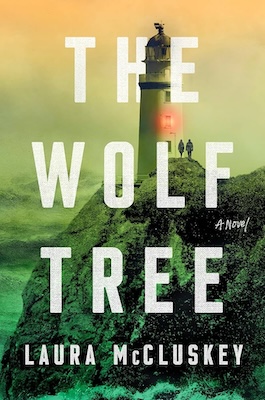
In my debut novel, The Wolf Tree, the tiny island of Eilean Eadar isn’t appearing on any must staylists; thrown way off the west coast of Scotland, battered by storms and ravaged by the elements, and largely forgotten by the mainland, this island and its people know how harsh life can be—and how harsh they have to be to survive. But the outside world comes knocking when a local teenager is found dead at the base of the island’s decommissioned lighthouse—a landmark steeped in infamy due to the disappearance of its final three keepers more than a century earlier—and DIs Georgina Lennox and Richard Stewart are dispatched from Glasgow to investigate.In classic small-town suspense fashion, George and Richie must race against a ticking clock to discover what secrets lie beneath the rugged beauty of Eilean Eadar – and hopefully solve not one, but two mysteries.
Here are 7 suspenseful books set in small towns, because when everyone knows everyone, secrets are hard to keep, and trust becomes a dangerous game. These seemingly idyllic places—where gossip spreads like wildfire—are perfect breeding grounds for shocking betrayals, unexpected twists, and chilling revelations.
When twelve-year-old Esther vanishes on her walk home from school in a small, close-knit town in rural Australia, the community is thrust into a whirlwind of suspicion and sorrow. Detective Sergeant Sarah Michaels arrives to investigate during the hottest spring in decades, while Esther’s best friend, Ronnie, is determined to find her. And as the story unravels, it seems like everyone in town is hiding something about what really happened to Esther.
Former FBI agent Jack McBride relocates with his teenage son to Stillwater, Texas – an attempt to escape suspicions surrounding his wife’s disappearance. Expecting a quiet job as Chief of Police in a low-crime town, Jack instead finds himself investigating a staged murder-suicide and a decades-old skeleton, sparking the first crime wave in thirty years. He seeks help from a respected local with a scandalous past, and as they grow closer despite town disapproval, the pair uncover deep, interlinked secrets from both cases that have the potential to devastate the town.
After a brief stint in a psychiatric hospital, reporter Camille Preaker is handed a daunting assignment: she must return to her small hometown to report on the unsolved murder of a young girl and the disappearance of another. Camille hasn’t been home in years, and has had very little contact with her neurotic, hypochondriac mother and her enigmatic and beautiful thirteen-year-old half-sister. Staying in her old room in her family’s Victorian mansion, Camille must piece together her own psychological puzzle if she is to uncover the truth about what is happening to the young women in her home town.
Best friends Lucy and Savvy were once the shining stars of their small Texas town; but everything changed in an instant when Lucy was found wandering the streets covered in Savvy’s blood. Years later, and with no memory of that night and having started anew in LA, Lucy is drawn back home because a true crime podcast, Listen for the Lie, plans to investigate Savvy’s murder. With a charismatic host at the helm, Lucy must confront her past to uncover the truth about her friend’s death … even if it means discovering her own guilt.
In the drought-stricken Australian town of Riversend, a young priest’s shocking act of violence leaves five parishioners dead. A year later, journalist Martin Scarsden arrives to investigate the tragedy’s anniversary. As he delves into the town’s secrets, Martin discovers discrepancies in the accepted narrative and faces a new, sensational development that thrusts him into the national spotlight. Battling his own demons, Martin risks everything to uncover a darker, more complex truth, while powerful forces work to keep the town’s secrets buried.
Ten years after her best friend Corinne vanished without a trace, Nicolette Farrell returns to her rural hometown to care for her ailing father, only to find herself entangled in the unresolved mystery. The old investigation, which scrutinised Nic and her inner circle, resurfaces with new urgency when Annaleise, Nic’s younger neighbor and alibi from the night Corinne disappeared, also goes missing. Narrated in reverse from the day Annaleise vanishes, Nic’s quest to uncover the truth exposes startling revelations about her family, friends, and the real events of that fateful night a decade ago.
In the midst of a terrible drought in rural Australia, Federal Agent Aaron Falk is summoned to his hometown for the first time in decades to attend the funeral of his best friend, Luke. Two decades earlier, Luke provided Aaron with an alibi when Aaron was accused of a terrible crime. But now, more than one person knows that this alibi was a lie, and Luke is dead. With the help of a local detective, Aaron questions what really happened to Luke – which stirs up secrets that have haunted the community since Aaron left town.
Last year, burned out from going straight into a full-time lectureship after a pandemic PhD, I needed the kind of intellectual rest that only one thing brings: re-reading an old favorite novel. For me, that was Anne Bishop’s Black Jewels Trilogy, the fantasy series that got me through my teenage angst.
My dilapidated 2003 paperback omnibus edition sports an illustration of a black-scaled dragon on the cover. Going by this aesthetic, you would be forgiven for thinking it’s some classic Lord of the Rings-esque adventure fantasy. In reality, the generic design hides both an erotic and dark story – and I mean several-trigger-warnings dark. “Not for the faint of heart” according to several Amazon reviews, it is about a morally bankrupt, violent society; magic that can cost you your sanity if not channelled correctly through jewels; corrupt Queens and “their males” who dominate and terrify; and three anti-heroes who have vowed to serve the all-powerful Witch destined to set the realm to rights. There is a love story in there, but this series is hardly a romance: it’s about how, when sexuality is purely a matter of having power over others, we lose something central to being alive. The storyline embraces the dark and imperfect aspects of our interiorities as creative forces for good or ill.
Parallels have been drawn between the Black Jewels Trilogy (BJT) and the wildly popular A Court of Thorns and Roses (ACOTAR) by Sarah J. Maas, the latter of which is credited with inaugurating the current wave of Romantasy taking over the perfectly curated bookshelves of BookTok. In case you have been living under a rock, the five-book story follows Feyre Archeron, a mortal who becomes entangled in the world of the Fae when she accidentally kills one. In subsequent books, Feyre discovers her immense powers and faces various ancient threats with the help of the enigmatic, protective and frequently snarling MMC (male main character) Rhysand, a High Fae. I won’t rehash the similarities between its main male characters and those of the BJT, which can be found detailed on Reddit (the most blatant being the race of winged “Illyrians” in ACOTAR, who explicitly mirror the “Eyriens” in BJT). But what I do want to discuss is how surprisingly unlike one another these two series are, despite the surface parallels.
Taking the creative potential of the fantasy genre as an opportunity to reimagine how gender, the psyche, and ecology could work, the eroticism of BJT is deeply linked to the frightening yet seductive vulnerability of mind, body, and nature itself. Like all the best fantasy, it pairs the author’s own unique take on compelling storytelling with capturing truths about our own world in a new light. In ACOTAR, however, I found no such depths. Though I more or less enjoyed the series, this lack of complexity in the storyline and perfection of its protagonists made me at times lose track of what was happening. There is little character development throughout: Feyre is, impossibly, fierce yet soft, cunning yet moral, sexy yet innocent, self-assured yet self-sacrificing from the start. Rhysand enjoys some light BDSM and makes some dubious choices, but that alone isn’t enough to make him a layered character. I was, truth be told, a few pages into the fourth book before realising I’d accidentally skipped the third and had to go back.
I then moved on to Fourth Wingby Rebecca Yarros. At this point I was growing motivated by the prospect of better understanding what people in their late teens were reading, given many of the students in my university courses on postcolonial literature seemed to struggle with novel-length reading assignments. After all, my own love of YA and genre fiction had eventually led to three English degrees; I just wanted to know they were reading something that fed their imagination and their literacy(even if it wasn’t Chinua Achebe’s Things Fall Apart). But Fourth Wing, too, left me feeling underwhelmed by yet another too-perfect, all-powerful heroine; the constantly high-strung character interactions; love interests that are immediately obvious (largely through angry exchanges); and sexual tension that barely has time to unfold before being sated.
Surely supernatural worlds could give us greater freedom to experiment with how beauty, attraction, and desire could work.
Two authors does not a genre make, so I decided to give the five-book Romantasy series From Blood and Ash by Jennifer L. Armentrout a chance. This had an entertaining blend of known tropes around vampire and werewolf tales, but our male anti-hero is, once again, enigmatic, protective and snarling, and our heroine Poppy Balfour is, once again, a perfect blend of strong-yet-vulnerable – that is, a very socially acceptable kind of “feminine.” By now, I was also noticing the consistently “porcelain” complexion and blonde/red/chestnut hair of all our heroines, and the consistently olive/brown complexions and black hair of all our male leads. It’s difficult not to see parallels here with recent research findings on race and desirability (biracial men with medium skin tones are apparently found highly desirable by everyone, while Black women get the fewest responses on dating apps). Surely supernatural worlds could give us greater freedom to experiment with how beauty, attraction, and desire could work.
Fantasy – whether featuring the sub-genre qualifiers of ‘romantic,” “dark,” “high” or “young/new adult” – can certainly aim to be a fun read. But depth does not come at the expense of enjoyment; in fact, if “reading for fun” is about reading that which grips your imagination and steals you away from the mundane everyday, then a compelling level of human and world complexity is vital. On this, contemporary Romantasy is falling short of its Fantasy forerunners. Its author aside, there are nuggets of insight on how we deal with love and death inHarry Potterthat spoke to millions around the globe at the turn of the millennium. There was something particularly relatable about the brutal realpolitik of A Song of Ice and Firein a post-2008 financial crisis world, and the number of people shipping Galadriel/Sauron in The Rings of Power shows how Tolkien turned the question of evil in his Lord of the Rings universe way more interesting when he made it take the form of what we covet.
This matter of desire can drive depth in plot, character and world-building. When reading Romantasy, a focus on romance and sex is to be expected. But what my foray into BookTok Romantasy had done, I realized, was somehow give me both without morally, philosophically, politically and socially rich worlds around it and, in doing so, left me frustrated – and not in a toe-curling way. In addition to keeping to largely conventional markers of attractiveness for characters, there are only so many times the mechanics of heterosexual coupling can be described before it starts to become just another day. The reader encounters at least ten highly detailed sex scenes in ACOTAR, with some noting that the especially graphic nature of the fifth installment, A Court of Silver Flames, veers decidedly out of the parameters of YA. Fourth Wing has at least four detailed, long sex scenes packed into it, which might not feel like so many if the book wasn’t perpetually fixated on the build up to and transition between them. Amidst some incidental dragon-flying, there is snarling jealousy at the thought of the other having sex, will-they-won’t-they banter about having sex, and build up to possibly having sex later. And yet this over-focus on sex acts leaves very little room for the erotic.
According to BookToker delayjaye, one of the first things asked in comments under her book recommendation videos is, “is it spicy?” In BookTok parlance, “spice” level – sometimes indicated by one to five chilli pepper emojis – is an important factor in whether or not many will pick up a Romantasy novel. In “one chilli” books, delayjaye argues, “it’s the plot that really matters.” At three chillies, we are apparently still “adding a spark without overpowering the story” (A Court of Silver Flames falls under a mere three chillies, with 53 of its 768 pages being purely descriptive sex acts, not inclusive of any set-up or aftermath). Youtuber Honest Fiction, whose spice-ranking system goes from “Mild” to “FIRE,” describes the latter ranking as “more spice than story.” Erotica is an age-old genre, and it will always exist. The more interesting observation emerging here is that a reading culture has come about that does not question its self-designated division between “spice” and “story.” How did we end up with an x-axis in our heads that runs from “plot” on one end, to “hot” on the other, and never the twain shall meet?
A Goodreads forum titled “Just BookTok Stuff” reflects this new dichotomy. “I usually avoid books with sexual stuff. And if by chance I was reading a book that’s got sexual parts I’ll just skip it,” writes Rori. “I love books with spiceness [sic] because while clean books are precious, I feel like they’re not as realistic,” Alys counters. Another user called Cassidy writes “Tension > explicit spice,” in response to both the enthusiasts and the haters. This short but sweet comment actually comes close to hinting that when “plot” is deemed the opposite of “spice,” contemporary Romantasy can miss the wood for the trees.
To put compelling storytelling on one end of the spectrum and ‘spice’ on the other fundamentally misunderstands ‘plot’ as ‘everything but sex.’
Georges Bataille situates eroticism within a tension between the sacred and the profane, as a breaking of boundaries and taboos. For Jacques Lacan, eroticism in literature exposes the tension between desire and its fulfilment, often highlighting the perpetual deferral of satisfaction; a gap which, for Michel Foucault, is often shaped by regimes of power. Literary critics like Roland Barthes add that the literary erotic invites the reader to participate imaginatively, blurring the boundaries between text and self. Reading fiction upwards of 500-pages is an altogether different experiential choice than, say, watching a 3-minute porn clip, precisely because of these phenomenological, existential, political and aesthetic aspects to the erotic. These unfold only through the kind of contextualizationthat can occur when sexual desire (whether fulfilled or unfulfilled, “explicit spice” or just “tension”), experienced by imperfect beings, is narrativized within a wider world of social norms, taboos, systems, gender roles, and other hierarchies. Hot is only hot when surrounded by the context of what makes it hot.
Context, which must be fully realised even or perhaps especially in the Fantasy genre (given the reader’s initial unfamiliarity with the author’s imaginary world), turns fleeting sexual desire, which can evaporate with a single intrusive thought, into a sustained kind of eroticism that is bound up with a world and the stakes of that world. Context determines whether desire is transgressive, unexpected, long-delayed, unforeseen, forbidden, subversive, gratifying, comforting, exciting, fortuitous, refreshing, consoling, or thrilling, rather than a mere bodily urge fulfilled through mechanical acts one could describe for pages and pages. Let’s say I tell you to imagine a scene where an attractive man and an attractive woman (other genders and preferences are available) are getting it on. Then I give you the same but within conditions that make it totally unexpected, long-denied, or unlikely, and in some way directly in conflict to the individual goals of the characters or the realization of their storyline thus far. Do we really want him to jump her then and there, obstacles be damned, or to hold off until we are squirming with the dilemmas, good or bad, that delayed gratification shall visit upon both the story and the characters?
To put compelling storytelling on one end of the spectrum and “spice” on the other fundamentally misunderstands “plot” as “everything but sex.” This actually does a massive disservice even to readers who are expressly looking for “spice,” because it ignores the art of storytelling as a key aspect of erotic genres. Eroticism in literature lies in the interplay of absence and presence – what you gain and what you lose when you desire – which is why it is not interchangeable with a non-narrative, passive, and non-imaginative activity like watching a 3-minute porn clip. But nor does it emerge (just by virtue of being textual rather than audiovisual) when a sex act is merely transcribed onto paper.
Tension in plot is more than just a tool to defer sexual gratification. It serves to heighten stakes in storytelling, particularly when characters navigate social or moral boundaries. Certain Fantasy novels manage to integrate this tension effectively without relying on explicitness to evoke similar responses. Take Trudi Canavan’s The Black Magician Trilogy, for instance. The eventual romantic couple are, individually, characters we’ve known since the first few chapters of the entire trilogy. They have a minor association until the gradual building of tension through social, moral, and situational barriers brings about a mutual attraction that is so memorable because it breaks Bataille’s sacred-profane dichotomy of class structures, which frame their social roles. Their eventual union becomes not merely satisfying as an end to sexual tension, but a culmination of layered emotional and moral stakes. Similarly with Jacqueline Carey’s Phèdre Trilogy, where the protagonist must turn the vulnerability of desire into agency in a world where her social position calls for the use of pleasure as a tool for negotiation, political subversion, and survival. Carey’s lush prose and sensuous world-building invite the reader into an intimate engagement with the text, echoing Barthes’ idea of the literary erotic as a participatory experience beyond any sex acts that may or may not be explicitly described.
Eroticism risks objectification as it strives for mutual recognition, and risks the dissolution of the self as it seeks to incorporate that which is other, without arriving at the end of the erotic – total possession. As Bishop, Canavan, and Carey show, it doesn’t necessarily need to equal tension that is never sated. But it cannot be disconnected from the moral, political and ontological stakes of desire. A touch is just a touch, a body just a body, unless it is part of wider social and psychic challenges that imbue it with consequence. If Romantasy can let go of its “plot versus hot” divide, it might just smolder in its reader’s imagination long after the final page.
The omniscient, intrusive narrative voice was common to many novels dating to and before the early 1900s: the sweeping perspective of a narrator who functions almost as a god, able to show us anything—and who often interrupts the story at hand to make wry comments at the expense of the characters and the society in which they function.
I took on such a voice for my second novel, Mutual Interest—from the very beginning the style felt like a natural fit for this book, a queer pastiche of these classic “novels of manners,” set at the turn of the twentieth century. I found this type of writing to be an instant joy: I loved having the freedom to dive into secondary characters’ heads (muddying the question of whether they were, in fact, secondary); I loved having unlimited scope and scale for what counted as “backstory;” I loved the sense of playful conspiracy such a voice cultivates with the reader, and the opportunity to express both mockery and affection for my characters.
As so often happens, I also found that this craft choice raised new questions; questions that have deepened and changed my relationship to the omniscient narration wherever I encounter it. Questions like: Where does the book begin and end—that is, what defines the shape and limits of the story, when they’re not inherent to the point of view? What does “all-knowing” really mean? How does an omniscient narrator decide when to interrupt the action (and when to shut up)? And, last but not least: who, exactly, is talking? (And does it matter?)
Having had to tackle these questions in my own novel, I am now even more interested in how other authors have answered them. Here are 8 contemporary novels that use omniscient narrators in a fascinating way:
Jennine Capó Crucet’s Say Hello to My Little Friend defies reductive description, but one of its many pleasures is its all-knowing, even elemental, narrator. I have heard Crucet describe it as a voice that “can go anywhere water can go”—a fascinating way to define the limits of omniscience, without in fact limiting it much at all (especially in Miami, at this late stage of climate change).
Crucet’s protagonist, Izzy, is experiencing what he sees as a very individual struggle. But from the reader’s perspective—and the narrator’s, and Lolita the orca whale’s as she swims in her cramped tank at the Miami Seaquarium—everything is connected, and there is no scale but the global. Crucet takes partial inspiration from Moby-Dickand uses some of Melville’s same techniques—including cataloging and digressions—to create a unique and thorough history of a place both doomed and thriving, depending on your perspective(s). This is a book that reads like a flood, one sweeping its characters along, some of them more aware than others of the currents through which they swim.
The narrator of Emma Copley Eisenberg’s Housemates is a queer elder, recently bereaved, who begins by eavesdropping on the novel’s main characters in a coffeeshop—and who, when the protagonists return home and close the door, literally melts through the wall of their house and continues narrating, both the forward action and both their backstories. She does return in scene, late in the book, but for the most part—and starting long before she ever meets them—her role is to tell Leah and Bernie’s love story.
This device is catnip for those of us interested in experiments with omniscience. I was fascinated by how this one speculative element complicated Eisenberg’s novel, adding the layer of an interstitial eye, witnessing and interpreting. The fantastically omniscient narration lets the story be strange and familiar at once, told by someone who is both an ancestor and a stranger, and it lends a sense of jaded retrospection to what is also quite a youthful bildungsroman—a poignant combination. Perhaps especially in this novel of queer community, Eisenberg’s unique narrative voice draws attention to the way different generations can be simultaneously awed and inspired by as well as jealous or judgmental of one another.
This first book of Ada Palmer’s Terra Ignota quartet is as much philosophical thought experiment as it is science-fiction epic, including in its narrative voice. Palmer writes in a self-consciously neo-Enlightenment style, matching her far-future setting in which a utopian (or is it?) Earth has reorganized its society around the aesthetics and ideas of the eighteenth century.
The narrator of Too Like the Lightning is in fact not omniscient, merely overambitious and highly unreliable—but Palmer invites the reader to interrogate the difference, if there is one.
Mycroft Canner, a convicted criminal living out his life in service to whoever may need him, prostrates himself before an imagined in-universe reader he addresses directly in frequent, often argumentative asides. It is Mycroft who affects the high-omniscient style in which Palmer writes, and though the book is theoretically his memoir, he often narrates scenes for which he was not present—some he claims to have heard summarized by characters who were present; some he imagines, wholesale; for others, muddying the stylistic waters still further, he passes the pen to secondary (often reluctant) narrators.
This is a novel of big swings, one that will give any book club enough to argue over for hours. I can’t promise the intrusive, patchily omniscient style will be at the top of your list of controversies to litigate, but hey—it depends on your crew!
Written in 1922, The Enchanted April is an outlier on this largely contemporary list. Its omniscience may also be less remarkable, given the style of the time. But the novel—which follows a foursome of barely-acquainted Englishwomen, rife with interpersonal conflicts, as they economize on their Italian vacation by sharing accommodation—feels strikingly modern, and Elizabeth von Arnim’s unique use of fizzy omniscient narration is certainly part of this feeling. She dives deep into the judgmental interiority of each of her protagonists, whipping up tension, affection, and biting social satire at once.
In her comic treatment of the form, Von Arnim also makes glib, masterful use of one of the omniscient narrator’s most astounding powers: withholding information. I will never forget my experience of reading this book for the first time and, at a crucially dramatic moment, being slapped with the sentence: “What Mrs. Fisher said to him that morning in her first shock will never be known.” I physically put the book down and exclaimed aloud, “Why not?!” There is an immersive pleasure in being toyed with, alongside the characters, by such a narrator.
In The Fraud’s opening pages, Zadie Smith’s omniscient narrator gives us equal access to the perspectives of two characters conversing across an 1837 London threshold. Having established that such certain and thorough understanding is possible, the narrator then withdraws somewhat, conspicuously declining to extend such bridges of perspective for large sections of the book. But Smith continues to tantalize with glimpses of an omniscient “ultimate reality” in this novel of authenticity and fakery, truth and imposture, rendered in prose that gestures stylistically toward its nineteenth-century literary setting (and therefore is often at least flirting with omniscience).
Most characters in The Fraud flatter themselves that they alone “see all” and struggle to make themselves understood, advocating for individual versions of the truth that seem at times irreconcilable, at others so universally accepted as to be unconscious—“everywhere, like weather.” Smith is interested in how “ultimate” reality in fact varies by perspective, and even her narrator is not unbiased.
This is omniscience made visible in its frustration: a novel in which each person is “a bottomless thing,” living by a kind of internal narration that functions as “[their] discreet, ironic and yet absolute God.”
Ragtime is so memorably epic in scope and scale that I’m always surprised to find, picking it up again, that it’s only about 250 pages long. But that’s one thing about high omniscience, used the way Doctorow employs it: it can save you a lot of time. Here, those 250 pages are sufficient to cover a decade in the lives of three wildly different and complexly interwoven families, with a plot that covers just about anything you could think of, including a plot to blow up the Morgan Library and an expedition to the North Pole.
Ragtime’s narrative voice calls to mind a god operating a busy telephone switchboard, or perhaps pointing out local sites of interest while motoring down the highway at 90 miles an hour. The modern reader might recognize a tinge of Forrest Gump, with historic figures like Harry Houdini, Booker T. Washington, and Emma Goldman coming into unlikely contact with Doctorow’s fictional cast. But a narrator this confident can render anything realistic—even including one character’s intermittent psychic visions of the future.
This is a book with a ten-thousand-foot view and a breakneck pace; omniscient narration at its most soaring and showboating. Doctorow’s pleasure in the writing is palpable and often contagious.
This may be verging on a subgenere, something we might call “collage omniscience:” the accumulation of an all-knowing perspective (the book’s; the reader’s) through the presentation of many individual perspectives. (Once you start thinking along these lines—possibly I should say, once you start fudging the rules—the possibilities are endless.)
I have found that many novels of this type, like Daniel Mason’s North Woods, are portraits of a place or a community, with a breadth of perspective over time. (Graveyard ghosts and archival research are also recurrent themes.) This novel tells the history of a single house in New England, spanning centuries, from the settlement of the American colonies to the present day (and beyond).
There is almost a journalistic gesture towards “objectivity” here—no sign of those catty, intrusive asides from a god-narrator laughing at the characters’ foibles (though the reader may find occasional cause to do so). Mason is almost relentless in his refusal to put up boundaries around his bricolage narrative—the scale here is meant to impress, even to frighten, as ghosts stack generation upon generation and begin to crowd each other for room. This is omniscience as haunting, and being haunted; omniscience as a duty to bear witness.
It’s clear from the first page of Andrew Sean Greer’s Less that the omniscient voice is central to the novel. We hear the story from a teasing, cheeky, highly intrusive narrator—full of obvious affection for protagonist Arthur Less, but just as obviously maddened by Less’s flaws and foibles.
As the book progresses, though, the question of who, exactly, is talking becomes more and more impossible to ignore. Tossed-in first-person asides referencing in-universe interactions with Less feel at first like they’re in fizzy, startling conversation with those omniscient narrators of bygone centuries who might intermittently use the royal “we” and log their opinions on the characters’ decisions.
Over time, things develop in a different direction.
Reading Less for the first time, it begins to feel like Greer is engaged in a craft experiment, then a very unique type of mystery novel—and finally (at the risk of spoiling the surprise) what we realize to be a truly unique po-mo rom-com.
My reading and writing interests of the last several years have led me to see all omniscient narration as an expression of love, and for this case, Less may be Exhibit A.
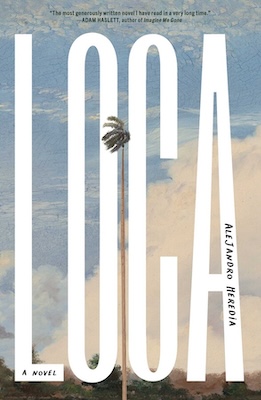
Like many of the characters in author Alejandro Heredia’s debut novel, Loca, he migrated to the United States from the Dominican Republic. Though he did so at a different age and time than the characters presented in the text, it’s the experiences of the lives of immigrants—his own and the people he knows—that he both excavates and explores to craft a capacious novel that unfolds over one year in 1999. Centered on best friends, Sal and Charo, the novel—moving between New York and the Dominican Republic, the Bronx and Santo Domingo—follows their lives, and the community they are both equally born into, and create, asking questions that investigate the tolls of immigration, the nuances of sexuality and gender, and the meaning of friendship.
Is it possible to be better to the people we love? Is it okay to need people? Is it necessary to reckon with the past to have a chance at a future? With an open heart, Loca provides a cross-cultural representation of characters weighed down by the prospect of possibility while also providing sharp snapshots—Latin dance parties, beach trips to Montauk, fire escape conversations—that enable them to survive.
As New York City quieted in the waning weeks of 2024, I spoke with Alejandro Heredia about Loca and the expansive ways it considers identity, loneliness, and atonement.
Jared Jackson: You were born in the Dominican Republic. How long did you live there before migrating to the United States?
Alejandro Heredia: I lived there until I was seven. I lived with my grandparents because my parents migrated to the United States, to New York, and to the Bronx, specifically, when I was eight or nine months old. I remember meeting my parents when I was seven, which was an interesting experience.
JJ: Do you remember your first impressions of the United States when you arrived in New York?
AH: I was disappointed when I got to the United States because when you’re in the Dominican Republic you see a lot of images of New York on Dominican television. There’s a machine, which probably still exists, though it might be different now, that sells New York to the Dominican population. In fact, in the late ‘80s and early ‘90s, there used to be commercials to entice people to migrate to New York. All I knew was the tall, beautiful buildings. Lots of shopping centers and stores and people walking around everywhere. When I got here, I was like, what is the Bronx? Why does it look like this? I thought I was going to be in a fancy tower somewhere.
One of the most important or impressionable things I remember about that time, outside of meeting my parents, was learning English. Seven is a particular age. I learned English fast. In eight months, I was speaking with my cousins in a mashed-up English, or what I could make of it. But I was speaking and listening and understanding it. Learning English was a form of survival because the Bronx in the early 2000s was a tough place to grow up in.
I remember the first thing I said in English was in my first week of school. My friends were hanging out and there was this other kid across the cafeteria who was looking at me. And my friends pointed to him and told me to say to him, “What are you looking at?” And so that’s what I yelled. I didn’t know what I was saying, but to me, that moment is telling because I keep asking myself that question. What was I looking at when I came to this country? I most remember paying attention to the way that people spoke. I grew up around a lot of bilingual kids. There were words I was trying to understand in translation. All to say that I had to pay a lot of attention to language to survive the environment that I arrived at in the United States.
JJ: I’m going to circle back to language. But I want to ask about the novel’s backdrop. It takes place over one year in 1999 and, as you write, “Everyone is existential.” It’s an interesting year. There’s the Y2K scare, the premiere of the Sopranos, Nelson Mandela steps down as the first Black president of South Africa. Why did you decide to set the novel in this particular year?
AH: I had questions about my parents’ generation of Dominican immigrants who came to the United States in the mid-90s. I was also curious about what it was like to date then. To explore relationships before the cell phone was a popular item.
1999 was a turning point. People were thinking about the turn of the century and what the future might or might not look like. The characters in the novel have a particular relationship to the future. Sal is always looking toward the future without necessarily looking back. With these characters, I wanted to explore this tense relationship with the future in a moment where everyone is, as I say, feeling existential about what’s coming, what society might look like, and what our individual and collective lives might look like.
JJ: You mentioned imagining what it might have been like when your parents migrated to New York.Early in the novel, Sal thinks, “So much of a person’s life is dictated by when and where they’re born.” In many ways this is a transgenerational novel. There’s Sal’s mother, Teresa, and his roommate, Don Julio’s generation who came over from the Dominican Republic in the late ‘60s and early ‘70s. There’s Sal and his best friend, Charo’s generation who arrive on the heels of their family in the early ‘90s. Then there’s Sal’s younger brother, Kiko, born in New York, but who uses Santo Domingo street slang, and Charo’s daughter, Carolina, also born in New York, and who Charo wonders where she’ll fall in the cultural divide. What did you want to explore in portraying three generations of characters who are equally, but differently, touched by the thumb print of migration?
AH: I was really invested in challenging this idea that all immigrants have this great relationship to their home country. A lot of these characters have no interest in going back to the Dominican Republic. Some of them have escaped terrible violence and injustice. Then there are some who are very invested in being connected to the Island, and it’s not the characters you expect, like Kiko, who has never been there. Who was born in the Bronx but is invested in connecting to Dominican culture from the Island. He’s a kid, but he’s picking up all this vernacular. I wanted to show the multiplicity of different generations’ relationship to wanting or not wanting to have a relationship to the Island.
Speaking of the accidents of birth, Don Julio was born at a particular moment. He fought in the Dominican Republic Civil War in 1965. He survived terrible things. His immigration story looks a little bit different from Sal and Charo’s because they’re not running from war. These characters are migrating for different reasons and because of that they develop different relationships to the country. To me, that felt like a more responsible way of writing about immigration than suggesting that all immigrants are pining to return home. That’s not the truth of my lived experience, or the immigrants from across the world whom I’ve met.
JJ: The novel is written in the present tense, including the sections that are set in the past. Why did you choose this structure? How did you hope to shape the reader’s experience?
AH: I find the present tense so challenging to write in, but I also feel very drawn to it because, to me, it’s the tense of images. This is why the novel begins with the way that it does. It begins with an image of this young man standing by the window washing dishes. It’s a very simple image, but I found when I was playing around with different tenses, this felt like the most visceral way to show or align the images I had in my brain.
The decision to write the past in the present tense came out of a desire to resist what Sal is doing with his life. Sal is wanting to forget the place and the people he comes from. And through this literary device I wanted to show the ways in which the past is constantly informing the present action of his life. It’s not in the past. It’s not something that happened a long time ago. It’s active. I wanted to have all the scenes in the same tense to show that as much as Sal is trying to outrun his past, he can’t.
JJ: Can we talk about having examples, role models? There’s a character, Renata, who takes Sal and his close friend, Yadiel, along with a group of other young queer Dominican adolescents, under her wing in the sections set in Santo Domingo. She protects them, offers guidance, validates their experience, and scolds them when needed. She’s a queer elder. How did she develop in your mind? In a novel that explores young queer people of color, did you always envision developing a character like her?
AH: Renata came out of questions I had about my own life. What if my life had been a little bit different in this way? Or a little bit different in that way? I didn’t have a queer adolescence in the Dominican Republic. I asked myself what it would have been like to have had a queer adolescence in the Dominican Republic and then, by extension, what would it have been like to have a queer elder to guide me, or people like me, through questions than one has about gender and sexuality?
Renata is one of those characters I wanted to exist as a role model, but I wanted her to have her own life too. I wanted her to have her shortcomings, and I didn’t want her to necessarily feel like a mother figure. I wanted her to feel like a friend, like an elder who’s a friend and who has her own fears. Who has dreams, too. Dreams about having a stable job and taking care of herself. Maybe buying some property. I wanted to humanize her because I think, sometimes, we look at mentors and we think that they have all the answers, and that’s not always true.
JJ: I mentioned Yadiel. I can’t get her out of my mind, and I think it’s because in a cast of characters who feel limited in their freedom—by fear, society, loved ones—she feels liberated, and dangerous because of it. She embodies a sentence that’s said later in the novel: “Some people would rather be destroyed than reduced.” Do you think there’s a cost to pursuing freedom?
AH: That’s my favorite sentence of the book. On the question of freedom, I think a lot about Toni Morrison. We sometimes confuse freedom for having no responsibilities and being able to do whatever we want, whenever we want, regardless of who it hurts or destroys, including oneself. Morrison explains freedom as the ability to choose one’s responsibilities rather than having no responsibilities. I don’t think Yadiel feels like she has no responsibilities, but she does a lot of self-destructive things to live as freely as she can within the confines of a homophobic and transphobic society.
I also wanted to show that, unfortunately, there are real repercussions to living as freely as we want. We all want to express ourselves in ways that align with who we believe we are. But the reality is that the world sometimes does not want that. What do we do when the world does not want that? Do we shy away from it? Do we go against it? Do we pretend it’s not there? Do we say fuck you and do whatever we want? Which, I must say, is something I deeply admire in people. But I also recognize that freedom is not always survival, and sometimes we need to survive.
JJ: Let’s circle back to language. I used “she” when referring to Yadiel. In the book’s dialogue, it’s mentioned that Yadiel sometimes uses “she” and other times “he.” Sal says it’s complicated. There’s also the word maricon, which is used frequently throughout the novel. Often, it’s used with malice, but when used by, say, Sal or Yadiel, who are queer, to discuss or identify another queer person, the bite is taken out of it. Finally, there’s the title of the novel, Loca, which is how Sal and Yadiel refer to each other. Using the feminine. And which allows them, as Sal notes, to see each other better. How is identity influenced, or represented, by the novel’s use of language?
AH: It’s important for me to point to the fact that Dominican people, and Black people across the Diaspora, use languages that have been thrust or forced upon us. But also, everywhere across the Diaspora, whether it’s in the Caribbean, in the Americas, or elsewhere, we find ways to take that language—Spanish, English, French, etc.—and do wonderful things with it. We make it our own in creative ways.
Dominican people do incredible things with the Spanish language. There are jokes on social media and in the world about how no one can understand what Dominicans are saying because we speak fast and have a particular vernacular. But I take seriously the use of Spanish and colloquialisms and vernacular of people from the barrios, people from working class communities in Santo Domingo and the Dominican Republic at large. I draw from that in my writing. In my fiction, I draw from that instinct to take language that is formal, that was given to us, and play with it to get to the specificity of what I’m trying to say. It’s about the people, their interiority, and what goes on in their minds and their hearts. It’s about what drives them to make the choices they make.
This is a sort of diasporic novel, right? There’s Dominican people, but there are also Puerto Ricans. There are Black Americans. Sal’s in a relationship with a Black American man from New York. And so, there’s a lot of these conversations around how we relate to each other across the Diaspora. What language do we use? What is our relationship to language? When I was writing I had to be mindful of Black American vernacular. Of Dominican vernacular from the Island. Of queer Dominican vernacular from the Island. Of vernacular from the diaspora of Dominican, New York. All these different ways of speaking and talking that I put in different characters’ mouths. All these different pools of language meeting and crossing streams.
Yes, sometimes it’s great when people can connect across vernacular and differences. But sometimes it creates tension, too. For example, there are conversations that Sal and his partner, Vance, have because Sal has it in his head that immigrants have it worse than Black Americans. And Vance is like, why are you comparing oppressions? They’re having these conversations about their identities. The language in the novel, including the title, comes from that investment in drawing from the ways that these different people in different places speak.
JJ: Expectations, self-expectations, circle around the novel, perhaps with no one more than Charo, Sal’s best friend. She’s in her early 20s, has a young daughter, works at a grocery store, and, in many ways, is deeply unhappy. She views herself as having become the type of woman she’d never thought she’d be—tending to a man, dreams deferred. In a 2020 interview with No, Dear Magazine, you said that you “think a lot about mothers and who they are outside of their roles to serve and provide.” What questions did you have around desires, expectations, and the structures—economic, political, patriarchal, racial—that act as obstacles to achieving them?
What I wanted to ask was what would it have been like for my mother and her sisters if they had had a group of friends to support them through all these structural issues.
AH: When I was conceptualizing Charo’s storyline I wasn’t always thinking about the structural “isms,” although they exist. Charo is a dark-skinned Dominican woman who’s an immigrant arriving in the United States in the ‘90s. But I was more so thinking about loneliness. Charo is not my mother, but I was thinking about my mother and her siblings and cousins. Women who came to New York in the mid-90s. Whenever they talk about it, they seem to have lived lonely and isolated lives. What I wanted to ask was what would it have been like for my mother, her sisters, or women like my mother and her sisters, if they had had a group of friends to support them through all these structural issues. Whether it be xenophobia or racism, or just how difficult it is to start your life over in a new place where you don’t speak the language or you don’t know anyone. Loneliness was on my mind a lot.
I almost had to step away from the language of what I call social justice to ask myself who this woman is? Because these people are not thinking about their lives in this way. They’re thinking about their lives in terms of what do I do when I get up? Who do I relate to? Who do I like in my life? Who don’t I like? When do I feel suffocated? When do I feel free? What does Charo want if it’s not always this domestic life? Because I don’t think that she doesn’t want it at all. I think what she’s saying is that I don’t want it to be my whole life. To try to understand her I had to get inside her heart and mind.
JJ:Speaking about friends, at its core, the novel is about friendship, which, to me, is a rare focus in literature, particularly when considering other forms of relationships—familial, romantic. Can you talk more about centering friendship, and all that comes with it, in the novel?
AH: It’s a personal investment. I take my friendships seriously. My friends have shown up for me in life saving ways. My friends challenge me just as much as they validate me, and that’s important. I wanted to honor that through my work. To honor that mode of relating and being in the world with other people. The world can be a lonely place, and in my personal life I’ve found that friendship can be one of the best balms for that loneliness.
I also thought about some of my favorite books. Books that even inspired Loca, like Sula, and White Teeth, and other texts that are great examples of what happens when we take friendship seriously. Because when we take friendship seriously, we see all the potential for creativity. My intention was to fill Loca with friendships that are challenging. The friendship between Mauricio and Vance is challenging. The friendship between Sal and Charo is challenging. So is the one between Sal and Yadiel. All these characters love each other, and yet there is always tension because they really love and are invested in each other. Those kinds of friendships have been some of the most fruitful relationships in my life. I wanted to put that into literary fiction to say that those relationships are valuable.
JJ: Near the end of the novel, Charo says to Sal, “You don’t have to forget the past to survive it.” To me, this echoes as a thesis that permeates the novel. It’s also, simply, as a testament to remembrance, a generous sentence. In the spirit of generosity, what did you hope to offer—to yourself, to readers—while crafting Loca?
AH: I’ll start with this question about surviving the past. I wrote that sentence because I come from a people who don’t speak about traumatic things. They’ve found ways, either through alcohol or drugs or sex or a thousand other ways to suppress the past, to go on. To move forward. I wanted to offer this as a remedy to myself, just in a way of thinking about the world. To express or explore a belief that I have, which is that to move forward it is necessary to look back and reflect on the past, and to be able to live with it in the present. Even, and especially when, it reflects our own shortcomings.
I also grew up around a lot of people with a severe lack of accountability. Some of these characters are grappling with that, too. I asked questions such as how are we accountable to ourselves? How are we accountable to the people we love? To our community? How do we move on? And how do we move on when we’ve made mistakes? I wanted to explore all the ways of how one can live with oneself. Because life is hard. And people do great violence and terrible things to each other. I wanted to ask myself, and I continue to ask myself as I continue to write: Is it possible to go on despite how challenging life can be? How can we be accountable for our actions, and who we hurt? And is atonement a real thing we can achieve?
At thirty-eight, I learn the alphabet of dying. Advanced directives. Biopsy. Cancer. My mom spends a month in the hospital just before Christmas. The rest of us—my dad, brother, and I—sit by her side in the oncology unit. I hold her hand that’s bruised and taped up with a needle thingamajig. When I was a kid, she was strung with those same thin tubes at a Delaware hospital, after she almost drowned at Rehoboth Beach. That word, again—drowning. Online, caretakers describe my mom’s disease as a yearlong drowning.
My brother, Robbie, and I pass our phones back and forth, laughing at dumb memes in the cafeteria, as we become part of the hospital’s rhythm. Our dad becomes an aphorism generator. He says to take things one day at a time. Meanwhile, nurses and doctors talk with the elegance of a freight train. I cry by myself, next to windows in quiet corners, with a half-eaten sandwich getting soggy in my lap. Mom is lucid at times. She asks when Katy is coming around, my first serious girlfriend who broke up with me when I transitioned years ago. My childhood toys are still in the basement, she says, and to please make sure my kids—that I don’t have—get some enjoyment out of them. I say, yes, of course, but Robbie’s kid—that he does have—might have fun with them too. She says, tearfully, she’s just glad that my life is full of love and purpose. It’s not. I date questionable people. I work for a nonprofit that believes its workers can pay the bills by believing in the mission. So, I smile and say, thanks, Mom. Someday, my life is going to make sense and I’m afraid she’s not going to be around to see me happy.
After visiting hours, Dad, Robbie, and I walk through the near-empty parking lot, speechless, under streetlamps decorated with wet, red-bowed wreaths. When I return to my apartment every night, I don’t cry. I crumple.
We bring Mom home, a milestone, with a walker and a year left to live if we’re lucky. Before the semester starts, Robbie decides to bring his family to stay for a week at our parents’ house. Robbie is a directionless, non-tenure-track lecturer of Marxist history at a small liberal arts college two hours away. His wife, Samantha, is a “consultant” who specializes in “asset oversight” for “troubled municipalities” at a “Big Four.” Other than a respect for each other’s bitterness, what they love about each other baffles me. They have a four-year-old son named Kevin, whom Samantha calls Little Mouthful. The nickname hasn’t caught on with anyone else. She reposts content from a Freudian mommy influencer and I assume the name refers to the oral stage of psychosexual development.
The day Robbie is supposed to arrive, I am at the house before him. My eyes itch and my mouth feels coated with dust. The fridge is full of slimy, wilted greens, collapsed fruit, and leftovers furred with mold. A slab of drywall has slid off the studs and shattered across the kitchen floor into powder and wallpapered chunks. The house should be livable before Robbie arrives and, eventually, I convince Mom to boss me around. She has to relearn how to navigate the house with her walker, pushing and lifting the wheels over the carpets and rugs, the wooden wedges between the door frames. I drag the garbage can from under the sink and clear the rotten food from the fridge. I vacuum the rug under the dining table. More things to fix keep appearing as I move through the house. Torn tissues on the floor. A picture frame that’s fallen off the wall and left behind a jagged hole. She tells me I missed a spot with the vacuum and the picture frame that I hung was crooked. A year ago, I would have been annoyed by the moving target of her expectations, but now, I am just happy that she’s here, alive to tell me that the ceiling lamp has a dead lightbulb that’s been driving her crazy and if I could please change it out. After an hour, my mom is tired and she settles down for a nap. I haven’t been able to find my dad. I hear his sounds in the walls—groaning, tapping, dull footsteps—and I assume he’s in some secret corner, repairing or making things worse.
I help Robbie unload his car and we settle in the living room. Kevin a.k.a. Little Mouthful is playing a brightly-colored game on Robbie’s phone where different types of beans (pinto, black, garbanzo, jelly) have been scrambled in a grid. Whenever he lines up several beans in a row, the beans vanish and the phone makes a farting noise. In between moves, Kevin rams his finger up his nose and slides boogers on the screen. Samantha sits on Robbie’s lap, twirling his shaggy beard. She asks for updates about my life, but I have difficulty looking at her directly.
“Your job,” she says to me, “you’re still at that dysfunctional non-profit?”
“Unfortunately,” I say.
“It says a lot about a person when they won’t leave an abusive relationship.”
She asks me about the lack of raises and promotions, if I’ve ever considered moving away from home and if I’m seeing anyone, which I hesitate to answer, but in my hesitation, she becomes persistent that I answer with anything but no. Her barrage of questions is not because she’s interested in me, but because she takes pleasure in other people’s injuries. Her gossip is usually full of colleagues lacking self-preservation at company parties: partners having affairs with new hires and interns vomiting where vomit shouldn’t be. She assumes every trans person’s life is tragic. I tell Samantha I have a girlfriend, but don’t tell her I am the affair.
Her name’s Clara and she’s an assistant editor at a small publisher. The way Clara talks about her work makes me think she hates reading. There are hardly any books in her apartment, which is decorated with plants, inoffensively-designed West Elm furniture, and flourishes that make me nauseous. A banner hangs over her bed, spelling FLAWLESS in bubbly, gold-glittered letters, and I have taken to calling her Flawless as a joke that she interprets as a compliment. Clara is getting married in mid-July and she has said that this, whatever this is between me and her, will end then. I am Clara’s promiscuous life that she can abandon whenever it becomes too dangerous or personal for her.
“Is this person marriage material?” Samantha asks.
“It’s on the horizon,” I say, with regret, but also as a joke for myself.
“You have to bring Clara around before we leave,” Samantha says. “I bet your mom would love her.”
A loud, juicy fart spills out from the phone in Kevin’s hands. Blood drips down his upper lip and onto his shirt too. Samantha crouches down and plugs two tissues up his nose.
“Don’t take them out, Little Mouthful, until your nosebleed is over,” she says.
“He’s gotten blood all over the carpet, Sammy,” Robbie says.
“Did you get your bodily fluids all over the floor, Lil Mouthie?”
Kevin shakes his head and tries to remove the tissues rammed in his nose, which saturate with blood. Samantha removes Kevin’s shirt and tosses it to Robbie.
“What do you want me to do with this shirt?” Robbie says.
“I want you to clean it,” she says.
“Then tell me to clean it. Don’t just throw it at me.”
“I’ll clean Little Mouthful and the floor. You: the shirt. Unless your bourgeois ass needs your servant wife to clean up everything.”
Robbie lets out a loud punch of a laugh. “I could live in poverty, you know. Rice and beans are a complete protein. We could feed this family for ten dollars a week.”
Kevin’s stomach juts out as if he’s pregnant, but his chest is flat, almost concave. His nipples are pink dimes that barely exist. I feel bad for him. Every time I hear Samantha say Little Mouthful, I want to crawl into a cave and be mauled by a bear. I hope he doesn’t turn into a selfish twerp like his parents and stays the feral freak he is. Robbie gets up and tussles Kevin’s hair. Samantha pulls the back of Robbie’s shirt as he tries to walk towards the laundry room and she wraps her arms around his neck.
“Robert loves it when I tease him,” she says to the room and kisses him.
He responds in a tiny, froggy voice: Iloveit-iloveit-iloveit. Kevin sits on the floor, pulls out the bloody tissues, and casts them onto the carpet. Blood drips back down his nose as Samantha and Robbie peck at each other’s lips like hungry, oblivious birds.
For the rest of the afternoon, Robbie watches football and Dad appears, gliding through the house, one hand clutched around his pants waistline. Faint whiffs of wet paint follow him. He has hardly spoken since the diagnosis. Every other week, he awls another hole in his belts to keep his pants from falling down his two-by-four waist. I wish I could articulate the right words that would open him up. I want to hear him say that he’s angry or upset, that my mom’s life is worth fighting for, and how we need to support each other through this illness.
I text Clara how I’ve only been home for a few hours and I already need a break from my family. Clara responds that we’re overdue for a tryst and we make dinner plans for next week.
Wear something cute, she texts. Don’t try to beta-test your mourning clothes on me.
I’m at the movies rn and people behind me are maaaaaaad I’m texting.
It’s not my fault Victorian England was dimly lit!!!
I tell her this sounds great and react to all of her texts with a !! or HA HA.
Our relationship has a bumper car rhythm. Clara has no facades and loves no one except herself. When we make out, there is too much saliva and the way she presses my lips against my teeth feels like Play Doh flattened between two palms. Our sex is slow, often clumsy. She is forceful, as if there were no greater injustice than having control taken away from her. But I like the bruises she gives me. Feeling small often feels better than processing my grief. The first time we fucked, she said not to friend her on social media. She doesn’t want any evidence we exist. I found her wedding website anyway and looked through the couple’s smiling photos: hiking in Bavaria; eating poutine in Montreal; half-naked, covered in mud at Burning Man. Maybe they’re not happy. He could be a starter husband, a placeholder until she discovers something better.
Night arrives abruptly and, for dinner, I make chili. The fridge has stopped working and I quickly pull out the first things I see: spinach, chicken sausage, pizza sauce. Kevin drinks his out of a cup. Steam pours from his mouth as sauce and chopped onions trickle down his chin and neck. He mimes a chef’s kiss and says, “Ahhh! Buonissimo!” When I try to eat, it burns my tongue. Everyone else blows on their spoons before carefully tipping the chili into their mouths.
“We were thinking about going to Delaware for the summer,” Robbie says. “Rehoboth Beach. Like when we were kids. We could rent a house and everyone could come.”
“I’ve never been,” Samantha says, with the conspiratorial air of a pre-planned conversation. “I hear it’s lovely that time of year.”
“The summer?” I say. “It’s a beach. Of course it’s lovely in the summer.”
There had been an unspoken moratorium on Rehoboth Beach since my mom almost drowned there. For years, we would go out of our way to avoid mentioning Delaware, even though most of my dad’s family still lived there. Dad would say, Aunt Liz’s house, or, the state where I grew up. My brother was too young to remember how traumatic that time was, seeing my mom carried off into the ocean, and then brought back unconscious by a lifeguard with a blurry Sublime tattoo on his pillowy, deeply bronzed pec, an image that I always see whenever I think of this moment. The lifeguard had stiff-armed my mom’s chest until she coughed up seawater and vomited in the sand. Even then, I had wanted to believe that Mom would always be around and that motherhood was the same as immortality. When she woke up, she laughed, scaring me, as the paramedics wrapped her in a thin, silvery blanket and brought her to the hospital. Now, her face reminds me of how broken she had looked in the ambulance. She’s bent forward, shaky, but she is smiling, as she follows along with the conversation.
“Yes. The summer,” Samantha says. “You could bring your girlfriend or themfriend, or whoever you’re playing around with these days.”
“Her name’s Clara,” I say.
“Well, don’t forget to invite us to your wedding.”
“What’s that?” I say, changing the subject to get a rise out of her. “Is that a library that needs privatizing?”
She says, in one quick breath, rising out of her chair: “Privatizing libraries is a perfectly efficient method to resolve budget crises in distressed municipalities.”
I turn to Robbie and say, “I thought you were a Marxist.”
“Stop pretending like we’re not a normal family with a normal happy life,” Samantha says.
“I’m happy, too,” I say, and hate how desperate it sounds. No one says anything except Kevin, who is meowing and slurping his glass of milk with his tongue.
“I wouldn’t plan around me,” my mom says. Her spoon rests on the edge of her bowl and she has stopped eating. “I may not be around this summer.”
My eyes meet Robbie’s and he has a sad, helpless look on his face. My dad too. Kevin holds out his empty cup to Samantha and pssts at her, as if trying to draw attention from a cat.
“Positive vibes,” Samantha says, scooping more chili into Kevin’s cup.
“If you want to go, just rent a house and we can decide later,” I say.
“Okay,” Samantha says, with unbroken eye contact towards me. “But we won’t know what size house to rent. And if we wait until May, there might not be anything left. Now’s the best time to find a place to rent, unless you’d rather vacation in some dump like Atlantic City.”
“Let’s talk about this later,” Robbie says.
“Okay, comrade,” she says.
“Don’t be like that,” he says.
Samantha says mmhmm, and smiles at her own joke. We eat the rest of dinner in silence. At one point, Kevin lets out a loud burp and Robbie gives him a light punch on his shoulder. Kevin growls with sauce-grouted teeth. After cleaning up, I pull Robbie aside into the hallway.
“Do you really think bringing Mom back to Rehoboth is a good idea?” I ask.
“She told me she wanted to go back,” he says.
“When?”
“Earlier.”
“I don’t believe you.”
“What’s gotten into you today?”
“Nothing. Just. Nothing,” I say. “Never mind.”
“Listen,” he says. “She said she needed to go back. It seemed important to her. And don’t you think it would be nice to have a family vacation one more time while she’s still around?”
Around for what? I want to say. No longer dying?
“Is that the best thing for her right now?” I ask.
“Yeah, I mean, I dunno, dude,” he says. “Sorry. I mean. I dunno.”
I shrug and make a face, like, it’s all good. “Dude can be gender neutral,” I say.
“I try to be better than that, though,” he says, embarrassed.
Before I leave, I help Mom into bed. The quilt she made is patched with green vines and bright, colorful pops of flowers. It’s heavy and seals her in. She looks as if she’s going to lay down by a river in a lush forest.
“When were you going to tell me that you had a fiancée?” she asks.
“We’re not engaged,” I say.
“St. Joseph’s is a nice place to get married. Remember Father Tom, who baptized your brother? He said he’d never seen a baby’s penis so crooked.”
“Mom,” I say and laugh. “I am dating someone. There’s no wedding. Her name’s Clara. She likes books. She’s flawless, really.”
“Bring her around next Saturday before Robbie leaves. Everyone wants to meet her.”
My mom will be charmed by anyone I bring around. Clara would be the first girlfriend my mom has met since Katy, who visited regularly and engaged in our family traditions, like pizza on Christmas Day and fireworks brought from New Hampshire on the Fourth of July. I wasn’t happy then. We all knew it. I drank too much. I argued with Samantha about her asinine, meritocratic outlook on life. I want to show my mom that I’m capable of finding oases of love and fulfilment in my own life. But Clara can be a wildcard and I have an urge to protect her from Samantha. Do I love Clara? I don’t think I do, even though I want something like love from her. This relationship is the closest thing I’ve felt to being desired since I transitioned, a feeling that’s impossible to explain to my mom. I have the urge to protect her too.
This relationship is the closest thing I’ve felt to being desired since I transitioned, a feeling that’s impossible to explain to my mom.
“We don’t have to go to the beach if you don’t want to,” I say.
“What beach?”
“Rehoboth. Robbie and Samantha brought it up.”
“Oh. Yes,” she says. “Robbie wants to go.”
“We never really talked about what happened, but, it might be an emotional experience going back. Or overwhelming. I’m here to talk about it if you want.”
“It’s fine.”
“Are you okay?”
“I’m a strong swimmer,” she says.
“I know that Mom,” I say.
She closes her eyes and says: “I was sad once, but it was different then. The expectations we put on ourselves. Now, let me get some rest.”
Her breaths are labored, rattling, and coughs snag her awake. I stay with her until she falls asleep. I want to believe she needs us, and that she knows the world is more alive with her in it, and that it’s okay if she was a little weak in that moment, we’ve had many good times since.
I wake up at odd hours, usually at two a.m., and fall back asleep around five or six. Every morning, I have to convince myself that my mom is dying. I don’t want her to die, but grief is a kind of love and all love will drown your heart in an acid bath at some point or another. I’m stuck thinking about our biannual road trips to Rehoboth Beach. Every other year, we were trapped in summer New Jersey turnpike traffic and passing through the cloying, rotten smells of factories and farms, as my brother and I pleaded for rest stop McDonald’s or Sbarro’s or a Nathan’s hot dog. We cried, we whined, we laughed and laughed as we crossed the Delaware River and said that’s a long river, George Washington probably peed in the river when crossing it—he peed in the Delaware River, you see, the Delaware River is full of his pee. My mom smiled back at us, not understanding why the joke was so funny and my dad was tired of driving, wishing for a beer and children knocked out with the drunkenness of a road-trip. We arrived at sunset, at low tide, sandbars exposed like bare gums, but the ocean still so vast and endless as we dipped our feet in the warm, leftover pools of seawater and asked Mom why the sun wasn’t setting over the ocean like the movies and my mom calmly said to us like we were adults that this is the Atlantic, sweetie. I asked if we could go to the Pacific next year and she cried instead of making a promise. There were many days like that even before vacation. Tears. Keeping our house intact. Removing a black mold that would never go away. Many years later, when I came out to her, she had said there will be deep, deep pits of weariness in my life, full of doubt and questioning that doubt, where nothing feels fixable and you watch the ridges lengthen and deepen in your skin and wonder where all the good years have gone. That’s okay. That’s how we live. I’ll get beyond it. But there we were on the last day of vacation, the sun as terrible as that stupid Sublime logo, and Mom being swept away into the horizon, fighting against the ocean but also letting the water drag her under. We stopped going to Rehoboth after that trip.
When morning plasters the curtains, I text my brother that I think I need a lobotomy if I’m ever going to be happy again. He says he knows a guy. The doc is imprecise, but he’s quick. I say sure, but does he take catastrophic insurance? Robbie’s not sure, but says maybe check the doc’s Yelp page and ignore the one-star reviews.
I ask him what he remembers about Rehoboth Beach. Being knocked around by the waves, he texts. The car ride back, all of us sitting in silence and seeing the Twin Towers when they were still standing. The game we played on long car rides where we owned everything outside our windows and I whispered, Robbie look, you own New York City. Did I remember? How he owned New York City and I was stuck with a bunch of billboards and Giants Stadium? Or maybe that was another trip.
I’m worried about Dad, Robbie texts. I don’t know what he’ll do without Mom.
The house is falling apart too. I’m tired of take-out and room-temperature leftovers.
I tell him I’ll look into refrigerator repair. It’s an old house with low ceilings and oddly-shaped rooms, and needs constant work. My mom’s father designed and built it after the war. When I was three, he died from a blood cancer and our parents moved in shortly after. Robbie was born a couple of years later.
For my whole life, I’ve associated this house with Mom. The home of her childhood, where Dad placed a corsage on her wrist for prom, where they converted an office into Robbie’s bedroom when he was born. My grandfather taught my mom how to caulk and grout and Mom taught Dad how to retile the bathroom floor. They tag-teamed repairs and garden projects. They would sump out floods in the basement during storms and emerge in the morning, baggy-eyed, spotted with dirty water, and microwave a cup of coffee that had gone cold from the day before. I never had the sense Dad knew how to repair anything without her guidance. He hammered his fingers instead of nails. He always forgot the difference between a Phillips-head and a flat-head. This was love, I thought, taking her lead without question. Simple, unselfish love.
Confronting this loss has turned Dad frail, though language was never his greatest gift. He has always attempted to be the most stoic among us, but vulnerability would bubble up unexpectedly. He would be the only family member to cry during movies. We would sit through the credits as a kind of reverence for what appeared to be a profound experience for him. When Mom was in the hospital after Rehoboth, he hardly spoke then too. I was nine and had to piece together keywords doctors used: IV fluids, shock, dehydration, support system, therapy, anti-depressants. Extracting his emotions is like unclipping the wings of an already flightless bird. We have to wait and hope he’ll reveal what he needs from us.
I text Robbie how we need to look out for Dad and we need to keep the house livable for him. He responds with a thumbs-up emoji. When I ask him if he thought Mom tried to drown on purpose he texts back: Why do you always go for the darkest ducking possibility?
Fucking*
She told me she was avoiding a jellyfish and got caught in a riptide.
Don’t you think we should try to leave there with one last good memory?
I want to show Samantha what a happy family looks like.
I wish he wasn’t making this trip about himself, but that last text makes me wonder how much of this desire for a family vacation is coming from Samantha, if she thinks she can replace our mom after she dies, with her Freudian mommy-isms and inability to patch drywall. I want to tell Robbie to not worry about Samantha, but I don’t, so I text back a noncommittal, Sure, instead.
Clara and I go on a date far outside of town, at an Italian restaurant known for its garlic-aggressive food. I ask Clara how her wedding planning is going. She eyes me suspiciously and says that July feels so far away. I know what she means. My dad says that every day is a blessing, but to me, anything beyond next week doesn’t exist.
“I can’t decide if it’s better to be bloated for my fitting or closer to my ideal weight,” she says.
“What’s your ideal weight?”
“As close to a waif as possible.”
She shows me pictures of wedding dresses on her phone. The models look emaciated and far too young as they pose at European-looking estates, in front of macaron towers and painted portraits of depressed, European-looking women. Waif-like, petite, and European-looking are not words I’d use to describe Clara. She is six feet tall, lacks nuance, and moves like a battering ram.
“I like the dresses that look like bowls of cream,” I say as our dinners arrive. “They seem expensive. Flawless. What’s your budget?”
“They are,” she says. She unfurls the silverware from the napkin and spreads the cloth across her lap. Her engagement ring sits loose on her finger and she spins it easily.
“Have you and your fiancé ever talked about having kids?”
“God, listen to you. You sound like my grandmother,” she says. “No, I want my youth. I want bottles of wine on the Seine. I want pizza with Stanley Tucci. I want people to feel like they have nothing because, when they see me, they’ll know I have everything. Doesn’t that sound perfect?”
While she talks, she forks and twirls her bucatini with the vigor of a concrete mixer. Dots of sauce and roughly-chopped garlic splatter on the edge of the plate. She avoids my gaze and speaks to her pasta, as if eye contact would have ruined her nice soliloquy about youth and defiance of expectations or whatever. I murmur something like an affirmation.
“Life’s too short to live for other people,” she continues. “Besides vanity, from what I remember, is not a deadly sin. What do you want in life?”
“I want to make rent next month. I want my mom to stop dying.”
“Don’t be so morose. I’ll end things right here if you don’t stop being so moody. Tell me what you want and don’t make it sound like you’re getting last rites while standing in oncoming traffic.”
I think of my mom and say, “I want someone who will love me despite my bad decisions and still give me perfect gifts every year.”
“That’s right. I am your bad decision,” she says with a mouthful of pasta and sauce wedged in the corner of her lips. Her foot slides under the hem of my skirt.
After dinner, we pass a “fog flavored” vape under the restaurant awning. A fine mist diffuses the streetlights. Warm winters still feel like an anomaly. It should be snowing.
“Have you ever seen someone die before?” I ask.
“No, never. I try to avoid death at all costs. Have you?”
“Once. My mom almost drowned when I was young, on a family vacation to Rehoboth Beach. Caught in a riptide, I guess.”
“Rer-hobe-both?” she says, stumbling over the pronunciation.
“Rehoboth,” I say. “It’s in Delaware.”
“I’ve never been.”
“We used to go every other year. If I went back now, I’d think it was some crowded tourist trap. There’s a boardwalk, arcades, taffy shops. It felt like something special then. I remember once my mom was teaching my brother how to swim in the ocean. He had those little floaties on his arms. He was two years old, I think. A wave knocked him over and whisked off his swim trunks. My mom laughed hysterically as she carried my naked brother across the beach, shouting: Don’t mind my naked child! The waves ate his swimsuit!”
“If I ever meet your mom,” she says, “I’ll collapse into a puddle of tears.”
“She’s very kind,” I say. I want to ask Clara if she can come over for dinner next week, but I’m too fragile to be rejected right now. I’ll text her about it.
“The best people die young. How old is your mom?”
My mom laughed hysterically as she carried my naked brother across the beach, shouting: Don’t mind my naked child! The waves ate his swimsuit!
“Sixty-five,” I say.
“I bet she would live another twenty years if she were more selfish.”
I’m tired of thinking about my mom. I hope she’s sleeping well or doing something nice for herself right now. “What did you think of the food?” I ask.
“All Italian restaurants are a scam. They make you pay thirty dollars for an entrée I could have made at home.”
I’m caught off guard by my own laugh. She is, too. At my apartment, she bludgeons my body into something ecstatic and pitiful. I want to tell her that I love her, but I know how embarrassing that sounds.
I’m surprised that Clara doesn’t decline my invitation for dinner at my parents’ house next Saturday. When I tell her all the ways my sister-in-law has been a bitch this week and has coerced me into inviting her, Clara responds that bitches like herself will out-bitch lesser bitches and ends her response with a foot emoji stepping on the smiling shit emoji. Besides, parents love her, she texts, she knows how to work them. I had been prepared to plead with her, but she said it was fine, just not to expect anything more serious between us.
When I arrive, the house has deteriorated further and I follow a trail of destruction: saw dust, bent nails, overturned furniture. Samantha is in the kitchen, unhelpfully letting water run in the sink as it cascades over a pile of unwashed dishes. She seems put off by my presence and I avoid her. I don’t know why I’m such a failure in her eyes. Is it my transness? I’ll never know because I never want to be vulnerable with her. A family is comprised of many thorns and she is most of them.
She tries to attract my attention, but I have drowned her out, my brain occupied by a sound that becomes more audible when I turn off the sink. A tapping, grinding. I attempt to triangulate the noise from different rooms. The living room. Outside my parents’ bedroom, where Mom is sleeping. The garage. My old bedroom connects to the attic with a crawl-space door. It’s cracked open. Inside, my dad is pushing a hand plane over the old framing studs. Wood chips gather around him as he makes each plank thinner and thinner. New studs are piled next to him. The cotton candy insulation has been ripped out and spread loose too. Somehow, he is wet.
I say hello to Dad, sit next to him, and I see a deep sadness in his face. Not one of a child who has been caught red-handed, on the verge of tears to avoid punishment. No, my dad looks more like a spelunker who has been trapped in a cave for months, uncertain what to make of his rescue.
My dad picks up a crowbar from the floor and says, “When your only tool is a hammer, every problem looks like a nail.”
“Are you okay?” I ask.
“You can’t unscramble an egg,” he says.
“I know, Dad. I wish we could.”
It’s hard to envision our lives without Mom. Is this his attempt to preserve the house, despite his incompetence with repairs? I don’t know what he’s trying to accomplish. But there are today’s problems, the solutions we’ll discover tomorrow, and the irresolvable questions that will outlive us all. I tell my dad it’s our responsibility to look out for each other and he nods solemnly.
“Thanks, D—,” he says. That’s not my name anymore, but I don’t correct him. I’ll let him stew in his sadness for now. I’m tired too.
I enlist Robbie to help me fix and tidy the house. We re-hang pictures and sweep up drywall. Kevin helps turn furniture back over and shouts to us when he discovers the fridge is not broken, but has just been unplugged. We cheer as the fridge’s cold light is restored.
At night, Clara is late. She said she would be here by four and it’s nearly six. We order pizza anyway and my dad drives to pick it up.
“Your girlfriend’s not real, is she?” Samantha says.
“What time are you leaving tomorrow?” I ask.
“As soon as Robert gets his ass out of bed,” Samantha says, ignoring my jab. “You know he’s been crying himself to sleep? Probably over your mom. He doesn’t think I hear it, but I do.”
“I can talk to him.”
“There’s no need. Someone has to take responsibility for this family when your mom is gone. Besides, that’s what wives are for,” Samantha says. Before I can tell her that she’s being cruel and delusional, she sees my phone light up on the counter and says, “Speaking of, is that yours?”
I open a text from Clara that says Outside? In the driveway, her car’s headlights splash across the trees. When I greet Clara, we kiss and she apologizes for being late. Her friend’s dog ate a candle and had to go to the emergency vet.
“An expensive candle too,” she says. “It cured her bad breath at least.”
“Maybe we should all be eating candles,” I say. She gives me a playful shove and I stagger away from her.
“He almost died,” she says.
Before we step inside, I tell her how appreciative I am of her being here, even though what I mean is that I’m appreciative of her being this crass and unlovable person who snaps me out of my sadness and makes me feel human. She laughs and says that it’s frankly adorable how sentimental I can be. She kisses me and it feels tangible, certain, but also like sticking my head into a void that would strangle me if I attempted to hold onto this moment any longer. A small hum exits with my breath.
Samantha pretends to appear surprised by our entrance. I panic when she raises Clara’s left hand and says, “Now, let me see that rock.” Clara removes her gloves and shows off her ringless hand.
“Haha,” I say. “That joke never gets old.”
I expect a sharp comeback from Clara, but instead, she rubs her tongue over her teeth, the way I imagine a chef hones their knife before making a cut.
“Well, we’re not getting any younger,” my dad says, as he enters with a stack of pizza.
My mom inches into the kitchen and I introduce her to Clara.
“What a beauty,” my mom says and holds Clara’s hands in hers, looking up to her. “And tall too. A real Amazon.”
Clara laughs and says, “You have a lovely home.”
Everyone sits down at the dinner table and, above us, I notice a dark water stain around the base of the ceiling fan. Tiny drips have soaked into the center trivet. Robbie looks up to the ceiling, but ignores the water and reaches for a slice of Hawaiian pizza. I don’t say anything either.
“I hear you’re a writer,” my mom says to Clara.
“Oh, haha, no,” Clara says. “I’m an editor, which means I get to work with some interesting writers.”
“Like Barbara Kingsolver?” my mom asks.
“I wish. We’re a small publisher. Translated work. Writers on the fringe. We have a book coming out next month by this Bulgarian author named Savina Makendzhiev. She has 1-in-1,250 odds of winning the Nobel this year.”
“Oh, interesting,” my mom says. “What’s it about?”
“It is interesting,” Clara says and leans closer to my mom. “It’s a satire about this Russian oligarch who, after experiencing nearly everything in the world, creates a space exploration company called The Monstrosity. He spends a week on the moon and, when he returns to Earth, he believes everyone in his life has been replaced by replicas. His wife—who, at the beginning of the book, is this docile, compliant woman—has suddenly turned into this boss, this Lady Macbeth-type who tries to manipulate him into assassinating all of his enemies.”
“And then what happens?”
“The man befriends a rat, a common street rat, who becomes his only friend.”
Samantha laughs and says, “Seriously?”
“Sounds like Ratatouille,” my mom says, ignoring Samantha.
“Exactly!” Clara says and looks to Samantha with a brief, taunting smile. “But get this: the rat is actually an accomplice of the wife. When the man refuses to name his wife as head of The Monstrosity, the rat bites him, sending him into this fever dream for the next four-hundred pages, where he confronts all of the damage he’s caused throughout his life.”
“What will they come up with next?” my mom says sweetly.
My mom and Clara are warm with each other. Their voices resonate at the same homey pitch. Whenever my mom’s shallow, persistent coughs take over and she appears self-conscious about interrupting their conversation, Clara waves them off and says, it’s okay, everyone coughs. Seeing Clara like this makes me doubt how cynical she really is. While they talk, I nod along and smile. I wipe my hands on the coarse paper napkin dotted with foggy oil spills of cheese and sauce, propping my cheek on my loose fist, and add approving mms and hahas. This is the liveliest I’ve seen my mom in months, since her sudden illness and her return home, as she’s moved around rooms lethargic, pale, ready to slip off into countless sleeps. And maybe this is what this is. A bright, motherly peace that now trusts I’ll continue to search for happiness and meaning when she’s no longer here.
But I can feel Samantha’s agitation at the table’s opposite end. Her laughs are loud. Samantha’s prickly invitations to conversation with Robbie, my father, and Kevin fail to magnetize the whole table towards her. She repeats and emphasizes Kevin’s nickname—Little Mouthful, Little Mouthful, Little Mouthful—as if he’s doing something unique. I pivot my head over to him and he is eating his pizza, uncharacteristically, like an adult, leaving strips of burnt crust gathered in a tidy pile. Mom is oblivious to offers to refill her plate. She won’t budge from Clara as pizza boxes are opened in front of her, shuffled like a deck of thick, greasy cards.
At an abrupt pause in our conversation, Samantha says, “Any plans this summer? You two. Hello? The lovebirds.”
“It’s only January,” I say.
“This is what we do. We plan. We dream of warmer months. We execute the plan.”
“Do you have plans?” Clara asks.
“Rehoboth Beach,” Samantha says. “It used to be a family tradition, I’ve learned.”
“Oh. Rehoboth?” Clara says and laughs, saying Rehoboth correctly this time. “What a tourist trap. And it’s so crowded.”
“Are there sharks in Rehoboth Beach?” Kevin says, dropping the Hs in Rehobothso that it sounds like rowbutt.
“Of course there are, Little Mouthful. There are sharks at every beach.”
Kevin ducks under the table and I feel him squirming between our legs. Our bodies jolt every time he knocks against us.
“We’ll have to see,” I say.
“Why?” Samantha says. “You don’t have anything else going on.”
“We can discuss this later,” Robbie says.
“It was your idea, Robert,” Samantha says. “Besides, wouldn’t it be nice to go on vacation while your mom is still alive? Mid-July seems like the perfect time.”
Robbie says her name under his breath, sternly, but Samantha is impenetrable. This is beginning to feel too personal, an attack for me and Clara. Everyone shifts and navigates their legs around Kevin, who is swimming under and around the table with his hands behind his head in the shape of a shark fin. I want to change the subject, but my dad has started singing the Jaws theme. Kevin forces his way onto Samantha’s lap and tries to bite her.
“Oh, you got me. The shark got me,” Samantha says, jostling Kevin around. “Save me! I’m drowning!”
“Samantha! Stop it,” Robbie says. “You’re being such a bitch right now.”
I realize I’ve never heard him shout like this. Samantha looks stunned, but takes a breath. She recomposes herself, moving Kevin to the side, folding her napkin, shifting her dirty fork, her clean knife, back into position.
“Clara has—as I understand it—a wedding in July. We can work around it, but you and your fiancé George look very happy on your wedding website.”
“I’m confused,” my mom says. It’s difficult to describe a dying person’s eyes. Vacant? No. Detached, maybe, as if her whole being has been loosened from the world. I’m scared she’s going to die thinking I’m an unloved failure.
“These arrangements are very common nowadays,” Samantha says. “Throuples, polycules, I think they’re called. Is that how it will work for you three?”
I wait for Robbie or my dad to say something, to tell Samantha she’s being out of line. I don’t want to bait her, so I say, sure, as cold as I can muster.
“What do you think, Mom?” Samantha says to my mom.
I hate Samantha and this terrible illness, but I cannot excise Samantha from this family any more than the cancer from Mom’s lungs. My hand trembles, I feel a violent shaking inside me, and I want to say something, but I don’t and I won’t, because we are a family that avoids the difficult things, the conversations that need to be said. I feel a gentle graze on my wrist from Clara as she stands up and knocks against the ceiling fan. It sways as she rubs her head.
“Why are you so goddamned horny about making everyone miserable?” Clara says to Samantha, snapped out of her performance. “Your husband looks sooo happy right now. Model family, my ass. And you’re taking a big sloppy dump on my choices? Be for real.”
“I just wanted to clarify my understanding of the situation,” Samantha says, shifting into her business voice. “In case it affects our travel plans.”
“Real mature. No one buys that. Look at your mother-in-law and apologize.” When Samantha says nothing, Clara continues: “Don’t be pathetic. She’s dying. None of you are going to say anything?”
I’m ashamed that no one says anything, even me, as I fail to find the words to back up Clara.
Drips rattle on the top of pizza boxes and build into a steady drumroll. Kevin places his palm under the ceiling fan and licks his hand before Robbie can pull him away. A few crumbs of wet drywall fall. Everyone pushes their bodies away from the table, instinctively, as the ceiling fan crashes on the pizza. My mom has hardly moved, but she does not seem shaken up like the rest of us. She looks at the broken fan and the needle-thin, candy-colored wires tentacled from the base, shaking her head and laughing.
When Samantha calms down, she says to Clara: “Look at what you did.”
“Stop,” Clara says, reprimanding Samantha. “You’ve lost.”
Clara, Robbie, and I help my dad move the ceiling fan from the table as my mom says that the fan was ancient and begging to be replaced. Samantha pats the top of Kevin’s head and, for the first time since I’ve met her, she looks wounded, defeated. Clara dusts the wet drywall from herself, gathers her coat and her purse.
“I’m going to go,” Clara says.
“Don’t be a stranger,” my mom says. “It’s not always like this.”
“I believe you.”
“Send me the rat book when it’s out. Signed, please.”
“Of course,” Clara says, smiling.
Before I walk with Clara to her car, my dad stops us and says, “Thanks. We’re a little lost right now.”
Clara puts her hand on his arm and I try not to cry.
Outside, I feel a resistance to touching her, kissing her on the cheek, saying goodbye, but I also want to do all of those things except say goodbye, because I have a feeling that it would probably be my last goodbye with her.
“Tell your mom I’m sorry for making a scene,” Clara says.
“Don’t apologize,” I say.
“Please. I can’t have a dying mother put a hex on me.”
She leans in and we kiss. Her mouth is wet and stings my chapped lips. As she backs out of the driveway, her car crunches over the gravel. I watch the headlights for as long as I can see them and listen to the faint decrescendo of her driving away as long as it echoes through the quiet neighborhood. It’s drizzling again and the mist clings to my eyelashes, or no, I’m crying. Through the kitchen windows and the dim, warm light, my dad is cleaning up, throwing away the wet, crushed pizza. My mom is still sitting there and she looks tired, immaculate. She deserves sainthood.
Someday soon, I’ll tell her not to worry about me because I have been loved. A sharp syrup of phlegm catches in my throat as I try to say it aloud. I have been loved. A second-floor window slides out of its frame and lands on the ground, somehow, without shattering.
I have twenty-five first cousins. It’s a lot, but it could be more—if all of my aunts and uncles had replicated their own childhood’s numbers, it would reach the biblical proportions of six-score (er, one hundred and twenty). Because there were loads of them and they were scattered over two continents, being thrown together at Thanksgiving or a wedding felt a little like meeting a celebrity: familiar, unsettling, and utterly fascinating. A decade could pass without seeing each other, but cousinhood, I learned, was a club that you didn’t join and couldn’t leave.
And so cousins are rich territory for fiction: they don’t have the voluntary nature of friends or the “can’t see the forest for the trees” quality of siblings. They look enough like you, some of the time, to let you see yourself from a new angle. Kids develop verboten crushes on cousins because often cousins are strangers with a spark of the familiar, a key ingredient for love at first sight. They can offer the clamor of family without the ponderous weight of direct familial obligation. They’re mostly luxuries rather than necessities.
My novel Idle Grounds is told from the point of view of a group of young cousins as they go on an odyssey over the family property and into the woods in search of the youngest member of their cousin clan. I wrote it in part because I now have kids of my own, and find myself ignoring an awful lot at social occasions in a bid to have a full, adult conversation. It’s something I remember keenly from my own childhood—grown-ups sat round the table, chewing over fond memories and old grievances. And all the while we cousins were left wonderfully unparented, free to size each other up and form a kind of makeshift society, even if just for one afternoon.
In some of the books below, the cousin bond forms the heart of the book. In others, there are missing cousins or ghost cousins, cousins as arch-villains, best friends, competitors, usurpers, and love-interests. Cousins who act as mirrors or offer different paths. Cousins who have been with you since birth, or who swoop down in later life to shake things up. And in nearly all of them, cousins as a foil, as someone who you can’t quite escape, who allows you to see yourself with a new clarity, for better or for worse.
Which is all to say: Cousins, they’re just like us (but not!).
The course of true love never did run smooth? Of course it did.
Guido and Vincent are third cousins. We know this because it’s the very first line of Laurie Colwin’s effervescent, razor-sharp novel Happy All the Time—a romantic comedy both genuinely romantic and relentlessly funny, bristling with delightful surprises while doing exactly what it says on the label. Not only are Vincent and Guido cousins, they’re best friends and they’re in trouble: both have fallen head over heels for women who are smarter, more interesting and far more complicated than they are—and that’s just fine.
Colwin, a food writer as well as a novelist, offers up an exquisite platter of neuroses, as well as some of the most delicious descriptions of office life ever put to paper. There’s also a personal secretary named Betty Helen Carnhoops—it’s worth a read just for that name alone.
Elizabeth Strout’s writing is beautifully understated, but her overall body of work reminds me of nothing so much as a spirograph: the novels collide, overlap, retrace, each book adding another illuminating layer. In Anything Is Possible, Strout drops us into her protagonist Lucy Barton’s hometown of Amgash, with its ghosts of a deeply impoverished childhood and the family she left behind.
Part of the loneliness of Lucy’s adult life is how few of her circle understand the marking power of poverty, and because Strout’s novels are elongated mysteries, answers are revealed only in glimpses and across books, decades and hundreds of miles. Two clues to what makes Lucy tick are found here, in her cousins Abel and Dottie. Unlike Lucy’s siblings, whose traumas are bound up with their feelings about Lucy and her lucky escape, Dottie and Abel offer a clearer window into growing up very, very poor: the humiliations and deprivations, the hard-won stability always on the verge of evaporation, and the capacity for a tremendous and thorny empathy–a hallmark of Strout’s fiction.
There’s Merricat Blackwood, of course, the unforgettable, feral antihero of Shirley Jackson’s masterpiece We Have Always Lived in the Castle. Then there’s Constance, Merricat’s beatific, martyred sister, shut up in self-exile on the family grounds after being cleared by the courts—if not the townsfolk—of poisoning her family with arsenic-laced sugar. And then there’s Cousin Charles: Venal, two-faced Cousin Charles can be felt long before he’s seen—Merricat knows something bad is coming but fails to ward against it, bringing further disaster down on the Blackwood house, and ultimately a very Shirley Jackson brand of redemption. In a book about both the rot and sustaining juices of community, Cousin Charles is the wormiest worm in the apple.
Milkman Dead’s nickname is only the latest of problems: His cold, unhappy father’s hatred for his mother makes everyone’s life a misery. His mother in turn is helplessly fixated on her own, dead father.
Instead, young Milkman finds refuge in his Aunt Pilate’s warm and lawless household, a haven which contains two further treasures: a bag which may or may not contain gold robbed off a corpse, and Milkman’s beautiful older cousin, Hagar. Hagar and Milkman begin a love affair that sours spectacularly as Milkman grows into a louche, disconnected adult with his own plans for Aunt Pilate’s gold. Chased south by a knife-wielding Hagar and his best friend/co-conspirator and now would-be assassin, Guitar, Milkman searches for clues to the mysterious tragedy that set his family on this course decades before.
Morrison packs so much into this book—a secret society seeking eye-for-an eye revenge for the murders of Black citizens, a beyond-ancient midwife named Circe living with generations of Weimaraners in a ruined mansion, not to mention the most heart-rending depiction of grief I’ve ever read—it’s impossible to do it justice. Powering it all, however, are Morrison’s timeless concerns with the poisonous, warping effects of racism, and the intricate and bloody bonds of family.
Greta & Valdin is a comedy of manners about capital-F Family, but contains only a single cousin who’s mostly conspicuous by his absence until—what else—an impromptu backyard wedding in the novel’s final pages. So why include it here? Because a) it’s fabulously funny and b) nearly everyone in the book falls into the category of ‘cousin-ish’: there are almost-grown nephews and uncles-by-marriage, and brothers-of-uncles-by-marriage, and every iteration in between.
The novel flits between Greta and Valdin, a brother and sister both unlucky in love, at least for the time being. Greta is hung up on a colleague mostly just keen to get free admin support, and Valdin receives a book in the mail (which he is forced to collect at the sorting depot in the divinely relatable opening scene), from an ex-boyfriend he can’t get over. As the siblings negotiate the treacherous romantic terrain that is being in your twenties, they are accompanied by their magnificent Russian-Māori-French-Spanish-Italian-Argentinian family and a clutch of affairs and amicable splits and not-so-secret secrets—and yes, their cousin Cosmo, on the run from love troubles of his very own.
Pop Jane Austen in a particle accelerator and that’s Greta & Valdin—the highest possible praise.
Kambili is quiet, pious, and always comes first in her year at her exclusive private Catholic high school, except when she doesn’t and the countdown begins on her father’s wrath. Purple Hibiscus, Chimamanda Ngozi Adichie’s deeply moving debut, suspends Kambili between two worlds. The first is her father’s: affluent, devout, and ferociously punitive. The second, her Aunty Ifeoma’s: full of good-natured debate, laughter, and tolerance, including of the Igbo culture to which Kambili’s father has severed all ties. As the first world starts to come apart when her father takes a stand against a military coup, Kambili starts to spend more time in the second, blossoming in the sunlight of their three spirited, intellectual cousins and Father Amadi, a definite forerunner of Fleabag’s Hot Priest.
A nuanced portrait of a daughter’s devotion to her loving and monstrous father against a backdrop of political upheaval, Purple Hibiscus explores what it means to be torn—between your past and your future, your principles and your living, your obligations and your desires—and offers the faint hope that something worthwhile can grow from the split.
Raw physicality, good backstory, spotlit psyche? The world of boxing has always fascinated writers—think Joyce Carol Oates, Norman Mailer, George Plimpton. Headshot, Rita Bullwinkel’s debut novel, expands the canon in more than just numbers: the novel takes place almost entirely in the ring, with each chapter devoted to a pair of boxers vying for the title of Daughters of America Cup over two days at Bob’s Boxing Palace in Reno, Nevada. Bullwinkel’s descriptions of the mechanics of boxing are beautifully inventive, but maybe her most audacious move is not only taking teenage girls seriously, in all of their idiosyncrasies, but depicting girls taking themselves seriously.
The third round features Izzy and Iggy Lang, cousins who have trained and travelled together. Iggy, eccentric and irrepressible, wants just two things in life: to be a golden retriever and to succeed her adored older cousin Izzy. Izzy, on the other hand, mostly just wants rid of Iggy. As the fights progress, Bullwinkel reveals glimpses of the girls’ pasts and futures, and you find yourself rooting for each and every one of them to find some kind of fulfilment, if not in the ring.
Headshot presents young athletes at the top of their game—each fighter has her own reasons for being there but shot through every chapter is a unifying love of the sport and the tragedy of how little the outside world cares.
Las Primas, a brutal and brutally told account of disability, artistic flowering, and lower middle-class womanhood in 1940s Argentina, was Aurora Venturini’s break-out hit at the age of 85. We see the world of Las Primas through the eyes of Yuna—wide-eyed and sharp-tongued, Yuna is a celebrated young painter born into a family of ‘freaks’, as Yuna tells it, of which she very much counts herself a member. As she recounts a parade of rapes, back-alley abortions, and sudden deaths with a jaunty pace and provocative lightness of touch, there are two bright spots in the otherwise bleak landscape: Yuna’s burgeoning career, and her friendship with cousin Petra, a plucky, revenge-fuelled sex worker with dwarfism. After Yuna and Petra bond over the tragic death of Petra’s sister and a grisly murder, they begin to fashion an unconventional domesticity financed by Yuna’s painting and Petra’s sex work. There are few happy endings here, but that’s not Venturini’s province—Las Primas is unsentimental in the extreme, ushering in a freedom Venturini would prefer over happiness any day.
Literary fiction will have the title in Helvetica along with amorphous shapes in shades of that year’s Pantone color.
Genre fiction will have a little cutout showing the face of either a wizard or a rakish duke. It opens to reveal the whole picture, and they’re standing in the snow.
2. Contemplate the book’s central questions.
Literary fiction asks:
What more can be said about humanity and society, really?
Should this novel perhaps have been a short story instead?
Will my book club notice if I SparkNotes this one?
Genre fiction asks:
How do so many vampires get onto public school grounds?
Should they just replace all police detectives with plucky grandmothers?
Why didn’t Regency-era inns ever have more than one available bed?
3. Ask, “How does this engage with our reality?”
Genrefiction, with its over-the-top characters and scenarios, offers an escape from real life. Literaryfiction, with its unflinching honesty, confronts it.
However, certain variables may apply, as shown in the example below:
4. Analyze the main characters.
If the protagonist is a man with a job related to publishing, that’s literary fiction, and he will spend the novel lamenting the profound things he could write but doesn’t. If the main character is a woman with a job related to publishing, that’s genre fiction, and she will spend the novel buying shoes and never thinking about writing at all.
5. Interpret the symbolism.
With literaryfiction, the reader can ascribe any meaning to the text because the author is either too dead or too busy working multiple adjunct jobs to argue. With genrefiction, the reader can ascribe any meaning to the text because the author already wrote eight more books this year and no longer remembers what The Rakish Martian Vampire Duke is about.
6. Consider other determining factors:
7. Try the process of elimination.
There are defined types of genrefiction: romance, mystery, fantasy, western, horror, science fiction, historical fiction, AP Historical Fiction, Calculus fiction, P.E. fiction, chick lit, kid lit, lamb lit, baby armadillo lit, cozy mystery, itchy-scratchy mystery, Jane Austen retellings, smutty Jane Austen retellings, novelty books about cats, novelty books about Jane Austen, novelty books about smutty cats, dystopian fiction, dystopian Jane Austen retellings, books where adolescents get sorted into categories, books where strangers are secretly angels / spies / Santas, and books that reveal the one true secret to getting rich (the latter may be labeled “nonfiction,” but come on).
Now, if your book doesn’t fit into any of these categories, chances are you’re holding a novel in which a man eats a fancy little cake and ponders his existence for five thousand pages. That’s literary fiction.
8. Reflect on the ending.
Genre fiction tends to neatly tie up every loose narrative thread; this is satisfying to audiences who read for entertainment. Contemporary romance in particular will end in an HEA, which stands for “Happily Ever After.” Literary fiction is more open-ended and ambiguous. Truly brilliant literary writers will shock the reader out of complacency by ending a work abruptly, even in the middle of a
Professional dominatrix Brittany Newell’s second novel, Soft Core, follows 27-year-old stripper Ruth (or Baby) as she searches, increasingly madly, for her stylish, ketamine dealer boyfriend, Dino, who one day goes missing from their home in San Francisco. Ruth’s search for Dino parallels with her unraveling, as she tries to fill the void of her longing with work and unconventional relationships, including a correspondence with a man with a suicide fetish who signs his emails “Nobody” and an aloof new girl at the strip club who reminds her of someone from her past.
While Soft Core is indisputably sexy, it’s also a nearly tactile portrait of the senses. Newell proves herself to be a writer in tune with both the physical and emotional realm, as she describes feelings and smells with equal deftness. The result is an atmospheric dreamscape of a book that’s ultimately an exploration of yearning, unusual intimacies, love and revenge, fueled by the pacing of a noir. While compulsively readable, Soft Core lingers like the cloud of perfume that can follow a beautiful woman, a real California dream. Finishing Soft Core felt like walking out of a bar and having no idea what time it was, to find yourself alone on the sidewalk on a foggy night, looking up at the neon sign of the bar before deciding to walk home.
I called Newell, who squealed excitedly about karaoke and quoted Foucalt with the same level of enthusiasm, on an afternoon in January. We talked about honesty and desire, the freeing power of a disguise, her go to karaoke song and more.
Ariél M. Martinez: Tell me how this book came to be.
Brittany Newell: I wrote it when I was 27 after the first time in my life where I wasn’t working on anything which was very existentially troubling for me as someone who functions best when I have a writing project to funnel all of my neuroses and observations into. It appeared after a period of fermentation where I wasn’t writing and what really facilitated it was that I got a grant from the city of San Francisco, the San Francisco Individual Artist Grant, and that reignited my belief that I was actually a writer, not just a wayward loser. I was able to rent office space in North Beach in San Francisco for really cheap—because COVID all of the techies and people with regular jobs had emptied out. I made it my 9-5 job, going to the office and working. I had been fermenting all of these ideas about writing about a stripper and wanted to find the best receptacle for all of my dominatrix and dungeon stories. I had previously tried to channel them into a book of essays called My Body and Other Conspiracy Theories, which never saw the light of day. In the end, a fictional universe with a more fluid character who has elements of me but isn’t me ended up being the most generous receptacle for all of the sex work observations and funny stories and tragedies that I always wanted to share in a way that was funny but also earnest. I’d never had the experience before of writing where everything flowed out of me almost like independently. I’d never had such an ecstatic writing experience: sitting down and wondering what was going to happen that day. Every writer chases the high of a flow state but you can’t force it. Writing a rough draft of Soft Core was six months of the most addictive flow state.
AM: How long have you been in San Francisco?
BN: Eight years.
AM: I’m interested in how you thought about infusing San Francisco into the book – it’s so alive and textured and feels like a character in the book itself.
BN: I do think of San Francisco as a character that Ruth is engaging with. The book is a love story that’s about Ruth’s relationship to Dino but also her less obvious romances with other characters and in a way her romantic relationship with San Francisco, which is how I feel about it. Sometimes I’m like, why are you making it so hard for me? But then the hills at twilight are just so irresistible that I just get knocked-kneed for San Francisco all over again and defend it to everyone. It’s such a beautiful and enchanting and strange and fucked up city. Sometimes I worry that it’s a shortcoming of mine that everything I write has to be set in San Francisco but then again I’m kind of sick of every contemporary fiction novel being set in an ambient, coffee shop version of Brooklyn. When I was reworking it with my agent Annie (Dewitt) and her assistant Mary Alice (Stewart), it was Mary Alice who pointed out that the book had a bit of a noir vibe—sleazy, ’90s erotic thriller—and that really helped hone in on the climax of the book where Ruth is seeking revenge from someone from her past. I liked thinking of San Francisco as this very noir landscape that has this sleaziness and griminess that characterizes a lot of ’90s thrillers, like “Basic Instinct” is set in San Francisco.
AM: Hitchcock has films set in San Francisco and I feel like there’s a Hitchcock element to Soft Core with seeing doubles or lookalikes… What were you exploring with imitation and doubles?
BN: There’s the question of mirroring and doppelgangers with Ruth seeing Dino all over the city and later there’s a question of identity. Is this someone she knew or is that a new person that she’s projecting Dino on which, like it or not, is how we engage with new lovers—finding the things that remind you of the people that who hurt you and hoping that this person will do it differently and maybe being attracted to the wisp of past lovers about them. Nothing I write is meant to be a solid statement about “this is what sex work is like” or “this is what domming is like”… It’s always my own musings of what’s funny or resonant. Towards the end, Ruth reveals the name of the strip club, and I’m invoking this image of a fog filled room with interchangeable porno angels floating around in the mist. I think it’s that image of interchangeability of women’s bodies on display or being for sale that is baked into the fantasy rules of whatever type of sex work the girls are engaged with. There’s a level of projection with Ruth in love with a new person and projecting Dino on it, and there’s another yearning of a John hiring a girl and projecting whoever on her. So there’s a mirroring quality that happens in both romance and transactional sex experiences. There’s a flickering quality to identity that can make sex work fun but also can take a toll on your psyche, which we see with Ruth where she’s losing her grip with what is real and what is imagined both because of her broken heartedness and this shifty underworld that she’s immersed in where there’s a defined, baked in slippage between the flesh and the fantasy which is what makes it exciting but also confusing if you’re in that world for too long.
AM: Do you think about dungeons or strip clubs as liminal spaces?
BN: Absolutely, they’re completely liminal. Almost everything about the Dream House, the dungeon in the book, is not made up. The dungeon is a suburban house on a quiet cul-de-sac where you have to know what it is for it to transmogrify to this place of fantasy or ecstasy, so it exists in that liminal space of knowing and not knowing. A strip club is less so but it’s still the same thing of paying a toll to come in and there’s a liminality that you can choose who you want to be when you enter these spaces and the girls working there are also choosing who they want to be. I’ve used this word but the word slippage is really important to these spaces and as a writer I’m always attracted to stories and experiences of slippage and the shifty line between the flesh and the fantasy.
AM: As a sex worker you have such a unique window into desire. What do you think is the relationship between honesty and desire?
BN: It’s sort of like when you put on a disguise it makes you able to be more honest because there’s a screening function. Ruth reflects on this at some point in the book where she’s engaging with literal strangers but at the same time these strangers are telling her things they’ve never told their wife or therapist or best friend so there’s this strange, heady combination of naked honesty and obfuscation of who they are and how much money they make and if they’re married. It makes me think of this client that I saw the other day who walked in presenting as a conventional cis man who wanted humiliation and to be kicked in the balls and hinted at some sissy stuff. We started the session and he’s very shy and I was trying to humiliate him so I was like, dance for me, do a sexy strip tease, take off your North Face or whatever. He was so awkward and he had just mentioned the sissy thing but I had a sense there was so much more that he wanted in that. I went to the closet and found the first tattered-ass blonde wig I could find and blindfolded him and set him up in front of the mirror and got out some muumuu for him to wear. Then everything changed. I was like, open your eyes, and I took off the blindfold and wanted to force him to reckon with his reflection—and of course part of it was humiliation but the demeanor totally changed. Then I was like, do a strip tease for me and they were really getting into it and feeling really sexy and feeling themselves. Sissies have this interesting, complicated thing. There are some clients where I’m like, you’re a fucking man through and through and for you, you want to be dressed as a sissy because the most humiliating and most debased thing to be is a woman, so that’s where that’s coming from. But for people like my client, which it isn’t for me to speculate if they’re secretly an egg or trans, that’s not for me to have access to—but what I have access to is that in the two hour session, we had this moment of transformation that I could really see. Once he was in the wig and I was calling her she and a slut and a bad girl, I could see that there was this palpable shift. I don’t know exactly what it was but something more honest was coming through. It was one of those moments where I was just like, oh this is so raw and I felt really lucky to facilitate it and behold it and be a container for this thing, which whatever it is… whether it was a fetish or something deeper and more identity based… but whatever it was, it was powerful and very honest and was made possible by this shitty disguise of this blonde wig that made this person feel so sexy.
AM: That’s so moving and must have been so beautiful to see that transformation. I went to this strip club in Portland where there’s karaoke with dancers performing… it’s very fun but there was this one man who sang this really earnest love song and it was so honest, I started tearing up. It was just such an earnest expression of desire and admiration that was really beautiful and I think about it a lot.
BN: Dude, I know exactly what you mean. I’ve had similar karaoke experiences where it’s this unassuming person and then there’s something really raw. Karaoke is actually a really interesting example of what we’re talking about because that’s another form of identity slippage: to briefly embody the pop star whose lyrics you’re borrowing.
AM: What’s your karaoke song?
BN: I usually do “Hurt” by Johnny Cash or “Jolene” is always a crowd pleaser.
AM: Classic. I love karaoke, we need more karaoke in books. Speaking of strip clubs, I’m a perfume freak and loved how perfume is everywhere in the depiction of the strip club. Can you talk about your relationship to perfume? And what perfume would you pair with Soft Core?
There’s a flickering quality to identity that can make sex work fun but also can take a toll on your psyche.
BN: This is such a prescient question. Anna Dorn who wrote Perfume and Pain does this bespoke curation of perfumes. She said she wanted to pick out some perfumes based on the description of the perfumes in Soft Core which was so exciting to me. I love amber and sandalwood and smokiness and incense… I’m a big slut for incense. But to bring it back to the book, I didn’t realize that I was so hyper attuned to smells until I was shopping the novel around and I sent it to Bill Clegg who turned it down but he wrote a really sweet and thoughtful message praising the book and said that he’d never read so many different descriptions of the way that bodies smell. That was the first time I was like oh I guess I’m really obsessed with smell as a writer, I knew I was as a person. I feel that perfume and clothes are the closest thing we have to everyday magic in terms of transforming the atmosphere that you’re in and kind of being able to cast a spell and control how you’re treated that day or what might happen. Perfume and clothes really feel like creating portals for different possibilities or engagement with the people you’re around. I got a sample of this perfume Encens Suave that’s described as a carnal vanilla, and I think that’s what Soft Core as a perfume would smell like. Sweet but also fleshy.
AM: Do you use perfume to write? BN: I don’t, I use music. There’s a lot of music throughout the book: songs that the girls dance to, songs on the radio, love songs, songs that people remember. I have a playlist that’s the Soft Core playlist.
AM: There’s a tension between romance and absence in the book, can you talk about that?
BN: I think it’s Lacan who says there can be no desire without lack. There has to be something missing or not entirely present in order to long. When people ask what the book is about and I don’t feel up for describing the plot, I say it’s about longing. The longing you feel as a 27-year-old and the longing you feel on a foggy night walk through San Francisco’s Chinatown, the longing you feel within a relationship and the longing you feel when they’re gone and never having that satiation. Longing is where romance and love and lack and absence meet. It really underpins all of my work if I were to zoom out and examine it. Maybe people who come from stable and happy families don’t have that relationship to love and romance or maybe they do feel a sense of satiation and completeness, but I don’t relate to that. I relate a lot more to the instability and the holiness of relationality. But also the wholeness. Both perforated and worshipful.
AM: Can you talk about the intimacies amongst the women in the book that might not fit a conventional shape?
BN: There’s a Foucualt quote in the epigraph where he says I think now after studying the history of sex we should study the history of friendship which is very important. In a queer world where the family structure is a bit more fractal or shattered, you sometimes have very romantic relationships with your friends and non-heteronormative reliances on and entanglements with your friends. There’s different ways of people being in your life that doesn’t have to be sexual… or even me being married to my best friend in a nonsexual but very romantic and devoted way. I think it’s a reflection of my own life and my own obsession with friendship.
DON’T MISS OUT
Sign up for our newsletter to get submission announcements and stay on top of our best work.
YOUR INBOX IS LIT
Enjoy absorbing fiction from Recommended Reading on Mondays, strange, diverting work from The Commuter on Wednesdays, and a roundup of our best work of the week on Fridays. Personalize your subscription preferences here.