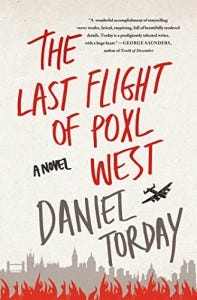
Cutting Past the Quick, an interview with Daniel Torday, author of The Last Flight of Poxl West

Daniel Torday

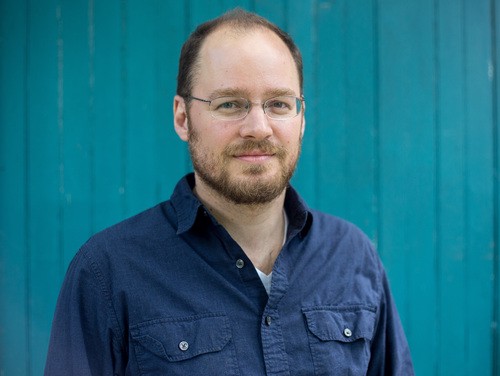
The title character in Daniel Torday’s new novel — The Last Flight of Poxl West — is a consummate storyteller. We meet Poxl West with a swift strike of charisma. He’s a former RAF pilot, a war hero, a best-selling memoirist, beloved uncle of Eli, art enthusiast…and not all that he seems. Torday is a consummate storyteller, too, though one of more integrity and honesty than Poxl. I sat down with him to hear some of his great stories and ideas over email. His novel is a moving inquiry into the limitations and possibilities of stories, how they have the power to shape, crush, reinvent us. In conversation, he is an endless fountain of pertinent quotations and insights, but perhaps the best insights he delivered were the ones that were all his own.

Early in the book, during a heated conversation with his girlfriend, Poxl feels he has maybe dawned on a working definition of love: “to disagree but to stay around and find out why, so it is no longer a disagreement.” This is perhaps also a reason for reading, for sitting with a novel until its conclusion. The Last Flight of Poxl West is an argument I wasn’t able to leave until the final page, and perhaps one I still haven’t left.

Hilary Leichter: The idea of muscle-memory is a recurring theme in your book: muscle-memory in learning how to play an instrument, in learning how to love, in our reactions and actions and our very human mistakes. Is there a kind of muscle-memory that goes along with writing a novel?

Daniel Torday: In moments of retrospection after a book comes out, probably it can’t hurt to acknowledge one’s mentors. So the oddly proper-nouny answer to this question is: George Saunders. I left a good job at Esquire Magazine to head up to the Syracuse MFA program, where I hoped to sit at George’s foot. He gives a lot of revelatory thought to process: just thinking deliberately about how we go about a fiction — what the regimen looks like of getting from not-writing to writing. It’s not mysterious, or precious — often it’s just finding the time, making the time when there is none, to work the sentences over and over and over until they all relate to each other. Flannery O’Connor has this great thing where she says something like “art is reason in making” — I think about that all the time. I take it to mean something like, a story or novel becomes artful, attains to a work of art, when every sentence, every move, style, is guided by the same central intelligence. Has its own DNA. That’s not something you achieve through your conscious mind. It’s a big-time subconscious-mind activity, and I think about that idea of muscle memory as another way of saying: find a way to let your subconscious mind, which is smarter and wiser, do as much of the work as possible. All of it, even.

HL: I love the idea of a book having its own DNA. If you could get it into a lab for analysis — I’m picturing bookish mad scientists armed with microscopes, getting paper cuts, etc. — what would the genome for POXL WEST look like?

DT: I love that idea of a book’s DNA, too! I stole it from Conrad, who says something like, “a work that aspires, however humbly, to the condition of art, must carry its own justification in every line.” I’ve always taken that to mean something like, a complete book has DNA that runs through every sentence. So I guess if they brought the POXL bloodwork into the lab they’d be surprised to find two interdependent organisms: Eli, who narrates from the present, and Poxl, who narrates through his memoir. But they’d also find that their DNA was closer to identical than they suspected. For me any first-person narrative that’s not told in the present tense derives its power, meaning, from this kind of coy fact of retrospection: what’s the chronological distance from the events to the moment of telling? Why is the narrator telling us now — what’s the occasion of the telling? And to return to Conrad, it’s in the sentences that we find that depth. As fiction writers, we’re always working at that perfect little long-evolved technology, the sentence.

HL: A book with two strands of DNA, like a chimera of sorts! There is an incredible momentum derived from the friction between Eli’s narration and Poxl’s narration, and from the alignment of their stories. How did your book split into these two distinct voices? Did it always exist in that form, or did it break by necessity, perhaps to provide occasion for the telling of the story? Was one voice easier to write than the other?

DT: The development of the two narrative strands here was odd and organic and jaunty, but in some crazy way natural. For years I had Poxl’s memoir, with a brief introduction from another young nephew-figure for Poxl. But it never really worked. At some point very late in the game I tried a short-story version of Eli’s narrative — and only after letting it sit for a year did I try to combine them. I was deeply skeptical that it would work. But I showed it to some of my most trusted readers — Rebecca Curtis, who has got to be working at a higher level than virtually any short story writer out there; Adam Levin, who always gives it to me straight — and they were surprisingly positive about it. And I’m not sure one voice was easier than the other. They each presented their own challenges — Poxl’s in all the homework it took to get there, Eli’s in just really wanting to get down the layers of that retrospective voice. What was harder was just getting the balance between the two in quantity and pace. By chance there’s actually just a lot more of Poxl than there is of Eli, though in some ways the story Eli is telling is the larger story of the novel itself. That was where Adam and Becky and a couple other late readers were so helpful — just in calling balls and strikes on whether the balance between the two worked.

HL: It seems that to properly imagine these events, specifically the events of Poxl’s World War II memoir, Skylock, you’ve had to do an incredible amount of research. Can you talk a bit about your process? Where did you start?

DT: Philip Roth has this great thing where he says the way to handle research is to not do it at all — at least in a first draft. When you’re getting the draft down, you just go. I mean, even if you knew not one thing of 1940’s London, you could start narrating, “As Preston Liverfootington walked down the, uh, cobbled (?) streets, he planned to spend his…uh…not-dollars…on a Pimm’s cup.” It’s awful, I know, but I mean only to say it’s not that you can’t get the prose down. That you can always do. Reading back that actually sounds like a not-bad start to a Barthelme story, a story with different aesthetic goals and told in a different context — you just have a lot of work to do, and some choices to make. So for me it was about getting drafts down where what mattered was Poxl’s emotional life — and then to go back in and expand. The things that helped most later were three-fold: the first was just going to retrace Poxl’s steps in Europe. I remember one early trip to Prague I just made a ton of notes about what I saw, and then on my next trip there, I checked what I’d written in Poxl’s voice against it. I was shocked by how little I had to change. Weirdly in a novel, it’s way more about not getting things wrong than it is about getting things ostentatiously right. That might matter in a nonfiction, but not so much in a novel. It can get showy.

The two main book sources for me were self-published memoirs, and really minute specific military histories. The former helped in getting so much of the dailiness down on the page — the details of what life looked like. The latter were great in being able to understand a day or two, a single air raid like the one I picked over Hamburg, so I could feel what it would have been for Poxl day-to-day. Oh, and one of the most helpful books was just a collection of New Yorker Talk of the Town pieces, written throughout the Blitz, by their main London reporter at the time. Her name was Mollie Panter-Downes, and she was a terrific observer. Her details, the way she presented them in real time, were just so precise and vivid.

HL: The phrase “What you know, you know” pops up again and again in these pages. It’s feels like a way for these characters to explain themselves, forgive themselves, explicate their individual stories. It started to read like a broken refrain, an apology, or even a mantra. Maybe it stuck out because I have Colson Whitehead’s brilliant essay about “You do you” on the brain, where he delves into the idea of a word William Safire coined: the tautophrase. Haters gonna hate. It is what it is. What you know, you know: is this a good philosophy when writing fact or fiction, or something in between? Is it a kind of way of understanding the idea of truth in writing?

DT: Well this is a complicated one — that line, “What you know you know,” is Iago speaking, after his awful business of putting honey in Othello’s ear is over. The next thing he says is, “From this time forth I never will speak a word.” I haven’t read that Colson essay (though I love his work and now want to immediately!) but I love that: tautophrase. I guess in a way it is at the heart of the stories both Poxl and Eli are telling: they’re stories of trauma, of the way memory and need can skew events over time. In my mind both of these characters just have this kind of eternal ache over the events they’re recalling, and some part of them has to narrate, but some other part wishes they could just let the past be. And in a way it really is central to the idea of “narration” itself — not simply listing facts, events, but making causal connections. E.M. Forster says “the king died, the queen died” isn’t a narrative; “the kind died, the queen died of grief” is. So on some level that question of causation is what burdens Poxl most, in a complicated way. Iago, too. But Poxl’s hitting on that phrase of Iago’s and sticking with it surely has something to do with a conflict between narrating, or maybe being prompted to narrate, or simply staying mute. Narrative, or just making a list of events. And so isn’t narrative in a way the very move past tautology, its opposite? To imagine events have caused each other, and make meaning of it.

HL: Poxl has this beautiful education in the arts that happens very naturally over the course of the narrative. His mother introduces him to painting early in the book. His first love, Francoise, introduces him to music and her mandolin. And then he climbs into a cave in the English countryside to read Shakespeare, almost as if you have to go spelunking for the written word. Where do you go looking (or spelunking) for inspiration, for art? Is an education in the arts a kind of travelogue, by necessity?

DT: That’s a really beautiful and generous read of Poxl’s growth over his memoir, Hilary. Thank you for it. I hadn’t thought about it in those terms, exactly, but it sounds just right hearing it. In a way if there’s a central conflict in the novel, it’s just that: Poxl’s desire to have his life be about all those loves — of art, of books, of music, of the lovers he lost — but the trauma of war pushed him instead into all these flights. In a quieter way, Eli, too, who might have liked to have studied art history, but ended up a historian. But I’d also just say that I’m always thinking of the other arts as such a useful analog to writing. I was talking the other day to a student of mine who also happens to teach the viola da gamba at Juilliard (I have some insanely talented interesting students), and found myself saying that music is the least representative art — its own, non-verbal, non-visual, non-narrative art. And she looked at me kind of askance. And I realized: I don’t think that at all! This might sound like lunacy or sophistry, but I like reading about physics, what I can understand of it (which isn’t all that much). But somehow string theory can give us this whole new view on music: if the physical world itself is at root not solid, but a vibration like a string, then isn’t music the world trying to speak itself back to itself? And isn’t there a similar vibration in the best prose or poetry? Makes me think of this line from Stanley Kunitz I love that I’m sure I’ll bungle but it goes something like, “I want to write a line so clear you can see the world through it.”

HL: Wow, that’s an amazing quote about sentences, and about writing in general. So much of storytelling hinges on these vibrations, where the “world speaks itself back to itself.” The prose in your novel is at once urgent and luxurious, which I think adds up to equal something akin to nostalgia. Just a few questions ago, you called the sentence a “perfect little long-evolved technology.” What are your personal criteria for a beautiful sentences? How do you know when a sentence you’ve written is giving off just the right vibration?

DT: You’re so kind! I never know if the sentences are doing just what I want, but I know I ultimately care about the sentence above all else. In some real literal way it’s the only tool at the writer’s disposal. Sometimes I think the perfect modern sentence is all about cutting past the quick — cutting almost to the point of incomprehensibility, or even a good bit past it. There’s a way that a sentence that risks almost not even making sense on its own invites the reader to have to fill in the gaps. It becomes an invitation rather than a foreboding. Or to stick with the initial metaphor, to staunch the bleeding after breaching the quick.

I’m a huge fan of Isaac Babel and the writers I think of as being somehow directly influenced by him — Leonard Michaels, Tobias Wolff, Amy Hempel, Denis Johnson, Saunders — and he was the great 20th century influence on cutting the line as bare as it can get. My process is pretty direct: in draft, I let myself go as freely as possible. But then on two or three or sixty-eight final rounds, I just go through with a pen and cut literally every word I’m able to while maintaining comprehensibility. I have a weird little rule, for example, where I’m not allowed to keep the words “that” or “and,” which often bloat my early-draft sentences. Lots of ands can help me get through a page, but the reader sure doesn’t need to know. Stuff like that — arbitrary, but little tricks to rub the strings down until they’re shining like new, ready to buzz.

HL: Eli’s passionate defense and promotion of Poxl’s memoir is one of the most touching parts of your novel. I was reminded of that possessive and exuberant way I often feel after discovering a new favorite book, or musician, or television show. There’s a frenetic desire to at once talk about the art in question with everyone and anyone who will listen, and a counter-desire to keep and save it all for myself. Have you ever felt this way about a writer or a book?

DT: All the time! It’s what I read for. I think that for a minute in my 20’s I might have wanted to be a critic, and being an undergraduate led me to have a kind of critical facility that could at times hinder the creative impulse. I mean, I know when something’s not working, but as a novelist it’s important not to mistake some aspect of a book not working as the whole thing being in trouble. The novelist’s job is to write until she encounters problems — real, seemingly insoluble problems — and then to figure out how to surmount them. That’s when the reader stands up and applauds — “Wow, I didn’t think she’d be able to hit that mogul and still keep on her skis, but phew! She landed with utter grace.”

Using cinema as an analog to writing can be insidious, but the first artist who comes to mind with this question for me is Wes Anderson. I suppose if you really start to try to push on a film like Moonrise Kingdom or The Grand Budapest Hotel you could come up with all kinds of criticism. Maybe you’d even have a point. But I find watching them to be an experience of almost unadulterated joy, and I don’t want the sophistry of criticism. I just want to be able to feel that joy. They’re perfect little hermetic objects, like Joseph Cornell boxes or Barry Hannah stories. With Anderson, my feeling is, if I can walk out of the theater for two days feeling everything I see is somehow purple, and my whole visual palette has changed, and inexplicably there’s an emotional element to that visual experience, why do I need to question it? I feel the same when I read, say, a Harold Brodkey story, or one by Karen Russell, or a Henry Green novel, or Fitzgerald, Roth, Bellow, Edward P. Jones, Nabokov, Deborah Eisenberg…the list could go on forever.

HL: Very early in the novel, Poxl recounts a story about helping his neighbors manage their father’s estate. He tells a mesmerized Eli about discovering a bookcase full of this man’s books, and each book is stuffed with a hundred dollar bill, his life’s savings invested in literature. They open the books and hundred dollar bills are fluttering to the floor. There is something comedic about this sequence — “There’s always money in the banana stand,” a la Arrested Development — but it was also one of the most moving images I’ve read in recent memory. It has a childlike magic to it, and an overwhelming sadness, or wonder, or maybe both? Can you talk a bit about how you came upon this story, which comes to feel central to the novel in so many ways? Are your books secretly stuffed with money, Dan? And what is the strangest thing you’ve ever found inside a book, aside from the content of the book itself?

DT: This was a weird one. The anecdote that set it off was one that my great aunt in Boston, my grandmother’s sister, told once. I’d spent so much time using my father’s East European family as models for this book, I consciously thought at some point, What stories am I neglecting on my mother’s side? And I remembered this story my aunt Ces had told. I was worried it would feel too shopworn, so I asked around about it, and no one else in the family seemed to remember it. Her neighbor wasn’t a writer, but apparently had just always used $20 bills as bookmarks, and after she died, her kids found thousands of dollars in her books. That’s the kind of story that when you’re a writer, once you hear it, I think you have no choice but to store it in some subconscious file for later use. (It’s also maybe an inversion of that epic scene in Gatsby when Owl Eyes is so amazed that Gatsby’s books are real, not just spines with no books).

As for me, I mostly just find coffee stains in my books. Though I can’t help but think here of that moment in one of my favorite novels, Marilynne Robinson’s Housekeeping, when Ruth and her sister find their grandfather’s pressed flowers filling the pages of his encyclopedia. Those dried flowers are almost secular relics — no, they are relics — the closest Ruth comes to physically touching her grandfather, who has died tragically before she was born, in the whole book. Isn’t that just a perfect little metaphor? Our memories pressed so cleanly between the pages of a book they can let us physically touch the remnants of our dead. Sounds a little like the whole gambit, doesn’t it?

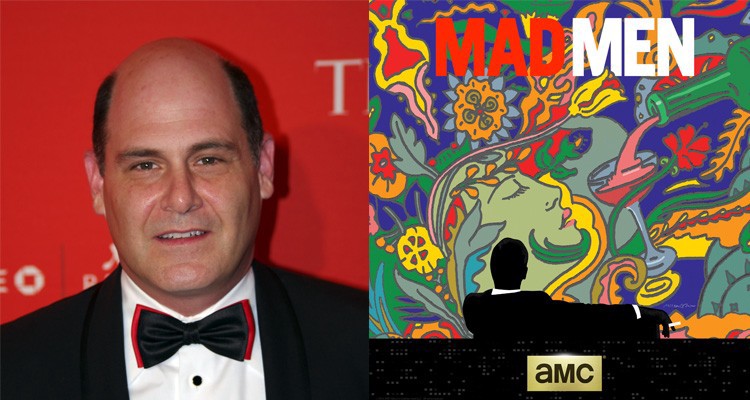
Even “Mad Men” Creator Matthew Weiner was a Struggling Writer Once

by Elizabeth Vogt

After a 7 season run, it’s #TheEndOfAnEra for the show that stood as a beacon for the Golden Age of Television. While “Mad Men” is widely considered to be one of the greatest TV shows ever created, it may never have even seen the light of day if not for the incredible persistence of its creator, Matthew Weiner. In an excerpt published at Fast Company from Gillian Zoe’s Getting There: A Book of Mentors, Weiner reveals the life-long adversity he faced as an aspiring writer while simultaneously providing exceptional advice for any struggling writer who has ever felt the hopelessness of rejection and lack of inspiration.

Weiner says he never hides his mistakes, or else he would never appreciate the finished product:

If you don’t get to see the notes, the rewrites, and the steps, it’s easy to look at a finished product and be under the illusion that it just came pouring out of someone’s head like that. People who are young, or still struggling, can get easily discouraged, because they can’t do it like they thought it was done. An artwork is a finished product, and it should be, but I always swore to myself that I would not hide my brushstrokes.

He also believes strongly in commitment and perseverance:

The most defeatist thing I hear is, “I’m going to give it a couple of years.” You can’t set a clock for yourself. If you do, you are not a writer. You should want it so badly that you don’t have a choice. You have to commit for the long haul. There’s no shame in being a starving artist. Get a day job, but don’t get too good at it. It will take you away from your writing.

But above all else, Weiner just wants struggling writers to write, and write often:

The greatest regret I have is that, early in my career, I showed myself such cruelty for not having accomplished anything significant. I spent so much time trying to write, but was paralyzed by how behind I felt. Many years later I realized that if I had written only a couple of pages a day, I would’ve written 500 pages at the end of a year (and that’s not even working weekends). Any contribution you make on a daily basis is fantastic. I still happen to write almost everything at once, but I now cut myself slack on all of the thinking and procrastination time I use. I know that it’s all part of my creative process.

For more on how Weiner finally got Mad Men off the ground and never let the haters get him down, read the full excerpt over at Fast Company.

PEN Award for Charlie Hebdo Causes Controversy Among Authors

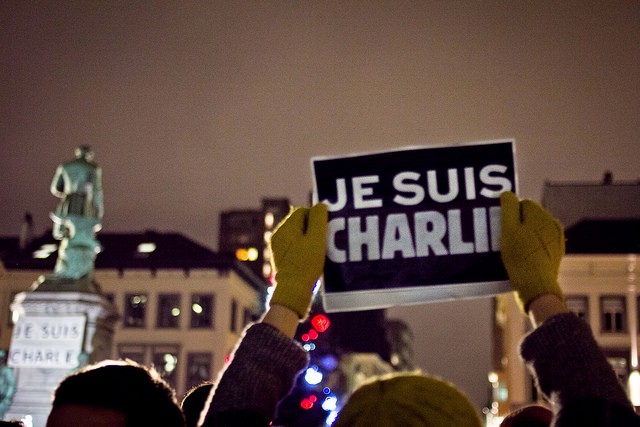
The PEN America Center, an organization dedicated to promoting literature and free speech, is being criticized by some of its members for giving its annual Freedom of Expression Courage Award to Charlie Hebdo, the satirical French newspaper that was attacked by gunmen earlier this year. The authors Teju Cole, Rachel Kushner, Michael Ondaatje, Francine Prose, Peter Carey, and Taiye Selasi have pulled out from next week’s PEN’s gala in response. Although the withdrawing authors condemned the murders, they questioned giving an award to a paper that many find offensive to religious groups and the Muslim community in France. “A hideous crime was committed, but was it a freedom-of-speech issue for PEN America to be self-righteous about?” asked Australian novelist Peter Carey.

In response, Salman Rushdie — who was famously targeted for murder for his novel The Satanic Verses — called the six novelists “horribly wrong.”

If PEN as a free-speech organisation can’t defend and celebrate people who have been murdered for drawing pictures, then frankly the organisation is not worth the name. What I would say to both Peter and Michael and the others is, I hope nobody ever comes after them.

Rushdie and other authors took to Twitter to discuss the controversy:

(Rushdie later apologized for using the sexist word “pussies.”)

ESSAY: Everything Gets Lost by Gabriel Heller

The Book of Disquiet, by Fernando Pessoa, is a masterpiece of fragmentary fiction. Assembled after Pessoa’s death from thousands of pages of notes found in a trunk and then posthumously divided into 481 short chapters, the novel weaves together the musings, observations, visions, riddles, paradoxes, prose poems, essays, parables, speculations, and confessions of Bernardo Soares, a reclusive bookkeeper in Lisbon.

It’s a work of brilliance and exhausting intensity.

There are various editions and versions of the text, none definitive. I am reading Richard Zenith’s translation in the Penguin Classics series.

This morning on the Q train, crushed up alongside my fellow commuters — oh, beautiful sad tired faces, sometimes it seems there is no mystery left in the world — I read chapter 170 that includes this amazing sentence: I felt happy because I couldn’t feel unhappy.

Pessoa died in 1935, at the age of forty-seven, having published just one book. As an adult he almost never left Lisbon, according to Zenith’s introductory essay, but as a kid he lived for a number of years in Durban, South Africa.

I remember my South African friend from high school, who used to tell me about stealing cars in Johannesburg and driving them to Durban. Political idealist, casual criminal, gifted artist, budding alcoholic, animal lover, misogynist — my friend was a true enigma. He was only a teenager, but he looked about thirty-five. One day, we smoked a joint in the arboretum, and he told me his life story in seven different languages, none of which I knew. The most beautiful was Xhosa with its melodic clicking sounds.

Famously, Pessoa wrote under the guise of a number of different authorial personas. He called them heteronymns. What is the self but a conglomeration of selves? the very form of his work seems to ask.

By delving within, I made myself into many, Soares says.

Like Cervantes, Pessoa is a master of irony. The extreme irony of the text is inseparable from its extreme sincerity. Pessoa’s irony is all-encompassing and is thoroughly rooted in the simple truth that Cervantes dramatizes with such great humor and pathos: in life, we are not who we think we are. Or in the words of Soares: We are who we’re not, and life is quick and sad.

When Don Quixote wakes up at the end of the dream, which is the end of the book, he dies.

The relation that exists between sleep and life is the same that exists between what we call life and what we call death, Soares tells us. We’re sleeping, and this life is a dream, not in a metaphorical or poetic sense, but in a very real sense.

After a long day of work, I walk past the bars on Third Avenue. Come on in and drink, the bars all say, but I quit drinking at the end of the summer, so I just walk past their steamed-up windows, thinking about Pessoa, the loneliness he endured throughout his life, the problem of emptiness and fragmentation, the impossible-seeming dream of wholeness.

My boredom with everything has numbed me. I feel banished from my soul.

I don’t know who I am or what I am.

On the subway back to Brooklyn, I put on my headphones. I listen to Radiohead. My eyes hurt.

The emptiest of feelings, clinging onto bottles, Thom Yorke sings in “Letdown”, a devastating apocalyptic poem masquerading as a pop song.

I get off at Pacific Street, walk past the Barclays Center. Traffic crawls up Atlantic Avenue. Throngs of basketball fans wait in front of the stadium. Neon lights cut through the darkness, illuminate their dreaming faces. The artificial disguise of consciousness only highlights for me the unconsciousness it doesn’t succeed in disguising. I walk along the side of the stadium, through a tunnel made of metal scaffolding and blue plywood. Where I emerge, the street is quiet — as still as a photograph. A construction site hugs the back of the dark arena. Cranes and diggers resemble dinosaur skeletons.

Where did all the people go?

Yesterday I went into a café in my neighborhood. Blake was working. He’s Hare Krishna. Sometimes while he’s working he plays Hare Krishna music, which I quite enjoy. But yesterday it was The Eraser, by Thom Yorke.

I like the unsettling beauty of Thom Yorke’s singing. I like how his voice bends language away from meaning, stretches words into pure sound. Maybe his music is about what happens to consciousness as it knocks up against the peril of the unseen. The way an insane, unintelligible world breaks into the unconscious mind, and the mind loses its hold, loses its way.

I meet my sister at a ramen place in Prospect Heights. We have some time to kill before we get a table, so we walk up Vanderbilt. She tells me about her auditions, a sociopathic scene study partner she’s working with in a Tennessee Williams class, this guy she’s seeing from Detroit.

All this makes me want to smile, but I feel a profound anxiety. I feel the chill of a sudden sickness in my soul.

And how are you, Gabey?

I’m good, I say. I’m good.

We stop at Unnameable Books. We browse the shelves for a little while. I buy a volume of Pessoa’s poetry.

It is very difficult to become conscious of what one is beyond a particular labyrinth molded to the contingencies of time and space. Coffee cups, subway rides, days dissolving into days. My tedium takes on an air of horror, and my boredom is a fear. My sweat isn’t cold, but my awareness of it is.

Blake comes back with my coffee. I hand him my bent-up card. He counts the punches out loud. Nine punches, so my coffee is free.

Congratulations, he says.

Thanks, I say.

His lips curl into a weird grin. I can see his incisors poking through his blond whiskers.

I drop a dollar in the big glass jar on the counter.

Almost nothing happens in The Book of Disquiet. It’s a book about the inner grain of experience, the self, the soul — its fullness and emptiness, its sleepiness and freedom.

We live and die — for what?

We never know self-realization.

We are two abysses — a well staring at the sky.

Last year, my sister and I went to hear Thom Yorke at the Barclay’s Center. She got free tickets. We smoked a joint beforehand, and once we were inside I got a little paranoid imagining terrorists figuring out a way to sneak poison gas into the ventilation system.

When Thom Yorke came on stage, he didn’t really look like Thom Yorke. He had a beard, and some of his grayish hair was gathered up into a samurai ponytail high on the back of his head.

I’m Justin Bieber, he said — his only greeting to the crowd.

So great is this tedium, so sovereign my horror of being alive, that I can’t conceive of anything that might serve as a palliative, antidote, balsam or distraction for it, Pessoa writes. Going and stopping are the same impossible thing. Hope and doubt are equally cold and grey. I’m a shelf of empty jars.

But once the music started, it seized me so completely and didn’t let me go. The songs were all about dread: its crystallization, but also its transformation. For what is a work of art if not an attempt to sharpen perception of what is — and to change it into something else?

Is it possible to read Pessoa without feeling some part of yourself almost constantly smiling?

Time is running out for us, Yorke sang, as squares of red light pulsed and shivered over the stage. But where was the introverted, melancholy poet? This was someone else — a jubilant trickster, full of rhythm and grace, dancing the whole time.

The Beautiful, the Broken, the Strange: Dark Lies the Island by Kevin Barry

“A storied past can project a rush of images to a suggestible mind,” Kevin Barry wrote for The Guardian in early 2011. The essay, “Once Upon a Life,” looked back half a dozen years to when Barry and his girlfriend were purchasing their first home, an ex-constabulary headquarters located in the reedy fields of County Sligo, Ireland. At the time, Barry worried that it “was a place to inspire overly limpid prose.” His first novel, City of Bohane, had not yet been published, nor could he have predicted the prestige that would come with it winning the €100,000 International IMPAC Dublin Literary Award in 2013.

Today, roughly a decade after moving to County Sligo, Barry needs not fear limpid prose. If anything, the move to the lake house gave life — beery, gritty, foggy life — to the thirteen short stories in Dark Lies the Island, his most recent published work, newly released in the U.S. from Graywolf Press. Certainly the storied past of Sligo has put blades, both literal and metaphorical, in Barry’s location-rich writing, and no one now would venture to imply he not have a fantastically suggestible mind.

In Dark Lies the Island, Barry proves that his greatest talent lies in his comedic sense of timing; he may very well be the reigning prince of punctuation, the king of conveying the Irish voice. Barry’s grip on the actual, physical movement of the prose ranges from using paragraph breaks as beats between jokes to the back-and-forth banter of the loud population that inhabits the collection’s pages. (Fittingly, the story “Wifey Redux” features an actual exclamation point caper).

The best example of this linguistic agility comes in the highlight of the collection, “Fjord of Killary,” in which a wry narrator operates a flooding 17th century inn. Barry orchestrates the story’s wild transitions and switchbacks like a kind of manic switchboard operator:

“I looked out the landing window as I dashed along the corridor to get some CDs from my room — this was a bad move:

Seven sheep in a rowing boat were being bobbed about on the vicious waves of Killary. The sheep appeared strangely calm.

I picked up lots of old familiars: Abba, The Pretenders, Bryan Adams.

I pelted back to the function room.

‘We’re here!’ I cried. ‘We might as well have a disco.’”

In another standout of the collection, “Beer Trip to Llandudno,” Barry animates members of the Real Ale Club, who are traveling to Wales on their July outing. Barry doesn’t tip his hand to outright tell you it’s funny — all of his humor is delivered straight-faced — but the middle-aged men’s serious approach to their work is perfectly timed:

“‘I’ve had better Tram Drivers,’ opened Mo.

‘I’ve had worse,’ countered Tom N.

‘She had a nice delivery but I’d worry more about her legs,’ said Billy Stroud, shrewdly.

‘You wouldn’t be having more than a couple,’ said John Mosely.

‘Not a skinful beer,’ I concurred.

All eyes turned to Everett Bell. He held a hand aloft, wavered it.

‘A five would be generous, a six insane,’ he said.

‘Give her the five,’ said Big John, dismissively.

I made the note. This was as smoothly as a beer was ever scored. There had been some world-historical ructions in our day. There was the time Billy Stroud and Mo hadn’t talked for a month over an eight handed out to a Belhaven Bombardier.”

Yet other stories in Dark Lies the Island repress a deep feeling of dread beneath their loony exteriors. “A Cruelty” reads like a modernized story from James Joyce’s Dubliners, in which a stranger accosts the young protagonist; another story, “Ernestine and Kit,” follows two sixty-year-old women on an increasingly sinister mission.

The pieces that work the best, though, find the middle ground between the laughter and the darkness. One is “Doctor Sot,” in which an alcoholic doctor goes on an Outreach visit to see the new-age travelers of rural Slieve Bo. Likewise, in the titular “Dark Lies the Island,” nothing much externally occurs — Sara, home alone, contemplates cutting herself while her hip father texts her from a bar in Granada — yet when it concludes in the damp night of County Mayo, Barry lingers on the impression of something lonely and uncharacteristically, though not unpleasantly, still. And if his emotional control of the story doesn’t impress readers, then who other than Barry could get away with describing islands as “inky blobs of mood?”

“She slid the glass doors and stepped outside and she looked back into the lit space — a magazine shot. Minus people. She turned and looked out beyond the expanse of the bog, where the ground fell away, so quickly, and there were low reefs of dune, and then a descent to superlative, untenanted coast. Ach year it lost about a metre to the Atlantic — it was coming towards the house, the water. This was Clew Bay, in County Mayo, and hundreds of tiny islands were strewn down there. They were inky blobs of mood against the grey water. It was a world of quiet dimly lit by the first stars and a quarter moon. The house behind her was silent as a lung.”

Barry’s is certainly a beautiful, broken, and strange world but readers are warned: this beauty belongs to an Ireland of trailer parks, chain smokers, and criminals. Barry does not bother to tidy up his characters’ views or language; women and racial minorities in particular do not fare well. Dark Lies the Island is thoroughly an Irishman’s world: coarse and swampy, where men contemplate passing the nights in caves — and yet it is also capable of producing moments of epiphany and delight. And while some shine brighter, or simmer darker, than others, the thirteen stories in Dark Lies the Island confirm Barry’s place among the foremost writers of contemporary Ireland. If there is a message beneath its dirt and its chaos, it might be this: County Sligo is here to stay.

[Editor’s note: read “Wifey Redux” from Dark Lies the Island in Electric Literature’s Recommended Reading]

Dark Lies the Island: Stories

by Kevin Barry

Powells.com

Introducing The Blunt Instrument: An Advice Column for Writers

Sometimes, as writers, we need gentle encouragement — someone to tousle our hair and kiss our boo-boos. Other times, we just need tough love — someone to shove us off the diving board and into the deep end.

This column is for the second group, the people who are looking for hard advice: hard to hear, and hard to follow. Maybe you’ve been blocked for a year and need to hear something more useful than “Your book will be waiting for you when you come back to it.” Maybe your manuscript keeps getting rejected and you don’t know why, and you need to hear something other than “Faulkner got rejected a lot too!” Maybe you’re addicted to clichés and bad metaphors (see previous paragraph; that’s terrible writing!).

In this new monthly advice column, I’ll respond to real questions (anonymous or not; your choice) about writing. Questions will be selected based on relevance to the Electric Literature audience and my personal whims. I may not be gentle, but I will endeavor to be useful. You can send your questions to blunt@electricliterature.com.

Disclaimer: I am not a licensed therapist, nor am I tenured professor. I do have an MFA in poetry and have published several books. I also give pretty good advice (sometimes unsolicited).

Sunday Sundries: Literary Links from Around the Web (April 26th)

Looking for some Sunday reading? Here are some literary links from around the web that you might have missed:

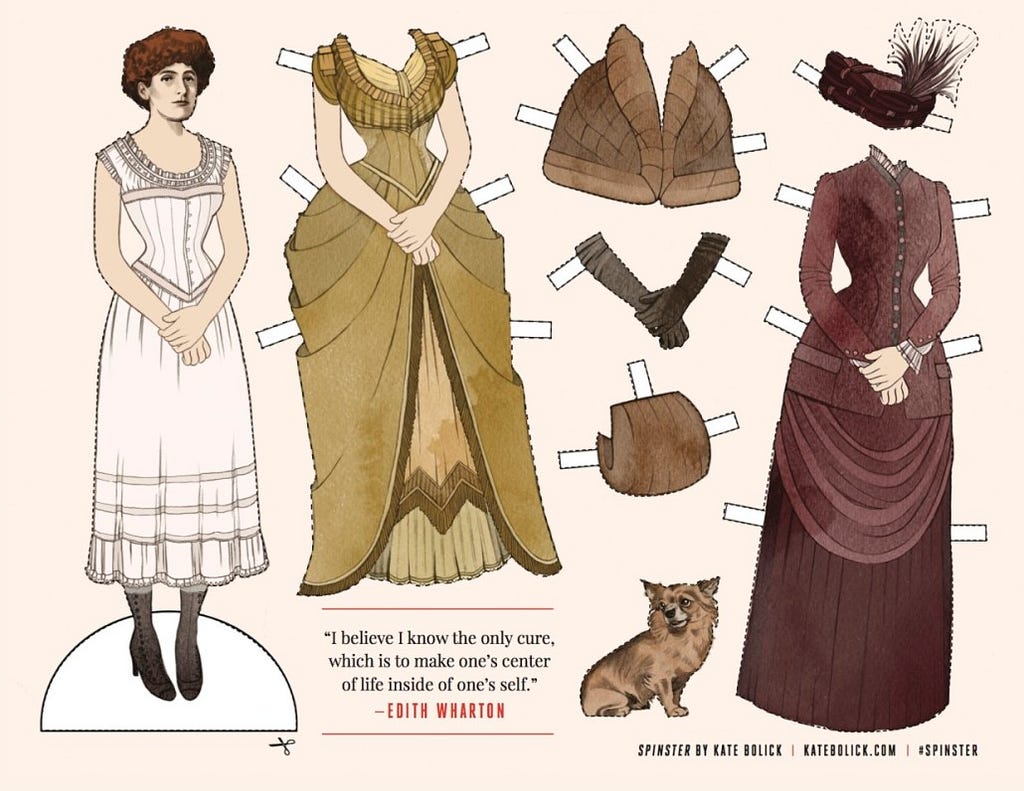
Edith Wharton

The Lit Hub posts cut-out dolls of pioneering women writers

A tour of the world’s great literary pubs

The New Yorker profiles Science Fiction’s Melville, Gene Wolfe

An interview with Anthony Doerr, who just won the Pulitzer Prize in Fiction

Novels that will turn you into a tree-hugger

Writers: have you been submitting work with one of the most overused short story titles?

Jeffrey Eugenides reviews the new Karl Ove Knausgaard

On the difficulties of a Saul Bellow biography

Ta-Nehisi Coates looks at how superheroes conquered pop culture

The Atlantic explains how writers grow by pretending to be other people

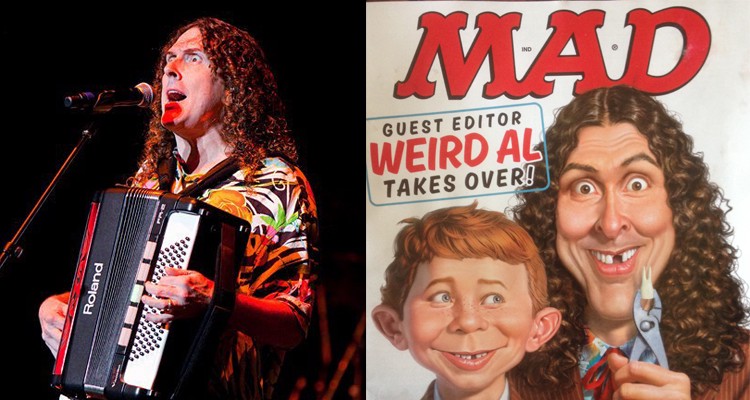
The Coolest Thing Ever: Weird Al Guest Edits MAD Magazine

If I could time travel and ask my middle-school self what the coolest collaboration of all time would be, middle-school me would probably say “Beastie Boys as playable characters on NBA Jam!” In response, I’d reach back into my time machine for a magazine I’d brought with me (not just because zipping through wormholes can be kind of monotonous), then I’d roll up that magazine and whack my middle-school self with it and tell him, “No, dummy, this is the coolest collaboration of all time.” Then I’d watch as he stared in awe of the latest issue of MAD Magazine guest edited by “Weird Al” Yankovic.

I’m sure my younger self’s jaw would drop (I was kind of a mouth breather) as he read the letters to the editor, all of which were addressed to and answered by “Weird Al.” And then he’d immediately jump to the MAD fold-in, which he’d bend so as not to damage the cover, to discover that even that had been infiltrated by the king of pop parodies. But, ever skeptical, when he’d thumb through the rest of the magazine (which includes pages of bad parody ideas from “Weird Al’s” journal, as well as other contributions from his friends like Patton Oswalt and Kristen Schaal) he’d get confused and say, “ Wait a second…there are ads in here. MAD Magazine doesn’t have ads in it!” At that point, I’d gently rest a hand on his shoulder (which would probably spark or something because space-time is like that) and say, “The future is a dark and humorless place. Pay attention in math class or you’ll wind up a slave in the lit mag mines of Brooklyn.”

Then I’d snatch the magazine from him before he ruined it (like everything else my younger self always ruined) and hop back in my time machine and head back to 2015 before they missed me in the lit mag mines. On the trip back to the future (again, boring) I’d marvel at how amazing it is for two entities to find travel across the universe and find each other: issue #533 is the first issue of MAD with a guest editor, or, as “Weird Al” puts it, the first time anyone was fool enough to accept the job. Upon arriving back at the present, I’m sure I’d have another epiphany: Beastie Boys characters for NBA Jam really would have been the coolest thing ever.

Weird Al mad magazine

11 Novels That Expectant Parents Should Read Instead of Parenting Books

I read two books explicitly written for expectant parents when I was pregnant. The first was a worn paperback lent to me by my doula, which, through unflinching detail, prepared me for the natural childbirth experience I did not end up having. The second was a dense guide to caring for children from infancy through toddlerhood and featured concepts that were as abstract to me as quantum physics at a time when I couldn’t even imagine how my first hour as a mother was supposed to play out. Nearly two years into parenthood, I can see that these books were both too specific to prepare me for what I ended up encountering and too generalized to grasp before I even had a look at my own son’s face.

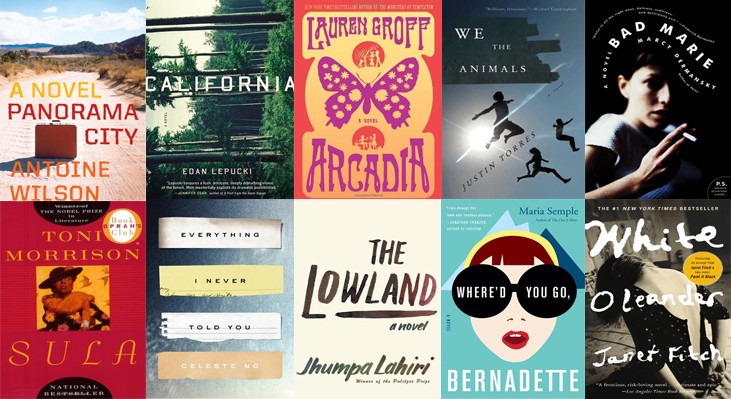
If Marilynne Robinson says that “fiction may be, whatever else, an exercise in the capacity for imaginative love, or sympathy, or identification,” then maybe reading about fictional families is a more effective (and certainly more entertaining) way to identify and work through an expectant parent’s anxieties. So, save the official handbooks for after the baby arrives and seek out the kind of book that, if you’re like me, has always helped you to make sense of life. Here are some novels that can illuminate common truths about parenthood by exploring the joys, challenges and, often, spectacularly flawed dynamics of the family experience.

we the animals

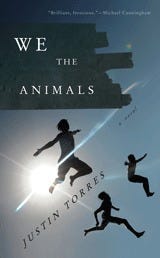
We the Animals by Justin Torres

If Justin Torres’s We the Animals can teach us anything about parenthood, it is to relish the bright moments of outright joy that, depending on your own circumstances, either outshine the dark ones or, as with the family at the center of this story, flash only occasionally, like a set of eyes in the dark wilderness. In a story dominated by domestic violence and the endless tussling of three rowdy brothers, We the Animals offers a few of these shining moments. I still find myself thinking about their impromptu kitchen dance parties and raucous evening bath routines as I live out my own domestic life.

When the three boys, ages seven to ten, pin down their 24-year-old mother and each one takes his turn blowing raspberries onto her belly, the scene exquisitely captures the intimacy that exists between bodies that were once connected as one. And yet, there is also the knowledge that they are now most definitely disconnected — and that, at least in this home, there is a fine line in every moment between delicacy and danger.

bad marie

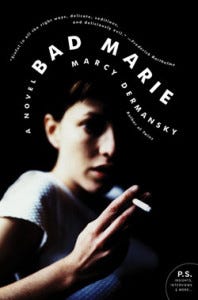
Bad Marie by Marcy Dermansky

It might seem insensitive to recommend that an expectant mother read a book about a seductive nanny running off to Paris with both the little girl in her charge and the toddler’s father. However, throughout the dark and deceptively slim novel Bad Marie, Marcy Dermansky manages to tease out so many of the more subtle challenges facing new parents and their relationships. It also features one of the most accurate depictions I’ve seen of the intense bond that a caregiver (mother or otherwise) can form with a small child.

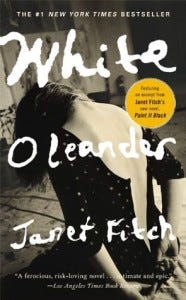
white oleander

White Oleander by Janet Fitch

In her masterful and much-celebrated novel White Oleander, Janet Fitch confirms every parent’s dark suspicion that with the responsibility of caring for a child comes the capacity to do tremendous damage. The story of a brilliant imprisoned poet, whose daughter ends up navigating adolescence in the foster care system, explores what it means to be both an artist and a parent — and what, if anything, can redeem the irreparable damage a parent’s choices have caused.

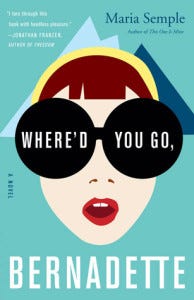
where'd you go, bernadette

Where’d You Go, Bernadette by Maria Semple

Where’d You Go, Bernadette is as funny as people say it is. But through the book’s humor, Maria Semple illustrates a moving portrait of friendship between the eccentric (and now MIA) Bernadette and her teenage daughter, Bee. In trying to solve the mystery of her mother’s disappearance by investigating emails, all manner of official documents and her own memories, Bee helps us to understand their unique bond — from quirky shared tastes and a fierce sense of loyalty, to moments of profound revelation upon discovering each other’s secrets.

more than it hurts you

More Than it Hurts You by Darin Strauss

Darin Strauss’s powerful novel More Than it Hurts You is the kind of book you’ll be glad you finished reading before the arrival of your child, mostly because it might be hard to get through this story after having experienced the fragility and innocence of a baby firsthand. Even Strauss has said (to me, on twitter!) that he doesn’t think he could have written it after having become a father. Told from multiple points of view, the story surrounds a Long Island family’s chronically sick baby boy and the doctor who cares for him. Facing these extreme circumstances, the child’s father, mother and doctor are forced to acknowledge their own best and worst natures and to question the motives of the people they trust the most.

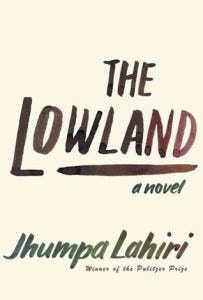
the lowland

The Lowland by Jhumpa Lahiri

Lahiri’s latest novel follows the vastly different trajectories of two Calcutta-born brothers. In telling their stories, from suspense and tragedy in India to seething domestic turmoil in seaside Rhode Island, The Lowland becomes a story about parental regret, responsibility and the way each character involved decides to reconcile the two.

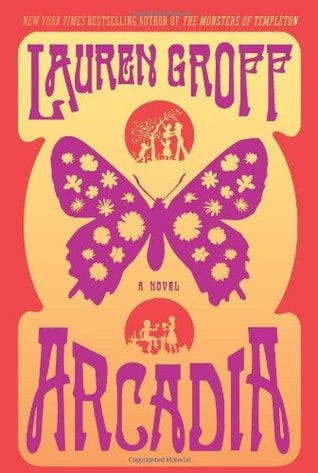
arcadia

Arcadia by Lauren Groff

Set on a New York commune in the 1970s, Lauren Groff’s Arcadia tells us much about the way the environment we create for our children can affect who they become. Her use of the senses — for instance, the way a young child is intimately familiar with the sounds and scents surrounding his parents — brilliantly illustrates the intense closeness a family can experience. But, in this story, that deep knowledge and dependence can lead to trouble, as the child protagonist discovers when the utopia he has been raised in falls apart and he is confronted with the outside world.

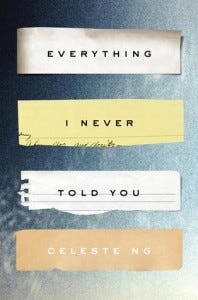
everything i never told you

Everything I Never Told You by Celeste Ng

From the start, Celeste Ng’s Everything I Never Told You reveals the unease of a parent discovering her child’s secrets. Not only her secrets, but her capacity to hide anything from her parents in the first place. When her teenage daughter Lydia goes missing, Marilyn Lee remembers having missed seeing Lydia’s first steps as a baby: “The thought that flashed through her mind wasn’t How did I miss it? but What else have you been hiding?” So begins the entire Lee family’s struggle to confront and reveal their own lies as they work toward discovering the truth about Lydia’s disappearance. Ng’s quiet and precise storytelling tugs at the loose threads of a seemingly close-knit suburban family and shows us that even the family next door has its own dark secrets.

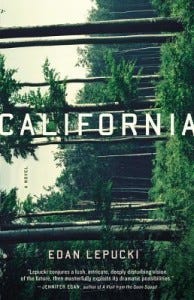
california

California by Edan Lepucki

Edan Lepucki’s debut novel California has been lauded as a fierce and original take on the post-apocalypse, but a lesser discussed quality of the book is Lepucki’s capacity for honestly rendering the uncertainty that an expectant mother feels, whether she’s confronting imminent threat in the face of post-apocalyptic disorder or just feeling general unease about raising a person in contemporary, not-burned-to-the-ground Los Angeles (see also: Lepucki’s novella If You’re Not Yet Like Me). Set in a dangerous and uncertain world, California looks at the role that community plays in the lives of individual families, and at the choices parents must make, even at the risk of isolating themselves from that community.

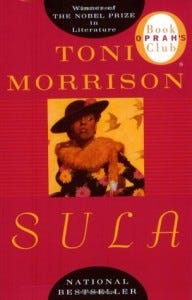
sula

Sula by Toni Morrison

I will never forget the moment in Toni Morrison’s Sula when a young mother attempts to relieve her constipated baby by sticking her finger up the baby’s butt to release the buildup of nuggets that has been blocking him. If that description made you uncomfortable, well, it won’t be long before you’re as well versed in baby bowel movements as your most obnoxious parent-friend on Facebook. And you’ll learn soon enough that, as that scene proves, you do what you have to do to take care of your kids.

Morrison’s slim, powerful and often overlooked novel traces the lives of two black girls in small town Ohio. Though the main thread of the story is not specific to parenting, in reading about the struggles and choices that these characters face, we come away with a better understanding of what it means to be human. Which can’t help but make us more thoughtful partners and parents.

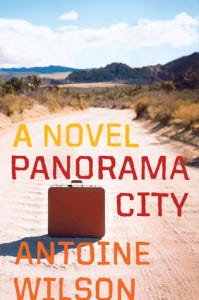
panorama city

Panorama City by Antoine Wilson

Antoine Wilson’s Panorama City, told by the impossibly loveable Oppen Porter through tape recordings made for his unborn son, is a study in parental love and sacrifice. A self-described “slow absorber,” 28-year-old Oppen has always been an easy target, but when he discovers that he is going to be a father, he sets out on a quest of self-discovery that ends up revealing the complex intentions of the adults who’ve cared for him throughout his journey. His bumbling yet, often surprisingly wise, efforts to turn himself into a “man of the world” for the sake of his child display a wide-eyed hopefulness that can teach us a lot about the level of dedication it requires to take on the responsibility of parenthood.