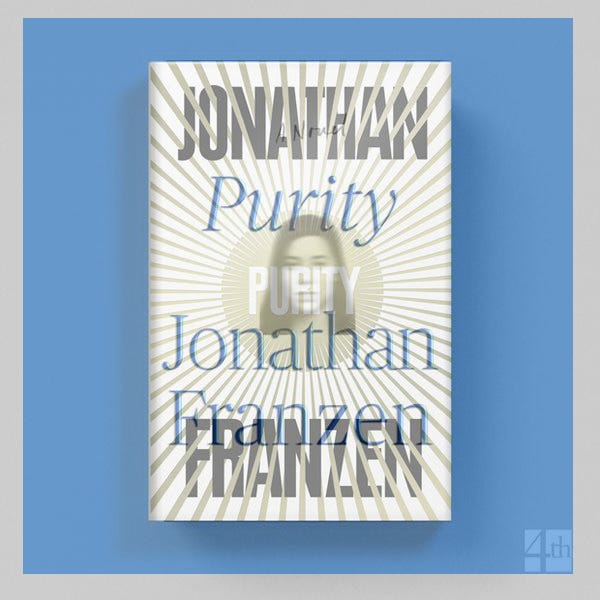
Do you have an opinion about the new Jonathan Franzen covers?

Jonathan Franzen is an American author who people have opinions about. Some of those opinions are that he is a Big Important Literary Author. Some are that he is a big meanie jerkface who doesn’t get Twitter and is mean to Oprah. Many people have opinions who have never read any of his books. This week the covers for the newest novel, Purity, were revealed, which released a lot of cover opinions on Twitter. What do you think? Left is the US (FSG), right is the UK (4th Estate).

ETA: Jeff VanderMeer and I have suggested the following third cover:

Franzen

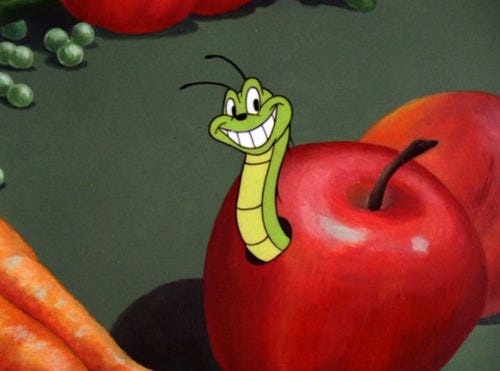
NEW GENRES: The Worm in The Apple Tale

by Rebecca Scherm

[Editor’s note: New Genres is a recurring feature that aims to complicate and expand our conception of literary genres and their always porous boundaries.]

The plot goes like this: the first time the family meets the worm, they are charmed. “What a charming young man,” one of them might say. But someone else will notice something off about the worm, an awkwardness they can’t pinpoint, but more often than not they will brush off this feeling as their own unfairness or prejudice. After a few more unexpected run-ins (“What are you doing here? How lovely to see you!”) they welcome the worm into their lives fully. In no time at all, they can hardly remember life without the worm.

Of course, the family doesn’t know the worm is a worm yet — except for possibly one doubter, one naysayer, who can’t brush off the feeling that something about the worm is not right. But whenever the doubter expresses concerns, they are dismissed by the others as jealous, petty, or paranoid. By the time the others realize that the doubter was right all along, it is too late. Their whole apple is rotten.

By the time the others realize that the doubter was right all along, it is too late. Their whole apple is rotten.

Gilbert Osmond in Henry James’s Portrait of a Lady is a classic worm, as are Shakespeare’s Iago and smarmy Uncle Claudius, who has wormed his way through the apple before Hamlet even begins. Not every betrayer is a worm. Short-term con artists are not worms. Spies are not worms because they’re working for larger interests than their own. To be a worm, the character has to slowly, steadily munch its way into a relatively healthy apple with little to no initial resistance, becoming harder to exterminate with every single bite.

My earliest encounters with the worm plot must have been fairy tales and Disney movies, where the worm is often a wicked stepmother. I didn’t give it any specific thought until, after writing my own novel, I was often asked about books and movies I found particularly influential and, connecting the dots, saw the worm-in-the-apple picture emerge. Now, it thrills me to recognize a worm plot, to see the soft, browning tunnel left behind as the worm disappears deeper into the apple. The worm-in-the-apple plot feeds our appetites for intrigue and suspicion, but against the backdrop of the most banal events in our lives: hiring a babysitter, meeting the new neighbors. The worm-in-the-apple plot rewards the recreational paranoia of the comfortable. It’s about two common fantasies in conflict: one dream of having it all — a happy, comfortable, fulfilling life — and the nightmare of not being believed, of recognizing a threat and being repeatedly discredited by your loved ones.

Now I’ve become a collector of these worm plots. Here, an introduction to the ways of the worm:

Classically Murderous Worms

hand rocks the cradle

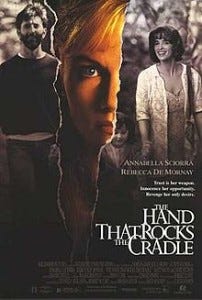
“Peyton Flanders” in The Hand That Rocks the Cradle

I saw this movie at thirteen years old and still can’t shake the quietly horrifying image of “Peyton” secretly breastfeeding the heroine’s baby in the middle of the night in an effort to sabotage her. Rebecca de Mornay, with her puffy blond bangs and shirts buttoned up to the neck, is an ideal worm, sunny and icy in equal measure. Cradle (directed by Curtis Hanson) feeds on both the parental fear of someone turning your children against you and the fear of seduction-by-nanny, cloaking them in pulp horror.

Shadow of a Doubt

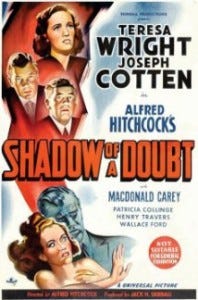
Uncle Charlie in Shadow of a Doubt

The Hitchcock classic begins with bored teenager Charlie wishing for something interesting to happen to her family. Soon enough, her beautiful, dapper Uncle Charlie, “merry widow strangler” on the lam, shows up bearing fine jewelry for all. Poor Charlie is the only one who knows his secret, but she’s not quite a naysayer: she’s too worried that this revelation will upset her mother to tell anyone the truth.

A Judgement in Stone

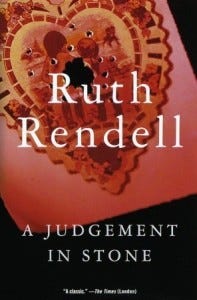
Eunice Parchman in A Judgement in Stone by Ruth Rendell

In this perfect, chilly novel, the Coverdale family hires a new housekeeper, Eunice Parchman, who gives everyone the willies, but they are all too embarrassed by their own class snobbery to fire her. Then, seething with hatred for the Coverdales’ bourgeois habits, Eunice murders them all while they watch opera on television. What’s unusual about Eunice as a worm is her lack of charm: no one likes her. Instead, they pity her or are frightened by her in ways they are ashamed to admit.

With a friend like harry

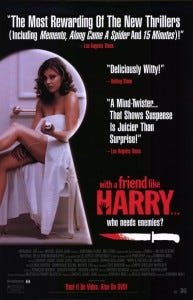
Harry Belastro in With a Friend Like Harry…

In this French film by Dominik Moll, a bizarre encounter in a gas station bathroom introduces Harry, a wealthy man of leisure and “solutions,” into the lives of Claire and Michel, the harried parents of three young children. Harry just wants to help out wherever he sees a problem: first, a new car when theirs is in the shop; later, murder. Claire and Michel are both uncomfortable with his gifts and attention but simply too exhausted to stop it, and Harry’s “solutions” become bloodier with each passing day.

The Fever book

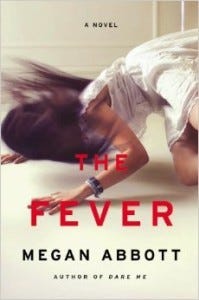
[Redacted] in The Fever by Megan Abbot

I can’t tell you who the worm is without spoiling it, but how many of us remember the betrayal and distrust we felt as teenagers when our friends made new friends without us?

The Worm’s Side of the Story

The Corrections

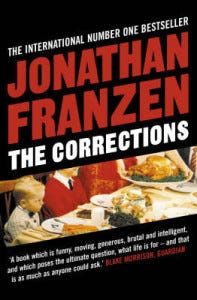
Denise Lambert in The Corrections by Jonathan Franzen

Jonathan Franzen loves a worm plot, and for the reader, Denise is an unusually complex worm. For one, she gets to tell her own story. We understand, as she tears Brian and Robin first apart and then to shreds, that she is not a monster out to commit evil. She’s a real and screwed-up person, carrying around a lingering shame and the cramp of only-daughter expectations. She’s not only destructive, but self-destructive. Whether readers sympathize or “forgive” Denise is immaterial: here, comically and painfully told, is the worm’s own tale.

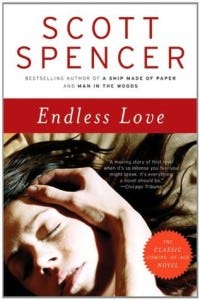
Endless Love

David Axelrod in Endless Love by Scott Spencer

David is a stalker and an arsonist. In obsessive teenage love with Jade Butterfield, he worms his way into her family, and in trying to prove his worth, begins to destroy it. With every desperate, self-serving corrective decision David makes, he hurts himself and the Butterfields more. The first thing people mention when Endless Love comes up is either its seventy page sex scene or the two disastrous movie adaptions of it, but those who love the novel prize its intensity, relentlessness, and its fearlessly naked examination of one tragically well-meaning worm.

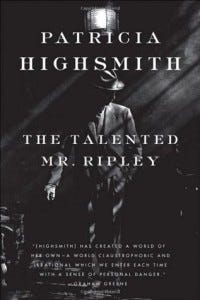
The Talented Mr. Ripley

Tom Ripley in The Talented Mr. Ripley by Patricia Highsmith

In Patricia Highsmith’s novel, Tom Ripley is a sociopath who charms first Dickie Greenleaf’s parents and later Dickie himself. He worms his way into Dickie’s world with a mixture of compliance and desperation. Highsmith’s novel has not one but two doubters, first Dickie’s girlfriend, Marge, and then his friend Freddie Miles. One doubter is converted to the charmed, the other is killed; such is the way of worms. But Anthony Minghella’s 1999 film adaptation gives us, instead, a deeply yearning and pitiful Tom who unsettles us not just because we fear a someone like him could enter our own lives, but we because we also feel terrifying empathy for him.

Wait, who’s the worm here?

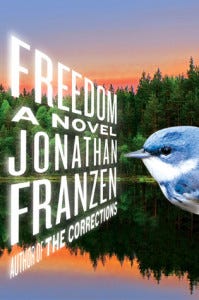
Freedom Franzen
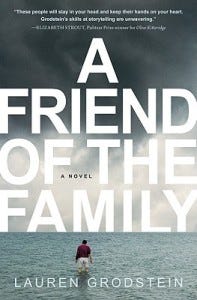
A Friend of the Family

Freedom by Jonathan Franzen

A Friend of the Family by Lauren Grodstein

In Freedom, Franzen looked at the worm story from another angle: Patty Berglund thinks her son Joey’s girlfriend Connie is the worm destroying her family, but it’s easier for her to see Connie as a predator than to sharpen her lens on Joey or herself. Similarly, in Lauren Grodstein’s A Friend of the Family, we feel our sense of blame and danger shift: at first we understand New Jersey doctor Pete’s disturbance when his aimless teenage son, Alec, starts hanging out with Laura, the newly-returned adult daughter of estranged family friends, ten years Alec’s senior and frighteningly beautiful, who has done something so apparently terrible that no one can say what it is. By the time we do know, our natural sympathies with the narrator are more than strained. Who is in danger here, and who is the monster in this family? What if the worm we fear isn’t the worm at all — it’s us?

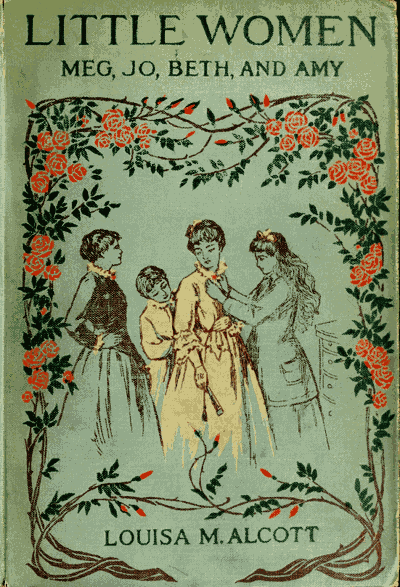
There Will Finally Be a New Little Women Film

Little Women

We live an in an era when every famous story seems to get rebooted or remade every other year. Sometimes a franchise will even get rebooted twice at the same time, such as the forthcoming all-male and all-female Ghostbusters films. Yet somehow Louisa May Alcot’s beloved Little Women hasn’t been adapted for over 20 years, the last version being the 1994 film with Winona Ryder and Susan Sarandon (pictured above). There have long been talks of a new remake, and this week news broke that the new version will definitely be made.

The new film will be produced by Amy Pascal — who you may remember from Sony hacking scandal fame — along with Denise Di Novi and Robin Swicord. Buzz is that Sarah Polley has been taped to adapt. Polley’s 2006 film Away from Her was nominated for an Academy Award for Best Adapted Screenplay.

No word yet on who will play Meg, Jo, Beth, and Amy March.

How DRM Evolved from Protecting Publishers from Piracy to Protecting Amazon from Competition

Editor’s note: the following essay by Andrew Lipstein, the founder and editor of the DRM-free ebook store 0s&1s, explains how DRM has helped Amazon maintain dominance in the ebook market.

On the course of an incredible Darwinian adventure, the very structure that keeps certain fish afloat originally served an entirely different purpose. The lungs of basal fish, eventually becoming the lungs of land vertebrates, went on to serve as the swim bladder in their undersea cousins. In evolutionary theory, this is referred to as an ‘exaptation’, or a shift in the function of a trait over time. For all of the coverage Amazon has received, in or out of the context of Hachette, we’ve ignored a major exaptation that has greatly contributed to the online booksellers’ success.

When technology began to enable the proliferation of electronic entertainment, the prevention of piracy became eminent. All creative industries — film, video games, books and (most famously) music — invested heavily in Digital Rights Management. As an encryption service, DRM was deemed necessary; how else would we protect profits against those willing to (illegally) share?

Now let’s flash forward many Darwinian cycles in digital publishing. DRM is still widely used. In fact, it ‘protects’ nearly every book published by the Big 5 (Penguin Random House, Macmillan, HarperCollins, Hachette and Simon & Schuster). But, like the swim bladder in basal fish, it now serves a completely different function in the evolutionary advantage of Amazon.

We now live in a digital landscape that, at best, renders DRM a formality. In just a few clicks, DRM can be cracked. Though virtually all of today’s bestsellers are DRM-protected, a reader who is inclined to pirate can without any real effort. So how do we explain Amazon and the Big 5 continuing to employ the method? Part of it is the friction that keeps us temporarily bound to antiquated technologies (the same reason we don’t yet pay our rents online). But the whole truth is that DRM now serves an entirely new purpose.

The specter of piracy forces publishers, already suffering in a hypercompetitive industry, to cling to DRM and, in turn, Amazon. DRM is just another service that publishers get from Amazon that they’d rather not spend the resources on themselves. As an Author Earnings Report points out, DRM also “makes it difficult to move ebooks between devices and traps readers into a single retail channel.” That is, DRM keeps Kindle users at Amazon, and Amazon users reading on Kindles. (It is worth noting that the same report finds that “DRM harms ebook sales at any price point” and “indie titles without DRM sell twice as many copies each, on average, as those with DRM.”)

Under the pretense of DRM, retailers like Amazon even avoid selling customers ownership of a given ebook, instead offering them a license to read. A 2009 Times article reported that, in a move that seemed to define the very concept of irony, “Amazon remotely deleted some digital editions of [Orwell’s 1984] from the Kindle devices of readers who had bought them.”

By unchaining ourselves from DRM, we can see a newly competitive ebook retail market, where transactions are as simple as the exchange of money for zeroes and ones. Publishers and retailers are already experimenting with DRM-free sales — this group includes Tor Books, OR Books and Emily Gould’s retailing service, Emily Books. Last summer, when I launched the literary fiction-focused ebookstore, 0s&1s, there was no question whether to encrypt our books.

Like in every art-based industry, figuring the mechanics of how creation turns into profit is a tough process. For books, it’s hard to imagine a more stable equilibrium than a world where the reader pays to own the story, and we trust them not to share.

***

andrew

Andrew Lipstein is the founder and editor of 0s&1s. The e-bookstore sells DRM-free novels, poetry and magazines from such publishing houses as Tin House, Verso Books, BOMB, Dzanc Books and Coach House Books.

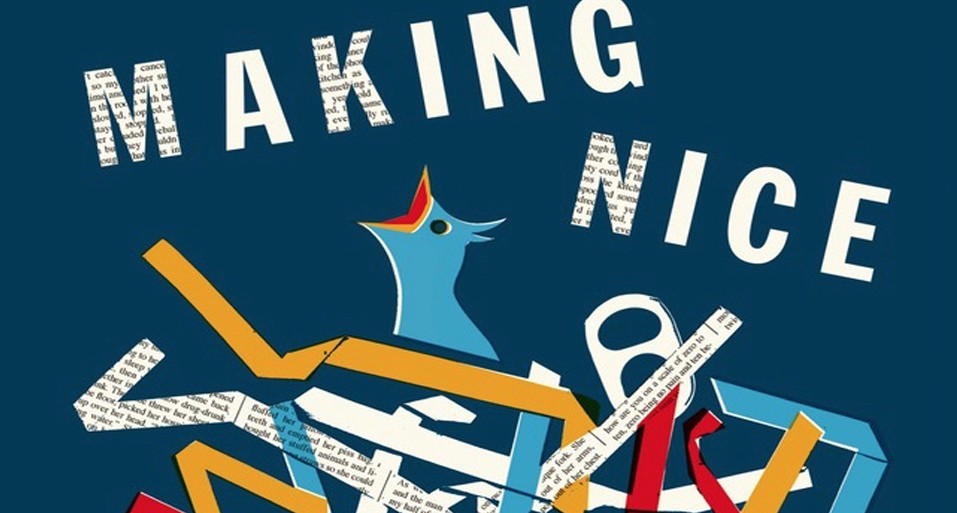
Anger, Understanding, a Confession: Making Nice by Matt Sumell

Matt Sumell’s debut collection of stories opens with a man in a rage. Alby, the narrator of “Punching Jackie,” has just been called a loser by his older sister and in response Alby struggles to control his temper, a temper he describes as “a rogue wave of weapons.” Later in the story, Alby flashes back to the moment when his dying mother called him to her hospital bedside — he is the last of his siblings to receive such an invitation — and instead of saying goodbye to her son, she dredges up the memory of Alby throwing a book at her head. Then she says to him, “I don’t want you to ever, ever, be abusive with a woman again. You can’t abuse women, Alby. I need you to promise me that.” One would assume that Alby’s violent tendencies, which are chronicled in great detail throughout the collection, trace back to the pain of watching his mother die, but we will come to learn that perhaps they come from a deeper, more irreconcilable place. Alby confesses in another story, “It feels good to be punched in the face, to punch someone in the face.”

Making Nice is less a collection of stories and more the episodic, first person confession of a man named Alby. Co-starring in this confession are the members of Alby’s family: brother made-good AJ; lesbian sister Jackie; a father with a prosthetic leg who utters such wisdom as, “Only pussies drink water;” a dog named Sparkles; most importantly, a dying and then dead mother, as well as a similarly doomed grandmother. Sumell mines the same darkly comic vein of wounded masculinity that Frederick Exley so memorably excavated in his three novels, most notably in A Fan’s Notes. More recently, Matthew Klam’s collection Sam the Cat picks at similar scabs, the scabs that have formed over the wounded pride of men. A more revealing influence is Nathanael West, inevitably used as a crossword clue in the story, “Rest Stop.” Like the title character in Miss Lonelyhearts, Alby often finds himself in bar fights, and like Miss Lonelyhearts, Alby also suffers from a persecution complex. In the end, Miss Lonelyhearts undergoes a conversion experience, but the price he pays is his life. Alby, on the other hand, does not experience a moment of enlightenment; instead, he is allowed to live. The reader is left to wonder whether that is a blessing or a curse.

Coupled with Alby’s rage is the urge to help, and to eventually heal. In the story “Little Things,” Alby says, “I folded my arms. They felt big, capable of anything. Lifting, digging, feeding cows PCP so they revolt with unexpected and tremendous violence — anything.” But later in the same paragraph, Alby also tells us that his arms, his strength, can also be useful for “pushing my Mexican neighbor’s broke-down car across the street Thursday mornings to avoid street sweeping tickets and tossing my cell phone to a friend who needs to make an important call to his mom.

Often in this collection, Alby’s need to help, his need to heal, extends to the animals. In “Rape in the Animal Kingdom,” Alby nurses a sick bird named Gary because, as Alby says to his father, “he’s helpless and he needs me, and I got a thing in my heart for helpless things that need me, OK?” Of course, Alby isn’t nursing Gary so that he’ll one day fly free; as Alby himself says, he is nursing Gary so that Gary can eventually “terrorize all of Suffolk County, hunting mammals and butt-fucking seagulls.” Later in the story, Alby forces Gary to watch YouTube videos of eagles killing goats and a dolphin raping an unsuspecting snorkeler. However, Alby seems incapable of helping himself. In the story “Super Markets” Alby is mistaken for a woman, and though he protests (“I’m a male, you can tell just by looking, I’ve got sideburns”), there is recognition throughout the collection that women are better equipped to deal with tragedy because they allowed to publicly express their feelings in ways more complex than a punch. It is as if Alby blames his inability to process his mother’s death on the sheer fact of his masculinity.

The stories in Making Nice essentially move chronologically through Alby’s life — from his mother’s death, to his delinquent adolescence in suburban Long Island to Alby’s man-child existence in California, and then back to his mother’s grave as an adult. There is an undeniable freshness to Alby’s voice, not to mention a string of memorable opening sentences (“Consider the look on Whatsherface’s face when I bought her a well drink and told her I lived on a boat”), but by the middle of the collection, the voice, like the world of the stories, begin to feel claustrophobic. One story is titled “All Lateral,” and that is exactly what it’s like to read this collection: we move laterally through Alby’s mess of a life, and because of the narrator’s limited point of view, we are never give the chance to see him, much less any of the other characters, from a different direction. Alby’s understanding of himself does deepen as the collection progresses, but this understanding is limited to simply asking the right question: “Maybe math could help me understand why — after suffering for so long — I don’t get better at suffering. But I don’t. Every time, I don’t.”

“OK,” the penultimate story in the collection, provides as much closure as the reader, and Alby, are allowed. In this story, Alby travels to Ohio to meet his new niece, whom he calls “Fatlegs,” and after he hears from his brother AJ about how bad of shape his father is in, Alby flies back to Long Island. Alby finds his father’s house flea-infested, and his cat Steve on the verge of death. Alby saves Steve, another of Alby’s animal rescues, but he decides that his father is beyond saving. Later, Alby’s father takes him on a boat ride — the smell of the engine exhaust reminding Alby of “the summer days when I was six- or seventeen and he was fifty-something and we were both happier people — and out on the South Bay we finally learn Alby’s secret. However, this secret does not provide the answer to the question the entire collection has been asking: why is Alby so angry? The real answer comes when Alby visits his mother’s grave: “I don’t know how you broads live like this, it’s hard to get things done when you’re thoughtful and having feelings all the time.”

[Editor’s note: read “Punching Jackie” from Making Nice in Electric Literature’s Recommended Reading]

Making Nice

by Matt Sumell

Powells.com

Diasporic Fantasies That Bind

This year, for the first time in the thirty year history of the William L. Crawford Award, there were two winners of the prize for best fantasy debut: Zen Cho and Stephanie Feldman. As a member of this year’s award jury, I was fascinated both by how different these books are and how much common ground they share.

Cho’s Spirits Abroad is a collection of short fiction set in Malaysia and among Malaysian students in England, in which ghosts, witches, and supernatural creatures interact with ordinary mortals in quirky, unexpected and often poignant ways. Feldman’s The Angel of Losses uses a mixture of history, theology, and real and imagined Jewish folklore to tell the story of a pair of estranged sisters, revealing the secrets of an American family’s troubled European past.

I decided to start up a conversation with Cho and Feldman, hoping to get a deeper look into the connections between them and the power of the fantastic to link generations, diasporas, and histories.


Sofia Samatar: Spirits Abroad and The Angel of Losses are such different books: Spirits is a short story collection, Angel a novel; Spirits uses quite a bit of humor, while Angel is written in a more melancholy mode. Yet they share an interest in fantasy and diaspora. What’s going on there? How does the fantastic relate to diasporic experiences?

Cho: As with many Malaysian writers in English, it actually took me a while to figure out how to populate the sort of fantasy stories I liked with the sort of people I knew in life. So there wasn’t an immediate connection between culture and fantasy, for me.

But I think there is something there. Diaspora involves such a huge disruption, an interruption in continuity. Fantasy or mythology or folk stories—the stories of the improbable that everyone tells—are one means of maintaining continuity, and also of reinforcing connection. As a Chinese person, what claim can I lay to being Malaysian except that I was born there, I absorbed the stories of the local hantu, the English I speak is a Malaysian English? As a Malaysian, what claim do I have to being Chinese, except that I grew up on stories of monkey gods and magpie bridges and rabbits on the moon?

So maybe magic — the fantastic — is the thing that survives all that travel from the original point, that loosening of ties to land and people and languages.

So maybe magic — the fantastic — is the thing that survives all that travel from the original point, that loosening of ties to land and people and languages.

Also, while I’ve classified several of my stories as fantasy because they feature dead people, that doesn’t actually make them fantasy on some views. Ghosts are more real back home than they are in the West.

Feldman: Fantasy was my way of talking about one aspect of diaspora: displacement, whether it results from immigration, war, or even one generation unable (or unwilling) to communicate with the next. In each of these cases, there’s a gap, something missing. In my case — personally, and in The Angel of Losses — what’s missing is Jewish Eastern Europe.

The novel uses fairy tales to recreate that world and its legacy. It never occurred to me to use strict realism. Magical realism comes easily to me, and here it gave me the freedom to follow emotional truth, instead of adhering entirely to research. It also reminds the reader that my Europe is an invention; it’s a huge responsibility, after all, to tell another person’s story, and I want the reader to be mindful of where my voice begins and ends.

But most important: Fantasy let me explore how the stories we choose to tell are as much about us — our questions, our needs — as they are about our subjects.

I suppose, while writing, I thought less about fantasy and more about storytelling, and it occurs to me now that stories must be one of the major things that binds a diaspora. We may live in different places and speak different languages, but many of our stories are the same.

Samatar: I love the idea that stories bind, that magic survives all these crossings and displacements. And it’s also interesting how you’ve both raised the question of belief. Zen, you say that “Ghosts are more real back home than they are in the West.” And Stephanie, you’ve used the term “magic realism,” which often suggests not fantasy but its opposite: a spiritual reality. How do you see your own work? Is it fantasy or realism or both? What sorts of designations satisfy you and which ones make you uncomfortable?

Cho: I definitely think of my stories as fantasy, because dragons … and I don’t actually think dragons exist, though I’m reserving judgment on gods and ghosts. A lot of the time when I write, it’s in conversation with the tropes of Western SFF, though the Malaysian setting might sometimes obscure the connections. It’s partly a practical decision as well — even smallish SFF zines tend to pay for short fiction, whereas literary journals don’t seem to, except for the really big ones.

Fantasy let me explore how the stories we choose to tell are as much about us — our questions, our needs — as they are about our subjects.

Feldman: I’ve been puzzling over genre terminology a lot lately. I tend to fall back on the term magical realism because in my first writing classes realism was the only acceptable literary mode. We could study magical realism, though, and that literature sent me on my way. Fantasy, fabulism, and speculative fiction are all good descriptors for this book and my work in general.

Genre labels are helpful for talking about books, and none of them makes me uncomfortable. Readers have even described the novel as historical fiction, which never occurred to me when I was writing — most of the action takes place in the present — but I see how it’s useful in describing the book. As a writer, though, I put labels aside. I’ve come to think of genres as non-exclusive sets of tools. When I was writing The Angel of Losses, the genre on my mind was 18th-century British gothic. I don’t know how evident that is in the finished book, but those are the conventions that informed a lot of my decisions. Mostly, when I write, I like to follow every strange and exciting idea and worry about the packaging later.

I do think of this story as real. The characters, their relationships, their struggles — all of that is real. I don’t believe in angels, but the forces my Angel embodies — loneliness, yearning, arrogance — are real. But then, the best of all genres captures something real, so I’m back to the beginning again.

Samatar: The stories that bind diasporas together across space also bind across time, across generations. Both of you write about forms of life after death: ghosts, angels, magical beings. And you also write about multi-generational and extended families (I’m thinking specifically of “The House of Aunts” in your case, Zen). How would you describe the way your work addresses family concerns — and what’s the connection between the familial and the fantastic?

Cho: It’s funny you mention writing about dead people, because my mom really hates that about my stories — all the vampire grandmas and levity about death.

It’s not meant to be disrespectful, though. I wrote “The House of Aunts” in particular because I was thinking about “Twilight” and how it’s a fantasy, and I don’t mean the werewolves and vampires so much as the sparkly boys who adore you, and your main personality flaw being clumsy, but in a really attractive way. So I thought, what would “Twilight” be like if it was realistic? For me, that didn’t mean removing the vampires. It meant adding bossy relatives with no respect for your personal space, because bossy relatives were my #1 problem when I was 16 years old.

So it ended up being a story about a teenage vampire and her six vampire aunties. And I think what you say about stories reaching across time and generations is my fantasy, in the “Twilight” sense. The fact that the main character of “The House of Aunts” can meet her great-grandmother and speak to her, and hear her stories directly from her — that is the fantasy. I don’t really speak any of the languages my grandparents spoke. There is so much distance between them and me, so much I don’t know about them.

I guess “The House of Aunts” is partly 16-year-old me being like, “Get out of my space! Aargh!”, and partly grown-up me, living in another country, looking over the distance that separates me and my family and history, and wishing there was a way to close it.

Feldman: Yes, in both books, the characters are literally speaking to their dead ancestors! I just realized how literal that is…

I’m troubled by the unreliability of family stories. In a history class long ago, I realized one of my family legends is very unlikely to be true, and that made me look at all my family stories in a new light. They have this distilled, simplistic feel — they’re fables. As a writer, I get it — they carry so much meaning, what does it matter if they’re not factual? As a daughter, granddaughter, great-granddaughter, though, it bothers me. It’s a cliché, but all human knowledge is available on the smart phone in my pocket, yet I’ll never really know what incident convinced my great-grandfather to travel halfway across the world. The Angel of Losses is wish fulfillment for me. My characters have the opportunity to ask and receive answers.

Samatar: The Angel of Losses really validates both kinds of knowledge, I think — the deep truth of the unreliable family story, and the verifiable facts of research. One of my favorite moments in the novel is when Marjorie’s research on the Wandering Jew dovetails with her family mythology, resulting in an academic mystery that reminds me a bit of A.S. Byatt’s Possession. Academic references and settings figure in Spirits Abroad, too — I’m thinking of “One-Day Travelcard for Fairyland” and “The Mystery of the Suet Swain,” both of which deal with the lives of Malaysian university students in England, and also, of course, the marvelous story “The First National Forum on the Position of Minorities in Malaysia.” Can you talk about the relationship of research and/or academic life to your work?

Cho: My reason for featuring academic settings was mostly laziness! I drew on stuff from my life because it minimised research. “One-Day Travelcard” is set in a UK school attended by Malaysian students because I attended a school of that kind. “The Mystery of the Suet Swain” is set in Cambridge because I went to Cambridge, and “First National Forum” was inspired by my brief stint with a Malaysian NGO.

But I also chose those settings because I’ve always loved stories that examine the dynamics within small communities with their own rules and conventions — Jane Austen’s two inches of ivory, Enid Blyton’s school stories, L. M. Montgomery’s Canadian villages, Star Trek’s starships. Schools and universities are a great canvas for fiction, because they’re a bubble that feels like the entire world when you’re in it. Everything can be very high-stakes and intense, while still being small-scale and human.

I’m troubled by the unreliability of family stories.

Feldman: I very carefully considered getting a Ph.D. in English. I wanted to study eighteenth-century literature, like my narrator, Marjorie. In the end, I wrote this novel instead. The university is where I first got the idea for this story, and it felt like a natural setting for a book about people who love books.

When I was preparing to write The Angel of Losses, I read tons of folklore and theology and history, and with every text I found a new piece of the story. (You should see my cutting room floor — all of the ideas and legends and people that didn’t make the final draft.) Marjorie is doing the same, but as a reader. That’s what research and criticism are all about: finding new meaning in — or between — books.

There are these longstanding arguments against academic literary criticism: that it’s completely out of touch with how readers and writers operate, or that postmodernism has robbed texts of meaning. But I loved studying theory. It taught me how to think in new ways — sometimes very strange ways, that I came to reject, but reading should bend your mind a little bit.

Samatar: High-stakes and intense, yet small-scale and human — a great description of fantasy at its best.

Zen, your mention of Jane Austen and Enid Blyton reminds me of one of your blog posts — the one about “postcolonial fluff for booknerds.” This is a genre you made up, and it’s about having fun, but it’s also deeply serious — it’s confronting imperialism with merry, romping stories, which seems like a necessary project. Can you say more about it? I think the concept really harmonizes with Stephanie’s effort to rewrite the story of the Wandering Jew. Stephanie, you’ve mentioned being fascinated by the legend, but also hating the fact that it’s rooted in bigotry, and trying to produce a new version from within the context of Jewish tradition. How do you both reflect on your literary revisions? Can you save a trope?

Feldman: The Wandering Jew legend is such a funny thing. Most people don’t know it’s an anti-Semitic myth, and many Jewish people have adopted it as their own. (At least, this is what I’ve experience and observed.) When I discovered the true origin of the story, I thought, “I want to take this back.” But it was never “ours” to begin with.

The trope was saved in an organic way. The old meaning fell away, and the people it once demonized gave it a new meaning. So my answer is yes, I do think old devices and figures can be saved, or at least declawed. Maybe not every time, and maybe not to everyone’s satisfaction, but it’s worth trying.

Here’s a common piece of writing advice that bugs me: first figure out your characters, then plot, then theme and symbolism. Sometimes the list is longer, or arranged differently, but theme and symbolism always come last. I prefer to think holistically instead of hierarchically. I don’t wait until I’m done writing and then look for a theme to punch up here and there. Throughout the process, I think about the issues I want to explore, and if the choices I’m making are conventional or challenging. All stories comment on society, and I try to be conscious of what my stories are arguing.

I started imagining The Angel of Losses because the elements were so fun: an immortal wanderer, family secrets, mysterious books, magic and mysticism. But I couldn’t write without asking, What makes a family? What makes an ethnic group or a nation? What do we owe each other today, and what responsibilities (or sins) do we inherit from our ancestors? My characters would each give different answers, and I haven’t settled on any answers either. Maybe I’ll come back to them again, and I’m sure I’ll continue to grapple with the past. (That’s the gothic novelist in me — the past is never past.)

Cho: I forgot this myself when I was writing that blog post, but the original term I devised was actually “fluff for postcolonial booknerds”, because a lot of the fluff I grew up reading was written and set at times when colonialism was still going strong. Enid Blyton, Jane Austen — the fluff I write that draws from that well is an attempt to reclaim their stories for myself, to assert that someone like me can be a main character in settings that, frankly, are incredibly hostile to people like me.

I feel like challenging the dominant paradigm through the medium of brain candy is hugely important, and it’s because you are what you read, right — you absorb ideas and ways of seeing from books. If the perspectives you get from books are narrow or just plain wrong, that can shape your mind in a bad way, especially if you encounter those perspectives at an impressionable age. And reading outside the mainstream, in terms of the cultures and the types of people you see in books, is challenging.

There’s a certain kind of story that matches the Third World in the Western mind and that gets published in the West, and it often involves this colourful poverty porn, lots of suffering and tragedy.

It’s challenging for people who fit the dominant paradigm, because they aren’t used to being forced to see the world through others’ eyes in the way that marginalised people are, and that can be uncomfortable. But it’s challenging for people who don’t fit that paradigm too, because they’re equally unused to seeing themselves put front and centre. And it might be badly done — so often it’s bad! — or it might be totally fine, but it could rub you the wrong way for reasons that aren’t to do with its being bad. Like maybe it’s a book for people who are really into the traditions of your underrepresented culture and are deeply connected to that community, but to you those traditions and that community are all mixed up with your mean parents, so it’s unpleasant to read. That’s not a problem if there are a lot of different kinds of books out there for people like you, but it is a problem when there are too few.

So it’s harder, and because it’s harder people often have a bit of a mental block about reading “diverse” books. I know so many people who are so hungry for more representation and pluralism in their fiction, but when they have a cold or they’re feeling depressed they just read a ton of Georgette Heyers because it’s easy. I love Heyer, but there needs to be something equivalent where you don’t have to wade through a load of anti-Semitism and classism to get to the fun, you know?

All these other things come together to reinforce the mental block, too. There’s a certain kind of story that matches the Third World in the Western mind and that gets published in the West, and it often involves this colourful poverty porn, lots of suffering and tragedy. You feel virtuous for reading it, like you’re cosmopolitan, you’re serious-minded, you care about the world.

There is absolutely a place for sad, hard stories, don’t get me wrong. But stories about robots punching each other or elf spies in flapper dresses, stories that light up the pleasure centres of the brain without being dismissive of huge groups of people, are also vital.

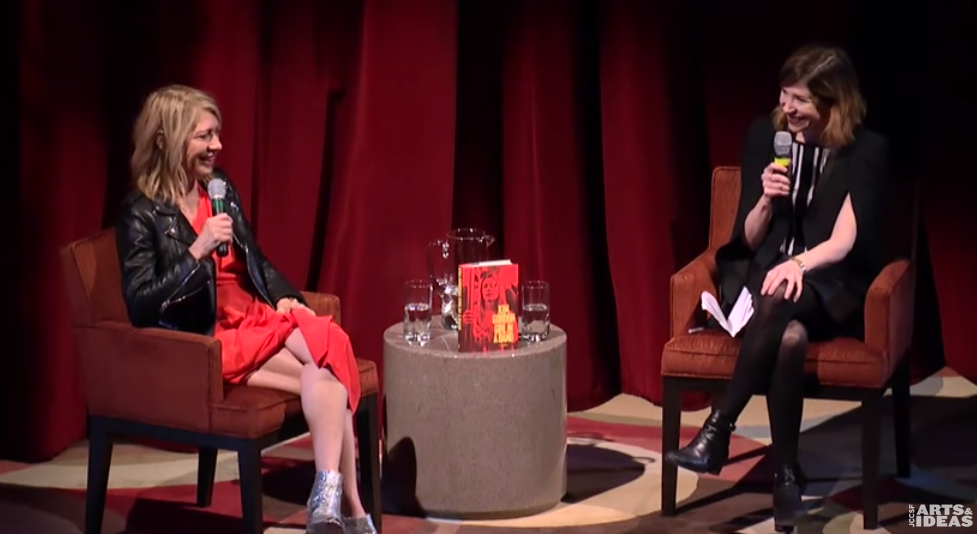
VIDEO: Kim Gordon in Conversation with Carrie Brownstein

Kim Gordon, rock legend and co-founder of Sonic Youth, just released her first memoir, Girl in a Band. (Read our review here.) Carrie Brownstein, co-founder of Sleater-Kinney and co-star of Portlandia, also has a memoir coming out this year. You can watch these two rockers-turned-memoirists in conversation in the above video filmed at the Jewish Community Center of San Francisco.

Erasure Methods

“Erasure Methods”
by Annie Ostlund

Emily has been living in the greenhouse ever since the sixth dog died. She returns to our house now only to replenish her supplies — flashlight batteries and almond butter sandwiches — or to trade out the books on Iceland and Finland she’s been devouring lately. The last dog was a northern breed, densely furred and husky, and it seems to have twisted open a lockbox inside Emily that she doesn’t know how to close. She refuses to talk about our new living arrangement. She speaks only about dogs from the shelter, how we aren’t doing enough, how we can never do enough.

I could trace it back, how Emily got here, though I’m not supposed to. Tracing, Dr. Z says, is useful only if you are looking to illuminate an origin, and illumination is inherently problematic. The human brain! he shouts. Look at this pink heap of matter chugging along so industriously — look at the brain thinking it can manage all the woes of the body! Dr. Z shouts when he becomes overly inflated with excitement, which happens at least twice during every meeting at the Center. He claps his hands against the sides of his waxy, bald head. The human brain thinks illumination means truth, he says, but a good student knows better. A good student sees an open hand, never a closed fist.

The Center is in Dr. Z’s house. There are floor pillows and softly lit lamps, thumbprint cookies and loose leaf teas, and paper garlands strung along the windows, which are made by the kids who come to the Center after school to learn about animal intuition and ESP. The rest of us come to Dr. Z for bigger things. We come to rearrange the molecules of the past, to erase what we no longer need; we come to exhale the demons, to get clean. This is what we’re told on our first day. It sounds like mystical New Age bullshit, but it works. The seething black knot in my neck is beginning to feel lighter. That’s where Dr. Z found my anger, there on the knobby peak of my spine. Our work begins with Level One: Locating. Locating is like a treasure hunt. We learn to find the energy, to sit with it and not resist. We’ve been watching the knot in my neck for months now, and I’m told it’s changing color already. I can’t see the colors, but Dr. Z can. There are charts up in the meeting room. Anger is black, sadness is blue, empathy is yellow like a marigold.

Eventually, we’ll make it through all the levels. We’ll learn more advanced techniques: how to ground ourselves like trees, and how to turn our bodies into bodies of glass. Body of Glass is all about seeing inside. It’s about releasing the negative clusters of energy, learning to make them go up and out instead of down and in. It helps the colors change. But releasing begins in Level Three, Restoration, and right now I’m still in Level Two, Erasure. When I ask Dr. Z when I’ll be ready to graduate to the next level, he leads me to the cookies and says, “You still need one more long, clean sweep across the chalkboard.”

“And then?”

“Then we’ll move forward.”

“When does that happen?”

“It’s impossible to say when, Wes. Here, we only say how.”

But he also makes promises. Your history is not your fault, he says. Eventually you’ll find yourself moving from black to blue to marigold. And I believe him.

In every meeting, Dr. Z likes to remind us that there are no coincidences. He’s big on fate. You have built the structure of your life, he says, throwing his arms into the air. You! The doors are open. There is already space within you for every breeze that will float through. When I walk into The Center tonight, I see her right away: Sheila in the back of the room by the round tin of shortbread cookies. My mother’s old friend Sheila who I had sex with once when I was seventeen — spilling coffee down her blouse and cursing under her breath. I remember instantly why I’d wanted her all those years ago. She possessed a rare and enthralling combination of elegance and irreverence; she could say fucking hell with a grace that should have only belonged to royalty. She looks up and narrows her eyes now. I give a hesitant wave.

“Wes Prince? Is it really you?”

“You missed your target,” I say, handing her a napkin.

“Because I need a real drink. I haven’t quite figured out what goes on here yet, but I think there ought to be spirits.” She pats the ends of her hair, which frame her face like a puff of colorless cotton candy. “Wes Prince,” she repeats. “What a fucking world!”

“Shh, would you?”

“What, you have a secret life as the Dalai Lama?”

“Maybe I’m here undercover.”

“Please, I’d have recognized you from fifty prayer rugs away. Except you’re thinner. You aren’t doing drugs again, are you?”

“Glad your memory’s still sharp.”

“Oh, shit, I’m sorry. You gave that up years ago, didn’t you?”

“It was hardly even a thing.”

Sheila nods. “You were a good kid, despite everything.”

I suck at my paper cup of coffee and watch the room fill up, remembering Sheila all those years ago. She wasn’t so old, I’d reasoned, and it had all been so mindlessly easy, like we had filed into a roller coaster car together and brought down the metal seatbelt, and all we had to do was wait. Her floral perfume had made me want to sneeze, and she complained briefly because we were under a streetlight and she wanted more darkness, told me she wanted to pretend I was someone else. Forget it, she snapped when I asked who, but then she whispered a name. Who’s Paul? I asked. Sheila’s face was full of anguish. Just kiss me, she said, and I did, but she had already begun to cry. I remembered that Sheila had mentioned Paul to my mother during dinner, and I had the distinct sense that Paul had hurt her, and also that Paul was dead, and that made me want to die a little bit too.

“So you’re the one doing the renovating,” Sheila says. “I heard your name and I thought, How many Wes Princes can there be in one city? Only one, obviously. So you’re a fancy-schmancy architect after all.”

“I don’t know about fancy.”

“Dr. Z said the new second level is going to look like a cloud. It sounds dreamy.”

“We’re still in the planning stages.”

Sheila smiles her knowing, peaceful smile, all red lipstick and white teeth. “It’s nice as hell to see you. Your mother doesn’t call anymore, you know. She can’t forgive the past.”

I stare at her teeth, not wanting to look at her eyes. They are teeth that knew braces, teeth scrubbed diligently with mint toothpaste every night. I picture Sheila shimmying floss between her sharp incisors. It looks like a mouth that has never been slammed into, a face that has never known pain. But I know better. I shove my hands into my pockets just as Dr. Z comes to the front of the room.

“Oh, it’s starting,” Sheila says. “Doesn’t his presence make you tingle?” She pulls me down onto a floor cushion, and I’m grateful that I don’t have to speak.

Late that night I find Emily kneeling beside the bathtub, massaging hypoallergenic oatmeal shampoo into a new dog’s coat. This one’s big, a German Shepherd, his fur coarse and spiked with gray. He’s lying down in the tub. Usually the dogs stand, calculating their escape, but this one has acquiesced.

“Bad joints,” Emily says. Her eyes are glassy. She has been bringing home elderly dogs for years, part of a foster arrangement available only to people who prove their hearts sturdy as concrete. The arrangement allows her to love them like a real owner might, but for less time. We’ve been through six dogs together. Most of them, she says, need human contact until the very last second.

“What’s this one called?”

“George of the Aegean Sea.”

“Is he from Turkey?”

“No, but he likes turkey.” She wipes her soapy forearm across her eyes. “I fed him scraps earlier. He ate like he’d never seen meat before. He has arthritis and probably cancer. There’s a lump. Want to feel it?”

“You can’t keep this up, Em.”

“But look at his face. How can you turn away from that face?”

I look. The dog appears barely conscious, soothed by Emily’s careful hands. I want to get closer, to see what Emily sees, but I’m rooted to my spot in the doorway. She inhales deeply, and I wonder what she’s taking in — the smell of wet dog, or shampoo, or maybe me and my own undetectable flow of pheromones. I walk to the bathtub and squat down. The dog looks at me without moving his head, a wise, graceful acknowledgement of my presence.

“Touch him. He wants you to touch him.”

“He does not. How do you know?”

She doesn’t answer. I put both my hand on George’s wet chest. His heart ping-pongs between my palms.

“This is the last one,” Emily says. “The last dog, I promise.”

“A break would do you good.”

“And the house, Wes — I’ve been thinking we should sell.”

“Our house? No. Absolutely not.”

“It’s cold and it echoes. I know you love it, but it’s a concept, not a home.” She bats my hands away from George. “Go, please. I can finish this alone.”

We bought the house not for its bones or character, but because it was set against the hill in such a way that made it feel secret and protected. The plan was always to gut it. I wanted to build an entirely organic dwelling, to let the forest wrap around the walls of the house. I explained everything to Emily, how structures should be viewed as unified organisms, and the concept of rooms as cells, and the absurdity of square spaces. We aren’t meant to confine ourselves to rigid lines and two-dimensional walls; nothing else in nature does. Such unimaginative design disrupts harmony and rhythm. It stifles the spirit. It stops the air from flowing through.

She agreed. We knocked down walls and created wide, arched doorways. We put in circular skylights and constructed rooms around natural elements: river rocks, plants, driftwood harvested from the coast. Emily! I would cry, storming through the house to find her, eager to share a new plan. You’re yelling! she’d holler, but I couldn’t stop. And the yelling was different now. I had somewhere positive to channel my excess energy. My anger was lighter, my episodes less frequent. I no longer used substances, no longer left fingerprint-sized bruises on Emily’s wrists. There were no more screaming matches, no more tiny ruptures in her vocal chords that must have made it painful to breathe. The house was fixing all our past slipups, all our faults. We would connect the cells and make a single perfect organism.

I became obsessed with the idea of living walls. I spent hours at nurseries, buying plants by the cartload. The first living wall went in my study, the second in the bedroom. Genius, Emily whispered. She stowed the humidifier in the closet and woke bright-eyed every morning, thrilled at how the increase in oxygen made her feel. Slowly, my obsession was transferred. She would stand over a pot on the stove, lamenting the seasons and how impossible it was to grow anything in the Pacific Northwest. We had leafy greens and onions by the bushel, but almost nothing of another hue until July when the berries appeared. We could have tomatoes, she said, if we had a greenhouse. We could have peppers and orchids. Orchids! She pointed out the window. Our own exotic oasis of plants.

She spent weeks pouring over heirloom seed catalogs. I could almost see her transforming, stretching her leafy arms out from dirt, pushing herself right through the ceiling of our lives. The first night she went to the greenhouse, I watched her float across the yard. Wrapped in a blanket and shivering, pulling all the isolated parts of her body toward the center, like a continent drawing close all the islands that surround it. I spend my nights now walking between the living room and the kitchen, trying to remember hunger. I picture Emily on the paved stone floor out there, in the sleeping bag that smells like wet earth and burnt marshmallows, and all I see is my wife wrapped in orchid petals and cabbage leaves. I write Dr. Z an email. How did we get here? I ask. Humans. How did we get this far?

George of the Aegean Sea is gone a week later, slipped peacefully out of his body one Saturday morning while Emily is at work. He’s under the desk in my office when it happens. I’m rearranging the layout for my website when I feel a shift in the air, all the molecules in the room briefly on pause. I put my foot against his body to feel for a heartbeat, but it’s gone. I call Emily home from the artificial flower warehouse where she volunteers for weekend shifts. She carries George’s body out of the house by herself and waits for the van from the shelter to come. She looks small out there on the sidewalk, arms tied so tightly across her chest I think she might burst a lung. As the van is pulling away, Emily hurries back toward the house, but in her rush she trips on the wet walkway and goes flying, arms out in front of her. I run out to the porch but she’s already on her feet.

“I’m fine!” she yells, brushing wet pine needles and dirt off her skirt. “I’m fine, don’t come near me.” She puts her hand to her mouth, and when she pulls it away to assess the damage there is blood on her knuckles.

“You’re bleeding,” I say.

“It’s not like it’s the first time.”

In the backyard, we stand in front of a temporary headstone, a small clay coaster on which she’s written Here lies George of the Aegean Sea, 1999–2012. There are six others lined up along the fence, weathered and forlorn.

“Are you going to say a few words?”

She nods, but her mouth is obscured by a white pouf of toilet paper, painfully red where she holds it against her gums.

“You don’t have to.”

“None of them have ever died at home.” Emily hiccups back a sob. She drops to her knees, and when I reach for her — the second my fingers graze her shoulder — she screams. One short, feral scream that quiets the birds, the crickets, the breeze. I can hear the air in her lungs, as though a wall inside her chest has torn. I want to push my arms down her throat and pull the scream out, or pull her lungs out and cradle them, or set them in one of those glass-domed baby incubators where the environment is perfectly controlled, where blood and oxygen flow freely and safely. The bloodied tissue falls from her mouth.

“It’s okay to scream,” I say. “It’s just an energy release.”

“Don’t.” She twists away. “Don’t use your methods on me.”

“That’s a fact, not a method.”

“If I can’t understand it, then it’s not a fact. Brainwashing is not an acceptable form of love, Wes.”

“It’s not brainwashing. You have no idea what we do there.”

“There — see? The way you talk now, it makes me nervous. I don’t trust it.”

Back inside the house, I write down her words and place them beneath a paperweight on my desk. Brainwashing is not an acceptable form of love. But it isn’t brainwashing. Or maybe it is — and if so, does it matter? So maybe I want my brain scrubbed clean. It seems to me that Emily has it backwards: maybe love itself is the subtlest form of brainwashing.

We sit together near the back of the meeting room, cookies in our laps and hot paper cups in our hands. I have brought a gift for Sheila, one arm of a succulent snipped from our bedroom wall, planted in a peat moss pot so it will take root. “I’ll kill it,” she says when I hand her the pot.

“You won’t. Give it light, forget to water it.”

“Funny, that’s how all my ex-husbands killed me off.”

Sheila crosses her legs toward me and taps her bare toes into my calf every time Dr. Z says something meaningful. Her toenails are painted a glittery indigo, the tip of each toe a self-contained night sky. I feel warm there beneath the balmy heat of the overhead light, Dr. Z on the rug at the front of the room, quietly authoritative.
“These cookies are made of sand,” Sheila whispers. “I’m not even hungry, anyway.” She puts the cookie in her mouth and chews slowly. “You want to know a secret? I didn’t start hating myself until recently. I thought I’d made it past all those bullshit youthful moments of self-disgust, but then it hit me out of the blue.”

“Is that why you come here?”

“I come because it’s better than AA. What about you?”

I realize Sheila knows nothing about me. She knows only who I was twenty years ago, only what went on in the car that night, how her crying had made me panic. I’d grabbed her so hard by the jaw that her bones had popped, and I’d held on until the terror in her eyes finally collapsed, her whole face like a tiny straw house buckling in my hand. The air went out of her and I let go, the thought of sex suddenly as ludicrous as opening the car door and expecting to find we’d parked on a cloud.

“I used to have episodes.” I’m holding my breath, afraid to let it out. “I have a rage thing, a problem. I’ve hurt people. You don’t remember?”

“Oh, god, sure. What, you think you were the first man to lay a hand on me?” Sheila laughs. “Probably my fault, anyway. I saw the potential in you and wanted it. I’ve been fucked up for years.” Gently, she presses her finger to the center of my forehead, right between my eyes. “You know your knot is turning blue.”

“You can see the colors?”

“Sure, can’t you?”

She says it so nonchalantly that I’m flushed with admiration. We’ve only sat together in the large group meetings; I don’t know what she does in private with Dr. Z. If she’s on to Level Four or Five, or if she’s a prodigy, or if she’s already healed.

Sheila applies more pressure with her finger. I imagine her finger as a skinny needle, siphoning the murky ions from my bloodstream. But my head is too heavy, my neck too swollen with blood, my muscles sore, everything blocked and static.

“Don’t try so hard,” she says. “It’ll happen when it happens.”

“I want to see what you see.”

She leans close. Her dangling earrings swing toward me, large oval hoops. I want to touch the underside of her jaw, to apologize for the scene, to ask her who Paul was, or if she loved him, or if it even matters in the end who we love and how we love them.

“Patience,” Sheila says. “Wherever you are, it’s a temporary state.”

Emily is stretched out on top of the sleeping bag, reading in the funnel of light given off by a flashlight. She has moved on from the book on Finland and now has a travel guide for Russia in her lap. She is ring-less, shoeless, and without makeup, swaddled in a blanket that renders her body amorphous. A new orchid sits on the table above her, its petals spotted like a leopard’s hide.

“You look flushed,” Emily says.

“I had a good meeting tonight.”

“Tell me, why it is you think there’s some other life waiting for you, some better life?”

“It’s not about a better life. It’s about being a better person.”

“What if I told you I’m in love with the gardener?”

“We don’t have a gardener. You’re the closest thing we have to a gardener, Em.” The knot is tightening at the back of my neck. I try to wrestle my breath back into the realm of normalcy by focusing on details: the tiny mole beside her left eye, the shadows around her collarbones, the bitten tips of her nails. I focus on my own connective tissues, the trail of muscles that extends from my neck to my hands, wishing for the tense black energy to drain out and away. “You don’t have to speak in code. I know you don’t want to live here with me anymore.”

“And you don’t care.”

“I don’t know what else you want. Your travel books and then these flowers — you can’t go to Russia and grow orchids. You can’t have both extremes, Em.”

“I don’t want extremes. I want passion.”

“You want passion, so you’re choosing this?” I grab for the orchid nearest me, pinching the stem of one just below the flower. There’s a satisfying snap. The flower falls into my palm, beheaded.
Emily makes a strangled sound. She lifts her book again, shielding herself with an expanse of white tundra. “I can’t wait around anymore for you to choose me, Wes.”

I step out of the greenhouse and cross the soggy lawn. It’s a clear night. The moon is visible through the open doorway, rising above the silhouette of our house. Beside the back door, a single piece of driftwood rests against the house — a leftover remnant from renovation, its cloud-gray hue the color of winter morning air. I lean against it and let the orchid petals fall from my fist. Through the screen door, the phone begins to ring. The woman from the shelter has left three messages since yesterday, desperate for Emily. They have an Australian Shepherd mix, a twelve-year-old male with hip dysplasia and cataracts. I already know that I’ll go there tomorrow morning. I’ll race along the frontage road and kneel beside that mopey-eyed dog, working my fingers through its dense coat. The phone rings and rings, the sound echoing through the halls, coursing beneath the raw archways, spilling out the skylights, running like water through all the diaphanous blue veins of our house, and I know that we are finally done tracing. Dr. Z! I want to yell. Look at the colors! We are exhaling, we are releasing, we are sweeping it all clean.

Midweek Links: Literary Links from Around the Web (March 18th)

Looking for some interesting reading to get you through hump day? Here are some literary links from around the web to check out:

bad kindle covers

Who said you can’t judge a book by its cover? Kindle cover disasters at The Guardian

Read Rita Dove’s tribute to Toni Morrison at the NBCC awards

How a Conan Doyle science fiction story became a horrific reality

A reader’s guide to the works of Italo Calvino

The Literary Hub is coming to unite the internet literary world

The Millions thinks we should stop writing literary biographies

Is the novel dead yet again? Vox collects 30 times the novel has been declared dead since 1902

Scientists have found the long lost bones of Miguel de Cervantes

Finally, Flavorwire collects 50 great novels that deal with madness

Spanish Scientists Have Found the Remains of Miguel de Cervantes

Spain has been searching for the bones of Don Quixote author Miguel de Cervantes for quite a long time. We wrote about this “quixotic” quest in 2012. Today, news broke that the search is over and scientists are confident that bones found in Madrid’s Convent of the Barefoot Trinitarians are his. BBC reports:

“The remains are in a bad state of conservation and do not allow us to do an individual identification of Miguel de Cervantes,” said forensic scientist Almudena Garcia Rubio.

“But we are sure what the historical sources say is the burial of Miguel de Cervantes and the other people buried with him is what we have found.”

The search involved 30 researches and used radar and 3D scanners to find and confirm the remains. Cervantes died on April 22nd, 1616, meaning his remains have been found 399 years after his death. The crypt will be opened to the public next year on the 400th anniversary of his death. His masterpiece, Don Quixote, is considered by many to be the first European novel and is still widely read around the world.