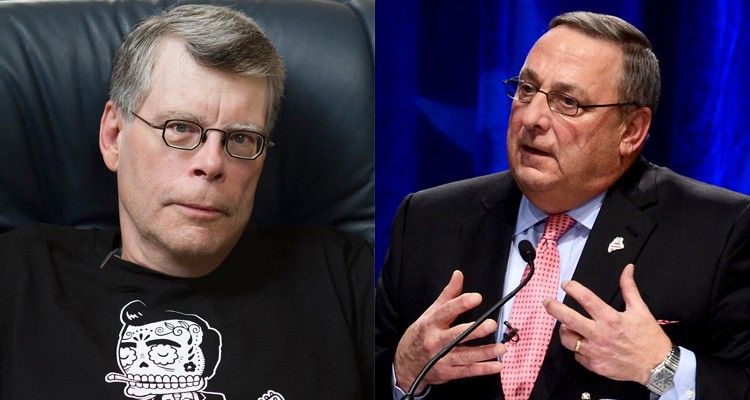
Horror icon Stephen King took to Twitter to call out Republican Gov. LePage for claiming that the author didn’t pay Maine income tax. LePage had made the claim on his weekly radio address.
Governor Paul LePage implied that I don't pay my taxes. I do. Every cent. I think he needs to man up and apologize.
In 2013, my wife and I paid approximately 1.4 million (dollars) in state taxes. As this is a matter of public record, I have no problem telling you that. I would imagine 2014 was about the same, but I do not have those figures.
King, who is one of the best-selling authors in the world, also noted he donates several million to charities. King is an outspoken Democrat and endorsed the conservative LePage’s rival in the last election.
King was born in Portland, Maine, graduated from the University of Maine, and has set a large number of his best-selling novels and stories in Maine.
UPDATE from 3/27: Maine’s governor finally responded, saying he would not apologize but telling King, “Just make me the villain of your next book and I won’t charge you royalties.”
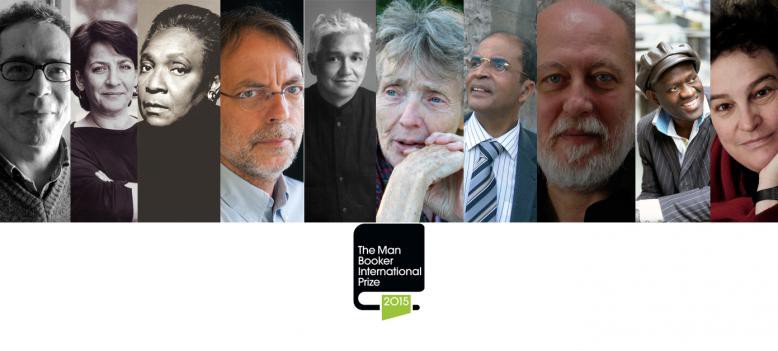
The finalists for the prestigious Man Booker International Prize were announced today. The finalists include César Aira, whose story “Athena Magazine” we recently published, László Krasznahorkai, and Fanny Howe. The winner will receive a £60,000 award. The prize, an offshoot of the famous Man Booker Prize, has been given out every other year since 2005. The previous winners were Ismail Kadare (Albania), Chinua Achebe (Nigeria), Alice Munro (Canada), Philip Roth (United States), and Lydia Davis (United States).
Here are this year’s finalists:
César Aira (Argentina) Hoda Barakat (Lebanon) Maryse Condé (Guadeloupe) Mia Couto (Mozambique) Amitav Ghosh (India) Fanny Howe (United States of America) Ibrahim al-Koni (Libya) László Krasznahorkai (Hungary) Alain Mabanckou (Republic of Congo) Marlene van Niekerk (South Africa)
If aliens were to use our fiction as an accurate representation of our real history, they’d think civilization fell apart in the early 21st century. Everywhere one looks there are apocalyptic signs in our literature: the cats of Robert Repino’s Mort(e), the Shakespeareans of Emily St. John Mandel’s Station Eleven and of course, every single person you know in either a writing workshop or MFA program who has just written a story titled “They Might Be Giants, They Might Be Zombies,” or some similar kitschy-knowing fare.
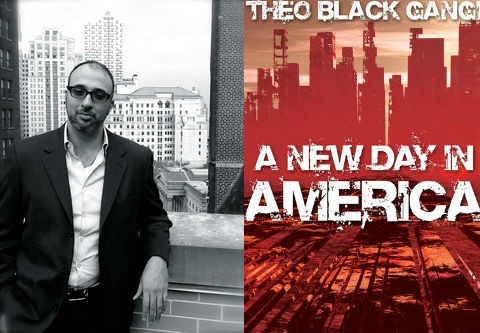
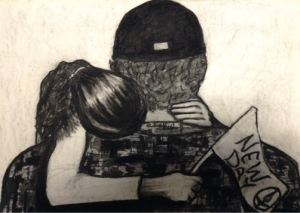
Enter into this, an unlikely apocalyptic-writer; Theo Gangi. Theo is a Brooklyn-based-writer, but he doesn’t write the kind of stuff you’d normally associate with Brooklyn-based-writers. Starting his career primarily as a crime writer with the novel Bang Bang, Theo recently turned his talents to a unique and under-the-radar apocalyptic novel; A New Day in America, published by James Frey’s ebook company, Full Fathom Five. If Gangi is an uncommon phylum-less writer, then his new book is much the same; an apocalyptic novel with Victor LaValle’s wry grittiness combined with the rapid-fire writing style of a hard-boiled crime novelist.
I talked with Gangi about race issues at the end of the world, apocalyptic Brooklyn versus apocalyptic Manhattan, and where an iconoclast like him weighs in on the genre wars.
Britt: A New Day In America is not the average post-apocalyptic novel. Did you feel wary of the genre? Were you afraid of certain tropes?
Gangi: When I wrote the first draft, I deliberately avoided reading PA lit, so yeah, I was a bit wary of tropes. The problem with that approach is you might write smack into a trope on accident. I knew I did not want zombies. It’s like the first thing I tell people. I say ‘I wrote a post-apocalyptic book and there’s no zombies.’
Britt: Outside of your book, what makes a great apocalyptic story? Do you have any favorites?
Gangi: Books that illuminate the human values that will endure the devastation. People often confuse apocalyptic literature with nihilism. Nihilism to me is just laziness. A few years ago, Neal Stephenson called on sci-fi writers to stop being so damn pessimistic. One of my favorite PA books is Walter M. Miller’s A Canticle for Leibowitz, where a group of monks risks their lives to preserve literacy and knowledge after the fall of civilization. Also Philip K Dick’s Do Androids Dream of Electric Sheep? Deckard’s motive is to own a real sheep, and he is ashamed that all he can afford is an electric one. That was always very touching to me — that we would miss the dying natural world so dearly that we would take care of electrical animals and crave real ones.
A good PA novel challenges our notion of ourselves. We only know who we are by the context of our social and infrastructural reality. I think we collectively itch to know who we would be without the world we’ve shaped to. A novel is a good exercise in that hypothetical. We wonder what decisions might confront us. Will we, when the time comes, make the moral decision or the practical one? Which choice serves the most good, idealism or survival? Is survival akin to a moral imperative?
With the pillars of society stripped away, all that is left is the enduring human spirit. Sure, there will be the savagery and ignorance that’s a constant throughout history, but also the love, honor, sacrifice, the soul. As Faulkner said, ‘man will not merely endure; he will prevail.’
Britt: We’ve seen New York City destroyed in a number of ways throughout the years in novels, films and TV. But is it more fun to destroy Brooklyn?
Gangi: Super fun to destroy Williamsburg.
Britt: Could you have survived the things you describe Nos experiencing? Do you personally fear the end of days?
Gangi: I fear the end of my days. To paraphrase Woody Allen — I don’t want to achieve immortality through my work, I want to achieve immortality by not dying.
Britt: Can you tell me a little bit about what role race and ethnicity played in how you wrote this? We don’t see a lot of black protagonists of this kind of sci-fi survival story. Why is that?
Gangi: I suspect it’s for the same reason there aren’t a lot of black protagonists in most genres. People often think a black protagonist is a genre in itself. My first book was a crime novel called Bang Bang. At Borders bookstore (RIP), it was shelved in the African-American Lit section. For no other reason than that the protagonist was black. He was also half Jewish, but Bang Bang never made it on the Judaica shelves.
In terms of sci-fi/fantasy, I’m sure it’s in part because the readers are predominantly white, and publishers and studios want characters that their audience can relate to. But I think that’s incredibly shortsighted. Junot Diaz talks about how there’s a natural affinity between people of color and genre fanboys and fangirls. Anyone who feels marginalized by mainstream American culture. There are great sites like blackgirlnerds.com that show this audience exists and is really enthusiastic.
Even as a kid, I never understood why there weren’t more characters like Chris Claremont’s Storm from X-Men. She’s a black character, her blackness is inseparable from who she is, but it never defines who she is, any more than it defines the genre she appears in. I mean, she’s a freaking weather goddess. And she’s such a badass character that her best storyline is when she loses her powers and fights mutants bare-knuckle style in the sewers. Fox Studios needs to get it together and give Storm a proper vehicle. She has about as many lines as there are X-Men movies.
When writing Nostradamus Greene, I wanted a black American hero whose race is integral to who he is but does not define who he is. His decisions and actions define him: His commitment to push himself to near superhuman limits to keep his daughter alive. His ethnicity and history is a part of that. Nos was set aside by his father — a self-hating Dominican cop in Brooklyn who wanted more than anything to be an Irishman. So Nos’ devotion to his daughter Naomi is in part retaliation against how his father rejected him. Nos is flawed — prone to anger, violence, pity and despair, and in spite of that he finds a reason to live that is greater than himself. “Anyone with a ‘why’ to live can overcome any ‘how’.”
Britt: There’s a great joke in the beginning about Denzel Washington is Denzel Washington as Denzel Washington in Denzel is Pissed. Is there a stereotype about the “badass” black male? When does it work in fiction? Or, to put it another way, could we never “buy” Samuel L. Jackson as a Jedi Knight because of that “angry” stereotype?
Gangi: Starring Denzel Washington.
Great question. I think this one is less about the ABM (Angry Black Man) syndrome and more about our American confusion about ‘blackness’. When people say ‘he sounds black’ they are really referring to an American regional dialect, not race. In other words, if Sam Jackson grew up in Manchester, England, he wouldn’t sound like Sam Jackson, he’d sound like a Manc. The Pulp Fiction Samuel Jackson with the wallet that says ‘Bad Mutherfucker’ has that trademark attitude that doesn’t quite scream ‘Alderan’. I love Samuel Jackson but this role wasn’t in his wheelhouse. He’s clearly trying to tamp dawn his Sam Jackness in the films, and it hurts the performance. Heavy American regional accents often don’t work well in sci-fi/fantasy. You don’t want to hear a Detroit 8 Mile accent in Westeros or a southie accent in Mos Eisley. Kinda ruins the illusion. Everyone loves James Earl Jones as Darth Vader, and he doesn’t exactly have the pipes of a white man. And when he says ‘tear this ship apart until you find those plans,’ that is one angry black Jedi.
Britt: Your first novel was a crime novel — Bang Bang. Do you see this book as a departure?
Gangi: For sure. I got burned out on crime novels and became obsessed with books set in speculative ‘elsewheres’ — historical fiction, fantasy, sci-fi, etc. I had to try my hand at world building. I suspect I’ll return to crime one day. I have a high chance of recidivism.
Britt: So far in your career you’ve got a lot of labels: crime/mystery and now sci-fi/dystopia. How do you feel about genre labels? Love them? Hate them? Indifferent?
My biggest problem with genre labels is how insufficient they are. There’s so much more to a book than concept and setting.
Gangi: I think they’re a necessary evil. Genre labels are reductive, they box in readers, and that in turn boxes in writers. But the bottom line is this: You need to know what neighborhood you’re in. My biggest problem with genre labels is how insufficient they are. There’s so much more to a book than concept and setting. Writing style, dialogue, mood, pace, scope, character development — these are all crucial elements of books that current genre labels fail to address. This directly impacts the way books are written. If your approach to character is more like the repartee of an Elmore Leonard crime novel, but it’s set in a dystopian future, readers who like your style will never find your book. Just because you write dark fantasy doesn’t mean you’re interested in sinewy arms and heaving bosoms. But because our genre labels conflate style, character and concept, that incentivizes sameness.
I think a possible solution here might be an algorithmic one. According to an article in The Atlantic, Netflix has 76,897 unique ways to describe types of movies. It’s easy to make fun of the absurd specificity of ‘Visually Striking Latin American Comedies’ and ‘Evil Kid Horror Movies’, but there’s a seed of innovation here. The challenge is for the intangibles of content to be represented by their labels. So someone who likes gritty, suspenseful stories will find a ‘Gritty Suspenseful Revenge’ category, a ‘Dark Suspenseful Gangster’ category, and a ‘Dark Suspenseful Sci-fi’ category. Whereas the literary genre equivalents would be ‘Thriller’, ‘Crime’, and ‘Sci-fi’. A devoted crime fiction reader would never find sci-fi book, even though that might be right up their alley. Jim Butcher fans might really like a moody mystery novel like CB McKenzie’s Bad Country. If they were in a bookstore, it would by almost physically impossible to find a title outside their genre. The Internet is capable of this sort of aggregation. I’m optimistic.
I have a great admiration for the loyalty of genre readers and writers. There are really solid communities of sci-fi/fantasy writers and crime/mystery writers. They read each other, support each other, and share a cannon of great works, and have a lineage of important writers creating in conversation with one another. I do find (with notable exceptions) that they often aren’t aware of one another. There were two books that came out in 2007 called The Blade Itself. One by the crime writer Marcus Sakey, and the other by the fantasy writer Joe Abercrombie. Both books are absolutely terrific. Both writers were a big hit with their respective fan bases. And there was zero overlap. If you ask a fantasy fan ‘did you read The Bade Itself?’ They won’t ask, ‘which one?’ They only know the one. Same with crime readers. I still haven’t spoken to anyone that read both books.
Britt: In what ways does your writing style mash-up genres?
Gangi: I’m a sucker for a showdown. Verbal sparring between the hero and the villain, or the hero and the love interest. That kind of slick talk that flirts with the edge of danger but never quite crosses the line, until it does. Elmore Leonard was the master of this. He started his career writing westerns. He took that high noon style and put it in contemporary crime novels and it worked. George RR Martin masterfully works showdown dialogue into Game of Thrones. I think it’s the Bayonne, Jersey disguised as medieval English. The scene when Theon Greyjoy first meets Asha Greyjoy is right out of an Elmore Leonard novel, when the hero meets and flirts with the prospective love interest. Of course, in Martin’s world, the love interest turns out to be his sister.
It’s a quality I associate as classic Americana. That style of verbal measuring and greasy talk is a big part of Bang Bang and a big part of A New Day in America. If it works in crime novels, it works in westerns, and it works in Westeros, it will work in the apocalypse.
Britt: What are influences on your work that some might find “unlikely.” For example: are you writing while listening to the Muppets soundtrack or something?
Gangi: Ha! I went back to my formative years and read the Japanese magna The Lone Wolf and Cub. Not sure if that’s ‘unlikely’ as that story cornered the killer-father-with-child concept. The landscape of feudal Japan felt right for the apocalypse. Samurai assassin Itto Ogami and his son Daigoro serve as a great model for Nostradamus Greene and Naomi. Apocalypse stories, while set in the future, are actually a return to the past. The time after modern civilization would resemble the time before it. The paradox of the killer-father character has a brutal simplicity. A man with a gun is a killer. A man with a gun and a child at his back is a hero.
Britt: This is becoming a question I ask of so many writers now: Imagine it’s 100 years from now and your books are being taught in school. What is some stuff people might misinterpret about your books?
Gangi: Tough question. It depends on what genre of 100 years from now we’re talking about. Is this an advanced society where terabytes of old novels are being aggregated by synthetic intelligence so computers can learn how to ‘love’? Is this future a wasteland where literacy is endangered and scraps of pages are being smuggled by book runners to save the written word from extinction? Or is this a future where students can travel 100 years back in time and ask me a series of questions? What I’m really asking is, are you from the future?
Britt: Sci-fi and adventure stories often don’t feel like they are autobiographical. But, how much of this was drawn from your own experiences? If not in the logistics, then in the emotional reality of the book?
Gangi: It’s the thought of protecting your family that really centers the book. Nos Greene kills a lot of people, which isn’t really something I can personally relate to. Then you imagine your child’s survival depends on you killing all those people. Then it’s like, ok sure, if it would save my daughter’s life, I’d kill everyone. I don’t even have children — just a wife and a dog. I’d still kill everyone.
Britt: What’s a book everyone loves that you don’t love?
Gangi: I’m a bad person to answer this question, as I’m a firm believer in not reading books I don’t like. There’s just too many good books and too little time. I think reading a book you’re not into is like being in a bad relationship. You’re dating someone you know you don’t like and you know it’s not going anywhere, but you keep calling them anyway.
That said, to answer the question, any book by Paul Auster. Bad fit, I guess.
Britt: What’s next?
Gangi: Sequel! Tentatively titled Another Day in America. The second in a trilogy about the quest for the cure amid America at war. I have a crypto-thriller called DARKER in the works, about an obsessive, voyeuristic society and a live-feed murder lottery network called Crap Shot, where gamblers place bets on killings. I also have a middle-grade children’s fantasy series tentatively called Elseweyr I’m working on, about a little girl named Else who can turn into an eagle. I know that sounds like an improbable genre jump, but after writing about gangsters, homicides, the apocalypse and live feed murder for 10 years, it’s nice to lighten up and turn into an eagle.
In the above video, award-winning authors Michael Chabon and Neil Gaiman discuss their love of the late Fantasy legend Terry Pratchett. Pratchett, who was the UK’s best-selling author in the 90s, had a wide influence on Fantasy and literature in general. Gaiman and Pratchett co-wrote the 1990 novel Good Omens. The video was recorded at the Jewish Community Center of San Francisco.
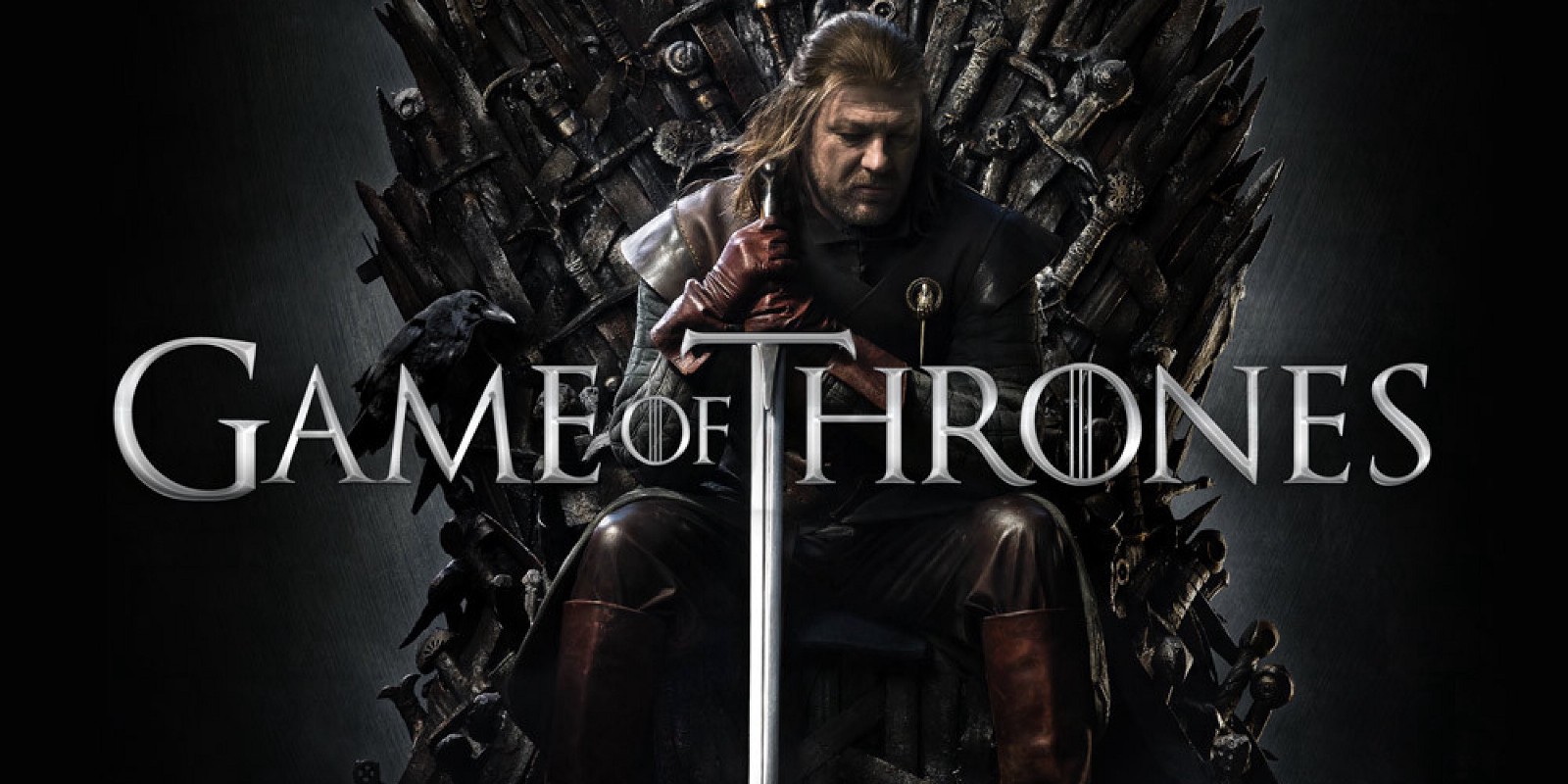
For years fans have worried that HBO’s adaptation of George R. R. Martin’s A Song of Ice and Fire, Game of Thrones, would overtake the books. Some TV show characters, like Bran, have already more or less reached the point they were left at in the last book. The TV show also showed us elements of the White Walkers that we haven’t seen in the books. So fans have been rightly concerned that the show would surpass the books. Yesterday, show runners Dan Weiss and David Benioff confirmed this will happen:
Luckily, we’ve been talking about this with George for a long time, ever since we saw this could happen, and we know where things are heading. And so we’ll eventually, basically, meet up at pretty much the same place where George is going; there might be a few deviations along the route, but we’re heading towards the same destination. I kind of wish that there were some things we didn’t have to spoil, but we’re kind of stuck between a rock and a hard place. The show must go on…and that’s what we’re going to do.
Truth be told, we all knew this was coming for years. Weiss and Benioff have said they only want to film seven seasons. George R. R. Martin has said he will write two more books. The last two books took an average of 5.5 years to finish. So even if Martin somehow rushed out book 6 this year, the TV show would still easily overtake the books before book 7 could realistically come out. Fans, and even George R. R. Martin himself, have proposed solutions such as taking a long hiatus or including a movie to wrap up the show… but that was never going to happen. HBO makes TV shows, and they can’t lock actors into contracts if the show goes on hiatus for the five years or so it would likely take for Martin to finish.
On the other hand, the TV show has already altered many plots and rumors are the show will kill of characters who do not die in the books. So book readers will still have some surprises in store whenever The Winds of Winter (book 6) and A Dream of Spring (book 7) are finally finished.
You can watch the video of the interview with the show runners and cast at Oxford Union here:
A year ago, a friend told me he doubted that he’d ever read a meaningful novel. He was then a third-year medical student, and couldn’t invest time in finding one. Judging by his taste, I suggested James Salter’s Light Years — a success. He took other recommendations to mixed results, and throughout the hits and misses I now believe I can clarify his ideal book’s necessary traits: 1) absolute realism and 2) sustained and relentless passages of insight. The best part of reading Light Years in your mid-twenties is that it feels like a crash course in life: you inherit the weight of a full life lived without having done the living. Though we may disagree on the definitions of 1) and 2), we can’t argue that a novel rarely accomplishes both. Rachel Cusk’s Outline: A Novel (FSG, 2015) is one of these books and how she does it is singular.
We begin in the air. The narrator speaks with her seatmate, ostensibly about his life, but what comes is a litany of hard truths. And yet, we’re at ease. If ever there’s harmony between character and writer, this is it. Cusk’s prose matches the frictionless flight; so effortless you believe every line has been lifted straight from her experience. And the narrator, a novelist, has the terrifying calm of a woman sitting comfortably in a devastated life. She listens to her neighbor tell the tale of his ex-wives. Honesty, perspective and fault are all questioned. We can quickly imagine Cusk flying us to the lands of the mutability of memory or no universal truths or even the intimacy of strangers. But she’s not that easy. What takes shape is something far more unsettling.
We land in Athens. From here on out, conversation is aplenty — not just best-souvlaki-in-town chitchat, but a torrent of introspective confessions. It’s a good thing the talk is so rich, given Outline contains nothing else. We go from interlocutor to interlocutor, only returning to a couple of characters — most notably her seatmate in the opening scene, which eventually attempts seduction with all of the gravitas of Snoopy. A structure built only on conversation doesn’t necessarily preclude plot (one recent example would be the film, Locke), but in this case we’re very far from following any three-act structure. Virtually all of the emotionally resonant passage that concern the narrator — a photograph taken years ago of her now dissolved family comes to mind — aren’t given resolution. Instead, we have a series of stories, most short enough to be offhand dinner party fodder: the narrator’s student’s sister’s friend’s house’s glass ceiling crashing down, a poet being silently harassed at every reading she gives, a woman beating her dog after it ruins a cake she made. The universality of these stories, though they are ridiculous, is undeniable. They are time- and place-agnostic. They are also one way Cusk is able to deliver insight after insight without having take a breath for the sake of plot, character development or any of the other tenets of storytelling taught during introductory creative writing classes. (Not without irony, the narrator teaches a writing class which one student finds so unsatisfactory she leaves, explaining, “I don’t know who you are, but I’ll tell you one thing, you’re a lousy teacher.”)
So what is a book built only from glimpses into secondary characters? It’s not a complete story, with purpose, consistent texture, a rise and fall and a lesson. It doesn’t have closure, connective tissue or redeeming growth. In other words, it’s just like an actual life. That is what Cusk is up to: giving us a real person by subverting the very nature of storytelling, that the medium is just and only that; it can tell us story but cannot tell us a person.
On the last day of her stay, the narrator is supplanted by a playwright. She wakes up to find the woman, the apartment’s next occupant, right outside her bedroom, shoveling honey into her mouth. It’s hard to count the layers of meaning folded into the new character (the least important might be how the dialogue-driven story might have fit more comfortably into a play — and be worse off for it). Consistent with the rest of the book, our new converser dives right into the most troubling aspects of her life, describing her inability to write, due to a problem she calls “summing up”. Once she’s able to summarize a work with one word (say jealousy), it becomes pointless to continue with it. The same became true of her life (a friend becomes just that, and can be nothing more). A loss of self (aided by a divorce and a mugging) continues to haunt her until (not insignificantly) a conversation with a seatmate on a flight. This man, she realizes, was her opposite and, being able to understand him, she can understand herself again, as his negative image: “…while he talked she began to see herself as a shape, an outline, with all the detail filled in around it while the shape itself remained blank.” Cusk uses the titular word only twice in the novel. This is the second.
The other mention is on the first page of the novel. A billionaire she meets with before her flight “had been keen to give me the outline of his life story, which had begun unprepossessingly and ended — obviously — with him being the relaxed, well-heeled man who sat across the table from me today.” The ‘outline’ here isn’t Cusk’s type — it’s the type defined by the character himself. The resulting image isn’t of a man but a caricature.
Cusk’s sort of outline doesn’t give us the facts of the narrator’s life. Instead, we get the reflections cast on her from the worlds of others. In doing so, we end up with something too foreign to fictionalize: the self built from the outside, and in that sense, it’s a “first-person novel” more than any. Her big insight, far more real than those given to her fleeting characters, is that, like any shape, a person can be defined by its outline.
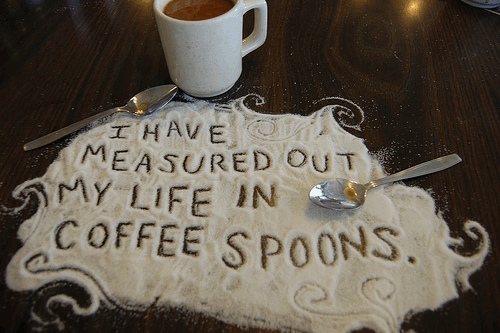
If you are a writer, you’ve probably measured out a good portion of your life in cafe coffee spoons. Well, today you writers can get your coffee for the price of a poem. To mark International Poetry Day, the coffee maker Julius Meinl has gotten over 1,000 coffee shops in 23 countries to agree to exchange coffee for poetry. You can see if your city has a poetry-friendly shop here (the vast majority are in continental Europe) or follow on twitter with #PayWithAPoem. Watch the video above to find out more.
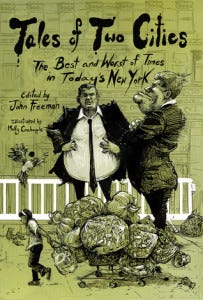
John Freeman is a widely published author and critic, as well as the former president of the National Book Critics Circle. His eponymous literary journal, Freeman’s, will debut in October this year. At the end of last year, Freeman served as editor for Tales of Two Cities: The Best and Worst of Times in Today’s New York, released by OR Books. The anthology includes fiction and nonfiction from David Byrne, Teju Cole, Junot Díaz, Victor LaValle, Téa Obreht, Edmund White and many others, all addressing, in various forms, the problems caused by the huge income disparities that have come to define so much of life in modern New York. A portion of the book’s proceeds will go towards Housing Works, a New York City based charity that helps people living with and affected by HIV/AIDS.
I reached out to Freeman in February, keen to discuss the issues raised in the book. The stories, poems and essays may be set in New York but the concerns portrayed, such as how to find decent, affordable housing, affect all of us; huge imbalances in income diminish everyone’s quality of life, however materially rich or poor we may be.
Worrall: Where did the idea for the book come from? What made you want to create it?
Freeman: I started making the book when I came back from London, and in some ways it was part of the thing that made me feel like New York City was home again. I’d been commuting back and forth and living more in London than I was in New York, and when I fully moved back it hit me how much the city had changed and how many more homeless people there were on the streets, and I thought, “Yikes!” So in many ways the book was my response to that reaction.
I was talking to Colin Robinson, the book’s editor, about how many businesses had changed hands just on one city corner block (on 23rd and 7th) and about how a shelter was being built on 25th street. It occurred to me then that there hadn’t really been anything written about the issues of income inequality in the city and about how you could really feel them on the street. There was a kind of silence, a literary silence, around the issues of inequality the city was facing, and I always think that literary culture is made to make you think, and that if people weren’t thinking about that then that seemed a problem.
I had planned as well at some point to wrestle with income inequality as a topic because of my own experience with my brother, and I thought that rather than write a whole book myself, it would probably be far more interesting to have thirty different writers write about what the city feels like today, with an eye on inequality but also with the freedom to write whatever they wanted.
So that was sort of the brief I gave to the writers: I want you to think about the city as it feels now and how inequality affects your life in it but if you don’t really want to address that then you can write about whatever you want. But all of them ended up coming back to it.
Worrall: Income inequality plays a large role in the pieces that make up this book. Would you say that’s the central, or the unifying focus?
Freeman: Well, the book’s main theme is that income inequality is about far more than just assets. The stories in the book explore many things about the culture that comes with entitlement and all the problems that come with disenfranchisement. These things are not easily solvable but the book does come back to a couple of things consistently, one of which is housing.
Even New Yorkers who are of the so-called middle-class can relate to the housing problem because everyone who comes here, unless they’re either fabulously wealthy or very, very lucky, ends up in really crappy apartments where there’s no heat: a very different environment from the suburbs they may have grown-up in. So the book explores the kind of baseline solidarity about how hard it can be to live in New York City and how hard it can be to find a house or to find a landlord who takes care of where you live.
Worrall: But couldn’t you say that the book is all about the fact the middle class is suddenly affected (because of the recession) and that’s why people are now concerned about these issues. After all there wasn’t this outcry when they were limited to the poor?
Freeman: Well, yes and no. Some of the people in the book are falling out of the middle-class and into the lower classes like in my brother’s story [Home by Tim Freeman]. But there are other people recorded in here, for example in D.W. Gibson piece [Partially Vacated] about the lawyer who works for tenant’s rights and the tenant who is, quite unlawfully, being bullied out of her apartment.
Worrall: So you have the classic New York Essay over the ages, you’ve got E. B. White in 1949 and then 1967, Joan Didion, and this book can be read in the context of those New York essays, but what interests me most about this book is that it’s the only one that employs race. E. B. White does mention race, but this book is the only one that enjoinders race within the discussion, as a key participant.
Freeman: I find that bizarre, I mean New York has been a fabulously diverse city for a long time and it’s increasingly impossible (and this is part of the reason why I wanted to make this book) to conceive of New York as a white city to some degree and I feel like, as much as I love those essays by Didion and E. B. White and some of the classic New Yorker writers, you can still read those pieces and envision the city as a 1950s Hollywood film with very small numbers of minorities, and, you know, cocktails at 5pm and poverty elsewhere.
Today I’m usually the only white person on the subways I take. The demographics of the city have changed and I think the story that the city has to tell about itself and the people that we listen to for those stories has to change.
Worrall: How did you select the essays that were going into the book? Some of them have been published elsewhere, so I was wondering about that process.
Freeman: I asked people whom I thought saw themselves as New Yorkers, people who felt like New York City was home even if they were from elsewhere. Zadie Smith, for example, seemed to me to be increasingly identifying herself with the city and she just happened to have written that story [Miss Adele Amidst The Corsets] which I felt like was such a great driving tour of the city that used to be, at least through one character’s eyes, so I said “Let’s just take that one”. But a lot of other people were willing to write something new.
I wanted there to be a balance of men and women and people from different boroughs: stories of the city can be heavily Manhattan based; Brooklyn would be the third largest city in the country if it wasn’t part of New York City. So I asked around and some of it happened by chance and some people said “No,” because they were busy, and some people said “Yes,” once they heard about it from someone else. I’m happy with the end result.
Worrall: The only people I felt were under-represented were the old…
Freeman: Yeah, it’s a very hard thing to do. You don’t see most people who are really old in New York. I really wanted to try and get a piece from Paula Fox, for example, who is in her late 80s now, and I wrote to her but never heard back. I would have loved to be able to tell stories of New York of a different era. So I totally agree with you, it’s a part of the city that’s missing.
Worrall: What do you want or what would you like the book to achieve?
Freeman: I’d like it to do a couple of things, one is to slightly change the way we conceive of the city when we talk about it in terms of myths and dreams and the way its represented. You can get some of this by watching Law & Order because crime cuts right through the gaps in society and exposes them but in terms of literature there’s very little out there at the moment that points out that the city is imbalanced in terms of equality.
The other thing that I want would be just to raise some money for Housing Works. The city is doing a lot (and more under de Blasio), to try to help the people that fall through the cracks but Housing Works is one of those organizations that picks up where the city is falling down and helps homeless people with HIV and AIDS with housing and job training.
I think a lot of us have an instinct for generosity but we don’t have an outlet, so I was trying to make something in doing the book that would make that outlet more approachable: people like to read these writers, they like to think about the issues, so simply by buying and reading the book they’re being an activist in a sense.
Worrall: Do you think it’s more of a book to dip into than a book to read straight through?
Freeman: Yes. I think all anthologies are and ultimately my hope is that it presents a complicated portrait. I want it to show that there are no villains and there are no angels here, just a heartbreakingly untenable situation, which we need more people to think about, pay attention to and talk about.
I don’t think the mayor can make the changes needed alone. For example, even if he gets what he wants, in terms of new housing and housing that’s designated as low income housing, the city still won’t have enough inventory to house all the people who live in New York City in the accommodation and at the prices they need. I think it’s terrible in a country where we can do so many different things that we can’t seem to give people homes.
Worrall: But how would you answer the people who would turn around and say this is about the inevitable gentrification of cities and there’s nothing we can do about it?
Freeman: I think that gentrification and income inequality are two different things. Gentrification is a symptom of income inequality, sure, but it can also exist in a city that has a better balance or awareness of where the money is going.
Increasing the minimum wage can make a difference because (as The New York Times pointed out in one of its recent op-eds) inequality is currently being subsidized by tax payers simply because people can’t live on the current minimum wage and so therefore they must use food stamps and Medicaid, which we all pay for with our taxes. So if anyone says that redistributing wealth will amount to class warfare, we can say we’re already redistributing wealth in our current system whereby all of us are subsidizing the tax code as it exists now.
But I do think we need to reconceive how we talk about it, and talk about it not as income redistribution and not about one class simply stealing from another. For example, one of my favorite pieces in the whole book is the first piece [Due North by Garnette Cadogan], which is about how two neighborhoods, the Upper East Side (the richest in the city) and the Bronx (the poorest) live side by side and how both are equally impoverished by inequality.
The Upper East Side is impoverished because rents for businesses are so high you create a neighborhood that is quiet and silent and doesn’t have the noise and life of the neighborhoods in the Bronx that the writer walks through. Similarly the neighborhoods in the Bronx are missing things that the Upper East Side has. So I think that the best way to look at the problem is to realize that none of us can really afford for it to keep continuing in the way it is now.
Worrall: It’s interesting to me that of my friends who moved to New York City, intending to make it their home and make it there as artists, all of them have gone back home.
Freeman: Jeanne Thornton writes about that [Quid Pro Quo, Just As Easy As That]. She had a job at a publishing house, which is a dream job to some people, and she’s living outside of Manhattan with other people and she still can’t make it work. I know so many writers who have come here and then bounced away, because they can’t afford to live in the city. That’s also going to be the case with San Francisco and other high rent cities.
It’s a big problem because cities are where a lot of culture is made and distributed, and if writers (who are meant to be observing and living in and thinking about what those places are like) can’t afford to live in them then we just end up with more dream machine Hollywood projections of what cities are supposedly like.
Worrall: My question would be to what extent do people care? There’s no one in the book who is represented who has money…
Freeman: Akhil Sharma talks about giving up money [Round Trip] and what I love about his piece is the way he describes how your definition of what is enough is always made by what you grew up with: if you grew up with very little, enough is never enough. Also, a very wealthy couple is depicted in Jonathan Dees’ story [Four More Years]. I think those two stories in particular are about how we identify ourselves by who we compare ourselves to.
Worrall: I guess what I really mean is do the uber wealthy people who are buying second and third homes in New York City really care about these issues? Do they really care about the fact that the artists they’re seeing at the Lincoln Center are having to live further and further out…? Do they care enough to be agents for change?
Freeman: I don’t think the Russians who are buying up the Time Warner Center and parking their money in New York City in case things go south, I don’t think they particularly care about the way the city represents and thinks about itself but, in a sense the anthology is not meant for them.
I mean, the anthology is meant for whoever wants to read it but I think in the main, anthologies are meant for readers and for writers, and I think readers and writers have an outsized influence on representations of the city simply because they’re making them, spreading them around by talking and writing about what they read.
So yes, maybe the millionaires and billionaires, who are buying up property in Manhattan, largely, don’t really care. But if enough writers think about the issue, and enough readers show they’re willing to read about it then maybe one day even those wealthy people who may not care will go to Lincoln Center and see a play about income gaps and will be prompted to make a donation somewhere…
Worrall: I think one of the things I liked overall about the book is that it is emphasizes the communality of the city. On the one hand I would level the criticism at the book that there’s almost too much to take in, on the other hand I would say well, this is New York City that we’re talking about. A single essay paints a very individual portrait, (although personal essays always draw on universal themes), and I believe you can’t sort of push the book into a corner by saying you haven’t looked at this or that aspect of the city’s issues with inequality.
Freeman: New York City is a city of 8 million people and the hard part about making this book was to try to pick pieces that would somehow speak from the variety of perspectives you might find within those eight million and at least make the reader able to imagine the diversity of those perspectives as a city.
Worrall: I think you’re absolutely right; there is a reason why people in cities are not fighting all the time…
Freeman: Yes, you have to allow each other space because space is limited and you have to be tolerant of diversity because it’s right in your face and you have to be willing to be part of civic processes because without that cities can’t function: only the city can pump the water out of the subways and make sure that they don’t flood and only the city can arrange the plowing service during blizzards. I think people realize that and are willing to sign up for that. The solution to the things that, particularly in the financial world, put the income disparity out of whack will be recognition of this connectivity.
People used to be told to invest in a mutual fund and leave it alone for thirty-five years but today the big scam of the financial markets is that increasingly all the profits are being taken pre-IPO, or pre-venture capital. The profit-taking has retreated further and further back into the creation of companies so that by the time it gets to the actual market, all that’s left of the profits for the mutual funds to share i.e. for most of us, are the equivalent of the bones and the broth of a turkey that’s been carved up for two or three days.
That’s a really big problem because people in the middle-classes feel that if social security is voted out (which is increasingly the chance if the Republicans are in office overall), then people are like “Okay, we’ll have our 401ks”, and some of those have value but the longer the system continues where those profits are taken earlier and earlier, the less value there will be in those things.
Worrall: I think this is why so many wealthy people are investing in property, that come a crash, the only thing that has any value is land. The book makes this point: that it always comes down in the end to the land.
Freeman: That’s why I like Valeria Luiselli’s piece [Zapata Boulevard] which is almost like a sensory map of her neighborhood in Harlem, and it’s why I like Mark Doty’s piece [Walt Whitman On Further Lane], they remind you that the things which really make a city are very tangible.
In city life, because you have to walk most places and you’re on the subway and you’re out there in a way that you’re not in the bubble of your car elsewhere, the impoverishment affects you a little sooner. The end result is that people are very conscious of changes in the city because they’re walking by them; they’re not driving by them.
A lot of people in New York, a lot of people who have lived here twenty years, as I have, have noticed how recently the stores are all chain stores and that it’s harder and harder for smaller businesses to open up. This is part of the reason why I think people (even though they can afford to live in Manhattan) move out to places like Brooklyn or Queens because there it’s not quite the shopping mall that Manhattan has become.
Worrall: One of the things about the book is that it shows there is definitely hope, as well as so much energy, and so many people willing to try to improve things (even though you might expect them to be down-trodden and fed-up)…
Freeman: Yes, I think New York City gets a very bad rep for being a hard place but I think that one of the things that makes cities work is the pre-agreement that we’re all in this together and that everyone’s connected to some degree.
I think in other types of living situations where isolation is more the mode, whether it’s extremely rural life or suburban life where everyone is separated by fences and yards, I think it’s possible to have far less fellow feeling than the people greasing up against each other on the subway who come from all walks and places and income brackets.
The book reminded me that connectivity is one of the bases of successful urban life and I think connectivity and the idea of the collective is a thing that is often attacked in American political life.
I think the last thirty years of the conservative movement, to some degree, has been an attempt to shrink public government by reminding people that they are the architects of their own dream but when you get into cities (if you extend the metaphor), you can’t get anything done with just architects on their own, you need building planners and permits, you need contractors who are going to work within city codes and so the feeling I get after working on the book and reading the pieces is that it is the connectivity of New York life that saves it from becoming a total oligarchy.
DON’T MISS OUT
Sign up for our newsletter to get submission announcements and stay on top of our best work.
YOUR INBOX IS LIT
Enjoy strange, diverting work from The Commuter on Mondays, absorbing fiction from Recommended Reading on Wednesdays, and a roundup of our best work of the week on Fridays. Personalize your subscription preferences here.