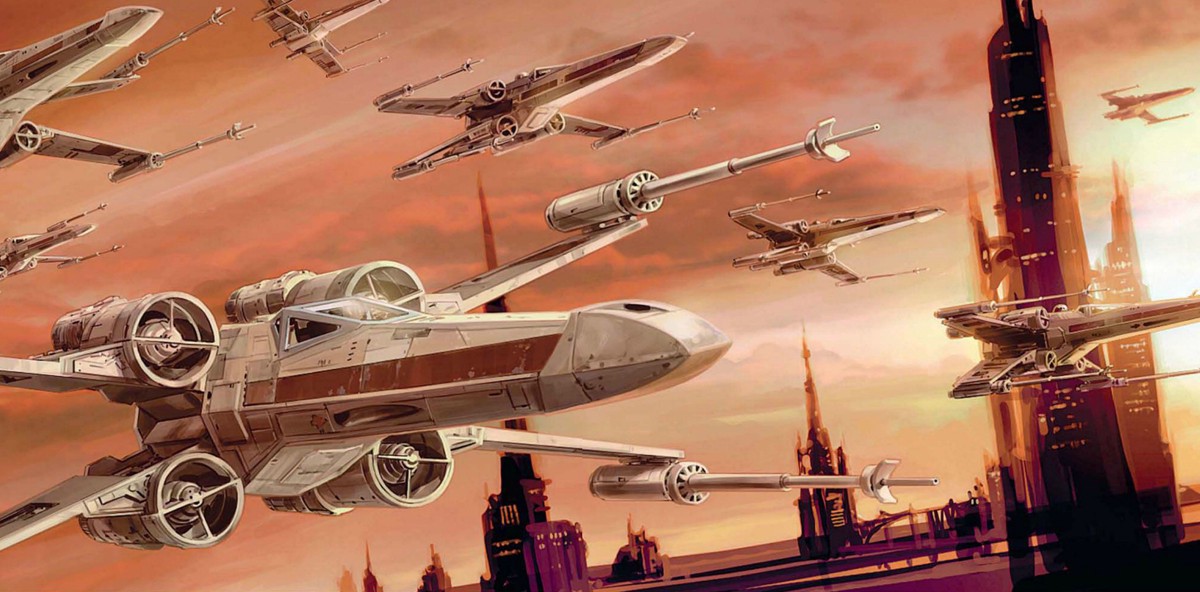
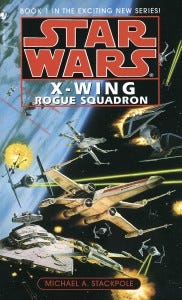
Late last week, the Internet got what it can never get enough of: more Star Wars movie news. But this time the revelations weren’t about this year’s impending Star Wars Episode VII: The Force Awakens, but instead, about the first “stand alone” Star Wars film. Supposedly, these self-contained movies will be totally watchable even if you don’t know crap about Star Wars, making them tonally the opposite of all the Star Wars movies released after 1980. The first of these is the 2016 release titled Star Wars: Rogue One, which seems to indicate it’s probably going to focus on the exploits of a gaggle of outer space fighter pilots called Rogue Squadron. Though briefly mentioned in the existing Star Wars movies, Rogue Squadron easily achieved their greatest popularity off-screen through a series of 1990’s novels and comic books, primarily written by Michael Stackpole. And those books are actually pretty great.
In the “reality” of Star Wars, Rogue Squadron is the team-name that a certain group of fighter pilots assigns to themselves after most of their friends died trying to blow up the Death Star. The fighter-planes they fly are usually the famous “X-Wings” and if you’re rolling your eyes because you bet that anything involving “Rogues” and “X-Wings” sounds like some kind of obvious attempt to sell toys and/or video games, you’re not entirely wrong. In 1995, the first Star Wars novel in the “X-Wing” series, Rogue Squadron, was released and many moms the world over assumed it was a slick novel-length commercial for the popular Star Wars computer game “X-Wing.” But, if you were also a smart mom, you figured a book about a video game was probably better for your kid than whatever the reverse of that would be. (Actually wait, would that be awesome? Would I play a video game based on The Corrections? Yes.)
Anyway, skipping this series of books because they’re shameless attempts to cash-in on the brand-identity of Star Wars in general and those old video games specifically wouldn’t make you an idiot and you’re not missing out by not reading these books per se. I mean, I’m not about to tell you that the X-Wing/Rogue Squadron series is the science fiction media-tie-in-version of Proust’s In Search of Lost Time. Though, if I’m being honest, I’d rather read these books right now than Proust. And that’s because if you already like Star Wars and you want to read a fun series of books that tackles the galaxy, far, far away with a little bit more of a realistic everyman (and everywoman and everyalien) vibe, then these books were pretty much the best.
The X-Wing/Rogue Squadron series benefits from a working-class hero cast of characters. EW has already called the folks from Rogue Squadron “Beloved B-Listers,” and that’s true. But in terms of who these characters were when the books were released in the 90’s, you’re actually dealing with Star Wars C-listers. Stackpole (and later Aaron Allston) didn’t give Star Wars fans the easy money shots by having Luke Skywalker or Han Solo central stage, but instead, focused on the tertiary character Wedge Antilles and his merry band, populated mostly with brand-new characters invented for these stories. Sporting some serious panache, each X-Wing book even begins with page which list the “Dramatis personae” of Rogue Squadron, nicely insinuating that these books are taking themselves a little more seriously than your average cash-cow monster. In fact, writing on his own blog recently, Michael Stackpole pointed out that publisher Bantam never expected the X-Wing books to do well. These weren’t your average sell-out brand monster books, but instead, a series that was actually kind of a risk. We might have a hard time ascribing artistic aspirations to something that is overly (and undeniable) commercial fiction, but the after-the-fact popularity of Rogue Squadron is somehow telling and emblematic of what we sometimes want from novels that we don’t want from big-loud films. Simply this: the Rogue Squadron books became popular because they were about characters that were mostly the opposite of the kinds of people in the Star Wars movies. If Luke, Vader, Leia, and Han were various Jungian Archetypes, then the characters of Rogue Squadron: Mirax, Wedge, Tycho, and Corran Horn were the Real Person Archetypes. We’re not exactly in Rosencrantz and Guildenstern territory with Rogue Squadron, but with Corran, Stackpole succeeded in creating an audience surrogate that out-Luke Skywalkers Luke Skywalker. How do you do that? Well, Stackpole imagined what it would be like if you were a person who lived in the world where Luke Skywalker was a living legend and you wanted to do some Luke Skywalker style stuff. Turns out, you’d be a little insecure in such a world.
Essentially, this is what makes the X-Wing books so interesting: they’re a tiny bit subversive of their genre because they’re actually about more “regular” people than you’d expect to find in a Star Wars book. I mean, Corran used to be a sort of outer space cop before joining the Squadron. Plus, Stackpole’s big Corran Horn book, I, Jedi, features a lot marital woes on top of spaceships getting blown up. Not everything can be non-stop action and political intrigue, even in a Star Wars novel. By giving these characters more conventional personalities and milder relationships with each other than the “heroes” in the Star Wars films, these books stand out as something of a quiet revolution in the strange literary game of professional fan fiction. Again, just because books like these are written exclusively for money/brand identification, doesn’t mean that the writers don’t occasionally (and often) try to be legit.
And now, with the announcement of this new movie, the big-budget film establishment has seemingly noticed the quiet brilliance of a story about normal people in a universe of the extraordinary. Because if Rogue One ends up being a loose film adaptation of the wonderful Stackpole and Allston books, then the filmmakers will know they have to throw in everything plus the kitchen sick. And by that, I mean they’ll throw in the outer-space-kitchen-sink drama.
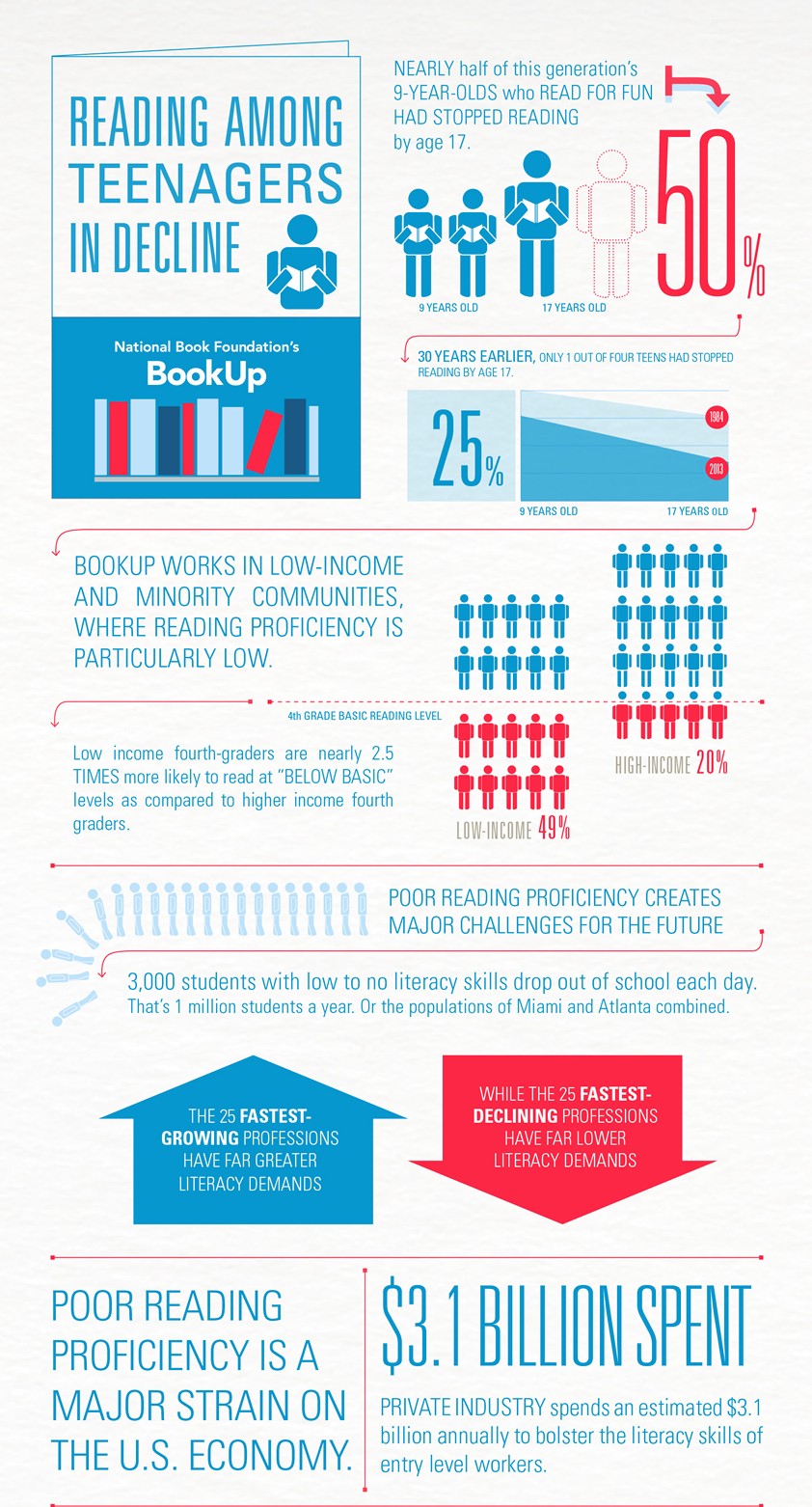
Since its inception in 2007, the National Book Foundation’s BookUp program has provided over 25,000 books to students free of charge, and is hoping to reverse the unfortunate trend of children losing interest in reading for pleasure throughout their teenage years. Currently helping over 300 students annually, BookUp is hoping to expand far beyond New York City and grow their program on a national scale. For more information on the program and how to help, check out the infographic below.
Three people walk into a bar: the first is carrying a book of experimental poetry, the second holds a YA vampire novel, and the last sits down and opens up a Victorian classic. Who is the “real reader”?
Writers, understandably, are always seeking advice for how to better connect to readers. And there is an abundance of advice that makes claims about what readers want: “Readers want realistic characters!” “Readers crave plot!” “Readers want emotion!” “Readers want simple stories, not complex literary gymnastics!” But, contrary to these claims, readers are not a monolithic block. Readers want different things. Some want realistic characters, others want archetypes. Some want plot-heavy books, others want essayistic musings. Some want simple language, others want complex sentences. And most, in truth, want all of those things at different times.
An appreciation of readers as diverse individuals with different tastes should be a basic tenet of criticism. Instead, it’s common for critics to imagine that their aesthetic preferences are the reflections of “readers” or a special class of readers — “serious readers,” “imaginative readers,” “brave readers,” or some other ill-defined category — whose views truly matter.
Take, for example, this painfully un-self-aware NPR review of Mark Doten’s experimental Iraq war novel, The Infernal:
[The Infernal is] a novel written not for readers but for those who love to argue about the novel-as-object more than they love the words. It’s an elbow-patch book, fodder for lit professors, likely attractive to those young enough (or cynical enough) to believe that oddness and iconoclasm equals genius, but that just ain’t me.
I don’t want to debate the merits of The Infernal here — it’s gotten mostly very positive reviews, and I, full disclosure, know Mark Doten personally — but this is the perfect example of a flaw common in today’s literary and cultural criticism. When a reviewer can’t defend their preferences through argument, they resort to a No True Scotsman fallacy and say anyone who feels differently isn’t even a reader.
For the sake of argument, let’s say that Jason Sheehan’s claim is true: The Infernal is the kind of book that can only be enjoyed by literary professors and young readers who love odd Iconoclastic work. How does that make it “not for readers”? Aren’t professors readers? When a young iconoclast reads a book, is she not really reading? Do they not “love words”? Is a book that sells 5,000 copies to literary professors less “read” than a book that sells 5,000 copies to restaurant critics who are oddly given NPR book review slots?
Perhaps a half-century ago, this kind of snobbery was restricted to Ivory Tower academics looking down on the peasants reading pulp fiction. But in the last few decades, the tables have turned. Pulp is the new prestige. Today the snobbiest critics are the anti-snobs: the ones who think that anyone who reads work that is complex or lyrical (or, god forbid, translated from another language) is an elitist fraud. You can find this mindset everywhere on the internet, but here’s one example from the Huffington Post: “Stop Lying About Your Favorite Books on Facebook.” Here, a blogger finds it “preposterous” that anyone could list Junot Diaz, Gabriel Garcia Marquez, or Ernest Hemingway as authors of books that stuck with them. (Her list of “real life” favorite books, the ones people actually love, includes The Hunger Games, 50 Shades of Grey, and Harry Potter.) It’s silly enough to claim that anyone who loves dense literary fiction or “difficult books” must be lying. But what’s so striking about the HuffPo “preposterous” list is that Marquez, Hemingway, and Diaz are massively popular, best-selling authors. If they are considered too pretentious to enjoy, what books aren’t elitist?
I realize that the Huffington Post writer was attempting to approximate something akin to humor, but people argue this seriously all the time. I saw a writer friend tweet recently that she thought anyone who didn’t admit to reading YA as an adult was lying. There’s nothing wrong with reading YA as an adult, but there is something wrong with being unable to believe that there are adult readers who don’t want to read YA or who prefer Marquez to Collins.
That the language of these critics echoes Fox News hosts talking about “real Americans” is no coincidence. Both are outshoots of the anti-intellectualism that’s gripped the country since at least the 2000 election. This conservative vision of culture — where anything that tries to push boundaries is inherently “pretentious” and anyone who has tastes that differ from the masses is an “elitist” — is offensive to all sides. Not only does it off-handedly dismiss so much great art, but it rests on a presumption that people who are working-class, without college educations, or simply not from the coasts — people from the so-called “real America” — have no interest in anything but airport fiction. I have never found this to be the case, and, on the flipside, have been in the homes of overeducated lawyers and doctors whose shelves were filled with Dan Brown and Dean Koontz.
Let’s also dispense with the idea that our aesthetic preferences are more “true” or “honest” or “brave.” Let me circle back to Sheehan’s review of The Infernal:
Oftentimes being straight and forthright in the face of a difficult topic is the bravest of all possible options, and one which Doten doesn’t for a moment consider.
If we are not discussing an author who risks injury, imprisonment, or death for their fiction writing, as many writers do, let’s leave “bravery” off the table. Hemingway is not “braver” than Faulkner because he is more straightforward. They wrote different kinds of fiction that, due to their aesthetic ideals, each achieved things that the other could not achieve.
I want to make it clear here that I think intelligent arts criticism is important and valuable. I want critics, writers, and readers to stake out their aesthetic ground and defend it. But your arguments should make us think deeper and harder about books. Criticism should complicate, not simplify.
If you think the above is true, but not worth fretting over, here is why I disagree: lazy stereotypes about reader preferences absolutely contribute to problems in the publishing industry. I know writers of color who’ve been rejected because their writing “isn’t black enough for black readers,” or is “too black for white readers.” It leads publishers to reject manuscripts because “readers won’t read translated fiction” or “don’t want more [insert ethnicity] immigrant fiction this year.” (Then, of course, those same publishers scramble after that same fiction as soon as one book sells well.) It’s part of the reason that women writers are pressured into flowery uplifting covers even if their fiction is dark and gritty. And, more generally, it’s part of why tons of great books that push boundaries and do new, exciting things get passed over, and literature, and readers, suffer for it.
First, a confession: I don’t like YA. It’s never been my cup of punch. Even Ruth Graham’s somewhat mean-spirited takedown of the genre, which struck many as harsh when it came out in Slate, indulged my deepest schadenfreude with a coarse blanket judgment I felt might be true. And so imagine my surprise (though passingly I know the author) when I read Horror Business by Ryan Craig Bradford and got my smugness rearranged.
YA’s what Horror Business is. Or anyway, it means to be. It follows the experience of one Jason Nightshade — the surname’s a reference, of course, to Jim Nightshade from Ray Bradbury’s YA-ish 1962 novel Something Wicked This Way Comes — a horror film buff and aspiring director growing up in the town of Silver Creek where children, including his twin brother Brian, have started going missing at an epidemic rate.
I mention Nightshade’s origins not to show what a consummate fanboy I am but rather how gleefully meta the novel, how lovingly keen on its own subject matter, a big part of what makes it tick. Jason is fond of reciting arcana from his favorite horror movies in times of distress: “The word vampire is never used in Near Dark, a movie about vampires. There are over ninety cuts in the Psycho shower scene and it took fives days to shoot; Anthony Perkins wasn’t there for any of it.”
The chapters devoted to Jason’s dog Brock, who is suffering from rabies or something far worse, take the titles of slice-and-dice films in a franchise: “Brock II,” “Brock III,” or “Brock: The Revenge.” Or take for another the following scene in a video store early on in the book, where Jason, an amateur auteur himself, is browsing titles on the wall: “I peruse the horror section, admiring the artwork on movie boxes, noting which ones have the scariest screenshot on the back. Re-Animator 2 is a good one; Chopping Mall is all right but it has the best name of any movie. Frankenhooker is one of my favorites. I watched that twice in one night before… When we were little, my brother and I were so scared of these boxes that we’d dare each other to look at them. Our mom made us stop when Brian started seeing monsters in the closet.”
Monsters in the movies, ergo monsters in the closet, is a common conceit in Bradford’s novel: from the blood-splatter posters that line Jason’s wall, to the pale moviegoers like “zombies” in line for a midnight marquee of The Texas Chainsaw Massacre, to the Halloween windsocks adorning front porches throughout the dim, autumnal town, fictional horror infects the real world at every turn throughout the book. (Acknowledge the fact that you’re reading a novel, the rabbit-hole goes deeper still.) But the confluence here is not just atmospherics, and it’s more than a reprise of Scream-era antics. Bradford does something exceedingly smart and a whole lot of fun to see pop off the page: in writing a novel concerning the horror of child murder and rabid dogs, among a host of other fears, he sets his sights on something worse: the horror of being a teenage boy.
The plot of the novel is outwardly simple, yet at the same time difficult to describe. Jason’s brother Brian has gone balefully missing, along with eight other of Silver Creek’s children and Jason resolves not to find them, per se, but only to keep pushing on past their absence. He locks antlers with neighborhood bully Colt Stribalt (what better name for a bully is there?). He picks up with Ally, a neighborhood girl. He fucks around with Steve, his pal. He keeps writing his horror script, a Dead Ringers-Seven-and-Fight Club mélange, whose typescript intrudes on the script of the book (Jason’s tagline-dispatching, doppleganger detectives go by Cronenberg and Raimi). He navigates his home-life in the absence of his mother, who has gone off to spend some QT with her sister in the wake of her son’s several-month disappearance, which probably highlights the book’s finest writing: Jason’s run-ins with his glassy-eyed and alcoholic father — palming Jason stacks of 20’s, showing Jason around streamer trunks full of porn.
Jason’s dog Brock gets infected with evil. Something lurks in the graveyard with beady red eyes. Turn after turn leads to a climax not so much horrific as baffling. The novel’s ambiguities are more Lorrie Moore (see 1994’s Who Will Run the Frog Hospital?) than anything by Stephen King — a genre bending brought off best when they are in the former camp. Indeed the novel stacks up strongest on the level of quirky and standalone scenes, many of which are near-Freudian cracks at the terror of what adults do behind doors while you and your pals take in Hellraiser III.
The steamer trunk of porn is one: “I bend over the cartridges. They all have a white strip displaying my dad’s handwriting: Debbie Does Duluth, Bang Plane, Penetrating Gazes…” And then when his father insists on a test-run: “I open my eyes and she’s bent over the desk. They’re both so hairy.” Or when Jason and Ally commence heavy-petting in the gloomy shark-tank of the town’s new aquarium only to end up shark-attacked, as though to reprimand them for their adolescent urges: “I put my face close to get a better view. The shark lunges… Its jaws push forward and the teeth break off as they slam into the glass…Blood pours out of the shark’s snout — a dark red cloud that makes everything hard to see…I run the length of the wall to the door, and the shark follows me, leaving a trail of blood, like plane exhaust.” Or in this scene of self-abuse, wherein Jason reflects on encounters with Ally: “Moving faster, I replay the images: her lips, her breast, squeezing her nipple between my fingers, her soft moans. She grinds into me. In my fantasy I say yeah bitch through clenched teeth. This is the best material I’ve had in a long time.”
Which is to say that Bradford’s book is, yes, and no, a book for teens. In Graham’s essay “Against YA,” with a subtitle reading, “Read whatever you want. But you should feel embarrassed when what you’re reading was written for children,” Graham makes the argument that “…crucially, YA books present the teenage perspective in a fundamentally uncritical way. It’s not simply that YA readers are asked to immerse themselves in a character’s emotional life — that’s the trick of so much great fiction — but that they are asked to abandon the mature insights into that perspective that they (supposedly) have acquired as adults.” Fair enough. Not so is Bradford’s Horror Business. Anything but “uncritical” when it comes to portraying the “teenage perspective,” the book is an interrogation with a wild, ribald humor that makes it unique.
The writing, yes, is sometimes clunky (“I try to remember the consequence that happens when you wake a sleepwalker”); and the horror of the novel hangs loosely together in a way that banks too stringently on the reader being partial to a literary ending; and in one key respect, if you ask me at least, the novel goes zig where it should’ve gone zag (see the laws of reality bounding the story). But these are quibbles, all considered.
In showing the horny, mouth-breathing, bewildered, sweetly innocent horror of male adolescence, Bradford does books like The Fault in Our Stars and Eleanor & Park one better. He proves that he’s up to the challenging work of never underestimating young adult readers in their ability to sniff out and reckon with nuance, while never overestimating adult readers, either, for being too wise to remember their youth. Horror Business is for all: a warm outstretched hand, and a chilling reminder.
To purchase Horror Business, click here to be redirected to Ryan Craig Bradford’s site.
What I’ve come up with is this: a small yellow one-story home, whose black leather couches in the living room rise back to their full shape. But my steps make no creaks in the floorboard. The house sends its message in silence, except for the fridge that hums itself cool again. This place feeds a hunger not recognized by the lash of my tongue, even in this version, my version.
I stare out the back window, and a man who looks
so much like my father I can mimic his walk, is pushing a mower. He should be my father but he is a stranger and I’m not surprised. The living room fills with the smell of cut grass and gasoline. There is nothing I can do here.
II Wanderer
Today no one forgave me. I heard the word whitewashed and everyone knew of my Spanish tongue lost like a ticket home that slips under a bench. I thought about bleach and the wrinkles of eyelids stung shut so I began to walk the streets, aimlessly listening for a way back.
•
Up and down streets there’s the buzz of mowers across lawns and hedge trimmers over the ivy elephants stampeding green. And the men behind machines never stop pushing, never stop working to turn their heads up at me or the swelling sun. I offer what the cloudless sky offers: nothing. They remove bandanas from their foreheads, to swing cool again, only to tie them back on. No one will tell me which way to go.
III Stopping in front of the day labor workers
Donde-meh-voy, where do I go, I try to say, knowing it’s all wrong.
Men lean against thin palm trees & Handicap parking signs outside the Home Depot.
They spit answers –want in their silence.
If I do not offer them work and pay, I am just another wave of heat they look through in search of a few hours of labor. My search is counterfeit to theirs.
They need to eat, keep wives fat with love, keep children in swap meet jeans bargained for. Barato, Barato. They need a 24-pack of Bud with each check cashed at the Sunny Liquor, to celebrate the power to spend, to celebrate anything, and everything. We have real problems, they blink at me. It’s hard to translate. I shrug apology and they fill their pockets with their hands again.
IV The street vendor on her way home
Her shift is over when no one’s hungry.
Going down the street — her small frame hunched over the cart whose wheels squeal with lost strands of hair — I whistle a last chance. She stops without looking up; children I did not know were there, pool around me and offer her crumpled dollars. She sighs.
Elotes con queso, limon y chile, she says without effort. I write every word down like taking directions and listen to her flip back-and-forth between Spanish and English for the younger children, tengo raspados de vanilla, blue raspberry y red cherry.
I order a snow cone and she takes my money. Ayuda me, I say, help me. She hands me a napkin and a quarter. Ignorance is a type of penance.
When she pushes away, the cart moves slowly like she’s rolling boulders. I want to go
where she is going. Toward the street lamps that flicker over her children who enter, kicking off shoes and jeans grass-stained for generations. In their small, dark hands, are the ripped pages of homework.
When she opens the door, she will yell at them to get off the couch, and join a house so loud with conversation that all windows are kept open.
And from outside, someone might catch a word, perhaps an entire phrase, in Spanish, before it breaks against the closed ear of sky.
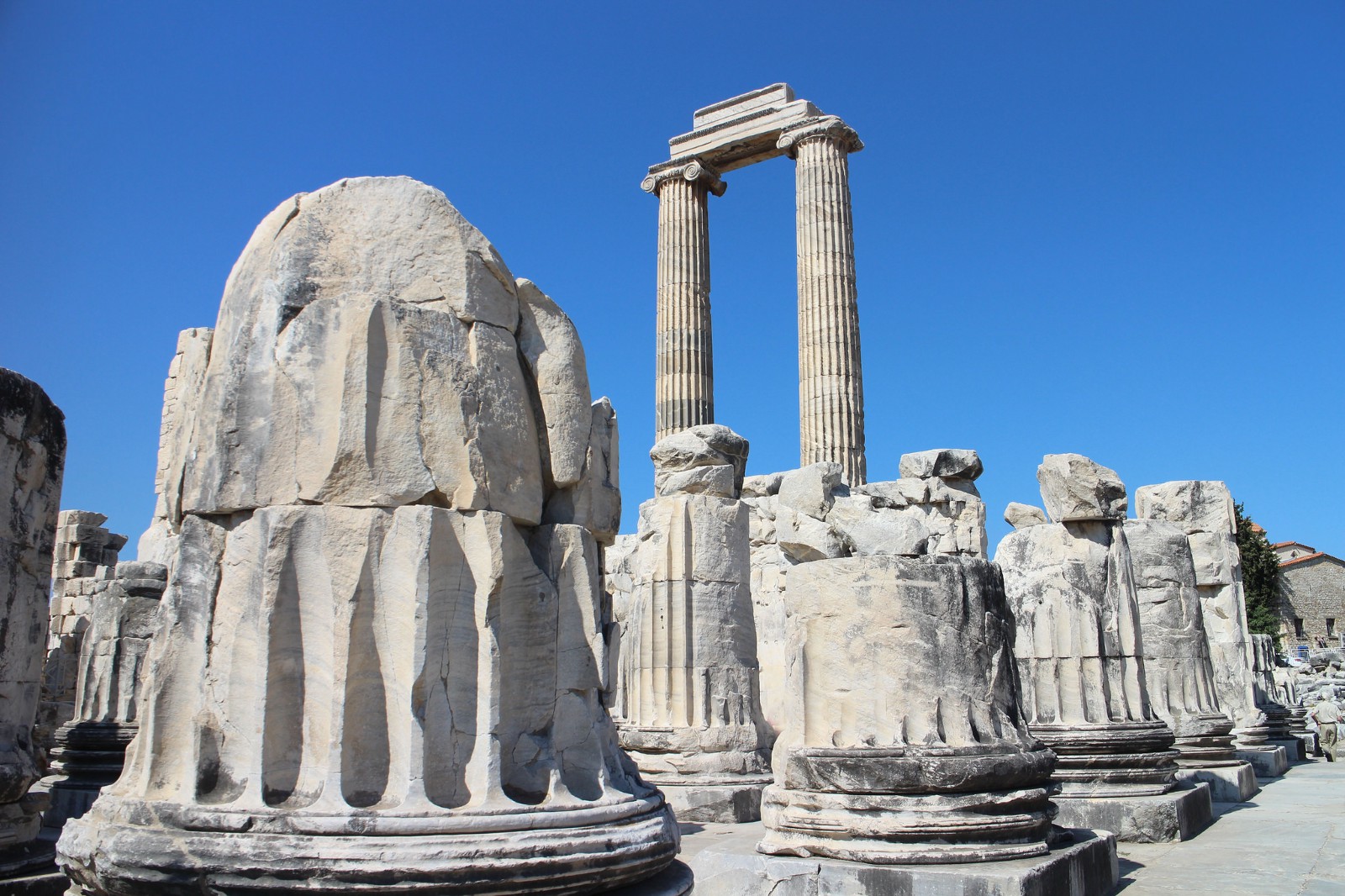
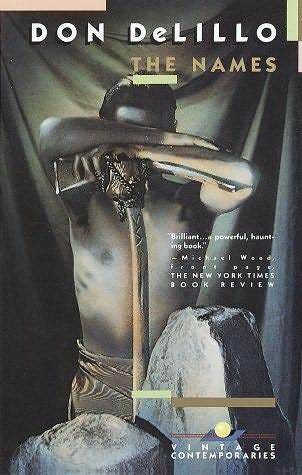
In Don DeLillo’s The Names, James Axton is a risk analyst living in Greece, monitoring market fluctuations, getting drunk with expatriates, and tracking the murders committed by a mysterious cult. The Parthenon, that synecdoche for everything ancient and glorious, is always nearby, but he can’t bring himself to visit it. “What ambiguity there is in exalted things,” he says. “We despise them a little.” At the end of the novel, however, after evading an attempt on his life by the aforementioned cult, Axton makes like a tourist and approaches the Parthenon.
I walk to the east face of the temple, so much space and openness, lost walls, pediments, roof, a grief for what has escaped containment. And this is what I mainly learned up there, that the Parthenon was not a thing to study but to feel. It wasn’t aloof, rational, timeless, pure. I couldn’t locate the serenity of the place, the logic and steady sense. It wasn’t a relic species of dead Greece but part of the living city below it. This was a surprise. I’d thought it was a separate thing, the sacred height, intact in its Doric order. I hadn’t expected a human feeling to emerge from the stones but this is what I found, deeper than the art and mathematics embodied in the structure, the optical exactitudes. I found a cry for pity. This is what remains to the mauled stones in their blue surround, this open cry, this voice we know as our own.
Recently, I had the unfortunate occasion to be reminded of this passage. In late February, the Islamic State of Iraq and Syria released a video of their members grabassing their way through a museum in Mosul, destroying statues, busts, friezes and other artifacts, some of them millennia old. Mosul was founded upon the ruins of Nineveh, the biblical city visited by the prophet Jonah, though not before he attempted to evade God’s command and was swallowed by a whale. I watched the footage in impotent rage as the vengeful delinquents brandished drills and jackhammers, defacing the likenesses of kings and deities, all the while blaspheming the name of the Prophet Mohammed by claiming their actions bore his imprimatur. As I rewatched it, however, dragging the cursor back to the start of the embedded video, another emotion rose up within me, stronger, eventually, than anger: a kind of intimate sadness, a response to the cry of pity Axton found in the Parthenon. Those antiquities were the expression of human desires, and it was an irony, though not an unkind one, that their humanity was most palpable at the instant of their destruction.
This perception of antiquities as fragile rather than permanent, and all the more affecting for their fragility, is common in literature. Writers have often found their imaginations piqued when encountering the broken, the cracked, the falling-apart. The stories that ruins tell are incomplete, fragmentary, and the literary imagination is often compelled to fill in the gaps of fractured narratives. The Names is the strongest example of this in DeLillo’s oeuvre, the result of DeLillo living in Greece and seeing the relics of the ancient past persist into the anxious present. A contemporary writer who pursues this theme of the past enveloped in the present, to the point of obsession, is Tom McCarthy.
McCarthy’s aims are often portrayed as essentially ones of subtraction: he takes the novel and systematically removes from it character, motivation, interiority, plot and so forth, leaving an object as sleek, sterile and blank as an iPod Nano. This is in part a result of critics and readers growing self-conscious in the presence of McCarthy’s Euro-louche, art world cool, which he works hard to cultivate. Step back, liberal humanists, and watch the Continental theorist dispel your pieties! The blankness of his characters, however, is a byproduct, rather than a primary goal. McCarthy’s real interest is in systems and patterns as they play out in space and time, and this has led him to gnaw at three interrelated questions in his work: 1) What is the present? 2) What is the past? 3) What is the difference?
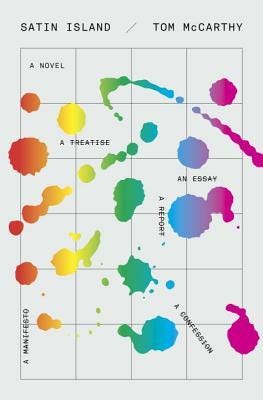
McCarthy’s new novel, Satin Island, sees him continue to explore these themes, although the means are somewhat different than his other books. Actually, that’s part of the point. He’s made clear that, while his style may change from book to book, the underlying concepts are much the same. With its numbered paragraphs and penchant for digression, Satin Island looks like a lost demo tape from the Frankfurt School. The narrator, who simply calls himself U, is an anthropologist at a London-based consulting firm. U’s personal hero, Claude Levi-Strauss, made the field of anthropology into an art form while studying indigenous tribal groups, their rituals and customs functioning like living relics. U uses the same techniques to advise corporations and governments on how to best present their goods and services so consumers and citizens will purchase them. The primitive within the postmodern, you could say. U often sounds like he’s giving a TED talk, which means he often sounds like a shaman performing a healing ritual. At one point, U considers his boss, Peyman, and the logo he designed for their consulting firm:
The Company’s logo was a giant, crumbling tower. It was Babel, of course, the old biblical parable. It embodied one of Peyman’s signature concepts. Babel’s tower, he’d say, is usually taken to be symbol of man’s hubris. But the myth, he’d carry on, has been misunderstood. What actually matters isn’t the attempt to reach the heavens, or to speak God’s language. No: what matters is what’s left when that attempt has failed. This ruinous edifice (he’d say), which serves as a glaring reminder that its would-be occupants are scattered about the earth, spread horizontally rather than vertically, babbling away in all these different tongues — this tower becomes of interest only once it has flunked its allotted task. Its ruination is the precondition for all subsequent exchange, all cultural activity. And, on top of that, despite its own demise, the tower remains: you see it there in all the paintings — ruined, but still rising with its arches and its buttresses, its jagged turrets and its rusty scaffolding. What’s valuable about it is its uselessness. Its uselessness sets it to work: as symbol, cipher, spur to the imagination, to productiveness. The first move for any strategy of cultural production, he’d say, must be to liberate things — objects, situations, systems — into uselessness.
The Parthenon, the artifacts in Mosul, and other antiquities affect the imagination more acutely when they become ruins. And it is certainly more disturbing when that ruining is carried out by human hands, rather than the indifferent dismantling caused by time. Indeed, watching ISIS destroy the antiquities made me feel strangely parental, as if they were children rather than ancient artifacts, children I had somehow failed to protect. The whole event gave me a skewed sense of time, of confusing one’s heritage with one’s offspring. In fact, McCarthy addressed this sensation of different eras getting layered on top of each other in his previous novel, C.
C follows the exploits of a young man named Serge Carrefax. Serge’s brief life spans from 1898 to 1922, coterminous with the dawn of modernism, a movement that was premised, after all, on finding the affinities the contemporary world shared with the ancient. Serge experiments with the first radios, gets marooned in a Swiss sanitarium, flies fighter planes in World War I, and eventually descends into an Egyptian tomb, recently unearthed, where he is fatally bit by a poisonous scarab. Midway through the novel, Serge is at Oxford, studying architecture. One of his lecturers describes the influence of ancient Greece on subsequent styles:
“The modern tendency,” he declaims without notes, turning to face the students from plan drawings of the Parthenon and Hephaesteum into which sketches of peripetal and prostyle columns, metopes and triglyphs are inset, “is to consider these structures as ruins rather than as functioning buildings. The temples, as they present themselves to us today, stripped of their original stucco, colour and so on. What we lose is the effect of reflected light flowing over the smooth, coloured wall surfaces, across the bronze gills and balustrades, the gold, ivory and precious stones. I want you, when contemplating the incomplete edifices of the Attic and Hellenic periods, to turn back the clock and think of them as under construction, not beyond it . . .”
The era of the Greeks, of the pharaohs, of Nineveh and the Babylonian Empire, is not past. We are still within it. Preserving the works of antiquity preserves ourselves just as much. And destroying them makes us amnesiacs, unable to recall our individual histories, to say nothing of our collective ones. This is, of course, exactly what ISIS is trying to accomplish.
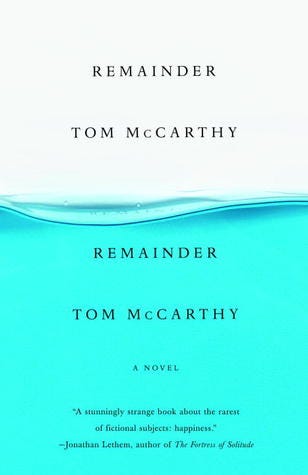
What is an amnesiac to do? This is, famously, a question that McCarthy tried to answer. His first and still best-known novel, Remainder, is about a man who has suffered a terrible accident, the particulars of which he can’t recall. The novel follows him as he tries to remember something of his former life, and former self. He fails, and fails, until one day, he has a vision. A vision of . . . a wall. With a crack in it. He doesn’t know if this is an actual memory, but it sure feels like one. He begins to use the huge amount of money he received as a settlement for his accident to try and recreate that memory, and so live within
Much of the talk on Remainder has focused on its aesthetic forebears, particularly Alain Robbe-Grillet and other proponents of the “New Novel” from the 60s and 70s. McCarthy is their heir, self-consciously so, continuing the work of dismantling the novel, and the society that reads novels along with it. Far less has been made of the book’s political significance, its portrait of a dehistoricized present. To be fair, McCarthy rarely speaks in terms of political relevance. But his depiction of a man who can’t remember the past, and creates simulacra in place of it, is resonant in ways he may not have even intended.
***
What is unique about ISIS’s destruction of millennia-old antiquities is that it isn’t unique. Long before the borders of present-day Iraq were drawn by the British Empire, the land saw countless crimes perpetrated against its cultural heritage. Every empire worth its salt made a point of dropping by and seeing what it could take for its own, or destroying it outright. The land’s most valuable natural resource isn’t oil, it’s history.
The most traumatic of these crimes, one that reverberates to the present, occurred in 1258. The Mongols, led by the grandson of Genghis Khan, ransacked the city of Baghdad, killing thousands of its citizens. Legend has it that the river Tigris ran red one day, and black the next. The red came from the blood of the citizens, their bodies cast into the river; the black came from the ink of the books taken from the city’s many libraries and universities, their pages bled of meaning, their words lost.
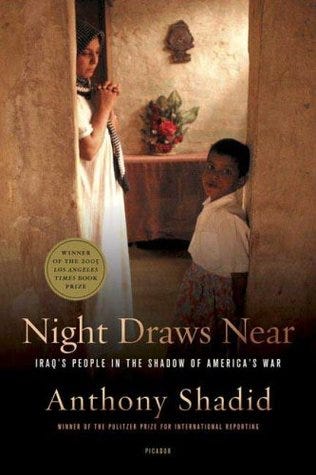
The late journalist Anthony Shadid described the effect this event still has in his book Night Draws Near, an account of the Iraqi people struggling to survive in the first years of the war.
Rome can still see its past, the magnificence of its ancient empire gracing the modern cityscape. Paris and London, storied cities reinventing themselves as they age across centuries, live in their histories, which surround them. Baghdad, its ancient grandeur utterly destroyed, cannot see its past, its glory. It can only remember. Baghdad’s is a culture of memory; the city draws strength and pride from the myths to which it continually returns. But the curse of recalling is the reminder of what has been lost.
Even this recollection was nearly impossible during the regime, as Saddam Hussein framed the city’s history as a precursor to his own glorious reign. Saddam is long gone, but opportunists like ISIS continue to sweep into the power vacuum created by the U.S.-led war, further destroying the country’s history, terrorizing citizens who already find it deeply painful to recall the past. What can these people do? Will they, like the narrator of Remainder, receive a vision of a small corner of their pasts and recreate it somehow, if only in their imaginations?
I found a suggestion in the work of another writer obsessed with systems and patterns, Jorge Luis Borges. His work is filled with the ruins and literatures of lost cultures, both real and imagined, such that if those proverbial aliens of the future were to reconstruct our world based solely on a volume of his collected works, they would have more than enough material.
“Tlön, Uqbar, Orbis Tertius” is one of his most famous stories. It begins as do many of his stories, with a semi-fictitious Borges discussing literature with a friend. The friend, fellow Argentine writer Adolfo Bioy Casares, mentions an epigram that Borges finds especially compelling. Borges asks Casares where he found it. Casares says he read it in a work of Uqbar literature. After consulting Borges’ library, however, they find no mention of Uqbar. Casares says he is quite certain that Uqbar was “a region in Iraq or Asia Minor.” After extensive research in far-flung libraries (remember, no Wikipedia), Borges discovers that Uqbar is a country in an imaginary planet called Tlön, whose whole history, down to the last detail, was created by hundreds of scholars working over generations. At the story’s close, the history of Tlön stands to overtake the history of earth.
A classic story, open to many interpretations. Here’s mine: the choice of “Iraq or Asia Minor” as a portal into a complete alternate world was deliberate. Borges knew the history of the region — he knew everything — and was deeply familiar with the struggle of its artists and scholars to create meaning out of ruins and fragments. It’s a struggle that continues today.
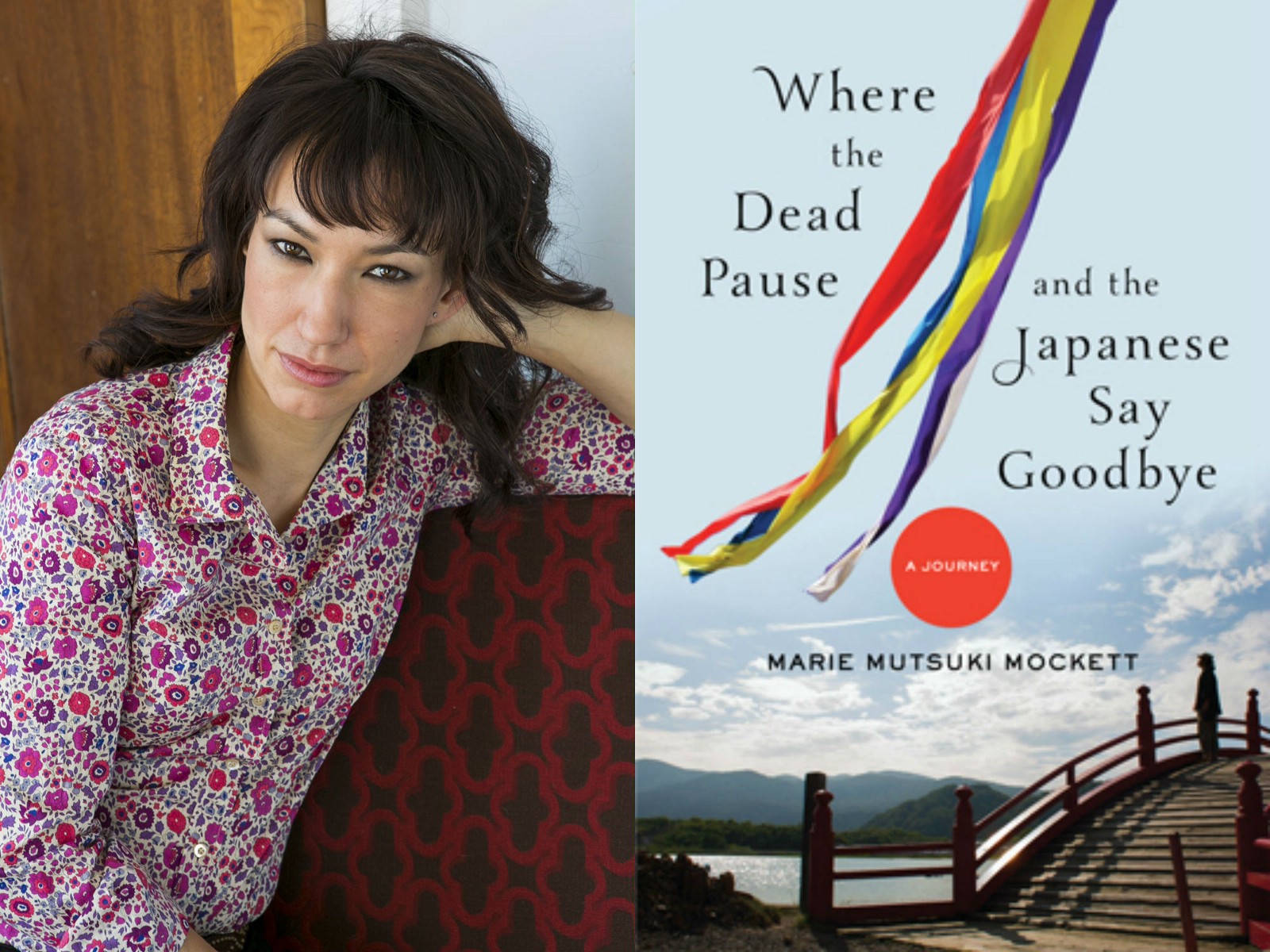
Marie Mockett was born and raised in California to a Japanese mother and an American father. Her first novel, Picking Bones From Ash (2011), incorporated many of the themes — Japanese fairy tales, ghosts, Japan’s Mount Doom — she would later revisit in her memoir of grief and mourning, Where the Dead Pause and the Japanese Say Goodbye (2015). Mockett’s family owns and runs a Zen Buddhist temple 25 miles from the Fukushima Daiichi nuclear power plant, the site of the nuclear meltdown that occurred in the wake of the 2011 Tohoku earthquake and tsunami, which left more than 15,000 people dead. With so much grief and mourning experienced at once, some of the survivors began to see ghosts, and others exhibited signs of spirit possession. In her new book, Mockett writes about the Buddhist exorcisms that priests performed to release these survivors from their grief, and she recounts her visit to a female shaman in the hopes of relief from her own sadness following the death of her father.
Grief after a loved one’s death is universal, but the traditions of mourning vary by culture. Like Mockett, I grew up observing the Taiwanese version of Obon — the month long Ghost Festival, where we make offerings to our ancestor’s spirits — without quite understanding its cultural context. When I was twelve my paternal Irish American grandfather was dying of cancer, and while I stood in the kitchen washing dishes my Taiwanese mother saw the white ribbon in my hair and commanded me to take it off. I protested — my paternal grandmother had given it to me, and I thought it looked pretty. My mother became agitated and explained that white was the color of mourning in “our” (Chinese) culture and wearing the ribbon in my hair was bad luck. Having been raised in New York City, where Judeo-Christian culture dominates, this was the first time I understood that death is a culture that we learn. Mockett’s book helped me understand what is universal about death, and gave context to what isn’t.
After seeing Mockett read at the Asian-American Writers’ Workshop, I wrote to her with some questions. We ended up discussing cultures of mourning, how jazz guided her narrative structure, female shamans, and her hopes for what this book might achieve, for herself and for others.
Kavanagh: Your book is about grief and mourning centered around Japanese culture, particularly Buddhism. From you research and your experiences, what are some differences between how Americans and Japanese process grieving?
Mockett: The Medieval Europeans called Death “the great equalizer” — he’ll come and get you whether you are a prince or a pauper. He will also show up if you are Japanese or American. And death — and the grief those left behind experience — is universally terrible.
But our responses to grief do vary depending on our culture. This, to me, is one of the beautiful things about human beings — that generations have spent time trying to figure out how to ameliorate the awful pain of suffering. It’s like in the Fairy Tale of Sleeping Beauty; there is the terrible curse, but then the Lilac Fairy comes along and tries to make things a little bit better. The compassion humans can have for each other functions like this too.
In Japan, there are so many customs — some local and some country wide — that encourage us to remember the dead just after they have left us and then for generations after. We think of them as watching over us. As a child, I didn’t understand the importance of this belief — it seemed maudlin and overly sentimental. But I do now realize that the most painful thing about losing someone, is that horrible feeling of being forever severed from someone who was part of your essential emotional architecture. The many mourning traditions in Japan are designed to assure us that we don’t completely lose those bonds and that every year, via Obon, we are able to welcome our ancestors home to spend time with us.
Kavanagh: Do you think going through the different rituals of Obon in Japan helped you finally come to terms with your grief after your father’s death, or was it time that ultimately helped you come through?
Mockett: I think it was both.
I think that some wounds are so deep, they do require enormous time to heal. And in my case, I needed a lot of time to understand exactly what hurt so much and why. I’m still in the phase of figuring out how I will live now that I’m out of the worst of the shock. Most of us will only have time to help us with grief — most people will not get to travel to Japan on a stipend funded by the US and Japanese governments. So, I want to stress that time is your best friend when you are suffering — it certainly was mine.
But the repetition of the rituals of Obon — and the many non-Obon related Buddhist rituals I participated in — also helped me to understand that my grief was one story in a sea of stories. I realized I would have to open up my heart further and feel a greater connection to other people, in order for the overwhelming pain to diminish. If I only focused on myself, then the pain would simply overwhelm everything. And that was the great gift of all the Obon rituals — they did really start to help me put my life in context.
Kavanagh:I saw you read at the Asian-American Writers’ Workshop in NYC recently. You said that you have many friends who are jazz musicians, so while thinking of the ordering of your book you saw each chapter as a song in a set list. You also said that you loosely structured your book around the cycle of a soul. Could you explain how that process worked?
Mockett: In the first few drafts of the book, I tried to follow a conventional narrative structure, with myself as the main character. I call this kind of book the “overcoming” book. I tried to write about my “overcoming.” But this did not work particularly well. I really resisted being the main character of the book — that is not a role I have ever wanted to play. And I don’t have that chatty, “I’m your best friend” voice that makes a book like that work for a contemporary audience. It felt forced and the writing showed my great discomfort.
I had been kicking around an idea for a long time — using the life cycle of a soul as the structure for a long work. At one point, when I was struggling with structure, I asked my editor what she thought of this idea and she was intrigued. And so, I started shaping the book loosely around that premise. We begin with:
The disaster Some people die Some people survive but are possessed by the dead Some of the dead move on Some of the living go to visit the dead Some of the living cannot let go of the dead, and the dead cannot let go of them The dead come back to visit once a year Eventually, we let these yearly visitors go The living who are in deep mourning go to Mt. Doom for a final farewell Etc.
That was the narrative structure I had in mind.
At the same time, I knew that not every chapter — or essay as some have called the chapters — was going to be the same in mood or in tone. Some are slight and poetic. Others are more active and more muscular. And so, I started to think about a jazz set — like how a masterful musician will put together a set so it unfolds with a natural shape, with “openers” and then with tunes that are intimate, and then other tunes that deepen the mood. I would look at my chapters and think — now, if this was the second set of Kurt Elling and Laurence Hobgood at Birdland on a Friday night, what kind of a tune would I play next? Would I speed things up? Would I need to linger in a poetic moment? How would I close out the set? Questions like this helped me shape my book as well. I’m a great believer that art learns from art. All artists are essentially trying to express something — and to address creative questions. Sometimes, looking at another art form can lead you to an answer. Sometimes, looking at another art form brings you to the truth in a way that is “slant,” to rob a quote from Emily Dickinson.
Kavanagh: In the book you talk about your American grandmother’s insistence that your Japanese mother teach you what is beautiful about Japan, and you visited Japan and learned Japanese at a young age. Still, there are many times in your book when you’re reminded that you are a “foreigner” because you are American, and are sometimes told that you won’t be able to understand what it means to be Japanese (an attitude I’ve experienced in Taiwan). In America, especially if we are non-white and/or have immigrant parents, we defiantly tell one another that anyone can become American. Why do you think the attitude is different in Japan? How did you reconcile the push-back you received with your desire to learn more about Buddhism and Japanese culture?
Mockett: Japan is a homogenous country. Many people are born there and die there and they don’t come from anywhere else — their roots go way, way back. The United States, more than anywhere else I have been, believes in reinvention, and in redemption at any moment. And while there are pockets of people who can trace their roots very far back in the United States (people who, not surprisingly, can be very conservative in their thinking), MOST of Japan is like this, though things are slowly changing.
I am married to a man from Scotland, and we recently had this conversation — how even in his old world, western European country, there is not the same belief as there is in America, that people can change, or that you can have a second shot at life.
It is very hard for an American who has not spent a lot of time out of the United States to understand how unique her attitude is — and to, at the same time — have a respect for what is good and what is limiting about old world attitudes. And Japan has an old world attitude. Remember — Japan was a country that completely kept out all foreigners, and barred its citizens from ever leaving until about 1868. If a Japanese person accidentally found himself drifting out to sea, and then getting picked up by a foreign vessel and then traveling the world before he tried to return home…well, the chances were high he would never be allowed back. Some of that attitude still remains. It’s very common for people to say that once Japanese leave Japan and live abroad, they can never return. Even my mother says this — too many years in America make it impossible for her to “be” Japanese again.
Even “inscrutable” cultures have their values and their rules and it behooves us to take the time to understand them.
But I also believe — because I’m a humanist — that people are people. Even “inscrutable” cultures have their values and their rules and it behooves us to take the time to understand them. We have all had that experience where sometimes just encountering something slightly different from what we are used to helps us to understand ourselves better — to grow. Maybe someone out there in the throes of grief will read about grief in Japan, and heal a little bit.
Conversely, maybe some stubborn Japanese will feel a little less anxious to have seen me, working hard to try to translate their culture to the outside world. And maybe — this is my true hope — the Japanese themselves will understand and value their culture better against the backdrop of a global world.
When I am in Japan, I am always struck by the number of books that highlight: “How to be Japanese” or “What does it mean to be Japanese?” There is tremendous anxiety in Japan about how to “fit in” in the world, because many are acutely aware that they do not. The American in me says — well, so what?
Kavanagh: Over at The Toast there was a recent conversation about Asian American writing where a writer named Ari Laurel had this to say:
“A professor and mentor of mine brought up the notion of performing for white readers. I try very hard to avoid shamanism in my work, and an attitude of bestowing a sort of ancient wisdom for non-Asian readers. It feels like self-exotification and self-betrayal. I notice that I will do things like mention Chinese philosophy and, say, Instagram, in the same paragraph. I will have narrators go on a tangent about spam instead of offering a standard “ethnic” food porn scene.”
I’m curious what you have to say in response to this, considering you are a Japanese-European American author writing about female shamanism in Japan. How did you first become interested in the female shaman of Japan? Can you explain their role in Japanese society and how it has evolved?
Mockett: The only way that writing or talking about ancient Asian wisdom is “performing for white people” is if deep down you believe in part that to talk about such things is performance, or that Chinese culture (and all the cultures that have borrowed heavily from China, like Japan) has a special lock on wisdom. It doesn’t.
If, on the other hand, you approach subjects like shamanism, healing and Daoism as facets of humanity and human culture, and speak about them in such a fashion, then how can you be performing? In that case, you are trying to reveal an aspect of the human experience which has, for centuries, been helpful and healing, even as it may also have been beguiling.
I became interested in shamanism originally because I read somewhere that it is one of mankind’s (and I hope you will forgive me here for using such a non PC term) oldest and most basic forms of religious expression. All cultures have a shamanic tradition. Yes, even white people!
One of the things that makes Japan so fascinating, is that its older, “pagan” roots were not stamped out by the weight of monotheism, as was the case in Europe; there, older religions were gradually choked off by the introduction of Christianity, so today, we only experience that kind of religious expression via the yearly decorating of Christmas trees, or Easter eggs, or even in the more watered down animistic expression of a Disney cartoon in which anything from a mouse to a car can talk and be our friend.
But before I go any further — what is a shaman? The loose definition of a shaman is that he — or she — is one who communicates directly with the gods by going into a trance, receives instruction and then returns to humanity to deliver whatever the news might be. Often a shaman is a healer. Scholars see traces of the shamanic tradition in everything from rock concerts in which a star musician helps bring an audience into a collective high, to charismatic college professors, to faith healers. There is some debate about male versus female shamans — the men tend to “fly” up to meet the gods, while women tend to become possessed. But I won’t go into that distinction here. Nonetheless, the fact remains, that shamanism seems to be a natural expression of man’s religious nature. So. To talk about China or, in my case, Japan, as having a “lock” on this tradition, would be arrogant.
I’m drawn in general to the study of religion because I think it is a natural impulse for people to try to express themselves in a religious or spiritual way. I am also a believer in the importance and power of science. These days, the term “spiritual” is quite loaded. But I do think that people seek meaning, and an understanding of their own inner worlds and their history and imagination. Science, a relatively newer discipline, can offer us only so much assistance. So, how to adapt the old religious practices for the modern world?
Not everyone agrees with me of course — and that can be a subject for another debate. But in general, I really like the work of people like Karen Armstrong, who asks us to consider how we might have a modern and healthy relationship to “God,” while still remaining true to the accomplishments of science that are our birthright.
I also think the question of how to have a healthy relationship with the whole notion of “spirituality” is a vital question for modern people. Look at the violence wrought around the world in the name of religion. Some would say that the answer is to reject all notions of God completely, and that if the world embraced atheism, then this kind of violence would stop.
I’m of the opinion, as I said above, that people are inherently meaning seeking creatures, and that the language of religion, which has given us performance, music, poetry and art, are vital to keeping us healthy and whole. So, I’m very interested in this question not of eradicating religion, but of how it can fit into modern life. And to do that, we have to look at how religion has functioned in the past and how it might fit into the present. And so, no, I don’t find it weird at all that an otherwise “modern” person in Japan might experience the shock of the tsunami and the mass casualties that resulted as a kind of spiritual trauma and believe herself to be possessed. And if she is given an exorcism in conjunction with the benefits of modern medicine and feels better, who is to say that this wasn’t exactly what she needed?
In your book you make it clear that in Japan there is a matter of fact acceptance about exorcism and shamanism that I found very comforting because I have a family history of Daoist exorcism and shamanism. How literally do people take these rituals?
I tried hard to bring out this point toward the end of my book — whether or not people in Japan believe in exorcism. I think that there is now an overemphasis on trying to disprove the literalness of most religious experience — and this, again, is where I’m indebted to Karen Armstrong and others.
I don’t think the “point” of most religious experience is whether or not it can be proven scientifically. Obviously, it can’t be. I mean, we can measure brain waves when people meditate and see that they do in fact undergo a physical change. But there is no proof that would placate a hard core scientist that God, the being, exists. But I don’t think that’s the “point” of God.
Can you prove love? Can you recreate it in a laboratory? Can you locate grief? Can you prove or force faith? Can you prove to someone who hates Mozart that Mozart was a genius? I don’t think that you can. To an extent, all these things are subjective. They are a reflection of personal experience in the world. This is for me the realm of all that is spiritual or religious.
That’s the power of culture. It is the collective wisdom of people who have, for centuries, tried to address the deepest and most difficult questions about being alive.
I think a healthy relationship with religion understands that it is metaphoric, that it expresses something you feel inside you. To go down the path of trying to factually prove all religious experience, or to insist that religion has a predictable and causal relationship with the elements of the universe is, I think, a misuse of the power of religion. But if you understand that, as in my case, a Japanese female shaman might know how to speak to me in such a way as to assuage my grief, when all logical paths have been exhausted, then what’s wrong with that? That’s the power of culture. It is the collective wisdom of people who have, for centuries, tried to address the deepest and most difficult questions about being alive.
Finally — a note about female shamans. Anthropologists think that once upon a time, we all lived in a matriarchy. There are vestiges of this matriarchy around the world, though this was stamped out. The vilification of witches, for example, is seen by some as an example of how the old European matriarchy was ultimately repressed. We know that female shamans once ruled most of Asia. Japan, because it is an island located at the end of the Eurasian continent, has preserved some of these traditions in the form of the female shaman, though she is disappearing. I find this fascinating. Given our current concern with equal rights for women, I wonder what lessons from history we might learn that are applicable to the modern world that can make our lives better.
Kavanagh: As a writer, what books and authors are you and your writing in conversation with? I think this is a more accurate way of asking about influence — seeing writing as a conversation with culture.
Mockett: This is a challenging question — one in which my reflex is to obfuscate or hide. But I’ll try to answer.
For every book that has cast Japan as a funny, weird, quirky, “oh the inscrutable East” kind of place, I am trying to say: No, here is what is human. Not only am I showing you what is human about Japan, but hopefully expanding your understanding of what is to be human, period. It is easy for us to access the humanity in stories that are set in cultures that have Judeo/Christian roots. This is true, even if one is a diehard atheist, which, frankly, is an attitude that comes from the Judeo/Christian tradition anyway, and its efforts to convert all and explain all and control all of the external world.
To Karen Armstrong, I am saying, yes, I understand that difference between mythos and logos, and here is a modern country (Japan) that did not stamp out its pagan and animistic religion, but kept it alive in tandem with a more modern religion (Buddhism). Might this not point to a healthy way that modern man can live with religiosity in his life?
To Richard E Nisbett, the distinguished professor of Social Psychology at Ann Arbor, I am saying: well, yes, as a matter of fact, our culture does literally determine what we see in our environment and landscape. In fact, it impacts what kinds of advertising work on us. It impacts how we want to design our houses, our temples and our parks. But in as much as all this helps us to understand foreign cultures, doesn’t it also speak to what the human mind can do, and how, in a very practical, non-hippy-dippy-I’m-on-a-vision-quest-pass-me-the-bong kind of way, the mind can actually expand? Don’t we want it to?
To Hayao Kawai, the Japanese Jungian psychologist whom I never met, and who sadly passed away a few years ago, I would say: I read your books and they changed my understanding of the psyche and thus of story. And while I know your work was partly intended to help the Japanese understand themselves, I can’t help but feel that it has also given us the basis from which to understand more about people and culture in general. Shouldn’t we train ourselves to understand that a story can resolve “with a beautiful image,” and that in wabi sabi, beauty is only complete when we accept death?
I paraphrase here, but Katherine Hepburn once said that she didn’t like Meryl Streep’s acting because all one heard was “click click click.” Hepburn found Streep too calculated.
Often, now, when I read a novel, I hear the click click click of it. And I don’t want to.
To all the young writers out there, then, I say stretch yourselves. There is no one right way to write a novel or to structure it. We are at an exciting time when how we read changes, and that means our stories can change too. Please be brave and bold and be thinkers, in addition to observers and craftsmen and women. And eliminate the “click click click” from your book. Because it exists in a lot of books.
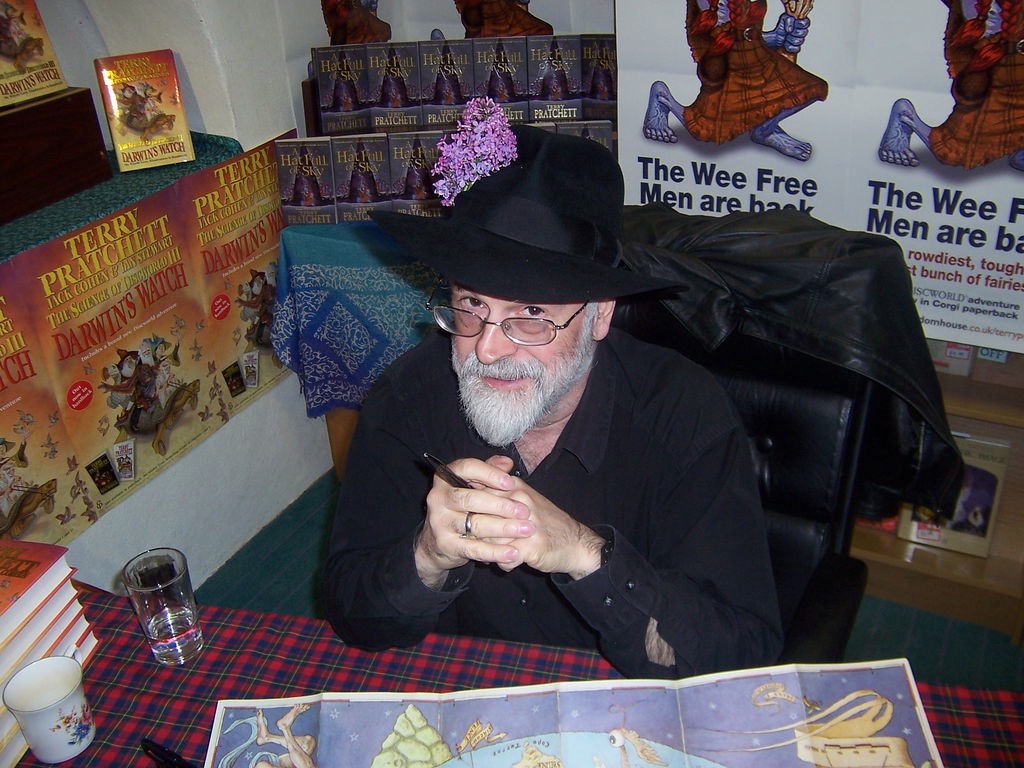
Terry Pratchett, the celebrated fantasy author best known for his massive Discworld series, has passed away today at the age of 66. He had long been battling with Alzheimer’s disease. In a statement, Transworld Publishers’ Larry Finlay said:
I was deeply saddened to learn that Sir Terry Pratchett has died. The world has lost one of its brightest, sharpest minds.
In over 70 books, Terry enriched the planet like few before him. As all who read him know, Discworld was his vehicle to satirize this world: he did so brilliantly, with great skill, enormous humour and constant invention.
Terry faced his Alzheimer’s disease (an ‘embuggerance’, as he called it) publicly and bravely. Over the last few years, it was his writing that sustained him. His legacy will endure for decades to come.
My sympathies go out to Terry’s wife Lyn, their daughter Rhianna, to his close friend Rob Wilkins, and to all closest to him.
Terry passed away in his home, with his cat sleeping on his bed surrounded by his family on 12th March 2015. Diagnosed with PCA1 in 2007, he battled the progressive disease with his trademark determination and creativity, and continued to write. He completed his last book, a new Discworld novel, in the summer of 2014, before succumbing to the final stages of the disease.
We ask that the family are left undisturbed at this distressing time.
Pratchett reportedly passed away in his home with his cat and family surrounding him.
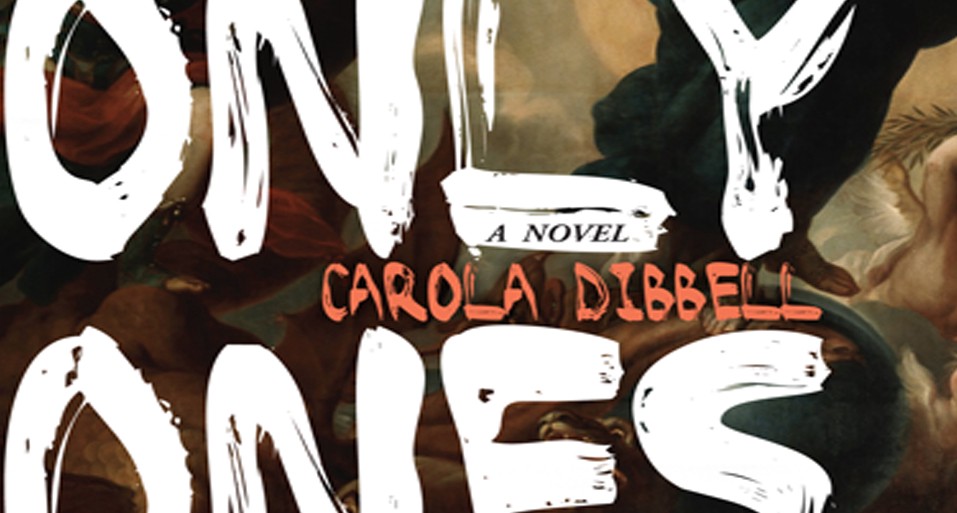
When you’ve seen one apocalypse, you’ve seen them all: there’s some real bad news, plus enough survivors left to tell the tale. What distinguishes a post-apocalyptic story, then, is who is doing the telling, and how. In a word, voice. In this regard, Carola Dibbell’s The Only One shines.
Our heroine is one of the handfuls that remain healthy after a series of pandemics decimate the global population. Her name is Inez, but the story opens with her telling us her sobriquet, I. “That’s what they call me. I’m lucky they call me anything,” she confides. She might as well be saying, Call me Ishmael. Anonymous yet fiercely individual, a castaway with little to her name except a hell of a story, she was found as an infant, the only one alive on a doomed bus.
Inez is a “hardy,” a genetic mutation capable of surviving exposure to disease, and as such has the most valuable DNA in the world. Frequently, in fiction, such mutations are paragons of purity. Inez, though, is an uneducated young hooker from Queens, and in this way, not unique in either her world or ours. She’s sullied, vulnerable, selling her hair, blood, and urine as well as donating her eggs for cash (as anyone who’s been down to their last fifty cents can tell you, this is hardly science fiction). This person, then, is the world’s great hope; but the fact that her genes could create a master race confers no special status on her whatsoever. If this comes as a surprise, what part of hooker from Queens don’t you understand?
It’s her DNA that has her entangled with a ramshackle cadre of for-hire geneticists who’ve promised a client mad with grief over the death of her children that they can clone Inez, creating adoptive children resistant to plague. Human cloning is illegal, though, and Inez is to undergo extraordinarily dangerous physical trials — with no legal protection, in order to produce progeny she’ll have no rights to It’s typical of Dibbell’s wry, socially-conscious humor that when Inez wants a guarantee that she’ll be paid, the wealthy, liberal client cries in disgust, “Why do you do this? Why do you treat your life as something that can be bought and sold?”
The client changes her mind, leaving Inez ill equipped to raise the clone, a girl who genetically shares the distinction and burden of being another “only one.” She returns to Queens, now a single mother living in the projects and vying for scarce resources. “Let me say a little about quarantine, which maybe you heard of or even went in once,” she says, in the pitch-perfect cadences of the outer boroughs. “…When everyone is finished dying, wait two more weeks. Then who is left could go. Now all you have to do is stay alive the regular way, and there is smoke and dust and anti-Patho spray, and they put you on trucks to some kind of Center but the trucks are commandeered and you are on Union Turnpike, which is a mess. Rickshaws, bikes, more trucks, cops in bubble suits, and everywhere, crowds on foot, running and shoving. You want food? Get on a line. Want shelter? Get on a line.” This is not exactly a world apart from ours.
Inez proves to be a devoted mother, despite her confusion about her daughter, Ani, being a clone — the media is hysterical with “clone panic,” horror stories meant to whip up revulsion on ethical grounds. Is it me or not me? she asks herself, watching Ani play. It’s not a farfetched question, as anyone with an organ donor’s heart now beating in their own chest can attest. “Maybe something is wrong with it. Maybe it is a crime against nature. But I wished we weren’t the only ones,” she concludes.
Dauntless, loving, Inez copes with the staggering bureaucracy of schools, arguing with teachers about her kid being dubbed “oppositional,” schlepping across town to work three jobs to secure Ani the best possible future. Pandemics aside, domed communities and rickshaws on the turnpike aside — all the story’s colorful dystopian backdrop aside — this is the central irony at the heart of Dibbell’s novel: Inez is far from being the only one.
Sign up for our newsletter to get submission announcements and stay on top of our best work.
YOUR INBOX IS LIT
Enjoy strange, diverting work from The Commuter on Mondays, absorbing fiction from Recommended Reading on Wednesdays, and a roundup of our best work of the week on Fridays. Personalize your subscription preferences here.