by Charles Yu
 I could definitely use a whole chicken right now. Or just a chicken leg. But I keep it to myself. I don’t want to alarm anyone in the group. They’re all busy fighting demon dogs. These guys are literally killing themselves for what? Fifty points a dog is what. It just breaks my heart. When I think of everything the group has been through together, the early days grinding it out in the coin farms, to where we are now, I get a little blue in the aura, I really do.
I can still remember the morning I found Fjoork in that wooded area near the Portal of Start. He was just a teenager then, nothing on his back but a thin piece of leather armor, just standing there like he’d been waiting since time immemorial. Like if I hadn’t come along, he might have been waiting there forever.
I’ll never forget what he said to me. The two of us standing at the place where the road splits off into three paths.
One leading into the forest.
A second path across a creek and into a valley.
And the third toward the north, up into the foothills and over the mountain pass, on the other side of which, as told in legend, lies the Eternal Coast of Pause.
And then Fjoork, all of three foot six, turns to me like he’s known me all my life and says, without a hint of emotion
Select Your Path.
I Shall Follow You.
The shall is what got me. I still love it when Fjoork goes all shall on me. To have someone believe in me like that, even as a kid. Or perhaps especially because I was just a kid. I was what, twenty-two? And here was this weird little guy saying I Shall Follow You all serious like that, as if I were someone, as if he knew I was destined for something good. Maybe even something great.
And now to see him like this, it just kills me, just makes me wish I’d made better choices. I just want to take Fjoork to get an ice cream and wash off all of that blood.
Trin and Byr are out in front of him, casting Small Area Fire over and over again. They aren’t going to be able to keep that up for long. They’ll drain everything they have trying. But that’s how we are. Like a family, after what we’ve been through. We’ve stuck together this long. Stuck together when everyone said we were all wrong for this quest, that we were a team built for flat-ground battles, that we’d never make it out here.
There were growing pains, for sure. We had to learn one another’s styles, everyone’s strengths and weaknesses, had to learn to stop getting in the way of one another’s semicircles of damage. More than once I got thwacked to the tune of 2d6 by someone’s +1 Staff. There were days when it just seemed like the world was nothing but fields and fields of blue demon dogs, each one needing three stabs before it would go down. We learned and improved, and there was a point, not long ago, when it felt like we’d been through just about everything there was to go through.
And then we learned about the uncharted land to the west. An entirely new continent had just opened up.
And that’s when things started to get bad.
Fjoork said We Shall Push On! It Is Our Destiny!
Trin and Byr suggested marshaling resources. Seeing if, perhaps, there were any alternatives.
Rostejn, being Rostejn, said to follow the action.
That made it two against two.
And I said, what are you all looking at?
Then my POV shifted.
And that’s when I realized everyone was looking right at me.
As in: We Shall Follow You.
You. As in, me.
Me. As in, The Hero.
It all made sense after that. The odd sense I’d always had, some kind of fixed radius around me. If I moved left, the group moved left. Hell, when I moved left, the whole battlefield moved left. I always seemed to find myself in the middle of everything, the center of the action.
Because the center of the action was defined as: wherever I was.
So yeah, I led them in here.
I led a thief (Fjoork), two mages (Trin and Byr), and a swordsman (Rostejn) into a devastated wasteland: brutal terrain, limitless bad guys, and, as far as I can tell, pretty much no chicken.
Fjoork is still getting hammered on. Trin and Byr have run out of magic for at least two rounds and now each of them is just randomly stabbing with Ordinary Dagger.
Rostejn and I are the only ones who are doing any kind of real damage, but neither of us is feeling exactly Thor-like at the moment.
I’m not going to die or anything, feeling about thirty-five, maybe forty percent health. If I had to guess, Rostejn is a little worse off than that right now.
We’re finishing off a cluster of these hellhounds, hoping against hope we’re close to a resting point, when a fresh wave of murderous dogs comes rushing in from the north. The worst part isn’t even their teeth. It’s their breath.
Rostejn’s a couple of feet in front of me, and when the new batch shows up, I see his shoulders slump. He slashes a demon dog in the throat and cuts another one’s legs off in two clean and efficient motions, then turns to look at me as if to say, chicken sure would be good right now.
I grunt in agreement.
Then it’s just there. I don’t know if it’s the prayers to the deity worked or we just lucked out, but there it is. A whole delicious chicken, cooked and on a platter, just sitting there under a tree. None of the demon dogs is interested. They’re undead and don’t get to eat anything except for human souls.
Go for it, Rostejn says.
No you, I say.
You eat it, he says.
This is what it’s all about. These guys, they all freaking love each other. And by guys, I am including Trin and Byr, who are like sisters, but also guys, but also, I might be slightly in love with Trin, like slightly and maybe also totally in love, like maybe ever since that double full moon in Oondar, when we spent a night flank-to-flank for warmth, but other than that, we are all like brothers, like chicken-sharing brothers.
Eat it, Rosti, I finally say, with authority. I tell him you feel great, only half lying. He needs it more, but even if he didn’t, this is what a hero does, right? Right?
No really, right? I am really asking. I wish there were someone who could answer.
The group sets up camp for the night. Everyone is demoralized. Turns out that chicken Rostejn and I kept offering each other wasn’t a chicken after all, just one of those smooth, chicken-looking-kind-of-rock mounds that stick out of the ground around these parts, so when Rostejn got nipped on the arm by one of those canine hell spawn, it took him down to twenty percent life bar and I’m sitting not so pretty myself at thirty-two, I just said to hell with it and used the Power Move I’d been saving for the last nine rounds. Lucky for everyone, it worked. But just barely. We all scrambled to this saving place, a little clearing near a cave. A place to hide out and heal our wounds, before setting out again in the morning.
The troops take stock of their equipment before dinner. A lot of it’s pretty banged up. Byr has the whole mess laid out in front of her and Fjoork is reading off the scroll of items.
Shield of the righteous.
Check.
+1 short sword.
Check.
+1 long sword.
Check.
+1 medium sword.
Check.
+1 medium long sword.
Check.
“Jesus,” someone mumbles.
“No wonder my back hurts,” Trin says.
Our problem isn’t really not having enough equipment. More like the opposite. No one wants to get rid of anything.
“Do we really need Blade of Slashing and Blade of Slicing?” Fjoork asks. Everyone knows it’s directed at Rostejn.
Darts of Severe Pain.
Check.
Darts of Moderate Pain.
Check.
Dagger of Nothing in Particular.
Check.
Chain mail’s one thing, and everyone knows you can never really have enough Heal Wounds, or Elixir of Potency, but this is sort of ridiculous.
Fjoork and Rostejn cook a meal together without saying a word to each other. Afterward, we all pass around a wineskin and look up at the night sky.
Byr says, “Have you ever wondered what you’d be if you hadn’t been what you are?”
“Probably a bard, I guess. I’m told I have a good singing voice.”
“No,” Byr says. “Not a different class. What if there were no classes? What if there were something else, other than ranger or thief, paladin or mage? What if you could be anything? What if you couldn’t be those things, but you had to be something else?”
“I’d be a hill giant,” Rostejn says. “Without having to wear a girdle of hill giant strength. Or maybe a frost giant. Those are stronger, right? Frost giant, I think.”
Byr rolls her eyes at Trin and the group drifts off to sleep.
I watch them all snoring, Trin the loudest. She’s a single mother. Who is taking care of her kid at home? I don’t even know. I am in love with her, and I don’t even know who takes care of her kid.
Byr wakes up and catches me staring at Trin.
“She loves you, you know.”
I ask Byr if Trin actually told her that.
“Yeah,” Byr says, throwing a stick into the fire. “But she thinks you’d be a shitty dad.”
Eventually, I drift off into a restless sleep of my own. I dream the ancient dream, the immense dream of the ancients, I am looking out across the gray timeless expanse of Evermoor, having the greatest of all dreams, until Rostejn wakes me up in the middle of the night relieving himself in the wooded area.
In the morning we set out for Argoq. Fjoork, who always seems to have a sense of these things, says he knows a guy who knows an elf who says to take the long way around, steering clear of the Lake of Sensual Pleasures. The group sort of grumbles, but everyone knows they have to stay focused on the mission, relentlessly scrolling toward the right.
We stop into a shop run by an old druid friend of Trin’s. Trin greets him with a peck on the cheek. Seeing her kiss him burns me up inside and I feel like I need to make a small saving throw just to avoid getting dizzy.
The druid shows off his new wares. Boots of speed, harp of discord, harp of merry diversion. The usual clatter thrown off by the steady flow of questers along the Silvan Route.
“How much,” asks Trin, “for that Ring of Regeneration?”
“Fifty,” the shopkeeper says, “but actually it’s a Ring of Warning.”
I fish coins out of my pouch and drop them in the keeper’s hand. He gives me the ring, which I nonchalantly pass over to Trin, trying to be cool about it.
Byr raises her eyebrows at Fjoork, as in, hey, get a load of Grenner the Romantic over here.
Trin refuses it. “You need this a lot more than I do,” she says. It’s true. I’m an 11 Dexterity, the lowest in the group. But really what it’s about is that Trin, being what she is, has an innate sense of being pursued.
I take it back and notice that Byr is suppressing a smile. OMG: how have I never realized this before? Byr is in love with Trin. She can barely contain herself.
I’m staring at Byr who is staring at Trin who is trying to pretend that this triangle of unrequited staring is not happening. Lucky for me, Rostejn breaks up the tension with his usual nonsense.
“Check this out,” he says, holding up a vial of something yellow and bubbly.
“Oil of Craziness,” the shopkeeper says.
“We’ll take two,” Rostejn says, flinging the coins onto the counter. I shoot him a look.
“What?” he says. “You never know when this might come in handy. You just never know.”
It is a half moon later when Krugnor joins our group. We’d spent several days slashing through wave after wave of dumb meat, orcs and ogres, churning and grinding. Toward the end, we were barely talking to one another, just carving up bodies, leaving them in piles. Green flesh hacked up everywhere.
Krugnor isn’t any of the classic types. Krugnor is special, and everyone can see it right away.
It used to be there were only four kinds of people in the world: fighters, mages, clerics, and thieves. What someone did for a living said something about who they were, what they thought of themselves, how they approached the world: strength, intelligence, wisdom, or charisma.
Krugnor, however, is one of these newfangled classes. A hybrid, part of the generation that refuses to be pinned down.
A warrior-mystic. Or at least that’s how he introduces himself, when we find him by a babbling brook, doing yoga.
I try to roll my eyes at Trin, but she’s not having it. She likes him. I can tell right away. I look over at Byr, to see if she’s noticing this, but even she seems to be in some kind of trance.
Even my own disciple seems smitten. “We need that guy,” Fjoork says.
So I put it to a vote.
Trin votes yes, tries to not look excited.
“He will help with hit points,” Byr says. “We could take on a thousand-ogre wave, if we had to. Brute-force our way through the battles and rest up. Just plain outslug the monsters.”
Rostejn votes yes, too, although I get the sense that he just wants to get at some of the awesome hardware Krugnor has in his equipment sack.
And Fjoork looks head-over-heels for the new guy already.
No need for me to even weigh in.
Krugnor joins the group.
“Shall we make it official?” he asks.
I say, uh, sure, what does he have in mind?
“Stare into one another’s souls, of course,” he says. “Isn’t that how you guys do it?”
I say yeah, sure, okay.
Krugnor goes to Trin first, big surprise, and takes her head in his large, callused hands. They lock eyes and she seems to melt.
“So that’s what a hero looks like,” Byr says.
I tell Byr to shut up.
Each member of the group gets their own turn. When it comes to me, I take a pass.
“If we are going to be brothers-in-arms,” he says, “we will need to touch souls.”
I say I’m getting over a cold and don’t want him to catch it.
“It was really a nasty bug. For your own good.”
“Okay,” he says. “But don’t think you’re getting away so easy.”
After he’s done with all the soul-staring, Krugnor asks me for a copy of the battleplan. I say, uh, I’ll get that right to him.
It is foretold that there will be two hundred fifty-five battles in our path to destiny.
In the Final Battle, Battle 256, we will face the final boss.
Sounds pretty exciting.
And it was, for a while.
Today is Battle 253.
I think.
Hard to tell, though.
Because, to be honest, these epic battles of good and evil, after about the first two hundred, they all start to kind of blur together.
Before setting out to the battlefield, we pray to our deity again, whose name is Frëd. He’s a minor deity, but sort of an up-and-comer. At least that’s what he tells us.
We get a lot of shit from other groups for worshipping him, but he’s really Byr’s deity. Now that I think about it, she’s partly responsible for this mess we’re in. Before we all became acolytes of Frëd, we used to worship different deities. Some of us didn’t even have one. And we definitely never talked about it, it was just sort of no one else’s business who or what you worshipped or sacrificed poultry for, so long as you pulled your weight and your deity wasn’t some imp who was going to screw with everyone or make us give up gold coins for safe passage or cause us to suffer ordeals. But then Byr went away to the north over summer vacation and when she came back she had that look like someone had cast Slightly Crazy on her, and she was all Frëd this, Frëd that, she couldn’t stop talking about the guy, and we were all like, okay, cool, but you’re not going to go all druid on us are you?
“Frëd,” Byr prays, “oh Sort-Of-Omnipotent One, protect us today. Keep us safe, body and soul. Let us fight without fear, and vanquish our enemies.”
“Or at least let us not get our asses kicked like last time,” Rostejn adds.
“Goddammit, Rostejn,” Byr says.
“No, no, fair enough,” Frëd says, from wherever he is. We can’t see him but his voice booms from on high. “I have to apologize for not doing such a great job with the god-thing lately. Honestly, I’ve just been going through kind of a weird time.”
Byr reassures Frëd. “You’re fine. Seriously. You know we love you,” she says, and everyone murmurs in agreement, but it’s not the most reassuring thing to realize that the god you worship actually just wants you to believe in him.
Krugnor turns out to be an absolute beast on the battlefield. Not that anyone is surprised. He’s ripped.
“Has to be at least 16 Strength,” Rostejn says, watching him tear through some bad elves.
Byr’s like, “Nuh uh. Seventeen, man. Easy.”
Trin isn’t even fighting, she’s just standing there watching, staring at the dude’s muscles while he brandishes his +3 broadsword. I’m not even sure I could pick that thing up.
I ask if he really has to fight with this shirt off, but no one’s listening. He flexes a lot, even when it doesn’t seem necessary, and he can even do that back-and-forth flexing thing with his pecs. Ugh, look at him, just standing there in the river as it rushes by and splashes on his hardened body.
Fjoork even gets in on the love fest. Fjoork, the guy who is supposed to be following me for all eternity.
“Did you see what he did to that kobold king?” he says. “Split him clean in half, one-handed, with his short sword.”
If I didn’t know better, I’d think Krugnor had cast Infatuation on everyone. The guy is totally cheeseball beefcake brooding sulking warrior-type. Such a cliché. Although, I have to admit, I do feel safer with him out there in front.
Maybe that is what a hero looks like. A leader. The protagonist.
And for the first time since the quest began, I start to feel a little wobbly, as if my POV isn’t so stable. As if the center of things is moving.
As if the frame is unsure of who to follow, whose story it is. As if, maybe, I’m not so destined for my destiny after all.
We cross the highlands and come to a ridge, on the other side of which is the Valley of Aaaa.
“I’ve always wondered how that’s pronounced,” Rostejn says.
Byr says a prayer for to Frëd as we begin our descent into the valley. We trudge through the Bog of Uncertainty. Trin reminds everyone to be careful of what we eat or even look at. Last time we were in the bog, Rostejn fell under the sphere of influence of a powerful mage in the Abjuration school and almost got everyone turned into black pudding.
Now we’re in a dead zone for magic. Alteration prevails on one side, and Necromancy on the other. Neither one can practice in the other’s region, as they are mutually forbidden schools. We walk the tightrope in between, maneuvering carefully, taking the narrow path, as shown on our scrolling map.
Krugnor follows my lead. Everyone else does, too.
At one point we encounter some halflings. A quiet, intelligent people who live around these parts. One of their young has disappeared. The boy’s mother is sobbing. Trin goes to comfort her. The mother explains that her son had fallen asleep on what he thought was a nice soft pile of leaves.
“A shambling mound,” Byr says.
The mother looks at us, unsure.
“A creature that looks like a heap of rotting vegetation,” Byr explains. “But is actually a flesh eater.”
“Yuck,” Rostejn says. “That is nasty.”
Byr shoots Rostejn a look like real nice, idiot, and the mother starts her crying again, even harder this time, and everyone is looking at me to do something, so without a word I leap straight into the mound, diving into the creature’s body to grab the halfling-kid, and then hacking my way out with a scythe. Which is messy, to say the least, and costs me about eight hit points, but in doing so, I level up. Everyone congratulates me, and I’m feeling pretty good. Even Trin looks impressed, and for a moment it doesn’t seem so impossible that she might be in love with me after all.
The good feeling doesn’t last long, though. The next battle is Battle 254 and we just aren’t quite ready for this kind of onslaught yet, not tactically, not in terms of speed or weapons or as a team. Byr nearly dies, Rostejn nearly dies. Even my health dips down into the red zone.
I start to flicker in and out, a warning that my existence on this plane is in danger.
I know what I should do, but I can’t bring myself to do it.
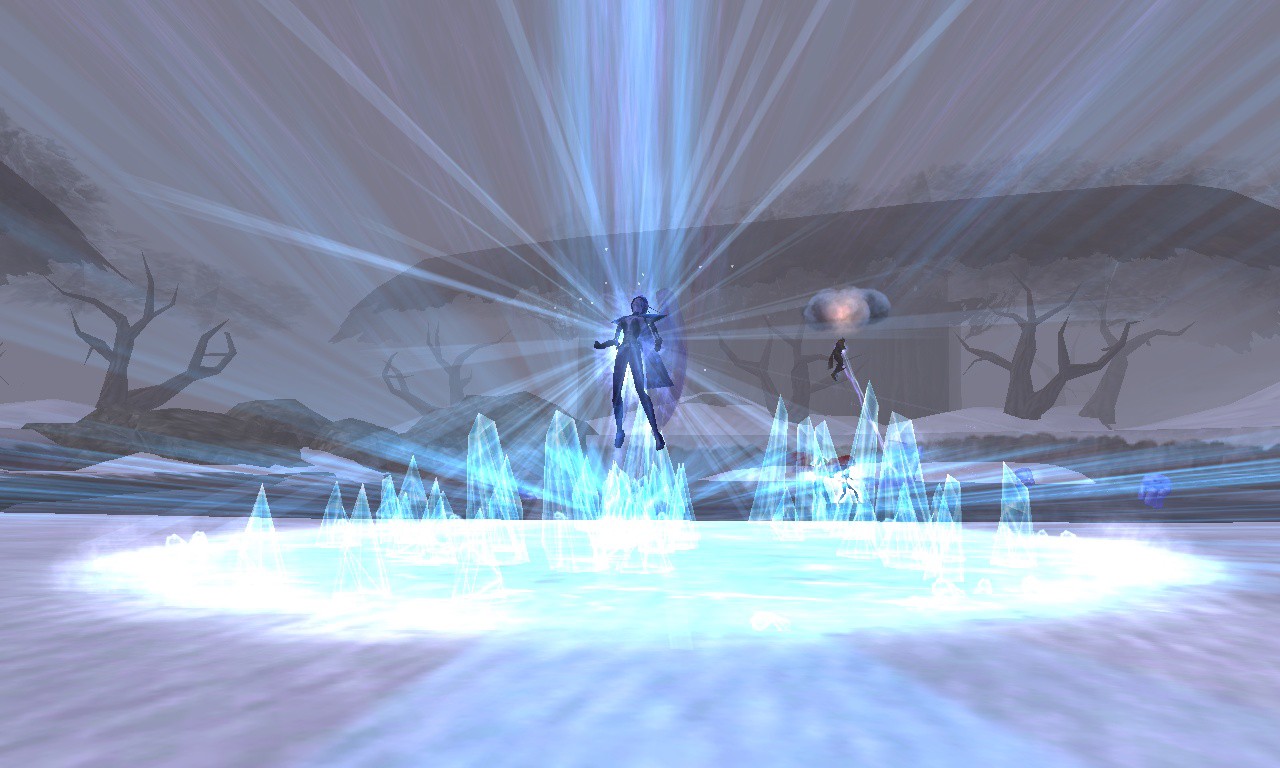
Another hit, direct to my torso, and that’s it, my health is critical. My soul starts to tug itself out of my mortal coil, and my POV is floating up toward the clouds. I watch my body down there, fighting without spirit.
Frëd help us, I cry out, in a moment of desperation.
I can’t see him, but I feel Frëd’s presence next to me. “I thought you didn’t believe in me,” he says.
“That seems sort of petty.”
“Um, yeah. Duh,” Frëd says. “Do you know anything about gods?”
He’s got a point, I suppose, although really what I’m thinking is how come I’ve never noticed how high Frëd’s voice is. I can’t quite put my finger on it, but for the first time I realize there’s something off about him.
“Byr’s down there,” I say. “She prays to you all the time.”
“Yeah, but you’re the one that’s asking for help,” he says. “Get on your knees.”
“You can’t be serious.”
“For real, dude. I want you to pray to me.”
So I start. “O sort-of-great one. O exalted mediocre one, Frëd.”
“Get on your knees.”
“You’re pushing your luck.”
Frëd uses some kind of POV shift power to direct my attention back down to the earthly battlefield, where my team is getting slaughtered. “I don’t think you’re in a position to be talking about luck right now.”
I sort of get on my knees and am about to start again when I hear a woman’s voice.
“Frëëëëëëëëëëëëëëëëëd,” she yells. She sounds angry. Great, now there are two gods, one petty, one angry, and I’m still floating in the sky, getting farther from life with every passing moment. “You are in big trouble, mister.”
Wait a minute. Is she? No. She can’t be.
“Um, Frëddie?” I say. “I think your mom’s calling you.”
“Not a word,” he says. “To anyone.”
“Sure, sure. Just kill those monsters for us.”
“I, uh, I can’t do that. Sort of used up all my juice for a while. But here’s a chicken leg,” he says, and disappears. “Sorry, gotta go.”
You eat the food and gain just enough health to stop flickering and return to the plane of the living, where you see that Krugnor and Trin are in berserker rages and Rostejn has just used his Daily Power Move and the battle’s pretty much over. The mini-boss, a frost giant, is on the ground, and one more thrusting attack by Krugnor does the trick.
Trin spots you reappearing and says welcome back, nice of you to join us.
The mood at dinner is somber. No one’s much inclined to be bawdy, or even merry, not with half of the group near death. We all lie still and chew on chicken in silence.
It’s hard to understand how it got to this. I led a bunch of good fighters, good hand-to-hand fighters, into a ranged combat situation. Maybe it’s my 15 Charisma. It’s the highest of anyone in the group. Maybe a good Charisma score has been my crutch. I’ve always secretly wished people wouldn’t like me so much.
After dinner, I find Fjoork over by a stream, washing his face.
“Hey buddy,” I say.
“Hey.”
“Tell me again why you think I’m destined for greatness?”
Fjoork looks off to the north, stands there just looking for a long time before answering.
“I never said that.”
I’m brushing my teeth with a twig and do a spit-take.
“You didn’t?”
“No man. I said, I Shall Follow You.”
“Oh,” I say. “Yeah, you did. Huh.”
Fjoork wipes his face, rubs the back of his neck.
“Well,” he says. “This is awkward.”
“Don’t I feel a bit silly. All this time, I thought.”
“Yeah, I know what you thought. And that’s okay. It got us this far, didn’t it?”
“I guess you’re right.”
“Who knows,” Fjoork says. “You might rise to the occasion.”
And if not, maybe Krugnor will do it for me.
When I get back to the campfire, I see Trin and Krugnor sitting together on a fallen tree. Trin has her hands under her thighs, which she only does when she’s feeling a little red in the aura. Now she’s looking at him in a way I have never seen her look at anyone. She’s definitely never looked at me that way, not even in Oondar.
Charisma’s good for a few things. Bluff, Disguise, Handle Animals, Intimidate, Perform. But it’s not so good when things get real. It’s not so good heading into Battle 256 with a group of tired, beaten-down warriors. Right now, I’d trade half of my Charisma points for some Wisdom. I’ve always been a couple of points on the low side in that department. I think about gathering everyone around, to rally their spirits a bit. If only I could say something wise right now, or at least something wise sounding. Even that might not work. But I can’t come up with anything decent, so I keep my mouth shut. Everyone’s a little tired of me anyway, I think.
In the middle of the night, I wake up to Byr and Rostejn whispering. I listen to them in the darkness.
Krugnor knows where the map doesn’t show.
Krugnor could lead us to The End.
Krugnor this, Krugnor that.
We keep on moving. We fight anything and everything: deathknells, bugbears, carrion crawlers, lesser devils. We fight a small band of ghouls, and the ghoul queen. We get attacked by a gray ooze, waking up one morning to find the creature all over us, our camp, in our hair, covering our food. We lose almost an entire day, not to mention using up several minor enchantments plus a Cure Light Wounds, just to get cleaned up. We keep moving on, to the right, slashing and stabbing, jumping and charging, dragging ourselves onward.
Then Rostejn quits.
He comes to me and says, “You’ve been good to me, this has been good, but I gotta say, where is this all going? What are we doing? I don’t know. I don’t know anymore. I used to know. I need to know what this group stood for. Now I don’t.”
“Ros,” I say. “You are killing me. You are absolutely freaking killing me here.”
How can I explain to him that I’ve been asking myself the same questions for the last ten moons? I can’t say any of that. It will make me sound weak.
Rostejn says, “Don’t think this means I’m not grateful. Don’t think this means, in any way whatsoever, that I don’t appreciate everything.”
“Yeah,” I say.
“Yeah. Yeah, man. Yeah to all of it, all of our good times. You used to be such a great leader. You led us against a gold dragon. We slew a gold freaking dragon, man! We were the toast of the Forgotten Village for twenty moons after that. Free mead and game bird until we all got fat and out of shape and our Dexterity scores started going down and we had to quit that place and move on. You gave me my first knife, my first Threnovian Sun Blade. You taught me how to bludgeon. You helped me increase the range of my barbarian’s rage. I won’t forget any of that. It’s just.”
“I know.”
“No, no, for real. There’s something else,” Rostejn says. He cracks a smile, something I haven’t seen for a long time. “I’ve got a girl now, boss. Met her right before we started this campaign. We’ve got a kid on the way. Going to ask her to marry me.”
“Wow, Rostejn,” I say. “Wow. That’s just, that’s great.”
“Yeah. I can’t believe it. Hopefully the kid’ll take after his mother and be a peaceful law-abiding villager. Be more than I am. More than a sword for hire. Maybe solve puzzles all day. A friendlier line of work than this.”
I tell him he’s going to be a great father.
“I just don’t know. I don’t know what we stand for anymore. Byr’s gone all churchy on us, Fjoork hasn’t said a word in a moon and a half.”
“That’s not fair.”
“It’s not just you. It’s all of us. Anyway, that’s not the point. I’ve given up on Immortal Hero. That’s a young man’s dream. I’m not going to get that Hero Path. I just want to get back to what I’m good at, basic stuff, level up every few years, maybe go out and pick up a few skills along the way. I’ve always wanted to get into Animal Empathy.”
“You?”
“Yeah, yeah,” Rostejn says.
We have a warriors’ embrace.
“If you’re ever in the area,” he says, “Jenny makes a mean boar pie.”
“Sounds good,” I say, sure that I’ll never see him again.
Krugnor finds me as I’m walking back to camp and pulls me aside. Here it comes. He’s taking over.
“There is something we should talk about,” he says. “Man-to-man.”
“Yeah, yeah. I know. Go for it.”
“Go for it?” he says. He looks surprised that it was so easy.
“Yeah, be my guest.”
Krugnor lunges forward and I am expecting him to knock me to the ground in some kind of alpha-male dominance, but instead he grabs the back of my head and shoves his tongue into my mouth. Way, way into my mouth.
It takes all of my strength to push him off me.
“What the hell was that, Krugnor?”
“You said go for it.”
“That’s what you thought I meant?”
“Wait, what did you mean?”
“I thought you were taking control of the group?”
“Why would I want to do that?”
“Um, I dunno, because look at you? You’re this super-buff warrior-mystic who crushes evil beings and likes to aggressively eyeball all of our souls? Because the whole group thinks you are Frëd’s gift to us?”
I hear some murmuring and that’s when Krugnor and I both look over and see the whole group watching. From the looks on their faces I realize they saw the whole thing.
Trin’s mouth is wide open. Rostejn looks actually sort of hurt, like if Krugnor was going to have a thing for one of the guys, it should have been Rostejn. Fjoork appears to be rapidly and violently recalibrating his view of everything that has happened for the last several weeks. Nobody speaks.
“Don’t mind us,” Byr finally says.
Krugnor turns back to me. “This is your group,” he says. “Always has been.”
“Then what the hell was with all of that flexing and showboating and stuff?”
“I was trying to impress you,” he says. And I look over at the group, and I can see it in all of their eyes. They’re sort of impressed. They’re sort of like, really? Trying to impress him? I know I’ve let them down, but it’s not too late. If this new guy, this super-strong, super-charming new guy is willing to follow me, maybe they can find it in themselves to remember why they followed me in the first place. Maybe I can find it in myself to remember. Just maybe.
Or not.
It’s the day of the final battle, Battle 256.
The first wave is lichs, and I know immediately that we are in trouble.
Then the rocs start in from the sky. Byr is praying her ass off, but her deity seems to be doing whatever gods do when they decide to ignore us down here, because about ten minutes into the fight I hear those dreaded words.
Byr absorbs major damage.
I do my Power Move, but it’s a drop in the bucket. We’re in a sea of enemy hit points here. A fresh wave of monsters comes over the top of the hill.
Trin absorbs major damage.
Rostejn absorbs major damage.
Fjoork absorbs major damage.
This couldn’t get any worse.
Then it gets worse.
Krugnor absorbs major damage.
It isn’t long before we are all exhausted, overwhelmed by the power and the sheer number of the enemy.
Then:
Hero absorbs major damage.
It can’t be.
I am drifting off to The Place Where You Go Between Lives. I go through heaven, through hell, through an interdimensional nether-region.
In the midst of the carnage, my soul lifts out of my corpse, and toward a great expanse of light, the eternal horizon, the edge of the world, that final screen, how beautiful and peaceful it looks.
I have failed in my quest, and as surprised as I am that the story is ending this way, what is really unexpected is how okay I am with it, with all of it.
THE END
Really?
Is it really going to end like that?
I Am Here.
When I wake up in the sky, I am two hundred feet above the battlefield.
It is not pretty.
But on this side of The End, everything looks slow motion, almost like a choreographed dance, or perhaps a game, played by people that don’t quite seem real anymore. Even my lifeless body down there looks like some kind of puppet, something to be pulled along, controlled and manipulated. The fighting goes on in silence, this gorgeous ballet of carnage, and I start to wonder, did it matter? Did any of it ever matter? I tried. I gave it my best. That’s as much as anyone can say, right? So there. So that’s that. So now, I find myself floating up to my eternal reward.
Then Frëd appears, sticking his big face through the clouds. I was right: he’s a child. Hasn’t hit puberty yet. A god-child. Even gods have to grow up, I guess.
“Hey Frëd,” I say.
“Actually, no umlaut,” he says. “It’s just plain Fred.”
“Well, good to finally meet you face-to-face, Fred.”
“Things aren’t looking too good for you,” he says. “I’m sorry about all of this.”
“Why are you sorry?”
He looks at me like, you don’t know?
“What?” I say.
“This world, all of this, all of your world,” he says, trying to find the words. The tingling gooseflesh of comprehension starts to creep up my arms and the back of my neck. My mind strains for a grasp of what it is he is getting at, like trying to visualize higher dimensions. Fred either can’t say or doesn’t want to say, but I think I know what he’s getting at.
“I’m just sorry to have put you guys in this position,” he says. “And now I have to go.”
“So, that’s it? That’s all we get? No proper ending? The forces of good and evil, geography, history, destiny, when you have to go, you just pull the plug and all of this just goes away?”
“Let me ask you a question,” Fred says. “What do you believe in? Do you believe in yourself? In your team? In heroism? In good? Do you believe in anything?”
“That was more than one question,” I say. “I want to believe. I believe I am capable of believing.”
“I guess that will have to do,” Fred says, and with a wave of his hand the clouds above part and projected onto the sky are two paths, two alternate futures for me.
In one direction is The Path of Legends:
You have fought enough battles. Your record, while imperfect, is already enough to earn you a place in the Hall of Eternity. Choose this path and you can vanish from the ordinary world. Perhaps you watch over the ongoing struggle, content in the knowledge that you have played your part. Perhaps you leave your plane of existence and become a minor deity yourself.
In the other direction is Honorable Death:
On the field of the most gruesome battle in history, you shall meet your foes and do battle. You may prevail. You may be defeated. You may prevail even as you are defeated. You may end up killing your enemy and in the process, killing yourself. Rejoin your team now and find out.
“Select Your Path,” Frëd says, resuming his god voice.
Trin is bleeding from her eyes, nose, mouth, and ears.
Byr has lost an arm.
Rostejn has lost both arms.
Fjoork is in the process of being eaten by an orc.
Krugnor is looking up at the sky. He seems to have given up.
Maybe Frëd is just Fred. Maybe we have been praying to a nine-year-old whose mom keeps yelling at him to clean up his room. Maybe this is all just a game, an elaborate architecture created by some intelligent designer, out of what, boredom? Grace? Perverse curiosity? Some kind of controlled experiment or attempt to reconcile determinism and free will? What is my score? What is a health bar? Here I am, outside my own story, no longer moving to the right, or to the left. On the other side of the edge of the screen, off screen. After the end of the game, I can see it for what it was. You know what? I can know all that and still care. I can know all that and at the same time know that it matters. It has to matter. So our deity might have to leave for a while. So he may or may not have meant to make things this way. So we might be left on our own down there. So maybe he never meant for any of this to happen; this wasn’t the story at all, he wishes he could just hit the button and start all over.
That doesn’t make it any less real. That doesn’t mean we should give up down here.
“I really gotta go now,” he says. “It’s your story now.”
He looks at me like, I’m sorry, but what am I supposed to do? And he’s right. He’s a minor power at best. He can’t get us out of this. He’s a nice guy, good at what he’s good at, but this is our problem.
I can see Trin and Krugnor down there getting their asses kicked. Things will suck if I go back down there. All of my friends might get killed. And even if they live, they will be horribly maimed and probably blame me forever for this shit that I got them into. But still. No one said it would be easy, or fun, or good, or clean, or that I would have any glory or comfort or a moment of rest in all of my days. But if I have anything at all I am still the Hero. This was my story. This is my problem. I’m going back down there to fix it.