Oh, my sweet summer child, what do you know of totes? Totes that stack a hundred high in your tiny Brooklyn apartment, totes in every color for every feeling, totes that hold other totes inside themselves.
But do you wonder if there is one literary tote bag to rule them all?
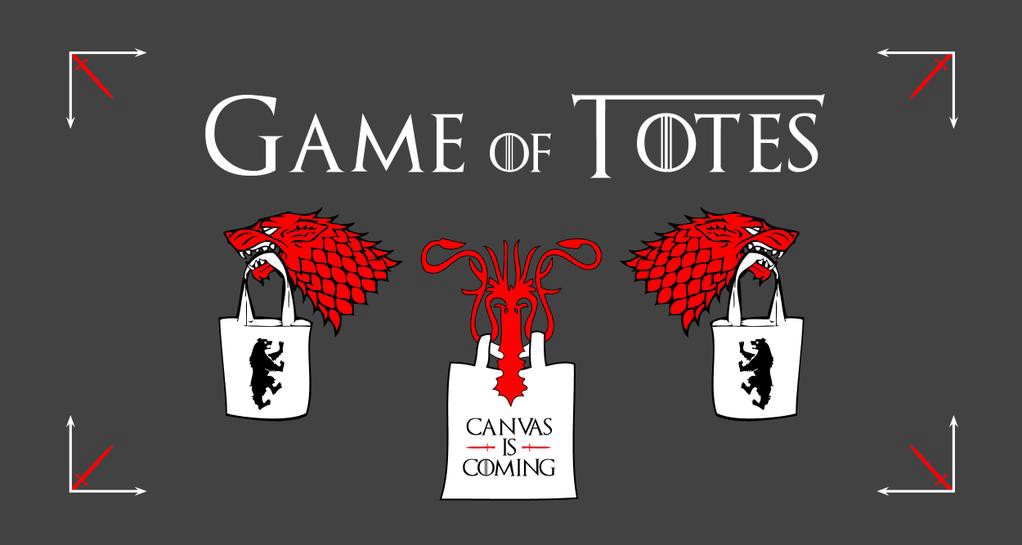
This April, Electric Literature and Vol. 1 Brooklyn will unite to answer that question, putting to rest the question that book fans have been wondering for ages: who makes the greatest tote bag of them all?
Who should sit atop the canvas throne in the greatest battle between unfastened bags with parallel handles? Who will win the Game of Totes? We want your advice! We’re looking for submissions by Monday, March 30th. What we need is a picture of the literary tote and your reasons why you think it is the best tote bag on the planet. On April 6th, we will unveil the entrants to the tournament, and ask you, the reader, to vote on which 12 will make it to the next round, to be judged by a panel of experts. Finally, on April 20th at Housing Works in the island fortress of Manhattan we will host the final round of the Game of Totes to find out whose bag can hold the most books, stand up to the worst public transportation condition, and hold the most kittens. Well maybe we won’t do the kitten thing, but there will probably be pictures of cats and/or direwolves in tote bags!
The title of this mix tape is “stuck” because these are songs I listened to when I was stuck on Find Me — I worked on the book on-and-off for about six years, so this stuck-ness happened a lot, which accounts for why there were so many years. Sometimes leaving the book alone for a while was the best thing, to give myself space for my understanding of the book to evolve and shift, but at other points just showing up on the regular and looking at the thing was what I needed to do and during those times, music made continuing on seem a lot more possible somehow.
I’m actually not going to say much about the individual songs because — as weird as this may sound — I don’t actually have a lot to say about them. I can’t really express what makes something a good writing song for me: I need a certain amount of energy and a certain kind of beat, something that makes me feel more present and, at the same time, something that I can disappear into. I like stuff that has a kind of hypnotic quality. I listen to a song for as long as I like listening to it. I don’t sweat finding new stuff too much. At this point, I feel the same way about bands as I do about friends: I have my people, but if someone introduces me to someone really cool, well then all right.
“Bone Machine,” The Pixies.
“An Apology,” Future Islands.
“How it Ends,” DeVotchKa.
“Knife,” Grizzly Bear.
“In Motion,” Trent Reznor.
“Old Strange,” Steve Gun.
“Bixby Canyon Bridge,” Death Cab for Cutie.
“No Fit State,” Hot Chip.
“Don’t You Forget About Me,” Simple Minds.
“Let Me Clear My Throat,” DJ Cool.
“Love Will Tear Us Apart,” Joy Division.
***
— Laura van den Bergis the author of the short story collections What the World Will Look Like When All the Water Leaves Us, a Barnes & Noble “Discover Great New Writers” selection, and The Isle of Youth, which won the Rosenthal Family Foundation Award from the American Academy of Arts & Letters and The Bard Fiction Prize. Find Me, Laura’s first novel, was published by FSG in February.
While most tanks ruin lives, Argentinian artist Raul Lemesoff has built one to encourage reading. Lemesoff’s “Weapon of Mass Instruction” sculpture to “attack people in a very nice and fun way.” The “tank” is built on a 1979 Ford Falcon. The following video, produced by 7-UP, shows the mobile library in action.
If you’re like me and grew up reading Raymond Carver alongside Raymond Chandler and Marvel comics alongside Flannery O’Connor, you know it is a great time for fiction. In 2015, the walls between genre fiction and literary fiction are mostly in ruins. The New Yorker devotes issues to science fiction and crime, the Library of America collects work by H. P. Lovecraft and Kurt Vonnegut, the National Book Foundation awards medals to Stephen King and Ursula K. Le Guin, and MFA and Clarion grads debate George R. R. Martin and Junot Diaz alike. If you are a teenager now, the concept of the genre wars could feel as anachronistic as cassette tapes and landlines.
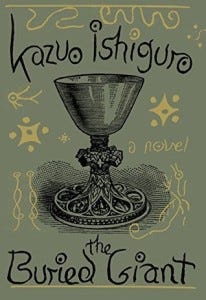
Except, somehow skirmishes in the genre wars keep flaring up. Even today there remain holdouts, fighting Hatifled-and-McCoy-battles on blogs and twitter over ancient insults. The most recent argument occurred last week over Kazuo Ishiguro’s latest novel, The Buried Giant. In a New York Times interview, Ishiguro wondered if readers would understand what he was trying to do: “Will they be prejudiced against the surface elements? Are they going to say this is fantasy?” Ursula K. Le Guin, among others, took great umbrage, arguing that not only was the book fantasy, it was failed fantasy: “It was like watching a man falling from a high wire while he shouts to the audience, ‘Are they going say I’m a tight-rope walker?’”
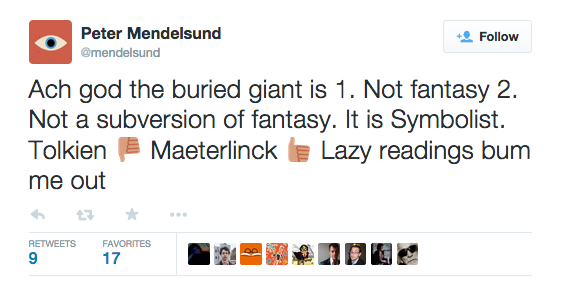
At Salon, Laura Miller wrote about how the book is not fantasy but rather a meshing of modern realism with medieval romance. At Flavorwire, Jonathan Sturgeon agreed: “…The Buried Giant is not a genre work: its inspiration predates fantasy literature. It would be inane, even absurd, to retroactively apply the fantasy label to Homer’s Odyssey because it has monsters.” On Twitter, Peter Mendelsund, who designed the jacket, had yet another label to apply:
Finally, Ishiguro came out to say that he hadn’t meant to insult fantasy: “If there is some sort of battle line being drawn for and against ogres and pixies appearing in books, I am on the side of ogres and pixies.”
As is typical in the genre wars, everyone seems to be talking past each other. The idea that Ishiguro “despises” genre — as Le Guin suggests — seems suspect. In the same interview that sparked the controversy, Ishiguro said that the atmosphere of The Buried Giant was inspired by western and samurai movies; he doesn’t seem concerned if his work is construed as genre. He does seem worried, however, that readers of his previous novels might come to The Buried Giant with the wrong expectations. All writers worry about how their books will be received, and Ishiguro had a similar problem with the science fiction-tinged Never Let Me Go being attacked by some for not being SF enough and by others for being too SF.
I don’t think genre labels are meaningless. Indeed, genres can be vital traditions for writers to work in and draw inspiration from. Genre distinctions are real — genre mash-ups wouldn’t exist without readers being able to distinguish between the genres being mashed — but genre, like so many labels, is better understood as a spectrum than separate boxes. Some works are clearly operating in a specific genre tradition, while others mix different traditions, and yet others simply play with a few elements while doing their own thing.
Part of the problem is that both the genre and literary worlds have incoherent and contradictory definitions of the words “genre” and “literary.” This often leads to a pointless game of appropriation, where literary critics and readers say that the best genre writers have “transcended genre” and should count as literary fiction, while, at the same time, genre fans declare that famous literary writers belong to genres they never considered themselves a part of. Raymond Chandler is “really” literary fiction while Italo Calvino is “actually” fantasy. (The most absurd proprietary claim I’ve ever encountered was a SF fan arguing that Philip Roth’s The Plot Against America — an otherwise realist novel that imagines what would have happened if FDR had lost the 1940 election — was by definition science fiction because all alternative history books are posited on a theory of multiple realities resulting, for some reason I can’t remember, from teleporting wormholes.)
The problem with this appropriation game is that it eschews any understanding of history, tradition, influence, or context in favor of “winning.” It turns criticism into politics instead of a means to better understand and appreciate books.
This is where I think Le Guin — who is one my favorite fiction writers — falters. She simultaneously defines Ishiguro’s work as fantasy, and then claims that it doesn’t work as real fantasy. Well, then maybe Ishiguro was correct all along in saying the label didn’t fit. If Ishiguro tells us his influences were westerns, samurai films, and 14th-century chivalric poems, what does it matter if the result can or can’t be labeled fantasy? Do the labels “fantasy” or “realism” advance an understanding of what he is doing?
Le Guin is right about the literary world having a tradition of genre snobbery. She talked about some of that history here at Electric Literature with Michael Cunningham. There was absolutely a time when genre work was walled-off from the so-called “literary” world, with literary critics and magazines thumbing their noses at certain genres (fantasy, horror, romance) while absorbing others into the canon (Victorian gothic, magical realism, southern gothic). Indeed, even a decade ago — when I began submitting fiction — it was common for literary magazines to openly state they weren’t open to genre fiction and for creative writing classes to disallow vampires and aliens. There are still a few stubborn holdouts, but they are a dwindling group.
But if the genre world has been marginalized, they’ve also walled themselves off. It is just as common to see genre fans call literary fiction “mundane fiction” and scoff at the “lack of imagination” of literary writers as it is to see literary fiction fans assume that all genre fiction is formulaic and poorly-written. Jonathan Lethem had a great essay about the fact that while the literary fiction world erred by not recognizing the likes of Delany, Dick, and Le Guin, the SF world made an equal error in ignoring the likes of Thomas Pynchon, Angela Carter, and Don DeLillo. The ignorance has been mutual.
Fortunately, “has” is the key word here. These battle lines and distinctions feel increasingly anachronistic. Nowadays, Karen Russell writes about werewolves and Colson Whitehead writes about zombies while NYRB reviews A Song of Ice and Fire. Yes, it is harder to win a Hugo if you are thought of as “literary” and harder to win a Pulitzer if you are thought of as “genre,” but we really do live in a time of genre-bending and omnivorous reading. Writers feel increasingly comfortable to write in any genre they desire, as well they should.
My grandfather’s late sister, Esther, fell within the loose category of people who are often credited with creating a “scene.” She claimed TGI Fridays hoarded the best ketchup in the world, and she once got in a major dispute with management when someone caught her exiting with three bottles of the good stuff smuggled in her purse. When I was in middle school, she backed her 2005 Volvo V70 station wagon out of her driveway, across a two-lane street, and straight into her neighbor’s living room. Before there were cellphones, Esther called my house almost every night to complain about something mundane, and when her name appeared on the caller ID, we all argued about who would answer it. A few years before Esther died, she did ring us up, however, with some actual of sad news: Somebody had run over her mutt, Hennessey, and the culprit had driven away without so much as providing a note. Of course, we were distressed to hear about Hennessey’s death, not only because we quite liked the dog but also we had learned, only hours earlier, that my grandfather had been the one behind the wheel. He phoned my mother, as he did several other immediate relatives, in a frantic plea for rationalization: He hit Hennessey once, and seeing him suffer, he had decided to end his misery by hitting him a second time. For him, upsetting his sister with his direct involvement wasn’t an option. This incident became something of a family secret, and naturally, everyone knew except for Esther. While the manslaughter of a beloved pet soon developed into a crude anecdote, it also came to occupy an uncomfortable space, over time, that made us laugh, made us smile at the bizarre moral issue my grandfather had to face. We felt as sorry for him just as much as we did for Esther, and as we were implicitly involved in the ridiculous drama, we had no right to criticize him.
An onlooker in the title story of Arthur Bradford’s second collection, Turtleface and Beyond, is left with a similar predicament. After he witnesses his friend, Otto, sprint down the face of a steep cliff, dive into a river, and smash his face on the shell of a turtle, he must choose what to do with the harmed creature (all the while his pseudo-daredevil pal remains unconscious): Should he abandon it? Should he, at another’s suggestions, let it die and then stir it into a soup? Should he duct tape the crack and bring the animal back home, nursing and praying for its survival, hiding it from the probable disapproval of his knocked-out buddy?
He makes, as do many of Turtleface and Beyond’s characters, a harried and seemingly well-intentioned decision, and Bradford, as we all learned to do with my grandfather’s confession, never passes any judgment. Instead, Bradford challenges the reader into becoming a smiling bystander, forgoing condemnation, and while his work is surreal yet understated in its strangeness (blurbing respectively for his first collection, Dogwalker, Zadie Smith labeled it “the mutt’s nuts,” and David Foster Wallace as “a book that’s like being able to have lunch with the part of you that dreams at night”), it’s most to his credit that he maintains the surrealism and strangeness without ever being disparaging. With Bradford’s hilarious and whimsical prose, it feels as if I’m reading a string of family-esque secrets, the silly actions of good people and poor choices that, barring being a character in, say, a Victorian romance, you can hold with your closest relatives without much consequence.
How else can I explain my amusement in finishing “The LSD and the Baby,” a narrative that chronicles, as the title suggests, a group of drug-users and a baby (who may or may not have consumed poisonous berries in the woods)? How else can I qualify my utter glee after reading “Resort Tik Tok,” a tragedy of a young author who travels to Thailand to write but becomes much too busy fantasizing about having sex with the resort owner’s wife? Bradford’s absence of judgment prevails, as it does throughout his work, when his characters are confronted with an ethical dilemma, often brought on by animals: In one case, William, a hermit in Vermont, misses when shooting a porcupine and worries “the creature [is] out for revenge”; in another, Willis, suffering from a snakebite, convinces a group en route to a wedding (well, at least one person in a group en route to a wedding) to bring him along to see if any of the guests might be doctors.
The narrator, Georgie, acts as a tonal link throughout the stories in Turtleface and Beyond. Georgie is a man that can be best expressed as being exceptionally unexceptional. He exists, much like Sam Lipsyte’s loser-laced “Gary,” the recurring, peripheral character who stands, at most times, as the protagonist’s best friend in Homeland, among others. Gary is a slightly more extreme version of the narrator, a reminder of what he could become with perhaps one more poor decision (for instance, Lewis “Teabag” Miner writes in his alumni newsletter that “Gary is a guy you might remember… though judging from back editions of Catamount Notes, most don’t”). Georgie moves throughout the book in a similar way to Gary — for him, nothing ever ends neatly, or nothing is ever fully resolved — and he seems to float from place-to-place, popping in-and-out, without much overarching change or emotional consequence. Georgie remains relatively the same, and no story of his, in any great effect, has a bearing on the others.
In “Travels with Paul,” Georgie hitches a ride to the West Coast with the cousin of a former lover. He flees to Pittsburgh after they commit an act of unintended arson in the home of a woman whom Paul insists is an old friend. We’re not sure whether or not Georgie makes it across the country (he probably doesn’t) and most, if not all, of the stories end similarly, peaking with a degree of uncertainty. In “Wendy, Mort, and I,” Georgie shouts up the stairs to his ex-girlfriend, though it isn’t certain she even hears him.
The collection is, in other words, episodic, and with the exception of Georgie’s voice, not much else carries throughout the whole, other than the most ridiculous of details. In “Lost Limbs,” for example, Georgie loses the lower-half of his leg after sticking it into an operating wood chipper (“Who would’ve guessed my day would be turning out like this?”). In “The Box,” which has nothing to do with his being an amputee and all to do with destroying a mysterious structure in his backyard, Georgie comments, “Earlier that year I’d lost my foot in a wood-chipper accident.” Chronologically, it’s logical (“The Box” comes after “Lost Limbs”), but the missing leg functions as a comical nod to consistency rather than an allusion loaded with meaning. It’s slightly cartoonish, and I was reminded, often, of the unacknowledged death-and-rebirth of South Park’s Kenny. Perhaps I did so because Bradford directed the Emmy-nominated documentary 6 Days to Air, an inside look at the organized chaos of putting together an entire South Park episode in a less than a week, but it could also be because he has, like his friends Trey Parker and Matt Stone, created an absurd and satiric world all his own.
Bradford’s professional life centers on the disabled; he is the co-director of Portland’s Camp Jabberwocky, a residential camp for men and women with disabilities. He created How’s Your News?, a former television series and feature film that focused on a group of reporters with developmental disabilities. It’s evident that much of his background shows on the page. As in Dogwalker, many of the characters of Turtleface and Beyond suffer from some sort of handicap or unfortunate deformity. In addition to the frequent appearance of animals, the grappling with disabilities is the most blatant element of Bradford’s fiction. In “Orderly,” Georgie feels guilty about flirting — and starting an affair — with a woman in the psych ward where he works. In “217-Pound Dog,” Georgie tries to help an unraveling lawyer with his splintering marriage, all the while dealing with the attorney’s erratic behavior and his abnormally large Newfoundland and Irish wolfhound mix, Boots. While much of Bradford’s success does arise from his sincere ability to avoid criticism of his characters, there’s also an odd sweetness to his words. However misguided, there’s something particularly humane about Georgie trying to rehabilitate a turtle in children’s wading pool in his apartment. There’s something clearly moving about him struggling to break his dog out of the kennel.
Bradford has, in short, taken immense care in constructing his universe, and he also appears, as Georgie and his friends in “Turtleface,” to be the member of “a group of people in no particular hurry.” In Farrar, Straus, and Giroux’s “Work in Progress blog,” Bradford addresses “what, exactly,” he has “been doing for the past fourteen years.” It’s a question he has been “anticipating.” and it’s probably not an unfair one. Dogwalker was released to acclaim in 2001, and his only other major publication since was Benny’s Brigade (2012), a children’s book. Yet despite the gap of more than a decade, Turtleface and Beyond arrives as if it’s a seamless extension of its predecessor, as if it’s a mere continuation than a grand aesthetic advancement. In lieu of “Catface,” a character of Dogwalker’s opening story whose flat face resembles that of a cat, we now have “Turtleface.” But none of this is to say that Bradford has floundered.
He has, instead, simply given us more secrets and, as is often the case, a reason to want more.
We are dancing to Shostakovich in a Taco Bell men’s room in Utica, New York.
Grabowski says, “I got a cache full of fire words and scads of time, rooster.” The acoustics of the men’s room are top notch and our man Shosty has never sounded more robust, but there is room for only two men in here at any given time. Tonight we are four and feeling the pinch. No one disagrees with Grabowski but Leach is laughing hard, too hard, in my opinion, for an uncomfortably long period of time.
Leach’s bio: love avoidant GED recipient, always picks Ratt’s “Round and Round” on Karaoke Nite, uses the term “comeuppance” with alarming frequency. I feel his hot breath on my ear lobe. I can’t escape the reach of his breath. We are too constricted here and he knows this, Leach does, and he uses it to his filthy advantage. “Grabowski ain’t got the gumption to glimmer newfangle,” he says in my ear. “You gonna need fibrocon consolation jacks to fortify that foundation, post haste.”
Cleaver’s been taking an origami night class at the community center. I’m watching him transform a wad of toilet paper into an African elephant. His hands are a blur, his tongue-tip clenched between his teeth. When he finishes, he grins and says, “Voilà.”
Door opens behind me, bangs into my back. A smirker in a bloodred Che T forces his way into our sanctuary. He wedges his body between Grabowski and Cleaver to get at the urinal. Now we are five and completely immobilized. And just when we thought it couldn’t get any warmer in here, another man — bearded, insolent, with sharp elbows — fights his way to the mirror, where he inspects the contours of his bristly face. He spits on his fingertip and runs his finger along the length of each eyebrow. Evidently they are ’brows that require not a little saliva to hold in place. Then he works a wooden toothpick between his lower teeth. I cannot look away.
“Dance party?” Grabowski says.
Me (shrugging): “Okay, sure. Why not?”
Cleaver: “Spank the torque out of my dingus maker. I’m fixing to canoodle with death.”
Eyebrows: “The fuck?”
Che: “Patria o Muerte!”
Leach, as always, colonizes the final word: “Stick dog wears a yellow beak and I’m fat fat fat. Hop to it, boys. The water’s fine.”
We start moving again and snapping our fingers. Cleaver ejects the Shostakovich cassette and inserts a Sibelius symphony, darker music with haunting modal implications, and Leach shoves the ’brow groomer into Che Guevara who uncorks a spray of fantastic profanity and Grabowski throws a left uppercut, misses, and the boomboombox slips off the sink and smashes on the dirty tile floor and Leach lets fly with a wild right hook that catches me in the mouth and the lights go out and when they come back on I am on the floor and Grabowski is standing on my abdomen. “Grabowski!” I say.
There are a lot of books in the world, but not all of them catch on with readers and even fewer get translated around the world. This infographic from 7Brands Inc. takes a look at 50 of the most translated books in the world from France’s The Little Prince to China’s Wolf Totem.
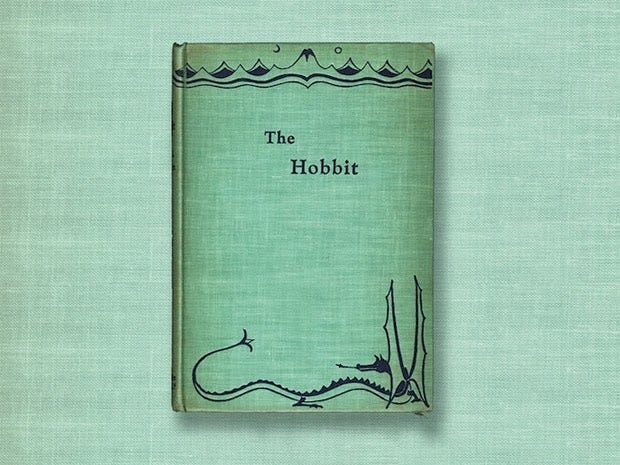
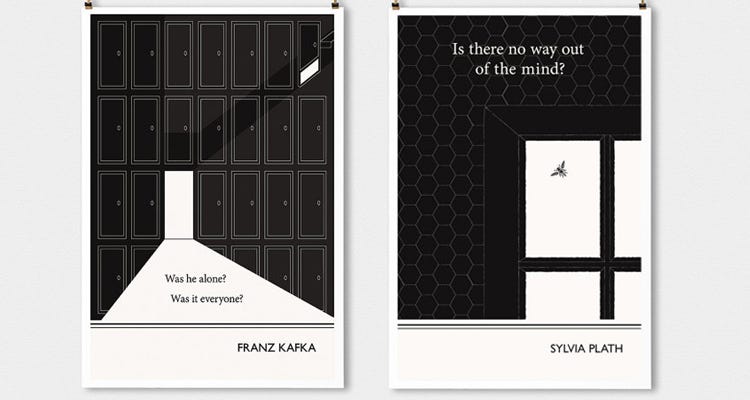
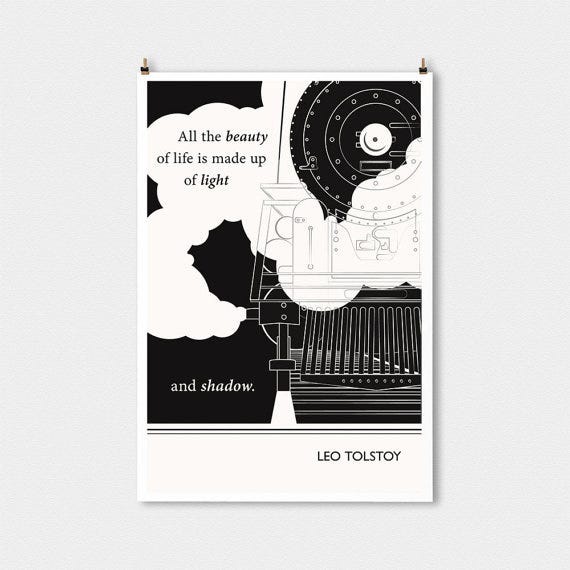
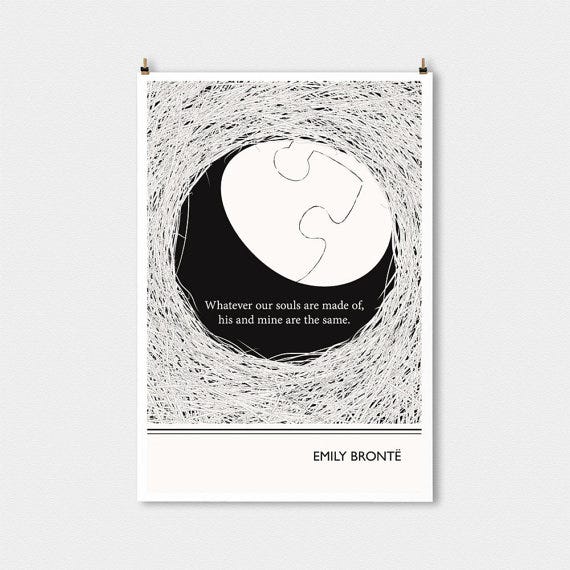
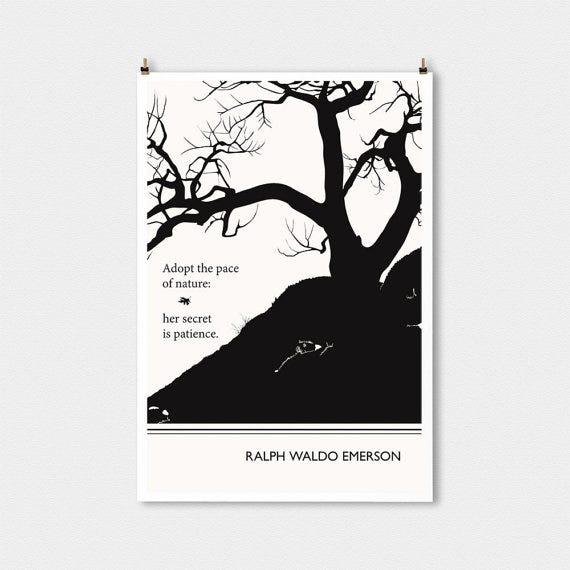
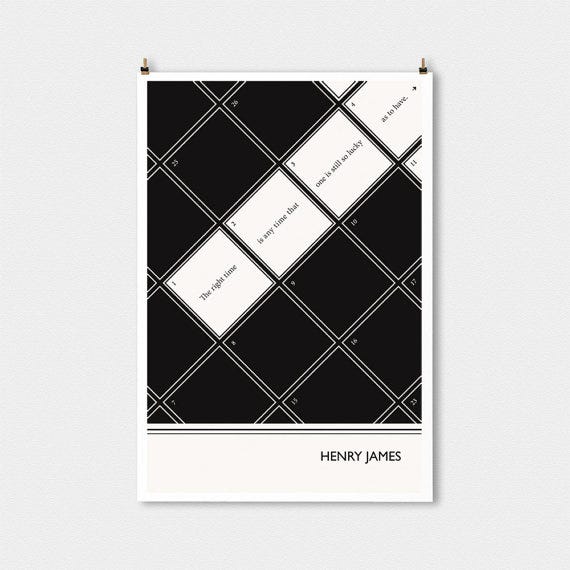
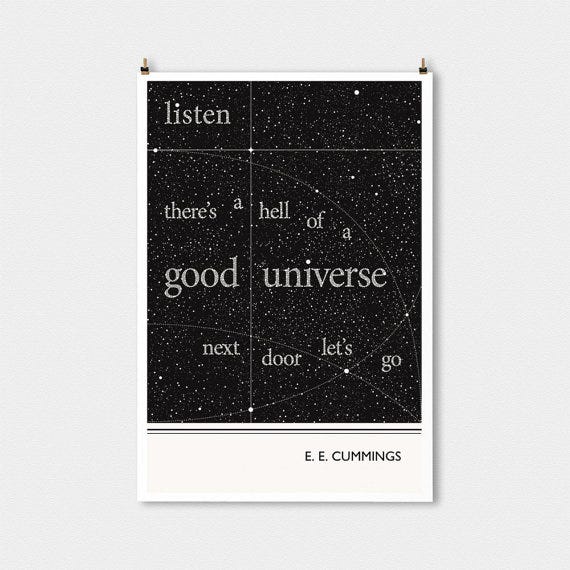
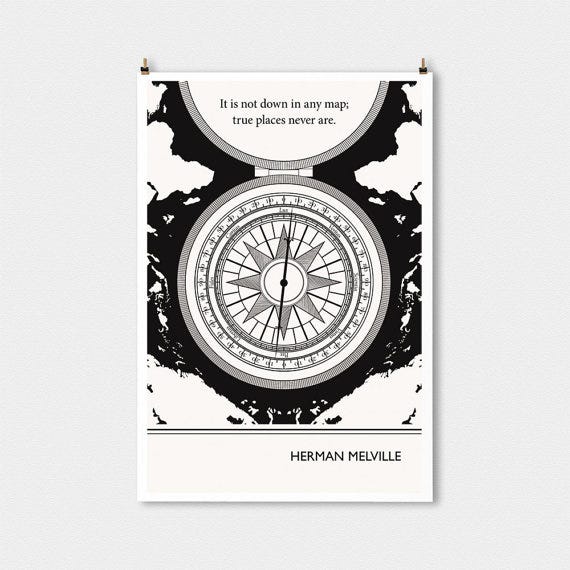
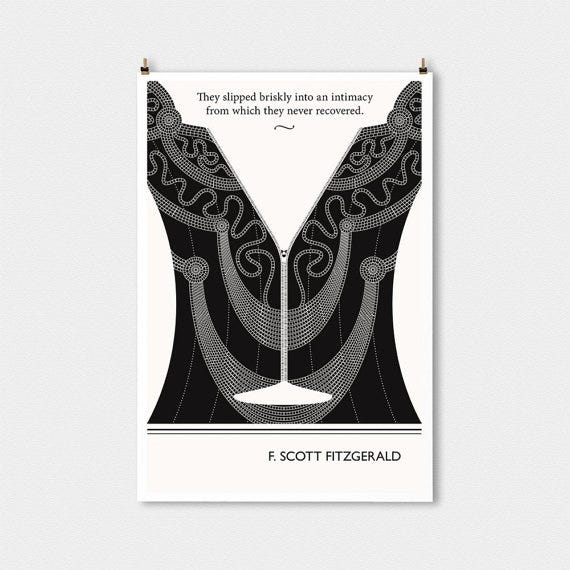
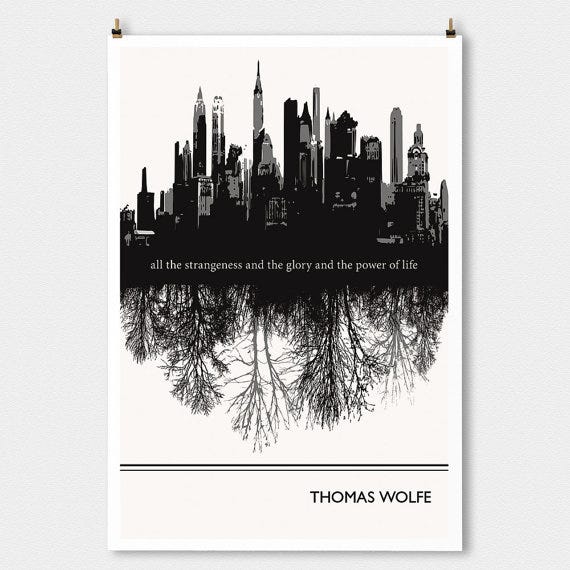
If there’s one thing bibliophiles can’t get enough of, it’s literary posters, and Obvious State’s minimalist offerings make the case for covering an entire wall with them. Drawing inspiration from such beloved authors as Hemingway, Salinger, and Dostoevsky, the posters feature simplistic yet metaphoric (in a non-cloying way) black and white designs that reflect the literary quote displayed across the page. And at just $24 a poster, you can totally make your dream of Sylvia Plath and Virginia Woolf hanging out together come true.
13×19 posters available for $24 each at Obvious State’s Etsy shop
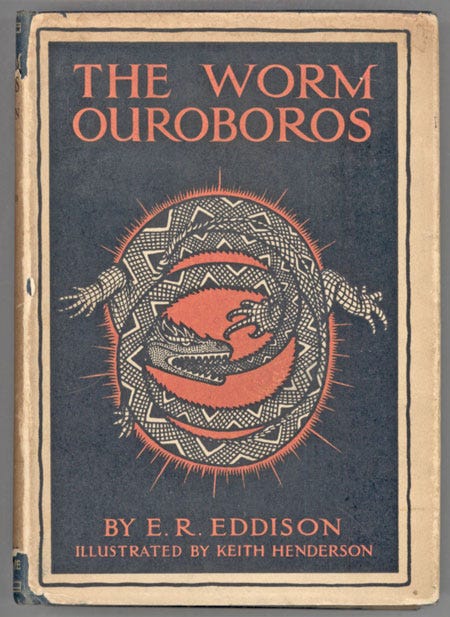
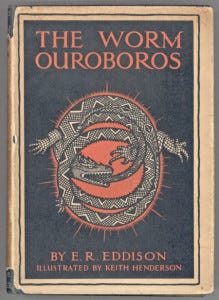
Colin Winnette admires the writer and musician John Darnielle, so he asked him to suggest a book that they might talk about. John Darnielle picked The Worm Ouroboros by E. R. Eddison. Then they talked about it.
John Darnielle is a writer, composer, guitarist, and vocalist for the band the Mountain Goats; he is widely considered one of the best lyricists of his generation. He lives in Durham, North Carolina, with his wife and son. He is the author of Master of Reality (a 33⅓ book on Black Sabbath) and Wolf in White Van, which was nominated for the National Book Award.
CW: Can you provide a brief description of The Worm Ouroboros? Something to ground anyone who hasn’t read it.
JD: It’s a classic quest narrative — there’s an evil to destroy, and four noble warriors take to the high seas and rough terrain to meet and defeat it. It all takes place on a distant planet where monsters range and magic holds sway.
CW: What’s your history with this book? From what I can tell, this one’s out of print. I placed a few orders online, but when those didn’t arrive for several days, I bought an ugly, old, red edition, I came upon in a used bookstore in San Francisco. Now I have like three copies. [If anyone wants a copy, be the first one to Tweet at me and it’s yours]. What got you to pick this book up and read it?
JD: I don’t remember where I bought my own used edition, a beat-up paperback with a green border. I think I grabbed it after remembering, from years ago, that it had been cited as a Tolkien precedent. I haven’t read Tolkien since grade school, but back then he was a huge favorite of mine, so when I remembered Eddison (thirty-odd years later) I thought I’d give him a shot. It sat on my shelf for a number of years, which is the fate of most books I buy, and then one day I said “what about that one?” and it really just grabbed me from the first chapter.
CW: What motivated this recommendation? Is this a book you think more people should read, in general? Or just one you’re still trying to wrap your head around?
JD: I try not say what I think people should read, people should read whatever they want, but I do feel like it’s a book some people might really enjoy if they got their hands on it. Like, a certain kind of person who’s taken pleasure in fantasy novels and/or Arthurian legend — this hits that axis in this weird, solitary way. It’s so much its own thing, but it kind of sets a precedent for a lot of later stuff. It feels kind of like it was drawn up without a blueprint — and often it seems to lack forward-motion, which is something that really interests me, when a book, either by design or lack of it, is able to hit these abiding lulls — these sort of open spaces.
CW: That’s interesting. When I first read it, I was struck by how compelling the action of the story is (the wrestling match for sovereignty of Demonland and how quickly things get rolling from there). You’re just kind of plopped into this very high stakes situation (sort of like the lords of Demonland). But then there is this weird back and forth between very compelling scenes/energies — power struggles, subterfuge, challenged or shifting loyalties — and these large swaths of time that pass between events and so much doubling back. Which parts stood out to you as particularly stationary? And what did you make of them? How do you experience those open spaces?
JD: Well, the long sojourn before the second expedition to Impland — it’s not boring, but it’s sort of time-biding stuff. You get that feeling, which I love in old fantasy or science fiction, that the author is luxuriating in the world he’s envisioned — that he wants to write scenes that kind of drag on where an editor might say, “Let’s get back onto the high seas here.” For me, I think Eddison’s ambition outpaces his style a bit; to really nail the mood he wants in “A King in Krothering,” say, you have to sort of rise to a different style, but Eddison’s style is dialed in from the first page. But then sometimes, when I feel like I’m seeing with Eddison’s eye, I want to remain with his characters at the idle dinner conversations. This may just be the long way around saying “he’s best in the action scenes, but I have affection for how hard he’s trying in the downtime.”
CW: Your new novel is full of references to sci-fi/fantasy. Some of my favorite parts of the book are the narrator’s descriptions of old fantasy movies or the mail-order swords he sees listed in magazines. What role did fantasy play in your young reading life, and has it changed in your adult life? (I’m asking specifically about genre here, but feel free to go whatever way you like with this question).
JD: I aligned with fantasy as a young science fiction / fantasy reader — I liked the fluffy stuff. Unicorns, dragons. Space was cool but mythical creatures, magic, wizards, talking trees — that was what inspired me when I was ten, eleven, twelve years old. I put that stuff aside when I began to have Pretensions — when I became a Serious-Minded Young Man — which I don’t regret, it’s great to go through phases. But I’m glad as a grown-up to have come back around to magic stuff, magic is really such a wonderful idea.
CW: What stuff did you pick up when you became a SMYM with P?
JD: Harlan Ellison was kind of ground zero for the SMYM with P, he was the gateway. He made me want to be Taken Seriously. But then I found Faulkner and it was Faulkner all day, and awe rather than any aspirational “one day I’ll break bread with these giants” feeling. Sheer awe. And also Joyce — Dubliners mainly, I didn’t kid myself about trying to be able to scale the big ones (though that didn’t stop me from getting my hands on Finnegans Wake). And I read poetry, 20th century poetry. Paul Celan. Sylvia Plath. Czeslaw Milosz’s anthology Postwar Polish Poetry.
CW: Let’s talk about magic. What’s wonderful about the idea to you? What can magic do for a story, and what are the pitfalls? And did you consciously choose to leave overtly magical things out of Wolf in White Van? Did you ever sit down to determine the “rules” of that reality, or did you just put one word in front of the other and look back to see a world that looks a lot more like our own than, say, Eddison’s Mercury?
JD: Magic I think for me is kind of personal. Like, as soon as magic is in play, then I am given permission to imagine a different world, one in which magic things might happen — one where maybe I get some magic to wield if I’m lucky. Where cool stuff might happen at any given moment, cool stuff you wouldn’t even guess at. And for as long as the story holds, I’m kind of living in that world. I don’t really do any rules-sketching ahead of time, although in Wolf I did want to be true to the physical reality of 80s southern California in memory; it was important for the locale to be vivid. I think it’s fine to trade stark real visions for colorful vivid ones but what I wanted in the world of the book was a sort of uncomfortable clarity to contrast with the limitless expanse of the imagination.
CW: What did you make of the opening of this book? The “frame story?” How does it (or does it even) serve the book? And what…happens to it?
JD: It goes away! That’s part of what I love about the book — it’s not a great big mess, but it feels almost like somebody’s hobby. It’s really personal-feeling, in a way. He sets up the story in a pretty traditional English way of framing a fantasy story, but his heart’s not even in that, his heart is with the Demons. However! there are two other volumes in the story I haven’t gotten to yet — maybe he closes the frame in The Menzentian Gate? I have it on my shelf, I’ll get to it at some point — I have a mini-collection of fantastic stuff, more Arthurian stuff than straight fantasy, but I have both the other volumes in the Eddison trilogy. It took a while to hunt them down, they’re nowhere near as well-known, but I’m curious about them.
CW: I grew up on Tolkien (literally, The Hobbit was a bedtime story), but haven’t read much high fantasy besides. This book struck me as interesting because it’s a complicated and well-imagined/described world, but it also leans heavily on familiar names/locations. Little effort is made, though, to engage with those references, outside of the immediate effects of their familiarity. The story takes place on “Mercury,” though it…shares nothing with the planet Mercury, as we know it. It just an “other” place, far away and inaccessible to us. Also, rather than having completely made up names, the races in the book are the Demons of Demonland, the Witches of Witchland, the Imps of Impland, the Goblins of Goblinland, etc. But when described these characters sound very human (though I think the Demons have small horns?). The physical world of the book, though, is well-imagined and beautifully rendered at times. How does this combination of the familiar and the uniquely imagined affect our reading of the book? Or your reading of the book?
I want to start a band called Witchland when I see that, you know?
JD: Did we mention that Tolkien esteemed this book somewhat, or was said to, with some reservations? One thing I like about it is just the inversion you mention — Eddison’s physical descriptions really reverberate, but his naming has none of Tolkien’s learned choices — he just settles on “Witchland,” which is so so great. Witchland. I want to start a band called Witchland when I see that, you know? But you can see so much of Lord of the Rings in this — there’s no way Gollum isn’t modeled on Mivarsh Faz, they’re the same character except that Gollum gets his big spiritual presence and metaphorical heft. Mivarsh is the Gollum you’d actually meet: “something’s up with that guy,” you’d say. But you’d never know what it was. I do like how Eddison can’t seem to fully break free from the world-world; his people are essentially knights-errant, but wants them in possession of some otherworldly quality…so the place is called Mercury.
I do think when he describes magic, which he does sparingly, he really hits his heights, though.
CW: The conjuring in the Witchland section is a lot of fun.
JD: You mean “The Conjuring in the Iron Tower”? This is probably my favorite part of the book — it’s so lush and weird. And hermetic, you know — like, this scene with a guy and a book and a tower — it’s got an iconic feel, like a tarot card.
CW: The prose is worth calling out. What do you make of it? The man who sold the book to me described it as “purple prose,” I think pejoratively. I thought it was great, though, particularly the descriptions of the physical world. And the dialogue is lively, compelling, even funny, at times. Overall, I found the prose commanding. It was a singular experience, stepping into this world.
JD: Oh it’s really purple. In an awesome and completely singular way. Eddison’s affecting this medieval tone that he doesn’t really seem to have mastered, but he’s pretty consistent within his own version of it, so it becomes very much its own voice. It’s like one of those records you find at the Goodwill with a weird sleeve and when you listen, you feel like it’s off in its own cluster of references — that it stands alone. There’s some stuff in higher fantasy that I miss — that wistful Arthurian tone that makes Malory so great — but in its place is something unique. There’s nothing quite like it.
CW: You’ve twice spoken to a kind of lack of “mastery” or polish, though from different angles — with regard to the prose, and earlier when you mentioned those “open spaces,” the book’s sudden lack of forward momentum. The book has this weird tension between the very constructed feeling of fantasy or “historical” fiction and these weird quirks that make it unique but also grant it a weird, almost childish, enthusiasm…like he’s trying things out and having a little fun.
JD: Yeah, I think that’s a big part of its appeal — like, you get the sense this guy either doesn’t expect to sell many of these books, so he might as well just be true to his inclinations….or maybe he’s got a lot of books in him so he follows his bliss on one instead of really playing for the historical record. He understands structure, but he dallies here and there, he gets a little distracted and doesn’t apologize for it. It’s kind of…ambitious on its own terms, rather than the “here, let me wow you” terms that’re kind of par for the course everywhere.
CW: *spoiler question* I found the ending of this book fascinating. I couldn’t help thinking about high fantasy as a concept, as a kind of location. You yourself described being “transported” by the book. At the end of the book, the Demons are depressed that their adventures have come to an end. They’re left with peace and peace is boring. They dream of going back to the start, to the beginning of the book, and reliving the epic fantasy we’ve just read. Narrative implications aside, it’s very similar to the feeling readers get when finishing a book we really love — we want to be back in it, we don’t want it to be over. The only choice we have is to go back through and read it again. What did you make of the end?
You want rest, but at rest, you pine for action.
JD: I think Eddison is taking this from Camelot — from those last meetings of the round table before the quest for the grail, when Arthur senses that their fellowship must change. These, in Malory (which I almost chose for you to read, but Malory is a real commitment), are some of the most moving passages in all literature. I dig the end — that itching feeling, that lust for battle even though the point of battle is to get through it. Right? That’s just human experience. You want rest, but at rest, you pine for action. But the ending’s a circle, right? They don’t dream of going back — they do, it’s revealed that the Ouroboros is in fact their story. The Ambassador from Witchland arrives anew. They’re going to do it all again. Or are they? There’s those other two books. I think I’ll put one of them next in my queue for after I finish Aubrey’s Brief Lives, which I’m working on right now.
CW: I’ll put Malory in my queue. Like the Demons, I’m itching for more of this stuff.
It’s a brilliant kind of doubling back (which the Demons do a lot of in this book), where at the closing of the book it seems that we’re back at the beginning of the book, back at the catalyzing moment — but are they in an endless loop (a satisfying enough ending for a book like this, if read on its own), or will they, or someone else, change their course — and if so, what will happen (a great setup for a trilogy)?
JD: I think that loop-ending is so satisfying, and the suggestion — especially given that the ouroborous then appears in the book — is that these guys actually exist only in and for this story, that this is who they are. And I love that, it’s the sort of ancient postmodernism that always lets the past remind us how playful fiction has always been, how open the space has been since forever.
CW: Will you leave us with a quote?
JD: “Therewith the earthquake was stilled, and there remained but a quivering of the walls and floor and the wind of those unseen winds and the hot smell of soot and brimstone burning. And speech came out of the teeming air of that chamber, strangely sweet, saying, ‘Accursed wretch that troublest our quiet, what is thy will?’ The terror of that speech made the throat of Gro dry, and the hairs on his scalp stood up.”
DON’T MISS OUT
Sign up for our newsletter to get submission announcements and stay on top of our best work.
YOUR INBOX IS LIT
Enjoy absorbing fiction from Recommended Reading on Mondays, strange, diverting work from The Commuter on Wednesdays, and a roundup of our best work of the week on Fridays. Personalize your subscription preferences here.