What Fiction Writers Can Learn from Comedy: on reading Poking a Dead Frog

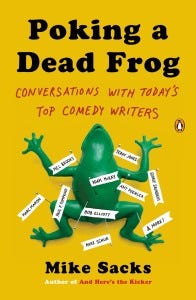
Poking a Dead Frog

If you read essays by and interviews with fiction writers, you can learn a lot about their processes; what inspires them, how they work, how the real world influences their work, and if autobiographical elements made it into the work. When somebody like Michael Silverblatt is interviewing a fiction writer, you learn tidbits that can enhance the reading experience. Even looking at pictures of where writers work can be endlessly fascinating to some. Personally, I can’t get enough of hearing what makes writers tick, but I was a little surprised when I closed Poking a Dead Frog: Conversations With Today’s Top Comedy Writers, and realized that it’s one of the most fascinating books about the process of writing in any genre I’ve ever read. It shows just how closely related fiction and comedy writing truly are. Editor Mike Sacks reveals that despite the fact that some writers pen novels or short stories and others write jokes for sitcoms, in the end, writing is writing. Sacks accomplishes this via thoughtful yet easygoing interviews with comedians and comedic writers, including one of the best interviews with George Saunders I’ve come across. Take this exchange:

Sacks: I don’t always sense compassion when it comes to humor or satire. I’m not sure if they don’t have full control of their toolbox or if they’re just not compassionate. Can satire work if the writer isn’t a compassionate person?

Saunders: Sure. I think a harsh truth can be compassionate, in the sense that it speeds us along from falseness to truth. So, if a friend is wearing something ridiculous, you can say, “You look like an idiot,” and maybe that will save him. I think we wouldn’t want to assume that compassion is always gentle.

Saunders is part of the small minority of fiction writers in Poking a Dead Frog, but he’s game to let Sacks lead the conversation to fit the book’s parameters. It might seem odd to see Saunders’s name alongside comedians like Mel Brooks and Patton Oswalt, and television writers like Todd Levin and Megan Amram (although both Levin and Amram also have books out as well), but the conversations and advice pieces are so complementary that going from Marc Maron to Saunders doesn’t read awkwardly at all.

Filled with plenty of illuminating facts and behind-closed-door secrets, Poking a Dead Frog showed a different side of writers and how they work, but it also left me wondering why comedy people don’t dabble more in fiction, and why fiction writers don’t let comedy guide their work more often. The conversation with author Bruce Jay Friedman serves as a perfect example of this. Friedman, whose first novel Stern, released in 1962, is described by Sacks as being, “Along with Kurt Vonnegut…one of the pioneers of “dark comedy.” And while I love good satire, I crave novels that make me laugh about the grimmest parts of life. Sadly, those books are far and few between. Sam Lipsyte’s The Ask, Fiona Maazel’s Woke Up Lonely, and Adam Wilson’s Flatscreen all fall under that category, but most contemporary fiction isn’t concerned with being funny. And I’m totally fine with that most of the time.

My own first encounter with Friedman was picking up a copy of the 1965 anthology he edited, Black Humor, while I was rifling through a Salvation Army store when I was a teenager. I recognized a few of the names, and at the time, had read books by two of them: Vladimir Nabokov and Joseph Heller. I’d eventually seek out more of Friedman’s books, along with some of the other writers included in the collection, including Terry Southern, J. P. Donleavy, and Thomas Pynchon, all in an attempt to understand how any of the authors Friedman selected for the book could be considered humorous. As Friedman put it in the introduction: “I am not sure of very much and I think it is true of the writers in this volume that they are not sure of very much either.” Friedman goes on to try and do his best to explain why those writers in the 1960s were funny to him. When I read his words over thirty years later, I had a difficult time understanding how any of those writers could make him or anybody else laugh; but then again, I had a very narrow teenage focus. This was also the period of my life (around the age of 14) when I also said, “This shit isn’t punk,” upon listening to the band that pretty much invented punk, The Velvet Underground. Much like I once thought punk only could sound like Minor Threat, I thought humor was supposed to make you instantly laugh, like a reflex. I didn’t get humor, and the work of some of the greatest writers of the 20th century was lost on me.

I got older. I experienced and learned things. Eventually I came to understand that comedy comes in all different shapes and sizes, and that great humor writing is reflective of its time. In the case of Black Humor, the broken promise of the post-war world and its descent into chaos of the 1960s required a different kind of humor.

Take books like Ulysses or Portnoy’s Complaint: I don’t know if James Joyce or Philip Roth meant to make people laugh, make them uncomfortable, challenge society’s norms, or just write great fiction that happened to do all of those things, but all of those things ended up happening. In his recent interview with Marc Maron on the WTF Podcast, Paul Thomas Anderson pointed out Pynchon was probably just as influenced by comedians Spike Jones and Lenny Bruce as he was any novel, and described his writing as, “Compassionate but upside down.” Did Pynchon hope to make people laugh as they tried to keep track of all the characters in his books? While I don’t know the answer to that, Anderson interpreted it that way, taking his directorial and writing cues for Inherent Vice not from Stanley Kubrick or some Italian guy from the 1960s. Instead, as critics noted, his adaptation “tips into, like, Zucker Bros” territory. How many other novelists can you name whose work gets one of the day’s premiere directors to go from There Will be Blood to shots that remind people of The Naked Gun? I mean, I guess anything could be funny if you slant it the right way. Look at Kafka for long enough, and Gregor Samsar’s day seems somewhat hilarious. “Oh shit, I woke up as a bug. #FML.” Meursault in The Stranger by Camus or Anton Petrovich in Nabokov’s short story “An Affair of Honor”? I’d like to consider these works proto-Larry David.

On the other side of the coin, comedians and comedy writers don’t usually venture too far out to shore. A few years ago, Chris Gethard put out the book A Bad Idea I’m About to Do, that, in my mind was probably one of the best books written by a comedian. Gethard’s personal essays, his tone, and his delivery, made me laugh and were a delight to read. The same goes for books by Julie Klausner and Mindy Kaling. Yet aside from Jack Handey, who you might know best for writing classic SNL skits like “Deep Thoughts” and “Unfrozen Caveman Lawyer,” Simon Rich, and B.J. Novak whose collection of short stories, One More Thing, took me by surprise, I always wonder why more comedy writers don’t try their hands at fiction.

Mike Schur whose resume includes writing and acting on the American version of The Office, as well as co-creating and writing shows like Parks and Recreation and Brooklyn Nine-Nine, talks a good deal about David Foster Wallace in his discussion with Sacks, and it makes me think of his shows in a different light. Take one of the more interesting observations that Schur — who wrote a thesis on how Wallace’s Infinite Jest and Pynchon’s V. “served as bookends for a type of post-modern fiction that dealt irony and identity cohesion” — makes the point that Wallace deals a lot with the themes of sincerity and honesty, something you see his characters searching for while trying to make you laugh. Two things that Schur says are tough for comedy writers, “because sincerity is the opposite of ‘cool’ or ‘hip’ or ‘ironic.’” Obviously as a fan of all of Schur’s work, I’d never ask him to quit his day job to go finish that novel he’s had stashed away. But with his interest in fiction, I can’t help but wonder if a guy who has been involved with some of the most acclaimed and beloved comedies of the last decade writes fiction every now and then. Because what is Pawnee, Indiana, but a fictional town filled with fictional people?

Ultimately, of course, the one thing that separates fiction writers and comedy writers is that comedy writers usually write with teams. There isn’t one person writing jokes for David Letterman or Jon Stewart; there are a bunch of people. You see it joked about on shows like 30 Rock, where the writer’s room is enlivened by the very collaborative energy that gives Poking a Dead Frog its legs. Writing fiction, on the other hand, is a largely solitary exercise, confined to a desk or a table in a coffee shop with headphones on. Yet the two forms of writing can work well together and have more in common than we might think. One of my favorite exchanges in all of Poking a Dead Frog sums is something most writers I know can relate to. When Sacks is talking with Cabin Boy writer and director Adam Resnick, Resnick tells Sacks about the prostitutes that live next door to his writing office in New City:

Resnick: I liked it at first, but it’s just annoying now. And they both have a habit of letting the door slam whenever they leave, and my whole apartment shakes. Prostitutes can be so boorish these days.

Sacks: The glamour of being a writer.

Resnick: I guess.

REVIEW: Jillian by Halle Butler

If everyone is connected then the threshold between one person and the next must be a smelly mess. In her debut novel, Jillian, Halle Butler takes this assumption to its darkest point when she draws a line between two women, a 35-year-old single mother of one and a 24 year-old casual alcoholic with commitment issues. They work together at a gastroenterologist’s office, which Megan, the younger of the two, renders succinctly by saying, “I look at saltine-sized photos of diseased anuses and colons all day.” Needless to say, she doesn’t like her job, but like her co-worker, Jillian, she lacks the fortitude and foresight to move on, which becomes a reoccurring theme throughout the novel.

Jillian is populated with characters that are stuck. Not just Jillian or Megan, but also Megan’s boyfriend, Jillian’s church friend, and even Jillian’s dog wander in and out of the narrator’s consciousness, each with their own set of values, each more misguided than the last. The beauty of this novel is that Butler handles their respective misery with deft clarity and dry wit, turning expectation on its head, only to prove its worth in the end.

The story arc is bookended with an accident and recovery. Megan is stabbed in the butt with a cooking knife, and like most everything in the novel, the appeal of this accident only lasts as long as its social importance. Once it becomes clear that Megan’s scar will not bring her attention, she moves on to the next feasible spectacle. Her most grandiose of these is a walk through her neighborhood in only her pajamas on the first warm day of the year. The moment is fascinating but also maddening, because her motivation is rooted in jealousy and self-loathing, which, to Butler’s credit, comes across as funny and self-reflexively real:

Oh right, heat, she thought. She was wearing flannel pajama pants. She thought about taking them off, but she didn’t what to take her pants off in front of Randy. She put shoes on, poured herself a glass of water, and left the apartment. Fuck you, Randy.

Megan’s negativity is juxtaposed with Jillian’s unwavering optimism, which very quickly reveals itself to be a defense mechanism. She focuses on long-term plains like starting a business and adopting a shelter pet in order to avoid her more pressing problems, a traffic violation that escalates quickly and mounting financial issues. One of the most irksome traits of this character is that she struggles throughout the novel to pay for her son’s daycare, but she still spends seven dollars on a drink from Starbucks every morning. Jillian continually acts against her best interest. She is a walking contradiction, which at times bottoms-out to create some of the saddest and most endearing moments of the novel, but it’s impossible to ignore the fact that these moments are a direct result of Jillian’s own mistakes. And that is the real challenge in this novel’s narrative; in order to empathize with Jillian and other characters, one is force to reconcile the ugliness within themselves, the part of themselves that is needy and unreliable. Butler takes a real risk here, hinging the success of her novel on her readers’ ability to forgive themselves for being just as selfish and unaware as her characters.

Like any great author, Butler is pulling her influences from contemporaries as well as the broader side of the literary canon. There are nods to Ann Beattie’s restlessness and Amy Hemple’s wonder and playfulness, but there are also moments that seem almost directly borrowed from Tao Lin, such as line progressions like “She was depressed. She said, ‘I’m depressed.’” But that’s not a fault. Butler maneuvers the distance within her prose in a different direction, creating a narrative that flitters between consciences, pulling from each a side-long perspective of the human condition and revealing it to be unpredictable and dangerous, and, nevertheless, righteous.

The best line of the book comes from the consciousness of Jillian’s dog. As it chews on a rawhide bone, it thinks, “It’s good to have an activity, even if you don’t fully understand what you’re doing.” That may be true, but it comes with a hint of irony, because if Jillian’s characters possessed the ability to understand their actions fully, the novel would follow a much straighter path. And like the trope “the more circuitous the journey the better the story”, Jillian is the sum of its characters’ misdirections. It’s a frank depiction of modern indecency, and a reflection of a generation that lacks any shred of a moral compass.

Jillian

by Halle Butler

Powells.com

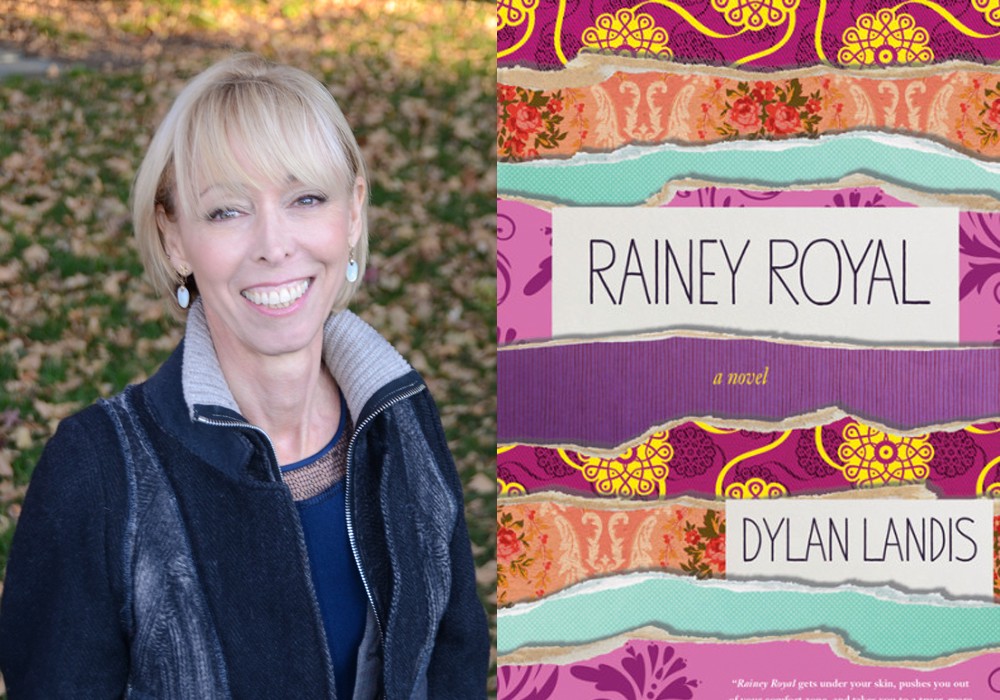
INTERVIEW: Dylan Landis, author of Rainey Royal

Dylan Landis is the author of the linked short story collection, Normal People Don’t Live Like This, and the novel, Rainey Royal. At the center of these two books is a group of mercurial teenage girls who psychologically torment one another but remain inseparable, and exude cool that masks their vulnerability. Landis depicts a 1970s New York City that is a permissive playground and menacing nightmare.

I asked Landis about the hidden lives of teenage girls, pre-gentrification New York City, and the ways we talk and don’t talk about sexual abuse.

Adalena Kavanagh: Your two books, Normal People Don’t Live Like This and Rainey Royal are both set in New York City in the 1960s and 1970s. Why that time period? Why New York? Did you rely on memory to evoke this specific version of New York or did you do research?
Dylan Landis: I once heard an author say she couldn’t write about anything till it had “filtered through memory,” and that is my experience exactly. Happily for the fiction I write, I found those eras to be risky, even dangerous times to be a New York kid and a teenager. I grew up in New York City, went to a suburban high school and moved back to New York. Our parents seemed to have no idea what we were doing, and they left us alone to do it. Music got darker. Clothes got more expressive. Kids could get drugs at school so easily, and attitudes about sex were so much looser. Men slept with teenage girls. There was no word for this. Maybe “gross.” A tenth-grade teacher got high with students. Shoplifting was a recreational sport. Every year one set of kids tried to blow up a small bridge.
That’s the research I did from memory. It was all about the vibe. The details that shore up the vibe I garner assiduously from the internet. What year were The Doors singing “The End”? What is a miscarriage like? Does anyone really play jazz oboe? What was Sotheby’s called in the day? I was a newspaper reporter for years, before the fiction, and I still fact-check like a maniac.

AK: I also grew up in New York, in a different time period than in the book (in the ’80s and ‘90s), but your depiction of the city rang true to me. At first I thought this was nostalgia, but the more I thought about it, the fact that so much of what you depict is “gritty” and what I experienced would also be described the same way, I decided that it wasn’t nostalgia I was feeling, but recognition of a New York that isn’t always portrayed accurately. Namely, you show the lives of middle and working class teenage girls in New York. It shouldn’t feel like a radical act to write about teenage girls, but it feels that way, as if you’ve given us a glimpse inside a secret world. What drew you to these particular characters? On the one hand they seem universally adolescent, but in a way that is specific to New York.

DL: That secret world is sex and girls and power and vulnerability. We lose access when we age out of it, which is why that glimpse feels so radical, and why fiction is the password that gets us back in. For me, the settings might be invented or conflated, and the characters must be, but the feelings come straight from the past: exhilaration on a rooftop with wild friends and wine and cigarettes, disorientation in an unfamiliar apartment with older boys and a stolen tank of nitrous, confusion at the seductive approach of an older man, the prickling sensation of shoplifting…always, the cathartic thrill of music. Such feelings must be uploaded from memory in a concrete and sensory way, which is the only way to channel anything when you’re writing.

The New York part of it is a curious chemistry of intensity and neglect, anxiety and independence. My mother warned me very early about the man who lured a child to his hotel room, then beat her to death with a hammer — but then she let me run free in Riverside Park, where men regularly exposed themselves, and asked to take pictures of me and my best friend. I never told my mother one thing. Children and adolescents lived private interior lives back then.

AK: Yes, I think you’re right. It’s the sex mixed with the power and vulnerability that makes the depiction of these girls seem radical but also realistic — it’s not the way we want to see girls. I agree — I had men ask to take pictures of me and I didn’t tell my parents. I wasn’t willing to trade my freedom for protection from those men. But then Rainey is a character who isn’t safe in her own home. Where did Howard Royal (Rainey Royal’s father) come from? He is a jazz musician who is characterized as someone who lives up to all the stereotypes people celebrate about the hedonistic male musician, but you take that a step further and show us how his hedonism disrupts and shapes his daughter’s life. Had you meant to critique the “free love” coming out of that time period, or were you just trying to depict things as they might have been?

DL: I never “mean” to do anything when I write except get into the basement, the subconscious, channel some sensory detail, and see who and what takes shape down there in the primordial, psychological muck. I found Howard in the basement, a man who loves his daughter, but loves himself so much more he’d send her at night to Central Park with his 39-year-old best friend, and fill the house with young men, and expose her to sex and drugs as if they were character-building. His voice came to me as I listened for him. It wasn’t a passive process, of course; I was casting about for the concrete, for the exact way he smiled at his daughter, the way he sat in a chair, the ironic cast of his speech, his choice of words, his choice of drink. He was one of the easiest characters to write, even though I didn’t know a single parent like that.

But I knew he could have existed, because parents, to me, were unreliable at best and dangerous at worst. I knew girls whose fathers molested them. One girl’s father said, “I know you’re doing it with everyone else.” Another father kept touching his daughter’s breasts. I could go on. One girl’s mother bruised her when she beat her. My close friend, at fifteen, was seduced by her boss after school — you know what we call that today, but then we said seduced. One friend’s mother openly smoked pot when I was eleven and my friend was twelve. When I was fifteen and told my mother that two adult men had pressed me into a corner on a train, she said, “What did you expect?” because my dress was short. The world was flammable; it was already burning. Coming up with Howard was not a stretch.

AK: I saw you read at Franklin Park in Brooklyn in the fall. Around this time there were several news stories about rape and sexual abuse involving members of the New York literary community, followed by the Bill Cosby rape scandal and the UVA rape scandal. The story you read was about your protagonist, Rainey Royal, and her rape at the hand of one of her father’s musical acolytes. Did you consciously choose to read that story and if so, why? What reaction did you get from the audience?

DL: We were asked to read for eight or nine minutes, something like that, and “Baby Girl” is my only story that reads in eight. It’s that simple. The stories of sexual abuse in the literary community were indeed huge at that time, and people at Franklin Park did ask if my choice was deliberate — but no. These topics have been just as alive for me since men first approached me in the park. I believe the only differences now are that people are speaking up, the media are reporting rape more, and the definition of rape is being refined and discussed. We didn’t have language for these things back then, never mind a forum for public discussion. We had a bunch of girls smoking cigarettes and confiding in each other. And thank God we had that.

AK: It definitely feels like the world is catching up to a dirty secret that has been suppressed to protect abusers and those in power. I think that’s another reason why your two books feel like we’re voyeurs into a secret world, or one that isn’t readily acknowledged.

There has been talk in the literary world about “unlikeable” characters, particularly unlikeable female characters. That conversation seems to treat characters in fiction as if they were moral guides, rather than representations of people that are possible (the same way you say that even though you didn’t know a parent like Howard Royal, he was certainly possible). The three adolescent girls at the center of these two books, Rainey, Tina, and Leah, are vulnerable but also manipulative — in short, they are incredibly three-dimensional. This seems important to me, and refreshing. Why do you think we’re debating about unlikeable female characters?

DL: Your question made me think of Flannery O’Connor. She said, in her extraordinary Mystery and Manners, “I myself prefer to say that a story is a dramatic event that involves a person because he is a person, and a particular person — that is, because he shares in the general human condition and in some specific human situation. A story always involves, in a dramatic way, the mystery of personality.” She isn’t just talking about men, and she doesn’t say a word about likeability, which has nothing to do with the mystery of personality. All of her characters are damaged in some way; they may or may not, at some point, be touched by grace. They don’t have to be moral guides — quite the opposite. In her Catholic world view, all souls are in need of grace. It seems to me a character must be interesting and flawed and vulnerable enough to keep you fastened to the page, and to leave room for some kind of deep internal shift.

Someone told me recently that my friends all tended to be good, generous people and I thought, yes, they do. But that’s life, not fiction. Would you want to read Madame Bovary if Emma was a perfect wife?

The most recent body blow in this debate, I think, is when Publisher’s Weekly asked Claire Messud, regarding The Woman Upstairs, “I wouldn’t want to be friends with Nora, would you? Her outlook is almost unbearably grim.” And Messud’s answer is vital enough to replay here. She said: “For heaven’s sake, what kind of question is that? Would you want to be friends with Humbert Humbert? Would you want to be friends with Mickey Sabbath? Saleem Sinai? Hamlet? Krapp? Oedipus? Oscar Wao? Antigone? Raskolnikov? Any of the characters in The Corrections? Any of the characters inInfinite Jest? Any of the characters in anything Pynchon has ever written? Or Martin Amis? Or Orhan Pamuk? Or Alice Munro, for that matter? If you’re reading to find friends, you’re in deep trouble. We read to find life, in all its possibilities. The relevant question isn’t “is this a potential friend for me?” but ‘is this character alive?’”

Rainey teases a schoolmate without mercy. She robs a couple at gunpoint. She’s seductive toward male teachers. She’s also deeply vulnerable, having been abandoned and neglected. So if I’ve done my job, you care what happens to her. That matters more to me than whether you want to be her friend.

AK: Maybe you can articulate how these three particular girls came to life for you? Why them, in particular? I’m especially interested in Tina because we so rarely have representations of Latina women in fiction, and in a way it seemed like she was passing for white until she couldn’t anymore. Was Tina always Puerto Rican (or bi-racial Puerto Rican) in your mind or was it something that developed as you wrote these books? This seemed like a truer representation of New York in fiction than I have read in a long time because you might believe New York doesn’t t have as large a Latino population as it does if you only read literary fiction!

DL: I didn’t know Tina was Puerto Rican as I initially wrote her — I only knew she had a secret, something she was hiding that concerned being raised by her grandmother, which made her ashamed. She was a tough chick, and when Rainey and Leah followed her on the subway to see where she lived, I had her go to a tough place for 1972, Spanish Harlem. We white girls all thought we’d get killed there. It was still all “us” and “them” back then, not that it isn’t now, but that divisiveness was right on the surface then. So I never intended for Tina to pass, no, but later I understood why she did. She was a scholarship kid at an Upper East Side school. That couldn’t have been fun. I’ll never forget my own second grade public-school teacher screaming at the only Latino kid in class for forgetting his pencil. I passed him a pencil and she screamed at me. I got the message, and I was seven. I still remember the boy’s name. And Tina might have thought she would lose Rainey, though she was dead wrong about that.

The character of Rainey feels like she has always been inside me. I was quite taken, at an early age, with a girl who bullied me. I knew nothing about her; I just thought she embodied beauty and mystery and sexuality. When Rainey came to me she had that girl’s edge. That’s all I borrowed from life, an edge and a laugh. I invented a damaging family to explain the cruel streak. The rest of Rainey was my own mean-girl alter ego, because for a while I did become, well, bad. Not mean, but prone to misbehavior. I was present at a stabbing. An ex-boyfriend went to prison for homicide. It’s not that far a leap to Rainey robbing someone herself. And Leah was the shy side of me, the science-nerd side, who was right there all along. I suppose I’m splintered into everyone in the book.

AK: Earlier you said that “parents, to me, were unreliable at best and dangerous at worst,” and that rings true, at least for the parent characters in both of your books. Rainey’s mother is offstage at an ashram, her father is busy with his acolytes, Tina is being raised by her grandmother, and Leah’s mother is lost in her own world of anorexia. You depict a world of permissiveness that the girls wouldn’t necessarily trade for something safer, but it’s clear that this permissiveness will leave a lasting mark on all of them. Is this permissiveness a characteristic of the time period in which the books are set or are these simply the parents that would have produced Tina, Leah and Rainey?

DL: Certainly I knew parents who were strict in the 70s, but their strictness was a sieve: the intensity of the decade punched holes in it. I had a friend whose father broke her bedroom door down because she dared to close it, and yet she found ways to participate in the culture that went on around her. My own parents were a curious balance of strict, distracted and naïve. Translation: they bought a chain-link ladder in case of fire when we moved to the suburbs for high school, and every weekend after curfew I lowered it from my bedroom window, Rapunzel-style, and escaped into the night. And then I knew parents who drank heavily, or were nudists in their own home, or put their kids on the Pill, or smoked pot with their kids, or simply didn’t believe in curfews, which made everything possible.

As a writer I’m interested in how you can have parental absence when the parent is, in fact, right there. How can you have both love and neglect, and what does that look like? What are the possible reasons for it? Can it be written about metaphorically, like Leah’s mother’s self-starvation? My writing mentor and teacher Jim Krusoe says writers often keep knocking at the same door, and that’s one of my doors.

AK: In your first book there is a story told from Leah’s mother’s point of view, and we can see how her need to control her body and her environment shaped her daughter’s need for control, but in your second book the parents are only shown through the points of view of the three girls. Was this intentional? If so, why?

DL: It was an intention that dawned slowly. I didn’t want to write from the POV of Rainey’s absent mother, because I didn’t want to move the action out of New York and into Colorado. But I did think about writing a story from the POV of Rainey’s narcissistic, seductive, jazz-pianist father, Howard. I talked to my writing partner Heather Sellers about what this might add. She’s the author of the short story collection Georgia Under Water, also about a teenaged girl in troubled circumstances, and with one story from the father’s POV. We weren’t sure Howard’s thinking, his insights, would add a dimension to Rainey. Howard already revealed himself in damaging ways; he talked about being sexually abused by a babysitter. We felt he was already on the page. I think the writer senses when there’s more to explore, or trusts her close readers to tell her.

This was a great relief, because there was a second factor. Howard is a jazz musician and I know virtually nothing about jazz. I couldn’t have sustained a whole story in which Howard sounded like an authority, a true musician. What I know about jazz comes from YouTube and Google and reading and a little satellite radio. If you look closely you’ll see that the music descriptions are all from Rainey’s point of view, and Rainey knows nothing about jazz, and doesn’t like it, which made my job easier. I only had to describe the music from her perspective. I could say, at one point, that jazz sounds to her about as rhythmic as a flock of startled birds flying up from the sidewalk.

AK: And lastly, what are you working on now?

DL: A new novel. I don’t stray far from my obsessions.

Sunday Sundries: Literary Links from Around the Web (January 24th)

Looking for some Sunday reading? Here are some literary links from around the web that you might have missed:

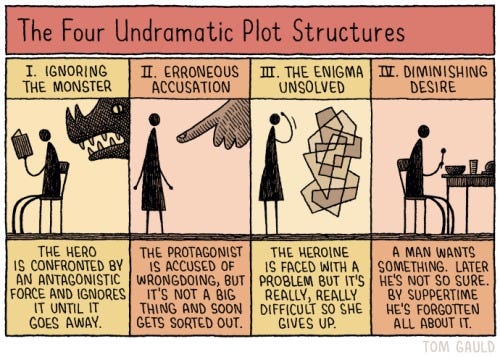
Tom Gauld

Tom Gauld illustrates some undramatic plots

January is a bleak month, but you can make it even bleaker with these new books

Will our novels soon be written by robots?

Is Denis Johnson’s ‘Jesus’ Son’ a ‘Red Cavalry’ Rip-Off?

James Patterson’s new book is about to blow up. Literally.

There’s a new Lovecraft-inspired beer that will drive you to utter madness

Why if the authors starve, we all go hungry

Are Thomas Pynchon’s books just made to be adapted to film?

Claudia Rankine’s poetry book Citizen has been a huge success for Graywolf with 40,000 copies in print

Publishers can now monitor how you read, but will that change publishing?

On the Stories (Or Lack Thereof) of Joe Brainard

by Ravi Mangla

The writings of Joe Brainard can coax a smile from even the most wretched of misanthropes. While many forms claim him as their own, his words belong to no one discipline. To attempt to tag and classify them, to pin down the origins of his screwball musings, is to miss the point completely. His talent was too far-ranging to be limited to a single mode of expression. Poems, stories, one-liners, essays, lists, plays — nothing falls outside his repertoire. When Brainard died of AIDS, twenty years ago as of May, the world lost an artist whose utter bizarreness was matched only by his profound compassion.

Poems, stories, one-liners, essays, lists, plays — nothing falls outside his repertoire.

Brainard was born in Tulsa, Oklahoma, at the base of the Great Plains, half a continent away from the young poets of Harvard (Ashbery, O’Hara, Bly, and the like), those precocious East Coast upstarts who would become the flagbearers for their generation. In many ways, Brainard lacked the blinkered ambitions of his literary counterparts. Like his drawings, his writing has a ragged, extemporaneous quality. The offhand delivery is laced with a lambent wit and odd poignancy. His peers figure prominently in his pieces, treading on and off stage like characters in a play. The charmingly concise “Ron Padgett” serves as a fitting ode to his oldest friend:

Ron Padgett is a poet. He has always been a poet and he always will be a poet. I don’t know how a poet becomes a poet. And I don’t think anyone else does either. It is something deep and mysterious inside of a person that cannot be explained. It is something that no one understands. It is something that no one will ever understand. I asked Ron Padgett once how it came about that he was a poet, and he said, “I don’t know. It is something deep and mysterious inside of me that cannot be explained.”

Joe Brainard remember

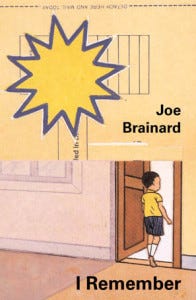
Brainard is remembered most notably for his lyric memoir, I Remember, in which each entry begins with the titular declaration. The recursive device, in its role as teaching apparatus for tenderhearted youths, has become almost a caricature of itself, yet reading the original — Brainard’s — resuscitates the form, returns it to a state of richness and novelty.

I remember once when I made scratches on my face with my fingernails so people would ask me what happened, and I would say a cat did it, and, of course, they would know that a cat did not do it.

A visual artist by trade, Brainard was informed equally by the artists of his generation as he was by its cadre of writers. Certain pieces read like the sort of texts John Baldessari might commit to canvas, or Warhol inscribe in his journal. A feeling of glee underpins his mischief making. (The entirety of “No Story”: I hope you have enjoyed not reading this story as much as I have enjoyed not writing it.) His literary leanings derive less from a predestined purpose than his social proximity to other writers. During an interview with the late Tim Dlogus, Brainard states his surprise at the course of his career: “I had no intentions of being a writer; everything was against me. I had no vocabulary, I can’t spell, I’m inarticulate. I have sort of learned to use that.” Brainard crafts ingenious texts out of deceptively simple ingredients. His matter-of-fact tone and conceptual savvy make him a spiritual forefather to contemporary writers like Lydia Davis and James Tate.

For the last fifteen years of his life Brainard ceased making work for public consumption. (He would, on occasion, produce small works for family and friends.) Many have speculated on the reason for his withdrawal. In an essay written by John Ashbery for the Brainard retrospective at the Tibor de Nagy Gallery, he mentions that Brainard spent the last decade and a half of his life immersed in his two favorite pastimes: “smoking and reading Victorian novels.” This description of Brainard’s later years contrasts sharply with the image of the artist as martyr, as the exemplary sufferer (to cop a phrase from Sontag). For the artist, the compulsion to create should supersede all other areas of interests. Anything less than absolute conviction is an admission of fraud. “There’s no retirement for an artist, it’s your way of living so there’s no end to it,” the sculptor Henry Moore once said. But this notion is an outdated pretention. The quality of an artist shouldn’t be measured by their unyielding devotion to the practice. Too often artists and writers are retrospectively punished for a lack of serious intent. (Without the ministrations of Ron Padgett, the writings of Brainard may have been lost to the onrush of time.) Brainard remains a singular artist of exceptional talent. That he found a source of contentment outside the bounds of art is not a blight but a blessing. By all accounts, he spent his final years absorbed in his passions, in the company of those he loved. We all should be so lucky.

J. K. Rowling’s Spreadsheet Shows How She Wrote Harry Potter

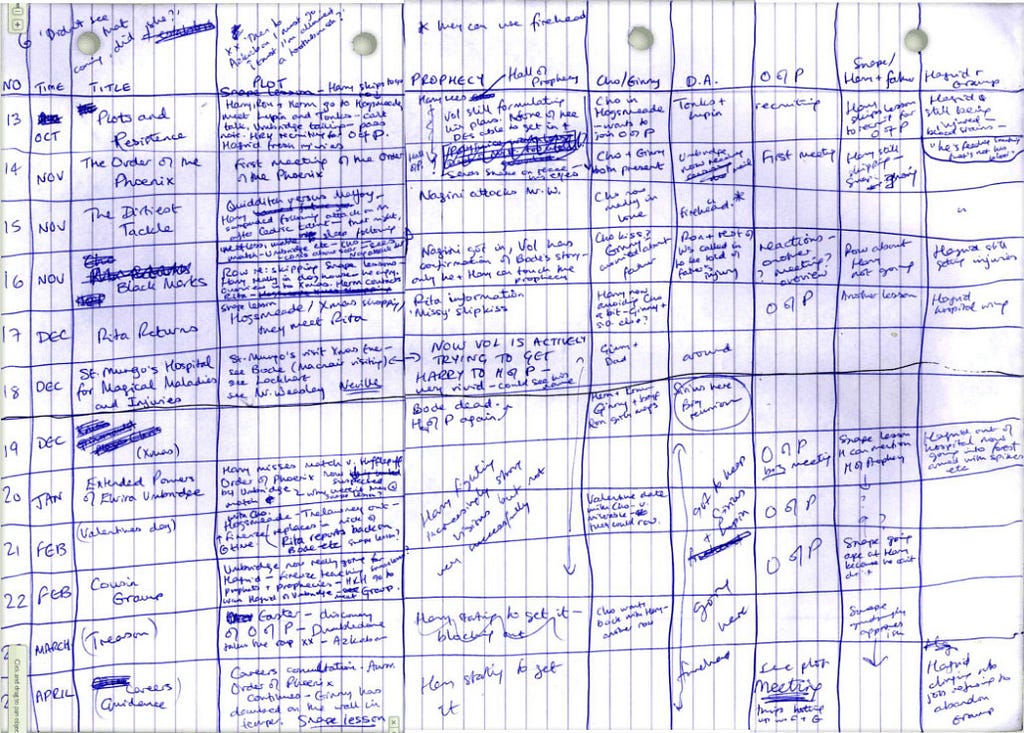
Every writer has their own process, and apparently J. K. Rowling is a meticulous plotter. This hand-written spreadsheet from Harry Potter and the Order of the Phoenix plots out everything from the month a chapter takes place to what is happening on or off screen in each subplot:

J. K. Rowling

The first few columns are pretty simple: chapter number, month, chapter title, and plot outline

The next set of columns keep track of the different subplots, as Endpaper explains:

  • “Prophecy”: A subplot about the prophecy Harry finds himself concerned about all through the book
  • “Cho/Ginny”: The book’s romantic subplot
  • “D.A.”: What’s happening with the resistance army, or “Dumbledore’s Army”
  • “O of P”: What’s happening with the “Order of the Phoenix” group
  • “Snape/Harry”: What’s happening with Snape and Harry
  • “Hagrid and Grawp”: What’s happening with Hagrid and Grawp

If you are stuck in your own writing, perhaps following Rowling’s lead and mapping out your novel will help.

(h/t Open Culture)

REVIEW: Limbo by Melania G. Mazzucco

It can sometimes seem like war is a specifically American pastime. This is the case particularly with the wars in the Middle East, since it’s easy to forget that the United Kingdom, Germany, Italy, Jordan, Turkey, Bulgaria and Romania, amongst others, have also sent troops to fight the Taliban. But as far as English-language literature goes, the Iraq and Afghanistan narratives have thus far been restricted to the likes of Kevin Powers, Ben Fountain, and Phil Klay — that is, white American men. But that is no longer the case.

Melania G. Mazzucco, an Italian writer whose novel, Limbo, was translated to English by Virginia Jewiss, offers an original take on the disillusionment of war. The novel itself exists in a sort of limbo, unfolding in the strange winter days that fill the end of the old year and the beginning of the new.

Just before Christmas, Manuela Paris returns to Italy from the war. She’s nationally recognized as a hero, albeit a broken one. During the opening of an Afghani girls school, a twelve-year-old suicide bomber detonated close enough to Manuela that she was sent home with crippling flashbacks and a body that may never fully heal. With her very identity tied to her image as a fighter, Manuela struggles to readjust to the slow life of her seaside hometown.

In the off-season hotel across the street, a shadowy figure slowly materializes into a character, and eventually into Manuela’s lover. Mattia helps Manuela heal, but reveals nothing about his strange past. Manuela’s best friend, her sister Vanessa, remains suspicious of this unforthcoming stranger, but he allows Manuela to evolve from a dark, angry victim into someone with the strength to reflect on her past.

Structurally, “Limbo” alternates between “Live” chapters and Manuela’s “Homework,” an assignment from her psychologist who’s told her to write down the experiences of Afghanistan. These first-person accounts offer a contrast to the star-crossed yet damaged woman she is in the “Live” sections; in the Middle East, Manuela seems a completely different character. Alternatively, the “Live” chapters are, on the whole, less successful, and at their worst, a close-omniscient racket. In a chance encounter with a policeman, for example, Mazzucco writes:

“ID” the officer insists. Harshly, because headquarters radioed in about a brawl that involved racist insults that had broken out on the soccer field just as he was about to go off duty, and he and his wife have to go to a dinner at his in-laws, out in the country, almost an hour’s drive, and he has to shower first, and now he’s going to be late, fucking hell.

But the “Homework” sections boom with a view of Afghanistan that is refreshingly un-American; Mazzucco’s is a distinctly Italian war. Walking the fine line between support-the-troops-but-hate-the-war, she observes through a supporting character:

Don’t you think the twenty-first-century Italians should break the spell of history that compels them to act like servants in other people’s wars? It’s been this way since even before Italy existed as a nation. The Crimean War, World War I, World War II, Yugoslavia, Somalia, Iraq. We go to war so as not to be left out, but without any real reason, which means we end up being there without real conviction, without the consensus of the people. It must be frustrating to be a soldier in a country that makes war that way.

Mazzucco is especially empathetic toward Manuela’s right to fight in a man’s world. One incident of bullying resolves in Manuela leaving a bloody tampon on a peer’s pillow, proving that she doesn’t use her womanhood as an excuse to be treated more delicately.

I’m a woman and a commander. And I represent my country…It took us two thousand years to get here, it may seem like a travesty to some, but to me it’s a victory…

Compared to the ferocity and vibrancy of Mazzucco’s research and politics in the “Homework” parts of Limbo, Manuela and Mattia’s romance is hard to believe. Mattia falls unreservedly in love with Manuela and, by all appearances, is written to be a “Prince Charming” through and through. The romance unfolds as all romances do: Manuela throws away her nice, do-no-wrong boyfriend from before the war for Mattia, who, although slightly edgier, seems of the same cut:

He kisses her again, and when his tongue is tired he slips his mouth and nose under her sweater as well. Just then the enormous shadow of an Airbus cover them, five hundred people who could look down into the dark mirror of Lake Bracciano and wouldn’t see them. No one can see Sergeant Paris, who lets herself be touched, licked, sucked, caressed by a stranger on a paddleboat. She is invisible. There’s no smoke when wind fans the flames. Reprehensible behavior. A black mark on her record. What the hell, she’s on leave. And she doesn’t even know if she’s still in the army.

Mazzucco tends to lean on unnecessary intensifiers and an over-reliance of familiar similes in her prose; the entire narrative, as a result, feels forcefully insistent. It’s also redundant: Manuela’s complexities are compelling enough to carry the story forward without the demand.

Limbo takes its title, in part, from the reoccurring reference to the Radiohead song, “In Limbo.” However, a better choice might just have been “Karma Police,” where singer Thom Yorke laments, “For a minute there, I lost myself.” Manuela’s minute is only a few weeks, because when Mattia’s love is introduced, her recovery is instantly assured. Why Mattia comes across as the hero who saves Manuela — she being a warrior who has never needed a man to come to her rescue — and why the emphasis of the novel switches to revealing his “secret” seems an empty question. Limbo reverberates when it’s a war story; the rest, it seems, is a fantasy world.

Limbo

by Melania G. Mazzucco

Powells.com