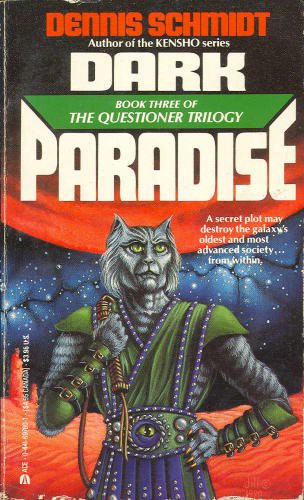
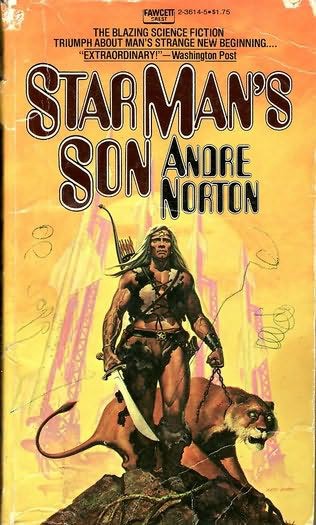
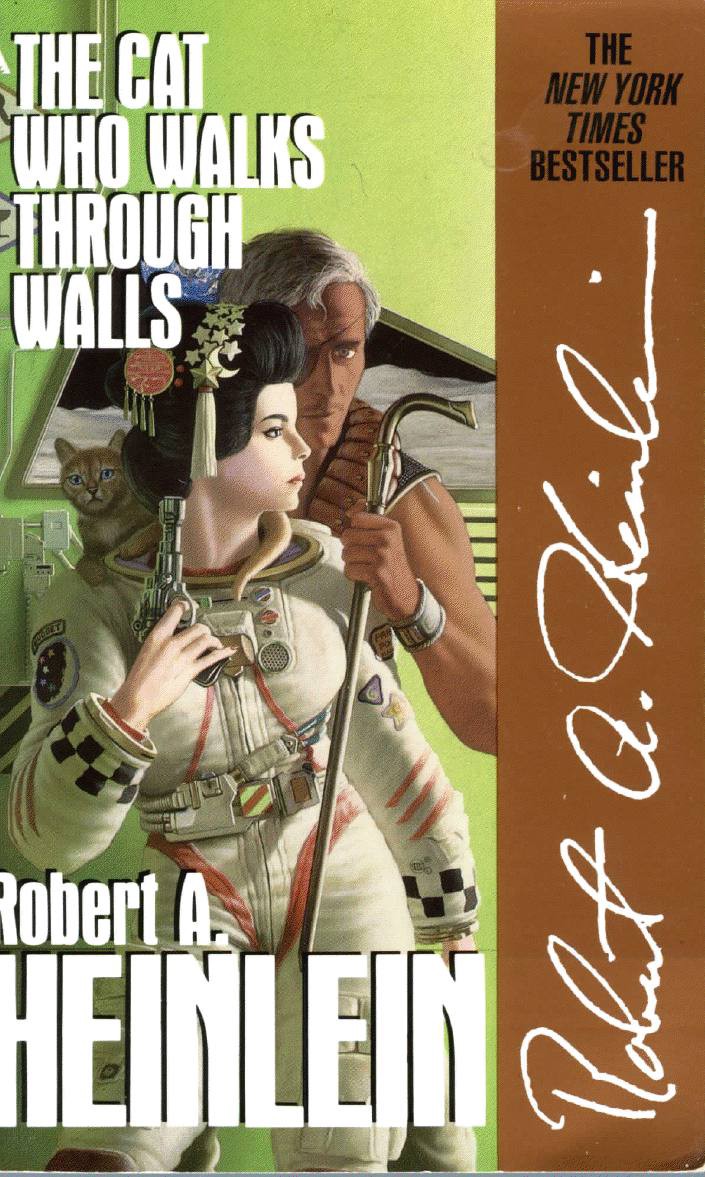
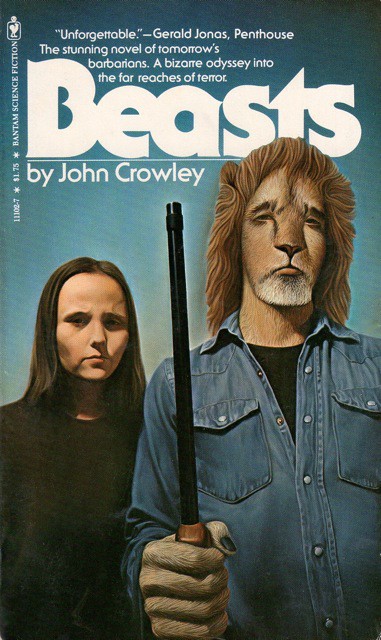
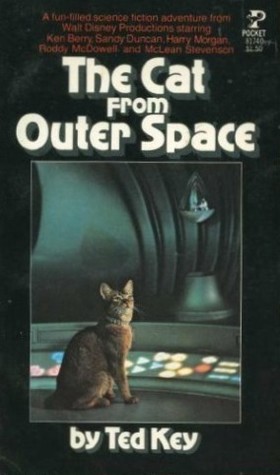
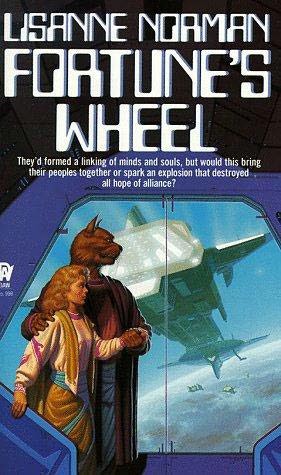
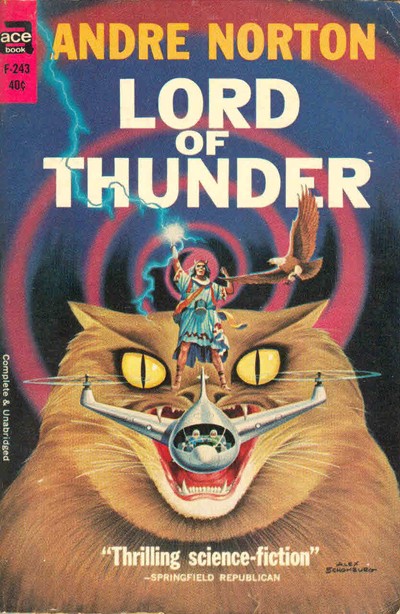
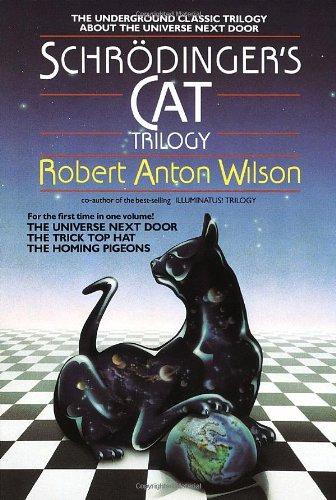
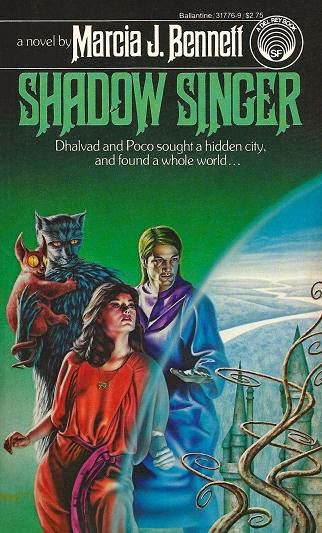
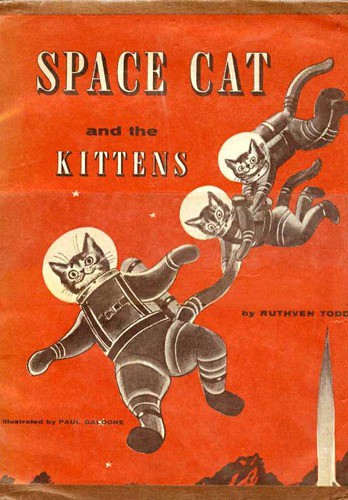
Look, the title pretty much explains it all. It’s covers of science fiction books with cats on the cover. You need a reason? It will reaffirm your faith in humanity’s ability to publish books with cats on the cover or something. What more do you want from us? (Maybe you want dogs on SF covers?)
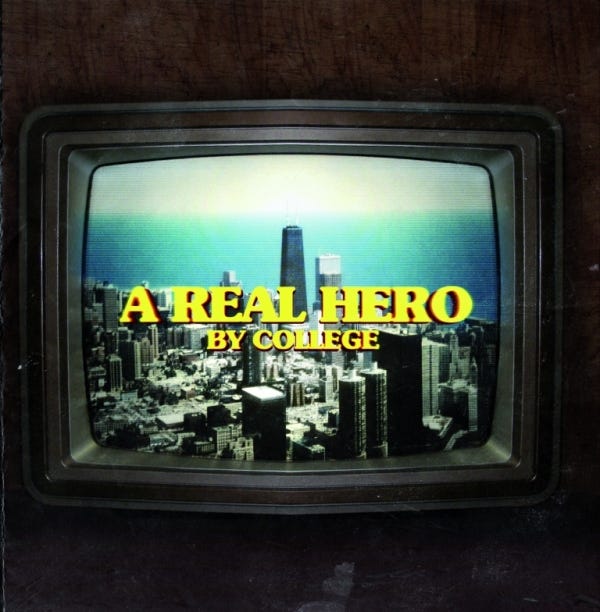
THE HEAD: College’s Teenage Color (2008) & A Real Hero (2011) EPs
People say about college before you arrive there: it marks your best and freest years. Except for that job in the art-slide library or whatever work-study you’re doing part-time, your prime responsibility is meant to be pursuing knowledge. That — and oh just everything that goes into being a real human being: feeding yourself (which you don’t really do), discovering sex (which you often do badly), expanding your mind and polluting your body (you do this, maybe, most of all), managing money (at which you fail hugely). And while bemoaning the lot of those who are lucky enough to attend college is equivalent on some level to looking the gift of Western privilege in its extensively orthidontured mouth, college can be, as you’re fumbling through it, a bewildering, scary, exuberant time. What you remember is what you are told, not what you dealt with in the moment, and the widely acknowledged surreal melancholy that lies at the heart of the college existence is lost in the mind of the so-called adult. The older you are, the less you know. What better group to score the surrealism of life at the foot of the ivory tower than David Grellier’s own College, specifically the one-man French music collective’s EPs Teenage Color (2008) and A Real Hero (2011). Laying down lonely, night-cruising drum tracks beneath majestic synth overlays and an aesthetic suffused with John-Hughes-era nostalgia, College’s Teenage Color and A Real Hero EPs — an abbreviated form perfectly suited to your college attention span — sound like they might’ve been composed in your poster-smothered dorm room on an all-nighter diet of Aderall, Dr. Pepper and Haribo candy. While Teenage Color is a dancy, neon-bright record on which Grellier’s reverberant waves of synth melancholy enter on the heels of a Duran Duran drum section that wouldn’t be out of place on a Thursday night in whatever humid, Miller-Light-smelling basement you were fond of spending “the weekend” in, A Real Hero is in some ways Teenage Color’s inverse. As on “Critical Mass,” A Real Hero’s standout track, Grellier’s keyboard lamentations (more Joy Division than Duran Duran) take center stage, and a darker, more meditative experience begins to unfold. Indeed the former record (Teenage Color) might be more appropriate to the heedless beginning of college, the latter (A Real Hero) to the dorm fire sale comedown that marks its conclusion. It’s this quality of ironic juxtaposition — not only between the records but within the music itself –that made College perfect for Nicolas Winding Refn’s 2011 “high trash” noir Drive, in which an outwardly gallant stunt driver/getaway man (Ryan Gosling) seeking to protect a single mother (Carey Mulligan) takes a sharp turn into macabre depravity. College’s collaboration with Electric Youth, the titular song “A Real Hero,” did volumes to underscore Winding Refn’s interrogation of on-screen violence in the film’s soundtrack alongside excellent cuts from Kavinsky, Desire and The Chromatics. “A real hero and a real human being,” goes the song’s ethereal female chorus before Gosling’s “Driver” proceeds to beat people to death in elevators and drown them in the ocean in between cruising the streets of a cotton-candy-colored L.A. It’s this kind of discrete shift between shadow and light, concreteness and surrealism that defines College as a band and make them a fitting soundtrack, furthermore, for the college experience itself. A tree-bordered lake in a winter landscape suctioned dry of its water before the first freeze; the sound of the cocks of the cross-country team flip-flopping against their legs on a 2 a.m. streak through the undergrad quad; the vertiginous feeling of being too drunk in some rooftop garden too far from your room and the limitless feeling of just letting go, bushes banking up at you.
THE TORSO: Wonder Boys dir. Curtis Hanson (2000)
There’s a scene toward the end of Curtis Hanson’s Wonder Boys (2000) that has stymied novelist and creative writing professor Grady Tripp (Michael Douglas) standing at the edge of Pittsburgh’s Monongahela River in between a pregnant diner waitress dressed in the wedding-day furs of Marilyn Monroe and a James Brown lookalike with a pistol as reams of paper scatter on the wind, blowing irretrievably into the water. Tripp’s pansexual editor Crabtree (Robert Downey Jr.) manages to catch a few stray sheets, having moments ago crashed Tripp’s car with the papers inside it into the side of a nearby warehouse. Semi-spoiler alert: the papers swallowed by the Monongahela comprise the only copy of Tripp’s 2,000 pages-and-counting second novel, which he hasn’t been able finish since his first book — a literary send-up: The Arsonist’s Daughter — set a critical bar too high to surmount. The tragi-farcical nature of this scene speaks not only to the liminal unease of being in college but also the tone of the film overall, which is rooted in gloomy absurdism and whimsical paradox. Essentially, Wonder Boys follows Tripp, a philandering pothead with tenure whose wife has recently left him and who has managed to impregnate his Dean (Frances McDormand), as he purports to serve as a role model for spooky, fiction-wunderkind James Leer (Tobey Maguire) over the course of several chaotic days. The film’s most compelling irony lives in the match-up between Tripp and Leer, who are constantly outdoing each other on the scale of who has his shit together less: Tripp is a man-child, where Leer is a child-man; Tripp fathers Leer who in turn fathers Tripp, daring him to be the idol that Leer, in his innocence, wants Tripp to be. In one scene, after being bitten by the Dean’s Rottweiler Poe, Tripp takes down two Codeine with a nip of whiskey before offering some to his student, Leer (really, only one of many prosecutable and inappropriate gestures Tripp makes in the course of their time together). When Leer says, “No thanks. I’m fine without them,” Tripp barks, “Right… You’re fine, all right. You’re fit as a fucking fiddle.” Leer isn’t. Lying somewhere “on the spectrum,” Leer is also a compulsive liar and a strident manipulator, not to mention an obsessive when it comes to the dark, suicide-riddled history of 1940’s Hollywood. Such conspicuous ironies and quirks as these, however, are not the only driving forces when it comes to the film’s unique sense of the absurd and the surreal. Based on a novel of the same name by Michael Chabon, Wonder Boys follows a picaresque structure (A leads to B leads to C leads to D) and recommends itself to the instability of the college experience through idiosyncratic set-pieces: a dead dog in the trunk of a car alongside a tuba in a calf-skin carrying case; a 6’ tall transvestite making the rounds at a faculty mixer; Tripp (perhaps Michael Douglas’ greatest achievement as an actor) driving around Pittsburgh in a tattered, pink housecoat with half of a joint forever burning in his mouth. Tripp also suffers from what Leer describes as “spells” (to which Tripp responds: “Jesus, James, you make it sound like we’re in a Tennessee Williams play. I don’t get spells.”), worrying blackouts that land him on his back at inopportune moments that, when combined with his Willy-Nelson-grade pot intake, lend the film’s already surreal goings-on a dimension of narrative unreliability. And although Wonder Boys isn’t your average college romp, falling partly into the category of academic satire à la Kingsley Amis’ Lucky Jim (1954) or Jane Smiley’s Moo (1995), in some ways that’s the point. While Tobey Maguire’s Leer and Katie Holmes’s Hannah (who Tripp refreshingly doesn’t sleep with), both students, help to root the story concretely in a college milieu, Douglas’ novelist living in a state of arrested development reinforces the surreal limbo within which the younger characters find themselves; in some ways Douglas is their foil, in other ways they serve as his. The film’s picaresque circumstances become an externalization of the characters’ inner turmoil, the ebbing away of their sense of the selves they never really knew they weren’t. The film ignores answers in favor of questions: though people may age, do they ever grow up? They might not, quite, but that’s okay.
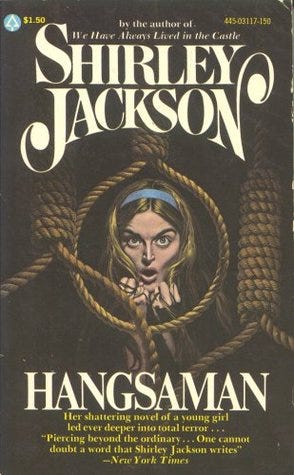
THE LEGS: Hangsaman by Shirley Jackson (1951)
If College’s EPs and Hanson’s film serve as wry overtures to the weirdness of being in college, then Shirley Jackson’s Hangsaman (1964) is a full, booming orchestra of it, and perhaps the first novel to use elements of sublime terror to address the process of obtaining a B.A. Unlike other psychological thrillers, however, there is no slow burn in Hangsaman, whereby cracks in the main character’s psyche presage a grand collapse; rather, Jackson’s novel and the protagonist at the center of it, Natalie Waite, are weird from the get-go and only get weirder. In this sense, the novel’s surreal nature isn’t limited to college alone; college is a petri dish that serves to augment a preexisting disorder and when Natalie gets there, she blossoms all right, but never in the way you’d think. Here is a girl who engages with an imaginary “detective” in her head about an unspecified murder; here is a girl who carries on a coquettishly literary written correspondence with her father, a pedantic minor scholar of English letters (one of her letters to him begins: “Dear Sir Knight: It was not you then, caroling lustily under my window these three nights past.”); here is a girl whose late-night study breaks take her not to the all campus dining center for grilled cheese with tomato but to wander, while singing, the freezing cold campus. Add to this a sexual trauma that Natalie suffers at the hands of one of her father’s colleagues before she leaves the nest and you have a brooding, simmering novel in the tradition of Emily Bronte’s Jane Eyre or Patrick McGrath’s Spider about the considerably more universal trauma of growing up. Hangsaman is similar to both Wonder Boys and the College EPs in the sense that it’s full of contradictions that belie the free wheeling circumstances of its plot: girl goes to college, finds self, journeys on. The school in Hangsaman is modeled roughly on Bennington College in Vermont where Jackson’s husband, the literary critic Stanley Edgar Hyman, taught. While it purports to be progressive, a place where gifted girls like Natalie go to become sophisticated women, one of Natalie’s first friends there is Elizabeth Langdon, the erstwhile student and now kept wife of Natalie’s lothario English professor Arthur Langdon. Elizabeth vacillates between martini-sodden bitterness and uncomfortable-making adoration; when she isn’t reinforcing staid gender binaries, like always having supper and a pitcher of cocktails ready for her husband when he arrives home after a hard day of flirting with the prettier of his female students, she makes for an amusing if excruciating scene-stealer next to understated Natalie. (In Hangsaman as opposed to Wonder Boys, the professors do sleep with their students.) And then there’s the fracture in Natalie’s psyche, manifest toward the end of the book in a fast “friend” named Tony that she makes while wandering her dormitory; although Jackson never states explicitly that Tony is a damaged extension of Natalie, you pick up the sense that they’re somehow related. The girls go on a spirit quest to the edge of the town, where the “wilderness” starts. Tony tells Natalie this as they’re walking: “ ‘We are on a carpet,’ … ‘It unrolls in front of us, but in back of us it rolls up and there is nothing under it.’” What a perfect assessment of college right there! Beyond the solo cups, the void. Natalie grows, though we’re not sure how much before the end of her ordeal. We’re left with the sense that the book is just one of many dark chapters in Natalie’s life, this one perhaps to be repeated. The psychological chiaroscuro of Hangsaman, a college novel about trauma, alienation and the lengths to which our minds will go to protect us from the terror of being alive is the ultimate paradoxical entry in a genre most comfortable with Greek system antics and pre-packaged self-discovery. In the College EPs, Wonder Boys and Hangsaman, college is nothing at last but the distance between expectation and coming up flustered. But damn if it doesn’t look good from behind. What nobody tells you before you arrive is everything you’ll never know.
ALTERNATIVE CUTS:
Salem’s King Night (2010); Springbreakers dir. Harmony Korine (2012); The Rules of Attraction by Brett Easton Ellis (1987)
Invisible Man by Ralph Ellison (1952); Public Enemy’s Fear of a Black Planet (1990); School Daze dir. Spike Lee (1998)
Animal House dir. John Landis (1978); Geronimo Rex by Barry Hannah (1972); Andrew W.K.’s I Get Wet (2001)
Indecision by Benjamin Kunkel (2005) or Flatscreen by Adam Wilson (2012); Andrew Bird’s Armchair Apocrypha (2007); The Graduate dir. Mike Nichols (1967)
Suspiria dir. Dario Argento (1977); The Lecturer’s Tale by James Hynes (2001); Suspiria film soundtrack (1977)
Cat Power’s Moon Pix (1998); The Squid & The Whale dir. Noah Baumbach (2005); Stoner by John Williams (1965)
The endlessly funny and clever folks at McSweeney’s are having their first ever student short story contest. The entry fee gets you a year’s subscription to the Quarterly, and the winner gets their story published in issue 51, plus $500!
Contestants must currently be students (undergraduate or graduate) and stories must be under 7,500 words. But that’s it for rules. The submission period runs from July 30 — August 31, 2014, so fellow students, go take advantage of these last weeks of freedom before the return to academia reins in your creativity.
For more information, check out the official guidelines here or on the submissions page. Godspeed!
[DISCLAIMER: The post below involves Short Story Thursdays alone and is in no way affiliated with any pop-up ads or sidebars you may be presented with on this site that are also advertizing a free short story a week. If you like the shit below, emailing shutyourlazymouthandread@shortstorythursdays.com is the only way to join. It’s a super long email address, I know. Sorry. But I hope you like it. And I hope you do it. Thank you.]
Hello. My name is Jacob Tomsky and I wrote this salacious, trashy book about the hotel business which sold well and got the Internet and some major hotel chains fiercely mad at me. But, as they say, never that now.
Because I am here to talk to you about reading and shit. About getting classic literature in your life, once a week, via email. Because I run this non-profit called Short Story Thursdays and that is exactly what we do. You email me and I promise I will take care of you and cherish you as a person and force feed you great short stories, once a week, painlessly, and introduce them with vibrant intro emails wherein I make jokes and curse.
Any further info needed about me, or this organization, or why I started it, or what my apartment looks like can be discovered in these two ways:
2- This single-take video where I am sitting in my own apartment and just scriptlessly bullshitting about SST: Video Introduction
But I am here at Electric Literature to give you a taste of what you’ll get if you sign up for Short Story Thursdays.
This is the third part of a four-part series, all fiction related to ocean travel because, at this point in our journey, I am on a freighter, crossing the Atlantic, seven days in on a ten-day journey, returning to America, just me and the crew on this gigantic container ship.
If you wish to read about the first two parts of my trip you can find them here and here.
Those first two posts, and the accompanying fiction, were all about fear. Because this was a rather terrifying thing to do. But at this point? I was no longer afraid. I hadn’t gotten seasick. I hadn’t gotten scurvy. I had not, as of yet, skidded on a deck puddle and hurled myself over the railing into the cold, briny maw of ocean.
Seven days in. And I had learned so much! Here is a rapid-fire list of some things I learned:
FREIGHTER FACTS:
1- The damn thing goes 13 miles an hour. I was crossing the entire Atlantic Ocean going 13 miles an hour.
2- The Captain will give you shit, constantly, and lie to you, and fuck with you, non-stop.
3- If you think you are good at ping-pong you are not good at ping- pong, these motherfuckers are exceptional at ping pong.
4- The store is called the “slopchest” and only open once a week and sells in bulk. Case of beer = $16. Bottle of vodka = $9. Can of salted nuts = $3.
5- Seasickness takes varying forms. Some people vomit. Some experience headaches. Others battle intense drowsiness the entire journey. And the boat can rock two ways: Pitching, which is back to front, so intense it seems like the freighter catches fucking air and then slams its nose down hard in the waves. And rolling, which is side-to-side and sends you stumbling into the wall.
6- I experienced no seasickness at all because I am a badass bitch.
7- No one talks while they eat. Meals are just a bunch of sailors chewing morosely in silence. It’s very strange at first but then you get used to it and when someone talks you’re all, “Will you shut the fuck up and just eat please? Goddamn shut up.”
8- You get really hungry at sea. And the meals are huge. And you eat it all. It’s called “freighter pigging.”
9- Just kidding it’s not called freighter pigging.
10- Day after day of only ocean. Pitching, rolling, storms, trying to soap up in the shower while holding on to a safety bar so you don’t smash your face against the wall, instant coffee, getting tossed around in bed randomly through the night, watching “Sleepless in Seattle” again because that’s the only movie in your cabin.
11- Don’t say, “I hope I get to experience at least some bad weather.” They will hate you. Don’t say, “It’s really beautiful out there today.” They will hate you.
12- Being on the bridge for a four-hour watch is mind-erasing. They call it “the blind man’s television.” Seriously you guys the ocean just goes on and on and it’s crazy.
So, after completing seven days out of ten, I’d almost made it home. Almost. And that’s the kind of thing that gets you thinking, right? What is there waiting for me at home? Who is there waiting for me? Prior to the freighter I’d been in Africa for four months and maybe my friends had found other friends? Maybe when I came back and was all, “Hey friends let’s hang out because I missed you,” they’d be all, “Hey well listen we found a replacement friend for you while you were gone and he’s got more money than you but we will certainly call you if something opens up, friend-wise.”
My friends didn’t do that because my friends are radical. They were there, in New York, waiting for me, prepared to get me historically drunk. But I would walk to the railing with a shitty cup of instant coffee and stare forward, toward the new world, or whatever, my old world. And that’s what today’s selection is about. It’s about a man who leaves his home for love. He leaves to earn money, to secure a future for the woman he loves, and he loves her so very much. But, if you stay away too long, you start to worry about returning. You’re sitting there, older now, with all of your numerous flaws fully visible, piled in your lap like dirty socks, and you start to question if they’d even want you anymore. Are you worth wanting? Have you changed? Surely your face, during all of this time, has taken a beating. You’re uglier now. Sadder. Aloner. Now you’re there at the railing with your instant coffee and you start to cry maybe because leaving was hard but, apparently, coming home is harder. What the fuck is that? But you can’t stop the boat. It’s churning along over the bowl of the ocean. The boat is like the arrow of time and it cannot be reversed.
I mean, doesn’t time make us worse, you guys? Tomorrow won’t we be less worthy of love than we are today?
I don’t know. And it bums me out to think of it. And in the story below by Ernest Dowson, published in 1922, called, “Statute of Limitations,” we will be offered one solution to that very dilemma.
It’s all very sad, you guys. But we are almost home. Perhaps they are waiting for us at home, arms wide and ready, ready to love our new handful of flaws, our new busted face. But perhaps there will be no one there. Perhaps it’s best to never even find out one way or the other.
Leaving is so hard. Coming home is so hard. Love is so hard.
“A Voice in the Night” (1907) by William Hope Hodgson
During five years of an almost daily association with Michael Garth, in a solitude of Chili, which threw us, men of common speech, though scarcely of common interests, largely on each other’s tolerance, I had grown, if not into an intimacy with him, at least into a certain familiarity, through which the salient feature of his history, his character reached me. It was a singular character, and an history rich in instruction. So much I gathered from hints, which he let drop long before I had heard the end of it. Unsympathetic as the man was to me, it was impossible not to be interested by it. As our acquaintance advanced, it took (his character I mean) more and more the aspect of a difficult problem in psychology, that I was passionately interested in solving: to study it was my recreation, after watching the fluctuating course of nitrates. So that when I had achieved fortune, and might have started home immediately, my interest induced me to wait more than three months, and return in the same ship with him. It was through this delay that I am enabled to transcribe the issue of my impressions: I found them edifying, if only for their singular irony.
From his own mouth indeed I gleaned but little; although during our voyage home, in those long nights when we paced the deck together under the Southern Cross, his reticence occasionally gave way, and I obtained glimpses of a more intimate knowledge of him than the whole of our juxtaposition on the station had ever afforded me. I guessed more, however, than he told me; and what was lacking I pieced together later, from the talk of the girl to whom I broke the news of his death. He named her to me, for the first time, a day or two before that happened: a piece of confidence so unprecedented, that I must have been blind, indeed, not to have foreseen what it prefaced. I had seen her face the first time I entered his house, where her photograph hung on a conspicuous wall: the charming, oval face of a young girl, little more than a child, with great eyes, that one guessed, one knew not why, to be the colour of violets, looking out with singular wistfulness from a waving cloud of dark hair. Afterwards, he told me that it was the picture of his fiancee: but, before that, signs had not been wanting by which I had read a woman in his life.
Iquique is not Paris; it is not even Valparaiso; but it is a city of civilisation; and but two days’ ride from the pestilential stew, where we nursed our lives doggedly on quinine and hope, the ultimate hope of evasion. The lives of most Englishmen yonder, who superintend works in the interior, are held on the same tenure: you know them by a certain savage, hungry look in their eyes. In the meantime, while they wait for their luck, most of them are glad enough when business calls them down for a day or two to Iquique. There are shops and streets, lit streets through which blackeyed Senoritas pass in their lace mantilas; there are cafes too; and faro for those who reck of it; and bull fights, and newspapers younger than six weeks; and in the harbour, taking in their fill of nitrates, many ships, not to be considered without envy, because they are coming, within a limit of days to England. But Iquique had no charm for Michael Garth, and when one of us must go, it was usually I, his subordinate, who being delegated, congratulated myself on his indifference. Hard-earned dollars melted at Iquique; and to Garth, life in Chili had long been solely a matter of amassing them. So he stayed on, in the prickly heat of Agnas Blancas, and grimly counted the days, and the money (although his nature, I believe, was fundamentally generous, in his set concentration of purpose, he had grown morbidly avaricious) which should restore him to his beautiful mistress. Morose, reticent, unsociable as he had become, he had still, I discovered by degrees, a leaning towards the humanities, a nice taste, such as could only be the result of much knowledge, in the fine things of literature. His infinitesimal library, a few French novels, an Horace, and some well thumbed volumes of the modern English poets in the familiar edition of Tauchnitz, he put at my disposal, in return for a collection, somewhat similar, although a little larger, of my own. In his rare moments of amiability, he could talk on such matters with verve and originality: more usually he preferred to pursue with the bitterest animosity an abstract fetish which he called his “luck.” He was by temperament an enraged pessimist; and I could believe, that he seriously attributed to Providence, some quality inconceivably malignant, directed in all things personally against himself. His immense bitterness and his careful avarice, alike, I could explain, and in a measure justify, when I came to understand that he had felt the sharpest stings of poverty, and, moreover, was passionately in love, in love comme on ne l’est plus. As to what his previous resources had been, I knew nothing, nor why they had failed him; but I gathered that the crisis had come, just when his life was complicated by the sudden blossoming of an old friendship into love, in his case, at least, to be complete and final. The girl too was poor; they were poorer than most poor persons: how could he refuse the post, which, through the good offices of a friend, was just then unexpectedly offered him? Certainly, it was abroad; it implied five years’ solitude in Equatorial America. Separation and change were to be accounted; perhaps, diseases and death, and certainly his ‘luck,’ which seemed to include all these. But it also promised, when the term of his exile was up, and there were means of shortening it, a certain competence, and very likely wealth; escaping those other contingencies, marriage. There seemed no other way. The girl was very young: there was no question of an early marriage; there was not even a definite engagement. Garth would take no promise from her: only for himself, he was her bound lover while he breathed; would keep himself free to claim her, when he came back in five years, or ten, or twenty, if she had not chosen better. He would not bind her; but I can imagine how impressive his dark, bitter face must have made this renunciation to the little girl with the violet eyes; how tenderly she repudiated her freedom. She went out as a governess, and sat down to wait. And absence only rivetted faster the chain of her affection: it set Garth more securely on the pedestal of her idea; for in love it is most usually the reverse of that social maxim, les absents ont toujours tort, which is true.
Garth, on his side, writing to her, month by month, while her picture smiled on him from the wall, if he was careful always to insist on her perfect freedom, added, in effect, so much more than this, that the renunciation lost its benefit. He lived in a dream of her; and the memory of her eyes and her hair was a perpetual presence with him, less ghostly than the real company among whom he mechanically transacted his daily business. Burnt away and consumed by desire of her living arms, he was counting the hours which still prevented him from them. Yet, when his five years were done, he delayed his return, although his economies had justified it; settled down for another term of five years, which was to be prolonged to seven. Actually, the memory of his old poverty, with its attendant dishonours, was grown a fury, pursuing him ceaselessly with whips. The lust of gain, always for the girl’s sake, and so, as it were, sanctified, had become a second nature to him; an intimate madness, which left him no peace. His worst nightmare was to wake with a sudden shock, imagining that he had lost everything, that he was reduced to his former poverty: a cold sweat would break all over him before he had mastered the horror. The recurrence of it, time after time, made him vow grimly, that he would go home a rich man, rich enough to laugh at the fantasies of his luck. Latterly, indeed, this seemed to have changed; so that his vow was fortunately kept. He made money lavishly at last: all his operations were successful, even those which seemed the wildest gambling: and the most forlorn speculations turned round, and shewed a pretty harvest, when Garth meddled with their stock.
And all the time he was waiting there, and scheming, at Agnas Blancas, in a feverish concentration of himself upon his ultimate reunion with the girl at home, the man was growing old: gradually at first, and insensibly; but towards the end, by leaps and starts, with an increasing consciousness of how he aged and altered, which did but feed his black melancholy. It was borne upon him, perhaps, a little brutally, and not by direct self-examination, when there came another photograph from England. A beautiful face still, but certainly the face of a woman, who had passed from the grace of girlhood (seven years now separated her from it), to a dignity touched with sadness: a face, upon which life had already written some of its cruelties. For many days after this arrival, Garth was silent and moody, even beyond his wont: then he studiously concealed it. He threw himself again furiously into his economic battle; he had gone back to the inspiration of that other, older portrait: the charming, oval face of a young girl, almost a child, with great eyes, that one guessed one knew not why, to be the colour of violets.
As the time of our departure approached, a week or two before we had gone down to Valparaiso, where Garth had business to wind up, I was enabled to study more intimately the morbid demon which possessed him. It was the most singular thing in the world: no man had hated the country more, had been more passionately determined for a period of years to escape from it; and now that his chance was come the emotion with which he viewed it was nearer akin to terror than to the joy of a reasonable man who is about to compass the desire of his life. He had kept the covenant which he had made with himself; he was a rich man, richer than he had ever meant to be. Even now he was full of vigour, and not much past the threshold of middle age, and he was going home to the woman whom for the best part of fifteen years he had adored with an unexampled constancy, whose fidelity had been to him all through that exile as the shadow of a rock in a desert land: he was going home to an honourable marriage. But withal he was a man with an incurable sadness; miserable and afraid. It seemed to me at times that he would have been glad if she had kept her troth less well, had only availed herself of that freedom which he gave her, to disregard her promise. And this was the more strange in that I never doubted the strength of his attachment; it remained engrossing and unchanged, the largest part of his life. No alien shadow had ever come between him and the memory of the little girl with the violet eyes, to whom he at least was bound. But a shadow was there; fantastic it seemed to me at first, too grotesque to be met with argument, but in whose very lack of substance, as I came to see, lay its ultimate strength. The notion of the woman, which now she was, came between him and the girl whom he had loved, whom he still loved with passion, and separated them. It was only on our voyage home, when we walked the deck together interminably during the hot, sleepless nights, that he first revealed to me without subterfuge, the slow agony by which this phantom slew him. And his old bitter conviction of the malignity of his luck, which had lain dormant in the first flush of his material prosperity, returned to him. The apparent change in it seemed to him just then, the last irony of those hostile powers which had pursued him.
‘It came to me suddenly,’ he said, ‘just before I left Agnas, when I had been adding up my pile and saw there was nothing to keep me, that it was all wrong. I had been a blamed fool! I might have gone home years ago. Where is the best of my life? Burnt out, wasted, buried in that cursed oven! Dollars? If I had all the metal in Chili, I couldn’t buy one day of youth. Her youth too; that has gone with the rest; that’s the worst part!’
Despite all my protests, his despondency increased as the steamer ploughed her way towards England, with the ceaseless throb of her screw, which was like the panting of a great beast. Once, when we had been talking of other matters, of certain living poets whom he favoured, he broke off with a quotation from the ‘Prince’s Progress’ of Miss Rossetti: ‘Ten years ago, five years ago, One year ago, Even then you had arrived in time; Though somewhat slow; Then you had known her living face Which now you cannot know.’
He stopped sharply, with a tone in his voice which seemed to intend, in the lines, a personal instance.
‘I beg your pardon!’ I protested. ‘I don’t see the analogy. You haven’t loitered; you don’t come too late. A brave woman has waited for you; you have a fine felicity before you: it should be all the better, because you have won it laboriously. For heaven’s sake, be reasonable!’ He shook his head sadly; then added, with a gesture of sudden passion, looking out over the taffrail, at the heaving gray waters: ‘It’s finished. I haven’t any longer the courage.’ ‘Ah!’ I exclaimed impatiently, ‘say once for all, outright, that you are tired of her, that you want to back out of it.’ ‘No,’ he said drearily, ‘it isn’t that. I can’t reproach myself with the least wavering. I have had a single passion; I have given my life to it; it is there still, consuming me. Only the girl I loved: it’s as if she had died. Yes, she is dead, as dead as Helen: and I have not the consolation of knowing where they have laid her. Our marriage will be a ghastly mockery: a marriage of corpses. Her heart, how can she give it me? She gave it years ago to the man I was, the man who is dead. We, who are left, are nothing to one another, mere strangers.’
One could not argue with a perversity so infatuate: it was useless to point out, that in life a distinction so arbitrary as the one which haunted him does not exist. It was only left me to wait, hoping that in the actual event of their meeting, his malady would be healed. But this meeting, would it ever be compassed? There were moments when his dread of it seemed to have grown so extreme, that he would be capable of any cowardice, any compromise to postpone it, to render it impossible. He was afraid that she would read his revulsion in his eyes, would suspect how time and his very constancy had given her the one rival with whom she could never compete; the memory of her old self, of her gracious girlhood, which was dead. Might not she too, actually, welcome a reprieve; however readily she would have submitted out of honour or lassitude, to a marriage which could only be a parody of what might have been?
At Lisbon, I hoped that he had settled these questions, had grown reasonable and sane, for he wrote a long letter to her which was subsequently a matter of much curiosity to me; and he wore, for a day or two afterwards, an air almost of assurance which deceived me. I wondered what he had put in that epistle, how far he had explained himself, justified his curious attitude. Or was it simply a resume, a conclusion to those many letters which he had written at Agnas Blancas, the last one which he would ever address to the little girl of the earlier photograph?
Later, I would have given much to decide this, but she herself, the woman who read it, maintained unbroken silence. In return, I kept a secret from her, my private interpretation of the accident of his death. It seemed to me a knowledge tragical enough for her, that he should have died as he did, so nearly in English waters; within a few days of the home coming, which they had passionately expected for years.
It would have been mere brutality to afflict her further, by lifting the veil of obscurity, which hangs over that calm, moonless night, by pointing to the note of intention in it. For it is in my experience, that accidents so opportune do not in real life occur, and I could not forget that, from Garth’s point of view, death was certainly a solution. Was it not, moreover, precisely a solution, which so little time before he had the appearance of having found? Indeed when the first shock of his death was past, I could feel that it was after all a solution: with his ‘luck’ to handicap him, he had perhaps avoided worse things than the death he met. For the luck of such a man, is it not his temperament, his character? Can any one escape from that? May it not have been an escape for the poor devil himself, an escape too for the woman who loved him, that he chose to drop down, fathoms down, into the calm, irrecoverable depths of the Atlantic, when he did, bearing with him at least an unspoilt ideal, and leaving her a memory that experience could never tarnish, nor custom stale?
The Horror Writers Association (HWA) has decided to allow self-publishing as a criterion for its membership, and the Science Fiction and Fantasy Writers of America (SFWA) is currently contemplating doing the same. Membership in both groups had previously been means-tested only to allow membership to writers who sold a certain number of short pieces at a certain pay rate, or a novel for an advance of a couple thousand dollars. (There are also other kinds of membership for publishing professionals, but that’s not relevant here.) Much anxiety and discussion has ensued, though of course there has been more light than heat.
The problem is that nobody understands the putative goals and purposes of these organizations, of which I was a member of both for a number of years — and a former Trustee of HWA and a former member of the grievance committee of SFWA. I am not a member of either right now, and have no plans to rejoin either group any time soon. I am a member of the Mystery Writers of America, however, though because MWA is sufficiently tight-lipped about its own operations I’m actually less qualified to talk about it.
The first question is this: why wasn’t self-publishing allowed before? The real answer has little to nothing to do with the ease of self-publishing, or “gatekeeping”, or the stigma attached to self-publishing, and it certainly had zero to do with the idea that self-published works make for worse reading than commercially published works. Though of course self-publishing is fairly easy, there are gatekeepers, there is still a stigma attached to self-publishing, and self-published works are, on the whole, more likely to be bad and to be bad in ways that bad commercially published fiction is not.
Self-publishing wasn’t a criterion for membership previously because the goal of these organizations was in large part to serve as a guild that would defend the commercial interests of their members against the state and the publishing industry. That is, publishers were the class enemy — even though editors and publishers could theoretically join the organization, and even though there is nothing to stop an editor from joining as a writer, as I did. Of course the groups had other goals: to give out awards, to provide some number of publishing opportunities via the licensing of member-only anthologies, to hold parties, to create and maintain a mailing list, and to make the mediocre feel grandiose. The goal of defense was incompletely manifested and riven with contradictions, but that’s life.
Who is the class enemy of the self-published writer? In times past, when self-publishing meant storing books in one’s garage, there was no class enemy. There were many enemies — bookstores that refused to stock books, mice and other vermin chewing away at the boxes, angry mail carriers, printers who get things wrong — but they are not class enemies. So there was never a reason for the self-published to join HWA, SFWA, or other groups, though of course the desire of the mediocre to feel grandiose led several to agitate for a seat.
And, it turns out that it is much easier to sell awards and grandiosity than it is to fight for writer interests, especially when the publishers the organizations dealt with would first collapse and then reform into far more powerful organizations thanks to conglomeratization. (The big achievement of these orgs over the past few years was to get a few magazines to pay five, and now six, cents a word, instead of three cents a word, for short fiction.) It used to make sense to have separate organizations for romance writers, science fiction writers, etc. Now, when the difference between a romance publisher and a science fiction publisher is which phone rings on which desk in the same office space, it does not. However, when it comes to awards and parties and grandiosity — well, you don’t get a lot of play on a country club scheme if anyone can walk off the street and join, especially when some of them are gross ugly nerds who smell like landfill, uh, I mean science fiction writers. In the pre-Kindle days, a number of self-published writers wanted to join, were rebuffed, and complained that they were “pros” too and made ever so much money — far more than three cents a word for a short story or whatever the going rate was at the time.
Amazon.com and the Kindle changed everything for self-publishing. It solved the two problems of self-publishing, distribution and quality. The Kindle made distribution simple, and the ability to price one’s titles cheaply solved the quality problem: people don’t care as much about products that cost them a dollar, especially when high-quality substitutes cost between eight and twenty-five times as much while only being twice to five times as good. Plus, as Amazon’s new Kindle Unlimited rule about a reader needing to read ten percent of a book before Amazon will pay the writer suggests, lots of people are buying dollar books and then promptly forgetting to even look at them.
Self-publishing today is more accurately called direct publishing via online networks that operate under some set of terms of service. The class enemy stands revealed! And yet, heavy subsidies by Amazon and competitive pressures from other firms — if you like your 70 percent royalty, thank Apple for forcing Amazon’s hand, not the other way around — makes it appear subjectively that Amazon is not a class enemy. That is, self-published writers have gone from rejected to accepted, from poor to rich, from mediocre to grandiose! With the press of a button, and the ritual payout to freelance “editors” — most of whom in fact do not edit. (Relatively few editors tell their clients, “Throw this book away. Do nothing but read widely and deeply for five years. Then try again.” This is an important part of the editorial process, formerly made manifest by the ubiquitous rejection letter.)
The only thing missing…the stamp of approval from a guild. Well, now they got that too.
What they don’t have are fighting organizations. What would SFWA and HWA do if tomorrow Amazon decides to cut royalties in half, or if Google decides to give every book away for free, or if Apple decides that vendors get paid only after 100 percent of a book is read? They would do nothing. They can do nothing. If the CEO of Macmillan can’t score more than a twenty-minute meeting with Amazon execs, and if Hachette finds itself outboxed and outfoxed by the company, what can a bunch of sad little mid-listers (SFWA) and, to be frank, a mess of small-press tyros and wannabes (HWA) do? Within the caste elite of publishing, Amazon reigns supreme. And its subsidy to the self-published and only slowly increasing demands (audible.com royalty reductions, increased pressure for exclusivity to thwart B&N and Smashwords) mean that most sellf-published writers are not interested in an organization that will fight against Amazon. The irony is that while successful self-published writers complain that the writer organizations were acting as gatekeepers and such, it is the top tier of the self-published who are truly the labor aristocracy, to only slightly misuse the Marxist term.
The lower tiers? Well, Steinbeck’s quip about “temporarily embarrassed millionaires” comes to mind.
So, what does this mean for the groups? Well, it means that now we will see more self-published material on the Nebula and Stoker Awards ballots, as being in a group is always the best way to get nominated by the group. Increasing amounts of the internal conversations in the groups will be given over to pricing schemes for Kindle, the creation of “box sets”, cross-promoting by writers, and laments when these strategies start working less well because now everyone is doing them. The promotional tactics of the self-published will also be focused internally: you-read-ten-percent-of-mine-and-I-will-read-ten-percent-of-yours, vote for me and I shall vote for you, and the like. When New York makes its countermoves against Amazon by squeezing margins on its writers, well, that will just prove the point that self-publishing is better, and by then it will be too late.
What should have happened is this: in the 1990s, SFWA, HWA, MWA, RWA, and whatever other groups out there should have merged. As stated above, there is no compelling reason to keep separate writer organizations when huge conglomerates publishe mystery and romance and science fiction and Western and other fiction. A significant group of size — with little affinity branches to hand out the various legacy awards and throw the parties and publish innocuous newsletters — could have perhaps done something about both New York and Seattle. The groups should still merge, but this would be a rearguard action at best.
What will happen is this: the last impulses toward guild status and interest-defense will fall to the wayside, and the groups will become fan/aficionado clubs. If you want an extant model, think of the cruises occasionally held by Turner Classic Movies. Do famous people show up for the cruises? Sure they do. Are the cruises interesting and fun? Sure they are. Are the cruises a useful tool for organization to change TCM’s programming, or to agitate for better pension plans for aging stars, or even to encourage better storage facilities for old film reels? Of course they are not, even if a petition is passed around or a small educational meeting is held. They are for fun. SFWA, HWA etc. are for fun. They were mostly for fun before, and will be almost entirely for fun and nothing else, at all, in five or six years. Not because self-publishers are the bad pennies flooding the market to adulterate the Real Horror and the Best Science Fiction, but because the battle was lost before it was joined. Before Amazon was even founded.
And thus the grandiose shall have their mediocrity revealed.
This was in 1948. A group of young people sitting on the darkened porch of a New Jersey summer cottage in a lake resort community. The host some Bernie wearing an Upsala College sweatshirt. The late June night so soft one can, in retrospect, forgive America for everything. There were perhaps eight or nine people there, two of them the people that this story sketches.
Bernie was talking about Sonny Stitt’s alto on “That’s Earl, Brother.” As good as Bird, he said. Arnie said, bullshit: he was a very hip young man from Washington Heights, wore mirrored sunglasses. A bop drummer in his senior year at the High School of Performing Arts. Our young man, nineteen at this time, listened only to Rebecca, a girl of fifteen, remarkable in her New Look clothes. A long full skirt, black, snug tailored shirt of blue and white stripes with a high white collar and black velvet string tie, black kid Capezios. It is no wonder that lesbians like women.
At some point during the evening he walked Rebecca home. She lived on Lake Shore Drive, a wide road that skirted the beach and ran parallel to the small river that flowed into Lake Minnehaha. Lake Ramapo? Lake Tomahawk. Lake O-shi-wa-noh? Lake Sunburst. Leaning against her father’s powder-blue Buick convertible, lost, in the indigo night, the creamy stars, sound of crickets, they kissed. They fell in love.
One of the songs that summer was “For Heaven’s Sake.” Another, “It’s Magic.” Who remembers the clarity of Claude Thornhill and Sarah Vaughan, their exquisite irrelevance? They are gone where the useless chrome doughnuts on the Buick’s hood have gone. That Valhalla of Amos ’n’ Andy and guinea fruit peddlers with golden earrings. “Pleasa No Squeeza Da Banana.” In 1948, the whole world seemed beautiful to young people of a certain milieu, or let me say, possible. Yes, it seemed a possible world. This idea persisted until 1950, at which time it died, along with many of the young people who had held it. In Korea, the Chinese played “Scrapple from the Apple” over loudspeakers pointed at the American lines. That savage and virile alto blue-clear on the subzero night. This is, of course, old news.
Rebecca was fair. She was fair. Lovely Jewish girl from the remote and exotic Bronx. To him that vast borough seemed a Cythera — that it could house such fantastic creatures as she! He wanted to be Jewish. He was, instead, a Roman Catholic, awash in sin and redemption. What loathing he had for the Irish girls who went to eleven o’clock Mass, legions of blushing pink and lavender spring coats, flat white straw hats, the crinkly veils over their open faces. Church clothes, under which their inviolate crotches sweetly nestled in soft hair.
She had white and perfect teeth. Wide mouth. Creamy stars, pale nights. Dusty black roads out past the beach. The sunlight on the raft, moonlight on the lake. Sprinkle of freckles on her shoulders. Aromatic breeze.
Of course this was a summer romance, but bear with me and see with what banal literary irony it all turns out — or does not turn out at all. The country bowled and spoke of Truman’s grit and spunk. How softly we had slid off the edge of civilization.
The liquid moonlight filling the small parking area outside the gates to the beach. Bass flopping softly in dark waters. What was the scent of the perfume she wore? The sound of a car radio in the cool nights, collective American memory. Her browned body, delicate hair bleached golden on her thighs. In the beach pavilion they danced and drank Cokes. Mel Tormé and the Mel-Tones. Dizzy Gillespie. “Too Soon to Know.” In the mornings, the sun so crystal and lucent it seemed the very exhalation of the sky, he would swim alone to the raft and lie there, the beach empty, music from the pavilion attendant’s radio coming to him in splinters. At such times he would thrill himself by pretending that he had not yet met Rebecca and that he would see her that afternoon for the first time.
The first time he touched her breasts he cried in his shame and delight. Can all this really have taken place in America? The trees rustled for him, as the rain did rain. One day, in New York, he bought her a silver friendship ring, tiny perfect hearts in bas-relief running around it so that the point of one heart nestled in the cleft of another. Innocent symbol that tortured his blood. She stood before him in the pale light in white bra and panties, her shorts and blouse hung on the hurricane fence of the abandoned and weed-grown tennis court and he held her, stroking her flanks and buttocks and kissing her shoulders. The smell of her flesh, vague sweat and perfume. Of course he was insane. She caressed him so far as she understood how through his faded denim shorts. Thus did they flay themselves, burning. What were they to do? Where were they to go? The very thought of the condom in his pocket made his heart careen in despair. Nothing was like anything said it was after all. He adored her.
She was entering her second year at Evander Childs that coming fall. He hated this school he had never seen, and hated all her fellow students. He longed to be Jewish, dark and mysterious and devoid of sin. He stroked her hair and fingered her nipples, masturbated fiercely on the dark roads after he had seen her home. Why didn’t he at least live in the Bronx?
Any fool can see that with the slightest twist one way or another all of this is fit material for a sophisticated comic’s routine. David Steinberg, say. One can hear his precise voice recording these picayune disasters as jokes. Yet all that moonlight was real. He kissed her luminous fingernails and died over and over again. The maimings of love are endlessly funny, as are the tiny figures of talking animals being blown to pieces in cartoons.
It was this same youth who, three years later, ravished the whores of Mexican border towns in a kind of drunken hilarity, falling down in the dusty streets of Nuevo Laredo, Villa Acuña, and Piedras Negras, the pungency of the overpowering perfume wedded to his rumpled khakis, his flowered shirt, his scuffed and beer-spattered low quarters scraping across the thresholds of the Blue Room, Ofelia’s, the 1–2–3 Club, Felicia’s, the Cadillac, Tres Hermanas. It would be a great pleasure for me to allow him to meet her there, in a yellow chiffon cocktail dress and spike heels, lost in prostitution.
One night, a huge smiling Indian whore bathed his member in gin as a testament to the strict hygiene she claimed to practice and he absurdly thought of Rebecca, that he had never seen her naked, nor she him, as he was now in the Hollywood pink light of the whore’s room, Jesus hanging in his perpetual torture from the wall above the little bed. The woman was gentle, the light glinting off her gold incisor and the tiny cross at her throat. You good fuck, Jack, she smiled in her lying whore way. He felt her flesh again warm in that long-dead New Jersey sunlight. Turn that into a joke.
They were at the amusement park at Lake Hopatcong with two other couples. A hot and breathless night toward the end of August, the patriotic smell of hot dogs and French fries and cranky music from the carousel easing through the sparsely planted trees down toward the shore. She was pale and sweating, sick, and he took her back to the car and they smoked. They walked to the edge of the black lake stretching out before them, the red and blue neon on the far shore clear in the hot dark.
He wiped her forehead and stroked her shoulders, worshiping her pain. He went to get a Coke and brought it back to her, but she only sipped at it, then said O God! and bent over to throw up. He held her hips while she vomited, loving the waste and odor of her. She lay down on the ground and he lay next to her, stroking her breasts until the nipples were erect under her cotton blouse. My period, she said. God, it just ruins me at the beginning. You bleeding, vomiting, incredible thing, he thought. You should have stayed in, he said. The moonlight of her teeth. I didn’t want to miss a night with you, she said. It’s August. Stars, my friend, great flashing stars fell on Alabama.
They stood in the dark in the driving rain underneath her umbrella. Where could it have been? Nokomis Road? Bliss Lane? Kissing with that trapped yet wholly innocent frenzy peculiar to American youth of that era. Her family was going back to the city early the next morning and his family would be leaving toward the end of the week. They kissed, they kissed. The angels sang. Where could they go, out of this driving rain?
Isn’t there anyone, any magazine writer or avant-garde filmmaker, any lover of life or dedicated optimist out there who will move them toward a cottage, already closed for the season, in whose split log exterior they will find an unlocked door? Inside there will be a bed, whiskey, an electric heater. Or better, a fireplace. White lamps, soft lights. Sweet music. A radio on which they will get Cooky’s Caravan or Symphony Sid. Billy Eckstine will sing “My Deep Blue Dream.” Who can bring them to each other and allow him to enter her? Tears of gratitude and release, the sublime and elegantly shadowed configuration their tanned legs will make lying together. This was in America, in 1948. Not even fake art or the wearisome tricks of movies can assist them.
She tottered, holding the umbrella crookedly while he went to his knees and clasped her, the rain soaking him through, put his head under her skirt and kissed her belly, licked at her crazily through her underclothes.
All you modern lovers, freed by Mick Jagger and the orgasm, give them, for Christ’s sake, for an hour, the use of your really terrific little apartment. They won’t smoke your marijuana nor disturb your Indiana graphics. They won’t borrow your Fanon or Cleaver or Barthelme or Vonnegut. They’ll make the bed before they leave. They whisper good night and dance in the dark.
She was crying and stroking his hair. Ah God, the leaves of brown came tumbling down, remember? He watched her go into the house and saw the door close. Some of his life washed away in the rain dripping from his chin.
A girl named Sheila whose father owned a fleet of taxis gave a reunion party in her parents’ apartment in Forest Hills. Where else would it be? I will insist on purchased elegance or nothing. None of your warm and cluttered apartments in this story, cats on the stacks of books, and so on. It was the first time he had ever seen a sunken living room and it fixed his idea of the good life forever after. Rebecca was talking to Marv and Robin, who were to be married in a month. They were Jewish, incredibly and wondrously Jewish, their parents smiled upon them and loaned them money and cars. He skulked in his loud Brooklyn clothes.
I’ll put her virgin flesh into a black linen suit, a single strand of pearls around her throat. Did I say that she had honey-colored hair? Believe me when I say he wanted to kiss her shoes.
Everybody was drinking Cutty Sark. This gives you an idea, not of who they were, but of what they thought they were. They worked desperately at it being August, but under the sharkskin and nylons those sunny limbs were hidden. Sheila put on “In the Still of the Night” and all six couples got up to dance. When he held her he thought he would weep.
He didn’t want to hear about Evander Childs or Gun Hill Road or the 92nd Street Y. He didn’t want to know what the pre-med student she was dating said. Whose hand had touched her secret thighs. It was most unbearable since this phantom knew them in a specifically erotic way that he did not. He had touched them decorated with garters and stockings. Different thighs. She had been to the Copa, to the Royal Roost, to Lewisohn Stadium to hear the Gershwin concert. She talked about The New Yorker and Vogue, e.e. cummings. She flew before him, floating in her black patent I. Miller heels.
Sitting together on the bed in Sheila’s parents’ room, she told him that she still loved him, she would always love him, but it was so hard not to go out with a lot of other boys, she had to keep her parents happy. They were concerned about him. They didn’t really know him. He wasn’t Jewish. All right. All right. But did she have to let Shelley? Did she have to go to the Museum of Modern Art? The Met? Where were these places? What is the University of Miami? Who is Brooklyn Law? What sort of god borrows a Chrysler and goes to the Latin Quarter? What is a supper club? What does Benedictine cost? Her epic acts, his Flagg Brothers shoes.
There was one boy who had almost made her. She had allowed him to take off her blouse and skirt, nothing else! at a CCNY sophomore party. She was a little high and he — messed — all over her slip. It was wicked and she was ashamed. Battering his heart in her candor. Well, I almost slipped too, he lied, and was terrified that she seemed relieved. He got up and closed the door, then lay down on the bed with her and took off her jacket and brassiere. She zipped open his trousers. Long enough! Sheila said, knocking on the door, then opening it to see him with his head on her breasts. Oh, oh, she said, and closed the door. Of course, it was all ruined. We got rid of a lot of these repressed people in the next decade, and now we are all happy and free.
At three o’clock, he kissed her good night on Yellowstone Boulevard in a thin drizzle. Call me, he said, and I’ll call you. She went into her glossy Jewish life, toward mambos and the Blue Angel.
Let me come and sleep with you. Let me lie in your bed and look at you in your beautiful pajamas. I’ll do anything you say. I’ll honor thy beautiful father and mother. I’ll hide in the closet and be no trouble. I’ll work as a stock boy in your father’s beautiful sweater factory. It’s not my fault I’m not Marvin or Shelley. I don’t even know where CCNY is! Who is Conrad Aiken? What is Bronx Science? Who is Berlioz? What is a Stravinsky? How do you play Mah-Jongg? What is schmooz, schlepp, Purim, Moo Goo Gai Pan? Help me.
When he got off the train in Brooklyn an hour later, he saw his friends through the window of the all-night diner, pouring coffee into the great pit of their beer drunks. He despised them as he despised himself and the neighborhood. He fought against the thought of her so that he would not have to place her subtle finesse in these streets of vulgar hells, benedictions, and incense.
On Christmas Eve, he left the office party at two, even though one of the file girls, her Catholicism temporarily displaced by Four Roses and ginger, stuck her tongue into his mouth in the stock room.
Rebecca was outside, waiting on the corner of 46th and Broadway, and they clasped hands, oh briefly, briefly. They walked aimlessly around in the gray bitter cold, standing for a while at the Rockefeller Center rink, watching the people who owned Manhattan. When it got too cold, they walked some more, ending up at the Automat across the street from Bryant Park. When she slipped her coat off her breasts moved under the crocheted sweater she wore. They had coffee and doughnuts, surrounded by office party drunks sobering up for the trip home.
Then it went this way: we can go to Maryland and get married, she said. You know I was sixteen a month ago. I want to marry you, I can’t stand it. He was excited and frightened, and got an erection. How could he bear this image? Her breasts, her familiar perfume, enormous figures of movie queens resplendent in silk and lace in the snug bedrooms of Vermont inns — shutters banging, the rain pouring down, all entangled, married! How do we get to Maryland? he said.
Against the tabletop her hand, its long and delicate fingers, the perfect moons, Carolina moons of her nails. I’ll give her every marvel: push gently the scent of magnolia and jasmine between her legs and permit her to piss champagne.
Against the tabletop her hand, glowing crescent moons over lakes of Prussian blue in evergreen twilights. Her eyes gray, flecked with bronze. In her fingers a golden chain and on the chain a car key. My father’s car, she said. We can take it and be there tonight. We can be married Christmas then, he said, but you’re Jewish. He saw a drunk going out onto Sixth Avenue carrying their lives along in a paper bag. I mean it, she said. I can’t stand it, I love you. I love you, he said, but I can’t drive. He smiled. I mean it, she said. She put the key in his hand. The car is in midtown here, over by Ninth Avenue. I really can’t drive, he said. He could shoot pool and drink boilermakers, keep score at baseball games and handicap horses, but he couldn’t drive.
The key in his hand, fascinating wrinkle of sweater at her waist. Of course, life is a conspiracy of defeat, a sophisticated joke, endless. I’ll get some money and we’ll go the holiday week, he said, we’ll take a train, O.K.? O.K., she said. She smiled and asked for another coffee, taking the key and dropping it into her bag. It was a joke after all. They walked to the subway and he said I’ll give you a call right after Christmas. Gray bitter sky. What he remembered was her gray cashmere coat swirling around her calves as she turned at the foot of the stairs to smile at him, making the gesture of dialing a phone and pointing at him and then at herself.
Give these children a Silver Phantom and a chauffeur. A black chauffeur, to complete the America that owned them.
Now I come to the literary part of this story, and the reader may prefer to let it go and watch her profile against the slick tiles of the IRT stairwell, since she has gone out of the reality of narrative, however splintered. This postscript offers something different, something finely artificial and discrete, one of the designer sweaters her father makes now, white and stylish as a sailor’s summer bells. I grant you it will be unbelievable.
I put the young man in 1958. He has served in the Army, and once told the Automat story to a group of friends as proof of his sexual prowess. They believed him: what else was there for them to believe? This shabby use of a fragile occurrence was occasioned by the smell of honeysuckle and magnolia in the tobacco country outside Winston-Salem. It brought her to him so that he was possessed. He felt the magic key in his hand again. To master this overpowering wave of nostalgia he cheapened it. Certainly the reader will recall such shoddy incidents in his own life.
After his discharge he married some girl and had three children by her. He allowed her divers interests and she tolerated his few stupid infidelities. He had a good job in advertising and they lived in Kew Gardens in a brick semidetached house. Let me give them a sunken living room to give this the appearance of realism. His mother died in 1958 and left the lake house to him. Since he had not been there for ten years he decided to sell it, against his wife’s wishes. The community was growing and the property was worth twice the original price.
This is a ruse to get him up there one soft spring day in May. He drives up in a year-old Pontiac. The realtor’s office, the papers, etc. Certainly, a shimmer of nostalgia about it all, although he felt a total stranger. He left the car on the main road, deciding to walk down to the lake, partly visible through the new-leaved trees. All right, now here we go. A Cadillac station wagon passed and then stopped about fifteen yards ahead of him and she got out. She was wearing white shorts and sneakers and a blue sweatshirt. Her hair was the same, shorter perhaps, tied with a ribbon of navy velour.
It’s too impossible to invent conversation for them. He got in her car. Her perfume was not the same. They drove to her parents’ house for a cup of coffee — for old times’ sake. How else would they get themselves together and alone? She had come up to open the house for the season. Her husband was a college traveler for a publishing house and was on the road, her son and daughter were staying at their grandparents’ for the day. Popular songs, the lyrics half-remembered. You will do well if you think of the ambience of the whole scene as akin to the one in detective novels where the private investigator goes to the murdered man’s summer house. This is always in off-season because it is magical then, one sees oneself as a being somehow existing outside time, the year-round residents are drawings in flat space.
When they walked into the chilly house she reached past him to latch the door and he touched her hand on the lock, then her forearm, her shoulder. Take your clothes off, he said, gently. Oh gently. Please. Take your clothes off? He opened the button of her shorts. You see that they now have the retreat I begged for them a decade ago. If one has faith all things will come. Her flesh was cool.
In the bedroom, she turned down the spread and fluffed the pillows, then sat and undressed. As she unlaced her sneakers, he put the last of his clothes on a chair. She got up, her breasts quivering slightly, and he saw faint stretch marks running into the shadowy symmetry of her pubic hair. She plugged in a small electric heater, bending before him, and he put his hands under her buttocks and held her there. She sighed and trembled and straightened up, turning toward him. Let me have a mist of tears in her eyes, of acrid joy and shame, of despair. She lay on the bed and opened her thighs and they made love without elaboration.
In the evening, he followed her car back into the city. They had promised to meet again the following week. Of course it wouldn’t be sordid. What, then, would it be? He had perhaps wept bitterly that afternoon as she kissed his knees. She would call him, he would call her. They could find a place to go. Was she happy? Really happy? God knows, he wasn’t happy! In the city they stopped for a drink in a Village bar and sat facing each other in the booth, their knees touching, holding hands. They carefully avoided speaking of the past, they made no jokes. He felt his heart rattling around in his chest in large jagged pieces. It was rotten for everybody, it was rotten but they would see each other, they were somehow owed it. They would find a place with clean sheets, a radio, whiskey, they would just — continue. Why not?
These destructive and bittersweet accidents do not happen every day. He put her number in his address book, but he wouldn’t call her. Perhaps she would call him, and if she did, well, they’d see, they’d see. But he would not call her. He wasn’t that crazy. On the way out to Queens he felt himself in her again and the car swerved erratically. When he got home he was exhausted.
You are perfectly justified in scoffing at the outrageous transparency of it if I tell you that his wife said that he was so pale that he looked as if he had seen a ghost, but that is, indeed, what she said. Art cannot rescue anybody from anything.
If you are are writer like me, Twin Peaks is as influential to you as any novel. Lynch’s ground breaking, beautiful, bizarre, and just plain amazing TV show influenced a whole generation of artists in every medium.
Last month, I posted some news stories that were strange enough to be fiction. Here’s another batch of headlines to get your creative ideas flowing along with suggested genres.
Till now, Alan Michael Parker has been more a poet than a novelist. He has seven collections of poetry, going back to 1997, but only two full-length fictions, and none before 2005. Nonetheless, that first novel appears to be in dialog with his latest (on Dzanc Books, I should add: also my current publisher). The Committee on Town Happiness can be read as, among other things, a joshing inversion of Parker’s ’05 title, Cry Uncle.
Uncle was the sort of broody noir we expect from a smalltown Southern setting; its clues led to racism and desperation. Parker’s latest Town, however, may have details that suggest the South, and the place may be getting whack, but the book never figures out who done it or why. It doesn’t even have a gumshoe!
The closest thing to a central character is the eponymous Committee, speaking in first person plural. Also the text presents its trouble — the town is emptying out and the Committee is helpless — as if through a kaleidoscope, with recurring elements tumbling into different combinations over more than 30 chapters, none of them more than a couple of pages long. The experiment recalls the miniaturist Calvino of Invisible Cities, and that work does seem to be one of Parker’s models, but I felt a closer correlation to Donald Barthelme’s dwarf collective in Snow White. Cities is a sober business, in the final analysis, whereas in Snow White, we’re laughing all the way.
Comedy is certainly the rule and rationale for Town Happiness, but it’s comedy of a rare sophistication. Consider this hypothetical “map of everything we’ve ever experienced:”
…red dots for traumatic childhood moments, green dots for carefree days, blue triangles for extra-special times, …fuchsia oblongs for favorite teachers who had babies without telling anyone, periwinkle oblongs for favorite teachers who coached sports and drove ridiculously obvious sports cars…
The pleasures of such a passage are almost musical. It moves from general (“traumatic,” “carefree’) to specific (those teacher sketches), meanwhile relying on natural juxtaposition and, especially, savvy implication. That is, similar items cluster, like childhood times or beloved faculty, and then these are made to sparkle by business only hinted at. How, for instance, is the coach’s car “incredibly obvious?” To know the answer is to know midlife crisis and wish-fulfillment by indirect means — to understand fallen humanity, no less.
This life-map actually makes a decent stand-in for the entire book. The shred of a plot pits the disappearance of the townsfolk, always mysterious, against our Committee, struggling to stop the exodus. But how maintain happiness in this battered world? Where the best adulthood can offer is, say, a sports car? Just seeing the car sets your friends chuckling, and so Parker’s glinting strings of indirections please us with their color and cleverness, but wind up reminding us we’ll never escape the game-board. My copy is speckled with stars next to passages at once brilliant and, when you think about it, gloomy:
Teenagers mutter and giggle in the dark warm night. There they played as children, lives they now disown, as the moon sings in their bodies.
The recurring chapter titles, like “Errors of Our Forebears” and (of course) “Report from the Committee on Town Happiness,” deepen the sense of befuddled entrapment. Even the party-colored balloons, sometimes taken aloft in search of the missing, wind up downed and deflated, the baskets beneath them empty. None of which is to say that, page by page, this Town doesn’t keep a visitor happy. Certainly Parker’s brought off a winner for readers like myself, intrigued by alternative narrative forms and vivified by sprightly sentences. My misgivings, rather, have to do with the lack of some viable counteraction to the prevailing diminuendo. From the first, we doubt the Committee’s work will succeed, and the text never sustains an alternative outcome for more than a few lines.
Still, by and large I was glad I caught the phenomenon that is Town Happiness. I particularly admired Parker’s inventive way around another leitmotif, “The Scandal.” These chapters never specify the dirty deed, but they tease us marvelously, sometimes with a single word — “motel,” for instance. If that motel tends to induce claustrophobia, well, haven’t a good century’s worth of readers felt suffocated, but also illuminated, after they stopped by Sherwood Anderson’s Winesburg?
Sign up for our newsletter to get submission announcements and stay on top of our best work.
YOUR INBOX IS LIT
Enjoy strange, diverting work from The Commuter on Mondays, absorbing fiction from Recommended Reading on Wednesdays, and a roundup of our best work of the week on Fridays. Personalize your subscription preferences here.