Your Sherlock Holmes fan fiction is now just regular fiction, as a US court has ruled that Sherlock Holmes is in the public domain. Wait, you may be asking, wasn’t Sherlock Holmes already in the public domain? Didn’t he first appear in freaking 1887, well over 100 years ago?
Even though the US has absurdly long copyright — it took 95 years for Holmes to start appearing in the public domain — companies and estates routinely try to find loopholes to keep copyright extending for forever. In this case, the Doyle estate has been using an argument out of an undergrad English class discussion: that Sherlock Holmes is a “round character” and the full character can’t be public domain until every single Holmes story has passed the copyright expiration mark. Since Sir Arthur Conan Doyle fleshed out Holmes into the 1920s, and copyright extends the life of the creator plus 70 years, the full Sherlock Holmes shouldn’t be in the public domain yet.
Luckily, the judge apparently came from a different school of literary criticism. As Michelle Dean at Gawker notes, his decision even included a discussion of Star Wars:
Repeatedly at the oral argument the estate’s lawyer dramatized the concept of a “round” character by describing large circles with his arms. And the additional details about Holmes and Watson in the ten late stories do indeed make for a more “rounded,” in the sense of a fuller, portrayal of these characters…We don’t see how that can justify extending the expired copyright on the flatter character. A contemporary example is the six Star Wars movies: Episodes IV, V, and VI were produced before I, II, and III. The Doyle estate would presumably argue that the copyrights on the characters as portrayed in IV, V, and VI will not expire until the copyrights on I, II, and III expire.
And that’s how the case of Holmes and the Public Domain was solved… at least until the appeal.
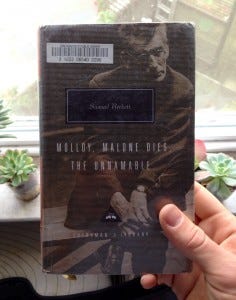
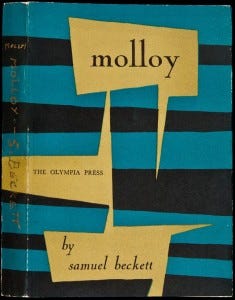
Colin Winnette asked Brian Evenson to suggest a book. Brian picked Molloy by Samuel Beckett. Then they talked about it
Brian Evenson is the author of many books of fiction, most recently the story collection Windeye and the novel Immobility. In 2009 he published the novel Last Days (which won the American Library Association’s RUSA award for Best Horror Novel of the year) and the story collection Fugue State, both of which were on Time Out New York’s top books of 2009. His novel The Open Curtain (Coffee House Press) was a finalist for an Edgar Award and an IHG Award. His work has been translated into French, Italian, Spanish, Japanese and Slovenian. He lives and works in Providence, Rhode Island, where he teaches in Brown University’s Literary Arts Program. Other books include The Wavering Knife (which won the IHG Award for best story collection), Dark Property, and Altmann’s Tongue. He has translated work by Christian Gailly, Jean Frémon, Claro, Jacques Jouet, Eric Chevillard, Manuela Draeger, Antoine Volodine, and others. He is the recipient of three O. Henry Prizes as well as an NEA fellowship.
Colin Winnette: What motivated this recommendation?
Brian Evenson: It’s a book I’m very fond of, and
I tend to think contemporary American fiction would be more interesting if more writers knew <i>Molloy</i>.
I think it’s also a very funny book (though weird humor sometimes) and has some amazing sentences.
CW:How did you first encounter this book? What was your initial reaction, if you can remember?
BE:At the end of my senior year in high school, we had to read Edward Albee’s play Zoo Story for class. In the note in the textbook for that play, it said that if you’d liked Albee you’d probably also like Samuel Beckett. There was a little used bookstore in an industrial area in Provo, Utah and I ended up picking up Beckett’s Endgame there for a dollar. I loved it — still my favorite Beckett play — and that ended up leading me to Beckett’s trilogy (Molloy, Malone Dies, and The Unnamable). I like all three of those books, but Molloy was the one that really blew me away. I was at once intrigued by it and felt like I was missing a lot. I also think that the fact that the first section is just two paragraphs (one a couple of pages long and one about 80 pages long) kept me going: I didn’t feel like I could stop reading until I’d reached the end of a paragraph, and that made for a very strange, anxious experience. I also think its ability to juxtapose two narratives and still work as a whole is really admirable. It was really different than anything else I’d ever read, which may be what kept me going, but I think also when the narrative switches from Molloy to Moran that did something for me and I wanted to keep reading to see how the two narratives would or wouldn’t come together.
CW: What’s your sense of how the Moran section (part II) interacts with the Molloy section (part I)? What’s revealed/complicated?
BE: Well, it’s a discontinuous juxtaposition, one that seems like it’s structured so that the second part will resolve the first part. There are all sorts of gestures made towards that in things said in the Moran section, but as it progresses you begin to realize it’s not going to actually sew up or resolve anything, at least not completely. Instead, it’s almost as if Moran is going through a kind of “Becoming-Molloy” (though that too is discontinuous and not completely parallel). Very little is accomplished by Moran (apart from a death he’s not sure he understands); he returns to where he started from, but that place has fallen apart in his absence just as he too has fallen apart in being absent. And of course the way it ends calls into question everything about the narrative itself and about narrative in general.
CW: Was the connection to Albee profitable (other than motivating you to discover Beckett)?
BE: Not really. I liked Zoo Story and I like the other Albee plays I’ve read or seen, but I feel that Beckett’s a different sort of animal than Albee. But sure, they’re animals that are pretty close evolutionarily even if they’re not the same. I think whoever wrote the notes for the anthology had read Martin Esslin’s The Theater of the Absurd and saw both Beckett and Albee as being part of that tradition. And in any case, I owe Albee a debt for not only changing my idea of what drama could be when I was in high school but also for leading me indirectly to Beckett.
CW: Will you talk a little about Beckett’s apparent obsession with decay, with aging, rot, even mental/psychological decay? Molloy isn’t the only Beckett work that leads you in one direction, only to lose its narrative “trajectory” to decay and stagnance.
BE: I think it’s more than apparent. It has something to do with Beckett’s philosophical notion that we move from the cradle to the grave, that that’s the only direction that anything moves, at least anything organic. As he suggests in Waiting for Godot: We “give birth astride of a grave, the light gleams an instant, then it’s night once more.” We are left each day with a little less — though moments in his work ironize this or call it into question.
Beckett’s about the night, but he’s also about the brief gleam.
CW: How might writers knowing about Molloy make contemporary American fiction more interesting?
BE: I guess what I think — and I’ve talked about this elsewhere — is that there are two very different strands of innovation in American fiction. One can be traced, roughly, back to Joyce (Ulysses in particular) and involves a kind of excessive maximalism and lots of pyrotechnics. David Foster Wallace, for instance (who I admire a lot). There’s a great deal to be admired in that strand, and a lot to be learned from it, but at the same time I feel sometimes like those writers seem like they want to cram the whole world into a paper bag. It’s impressive, in a way, to watch that cramming take place, but what you have in the end often strikes me as being a little too proud of itself, wanting a little too much attention for being virtuosic. The other strand for me is traced back to Beckett and Kafka, who manage to do amazing things with language but also aren’t really interested in being impressive. Those works don’t say “Look at me”; instead they get down to the very serious business of figuring something out, of following and pursuing a line, and then don’t mind cutting out the noise of other things that don’t feel relevant. They’re modest in one way, incisive and deadly in another. I tend to think if more American writers ended up reading Beckett, and Molloy in particular, it’d shift the American sense of what experiment is. I can see it in contemporary French literature — Beckett has had a very positive effect. And then of course there are the non-innovative/non-experimental realms of literature. I think realist writers in particular should be confronted with Molloy’s lack of tidiness.
CW: Are there any contemporary American realist writers who you think have been positively affected by Beckett, or Molloy, in particular?
BE: Hmmmm. Offhand, I can’t really think of any.
I think there are a lot of innovative writers influenced by Beckett but few if any realists.
I think some of those innovative writers might have started as realists, but Beckett’s kind of a gateway drug to places beyond realism.
CW: Do you reread Molloy regularly? How do you approach it? Are you still looking to learn from it?
BE: Yes. I used to reread it once a year; now it’s every few years or so — mainly because I want to forget it enough in between to feel like it’s partly new again. When I was in graduate school I ended up going through the French and English versions and comparing them line by line and wrote an article about the differences and similarities, so I feel like I’ve gone over it more intensively than any other book. When I reread it, it’s like seeing an old friend again, and being reminded of why you’re friends. There are lots of moments I remember from reading to reading, but other moments that I only remember as I’m reading them, and moments which didn’t strike me on an earlier reading that strike me now.
CW: Could you provide a link to that article, for interested folks?
BE: It’s called “Heterotopia and Negativity in Beckett’s Molloy(s)” and was published in Symposium in 1992. You can get to it from that title, though probably need a university library to access the full article.
CW: For those who don’t know, can you talk a little bit about Beckett’s relationship to French? I know he wrote in French, though it wasn’t his first language, and he did so for very particular reasons.
BE: Beckett said he wrote in French “parce qu’en français, c’est plus facile d’écrire sans style” [because in French it’s easier to write without style]. I think you always have a different relationship to your adopted tongue than you do your native tongue, and Beckett felt that writing in French meant stripping away a lot of the stylistic fillips and language games that he was using at the time in English (in writing, for instance his early novel Dream of Fair to Middling Women). It’s a deliberate impoverishment of his syntactic and vocabularic repertoire.
CW: Can you offer some advice for readers interested in Beckett, but who might feel intimidated by this book?
BE: Well, if you can make it through the first two paragraphs, you’re good. After that, you get roughly normal paragraphing. I think it’s a slightly tricky book in that for me a lot of the satisfaction comes from getting through Molloy’s narrative and then entering Moran’s very different narrative, and then starting to make the little connections between the two. The Molloy section deliberately wanders, and gives us very little to hold onto until we get quite far into it. The voice carries us forward, I think, and the obsessions of the narrator, and the idea that it’s a kind of journey, but that’s undercut by Molloy’s own confusion. I think the best way to read Molloy is to relax into it, not worry about whether you’re missing something, and just plunge ahead. The book won’t give answers to some of the questions that it raises (and that more traditional novels would answer) but it gives a lot of satisfactions in terms of what’s going on with language. I think, like Samuel Delany’s Hogg (which is a very different, very extreme book), that there’s going to be the temptation to stop reading, but that if you do you’re not getting the part of the reading that helps you make sense of what you’ve already read. So, persist, don’t worry about what’s significant or not, and just forge ahead.
CW: What are some of the unanswered questions? What’s offered instead?
BE: Why is Molloy in his mother’s room? Who is the man who takes his pages? To what degree is Moran’s story constructed and to what degree is it based/tied to real events? And on and on… What’s offered instead is a lively voice, confusion, humor, and more questions.
CW: Can you talk a little more about the function of obsession in Molloy? For me, Molloy’s obsessive and compulsive behavior compellingly complicates his frequent fatalism. And how might Moran’s deterioration relate?
BE: I think this is something that you find in most of Beckett’s work, not just Molloy, that the obsessiveness and the interest in formulating the world is what drives the work itself. It’s not a tidy sort of directionality, like a 19th century novel plot or a typical story arc, but like little eruptions of obsessiveness. So, in Molloy, suddenly it seems imperative to the narrator to explain his sucking stone system. Or in How It Is there’s a very meticulous outlining of the shape and structure of the world that’s been created and how it all interrelates. It’s an obsession with systematization, which is something that we use to try to control the world around us, to try to make sense of what is difficult to make sense of at all.
CW: In the past, you and I have talked about your love for “…following the articulation of a system or a series of ideas: it doesn’t really matter…how wrong the system or the idea is (or if I know whether it’s wrong or not) as long as I can pursue its development and processing…” Is this interest, on your part, something that drew you to Beckett, or something that developed out of, or alongside, your encounters with his work?
BE: That’s a really good question. I don’t know which came first, but I imagine I responded to it in Beckett because I already had that impulse, that reading Beckett fed something that was already there but buried.
CW: When did you first lock into what appealed to you about what Beckett was doing? Do you remember the moment when you realized this book was going to stick with you?
BE: I think for me I started reading wondering what had happened to Molloy, how he had come to be where he was, and who it was that was having him record his story. That’s a good entry point, and gives a kind of tension that makes you wonder whether his digressions and lack of clarity have something to do with his own suspicions about who his audience is. But, as it progresses, you have to give up at least some of those concerns, slowly realizing you might never have a complete answer. But the offbeat humor is something that gets under your skin slowly. And ultimately for me, by the time we get to the last lines the book has profoundly questioned reality.
CW: The narrative voice is both compelling and destabilizing. As a reader, you’re pulled in two directions at once.
BE: Yes, you are. The voice gives you something to hold onto, but after a while you wonder what it is exactly you’re holding onto. That tension is similar to something Beckett refers to at one point, I can no longer remember where, as the “two-fold vibration.” I like that in that it implies a kind of movement back and forth that strikes me as being more than a tension, and describes for me better the effect it has on the reader.
CW: In many ways, the character of Molloy is a typical Beckett centerpiece. An older, enfeebled figure, attempting a report on his life, while also simply attempting to move (often characters will strain to even lift a leg — I love the description of Molloy riding a bike). It made me suspicious of Moran — a character who, at first, is unlike the majority of characters in the Beckett universe.
BE: Yes, that’s true. Molloy’s a transitional book for Beckett in many regards. For me that’s one of the appeals of it, that it retains something of the structure of a novel at a moment when Beckett is moving past the novel — it’s like it’s the novel’s ghost, I suppose. We feel the way the gestures might go if Beckett were writing at a different time, and he nods toward those gestures and then does what he really wants to do.
CW: There’s something I always wonder, when encountering a hardcore Beckett fan, so I wanted to ask you here, because it seems particularly relevant given your body of work: is death a primary concern of yours? Aging? Decay? I guess I mean personally. How much do these thoughts occupy you, and is work like Beckett’s a balm or an irritant for those concerns?
BE: The Times review of my first story collection pointed out that of the 29 stories in the collection 11 begin with a death in the first paragraph, so I think that yes, it’s likely that there’s an obsession with death for me, at least in my fiction. I don’t think that extends much to my life. I’m not abnormally afraid of death, and not all that scared of aging.
I think there’s a kind of stoicism that comes from growing up in the American West as the descendant of pioneers, where I was raised to just see death and life as two sides of the same coin.
So, I don’t think I’m particularly morbid as a person — most people when they meet me are surprised to find that I’m a fairly gentle, relaxed, happy human — but also don’t think that there’s any reason not to think and write about difficult stuff, partly because they reveal things to us about human experience that might not be revealed by less extreme situations. And yes, for some reason, I do find joy and satisfaction in some of Beckett’s darker moments.
CW: Could you leave us with a passage? Or something to keep in mind?
BE: I love the way Beckett plays with narrative expectation, and the black humor of this book as well. My favorite passage of the novel, which I’ve quoted a few times elsewhere, is “He thrust his hand at me. I have an idea I told him once again to get out of my way. I can still see the hand coming toward me, pallid, opening and closing. As if self-propelled. I do not know what happened then. But a little later, perhaps a long time later, I found him stretched on the ground, his head in a pulp. I am sorry I cannot indicate more clearly how this result was obtained, it would have been something worth reading.”
The acclaimed naturalist started his writing career with a hunting and fishing column in his college newspaper.
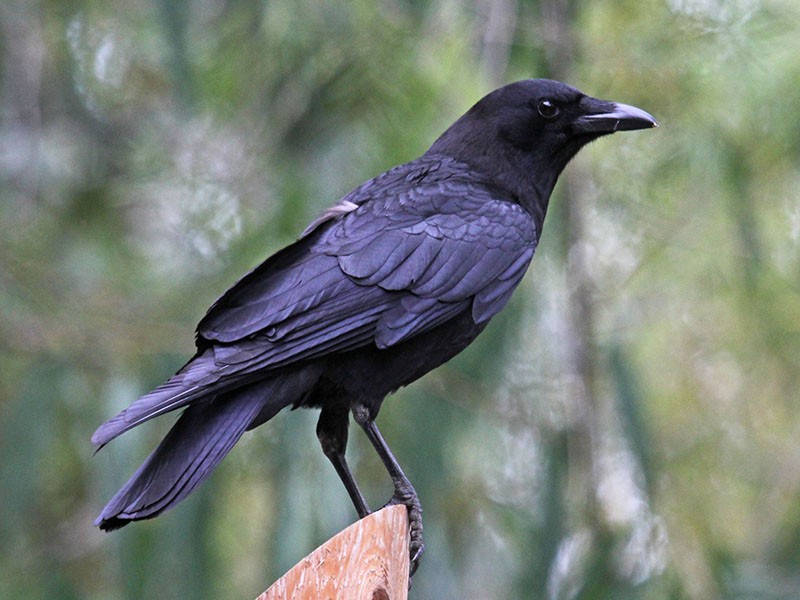
Before Peter Matthiessen chronicled his attempts to capture musk oxen as large as nine hundred pounds in Alaska, and before he narrated his expedition to harpoon narwhals with the Greenlandic Inuit amidst challenges by animal-welfare groups, he wrote about shooting crows near Yale’s campus in New Haven, Conn.
“Cruising along the back roads in an automobile is not only the most comfortable, but the most efficient way of locating the crow,” he wrote
with friend John N. Cole in a 1947 issue of the Yale Daily News. “Make sure the cover chosen is not so dense that it prohibits rapid gun handling, for swift shooting will be necessary.”
Matthiessen succumbed to leukemia in April. Up until his death, he was well-known among literati and environmentalists. A short list of his descriptors reads like a mass-market paperback thriller: novelist, naturalist, CIA agent, Zen Buddhist priest, and founding editor of The Paris Review. He can be seen in the new film Plimpton! Starring George Plimpton as Himself, which debuted this month on PBS, and one of his last interviews was conducted by Ron Rosenbaum for Smithsonian Magazine. The former showcases his boyhood friendship with Review editor George Plimpton, and the Smithsonian interview focuses on Matthiessen’s lifelong vocation to understand the natural world through his writing. “I can’t find a single thing in nature where one animal, on purpose, tortures or is cruel,” he says. “But human beings can be cruel, especially cruel to their own kind. Why?”
Prior to his writing career, Matthiessen served in the U.S. Navy during World War II and then enrolled at Yale. There, he met Cole, an enthusiastic outdoorsman from Maine who became his writing buddy and later, his business partner in professional fishing and charter boat ventures. “At New Haven…I was an English major (with a strong side interest in zoology and ornithology courses at the Peabody Museum) and I co-wrote a hunting-fishing column for the Yale Daily News,” Matthiessen once noted. In addition to his studies, many hours spent outdoors, and nights drinking dry martinis at the Fence Club, Matthiessen published eight columns with Cole in 1947, all while claiming that he “never made the most of my Yale years.”
Two years before Matthiessen’s roommate Thomas H. Guinzburg became managing editor of the Yale Daily News under chairman William F. Buckley, Jr. (the same Buckley that founded the conservative magazine National Review in 1955), Matthiessen and Cole presented their undertaking to the newspaper’s readers in the first “Two in the Bush” column on October 9, 1947:
Over the course of the year, we shall attempt to deal with the possibilities and seasons for local hunting and fishing. The purpose of the column is to acquaint the reader with field sports within striking distance of New Haven and to comment more or less informatively upon facilities and methods for enjoying them.
The two college students, who later celebrated careers as writers and naturalists (Cole founded Maine Times, and Matthiessen won three National Book Awards), wrote about using owl decoys to hunt hawks in one of the first, if not the first, pieces of published writing from either of them. “The best investment, we think, is a stuffed bird, usually a Great Horned Owl, which retails for around $25.00,” they wrote. “Abercrombie’s for one, turns out a large dignified specimen of a supercilious demeanor calculated to infuriate any right thinking hawk.” (Abercrombie & Fitch, a company that now sells clothing for teenagers, existed previously as an upscale purveyor of sporting goods.)
Matthiessen and Cole’s humorous anthropomorphism characterized their columns and transformed often dry and callous writing about killing animals into what they believed these types of outings should be — encounters between clever, manipulative creatures whose ultimate goal was to outwit each other. “Grouse will run a little if they feel such a procedure to be necessary, but are more apt to wait until you have passed before taking off the other way,” they wrote. “[B]e careful to mark the point where they fall, whether dead or cripple; upland birds get increasingly elusive with age, up to and after death.”
Their columns also leave meaningful vestiges of traditional “sporting,” whose demise Matthiessen lamented with similar humanizing techniques and greater intensity as he grew older. “One of the turtles winked at me lugubriously, and both of us released a doleful sigh,” he noted while hunting green turtles near the Cayman Islands, an experience that served as the basis for his fifth novel, Far Tortuga. This book, along with his other longer works, displays Matthiessen’s thematic evolution from youthful and playful bird hunting to the cruelty of humans toward other animals. “[S]ad, weary sounds, along with the ‘tears’ of lubricating fluid that squeezed regularly from the turtles’ eyes, went unnoticed by the crew,” he continued. “[O]ne turtle lay next to where I slept on the deck…it’s eye not three feet from my own.”
Eyes captivated Matthiessen. His writings illuminate how these organs serve as an entry point for empathy between humans and nonhumans.
Robert Stone wrote in his New York Timesreview of Far Tortuga, “[T]he reader senses that the narrative itself is the recapitulation of a cosmic process, as though the author has sought to link his storytelling with the eye of creation.” Matthiessen had been telling stories since the beginning of his writing career with this eye, and with the many more he encountered during his travels. While hunting crows around New Haven from a car, he and Cole learned that a “crow’s wisdom is exceeded only by the keenness of his vision, and if you are observed slinking to the blind no amount of calling will bring any reaction but derision from your quarry.” Matthiessen likely never dreamt that his literary, activist, and environmentalist contributions over the past eighty-six years would bring him closer to this “sinister bird” than any camouflaged blind, or automobile, ever could.
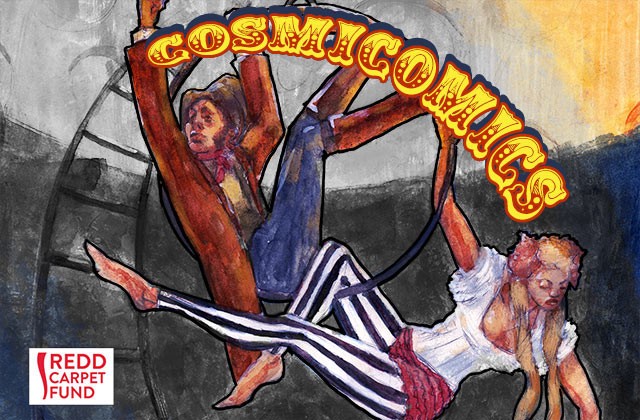
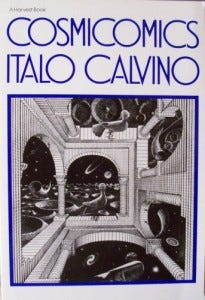
Have you ever wanted to see your favorite short story collection in aerial circus form? Well, if you live near Austin, Texas, you can head on over to the Long Center for “an aerial theatre production of COSMICOMICS, adapted from Italo Calvino’s beloved collection of short stories.”
I can’t say that I’ve seen an aerial circus adaptation of anything, much less a short story collection. But Cosmicomics is a truly fantastic collection of fabulist science fiction stories — which I’d highly recommend — so this might be worth checking out. Runs from June 21st to 29th.
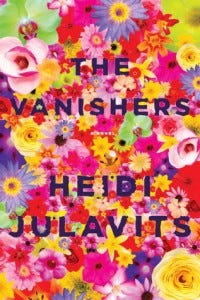
This phrase from a friend once stuck in my mind describing how women are cruel to each other: “girl-on-girl violence.” It implies, on the one hand, that women can wound just as much if not more than the most violent men, and yet on another that they are above it, that cruelty reduces them to middle-school girlhood and that in a society that tells them to smile, what to do with their bodies, they owe it to each other to be basically decent — collegial, if they can stand it (the friend was female, by the way). Heidi Julavits’ 4th novel The Vanishers (2013)simultaneously attempts to decipher the rulebook of female cruelty and explode it by setting her own unique tale of “girl-on-girl violence” at the Institute of Integrated Parapsychology — aka the Workshop — a sort of Deep Springs for spiritual mediums in rural New Hampshire. Here Julia Severn, a psychic prodigy, falls afoul of house mother Madame Ackerman and, in the wake of a devastating psychic attack that makes Julia’s gums bleed, her fingernails snap, her scalp chafe and her bowels rebel, Julia flees to Manhattan. There Julia becomes embroiled in the search for a missing avant-garde filmmaker named Dominique Varga, which leads her on a madcap and frequently uncanny quest through dueling milieux of plastic surgery-enthusiasts, vanishing cults, schizophrenics and a Hungarian skin-care heiress. But where does the ghost enter in, you might ask? In the tragic exemplar of Julia’s mother, who Sylvia-Plath-ed herself into the ether when Julia was just a girl (the poet and her suicide become a motif throughout the novel) and appears to be somehow related to Varga. Our hero has meanwhile begun to receive a series of spectrally threatening emails — “a blob of clockwise-spinning fog, inside of which I could occasionally discern the shape of a woman lying motionless in a bed.” These ghost-in-the-machine missives are coming from someone called only “aconcernedfriend,” whom Julia at first assumes is Madame Ackerman — or someone privy, anyway, to the soul-crushing way that her mother checked out. (Where Plath used the oven, Julia’s swallowed pills). This haunting and dissociated mother/daughter relationship is what lies at the core of Julavits’ novel, which locates itself by and large among women. Radiating out like waves from the dark astral limbo that Julia visits in her psychic “regressions” are various other female pairings (mentor and protégé, friend and friend, a woman’s kinship with herself).
<em>The Vanishers </em>brilliantly subverts both the web-work detective novel and the metaphysical ghost story in having its veils of supernatural mystery fall away on nothing less than a mother’s troubled love for her daughter, and vice-versa.
In embracing ghost story tropes amidst a largely female milieu, the novel suggests a substratum of real, harmful chaos beneath the cat scratching and bless-your-heart manners American culture attributes to women, more smartly brought off for the signature fact that Julavits’ mediums are anything but passive as the 19th and 20th centuries have them (e.g. a woman is to spirits as a tampon is to blood), but actively nasty and unwisely fucked with. The ghost gets busted in the end, but never in the way you’d think.
THE TORSO: Portishead’s Portishead (1997)
What better record to underscore The Vanishers’ substratum of female chaos than the British band Portishead’s sophomore outing Portishead (1997). Widely classed in with the mid-to-late 90’s phenomenon of trip-hop alongside Tricky and Massive Attack, Portishead, fronted by vocalist Beth Gibbons, has also been described as “Gothic hip-hop” or “musique noire for a movie not yet made.” You need look no further than the album’s second track “All Mine” (also released as a single) for confirmation, in which a big-stepping, Dick Tracy-esque horn section with a mournful undercurrent of string instruments punctuated by shudders of deep bass is subsumed by a massively twanging ascension of guitar. Over the course of some very impressive (yet never straining) vocal spikes and declivities, Gibbons sings: “All the stars may shine bright/ All the clouds may be white/ But when you smile/ Ohh how I feel so good/ That I can hardly wait/ To hold you/ Enfold you/ Never enough/ Render your heart to me/ All mine…/ You have to be.” Sure, the lyrics could be and most likely are the musical equivalent of a magazine-cutout stalker’s paean to some former lover (if I can’t have you no one will); but even so they might, too, signal the fallout from a female friendship gone awry or a mother’s unbounded and terrible love. Gibbons has the voice of some malign songbird or a spirit in limbo, beseeching the living. A few of the songs on Portishead (most notably “Cowboys,” “Over” and “Elysium”) could go on to score Julia Severn’s astral projections in The Vanishers, in which she wanders the halls of a “bluestone” building “varicrosed by dead ivy” and encounters a spirit wolf named Fenrir,with eerie perfection. Portishead’s musical arrangements — a mixture of nightclub orchestra, beat-box minimalism and a record player repeating itself in the ballroom of a haunted mansion — are painfully crisp at first, even over-produced, only to succumb to guitar-swirling and record-scratching entropy as the tracks progress.
If there’s a ghost in <em>Portishead</em>, then it’s the ghost of thwarted love.
The album takes shape as an anguished attempt to reckon with the fact that even when love has died in the mind of the love object — or never lived there to begin with — it will never succumb in the mind of the lover. It struggles, haunted, hapless, on.
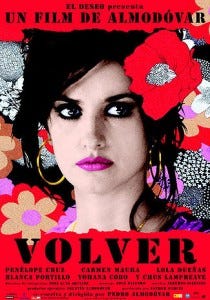
THE LEGS: Volver dir. Pedro Almodóvar (2006)
Where The Vanishers and Portishead envelope us in spectral fog, Pedro Almodóvar’s film Volver (2006) adopts a more concrete approach — say, a fog machine that breaks down and stutters every few minutes to reveal to us our beautiful and mundane surroundings. Although Volver also has undertones of noir and the supernatural (as do many of Almodóvar’s movies — see Bad Education (2004) and The Skin I Live In (2011), respectively) and although it, too, like The Vanishers is a clever subversion of the ghost story, Volver utilizes an almost completely female cast led by Penèlope Cruz and Lola Dueñas to tell the far more earthbound story of three generations of Spanish women. Switching back and forth between Madrid and the fictional wind-swept village of Alcanfor de la Infantas (translates: “Camphor of the Princesses”), the film follows Raimunda (Penèlope Cruz), her teenage daughter Paula (Yohana Cobo), Raimunda’s sister Sole (Lola Dueñas) and Sole and Raimunda’s mother Irene (Carmen Maura), who has died in a fire three years previous to when the movie begins but whose remarkably chatty and un-charred corpse begins to appear to various members of the family when they return to Alcanfor for the funeral of their beloved Tía Paula. Almodóvar is a phenomenally talented and poetic filmmaker. Several early scenes in the film are nothing short of astounding, including a high-angle shot at Aunt Paula’s wake that has dozens of black-clad biddies clutching at Sole while muttering their condolences which achieves an unlikely harmony between poignancy and claustrophobia. Speaking of those old Spanish women in mourning garb, they’re just the tip of the coffin when it comes to female presence in the film. All of the principals are women and damn fine actresses into the bargain, especially Cruz — Almodóvar, in many ways the anti-Hitchcock Hitchcock, clearly reveres women and has always managed to elicit career-making performances from them — and apart from a few ancillary characters or characters who are some iteration of absent or dead, there is hardly a man to be found in Volver. Indeed, the early murder and concealment of a particularly nasty male specimen comes to seem as inconsequential after a certain point as the character himself as the film draws focus more and more on the relationships among the women. Raimunda’s mother continues to haunt, hiding underneath beds, in car-trunks, in spare rooms. You begin to suspect that what she is is far more frightening than a ghost: a dispossessed person who suffers and loves and needs her daughters more than ever. It’s a curiously suspenseful and innovative use of magical realist tropes by Almodóvar — black comedy leavened by wrenching tenderness. And while Volver is gentler in its harnessing of female chaos than either The Vanishers or Portishead, its principle players don’t always play nice. In a kitchen scene between Raimunda and her estranged ghost-mother Irene, Irene asks: “Have you always had such a big chest?” to which Raimunda answers with pained incredulity: “Yes, since I was little.” Irene’s response: “I remembered you having less. Have you had anything done?” As Raimunda attempts to confront her own troubled past while shielding her already-far-from-innocent daughter from the world’s utmost cruelties, family secrets emerge, alliances are made, broken and repaired among the sisters and the Márquezian winds of Alcanfor de las Infantas continue to blow. When Paula’s ghost gets exorcised, it’s a quiet and world-weary moment for all, suggesting at last that the stygian realm underlying the bedrock of female relations isn’t chaotic so much as just grasping.
What the supernaturalism of <em>The Vanishers, Portishead </em>and <em>Volver </em>seem to be saying is that when women (and by extension all humans) treat each other badly or underhandedly there is always something far more rarified and mysterious at work: people trying, clumsily, to bare to each other their unquiet souls.
Alternative Cuts:
(Big Machine by Victor LaValle (2009); Tricky’s Maxinquay (1995); Dark City dir. Alex Proyas (1998))
(The Innkeepers dir. Ti West (2011); Ghost B.C.’s Opus Eponymous (2010); The Haunting of Hill House by Shirley Jackson (1959))
(Beloved by Toni Morrison (1987); The Best of Billie Holiday: 20th Century Masters (2002); Kara Walker’s Gone: An Historical Romance of a Civil War as It Occurred b’tween the Dusky Thighs of One Young Negress and Her Heart (1994))(Ju-On dir. Takashi Shimizu (2002); Revenge: Eleven Dark Tales by Yoko Ogawa (2013); Boris’ Amplifier Worship (1998))
Bald New World is sort of like a Haruki Murakami novel set in a future reminiscent of Neal Stephenson’s Snow Crash… where everyone is bald. At the same time, it’s really nothing like that. The debut novel from Peter Tieryas Liu, this book is a complete original, and always fun to read. It’s a very strange book with a lot of heart, with a strong eye for both character and narrative, and overflowing with great ideas.
The focus of the novel is on two friends: Larry Chao, a talented but obscure filmmaker who also happens to own the biggest wig company in a world with no hair; and the narrator Nick Guan, Larry’s best friend and professional cameraman. It’s a story equally about their friendship and their world — one where it’s impossible to go outside in LA without body armor and the most popular show is about Jesus killing people as a war hero.
In the tradition of Huxley’s <em>Brave New World, it’s</em> a place seething with capitalism
, where everything is artificial and everything can be sold… but especially hair.
The first act takes us through both China and the warzone of the United States, as Nick and Larry become involved with a pair of beautiful North Korean spies. There’s a relaxed pace to the early novel that brings the reader smoothly into the world, with details that tend to be funny as often as they’re grotesque. The slower pace also leaves lots of space for the characters to breathe, and really brings the friendship between Larry and Nick to life. Unlike Nick, Larry is a compulsive womanizer and sort of cartoonish guy (who I imagine looking like a younger version of Ah Ping from Wong Kar Wai’s In the Mood for Love), which ultimately causes problems for both of them. When Larry’s wig company is attacked — presumably by a rival wig company — and Nick is abducted, it sets in motion a chain of events that involves religious fanatics, fighting crickets, murderous butlers, genetic experiments, and all ends with a crowd of naked people in LA.
If the early novel is about Larry, the rest is about Nick. One of the most interesting narrators in recent fiction, Nick is a survivor of abuse from a low-income family, overcoming psychological damage that ultimately ruined his marriage; a veteran of “The African wars”; and distinguished cricket fighter. Bald New World is an ambitious book despite being fairly short, but it’s also one that might have been potentially alienating. Especially with how strange things get at times, having such a strong narrator holds the book together. Nick is intensely human and relatable, and ultimately his character might be the strongest element of the book.
As a first novel, there are some growing pains — particularly the shifts in the pacing, and a certain episodic feel to parts of the narrative. Around the middle there’s a shift that might alienate certain readers, where the book suddenly becomes a high-octane romp. The two halves do feel very separate from each other, but the transition is natural (or, to try to avoid spoilers, jarring in the best possible way). The book ends in a place very different from where it began, but it’s a great journey getting there, and seeing it transform is part of the fun.
On some level <em>Bald New World</em> functions as a gallery of images and ideas, but deeply rooted in both character and narrative.
Unlike Watering Heaven, Tieryas’s debut collection (which drew heavily on magical realism and Chinese mythology), Bald New World is a science fiction novel with heavy elements of satire taken to the point of absurdism. There are also tons of easter eggs for anyone familiar with video games and the Romance of the Three Kingdoms, plus a torture scene worthy of Ian Banks. Noticeably though, there’s a tonal difference from most SF, as Tieryas’ style still has all the emotional resonance of Watering Heaven, and the book is extremely friendly to people who don’t read science fiction often.
Here’s a rad video by Ilana Simons about the great Japanese author Haruki Murakami. Simons is the author of A Life of One’s Own: A Guide to Better Living through the Work and Wisdom of Virginia Woolf (Penguin, 2007) and curates Tin House Reels.
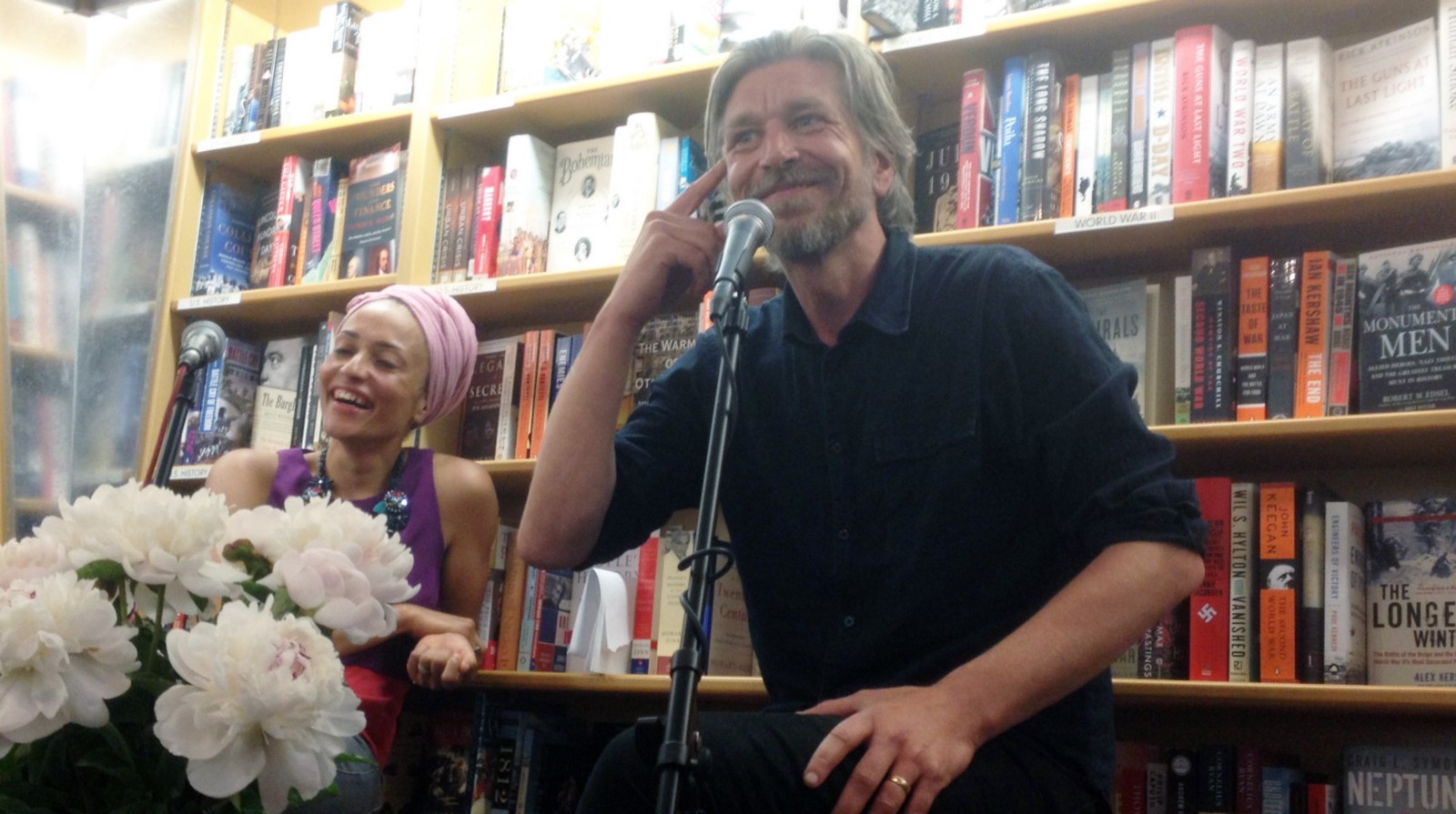
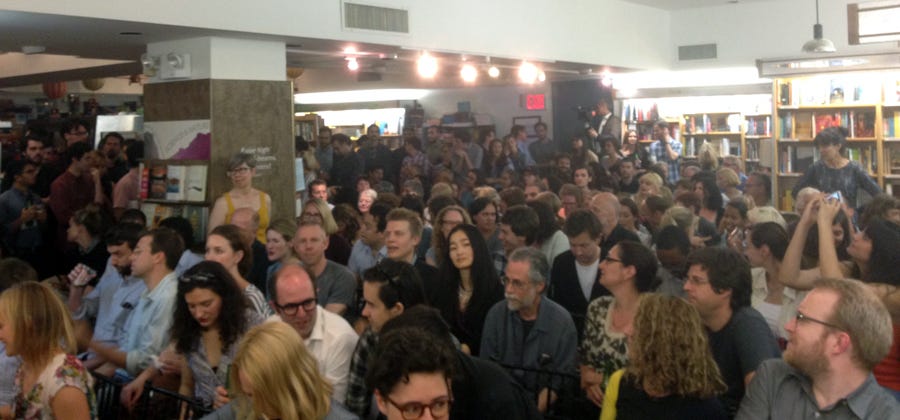
The first thing I noticed was the line, which snaked out the front door of McNally Jackson Books in Manhattan, coiled down Mulberry Street, and ended somewhere halfway down the block. After the event, I overheard Sarah McNally, the bookshop’s owner, estimate between 300 and 400 attendees, the most they had ever had for an author event. The reading, she said, also held the distinction of being the first one to be held in the basement while simultaneously live-streamed to the café on the ground floor of the two-floor bookshop.
I had expected a crowd — there had recently been, among many other articles and reviews, a profile in Time magazine under the headline “Norway’s Proust” and a series of New York Times articles, one referencing the surprising popularity of Knausgaard’s six-volume, 3,600-page autobiographical novel My Struggle, describing it as a “movement” — but I hadn’t expected something to this extent, mostly because this kind of thing never happened at literary events, and even less so for an international author in translation making a bookstore appearance. The event, billed as a “book three launch party with Karl Ove Knausgaard and Zadie Smith,” was scheduled to start at 7 PM with, according to the bookstore’s website, “doors open at 6 PM,” as though it were a rock concert.
“We’ve been waiting since 4:30,” said Kelsey Ford, the permissions editor at New Directions, who stood maybe fifty people from the front of the line, far enough away as to be invisible from where we were standing, like some promised land to which we could only be admitted after proving ourselves worthy, a thing that could — or, depending on your place in line, could very possibly not — happen.
Toward the end of the line, I saw Anelise Chen, a writer I know, who said she’d been waiting since six or so.
“How much have you read?” I asked, and she answered, “Just the first and second books” — <em>just</em> meaning, roughly, one thousand pages.
“What is it about Knausgaard?” I asked, curious.
“I don’t know,” said Anelise. “It’s bizarre and a little unreadable. But also completely brilliant.” Her assessment reminded me of poet and autobiographical novelist Ben Lerner’s smart review in the London Review of Books that described My Struggle as, essentially, “boring,” unexcerptable — and “a work of genius.”
I recalled the week before, having run into Michael H. Miller, a culture reporter at the New York Observer, and the writer Tao Lin in the crowded hallway of New Directions’ annual BEA office party. I asked Tao, the author of several autobiographically-driven — Knausgaardian, you could say — novels, whether he had read much Knausgaard and he answered something along the lines of having “read five pages or so” and then feeling “tired.” He noted, with some amusement, that he had two copies of book one, as though they had appeared in his possession through no conscious effort — or desire — of his own.
“You should read it so you can write about it and pan it,” suggested Michael, provocatively, and two weeks later, Tao would write about it, or close to it, an article for the Observer about attending this same event, not panning it but expressing, instead, deep, sustained interest in the conversation, as well as fascination at the spectacle. Had Tao been convinced, as I would be, by attending the event, by hearing Knausgaard’s “soothing and calm” voice, by observing his “intensely focused” and nearly unblinking blue eyes, his “sensitive” and “paradoxical” way? Maybe Tao had earlier been making a joke about not reading it, or, perhaps more likely, had decided to give the tome another chance, finding himself, like so many others — myself included — amazed, wholly entranced: another convert into the cult of Karl.
I had told Michael and Tao that a journalist from Time had recently been over to Knausgaard’s house in Sweden and brought along with her a crew of something like twenty-four people — camera, lighting, the whole deal.
“Maybe when book six comes out,” I said to Tao, “they could put him on the cover with the headline, ‘His Struggle’ — surviving the fallout from your negative review.” I exited the conversation before revealing how little I, myself, had read of Knausgaard’s work, a couple pages about a high-school incident, a well-hung classmate, and a female gym teacher that had been excerpted in the New Yorker, and which I remember enjoying but had not bothered to finish, for the same reason there are so many things we enjoy but never finish — perhaps because of that reason, too.
Down in the basement of the bookstore, people were finding their seats, deciding for or against last-minute trips to the bathroom. “I’ve been waiting since four,” admitted a heavyset, white-mustached man in line for free drinks provided, I had been told, by the Norwegian Consulate, cosponsors of the event. “You must be a big fan then,” I said. “I’m a big fan of Zadie Smith’s, but I haven’t read Karl’s work,” said the man, who appeared to be in his fifties and, to my view, a casual reader, someone outside the scene. Perhaps this could explain why, despite not having read a page of the work, the man felt comfortable enough referring to Knausgaard by his first name only, as one would a friend? Or maybe it was because he did not want to be heard mispronouncing an unusual, unfamiliar last name — an outsider who didn’t want to give himself away.
In the front row, Danielle Peterson Searls, a carpet specialist at Christie’s, seated herself in the folding chair next to mine. “I’m something of a super-fan,” she admitted, saying she had been waiting in line since 5 PM or so. She told me she had been to the event the night before, in Park Slope, at Community Bookstore, and was planning on attending the next one too, a sold-out event at the New York Public Library the following evening that she and her husband, Damion, whom I knew as a prominent translator and Proust scholar — and who, she told me, wasn’t so much a fan of Knausgaard — would to get her attend. What was it, I asked, that drew her so strongly to the writer’s work? She referred to something Knausgaard himself had posited at the bookstore the night before, of a kind of intimacy that readers felt with him as the author, a relationship-like quality, that you got to know the book and its author so well — better than anyone you knew in your actual life, even yourself.
She added, “When I start reading, I miss my stop every time.”
I mentioned meeting the man in the free-drinks line who had been waiting since four and yet who hadn’t read a word of Knausgaard’s, and Danielle told of a woman in front of her in line who, over the course of two hours, allowed no less than ten of her friends to cut in line. She recalled feeling angered less by the cutting, but more their unworthiness to attend, when so many true followers like herself were at risk of getting shut out. “It’s amazing how many Zadie fans there were in line who didn’t know Knausgaard’s work,” she related.
“Someone was asked, ‘What are you in line for?’ and they were like, ‘I don’t know, some Norwegian guy.’”
Behind us I spotted London Review of Books editor Christian Lorentzen, who had recently reviewed book three for Slate, referring to it as “narcissistic, indiscreet, and a remarkable work of art.” I asked Christian if he had edited the Ben Lerner piece on Knausgaard, and he said that he had. After a few minutes of more waiting, he glanced around the crowd with an expression of amused disbelief.
“Is he like Axl Rose or something?” he wondered aloud.
“Maybe he’s like Thomas Pynchon,” I offered.
“If this was for Thomas Pynchon, I’d be in your seat,” said Christian, referring to my folding chair, front and center, especially reserved for press members.
During a lull I mentioned to Christian the white-mustached man who had been waiting since 4 PM.
“It’s not like he couldn’t see Zadie all the time,” Christian replied. “He could go into the bar down the street and see her there. Well, not the bar down the street, but somewhere. It’s not like she doesn’t do things.”
Introducing the event was bookstore owner Sarah McNally, whom I had earlier seen standing in the front area of the room for a few minutes without speaking to anyone, just waiting there quietly. She mentioned how, following the conversation between Knausgaard and Zadie Smith, there would be two lines to get your books signed — one beginning downstairs, one beginning upstairs — both converging at a table where, beside stacks of his hardcovers, Knausgaard would be seated, receiving his audience like a kind of literary guru or king-figure.
After the conversation, on line for the bathroom, I met a Norwegian woman with very blond hair and a wispily bearded man who had taken a bus from a small city in Pennsylvania to attend the reading. A friend of the man’s had recommended the event to him and, bizarrely, he had taken that friend’s recommendation of a pilgrimage — two hours on the bus, three hours in line — to hear this Nordic author whom he had never before read.
“Why do you think there’s been such an interest?” the blue-blazered Zenia Chrysostomidis of the Royal Norwegian Consulate General asked a group of us as the crowd was thinning out. The question seemed both sincere and utilitarian: if one could with any knowledge determine which books American readers preferred, and why, one could better achieve the objective of promoting Norwegian interests abroad. We were standing, it occurred to me, within a small circle of Norwegian journalists, a Norwegian photographer, and a Norwegian literary critic, and I noticed the consul had posed her question to the group, but primarily directed it at me, due, I imagine, to my status as the lone American in the circle.
She was, in short, asking the same question I had been asking all night long: <em>Why? Why all this?</em>
“Well, that’s what I’m trying to find out,” I said, not having read the books yet knowing suddenly, instinctively, that there was where our answer was.
It must be summer because indie presses are opening up their inboxes as if to say, “Come one, come all.” A number of well-respected presses have opened up unsolicited submissions in what has become an open season for authors seeking a home in the months and years to follow. I’m counting at least six indies seeking your work.
What are you waiting for?
It’s summer; let’s get submitting.
Civil Coping Mechanisms will begin their second Mainline contest. For one week, entries are encouraged and will be read upon receipt. The top five ranking manuscripts are announced at the end of every day. On the seventh day, the winner is announced alongside honorable mentions. It’s a veritable reality TV show broadcast via social media. Mainline begins June 23rd, 2014. At that time, entries can be sent to ccmmainline@gmail.com.
Caketrain has opened up submissions for its annual competition. Judged by Peter Markus, entries placed between now and October 1st, will be eligible for consideration of publication in Caketrain’s renown catalog, which consists of authors like Sarah Rose Etter, Ben Mirov, AT Grant, and Ryan Call. If interested, follow this link to enter.
Publishing Genius’s Adam Robinson has been one of the best literary citizens since the dawn of his then fledgling press. Since then, Publishing Genius has given birth to Everyday Genius, a daily journal of fiction and poetry, alongside publishing authors like Shane Jones, Melissa Broder, Mike Young, Gabe Durhan, Spencer Madsen, and more. Publishing Genius has opened up submissions for full-length manuscripts through June 30th. If interested, click here.
That’s right, Black Ocean is open for submissions throughout the month of June. This is the same Black Ocean that has published authors like Zachary Schomburg, Elsa Gabbert, Aase Berg, and Rauan Klassnik. Typically limited to select manuscripts throughout the year, Black Ocean is open, waiting for your latest, your best. This is truly an opportunity. If interested, click here to submit.
Brooklyn Arts Press is devoted to publishing poetry books, lyrical fiction, short fiction, novels, chapbooks, art monographs, essays, translations, & nonfiction by emerging artists. These artists have included Bill Rasmovicz, Paige Taggart, and Heather Morgan, and your name could be in the mix if you send your manuscript. Brooklyn Arts submissions are open throughout the month of June.
One of the spunkiest presses this side of alt lit, Plain Wrap Press is open to submissions throughout the months of June and July. Plain Wrap has published some of the best in the budding world of online-centric literature; with names such as Janey Smith, Matthew Sherling, Kalliopi Mathios, and Andrea Kneeland, nothing is considered “too different” and “too weird” for this press.
Les Figues Press has opened up submissions for their 2014 edition of NOS (not otherwise specified) Contest. Judged by Fanny Howe, the contest, as well as the press-at-large, is known for publishing some of the best in experimental forms. The contest is open for submissions throughout the summer, ending on September 15th so get those manuscripts in order and click here to submit.
Sign up for our newsletter to get submission announcements and stay on top of our best work.
YOUR INBOX IS LIT
Enjoy strange, diverting work from The Commuter on Mondays, absorbing fiction from Recommended Reading on Wednesdays, and a roundup of our best work of the week on Fridays. Personalize your subscription preferences here.