THE WRITING LIFE: Optimizing Revision

All published writers are alike; every unpublished writer is unpublished in her own way.

Or maybe not. Most unpublished writers — assuming they actively want to find a readership for their work — are unpublished for one of a few reasons.

First, there are writers who are truly bad. I don’t believe in objective taste, so what I really mean is there are writers who are truly clueless. They have no idea how far off they are from the kind of writing that gets published, and so they probably never will be.

Then, there are writers who are good — you could call it a talent for writing, or you could say they have a talent for emulating writing that meets our current standards for “good” — who just haven’t put in the time yet. They’re in a pre-published state, but if they continue to work (reading, making connections, finding their markets) they’ll eventually be published.

Then there is the broad middle — writers who are pretty good, or almost good, but stuck. Often, they are willing to work — they take classes, they seek out mentors, they profess a desire to edit their manuscripts into publishable shape. The problem is, they’re doing the wrong kind of work. They’ve heard stories about some famous writer, like Robert Lowell, tinkering with his poems even after they were published in books, changing a word or a line break or a comma, and they think that’s what revision is. That is not what revision is, and this is why their work is not getting appreciably better.

An Analogy from the Seedy World of Marketing

My day job is in content marketing (and it’s doubly/meta seedy, because the product in question is marketing software). I recently had an epiphany about revision based on an excellent, if somewhat sensationalist marketing presentation that my boss did called “Everything You Know About Conversion Rate Optimization Is Wrong.”

First, let me explain what conversion rate optimization is. If you have some kind of transactional website, like an e-commerce site to sell small-press novels, or a SaaS platform where you try to get people to sign up for a free trial of your software, the page where those transactions happen (or don’t) is called a landing page. And since your success as a business more or less depends on how many people you can get to “convert” on that landing page (i.e., buy the book or sign up for the free trial), businesses usually attempt to optimize their conversion rates through various tests. A high conversion rate translates to a high percentage of your site’s visitors converting into a customer or lead.

A lot of the “best practices” and received wisdom around conversion rate optimization have to do with tests that are designed to hack your potential customer’s psychology. Some of these tests involve visual elements on the page, such as the shape, color, size, or location of the button your visitor needs to click to complete the conversion process. Others involve copy, like the main heading on the page or the “call to action” (the words on the button, such as “Add to Cart” or “Start My Free Trial”). Is longer or shorter better? Do exclamation points help? What if you put a big yellow arrow on the page, pointing to the button? Et cetera, et cetera. The idea is that you can eke a few more conversions out of the same number of visitors with these tricks that make your page more persuasive or frictionless.

My boss’s presentation drew from data and tests to make a case that this whole approach to conversion rate optimization is wrong-headed. Basically, he said, stop futzing around with the button color — you can only make small incremental gains that way, and many of those apparent gains are illusory anyway (due to statistical insignificance, for example). If you really want to improve your conversion rate, you need to make radical changes. For example, change the offer: Maybe it’s not that people aren’t buying the book because your button is the wrong shade of green, but because nobody wants that book.

This isn’t to say that it’s not worth testing the button color. You can mess around with that level of testing once you know for sure that people actually want what you’re peddling.

Everything You Know About Revision Is Wrong

So here’s my theory: Revision works the same way. For the same reason that most businesses fail slowly — by focusing on small details instead of the big picture — most writers can’t get their work better than a certain level of passable mediocrity because they’re optimizing the small stuff before they hit on a project that’s worth optimizing. They approach revision through tinkering and line edits, trying to improve the poem with different enjambment on line 3 or changing “blue” to “cerulean.” But those small edits can only make a poem or a novel or a memoir 1–5% better. A radical revision that completely rethinks the form or concept or scope or flow could make it twice as good.

Of course, this theory doesn’t apply only to unpublished writers. Any writer has the chance to make any project dramatically better through a complete re-envisioning of the project. George Saunders was reportedly stuck on the story “Sea Oak” for a long time until he decided to change the whole ending and make the aunt come back as a zombie. Maggie Nelson wasn’t happy with Bluets until she decided to abandon the form of poetry completely and write it as a series of numbered paragraphs.

Remember, though, that any revision is a kind of test. Completely redesigning your landing page could very well tank your results, and the same is true of revision. This is why I always recommend doing revisions in a new file — don’t kill your first-version darling, just tuck it away where it can be recovered. Revisions, like theories, are only worthwhile if they can fail.

Patterns

The three men I’ve bitten arms off of are doing well. I felt guilty for many years. I was afraid I had completely ruined their lives. Of course it must have been difficult for them. But a physical disability doesn’t have to make anyone unhappy. If a person has a great will to live, he’ll recover from the very greatest traumas.

At times I was quite wild when I was young. I generally managed to keep myself under control in the daytime, but at night I could be a real ferocious beast. My first husband was a very gentle, sensitive man. In the mornings he made thin pancakes fried golden brown in butter and poured coffee mixed with frothed milk into my blue earthenware mug. One morning he just couldn’t wait for me to get up. The pancakes were ready and the coffee getting cold. He sat down softly on the edge of my bed and slid his left hand caressingly over my long, soft hair, shoulders, and back. I woke with a start. A wild rage came over me. I pounced on to his upper arm and before I understood what I was doing, I had bitten his whole arm off.

When we filed the divorce papers, I cried bitterly. “You could at least have snarled… ” he said as he was leaving. “That you suddenly, just like that… ”

Jaan is now married to a frail actress. She certainly won’t ever bite him. Jaan works at the automobile museum. At open-air events he earns good money with his artificial arm. He sits next to the driver in open Benzes and De Dion Boutons and points the way, controlling his arm by means of a control panel. In the evening a little light flashes in his arm as well.

Tourists photograph him like mad and Jaan is a made man all over town.

I had therapy for two years and then had the courage to get married again. My second husband’s name was also Jaan. We joked that he must be a hard man indeed to take me to be his wife. And himself a discus thrower and the great Olympic hope of the entire nation. It happened already on our wedding night.

As I was expecting a child, I suddenly felt a great tiredness in the midst of all the wedding hubbub. Suddenly I just couldn’t dance anymore or sit at the table either. I staggered through the rooms of the hunting lodge we had hired for our wedding reception and climbed the stairs. Jaan was still busy with our guests and an hour later he followed me up to our bedroom. He pushed aside the heavy, white brocade curtains of the canopy bed, kissed me passionately on my half-open lips, opened the hooks on the front of my wedding dress, lay down beside me on the bed and put his right arm under my neck. I felt his gigantic, rapidly twitching muscle. Rage struck me like a thunderbolt. Just as lightning rends a tree with one blow, I had, in a fraction of a second, shattered our people’s Olympic hopes. Blood spurted onto the white brocade curtains. Everything all around was suddenly red-white, the approaching ambulance siren rose and fell, the ambulance crew in red overalls stormed in and tried to stop the spurting flow of blood from Jaan’s upper arm, lunatic-asylum nurses in white coats wrenched my arms behind my back and led me, with the hooks of my wedding dress open, to the madhouse. Seven months later I gave birth to a dear little girl and got out of the locked ward. For years I lived in the countryside at my grandmother’s and helped the old girl with the farmwork. I still took very strong medication. My daughter Maarja was four when we moved back to town. The newspapers didn’t write about us anymore.

Jaan married his former beloved just after the accident. Soon after that triplet sons were born to them. Jaan worked at the chocolate factory as a mascot. This job made his family downright wealthy. You see, Jaan had a chocolate arm and was the factory’s most expensive attraction. Every evening, when the tour group children had eaten Jaan’s arm, a new one was moulded for him. Jaan’s sons worshipped their father.

Some years later I met my third husband. For months I tried to convince him that he should find himself a less dangerous woman. But he tried to make me believe that I was completely well. Against my will my daughter Maarja had been waking me in the morning for years and I hadn’t attacked her a single time.

We got married in 1998 on St John’s day in a close family circle. Maarja was our bridesmaid. My husband — his name was Jaan, too — carried me in his arms to a tiny altar bordered with blossoming lilacs and bird cherry trees at the edge of the forest. Framed by tall fir trees we were joined together under the slanting rays of the evening sun. We pressed wedding rings of genuine raw gold onto each other’s finger. They glittered like mad with a wild, dazzling sparkle. Jaan had made the rings himself, he was, after all, a world-famous goldsmith. You would have to look far and wide for a stronger, broader-shouldered man.

I was happy and content. Jaan constantly gave me the most unusual jewelry as presents. I worked as a model for his masterworks. We were always travelling around the world’s most special places.

It happened at the Istanbul World Smithing tournament. Jaan had been hammering day and night without a break. Barely had the gold been able to cool a bit when it was put jingling around my wrists, ankles and hips. We reached the final.

Jaan’s opponent was a little old man whose origins were unknown to everyone. He was able to hammer out jewelry as fine as mist, but his special trump card was supple and beautifully glimmering golden hair. Copper snakes crafted by the old man twisted their way out of gold chests and coiled round the models’ waists and arms. The flute played ever more beautifully and passionately, the drum rumbled some wild and elusive rhythm. Watching this from between the curtains backstage, I suddenly fell into a heavy, restless sleep on my snail sofa. Then Jaan touched my cheek. “Wake up, my dear,” he said, pressing onto my head a gold crown on which a hundred seven-metre-long candles were burning. “Our turn!”

I don’t remember how it happened, but suddenly Jaan’s two strong arms were lying at our feet. The old man smiled sinisterly.

I gave everything else back to Jaan, but I’m holding on to those candles and my wedding ring like some great treasure. I’m not able to forget Jaan. He swore before everyone that it was an accident and his own fault. I escaped a years-long prison sentence and committal to a psychiatric hospital.

Maarja still writes to Jaan to this day. She says he lives in the Kham region of Tibet and has made wings for himself. With the aid of huge shoulder and upper-back muscles he flies around the Himalayas. He’s married to a Tibetan beauty and they have a bevy of children. Jaan is the only person in the world who really knows how to fly. Maarja wants us to visit them some time.

When my candles have finally burnt down and my wedding ring no longer sparkles with such a wild dazzle, then perhaps we’ll really go.

REVIEW: What Happened Here by Bonnie ZoBell

“I knew all about the crash when I moved onto Boundary Street in 2003,” Lenora says in the novella that opens Bonnie ZoBell’s collection, What Happened Here. “Everyone in San Diego did. Twenty-five years earlier, the deadliest airline disaster in U.S. history occurred above our homes before we lived here.” Since the crash, this San Diego neighborhood thrives, populated by people from all walks of life. But the 1978 crash of PSA Flight 182 into North Park still haunts like a specter.

The subtle differences in how each character lives in the shadow of tragedy make ZoBell’s work feel delicately tuned

, important. ZoBell is able to capture the irony that surrounds any gruesome disaster: We are repulsed by tragedy, and yet we’re drawn to it.

Several stories in What Happened Here have an undercurrent of fear; the characters’ anxieties or comfort with disaster each manifest differently. The characters’ proximity to disaster (or simply the location of a disaster) means they are acutely aware of rhythms of a higher frequency. They are highly sensitive: hearing, often, noises that signify heightened emotions. Heather, the young woman in “People Scream,” is haunted by a scream she can’t identify. “This Time of Night” echoes that scream with another; a couple camps near San Onofre, the nuclear “boobs” visible in much of the surrounding area, and the wife’s anticipation of a nuclear alarm puts her on edge. Sound is important again — transformative, even — in “Sea Life,” the tale of a surfer who takes a journey out to sea and is changed by the echolocation of a dolphin pod. This is a tightly connected collection.

Characters, psychiatric disorders, and descriptions of place each bleed from one story to another.

This is a neighborhood story, too, giving it a lovely dramatic irony: The reader is privileged to see through each person’s eyes, while what the characters see of each other is limited. This is the experience of any neighborhood. North Park, with its wild macaws, draws characters — and the reader — in. ZoBell’s vivid descriptions of the houses, the dividing line between old and new (pre- and post-tragedy) homes, and the macaws that fly overhead give a consistent sense of place. Just as it is for the characters, it’s hard for the reader to leave the world of North Park for too long.

For some in the story, especially Lenora’s bipolar husband, John, the haunting tragedy is a cause of so much anguish that it alters their behavior. “John began blaming the fiery metal nightmare plummeting from the sky for causing such a ravenous reoccurrence of despair in him. He was sure there was a parallel to the anniversary.” John’s mania spirals out of control, and the story is emblematic of the anxiety that buzzes throughout the neighborhood. Anticipation and dread about the anniversary exist in tandem.

ZoBell deftly describes the duality of emotion — the fascination with tragedy

— that impacts any place where horrific death occurs.

In “Sea Life,” the story of Sean, a less-than-confident surfer, we see the compelling, addictive power of danger. ZoBell plays with elements of expectation and anticipation. Sean ends up abandoning his friends, the shore, all sense of purpose in an effort to maintain the spell he’s under.

“He feels so good it’s frightening. He doesn’t think he could ever have wished for more than he’s feeling now. Even if he doesn’t quite know where he is or how he’s going to get back to shore. The current has pushed him to rockier waters, where there are reefs that cut, waves that pull…

“Then he feels it again, only this time it’s stronger and he’s sure. It’s a texture, a pulsation, a signal. It’s a locomotion, a singing inside. He’s never felt such euphoria. Sounds travel up and down his legs; his insides pulsate, echo. Lying on his stomach on his board, he never wants to pull his arms out of the sea again.”

Like characters drawn to the history of the tragedy, Sean finds himself unable to let go, to return to the life he knew before his hyper-awareness. Many of ZoBell’s characters are pulled by things that aren’t good for them. But they find themselves unable to resist the draw, the duality of macabre fascination.

At the neighborhood gathering to mark the anniversary of the crash, Lenora observes that “the aerial photo of the accident presiding over the chips and guacamole was a litmus test for the soul.” Twenty-five years later, the accident is as much a part of the neighborhood as its diversity and colorful birds. It drives some characters to depression, sends others out in search of affection or answers to mysterious questions. As Archie, one of the neighbors who is most knowledgeable about the crash says, “You have to appease the spirits, man, so they’ll leave you be, or you’ll get stuck here with them.” Each character in this collection has a choice: accept the ghosts that haunt North Park, or be forever haunted by their presence.

What Happened Here

by Bonnie Zobell

Powells.com

The Fun We’re Supposed to Be Having

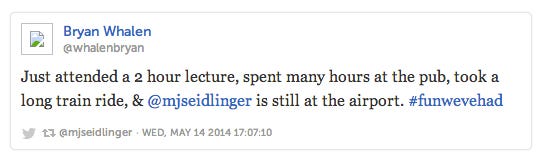
Tweet1

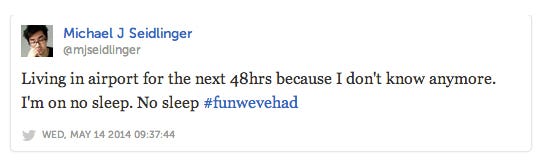
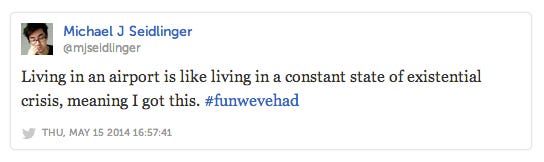
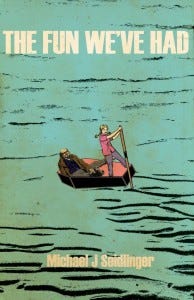
The idea was simple yet absurd: Live in an airport for forty-eight hours to promote my latest book, The Fun We’ve Had. This would be long enough to feel stranded, and more than enough to feel distanced from the blasé of daily routine. At the time, I didn’t know how long that would actually be.

I feared that I’d barely make it past the twelve-hour mark.

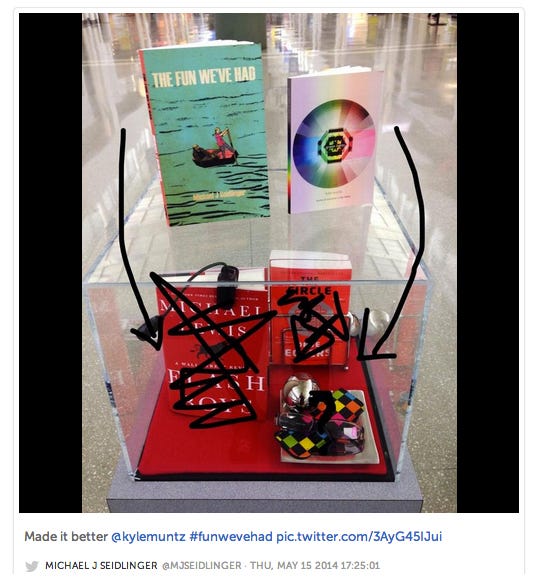
I would remain online and available, tweeting and posting for the duration of the performance. It sounded like fun, maybe, but it helped that I wasn’t alone at the airport, joined by Kyle Muntz, a good friend and author of a number of books, including his most recent, Green Lights.

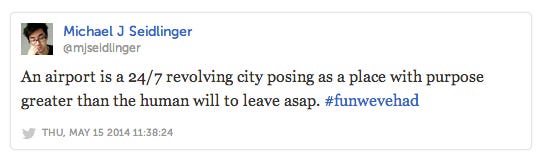
It helped that the airport functioned as a suitable metaphor for the book’s setting, given that being in an airport is a lot like being lost at sea. So many places and possibilities to drift, but not if you don’t already know where it is that you’re going. In the case of Kyle and I, we weren’t going anywhere. We weren’t actually getting on an airplane. We remained in stasis, disconnected from all tethers except the digital variety for the entire duration of the performance.

This was a performance.

This was an experiment.

And it was also a sort of nontraditional celebration of a book’s official publication because, in theory, I wanted to do something totally different, even if it ended up being a failure.

But I was worried. I was worried in the week or two leading up to performance. I had trouble sleeping and had begun to view May 14th, the day when the performance would begin, as a sort of blockade, that one precise moment in the future where everything would stop. Something entirely final.

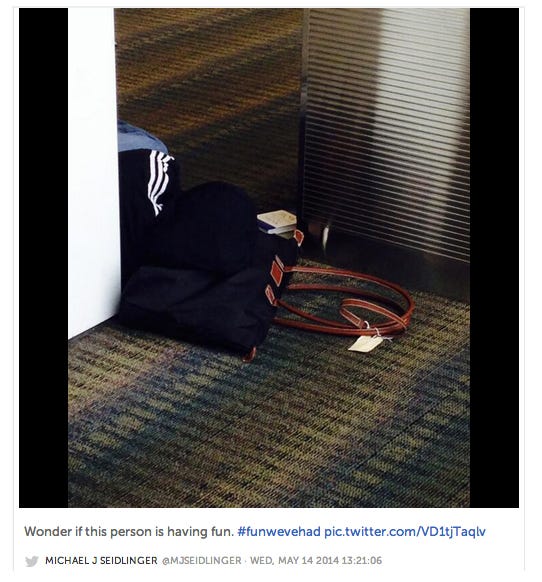
Tweet13

I thought about how plausible it could be living in an airport for two days. I thought about how social media would be the one buoy for the performance, and whether or not Kyle and I would discover the airport Wi-Fi to be inferior. I couldn’t fathom how the entire performance would play out, but figured, at the very worst, we’d get kicked out or abandon the entire thing a couple hours in. It would be fine — we could always ditch the entire thing in the first few hours.

I kept telling Kyle, “It’ll be great.”

Not that he doubted the performance. Kyle was far more optimistic than I was.

Really, I was trying to convince myself that it’d be okay.

“If it sucks, we could tell people that we decided to leave the country or something.”

Yeah, I was definitely worried. Kyle and I met up about a day before the performance to hang out and, ideally, to plan out how the hell we would survive living in the airport. But instead of planning, we amassed a modest selection of local craft brews and started on washing away the worry with a nice calming beer buzz. It seemed like a good choice at the time; besides, we were two friends eager to talk shop and catch up on what had consumed our creative lives since our last discussion at AWP. It seemed right that we went into the performance low on sleep and hungover. Now that I look back, I’m not sure I could have gone into this any other way but tired and drunk. Seems like most situations of mine begin with one and/or the other. Anxiety would have murdered me.

May 14th, early morning, around 9AM, we walked into Arrivals and spent ten minutes dazed, scanning the big digital screen listing out all of the arrivals and departures. I’m not sure why we bothered since we knew about the particulars of the flight — its departure at 9:55AM, its destination, John F. Kennedy International Airport — and it would depart with at least two empty seats. I wonder if JetBlue employees bothered calling out our names over the terminal speakers, figuring Kyle and I for yet another example of poor traveling, late and in dire threat of being left behind.

The truth is, I needed a moment to soak in the atmosphere. I needed to let the confusion pass. I needed to stand still and stare to keep the waves of nausea from mounting.

Picture8

Man I was hungover.

We were able to print our boarding passes without speaking to a single airline employee, which helped because I wasn’t sure I would have been able keep a straight face. If anyone asked, I’m sure we would have been found out right from the start. But no one bothered to look. Every step had become like anything else: a casual encounter with technology.

When you’re rushed through security, no one pays attention to anyone else. No one wants to take off their belts, their shoes, have their items scanned and judged, while they too are forced through a comprehensive check.

“I hate having to take my laptop out of the damn bag.”

“Yeah man,” Kyle yawned.

“I have this irrational fear about how their scanners will erase everything on my hard drive.”

“Do you have your work-in-progress on the laptop?”

“Maybe.”

Kyle laughed.

“Not funny.”

Kyle laughed harder.

“Okay it’s a little funny.”

Kyle and I waited in that line like everyone else, already worn down, most definitely uncomfortable, and, most of all, absolutely uninterested in anything other than getting past this point. Afterward, we were packed in with the crowd being shuttled toward the terminals. We spilled out into a long concourse, full of so many stores and other services, it would be quite easy to mistake the airport for yet another shopping mall.

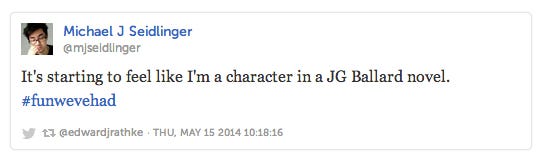
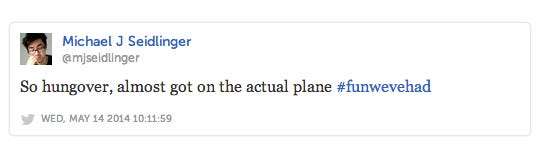
Because we had no other destination, Kyle and I stumbled towards gate B70, which had already been boarded upon our arrival. In that numbing haze of a hangover, I walked towards the gate, stopped only by the sudden glance of one of the Jetblue employees, figuring me for the type that gives flight attendants a hard time. I nearly boarded that plane. I know, so stupid. Not quite the best start. But it was the beginning.

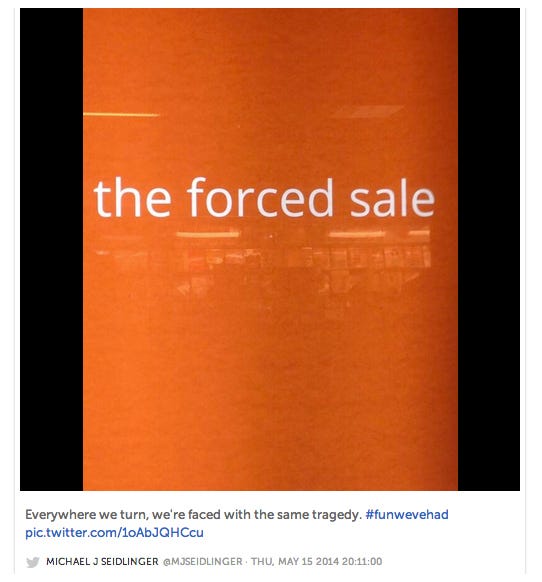
Tweet2

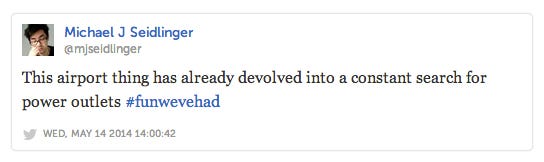
After that, we became cautious. I didn’t want to commit to any particular location. We walked the concourse once, twice, three times, stopping only for coffee and accessible power outlets where plugging in the laptop, our phones and other devices became a sort of checkpoint, a consistent choke point, and an act that ultimately became the bulk of the performance. At the start, I intended on live-tweeting the entire performance. It seemed like a good idea going in, only to be abandoned after walking the concourse once.

Tweet12

When you enter an airport, there’s the immediate response, an imperative to flee. You don’t want to be here, not in this setting full of repeated landscapes and muted situations. There’s the feeling of being watched while, at the same time, washed out, sapped of any and all energy you may have had. Sometimes there’s a layover, but in the case of why I was there, it was living, attempted living.

Tweet4

For the most part, our minds were blanketed by the dull hum and constant rush of wave after wave of people hurrying to leave, looking to disappear from the very setting that I’d become well-accustomed to over the duration of the entire performance. But we were here, and besides coffee, liquor, and social media, there wasn’t a whole lot to be desired. I guess that’s what nudged me in the direction of seeing the irony of the entire experience.

It wasn’t supposed to be ironic, not initially. However, when the first day sped by quickly as a mixture of moving from terminal to terminal, meaningless locations that served only as places where we could remain online and out of the way — not at all suspicious given that the majority of customers and travelers surrounding us did exactly the same — the performance revealed its true form.

Picture1

Having fun at an airport? Surely that’s ridiculous.

I mean, really: People stuck at an airport between flights typically turn to their computers and their phones; they pass out on terminal floors, smoke cigarettes and pipes in the provided smoking lounges; they spend more than anyone ever should on overpriced meals at strategically placed restaurants and eateries.

The irony could be seen in the exaggeration of people’s attempts to deal with such an unpleasant setting. But here we were, two writers stranded by choice. We saw the humor in the performance, and turned a blind eye to anything else, becoming like journalists in mock wonder, studying the satire. Any tweets, pictures, or posts turned into those sorts of declarations of the aforementioned irony. But Kyle and I were fine with that. We knew it would be a risk. We were open to evolving alongside every new discovery.

Tweet5

Because we had figured out what we were actually doing here, we turned our attention to blurring the hours, speeding up time. It was barely 5PM when we honed in on the airport bars. A drink here, one there, we let the hours fade by nursing what would have been gulped down quickly. We had to make each drink count, given the expense. We had a chance encounter with friend and author, Amber Sparks, who had stopped by one of the bars to waste away the hour or so before her flight.

Amber opted for a drink, much like we did, to shorten the hour(s) of waiting. Exhaustion started to set in by nightfall. The bartenders were intrigued and mystified by the performance. They let us stay, going so far as to offer the place as a “safehouse” if we felt like we had nowhere else to go, or needed to hide from airport security. Too bad airport bars close at 10PM. If you keep drinking, you can prolong the inevitable threat of fatigue setting in. Keep the buzz from fading. We drunkenly walked to the international terminals, where flights from Paris, Korea, Japan, and one from Italy, would give us enough of a pocket of time to doze. I’m positive that we wouldn’t have made it to the second day if we weren’t able to sleep without disruption until shortly after dawn.

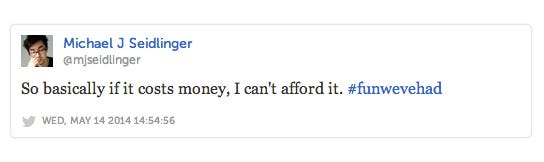
It’s interesting to see how prices become sensible after drifting between the airport’s various absurdities for over eighteen hours. When we found a concourse liquor supplier offering two bottles for forty-five dollars, we couldn’t resist the purchase.

Picture10

Kyle observed the available options.

“Damn, not bad.”

I agreed. The prices weren’t that bad.

“We’ve been in this airport for way too long.”

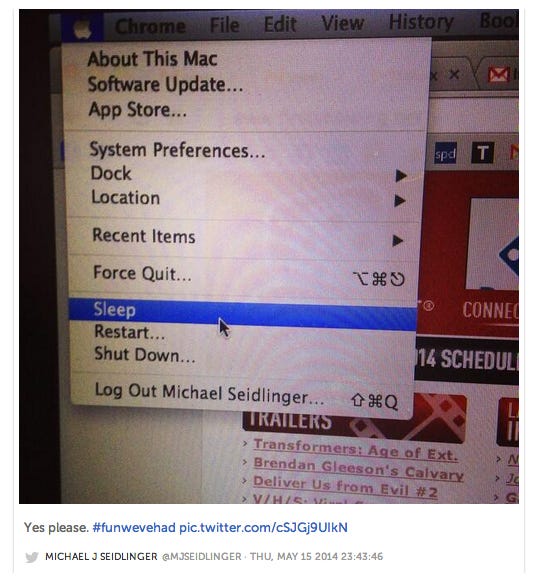
Those bottles became a lifeline, much like social media, the only other thing keeping Kyle and I from giving up. Sure, the fun existed, but we never lost sight of the fact that we could do what we were doing somewhere better. Drunk, soon to be hungover, we did what you’d probably expect: we turned to those screens, the mobile device, the laptop screen, only to find dozens upon dozens of Facebook, Gmail, and Twitter messages, not to mention a dizzying amount of unanswered emails.

They were from friends interested in receiving updates, wanting to know what the hell we were thinking. They wanted to talk, to see if we were okay. But as the night of the first rolled into the morning of the second, the names became unfamiliar. People I’d never spoken to before contacted me. Some of the names I’d seen across social media but we’d never spoken.

<span class=”right” style=”font-weight: inherit; font-style: inherit;”>The audacity and absurdity of this performance gave people seemingly a reason to reach out </span>

, and what transpired over the last day was not only reassuring but also the perfect remedy to exhaustion. It felt a lot like reacting to an audience, in a situation where there was no actual stage, only the performance, a bizarre scenario of being stranded. And yet, the audience responded to our S.O.S. signal, wanting to become a part of the adventure, if only tangentially.

Day two. 9AM turned to 11AM turned to 3PM without so much as a single change. Time felt like it stood still and yet, the clock continued to tick. Every time I’d check, Kyle and I were getting closer to the end. Suddenly we felt like we could actually make it. We felt horrible but we held on. We didn’t move around much on the second day, opting instead for empty terminals near power outlets, putting headphones on even if we didn’t have music playing. Sure, we bought coffee, a bagel, going through with a dare by someone that prefers to remain nameless: eating a Cinnabon, which nearly brought me to my knees.

We took photos from around the concourse, anything that seemed to accentuate the irony that had now become brutally close and painful. Our pockets were empty — the meager budget we’d allotted long since spent, and yet we mustered up the funds to go for broke on a much needed airport massage.

Picture11

After the massage, I asked Kyle, “What the hell did we pay for?”

“Yeah, I fell asleep.”

I felt dizzy, more nauseous than relaxed. “I think I did too.”

“Let’s not mention this to anyone.”

“Deal.”

We were out of cash and had to wait out the rest of the day with none of the usual options. Every dollar set aside for the performance gone, but we still had those two bottles left, some empty coffee cups, and an airport terminal floor to sleep on.

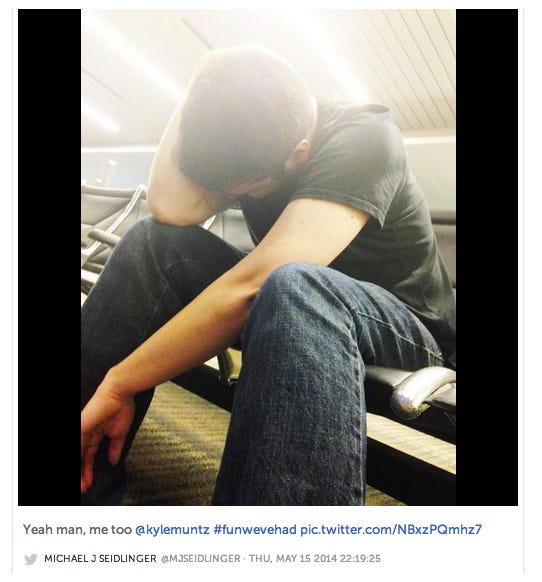
Tweet14

Fun fact: Add “airport” in front of any word and instantly it loses all meaning.

I didn’t care anymore. I remember telling Kyle, “Photos man. Take photos of all the trashcans. Anything.”

The previous night, it had been easy to remain undetected; yet on the second night, the night of May 15th into the 16th, Kyle and I discovered that we had to be far more selective. We couldn’t venture into just any concourse or store. We couldn’t afford any more food or coffee, and by the time we started to suspect that we were becoming a little too odd, a little too obvious, most of the stores had closed for the evening. We had nothing else left but to leave. We left the concourse area for the baggage claim, staying the final four hours in the drowned out glow where travelers wait to be picked up. Kyle and I sipped from those coffee cups and chatted online with those that had become invested in the performance no matter how distanced and remote they were from the actual adventure.

Tweet7

At one point, Kyle and I reflected on the events, the relative ease of the first day, countered by the horrible drawl of the second; we thought about the metaphor of an airport as being “lost at sea.”

Kyle spoke about that the first day, “It went by so quick, man. It felt like we had only been here for an hour but when I looked at the phone, eighteen hours down.”

“It’s the booze.”

He agreed, “It’s always the booze.”

“Look at us now…”

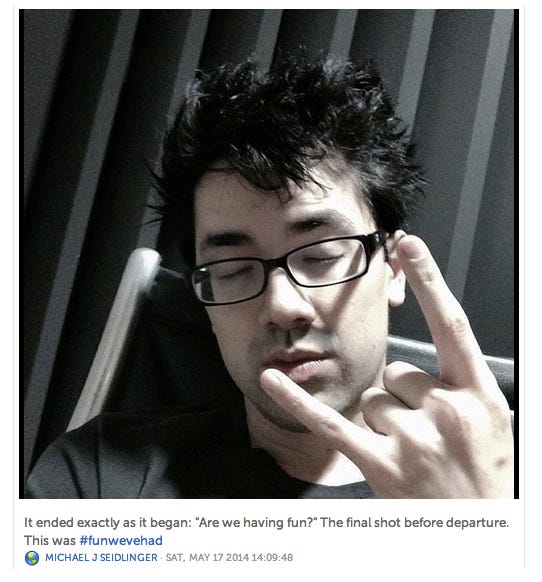
Yeah we were a wreck, but it was almost over. We talked about the performance as a whole, which brought up the question, the one that started it all:

<span class=”left” style=”font-weight: inherit; font-style: inherit;”>“Are we having fun?”

It’s here that I can finally say it in clear confidence: Yes. Despite the dreaded lows, the answer is a resounding yes.

While ambling around crowded bars and sneaking into empty terminals, I had at least one screen by my side. Be it via mobile or laptop, I had an audience; I had acquaintances and friends, old and new. There’s absolutely no point in having a screen to look at if there isn’t a voice, an image, a personality or two blinking and twinkling from behind that screen. Knowing well that that those voices were people seeking out the latest update, the situation, the happenstance of the airport performance piece, was reassuring. It’s still interesting, thinking about how I had people staying up later than anticipated to help keep me stay awake while I nodded off in an airport terminal at 4AM. They cared. They had fun, wanting to talk a bit longer. In the relative insanity of the performance, there was something to be had, an odd form of fun.

Picture12

It became something beyond a promotional stunt for a book (not that I’m positive that was ever my sole intention); during its two-day stretch, I spoke about the book perhaps only a handful of times. This experience became something far more personal, something more intimate with the audience that it drew in from the already crowded social media waves. The reason for their interest, I’ve come to understand, was due to the sheer oddity of the idea. It’s simple, yet absurd, completely contrary to the typical promotional venture, and yet, via the irony of the question being asked, “Are we having fun?” It took on an interesting context in relation to its source material, “The Fun We’ve Had.”

I’m not sure I have anything definitive to say at this point, less than a week after the experience; however, I can say that I’d do it again.

<span class=”right” style=”font-weight: inherit; font-style: inherit;”>I would like to do something like this for every book I publish. Not the exact same stunt, mind you, but something, a performance, a declaration… an experiment.

Something that feels exciting, odd, and/or dangerous. Something that connects with an audience beyond the book itself. Since catching up on sleep, I’ve begun thinking about the possibilities, what can be done to not only promote a book but also bring fun and fuel to an audience. A book takes on its own life, but the author, and to a lesser extent, its publisher, has a responsibility to spread word of the book’s existence. It’s becoming more and more difficult these days; people become bored, disinterested after a single glance. What keeps people’s attention? I’m no different from the prospective reader. I get bored easily too. This idea began due to being bored with the hustle of promoting a book. I wanted to do something different. I wanted to do something fun.

If it’s fun and/or risky for you, if it pushes you out of your element, chances are it’ll be fun and interesting for everyone else that bothers to pay attention. This was risky. I could have been caught. It could have bombed, not even a single response or message from people that could have been watching. The performance could have been excruciating to both me, the one out of his element, and the viewer, who could easily scroll past the post without any concern. Not everyone will look; even fewer will listen, yet for those that fit into the former, it’s a potential fit for fun.

Picture9

We’re supposed to have fun, right?

I’m certain that I did just that and, for the people that reached out when they could have very well remained lurkers and strangers watching from behind the comfort of their own screens, we rode the digital waves for a spell, letting the fun and confusion, those digital memories, become time-stamped within messages, tweets, and chat logs across all accounts. There’s something thrilling about having shared a moment that might have otherwise never been true. In the blotted-out light of an airport hallway, I had an audience and an audience had me. Kyle and I moved into the dreary deep end of the performance on little sleep and too much liquor, but we kept going because there was never a quiet moment. There was never a moment that didn’t involve inspecting the very act that became true: Why are you staying in an airport? Why bother doing something like this? And, more so, was it worth it?

Tweet8

While writing this essay, I scrolled through all the messages sent and received for some sort of answer. I’m overwhelmed by just how many messages I’ve received. I look at the comments and the likes, the few favorites and retweets, but I keep going back to the correspondence, namely one individual, someone that I’m sure would never have contacted me if it wasn’t for the performance. We’ve since spoken on a daily basis. It’s thrilling to be able to make a close connection with a new reader and, more importantly, new friend. Because that’s where it matters; ultimately, it’s about making contact, finding reason in the stasis of the storm of endless information and chatter. And if you’re stranded and or stuck — think the endless sea from the book or the dreary and dull setting of an airport —

TheFunWe'veHad

There’s a lot of potential out there to try something new. It might not work. It might fail. But what’s important is to try. I encourage everyone to think outside of the box and try something new to help garner a response. It’s not just about marketing. It’s about making a connection, fostering a readership.

“Are we having fun? I’m having fun when I’m with you.”

But I’m not just reciting a few lines from the book. I am speaking in all honesty to the audience that remained by my side. I am having fun when I’m with you. I hope you know that I’m talking to you, every single one of you.

Picture13

It was a hell of a time, the #funwevehad.

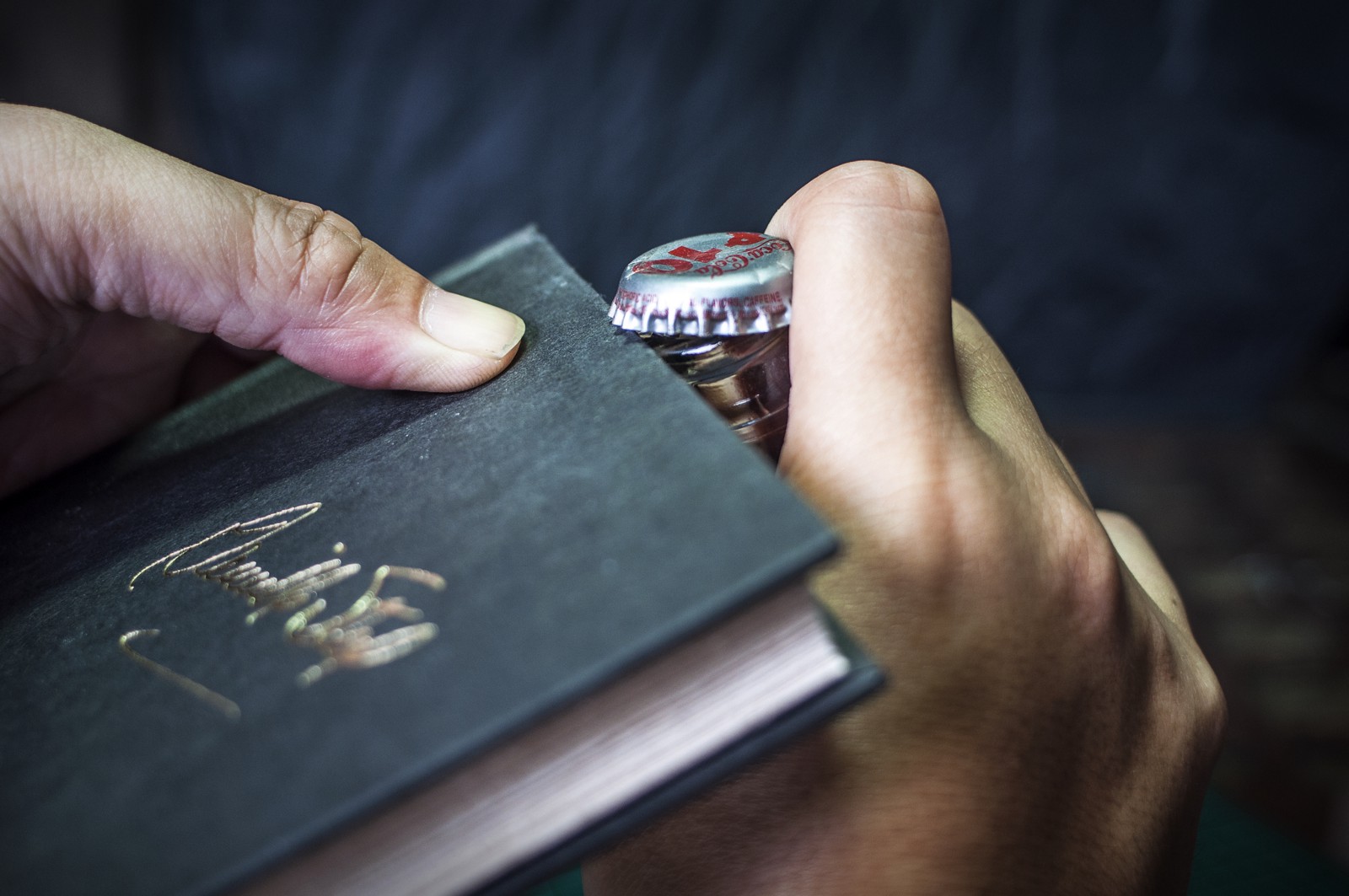
Do YOU Know How To Open a New Book?

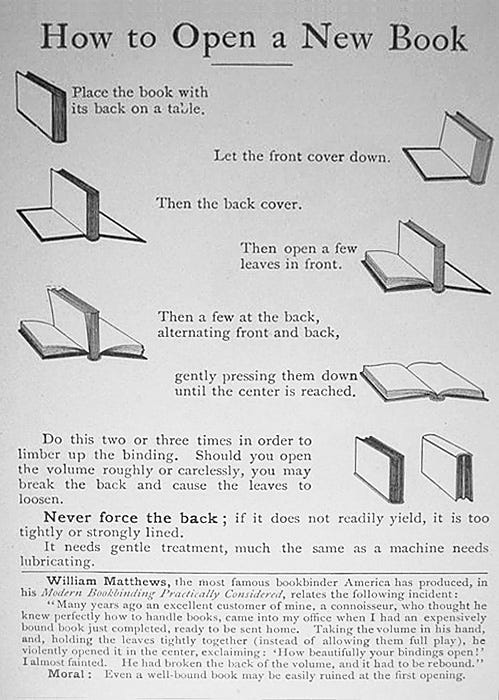
Opening a new book may seem so easy a baby could do it, but the dangers — from paper cuts and cracked bindings to the baby drooling all over the pages — are numerous. Luckily, there are a few techniques readers have developed over the centuries to ensure a smooth reading experiences. Here are a few of the most popular:

The Isaac Newton: A scientifically simple technique, the Isaac Newton uses gravity to soften the spine of new book.

The Hard Sell: This technique is popular at AWP book fair tables. It involves shoving a small press novel into the hand of an unsuspecting book fair attendee with such force that the spine cracks down the middle. Often coupled with the phrase, “Oh, you’ll love this one. You just have to buy it.”

how to open a book

The Spoiler: Readers who use The Spoiler start by opening the last page of a new book, then get pissed that they ruined the ending, and finally toss it — spine otherwise unbent — in a to-read pile in the corner.

Scratch ’n’ Sniff: People who love the smell of new books can use their nose to flip and press pages.

The Precious: A favorite of collectors who want to keep their books in as near mint condition as possible, The Precious involves only opening pages at a thirty degree angle to ensure the spine never bends. The downside is that readers often can’t make out the two words on each line closest to the gutter, but at least the books stay pretty.

Centipedin’: Centipedin’ uses hard bends every ~50 pages so that the spine is broken into many segments. These segments should run across the length of the spine. If they are running across the width of the spine, man, how did you do that?

Puppy Earing It: Readers with puppies or small dogs can slide a few treats between the pages of a new book and let their dog loosen up the binding as Fido digs for a snack.

The Pick a Card!: Here, a reader flips the pages back and forth rapidly while every now and then smashing a forefinger into a random page.

Ogre Open: The Ogre Open often happens by accident. A reader will be attempting to gently fold a section of the book and instead snaps the glue with their dumb, clumsy hands. Ogre Openers tend to get pissed, promise themselves they’ll gently bend the next section, then screw it up again fifty pages later.

Karate Chop: This is the only opening technique that does not actually involve opening the book. Instead, the reader says “hiya!” and firmly chops the spine from the outside until sufficiently loosened.

The Assembly Line: Good for book clubs, this book opening technique requires at least three people: one to lay the book on its back, a second to bend the spine at regular intervals, and a third to gently press each section down.

The E-Reader: The E-Reader involves clicking a button on some gizmo and then smugly talking for twenty minutes about how paper is dead, only luddites read physical books, and the future of literature is 3D-printed, cloud-based hypertext fan fiction Google Glass apps.

The “I Totally Read That”: This method is for readers who frankly have better things to do than read a book — like cable TV marathons and candy-based cellphone games — but who still would like to look well-read. Basically, all you need to do is chaotically ruffle, bend, dog-ear, punch, and scratch at the book until it looks like a novel lovingly reread a dozen times. Then place it on the shelf for any guest to see.

NEW GENRES: Country Noir

[Editor’s note: New Genres is a recurring feature that aims to complicate and expand our conception of literary genres and their always porous boundaries.]

Country noir carves out a space for the small, the local, the defiant and the defeated. That losing side of the American mythology that walks out of the shining city on a hill spitting and reaching for a flask. Take this line from Benjamin Whitmer’s Pike:

“ … Jack used to have plans for his life.”

“Most of us did,” Pike says. “Before we became what we are.”

Daniel Woodrell coined the term “country noir” with his 1996 novel Give Us A Kiss: A Country Noir. He has since had the subtitle removed in subsequent editions and distanced himself: “The term ‘country noir’ isn’t even worth using any more. … I don’t want to be required to live up to my own definition.” Fair enough, but to coin a term does not mean you’ve defined a term. His novel constitutes neither the beginning nor end points of country noir.

Mary Rowlandson

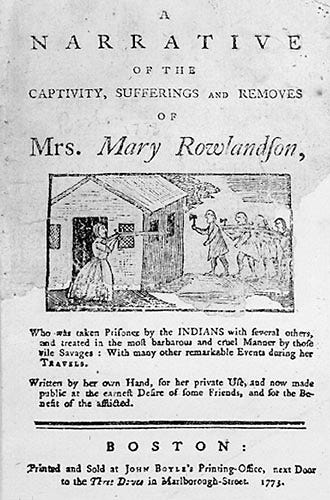
In fact, country noir has a long-hidden tradition in American literature with roots that reach back to 1682, beginning with the unlikely-sounding The Sovereignty and Goodness of God, by Mary Rowlandson. The book’s opening plunges us straight into the slaughter of Rowlandson’s family by marauding Indians and her forced captivity into the wilderness. Her description of the experience after being “redeemed” serves as an accurate summation of the country noir outlook as can be imagined:

I can remember the time, when I used to sleep quietly without workings in my thoughts, whole nights together, but now it is other ways with me … I have seen the extreme vanity of this World. One hour I have been in health, and wealth, wanting nothing: But the next hour in sickness and wounds, and death, having nothing but sorrow and affliction.

The tropes of Rowlandson’s journey become familiar ones in country noir: the violent fall from grace with uncertain prospects of ever returning to bliss, hyper-local concerns that stoutly do not form a symbolic template for any larger spiritual or political happenings. The characters of country noir don’t look to the wider world — they are inextricably mired in their own personalities, locales, family arrangements, and social classes.

Over and against the overweening hubris of the American Dream, country noir looks to the broken-down farmhouse, abandoned in a pasture, with its dreams long gone and broken. It flips the bird to social conscience, ideology and utopian hopes, turns to the bar for another red beer, contemplating the tottering of social order against the meth epidemic, the plight of returned veterans abandoned by their country, the fate of fugitives. There is no epic sweep to these stories, no recourse to a mythology which sweeps us all along to a manifest destiny.

Country noir occurs beyond the aegis of the city and the suburbs. Its rural settings bring the actions and characters into sharp relief, stripping away social context and revealing its humans as naked, trembling, and very horribly fallible. Eschewing social commentary and symbolism, country noir prefers to dwell in the more homely environs of story.

No crusaders appear. Characters may be victims, passive or flailing, of vicious social circumstance, but while there may be a good deal of awareness of the haves, they will remain have-nots. The swindling Bible salesmen in Flannery O’Connor’s “Good Country People,” for instance, certainly has some idea what he’s missing out in the pleasant homes he visits. Many lives in country noir works are worn out over amounts of money that would be beneath the notice of the prosperous; from Rueben Bourne accidentally murdering his son in the wilderness after going broke in Nathanial Hawthorne’s “Roger Malvin’s Burial” to the unnamed fugitive in Scott Wolven’s “Atomic Supernova” eking out a living in the Nevada badlands recycling metal and running drugs, the characters of country noir works are generally not economic winners.

ElectricLit_COUNTRYNOIR2014

infographic by Nadxi Nieto

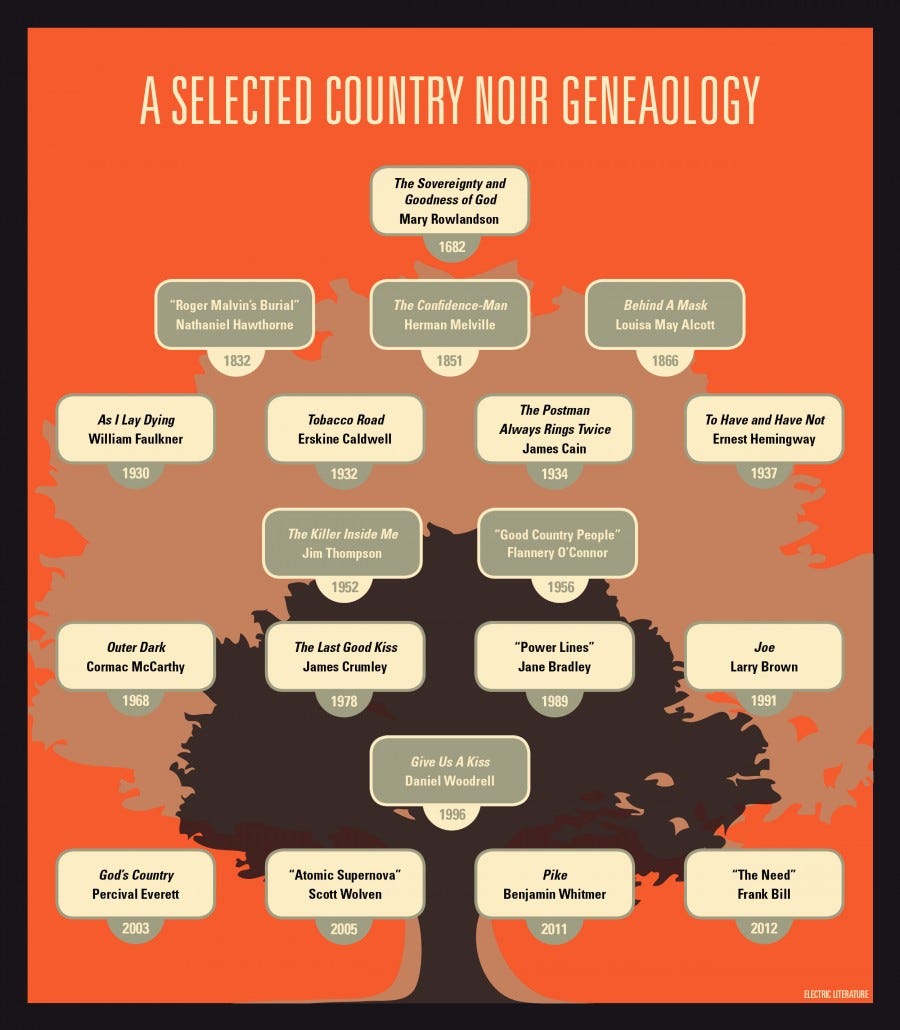
This is a highly disparate genealogy, to be sure. Acknowledged American classics stand alongside “mere genre” writing. However, I hold that artificial genre boundaries ought not constrain our view of literature. What binds these works together across time is not a conscious adherence to a certain literary style or genre; rather, these works are exemplars of the dark shadow cast by the burgeoning American dream across the North American continent.

Country noir peels back the edges of those illusions. Larry Brown’s Joe (soon to be a motion picture) paints a Cormac McCarthyesque picture of the rural South, unflinching in its portrayal of quotidian economic realities. Unable to look beyond his routine of whiskey and work, Joe’s shredded moral compass barely guides him through his rough days, while the father who pimps out his own pubescent daughter is not the worst character to put in an appearance.

As I Lay Dying

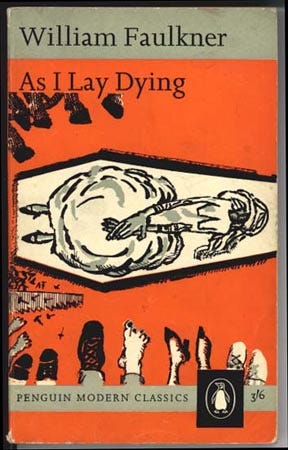
For if country noir is about nothing else, it is about characters who lack for good choices, or often, many choices at all. The scammers aboard Melville’s Mississippi tramp in The Confidence-Man are conned to the extent of their own naiveté and willful blindness, while the Bundren family in Faulkner’s As I Lay Dying has been poor and getting poorer from the beginning. Even the apparent wealth of Abraham Trahearne in James Crumley’s The Last Good Kiss is revealed to be a sham; he is deeply in debt and living off the largesse of his mother and ex-wife, both of whom despise his current wife, the woman of mystery at the heart of the novel’s story. Chronic economic insecurity haunts the characters’ actions, especially the ones that are despicable, desperate and unwise. Consider Harry Morgan in Hemingway’s To Have and Have Not:

I could stay here now and I’d be out of it. But what the hell would they eat on? Where’s the money coming from to keep Marie and the girls? I’ve got no boat, no cash, I got no education. What can a one-armed man work at? All I’ve got is my cojones to peddle.

That’s country noir. Or as Hank Williams put it a long time ago: “I’ll never get out of this world alive.”

Country noir makes short shrift of the notion of a hero riding to the rescue, howsoever rough he is around the edges. Country noir is all rough edges. Wayne in Frank Bill’s short story “The Need” can chase solace in drugs before finally succumbing to ultimate violence, while the young boy in “Power Lines” by Jane Bradley will not have his voice heard, and an innocent ghost of a black man, himself a victim of great injustice, takes the blame instead. In Percival Everett’s God’s Country, the fiendishly stupid Curt Marder succeeds only in losing what little grubstake he has, while George Armstrong Custer is portrayed as a bumbling, effeminate idiot who blunders into the massacre at the Little Bighorn and the black tracker Bubba rides a mule because “Nobody ever wonders if a mule is stole.”

In “Atomic Supernova,” a little boy squints up at a sheriff in the blacktop desert sun, awed by the uniform and the tin star and the gun, hero worship in his eyes. The sheriff’s deadpan reply says a good deal about the state of American justice:

“Are you the good guy?” Stevie asked.

“I’m the only guy,” the sheriff said.

John Wayne is dead and these days a sheriff is far more likely to be found turning an indigent family into the street than hunting down bad guys. For so many, the sheen of the American dream stands burnished far less bright than once it was. Country noir no longer looks like so alien, nor quite so hidden: it looks a whole lot like reality.

H.I.P. Lit: The End of the World Edition

by Alizah Salario

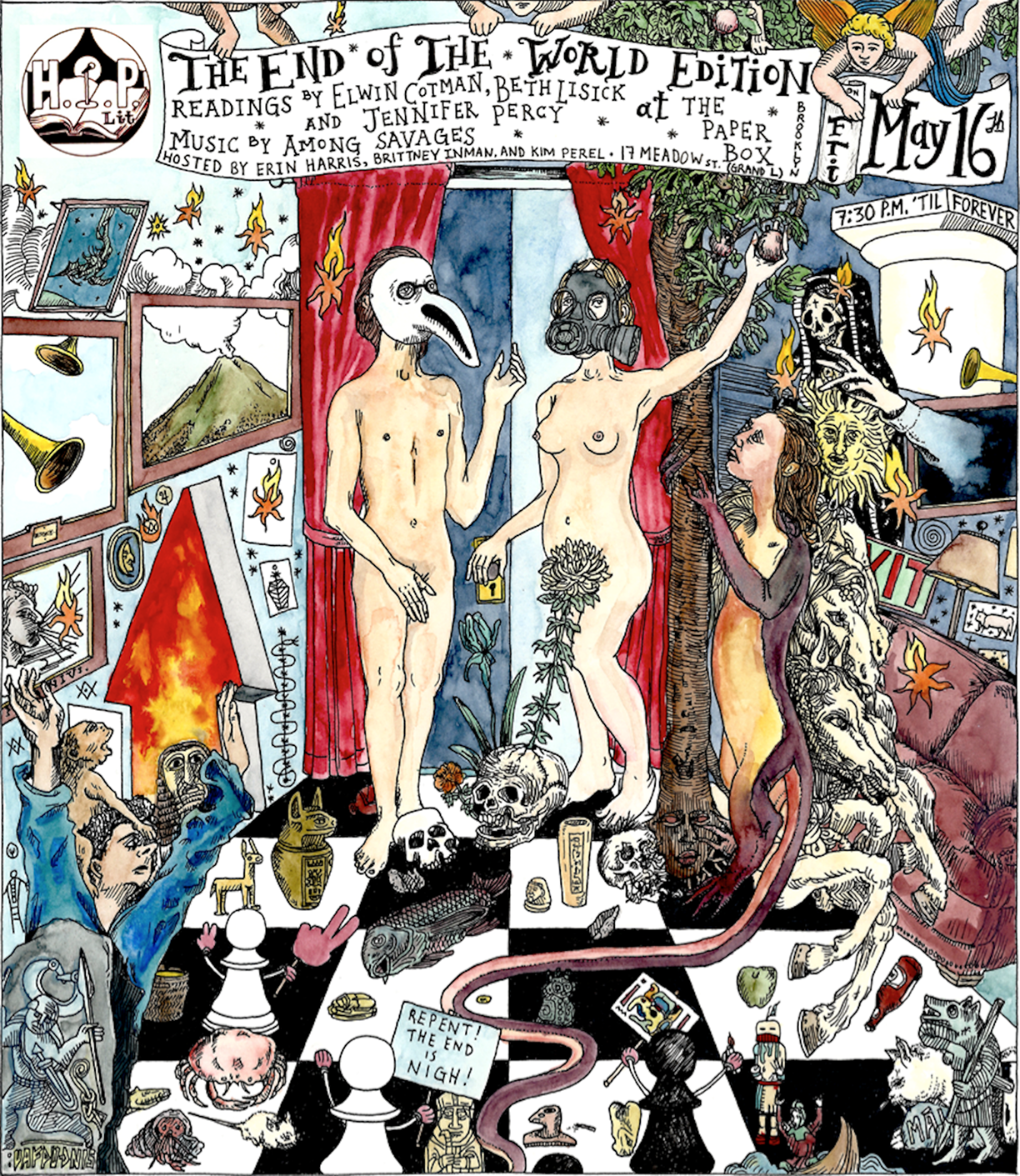
HIP Lit End of the World flyer, Design by Christopher Russell

Among Savages

Elwin Cotman, Beth Lisick, Jennifer Percy (top, left to right)

Elwin Cotman, Beth Lisick, Jennifer Percy (top, left to right)

Erin Harris, Brittney Inman, Beth Lisick, and Jennifer Percy (Left to right)

Erin Harris, Brittney Inman, Beth Lisick, and Jennifer Percy (Left to right)

The first sign of the coming apocalypse will be a hipster Jesus handing out glow-in-the-dark halos. A Mexican food truck, decorative pineapples, and free cookies will follow the revelation. These were just some of the earthly delights at the latest installment of the H.I.P Lit Reading Series: The End of the World Edition, co-hosted by Erin Harris, Brittney Inman, & Kim Perel on Friday, May 16th at the Paper Box in Williamsburg. An artistic experience that incorporated music and film with literary readings, the event was somewhere between Paradise Lost and Dante’s Inferno, sputtering paper mache volcano and all.

The literal meaning of apocalypse is “an unveiling,” and the readings did just that. Oakland-based poet Elwin Cotman kicked off the night with “The Revelation of John,” a selection from his collection of lyrical fables, Hard Times Blues,about an epic flood on the Mississippi River. The rain pounding down on the Paper Box conspired beautifully with Cotman’s melancholy fable. Next, Beth Lisick, author of Yokohama Threeway and Other Small Shames and the comic memoirEverybody Into the Pool, read from a work in progress titled “Rods and Cones.” She managed to weave references to Carmela Soprano, wet farts, and throwing frozen peas at a crucifix with startling insight and eloquence. Jen Percy ended the reading with a wrenching except from Demon Camp: A Soldier’s Exorcism, her astutely-observed nonfiction book about a soldier with PTSD tormented by his demons. The most apocalyptic moment of the evening was Percy’s haunting repetition of a single word: Goodbye, goodbye, goodbye. Over and over, this is what a former soldier told his sister right before putting a gun to his head.

The event wrapped up with a set from the band Among Savages, but not before a Q&A session with the readers. A moment of purgatory followed the dreaded question, “Why do you write?” The responses, however, were illuminating: “I write so I can understand what I’m thinking,” said Lisick. For Percy, “It’s like having a secret love affair with my whatever you want. It revives me. It’s like an I.V.”

Spring in Zurveyta

Mr. Cherkeso had agreed: he would sit for the interview. It would be conducted at his compound in Zurveyta at exactly three forty-five in the afternoon. The journalist, Ms. Petrovich, would submit a list of questions. From this list ten questions would be selected and his representatives would submit a copy of his answers one hour before the interview. She would be allowed to formulate supplementary questions to his answers during this time. Arrival time would be at noon, granting a thorough search of her car and body; after the interview, they would have dinner with the Minister of the Interior and his wife.

Anna Petrovich, Anna P. as her friends called her (her editor at Novaya Gazeta, Mischa Hosculman, called her Petrovich — the negation of familiarity belying his affection for her) had reported on the wars in Khruekistan and predicted the consolidation of power by Akhmed Cherkeso’s son after his assassination two years ago. His son had been the head of security forces. He wasn’t yet thirty years old when his father had died. This is how it had happened: at a public independence day rally at Iznek Stadium, he’d sat in the twenty-fifth row of the concrete bleachers overlooking the youth parade. Several hundred pounds of explosives had been rigged around the columns upholding the bleachers. At noon they were detonated. One man watching through binoculars as the president waved to the parade had seen his hand fly right off the wrist. “Like a sparrow at the sound of gunshot,” he’d later described. One hundred and sixty-three people killed. Probably twice that many detained. It could have been read as a show of incompetence on the son’s part, that his security scan of the stadium days prior to the event hadn’t turned up a cache of explosives taped to the pylons beneath the bleachers and painted the color of concrete. But the time it would take to formulate such a criticism was quickly filled with a flurry of retributive action. All military-aged males in the village of Kirpukt, the home town of Sulamir Besmir, the most prominent of the rebel leaders, were detained, brought to Iznek, and subjected to a month of “intensive cross-examination.” Tactics of cross-examination had included beatings, sodomization, torture by blowtorch and electrified wires secured to the genitals, followed by execution by pistol, hunting knife, and nail gun. In the words of one observer who had attended the state funeral for Cherkeso the elder, the son had “wept fists” at the service. He’d delivered the eulogy with an announcement of authority, removing a pistol from the shoulder holster beneath his suit, holding it up for the crowd to see, before setting it, with a show of ominous grace, on the podium. This was what the country should expect. Here was a man who protected his interests from a position of deep emotion; and, being a man of the people, his interests were aligned with everyone’s.

Anna P. had to wait eighteen months before she was allowed to contact President the Younger Cherkeso, six more before she was granted council with him. She had spoken by telephone with a series of functionaries, all who claimed to be speaking on behalf of Mr. Cherkeso. Yes, the President had agreed, it was important to develop a relationship with reporters from Moscow. It would be necessary especially in light of the Kremlin’s support of his efforts to rebuild and rehabilitate his country’s sense of direction and identity. Not seventy years had passed since Stalin’s soldiers had marched into Iznek and worked to modernize what was until then essentially a peasant state. They tore down old buildings and built them anew. And when they exhausted the city’s supply of stone and brick, they uprooted headstones from the cemeteries and put them to use. This was, the President’s representative to the press said, what must be done once again. We must rebuild from the bottom up this country that has, until now, built nothing new but fresh graves.

Anna P. smiled dryly at that. She had been in country for three months and had seen more than enough fresh graves. The problem was, there weren’t enough of them. Public executions had been the chosen deterrent for any rebels still embedded in the villages. In Porguna, forty miles to the west of Iznek, she had witnessed the murder of two men by government security agents. She had stood in the gathering crowd near the oil pipeline outside the village, disguised beneath a burkha, while the two men, possible rebels dressed in track suits, were shot and beheaded. The heads were placed chest-high atop the pipeline. Security agents posed next to them for photos from their camera phones. One of them placed the cigarette between the lips of a dead man then returned it to his own to take a puff. By public order the bodies and heads were not to be buried. They were to be left to rot. “But if the dogs have their way with them,” they said, “that will be fine.”

She had seen similar things in the south of the country. The president’s control was stronger in the east and the north. Moscow had expressed an interest in unifying the country fully by the end of the year. Here it was, halfway through summer, and this deadline seemed all but met. Anna had framed her request to meet President Cherkeso in these terms: to discuss his plans for the country once its regions had been stabilized and local governments had been integrated under his authority. Word was received by her editor in Moscow. Yes, it is time we sat down and outlined in a public manner our plans for the future. The time came sooner than she had thought: “President Cherkeso would be happy to sit down with you later this week, Saturday.”

Saturday morning she left her hotel in Iznek early and in a rental car drove west. The President’s compound was halfway between the capital and the coastal town of Uzun. The land there was hilly and less populated than along the coast; forests rose and fell like preparatory waves on the way to the sea. Anna kept her notes open on the passenger’s seat and listened to the state radio news report, which ended not soon after she had begun listening. A Russian program announcer introduced a symphony by Prokofiev and faintly and slowly the music began, unwinding from a dormant state of dim silence. This was her soundtrack for the trees that rose out of the ground and slowly approached and then, as she reached them, rushed past her. What had Mischa said? To not press the president on his agreement with the Kremlin. To not mention the testimony of exiled rebels. Or the assassinations of defected members of his security force; or the murder of journalists; or the killings of Salim Nazmir in Vienna or Ramzan Yennul in Abu Dhabi. Stay focused on him as a speaker, as a promoter of his own prejudices, as a man in a room. Don’t press his answers too forcefully. Pay attention to how convincingly he talks up his plans for reconstituting the government and for rebuilding Iznek especially. We just need a clear sense of how he views himself. How he presents himself will be a large part of that.

Before she had left the hotel that morning, she had told her husband Ilya, “My hands have been shaking for two days now. I want to have a drink or take a Vicodin to calm my nerves, but I don’t want to dull my wits.” Her husband, also a journalist, had taught her a breathing exercise that he had used in the past; to hold one’s arms above one’s head and breathe rapidly through the nose; to do this for three minutes and, when done, to hold one’s breath for as long as one can and then lay on the floor with eyes closed. He called it his “Five Minute Sanity Session.” The tension in Anna’s voice was so strong, the cell phone in his hand seemed ready to collapse from the pressure if he let her keep talking; so he asked her to take “five minutes of sanity.” “I’ve already done that, right before I called you,” she said. “I know nothing will happen. I’ll go there, ask my questions, stir his ire, then be sent away. He needs to put on a good strong face for the press. Journalists don’t have a way of disappearing when they go to talk with him. That comes later. After the articles are published.” Ilya could tell she was standing at a window. From the acoustical color of her voice: thinly doubled, with a faint, sharp echo. He was worried for her. This is not where he wanted her to be. Alone, standing in a hotel room, in one of the most ruined cities on the continent, in the world, if one were to draw comparisons. “Call me any time,” he said. “From the drive there. From Cherkeso’s place. Remember, we want you back here by the end of the month. We’ll coddle you like a batty old heiress. Be safe.” She nodded, then said, to the window, to the window echoing back at her face, through the receiver to a cell tower, up to an orbiting satellite and then down to her husband on the other end of the line: “I’m safe. Don’t worry. I’m just nervous. More later, Mr. Husband.” After they’d said their goodbyes, Ilya sat on the edge of his bed and imagined Anna doing the same, then noted to himself, “You don’t get nervous. And now you are.” When he looked at the clock on the nightstand, it said nine thirty.

Now that she was driving to meet Cherkeso, her nerves were feeding back into her usual state of calm alertness. What had begun as a quick drive through ugly countryside had gradually become more pleasant. The land between the capital and Uzun was not as ruined as she’d expected. It had rained before dawn, and the dark trees, the small scattered cottages among them, had a fresh, dewy pastoral homeliness to them. The road shone in patches where the morning light passed through the trees. Due to the humidity there was a sepia quality to the air, miniscule tracers of light refracting by the trillions through airborne specks of water.

She drove without thinking, preparing her instincts for the netting and recording of quick details. This was what she called her “cleaning ritual.” Hours before an interview, she would empty her mind of any reference points or opinions of her subject. Not that she was erasing the vital lines leading from the present moment back to the compiled information she had prepared and reviewed weeks beforehand; rather she was clearing the way between the two, so when she needed to draw on some critical particle of data to aid in the formation of a question, the recorded fact would arrive at the right time and from the right angle spontaneously. In the mournfully objective spaces within her was the worst of a country’s available history. Ten years of disarray and civil war, revenge killings and government sanctioned executions. These were the generalities afforded by cause and effect: the breaking free of satellite states in the messy twilight months of the Soviet Union; the push for autonomy by tribal leaders against the interests of old loyalists. The civil war of ‘92-’95, followed by a truce, followed by a second war that began in ’97 and continues until now, stalled in a state of perpetual disintegration in this, its last, meanest phase. These were the bare structures of events boiled down to their timelines and held together by a procession of names and dispatches. What was harder to retain were the things seen, the stories relayed to her. These she couldn’t affix to a meaningful trajectory.

There was the Muslim woman she had met in Gamurzigol who, having been accused of infidelity against her husband, was arrested by security police and brought to the basement of the police station. There they tied her to an iron pole and beat her with a length of rubber pipe, insisting she confess and beg repentance from her husband. Her husband, of course, was nowhere to be found. Hiding, most likely, at a house in a nearby village.

This was a small, youngish woman with a jagged scab cutting across her upper and bottom lip. She shook and kneaded the back of her neck as she spoke. “I was too afraid to deny it and too afraid to tell them the lie they wanted from me. So I kept quiet.”

The police who beat her were young, younger than her, and laughed and mocked her when she flinched. When they saw that she would admit to nothing, one said with a pious rage that seemed affected, not at all a flourish of righteous feeling, “If you won’t confess, you must be punished. You are sentenced to three days of shame.” At that they shaved her head and eyebrows with electric shears, then spray-painted the stubble bright green. Pressing her head against the iron pole, one of the officers asked for the can; on her forehead he sprayed an upside down cross beginning at the widow’s peak and ending at the bridge of the nose. After this they dragged her into the streets and called bystanders to pelt her with stones and rotten food. She was led to the town square and handcuffed her to an old iron ring embedded in the concrete fountain. There she lay for three days, hardly sleeping, begging for food. No one dared look at her, though no one besides the police stopped to mock her.

This was only one of hundreds of stories. Within the neatly memorized pattern of events and official reports existed a chaos of barely verifiable losses. The sheer number of them, as they amassed within her, generated pressure on her conscience; enough, at times, to weaken her composure. There’s only so much a conscience can hold and focus into direct action before it collapses inward in a kind of inert, speechless grief. To outmaneuver that grief, which over the past five years had grown more prominent and leaden in her, she had simply written and submitted accounts such as these as quickly as they were relayed to her.

One night, at her hotel in Azran, there was a knock at her door. Outside there was line of old people. The mothers and fathers of the disappeared in Nalgazalan. One man, a doctor, wept and let the women hold his shoulders as he described his son’s abduction six months earlier. “He could not have been anyone to them,” he said, “just a bright, happy young man, a computer programmer. Very popular, many friends. There must have been some misunderstanding, he only wanted to keep to himself and raise his family.” One morning without notice he was abducted. Armed men wearing masks and camouflage fatigues wrestled him into a black Niva with unnumbered plates. For weeks there was no word of him. His father asked after him at the police station, at the checkpoint outside Nalgazalan. No one he spoke with seemed to know who his son was, where he was held, or why he was taken into custody. On March 5th, twenty-six days after the abduction, the body of a man in his early thirties, badly beaten, hands severed at the wrists, was found face down in a ditch just south of the Nubil Textile factory. The hands were found several paces from the body, sealed in a large clear plastic sandwich bag. This was his son, Amal. Since burying him, he told her, he has not allowed any member of his family to leave the house. If they need food, toys, liquor, words from friends, he would leave on his own and acquire them. This was, she discovered, not an unusual case. Whole neighborhoods in Nagazalan were empty during the late afternoon and evening except for old men running their families’ errands.

These, Anna knew, were things she would have to exert discipline against, to repress. Certainly Cherkeso was aware of her dispatches, her articles on Moscow’s support of his consolidation of power and terror campaign against communities supportive of the rebels. Since that much was known, that would not need mentioning. She would do as his instructions asked and discuss the answers to the ten questions he selected and would respond to. She would collect evidence of his character and categorize the varieties of justifications for his actions. And most likely he would watch and listen and playfully hint that her removal from the country and his affairs would be very pleasant news to him. For now, she would concentrate on redirecting her fear into intensified tact and alertness.

After an hour, she reached what appeared to be the first of many checkpoints. Three armed men waved her car to the side of the road. After checking her papers, they called her out of her car and walked her across the road to a black UAZ Patrio. She would leave her car there, they said; they would drive the rest of the way. A mile further they arrived at a second checkpoint. More armed men. One more joined them in the back seat, an amiable man wearing a round tyubeteika cap. He laid the assault weapon in his lap so the barrel pointed at an upward angle, toward her chin. For most of the way they sat silently. Passing a number of barracks and guesthouses, they reached the main compound after another half mile. The last checkpoint was flanked on either side by a ten-foot chain link fence. This was topped with layered curls of razor wire. The fence divided the forest in either direction. Beyond this last control post there were three more stops between the gate and the main yard, an hour of inspection and waiting, before the Patrio rolled up the main drive towards a large stone manor house. To Anna’s eyes, it looked like a squat, half-sized chalet. At the top of the circular drive, her escorts led her from the jeep through the front entrance, up a wide flight of dark wooden steps, then left past the study to a leisure room in the west wing of the house. This is where she sat, in the company of several rough, good-humored men and their armaments, for three hours.

What did she see around her? Oversized, dark furniture. A display cabinet filled with ornamental daggers. On the wall opposite the couch and chairs hung a Dagestani rug depicting the deceased Akhmed Cherkeso wearing an astrakhan papkha on his head, against a crimson background. He was portrayed with a forcefully serene expression on his face, eyes narrowed. A sliding glass door opened onto a courtyard.

After a short time Gumiel Festarov, director of the largest oil refinery in Lukaev, arrived. The guards stood by mutely. It was then she realized their silence was textured with the contempt of disinterest. When Festarov spoke they looked at each other in agreement. As he led her into the courtyard he began describing the upswing in oil production due to the president’s actions against the rebels. The majority of the country was secure, the pipelines were pumping thousands of gallons north to Russia each day. “If things stay as they are, or improve,” he effused, “we can expect to triple our growth over the next five years.”

In the center of the courtyard was a fountain. Of the kind found outside a Spanish villa: classical, decorated with vegetation. Beneath an open terrace bamboo deck furniture was arranged around a large round glass top table, the price tags still dangling from them. Later Anna would discover this was the house style of decoration; in the bedrooms, in the bathrooms and library, price tags were there if you looked for them. Festarov, a short, springy man in his early forties, offered a tour of the house but as he was about to lead her back into the waiting room, the guard with the tyubeteika cap pulled him aside into the hallway. When Festarov returned he said they would have to make do with a short tour of the west wing.

In the guest bedroom her host made it a point of showing her the labels on the dressers, lamps, and mirrors; these, she assumed, were gifts from Festarov himself, “from Hong Kong” he said, with a magisterial pirouette in his voice. No doubt the house was furnished with tributes from tribal leaders, businessmen, families working to protect their interests. In the guest bedroom Festarov stood between two beds, one pink with pink silk sheets, one blue, and lifted both arms in the direction of the flat screen television hung on the wall across from them. In the bathroom, she found tags hanging from the toilet seat, the showerhead, and the mirror. “You should see the Jacuzzi, sauna and swimming pool!” Festarov gushed as led her back to the waiting room. The flat force of his excitement was familiar. Businessmen who supported Cherkeso often bore themselves with a mix of nervous self-interest and enthusiasm.

At three, with clear relief disguised as graciousness, Festarov excused himself. At three thirty a bodyguard in a white and gold track suit walked in to announce the president would be running late. On the pretense of security he asked that she leave her cell phone with him. Should she need access to a telephone, she was welcome to use the land line, but it was a requirement of all guests to leave their electronics with house security for the duration of their visit. With a direct but discreet tone perfected from years of negotiation, she asked if she might remove the battery from the phone before leaving it with him. After a flat pause, he nodded yes. Since her fingernails were short it took several tries to pry the battery from the phone. After laying it in the man’s hand, she dropped the battery into her jacket pocket. It weighed as much as a stone that was thrown to sink, not skip water. As he was leaving, she asked him to inquire the staff about the president’s list of answers to her prepared questions. “Yes,” he replied, “I can tell you. The president does not have time to answer. He will come to talk. Wait here. He will be here soon.”

She should have expected this. It was in keeping with what she knew of Cherkeso that he would encourage preparation only to undermine it. One man, an older fighter under Malavna Tvesa during the first war, who had known Cherkeso when he was still on the side of the resistance, described his talent for frustrating expectations. He would work these kinds of disruptions with his friends as much as with his enemies. Once, the old fighter said, he had even encouraged the Russians to hunt him down at the house of a woman he had stayed with. A beautiful, unmannered country girl he had known in grammar school. Every Saturday, if there was no “fire” (rebel slang for an attack or counterattack), he would come down into the village from the forest. Boldly, as if no one knew he wasn’t one of Tvesa’s fighters. He would walk through the center of town, stop by the barber shop for a shave or haircut, buy a bottle of Struka at the grocery, then head for this woman’s cottage. The Russians had informants in the village, he knew this. But for all one day each week he would stay in this woman’s cottage as she came and went. And the next morning when he left again for the forest, it was with a rucksack full of foodstuffs and fresh clothes. For months, he did this. Eventually, after a few skirmishes in the region, the Russians would come through the village several times a week. They threatened the shop owners. They held the barber’s fingers over a washing bowl and laid a straight razor to his knuckles. These were things he knew were happening, yet every week he walked in an unhurried way into the village. During the week when he was gone, the girl walked quickly to work at the weaver’s house, and heading home bore herself with tense silence.

One morning when he was in town the Russians drove into the village. They drove straight to this girl’s cottage. They surrounded it and called for him and the girl to come out. They heard the girl call from the cottage. But the door didn’t open, so the soldiers shouldered it clear and entered. A half dozen of them were inside when an explosion threw the roof off of it. Bodies were thrown thirty, forty paces. The leg of one man landed on the hood of a Russian armored car. Later people were told that while the girl was about the village doing her errands, he had rigged the cottage with explosives armed with a remote detonator. Early in the morning before dawn he had woken her, tied her to her bed frame and left. From the forest brush he had watched the Russians surround the cottage and enter. Without any feeling for the girl, he had blown her up along with six men. This was a favorite of Cherkeso, this story, the old fighter under Tvesa said; he told it often.

And now here was another, more formalized variation of that story: Anna, in a chair, in a well-lit, gaudily decorated study, waiting for the protagonist to arrive with his version of the rising action, climax and resolution. She sat in the company of a number of guards who in disorganized shifts came and went. Sometime around six o’clock it began to rain. Not heavily, like the night before, but in loose, leisurely washes of falling water that wandered the grounds outside. On the patio the guards stood together beneath the terrace awning and shared cigarettes. Across from them Anna sat in a square, leather chair facing the sliding door and patio. She opened a pad on her knee, wrote a note, FSB guards outside, then flipped to the next page to hide it. The FSB (Federal Service Bureau) was the paramilitary arm of the Russian foreign security branch of the military. Cherkeso had come to power with the support of FSB operations in the North Caucasus. Since establishing the government he had dissolved a large part of the formal military and built his security force around the FSB. This meant he had first say in all local decisions, but the Kremlin had the final word. There was a strong FSB presence in Inyulgetma and Abkazia but this was the first instance when a border territory allied with Russian interests established itself as a formal political body with foreign paramilitary support.

As it began to darken outside, she asked one of the men standing near her for the time. It was eight thirty.

The president arrived not long after. Even more armed men arrived with him. On the patio, in the hallway and the study. Stocky, bearded, with a thick crooked nose and small eyes set close together, Cherkeso was dressed in a black windbreaker and black cargo pants.
He raised a hand as he sat down at the edge of the couch nearest to her, signaling for her to sit as well. She took his hand as he reached toward hers and shook it, then waited as he unlaced his boots. In socks, he pressed his toes into the carpet until the knuckles cracked. He let out an exaggerated bellow of satisfaction, then rolled his head over to her as if he were finally ready to speak, after several long delays, to someone close to him. “We want to restore order not only in Khruekistan, but throughout the North Caucasus. My people will fight anywhere, even in Russia. But before anything, we must establish stability here, peace. My first directive is to clear the North Caucasus of the older elements. The bandits.”

He was beginning mid-conversation. All he had said had been borrowed with little variation from his televised addresses over the past two years. He was a big man and didn’t bear himself like an elected official; his body language was still very much a soldier’s. As he spoke a threatening energy added momentum to his gestures, as if he were hacking through invisible brush with his hands. It was difficult not to blink excessively when he fought to gain advantage in the conversation, since his hands and his legs were working so actively to expel his thoughts from his body. But this wasn’t the case with him alone. While they spoke, his guards also commented on their conversation loudly. Mostly interjections of agreement or, at Anna’s expense, suspicion.

“Who do you call bandits?”

“The older fighters. Katrul. Masadov, and others.”

“Do you see the mission of your troops as eliminating these men instead of bringing them into detention, rehabilitating them?”

“There is nothing to be done with them,” he laughed, “They have been fighting for so long the only thing they know how to do is kill, die, and eat berries. This is a great service for the people, to capture and kill the bandits. They won’t allow any kind of order that doesn’t involve them.” Cherkeso gestured to one of the men for a beer. Another man near the doorway to the adjoining room turned on a television in the corner and left it on mute.

“Well, why not involve them? It seems everything done in the name of unification until now has involved killing and liquidating. In interests of unifying the country wouldn’t it be best to extend amnesty to the rebels?”

“This is already happening. Eight hundred people have already surrendered to us and are living a normal life. And when they come back to their families and see what they’ve done, having abandoned them for so long, this is a good thing. What the bandits must know is the resistance doesn’t just affect them, it has taken fathers and sons from their families. It is time for them to come home and act like men, support their elders, wives and children. The people want to put the war behind them. That is what the majority wants. A great majority!” At this Cherkeso spread his arms widely before him. The man he had sent for the beer stepped forward and placed the beer in his outstretched hand. Cherkeso nodded pragmatically, smiled, then sipped the beer. Some of the other men in the room were drinking as well.

“Do you believe Katrul will surrender? He is much older than you. It would be unusual if he did so.”

“It does not matter. It would be better to take him alive. Then the people could see how old and tired he is. We would keep him in a cage, put him on live television, surely! So they could see.”

“It has been said people in the south still support him.”

“They are misled. I have spoken with the women in these villages. They have come to me, they have pleaded with me, ‘Sulim, Katrul has stolen our sons into the forest. He has promised them money if they join him in the forests, but there is no money and he keeps them there without a choice to come home. Sulim, bring our sons back, bring death to this bandit!’ These boys do not know they are fighting for the wrong side. It’s our job to show them where the future is, to leave the forests and help us rebuild, instead of pulling all of us back into the Cave Age! Anyway, Katrul is not a problem. Eventually we will find him. He is of little concern.”

“And Masadov?”

“Masadov is different. Masadov is a warrior.”

“It seems that, where you are dismissive of Katrul, you have real respect for Masadov.”

“He is not a coward. He is a fighter. What I would like is to meet him in open battle, with no outside influences, just his men and my men in direct fighting, no hiding. Then it would be decided who is the better fighter.”

“And what if Masadov won?”

“Impossible! I never lose. Anyway, I do not consider Masadov an enemy. An opponent merely.”

“What is the difference?”

“An enemy is someone who wants what you have and tries to take it by indirect means. An opponent is someone who wants nothing from you, and who respects you enough to attack you directly. Katrul is an enemy, certainly. He would like nothing more than to have the Kremlin’s support, these men behind him. He hides in the forests and attacks at night, never in numbers larger than ten or twenty. Masadov despises the Russians, despises Katrul and everyone else. He fights in large numbers, to the death, by daylight. And when he strikes where there are civilians, he shows no mercy.”

“And that is something to respect?”

“Certainly. It is not easy to be a leader. Masadov is a leader. He does not let feelings for others get in the way of decisions. I can admire him, but being an elected leader I cannot be that way. My feeling for the people and my demand for order are equal,” he said, holding his open hand flat at eye level. “Even.”

Cherkeso began to unzip his windbreaker. Beneath it he wore a tie and crisp navy blue dress shirt. Setting his beer on a side table he stood, removed the windbreaker and handed it to one of his men, then drew the elastic waistline of his cargo pants to his ankles. A pair of gray slacks was beneath them. He adjusted the knot on his burgundy tie, smoothed it down its length, then took his seat again with an air of bemusement.

“Enough of Masadov. Next question?”

“Just one more. Six months ago your men captured Masadov’s bodyguard Kalseh Adaman Ulin. Where is he now?”

A smile. “We have him under house arrest not far from here. We could bring him here, if you like. You could speak with him, no inconvenience. We use him for negotiations. The rebels know him. He has been very useful and cooperative.”

“Not long ago on television he called himself a traitor.”

“Not so, he did not say this and he is not a traitor. He is a responsible countryman. He surrendered out of good conscience, as he said. Not true that we captured him.”

“His leg was amputated. He had been injured while fighting?”

“Yes, but he had been injured long before he surrendered. Such are the conditions in which these rebels live. They can’t even take care of their own! Anyway, I have him not far from here. I could have him brought here within minutes.”

“That is okay, I wouldn’t want to wake him.”

“Nonsense. He would be happy to come.” The men around the room laughed and looked at her. Cherkeso, though, watched her hand as it jotted notes on the pad open on her thigh. Once it stopped moving, he nodded at it, “Note finished. What else?”

“What are your strengths and weaknesses?”

“What? I don’t understand.”

“What are your weaknesses as a person, as a leader?”

“I have none.”

“And your strengths?”

At this, without smiling, he opened his hands and gestured to the room around them. After a short pause he translated the gesture into words: “Strengths speak for themselves.” “Besides,” he added, “Busy men don’t have time to think about strengths and weaknesses. They act. Only the weak have time to think about such things.”

Looking at Cherkeso, Anna remembered a press photo she had once seen of him. Either the color of his tie or the beer in his hand had reminded her: of the newly appointed president standing before reporters at a private dinner, his cabinet and foreign investors around the banquet table, a golden revolver, a gift from Yeshtriko, CEO of Zukkor Mining, in his right hand, and in his left a microphone held inches from his mouth. When she had first seen it the photograph had struck her as crass; but when at parties or in discussions with friends or other reporters it came to mind as she described the character of the man. But now she thought of that other element of the photograph, the gold-framed portrait of the Russian Prime Minister hanging on the wall behind him, over his left shoulder. Between the microphone and his mouth, the corner of the gilded frame angled perfectly, as if arranged by design instead of by whim of the frozen moment. This she hadn’t noticed before: the gold of the portrait frame and the revolver afforded a perfect symmetry. And this, more than the revolver itself, might have been the reason the photograph asserted a stronger pull on her memory.

And now here he was, Cherkeso explaining himself, declaiming.

“The Kremlin and the Prime Minister have given us their full support. Just as well as us they want to see Khruekistan united. The Prime Minister has offered access and command over any resources we need, but I told him, ‘No, this is our country, our mess to put right.’ But if needed, I could call him any time of day and have two battalions under my command, no questions.”

“Has there ever been an instance when there had been need for military assistance?”

“Never. And there won’t be. The only assistance we need is with keeping certain people from our business.”

“Which people?”

“You.”

Cold waves of tension made their way down Anna’s legs to her ankles. “Who do you mean by ‘you’?”

“Journalists, people like you. Politicians. You don’t let us sort things out. You divide us. You come between Khruekistanis. You personally are the enemy. You are worse than Masadov.”

“When peace is established, and the country has been rebuilt, will there be elections?”

“Of course. A six-year cycle. But only once the government is established.”

“Will you run during that first election?”

“I have already run once, so no.”

“There was an election?”

“Yes, I was voted into office two years ago, by members of parliament. Elected representatives of the people.”

“So you will not run again for the first direct election.”

“I will not. I will retire.”

Anna placed the pen cap back onto the pen, slid it into the spiral binding of her notepad. She had followed his answers too far into the kind of questions Michsa had advised against. Mischa and Ilya, and the photographer Rikorski, who had spoken with Cherkeso once at a policy dinner. “With him, keep all serious questions under the spell of pleasantries,” he had said. “His answers will show soon in the next news cycle.”

“And what will you do then?”

“I will take up bee farming. Already I have bees, and bullocks, and fighting dogs.”

“Fighting dogs? Don’t you feel sorry when they kill each other?”

“Not at all. I respect them. I respect my dog Napoleon as much as any man. He’s a Caucasian sheepdog. Those are the most fair-minded dogs there are.”

On the television near the adjoining doorway the Russian Prime Minister was speaking. The volume was muted and several guards were talking over the images of reporters and the Prime Minister.

“Now there is a man,” Cherkeso said, pointing at the screen. “Very intelligent.” After a few seconds of footage of the Prime Minister walking to his car, he added, “See there, how he walks? I had always wondered, even after the first time we met, he reminded me of something. He walks like a mountain dweller! I even told him so.”

After several minutes a group of men came to the sliding glass door. Two helped another other step into the study from the patio. It was Kalseh Adaman Ulin. “The Pride of the Nation,” “The Hero of the Nation,” a gray-haired man of thirty-two. The guards led him to a large wooden chair that had been pulled from a corner to the center of the room. Not until he took this seat did the guards remove their hands from his armpits. Another man, older, thin, with a full unkempt beard, stood to the right of Ulin. Though he did not rest his hand on the back of the chair, it seemed that at any moment he would. This was the interpreter. Ulin, Cherkeso explained, did not speak Russian fluently, though from the keenness with which Ulin followed their conversation Anna doubted this.

“This is a reporter. From Russia,” the president said with the same brisk control he addressed Anna with. “She has asked about Masadov. I have told her that you surrender to us after fighting with him. Tell her, so there will no more questions about that: you surrendered.”

The interpreter spoke to Ulin but Ulin did not look up. With both hands flat on his left thigh, he watched the carpet with a dignified blankness. Neither nodding nor shaking his head, he looked at them, from the president to Anna, from Anna to Cherkeso, and replied with a few short words. The interpreter translated Ulin’s response into several sentences about Masadov’s lack of provisions, his inability to properly treat the wounded, about Ulin’s leg injury and Masadov’s indifference to it. “I surrendered,” the interpreter said, “Not just to get treatment, but because it was clear Masadov’s care for all Khruekistanis would be as good for others as it had been for me.”

As the interpreter spoke Ulin continued to stare at the carpet.

“That’s it,” Cherkeso said, turning to everyone in the room. “See? That’s all we needed to hear. Tell him ‘thank you’ and that he can go now.”

Ulin looked over his shoulder before the interpreter could tap the chair. While Ulin rose two men stepped to help him up.

Anna stood as well, but Ulin didn’t look at her. There was a brief moment as the guards helped him through the door. His shoulder had caught the doorframe on his way onto the patio, or his foot had slipped on the wet metal sliding track; but the grip of the men tightened and helped him up. When the door slid shut behind them, Cherkeso stood as well. Turning to her he said, “A good meeting. It’s late though. Now you must be going as well.”

The phrasing, the slight lift in which it was delivered, was precise enough to tighten the muscles in her stomach.

“Come back in a year or so, when we have really begun to straighten things out.”

In a short, almost calibrated series of actions, he shook her hand, led her to the hallway where the drivers were waiting. The drivers led her out of the west wing to the main foyer, down the main staircase, through the front door and into the Patrio idling on the drive. Not until they had curled around the drive and down the hill through the manor gate did she remember the phone she had left with house security. She asked the men in the front seat to turn around. The front passenger, the man in the tyubeteika cap, adjusted the rear view mirror to answer, his mouth turned away from her while his eyes held hers directly. “Not now. We will have it sent later to your hotel. Tomorrow morning you can pick it up at the front desk.”

When they reached the first control post, two men stepped from the car. As they reached the next stop, the other guard reached to clap the driver on the shoulder and left. For the rest of the drive Anna sat in the middle of the back seat as the driver steered into the light cast by the headlights on the road. There was no one on the road. As they approached the checkpoints, men strode into the headlights and waved them past. A weak weight began to harden between her eyes, between her breasts, gathered density in her stomach, and after several attempts, in as even a voice she could shape from her throat, she asked the driver: “Are you driving me to my car?”

The driver didn’t turn and kept steering, so in a quieter voice she asked again.

“Yes,” the driver responded. He spoke with a southern accent.

“Don’t worry. And don’t cry,” he said. Though she hadn’t made a sound and he hadn’t looked in the mirror to see her, it was true, she was crying.

“You are strong,” he said. And then: “That won’t happen.”

The Ten-Century Man

My brother used his knife to make a cross in the dirt beneath the weeping willow tree to mark the spot where we would dig the hole to hide our father’s body. He asked me, “Do you remember this willow?”

I said I surely did.

“It is the same tree our father made us cut his switches from when we still lived in the red house,” he said. When it was my brother’s turn on our father’s knee, our father would give me his knife and point out our window, through which the weeping willow tree could be seen. I could have killed him with that knife if I was brave — he was not a strong man — but instead I cut the switch and brought it to him. When it was my turn on that knee, our father gave the same knife to my brother, and he pointed out the same window, and silently I begged my brother to kill our father with that knife, but he never did it either. He cut the switch and brought it back. With each blow I practiced my sums. What I wanted to know was the number of switches left for cutting from the tree. Even willows only have so much to give. When he was done with me I never could recall my final answer, and so I never knew how many days were left.

Now the red house was gone, burnt to the ground by horse thieves ten years past. The foundation, insofar as one could call it that, was all that was left: a loose square of found rocks one hundred paces from our selves, our mules, and the two-wheeled wooden cart in which lay our father’s body.

It was right that our father’s remainder should feed the injured tree. I put my shovel in the ground and stomped it deeper with my good foot. I tossed the dirt over my shoulder. My brother helped. Soon our best shirts were turned brown and there was a hole three feet deep. In the hole there was a small white hand. My brother said he saw it too.

“The murderers,” I said. “They got here first.”

I don’t need to tell about the murderers. This was early in their reign.

My brother asked me whose the hand was. I said I would not recognize my own hand if I found it buried there. (And this was true. Even now, turning my good hand before my eyes, and having known it for much longer, its skin is strange to me: hard, cracked, overworked, and sun-spotted.) We dug the body out, taking care to avoid piercing what was left of the flesh with our shovels. She was face-down. My brother rolled her over.

“The wheelwright’s daughter,” he said.

I recognized her face even in its current state. I did not know her Christian name.

“She was betrothed,” he said.

He clearly wanted me to ask who was her beau. I obliged him.

“The miller’s son,” he said. Then he spat in her hair.

He wanted me to ask him if he loved the girl. So I asked. My brother shook his head. He adjusted his hat so I could not see his eyes through the veil of its shadow.

“Can a man love a girl who never speaks to him?” he asked me. “Can a man love a girl who only knows one song? Can he love her if she will not read his letters? If he sees her walking with the miller’s fat son, hand in hand, ankles-deep in the field of little yellow flowers?”

I knew the field he meant. The grass and wildflowers were a little more than ankle deep. I have never walked there as young lovers do because I believe that snakes lie in wait.

I said I knew nothing of love. I said that she was very pretty, apart from the wound, with thin wrists and a lovely collar bone. I meant to flatter his choice.

“We will bury her again,” said my brother. “We can put our father on the other side.”

He rolled her body back into its hole, face-down as we found it. He put his foot on her to make her lie correctly, as she had lain before. If the murderers saw one of their bodies was found then it would be the end for us that found it.

I said that we should tell her father.

“If we do he will believe we did the murder.”

I suggested a letter. I suggested anonymity. He said, “The wheelwright cannot read.”

(And in my brother’s ledger there can be no greater sin.)

So we covered the girl with dirt and stomped the ground flat and agreed that we had never seen her. And while we dug the new hole on the tree’s opposite side we practiced the faces we would make — the shocked, bewildered, dumbstruck faces — when first we heard of her death.

“Would a murderer make a face like this?” I asked my brother. I crossed my eyes and puffed my cheeks out like a frog’s throat. He laughed until he doubled over.

“No,” he said, “I don’t believe he would.”

In our new hole we found a man’s hand. We sighed and searched the dirt until we found the matching face.

“The miller’s son,” said my brother. “You see? Fat.”

I kicked the willow tree and hurt my toe.
Our father’s wound was in his chest. There was another in his back where the ball had passed through. We preferred the chest wound, which was smaller, like a thumbhole in a pie crust, and so he lay face-up. My brother said the blood that stained our father’s shirt was shaped exactly like a heart. He had clearly never seen a heart.

We picked the last remaining apple from our former apple tree and I cut it down the middle. The seeds were arranged on either side of each half like the toes in a dog’s footprint. The fruit was bitter but my brother said it was sweet. We are very different people.

We agreed that we must take our father’s body elsewhere. There were too many dead things here. We agreed the body must be hidden in the cart while we traveled. My brother suggested that we fill the cart with dirt. I said that if we dug another hole here then we would surely find another body. I suggested the rocks that were our former home’s foundation. “If anybody asks, then we can say we are building a new home in the land nobody wants. We can say we want to use the rocks we lived on as boys, and no one could question that.”

So we covered our father’s body with the rocks on which the red house was once built. There were white rocks, yellow rocks, red rocks, and gray rocks, some smooth and some rough. The cart became heavy and I worried that the rocks would crush the body, that they would break the bones and make the meat a pudding. It was too late to voice my fears, however, and we were both very tired, my brother and I, from lifting all those rocks onto the cart. There was another problem, also: they did not cover him completely. There were gaps between the rocks, through which the body, if viewed from the right angle, revealed itself, like a thread of blood in bathwater. We hid these gaps by packing them with mud and blades of grass. The tomb’s final shape suggested something of the man inside. It almost had legs, shoulders, a head. My brother was afraid someone would see this and understand in one glance exactly what we’d done. I told him the resemblance was all in his head. I said it was his fevered poet’s imagination. Meanwhile I comforted myself by planning not to be seen by anyone until our work was done.

We yoked my donkey — the stronger of the two, owing to I am the elder — to the cart and I walked by its side. My brother rode. His donkey carried our water, bread, cheese, blankets, gun powder, and ammunition. (Our pistols were abandoned in a tree stump a small distance from where we’d killed our father.) It was slow going with the rocks. We had much time for contemplation and feelings of remorse, though there was nothing to be sorry for. My brother recited one of his poems. I did not hear a word of it but when he was done I told him the rhymes were all perfect.

“You’re thinking about him,” said my brother.

I said, “I am thinking of your poem.”

Our father lied to us most of all about numbers. Though I turned one and two years old according to the usual calendar, at which point my brother was born, after that it was always two years at least before I had another birthday, so that I was called three when other men are called four, four when other men are called six, five when other men are called nine, and so on, according to my father’s system. My brother, whose birth may have been the impetus for this new way of counting, was advanced according to a similar but not identical schedule. He was one when I was called three, and two when I was called three, and three when I was called four, and three when I was called five. Of course these memories are not precise, and our father himself often got the years confused — there was one day he insisted that I was the younger.

When I asked about the other children in the church who seemed to be my age, those who were my size and — if anything — my mental inferiors, and how it was that they were all so much older than I, and many blessed with double (even treble) birthdays, what our father said was that their parents could not count, or counted carelessly. And what was there for me but to accept his answer?

The day we shot our father dead he would have said, if asked, that I was twelve and my brother ten years old.

There are many reasons our father did what he did and I can’t pretend to know them all. It kept us close. It kept us dizzy. Perhaps most important, it kept us working his land much longer than we would have ever done by choice. We believed we were still children. We were only doing chores.

The way that I know my true age is I keep one U.S. penny minted in each year I’ve lived. When I am uncertain I can always count the pennies, though of late, and not for the first time, I’ve had to spend a few. One of these was my oldest; it will be hard to replace.
We never lived in gold country, but there was a creek where our father used to pan for nuggets when he was feeling lucky. He liked to kneel at a particular spot, in its most shallow shallows, where it was more mud than water. We took the long way there to avoid neighborly eyes. It was dusk when we found Father’s favored mud. It was my brother’s thought that we should bury the body beneath it, repairing (perhaps even improving) the creek bed’s shape when the hole was made and filled again; I reminded him that any unexpected flood would swell this stream and probably unearth the body. (I didn’t have to tell him what the corpse would be like after, and I didn’t need to mention the bloat of the murderers’ first known victim, the boy they drowned or discarded in the well.) Neither could we bury our father at either bank, for the same reason: little creeks are where rivers come from.

We agreed two dozen paces would be far enough. There was, at that distance, a rusted horseshoe. I made a cross in the dirt beside the shoe with my knife. My brother put his shovel in and I put mine beside it. The dirt was moist even this far from the water, and seemed to want a body in it.

(On those days our father panned for gold, he returned with three to five socks full of mud. The socks were divided evenly between we brothers if they were an even number. If they were odd I got the extra. We hung them by their toes and coaxed the muck out with our fingers. Then there was mud on the floor and there was supposed to be gold in the mud. We got down on our bellies to search it. Our father was sure it was there. He reasoned the hard part was done when he gathered the mud. All we had to do was harvest the dust. He said, “Only harvest the dust.”)

We were four hands deep into our father’s grave when we found the missing barber’s body. I knew him by his mustache. His throat was opened like a book — that is, it was opened by hand; this tear was packed with earth, and the rest of him with worms, which worried his flesh and slowly drew back the veil on his bones.

“The murderers,” we said, and filled the hole again.

Our tracks would be more difficult to cover. There were one thousand overlapping footprints in the mud around the hole. My brother said that it was dimpled like the surface of the moon and I promised I would look to see if this was true when next the moon waxed full. I said there was no time for a poem. We smoothed the ground as best we could with the backs of our shovels, which left in it a subtle swirling grain, an etching of a knot. Good enough. We walked both mules and the cart across the grave to demonstrate to any future passing murderers that we had never seen it. We forded Father’s creek if you can call three footsteps fording. We walked until we could not hear the water’s burble.

The moon was full that night, as I should have known it would be. Big, and bright. My brother pointed to it. He said, “You see? It’s like we were just walking there.”

We slept beneath the cart, where its shadow would have fallen were there light. We had no blankets. Our mules lay against the wheels. My bad hand was my pillow. My good hand was in my pocket, warming my annual pennies, counting the years.
We woke to the startled braying of a kicked mule. My brother hit his head on the cart sitting up. While he cursed I crawled out into the sun. The sheriff stood beside the cart, biting off his fingernails. It is a filthy habit but he approached it with such care and patience it appeared almost necessary. He kicked my mule again. My brother stumbled upright.

“Here I am,” he said.

“Is this your family’s land?” said the sheriff.

I said I did not think it was.

“No,” said the sheriff, “it is not. Your plot is several miles west. You would know it if you saw it by the house that stands at its center. You would know that house because it would be yours.”

“We are looking for the land nobody wants,” I said. “We have split from our father, who anyway has not spoken to us in days, and we wish to establish our own home, building on the foundation of our former home, the red house that stood on the land horse thieves ruined.” I motioned demonstratively at the cart and its pile of rocks.

“This is not the land nobody wants,” said the sheriff. “That land is not like this land at all.” We were standing in a vastness of clover, dandelions, red pebbles, and dust. He said, “That land is much worse.”

My brother said that we would go if he told us the way. The sheriff swallowed his thumbnail and pointed.

Then he looked me in the eye, showed his teeth, and kicked my mule a third time. It was one too many. The animal lurched up and kicked the air, which upset the cart, which dumped most of its rocks and all that was left of our father.

“Sir,” said my brother, “we are innocent.”

What he should have said, were he being honest, was that one of us was innocent but he did not know which.

Most things that people introduce to you as little-known facts are in truth very commonly known. Here is one of those: in a firing line, not every gun is loaded. None of the men in the line knows if he’s got a murder bullet or a lucky empty rifle. So afterward, none of the men knows if there’s blood on his hands or he’s clean.

When we agreed to kill our father, I told my brother this “little-known fact.” Given that we owned matching pistols, he drew the logical conclusion. We should load one gun but not the other, put both in a sack with several bricks and spoons, stir the sack’s contents with a sturdy branch, and leave it in our secret tree stump for a day. When we returned we could not possibly know which was which. Then we would find our father in his fields, brain him, though not hard enough to kill, bind his hands and gag him, wait for him to wake, and when he woke make him kneel, and when he knelt recite our grievances. We would offer to remove the gag if he wanted to repent. And when he did not repent, we would use the guns, and he would be dead, and both our guns would shake from the powder, but only one would spit a bullet, and neither brother would know who was a killer and who was still a man.

And in this way we would both benefit from our father’s death, but we would also know that one of us was blameless in it, and so even if we still felt guilty, the guilt would be limited, and if we were sleepless some nights from the thought it was us, then half our remaining nights we would sleep like the dead, because we were each half innocent, mathematically speaking, poised on the knife’s edge between Heaven and Hell, though I believe in neither, being first a man of numbers.

But in fact there was a better outcome: one of us could believe (wrongly) that he might be an innocent, and the other could know that he was. My brother would imagine himself half-blameless, and I would know that I was wholly, and that would mean we made one and a half good men and half a murderer between us. So while the pistol was loaded — I volunteered my own — I quickly marked the other by surreptitiously thumbing a wad of cotton down the barrel. When we returned for the weapons I found the one I wanted by slipping my finger inside it. As it happens, the first my hand found in that sack was the right gun, which means my brother would have been the genuine triggerman regardless. But this way I knew, and he was no worse off than he would have been, and I was much better.

The sheriff said, “If you did not kill your father, hide his body in these rocks, and lie to me about your father and your purpose and the meaning of the rocks, who did?”

“We did the other things,” said my brother, “but we did not do the murder.”

“That was the murderers,” I said. “Those that got the miller, the Carter family, the floozy, those others, and the wheelwright’s daughter.”

My brother cuffed my ear for mentioning the gone daughter, which I ought not have done, because I shouldn’t know she was dead. But the sheriff did not notice. The body in our cart was damning enough, and he had probably — like most of us — already begun to lose count of the victims.

“Boys,” he said, “you know I’ve got to bring you to my house on this one.” He meant his office, which was also the jail, and which was also where he slept most nights, in a cell of his own, because his wife would not let him in their marriage bed until the murderers were caught and hanged. I had not seen the cell myself but the rumor was he kept an unusual number of pillows and a cross-stitch portrait of our putative savior was hung on the wall.

He swept those rocks that remained on our cart onto the ground. He helped us lift the body back on — my brother took one arm, and I the other, while the sheriff got the legs. We all grunted in the same way, with the same effort, and for a moment I felt I had a second brother, but I doubt the sheriff felt the same. He climbed up on his horse, a mottled thing more like a cow in dignity and posture, and led us toward what passed then for a town square. We left the foundation of our former home scattered on a stranger’s claim.

Though he believed we had conspired to kill our father, the fool rode ahead of us: he showed us his back. No wonder some find taking life so easy.
Fourteen people saw us pull the cart that held our father’s body to and through the square. I should know; I counted. Such “walks of infamy” are a common practice among small-town lickspittle sheriffs who resent the judge’s role in justice. The fact of our providing the body made his work too easy. It looked a lot like evidence.

I pled our case until the sheriff told me he would shoot me if I could not let him have a little peace. And so I did not speak, until we passed a certain home, and it was far back from the road we traveled, but I could clearly see through both its windows, one on either side of the front door. In the window on the right, the shadow of a man pulled a rope’s shadow taut and leaned with all his weight against it, so that the rope made a straight diagonal line toward the window’s top-left corner. In the window on the left side, there was a man’s shadow dangling. His legs kicked and thrashed while a third man’s shadow stood beside, looking on. I begged the sheriff to look through those windows, but he would not, and when I promised him that if he only looked then he would see the scourge of our community, he fingered his holster till I mended my silence.

We came to the tall house. That is what we call the inn and saloon, because it has no other name, and because it is the only thing within a hundred miles that stands two stories high. The first floor is where the liquor’s kept. The second floor is where the drunks sleep it off. It used to be a place for using prostitutes, but the murderers made them all go away, one way or another; some became bodies, some fled, and many were forgotten, because we confused them with each other anyway, because they mostly wore the same clothes, and many of them even shared, with just one real dress between them — and it was a fine dress, with fine embellishments, but if one in any pair of girls was clothed, then the other was working. The sheriff tied his horse and our mules to a post outside. My brother hesitated to leave our father alone in the sun. He said, “Someone might make off with the body.”

“He would be doing you a favor,” said the sheriff, and ushered us inside.

There was a pair of dirty men playing checkers at a corner table. The owner was not in. The checkers players had full cups anyway. Either the owner had been here recently or they had served themselves. They were in conspicuous good spirits.

The sheriff went behind the bar. He rolled up his sleeves and asked what we were drinking.

“It would be a crime,” I said. I was showing him how law-abiding I could be.

The sheriff glared at me. I said I would have water. My brother asked for whiskey. The sheriff filled each cup from its proper source but they both came back the same brown. I should have been thirsty but each sip was a struggle. The law served himself last and best. More whiskey. He emptied the bottle.

He said, “You say it was the murderers who killed your father.”

We nodded emphatically.

“Did you see them?”

We shook our heads.

“Well do you know who they are?”

“No sir,” said my brother.

“Then how can you know it was them that did it in the first place?”

My brother said, “Who else would?”

The sheriff asked us how we found the body. I spoke before my brother had a chance, knowing he could never tell a lie without some unnecessary patina of literary embellishment. I said we found our father in the field. For the past week, I said, he had been planting corn. He was bleeding in the seed holes. He was covered in his own crimson, I said. The reason that he wasn’t covered in it anymore was we had washed him clean, I said. We asked him who it was. He said, “It was Them,” and that was all he would say, I said. Then the blood poured out his mouth and off his chin onto his chest. (Here one of the checkers players interrupted my story by asking the sheriff to fill his glass, which the sheriff promptly did, opening another whiskey bottle for that purpose.) His last words, I said, were that we had to make a promise. “When this corn grows,” he said, meaning the corn that would grow from the seeds that he had watered with his blood, “you boys have to eat it.” Then we forgave him his sins against us, one-by-one, naming each, and he closed his eyes and exhaled. It was only then we saw the murderers’ crimson footprints leading into the field. (It looked like they were wearing boots.) We gave pursuit but their trail faded quickly as their shoes were made clean of his blood by the dirt. When we came back to say goodbye our father was already done.

My brother touched my arm to still it. I had been audibly handling my annual pennies for the full duration of my speaking. I withdrew my hand — the bad one — and smelled the fingertips, which reeked of bitter copper.

“I have two sons,” said the sheriff. “Quiet boys, like you two used to be before you learned to read. If they grew up and killed me I would never forgive myself for it.”

Another fingernail, one I hadn’t even seen him bite, was floating in his whiskey. He saw it there and saw me looking at it. He tossed the whiskey back and when he set the glass down it was empty. He filled it up again.

“I don’t think it’s plausible that you’re behind the other deaths and disappearances,” he said. “But if we hang you and they stop we’ll know for sure, and if we hang you and they don’t we’ll know you were only damned once.”

“I am not damned at all,” I said. My bad hand wanted to dive for my pennies again but I made it hold my water.

At some point the checkers players’ game must have taken a bad turn; now they were shouting at each other.

“Kings can’t do that!” said one, the younger.

“Kings can do anything!” said the other, the elder. He was building a tower of black game pieces at the board’s center. It was clearly impossible for any red piece to jump, and therefore invulnerable, and therefore immortal.

One of my first memories is playing checkers with my father. I knew two rules: diagonal movement and jumping. I didn’t know you could jump more than one piece. I didn’t know kings could jump in both directions. He taught me both of these rules in one cruel turn, jumping all my men excepting those that crowded the board’s edges. I said it wasn’t allowed and he said that it certainly was. By his count I was four that year, as I had been the last. When I cried he said it was my turn and opportunity. I had no other move than to nudge a checker off the wall. He took that too. (And then he smiled in the way he always did when he thought he had one over on you — not cruel, but relieved, which was somehow worse, implying as it did that he could only relax when he had some unfair advantage over everyone in the room.)

Now the checkers player who did not believe in the divine right of kings revealed a knife. He stabbed through the black checker tower, aiming for his opponent and coming up just short, cutting the shirt but not the skin.

The sheriff said, “Attempted murder!”

The aggressor ran out the door and the sheriff gave chase. I took the opportunity to get myself a better drink.

“Do you think that he will really hang us?” said my brother.

The remaining checkers player whistled to get our attention. He was smirking. He was missing several teeth. He produced a little cube of yellow powder. He approached us, crushed the cube between his fingers, and dropped its crumbles in the sheriff’s glass. He handed me a spoon from the bar and winked twice — once for each eye. I stirred the powder in till it vanished. The checkers player shushed my brother, who was not speaking, and returned to his table. He put all the game pieces in their beginning positions.

I counted to three hundred fifty-seven in the time it took the sheriff to come back. He was sweating like a man condemned. His breaths were desperate and insufficient. He stumbled to the bar and took his seat.

“Why didn’t we run?” said my brother.

I said, “We would’ve had to leave Dad’s body.” It was one of two reasons.

The sheriff drank his whiskey. The remaining checkers player made no secret of his interest.

“Even the reach of the law’s long arm has its limits,” said the sheriff. He wiped his mouth. His left eye was going crossed, turning sharply inward toward his nose. He hit his own forehead to right it but the eye would not correct. “I should never have taken this job,” he said. “I thought it would be nothing but chases on horseback.” Now the other eye was crossing too. He hit his head again, and hard — I suspect he could not feel the blows. “But the truth is, when the chance comes, there’s never enough time to untie your horse.”

He fell down in convulsions; a yellow foam bubbled up and out his mouth. He was still.

“Wingo!” shouted the checkers player. “It worked!” He tried and failed to make his hat spin on his head. Then he remembered he was not alone and put on a serious face more befitting the occasion.

My brother asked him was he one of the murderers. I asked him was the other checkers player also.

“No,” he said. “We only hated him, and he’s the only one we’ll kill. Two victims make a murderer. One victim makes a man.”
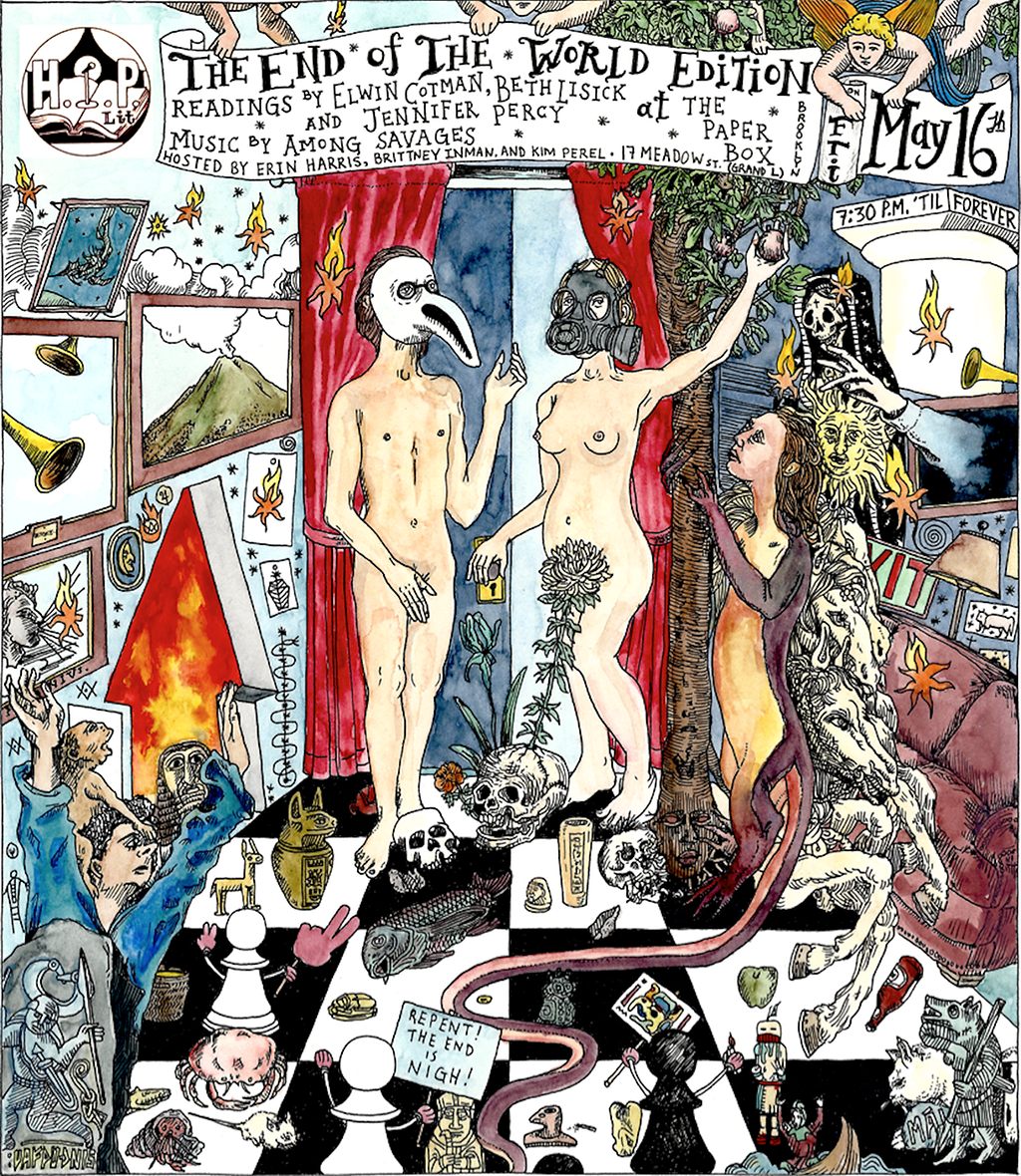
Now that we had been witnessed walking with the sheriff and our father’s body, and now that the sheriff was dead, leaving only his handsome deputy to enforce the law books, there was no point in hiding the body, and in fact it would look more suspicious to do so than not. Instead we settled on the church graveyard. (My brother said the bastard did not deserve it, and I said there was nothing special about that graveyard, that it was only dirt with lofty pretensions.) We would put him in a hole that we would dig beside our mother’s grave, which was marked by a wooden cross our father made. His plot was not marked, though it was reserved, and we did not plan to plant a cross for him.

Our mother was a mute. There are words learned people can make with their hands but she didn’t know any. Sometimes she improvised her own. The way she said she felt ill was she rubbed her belly and frowned. The way she told my brother to sing for her was she made a mouth of her hand and opened it wide. The way she begged my father to be kinder to his boys was she put her hands together like a prayer. The way she said she regretted her life choices was she looked out a window till someone asked what was wrong. The way she said “I love you” is she stroked my hair.

She was not killed by a man, but by the bad winter that followed the year of the horse thieves. It was our father found her body. He would not let us see her again until they put her in the grave, but he did describe her body. (I will not repeat it here.)

I put my shovel in the dirt and turned it over. We worked until the sun was low. We wanted all six feet. We found there was a body there already, at the bottom of our hole, in the plot that was our father’s.

I did not know the man.

My brother said, “Me neither.”
He was an older man, recently dead, with gray in his hair and mustache. He did not die before his time. He wore a vest and garters on his sleeves. His nose showed a mark where spectacles once rested, but those were lost or stolen. His eyes were still covered with dirt, as were his hands and legs. There was a red line on his throat where the skin was badly abraded. He kept a lavender square in his pocket. I wanted a lavender square of my own, but my brother climbed down in the grave and took the dead man’s, which made me think, though I no longer know my reason, that he must know what I had done to ensure he got the loaded gun.

We laid our father’s body on the stranger’s, arranging his head so that it hid that other, and likewise the shoulders, arms, and legs. We put the dirt back in. When we were done the sun was red and resting on the mountains. We saw there were two shadows watching us at the far edge of the graveyard — two slouching men in hats one size too large. I said that we should leave. My brother was not afraid; he went to them, and he became a matching shadow. I could not hear what anyone was saying. I counted to one hundred before he came back to me.

I asked him what the shadows said. I couldn’t see his face through the shadow of his hat’s brim, except for his nose’s red tip.

“They are sorry for our loss,” said my brother. “Tomorrow one of them will be dead. They are suitors to the same girl, and she cannot choose between them, so they are going to have a duel. All their friends are either disappeared or recent murder victims, so I am going to be the younger’s second. I told them you might do the same for the elder.”
The shadows waved to us across the graveyard. We brothers waved back.

My brother said, “I think it will make a good poem.”
Once I asked my father how old he was. He said, “One thousand years.” I asked him was it true. He said that if he was a liar then I had much bigger problems than I didn’t know his age. I said one thousand years seemed like forever. He said that if I could count to one thousand that same day without cheating then I could understand one thousand years. I said that I would do it. There were three distractions, however, that interrupted my count and made me forget where I was in the numbers. The first was a butterfly with yellow wings. The second was a spider on a window. The third was my father. I was somewhere in the nine hundreds. He shouted over me, “ONE THOUSAND!”

I said my number again.

“ONE THOUSAND!”

I tried again.

“ONE THOUSAND ONE THOUSAND ONE THOUSAND!” he screamed, and knelt to be closer, and held my shoulders. “I AM THE TEN-CENTURY MAN. I HAVE SEEN IT ALL. I HAVE SEEN EVERYTHING THERE IS IN ALL CREATION.”

I covered my eyes and ears as best I could with clutching hands and hunched shoulders and counted to one thousand in a whisper in my dark.

I promised myself I would die by five hundred.