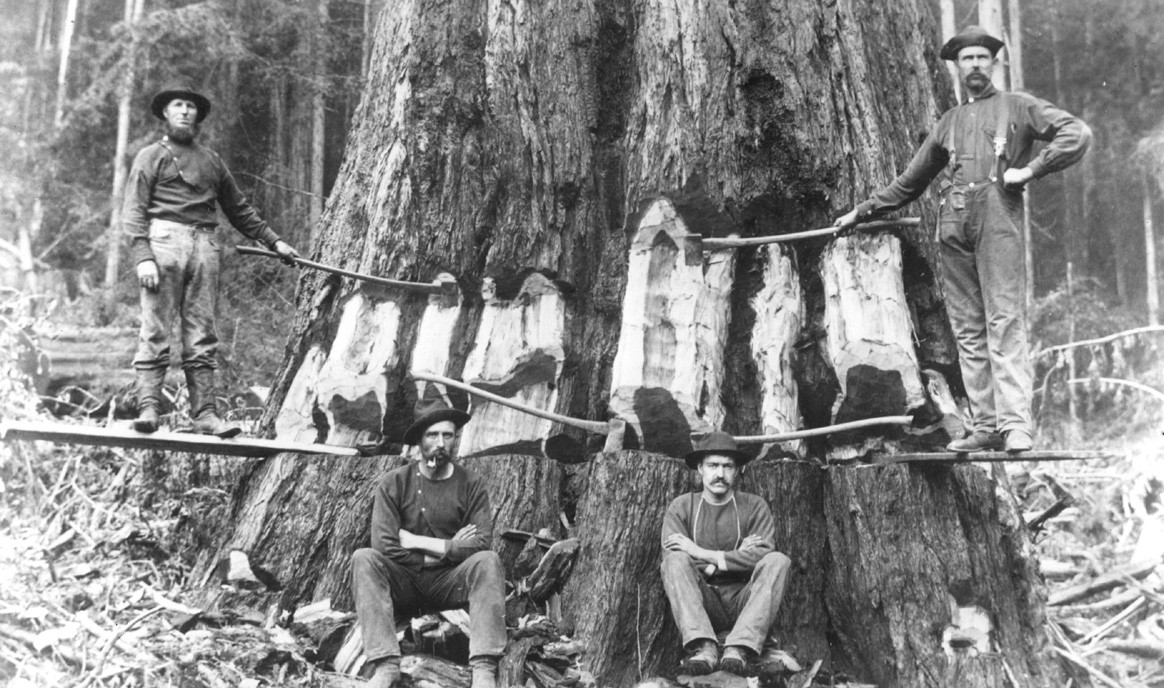
Frank didn’t want to look down at the men who’d taken bets on whether he’d fall. They were decent enough to try and hide it, palming the bills to one another when he harnessed up for his first climb. Their voices faded as he crept up the trunk, and he heard only the treetops turning in the wind, the chattering wren that cocked its head, then flew past his face.
He narrowed his mind to the work: slide the strap up the tree, drive the spikes on the soles of his cork boots into the bark, then push up with his legs. Three-quarters up was the highest he’d ever been — higher than the silo at his parents’ farm in Dry Creek — and he could see the coastline of the Olympic Peninsula and the trail of stumps that marked the logging camp’s progress through the green.
Frank tightened his grip on the strap as he neared the branches he needed to clear at the top. Then he’d have to secure the line and drop it to the foreman, Gabriel, who was straddling the roots, waiting with his hand up against the bark. He couldn’t make out Gabriel’s face anymore, but he thought he could sense him through the pith of the tree, a wavering presence like a moth flitting.Gabriel had picked him as the high rigger; Frank was the smallest man on the crew but still strong enough to split a log in one stroke. He wasn’t decided if this meant he was lucky or not.
The first branch was solid and knotty; every cut shook the tree. He moved his hands down the ax handle, leaned back in the harness, and drove the blade home. That would do her.
“Fell, ho,” he yelled.
The men on the ground spilled away from the trunk and the branch crashed down. The last branch, the topper, was reluctant to go. He swung the ax over his shoulder and it popped through his fingers like a slippery fish. Then there was only his empty hand, his palm slick with sweat. He heard the distant clunk of the ax hitting the ground and the hollers of the men. He wouldn’t look down anymore. Someone, likely short-tempered Gabriel, took an ax and whacked the tree, sending a shiver up the trunk that spooked Frank and made him lose hold until he skidded to a stop with his corks.
“Come Down in the World” is now available as a Kindle Single. To continue reading, please visit the Amazon store.
If you pay any attention to the literary world, you know that Karl Ove Knausgaard’s six volume heavily autobiographical novel is the book series everyone is talking about. The books have been so successful that publishers are scrambling to recreate their success. We’ve acquired sneak peaks at the covers of the first volumes of eight new series debuting this fall.
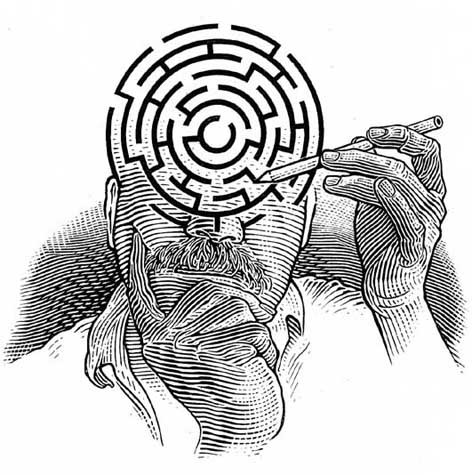
Writers have it tough. It’s not just the endless rejection letters and the slim chances of making a living from their craft — it’s also their mental health.
The idea that creative writing is linked to mental abnormality is ancient: Socrates argues in Phaedrus that poetry is a form of divine madness. The literary world has lost many of its greats to suicide: Sylvia Plath, Virginia Woolf, and David Foster Wallace, to name a few. But are writers actually more prone to mental illness — or is this a myth fueled by memorable anecdotes?
In the largest study on this question (including almost 1.2 million Swedish patients), researchers found writers to have more than double the risk of schizophrenia and bipolar disorder compared to a control group of accountants. Writers also faced a greater risk of depression, anxiety disorders, and substance abuse.
The “tortured genius” stereotype isn’t limited to writers, so the researchers looked at individuals in other “creative professions” (including artists and scientists). But artists in general were only at greater risk for bipolar disorder — and even this risk was much greater for writers specifically.
Some speculate that writers become depressed or turn to drugs because of the stresses of the writing life — constant rejection and unpredictable, usually low income.
But the Swedish study shows that other artists, who endure similar hardships, don’t suffer the same behavioral health problems.
Psychiatric diagnosis is fraught — National Institute of Mental Health Director Tom Insel, M.D., slammed the prevailing diagnostic paradigm last year for its “lack of validity” — and lack of objective, biological basis. But the Swedish researchers’ results weren’t limited to diagnostic labels: they found writers faced a 50% greater risk of suicide — and the increased risk applied even to authors who had no diagnosis at all.
The Swedish researchers offer one potential explanation for their results: social drift. Individuals with severe mental illness often have a hard time holding a steady job. Some may turn to self-employment — including in artistic fields. But it’s not clear why this should apply more to writers than to other artists.
Another possible explanation can be drawn from the theory of depressive realism, which essentially claims that depressed people are depressed because they see the world as it is — depressing. They are “sadder but wiser.” Writers have to be careful observers of human nature and society. Painters and composers can take inspiration from suffering; but writers have to: drama comes from misery — comedy, perhaps even more so. Depressive realists may often be drawn to writing for this reason.
The following mix is made up of every song mentioned in my novel, ADAM. If there’s a section where music is playing, but no song is specified, I have decided what song that should be, here.
1. Karma Police by Radiohead In the opening scene when Adam goes over to Kelsey Winslow’s house, this is the music Kelsey puts on and does a flow-y dance to prior to her and Adam getting high.
2. Rebel Girl by Bikini Kill This is the song Adam and Brad hear Casey blast from her room while making out with her girlfriend, Sam.
4. Just Let Go by Fischerspooner This is the “weird electronic music” Ethan puts on when Adam first meets him and the gang sets up their new Bushwick apartment.
5. The L Word Theme by Betty The opening credits theme song that everyone, except Adam, sings along to at the L Word party.
6. King of Carrot Flowers Pt.1 by Neutral Milk Hotel The song Ethan has too strong of an emotional reaction to when he and the others are pre-gaming at Boy Casey’s before The Hole.
7. Hey Ya! by Outkast The pounding pop music Adam hears upon first entering The Hole.
8. Speed of Sound by Coldplay The song that Luke Trevor uses in his FTM transitioning music video “Becoming Me.”
9. This is Halloween from The Nightmare Before Christmas soundtrack The tune Adam and Gillian sing “M. Night Shyamalan” to.
10. Jolene by Dolly Parton This is the song playing when Adam walks into Gillian’s bedroom for the first time.
Photo Credit: Chloe Aftel
11. 99 Problems by Jay-Z One of the songs Brad and Colin are always going around quoting like they really relate.
12. Summer in the City by The Lovin’ Spoonful From Gillian’s mix. Adam listens and imagines Gillian and him on Carlisle’s rooftop after the insanely hot day at the Gay Marriage rally.
13. How Does it Feel By Avril Lavigne From Gillian’s mix. Adam listens and imagines Gillian and him walking around the BODIES exhibit, all the stripped-raw muscle-and-bones men staring at them.
14. Several Arrows Later by Matt Pond PA From Gillian’s mix. Adam listens and thinks about how his mom, dad, Brad, everyone from is old life doesn’t understand him or want him the way Gillian does.
15. So Jealous by Tegan and Sara From Gillian’s mix. Adam listens and is filled with jealousy over anyone who has ever been or will be with Gillian.
16. Rebellion (Lies) by Arcade Fire From Gillian’s mix. Adam listens and thinks about the grand universality of lies.
17. Do You Realize?? by The Flaming Lips From Gillian’s mix. Adam listens and imagines Gillian and him having sex, and how sometimes his mind will blur out and it feels like floating in space.
18. Drive by The Cars From Gillian’s mix. Adam listens and thinks about Gillian and his unspoken, inevitable end.
19. I Want it That Way by Backstreet Boys The song Lionel wants Adam to duet with him at Karaoke.
20. Different Drum by Linda Ronstadt The song Gillian sings at Karaoke, shocking Adam with her talent and causing him to feel a sudden, desperate love and possessiveness.
21. Shameless by Ani DiFranco The song Adam and Brad sing Karaoke to with Gillian and her gang, making them probably the only two straight teenage boys in existence to belt Ani DiFranco at the top of their lungs from a stage.
22. Words and Guitar by Sleater-Kinney The music that groggy Adam wakes up to, crammed next to Riverrun in the back of Jackie’s car, on the way to Camp Trans.
23. The Life by Katastrophe The song Adam and Gillian can hear faintly playing back at the Camp Trans dance party as they have sex on the bank by the lake.
***
— Ariel Schragis the author of the graphic memoirs Awkward, Definition, Potential, and Likewise, and has written for television series for HBO and Showtime. Adam is her first novel. She lives in Brooklyn.
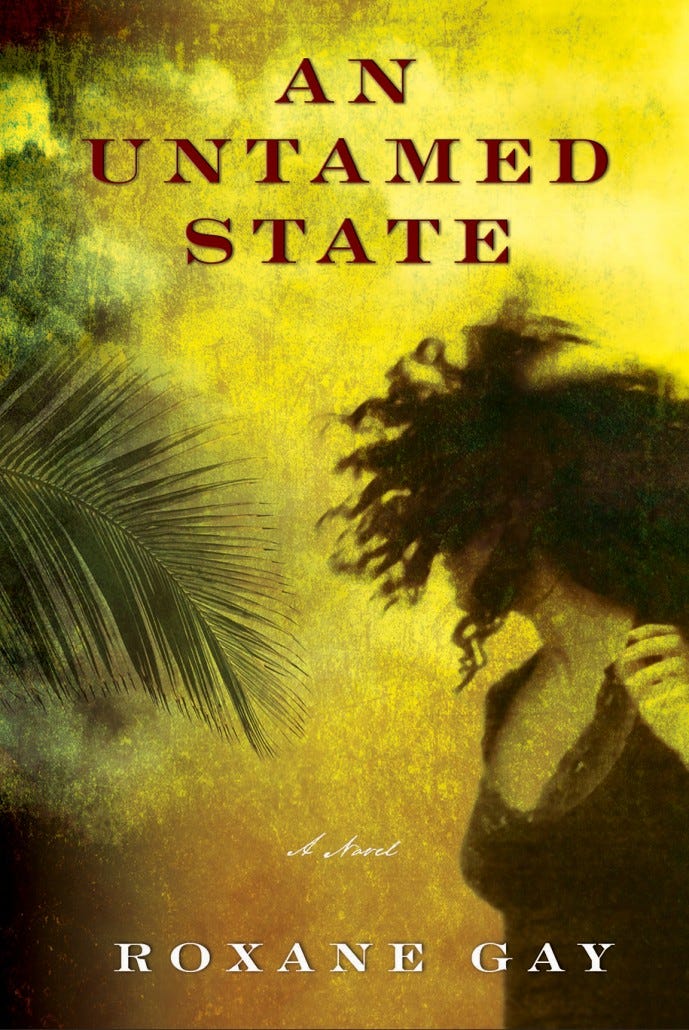
Mirielle Duval Jameson’s fairy tale life is shattered when, during a visit to Haiti, she is kidnapped. Her father, a self-made millionaire, refuses to pay the ransom. Infuriated, her captors take their revenge on Mirielle, brutalizing her past the limits of what she previously thought possible to endure. After her release, she struggles to come to grips with her father’s betrayal, with her punctured illusions of Haiti, and with reconciling who she is now with the woman she was before.
Roxane Gay’s debut novel, An Untamed State, is her second work of fiction; Ayiti, a short story and poetry collection, was released in 2011. An anthology of Gay’s essays, Bad Feminist, will be published in August. Over the past few weeks, Gay and I discussed the link between inequity and violence, its impact upon women, and the books that most challenged her.
Early in An Untamed State, Mirielle notes that “There are three Haitis — the country Americans know and the country Haitians know and the country I thought I knew.” Can you discuss the Haiti Mirielle knows? How does it compare to the Haiti you know?
Before her kidnapping, Mireille only knows a life of privilege both in the States and in Haiti. By way of her father’s success and her family’s social standing, she has been afforded every opportunity and though she isn’t spoiled she has taken a lot for granted. During and after her kidnapping, she begins to see so much of what she has, unwittingly, turned a blind eye to, circumstances that drive people to consider kidnapping a viable option.
The Haiti I know is definitely closer to the one Mireille knows before her kidnapping — one where I have had the opportunity to see the best of the country and her people, though certainly not with the same extravagance. To be clear, my novel is fiction. That said, I have always been mindful of how lucky I am as a Haitian American. As I got older, my eyes were certainly opened to the poverty far too many people in the country experience. I began to realize my family and I enjoyed a lifestyle few others were afforded and I’ve struggled with what to make of that.
Mirielle is brutalized horrifically by her captors. Why did you choose to explore this topic?
Kidnapping is a brutal crime, and certainly, what happens in An Untamed State is intense but I wanted to go there. I wanted to imagine what it would be like for Mireille to not only be kidnapped, but also suffer her father’s betrayal because that, too my mind, is the truly insurmountable trauma. There is, indeed, a lot of violence in this book but the world is a violent place and all too often, women are the victims of that violence. This does not mean that violence defines women’s lives. In this novel, violence is a symptom of a much more profound malaise.
Can you elaborate on how violence is a symptom of a more profound malaise? How is this related to inequity?
There are situations, like absolute poverty, where you feel so helpless, so unable to even conceive of how to change your circumstance, that all you can do is lash out. All you can do is give physical voice to your rage. In this novel, that is, in part, what motivates the kidnappers.
Mirielle’s father Sebastien cannot bear to allow the men who kidnapped his daughter take everything he has struggled to build. His denial of what could happen fractures his daughter so brutally that she has to forget who she is in order to survive. This ties into another theme — the price that daughters have to pay for the dreams and delusions of their fathers. Can you elaborate?
Sebastien, like the kidnappers, is also, in his way, a victim of circumstance. The poverty of his childhood has scarred him in the way that makes it possible to wait too long to secure his daughter’s freedom.
I think children often pay the price for their parents’ dreams and delusions. In this novel, it is, in part, a father’s choices that profoundly change the course of Miri’s life. I was interested in that, how the person who was supposed to have her best interest in heart, prioritized his own best interests instead.
There are also so many other fathers who have contributed to the circumstances that give rise to a place where people consider kidnapping a viable choice. I hope I acknowledged that in the writing.
During a craft talk at Atlanta’s Lost in the Letters Festival you said, “I’m a slow burner. I’ve been writing a long time.” How has time helped you develop your craft?
I’ve been writing since I was four years old. I’ve been publishing since the late 90s. It’s only in the past four or five years that I’ve been meeting with any kind of success.
Taking time has allowed me to become a much better writer and reader. I learned how to more rigorously edit myself. I mostly got over the phase of my writing life where I thought everything I wrote was perfection. Basically, I grew up and certainly I have a lot of growing yet to do.
During that same talk you encouraged writers to “read diversely in every single way, to challenge yourselves, to read outside of your comfort zone.” What books have challenged you? What would you include on your recommended reading list?
Books that have challenged me include Story of O, Deliverance, We the Animals, Notes From No Man’s Land, Maidenhead, everything Percival Everett writes… the list is long and continually evolving. I recommend reading all those books and the complete works of Zadie Smith, Meg Wolitzer, James Salter, Edith Wharton, Tayari Jones, Birds of a Lesser Paradise by Megan Mayhew Bergman, The Men We Reaped by Jesmyn Ward, and The Lover by Marguerite Duras.
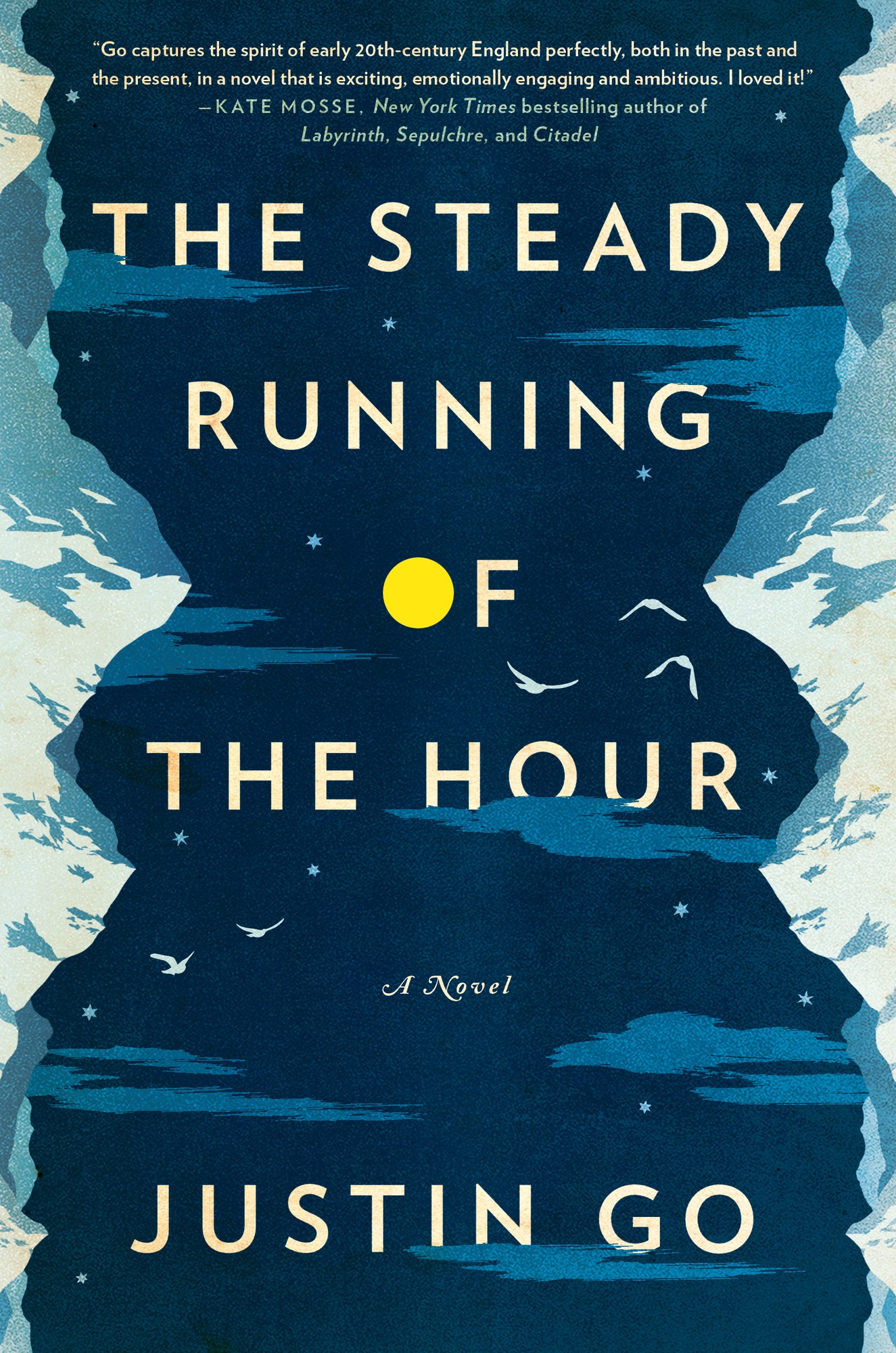
<em>The Steady Running of the Hour</em>, Justin Go’s debut novel, is an expression of love and angst
told in many locations and points of time, spanning a century and several continents. The quest begins when Tristan Campbell, a stereotypical, dissociated college grad with a fondness for heavy books and arcane history, learns he may be the sole benefactor of a vast estate by way of a complicated eighty-year trust. Dual stories are told as the book jumps between the present and the years surrounding World War I. Given slightly less than two months, Tristan takes a free ticket to Europe to unravel the past, living out of his backpack, rationing his life savings, following hunches, clues found in letters and via dumb luck.
The past centers around Ashley Walsingham, veteran of the Great War and accomplished climber, who dies in 1924 attempting to reach the summit on Mt. Everest. He is responsible for the trust in question, leaving everything to his former lover, Imogen Soames-Anderson. Imogen, stricken, betrayed, never collects. Decades later, it is Walsingham’s solicitors, as mysterious and closed as the yesteryears Tristan seeks to reveal, who uncover information suggesting Tristan’s grandmother as their natural child, making him the rightful heir. The burden of proof is his, and it comes with the unbearable weight of secrecy.
Go’s website states that
he traveled to every location included in the novel, from the fields of the Somme to the base of Mt. Everest
, proven through photographs. Like Tristan, Go risked everything to follow a dream, the dream of being a writer. The result is a sense of place that is unique in its exactitude, Southern California detailed with the same clarity as the Eastfjords of Iceland, and everywhere in-between. His research also appears beyond commendable. History’s social fabric is a viscid presence in each explored moment of time. The fervor of the Great War is felt as intimately as its understood futility. In the present, Tristan must call his girlfriend collect from a payphone, because it is 2004 and he cannot afford a cell.
The juxtaposition of climbing — the elements of raw earth and nature that remind us we are nothing except fragile beings on an indifferent planet
— with the utterly manmade brutality of warfare is brilliant. The way war affects us as a culture, collectively and individually, is as forceful as personal emotions. Tristan’s own sense of displacement mirrors many of the contemporary issues of first world liberal arts lovers. Go himself admits that he had no idea what the ending would be when he began writing and that much is clear. Sometimes a good plot requires occasional one-dimensional characters to progress. A grieving father, an unexplained stepbrother. Emotional attachment, however, demands elements of roundness, flaws and fantasy. The main characters are alive — Ashley is easy to mark, aloof, lonely; Imogen, eccentric and rash; Tristan, aimless — all except Tristan’s eventual love interest, who is flat, a dull, undeveloped blemish in an otherwise compelling and textured tale.
The diverse, geographical texture of Go’s debut makes the meat of the book itself a consummate success
— a fortune guarded by secretive lawyers; the utter disillusionment of war, portrayed in the gray tones of trenches overwrought with endless rain, colored only by blood spilt as often from machine guns as hand-to-hand combat; an impossible love; the awesome power of unforgiving rock. Time slips seamlessly between the conjoined plots, Tristan making discoveries alongside the progression of his great-grandparents’ twisted fates. In careful, eerie prose, battles are fought, hearts are broken, and mysteries unravel. The Steady Running of the Hour explores beyond the themes of survival and emotional fulfillment, and branches into how human stubbornness can create the elusiveness of both.
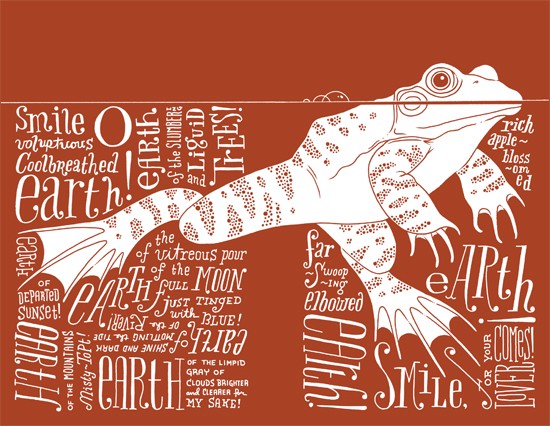
If you like poetry and gorgeous illustrations, then you’ll want to rush and check out the latest book from Tin House: Whitman Illuminated. Artist Allen Crawford turns Whitman’s epic “Song of Myself” into a book length illustrated wonder. Check out the sample images in the gallery, and buy one for your coffee table or poetry loving friend.
[Editor’s note: this article was sponsored by AbeBooks.com.]
Ten years before The Da Vinci Code was published, Arturo Perez-Reverte’s The Club Dumas came out. It follows a book dealer tasked with authenticating an antique book. While on mission he finds a pattern in the symbology which leads him into a world of secrecy and dark religious practices. (Watch what I’m doing here). The book eventually becomes Roman Polanski’s film The Ninth Gate. Which becomes The Da Vinci Code, which becomes National Treasure, and Nancy Drew is holding a kill list and training at night. While there’s nothing new about the detective novel or film adaptation, it’s worth saying plainly that artwork not only sets mood for the audience and readership; whether informing the choices characters make or foreshadowing danger looming ahead, those who skip over it or take it for granted risk donning a dunce cap as they speak up in book club.
In honor of great illustrations used in books, here’s a quick list of names and works to know.
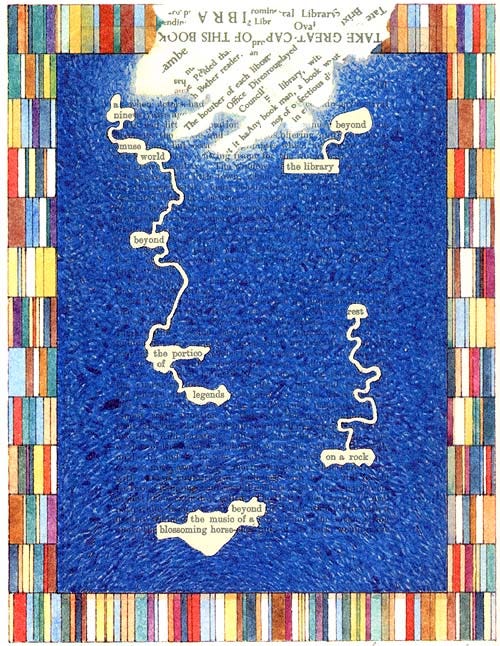
Next to the Jefferson Bible, Tom Phillips’ A Humument is one of the most famous erasures. By painting, collaging, and drawing over the pages of the W. H. Mallock’s A Human Document, Phillips made a text distinct in its own right, following a protagonist named Toge who appears, logically enough, only when the words “together” and “altogether” have presented themselves through Mallock’s original text. Readers used to staring at white space will find themselves far from home with A Humument which embeds text in illustration rather than the other way around.
We’re in a caption contest. All of us. I’m not joking. Look at Facebook. Look at memes and animated GIFs. It’s easy to be pithy, but sincerity is hard. Matt Kish has found a way. Rather than captioning pre-existing graphics, Kish has taken prose from each page of Herman Melville’s Moby Dick (and more recently Joseph Conrad’s Heart of Darkness), working on one page per day, he’s produced one illustration to match each quotation. Some think the artwork in Moby-Dick in Pictures looks a little unfinished, and maybe it does, but some see what 552 days of imagining look like on paper and feel pretty good about life.
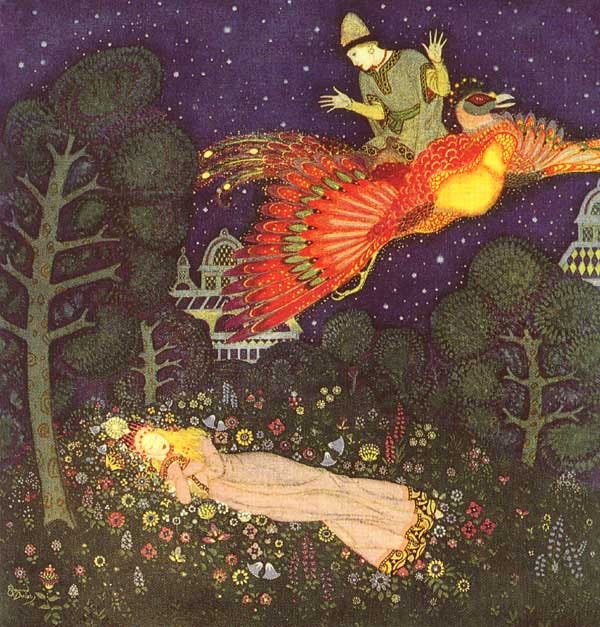
Edmund Dulac isn’t as well known as Aesop or Roald Dahl but he should be. He worked in a time known as The Golden Age of Illustration, placing work through the first half of the 20th Century in printings of Sleeping Beauty, The Stories of Hans Christian Andersen, and The Arabian Nights. He was born in France and lived in England and died in 1953 at the age of 70 at work on Milton’s Comus while Mickey Mouse danced on TV.
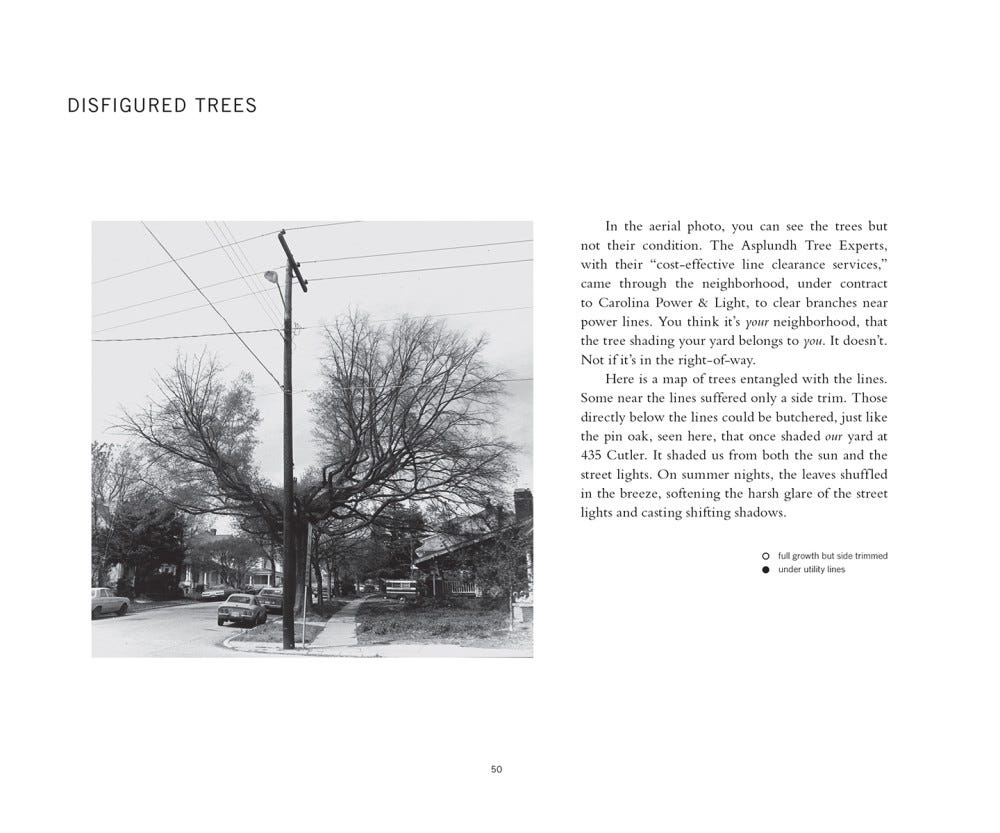
In February 2003 Colin Powell appeared at the United Nations in Midtown Manhattan and made a case for going to war in Iraq. He took with him aerial photographs which showed longitude, latitude and, through a history of regional violence, worry about weapons and the destruction they cause. In Everything Sings, Dennis Wood argues all maps are ideological and he pursues their limits and strengths across his neighborhood, Boylan Heights. In a section titled “Disfigured Trees” he writes, “In the aerial photo, you can see the trees but not their condition.” He might have cautioned the General Assembly, We can make out a payload, but not what’s inside it. In addition to weapons, he might have searched for children, jack-o’-lanterns, and the perspectives of people from the axes they walk. In February 2003, on the floor of the United Nations, Dennis Wood would have challenged not only the pixels shown on the maps but what the maps stood for.
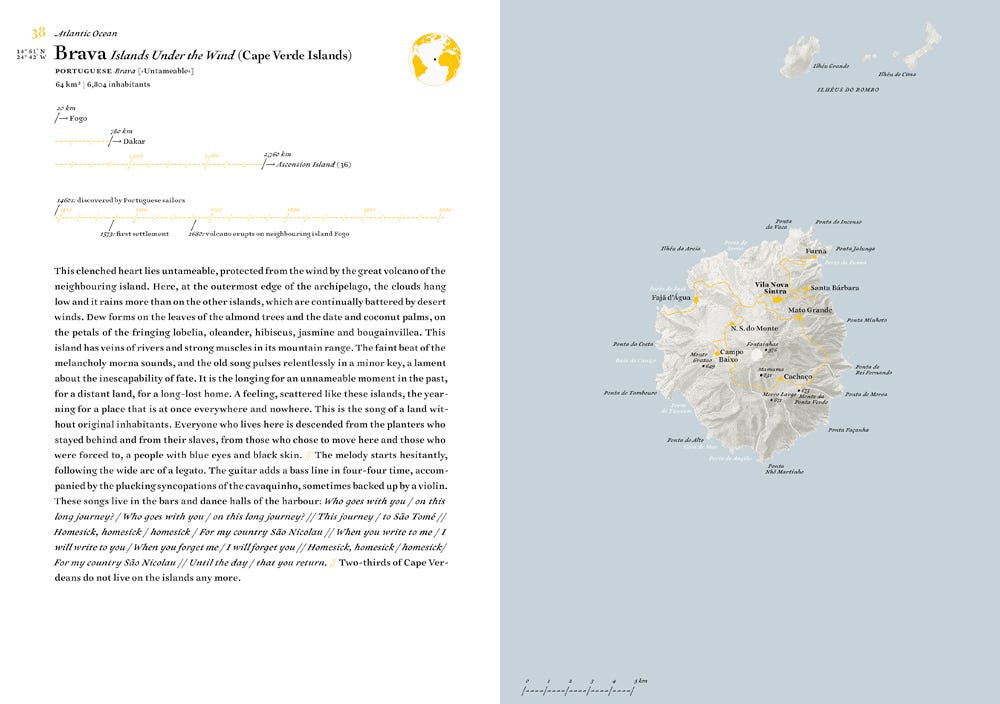
If you find comfort in Everything Sings, you’ll find the opposite in Atlas of Remote Islands. In it, Judith Schalansky covers 50 of the loneliest places on Earth. On the verso, below a time-line, and the number of inhabitants (if any), she delivers a prose poem in the present tense. There’s no room for paragraph breaks here so a double slash will have to do. On the recto, a gray mass sits adrift in blue. Each map in the book serves as a dedication to those small, boxed-off scribbles artificially drawn as afterthoughts near images of bigger masses. The maps here are planned out as part of the main event. They’re married to the prose, one map to each entry, rolling one next to the other like the animals in Noah’s Ark. The book proves that dedications, like marriages, can be lonely business.
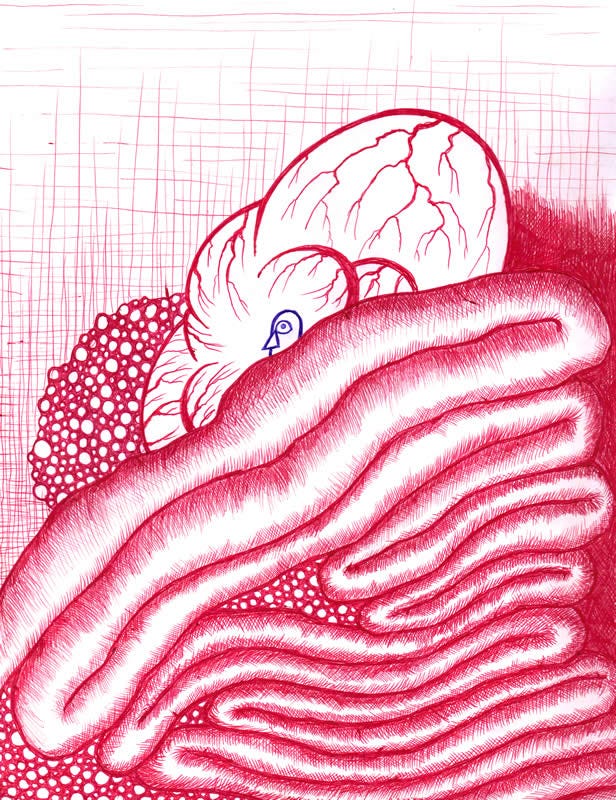
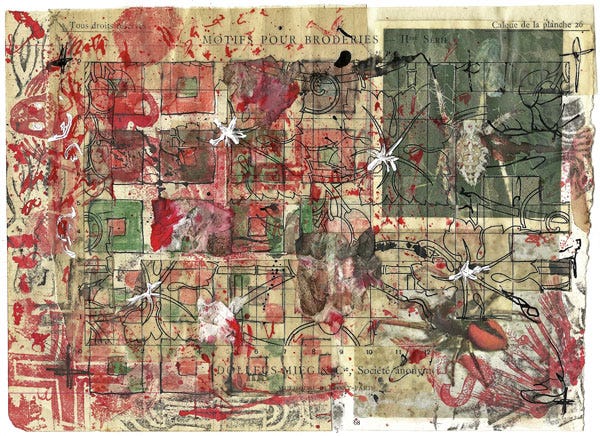
Though Calamari Press has put out some of the most interesting titles in the last decade or so, including several from Gary Lutz, Chiara Barzini’s Sister Stop Breathing is a particularly good example of the interplay between artwork and prose. The book consists of 38 short fictions but very few of them contain what normally passes for story. Most of the entries take the form of a sketch or advice, something darker than a recipe but not quite as terrorizing as a spell. For instance, the title selection opens, “What can you do if you want your sister to stop breathing?” Of course, two thirds of the pieces are matched with illustrations or what Derek White, the founder of Calamari, calls “synchronous images.” Some of the images, like the one paired with “Red Spiders,” have a link that’s obvious before reading the story. Some, like the image of hands accompanying “Vauville,” make sense only after the piece has been read. They haunt.
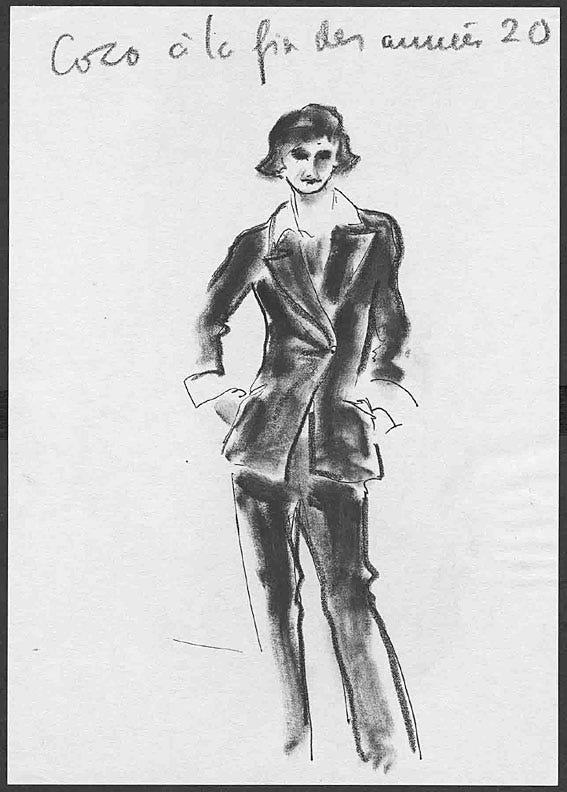
Karl Lagerfeld is known for designing haute couture for Fendi and Chanel and wearing very high collars that make him look like a sexual deviant. It turns out that at least one of those things relies on drawing well. After releasing The Allure of Chanelin 2008, Puhskin Press has recently released a deluxe version of Coco Chanel’s life story as told by Paul Morand, which includes illustrations by Lagerfeld that do justice to the term sketch. They look like they were made quickly with the aim of suggesting more than what’s there. You can conjure fabric if you like or enjoy them as is. Apparently the man has more than a few tricks up his sleeve. Maybe a few under his collar.
Calling Bianca Stone an artist is like calling Deion Sanders an athlete; she’s got game in different fields. Having penned and illustrated several chapbooks, she’s also collaborated with Anne Carson to produce Antigonick(which the above image is taken from), and recently released a book of poetry called Someone Else’s WeddingVows. She also so happens to have produced the Single-Sentence Animation for A-J Aronstein’s “Flower Box.” She can probably disarm a bomb blindfolded and dunk on you too. Only time and Bond villains will tell.
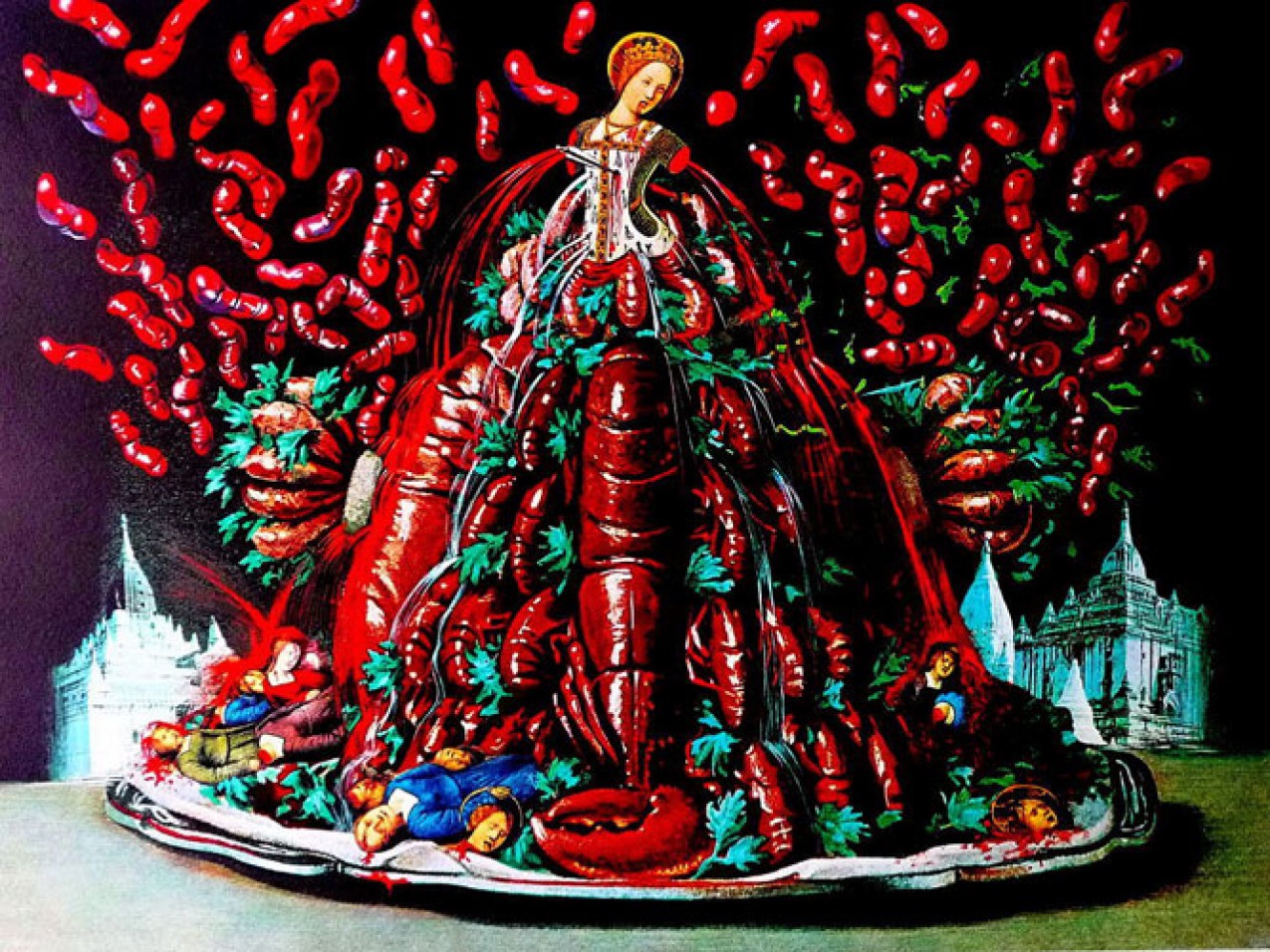
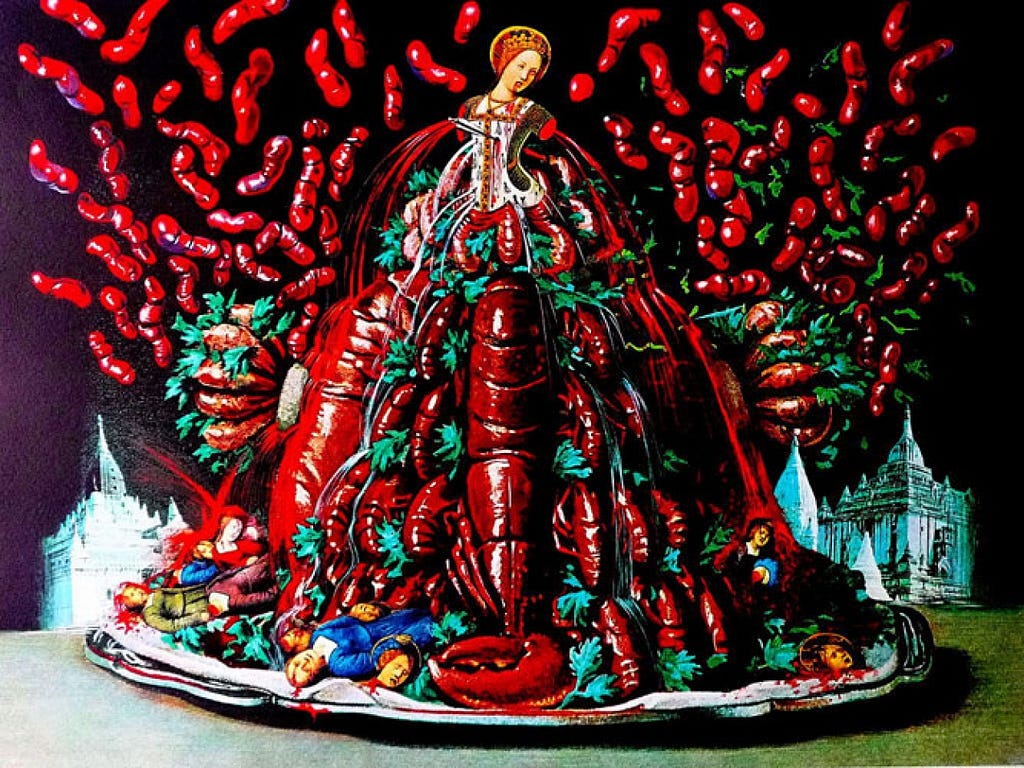
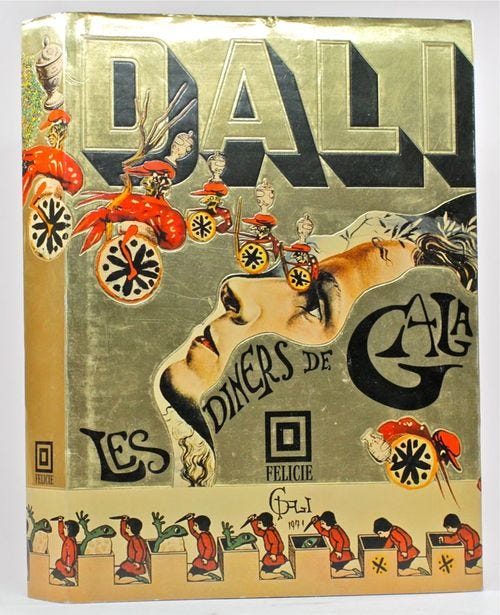
Though it’s not the first thing that comes to mind when one thinks Salvador Dali, he illustrated plenty of book covers and not only his own. Prior to being pigeonholed as the premier posterist for freshman dorm rooms, his illustrations were placed on the covers of books by such greats as Dante Alighieri and William Shakespeare. It turns out that, even in art, across centuries and centuries, the cool kids really do hang together.
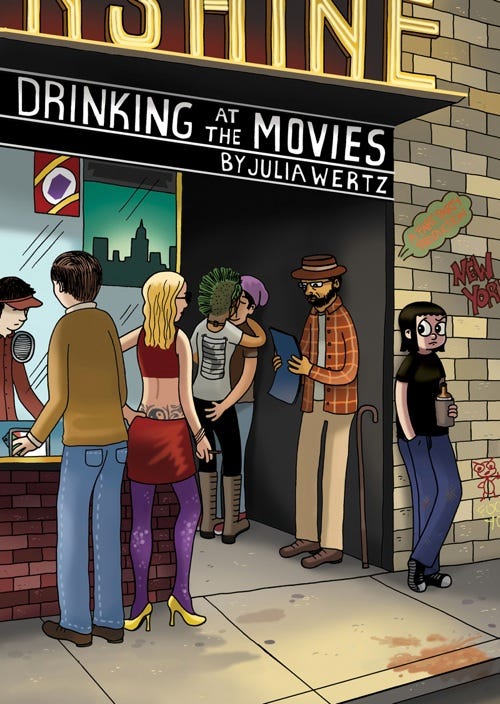
Julia Wertz, I bet you never thought you’d follow Salvador Dali on a list, but if there are things to learn from Drinking at the Movies or this article, they’re a) that you often make errors in judgment and b) that I can address an author directly even if I’ve never met her. Let’s add to that c) you draw pretty damn well and d) even though you have a bad mouth, a memoir in comics can be pretty poignant.
Submissions are open for Electric Literature’s Recommended Reading, but they close June 1st. Send those stories in!
Recommended Reading, a magazine by Electric Literature, publishes one story a week, each chosen by today’s best authors and editors. Though Recommended Reading features original fiction as well as reprints, we will only consider previously unpublished stories during our spring submission period.
Before submitting, please take some time to read Recommended Reading, especially those recommended by Electric Literature, in which we showcase original fiction. Recommended Reading publishes fiction ranging in length from 2,000 to 10,000 words, and pays each contributor $300. We accept simultaneous submissions, but if your story is accepted elsewhere, please withdraw it immediately through the Submittable system. We can only consider one story by an author at any given time.”
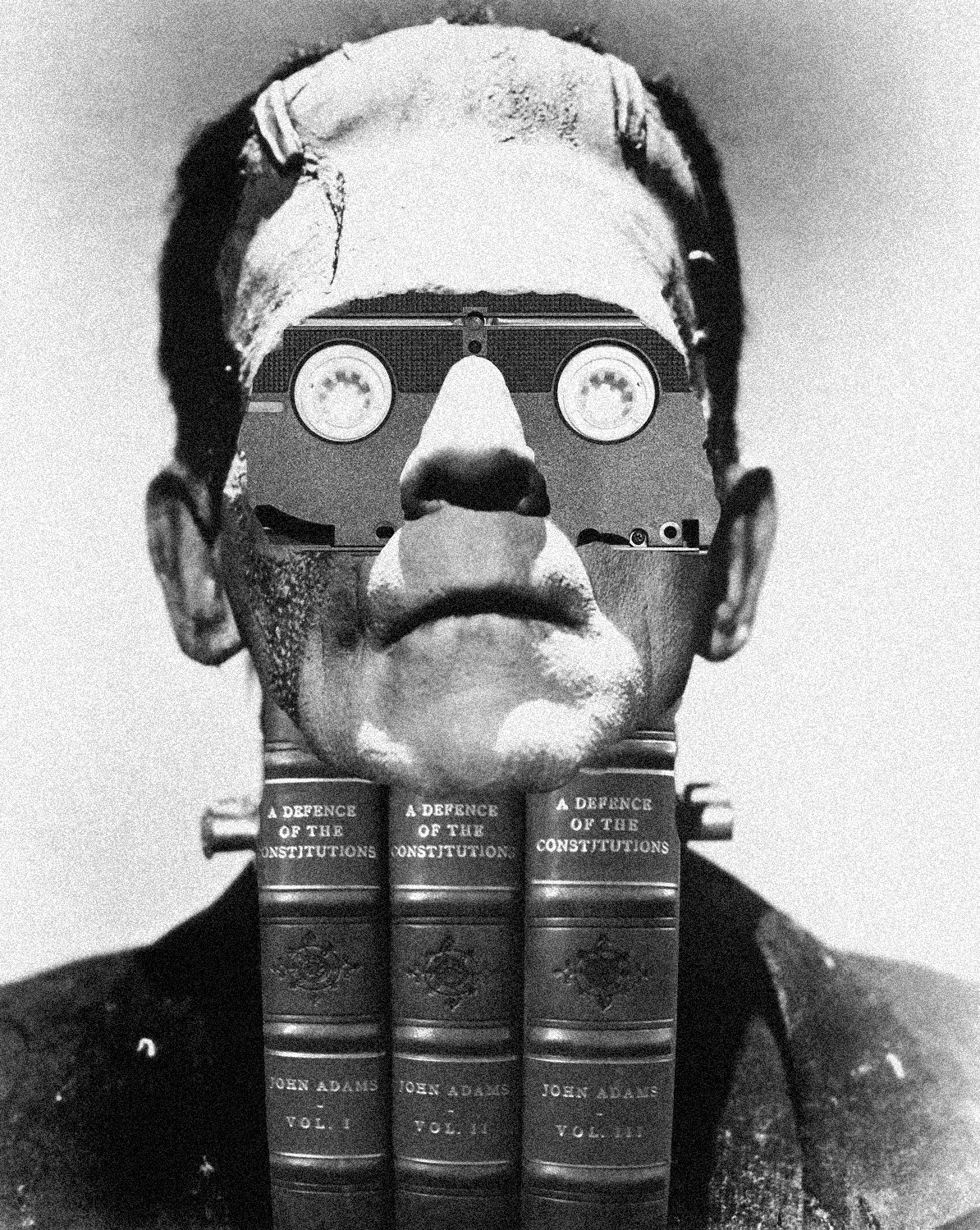
A Monstrous Primer: In Frankenstein (1818), Mary Shelley has Victor Frankenstein say the following about the creature he has labored among “the unhallowed damps of the grave” to create: “How can I describe my emotions at this catastrophe, or how delineate the wretch whom with such infinite pains and care I had endeavored to form? His limbs were in proportion and I had selected his features as beautiful. Beautiful! — Great God! His yellow skin scarcely covered the work of muscles and arteries beneath; his hair was of a lustrous black, and flowing; his teeth of a pearly whiteness; but these luxuriances only formed a more horrid contrast with his watery eyes, that seemed almost of the same color as the dun white sockets in which they were set, his shriveled complexion, and straight black lips.” As soon as the doctor has glimpsed his creation, he can no more regard its components as separate; much like the life he calls down from the sky to make his creature walk and breathe, the creature’s physiognomy is elemental and eternal. And so if “all mankind is of one author and is one volume,” as John Donne says, we at Electric Literature believe that all art is part of the same monstrous body, disparate yet complementary. In that spirit, this biweekly column will devote itself to illuminating the gorgeous and grotesque connections between outwardly different works of art, organized around a theme. The column means to recommend an aesthetic experience to the reader. She might, for example, read the book while listening to the record and then watch the movie. Or abide with the catalog raisonné while listening to the record before watching the movie and reading the book — in any order she so chooses. The Head, the Torso and the Legs will go to make the creature whole. Alternative Cuts, every posting, will follow.
Media Frankenstein #1: Manmade Apocalypse
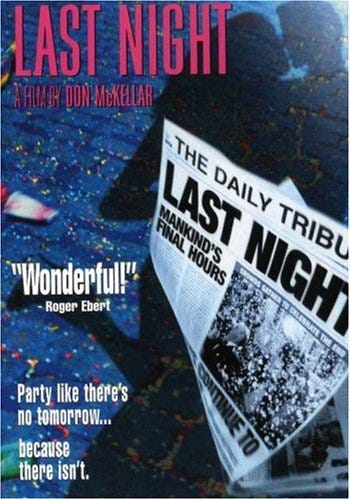
THE HEAD: Last Night, dir. Don McKellar (1998)
What if you knew the precise date and time that the world as you know it would cease to exist?
Would you spend your last hours on this earth with your loved ones, staging a drear and unseasonal Christmas? Or crossing off acts on your sex bucket-list like bedding your high school French teacher, perhaps, or a middle-aged virgin you picked up online? Would you run blood-drunk through the streets, shooting down strangers and toppling buses? Or would you relax in a chair on your roof with an old record player and a glass of red wine, cherishing the solitude we carry with us always, acknowledging solitude, making it yours? Such are the circumstances of Canadian director Don McKellar’s wonderfully subversive and curiously warm pre-apocalyptic film Last Night, which boasts a stellar indie cast the
likes of Sandra Oh, Sarah Polley and body-horror auteur David Cronenberg, who plays a power-company owner calling all of his customers (and many of the film’s characters) to console them: “I hope you’re doing well and spending these final hours in peace with your loved ones. Rest assured that we will make every effort to keep the gas flowing right until the end.” Herein lies the film’s tenderhearted gallows humor, which only grows more wrenching the closer we get to the final countdown. Every character’s leave-taking of another is weighted with agonizing foredoom, including a scene in which one male bro-friend rejects the sexual advances of his pal before saying: “See ya.” The pal’s response: “No you won’t.” In many ways it’s the film’s glib comedy juxtaposed with its unrepentant darkness that hits the viewer so hard, utilizing the funny/sad dichotomy of authors such as George Saunders and filmmakers such as Bobcat Goldthwait. By default the film’s characters are resigned, and yet their behaviors and choices belie them; with a couple exceptions, they’re terribly hopeful. And although, as in many of the best end-times narratives (see Cormac McCarthy’s The Road), we never get the precise reason for the world’s demise, by the end of the film that reason seems ultimately so far from the point that maybe we’re better off not knowing. We make our own apocalypse, regardless of whether or not we have caused it.
THE TORSO: Godspeed You! Black Emperor’s F ♯ A ♯ ∞ (1997)
It should come as little surprise that a heavily modified cut of the track “East Hastings” taken from Godspeed You! Black Emperor’s first record F ♯ A ♯ ∞ (pronounced: “F sharp, A sharp, Infinity”) is not only from a Canadian band, but also features in the beginning of Danny Boyle’s meth-zombie opera 28 Days Later (2002), in the scene where Cillian Murphy shambles in disbelief through the streets of an abandoned London. The scene is telling of the existential melancholy at the heart of the record, itself a sort of paean to the end-times — not before the last hour or in those that stretch after, but as the end is going down. Following in the footsteps of Mogwai and Rodan, the Montreal-based post-rock band Godspeed You! Black Emperor summons nothing less than a glockenspiel, horn, violin, slide guitar, Swans-esque industrial clamor and loop tracks of a raving messianic street preacher to do its business over the course of a full hour and change. The first track “Dead Flag Blues” begins with the voice of a man intoning over string instruments: “The car’s on fire and there’s no driver at the wheel. And the sewers are all muddled with a thousand lonely suicides. And a dark wind blows.” He goes on to say: “The skyline was beautiful on fire. All twisting metal stretching upwards. Everything washed in a thin orange haze.” You might be reading Baudelaire. Until the first “movement” dissolves — Godspeed writes not songs, but movements — and the music ascends, quiets down, ripples outward, before rising again in a fog of reverb; becomes the only thing you hear (if you are listening to it right). The universe’s entropy begins to swirl around your head. Yet much as in the film Last Night, the music is never all dark as with Swans or Godspeed’s electrified cousin Neurosis, but spry and orchestral and cautiously mournful, a last living wake for a vanishing world.
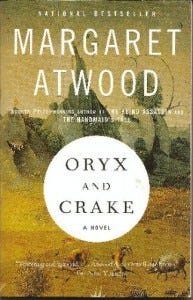
THE LEGS: Oryx & Crake by Margaret Atwood (2003)
If Last Night evokes the pre-apocalyptic world and Godspeed’s F ♯ A ♯ ∞ the apocalypse itself then Oryx & Crake, the first novel in fellow-Canadian Margaret Atwood’s MaddAddam Trilogy, takes us on a final descent into darkness, the world in the wake of extended decay. The novel centers around a character named Snowman, formerly Jimmy, who after years of living ferally among the wastes of what used to be planet earth has come to resemble a sort of Bigfoot, prolifically hairy, covered in superannuated bug-bites and clothed in a “dirty bedsheet,” yet also sporting such remnants of civilization as a watch that no longer ticks and an “authentic-replica Red Sox baseball hat.” Moving back and forth in time between Snowman’s attempts in the present to navigate a world populated only by genetic splices (Pigoons, Wolvogs, Rakunks and a breed of uncanny, lab-grown humans called Crakers), and the doomsday-precipitating events that took place in the past among Snowman himself, an enigmatic girl named Oryx and a sociopathic prodigy named Crake, the novel establishes a direct correlation between the Then and the Now, the World and the not-World, which is nothing if not chilling in its oblique resemblance to what will probably go down within the next century or so if we don’t get our shit together quick. Yet in spite of its vibrant colors and charnel-house comedy, Oryx & Crake may be one of the bleakest eschatological narratives ever penned, bleaker even than McCarthy’s The Road (a book which contains more than its own fair share of cautious optimism), though both books are creation myths. Snowman, its hero, is wholly alone, foraging among the ruins: “[Snowman] scans the horizon, using his one sunglassed eye: nothing. The sea is hot metal, the sky a bleached blue, except for the hole burnt in it by the sun. Everything is so empty. Water, sand, sky, trees, fragments of past time. Nobody to hear him. ‘Crake!’ he yells. ‘Asshole! Shit for brains!’ … No answer, which isn’t surprising. Only the waves, wish-wash, wish-wash. He wipes his fist across his face, across the grime and tears and snot and the derelict’s whiskers and sticky mango juice. ‘Snowman, Snowman,’ he says. ‘Get a life.’” And while the mystery of how Snowman is able to survive the apocalypse, not to mention the reason the world has to end Atwood by and by reveals, such answers do nothing to alleviate either the reader or Snowman’s existential terror in the face of a barren eternity. Yet Snowman continues to stockpile supplies, to curse his scorched, unlucky stars, to teach the Crakers what he knows, “pedagogue, soothsayer and benevolent uncle.”
What <em>Last Night, </em>F ♯ A ♯ ∞, and <em>Oryx & Crake </em>all seem to be suggesting, apart from a gleefully mordant brand of Canadian fatalism, is the tragedy not that the world has to end, or that when it does we will likely have caused it but the tragedy, rather, that we as a species will be compelled to soldier on.
The human comedy plays out, whether or not we are actively laughing.
Alternative Cuts:
(The Hunger Games Trilogy by Suzanne Collins; The Pixies’ Doolittle (1998); A Boy and His Dog, dir. L.Q. Jones (1975))
(The Road by Cormac McCarthy (2006); Igor Stravinsky’s The Rites of Spring; Goya’s “black paintings”)
(Pastoralia by George Saunders (2001); Miracle Mile dir. Steve de Jarnett (1988); Deltron 3030’s City Rising from the Ashes EP (2013)
(Zone One by Colson Whitehead (2011); 28 Days Later dir. Danny Boyle (2002); The Misfits’ Earth A.D./Wolf’s Blood (1983)
In Two Weeks: Ghostbusters
DON’T MISS OUT
Sign up for our newsletter to get submission announcements and stay on top of our best work.
YOUR INBOX IS LIT
Enjoy strange, diverting work from The Commuter on Mondays, absorbing fiction from Recommended Reading on Wednesdays, and a roundup of our best work of the week on Fridays. Personalize your subscription preferences here.