Dispatches from the Road: Made to Break NorCal

3/5

I’m nine days into my tour now, but it feels like ninety.

Probably this wouldn’t be the case had I not hit the four-day extravaganza that was AWP, though I wouldn’t know, because I’ve never been on a book tour, much less a book tour across and around the country. My fatigue this morning might also derive from the workout yesterday with my North-West tour pal, Cari Luna: a five-hour drive from Vancouver to Olympia, from which, after the debacle at Orca Books, we drove (thank God we ditched that town) two more hours to Cari’s home in Portland, where she and her family (husband and two fantastic kids) were gracious enough to host me that night. But waking up after insufficient sleep in the strangeness of her boy’s room — surrounded by superhero action figures and model ships, her boy’s many drawings and Vietnamese kites — might have something to do with my fatigue, as well. The unknown is crafty. Strangeness, like a needy dog, won’t let you be. And while strangers need less than family and good friends, they need something family and good friends often don’t, the courtesy to meet them, a formal thoughtfulness and attentiveness without which the world might very well end. Take away the familiar, I’m learning afresh, and the energy that gets you through it isn’t half enough.

But it doesn’t matter how beat I am. I’ve got work to do, and in spades: checking in with my future hosts; completing written interviews; corresponding with the writers I’ll soon be reading and conversing with; re-reading their books in preparation for those conversations; knocking out the grant-writing work that pays my rent; composing an update for the Indiegogo campaign I’m running to help fund my tour; doctoring the pictures I’ve been snapping; networking via social media; and so on and so forth — none of it seems to end . . .

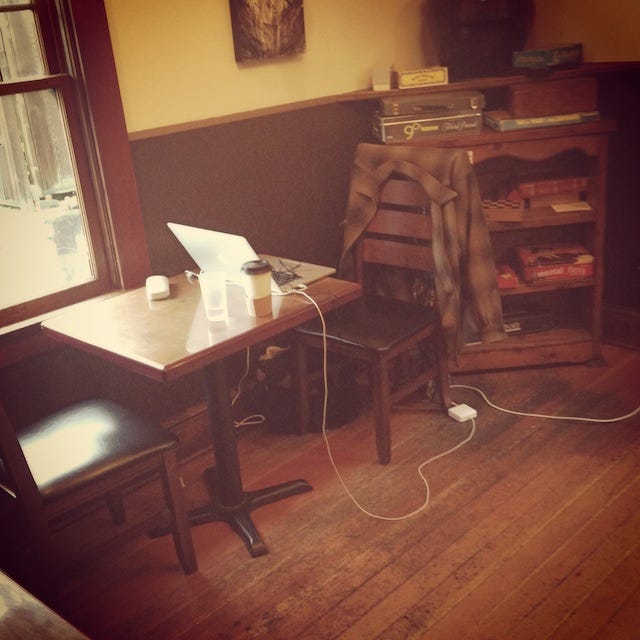
After introducing me to the four chickens she and her family keep in their back yard, Cari sends me to her favorite haunt in South-East Portland, a house that was converted into The Rocking Frog Café, famous for the donuts it makes to order. I drink copious amounts of coffee in a quiet room and attend to my work, then, hours later, drive crosstown through the rain to Charlie’s, my host for the next two nights.

IMG_2641

Charlie is a landscape architect and designer and builder of ponds for koi. His home, which he brought back alone from near collapse, is both peaceful and gorgeous — like Charlie himself, a consummate human being — so very much what I’ve needed. Charlie sees my state. Solitude and rest are in order, he knows, and he gives them to me gently, along with great comfort: a queen-sized bed appointed with the camel hair blanket under which I nap for two-and-a-half hours . . . I wake up with a start, though, believing myself late for a reading, only to realize with relief that for the first time since I left home, I’ve no obligation for the rest of the night to any but myself. I eat Charlie’s homemade chili with tortillas then drive to the store for a piece of cheesecake.

3/6

Most of today I spend re-reading Christian Kiefer’s gorgeous book, The Infinite Tides.

IMG_2623

In the afternoon, however, I take a long shower, groom a bit more than usual, and roll into town to eat dinner before the reading at Powell’s, my first solo gig ever — as in, I’m the only reader, it’s just me reading, and when I’m through Cari Luna’s going to ask me questions about my book, because — purportedly, anyway, on the face of it, anyway — I’m an interesting enough guy that, first, someone would want to talk to me, and, second, that someone would want to listen to someone talk to me — whoa! — an audience, in other words, is coming specifically to hear me read a book I wrote and answer questions about me and the book I wrote, and that is really weird, that is really freaky, I am like totally wacked, in other words, way the fuck out.

IMG_2640

That I’m a published author, now, with an honest-to-goodness book out in the world, that people are paying money for, strikes me here for the first time in a way I haven’t anticipated. I’ve worked a long time for this moment, and now the moment doesn’t seem part of this world. I can’t go on, I must go on, I can’t go on . . .

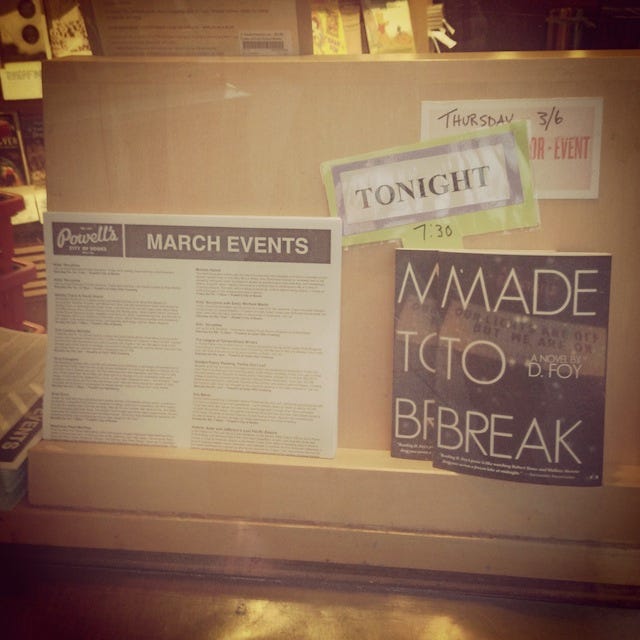
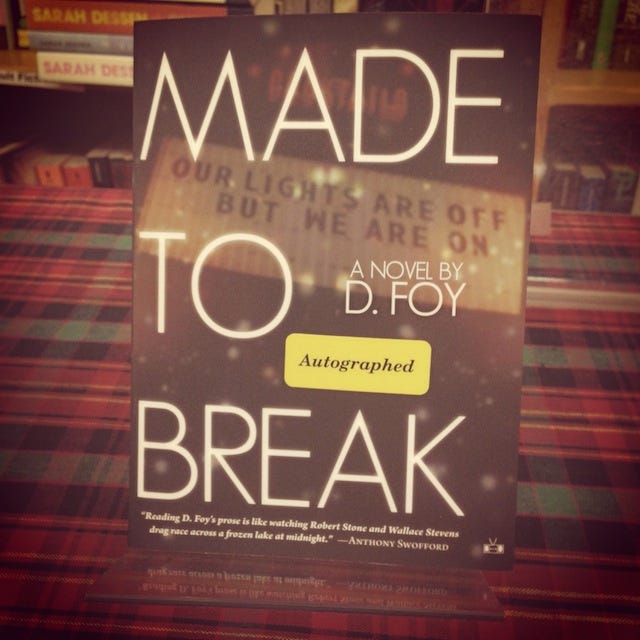
At Powell’s, my book’s on display in the front window, together with the store’s events calendar, yet another surreal moment. And hardly have I got past that surprise than Jeremy, the events coordinator, greets me with what has always been to my mind the sort of respect an author on his book tour should command. He shows me round the store, then tells John, the barista in the store’s café, to make sure I get whatever I need, on the house, which John does with genuine cheer.

IMG_2638

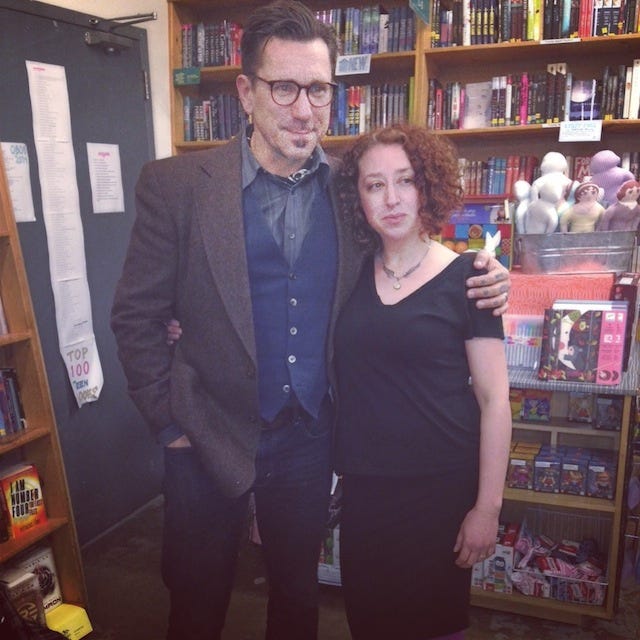
The reading and conversation are incredible, as well. An audience is there. The audience consists of living people. These people, moreover, dig my read and applaud unreservedly. And Cari, too, dressed to the nines, is a champion, asking me a number of questions that reflect insight, thoughtfulness, and care. When we’re finished talking, and I’ve fielded questions from the audience, people buy my book, and I sign them, yet another instance I’ve not anticipated will feel as alien as it does.

IMG_2643
IMG_2642

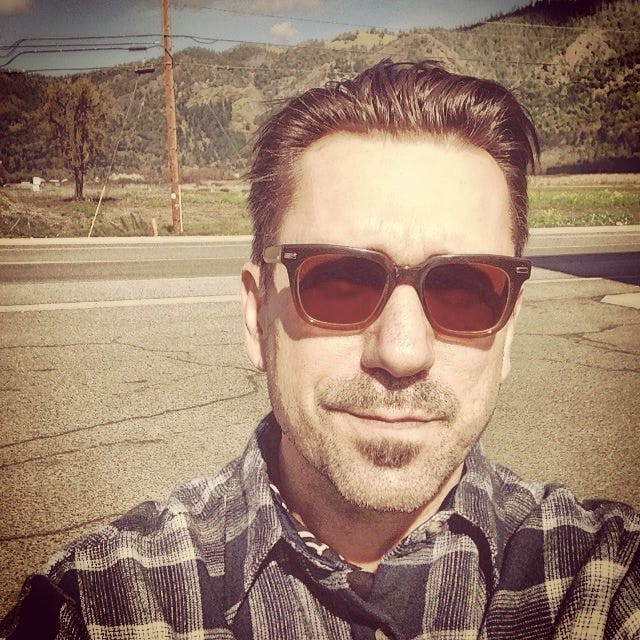
Then comes the moment, later, as we’re leaving, that Cari’s friend tells her I look like “a dirty Don Draper.” Wha??? Told Goldberg had said something similar when introducing me for a read at AWP, and now this. I can’t understand it, this comparison, not at all. It doesn’t matter, though, whether I understand, does it? It must be a thing. It is a thing. I know it is, because more people in the days to come, unrelated to the people before, will continue to connect me in some form or other to Don Draper. A guy can’t make up his own nickname, I think. There’s nothing to do but take it.

3/7

This marks the first day I’m on my own for the rest of my tour, another solid month of driving town-to-town across the country before anything like a breather comes. Today I’ve got an eleven-hour haul — 607 miles — from Portland to Oakland, where I’ll sojourn for a night with Megan, a dancer, choreographer, and professor at USF who’s a friend and colleague of my wife, Jeanine, and then with two other friends, and then at an Airbnb. But this isn’t just the first day on my own. It’s the first day I’ve had a moment to reflect with any concentration on the magnitude of my endeavor.

IMG_2639
IMG_2618
IMG_2622

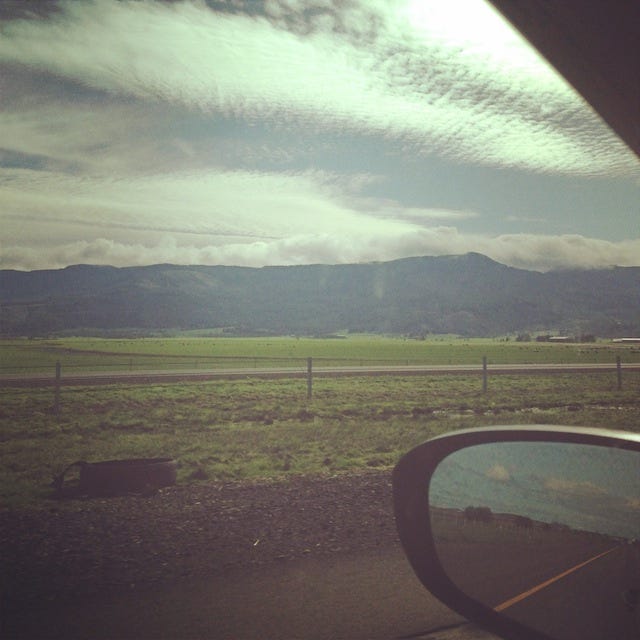
Down the I-5, in NorCal, now, I’m crushed with emotion. I grew up in Oakland, and together with Berkeley and San Francisco, these are my stomping grounds, these are the places I lived and loved and broke and robbed and fretted and wept and howled for most of what I remember as a life of hardship and cruelty and despair, the places I left at the end of all that, at the start of 2003, in a state very near to disgrace and definitely one of madness. But now I realize: I’m going home, I’m in the midst of what we call a homecoming. And yet it’s not in disgrace that I return, nor is it in triumph, either, as it were, but rather, simply, in good standing. I’ve changed my life. I’m not the man I was. And, for all that it’s worth, I’m true. The mist of nostalgia had begun to gather round me in the south of Oregon. I sense this mist as I move south without placing it and feel the intensity of its creep, but it isn’t until I spy for the first time, in the far distance, peeking through the corridor of canyons and trees, the enormity that is Mt. Shasta, perennially snowcapped at over 14,000 feet and fraught with so much personal history.

As a teenager, and then as a young man, I spent many summers backpacking in the mountains of this country. Even before I had a car I’d take Greyhound busses up here, or hitchhike up to the town of Mt Shasta, then hitchhike again out to the trailheads themselves, from which I’d set off alone into the mountains for five to ten days at a stretch with just my flyrod and pack and for company a bottle of booze and bag of weed. The only other place I loved as much back then was Yosemite. Now, seeing the mountain again, from this vantage, I’m cracked hard with this thing, it smashes me hard like an anvil from the sky — knowledge, certain, clear, profound: this country has been my salvation, this country has saved me, many, many times, when I was a boy, and when I was a man, as well.

The last time it saved me, I’d gone to the mountain itself, or to the monastery at its foot, Shasta Abbey, in the fall of 2002, groping my way through an immensity of loss. Another marriage was destroyed. I was penniless and sick and bereft of all but the loyalist or stupidest of family and friends, and I was a few months shy of losing my mind. The mountain saved me, though, the monastery saved me, what I learned in the monastery, what I saw in the monastery, it all saved me, though I didn’t know it then, and wouldn’t for some time, the way I do now, for instance — again — and I know it now with the conviction of ancient, ancient stars. I’m not coming home merely to a place. I’m coming home to a life, which, patient as Penelope, knowing me better than I’ve known myself, has been waiting all these years, sentinelian at the door, knowing I’d come home, and more, knowing I’ve known, too, however lost, however much confused. I’ve been freed of the old shackles, I realize. I’ve been purged of the ghosts. I’m coming home, now, in clarity and relief, to a life and to myself. Old friends are waiting. New friends stand close by. I gaze in awe at the mountain in the distance, rising from the northern plain, magnificent in its solitude. The mountain never moves — it is a mountain — and yet, I also know, held up by the sky itself, the mountain does nothing ever but move, walking on with the rest, stone by stone, pebble by pebble with the rivers to the sea — it is the way. Satisfaction courses through me. The purest of joys courses through me. I’m filled past sense with more than I can speak, with sadness, too, I realize, with the memories of shame and the memories of days no deeds can repair, and with relief, as well, that those days are far behind me, now, I’m myself, now, I am myself, and I am good.

The mountain rolls by. The miles roll by. Familiarity surges through me, the pull of days gone by, and soon I’m in the midst of traffic on I-80, the bay to my right, the bridge across it through the distance, into Treasure Island, on to the city of Kerouac and Bierce, and the city of London is nearby, too, Oaktown, my old familiar, and now the traffic thins, now I leave the big road for smaller roads, I’m in the city now, College Avenue in Rockridge, just south of Berkeley, where I became a writer and went to school, it’s dusk already, this day’s gone, too, I’m hungry among my old haunts, there’s a place I loved, I can’t believe it’s yet there, unchanged after years, Cactus Taqueria, and I go in and eat a meal before heading on to Megan’s place around the corner, the comfort of her generosity and kindness, a stranger before and now a new friend. It’s true, I know, I’m a writer. And this is the life I’ve been given, this is the life I’ve made. Offer me anything different, and I promise, I’ll refuse.

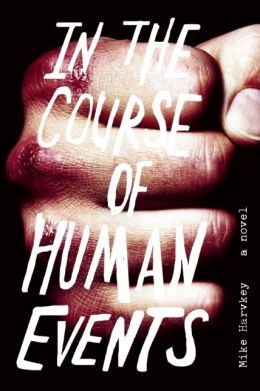
REVIEW: In the Course of Human Events by Mike Harvkey

by Benjamin Rybeck

“We be okay. This be America, man.”

This dialogue arrives 259 pages into Mike Harvkey’s In the Course of Human Events, and it’s the first time in the novel that anyone expresses any faith whatsoever in the United States. Granted, the minor character that speaks these words does so ironically: as an illegal immigrant, he has little reason to feel optimistic about his adopted country’s plans for him (especially since he utters this line of dialogue in a conversation about dealing crystal meth). But it’s at least a step beyond the novel’s earlier pages, which describe the setting — a small Missouri town — as “the town the American Dream forgot.”

Certainly the American Dream seems to have forgotten the novel’s protagonist, Clyde Twitty.

The factory where he used to work has closed. He makes a pittance occasionally driving cars to auctions. Later he gets a part-time job at Walmart, but it’s not enough, and he wonders, “How did this math make sense to anybody? Prices kept going up when the salary went down…” He’s past due on his mortgage and owes the government money from a years-old tax mistake (not his fault). Clyde seems so put-upon (or beaten “down in ways he didn’t even know,” as Harvkey’s third-person narrator reveals in a rare moment of psychic distance) that he seems much older than twenty, but he also has no expectation that his life will change. Instead, he looks at his economic circumstances, the result of a vast network of problems, and he boils it down to one sarcastic remark: “Thank you, Obama.”

Into Clyde’s life comes the Smalls family, which lives in a model house on otherwise undeveloped land. Tina, the family’s daughter, takes a special interest in Clyde: a budding entrepreneur, she first tries to pitch Clyde shampoo, and later tries to pitch herself as a girlfriend. (These scenes are farcical, with comic timing worthy of the Marx Brothers.) But it’s the family patriarch, Jay, in whom Clyde has the strongest interest. Jay teaches karate classes and invites Clyde to attend, drawing him into the family.

“Modern man is stuck in a rut,”

Jay tells him. “We been castrated. By society, by our wives, our mommies, our job.” Clyde is a young man full of misdirected rage, who feels like his masculinity is under assault from every direction. Before meeting Jay, Clyde never had anyone tell him that he’s worth a damn. “No one had ever seen into [Clyde] so clearly before,” Harvkey writes, and Clyde is seduced, so much so that he doesn’t worry much about Jay’s racist rants, or his assault weapons, or his paranoia about the FBI, or the book he reveres — The Turner Diaries, by William Luther Pierce (as Andrew Macdonald), which has counted Timothy McVeigh among its biggest fans.

In the Course of Human Events is a novel written out of anger

— anger that’s as far-reaching, though not as misdirected, as Clyde’s. Harvkey indicts a vast array of anti-government people: not only birthers and Tea Party-ers, but also men like Clive Bundy, or Alex Jones, who believe that grazing fees, or mandatory background checks for firearm purchases, are examples of governmental overreach. For Harvkey, Jay Smalls — assembling a group of warriors, fearful that President Obama and the federal government are advocating an anti-white agenda — represents a bouquet of America’s pernicious elements.

But Harvkey directs his sharpest anger toward people like Clyde, whose weakness allows them to be drawn into violence. A creative writing workshop might ask Harvkey, “Where’s the humanity in Clyde?” As a reader, it’s sometimes difficult to stomach a writer exploring despicable characters. But Harvkey finds plenty of complexity in Clyde as he traces his character’s descent into extremism, and this effort — making us understand Clyde — is the utility (to the degree that novels should be discussed in terms of “utility”) of this book. In telling Clyde’s story,

Harvkey humanizes a particular strand of extremism in American society.

But this doesn’t mean that Harvkey has to put a happy face on what he reveals. Harvkey does not find any humanity because there’s no humanity to find.

As a writer, Harvkey gets a lot of mileage out of simplicity. The novel opens with a sentence that echoes the plainspoken mistrust of the comma evinced by writers like Cormac McCarthy, Kent Haruf, and Joan Chase; elsewhere, Harvkey shows a willingness to indulge in Clyde’s vernacular, even when in third person, using terms like “pitching shit fits.” Harvkey is at his most manipulative in those moments as a writer, sucking the reader into a begrudging camaraderie with Clyde (it’s not hard to imagine a reader even agreeing with him during some early passages, where he criticizes bankers and CEOs for contributing to mass poverty) only to then push the character into psychologically disturbing places. Harvkey suggests this shift in subtle, syntactical ways. Here’s Harvkey writing a scene in which Clyde defends Jay against somebody outside of the Smalls family: “Clyde said, ‘[It has] nothing to do with [Jay],” even though it had everything to do with him. Everything.” In that last fragment — “Everything” — Harvkey tells an entire story about mind control, and the degree to which the influence of Jay has fractured and made repetitive Clyde’s thought patterns. Harvkey has other ways of suggesting Clyde’s psychological deterioration — notably, Clyde’s physical appearance gradually shifts, which evokes Travis Bickle — but

<em>In the Course of Human Events</em> is a sharp study in free indirect discourse.

By the novel’s end, Clyde is so disconnected from his own thoughts and his own body that Harvkey gets away with writing a loopy passage like this: “[Clyde] wanted to say, ‘Get your damn roscoe out of my face, pig,’ but didn’t. Then he did, he actually said it…”

In this great novel’s final stretch, there is a shootout — something of a cross between Llewelyn Moss vs. Anton Chigurh in No Country for Old Men and the end of Truffaut’s Shoot the Piano Player, but with a Fulci-like sense of gore — which, at first, seems designed to tie off the novel’s loose ends. But the novel closes in the middle of a scene, and the reader might feel frustrated to find that there isn’t another chapter — just the lingering knowledge of the violence and havoc that one character sill intends to cause. This plays into what makes In the Course of Human Events such a uniquely frightening novel: It seems almost to happen in real time, right in front of the reader’s eyes. It feels as contemporary as news read on a Twitter feed, with the kind of ending that makes a reader want to hit “refresh” again and again, hoping that something will change.

In the Course of Human Events

by Mike Harvkey

Powells.com

REVIEW: Black Cloud by Juliet Escoria

by Benjamin Rybeck

In a 2013 piece for The Guardian, the actor Russell Brand, a recovering addict, wrote that his problem wasn’t drugs and alcohol, but reality. The characters in Juliet Escoria’s Black Cloud are the same way, which is to say that their problem is everywhere, all the time. For them, reality is a constant, gnawing headache. They work shitty jobs and float through empty relationships.

Reality leaves them unfulfilled. Reality makes them boring, and bored.

The book opens with “gnats and mosquitoes” swarming a narrator “in black clouds,” but considering everything else swarming around in this book, the narrator is lucky she gets to deal with the bugs — something concrete, rather than existential.

Drugs become a way to beat reality back, and Escoria’s characters divide their memories into two columns: when I was using and when I was struggling to stay sober. Of course they have no idea what to do with their lives, but then, it’s hard “to have foresight when you’re spending your nights on your back with the room throbbing inside your ears.” Their attempts at connection resemble the date between Melora Walters and John C. Reilly in Magnolia, full of awkward kissing and desperate confession, ending in tears. “I started using meth the way most people do,” the first sentence of “Glass, Distilled” goes. “One day our dealer was out of everything else.” It feels less like an opening hook than like a stranger trying to bait the reader into sticking around for one last cocktail.

This is an edgy, intimate book that lends itself easily to questions of autobiography.

At several points, Escoria seems to intentionally blur the line between character and author by punctuating the stories with photographs of herself in vulnerable moments: underwear-clad, or in her bathtub, or hugging her knees to her chest. Turning to each of these photographs, the reader might feel compelled to apologize for intruding. In some ways the collection feels like a book-length version of Sky Ferreira’s album cover — click here to take a peek — and Escoria shares Ferreira’s guise of direct — almost aggressive — vulnerability. She wants the reader uncomfortable. She wants the reader ready to say, “I’m sorry.”

Escoria gets by on voice and attitude a lot, but her writing feels most accomplished when she uses narrative as an anchor.

One of the highlights of the book, “The Sharpest Part of Her,” sketches the entirety of its narrator’s adolescence with a drug-addicted mother, capturing “her cigarettes, glass and paper, always something being drawn to her mouth that wasn’t me.” By the story’s end, the narrator makes it to adulthood and her mother cleans up, which would feel happy if the story didn’t then turn, in its final moment, toward the impossibility of forgiveness.

Black Cloud is, of course, a depressing book. Yet, I return to the first story, “Fuck California,” in which a young woman says “I love you” and means it, or at least “thought [she] meant it.” The story ends with the narrator tricking herself “into thinking the roar of the jets was that of the waves, and the lights on the landing strip were, in fact, stars” — anything to deflect attention from reality. I wonder whether Escoria is familiar with Erika M. Anderson and her song “California,” which begins with the lyrics “Fuck California,” and ends with her begging “you please to look away.” It’s what so many of Escoria’s characters want — for someone to look away. But at least it means somebody was looking in first place.

To purchase Black Cloud, click here to be directed to CCM’s site.

Mascots

There was a cutter who had scars like tiny plastic slugs on her arm, and a guy who torched his high school gym with a bucket of gasoline, his neck and jaw still shiny and melted. They were kids who had been given everything and still terrified their families with an unexplainable urge to destroy. All they need is self-confidence, promised Outward Bound, we’ve seen it time and time again. But I knew, even before I went, when Mom had set the catalog in front of me and showed me the pages of kids smiling, arm-in-arm at the summit of a Teton, that the trip wasn’t for me. I don’t belong on this, I’d wanted to tell her.

But marching up our granite walkway, pushing open our heavy front door and entering again the familiar air of home, I was ready, after twenty-eight days in the woods, to put that behind me. I was ready, in a way, to start again.

The front hallway smelled of Pine-Sol, and even though I knew better, I charged in with my boots, their hard muddy soles echoing with each step, and turned the corner hoping to see my mother, to appear before her with my big, dirty backpack and face darkened by the Wyoming sun, and show her, in a single glimpse, that I had changed. But neither of my parents were in the living room. Instead, two boys were on the floor in front of the television, leaning forward as if transfixed.

“Hello?” I said. They turned their heads, staring at me for a long moment. On the television, a game show contestant was being suspended from a helicopter by a cable.

One of them climbed to his feet. “I am Heintz,” he said, holding out his hand. He was small and soft, a mop-headed blonde who wore a tight polo shirt over his doughy middle. As I shook his hand, the other one came up beside him. He was scrawny as a marathoner and wore a baggy tank top that exposed his entire bony torso through the holes at his armpits. Neither could’ve been more than fourteen.

“Who are you guys?” I said.

“They’re our guests,” said Mom, coming in from the kitchen, wiping her hands on an apron tied around her waist. She seemed to have shrunken while I was gone, as if all that time at the beach had somehow boiled her down to her concentrated core. Her hair had grown and been bleached by the sun, its straight golden strands pulled back and barretted over its sandy base. She reached up and cupped her cool hands along my jaw. It had been a month since I’d shaved, which at seventeen was something like watching weeds grow in an abandoned lot. “Your hair,” she said, grabbing a shaggy bit that poked out from behind my ear. “It’s so long.”

She stepped back, clutching the clumps behind my ears, as if trying to picture me without it. “There you are,” she said, and kissed me, almost angrily, on the cheek.

The boys had come from Austria, she said, part of a summer exchange program for German-speaking youth called “Surfin’ USA!”

“Stupid name,” said Deiter, shaking his head at me. “Nobody surfs.”

“That’s not true!” chimed in Heintz from the kitchen. “We went at Block Island.”

“That was boogie boarding! It’s not the same.” Deiter looked at me and rolled his eyes. “It’s for babies.”

As I sank into the sofa, I felt suddenly filthy. There were dark strips on my polypropylene shirt from the pack straps and my armpits were nearly black. The little one was hustling around the kitchen, carrying trays and bowls back and forth for my mother. Mom had always been a health nut, serving us celery chutes after school and, much to Carter’s and my embarrassment, tempeh cheese steaks to our friends. I wasn’t sure if I’d ever seen her bake.

“Who wants a coo-kie?” said Heintz, carrying in a plate piled high with warm Tollhouse.

“These boys can eat,” said Mom, and Heintz lit up with a crumbly smile. “I’m at the grocery every other day.”

“It’s Deiter,” said Heintz. “He’s so greedy.”

“What?” said Deiter, launching into a long stream of German. “Heintzy is so stupid,” he said to me finally, shaking his head. “See for yourself.” He pointed to his chest, then at Heintz’s round belly. “Who eats more?”

“You’re both beautiful,” said my mother, and we sat for a moment with that thought and the soft crunching of our cookies.

“Where did they come from again?” I said. I had called from the airport and she hadn’t said a word.

“Peter,” said Mom with a sigh. “They lost their exchange family and were going to have to stay in a motel.” She shook her head. “They’re great kids.” Heintz kicked his feet, the toes of his socks flapping.

My father came down the stairs in his pajamas. It was late for him, and I could tell he had been sleeping. He wore his hair pulled back, no ponytail, like an Italian soccer star, and had his suits snugly tailored by a man who did the same for GQ. He had a bony face that he shaved smooth each night, shaking his razor in the sink so that it sounded, from my room down the hall, like a school of minnows were surfacing. He held his arms out but his hug was feather-light. He eased himself beside me on the sofa and I could see for the first time, under the living room lamps, that he had been dying his hair.

“So tell us everything,” said Mom. “I want to hear the whole trip.” She leaned back and, in her snug workout clothes, was swallowed by the armchair. It seemed a feat for a woman of her size to have borne a child at all, much less twins who had towered over her from the fifth grade.

“I don’t know,” I said. “It was a lot of hiking.”

She nodded. “And what did you learn?”

It was a good question. On day three the cutter had arranged a group rendezvous, where we’d met in the dark nearly a mile from camp and snorted meth that she’d smuggled in the hem of her rain pants. I felt again for a moment the awful burn it produced in the back of my throat, then the exhilarating lift as my skeleton took flight. Of all the discoveries I was supposed to have made, the only one that felt real was that when you lose your identical twin, in a way you become two people.

“I learned how to tie a bowline,” I said.

She squinted at me, and I could see the same urgency she’d had when she’d signed me up to go. Though small, she was a little knot of muscle who could silence an entire sleepover with a single look. “And what else?”

I knew what she was looking for so I made up a story about running into a grizzly while I was peeing on a young alder tree. I told them about how I held my arms up and said, “Hey bear! Hey bear!” as they’d instructed us, and that the massive animal had wandered away, bewildered, while my pants were still around my knees. “It wasn’t until he left that I realized I was still peeing.”

Heintz and Deiter laughed at this and I could tell Mom was satisfied. “It sounds transformative,” she said, standing up and brushing the crumbs from her lap. She clapped. “Alright, boys, it’s bedtime.”

Dad put a hand on my shoulder, his spidered eyes fighting sleep. “We’ve missed you,” he said. I started to say something in return, but he let out a moaning yawn. Mom leaned over and kissed the Austrians on the forehead.

When you’re twins in a town like ours you become a kind of institution. Carter and I, at eight, modeled for the local department store, and a billboard of us in matching corduroy jackets had hung outside the public library until we were well into middle school. Everywhere I went people knew me, the way a mascot is never anonymous, and they often referenced conversations I’d never had, mistaking me for my brother and assuming what was said to one was said to the other. At the wake, the house teeming with strangers, people kept touching me, hands on my back and head and neck, as though in doing so they were reaching across the divide, as if I was a creature with one foot in this world and one in the next.

I had been gone all of July, and now the heavy days of August had set in, leaving even the beaches in our seaside town crowded and airless. I sat with Ian in his lifeguard chair, perched high above the sunbathers, while he twirled and untwirled his whistle around two fingers. While I was away he’d had his nipples pierced with two heavy rings. Now there was only one, the other covered by an x of Band-Aids.

“Shit got ripped clean off,” he said and made a slicing motion with his hand. “I swear to God if I ever see that asshole — ” he stopped. “Three o’clock,” he said as a clump of seventh-grade girls scuttled past in faded one-pieces. They were all skinny and self-conscious, not a real breast among them.

“You’re sick.”

“I’m just predicting the future,” he said, and scanned the beach. Somewhere in that patchwork of towels the Austrians were sharing an umbrella and fanning themselves with my mother’s sun hat.

“Germans are a trip, huh?”

“They’re Austrian.”

“Whatever. They kill me. I saw them at the grocery store with your mom. The little one gave me a hug.” He looked back the other way. “Mm mm mm,” he said. “I’ll tell you what, some of these older ladies…” He shook his head in wonder. This had been Ian and Carter’s territory, the two of them heading out to private school dances and wedding receptions, places with open bars and no discernable guest list, to work some kind of magic I had never possessed. When Ian gave the eulogy, I kept waiting for it to devolve into a tale of pantyless girls in party dresses.

“You spend way too much time up here.”

“No, listen. Foxy moms are what’s up this summer. While you were off hugging trees, Pete, you have missed a seismic cultural shift.”

There was a haze above the surface of the water, as though what little of it was left in Long Island Sound was evaporating before our eyes. Underneath, who knew what’d be there. There could be whole canyons. It could be like the briny surface of the moon. There would also be dead things, a whole pit of them, a mass grave. As children, Carter and I would spend hours on those jetties, hunting for crab shells beneath the giant stones, amazed again and again by the husks that’d been discarded there.

“You only like going after the women you can’t have.”

“There’s this one lady — ” he paused, as if to conjure her precisely in his mind. “So sexy.”

I’d seen this routine before. “So you’re fucking her.”

He grinned and raised his eyebrows. “Excuse me, I gotta guard some lives.” He stood up, blowing his whistle at some kids who’d passed the swim buoy.

“You’ll see,” he said when he sat down. “They’ll be at your parents’ party.”

“What party?”

Off in the water, Heintz was running with a Styrofoam kickboard, trying to catch a wave. The water was still as a bath, but eventually the wake from a passing boat gave him enough momentum to float onto the sand. He grinned at Mom and gave her two thumbs up before wading into the water to try again.

“It’s a going-away thing. For Hans and Franz.”

“I haven’t heard about a party.”

“Whatever, dude, it’s small. Like family and close friends.”

“And you.”

He grinned. “Pete, I’m like a son to them.” He hung his heavy arm around my neck. It was sticky with sunscreen. “You and me,” he said. “We’re like brothers.”

I hadn’t heard the sound since before Carter died. It startled me awake from a dream, one in which I was back in Wyoming with Outward Bound and we were torching the forest with flame-throwers. The beat came from down the hall, a steady electronic thump that vibrated the walls as if the house had an enormous pacemaker.

Down the hall, I found Deiter standing over Carter’s turntables, wearing his headphones, bobbing and grinning to the beat. It was a bright morning, and all of Carter’s things were pretty much as he’d left them — crates of records by the window, a closet full of hoodies hanging above a rainbow of rare European sneakers. The two speaker stacks, connected by turntables, made a human-sized capital H. Heintz sat on the bed, smiling and covering his ears. Deiter noticed me and waved, then leaned forward and scratched a little, flicking randomly at the knobs and levers.

Carter had stashed his equipment in padded silver cases like precision weapons and wouldn’t let me touch them, even to help him carry them after he’d arrived home late from a gig. In those last weeks, during spring break, he’d arrive back at the house long after Mom and Dad had left for work, and I knew that he was coked up and rolling on whatever trendy concoction the club kids had been peddling at their after-parties. And one morning, as I was sitting at the counter working my way through the end of Bleak House, he came in lugging a crate of records. His hoodie was hanging open and he had a pizza stain on his V-neck like an open wound. His eyes were puffy, as if whatever blood was left in his face had gathered around the sockets. It’s an odd thing to look at your identical twin and see a ghoul looking back. I reached for the crate. His hands were shaking.

“I got it,” he said.

“What happened to you?”

He shrugged. “It was a long night.” He wobbled for a moment like a drunk and I reached again for the crate. “Just let me,” I said, and for a moment he did. “You need some sleep,” I said. He smiled blandly, the color gone from his lips, then snapped awake.

“Get your fucking hands off this,” he said, and pushed past me up the stairs.

I’d never been a fan of club music, with its endless thumping songs, but I also wondered if the monotony was just a product of not understanding it, as though listening to poetry in a language I didn’t speak. Carter insisted on it whenever there was music to be played, hogging the CD player in our shared Wrangler, then walking around school with his ears encased in plastic, the party muffled just enough that I could never quite hear it. There was even a joke at his service that when the State Patrol found the Wrangler flipped on the side of the Merritt Parkway, they couldn’t figure out how to silence the throbbing beat. “Jackass wouldn’t even turn it off then!” Ian had told the church. People like to laugh at funerals, even if the story’s not true.

I went to Deiter and clapped him on the shoulder. It was all bone and ligament.

“You don’t like techno?” he yelled.

I reached forward and flipped it off. The silence was sudden. Somewhere downstairs a TV was on. “It’s too loud?”

“Listen,” I said. “This stuff,” I motioned around me, looked back at Heintz. “It isn’t for you. It’s off-limits.”

Heintz looked down for a moment. I was still in my boxers, disheveled and shirtless. On my chest was the lighter smiley the cutter had burned into my flesh as a memento of our trip. Deiter stared at it. I said, “Does that make sense?”

He nodded.

“Look at me,” I said, snapping my fingers in his face. “Does that make sense?”

His big eyes came back up to me. “Of course.”

When I turned around, Deiter spit something in German and Heintz laughed.

I yanked the cords from the speakers and took them with me.

At the wake I had been careful to wear a new suit and to comb my hair unfashionably to the side so as not to disturb anyone who was still clutching a program emblazoned with my brother’s face. And it worked, except for with Mom, who stood across the room and refused to make eye contact with me. Her doctor had given her some pills and she remained for the most part polite and mild, even though twenty minutes before the guests arrived, as the catering was being delivered, I’d heard her shrieking at my father from their room, “This is not a party! I will not celebrate this!”

I came downstairs at noon and found Mom in the kitchen, humming to herself. The boys were in the basement rec room watching DVDs of old Jerry Springer episodes, impersonating the fights and falling over with hoots of laughter.

“How many of those do they have?”

“They bought a whole set,” said Mom, spreading mayo on several slices of bread. She wore only the wispy cotton of a bathing suit cover. “Will you get them?”

They had pulled the cushions from the sofa and were rolling around on each other in their tighty-whities and socks. Deiter straddled Heintz’s bare back, pushing his face into the cushion. Heintz struggled free.

“Peter!” he said. “You like WWE?”

Heintz’s pale belly had been rubbed pink. They were huffing, their faces red. “Not really,” I said, and they both sat for a moment with the slack look of disappointment. “Lunch is ready.”

Heintz struggled to his knees. “I’m first!” he yelled.

The boys piled in, pink and sweating in their underwear and socks, and fought over the chair at the head of the table as if it were a throne. Heintz squeezed in first and Deiter landed in his lap. “I am the King!” said Heintz with his arms up.

“You are nothing,” said Deiter. “You are the servant.”

“You’re both princes,” said Mom, putting the plates on the table.

Deiter plopped down in the seat next to me, attacking his sandwich.

“Ian said we were having a party?”

“Let’s — ” she looked at the Austrians, then back at me. “Talk about this later.”

“It’s a surprise?”

“Peter.”

“Who the fuck do they know?”

“Language,” she said.

I turned to the Austrians. “We’re going to have a party for you. Can you understand that?” They stared at me. “Nod yes if you understand what I’m saying.”

They nodded.

“OK,” I said, looking back at Mom. “So is this one going to be a catered affair as well, or — ”

“Don’t be a little shit,” she said, her index finger pointing between my eyes like a pistol.

She dropped her hand and wiped it on her lap, as if trying to rub away the threat. Mom took her plate to the sink, only half her sandwich finished, then, without a word, left me in charge of the children.

I hadn’t seen the house this full since the wake. People filled the entire kitchen, crowding around the bar and spilling out onto the back deck. Ian wore pink, a crisp flat linen rolled to the elbows, and when I saw him he held up his bourbon highball from the deck and winked at me. I made my way outside, into the stink and haze of cigar smoke, where Ian put his arm around my shoulder and pulled me into his cloud of cologne. “Why you gotta be so damn handsome,” he said. His face was flushed with sun and booze. “I was just telling these ladies about where you’ve been for the last month. What was it, Washington?”

“Wyoming.” The two women nodded. They were in sundresses and clutched their wine glasses with two hands as if they were afraid to touch anything else.

Ian threw up his arms. “Well, they have grizzlies there, too.”

“What an amazing story,” said one, looking at me. She was tall, lifted by her heels so that I faced directly into the freckled tan of her chest. It descended like cheetah skin, plunging all the way into the darkness of her bust. “I was once married to a marine, but the guy couldn’t tell a good story.”

She sipped her wine slowly. Her huge eyes were rimmed in black. Behind her, Heintz worked his way around the deck with a tray of deviled eggs.

“You ladies dry?” said Ian, reaching for their empty wine glasses. He elbowed me in the ribs. “Come on, give me a hand.”

We worked our way back to the kitchen, where there was a tub of wine bottles nestled on ice. Ian tucked one under his arm. “So what do you think?” he said, raising an eyebrow.

“About which one?”

Ian leaned toward the bar on his tiptoes, lifting the bourbon over a wall of backs.

“Both of ’em. All of ’em. I’m telling you man, I never knew this before, but we can have our pick.” He handed me the wine bottle, which was icy and wet. “This summer has been a revelation, Jesus, and I’ll tell you something.” He looked at me again, raised his eyebrows. “That Linda likes you.” I shook my head. “And I’ll tell you something else. She’s well worth it.” He filled his highball to the brim.

“Hey, save some for the real men!” My father braced himself on my shoulder. He leaned in and whispered, “Make sure that punk doesn’t finish my whiskey.”

“Keep your jock strap on, Bradford,” said Ian, holding out the bottle for Dad.

“Who is this punk?” Dad said to me. Ian dumped the rest of the bottle into Dad’s glass. “Besides a goddamn angel!” He threw his arm around Ian’s meaty shoulders and they held each other there like two men who had fought together in the war. “How do we look?” said Dad.

“Blitzed,” I said, and they both laughed.

Someone turned up the stereo, and the warm, familiar harmonies of the Beach Boys came over the room. Deiter was grinning, standing near the old oak stereo cabinet with one hand on the heavy brass volume knob and the other holding a cardboard record casing. The party chatter turned to a roar. Behind me Dad and Ian barked, arm in arm, “Help me Rhonda, help, help me Rhonda!”

The room was a pile of legs and limbs, a collection of strangers with sunburns, and if I closed my eyes I had the distinct impression that they were all yelling at each other, that this was one massive argument. I found Mom across the room, in her party dress, telling stories to an amused circle. She was animated, leaning in, had them all captivated, as her hand rested gently on the back of Deiter’s neck. Ian and Dad had slipped back out to the porch and I realized that, other than an Austrian and my own mother, I couldn’t recognize a single person in the room.

Upstairs it was dark. The patchwork of family photos that cluttered the hallway wall looked like the portholes on a deranged ship. I ran my hand along them as I passed, feeling them shift in my wake. Carter’s door was open, a lamp on in the corner. The old air conditioner shuddered in the window and the dim room felt suddenly chilly. I took a hoodie from the closet and put it on. It was loudly patterned in teal and pink. I closed the door and sat in the middle of the floor with the wet wine bottle between my knees. I’d forgotten an opener, so I stabbed at the cork with scissors and then took a pull, filling my cheeks and picking bits of cork from my tongue.

The room was a sealed chamber. I could barely hear the party over the clatter of the AC. I dragged over a crate of records and flipped through their mysterious covers, abstract designs and Japanese characters, rarely any names even printed on them. Some were even blank, just white sleeves with a serial number at the bottom. I took one of those and put it on the turntable. The vinyl was lime green, translucent, spinning there continuous as a hypnotist’s spiral. I touched the needle to it, clicked off the light, and pulled Carter’s headphones over my ears.

At first there was just static and I wondered if I’d placed the needle wrong, but soon a rhythmic clicking emerged and then came the trademark thump, the beating pulse that tied together entire warehouses of strangers. I tried to listen for whatever it was Carter had heard, some sort of meaning in the repetition, a kind of code somewhere that explained for me why he had loved it. I tried to picture walking through a world with this soundtrack, its mechanical, programmed noise, its slow-building, manufactured crescendos, and I was lulled into a deep, pleasant trance, so that when the door cracked open, its bright blade of light seemed for a moment an extension of that dream, until I realized someone was talking to me.

“So do you always sit alone in your room in the dark?” Linda was backlit, a single smudge leaning against the doorjamb.

“It’s not my room.”

She walked in and picked the wine bottle up off the floor, filling her glass to the brim, then handed me the bottle by the neck. I clinked it to her glass. “Cheers,” she said. She slid off her shoes one at a time in the middle of the carpet and walked over to the crates of records along the wall. “Look at all these.” She pulled out a record with a tarantula on it. “What are you listening to?”

The music, coming from the headphones at my chin, was tinny and distant. “I don’t actually know,” I said.

“Can I hear?” She came around to my side of the speakers and I put the headphones on her. They made her skull look tiny. She nodded her head to the beat, then began shimmying her shoulders, swaying back and forth. “It’s good!” she said, the hem of her dress swishing against my leg. She pulled the headphones off and dropped them in my lap. “Now that’s a party.” She wandered over to the windowsill, standing with a hand on her hip as if posing there. She picked up a picture of Carter after a gig, his purple hat cocked to the side, smoking a cigarette in the white surgical light of a bodega.

“So where are the pictures of the bears?” she said.

“There aren’t any.”

She turned around, tapping her finger with her cheek. “Why is that?”

“Because I made that story up.”

She turned back to the sill. “I know,” she said, her back to me. “So tell me something that is true.” The cotton clung to her rear so that I could see the entire triangle of her underwear. “Something you would never tell me.”

“I’ve never had sex,” I said, but when I looked up she was holding an old snapshot of Carter and me with our hands up on a roller coaster.

“That’s old,” I said.

“Which one’s you?”

I looked over her shoulder. “I’m on the left.” I sat down on the edge of the bed. She stared at it quietly, a lengthy pause that made me uncomfortable. “Now you tell me something true.”

She turned and smiled, leaning over me, her hands down between her knees.

“I’m sloshed,” she said, shaking her head slowly. “Absolutely stinko.”

“I know,” I said. “Something else.”

She plopped down on the floor and took a long, noisy breath. I could see the white flash of her underwear. “Fine,” she said, looking up at me. “I knew your brother.” She was running her finger around the rim of her glass, as if trying to create a musical note. “Did you know that?”

I shrugged. “No.”

“Well I did. He was amazing. So funny, just adorable, just — ” She shook her head, rubbing her eyes with her palms, then looked back up at me. “He was my favorite.”

“What do you mean?”

She smiled. “Shit. You shouldn’t have asked me to say anything. It’s just nice to be able to talk to you. It feels like a dream or something. I miss him.” She reached forward and grabbed the shaggy mass of hair behind my ear. She pressed it against my head, squinting at me. There were wrinkles on her face, folds she could no longer control, and a fading rim of lipstick, smudged from wine and, from what I could smell, cigarettes. There was something beautiful about her, sad and needy and playful, and I wondered if that’s what Carter had seen, if this was what he’d felt.

“Will you cut it?” I said.

She pulled her hand away. I pointed to the scissors beside her. I could see her thinking. “Here,” she said, motioning for me to sit on the floor. She knelt behind me, her fingers running through my hair, pulling at its lengthy bits, then snipped a clump. It felt sharp and clean and good. “I’m no pro,” she said and took a chunk away with confidence. “But I think I know what would look good.” Her hands were firm, assertive. She cut again and again, littering it by the fistful onto the carpet as I felt my hair disappear. “How does that feel?” she said after a while.

I rubbed my head and it felt smaller. She came around and looked at me, running her hand through my hair slowly, surveying her work. Her face seemed to soften in recognition.

“I’d say that’s right,” she said and tipped her head back, downing the rest of her wine. “Gimme that. I’m way ahead of you.” I handed her the bottle and she scooted forward and held it up to my lips. “Open up,” she said, and tilted my head back as if I was a nestling bird. Wine dripped down my chin and she giggled as I struggled to keep up, cupping her hand beneath my jaw. I yanked my head away, coughing, and wine spilled down the front of my shirt. “What?” she said.

I shook my head, wheezing, and she climbed on top of me, trying to kiss me as I coughed. Her mouth was tart. I turned my face away and coughed until there were flashes behind my eyes. “You OK?” she said, gently rubbing my back. She was heavy in my lap. She pulled the hood up over my head. “D’you mind?” she said. I led her up to the mattress, where she climbed onto me, kissing me again, and I felt her breasts graze the top of my chest. “You poor thing,” she whispered through the hood. “You poor, poor thing.” Her hand was working my fly down and then I felt its cold touch.

“Relax, baby,” she whispered, and unzipped the hoodie, which was damp with wine. She pulled my shirt up and rubbed my chest, stopping at the lighter welt and fingering its tender skin. Then she leaned back, her hair falling to the mattress behind her and her face tilting to the ceiling. I must’ve been doing it right, must’ve been doing it exactly right, because I felt her shift and relax, then speed up, as I looked up and saw my mother in the doorway. She was holding Deiter’s hand, as if he had been leading the blind, and she stood there, looking in, slack and motionless and tired.

“What is it?” said Linda.

“Nothing,” I said, and closed my eyes.

She was heavy and forceful, a machine that made the bed frame squeak, and I held on as long as I could while she kept at it, eyes clenched, as if trying to force out of me something she could never have again.

When Linda finally slowed and I opened my eyes, the doorframe was empty.

She opened her eyes and carefully lifted herself off me.

“I’m sorry,” I said. She came over and pulled the hood off my head, ran her fingers through my patchy hair.

“You know, I actually can see the difference,” she said, running her fingers down my forehead, my eyelids, my nose. “After a while, it’s not really so hard to tell.”

The Brave New World of Choicefic

by Joseph Jaynes Rositano

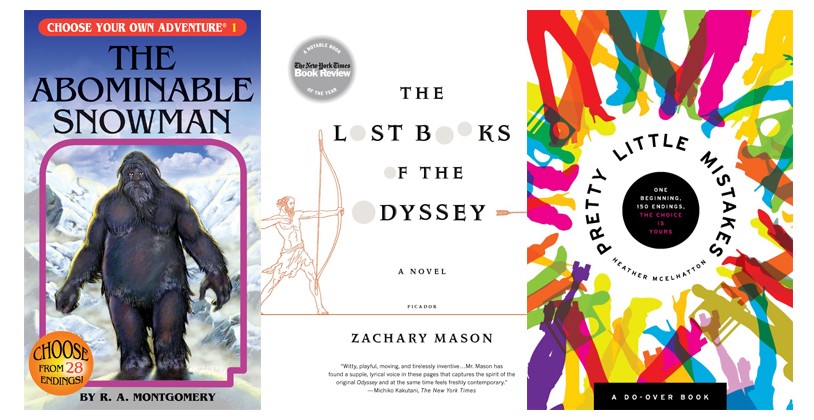
Interactive fiction (often referred to as IF or choicefic) has been the province of children’s books, humor, and puzzle-like digital games — but it’s also fertile ground for serious literary fiction. The medium goes by many names: gamebooks, hyperfiction, or choose your own adventure (CYOA) — as in the children’s series of the ’80s and ’90s. The essential feature of choicefic is that it treats readers as players, letting them decide what the protagonist will do.

Here are some opportunities for how the medium opens new vistas for literary fiction:

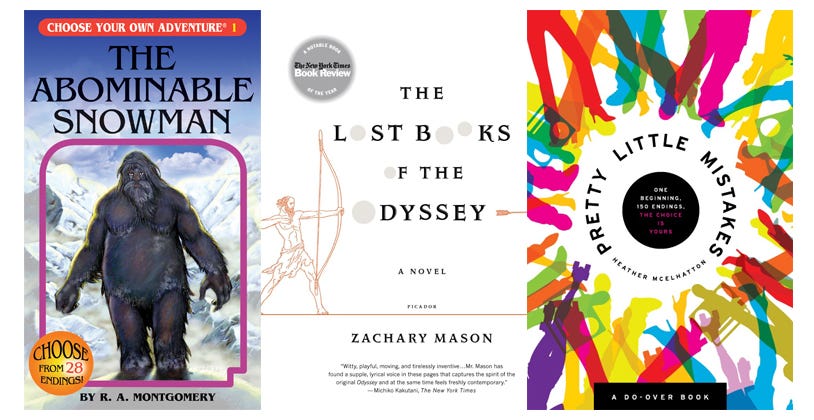
  • Character: Choicefic offers revolutionary potential for character development. Branching path narrative allows the author to show how a character’s evolution depends on his or her decisions: if the reader chooses violence, the protagonist may commit more violence later — without the reader having a choice. Choicefic can illustrate how our actions change and define us; it’s the ideal medium for representing free will operating within the constraints of character. Heather McElhatton explores this in her choicefic novel Pretty Little Mistakes: A Do-Over Novel (William Morrow), by showing how her protagonist is transformed by the relationships the reader selects for her.
  • Theme: Nowhere is the McLuhan mantra, “the medium is the message,” more apt: choicefic is uniquely equipped to explore themes of free will and moral responsibility. Choicefic could be used to represent a world in which minor moral failings have profound consequences — or one in which choice is illusory and all paths twist around to the same outcome. Imagine if Fight Club gave you your choice of havoc to wreak.
  • Plot: More radical than multiple endings is the opportunity for intricate tapestries of plot lines. A literary choicefic novel can be enjoyed one plot line at a time, but full appreciation demands the reader consider how the plot lines relate to each other, perhaps in subtle ways. Though not choicefic, Zachary Mason’s The Lost Books of the Odyssey (reprint by Farrar, Straus & Giroux) points to this possibility with its 44 contrasting versions of the epic’s narrative.

Book-form choicefic has been dominated by the CYOA kids’ adventure genre — and humor. Ryan North’s To Be or Not To Be: That Is The Adventure, a $580,000 Kickstarter mega-success, is a goofball farce of Hamlet. The 110 endings include dozens of droll and grisly ways for the prince to die. A tongue-in-cheek score assigned for each ending gives a nod to interactive fiction’’s roots in digital gaming.

The line between narrative games and interactive literature is fuzzy — and each has its place — but the difference is crucial. Sherry Jones, a philosopher who studies interactive fiction, told me about the debate between narratologists, who view story as central to choicefic, with gaming elements built around it, and ludologists who see story as decoration for the underlying structure of a game. Jones says that digital choicefic has grown from its gaming roots to thoroughly embrace narrative — though she says its creators could still benefit from absorbing more influence from traditional literature.

It’s an exciting time: the great choicefic novels remain to be written.

INTERVIEW: Paul Laudiero of Shit Rough Drafts

Shit Rough Drafts began when Paul Laudiero came up with humorous alternate titles for The Great Gatsby while bored in class. He posted that first image to Tumblr just over a year ago, and his blog has since achieved immense popularity. Starting today the 23-year-old writer and comedian’s debut book of hilariously shitty rough drafts (Chronicle Books) will be on shelves (check out the book trailer here). I interviewed Laudiero about the nature of successful blogs, the importance of discipline, and the highly sought-after blog-to-book deal.

To commemorate Shit Rough Drafts’ one-year anniversary, you told the story of the blog’s origin. Once you had taken that fundamental step to start the Tumblr, what came next? Your very first post ended up with over 1,000 notes — when did you start to recognize that your idea could turn into something so popular, and what did you do in its early stages to facilitate that success?

After I started the Tumblr, I just kept working at it. I spent a few hours each day really focusing on creating funny drafts and making sure that whatever I posted was something that would make me laugh. I posted two or three a day for the first few weeks, not hoping for anything, just doing it because it was fun. I think about two weeks after I started it, Mashable and The Huffington Post covered it, and then it sort of blew up after that.

I guess I realized it could turn into something popular after it got some coverage. It was an easy concept that I could apply to any sort of medium (books, plays, poetry, TV, movies, etc.) and it shared really well. I remember that right after Shit Rough Drafts got covered, the Academy Awards were coming up, so I worked really hard to have strong drafts for each movie that won something. Instead of live-tweeting the event, I posted a draft of each movie that won an award. That really helped pick up a lot of followers. Basically, I just worked really hard on it for a few hours each day. That was the main thing.

Although your project is unique and differs from conventional narrative storytelling, your description of the work involves the same discipline that writers universally struggle with. Spending hours refining drafts, striving for work that satisfies your own criteria as the creator, and designating time to get words on the page are familiar preoccupations for all people agonizing over their own shit rough drafts. What is your own background as a writer and comedian, and how did that training inform your current success?

Paul Laudiero, author of Sh*t Rough Drafts

Paul Laudiero, author of Sh*t Rough Drafts

I was an English major at George Mason University with a focus in Creative Writing. I wish there was some big thing I learned or some secret to writing they taught me, but really all I took away from the program was to write every day and know that a good amount of what I put down on paper was going to be shit. I took a few writing workshops at school, and I learned to embrace criticisms and suggestions for my writing, and to work harder at it.

As far as comedy goes, I started doing improv with the Washington Improv Theater in 2009 and went through the classes and program there. I was on a few different “indie” teams and performed once or twice a week either in D.C. or at my college. After I graduated in May of last year, I moved to New York City to keep on taking improv classes at the Upright Citizens Brigade. That’s what I’m doing now. Improv has definitely helped me to become a better writer. Getting to make stuff up on a stage with other funny people is the best way to generate new ideas. Even if you’re not aware of it, you’re picking up new stuff every show night and it will bleed into your writing. Also, improv is just freaking fun.

Thinking of improvisation in the broader sense is very useful, as responding creatively to current events and trends is crucial to staying relevant in the blogosphere. You have done this with historical dates in literature, popular shows, and movies. Equally important is connecting and collaborating with others on the web. When did you start posting submissions from others? Do you have any favorite guest posts you’d like to share?

I started accepting submissions a few months after I got the deal with Chronicle. People had been submitting for a while without me even posting the option, so I finally added the link. I think one of the first big events I accepted submissions for was the last season of “Breaking Bad.” It got picked up by Wired and was received really well. Since then, I’ve always encouraged submissions and tried to find ways to integrate them into promoting the book.

One of my favorites so far has been by a comedian named Dillon Diatlo. He submits a ton of drafts for children’s books and stories that are always hysterical. And dark.

Getting a book deal from a Tumblr or Twitter account is an elusive dream for most people, yet you managed to pull it off! Was this always a goal of yours with the blog, or was it a more unexpected progression? Will favorite entries of yours from the site appear in the book, or will it all be previously unseen material?

It was an unexpected progression! After I got covered by The Huffington Post and Mashable, I was put in touch with my agent, Kate McKean, by a mutual friend from D.C. I had at the same time submitted my idea for Chronicle’s Great Tumblr Book Search. I actually won that, and then my agent sat down with Chronicle and hammered out a deal.

My editor was fantastic, and the book is the same humor as the site. I was given almost total creative freedom, which was great. About a quarter of the book will be my favorite entries from the site, and the rest will be new and unseen material.

Shit Rough Drafts will surely be an ongoing project, but have you had any chance to give a thought to future aspirations? What other kinds of creative projects appeal to you? Do you have any interest in going back to your fiction roots?

Oh man, good question. Anything where humor and writing are involved interests me. I would dig writing for television but am just as happy writing fiction. I spend a few hours writing every day, whether stories, sketches, humor bits, or comics. I plan on writing for the rest of my life, and I want to do everything I can to try and become better at it. For me that just means working every day.

Just like every other white male in his twenties who does improv and writes, I’m working on a web series right now. That should be finished in the next couple months. I guess that’s the next actual project I’m focusing on.

Could you give us any details about the web series?

The series is about a young writer facing the fact that he is shit, and that he will be for a long time. He wants to be a good writer and is trying to work hard at it, but he is young and has no life experience. So he’s shit.

REVIEW: Sleep Donation by Karen Russell

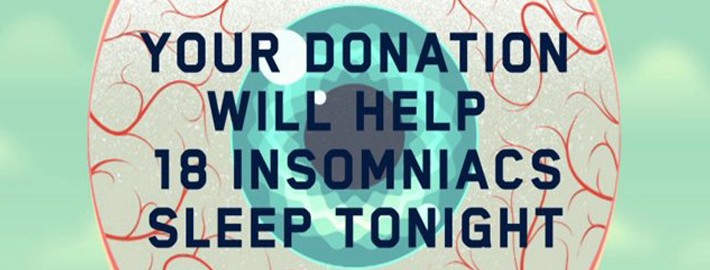
Karen Russell is weird. I mean that as the highest form of praise, of course. She’s mastered the art of the bizarre so thoroughly in her previous work that her foray into a quasi-dystopian,” sci-fi-lite” story doesn’t only seem natural, I was surprised she had yet to cover that territory. In her e-novella, Sleep Donation, released on March 25th by the newly-launched Atavist Books,
America is plagued by an insomnia crisis.

Readers with sleep troubles, myself included, can breathe a sigh of relief that our unwilling propensity to stay awake all hours of the night hasn’t gotten so bad that it can kill us. In Sleep Donation, those who have fallen prey to the epidemic — “orexins” — can seek relief from the fatal illness through the Slumber Corps, an organization that tracks down healthy sleepers and urges them to donate their dreams to the less fortunate.

Star recruiter, Trish Edgewater, knows exactly how to get what she needs from donors. Her elder sister, Dori, was among the first handful of people to die from the insomnia plague. Whenever Trish begins telling the story of Dori’s untimely demise, she breaks down in tears and donors are practically lining up to give. Her most valuable recruit is Baby A (by way of the child’s mother’s heartstrings), an infant with pure, perfect sleep who can donate universally. Baby A is the country’s savior when a mysterious Donor Y unleashes a sinister strain of nightmares that worsens the plague; this disturbs the baby’s father, who’s always felt that his child was being taken advantage of.

Russell excels at creating solitary, profoundly-damaged female narrators who are singularly-focused, almost obsessively so

, and Trish is no exception. Her sister’s passing, though it happened nearly a decade before, is the defining aspect of her life. She’s tragically burdened by Dori’s death, and yet it’s the very thing that makes her so good at her job. Trish is keenly self-aware when musing on a grief so intense, it seems to manifest itself physically: “Sometimes I think the right doctor could open my chest and find her there, my sister, frozen inside of me, like a face in a locket.”

Trish is rattled with doubts about her altruism, at one point even likening her use of her sister’s death to obtain more donors with the epidemic: “Thanks to my efforts, millions of people are infected with Dori’s last breath.” As Trish examines the moral quandaries of her job, and eventually discovers unsavory details about the Slumber Corps, the reader is confronted with a larger societal question about countless charities: At what point does manipulating emotions to acquire support veer into exploitation?

Readers who delight in the more peculiar and surreal will enjoy the sequence that takes place in one of the “Night Worlds,” a camp on the outskirts of town. The place has a seedy, underbelly vibe; it’s where orexins gather to indulge in black market remedies. Trish visits and shells out for a drink, even though she’s not afflicted, and is offered a plot of dirt to fall asleep on. At a price, of course. The reader is suddenly jerked out of the fantastical surroundings we’ve been immersed in and faced with Trish’s straightforward opinion: “America’s great talent, I think, is to generate desires that would never have occurred, natively, to a body like mine, and to make those desires so painfully real that money becomes fiction, an imaginary means to some concrete end.”

That’s precisely what makes Russell’s brand of magical realism so effective. As with her books, the tone and language in

Sleep Donation is so deliberate and well-crafted that it provides a framework for any and all things outlandish.

The reader is guided along by prose so intimately conversational and frank that we feel for Trish, taking her opinions to heart; and find even the most otherworldly parts of the storyline entirely plausible. In Sleep Donation, Russell once again proves herself to be a master storyteller: she is the type of author who can effortlessly convince readers to suspend our disbelief and invest in a character in a way that many of us haven’t done since we were children listening to a bedtime story.

To purchase Sleep Donation, click here to visit Atavist’s website.

CRITICAL HIT AWARDS: Winners Picked by Laura Miller of Salon

Welcome back to the Critical Hit Awards for book reviews. This is a round-up, a recommended reading list, and — why not? — a terribly prestigious and coveted prize. Winners receive a bang-up gift from Field Notes, our beloved sponsor. Nominate your favorite recent review by tweeting it at @electriclit with the hashtag #criticalhit, or cast your vote in the comments section below.

Our guest judge is Laura Miller, a co-founder and staff writer at Salon.com.

Electric Literature: You’ve been writing for Salon for nearly 20 years. In that time, book reviews have largely migrated from print publications to join you on the web. How do you think reviews have changed as a result of their migration?

Laura Miller: I think the public’s idea of what reviews mean has changed a lot, and that only some reviewers have caught up to it. This has to do with the authority — usually institutional — invested in any particular review. You still hear people say “The New York Times loved this book,” when really it’s just one of the staff critics there who loved it and probably no one else who works there has even read it. Nevertheless, I think the informality of web publishing and the proliferation of amateur reviewers on sites like Amazon and Goodreads have made many more people than ever before aware that any given review is not the last word on a book.

Reviews are seen more as points in an ongoing argument, which to me is a welcome change.

When a critic — like Pauline Kael, for instance — develops a large body of work, we can look back and identify her major themes and arguments. Do you keep your own larger themes and arguments in mind when you review, or are you taking each book as it comes?

A certain chunk of my “criticism” lies in picking the books I’ll review — I look at several for every one I write about. And there are dozens more that I eliminate out of hand for one reason or another. That stage of the reviewing is the most programmatic, because I know that some books interest Salon’s readers more than others, and other books (say, a 500+-page, densely written biography) just aren’t practical for me to review in a week. But by the same token, it’s beholden on me to mix it up a lot because our readers are interested in a wide variety of subjects.

Once I’ve picked something, I do have specific preferences, but these also have to be measured against what the book is meant to be doing. You can’t indict an author for not writing a book she never set out to write in the first place. I’m sure someone looking at the hundreds of reviews I’ve written could see some patterns emerging:

I don’t have much patience for writing that I call “pretty-pretty,” where Language just accumulates on the page like plaque, insistently calling attention to itself.

I think a little landscape description goes a long way. I prefer witty to broad humor and roll my eyes at bad-boy narratives. But unlike Kael, I don’t have such an emphatic idea of what a book *should* be, except that it should not be boring. Alas, so many are. Still, I like to think that the right book can talk me out of my prejudices. I used to go around saying I couldn’t stand novels about 1) stage magicians and 2) rabbis in Prague, but then along came The Amazing Adventures of Kavalier and Clay.

What’s the one thing you could hear about a book that would make you feel like you absolutely had to read it?

It’s less what than who. There are fellow readers out there whose recommendations I consider golden. These are handed back and forth privately, since I have no faith whatsoever in blurbs. We send each other emails and ask what we’re liking these days. Lev Grossman is one. So is Kelly Link. Jonathan Franzen used to recommend books to me, and they were always good, but he hasn’t in several years. Elizabeth Hand, a novelist who should be better known, is another. I have a friend in Minneapolis, Melissa Klug, who works for a paper company and gets a lot of advance reader copies that way, and her tips are always worth checking. And then I know a lot of people who work in publishing. When they tell me that they love a book published by another house, I know it’s got to be great.

What I most want to hear about a novel is that somebody started reading it and lost all sense of time and place. Who doesn’t want that immersion in a fictive world? With nonfiction, which is mostly what I review for Salon, I want to hear that the ideas or information or narrative in the book has changed the way that reader sees the world, on whatever scale.

And the winners are…

Lydia Kiesling on Hill William by Scott McClanahan vs. A Tale for the Time Being by Ruth Ozeki for the Tournament of Books

Kiesling, who writes for the Millions and not enough other places, is just about my favorite regular book reviewer, and I also love the Tournament of Books. When it comes to critics, I’m less fond of the school of disembodied pronouncements emanating from the cloud-shrouded peak of Mt. Olympus than the type of review that reflects the idiosyncratic nature of reading itself. It’s an approach that comes from movie criticism: in other words, Pauline Kael and David Thomson are writers who mean more to me that Dwight MacDonald or Alfred Kazin. Kiesling always writes about what it feels like to read a particular book, an approach that can be slipshod and solipsistic in amateur hands (which is where you most often find it). When done right, however, it can be sublime, but perhaps more to the point it strikes me as more true. This is the usual top-notch Kiesling performance, even if the two books in question don’t fire her up as much as some of the other things she’s written for the Millions. Her series on reading the Modern Library is not to be missed.

As for the Tournament of Books, as someone who’s been on more than one prize jury, I find the transparency it brings to the decision-making process endlessly fascinating. Why do some readers like certain books more than others? What makes a reader decide one book is “better” than another — a related but different question. I suppose some people would call the bracket device artificial or overly competitive, but to me it’s the height of realism: Each of us is only going to be able to read a limited number of books in our lifetime, and these are choices readers make every day.

Leslie Jamison on MFA vs NYC for The New Republic

Call me a Marxist (although you’d have to be pretty dumb to do so) but I firmly believe that the means of production tend to determine what is produced. That’s why I found Chad Harbach’s rundown of the two primary economic models for supporting fiction writing in America to be refreshingly honest. Jamison doesn’t entirely concur with Harbach (and perhaps I don’t either — I just think it’s a phenomenon that ought to be talked about), but she understands what Harbach was getting at better than anyone else who wrote about the essay “MFA vs NYC” and the anthology named after it. Many reviewers seemed to think the book was a referendum on MFA degrees and the need for aspiring novelists to live in New York. This review is smart, thorough and informed by personal experience without being blinkered by it.

Where I'm Writing From

Tim Parks on “Where I’m Reading From” for The New York Review of Books

This isn’t the very strongest of the series of blog posts Parks writes for the NYRB web site — that would be a post from last fall about the evolution of a “global style” in fiction — but I get the impression that few people are aware of the excellent column-like essays he writes there. And this essay is also not technically a book review, but it is most definitely an example of the sort of writing about reading I admire. Parks describes how his own internalized geography of taste was first laid down in his childhood, where each of the rooms in his family’s home contained books of a different category, reflecting the appetites of his sister (Georgette Heyer romances), his brother (science fiction), and his father (parched and learned biblical commentary — the family was evangelical). To this day, Parks is put off by “literary exhibitionism; intellectuality as an end in itself, self-indulgent performance whose main intention was to encourage the reader to concede that the author was smart” because they remind him of his father’s books. How much of what we love and hate in a book is determined by these highly personal influences and memories? This seems like a subject most critics have barely touched upon in their earnest scramble to present their opinions as definitive or invested with some special authority.

***

Congratulations to our winners! Please contact Brian Hurley to claim your Field Notes prize.

Read a good review lately? Nominate it for a Critical Hit Award by tweeting it at @electriclit with the hashtag #criticalhit or cast your vote in the comments section below.

***

Laura Miller is a journalist and critic living in New York. She is a co-founder of Salon.com, where she is currently a staff writer. Her work has appeared in the New York Times Book Review, where she wrote the “Last Word” column for two years, the New Yorker, the Guardian, Harper’s magazine and other publications. She is the author of “The Magician’s Book: A Skeptic’s Adventures in Narnia” (Little, Brown, 2008) and editor of the “The Salon.com Reader’s Guide to Contemporary Authors” (Penguin, 2000).

Brian Hurley is Books Editor at The Rumpus, Founder of Fiction Advocate, and Curator of the Critical Hit Awards.

Unhappiness, Guanajuato

ALSO KNOWN AS RUMINATION.

As much as it might seem incredible to someone like you or I, happiness, wait, Happiness, hasn’t always had a positive connotation for everyone. This will be easier to accept if you consider that no one thing has been anything, always, for everyone. Most things have been many things for at least some people. Nothing has at times meant Everything and at others meant Some Things. For long stretches of time Nothing actually meant nothing. But I must stop myself because I have the tendency to spin uncontrollably into spirals of confusion and — sometimes — complete nonsense.

FOR EXAMPLE: MADDEN’S SAVAGES.

The first records of a society which considered Happiness to be something to avoid rather than the Ultimate Goal come from Scottish anthropologist Newman J. Madden. When he died in 1809, Dr. Madden was working on a book about a tribe, which he simply referred to as the Savages, dwellers of a village near what today is Alice Springs, Australia, people who associated Happiness with death and decay. “We are born crying,” wrote Dr. Madden, “and die, when we die as nature intended us to, with a lazy smile on our faces, so it shouldn’t be surprising that the Savages think of bursts of happiness as little pushes and shoves towards nonexistence.”

The manuscript goes on to explain a ritual wherein Madden’s Savages — which some modern anthropologists think might be an offshoot of the Noogri tribe — slashed their infants’ cheeks as a rite of passage, rendering them forever incapable of smiling. (Portraits of the brutally scarred faces of Madden’s Savages can be found among the anthropologist’s papers at the University of California, Berkeley.)

THE FALSE REASON WHY I’M TELLING THIS STORY: A SMOKESCREEN.

Then there was, of course, the Sorg (Grief) cult in Stockholm during the late 19th century, whose members would go years without being exposed to sunlight, which was dismantled after their unsuccessful attempt to assassinate Sofia of Nassau. During America’s Great Depression something called the Frown Militia, a gang of ultra-right-wing manic-depressives who wanted to take over the country, appeared and quickly disappeared in Oklahoma.1

But much has already been written about these and other cases of note. Besides, I am not an anthropologist nor did I ever finish medical school. The only reason I feel compelled to write this is that my grandfather died last week. He himself once belonged to what in academic circles are known as societies of unhappiness.

THE SOCIETY.

You can call it a cult, commune, or whatever else provides you with a better understanding of the phenomenon. I call it a society. All they wanted was a paradigm shift that would better suit their reality. I’ve heard of worse things.

Dr. Blanco’s society of unhappiness might be the most recent one on record. From the very little that has been written of it, it’s still unclear if it was founded in 1946 or 1949. My grandparents Tomás and Mariana didn’t join until the autumn of ‘52.

TOMÁS.

The youngest child of one of Mexico City’s most prominent families, at thirty Tomás de Feo had already built a name for himself as a lawyer and a professor, even serving as a trusted legal advisor to President Miguel Alemán. Alemán, as Mexico’s sitting mandatary, officiated Tomás’ marriage to Mariana Schiffner, a beautiful young woman who’d turned sixteen only a month before the wedding.

There’s a slight mention of my grandfather in Alemán’s colossal and self-serving autobiography. After dedicating a single paragraph to Tomás’ rise and fall, Alemán concludes that “[l]icenciado de Feo was a man whose genius sadly morphed into complete lunacy.”

HIS MIND WAS ALL ANYONE SPOKE OF.

Mariana’s father, my great grandfather Knut, described Tomás in his diaries as “an ambitious man with rare intelligence who, nonetheless, seems to know nothing of what the joys of life can bring. Most of the time he’s deep in thought and what he seems to be thinking about is DEATH.”

THE MIRALARGA EPISODE.

Not long after the wedding there was an episode in which Tomás refused to leave his office on the thirty-second floor of the Torre Miralarga for over seventy-five hours. After finally stumbling out into the hallway, the young lawyer adamantly refused to be institutionalized and was back to work the following week.

MAJOR DEPRESSIVE DISORDER.

I understand perfectly what Tomás was going through because his nasty melancholic gene squeezed its way into my father’s bloodstream and then skipped onto my brother Javier’s and mine. It must be said at some point, it might as well be here, that my father, Jerónimo de Feo, hanged himself one night from the thick branches of a Coral tree in the courtyard of his law firm in downtown Mexico City.

XX.

My sister, Tamara, I’m proud to report, seems to be free of the disease. She lives in Cambridge, Massachusetts with her husband and four children.

THREE NUNS WALK INTO A HOSPITAL ROOM.

So yes, Tomás de Feo was a dark cloud of a man, but for a large part of his life he, like everyone else, was obsessed with finding Happiness. From a very early age he read the great philosophers and left dozens of notebooks filled with scribbled notes of his reactions. I’ve read hundreds of pages from his notebooks and must say that it’s painful to trace the mental footsteps of a man who is so clearly not in control of his spirit. One day he’d write something like, “Happiness is understanding that we are everything, everything is us.” Then, after twenty pages filled with minuscule scribbling, he’d come to the conclusion that, “to be truly content one must accept that he is nothing. We don’t exist.”

Tomás attended seminars on Happiness, made at least five trips to Boston to visit one of the psychiatrists who was working to include Major Depression in the first version of the DSM, escaped to Buddhist retreats and even dabbled with hallucinogenics. Nothing worked.

Finally, in 1952, frustrated by the only problem that his brain couldn’t seem to resolve — for it was a problem of the brain itself — Tomás tried to take his life by ingesting a cocktail of sleeping pills and rat poison. It was a miracle, or at least that’s what most would call it, that Mariana felt ill while at a visit to her sister’s and decided to return home early that day. So it was that Tomás awoke in the Hospital Católico with three nuns praying at his bedside and Mariana weeping behind them.

LEMMINGS.

Not long after his botched suicide attempt, Tomás published an essay in El Universal’s culture supplement titled “On Escaping Melancholia.” The essay, which catalogued my grandfather’s search for Happiness, was widely read in Mexico, and a French translation even made it to the pages of Le Monde. As a result, my grandfather received dozens of letters from the depressed and their close ones thanking him for raising consciousness about the disease.

Then one day he opened a letter from Dr. Efraín Blanco. Dr. Blanco’s missive was aggressive and condescending. Tomás, according to Dr. Blanco, had been doing it all wrong. “Sadness is Man’s natural state,” reads Dr. Blanco’s beautiful handwriting. “Escaping melancholia is as unnatural as fasting or chastity. It is Culture along with the powers that be who have convinced us that smiling, which, as everyone knows, not only feels but also looks unnatural, is the face’s most positive expression. Chasing Culture’s promise of Happiness — a mirage, at best — is as ludicrous and destined to failure as those imbecile rodents who follow each other off a cliff.”2

THE ROAD TO UNHAPPINESS.

It is unclear why Tomás and Mariana got in their Chrysler Town & Country and drove to see Dr. Blanco that October day. Half my family argues that Tomás, who was also known for his sudden bursts of uncontrollable rage, had his revolver with him and was planning to kill the only person who had ever dared to call him obtuse. The other half of the de Feos argues that he just wanted to talk with the man. After all, why would he have taken his wife on a road-trip to witness a murder?

I’ve driven that road that my grandfather took to Guanajuato many times because as a student I did my residency in León, the state’s most important city. After a few weeks of commuting I decided that in one of those drives to Guanajuato I’d detour to Dr. Blanco’s estate. Young and brazen, I began asking around in de Feo family events if anyone knew exactly where the estate was located. My family spoke about the society frequently, but they always did so in vague terms, never providing anything as specific as location. All I could find out was that it was a few kilometers from a little village called Loma Escondida.

I drove toward the general area and once I got close enough to Loma Escondida I began to ask the locals for directions. Everyone looked at me like I was asking them if they knew which road to take to El Dorado. “Doctor who?” they said. “Never heard of him.” As I was about to give up my search for the estate I pulled into a gas station to buy some snacks and asked the cashier, a good-humored old man, if he knew how to get to where I wanted to go. He laughed. “Tristeza?” I was confused. “Nobody knows about that place anymore,” he said, “but we used to call it Tristeza.”3

Tristeza was a ghost town. Its cement, unpainted villas were falling apart and the paint of the black mansion where Dr. Blanco once lived with his three wives and dozen children was fading. I didn’t stay long. My companion felt scared and uneasy and begged me to take her away from Tristeza. I don’t blame her. The town’s all-around vibe — a term I stay away from — was unsettling.

I often try to imagine what Tristeza looked like when Tomás and Mariana arrived that afternoon in the autumn of 1952. Sure, the villas and the mansion were terribly depressing even then — I’ve heard that all furniture, clothes, and belongings had to be painted black — but there were broccoli and strawberry plantations that must’ve looked beautiful even amid so much gloom.

Dr. Blanco, who was by all accounts an incredibly charming man, must’ve made some impression on Tomás, because that night he and Mariana drove back to Mexico City, packed their bags and drove right back to Tristeza. A cement hut only a few meters from the black mansion welcomed them.

FINDINGS.

Some have suggested that Dr. Blanco wasn’t even a real doctor, but rather a classic example of the charismatic and psychopathic leader who in this case found a “cause” that just happened to be psychiatric in nature. False. Dr. Blanco was, at one point, a real psychiatrist.

I looked up Dr. Blanco’s records in the Mexican Psychiatric Association (AMP). Here are my findings:

Elías Blanco arrived at the Washington University School of Medicine in Saint Louis in 1926. No one, at least no one that I know of, knows anything about him before then. In 1932 Dr. Blanco arrived in Mexico City where he started his practice. In 1936 he had his license taken away for what the AMP called “improper use of medication” and “multiple violations of AMP stipulations.” At some point during the next couple of years he moved to Guanajuato with a dozen or so of his patients. One of those original settlers of Tristeza was Diana Velasco-Cabañero, co-heir to the fortune of railroad tycoon Alonso Velasco-Cabañero. Diana would later become one of Dr. Blanco’s wives and give birth to two of his children.

MR. VACA.

It seems logical to think that those first settlers of Tristeza were all either depressives or bipolar, though that very well may not be the case. As I’ve said repeatedly, not much is known about Dr. Blanco’s society. That everyone wore black we know because there exist, amid Dr. Blanco’s papers in the library of the Universidad Nacional, two hazy pictures of Tristeza taken from above, maybe from a tree, maybe from an actual observation tower that was later destroyed.

Happiness was outlawed in Tristeza. We know from a letter to his family that Guillermo Vaca snuck out to the post office, that if someone was deemed to be happy they would immediately be put away in a small cement hut with no windows and a narrow steel door.4

According to Mr. Vaca, the hardest thing about living in Tristeza was staying productive while being sad. Dr. Blanco was, after all, delivering kilos and kilos of strawberries and broccoli to León on a regular basis and someone had to do the picking. In his letter, Mr. Vaca tells of people working on the field breaking down in crying fits or suddenly falling asleep.

SEX IN TRISTEZA.

Have I wondered if Mariana was one of Dr. Blanco’s lovers? Of course I have. She was a very beautiful, very young woman. (The leader liked them young.) Meanwhile, Dr. Blanco was a middle-aged man of short stature and a pencil-thin mustache. Some people say that the only reason he began the society was so he could have access to women that would, in a regular environment, not even give him the light of day. I am not one of those people.

FOOD IN TRISTEZA.

The inhabitants of Tristeza didn’t eat the strawberries and vegetables they grew. In fact, they didn’t eat fruits and vegetables at all. Dr. Blanco, who was an iconoclast if he was anything, thought that we only have positive ideas about those foods because they make us feel “good.” Also prohibited in Tristeza were foods rich in carbohydrates. A normal lunch in the society would consist of pork, fried eggs, wine and coffee. “We consume foods that make us sluggish,” said Dr. Blanco in a rare letter to one of his close friends from St. Louis. “Sluggishness leads to discomfort, irritability and sedentariousness (sic.), which in turn lead to questioning and contemplation.” Exercise, except in the form of sex, was also prohibited in Tristeza.

DREAMS.

I often dream of Tristeza. In some of these dreams I am Dr. Blanco, while in others I am my grandfather, myself, or an anonymous member of the society. There are some dreams in which I am God, looking down on Tristeza through the clouds. Mostly, these dreams cause me anxiety and stress, but sometimes they fill me with serenity. There is a recurring dream in which I am riding a goat in a never-ending strawberry field and the goat slowly dies. Interpret that if you like, but I find that the more I study dreams the more meaningless they become. That might be true for everything under Reality.

I also daydream about Tristeza. (I am certain that adult daydreaming is a sign of stunted maturity.) When I had a job I’d spent most of my time in the office thinking about the society. Now, unemployed, a dweller in the big house my mother left me, I spend afternoons in her old room scratching my rough cheeks and pretending I am an inhabitant of Tristeza or nursing the fantasy that I am a high-ranking member of the government’s secret police sent along with a team of soldiers to shut the society down. For a long time it shamed me how often I thought of Dr. Blanco fucking this or that wife in the bedroom, the kitchen, the living-room. The thought of him in bed with young Mariana often enters my head and I’ve stopped trying to push it out. It must be there for a reason. I like to picture Tristeza’s inhabitants, clad in black, mumbling and grumbling, cursing this and that, feeling at the same time alone and part of something. It is, I guess, a collective loneliness, which is as good a loneliness as there is.

STANCE.

It’s hard for a man of my age and circumstance to take a stance on anything, much less on something as hazy and personal as Tristeza, Guanajuato. At times I think that living there would’ve worked for me, whatever that may mean. I’ve felt the taunting tyranny of the Happiness bait since I can remember. Maybe Dr. Blanco would’ve allowed me to escape from it. There wasn’t a single suicide that I know of in Tristeza, a place whose dwellers were mostly prone to suicide. That puts a bitter smile on my face.

MY MOTHER SLEPT CALMLY IN HER CRIB.

Not to say that Dr. Blanco wasn’t a charlatan. In 1957 he took all the broccoli and strawberry money and disappeared forever with a Tristeza newcomer. But aren’t all leaders charlatans? If they’re not fooling us they’re fooling themselves. (And when they find out they’ve been fooling themselves they go on to fool us.)

Tomás and Mariana stayed in Tristeza for a few months after Dr. Blanco’s departure in hopes of saving the society. In fact, my uncle Ernesto was born in post-Dr. Blanco Tristeza. But the new leadership failed. All hope had left with the money. My grandparents returned to Mexico City in 1958 and in 1962, driving back from a party, Tomás shot Mariana in the temple and then drove off a cliff.

THE REAL REASON I AM TELLING THIS STORY.

I, of course, would’ve never had a child on purpose. I hope not to sound too drenched in self-pity when I say that I am well aware of the black stain that runs through my genetic material. But, alas, it happened.

A few weeks after my forty-first birthday I received a call from Teresa Alba, a beautiful Nicaraguan graduate student who had come to Mexico for a conference and whom I met at the lobby bar of a hotel. She asked me if I remembered her. Of course I did. I hadn’t slept with a woman for years before I slept with Teresa and hadn’t slept with one since.

“I — We had a son,” she said.

My knees buckled. My throat went dry. I remember grabbing on to a large portrait of one of my aunts that decorated my bedroom wall. “Excuse me?”

Silence.

“Are you sure?”

“He’s three months old,” she said. “If I remember your face correctly the little guy looks just like his father.”

“How did you get my number?”

“I wasn’t even going to tell you, Joaquín. I guess I’m not as cruel as I thought.”

I suggested that maybe she was crueler. I was angry at myself, which means I was angry at the world.

ACKNOWLEDGEMENTS.

I met little Octavio in the Managua airport a couple of days after the phone call. He was sleeping in his mother’s arms. Next to Teresa stood her newfound boyfriend, a young poet with a kind smile and a high-pitched voice.

I’d like to say that holding Octavio cured me, saved me, but the truth is that it only made things worse. As I paced back and forth in Teresa’s house with my son in my arms, I could see it in his eyes, the disease, the lifetime of —

I’ll stop here. I don’t even know if I want him to read this. But maybe it will help him hate me instead of himself.

  1. Unlike what most people think and common sense suggests, the Frown Militia got its name not from the facial gesture associated with being sad, but rather from its founder Wallace T. Frown.
  2. Dr. Blanco was, no doubt, referring to the popular (and completely false) myth that at a certain age lemmings commit suicide by jumping off a cliff.
  3. Unhappiness.
  4. Mr. Vaca, who was once rescued from the ledge of a twenty-story office building, was not complaining about Dr. Blanco’s policies, just describing them.