CELEBRITY BOOK REVIEW: Joan Didion on “Astonish Me” by Maggie Shipstead

Editor’s note: Any resemblances to actual celebrities — alive or dead — are miraculously coincidental. Celebrity voices channeled by Courtney Maum.

This is a keepsake about motion and longing. This is the imminent agony of a nail underfoot. This is a story about dreams being realized by the dreamer’s runner up. This is the leaden taste of disappointment, the muscle memory ache of not good enough.

For over a decade, Joan Joyce, the antihero of Maggie Shipstead’s Astonish Me, dreamt of being a principal dancer in the ballet until a pregnancy — unplanned, perhaps, or fateful — presented her with a respectful way to deter her professional career before the critics could point out what Joan herself had always known: that she was a good dancer who would never be great.

Pale flesh masking tendons, pink silk against bone; the professional dance world has a way of beautifying the gruesome with rosin and soft lights. In her early years as a dancer, Joan roomed with Elaine, a ballerina who was a relentless, gifted “have” to Joan’s “have-not.” Despite her roommate’s innate talent, the two remain friends, with schemes and secrets settling between their lives like river silt. It is Elaine, and Elaine only, who knows the impetus behind Joan’s premature bow, as well as the vengeful hopes Joan harbors for the embryo inside her.

Astonish Me is the story of a disappointed woman who trades the monolithic energy of Manhattan for the planned communities of southern California.

From the outside, Joan chooses a safe life: she marries a steadfast man named Jacob who was besot with her as a young boy and is none the less absorbed by her now that he is a man. She has a pudgy neighbor whom she torments by doing battement exercises while her baby plays up-sided on the grass. Her neighbor also has a child, a girl for Joan’s boy. Joan is offered opportunities to reconfigure her present, but remains fixated on the ill-conceived choreography of her past: when she was in her twenties, she helped the world’s most famous Russian dancer defect. His name was Arslan Ruskov. There were years of shared bedsheets. Silk against bone.

But even the safe-houses cannot escape the wind.

To have lived in New York in your twenties is to never be fully content with the world again.

When I was younger, I stopped at street corners, endlessly seduced by the synchronicity of green lights. If I felt like eating a piece of fruit, I would stop at a fruit stand and purchase a piece of fruit, giving to a single peach skin the attention usually delegated to a lover. Young enough to eat a peach on a New York street corner, out of season, with only a paper sheet of napkin to wipe the pulp from my lips. To want so much, and to have had it, had it even for a moment in your thrumming grasp — I am here to tell you that you will never want that way again. A wish for sweet fruit now is but an echo from a dream. Ghost yells of sirens. Green lights turning red.

Once Joan and Jacob move to suburban California, Joan, too, moves from the future perfect to the past. The edifices she has built to hide her secrets start to crumble, exposing those around her to the upturned cigarette trays, the fingerprinted glasses, the tired refuse of a party stayed at too long.

In California, despite the husband, her blameless figure, despite her bright son, Joan Joyce greets each morning with sinewy dread.

All is not what it was, or what it was meant to be, which, in the closed mind of the nostalgic, amounts to the same thing.

Steps are missed. Lights are aimed to spotlight someone other than the star. In these two hundred and seventy-two pages of uncompromising prose, Shipstead reveals what occurs when a life is lived disingenuously by its keeper so that it might be lived to perfection by someone else. Cold of heart and skin, in Joan Joyce Shipstead has created a malevolent forget-me-not who keeps her aspirations on the lowest possible simmer until they choke us with the odor of good wine gone off.

Small Wonders at Seattle’s APRIL Festival

At the APRIL book festival (the acronym stands for Authors, Publishers, and Readers of Independent Literature), I met a reader. Not a student, artist, teacher, or writer (I asked!) — just someone who enjoys reading. It felt kind of like glimpsing an exotic bird or maybe something more slow-moving, like the time I saw a sloth in Costa Rica. She was probably in her fifties, with blunt-cut bangs and a caftan-esque outfit, and had read about the event in The Stranger. We chatted about our favorite authors as we waited at Chop Suey, a divey Seattle bar, for the kickoff party to begin. As writers, we so often have our work heard and read only by other writers — I always love to hear what people outside that world think. An independent book fest didn’t strike me as something that would attract people who weren’t also writers or artists, but one of the cool things about APRIL was that it bled into the margins of non-literary life more than I’d expected.

Launched with a Kickstarter campaign in 2012, APRIL has steadily gained a pretty large following of independent literature lovers for its annual, six-day party. The festival includes readings, theatrical performances, art shows, dance parties, and more celebratory events held in a smattering of venues across Seattle.

By the time the kickoff party was over, the reader and I had drifted our separate ways, so I didn’t get to hear what she thought. To me, the readings felt surprisingly interconnected, a collection of linked meditations on sex and death, bodies and art. Maged Zaher’s poems about “the madness of the everyday … and how we work like work matters”; Ed Skoog’s reflection that “poetry is showering at night: something not really necessary but cleansing and preparatory”; and Jac Jemc’s narrator comparing himself to a “fluctuating compass” between good and evil.

At another APRIL event I attended, the bar (Bush Garden, another divey Chinese place) was full of non-literary types — ladies who clearly have a standing happy hour there. They intermittently chatted and listened. The background noise might have been annoying to the readers, but to me it made the reading feel cozy and warm, as if it were woven into something larger, rather than existing entirely on its own. I really wanted to ask those ladies what they thought when Darren Davis read an essay about his obsession with video games: “I know that after grad school I wanted to become the Dragonborn.” (I thought it was hilarious.)

All told, the events I attended felt intimate and yet not, like attending a dinner party where you don’t know everyone. They had their awkward moments (the “meet and greet” where everyone stayed seated at long tables, talking to their friends), but that is also part of the festival’s small-batch kind of charm. Overall, the vibe reflected the type of literature APRIL celebrates — small and well-made, full of the odd and unexpected. And I hope it stays that way for a while.

“A Great Deserted Landscape” by Kjell Askildsen

I’d been helped out onto the veranda. My sister Sonja had placed cushions under my feet, and I was in hardly any pain. It was a warm day in August, my wife’s funeral was about to take place, and I was lying in the shade looking up at the pale blue sky. I was unaccustomed to such bright light, and on one of the occasions Sonja came to check on me, I had tears in my eyes. I asked her to fetch my sunglasses, I didn’t want her to misunderstand. She went to find them. It was only the two of us; the others were at the funeral service. She came back and put the sunglasses on me. I formed a kiss with my lips. She smiled. I thought: if she only knew. The sunglasses were so dark that I could look at her body without her noticing. When she was gone I looked up at the sky again. From somewhere quite far off I could hear the sound of hammering, it was reassuring, I never like when it’s completely silent. I once said that to Helen, my wife, and she replied that it was due to feelings of guilt. You couldn’t talk to her about that kind of thing, she’d immediately start prying.

When I’d been lying there for quite some time, and the blows of the hammer had long since ceased, it suddenly grew a lot darker around me, and before I realized that it was due to the combined effect of a cloud and the dark sunglasses, I was seized by an inexplicable feeling of anxiety. It passed almost immediately, but something remained, a feeling of emptiness or desolation, and when Sonja came out to check on me a little later, I asked for a pill. She said it was too early. I insisted, and she removed my sunglasses. Don’t do that, I said. I closed my eyes. She put them back on. Are you in a lot of pain? Yes, I said. She left. She returned soon after with a pill and a glass of water. Propping me up by my uninjured shoulder, she put the pill in my mouth and held the glass to my lips. I could smell her scent.

Not long after, my mother, my two brothers and my sister-in-law came back from the funeral. And Helen’s father, her two sisters, and an aunt I hardly knew, arrived a little after that. Everyone came over and said a few words to me. The pill was beginning to take effect, and I lay hidden behind the dark sunglasses feeling like a godfather. I didn’t feel it necessary to say too much, naturally enough everyone credited me with profound grief, there was no way they could know I was lying there feeling immense indifference. And when Helen’s father came up to me and said something or other, I felt something approaching satisfaction thinking about how, now that Helen was dead, he was no longer my father-in-law, and Helen’s sisters were no longer my in-laws either.

A little later my brother’s wife and Helen’s sisters began putting out plates and cutlery on the long garden bench below the veranda, and every time they went past me on the way into the living room, they nodded and smiled, even though I pretended not to see them. Then I must have dozed off, because the next thing I remember is the buzz of conversation down in the garden, and I could see their heads, nine heads hardly moving. It was a peaceful scene, those nine heads in the shade of the big birch tree, and at the end of the table, facing me: Sonja. After a while I raised my arm, to attract her attention, but she didn’t see me. Right after that my youngest brother stood up and made his way towards the veranda. I closed my eyes and pretended to be asleep. I heard him stop up for a moment as he passed me, and I thought: we are completely helpless.

Eventually they got up from the table, and the entire time they were all, with the exception of Mom and Sonja, getting ready to go, I lay with my eyes closed, pretending to sleep. Then Mom emerged from the living room and came over to me. I smiled at her, and she asked if I was hungry. I wasn’t. Are you in pain? she asked. No, I said. What about on the inside? she said. No, I said. Well, she said and fixed the sheet I had over me, even though it was straight. Would you sooner be off home? I asked. Why? she replied, do you not want me here? Of course, I said, I just thought you might miss Dad. She didn’t reply. She went over and sat on the wicker sofa. Just then Sonja appeared. I removed my sunglasses. She had a wine glass in her hand. She gave it to Mom. I’d like one as well, I said. Not with pills, she said. Don’t be silly, I said. Just one glass then, she said. She left. Mom sat looking out over the garden, the wine glass in her hand. Is this all yours now? she asked. Yes, I said, ownership by conveyance. There’ll be a lot of emptiness, she said. I didn’t reply, I wasn’t sure what she meant. Sonja came out with two glasses, she placed one down on the nest of tables beside Mom. She came over to me with the other, held me by the shoulder, and brought the glass to my lips. She bent over more than the last time, and I could glimpse her breasts. As she was taking the glass away, our eyes met, and I don’t know, maybe she saw something she hadn’t noticed before, because something flashed in her eyes, something resembling anger. Then she smiled and went over to sit beside Mom. Cheers, Mom, she said. Yes, said Mom. They drank. I put on my sunglasses. Nobody spoke. I didn’t find it a very comfortable silence, I wanted to say something, but I didn’t know what. There are no birds here, said Sonja. There are none around our place either, said Mom. Apart from seagulls. There used to be swallows, lots of swallows, but they’re gone now. That’s a pity, said Sonja. What’s that down to? That’s what no one can figure out, said Mom. Then they didn’t say anything else for a while. Now we can’t tell if it’s going to be nice or if it’s going to rain anymore, said Mom. You could just listen to the weather forecast, said Sonja. You can’t rely on them, said Mom. In the Mediterranean, swallows fly low even if it isn’t going to rain, said Sonja. Well then they must be a different type of swallow, said Mom. No, said Sonja, they’re the same type. That’s odd, said Mom. Sonja didn’t say anything else. She drank her wine. Is that true what Sonja’s saying? asked Mom. Yes, I said. Jesus, you never believe anything I say, said Sonja. I think it ought to be beneath your dignity to swear on a day like today, said Mom. Sonja drained her glass and stood up. You’re right, she said, I should wait until tomorrow. Now you’re being mean, said Mom. And to think I was such a good-natured child, said Sonja. She came over and helped me to more wine. She didn’t hold my head high enough, and some of it ran out of the corner of my mouth and down my chin. She wiped me rather roughly with a corner of the sheet, her lips were tightened in anger. Then she went into the living room. What’s got into her? said Mom. She’s an adult, Mom, I said, she doesn’t want to be told off. But I’m her mother, she said. I didn’t reply. I only want what’s best for her, she said. I didn’t reply. She started crying. What’s wrong, Mom? I said. Nothing’s the way it used to be, she said, everything is so… strange. Sonja came back out. I’m going for a walk, she said. I think she saw that Mom was crying, but I’m not sure. She left. She’s so pretty, I said. What good is that, said Mom. Oh, Mom, I said. You’re right, she said, I don’t know what I’m saying. It’s okay if you want to go home, I said, Sonja’s here after all. She started crying again, louder this time, and more uncontrollably. I let her cry for a while, long enough, I thought, then I said: Why are you crying? She didn’t reply. I started to get annoyed, I thought: what the fuck have you got to cry about? Then she said: Your father’s met someone. Met someone? I said. Dad? I wasn’t planning to tell you, she said. It’s not as if you don’t have enough sorrows of your own. I’ve no sorrows, I said. How can you say such a thing? she said. I didn’t reply. I lay there thinking about that skinny little man, my father, who at the age of sixty-three… a man I’d never credited with more libido than was strictly necessary to sire me and my siblings. An image of him, naked between a woman’s thighs, flashed before me. It was extremely unpleasant. Mom brought the empty glasses inside, but she soon came back, so I could tell she wanted to talk. She stood with her back to me looking out at the garden. What are you going to do? I asked. What can I do, she replied, he says I can do what I want, so there’s nothing I can do. You can stay here, I said. I could see by her back that she had started crying again, and perhaps because she didn’t want me to see her, she began walking down the veranda steps. She likely had tears in her eyes, and she must have stumbled, because she lost her balance and fell forwards, and disappeared from my view. I called out to her, but she didn’t answer. I called out several more times. I tried to get up but there was nothing I could hold on to. I turned over on my side and eased one leg, in plaster, out over the side of the lounger, supported myself by my elbow and managed to sit up. Then I saw her. She was lying face down in the gravel. I lifted my other leg, also in plaster, off the lounger. My shoulder and arm hurt most. I couldn’t walk with both legs in casts, so I slid down onto the floor. I inched my way over to the steps. There wasn’t a great deal I could do, but I couldn’t just leave her lying there. I edged my way down the steps and over to her. I tried to turn her over on her side, but wasn’t able. I slid my hand beneath her forehead. It was moist. The gravel cut into the back of my hand. I had no strength left. I lay down beside her. Then she moved a little. Mom, I said. She didn’t reply. Mom, I said. She groaned and turned her face to me, she was bleeding and looked frightened. Where does it hurt? I said. Oh no! she said. Just lie still, I said, but she rolled onto her back and sat up. She looked at her bloodied knees and began picking pebbles from the cuts. Oh no, oh no, she said, how did I… You fainted, I said. Yes, she said, everything went black. Then she turned and stared at me. William! she said. What have you done! Oh my dear, what have you done! There, there, I said. I was lying in a painful position, and with my one good arm I inched my way onto the lawn. I lay there on my back and closed my eyes. My shoulder ached, it felt as if the fracture had recurred. Mom was talking, but I didn’t have the energy to answer. I felt I’d done my bit. I heard her get to her feet. I didn’t want to open my eyes. She groaned. Come and sit on the grass, I said. What about you? she said. I’m fine, I said, come and sit down, Sonja’s bound to be back soon. I looked at her. She could hardly walk. She sat down gingerly beside me. I think I need to lie down a little, she said. We lay in the sun, it was hot. You mustn’t fall asleep, I said. No, I know that, she said. Then we didn’t say anything for a while. Don’t say anything to Sonja about Dad, she said. Why not? I asked. It’s so humiliating, she said. For you? I said, even though I knew that’s what she meant. Yes, she said. To be deceived by someone you’ve trusted for forty years. He’ll be back, I said. If he comes back, she said, he’ll be a different person. And he’ll come back to a different person. No, I said, but didn’t get any further. Sonja was standing in the doorway. She cried out my name. I closed my eyes, I’d no strength left, I wanted to be taken care of. Mom! she cried. When I heard her standing right next to me, I opened my eyes and smiled at her, then closed them again. Mom explained what had happened. I didn’t say anything, I wanted to be helpless, to be left in Sonja’s hands. She brought cushions and put them under my shoulders and head, and I asked if I could get a pill. She was gone a while, it must have been then that she rang for an ambulance, but she didn’t say anything about it when she came back out. She gave me the pill and asked how I was. Fine, I said, and even though it was true, I hadn’t intended her to believe it. I did have an ache in my shoulder, but I was fine. She looked at me for quite a while, then she went up to the veranda and carried down the lounger. But not for me. For Mom. When I thought about it, it seemed only right, but at the same time she could have asked, if only to have allowed me the opportunity to give it up. Mom protested, she wanted me to have it. No, said Sonja, you sit down there. I didn’t say anything. I thought: I told Sonja I was fine, that’s the reason. Sonja helped Mom onto the lounger, then went into the house. The lawn felt hard beneath me, I wondered how long Sonja was planning to leave me there, after all I didn’t know she’d rang the hospital. It was completely quiet, and I heard a car pull in front of the house and the doorbell ring. After a while, Sonja and two men in white came out onto the veranda and down the steps. They went straight to Mom. One of them spoke with her, the other one turned to me and stared at my leg. How long have you had that? he asked, pointing at the cast. A week, I said. Did you fall off the roof? he asked. Car crash, I said. I turned my face away. Is this really necessary, said Mom. Yes, Mom, said Sonja. The one who had spoken to me went to fetch a stretcher, the other one came over and asked how I was. Good, I said. Sonja must have told him about my shoulder, because he leaned over me and examined it. His assistant came with the stretcher, and they lifted me onto it. They carried me up the steps and into the bedroom. Sonja walked in front to show them the way. They lay me down on the bed, then left, Sonja too. She returned shortly afterwards. I’m going along to the hospital with Mom, she said. Okay, I said. Do you need anything? she asked. No, I said. She left. I hadn’t meant to be so short, not really, after all I realized Mom might also need her help.

After a while it was completely quiet in the house. My eyes slowly closed, and I saw that great deserted landscape, that’s painful to see, it’s far too big, and far too desolate, and in a way it’s both within me and around me. I opened my eyes to make it go away, but I was so tired, they closed by themselves. Probably due to the pills. I’m not afraid, I said out loud, just to say something. I said it a few times. Then I don’t remember any more.

I awoke in the half-light. The curtains were drawn, the alarm clock showed four-thirty. The bedroom door was ajar, and a thin strip of light fell in through the gap. There was a bottle of water on the nightstand, and the bedpan was within easy reach of my good hand. I had no excuse to wake Sonja. I switched on the light and began to read Maigret and the Dead Girl, which Sonja had had with her. After a while I noticed I was hungry, but it was too early to call Sonja. I continued reading. When the clock showed six-thirty I began to grow impatient and slightly irritated. I thought it very inconsiderate of Sonja not to have left some sandwiches for me, she should have realized I’d wake up during the night. I lay there listening for any sounds in the house, but it was utterly silent. I pictured Sonja, and a different appetite took hold. I saw her more clearly than I had ever seen her in reality, and I didn’t do anything to erase the image. I lay like that for a long time, until I heard an alarm clock ring. I picked up the book, but didn’t read it. I waited. Eventually I called out for her. Then she came. She was wearing a pink bathrobe. I lay with the book in my hand so she’d see I had been awake. I heard the alarm clock, I said. You were fast asleep, she said, I didn’t want to wake you. Are you in any pain? My shoulder hurts, I said. Will I get you a pill? she said. Yes, please, I said. She left. She was barefoot. Her heels didn’t touch the ground. I placed the book on the nightstand. She returned with the pill and a glass of water. She held me behind the shoulder. I could see one of her breasts. Then I asked her to put another pillow behind me. You look so pretty, I said. Are you more comfortable now? she asked. Yes, thanks, I said. I’ll make you breakfast soon, she said, I just need to get dressed. That’s not necessary, I said. Aren’t you hungry? she said. Oh yes, I said. She looked at me. I wasn’t able to interpret her look. Then she left. She was gone a long time.

When she brought me breakfast, she was dressed. She was wearing a loose-fitting blouse buttoned right up. She said I should try to sit up, and she fetched some cushions, which she put behind my back. She was different. She looked everywhere but at me. She placed the tray with sandwiches and coffee on the duvet in front of me. Shout if you need anything, she said, and left.

After I’d eaten, I made up my mind not to call her, she could come of her own accord. I put the cup and plate on the nightstand and let the tray drop onto the floor, I was pretty sure she’d hear it. I lay waiting, for a long time, but she didn’t come. I thought about how I’d forgotten to ask her how Mom was. Then I thought about how, when I was better, I’d be all on my own. I’d have the house all to myself, there would be no one who’d know when I was coming and going, and no one would know what I was up to. I wouldn’t need to hide.

At last she came. I’d been feeling the effects of the pill for quite some time, and I was considerably better disposed towards her. I asked how Mom was doing, and she said that she was just getting up. I thought she was in hospital, I said. No, she said, it was only cuts and bruises. I told her what Mom had said to me about Dad. At first she looked like she didn’t believe me, then it was like her whole body froze, her gaze too, and she said: That’s… that’s… disgusting! I was taken aback by her vehement reaction, after all she was a modern young woman. These things happen, I said. She stared at me as if I’d said something wrong. Oh, sure, yeah, she said, then picked the tray up off the floor and planted the cup and plate hard down on it. Don’t let Mom know I told you, I said. Why not? she said. She asked me not to, I said. So why did you then? she said. I thought you should know, I said. Why? she said. I didn’t reply, I was beginning to grow quite irritated, I certainly didn’t like being told off. So the two of us would have a little secret? she said, in a tone I wasn’t supposed to like. Yes, why not, I said. She looked at me, for quite a while, then she said: I think we both have different ideas about each other. That’s a pity, I said. I closed my eyes. I heard her leave and close the door behind her. It hadn’t been closed since I had come home from the hospital, and she knew I wanted it open. I was already angry, and that closed door didn’t serve to lessen my anger. I wanted her out of the house, I didn’t want to see her anymore. I wasn’t so helpless that I needed to put up with all this. I hadn’t done her any harm.

It took quite some time before I calmed down again. Then I thought about how the way she had behaved probably had more to do with Dad than with me, and once she had a chance to think it over, she’d see how unreasonable she had been.

But I couldn’t quite manage to relax, and I had to admit to myself that I was dreading her return. I kept thinking I heard footsteps outside the door, and I’d close my eyes and pretend to be asleep. And I was just as relieved each time when she didn’t come. Finally I lay there with my eyes closed just listening and waiting, and then I don’t remember anymore until I saw Mom at the end of the bed, standing looking at me, a gauze dressing on her forehead, and a kind of bonnet on her head. Were you having a bad dream? she said. Was I talking in my sleep? I said. No, she said, but you were making faces. Are you in pain? Yes, I said. I’ll go get you a pill, she said. She could hardly walk. I thought Sonja was probably embarrassed about having behaved in such an unreasonable manner, and that was why Mom had come instead of her, but when Mom came back with the pill, she said: Well, it’s just the two of us now. She said it as if I was already aware of it. I didn’t reply. She gave me the pill and offered to hold me up behind the shoulder, but I told her it wasn’t necessary. I put the pill in my mouth and drank from the bottle. She sat down on the chair by the window. She said: Sonja was worried it would be too much for me, but she really wanted to get back. I nodded. Yes, she said, she said that you understood why she had to leave. Yes, I said. She smiled at me, then she said: You don’t know how grateful I am. For what? I said, even though I knew what she meant. When I came around and saw you lying there beside me, she said, and I thought, at least William cares about me. Of course I do, I said. I closed my eyes. After a while I heard her get up and leave. I opened my eyes and thought: if she only knew.

APRIL MIX by Juliet Escoria

SUPER UNCOOL MIX

Mixtapes are things that people generally use to show their super cool, super diverse taste in music. They are often created to impress people, to woo them. Well, I was once diagnosed with oppositional defiant disorder, and my childhood nickname was Contrary Juliet.

I have a story collection coming out on the 23rd through Civil Coping Mechanisms. The title of the book is Black Cloud. If you want me to tie my collection to this mix, I can do that. Black Cloud is a really cool book. Look at the title! Black is cool! All the stories are about drugs! Drugs are cool! (Just kidding, drugs aren’t cool, stay in school.) Even when the character in the book is doing uncool things, they’re still cool in a “U so crazy” type of way. How annoying. How oppressive.

Clearly the only choice for this mixtape was to make it as uncool as possible. So here, dear reader, I present to you: my favorite uncool songs.

1. “Without Me” by Eminem

Someone on my Facebook recently posted something like “If Eminem is your favorite rapper that means you hate rap and also Black people,” which pissed me off because it fails to take into account Eminem’s imaginative rhymes and dexterous delivery. But I understood their point, sort of — if you’re trying to showcase your vast knowledge of hip hop, you probably wouldn’t want to lead with Eminem. Same goes for if you’re on a date with someone who enjoys using phrases like “slut shaming” on their Tumblr. But fuck those people. I like Eminem because he’s not afraid to be nasty, and most people are spineless pieces of shit who would sooner deny their own humanity than possibly offend someone.

2. “Hell Yeah” by the Bloodhound Gang

Bloodhound Gang is either a more intelligent Beavis & Butthead, or a crasser, angrier, less shitty version of Cake.

3. “Whatever You Like” by T.I.

T.I. is doing a lot of complicated shit in this song, like rhyming “nobody” with “body”, “buy it” with “quiet”, and “right” with “right.” I thought the line about brain was sweet the first few times I heard it — like it was really nice that he wanted his girl to be smart and educated — but then someone explained it to me and ruined it. My dog Sally really likes it when I sing this song to her.

4. “Teenage Dream” by Katy Perry

My love for Katy Perry is very confusing to me. I understand that she sucks but I love her so much anyway. It was hard to pick between all the great Katy Perry songs out there, but I ended up choosing this one because I love the nail polish named after it, somebody at Slate recently wrote something explaining its greatness, and it also reminds me of my friend Anna, who prefers to sing it as “You. Make. Me. Feel. Like a manatee.” I watched the Katy Perry documentary on Netflix once and it made me cry.

5. “Meet Me Halfway” by The Black Eyed Peas

There is one acceptable Black Eyed Peas song in this world and this is it.

6. “For Reasons Unknown” by The Killers

The Killers first album came out in 2004, which was when I was probably at the peak of my “I listen to cool music” phase. At the time, The Killers were like what Vampire Weekend is now, in that they were the band that un-alt people listened to in order to feel alt. Meaning, if you were alt, you didn’t cop to liking them. Despite all this, my love for The Killers has been beating hard and true for ten years now. Brandon Flowers is the only true rock star we have left (except for maybe Eminem, and Eminem is a rapper so that doesn’t really count). Too bad about the Mormon thing.

7. “Holy Holy” by Neil Diamond

I bet somebody is going to get upset that I put this song on this list. That’s fine. I agree with you. Neil Diamond is actually a good musician. But so is almost everyone else on this list.

The uncool thing about Neil Diamond is how I listen to Neil Diamond, which is loud and often. When I listen to Neil Diamond, I feel like a middle-aged man reliving his youth, thinking about lighting up a doob after the kids go to bed, considering maybe growing his hair out again.

Black Cloud

8. “You Will. You? Will. You? Will.” by Bright Eyes

I remember listening to this album a couple years after it came out while jogging in the park near my apartment. I was on birth control and a high dose of mood stabilizers at the time, and it was the one point in my life when I felt truly fat. I was also extremely depressed. I am pretty sure I cried and ran at the same time.

People talk shit about Bright Eyes, but I feel more feelings more intensely when I listen to his music than just about anything else.

9. “Drop the World” by Lil Wayne (ft. Eminem)

This song is funny cus it involves a couple of millionaires talking about how hard life is and how alienated they feel. “Rebirth” sounds like afterbirth to me. I like to imagine Eminem and Lil Wayne sliding out of a kitty cat in two cute embryonic sacs like sweet little Easter eggs. This image is reinforced because Eminem says something about Easter eggs during his solo.

10. “Ride Wit Me” by Nelly

Next time the creditors call you up asking you why you haven’t paid your bills, I recommend throwing your arms up in the air and saying “Hey! Must be the money!” They won’t see you throwing your arms up, but they will hear it.

I feel a kinship with this song because although I am no longer 18 or 19, I still have an attitude, am good at acting snotty and real rude, and have thicky thicky thick butt/thighs.

11. “She Thinks My Tractor’s Sexy” by Kenny Chesney

I spent my junior year of high school at a “therapeutic” boarding school on a farm in a very small town in Oregon. I listened to a lot of country music that year. I also learned to drive a tractor and started using chewing tobacco (it was easier to hide than cigarettes). This song brings me right back to that farm.

12. “Papi Chulo” by Traigo

At my first waitressing job, the back of the house and the front of house interacted a lot more than what I later would learn was normal. I oftentimes enjoyed the company of the back of house way more than that of the other servers. As a result, my Spanish got a lot better (particularly involving insults) and I also got to listen to a lot of really great reggaeton. Papi Chulo essentially means sexy daddy, and is a really good term of endearment if you’re sick of saying “baby.”

13. “Ecstasy, You Got What I Need” by Rob Gee

I did a lot of E in the late ’90s and early ’00s. A lot of that Ecstasy was sold to me by my friend Justin. This song reminds me of driving around in his red Acura. It is a deeply, deeply annoying song, possibly one of the most annoying songs of all time, and I love it so very much.

14. “Break Stuff” by Limp Bizkit

A few months ago, I was in a bar with some of my friends. They were drunk. I was sober. I was bored. I entertained myself by going up to strangers and punching them in the stomach while yelling I’M LIKE A CHAINSAW WHAT. I expected to get kicked out of the bar, or for someone to at least get mad at me, but instead I made a couple one-night friends. This is one of the only songs I will sing in karaoke, because I can’t sing or rap worth shit and neither can Fred Durst. I got my boyfriend to drop lines from this song into the book he’s currently working on. That’s how you know you’ve found True Love: when someone will put Limp Bizkit lyrics in their writing in order to make you happy.

15. “Dammit” by blink-182

I went to high school in the late ’90s in San Diego County. That means I listened to a lot of blink-182. This song represents every shitty “punk” band out there that I’ve ever loved, including NOFX and Rancid.

16. “Love in This Club” by Usher

This is one of my favorite things on the internet. It is magical. This song is magical. I want this song to be the second song I dance to at my wedding.

17. “All My Life” by K-Ci and JoJo

The first time I did acid, my best friend and I went to a party and then came back to her house and listened to this song on repeat. I really didn’t like this song before that, but suddenly it was the most tender and beautiful thing I’d ever heard. I’m not sure why we did that because at the time I was really into classic rock.

18. “Dancing on my Own” by Robyn

Robyn is a cooler version of Pink and a slightly less cool version of Annie. This song recently experienced a revival in my life, thanks to this video made by Elizabeth Ellen and Chelsea Martin.

***

— Juliet Escoria is the author of Black Cloud, which will be published by Civil Coping Mechanisms on April 23. She’s done things in various capacities for Electric Literature for a while now. Her website is here, and she sometimes Tweets here.

Dispatches from the Road: Made to Break Vancouver

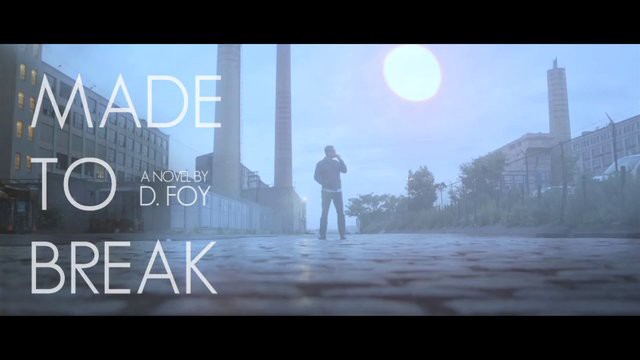
February 26th marked the inauguration of D. Foy’s national book tour in support of his debut novel, Made to Break, released from Two Dollar Radio on March 18th. Here is the second installment of his tour blog.

3/2

This was the first day of my sweep through the Pacific Northwest with Cari Luna, author of the killerdiller novel, The Revolution of Every Day. My publisher, Eric, had hooked us up for my event at Powell’s, but because she’d received invitations to read in Bellingham and Olympia (Washington), we took advantage of the opportunity to plan a sort of Bonnie-and-Clyde on the Northwest. By the time we booked a date in Vancouver, as well, where I’d had a fantasy of reading, probably for nostalgic reasons (I’d been there years ago as a kid), we had ourselves a five-city tour lined up, under the auspices of #LunaAndFoy.

All-things AWP far surpassed my expectations. I probably had more fun in the last four days than at any conference-type affair, ever. The flipside of this? I was due for trouble, or rather at least for trouble’s little brother. And sure enough, the rat chose the morning Cari and I were set to leave Seattle to waylay me.

According to plan, having flown out to Seattle, I was now ready to pick up the rental car I’d reserved back in December for the West coast leg of my tour — Vancouver to LA. But when I called Advantage rental car that morning to check its pickup address, I was greeted by the computer lady that answers when phone numbers are disconnected. I called the 800-number for Advantage to receive confirmation from a human in the Philippines or India that in fact Advantage no longer existed in Seattle and that Thrifty car rental had assumed responsibility for its obligation to me. But when I called Thrifty, they had no record of my reservation. The same human from the Philippines or India, or so it seemed — the human not only spoke English very badly but couldn’t seem to understand it, either, repeatedly parroting as they did gibberish that had nothing to do with my questions — told me I needed to call Advantage again to get another confirmation code that corresponded to a code recognized by the Thrifty system. This went on and on, back and forth and all around, until two and a half hours later it struck me

I’d somehow become the object of the sort of cosmic hoax with which our old friend Mr J. Kafka was so familiar

. Nothing could be done, or so I was informed by a different, purportedly superior human: it was now incumbent upon me — me! — to rent another car on my own. I checked the email account I use for buying things online — essentially my spam account — and found that just yesterday Advantage had sent a letter informing me, like the humans on the phone, that they were no longer responsible for my reservation. The letter also included a new confirmation code that, doubtless, was still unrecognizable by any of the aforementioned systems.

This is as good a place as any to speak a bit of politicalese: the human from India or the Philippines was not a nameless humanoid but, very obviously, a thinking, feeling person. The system these people work for has dehumanized them in the name of profit. I don’t know for a fact that they were speaking from India or the Philippines, but assume so by virtue of precedent. Every customer service operation for every major business, it seems, nowadays bases its operations in India or the Philippines. Why? Because capitalism seeks out the cheapest labor it can find, whether by machine or man, though preferably by machine, reducing man meantime — when it can’t resort to machine — to machine. The most profitable market for exploiting humans, as far as my experience can tell, is India and the Philippines, though surely that market will shift the instant the people it depends on for profit become intractable to that end. But no matter where that market is, one factor will stay constant: even as the service worker is mistreated, the consumer, as was the case for me that morning, and as has many times been the case, will always bear the brunt of systemic greed.

Dura in Grand Hyatt while Cari waits2

To continue, however, and to wit: in the lobby of the Grand Hyatt, where Cari had been waiting all this time (reading Duras as she did), she confirmed that despite my trauma I still possessed enough of my faculties to continue on. We would go to the Dollar agency at the airport with my new letter as though none of what had just happened happened.

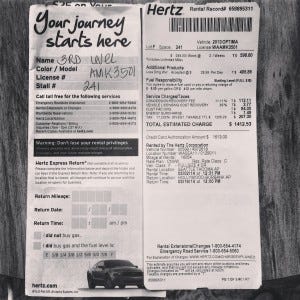
At the airport, with an actual and actually kind woman, I went through more of what I’d experienced on the phone until the person the kind woman called on her phone said that my reservation would likely have been assumed by Hertz, which, as it turns out, owns both Thrifty and Dollar. This was true. My confirmation number agreed with the Hertz system. Hertz gave me my car, at last, and only charged me $500 more, in insurance fees, despite my existing coverage for my car back home, which protects any car I drive. The fees for Hertz would cover the cost of the daily rental fee for every day the car would be out of commission in a shop, should I get in an accident, they said. Later I was informed that the person at Hertz had lied about the insurance fees, and that the employees of car rental agencies employ this dastardliness all the time. Wha???

Hertz ripoff

That night, in freezing, slushy Bellingham, Cari and I read to three people, one of whom was Dave, the accommodating and very pleasant events coordinator. We hadn’t considered AWP burnout, much less that it would doubtless apply to the people of letters who lived in Bellingham, most of whom would likely have been at AWP. Worse, and I think far more foolishly, we had overlooked a key fact — that this date coincided with Oscars night. I mean, right? Forget known writers, or even writers who are bona fide famous. What unknown writer in her working mind will think she can compete with the Oscars? Despite these obstacles, however, the reading and discussion came off fantastically. Village Books recorded the whole thing for play on two radio stations later in the month. No one in that audience will have any idea that the show wasn’t packed!

D1 Village Books Bellingham2

Later I slept in a hotel room that, did I believe in ghosts, I’d have said was haunted. But I don’t believe in ghosts but in moribund energy — the remnants, that is, of bad shit having gone down. I’m a bit of a psychic — the examples of this minor power are too many and long to say here — and am sensitive to the extreme of the mojo in a place. And the mojo in my room was anything but nice. I woke up at least six times during the night, and when I got up for good, way too early, I felt as though I were covered with mold. By the time Cari and I had nabbed some provisions for the road in the local co-op grocery, the mold was gone and the town was a blur.

Cari Shopping in Bellingham2
D Buying Produce in Bellingham

3/4

Cari and I appeared at a well-attended reading at Pulpfiction Books in Vancouver the night before, courtesy of its magnanimous and considerably educated owner, Chris Brayshaw, and Sean Cranberry, local literary impresario and host of Books on the Radio. A young woman in the audience hadn’t read (or even heard of) Cari until that night, but Cari’s reading so affected her that she bought Cari’s book straightaway, saying, almost in tears, how much she identified with the young woman in Cari’s passage. Needless to say, that was all Cari needed to hang out on Cloud 9 for the next day or two.

Cari at Pulpfiction in Vancouver
Chris Brayshaw Pulpfiction Books (photo by Sean Conner)2

I was happy for Cari in this alone, but I was happier for her still when we hit Orca Books in the dump that is the town of Olympia, Washington. This was after a five-hour drive during which we passed through the rainy farmland south of Vancouver, its trees filled — and I mean filled — with colonies of roosting vultures. “@dfoyble and I have arrived in Vancouver,” Cari tweeted. “The trees outside the city were full of vultures! This made me deeply, inexplicably happy.”

At the Vancouver Border

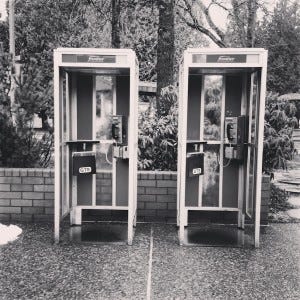
At a rest stop just inside the States again, I was as happy to find a pair of old school phone booths as Cari was to see her buzzards. “Won’t be seeing these for much longer. #relics,” I posted on Facebook.

Phone booths at Canada USA border

As for Olympia, its ugly face should’ve been portent enough for things to come. From barren hinterland straight through to city center, this place stunk of oppression and despair, like some creepy hamlet in a dark ages film, wasted by plague or sacked in war. The denizens were scarcely evolved from punk rock derelicts — as far from the cool punk kids that galvanized the world a few decades back as a ghetto cur is from a blue-ribbon pit bull. We were hungry. A Yelp review that rated 94% directed us to a banh mi joint that with its filth and gloom wouldn’t last a day in NYC. It so appalled Cari, she refused to eat its food. When at last we pulled into Orca after working a few hours in a nearby café, we were “greeted” by John Muir’s great great grandson, then told by his cohort that my books were not in-store. “Your distributor had a problem,” she said with an icy smirk, and turned away to ask another cohort whether that was the case. It was the case. But did I receive an apology, or what could pass for an apology? Did I receive any acknowledgement that I’d traveled thousands of miles to attend this reading? Did I receive even the basest courtesy? I did not. Not the tiniest least.

This is where Cari’s status as a visitor on Cloud 9 came in handy.

She rubbed my shoulder and patted my head and talked all nice and special. In short, she was a real friend, a perfect doll, a lady. The fun, however, was far from over. Come reading time, the people who ran the store refused to introduce us. Two of them slunk off to a stock room while John Muir’s descendant sat with his back to us, hunched before his crappy PC. Fortunately, despite the ineptitude of this “business” (it pains me in extremis to see independent booksellers comporting themselves so shoddily) thanks to friends and Twitter — Cari knows people who know good people in Olympia — our reading was well-attended. One of the audience, in fact, was already an actual fan of Cari’s. He loved her book so much, he told her while she glowed, that, as is his wont when reading fiction, he found a companion non-fiction book with which to pair hers — Rats: Observations on the History and Habitat of the City’s Most Unwanted Inhabitants. What could be more perfect for a book about squatters in NYC’s Lower East Side in the ’90s? We left the store as we’d entered, without a word from its employees, and in a flash I understood with disturbing intimacy Kurt Cobain and why he used a shotgun to take his life. Misery may be a dynamo for great art, but more often it’s the dynamo for the stuff of endings like his. If only we talked about that part half as much.

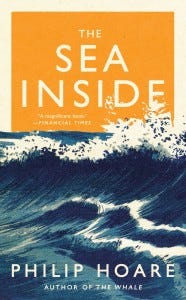
REVIEW: The Sea Inside by Philip Hoare

70 percent of the earth’s surface is ocean; about 60 percent of the human body is made of water, too. The sea outside and the sea inside — author Philip Hoare has spent much of his career interested in both. Now, on the heels of 2010’s The Whale, comes Hoare’s next book, similarly populated by leviathans, seabirds, and the occasional man: The Sea Inside.

To be published, with titular appropriateness, by Melville House in the U.S. (it’s already out in the U.K.), The Sea Inside is foremost a work of joy. While writing about modern oceans requires a certain degree of gravity, Hoare balances the seriousness with his own unforced enthusiasm on the subject of the sea. More than once does Hoare slip from the side of a boat to contemplate whales, dolphins, and human history face-to-face. From Hoare’s native Southampton Water, moving through Sri Lanka and into the southern oceans surrounding Australia and New Zealand, The Sea Inside is at once a travelogue, report, and memoir.

It might also be considered a collection of encounters: each turn of the page brings a new friend to Hoare. Here, a seal; there, a curious wheatear. Dolphins of assorted varieties. And whales — so many whales. “I probably think too much about whales, generally,” Hoare discloses at one point. Director John Waters agrees, saying in his blurb for the book that, “

I tell [Hoare] he writes whale porn; it’s better than any erotica that’s ever been written.

He makes his passion like an illness, like a good illness.” And yes, while the lyricism is easy to get lost in, the stories are strongly rooted in Hoare himself — confessional, even. If you get past the joy (and why would you want to?), there’s loneliness in The Sea Inside, too. “Homesickness,” Hoare eventually labels it, but since it’s pervasive even when he’s in Southampton, this seems like a rare instance of imperceptiveness.

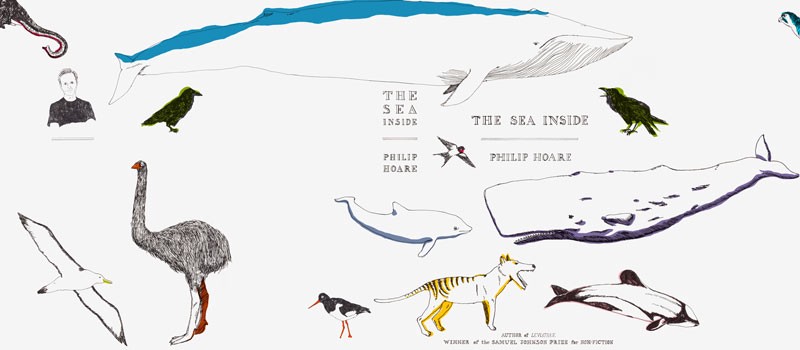
The Sea Inside, U.S. edition published by Melville House

The Sea Inside, U.S. edition published by Melville House

But that melancholy doesn’t bog the story; in fact, for a memoir, Hoare is suspiciously absent. Instead, the book is divided into nine seas (“The Suburban Sea,” “The Sea of Serendipity,” “The Silent Sea,” to name a few), each of which visits a different history and place. We are introduced to Azorean sailors, whalers, writers, British surgeons, Maori princesses and warrior kings — and those are just the people. For the animals, there are delightful illustrations, photographs, and antique diagrams to aid our visualizations. That is, Hoare’s writing is vibrant enough but also so referential that without the inclusion of illustrations, we’d be constantly running off to look up exactly what he’s talking about. It’s an effective strategy: Hoare knows how to use a reader’s natural curiosity to stoke the story, likely because he’s being lead along by his own.

The Sea Inside might be boiled down to one passage, in which Hoare writes, “We must wait as the whale blows and rolls through the water. Everything is stilled by expectation, diminished by this deferred miracle. All around the world people are going about their business; we are watching a blue whale about to dive.” Here is the distilled essence of Hoare’s work: one part poetry, one part record, and one part a plea for us to pay attention to these oceans, our oceans — and ourselves.

The Sea Inside will be released in the U.S. by Melville House on April 29th and is available for pre-order.

REVIEW: Hanging Man: The Arrest of Ai Weiwei by Barnaby Martin

by Ellen Adams

The core of Barnaby Martin’s The Hanging Man: The Arrest of Ai Weiwei is a two-day extensive interview with Chinese artist and activist Ai Weiwei. In the midst of a 2011 round-up of Chinese intellectuals, activists and creatives, world-renowned and politically-engaged conceptual artist Ai Weiwei was arrested without warning. Unlike some of his counterparts,

he was ultimately released following eighty-one days of imprisonment.

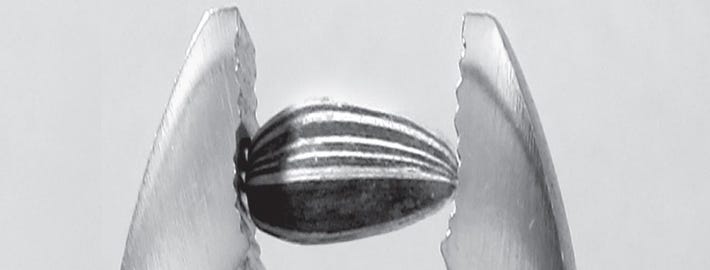
British writer Barnaby Martin, who has known Ai since his landmark sunflower seeds exhibition at the Tate, visited the artist’s compound soon after, thereby defying two conditions of the Ai’s release: 24-hour surveillance and ban on speaking with journalists.

Paired with Martin’s rendition of the artist’s biography, Ai’s words are enough to keep the reader in a steady rotation of compassion and disbelief. Like the 19-year-old countryside soldiers tasked with watching Ai’s every outward movement, one begins to ask aloud what undetectable inner engine is generating such high-risk art and anti-state activism. If you or anyone you know is struggling with the wherefore of conceptual art, I highly recommend this book; Ai Weiwei’s explanation, whispered through the stiff lips of a ventriloquist so as not to jeopardize the careers or curiosity of his jail cell guards, is the best I have come across.

Readers who are familiar with pseudonymous Emma Larkin’s Finding George Orwell in Burma will find a similar scope and structure: close consideration of one individual’s life becomes the home base for exploring a nation’s history and creative world, as well as the Western author’s experiences as an outsider and observer in a repressive regime. As with any narrative, though, the events are inextricable from the stance of the storytelling. One of the most defining elements of Martin’s book — and a perhaps fruitful counterpoint to Ai’s public displays of courage — is the underlying anxiety that colors the journalist’s sentences and decisions. Martin begins his journey to the interview with a preamble of uncertainty.

Given the conditions of Ai’s release, welcoming a foreign journalist into his home could easily jeopardize his freedom, if not life.

Even once safely inside Ai’s compound, Martin openly admits how he struggles to broach the torture Ai endured in his imprisonment. The reader becomes informed and implicated in the complicated ethics of digging into another’s trauma. The stakes are high, in this moment of interview as much as in both men’s larger project of seeking and speaking the truth.

While the interview with Ai Wei Wei serve as the backbone for the book, Martin extends his attention — and the reader’s understanding — to the widespread currents of suppression and intimidation for other high-profile creatives in China. Martin intermittently pauses the transcript, turning instead to prior interviews with prominent writers such as Liao Yiwu, Mang Ke, and Chan Koonchung and their strategies for creating and coping under the regime. Even Mexican conceptual artist Gabriel Orozco makes a cameo in an interview that contextualizes the relationship between art and changing consciousness.

Martin places special emphasis on Orozco’s conviction that art holds the potential to “build a bridge to reality.”

Narratively, these departures from Ai Weiwei’s imprisonment story provide recess from the claustrophobia, if not the risk of the pedestal. More importantly than this variety of voices, however, is a more universal truth that each writer or artist ultimately confirms: the freedom to think, whether encouraged or dangerously exercised, leads to the desire for and creation of a closer version to the truth. As Ai Weiwei himself says at the interview’s conclusion, “I wonder if that’s how this nation will change because now there are a lot of individuals who have their own sensibilities and their own judgment.”

When Martin takes us out of the words and world of the artist, the necessary provision of historical context sometimes trumps the book’s sense of focus. Those already initiated to the events and eras of modern China might be less than enthused about the perfunctory summary; those less acquainted with the nuances of modern China might be a bit bewildered as the tumult of the Cultural Revolution is boiled down to several pages of proper nouns and play-by-plays. Although Martin makes a noble attempt at an on-ramp into his own lived-in expertise, the reader will benefit from search engines and hypertext. Whether it be images of works of the Chinese contemporary art heavyweights that Martin mentions, or of the described-but-not-depicted oeuvre of its most famous living artist, such a need for supplemental information is perhaps, unintentionally, this book’s greatest strength.

By honing in on the specifics of Ai Weiwei’s eighty-one days of incarceration,

<em>The Hanging Man</em> provides ample foundation and fuels a greater curiosity

to the challenges and courage integral to the questioning creative in modern China. It is a book that teaches, but, like the best of teachers, it lays down the tarmac for a further-reaching curiosity. Furthermore, this instinct to seek out more information reminds the reader that such open access to questions, information and analysis are luxuries for which artists like Ai Weiwei must continue to fight.

Hanging Man: The Arrest of Ai Weiwei

by Barnaby Martin

Powells.com

NYPL’s Young Lions Award Finalists Take Readers to Unfamiliar Lands

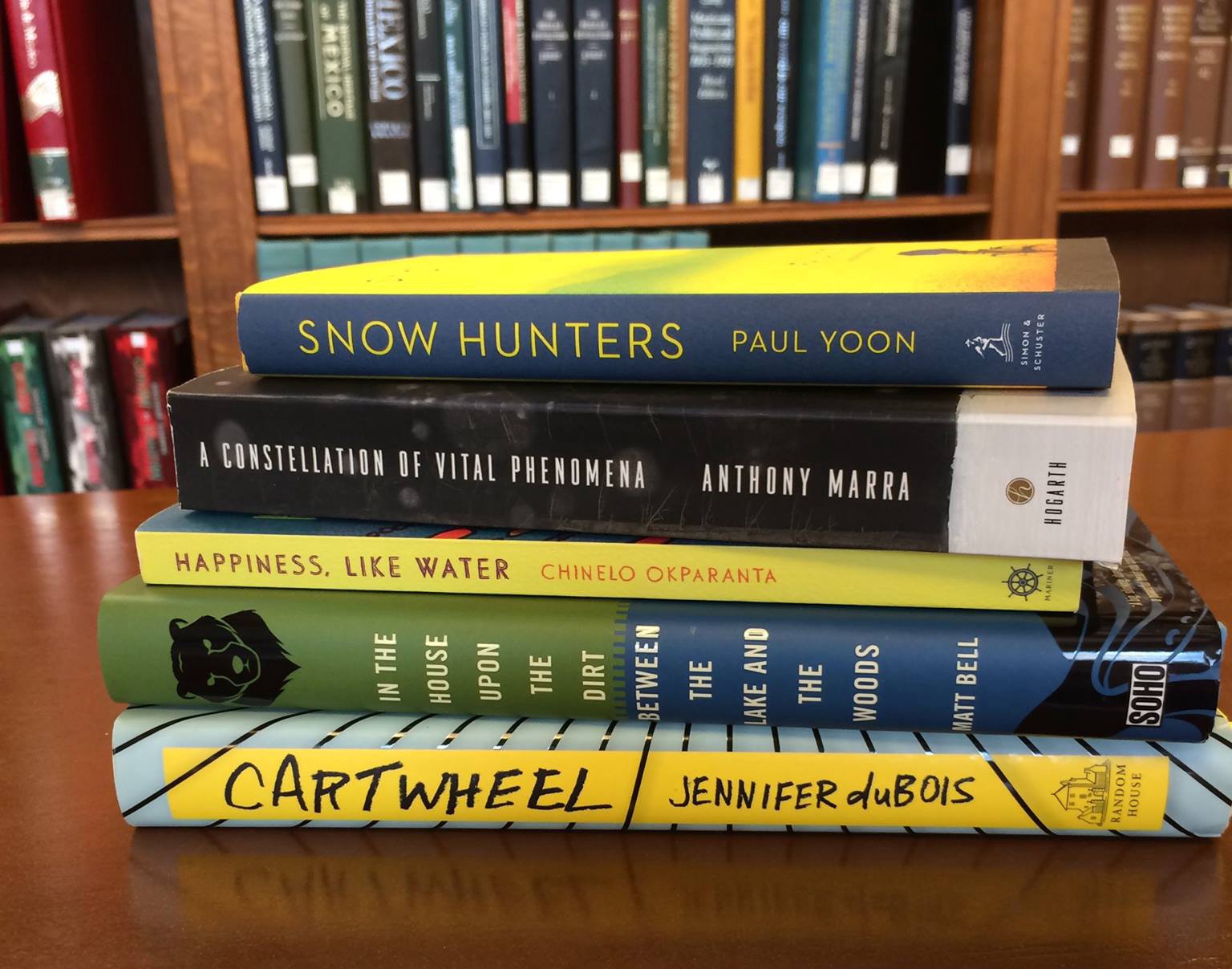
Five finalists have been named for the New York Public Library’s Young Lions Fiction Award, a prize given annually to a writer under the age of 35 for a novel or collection of short stories. A panel of Young Lions members, writers, editors, and librarians selected the finalists; on June 9th, judges will award one author with the $10,000 prize.

In the running for 2014 are Matt Bell (In the House Upon the Dirt Between the Lake and the Woods), Jennifer DuBois (Cartwheel), Anthony Marra (A Constellation of Vital Phenomena), Chinelo Okparanta (Happiness, Like Water), and Paul Yoon (Snow Hunters).

The settings of the novels are as diverse as their authors: the finalists take us to Brazil, Nigeria, Chechnya, Buenos Aires, and a remote lakeshore far away from home. Anthony Marra might be considered a frontrunner, as he’s already won the John Leonard Prize from the National Book Critics Circle for best debut novel. For others, this would be their first major award.

Claire Vaye Watkins’ Battleborn won the 2013 Young Lions Fiction Award, as voted on by Karen Russell, John Wray, and Peter Nathaniel Malae. As last year’s winner, Watkins will join the jury to select 2014’s winner.

Dear Sir or Madam

Here’s how Dad nearly lost a kidney: a man calls — a man with a voice as smooth as frosting on a wedding cake, Dad would here protest — and says he needs to speak with Mr. Wasinger about some test results. Despite the apparent and protracted decline of Dad’s body, he hasn’t had any recent business with the hospital as every urinalysis and blood gas and X-Ray only earns a more somber shaking of the head. But Dad — that’s all anyone calls him, even those of us who would rather not — desires only to be a friend so he says sure he’s Mr. Wasinger and wants to know if he passed. Wants so desperately it’s as if God’s phoning about the color of Dad’s soul. So, this phone-beautiful man tells Dad he needs to hear the results in person, not at the hospital but at an old wheat silo out on County Road 18. This is where most, I suspect, would come around to hanging up. The best, most civic-minded might call the police and the worst might send a child to investigate, but Dad, finding himself somewhere off the scale altogether, calls to borrow my Charger.

“I only meant to spare you the particulars of my ruination,” he says when I wrench the whole story out of him.

I dial the police — not that I am one of the good ones — and Sergeant Kidder tells me it’s only some meth addicts out to steal organs. Apparently the addicts — when they’re not only industrious but maintain an adequate front of teeth — get hospital jobs to pilfer pills and chemicals and patient records. They exhaust those — in that order — then find the next town west. They must be getting desperate to reach Ellyss, Sergeant Kidder adds. And I see his point. We are the final bivouac of civilization against the conquering prairie. When the last valedictorian moves away, the wheat fields will come for us. Before he hangs up, Sergeant Kidder says, Really they’re quite clever. I fear and respect them considerably.

Jimmy Kidder and I have known each other our whole lives, and he’s nice not to mention how me and the boys used to chase after him on four-wheelers or how more than once he’s had to ticket bartenders at The Jake for serving me drinks when they ought not have. This might be the first conversation we’ve had that does not end with one of us asking the other if he’s okay.

“It’s a win, Troy,” Dad claims later, scratching his stomach where he must believe a kidney to be, “because I went to the DMV to make myself an organ donor. Someone’s going to keep dancing because they’ve got my kidney. Hell, she — I imagine it’s a little orphan girl — can have whatever parts she can use.” His eyes get tears and his mouth gets a long pull at his Highlife. “Don’t imagine she wants my liver, but baby she can have it.”

This, I suppose, is a truth.

So Dad kept his kidney, but it seems only a matter of time before someone comes for one again. He signs his name — Dad Wasinger, what has become his name — on every special offer, every kiosk mailing list, every petitioner’s clipboard that circulates through The Home. On the phone he is even more exposed though I cannot suffer to sever the withered umbilical feeding him the world. Sometimes I imagine Dad hovering above his medical bed and how if someone were to open the room’s only window, he would float away.

The nightmare is such that in a fit of drunken pity I trade Van a laptop for a guitar amp I haven’t used since my high school band moved away. I slip an orderly twenty so that he’ll show Dad the internet and, I hint, the bookmarked pornography.

And this is where it begins.

Not with the pornography. That Dad never mentions except perhaps when he tells me there’s crazy stuff out there and either winks both eyes or closes them involuntarily during a tremor. At first it’s chain emails full of dirty jokes — the punch line to one is, Whose turtle is it now, Chad? — and then it’s conspiracies that I scroll through to find his irregularly typed, !did you no They s teal even R Dreams!, placed after thousands of other email addresses of which he has added exactly two: mine and the mayor’s. For a time it’s coupons to chain restaurants not found in Ellyss then videos of kittens sneezing then fundraising emails for the Children’s Organ Transplant Association then, finally, this:

Dear Sir or Madam,

I the Deposed King of the God-fearing Land of nigeria humbly ask from one beatific Christ child to another your help. Mountains of wealth I archived in your magnanimous motherland and need a U.S. American brother to help this disciple retrieve. Please good kind wealthy angelic sir assist a fellow human man in His time of need by replying with your address, Security Social, and account numbers so conveyance might be purchased to your home wherein you will receive UNIMAGINABLE EARTHY AND HEAVENLY AWARDS.

Yours,
The Improperly Deposed King of Nigeria

Dad tells me he has already replied and also ordered some Canadian Viagra at discount prices, an offer he forwarded to everyone in his address book which has now expanded to include The Ellyss Prophet’s editor.

At The Jake, I tell Van that Dad might be in trouble. I am thinking of his poor, shrunken kidneys and who might come for them next.

“Who?”

“My dad.”

“I thought Dad was just, you know, his name.”

“It is,” I say.

“That’s a capital-F fucking good omen your dad’s name is Dad.”

Van is not my friend; Van is my pot guy. But in recent years, moored and alone, the distinction blurred, a Venn Diagram converging into a circle with both of us trapped inside. Sometimes on his constitutionals, Dad smokes with us because glaucoma runs in our family, or so he claims. I do it because I have grown bored of spending my income on car stereos then despairing over which to install.

Days I work as the office manager for a trucking company — a job a girlfriend got me a decade back — and nights I go to The Jake where the familiar faces are either disappearing or turning sour.

The Jake is one of two bars in Ellyss — because Ellyss is just big enough to have two of everything, one good, one bad. The Jake is the bad one just as The Home is the bad nursing home. I put Dad there six years ago when I felt 30 taking aim at me. I went from a good home where Dad raised me to a bad apartment because I always settle on the shit side of the town’s dichotomy. Maybe that’s fated. The Jake was Dad’s bar, and I played in between the legs of these stools when I was a boy. My favorite childhood memories taste of stale corn nuts.

“Let’s introduce him to someone named Mom,” Van says. “My mom is named Mom but she’s already married to a Dad.”

I shrug over my beer. I never had a Mom with a capital M. The original one — which is to say the real one — Dad claims dead, but I know the truth is murkier. When I cleaned out Dad’s house, I found an ammo box full of postcards from her in his bedroom. I never read those cards and do not for a minute regret it. I only had to check the postmark to see the earliest arrived when I was 14 and by that time it had been only Dad and me for years. Well, not always, what with the way mothers came and went. But I figure Dad did all right by me, and when some of my ex-girlfriends got to crying about what our breakup would mean to their kids, I reminded them I turned out fine. Still, I spend nights in bed tracing the spaces between my ribs wondering if I am truly as weak as my body feels.

I admit this to Van.

“It’s natural,” he says. “We live to find new ways to die. That’s the secret. Most fail. Just more mice starving in the maze.”

Maybe Van is my friend. Maybe my only friend. So slowly that I failed to recognize the evacuation, my friends abandoned Ellyss. Which is to say they left me high and not particularly dry. And even that I could abide, if not for them having also left behind ex-girlfriends who glare from behind strollers as they walk through autumn mornings. I don’t have anything to do with the kids, at least not in the way of fathering them. But I pushed them on swings where I once swung myself. I gave my old children’s books as birthday presents. I showed the older ones how to make Troy Stew by buying four varieties of Campbell’s. I heard them accidentally call me Dad and did not correct them. Their mothers — who were so damn hard they were brittle — made me promise I would not hurt them. I promised, I did, again and again. And now I’m gone but not very far.

The worst part is that I don’t care a damn for any of the ex-girlfriends save Fran. Well, Fran and Maria. And these are the two I never see. Or maybe that I always see, just never when I am at my best. Like when Maria comes into the Russ’s and my shopping cart is full of microwave dinners. Or when I’m walking home from The Jake and Fran sees me standing in her lawn yelling her name at the stars.

Van says, “Didn’t you cheat on one with the other then the other with the one? Those bridges are burned.”

I remind him there aren’t any bridges in this prairie town.

All night in my drunken sleep I roll over and over the question of which is the good ex-girlfriend and which is the bad. This knowledge can free me, I’m certain, but I wake up red-eyed and no closer to knowing how I can ever choose one or accept neither.

Out of concern for my hung-over appetite more than Dad’s online activities, I pick him up early for lunch. I find him coloring his room with whistles. When I ask what he’s so happy about, he says, “O, Son, you can’t measure the good that’s coming.”

I worry about him more when he’s happy. Why should he be happy? He is shrinking back down into his athletic socks. His skin — burnt crisp over 40 years of fixing power lines too close to the sun — conveys his state, and I can’t imagine a little orphan girl could do a thing with any part of him.

We go to Taco’s for tacos, the Mexican restaurant Dad prefers to Olé’s which is owned by actual Mexicans. The idea of Mexicans beat actual Mexicans to Ellyss by some 20 years, and for the persistent racism of Dad’s generation I am sometimes grateful, even if the tacos taste like meatloaf sandwiches. See, Maria works at Olé’s and to see her would cause a terrible pain in my chest. I know because not seeing her also causes a terrible pain in my chest.

And Fran, too. Both that she causes this pain and that she works at Olé’s. The two are the best of friends and blame only me for our tortuous past.

Dad orders extra tacos because, he says, he’s suspicious of a Vietnamese cafeteria worker, and I don’t think anything of it. In fact, I enjoy the simple goodness of my gesture so much that I take him for tacos the next day too. We laugh at old stories and let the shredded American cheese rain onto the Charger’s floor mats.

This lightness lasts only a week.

The call comes at work. Before a word is said, I know it’s The Home. I cannot prove it, but those halls hold more oxygen than God’s atmosphere grants us. It leads, surely, to that smell — something so alive it’s death — and the way this woman on the phone breathes like a sparrow.

“If it’s about the bill,” I say, “it’s not that I don’t have the money. It’s that I’m forgetful.”

This, I suppose, is a half-truth.

The nurse insists that I come that minute. I think about how I haven’t shifted the papers around my desk for a while and want to tell her I’m busy. But I know her, or at least I know her daughter. I took Cindy Phillips to the Starlight dance at the Rec. Center in the 7thgrade. At our 10-year reunion, I asked her if I was the first person to have felt her up. Still a prude, she demurred and shuffled her husband away.

At The Home, everything is beige plastic, as if they built the facility after smelting the veterans’ false legs. A fist against Dad’s door sounds like knocking on a portajohn.

“It’s my own damn closet,” Dad says. “Couldn’t I put anything in there? Well, not a hotplate, they were clear on that.”

This confuses me until I look into the closet and see the dressing bench pulled down and covered with lumpy blankets that rise and fall in soft snores.

“Don’t wake him,” Dad says. “He’s still on Nigeria time.”

I try anyway. At first I clap my hands then I turn up the volume on the TV until the accusations on the soap opera crack like heat lightning. None of this has any effect, but it makes me feel like I at least tried. Dad yells over the TV that the man has been living in his closet for days, and that nobody cared until Mrs. Phillips thought something smelled like cabbage.

“It is cabbage,” the lump says.

The man — white and elfin sharp with a frizzy pompadour and a single curl of hair pointing down at a thick black goatee — stands and brushes off his too short pants.

“I am De King of Nigeria,” he says. He wears not a shirt, and I spy what appear to be gunshot scars.

I beg his highness for a brief parley with Dad, and his majesty grants this indulgence by shooshing us away with a limp wristed hand wearing a ruby ring bigger than the cherry suckers I used to buy at the Ben Franklin.

“You’ve embarrassed me,” Dad says. “Now I fear he’ll never trust me to rescue his millions in the name of Jesus.”

“You don’t care about Jesus,” I say. This seems a small point, but I want to win the little ones first.

“That doesn’t mean I’m not a soldier in God’s Army of the Blessed Redemption, my son.”

I am not sure who taught him to talk like this, but I have a theory. Mrs. Phillips glares at us when she enters. He’s been here a week, she says. Dad corrects her by saying it will be a week tomorrow then pulls back his lips to form a big smile. I don’t know about glaucoma, but the Wasingers have strong, bright teeth.

“He’s not the king of Nigeria,” I tell him.

“Of course he’s the king,” Dad says. “He knows all about it. Says he comes from Legos. Plus, his name is King.”

“De King, da,” the man says. He’s changed into a gold shirt and a black silk vest. “Papa, is this de son who brings of the tacos?”

Turns out Dad had been feeding the extra tacos to De King. This Dad explains to me as we drive through town, and when he hands a taco back to De King, he says my liege and bows so that his forehead touches the Charger’s vinyl.

“He’s not even Nigerian,” I say. There’s no chance of offending De King as he’s focused on the girls’ high school track team jogging down the street as he chews with his mouth open.

“Sure he is,” Dad says. “I replied to his electronic letter, and two weeks later he’d taken my savings to buy his plane ticket here, just like he promised. It’s God’s providence divine, Troy.”

I don’t think he knows what these words mean. Watch, I say.

“Perhaps you’d say grace for us, Your Highness,” I call into the backseat.

In the rearview mirror I watch De King stall by picking ground beef from his goatee. He waits for me to take my eyes of him — which I will not do, I don’t care if I run the Charger through the glass doors of the Orscheln’s — before he starts.

“O Lord God of de mother coontry. Bless dis feast and all who live within dis motorcar. Amen.”

“Beautiful,” Dad says.

I drive Dad and De King back, and begin a complex negotiation with Mrs. Phillips over what it will take to get The Home to not ask questions about what’s in Dad’s closet until we can figure this out. I offer the following: I will pay the double rate retroactive a month, and she will let Cindy know I’m thinking about her. Mrs. Phillips counter-offers: no.

But when I see Dad’s expectant eyes I tell him everything went fine. He hid the harder truths from me, and I can do the same for him. In the corner, De King tests the room’s only chair for durability by kicking at its legs then — satisfied — paces regally, his thin head so far back his pompadour is perpendicular with the floor. Dad hugs me for the first time in a forever then kneels to kiss De King’s ring. He says it’s only for a week then all the financial issues will be settled and De King intends to move somewhere more befitting a God-issued monarch. Somewhere like Las Vegas or Boise. I ask De King how he settled on those two destinations, but De King — sniffing Dad’s remote control — only says, “Boy-easy, da.”

I say, “Until then, keep him in the closet. They don’t want the others to know you’re coming into money.”

Dad nods. “Their jealousies vex me so.” Before I can leave De King clasps his hand on my shoulder and says, “Perhaps you’d like princess?”

“No,” I say. “I’m good.”

He squeezes tightly and my arm numbs. He both smells like anise and looks like how anise smells. But his eyes, they’re black and red and not at all shaped like eyes should be shaped. De King nods as if he knows I’m wondering if he is a mortal after all and says, “I take her out your share. Papa give you everyting. Say da.”

He will not release me until I say da. And I need my arm for Cornhole at The Jake so I say da.

Dad sends me updates through Facebook. De King told him about escaping from an African work camp where it was always snowing; Dad set the TV to Univision because De King is worldly; they sneak out to the rec room at night so De King can learn ping-pong. Even though Dad has only been on the site for two days, he already has more friends than I do. One is Maria. One is Fran. And one is De King who in his profile picture has a hand under his goatee while the other shields his eyes from the future or God’s grace or the uncovered neon tubes that light Dad’s room. De King has no other friends — but hundreds of discarded, nearly identical potential profile pictures he must have uploaded accidentally — and out of the same considerable pity that led me to get Dad a computer, I friend him. He never responds.

“It’s a scam,” I say to Van in the alley behind The Jake, “but I can’t figure out what he’d be after.”

“I vant only your happy,” De King says.

I can’t help their presence. Dad needed a constitutional, De King, too. He takes a long drag from the joint and coughs into the night. When it begins to rain, Dad unbuttons his flannel shirt and stands on his toes in a stained white tank top holding the shirt above De King’s head until the joint is gone and we are back in the warm bosom of The Jake. As Dad explains the rules of Cornhole to De King, I take Van aside and say, “Seriously, what’s his game?”

“It’s not Cornhole,” Van says, and he’s right. De King drops the beanbags into his own board and adds three points to his score while Dad claps.

“I mean with Dad.”

Van looks down into the vodka shot De King ordered for him then up at Dad, “And he still has his kidneys? Then it’s kosher.”

I remind him that he is supposed to be my accomplice in suspicion. I remind him he once wanted me to steal the tapioca pudding from The Home so he could test it for LSD.

Van shakes his head, pushes a dollar into the jukebox, says, “Mystery is the heart’s rose.”

As he saunters away, “Smoke on the Water,” comes over the bar’s speakers, and Van might be an idiot.

Drunk, I call the worse of the town’s two unofficial taxis to take us home. The streets of Ellyss are slick with tomorrow’s dew and the moon makes shimmering lakes of the streets. Dad says it reminds him of the war. He wasn’t in the war, but at this drunken moment I nod and so does De King. Tricia, who uses the family van to moonlight as a cab, must think we’re crazy because suddenly I am trying to explain to her the horror and beauty of wars I haven’t fought. And if not then she must think it when we get to The Home and I discover my pockets are empty. Dad offers to pay with his Eagle Scout keychain, but De King insists Tricia leave with his ruby ring which glows like blood in the night.

“I have many and you are as beautiful as this warnight,” he says. “But I must request de service of de toy pony I found on de floor.”

In the morning, I am only my headache when I crawl out from under Dad’s bed just to crawl back when there’s a knock at the door. A pair of white trainers drops off lunch and I hear Mrs. Phillips ask Dad what smells like cabbage. From the closet, nearly a snore, I hear De King moan, “It’s still cabbage.”

I spend the rest of the morning helping Dad move his stuff — only the computer and some old pictures of me as a boy — out of The Home and into the Charger. De King has no stuff. Everything he wears has been seized from other residents, and Dad and I wait as he returns the items.

“This isn’t what I want for you,” Dad says. “I want you to live your life.”

“And you?” I say.

“I suppose I want my life not to feel so lived.”

When De King climbs into the backseat, he holds a pair of khakis far too big for him and beams. “He lives in Jesus now.”

That afternoon as Dad and De King unpack, I walk a circuitous route through Ellyss that takes me by the houses of old friends who I want to follow to somewhere far away, but somehow I just end up at the Russ’s. A Saturday, the store is busy with the risk takers who prefer its roulette of expiration dates to the newer Dillon’s safety, selection, and convenience. I walk down the soup aisle throwing cans of chili and cream of chicken and vegetable beef with the alphabet noodles into my cart. I feel like every face recognizes this recipe, but I no longer recognize theirs. I have used them until I found them empty, and here faces are not born as quickly as I deplete them. I have Dad. I have De King. I have Maria.

At home, I make a stockpot full of Troy Stew and lock my bedroom door. Though the working week is two moons away, I leave a message saying I intend to be sick every day. O, and Fran. I have Fran, too.

In the living room, Dad and De King laugh and slap each other’s backs in front of the computer. I pass the time reading the emails Dad sends. They come rapidly in increasingly fragmented internet speak until he is signing his name !)@!). De King sends me messages, too, but only with requests to visit his personal website which automatically plays “Silent Night” while a winking moon rocks on a swing and a snowflake breakdances. There is this message:

Dear Sir or Madam, I need you more than ever. Please, in Lordly Kindness, link yourself to me.

The Irregularly Disposed King of Nigeria

Underneath, there is a picture of Dad and De King pretending to urinate on a plastic fern. It says © TROY WASINGER PHOTOGRAPHY, but I remember only urinating in that fern for real that night after The Jake.

On Friday I hear them whispering to each other outside my bedroom door, and for a time I think they are planning a house meeting so we can set up a chore chart and discuss upgrading the cable TV. But then they are gone, and for the first time in days I am alone. I step into the living room to survey the empty Mountain Dew bottles strewn around the computer and a drawing of black and white stick figures holding hands atop an icy plain. In the background lions dance with brown bears. Across the top it says, NIGERIA, and at the bottom, FLAG. Before I can take it down the door opens. I assume it’s Dad and De King back with sacks full of moon pies and 5-hour Energy until a woman says, Husband.

She steps into my apartment with her chin held high and lowers it only when she kisses my cheeks. She wears a dress of gold and green silk that stops halfway up her shoulders as if the fabric got tired on the climb up the smooth, brown slope. Thin braids cover her ears and a long ponytail cascades down her back. A uniformed driver carries in a set of white leather luggage, a blessing because I never want a time to come when we are alone.

“You ordered a wife?” she says.

This, I suppose, is a near-truth.

She kicks away a can that once held beets and says, “The Nigerian Princess. You received my emails?”

When I laugh she says, “What? You think I want to marry you?”

Her eyes take mine on a walk around my apartment, and I see it as she must see it. More damningly, I smell it as she must smell it. The nose does not like a mystery and Van is full of shit. I am too old to live like this. I know because I am standing on a black t-shirt I got when I played JV basketball.

When I put Dad in The Home, I remember being jealous of how he accepted that there were places he would not return to and would never go.

“I was once like you,” she says then pauses to think about it. “No, better than this.”

I excuse myself — with considerable relief — when the phone rings. It’s Dad. He says I won’t get the money if I don’t marry her and I say that’s ridiculous and he’s says he’s got to go because his druid is about to level up and De King says they won’t be able to kill the dragon unless they find a white mage and I say where are you and I say where are you. He’s gone.

“What’s your name?” I ask when the silence becomes intolerable.

“Princess Kano,” she says. “Like the city.”

“O,” I say, “Naturally.”

She calls me Husband until I insist she call me Troy. She insists in turn I call her Princess — which I thought I had been doing — but I realize I have not risked saying her name at all. I tell her I will put her on a bus to wherever she wants to go.

“Boise,” she says. “I’ve heard good things about their medical school.”

But she is hungry and there is no restaurant in Ellyss worthy of a princess. I choose the opposite of the one where I would normally go, but first we see the town. I drive in widening circles, not talking much but slowing near all the landmarks of my childhood. I am surprised how many places hold memories, and for the hour of the drive the town feels bigger than I know it to be. I even take her out to the decrepit wheat silo where the meth addicts once tried to steal Dad’s kidney and though I say nothing, though she has no idea what has happened, she holds my hand.

“You can’t trust anyone,” I say.

“I agree,” she says. “Or you can trust everyone.”

This does not strike me as agreement.

At Olé’s, I try to sit across from her, but she insists on the same side of the red booth. Sombreros hang from the ceiling and the salt and pepper shakers are tiny maracas. When the waiter comes, Princess slaps my shoulder with the menu.

“Tacos!” she cries.

We order a medley, all the varieties, even the ones that are made out of parts of cows I will not describe to her. While she eats — one bite from the bottom center of each taco, spinning the plate to bring the next one around — she widens her eyes and says De King is not her father. She looks as if this information might cause me to faint though I only say good lord, of course not. Disappointed, she continues. She didn’t know she was a princess until he told her in an email. What choice did she have? And all this time she’s talking I know she’s not lying and she’s not stupid, either. I believe her when she says she was studying to be a doctor, and that she’d like to continue to in America. I say it’s too bad there is only the Veterinary School in Ellyss, but that the university in Boise has a football field blue as an ocean. This pleases her greatly. She asks me to tell her about my family, and though I try to hide my mother behind the considerable adventures of my father — for this has always been my strategy — she will not relent. I tell her about the postcard box, and she says sometimes we must be guarded against the truth.

And this I do agree with, but an argument overcomes me anyway. “I can’t imagine it was anything so horrible.”

She shakes her head. Not a braid moves. “She left. Your father couldn’t. He moved forward where he could.”

Then I see them. First Maria then Fran then Fran and Maria together. They are looking and whispering. Both wear short black aprons heavy with order pads and pens. I am grateful they are friends despite what I did, and suddenly the thing I want most is to be able to explain something to them but I don’t know what.

“Ex-lover?” Princess says.

“Both of them.”

“Past wounds can heal,” she says, “but the future scars before it cuts.”

I tell her she reminds me of a friend of mine, and she says it is nothing, only the limited wisdom of someone who once received a message, who gave up her old life for a new one, who will do it again. In Boise.

A gas station serves as the stop for the day’s one bus, which goes the wrong direction. It will take her to Kansas City then to Omaha and then she will need to get a different bus — likely several different busses — until she arrives, two days later, in Idaho. I try to convince her of the arduousness of such a trip, but Princess only says she is sorry things could not have worked out.

“You should be far more worried,” I say. “Try not to sit by the bathroom.”

I go inside for the ATM to give her whatever I can, but when I punch in my PIN, I find a richer man’s account. Hands shaking, I dial my number and De King answers with a curt, “Ve’re podcasting.”

“The money?” I say. Outside I can see Princess by the pumps washing the Charger’s windshield, even taking a towel to wipe off the squeegee after each pass to prevent streaks. I love that car, and even I never do that.

“I promised,” De King says. “Your money minus $2,526. Wife fee. You are also official Nigerian Knight. Tap your shoulders and rise Sir Papason. O, and I took de tax, too. Do not be angry with this old bear-o-cat.”

And I don’t know what good things are coming. I only know that when I go to buy the bus ticket, I buy two. Outside, I tell Princess that it’s not a journey one should undertake alone.

This, I suppose, is a lie.

And it’s not that I believe in Princess as a princess or a wife. But I believe she believes something and maybe that’s enough.

When I go back into the truck stop to get Princess a water, I call Van and tell him he can have the Charger, and as he’s haggling over how much pot he’ll trade for it, I hang up. I leave the keys with the clerk and buy two postcards. The cards are all black and on the back say ELLYSS AT NIGHT, and while Princess is checking my brake fluid, I begin to write atop a dusty box of Fifth Avenue bars. One I write to Dad. I say I’m going and that he should videochat me so that I can look after his kidneys from afar. The other I write to Maria and Fran, care of Olé’s. I say I’m sorry for not knowing how to live here and even more sorry for not knowing I didn’t know. I say I don’t know how to live anywhere else either. I say I never knew what you wanted or what I could have done to give it to you. I say I am not sure I have learned anything. I say don’t read this postcard. I say I want to take you with me exactly as much as I want to leave you behind. I say goodbye but it might be hello, and I worry those two who once loved me will recognize the sad, smiling contradictions in my handwriting and give me up for good. Then where will I be.

REVIEW: Happy Mutant Baby Pills by Jerry Stahl

Jerry Stahl’s Happy Mutant Baby Pills is a hurricane of comedic and satirical horrors involving drug abuse, violence, manic lovers (including their manic sex lives), and ungodly revenge against the United States.

Stahl ventures unapologetically through the darkest imaginable places.

He boldly dives into the minds of hopped-up Lloyd, the heroin-addict protagonist, and Nora, his even more hopped-up girlfriend. In a way, I wish I had been on heroin with Lloyd and Nora when I sat to read Happy Mutant Baby Pills. Stahl’s social satire is not exactly a “pajamas-and-fireplace” kind of book. It is far from cozy, and diving in should require some serious psychological preparation. This is a hurricane few (sober) people can stomach.

The narrative focuses on Lloyd, a sucker looking for a writing career. He ends up as a copywriter for Christian Swingles, an online dating hub for the pure in heart, as well as job as a small print side-effect writer for prescription drugs.

Lloyd’s purpose is to condense the nasty, hairy, and sometimes-fatal side effects for the capitalist drug market.

In contradiction with his career, he shoots up an unholy amount of heroin. He establishes a quick and funny contrast between the effects of his heroin addiction versus the effects of acceptable prescription drugs. The comedy is at its strongest in Lloyd’s seeming lack of attention for the deadliness of heroin in shadow of his fixation on the big, bad, capitalist American monster. It sinks into some pretty gnarly places that are hard to stomach.

For instance, there is a recurring strand of jokes about Nora’s body, whose “purply” clitoris is “so large I wondered if she might be a hermaphrodite. It was shocking, hot, and National Geographic-worthy all at once.” Point blank — let it be known that this book’s humor isn’t for everyone.

But to counteract the rough and pornographic edges,

there’s enough here to be refreshingly funny

. In a “Prayer of Affirmation,” Stahl writes, “Just for today, help me not be who I really am.” There are several fun one-liners like this that offer a breath of “cleaner” air. One thing I particularly loved about the book is Stahl’s consistency of tone and motive from start to finish. The tale was unpleasant but never boring. Stahl’s structure effectively and excitingly builds to a conclusion that finalizes the story well without trying too much to have a “twist” ending. Amidst Lloyd’s wild circumstances, Stahl kept a strong hold on the character, making for an interesting protagonist.

Happy Mutant Baby Pills may be a bitter cup of tea, but I recommend it solely to experience the madness of Stahl’s writing. Somewhere between the “aha!” moments of this four-part story, I developed some disturbing fascination with drug abuse and social irrationality. There is a certain element of fun and mischief in reading something so daring and appalling. So if volatile love affairs, social extremism, and hysteric lunacy are on the agenda for a late-night read, this book is right to take off the shelf. A tip, however? It may be a good idea to shoot up first.

Happy Mutant Baby Pills

by Jerry Stahl

Powells.com