“Valentine”
by Alexander Yates
On Valentine’s Day Sandra wakes up early to go to the flower shop. It isn’t to buy anything — she has nobody to send flowers to, or at least nobody who would accept such a gift from her gladly. The flower shop is where she works, and the morning is like any other. She eats breakfast alone, smokes two cigarettes in the bathroom, showers, towels dry. She changes into a brightly printed blouse that, as she eyeballs it on the hanger, still looks like it belongs to somebody else. She stands in front of her mirror and says: “You can do this.” Then she opens the front door, and leaves.
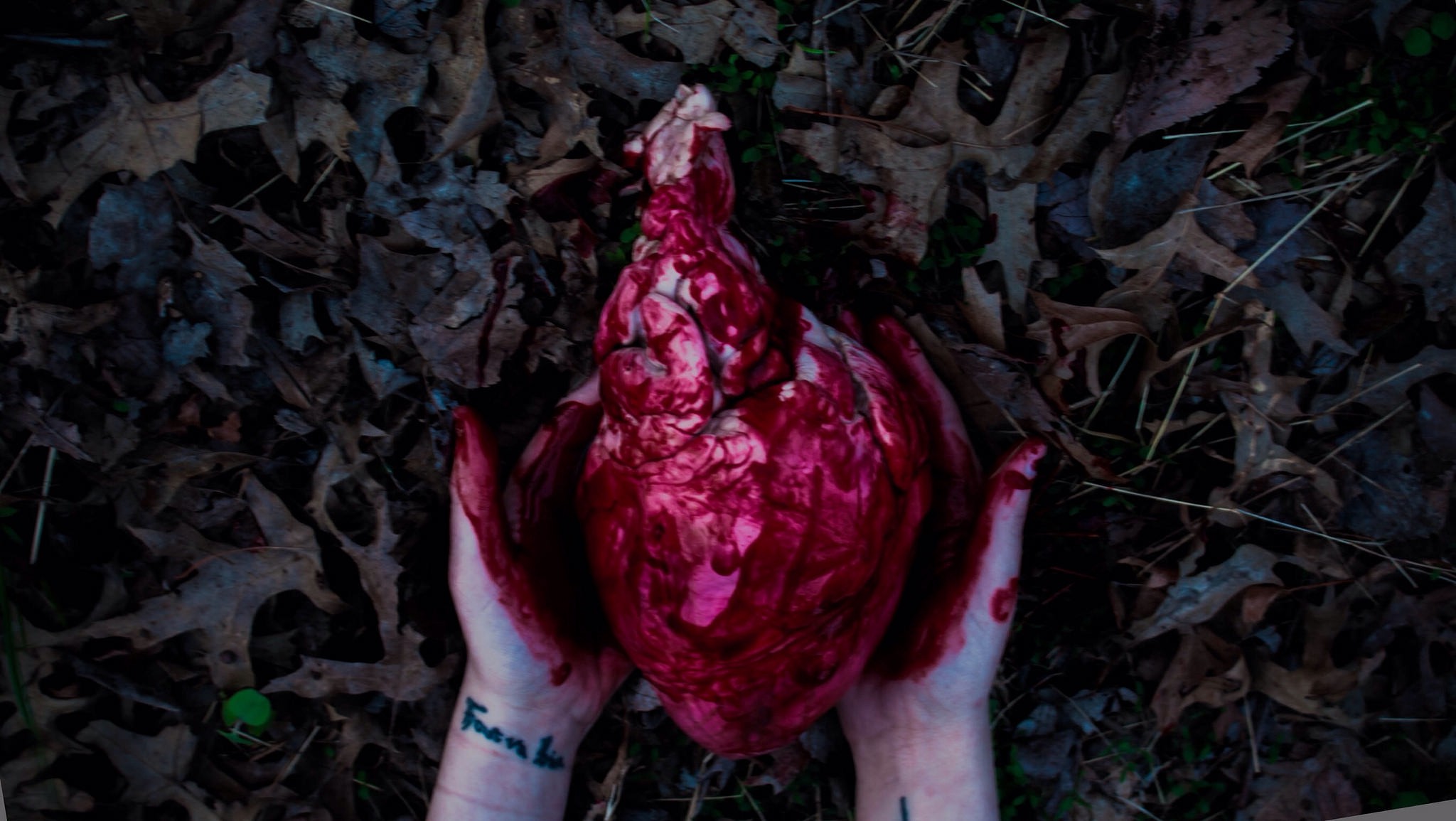
She doesn’t get far. There’s something on her porch. It looks, at first, like a hunk of uncooked steak with an arrow sticking out of it. Stepping closer, she sees that this is more or less what it is — a beef heart, big as a football, probably bought from the butcher in town. Though the arrow is actually a bolt, maybe from a crossbow; not your traditional cupid-type arrow. She’s surprised and then not surprised to see it. She steps around the burgundy-brown stain and scans the street. She knows who did this; knows he must be out there, somewhere.
His usual hiding places are empty. The trashcans beside the curb conceal nothing but more trashcans, and he’s not peering out from the storm drain beyond. The bare trees have only abandoned nests in them, and there’s nothing on the neighbors’ roof but a Frisbee and some ice. Finally she spots him, sitting in an economy rental car, parked down the block. Even with the sun reflecting off the windows, she can tell that he’s naked in there. She can see one dark nipple; the other covered by the buckled seatbelt. She takes out her mobile phone and calls the police.
“Don’t tell me,” Molly, the dispatch operator, says. “Him?”
“At it again,” she says.
“Oh honey. Happy Valentine’s, I guess. You sit tight. I’ll send George right over.”
George is the sheriff. He’s also Molly’s fiancé. It’s a very small town they live in, one where workplace relationships are not uncommon. In fact they’re something of a local institution — the teacher and the principal; the doctor and his nurse. She arrived in October, and by the first frost the manager was already hinting that she’d be a perfect match for Stanly over at the greenhouse.
“Thanks,” she says. “No special rush. He’s keeping his distance.”
“Well don’t you go talking to him again,” Molly says. “That just aggravates it.” There is a pause — radio static and acrylic nails gossiping over a keyboard. Down the block her stalker just stares. Then Molly’s voice returns, with verve. “So now, babe, I’m guessing that you have nothing, zero, na-da in terms of plans for tonight.”
“You’re guessing right,” she says, regretting how flat and self-pitying this sounds. Not so long ago she had plans every night.
“Girl, that’s crazy-sad,” Molly says. “Listen — you’re coming out with us.”
“On no,” she says, with a polite reflexive smile that’s wasted on the phone. Down the block her stalker notices and smiles back, widely. He flashes his high beams in a way that can only be construed as lewd. “I can’t tag along with you two on date night.”
“Who said date night? I’ll invite, like, a whole group. We’ll make it a thing. No one’s a spare wheel when everybody is.”
“I think I’d rather — ”
“Rather my tush,” Molly says. “Stop home after work and put on something slutty. It’ll be like our college days.”
“All right,” she says, even though she didn’t go to college with Molly, and that sounds nothing like her college days. But since moving to this town she’s spent every night alone, and some company would be nice. Her solitude has been intentional, of course. She moved here to recalibrate, to get acquainted with a version of herself that she can be proud of. But right now, on Valentine’s Day, in this frost-brittle town in upstate New York, nothing sounds better than a beer or two; a night out with people who could become friends. It’s a sign, she hopes, that she’s getting better.
Molly sets a time and hangs up, maybe to answer another emergency. And just at that moment Sheriff George rounds the corner, vintage cherry-top whirling. As the cruiser pulls into her driveway she notices that he isn’t alone; Jeff has come along. He’s the deputy and, along with Molly, the only other employee of the crumbling, underused local station. She’s met him many times in contexts such as this, but makes it a rule to avoid him socially. Why? Because, like Stanley in the greenhouse, Deputy Jeff is available. And, unlike Stanley, he is young and fit, without a trace of eczema.
George steps out of his cruiser, gives her a friendly nod and makes for the naked man in the rental. Jeff gets out as well and crosses her frozen lawn in a few long strides. He places tiny orange cones all around the beef heart, and then photographs it from a number of angles, even lying down on his belly. From that perspective, the heart must look enormous, she thinks — it must loom. Jeff also photographs the front walk and the deck and her shoes, which, she realizes now, have some blood on them.
“Are you hurt?” he asks.
Always this question is the first thing out of their mouths. Always they seem a little disappointed with her answer. “Oh, no,” she says. “He’d never hurt me.”
“Just because he hasn’t, doesn’t mean he won’t.” Jeff glances back at the rental car with contempt. Sheriff George tries the handles and finds them locked. He leans over the windshield, tapping on the glass with his flashlight, negotiating in a stern voice. Her stalker flips the wipers on and sprays wiper fluid, whipping blue foam across George’s uniform. She laughs at this, then quickly pretends she’s coughing. Jeff pats her back. “You okay?”
“Fine,” she says.
Out in the street George wipes the suds off his uniform and hooks the end of a measuring tape to the rental’s front license plate. He walks it back in the direction of her property, and the tape terminates a few feet away from her lawn. “Rats,” he says, with a trace of admiration. “Well, he’s just outside the limit. We can get him on exposure, and on this mess,” he gestures vaguely at the heart. “But it would have been better to catch him violating the order.”
“We can always give him a little push,” Jeff says. He pantomimes nudging the rental car across the invisible perimeter of her restraining order. He laughs, and George laughs, and she laughs as well, mostly because laughing makes what Jeff said a joke.
“So what are you thinking?” Jeff goes on after a pause. “Jaws of life? Smash the glass and pull looney-tunes out?”
George makes a tsk-tsk sound, reminds Jeff that it’s Marty that owns the Avis place down at the airport, that Marty is hanging by a thread, that the up-tick in his insurance premiums would be as good as scissors. He points out, also, that Tony’s tow business is hurting; grins benevolently at this opportunity to throw him some work.
Marty, Tony, Jeff, and George, she thinks. It’s a first-name-basis kind of town.
Tony arrives in less than five minutes, looking like he didn’t expect to get out of bed today. “Thanks,” he says to them. “I mean it. Thank you,” as he loops the grab hooks under the suspension and raises the winch to lift the front axle into the air. Her stalker seems unfazed by it all. He waves at her. She waves at him. Tony drives away.
George and Jeff drive away also. No one has said anything about what to do with the heart. She sits down on her front step, careful to avoid the heart, and lights a cigarette. She sees, upon closer inspection, that the heart has something written on it. Their first initials — hers and his — have been carved into the atrial muscle and inlaid with shoeshine, to stand out. An ornate ampersand sits between the letters, linking arms with each, like a child between loving parents. The morbid detail thrills her. What on earth is wrong with him? she wonders. What on earth is wrong with her?
She doesn’t own anything slutty, so she stops by the mall after work to pick something up. From there she returns home repeating the words, “Tube top? Tube top? Really?” to herself. She leaves the bag unopened by the front door and instead changes into her least boring work clothes — a silk blouse and tight woolen pants that hug what ass she has. She unbuttons the blouse lower than usual, which makes her look a little like a secretary in a porno, but it’ll have to do. She sits out front beside the now frozen heart, waits for Molly to pick her up. But she’s not thinking about Molly. She’s thinking about him; pressed against the barred window of the one and only holding cell down at the station, gazing madly at the wavering stars.
Molly and George arrive a half-hour late, with apologies. Jeff is with them, sitting in the back of the cruiser like an apprehended suspect. He looks sexy and awkward in his blue suit and polka-dot tie, and she is momentarily annoyed with herself for being surprised by this setup. She gets into the back with Jeff, and he politely fixes his gaze on the honeycomb mesh while she buttons her blouse back up. They drive to the Chez, a little French place sitting alone by the marshy highway overpass. When they arrive Molly pretends to forget that the rear doors don’t open from inside — as though she expects one of them, during this instant of forced privacy, to make a romantic move. But then Deputy Jeff does make a move. He puts his hand over her knee, barely touching it. And he says: “I think it would be weird if I kissed you, probably. But wow. I’d love to.”
George opens the door and Jeff hops out. They grin at each other like mission accomplished. She lingers for a moment, glancing at herself in the rearview. At her lie of a face. “You can do this,” she says.
Inside the Chez they do not drink beers. They drink Chablis from the Finger Lakes, and Molly gives George nuzzly Eskimo kisses. Jeff is a gentleman — polite, chatty, balancing the anecdotes about his life and childhood with questions about hers. She answers as briefly, as succinctly as she can. Her job — she likes it, sure. Her family — they’re still out west, where she was born. Sisters — nope. A brother — one, yes, younger. Before here — nowhere special, the city. What did she do there? God, what didn’t she do there? This gets a laugh from the intimate little party, and that’s the end of it.
The waiter shuttles away their empty plates and she reaches into her purse, but no one else seems ready to call it a night. Sheriff George orders deserts for the table, and, over her halfhearted protest, a bottle of Port. She’s already had three glasses of wine, hasn’t been this tipsy since moving here. George and Jeff and Molly are tipsy as well, they get downright rose-cheeked and jolly. Molly nuzzles up to her fiancé, biting at his earlobe with the self-conscious friskiness of people on TV. Jeff twice brushes her hand under the table before summoning the guts, on his third go-round, to just take it and hold it. Everything goes well enough until, inevitably, they bring up him.
“So, regarding our psycho,” Jeff says, sort of airy and bemused. “What is it about you that’s got him crawling the walls?”
She stiffens. Molly pulls herself away from George’s neck. To his credit, Jeff realizes at once that his approach was awful. “I didn’t mean…” he struggles for a way out. “Nothing about you. Obviously. But I just… don’t get me wrong, you are totally, like really beautiful.” He blushes as he says this and it is, unfortunately, adorable. “But there are other pretty women in town, and they don’t have what’s-his-name scouting out their front lawns, sleeping in trees across the street.”
“They sure don’t,” she says.
“I was just wondering why that was.”
“I don’t know,” she says. “I haven’t tried to guess what he’s thinking.” A lie, of course. She’s stayed up nights wondering, watching him wander her street, conversing with empty seats in parked cars. What has given her away as kindred and broken?
“Why not ask old gonzo yourself,” George says. “Check it out.” He moves his finger in a circle around his ear, as though winding a clock, and then points that finger across the dining room. The party turns and sure enough, there he is. Not confined to the relatively comfy holding cell at the station, but right here, pressing up against the back window of the Chez. He’s dressed inappropriately for the frozen evening; seersucker slacks, a short-sleeved button-down, a tie. He’s crying — must have been pressing his face against the window, because the glass is thick with it. His cheeks and nose are a bright burning pink, either from the weather or the weeping.
“Holy Christmas,” Jeff says.
“And I’d say that’s less than fifty yards, wouldn’t you?” Sheriff George is delighted. “Bonus points.”
“How’d he do it so quickly?”
“I’m not surprised,” George says, “motivated as he is by love.”
“You let him out,” she says. The words land flat; not quite a question, not quite an accusation. She teeters. Because judging these people is what the old her would have done. And to be against them is to put herself on the side of the man in the window — not a healthy place to be. But what the fuck? The poor guy is hugging himself, swinging around, grabbing at his shirt collar and pulling so that the buttons pop and fly.
“We did no such thing,” Deputy Jeff says, briefly scandalized.
“We allowed for circumstances,” Sheriff George says. “We left him unsupervised. We dropped the keys on Molly’s desk instead of hanging them from the hook on the wall. Not a reachable distance, mind. Not without the county-issue shoelaces, a belt, some acrobatics. I tell you what; I can’t wait to look at our surveillance footage to see just how he did it.”
Some of the other diners have noticed the stalker now, a hush falling over their conversations as they watch him. One of them calls the police, which forwards to Molly’s mobile phone. She lets it ring. “Don’t be sore, honey,” she says. “We thought this would be best.”
“Best for who?”
“For everybody,” George says, his tone verging towards fatherly annoyance. “If head case over there keeps up with the small potatoes, I can’t hold him but for a night or two. But escaping custody is a different matter altogether. I don’t know that he’ll ever graduate from irritating-crazy to evening-news-crazy, but who wants to find out? And besides,” he pauses to gesture at the desperate man, holding himself under plumes of fogged breath. “That’s not a person whose life is appreciably improved by freedom. He needs protection just as much as you do. And nobody forced him to abscond. Nobody put a gun to his head.”
“Yet…” Jeff says, in what she can only guess is an attempt to lighten the mood. “You know, I mean, only if we have to.”
Outside the stalker strikes at the window with his soggy fists. The double-paned glass shakes, reverberates. George and Jeff stand, pluck the napkin-bibs from their collars, and straighten their shirtfronts. Seeing this, the stalker freezes. Then he turns and charges headlong across the gravel lot, away from the flickering ambiance of the Chez, out into the night like a spooked deer. George has a little port left, which he finishes with a grimacing swallow.
“Better if it isn’t both of us,” he says.
“I agree,” Jeff says. “The ladies.”
“You mind taking her home in a cab? I’m going to need the squad car to collect crackerjacks. I’ll give you a ring when I’ve got him.”
“That’s prudent,” Jeff says. “That sounds about right.”
“You be careful, lover,” Molly says.
“What careful?” George says. “You’re coming with. I’m in no shape to drive.”
“Oh my,” Molly gives an excited squint and takes her fiancé’s hand. She stands shakily, smoothes the pleats of her shimmery skirt, searches around for her clutch and finds it at the base of her chair. Then she dips her head and says, “You two be good now,” in an utterly failed, mortifyingly loud whisper. George leads her to the exit, turning in the doorframe to wish everybody in the Chez a very happy V-day, his cheeks flushed and moist and merry.
She says nothing while Jeff settles up the bill. Quiet still as they wait below the icicle-draped awning for a phone-in taxi, watching Molly drive in slow circles around the lot, George leaning out of the passenger-side window, aiming his big flashlight into the brittle winter reeds. It’s not that she’s angry, but she has the distinct sense that she should be. She ought to be furious about this scummy thing they’ve done, even if on her behalf. Instead what she feels most profoundly is relief. Because tonight was totally doable. Tonight was, for brief moments, fun.
George and Molly are still searching when the taxi arrives. It is a short ride to her place, and when it stops Jeff gets out as well.
“Just until I get the call from George,” he says, saving her from having to object. “I don’t want to leave until I know they have him.” He takes a seat on the bottom step. Not wanting to abandon him to the cold, she sits as well. She notices vaguely that the heart is gone; the spot where it sat still caked in crystalline froth. Jeff removes his pea coat and puts it around her shoulders. He rubs his own shoulders, his impressive biceps. “Gosh, I hope George gets him before too long,” he says. “The poor nut could catch his death out here.”
She looks Jeff in the eyes, a little suspicious of this considerate utterance. He looks back at her, his face soft and open, utterly unknowable. Curiosity gets the better of her, and she kisses him. Jeff does not expect it, but he reacts well — arms around her waist, not too low. A slightly too-deep, probing kiss. Like they’re in high school, sucking air as soon as they’re done.
“Wow,” Jeff says. “Thanks for that.”
“You really don’t have to stay,” she says.
“It’s not a problem,” Jeff says. Then he takes a moment, seeming to think something over, his tongue beating about his cheeks. “Listen,” he says, “please don’t take this the wrong way. You really shouldn’t smoke.”
There are lots of answers to this, but nothing she has the heart for. And it’s true enough, anyhow. She gives Jeff back his pea coat and goes inside. She locks the deadbolt, slides home the chain, draws the curtains, turns on all the lights. There’s a piece of paper under her foot. It is folded tight, must have been flicked through the mail slot. She knows what it is before unfolding it — a note from him.
I can’t say enough how sorry I am about this morning. As you know, I have good days and I have bad days. Today was a bad day. I remember most of what happened, and I remember it making sense at the time. I know it’s not my place to tell you what to feel, but please don’t feel threatened by my gesture. I regret it immensely. I hope you’re not angry that I came back for the heart. Leaving it on your deck would be an insult. And I’d never want to insult you. I love you.
She folds the letter up and puts it in her pocket. It’s a cogent little note, and she finds that frustrating. The feeling mounts on her. That the man who wrote this note should be the same one who left an organ on her doorstep! She takes the letter out of her pocket and tears it to pieces. Sympathy for a madman — God, worse than sympathy, if she’s being honest — is no way to make a fresh start. It’s exactly the wrong foot forward. She hopes that Sheriff George catches him tonight and puts him away for the rest of the still-young year. Better yet, for several years. Let him get help, absolutely — talk therapy, medications, devices in his brain that discharge electricity and balms — but somewhere far away from here, in a hospital with locking doors.
Her motion-activated lights spring on out back, and she jumps. But it’s not him. It’s a raccoon. A family of raccoons. They paw the frozen grass as if they’re blind. She has never seen non-cartoon raccoons before, and she watches them intently. They radiate ingenuity and health — can be nothing but a good sign. She searches the fridge and then cracks open the back door to throw out a couple of hotdogs, over which the raccoons tussle and yip. She slices up an apple and throws that out as well, realizing that she failed to offer Jeff — who is still keeping guard out front — anything warm to drink. But she doesn’t go out to him. She doesn’t want anything to spoil this sense that things are on the mend.
She goes to bed feeling — not happy, exactly. But happier. It’s still dark when she wakes up. Her bedside alarm says that only two hours have passed. Why is she awake? Oh — someone outside is yelling. Screaming. She stumbles to the window and parts the blinds. The madman is racing down the street in the moonlight, his loosened tie flying behind him like a tongue. Deputy Jeff follows, bent at the waist, collapsible baton dangling in his limp grip, glinting like a fish held by the tailfin. George and Molly are there, too — the cruiser parked halfway on the neighbors lawn, the two of them misting the air with pepper spray even though they’re not near enough to do any good. Somebody is yelling, “You will never you will never you will never!” but who it is she can’t tell.
The sheriff and the deputy come over the next morning, bags under their eyes and paper cups of coffee in their fists. They tell her how he ran hollering all the way down her street, up the old carriage road behind the subdivision and across the frozen reservoir. Had he made the far shore he’d have disappeared into the woods, a wilderness beyond their jurisdiction, but luckily he slipped on the ice and rolled his ankle. “And I’m happy to report,” George says, “that you’re going to have a very quiet, very relaxing spring. We’re adding resisting arrest and assaulting an officer to our little garden of charges.”
She asks if they’re all right, mostly to be polite, because they look just fine. In fact, under that veil of drowsiness, the two are beaming. Jeff returns by himself that afternoon to take her statement, and again at the end of the week to see if she’d like to attend the arraignment. When she says no he asks her to dinner instead. It takes her so long to answer that he asks again, thinking she didn’t hear.
Her romance with Deputy Jeff, while inevitable, is surprisingly pleasant. On the weekends they drive into Syracuse to watch movies at the Carousel Center. On weekday evenings they cook together, or eat at the Chez. Jeff lets her stay quiet when she wants to be quiet, and talks with her when she wants to talk. By April the trees go to bud, and Jeff moves in. At first, she doesn’t realize what is happening. One day it’s a suitcase, the next he’s colonizing her medicine cabinet, and by the weekend he’s rearranged the living room to accommodate his electronic keyboard. George and Molly are thrilled. Marty and Tony and Stanley swing by with neighborly gifts. She and Jeff throw a party. Everyone comes.
Work at the flower shop is slow that spring, the hothouse blossoms swapped out for perennials, still slight and new, half-furled. During these quiet months nobody says much about her stalker, and when they do it’s rarely more than an oblique mention of his progress towards incarceration. There are, apparently, some minor problems with the pretrial proceedings. The judge is, according to Sheriff George, a downstate bleeding-heart who would take a madman’s word over a lawman’s. But whenever the subject comes up, she changes it. She’d rather not think about him — rather not acknowledge that some foolish, self-destroying hunk of her brain misses him.
Then, one afternoon in May, the promise of a relaxing spring is broken. She is driving home from work when she sees a township DPW van parked sloppily at the corner, two wheels up on the sidewalk. Jeff and George stand beside it in reflective yellow vests, slathering a thick line of median paint across both lanes of her street. The line is about fifty yards from her house. She pulls beside them and lowers her window.
“What are you two doing?”
“Marking off the forbidden zone, babe.”
“You’re messing up the street.”
“We’ve got a situation.”
“A situation?”
“What can I tell you,” Jeff says. “The legal organs in this state are disease-ridden. Hurry on in — you’re blocking our perimeter.”
She continues down to her little home — doesn’t yet think of it as theirs — and parks beside the squad car in the driveway. She unlocks the deadbolt, but the door only swings open a few inches before catching on the chain guard. “Hello,” she calls into the foyer. “What’s going on?”
Molly’s face appears in the open space so quickly that it startles her. “Just a sec, don’t mean to be rude.” Molly slams the door closed and opens it again with the chain unlatched. Both the foyer and den have been tidied and vacuumed. A billow of starchy steam hangs in the kitchen. “I made noodles,” Molly says.
She hesitates for a moment, struck by the odd sensation that she should wait to be invited in. Perhaps Molly senses this, because she grabs her by the wrist.
“Well, come on. Before he sees you.” She pulls her into the house and shuts the door, locking the deadbolt, sliding home the chain. It smells of cleaning products and garlic. The sofa in the den has been moved so that it faces the bay window instead of the tiny, outdated TV. A pair of binoculars sits on one of the cushions, as well as Jeff’s collapsible baton. She can hear grackles cackling in her rain gutters.
“He’s out there?”
“One can only guess,” Molly says.
“So, something went wrong, then? They let him free?”
“That is my understanding of the facts, more or less.”
She is quiet for a minute. Why does this news not upset her more?
“Oh, hon,” Molly says. “I’m so sorry.”
“It’s all right.”
“That’s the spirit. It will be.”
The two sit opposite each other at the table, which is already set for dinner. Some moments later Jeff and George arrive, knocking out a complicated elaboration of shave-and-a-haircut on the locked door. Molly lets them in. They are stinky and sweaty, spotted with yellow road paint. Outside she can hear the squeal of brakes — some passing motorist confused by the newly demarcated perimeter.
“I tell you this much,” Sheriff George is saying, “that bitch wouldn’t know a menace if it menaced her in the ass.”
“If it menaced her to death,” Jeff agrees. “If it menaced her whole family.”
They shake their heads disgustedly and join the women at the table. The noodles gurgle in the kitchen and Molly gets up to drain them. She has the aura of a happy warrior — grim and smilingly determined. “So that’s it?” she says. “They dismissed the charges?”
“Good as,” Jeff says, rubbing his temples. “The Judge was swayed by a motion to reconsider pretrial release. Bananas is out on bail. He may stay out for a long time. She’s got some upended priorities, this Judge.”
“Meaning: she’s an idiot,” George says. “There aren’t any more criminals in this world, apparently. Just victims. And their victims. And the police.”
“Victimizers,” Jeff says.
“Shameless,” Molly says, returning with plates of pasta.
They skip grace. She watches her new friends as she chews, feeling a sudden swell of sympathy for them. This startles her — so much so that she stops to turn the odd feeling over. There it is: no acting or self-deception. She really is worried for them. She knows that Jeff and George were rougher than they needed to be when they collected her stalker from the frozen reservoir on Valentines Day, to say nothing of the fact that they allowed him to escape in the first place. And if the judge was already suspicious enough to order her stalker’s release, then Jeff and George could be headed for real trouble. She doesn’t want that. Sure, it was a shitty thing they’d done. But they’d done it for her.
George and Molly depart after dinner, bourbon, decaf, hugs and handshakes. Jeff locks up behind them and plants himself on the couch, scanning the darkening street with his binoculars. She watches him from the kitchen as she cleans up, reminded of his doggish posture on the night of their first date, sitting watch on her bloody, frozen deck. As creepy and possessive as it was loyal and endearing. And still is.
Jeff takes his collapsible baton to bed. She lies beside him for hours, unable to sleep. The night outside, the dripping gutters, the settling house; all the typical noises happen. Then there is something else. She holds her breath and listens hard; a brassy jostle. Somebody fiddling with the back door. She hopes that Jeff can’t hear it — the desire as sudden and undeniable as her sympathy for him at dinner. “Just quit. Just go away.” She’s not aware she’s saying it aloud until Jeff shushes her and bolts upright. He holds a finger in the air as though to pin the sound in place. He throws off the sheets and grabs for his baton.
“What are you going to do?” she asks.
“I’m going to do us a favor,” he says, “and knock the fucker cold.”
He slinks through the foyer, into the den, and down towards the kitchen. She sits up in bed, plants her feet on the cool floor. No sound but the occasional knock and twig-snap. Then footsteps, heavy and discouraged. Jeff returns to the bedroom.
“Raccoons,” he grumbles, getting back under the sheets. He sounds disappointed.
“I’ll shoo them.” She gets out of bed and pads through the dark house. The raccoons circle one another outside, like gangsters in a musical. When they see her face in the kitchen window they sit on their haunches and look hopeful. They’ve gotten fatter since winter — her doing. She scours the fridge, cracks the door and tosses them the leftover pasta. They go wild for it, marinara dotting their whiskers. When they’ve eaten their fill they waddle away, disappearing in the murk edging her yard. The empty lawn blazes. Then, by degrees, the motion-lights switch off.
Jeff is snoring now; she can hear him from here. She locks the back door and returns softly through the foyer. She stops at the front door, double-checking the chain guard in the dark. Her thigh grazes something, and she thinks for a moment that it might just be the end of one of their upturned umbrellas. But then that something moves. She switches on the light and sees fingers. A hand, crawling through the mail slot like a pale, overweight tarantula. She takes a step back and falls down onto her backside. She can hardly breathe.
“Don’t scream,” her stalker whispers, his hand pushing further through the slot, the skin of his wrist and then his forearm pinched and pulling at the brass edges. She can see his mouth through the remaining gash of space, his top lip wet with sweat. “Don’t scream, don’t scream, don’t scream.”
She doesn’t scream. She braces her palms flat on the floor, pulls back both of her knees and gives his hand a hard kick. His fingers pop — she feels them writhe between her bare feet and the solid wood. Air whistles through his clenched teeth, and he cries out faintly. But he doesn’t pull back.
“That’s okay,” he says. “That’s fine. I deserve that.”
She lowers her feet and slides over to the door, trying to close the slot. But the flap just presses a pale red line into her stalker’s wrist. She grabs the back of his hand and tries to force it out. A mistake — his fingers flip around, find hers, and clamp down. Not so hard that it hurts, but she knows there’s no getting away. Twisted and bruised as they are, his fingers still feel strong enough to break her knuckles, one by one.
“Let me go,” she whispers.
“Just listen to what I have to tell you first. You listen and I go, is that a deal?”
“No, it isn’t. If you don’t leave I’ll scream, and Jeff will wake up and hurt you.”
His twisted, already swelling fingers shake a little, but their grip slackens not a bit. He gives a dismissive little grunt — the sanest sound she’s ever heard him make. “I don’t doubt it. Jeff is tiny-hearted.”
“You don’t know anything about him,” she says.
“I know what leg he favors when he hits, and that he enjoys it. He’s a goon. In a town full of goons, Jeff is the head goon.”
“This is not a town full of goons,” she says, faltering.
“Forgive me, dear, but I’ve lived here longer than you. These people are the pits.” Dark red shadows appear beneath his smashed fingernails, blood welling with nowhere to go. The nail on his thumb is already grading from blue to black. Really, she hadn’t meant to kick him so hard. “And Jeff — forget about love, you don’t even like the guy. I don’t know who you think you’re fooling.”
A big hand closes over her shoulder, and for a moment it feels like the madman has vaporized and poured himself through the mail slot to grab her. But it’s Jeff, awake and out of the bedroom. His baton gripped tight, his eyes on the stalker’s swollen, bleeding fingers. The violence on his face is terrifying, and a relief. “Hurting you?” he mouths.
She shakes her head.
Jeff points at the kitchen door, indicates that he intends to go out the back, around the house, and come up on the stalker squatting at the front door. “Can you keep him there?” he mouths, very slowly. This would seem to be a dramatic decision point. It isn’t — there’s no decision to be made. Of course she nods.
She says to the stalker: “Fine. Tell me what you came here to tell me.”
“You mean it?”
“Yes. I do.”
He can’t seem to believe his luck, stumbling over his words as he launches into an appeal. He says that he is the luminous pathway, and that he speaks the language of electricity. He says he has long suspected her of knowing his mind, and he begs her to hold it only lightly. As the madman rambles, Deputy Jeff slips quietly out the back door. She can see him through the kitchen window, his back pressed against the glass, shimmying duck-footed under the eaves. Just a single step into the yard and the motion-lights will give him away. The madman says that it has been appointed for today, that they will be in love until they die. And she wishes, for a moment, that the door wasn’t between them. Wishes she could at least look him in the face, see his wet eyes as he quavers between crazy and less so. As he struggles to be.
It’s not until Deputy Jeff rounds the front corner of the house that the stalker begins hollering. There is a sudden rush of feet, and then the motion-lights erupt, blasting through the blinds, filling up the fanlight window like a sunrise. She can feel it in the stalker’s fingers, a thrum that runs the length of him as Jeff brings down his whistling baton. Still, he doesn’t let go. He doesn’t pull his hand away, even to defend himself. She feels it again, and again; the madman’s chiming bones. He shouts her name, over and over, like the sound of it will be enough to shelter him from the blows.
Her name is Sandra and she lives in this town. His name is Robert and he does, too. Robert’s hand loosens in hers. But she won’t let go until he does.
About the Author
Alexander Yates’ work has appeared in Salon, The Kenyon Review, Five Chapters, and This Land. He is the author of Moondogs (Doubleday) which was listed as one of the best books of 2011 by Kirkus Reviews. He lives in Rwanda with his wife and cats.