On Saturday, August 3 The Atlas Review, in collaboration with Marina Abramović Institute (MAI), will host a marathon reading at Wythe Hotel in Williamsburg beginning at 2:30pm. Over the course of eight hours, more than 55 participants will read from Stanislaw Lem’s classic sci-fi novel Solaris.
I emailed Dolan Morgan, Contributing Editor at The Atlas Review to find out more about the collaboration.
Electric Literature: Let’s start with the obvious: Eight hours is a long time to do anything, including work, which is the reason we have Facebook. Is the idea for people to come and go, or should people plan to carbo-load and stick it out for the entire marathon reading?
Dolan Morgan: Yes it’s going to be a lengthy event, no doubt about that. And the long durational nature of the reading embodies a unique overlap of interests for The Atlas Review and Marina Abramović Institute (MAI). Atlas, at our reading series down at 61 Local, asks writers and artists to collaborate every month, while MAI aims (among other things) to preserve and stage long durational work. A marathon reading accomplishes each mission simultaneously, and we absolutely invite people to partake in the full experience. To quote the institute: “a long durational work encourages both its performers and audience to step outside of traditional conceptions of time and examine what this experience means to them” — and a marathon reading is no exception. Listening to a book read aloud for hours on end can be emotionally riveting, mildly boring, and something else entirely, a kind of mysterious other-zone that is probably different for each individual listener. You’ll find this zone around hour two or three, when the world melts away and there’s just the sound of one idea after another floating toward you through space. Solaris is an incredible book, too, and worth diving into completely. That said, people are of course welcome to come and go as they please. Wythe Hotel has provided an amazing venue, and there’s an adjoining room where people can take a break if they need it. Hell, walk over to the water and stare at the Manhattan skyline for a while if you need to.
EL: Is it important for attendees to be familiar with Solaris, or will the event serve as an introduction to the novel?
Morgan: Foreknowledge of Solaris is entirely unnecessary. If you’ve never read the book, this is a surprisingly intimate way to get acquainted. And for those who have already read the book, you’ll find that the marathon reading format mirrors many of the themes of the book; the onslaught of numerous bodies giving life to a larger and unified voice below matches perfectly the sentient ocean’s ongoing attempts to communicate through numerous shapes and forms. Hopefully, too, listeners become lost in their own thoughts as the characters do in the novel.
EL: Is this more reading or more performance art?
Morgan: I’d say it’s difficult to make the distinction. While this event is nothing like an evening of a few readers sharing their poetry and stories, Saturday will follow the basic blueprint of marathon readings that have come before it: we’re celebrating a new translation of a classic work of literature, allowing us to swim in the gorgeous language and overwhelming imagery, and one person after another will take the stage to read pieces of the book until we’re done. However, Marina Abramović has designed a pivotal feature of the evening that will most definitely set it apart from other similar events, a twist that will further blur the line between traditional reading and performance art. We can’t reveal this portion of the event until Saturday, but we’re excited to see it come together.
EL: Marina Abramović recently collaborated with Jay-Z and is now collaborating with you all at Atlas. Is there a through-point here?
Morgan: Besides Jay- Z himself being a lot like an enormous planet that mimics our inner thoughts and emotions, forcing us to reconsider how we communicate with each other and ourselves, the through-point here is almost certainly long durational performance. Jay-Z rapped for 6+ hours, we’ll read Solaris for just as long (or even longer), and MAI aims to be an enduring home for long durational works. So, it’s either Jay-Z’s similarity to a distant fictional planet, or it’s long durational work. One or the other.
EL: Any advice for those who plan on attending?
Morgan: Get there early! A lot of people have said they plan to attend, so if you want a great seat, you’ll need to stake your territory sooner than later. Other than that, just come prepared to immerse yourself in a magnificent novel by one of the world’s most original authors.
EL: Who should we be hyped to hear read?
Morgan: Of course, we’re looking forward to Marina Skyping in, and we’ve got a few secret guests that should be fun, too, but we’re also so glad to be joined by the Gigantic Magazine staff — they’re putting out a badass collection of science flash fiction, so it’s sort of perfect. Who else? Michael Barron is not only reading but delivering a brief introduction to the book, and the wonderful Ken Kalfus will give us the final pages. It’s an honor to host Rachel Rosenfelt of The New Inquiry, whose marathon reading of Frederic Tuten’s The Adventures of Mao on the Long March a few years back at the Jane hotel was an inspiration. Atlas Review contributors Benjamin Hale and Catherine Lacey are both fantastic performers, and I can’t wait to hear how they interpret their sections. Sean H. Doyle won’t be wearing a gorilla costume (as he briefly threatened), but we’re sure he’ll deliver something special. There are so many more amazing people: Jason Diamond, Marco Roth, Nelly Reifler, Tobias Carroll, Ariana Reines, Lynne Tillman, Stacey D’Erasmo, Donald Antrim, Justin Taylor, Jenny Zhang, Sasha Frere-Jones, Kendra Grant Malone, Ben Fama, Megan McShea, each bringing a different feel to the book. And that’s not even half the list. Really, who could you not be hyped to hear read? Maybe Robb Todd? No, we’re definitely excited to hear Robb read. On the other hand, you should not be excited to hear Philip K. Dick read; Dick once suggested that “Stanisław Lem was a false name used by a composite committee operating on orders of the Communist party to gain control over public opinion,” and our long list of readers taking on Lem’s voice would probably not have done much to disabuse him of that opinion.
Anyway, see you Saturday.
***
— The Atlas Review is a new, independent literary magazine, comprising poetry, short stories, essays and visual art.
— Marina Abramović Institute (MAI) is dedicated to the presentation and preservation of long durational work, including that of performance art, dance, theater, film, music, opera, and other forms that may develop in the future. MAI will foster collaboration between art, science, technology, and spirituality, bringing these fields into conversation with long durational work. MAI will provide an educational space to host workshops, lectures, residencies, and research.
— Josh Milberg is Director of Promotions and Outreach for Electric Literature and thinks you should listen to “A soggy sad solar pageant.”
I didn’t listen to music while writing Solip. I found its voice too singsongy, too gross, too tremulous on its own. But I discovered some music outside that voice’s time with me, and I’ve found music since Solip’s publication that seems to sync with its curses and entertainments. Listen, or ignore, at whim.
* denotes that song was not available on Spotify
1. “Windowlicker” — Aphex Twin
This song probably laid the reflective eggs that lead to Solip’s voice. I’ve probably listened to it 300–400 times since I was 16. I love its funky sickliness.
2. “Good Friday” — Why?
The deadpan echo of that guitar hook and Yoni Wolf’s voice feels doomed and just right. And that chorus — If I’m sinking and laughing at something sunken in, I am — seems dead on to Solip’s style of dissolving hysteria.
3. “Señorita Panchita” — Neville Marcano
Give this guy all the gold. Everything in this song seems charming but slightly bent — his half-assed lilt and delivery, the off-tune woodwinds, the uneven tempo. All qualities that make me feel like it’s kin.
This song feels perfectly built for today. Obliterative bass, machine claps, words like Artaud grew up in the projects and is now screaming at you, hoarse invitations, threats, self-hatred. It’s loud and it’s trying to destroy itself. Sound familiar?
5. “Way Too Gone (feat. Future)” — Young Jeezy
The weirdest Young Jeezy song. Scifi synths, delayed bass… I feel like this is the loneliest thug rap song that ever got radio play. It seems like Jeezy made this song as a ghost.
6. “A Year In a Minute” — Fennesz
Another one that I’ve listened to endlessly. There are songs that feel like palatable pieces of death, and this is one of them. There’s a portal hidden in it.
7. “Hatred of Music I” — Tim Hecker
This is another.
8. “Autumn 2” — Max Richter
Ricther recomposed Vivaldi’s The Four Seasons and seemed to isolate its essential creepiness in this one. Recently, I listened to this song 62 times in a row.
Another slippery, hunchbacked, childish, saccharine, dirty fucking song that I want to take over my living room randomly, as a chaotic exercise.
10. “Reeling The Liars In” — Swans
Just make this the American national anthem, already.
11. “You Fucking People Make Me Sick” — Swans
The song that plays over the death montage in the 800 hour long film based on a schizophrenic child’s fairy tale that the Hollywood studios shepherd all their wealth together to make and get projected from every screen available to us.
12. “La Valse 2” — Ravel
Plug in good headphones, max the sound, listen. Ravel composed this before suffering a life-altering head wound that would render his music repetitive and degenerative. A new theory is that the wound gave Ravel dementia. If so, this song — especially its early grumble awake — is majestic prophecy, pure and simple.
13. “Every Single Night” — Fiona Apple
I can feel her nerves taking over. Again: childish, feverish, desirous, hyperbolic. I don’t want to live inside this, but I love it.
14. “Like a Prayer” — Madonna
Whoever cut the theatrical trailer to Gummo knew that this song does not belong in the popular universe. Did Madonna get possessed by an abusive gargoyle dominatrix? What children had to die for her to summon this song with their blood? This song has been ransacking Heaven since its release, crushing its holy pillars and backing God up against the last wall.
15. “The Chalet Lines” — Belle and Sebastian
One of the most beautiful tragedies I’ve heard.
16. “God Only Knows (Stack-O-Vocals)” — The Beach Boys
These men made their voices into this. They often wore turtlenecks. Taken alone, these voices feel captured in an impossible-to-escape box, looping and praising beyond the last living ears.
17. “Let’s Live” — Aaron Neville
Romance.
To bring it back to Solip’s epigraph:
The call of love sounds very hollow
among these immobile rocks.
— Gustav Mahler
***
— Ken Baumann lives in Los Angeles. For more, see kenbaumann.com.
Last night’s Fiction Addiction reading ended on an inspiring note. In fact, it ended on several inspiring notes and those notes comprise the famous Rocky theme song.
One Story editor, writer, and stellar ukulele-player Hannah Tinti lead a rendition of Survivor’s “Eye of the Tiger.” She was joined by fellow readers Karen Shepard, Ben Stroud, and Douglas Watson, along with some enthusiastic audience participation. So the next time you need some help breaking through writers block, or need some encouragement to keep you pounding away at the keys like they’re slabs of meat in the back of a butcher shop, play the video below and KEEP WRITING.
Note: The poor film quality is a disservice to the power and beauty of this moment, and for that I humbly apologize.
AFTER THE WAR THEY MET IN SAN FRANCISCO. She waited for him at a hotel on Nob Hill for five days before she got word that his ship had arrived. It is those five days she thinks of now, not the reunion itself. She thinks of the park across the street from a cathedral and the hours she spent sitting with her hands in her lap. It was April and cool and she sat there coatless, not waiting, her mind drained, enjoying it, the days away from the children who’d remained in Chicago with her mother. Men, older men, spoke to her and she didn’t discourage them. They talked about the weather. It was nice to talk about something and not care a lick about it. She can’t remember another time in her life, even during blizzards, when she ever had much to say about the weather, and yet there she was on a bench, in the chill wind, goosebumps on her bare arms, cheerfully saying things like, “Who would have imagined it would be so cold in California and here I am with no coat. My girlfriend Gloria warned me, but I didn’t believe her!” Words flung out her mouth like tiny birds in every direction, that’s how good it felt just to say whatever nonsense came into her head. Because the words themselves meant nothing. It was only the thrill of talking to strangers, men, old men in tweed and scarves, in an unfamiliar place.
“My husband’s in the Navy. He’s coming back from Tokyo, Tokyo, can you imagine? He wrote that if you took the street signs away it looks just like State Street. He says the department stores are even bigger than ours. We’re from Chicago! My husband sells insurance!”
And one or another of the tweedy men would nod respectfully, but even then they could sense, she knew, that she was only talking to fill the air, the space that separated her bench from theirs.
“Ah, yes. Your husband is a true hero.”
“And at home he’s just a scared old tubby!”
And then, unlike talking about him, unlike being genuinely proud of him and half-pretending not to be, suddenly there he was, Seymour, the flesh and the body of him, sharing her bed at the Fairmont. His chatter from the bathroom. “This head’s bigger than my entire quarters. Can you beat that?” His voice echoing, booming off all that shiny porcelain. “What a life, what a life.” And what surprised her most was how unvoracious he was. She’d prepared herself for him to be voracious, to leap on her with his usual frenzy, burrowing his head into her neck like an excited gopher, and jabbing, jabbing. She’d been ready to do her part for the war effort. Out of appreciation and gratitude and patriotism. All those hours on that terrible ship. Now what Seymour wanted was love, and she couldn’t possibly give that to him. After two years away he was lean, tan, and wanting to be held — held? — and that first morning after that first endless night of his tenderly cooing (My darling, my precious darling), she’d kept inching away from him across the sheets, his fingers gently kneading her upper arm, until, sometime after dawn, she dropped off the bed. Thunked right down to that thick white Fairmont carpet. It was embroidered with roses and she ran her palm over one of them as Seymour, confused, peered at her from up on the mattress.
“Man overboard?” he whispered playfully.
“Come here,” she said.
And he rolled off the bed right on top of her, and his weight, though there was less of him than in the past, had crushed her, and yet this was more like it — and there on the floor things got back to normal for a while and soon he was sleeping again, his snoring low, that familiar snuffling, and she lay there with him still half on top of her. Again, she ran her hand over the carpet rose. She looked up at the ceiling with the naked cherubs holding up the latticework at the corners and thought, home, soon enough home, the children, his work, his office, a blessed secretary.
All that came after. It was those days alone, the wind in the trees, the church rising, not an old church, a new church, not especially beautiful, but welcoming in its way though she never went inside, only watched the people come and go, in and out, through the big doors. The polite old men on the other benches, in their scarves, weren’t old. She knows this now, of course. They were at most in their early fifties. But then she was, what, twenty-eight? Something so peaceful in that waiting that wasn’t waiting, and what she finds herself doing today is mourning those five days as she mourns so many things, including Seymour, dead three years this June.
The day before she got word of Seymour’s ship, one of the men had asked her for a drink and she’d accepted with the blithe unhesitation of those days, of that city — a city she hadn’t seen much of aside from the hotel and the park, and yet all the lingering hours had at least earned her a temporary place inside its rhythms. What made things even more exciting was that it really could have been any of the men on the benches in the park. It just happened to be Anthony who came to her out of the joyous blur. You could love someone simply because he stepped forward and spoke.
And she’d said, “Why shouldn’t I have a drink?”
After a couple of glasses of wine and some dancing, he’d escorted her up to her room at the Fairmont.
“You dance so well,” he said.
“Well, I used to be a professional. A chorus girl, actually. Now I’m a frump. I teach ballet to snots.”
“Frump! I had you pegged as a dancer.”
“You didn’t have me pegged anything.”
His eyes roved her body and she’d pulled him inside the room.
And now, even now, a hotel room in San Francisco in the morning light. Those weightless days. A man, an insignificant man he would have seemed to more significant men who do nothing but judge their significance in relation to other men. He’d told her he worked in an architect’s office but that he wasn’t an architect, only a draftsman. It wasn’t lack of brains or talent, he just preferred to draw. Buildings themselves meant nothing to him, only the renderings mattered. He lived with his mother. Years later he sent her a drawing, a portrait of her, in the shape of a cathedral. Bernice’s face was at the top of the steeple. He was kind about her nose. The contours of her figure were sleek and aerodynamic. The twin columns out front were legs, her legs, the ways her legs used to look, and they wore golden ballet shoes. She hadn’t known what to make of it. She stuffed it in the bottom of a drawer. But these days, the drawing, too, has come bubbling back. She thinks about digging it out but fears finding other things she doesn’t want to be reminded of. If it even survived the last move, that drawing is in some box in the basement. Someone might find it one day, one of the grandkids maybe, and not know what to make of it either.
They were in still bed when the bellhop knocked on the door with the message. It was after three in the afternoon, the light leaked from beneath those heavy velvet drapes.
Two men, two days, one bed. I’m a walking scandal! A private joke she told herself for years. Bernice sits down by the window in this quiet house and looks out at Seymour’s tomatoes and cabbages. In spite of her lack of encouragement, they continue to grow like gangbusters. A man named Anthony, his bony shoulders, his nimble probing fingers. And before, each time, he’d asked permission, “May I?” How long dead himself?
“You may.”
And she thinks of the furniture in that room at the Fairmont, how ugly and solid and useful it was, the most prominent piece, by far, being a massive, green wingback chair. It was some kind of joke in terribly expensive leather, an absurd throne built for a giant. Anthony was appalled and fascinated by it. Seymour too had thought the chair hilarious. He posed on it wearing only skivvies and his peaked officer’s hat. But Seymour laughing about the chair was of course different and by then she was through with it, the chair, the room, San Francisco.
“The children,” she said to her husband, louder than she’d intended. As if the children were anywhere near. A grown man back from war, bouncing up and down on that colossal chair, his hands mincing like an excited puppy. “Seymour, the children!”
About the Author
Peter Orner is the author of two acclaimed novels, The Second Coming of Mavala Shikongo and Love and Shame and Love, and the collections Esther Stories and Last Car Over the Sagamore Bridge. Stories from Last Car Over the Sagamore Bridge, which includes “At the Fairmont,” first appeared in The Paris Review, McSweeney’s, Granta, A Public Space, and other journals. Orner is the recipient of a Guggenheim Fellowship and two Pushcart Prizes. Born in Chicago, he now lives in San Francisco.
About the Guest Editor
Ann Beattie’s stories have been included in The Best American Short Stories of the Century as well as in several O. Henry Award collections. She has received the PEN/Malamud Award for Excellence in Short Fiction, the Rea Award for the Short Story, a Guggenheim Fellowship, and the award for Literature from the American Academy of Arts and Letters. She is the author of one novella, Walks With Men; seven novels, including Chilly Scenes of Winter and My Life, Starring Dara Falcon; and nine collections of short stories, the latest of which is The New Yorker Stories. Her most recent book is Mrs. Nixon: A Novelist Imagines a Life. Beattie lives in Key West, Florida and Maine.
New York is a city busy with literature. And if you live here, chances are you’re busy, too. The Lit List is Electric Literature’s weekly listing of the best, booziest, and otherwise important literary happenings in NYC.
Is there a reading, launch party, or other literary event we should know about? Tell us about it here.
Monday
Recovering the Classics presents a “crowdsourced collection of original cover art for some of the greatest works of literature in the public domain” at this pop-up gallery and party. Housing Works at 7pm.
One Story hosts Fiction Addiction for a night of readings by Hannah Tinti, Karen Shepard, Douglas Watson, and Ben Stroud. 2A at 8pm.
Wednesday
Vol. 1 Brooklynpresents the greatest 3-minute internet stories, with short readings by Maris Kriezman, Alina Simone, Karolina Waclawiak, and more. Housing Works at 7pm.
Friday
CA Conrad and Steven Zultanksi come together for “an evening of poetry, pain, and deviant propulsions.” McNally Jackson at 7pm.
Norman Mailer’s Provincetown residence, where the author once boxed, wrote, and partied, is now on the market. “It is sad but, you know, honestly no one’s around to use it except for a couple of weeks a summer,” Michael Mailer, the author’s oldest son, told Cape Cod’s Wicked Local.
After Mailer’s death, the house was used by the Norman Mailer Center for their summer Writers Colony. Read A. Igoni Barrett’s essay about his fellowship at the Colony here.
The Norman Mailer Center had until March to purchase the home at a reduced price of $3.5 million. It’s now on the market for $3.9 million. If you’re interested in buying, Electric Literature’s staff is available for house warming parties.
*** — Benjamin Samuel is the co-editor of Electric Literature. He lives in Brooklyn, but his other home is on Twitter.
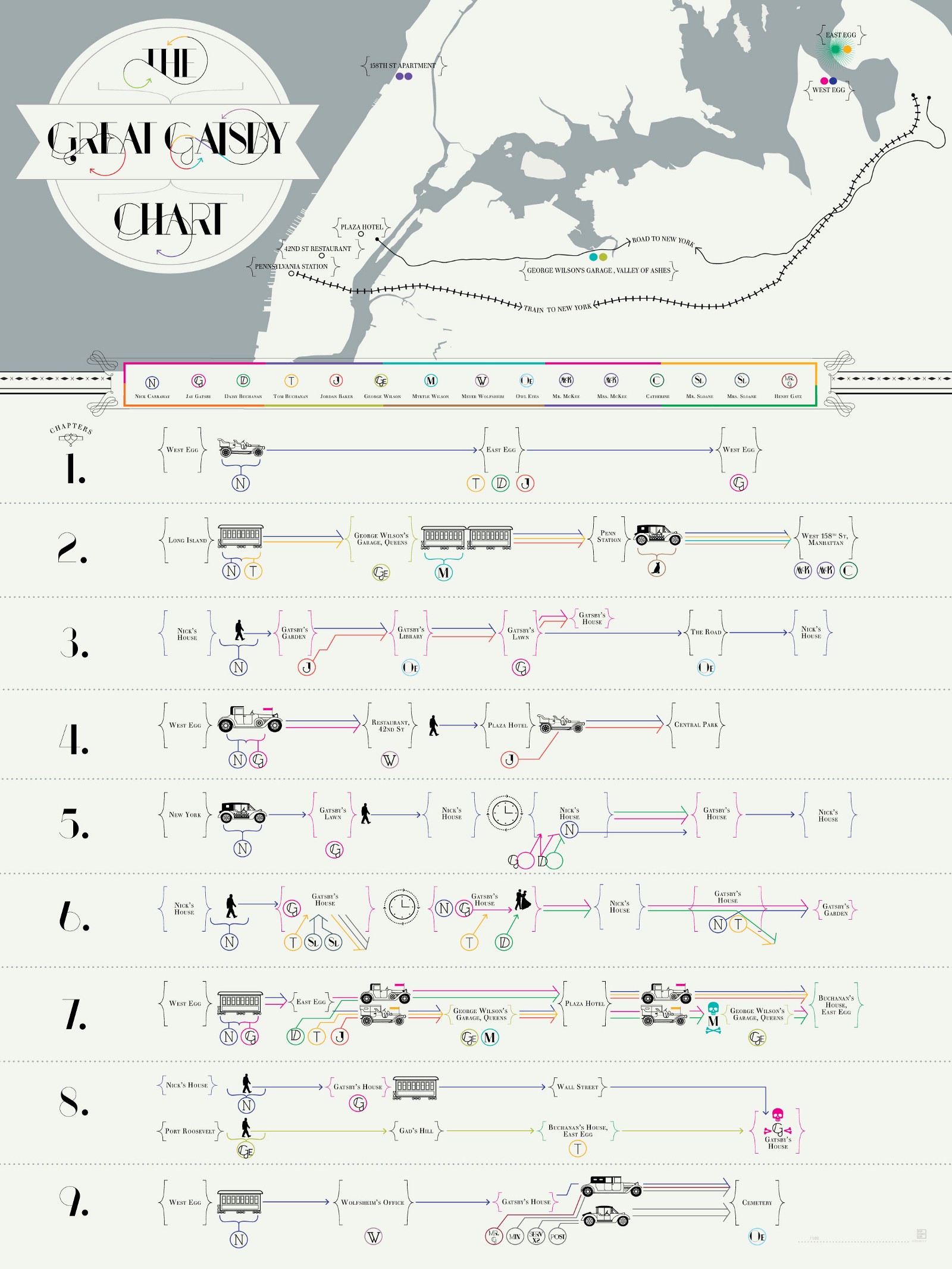
Pop Chart Lab just released a beautiful print that’s a “chapter-by-chapter breakdown of the comings and goings of characters in the The Great Gatsby” as they move towards (spoiler alert) tragedy. Pre-order it now and get 20% off.
*** — Benjamin Samuel is the co-editor of Electric Literature. Keep up with his comings and goings by following him on Twitter.
Like Anthony Weiner, Electric Literature is no stranger to sexting or dick pics. In fact, we’re so proud of our salacious history, that if we ran for Mayor of the Publishing World, we’d base our entire campaign platform around sexting readers. But before we make any more campaign promises, it’s time to jump on the latest meme: mayoral candidate Anthony Weiner apparently used “Carlos Danger” as his sexting pseudonym. Now, thanks to the Carlos Danger Name Generator, anyone can have anonymous sext. Since we’re known for asking the hard questions, I ask, what would literature do? Here are some of your favorite literary characters and their official Carlos Danger pseudonyms:
Hester Prynne = Narciso Jeopardy
Holden Caulfield = Gilberto Catastrophe
Huckleberry Finn = Carmelo Risk
Elizabeth Bennet = Mateo Smash
Humbert Humbert = Ricardo Smash*
Jane Eyre = Pascual Distress
Leopold Bloom = Julio Cesar Dynamite
Atticus Finch = Marcelino Covert
Eliza Doolittle = Lorenzo Gamble
Moby Dick = Alberto Death
*Let the record show that Elizabeth Bennett has found a new man, and Humbert Humbert is now into older women.
*** — Benjamin Samuel is the co-editor of Electric Literature, and he approves this sext. Find him on Twitter.
IF I WERE A CHARACTER IN A PLAY, the lack of true privacy would arouse in me feelings of profound mistrust, disquiet, suspicion. In some way — I don’t know how — I would feel the silent, attentive presence of the audience. I would always be aware that my words are being heard by others, and if that can actually fit in with some parts of my dialogue (there are intelligent things we say to show off before the largest number of people possible, and there are also times when we regret there isn’t an audience to appreciate those things), I’m sure that there would be other parts that would have to be spoken in an authentic and not fictitious intimacy. And those would be the most important parts for understanding the plot: the entire interest, the whole value of the play would be based on them. But their importance would not stimulate my loquacity; to the contrary; I would take the requirements for keeping any secrets very literally, as I always have. To start, I’d prefer not to speak. I’d say “Let’s go into another room, I have to tell you something important that no one else should hear.” But at that point the curtain would fall, and in the next scene we’d enter that other room, which would be the same stage with different decor. I’d look all around, sniff the ineffable… I know there are no seats in fiction, and in my character as a character I’d know that more than ever, because my very existence would be based on that knowledge, but even so…
“No, I can’t speak here, either… ” Of course, finally convinced that the stage would follow me to the ends of the earth, I’d sidestep the issue by saying anodyne, noncompromising things, and sacrificing the play’s interest. But that’s exactly what I could not sacrifice, ever, because my existence as a character would depend on it. So the moment would arrive when there would be nothing else to do but speak. But even then I’d resist, possessed by a horror stronger than I was! My mouth would be sealed, the keys to the situation (at least the keys I controlled) would never be able to come to light, in no way whatsoever. Never! And I would see fade away — as if I were in the impotence of a nightmare — a portion, large or small, perhaps important, even fundamental, of the aesthetic value of the play. And all my fault. The other characters, disoriented and, so to speak, mutilated, would begin to move around and act like so many dummies, lifeless, bereft of a destiny, as in those failed dramas where nothing takes place…
Then, and only then, I would clutch at one last hope: that the audience would intuit what it was all about, despite my refusal to say it. An outlandish hope, because I would be concealing facts and not just mere comments or opinions. If what I had to reveal, to reveal to someone, with the maximum of discretion and with very specific motives, is that I’m the secret agent of a foreign power, and that in all my prior and subsequent dialogues that fact is kept secret (the author, if he’s good, will have made sure of that), how will the audience know it? It’s ridiculous to hope they will deduce it correctly from my silence, from my scruples about privacy, most of all because I could be anything else: instead of a spy, I could be the bastard son of the owner of the house or a fugitive who’s assumed the personality of someone he killed.
But to base that hope on the superhuman intelligence of the audience, as insane and everything as it is, isn’t that the reverse of a fear, also quite absurd but which reality has justified many times — the fear that they’ll figure it all out despite everything? If I refuse to speak, if I exercise such prudence to the point of obeying a mistrust of supernatural degree (such as suspecting that in reality one of the four walls is missing and that there are people sitting in seats listening to what I say), it’s precisely because I have secrets to keep, serious secrets. In harboring the hope that they’ll guess my secret, am I not comporting myself exactly the opposite way I should? How could it occur to me even to call that “hope” in real life? It’s art, in which I launched myself when I became a character, in which I saddled myself with this extravagant aberration. In art there is one condition that takes precedent over all others: to do things well. Which means I’ve got to be a good actor in a good drama: if I don’t do it well, there will be no effect, the show will fall into nothingness. “To do things well” and “to do it” go together in art, fused, as nowhere else. So if my suspicion of being hypersensitive obliges me to disassociate them, I have no other option but hope: a fatal hope, the equivalent of death. Because my secrets are of such a gravity that I would not survive their revelation. That last bit I’m discovering now in the predicament in which I find myself, and I could almost say that I entered the fatal game of art to discover it.
Until now, I’ve lived secure in the knowledge that my secrets are well kept: they’re in the past, and the past is inviolable. Only I have the key to that treasure chest. At least, that’s what I believe: that the past is definitively, tightly shut, that its secrets, which are mine, will never be revealed to anyone unless I start telling them, which I have no intention of doing. But sometimes, I think that chest is not so inviolable. In some way, time could go backward, in some way my imagination can’t manage to foresee — although or because it’s my imagination precisely that leads me to these exorbitant suspicions — and then what’s hidden will become visible. But as often as I think it, I also think that it really is safe, inviolable, definitive, that there’s no reason to worry on that score, and that if what I want to do is worry I can do so for other reasons. For so many that if I start enumerating them I’d never finish, because a new one will always turn up. But all of them meet in the center, which is the site in the center of the illuminated stage, where I tremble in my paralysis, where I tremble and break out in a cold sweat.
Fused with me, there is an actor. I can’t separate him from myself, except through negatives: I don’t know what he wants, and I don’t know what he can do. I don’t even know what he’s thinking. He’s a statue of fear, an automaton of apprehension; he’s identical to me in every fiber. The author has written him into the play thematically, which produces the doppelgänger. The idea has been used so much it’s worn out: the actor who plays two characters who turn out to be doubles or twins. With the limitations inherent to the theater, the two characters, if one actor’s going to play both, must develop in different spaces. There is always a door between them, an entrance or an exit, a mistake or a change of decor. The mechanics of staging dislocate the spaces, but to the degree to which they create the fiction, they also create a continuity between them, where the horror of meeting the double face-to-face takes place. It’s possible to go a bit further, in the direction of Grand Guignol, and bring about the meeting by means of makeup, costume, lights, and taking advantage of the actors’s distance from the audience. (One important restriction: this applies to modern theater, because ancient theater worked the opposite way, using masks.) Movies, on the other hand — thanks to montage — can do it perfectly. Television, though it possesses montage, cannot use it because two elements intervene, time and the gaze of the spectator, the latter of which is too close and, as it were, sees thoughts. In theater, when we don’t want to resort to doubtful tricks (or when we actually don’t have twin actors), we have to thematize the thematization of the double in such a way that the two identical characters are revealed at the end to be only one. All the preceding seems very confused to me, and I should say it in some other way (not by providing examples but, again, by thematizing) if I want to make myself understood. Sooner or later you get to a point where it’s vitally important to be understood correctly. The hidden can’t sustain itself without that transparency upon which it becomes visible. The hidden: those are the secrets. I have secrets, just as everyone has them. I don’t know if mine are more serious than others, but I take all kinds of precautions so they don’t come out. It’s natural that your affairs seem important to you: the ego is a natural amplifier. If we’re dealing with a character caught right in the middle of the representation of the play to which he belongs, in the very center of the plot, the amplification reaches deafening levels. The vertigo of the action impedes any distancing. Well then, if my most protected secret is what I did in the past, perhaps the secret will come out on its own, in the facts, since according to healthy logic the result of what happened should be the current state of things. But anyone who tries to unmask me with the classical “by their acts shall ye know them” will be left empty handed because what I want to hide is exactly that in my case the process was just the reverse: the acts remained in the past, and no one would be able to deduce what they are by contemplating the flower open in the present. We can attribute that curious aberration to the nature of my original action, which consisted in a separation, in a “distancing” with respect to my very self. I thought I was seriously ill (I won’t go into details), and I committed the infamy of abandoning my wife and small children. The years went by, I changed personality, I lived. I achieved the dream of living. When I was young, I knew nothing about life, and later it was the same; I never knew what it was. The most I managed to know was that life existed, and love, and adventure: that there was something beyond books. And since I was always an optimist and always had faith in my intelligence, I came to the alarming conclusion that I too could learn what life was and how to live it. I’m not looking for excuses, but at least I can explain myself. My problem was to have been too ambitious. I wanted everything, that is, two things: intelligence and life. Everyone else just leapt into life without a second thought, as soon as the opportunity turned up. Brutal, mistaken, criminal… but because of their simple decision to live, they provoked the transmutation of their vices and ended up happy, while I wanted to consume intelligence and reach happiness from the other side. Well… I’m not blaming anyone.
In sum, before it was too late, in despair, I broke with my past. When the curtain goes up, I’m the double of the man I was, I’m my own twin, my identical other. Twenty years have passed, and I’m still in the same spot (I can’t fool myself, even by being another, my own other). I’ve learned computer science, and the same intellectual brilliance I exercised in literature I now use in politics and betrayal, and now it turns out I’m a double agent, infiltrated both in the high command of the forces occupying Argentina and in the secret coordination of the resistance. The action takes place in the palatial salons of the Villa de Olivos, at around midnight during a reception in honor of the ambassadors from Atlantis. I’m wearing evening clothes, extremely elegant, cold, competent, hypocritical as always. The most astonishing thing is that I haven’t aged; the mirrors show me the image of the man I was at age 30, but I know that old age is just a step away, behind a door. I always thought that my youthful air (which when I was 30 already caught people’s eye) is a symptom of my lack of life. It’s nothing more than a suspended sentence, but until when does the suspension last? The biological process follows its implacable course, but if after a change of name, personality, and profession the suspension continues, I don’t really know what I should do.
I’m a leading man, the supreme human flower open in the present, in the theater of the world. “By my acts” no one would be able to know me, because I’ve left my acts in another life. But low and behold, the acts return, and in the most unexpected way. They’re returning tonight, at this very moment, so punctual that it seems quite incredible: but that’s the law of the theater of the world. If a man lives happily and tranquilly with his family for decades, and one day a psychopath gets into the house and takes everyone prisoner, rapes them, kills them, on which day will the movie that tells their story be set? On the previous day?
The staff reports an extra guest, for me the most surprising: my wife Liliana (I should have said my ex-wife, the wife of the man I was). Of course, she has no idea I’m here, that I’m a gray eminence in the high command; everyone thinks I’m dead, disappeared; as for me, during these past 20 years, I’ve heard nothing about her. That’s how radical my break with the past was. She could have been dead and buried, but she isn’t: she’s alive and here… I saw her by chance, from a distance, in the golden salon; she didn’t see me. I sent my secretary to check, and meanwhile I strolled into other salons in this labyrinthine palace. I didn’t need excuses to do so, because during the “real time” of the reception, the closed door meetings take place. The situation is incendiary; imminent changes are foreseen; there is a considerable charge of nervousness in the air.
Liliana came to the reception to have an audience with the ambassadors from Atlantis; she won’t have another chance because they will be in this country for barely a few hours. They’re here to sign a bridge credit agreement and will leave at midnight: from the party, they’ll go directly to the airport in limousines whose motors are already running. Liliana’s intention is to ask to have her son returned to her alive. He was arrested — I only found out just now. Her son is also mine, Tomasito, my first born, whom I stopped seeing when he was a baby, when I left home, and whom I’d forgotten. A simple calculation tells me he must be 22 years old. Hmm… So he entered the opposition, joined the resistance, and was captured. If he got involved in politics, and in that way, it was certainly because of his mother’s influence. Now I’m remembering Liliana’s hatred for Menem, Neustadt, Cavallo, and Zulemita… I can also explain how she was able to enter the villa tonight: the leaders of the resistance, of which I’m a member, must have given her the invitation: I myself had a couple sent to them as I always do for official affairs, just in case they want to infiltrate someone to plant a bomb or kidnap someone. But knowing her, I know that she couldn’t come alone: she’s so incapable when it comes to taking action that not even being in the process of fighting for her son’s life could she have done without help. Exactly — I discover she’s accompanied by a lawyer from Amnesty, who is also (only I know this) a prominent member of the resistance’s central committee.
But there is something else, something that challenges all imagination, something I discern by listening in on some conversations while I’m hidden behind doors or curtains: Liliana has gone insane. The logical conclusion would be that her reason could not stand the anguish of having a disappeared son and having to face the situation alone. But I suspect reality is less logical, that she’s been insane for a long time, that she lost her mind suddenly or little by little and imperceptibly ever since I left her. All of which makes me think this is the most obvious manifestation of her dementia, one I can detect from my hiding place: she’s saying she’s accompanied in this petition by her lawyer… and her husband! Could she have remarried? No, because she refers to me by my full name: César Aira, the famous (she exaggerates) writer. She says I’ve stayed behind in the salon speaking with someone and that I’ll be joining her immediately. She’s crazy, hallucinating, poor thing. I instantly make a bold decision: I’II make her illusion real, reassume my old personality and appear at her side before the ambassadors… not only a pious gesture but one with a very practical goal: I know exactly what must be said to move the Atlantis ambassadors to act, to put pressure on the occupation forces so Tomasito will get out. Without my intervention, he doesn’t have a hope. And I can do it properly, because even though I abandoned and repudiated my family, he’s still my son, my blood.
I have a room in the Villa de Olivos that I use when I have to spend the night here during crisis periods (of which there are many) or when my services are needed around the clock. I run to it and change clothes. I choose a casual style that most resembles how I remember my style in my previous life. I tousle my hair, put on glasses, and there we are! I make my entrance: Good evening, excuse my delay, I’m César Aira, the father of the disappeared boy. The mad woman accepts me with naturalness, that’s why she’s mad; 20 years of absence mean nothing to her disturbed mind. But not entirely: taking me aside, she scolds me for not changing my sweater… you’ve got others, this one’s all stained… they’re going to think I’m a slob… you could have put on other trousers, they’re ironed… She doesn’t change! My entire marriage comes back in waves, marriage is a sum of small details, any one of which represents all the others. Things are not so easy. During the exposition, I have to slip away using some pretext, put on my evening clothes, comb my hair, attend to the leaders of the occupation who need me to discuss matters of the greatest urgency: they’re predicting that tonight there will be an explosion of the tensions in the high command. The concrete result will be a coup (they’re offering me the presidency of the central bank); there will be executions and murders among them, which will be hidden from public opinion. In an intermediary room (everything is taking place very quickly) I again become “the writer” César Aira, at Liliana’s side. And later, I once again put on my tuxedo. It’s all entrances and exits much in the vaudeville style, complicated moreover by a mission I set for myself: to tell the lawyer from Amnesty about the coup, together with instructions for a plan I’ve devised so the resistance can take advantage of the internal convulsion and arouse the people at the exact moment when the occupation forces will have no leaders. It must take place tonight. The palace coup will be carried out by relying on speed and silence: they calculate it will be over in a few hours, before dawn (they’ve taken advantage of the highly publicized visit of the Atlantis ambassadors as a façade and this reception to gather together all the conspirators and their victims without arousing suspicion), it would never occur to them that the resistance could find out about it as it was happening and make a lightning strike … and it will! At least it will if I can tell the man who’s supposedly the lawyer, whom I know to be a member of the resistance’s central committee. In my earlier conversations I arranged things to keep him busy so he couldn’t show any surprise at the unexpected appearance of “César Aira.” Now, in my other guise, in evening clothes and with my hair slicked down, I take him aside…it has to be very, very aside. I know very well, better than anyone, that “the walls have ears,” especially here, but I also know there are many small rooms and offices where I can take him to make the revelation — I myself directed the placement of microphones, I know where they are and how to get into the silent zones. Even so, I’m beset by the suspicion — completely irrational for my new technocrat personality — that we’re being heard. I feel as if suddenly the fourth wall were missing, and that there are people sitting in the darkness, paying close attention to everything I might say. It’s the typical kind of fantasy that would have occurred to the writer I was and who’s now returning. I resist the temptation to accept him, but I don’t dare reject him completely; there’s too much at stake. So I say to the lawyer, “No, wait a minute, I can’t talk here, come to the office next door.” But when we’re there, the same thing happens, and if we move again, the suspicion comes along with us. The expense in useless sets is huge; it could only be justified by record-setting audiences, but then a vicious circle is created, because the more spectators there are, the more my suspicion grows that I’m being spied on and the more often I have to move in search of a privacy that continues to flee. And besides, the minutes are passing without any advance in the action. It’s catastrophic, the failure of the play. I don’t know how to fix things; actually, I know that at this point, there’s nothing to be done. My error was that in the enthusiasm of the action I forgot that this was a theatrical performance. More clearly, I didn’t forget, but instead didn’t know, because I can’t know it or have ever known it, since for me, as a character, all this is reality. I should clarify that this scene aborted by my infinite postponements and displacements was fundamental, because until now the audience (I no longer know if they’re hypothetical or real) had no way to know why the same actor was playing two characters who were so different, so the conversation with the lawyer was conceived as a grand revelation, and something like the general explanation of the intrigue. Everything’s falling apart. Nothing important is being lost, because the play is ridiculous, melodramatic, based on facile tricks. Perhaps the very principle of the work wasn’t worthwhile, and the development was defective. While I was a writer, I thought I was a good one, but nothing confirmed such an idea in reality — not success, not my personal satisfaction. Those occasional admirers who were always turning up confirmed nothing. I thought death would be a solution, a severing of the Gordian knot, but ever since my disappearance 20 years ago now, things have gone on the same as before: a few readers, always in universities, writing theses on me, and nothing else. They seem interested and even enthusiastic, but they aren’t an audience. The audience would have made me rich, and I wouldn’t have had to drift off in fantasies. The way things have turned out, the doubts persist, suspense is maintained, and there will be no denouement. Between my life and my death as a writer the same suspicion sets in that paralyzes me and keeps me from speaking in the to-ing and fro-ing between the theater’s virtual and real spaces.
From La trompeta de mimbre, 1998.
End
About the Author
César Aira was born in Coronel Pringles, Argentina, in 1949. Wildly popular in Latin America, he has published more than seventy books of short fictions and essays.
About the Translator
Alfred Mac Adam teaches Latin American literature at Barnard College-Columbia University. He has translated Carlos Fuentes, Mario Vargas Llosa, Alfredo Bryce Echenique, and Julio Cortázar, among others. His most recent publication is an introduction to The Violent Land a novel by the Brazilian Jorge Amado (Penguin Books).
About the Guest Editor
BOMB has been publishing artists in conversation since 1981.
Welcome back to the Critical Hit Awards for book reviews. This is a round-up, a recommended reading list, and — why not? — a terribly prestigious and coveted prize. Winners receive a bang-up gift from Field Notes, our beloved sponsor. Nominate your favorite review of the month by tweeting it at @electriclit with the hashtag #criticalhit, or cast your vote in the comments section below.
Electric Literature: You literally wrote the book on regionalism in American literature. And you founded a publication with an almost defiantly regional name. What do you see as the geography of LARB?
Tom Lutz: We knew when we chose the name that Los Angeles Review of Books was a bit steampunk — a traditionalist name signifying a commitment to the future. Most of the editors are here, but some are scattered around, and the contributors include people living in Istanbul, Cairo, Japan, Poland. At one level we are happy to represent a local way of thinking: we have a West Coast relation to cultural hierarchy, for instance, and we are a bit more Pacific, a bit less Atlantic. But from day one, we were international, with readers in 140, 150 countries, all 50 states, and since our early months we have had more readers overseas than we have in California.
My book on regionalism argued that all regionalist literature, at least all of it that people considered and still consider significant, was fundamentally cosmopolitan. When Hamlin Garland argued in the 1890s that the literary center of the country was and should be moving west, it wasn’t simply to replace one kind of provincialism with another, as Boston’s sense of cultural superiority had been displaced by New York’s in the late 19th century. He wanted representative literature, in the same way some people are now attuned to world literature. In short, we live in L.A., a lot of us, but we are not for L.A. It’s a world-wide web we live in, too.
The web gives you an accidental geography too, pushing your work into places you didn’t even seek out. You recently launched a print edition, right? That’s a huge milestone. How far has LARB come, exactly, from when it didn’t exist to where you want it to be? Over halfway?
We are launching a membership program this week, like an NPR station, and knew we needed some premiums to offer people. I thought maybe the world had enough tote bags and coffee mugs for the moment, and we hit on the idea of a print journal — one thing we know about our prospective members is that they like to read — as a premium, a free subscription for members. We will be launching a book line as well. The books will also be offered as premiums at a certain level of membership, and both the books and journal will be available in books stores, physical and online.
How far have we come? In some ways we’ve already come farther than we first imagined. I didn’t expect to have thousands of readers in India, thousands in Germany, France, Turkey, Brazil, and China — over 30% of our readers are outside the US. And in some ways we haven’t come as far as I expected — I though publishers would step up faster to support us, as they did for the New York Review of Books when it started. We are not halfway to the budget we need to thrive.
It is a communal, living project, and so it continues to evolve in ways that I wouldn’t have predicted, and I wouldn’t necessarily want to be able to predict where else we are headed. We have dreams of doing much more, we hatch new conspiracies every day….
I’m definitely signing up for that membership program. It sounds web content has been your grains and proteins, and now the print journal is dessert.
We’re gonna hit you with a tough question at the end. What makes a good book review? And what makes something a good LARB book review?
That’s both a tough and an easy question, the same as ‘what makes a good novel a good novel?’ — and it has the same set of answers: great writing, of course, engaging voice, wit, intelligence, insight, the ability to take readers into new worlds. It has to hit the intellect and the emotions (if we analytically separate the two). And in formulating this answer, I realized that there is something more personal, as well: I always find that the novels and book reviews I respond to remind me — not explicitly, of course, or obnoxiously — that the writer is smarter, or more adroit, or more knowledgeable, or more skillful (or all of those things) than I am. That’s part of the pleasure of reading, feeling like one is in extremely capable hands.
I was reading the New York Review of Books this morning, and piece after piece was great — Bob Silvers knows exactly what makes a good book review. At LARB we aspire to that excellence, but we also want to cast a much wider net, include a wider swath of writers, conceive of significant culture more broadly, and allow for a greater diversity of diction and style. So a great LARB review is one that surprises me with its reach.
Wasserman, who once edited my hometown book review and is now at Yale University Press, begins this as a smart, longform book-based essay, in which the book itself takes a back seat to history, but then, 1500 words in, it becomes personal, Wasserman having been a teenage radical in Berkeley at the time (and, we find later, having reason to spend time with Bobby Seale later). He avoids the temptations of nostalgia and righteousness, though, even if the authors of the book he is reviewing didn’t manage to do so. He gives them their due, and their due criticism, and in the end, like a great essayist, he lets narrative make his argument.
I can offer no better introduction than her own opening: “When I began to read Taipei on my morning commute, I wondered if I had been lobotomized in the night. On the way back home, I wondered why someone who hates words would take the trouble to arrange so many of them in a row. The following morning, I wondered, Why does he hate me?”
Congratulations to our winners! You may contact Brian Hurley to claim your Field Notes prize. And thanks to Mark Molloy for nominating book reviews this month!
Read a good review lately? Nominate it for a Critical Hit Award by tweeting it at @electriclit with the hashtag #criticalhit or cast your vote in the comments section below.
***
– Tom Lutz is the founder and editor-in-chief of the Los Angeles Review of Books. He is also the author of Crying: A Natural and Cultural History of Tears; Doing Nothing: A History of Loafers, Loungers, Slackers, and Bums in America; Cosmopolitan Vistas, and American Nervousness, 1903: An Anecdotal History.
Sign up for our newsletter to get submission announcements and stay on top of our best work.
YOUR INBOX IS LIT
Enjoy strange, diverting work from The Commuter on Mondays, absorbing fiction from Recommended Reading on Wednesdays, and a roundup of our best work of the week on Fridays. Personalize your subscription preferences here.