ANA CALLS IT GIRLTOWN, the way it is now, all the boys gone. We walk through the night to some party. It is warm, the street is damp and shining, green leaves rip across the pavement in the wind.
The boys all moved away to cities and jobs. There is more space now, a quietness. I am in my last semester of school, Alison is working at Kerr Drug, Ana came back from Hungary just after the New Year.
I walk with Alison. She is wearing a flowered dress and her brown hair is loose. Ahead of us, Ana and Liam are arguing. Ana keeps her back straight, walks confidently in heels. She does not look at Liam, although he is beside her, or she looks away to the side where he is not.
Liam is visiting from Richmond. He and Ana have known each other since childhood and Ana is sure that they are in love. Liam is thin and his jaw is always tense. He speaks in short, disdainful sentences.
Liam and Ana pause on the sidewalk while Liam lights a cigarette, and Alison and I pass them, round a corner, arrive at the house where the party is. It is a start-of-semester party thrown by a girl Ana knows from school. My Chaucer professor is standing at the edge of the backyard, his hair like a cloud of steel wool. Behind him are strings of white lights, dark shapes moving. I do not want to pass him walking in. In class he fixes me with these stares.
Alison heads down the driveway towards the house and turns when she sees I’m not with her. I wave her on, wait on the sidewalk.
Ana comes around the corner. She is alone now, and smoking a cigarette as she walks.
“Where’s Liam?” I ask when she reaches me. She shakes her head, throws her cigarette to the ground and grinds it with her toe. There are moments of lightning, the air white. The wind pushes our hair.
“Let’s get drunk,” she says, looking away. Ana has a soft accent: her words roll together, catch on t’s and d’s. We walk into the backyard. I keep my back as straight as Ana’s, nod to my professor as we pass.
“Who is that?” Ana asks.
“My Chaucer professor,” I tell her.
“Oh,” says Ana, with emphasis of understanding, “Are you gonna fuck him?”
I give a pained grunt.
At the party Ana can talk to anyone. If you are from Texas, she has been to Texas. If you are wearing black, Ana will tell you about her Goth phase. If you are drinking PBR, she will tell about Pabst, the dirty baby doll that was the sad mascot of her old house. If you have a tattoo, Ana will show you the crest on her shoulder, the ship on her inner arm. Ana is a storyteller, and in her telling she opens up words to do things you don’t expect. She creates a language. For example. Any extreme situation has its own descriptive municipality. Drunktown, Slutsville, Panic Attack City. Girltown. I mostly stand beside her with my arms crossed and look away.
When there is a crack of thunder and sudden hailstones everyone presses into the house, loud and colorful. I find a sliding glass door in the kitchen and stand looking out, at the wind bending the trees, and at the white hail. The noise is enormous, louder than all the voices in the small space, and I wonder what it would be like to die right here, in this house, with these people. I wonder if I am happy.
Chaucer professor is beside me.
“Eve,” he says, “Are you enjoying the party?”
“Yes, it’s good,” I say.
“Do you know Caitlyn?” he asks me. Caitlyn is the hostess. I do not know her and I tell him so.
“Ah,” he says, “You ought to meet Caitlyn. She’s lovely. She’s a prize.”
I wonder if he is sleeping with her. He wears these thick-bottomed black orthopedic shoes.
Ana appears from the crowd, takes my arm, pulls me to the counter to do shots. “To the apocalypse,” Ana says, and we hold hands, down our glasses. The whiskey is sharp and bitter.
I met Ana’s mother once. When Ana introduced me she said, “This is Eve. She is also an only child and also fatherless. That’s why we’re friends.”
Everyone gets warm and drunk, leans in close. Alison leaves early. Nothing happens.
When the storm ends Ana and I walk home together. The streets are empty and plastered with leaves, whole branches. The pavement steams. There are piles of white hailstones in the gutter. The air is still. We could be the only people in town, in the world.
“I don’t know what to do about Liam,” Ana says, “He’s bad, it’s really bad, he makes me unhappy.”
“All the fighting?” I say.
“Yes,” she says, “all the fighting. We’re just such different people. He dropped out of high school, he loses every job, he uses all his money to buy cocaine. I want to be able to take care of him, you know? I want to be able to make life okay for him. He can stay at home and be the father of my children. He’d be a good father, I think.”
“I think you could find someone who would take care of you,” I say.
“I know that,” Ana says. “I can’t deal with that, you know?” she says, “I could never let someone take care of me.”
“Well,” I say, “at least someone who could take care of themselves.”
“Yes,” Ana says. She digs her hand into her purse while we walk and finds her cigarettes. She shakes one out of the pack.
We pass the playground.
“I did acid in this field once,” she says, waving at the darkness. She puts her cigarette in her mouth and digs for her lighter, “It was only the second time I did acid, and the first time I did it I got molested by my stepfather.”
She flicks the lighter at the cigarette and inhales.
“So you know,” she says, “acid was Shametown.”
“I didn’t know your stepfather molested you,” I say.
“Yes, well, I don’t tell people. I have this fear,” she says, “that people won’t think it’s a big deal because he never raped me. He just said things, or made me stand in front of him and let him look at me, touched my arms in this slow way if there were other people around.”
I listen. We walk down the gravel road to our house. Our feet make soft rolling sounds like the sea.
We find Alison in the kitchen. She has been to the Harris Teeter — it is open all night — and she is unpacking bags. The light in the kitchen is yellow and warm.
“I’m drunk,” Ana says. “I’m, like, going to be sick.”
Alison reaches into a bag. “Do you want me to cook you this zucchini?” she asks. Ana sits down at the table and I lean against the counter. Alison slices by the stove, puts oil into a pan. She serves Ana zucchini on a plate.
“This,” Ana says, “is the best thing I’ve ever tasted.”
I slide a stray piece of zucchini out of the pan with my finger and put it in my mouth. It is salty, soft.
There is a way in which I will always live here, in this house, with these people.
Joshua Mohr is the author of four novels, most recently Fight Song, launched on February 12th. An Arizona native, San Francisco has become Mohr’s literary home and the setting of his first three novels, among them Some Things That Meant the World to Me. Fight Song is a departure from his SF trilogy, a Wizard of Oz inspired fable that takes place in a gated community.
I was introduced to Mohr’s when he was on tour for his book Damascusin 2011. He referred to one of his characters as the “patron saint of the handjob,” a description that was put to the test in one of the scenes Mohr read from. When I met Mohr, I found myself saying that handjobs were the new first base. I’m not sure whether I believe that, but it felt like the right at the time.
In anticipation of Mohr’s new novel, we used the internet to speak to each other in late January, discussing handjobs, masculinity, tuna melts, writing sober, baseball and whether Mohr would ever use the word Bro.
-Erika Anderson for Electric Literature
EL: I was talking to one of the editors at EL about your writing, who asked me how I would characterize your work. We were on the subway coming back from a panel at Housing Works. I said, “Well, it’s sort of like the San Francisco, hand job, dive bar genre.” Which I realize Fight Song is a departure from. How does that six-word description of your work sit with you?
Mohr: The milieu I was trying to examine with those first three books was seedy bars where I spent my twenties in the Mission District. I wanted to talk about the weird addicts and the oddball artists that I spent many a year with before I got sober. And it was really fun to recreate that zeitgeist because it was so pivotal in my coming of age. That being said, I think you get to a certain point with one aesthetic, and you risk turning into the literary AC/DC, where you’re just writing the same song over and over again. So very consciously with Fight Song, I tried to get as far away from my comfort zone as I possibly could. As artists, I think that’s when we do our best work, when we’re the most vulnerable. So I set myself the challenge to retell the Wizard of Oz set in a twenty-first century American suburb, and that was the conceit that launched this madcap narrative that ended up turning into Fight Song.
EL: How did Fight Song come about?
Mohr: I wrote what I thought was going to be a short story about Bob riding his bike home from work and Schumann ramming him off the road. I’m not a very good short story writer, because I get what I think is a complete draft and then my mind starts to say, “What would have happened three weeks ago? What’s going to happen five months from now?” And suddenly my short story is in this weird 90-page no mans land. And I go, “Fuck it, I might as well just turn this into a book. I’m already halfway there.” I think you’re either programmed organically as either a sprinter or a marathoner, and I like to have more canvas to play with.
EL: You just jumped metaphors.
Mohr: There’s a line I think in Fight Song where they’re talking about Bob Coffen’s stupid boss and they say he macerates his metaphors to a pulp. I’ve been known to do that myself.
EL: What was different about writing this book from your first three?
Mohr: I had never written a book from soup to nuts, as the kids say, sober. I was sober when I revised Damascus, but the whole book was conceived when I was lying in a patch of oxycontin. In Fight Song, I was dealing with the ubiquitous fear whenever you stop using drugs: Am I still capable of doing this? Do I need substances in order to tell compelling stories? You’ll notice that in Bob Coffen’s trajectory, the technology of gaming has caught up to his area of expertise. And now he feels obsolete. His niche is no longer. I wanted to work with a metaphor to map the things I was personally struggling with — what if I can’t write books anymore without drugs? If you think about it, it’s a really crazy mindfuck, because on the one hand you would say, “Well, I would rather live a happier life than be a better writer. I’m not going to relapse just to write a book.” But that being said, if writing books is your passion and you can’t do it anymore, that’s a pretty crazy place to be. I was really happy with the way Fight Song turned out. I think that was the bridge book — I don’t think satire is where I’m going to end up.
EL: Well, congrats on your first sober book.
Mohr: Yay sober books! My first couple books were written in a complete and total blackout. I would start writing around midnight, work until five or six in the morning, pass out, and then next afternoon I would read things and be like, “Pretty good, Drunk Josh. This isn’t so bad.” Then I would read it and sometimes it was terrible. But I literally I had no idea what I was writing for both Some Things That Meant the World to Me and Termite Parade. They were written mostly by my subconscious.
EL: I read that one draft of Fight Song was written in second person.
Mohr: It was not one draft. It was probably four or five drafts. And then you have to have that come to Jesus talk with yourself where you say, “Well, I’m glad that I gave this idea every chance to succeed, but fuck all if this is terrible.” And then it was a matter of would this be better in the first person or would this be terrible in the third person? So I tried it in the third person first and felt like I was able to get the balance in tone and voice that I was hunting for. I’m a big advocate in the revision process of artists giving opportunities to all their ideas, even their shitty ideas. Sometimes I feel like we hedge our bets too much, we try to prioritize and problem solve in our psyches and we don’t actually collect active evidence on the page. So no matter how inane or how stupid an idea is, I’m going to let it go in a draft. For example, in an earlier draft of Fight Song there was a crazy goat who talked in prison lingo —
EL: [Laughs]
Mohr: — even saying that to you is so terribly embarrassing, but at least I had the actual evidence rather than my system of hypotheses about what would work and what would not work.
EL: What other ideas that came and went?
Mohr: In Damascus I had a genie living in a whiskey bottle that Shambles was talking to almost in every one of her chapters. I kept that for probably ten or twelve drafts. And then finally it was pointed out to me by some trusted readers that that was, how shall we say, fucking stupid. [Laughs]
EL: [Laughs] I love the idea of letting every idea rise to the surface because as I think of my creative journey, I think of all the times I’ve been told — as I’m sure we’ve all been told — that I can’t do things. And then all we’re left with are dead ends.
Mohr: I have my grad students hold up their thumbs. I say, “I think that the human imagination is as unique as our fingerprints.” It’s the ultimate currency that we have as artists. And it has to be the strength that we play to on the page. Don’t just write the book that you want to read, which is what conventional wisdom says, but write the book that only you can write. That talking prison goat was a bad idea, but it was my bad idea, and I bet that no one else would have that bad idea. But I feel like if we give all of our bad ideas a chance to succeed.
It also reminds us that the drafting process has to be fun, that we should maintain the whimsy and the joy later in the process. If we’re open to exploring, we’re open to those deviations and those dislocations. Where writers get themselves in trouble is when they’re only on draft five, which I would call a very nascent draft, and they think, “Oh, I know what this is. I’ve mastered this world.” They lose that sense of exploration. All the really cool things that I learn about a narrative come later in the drafting process, once I really know my characters thoroughly. It takes so much time to get to know a consciousness that’s not our own. A metaphorical heart that’s not our own.
EL: You said that you wanted writing this book to be more fun than your San Francisco trilogy. Did it turn out that way?
Mohr: Certainly. I had a blast on a daily basis putting this book together because whatever inanity or sordidness I could cook up, I would toss right in the book. I never write with any sort of plan. I only know what the first image is going to be. And then I don’t know anything after that because I love that sort of wanton and reckless journey through the book.
A couple of the Cohen brothers’ first films, Blood Simple or Miller’s Crossing, navigated macabre and dangerous territory. Yet the Cohen brothers gave themselves the artistic freedom to go on to do things like The Big Lebowski. I love that idea that you don’t know what an artist is going to give you until you open the front cover. That’s the kind of artist that I want to be. I don’t just want to be, “Handjob Guy.”
EL: [Laughs] I don’t get that.
Mohr: Most men would wear the moniker “Handjob Guy” as a badge of honor. And I’m fine with being “Handjob Guy,” but I’d also like to be “Fable Guy,” or whatever I turn out to be.
EL: Do you have a favorite handjob scene in literature or in your own work?
Mohr: I can’t actually think of all that many handjob scenes. I can think of a lot of jerk off scenes but I can’t think of a lot of handjob scenes. In Damascus specifically, it seemed like an apt metaphor to launch that particular narrative. One of the main characters is seeking human affection, he just wants to be touched, and when he gets jerked off by that character Shambles in the first chapter, it’s this prurient exchange. And as the book pushes on, those touchings morph in terms of what they mean on an emotional level as they start to build some sort of contorted camaraderie. They’re both salvaging something from the other. They probably wouldn’t be able to articulate it. But they’re recognizing some sort of kindred and distressed spirit. And they’re able to offer a semblance of sanctuary along the way.
EL: While I saw Fight Song as a departure from your San Francisco trilogy, I also saw an overarching theme in all four of your books of the emasculated man, and I connected that to Judd Apatow’s movies, and to the Junior character in the fiction of Junot Diaz. It made me think of what it means to be a man in America today.
Mohr: With Bob Coffen, I’m talking about someone I don’t really know a lot about. I’m not a suburban father of two who programs video games. With the first three books, I was writing about myself and my struggles with drugs and whiskey. With this one, it was a different frame of reference. I wanted to write it as a fable, I wanted to write it as a cautionary tale. Because I’m sure there are a lot of happy people who live in the suburbs. But my own paranoia and my superimposition about what that life would be like is almost like something out of Dante. Fight Song is actually scary if you think about what’s going on in that narrative.
The emasculation is one thing, and then the ennui is another — they’re all treading water, which is a metaphor that runs throughout the book literally with Jane’s sport. But you can stand back and watch them all barely keep their heads above water solely because they’ve stopped trying. From the outside, there’s nothing wrong. They have plenty of money. They’re a nuclear family. They’re in the same house together, and yet when we examine them under a more detailed proximity, we can see the fissures in their existence. When they finally get to the end of the yellow brick road, what are they going to be asking for? What is their actual goal? Is there something here worth salvaging?
EL: It seems like they’re all striving for connection and yet that’s not what they get. The kids’ electronic devices come in between them and their dad. What’s at risk? Why is it so dangerous to have real human connection?
Mohr: It’s so interesting to ponder the different definitions of connection because the daughter is twelve in the book and is constantly glued to her iPad. She would consider herself a world traveler although she’s probably never been within ten miles of their gated community. Where satire can function at its best is where we take the time to occupy everybody’s mindset. If I did my job right, the daughter has a valid viewpoint, the father has a cogent viewpoint, the wife has a cogent viewpoint and it’s up to the reader to parse through all that and then she or he can fend for their own affiliations. Lars von Trier talks about trying to leave open the avenues of interpretation at the end of his films. We don’t want to steer our audience to this inevitable conclusion.
EL: The ending to Fight Song brings up questions.
Mohr: Sure. It ends in this moment of magic realism where hopefully a lot of the audience will be like, ‘What the fuck is that?’ And somebody else will be like, ‘I love that.’ And somebody else will be like, ‘I hate that.’ I love those extreme reactions. I don’t really care if someone likes the book or not. I just don’t want an ambivalent or tepid response. I’ll take hate or love any day of the week.
EL: I want to say that seems brave.
Mohr: You can never go wrong calling someone brave. That’s the exciting thing about being a storyteller. You spend two, three, four years on one book, and tell that story as thoughtfully as you possibly can and then as the poet Jay Z says, move onto the next one. Who cares? I can’t do anything about Fight Song anymore. It’s bound. It’s shipping as we speak. There’s no reason for me to worry about that anymore. I’m onto what will be the next weird adventure.
EL: What’s the next weird adventure?
Mohr: With the early stuff, you can never tell what’s going to be the prison-talking goat, but I’ve been clacking away. I try to do as much as I can before I can on tour because I’ll have about five or six weeks where I don’t get to do anything except eat hotel food and gain ten pounds. Which is awesome. “Another tuna melt, please” as you cry to yourself.
EL: Are tuna melts your thing?
Mohr: I grew up pretty white trash so all of those things are in my wheelhouse. A Reuben, tuna melt, a BLT, anything that could waft out of trailer I’m a huge fan of. That’s how I can tell if it’s the sandwich for me.
EL: Some of your male characters address each other as buddy and fella, a phenomenon I find fascinating. How do you refer to your male friends? Are they buddies?
Mohr: I don’t know that I would ever say the word buddy. As an aging hipster, I would have dude in my nomenclature, cats in my nomenclature, but I like that idea of trying to render the false camaraderie that develops between bar stools. Your bars stay open a little later than ours do in San Francisco, but usually if I go in a bar at six or seven in the morning, there is this weird, horrible connection with the guy drinking next to be because he hates himself just as much as I do. We’re here because we have to be here right now, and suddenly it’s like we’re having the time of our lives — could it get any better than this? Let’s play a game of pool, Bro. Let’s get a bottle of Fernet, Bro. I like to render that dynamic. I’m not one of those people who look back on all my years of using and shake my head. I don’t say, “I wish I hadn’t done that.” Fuck that. I loved those years. I would probably still be in those years if my health didn’t start to fail. I look back on some of those things with toxic revelry. Those memories aren’t all awful. I wasn’t in Reno when I started drinking, and my nose wasn’t broken when I started drinking, but I’m glad that I’m here now, sitting on this weird stool with a broken nose.
EL: It’s rare to hear that measured perspective. So often the story of the sober is “let me tell you how bad I was.”
Mohr: It might be some sort of defense mechanism, a very binary relationship: you love spirits and drugs or you hate sprits and drugs. My mind doesn’t work like that. That’s one reason I like narrative so much. I get to pose all these questions in the book, questions I don’t necessarily have to answer. I just have to lob them at the canvas and see what happens. I look back at those years fondly: going to jail, getting in lots of fist fights, making tons of mistakes, ruining my first marriage. I don’t necessarily regret those life experiences because they’ve led me to where I am now. And I’m in a really happy place in my life.
EL: Married with a baby on the way.
Mohr: Yeah, it will be a totally rewiring of my world. We have this really big closet, it has a window, so it’s not really a closet, but it’s the baby’s room. It’s been funny to watch people’s reactions when we tell them that the baby’s going to live in a closet. A lot of hipsters are like, “Oh, that’s great.” A lot of other people look at us like, “You can’t do that. You have to find a place for your baby to sleep that wasn’t manicured for socks.”
EL: You’ve said that the sign of a bad interview is asking a random question about baseball. How do you feel about baseball?
Mohr: I don’t have the attention span for sports where things don’t happen. I’m kind of myopic that way. And you can be fat and play baseball. That doesn’t make any sense to me. Shouldn’t they be working harder? Shouldn’t they be doing more … things?
I box. It helps me clear my head. When you get sober, you have to find other ways to get high. And boxing is one of those things for me. I get that adrenaline and endorphins and then the rest of the day makes more sense to me. I go down three days a week and put the gloves on. Maybe that would be a setting where I might drop a bro or two. That was a good shot, Bro! Way to give me a concussion, Bro!
EL: Always “bro” never “brah”?
Mohr: I would have to get hit really, really hard to say brah. I’ll go through Boston on tour. I’ll see if I can cultivate my inner brah hanging out with all the Irish kids up there. We’ll see what happens.
***
-Joshua Mohris the author of four novels, most recently Fight Song. He teaches writing to graduate students in San Francisco.
-Erika Anderson is one half of The Outlet’s editorial team. The other half is here.
1. A few people actually like to be an hour early for things. 2. Allison and Blake are glad The Moth is back in Portland. 3. The Moth makes Lauren and Veronica laugh and cry and sometimes wish the stories they hear were their stories, too.
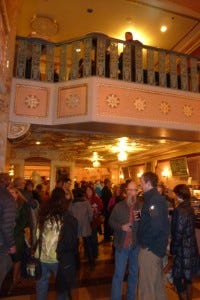
I screwed-up on the start time by about an hour, so Dena Rash Guzman and I showed up to a pretty-much empty Schnitz. We headed to the bar area for more information and drinks while we planned our next move. I would’ve been more in favor of chugging our drinks and heading next door to the Heathman for a slower one if I hadn’t already gone to a happy hour and had some tea while getting ready. Plus, I was kind of curious about who shows up an hour early on purpose.
1. Jessica Holmes, who runs Story Story Night in Boise, and Amanda Peacher, who works for OPB, with Isolde Raftery. 2. Mel Wells, writer and recent storyteller at Portland’s StorySLAM; Dena Rash Guzman, Founding Editor of Unshod Quills; Tammy Lynne Stoner, Fiction Editor for Gertrude Press; and Karena Stoner.
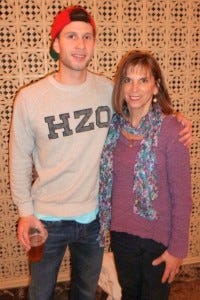
Turns out, it’s mostly people who set up booths and need to stick around. As the crowd thickened and the event start time became less distant, I saw plenty of couples, some pairs of besties, and not too many groups. I was came up short on my “group of dudes” photo goal, but I did capture the elusive mother and son duo.
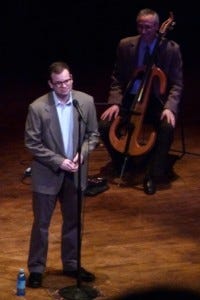
Eisenberg held the night together with intros and personal stories, as different storytellers took turns bringing their own pace and energy to the mic.
Wade led-off with a very sweet story about taking his aunt and grandma out on Saturday nights while he was in high school. He’s a careful storyteller who takes time to enjoy the sound of words and reflect on moments, like watching The Comish with his ladies, who wore slippers made of yarn and saw him as he wanted to be seen.
1. Lots of people paired off. I could not find a group of dudes getting their Moth on. 2. Connor with his mother, Kyle. How cute is that? 3. Adam Wade, eighteen time StorySLAM winner and two-time GrandSLAM Champion at The Moth.
Cohen, who replaced a flu-stricken Cheryl Strayed, started with two unused tickets to Hawaii. We moved in with a bass player and went to the airport with him. We watched him sweat through security and eventually get busted for carrying weed. She took us all with her, until she made a decision that this guy and Hawaii wasn’t what she wanted or needed in her life. I think that’s the point when I realized that I forgot to take notes while she talked, simply because she was so engaging.
I listened to Bonner’s dates and details, rationally putting together the time frame and empathizing rather poorly to her experience of being smuggled from Afghanistan to the United States, with a stop-over in Thailand. By the time she hugged the flag on American soil, I realized that, with a sense of relief, she was safe and therefore I could process the earlier depths of hardship. I wondered if she had done the same thing, in order to persevere.
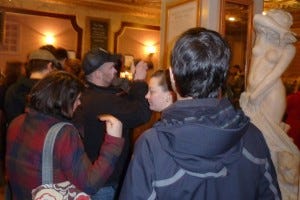
1. This demure statue is just a little too close to the booze line to avoid getting her picture taken. 2. Gideon Freudmann, looping through a composition as the final few found their seats.
As I listened to Shakoor, I imagined sitting next to her while riding a bus to meet a friend. I overheard her telling someone about dealing with the death of her child, not wanting to work for anyone who would hire her, pulling it together for an interview at Macy’s, making a decision to do what she loved to do for the rest of her life, and making that happen for herself.
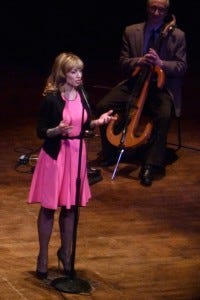
Lauren closed the night with a story about going from “squeaking around a pole at night” to becoming the second favorite girlfriend and possibly fourth wife before deciding “numbness is its own kind of misery” and heading home. I wondered what Patti Smith would think of all this.
1. Dori Samadazai Bonner was once honored by the US Open, alongside Martina Navratilova. 2. Jillian Lauren, author of the memoir Some Girls: My Life in a Harem and the novel Pretty.
As per usual, the night of storytelling was emotionally exhausting for me. I get too caught up in the stories and find myself going to sleep at eight o’clock for the next night or two. But, it’s a good kind of hell, one that gives me a renewed sense of how amazing it is to experience stories without reading them.
***
— Judith Ossello currently lives and writes in Portland, Oregon. Find her here.
I’d been looking forward to last night’s installment of the venerable Crown Heights Franklin Park Reading Series ever since Penina announced the lineup. While I trudged through the brown and black slush left from the rain, all thoughts centered on the prospect of hearing Dylan Nice’s Other Kinds, which made the rounds of many a “Best Of” list last year, and especially the antics of Lars Iyer’s would-be philosophers W. and Lars from Exodus, which had its American debut at the reading last night. To boot, Karolina Waclawiak brought Anya from How To Get Into The Twin Palms, Tim Horvath introduced us to Doll and Nachbor, and multimedia artist Margarita Korol paid tribute to her mother with a poem and accompanying slideshow. All five delivered; all five were awesome.
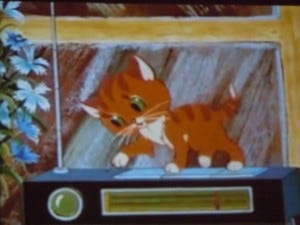
1. Poet and Artist Magarita Korol, on her mother’s role to “own the role of victim and proceed as victor.” 2. I really hope this clip came from a Soviet propaganda cartoon.
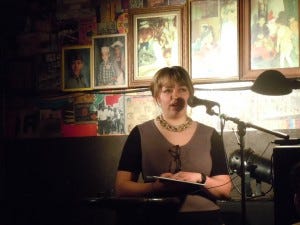
First up was Margarita Korol and her narrative poem “Spoils of War,” an ode to her mother’s 1988 immigration from the Ukraine to the US. Korol read the poem while we watched a video collage of images from the Ukraine, stills of Soviet-era propaganda posters, and the text itself. “We go away without people we were to be nuclear with,” Korol read, as the familiar melody of “Korobeiniki” danced over hip-hop beats.
1. Dylan Nice: “The place I was from was just as empty but not as flat.” 2. Peter Cavanaugh and Sarahana Shrestha, editors of a pretty cool website called The Short Form.
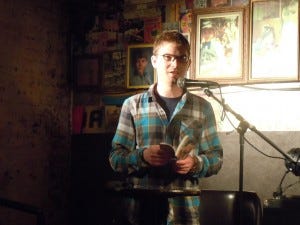
Dylan Nice brought the heat with “Flat Land” from his collection Other Kinds. What I loved most about this story, besides the lovely acoustics of phrases like “the water ran orange with iron,” was that Nice wrote a sentimental story and not only did it not suck, it ruled. It was funny, it was sad, the sense of risk authentic and palpable. Our narrator first plays tour guide to Lily, a photographer from an eastern city, who “wore her hair long and her jeans high in a way I liked.” Sexual tension is relieved in a tiny, throwaway moment, teasing the narrator with the prospect of leaving the place with “nothing on the horizon, nothing farther in the distance to mark time.” There’s Lily’s subsequent polite rejections, a house fire and her photographic tourism, a visit to the narrator’s older brother and the ultimate realization of being stranded in a place of “no states … only the sky that never got any closer and me moving through places I could not stay.” Other Kinds is a handsome pocket-sized edition; you have no excuse not to buy it and put it in your pocket.
1. Tim Horvath on Nachbor’s NYT spread: “sandwiched between an article about a golfer and one about artichoke dip.” 2. FPRS intern Elise Anderson reading off raffle tickets.
Tim Horvath treated us with a brand new, unpublished story with the working title “chill6.1.doc.” A conductor and composer, Doll, gets chills from the years 1995–2007 exactly eleven times. “The net good the chills brought outdid the bills … the girlfriends he’d driven away. His music would endure.” Doll struggles with producing work, the widespread acclaim of contemporary and one-time college roommate Nachbor, sending him into existential stupor. “He felt a new kinship with cows and other swaddlers … which of [the muggers] would find more ludicrous: his wallet or his composition book?” What follows? A description of the disparity between Doll’s and Nachbor’s respective dorm corners, Doll’s envy, and then to an initially carefree, drunken night of calling out pieces played on a 20th-Century Music WQXR show. It all goes to shit when Doll doesn’t recognize Nachbor’s piece. End of friendship. I’m looking forward to reading this piece when it’s finished, especially this line: “So a priori — save your dirty talk for your wife.”
1. Karolina Waclawiak: “Suka! Suka! Suka!”
After the raffle, Karolina Waclawiak read from How To Get Into the Twin Palms, which details the antics of Anya, a 25-year-old Polish lady in LA trying to pass as Russian. “It was a strange decision to pass as a Russian, but it was a decision based on allure.” The Twin Palms, a Russian night club across the street from her apartment, is a venue where couples fucking against cars. Anya, the ever-insightful narrator, notes that one man “wouldn’t be fucking her if she were his wife.” Men in her apartment building walk past her with “Eastern Bloc homemade hair cuts” and ask “Polski? Ruska? Svetka? Amerikanski?” punctuated with the Russian phrase for bitch/slut: “suka.” Waclawiak jumped forward to a passage where Anya gets a job calling bingo numbers to sexually boastful American octogenarian women. “I’m 82 and my libido is raging … by the time I was your age, I had six [boyfriends].” Yes. Yes. Yes.
1. Lars Iyer: “A life of the mind for postgraduates from all over Britain, a kind of internal exile.”
Lars Iyer came to Crown Heights all the way from a magical place called Britain to read from his seriously funny novel Exodus, the third and final installment in his trilogy. Amidst the “end times,” where academics and philosophers are moved to badminton departments, failed philosopher W. takes it upon himself to insult would-be philosopher Lars, who subsequently decides to narrate these insults. Iyer read in that lofty, authoritative tone usually heard from the mouths of white-wigged adjudicators. “My hotel room. W. takes his seat once again on the Chair of Judgement. … Still more questions. ‘Do you think you have a noble face? A dignified bearing? Do you think you have the physiognomy of a thinker? An intelligent face? Do your rolls of fat make you uncomfortable?’” Iyer simultaneously deals with the serious and the slapstick through the philosophical duo, lampooning and celebrating the academy. Kafka, Kierkegaard, and the world’s favorite Slovene Slavoj Zizek all make cameos in Exodus, usually when W. and Lars are hungover, looking for more gin.
Next month is the series’ fourth anniversary, and features Joshua Mohr (Fight Song), T. Geronimo Johnson (Hold It ’Til it Hurts), The Outlet’s very own Erika Anderson (!), Eric Nelson (The Walt Whitman House and occasional Outlet contributor), and a very special surprise guest. Oooh! It goes down on 3/11. Be there, dudes.
***
— Ryan Chang is a writer, and is generally bad at parties. He tweets here and tumbles here.
The Lit List is a sometimes-weekly compendium of New York’s finest literary events and readings. If there’s something you think we should know about, email dish@electricliterature.com.
Monday, February 11
Franklin Park Reading Series: Lars Iyer, Karolina Waclawiak, Tim Horvath, Dylan Nice, Margarita Korol. #Wanderers, each and every one.
More Valentines! Ugly Duckling Presse Presents Vanessa Place, Jacqueline Waters, and Sara Wintz. Hosted by editors Anna Moschovakis and Matvei Yankelevich.
Akashaic Books + Black History Month = book launch times two. Bernice L. McFadden, author of Nowhere Is a Place talks to Courttia Newland, author of Gospel According to Cane.
Tuesday, February 19
Karen Russell, Stuart Nadler, & Dina Nayeri get “Behind the Book” at KGB
Dina Nayeri talks about her novel A Teaspoon of Earth and Sea to Sackett Street Writers’ Workshop founder Julia Fierro
Thursday, February 21
How long has it been since you’ve seen James Frey? Too long! Frey, Kathryn Harrison and editor Meredith Maran take on the age-old “Why We Write?”
The New Salon: Writers in Conversation, featuring Nell Freudenberger and Dinaw Mengestu (with Darin Strauss).
A library opens in Bushwick: Mellow Pages Library & Reading Room at 56 Bogart St at 7pm. Beer and readings prevail.
Friday, February 22
Pink Thunder Reading and Performance: Michael Zapruder performs from his album “Pink Thunder” (Black Ocean Books, The Kora Records, 2012), a collection of free-verse indie rock songs made from poems by two dozen American poets. With special guest reader Matthew Rohrer. ***
— Erika Anderson is one-half of The Outlet’s editorial team. (The other half is here.)
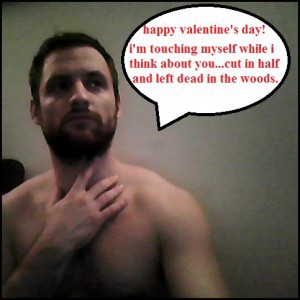
On February 14, Electric Literature will release Sam Pink’s new novel, Rontel, which Tao Lin calls, “the funniest book I’ve ever read.” Pre-order the eBook now and Sam Pink will sext you on Valentine’s Day.
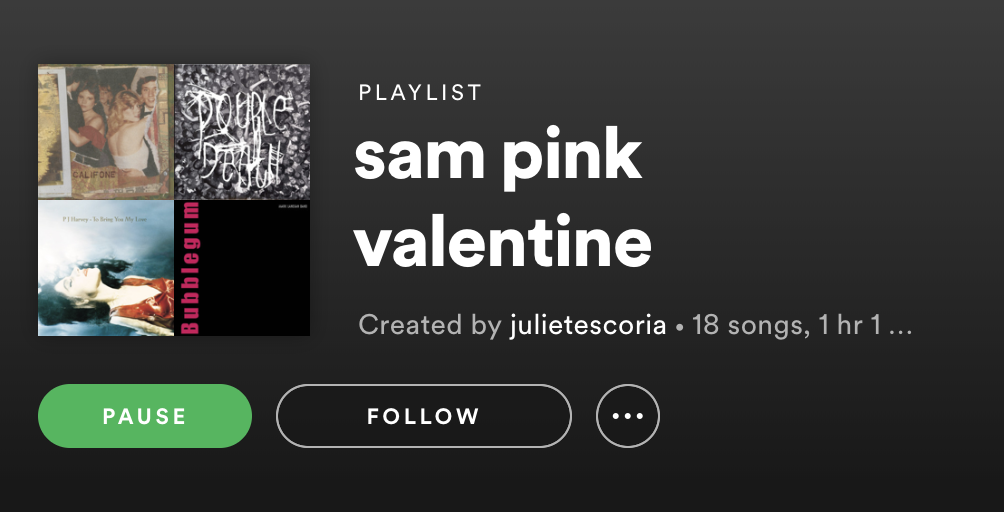
Valentine’s Day Heartattack Music
happy valentine’s day everybody! can’t believe it’s that time of year again! you know, if you’re like me, then you’re useless. but seriously, if you’re like me, then you like music. nothing warms my heart and makes me think of love and other valentine’s day related things like music does. Mm hm, fuck yeah, music! love that stuff. good ol music. here are some hot-ass picks for you on this blessed day, a day where we either remember that we are too good for the person we’re with, or not good-enough. enjoy!
note: i am too stupid to figure out spotify so look up the songs marked with an asterisk. just imagined myself getting really defensive and yelling “my picks are my picks goddamnit.”
1. “south of heaven” slayer, as covered by modest mouse/califone*
I’m putting this selection on here because I make all the music for this band and I want to promote my own band and I’m using this opportunity to promote myself.
4. “Death machine” by the coachwhips
This song seems like the soundtrack in my head after walking into a dark room and just standing there. While re-reading that first sentence, I put my hand over my own ass and caressed it like I would with a woman’s ass. I felt really sexy doing it. My ass is good. i have nice legs too. Seems like I need to exploit that. Can I begin to make money by having people take pictures of my legs. What the fuck am I typing this is so shitty. What if someone reads this and then decides to never read my books.
5. “halibut acid” by aphex twin*
I don’t have anything to type about this song.
6. “to bring you my love” by pj Harvey.
This is probably the “heaviest” song I can think of. The lyrics make me have a vibrating feeling along my scalp. I like the yodeling she does at the end. Makes me think she could whip my ass. I would like to be whipped with a broken tv antennae to this song. I want a woman to whip me in the mouth with a tv antenna and then make me kiss her with my stinging/bloody mouth. I want to be getting whipped in the mouth with a tv antenna and then for the woman to have her leg up over my shoulder while it’s happening and then for her to stop whipping me and use the broken tv antenna to point up her dress.
7. “when your number isn’t up” by mark lanegan band
Much like my last selection, I would like to get whipped in the mouth with a broken tv antenna to this song. Only, for this song, the woman would have to be wearing sweatpants and point with the broken tv antenna through a hole in the crotch.
8. “hyperviolet” by pig destroyer
When the drum fill starts the song, I almost always curl my fingers and thumbs at my side and feel like my chest is growing painfully. Honestly feel like I could beat anyone up if this song was playing loud enough. Someties I like to read comment-thread arguments in pig destroyer youtube videos about what is “grindcore/thrashcore/whatever.” Haha for some reason I just forgot I was writing this and thought, “nasty nuggets” in reference to nothing. Also, I know this lyric isn’t in this song, but to tie this in to valentine’s day, there’s a pig destroyer lyric that goes, ‘your skin/is yellow/like wildflowers/in july.” And to me that’s good.
9. “96 tears” by ? and the mysterians
It’s a song where the lyrics would seem dumb to me if I just read them, but the way they’re sung makes me like them. The middle part of the song where the guy’s just like, talking, seems dumb though. Always imagine myself in the studio, pressing a button and talking to the band through the soundproof glass and I say, “guys, cut this shit out, this part sucks.”
10. “rich people” by the hospitals
The guitar riff is just a slowed down version of that song college marching bands play, where it’s like “let’s go team!” when that riff comes in, I honestly want to jump off a high thing and land facedown on the street but not die. I also really like the lyric, “there’s something I should tell you/but I don’t know if I should tell you.” I like that for some reason. For some reason that’s just the kind of nasty nugget to run my genitals through a deli slicer. (been trying to do that lately, like where how people describe things they like by referencing how it “destroyed” them or something, but I’m trying to use overly ridiculous things, feel me?)
11. “death before dishonor” by twista
This song is from the album “adrenaline rush.” I don’t like a lot of rap but I feel like “adrenaline rush” is so good. I like the “skits” between tracks too. There’s one about a guy buying a hotdog then getting shot. It’s pretty funny! Some of the lines on this album are like, really really well written too. I honestly feel like “adrenaline rush” is a failure because it’s too good. twis’ like, did it all on the first try. “death before dishonor” makes me feel something strong. He says, “always ever all days, death befo’ dishonor/coming back as long as I can still see/fuck tryna steal me/shit, you gon’ have to kill me.”
12. “fuck the usa” by the exploited
It’s really catchy. Seems like someone had put us in our place in the u/s/a. I also like the exploited because my only real friend in high school, rabbnuwaz ali shah, always wore an exploited shirt that said, “punk’s not dead” on the back and he was the kind of person who would just smash you in the face at a party or something. Rabb burned my arm with a lighter when I wasn’t looking and scarred me for life.
13 & 14. “we all love judy” (pts. 1 &2) by the melvins
Pretty heavy song. I immediately start a deep, slow, rich headbang when I hear this song. Feel like I really respect the melvins. They’ve been around since the eighties and they still make music and it’s always different. Dale crover is their drummer and he’s maybe my favorite drummer. I imagined this song on and me just sitting in a rocking chair naked putting lipstick all over my face while I smile with my eyes closed. For some reason I forgot I was writing this again and imagined myself saying, “what’s ya game, partner” to no one, in my head.
15. “crumbs” by ministry
This is from the album “filth pig” which most “hardcore” ministry fans don’t like, but it’s my favorite ministry album. The whole album is so good. “crumbs” is sweet because of the lyrics and also there’s a Charlie manson sample in it. Charlie manson says, “I never had a life, I don’t even know what life is. Have you? Have you? Had what you call a life…every day of my life.” Feels devastating to hear that sample every time. I also honestly feel an affinity for the idea of crumbs. One of the lyrics in the song is “juuuuuust crumbs.” Representative of how I feel about a lot. Just crumbs.
16. “pigs” by the black dice
I think the black dice were the last band I saw in concert, like years ago. They were the main band but almost all of the people in the venue left right before they went on, and it was me and like, maybe ten people. Fucking sweet. Black dice make weird improve alien dance music. Pigs is from their newest album. Pigs seems like the most accessible song the black dice have written, in that, there is a clear drum beat, and riffs and stuff.
17. “myth” by beach house
I just read over some of the things I’ve typed and decided I wouldn’t like myself if this was the first thing I read of me. But it’s like, who gives a shit because I’m going to die.
18. “street gutter boy” by FANG*
This is from the album “American nightmare” which is probably my favorite “punk” album. This song is about a kid who was born too late to enjoy the time period of his favorite bands. It’s another song where once the first drum fill hits and the singing comes in, I feel insane. They also do some sweet backing vocals, like “whoa oh” or “ah ah” like some punks bands do. The artwork in the cd is like a painting of people dying and getting their throats cut open and guts and crabs and weird shit.
19. “disciple” by slayer
Probably get some shit from “real” slayer fans because this song is newer. But I like it a lot. Most of slayer’s lyrics are really aggressive and violent but this one is the best to me. It’s basically about hating everyone equally and feeling no allegiance to anyone, not even god. The chorus is, “god hates us all” over and over. I always had this idea that I would understand/believe in god if I just thought of god as something that created us for us to be miserable. Like a terrible joke, unloving. Fuck. I like slayer a lot. I want to wear a slayer shirt and yell “god hates us all” while I’m inside a small cardboard box ductaped shut sliding down an icy mountain into a giant town on fire. i want to think about slayer while a woman cuts me with a razor and then pisses on me. At the end, there is a massive breakdown where the singer keeps screaming, “I reject this fucking race, I despise this fucking place.”
20. “oh why” by balam acab
A lot of people don’t know this but saddam Hussein is in this band. He didn’t die, the US government just wanted to erase his identity so he could make music.
21. “prayer to god” by shellac*
This song is written in the form of a prayer to god, where the singer first says, “to the one true god above, here is my prayer…” and then goes on to ask god to kill his ex girlfriend and her new boyfriend. I like it because it seems really powerful. It feels good for me to hear something so terrible because it feels honest. I like when people can write angry things and make it seems honest rather than just clichéd. Part of what I like about the song is how “wrong” it is but is still being genuine. Like, he asks god to kill his ex girlfriend quietly and painlessly with a single blow, and then he says, about the other guy, “him, just fucking kill him, I don’t care if it hurts/yes I do/I want it to/fucking, kill him but first/make him cry like a woman…let him hold out, hope that, someone or other might come and kill him, fucking kill him (repeat).” I also like that he’s praying for this. That makes it seem more good to me. I like how violent and unapologetic it is. I like when people are just straightforward about hating something/wanting to hurt it.
22. “(blackout)” by boris
When the first note hits, I imagine myself standing in 30 below zero weather, in the middle of a huge field while it’s snowing and I just stand there. This song reminds me that I’m a petty, hateful piece of shit.
23. “you gonna get it” by the coachwhips
I remember having an “argument” with this really clichéd hipster guy about how the drummer from coachwhips was not good. I kept saying, “he’s not good but it sounds good with the music.” And the other guy was like, arguing with me and I kept saying, “I’m not saying he’s bad but he’s, like he can’t keep the tempo.” A couple years later I was listening to an interview with the singer and he said he picked that drummer because the drummer didn’t know what he was doing/he wasn’t that good. So fuck that guy I was arguing with. Fuck his dumb ass. I hate talking to people about music actually. Seems like the worst thing to talk about. It’s a thing that is wordless (kind of) and then people talk about it. And people get mad if you don’t like what they like. Or you can be categorized based on the music you like. Feel like some people’s entire personalities are just “liking bands.”
24. “burn your house down” by wolf eyes
I first heard wolf eyes at a sonic youth concert that my ex girlfriend took me to. I don’t like sonic youth but I went and wolf eyes was the opener and I became an instant fan. Three guys came out and started making really, like, horror-movie type sounds and it kept building and I kept thinking “when’s the drummer going to come out” but get this: they don’t have a drummer. People were like, leaving the concert because of the noise and shit but I thought it was the fucking best concert I’ve seen. Another time I saw them at the empty bottle in Chicago and the people there were really like, they were booing wolf eyes so the band started just making terrible noise without doing any songs. I feel like that’s good. They piss off the audience because the audience was being shitheads.
HE TELLS HIS DAUGHTER TO BE STILL, works across the back as straight as he can, almost has it but she’s whining the way she does, whining and crying, almost six and still no whole words and it grinds all up in his brain and never stops. He asks her to quiet down, tells her, he shouts and she screams. One last cut nowhere near square and he throws the scissors in the sink, grabs her then slows, thinks maybe there’s still time. He bends down but she bites him on the wrist and runs.
He sweeps up a little, lopes to the porch with what’s left of a bottle of Beam. Sits down, rubs some on the bite. He could have sold her if they were in Africa or wherever that is. A two-headed rattlesnake once, he remembers that — some zoo, or else maybe a field trip. He’s been looking for one ever since, and how much would they pay, those crazy snake Christians down the road?
When the Beam is done he goes looking. The morning is cold and quiet. She isn’t in the usual places, not even under the dead tractor. Through the oaks and madrones, and the light, his hands keep staining, blue, brown, orange, and then he knows: out where he planted her mother. It’s most of a mile and there isn’t any stone but the girl has a nose for it.
No sense making the hike — she’ll come when she’s hungry. He heads back into the house, curls on the carpet, sleeps.
There’s something and he wakes and waits, hears a skittering stone. He gets up and goes to the porch and there she is on the path, perfectly still, the snake coiled and buzzing beside her. First one of the year not counting the ones from the woodpile. Maybe yesterday’s rain filled its burrow.
He grabs a shovel, closes in. It takes a couple swings and he leaves the hot writhing there on the path, tosses the head down into the manzanita. She’s blurry, shaking, hating him. They both know she doesn’t need protecting, it’s part of the way she has, but they’d damn sure bite him if they got a chance. Jay lifts her and she’s screaming again.
He drops her a little by the television, turns it on, jacks the antenna until snow stops falling through the picture. Now she’s quiet. He heads out back to the tool shed, smells oil and leather, cold metal and compost. He takes off his shirt, draws an old Barlow down soft through the map of scars on his arm, and just like that: blood of the lamb, or something worse, something he deserves.
He tapes a rag around it, puts his shirt back on. The sky’s clouding up. He walks to the porch, calls in to her that he’ll be back, gets in the truck and pulls out onto the river road.
He killed thirty-one last year. He used to skin the biggest ones and tan the hides, but never really found any use. For a while he kept all the rattles, still has a box up in the rafters somewhere, a hundred at least, maybe five years’ worth. He’s heard there’s dust inside that if it gets in your eyes will blind you, and wonders if it’s true.
There’s no saving anything now, just shovel or shotgun or stick. So far he’s never been bit, but there was once, deer hunt, climbing a bluff and he’d slipped, rolled down a shale slide into some kind of grotto and the whole fucking place started buzzing. Big nest, twenty or so, all small but they’ll kill you just the same and he’d scrambled and cranked round after round through the bolt, felt a hot white pain in his leg, dropped the gun and jumped. Once he was out of it he pulled down his pants, found the bite but it wasn’t a bite, just the one hole and too big, something lodged under the skin. He cut at it for a time. Piece of copper jacket from one of his own bullets, turned out. Stood there, sun in his eyes, blood on his hands, pants full of blood and bunched at his ankles, happy as he’d been in a while.
The river’s full, tearing at the roots of the scrub oaks along the far bank. The bite on his wrist starts to ache. He stretches the torn skin, looks back at the road too late and the dog’s already under the wheels, front, back, and he skids, nearly takes to the water. Motherfucker. Walks back. Mostly border collie but something bigger mixed in, maybe some lab, half dead or a little more. He talks to it. He picks it up and puts it in the bed, turns the truck around.
By the time he gets home and unloads the dog in the kitchen and calls to his daughter, the dog’s about all dead, but that won’t matter. Back to the truck. Into town, not as cold any more but the rain starts up, whips him as he runs into the market. He does a circle. Bread potatoes Beam is what he’s got enough for. Waiting in line at the register, though, Cranley, snake preacher, hands all twisted up and he wants to talk.
– Church needs a new roof, he says. Interested?
– Sure. Soon as the rain stops.
– What do you think it needs a new roof for?
– When the rain stops, says Jay.
– Like to have it done for Sunday.
– What’s today?
– Tuesday.
– Takes four days to shingle, maybe five. And if there’s rot —
– Shouldn’t be. Bunch of little leaks just starting. But the whole thing’s old, so….
Jay looks at him, fucking hates these people who wait too long and then need him right this minute. Cash, though.
– You get the rain to stay stopped for five days, I’ll get your roof on.
– Deal. What happened to your wrist?
Jay takes the bag, nods at the register girl, runs out to the truck. He gets home and already the dog is sitting up, licking at the air around his daughter’s face. He watches, looks. Haircut could have been worse. Dog’s got no collar but it’s clean, somebody’s for sure but nobody’s from around here close. He boils up the potatoes, fries some venison sausage, lets her feed a little to the dog. The rain stops. An okay day.
The church is just a house way up Ember Ridge. Big cross on top, half-built pump house off to one side, loose rebar piled in the grass. The front door’s open and Jay walks in.
There’s a bunch of metal chairs in the living room, and Cranley’s on a little stage up front, maybe practicing. They shake hands, head outside and ladder up, take a look at what’s there. Sun’s out, strong for early March. The plywood underneath is wet in places but solid enough.
They go into town for supplies. Cranley pays in new hundreds and Jay thinks snake-preachering must be good business but then the man asks if he can work alongside, bring the cost down a little. Jay figures Cranley can’t barely hammer with his hands like that but says he doesn’t much care, says he’d just as soon have someone to haul anyway.
They chip the edge all the way around, rip the old gutters out, and he sends Cranley to keep at the shingles higher up. The new gutters waver like saw blades as he hammers them into place, stretched reflections, Cranley crawling down to help hold when he needs it. Half a day this way and there’s no clouds and nothing to say but Cranley talks and talks, weather and basketball, livestock. Jay has no idea about any of it except weather: it rains or it doesn’t.
They stop for lunch, and Cranley asks about Jay’s daughter, says he’s heard things. Jay cuts him off.
– What are you doing here?
– What?
– I thought you snake people were out wherever, Oklahoma, somewhere.
– Tennessee, Kentucky. Other places. We started in Georgia but they didn’t much want us around. Burned down our church, even. We heard out here was easier — tried outside Sacramento, tried outside Santa Rosa, did some driving around. My wife likes the trees.
– She likes the trees in Fallash.
– That’s right.
– Think you’ll stick it out?
– Like to, if things stay quiet.
They head back up and Jay tarpapers the edge, lapping it just over the lip of new gutter. There’s maybe two hours left of light. He cuts a couple starter sets, puts the scraps aside, has Cranley hauling bundles up the ladder. He nails the first set in place, and asks the only thing he cares to know.
– What’s it like to get bit?
– Hurts like hell. You expect something different?
– So why keep at it?
Cranley sets the last bundle down and already Jay’s sorry he asked.
– You know about signs?
– Maybe.
– For everybody watching, that’s what they get. And for you who’s doing it, it’s like you empty out. That’s all. You lift the snake up and everything disappears and it’s not even you and the snake, it’s you and the snake is part of you. Then you’re gone too, and the snake, and it’s all just God.
– But if you get bit?
– You get bit and live and the pain has made you clean. You get bit and die and that means you’ve done your time.
Jay nods and shakes his head.
– I know how it sounds, says Cranley.
– No worse than most things.
– But it’s not like any other thing at all. Why don’t you come take a look?
Jay knows he won’t ever but still he says it sounds like a plan. They work until the light is gone. He asks Cranley for half in advance, and the preacher says he can maybe do thirty percent. Jay nods, takes it, packs up.
The dog is on its feet, barely. Jay puts the grocery bags in the kitchen, gets a fire started. His daughter sits on the floor and watches. She looks more like him than like her mother, but there’s enough of his wife to make him hurt.
He watches television and she walks the dog in slow shaky circles. She could probably even heal the snakes. And maybe she has, maybe that’s why there were so many last year, she got their heads back on somehow, sent them back into the brush.
He falls asleep, snaps awake, and she’s still at it with the dog, around and around.
The roof goes all right. Cranley is decent company except when he asks about the daughter, tries to get him to send her to Sunday School, says his wife will take care of her. Keeps on Jay to go too. Jay says there’s other paths, and Cranley says there sure enough are.
Then on Friday Cranley slips, catches hold of the gutter, holds on until it rips out, lands on soft grass but does his ankle bad. Two wasted hours getting the gutter straightened and nailed back on. The ankle swells like a deer left ungutted and now Cranley just limps around looking for conversation.
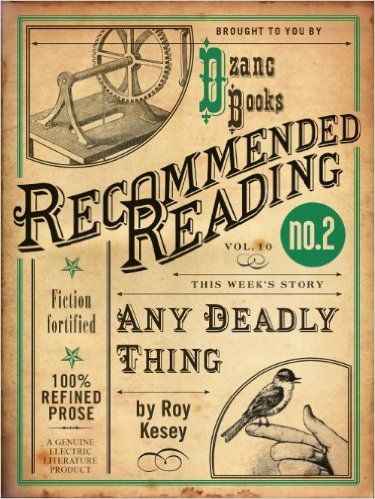
– There’s more to it than snakes, he says.
– That so.
– Any deadly thing, that’s what the verse says. I can drink lye, strychnine, whatever. Tried using scorpions once but they got in my clothes, had me dancing crazy, striptease.
Jay laughs, hammers shingles, thinks of women, wants a new tattoo. Bear, maybe. Something. The bite on his wrist has gotten infected, is red and warm, but the girl’s gone quieter. Having the dog around, most likely.
Late Saturday Jay says he can catch all the snakes they’ll ever need, ten bucks a pop, free delivery. Cranley says they do okay with the ones they catch on their own. Jay shrugs. The roof’s close to done but there’s more than he’ll get to tonight, and the sky is clouding up.
– Looks like your magic on the rain is wearing out, he says.
– No magic. Just got lucky.
– I’ll finish it tomorrow.
– Can’t have you hammering during the service.
– What time you start?
– Nine.
– Get here by five, have it done by then.
– Okay. Bring your kid?
– You save her soul?
– Not if it don’t need it. My wife has them playing with felt boards mostly, stories and such. Arts and crafts. Cookies. That sound okay?
– You let them mix with the snakes?
– Nobody under eighteen.
Jay doesn’t much like it but figures they can’t do any harm. He runs a hand through his hair, wishes he’d cut it even shorter. He waits, thinks Cranley will maybe give up, but the man asks again.
– All right, says Jay. All right.
Home, in through the door and the television’s on way too loud. He turns it down and she comes screaming from behind the couch. He grabs her and almost swings but the dog’s there showing its teeth. He drops her, heads for the tool shed, bleeds down the Barlow.
She doesn’t know, too young to remember, four years old when it happened, she was screaming and he’d shouted and his wife had come at him. He knocked her down. She got up and he knocked her down again, and she got up and ran. It was an hour later he heard his daughter scream from downhill, and he took his time — took his time — until he saw his wife stretched out. Then he ran too but there was no sense to it, her head broken open, blood all over the rocks.
The girl’s back at the television, won’t look up but the dog watches him, about healthy now, not growling, just watching. He cooks up string beans and rice and half a chicken, but she won’t eat. He tells her about tomorrow, and she’s listening a little. He says she’ll like it, says he promises, and lets her be.
Five o’clock and still dark and Cranley’s there waiting, his wife too, and some other woman with two kids. Come to welcome them, looks like. The kids chase the dog around inside and the women watch and Jay heads up.
A few hours later Cranley calls him down for coffee. There’s more people now, couple dozen, some he doesn’t know. The women all look alike — long hair, long dresses. The men too have a sameness, short hair, wool shirts, faces that know about work outside. He watches his daughter there with the other kids, eight or ten of them running, she says something and it almost sounds like words but it’s hard to tell. Maybe school in September, then. Maybe.
Cranley’s wife brings the coffee. Her left hand is withered so she’s been bit too but her face looks clear, big smile, good eyes. Couple people come up to say hello, shake his hand and thank him for the roof. There’s one guy though, young, big shoulders, most of the fingers gone from his right hand, stands a ways off and asks where he got the dog.
– Hit it on the river road.
– When?
– Last week sometime.
– Thought so. She’s mine.
Jay looks at the man. The man looks back.
– If you say so.
– And she doesn’t look too hit if you ask me.
That’s about enough. Jay steps forward, looks at his daughter and wishes he hadn’t. Everyone is looking at her now, and they all must have heard about her way.
– Bumped her a little is all. But my girl —
– I figured. But the dog belongs to my boy.
– He’d maybe sell her?
– Don’t think so.
His daughter’s up close, and the dog’s alongside, its fur in her fists, and it watches the man like it knows him but not too well.
– Could you ask him at least?
– I’ll ask. But you know how kids are.
Jay looks at his daughter, shrugs, and she goes tight. He nods, finishes his coffee, heads back up. He’s almost done when the rain starts and the roof goes slick. He hammers a little faster. Cranley comes out, asks how much longer.
– Ten minutes.
– Got to get started.
– Ten minutes.
Cranley stands there, watches, gets rained on the whole ten minutes, no hat or coat, just stands there getting wet. Then it’s done. Jay looks things over. Cranley waves him down. Jay hangs his hammer on his belt, takes a step and his feet go out from under him. He’s sliding fast, twists and reaches, misses the gutter, slams into the ground beside the pump house and there’s hard hot white in his gut.
Piece of fucking rebar. He fights at the air, settles back. It’s gone clear through, pokes out his stomach, pulls at him inside.
Rain on his face and Cranley’s there telling him to stay quiet, they’ll call an ambulance, get him taken care of, it’ll all be all right. Jay can barely breathe and it’s hard to tell what’s still whole. He holds the rebar. Cranley’s talking slower. There’s others, and they lift him.
He breathes as shallow as he can, closes his eyes as they carry him in and lay him on his side. It hurts but maybe not enough. There’s talk of the rebar and they leave it in place to keep the bleeding down, get a pillow under his head and they’re talking again, something, Cranley trying to get them settled and they won’t have it and nothing matters but how much it hurts.
His daughter’s scream though, he opens his eyes and he’s lying on the little stage up front, everybody else close around and she’s fighting her way toward him but the preacher’s wife catches her up, bears her off toward the back. Her screams fade a bit and it’s best this way, exactly how he wants it. The air catches and twists inside him. Music starts, tambourines, all kinds of singing and something else, dancing and hopping and spinning, and Cranley comes forward with a big cloth bag.
Voices wild, the music faster. Cranley looks at Jay, and Jay nods. Cranley opens the bag, brings out the snake, asks if he’s sure. Jay nods again, would tell them if he could, he believed as he fell and before all that and believes now, but there’s no words for it except whatever these people are saying as they jump and sway.
There’s wet coming out his mouth and he wonders if the rebar hit a lung. Cranley’s voice again, says the ambulance is coming but he needs to hold on and this will help. Jay smiles, says he knows. Cranley leans in close, sets the snake around Jay’s neck and it curls heavy around the rebar and maybe it’s not the right thing, the snake buzzes and the voices go louder and there’s something behind it, a siren maybe but he can’t quite tell. Around him are other men with snakes and they lift them and shout and pray, the snakes knotting up and then loosening, going still, the music rises and spins and something releases, the music drops off and the dancing stops, nothing now but quiet and the smell of sweat.
Jay hears his daughter again and she’s screaming or singing, no way to know, and she’ll be okay with them either way. His vision blurs, and he blinks hard. Things go mostly clear. The others talk, pray, something. The snake on his chest tightens and lifts, its skin rasping the side of his neck. The music starts again but slower, and the others are putting their snakes away, the light goes thick and bright, Cranley steps to him and reaches and Jay turns, Cranley smiles and the snake strikes, hits Jay right below the eye, snaps his head back, holds on, more heat and oh it hurts and Cranley’s pulling it away slipping it into the bag says it will all still be all right, the pain curls Jay up around the rebar and there’s lights and faces in close, his wife his daughter and hands on his shoulders his neck his face, voices and something singing and at last this yes this pain is exactly right.
On a Wednesday night late in January, half a dozen known-associates of the late activist-poet Allen Ginsberg gathered at the Housing Works Bookstore on Crosby Street to read anti-government poetry and perform live, radical music to a room packed by dissidents both young and old, who were quite literally hanging from the rafters. It wasn’t so much an anarchistic rally as it was an exuberant and peaceful celebration of Ginsberg’s life in poetry and song. But it was hard not to be stirred by the lawless spirit of the Beats while in the presence of some of Allen’s greatest collaborators
Allen Ginsberg is best known as the poet who wrote “Howl” and as a member of the Beat Generation, friend to Jack Kerouac, William S. Burroughs, Neal Cassady, and Gary Snyder. It is these years of his life and these friendships which are most often the focus of today’s films (including the new Kill Your Darlings, starring Daniel Radcliffe, as Allen).
But long after those heady days, Ginsberg continued to collaborate with other writers, poets, musicians and luminaries. At the website for the Allen Ginsberg Estate, you can see photographs of him with Thelonious Monk, Patti Smith, The Clash, John Cage, Arthur Miller, William Gaddis, Susan Sontag, David Letterman, and even, well… Beck.
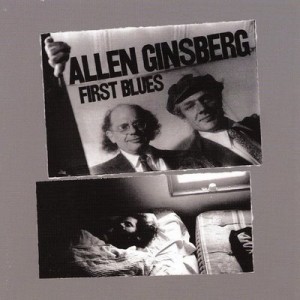
The January gathering at Housing Works launched the re-issue of Ginsberg’s album First Blues, and featured live performances by friends of Ginsberg’s who worked on the original album. Lou Reed and Bob Dylan couldn’t make it, but there were performances by poet Andy Clausen, composer David Amram, Anne Waldman (who, with Ginsberg, founded the Jack Kerouac School of Disembodied Poetics in Colorado), and author Hettie Jones.
The record re-issue is part of a collaboration between Peter Hale, manager of the Ginsberg estate and Nina Kossoff, of Esther Creative Group, a music management company. Kossoff, who studied literature in college, jumped at the opportunity to work on something a bit more bookish and began by arranging the re-release last year of Ginsberg’s 1994 four-album set, Holy Soul Jelly Roll onto iTunes.
She soon discovered that Ginsberg fans weren’t that interested in paying for an electronic download, when there were plenty of free or pirated recordings out there. Kossoff explained the same phenomenon applies to the contemporary music scene. When “paying for music” means listening to ad-enabled Spotify and Pandora, artists have to find profits elsewhere: concert sales, t-shirts, posters and books.
So what, then, could be done for Allen in the digital age?
Ironically, the answer was to return to the era of physical media, from whence Ginsberg came. She and Hale have re-released First Blues on vinyl –faithful to the original, right down to the newspaper insert and the typos on the packaging. Anyone who buys one of these limited-edition records also gets a free link to download the tracks digitally.
And it appears to have worked. They sold out of records before the Housing Works event even started — and more are on sale now. Satisfied with this model, Kossoff and Hale intend to continue their collaboration with new re-issues of Ginsberg’s music.
From his first reading of Howl in 1955 to his death in 1997, Allen Ginsberg produced poetry, music, and spoken word at a delirious pace and he recorded himself and his collaborators whenever possible. According to a 1994 article in the New York Times, Ginsberg was a “compulsive collector” and a “pack rat” whose personal archives include over 300,000 items, ranging from “mail from an admiring high school student named Abbie Hoffman [and] the sneakers Mr. Ginsberg was wearing when he was kicked out of Czechoslovakia in 1965” to “report cards from East Side High School in Paterson, N.J., electric bills and restaurant receipts […] with Mr. Ginsberg’s annotations.” Among the hundreds of tapes are “readings, telephone chats with William S. Burroughs, jam sessions with Bob Dylan,” but surely also countless hours of idle chatter.
These tapes have now made their way to Stanford University, where they are being reviewed and catalogued by academics, but Peter Hale sees potential in the idea of using social media to crowd-source the mining expedition — allowing the community-at-large to become collaborators too, finding history in the echoes.
But because Ginsberg read all around the world in all kinds of company, recordings are still materializing out of the ether, some sixteen years after Ginsberg’s death. In 2008, an academic working on a biography of Allen’s friend Gary Snyder accidentally stumbled across a recording at Reed College, which is now the earliest-known recording of Ginsberg’s “Howl”.
According to the Guardian, the early recording was made in the winter of 1956, only a few months after he first performed the piece. According to biographer Barry Miles, Ginsberg is more quiet and subdued in this early reading than in the dramatic performances he later gave. Indeed, after about 35 minutes, Allen stops abruptly, explaining, “I don’t really feel like reading any more. I just sorta haven’t got any kind of steam.”
Last July, a blogger posted a recording of Ginsberg performing with Peter Orlovsky, Steven Taylor and Harry Hoogstraten at a small bar in Eindhoven, Holland. The recording had been “discovered only recently after reportedly gathering dust on Hoogstraten’s shelf for thirty years.” Another recording, featuring a 1977 Ginsberg collaboration with avant-garde composer Arthur Russell was found in 2003 by a record producer who was digging around in a Long Island City storage-facility.
Hale hasn’t been surprised by discoveries like these. He showed me a Ginsberg recording that someone had mailed him from Arhus, Denmark in a strange format he hasn’t yet figured out how to play. Hale works out of the building that Allen Ginsberg bought on East 13th street in Manhattan’s Lower East Side. Guests and collaborators often stayed at the building while Allen was alive, and part of it is still rented out as artistic space. This seems appropriate to the abiding spirit of generosity that echoes through every memory of Ginsberg by his many collaborators. Hale told me, “Allen was the sort of person who would stop on the street and start talking to the homeless guy who’s talking to himself. He’d say to him, ‘Now what are you crying about?’”
Perhaps nothing captures this spirit quite as beautifully as this article from The New Yorker’s “Department of Immortality,” which describes how Ginsberg famously loved inviting his compatriots over for soup and even installed a special shelf just to hold his twelve-gallon stockpot. His secretary since 1977, Bob Rosenthal, saved two jars of the last batch of fish chowder that Ginsberg ever cooked for his company. For sixteen years, Rosenthal has been looking for a museum that could properly display them. In the meantime, he has kept the jars in the freezer at the 13th street building, where they still sit on ice, as of the time of this post.
There is so much of Allen’s genius still alive, in boxes and on tape and in jars, that it doesn’t seem like he’s gone. When I woke up, the day after chatting with Hale, to find that Allen Ginsberg had “liked” me on Facebook, it only felt a little strange. The Allen Ginsberg fan page on Facebook, created in 2011, 14 years after Ginsberg’s death is maintained by his estate and has been “liked” by nearly 57,000 fans. I don’t think Ginsberg was one for computers, but he was certainly into social-networking long before it was cool.
Because of course, he also lives on in the hundreds of people he worked with, who remember him fondly. At the Housing Works event, Bob Rosenthal recalled that “Allen didn’t have a naturally beautiful voice” but that he decided to sing anyway, because he firmly believed poetry and music were linked. “Don’t forget that Homer sang!” Rosenthal added, “Maybe.”
According to Rosenthal, Ginsberg also believed in improvisation. “He said if you can read off a piece of paper then you can read off your mind.” He described how Allen’s eyes would sometimes roll into his head as if doing just this as he began to go off-book while reading a poem. Then he read a poem called “Starry Rhymes”, one of the many that Ginsberg wrote in March of 1997, while he lay in a Beth Israel hospital bed, just before being diagnosed with general organ failure.
David Amram recalled how Allen’s singing career began when they finally convinced Bob Dylan to come to one of their parties — after trying for twenty years. Singing allowed Ginsberg to embrace the performance side of poetry and, according to Amram, avoid becoming an academic poet in the “University death scene.” Amram’s song involved accompaniment by a banjo and a glockenspiel, as well as him playing two strange Chinese flutes (simultaneously) and instructing the audience to sing in Mandarin, “I am happy to be on Crosby Street.”
Amram’s advice to the young people of the crowd was to “Hang out with people who say ‘Yes… let me see what you’re doing.’ Egotistic, greedy, selfish narcissism is an overcrowded field in a non-growth industry.”
Later, Hettie Jones recalled teaching Allen to sing in Hebrew for a recording of Kaddish, at a time when she had recently been cast out of her own Jewish family. She mused happily that in accordance with Ginsberg’s wishes, a third of his ashes had been scattered in the West, a third in the East, and a third in the middle. “Now he’s finally given himself to everyone. What was not possible in life is possible in death.”
Writing anything — poetry, novels, cookbooks, blogs — can be a lonesome business. It takes hours of solitude, contemplation, scribbling, revision; it can make bad friends of us. Trying to make something good enough to last, we tend to lock our generosity away, like so many frozen jars of soup. Literary history is rife enough with isolates, loners, and introverts, but Allen Ginsberg stands for the other, shining possibility. That words can be connective tissue; that the guy shouting on the street corner might just be onto something; that, in fact, you ought to grab your kazoo and go accompany him; that you should grab your tape recorder too, because it might just be genius.
At the end of the night, after thanking everyone for coming, the host remembered that Ginsberg was always fond of reminding both friends and interviewers that “immortality comes later.”
“Now,” he said, “It’s later.”
***
— Kristopher Jansma is a writer and teacher living in New York City. His debut novel, The Unchangeable Spots of Leopards, will be published by Viking Press in March 2013. Want more Literary Artifacts? Here you go.
The George Saunders Love Parade continues! Jacket Copy, the Los Angeles Times book blog, will be video-chatting with the author today at 1pm, Eastern time.
For hundreds of years, the image of the solitary writer as successful creative genius has been the dominant paradigm. Well, we have to rethink that — it seems that today’s successful author is looking more and more like a highly engaged startup entrepreneur than a solo artist.
According to the just released study from Digital Book World and Writer’s Digest What Authors Want: Understanding Authors in the Era of Self-Publishing, the hybrid author — an author who has published through traditional publishers, and non-traditional alternatives such as self-publishing — outperforms both their traditionally published and self-published peers by just about every measure.
Hybrid authors make on average $10K more a year from their writing than traditionally published authors surveyed, and nearly $31K a year more than the self-published authors. They also command higher advances, and demonstrate more sophisticated attitudes about everything from the importance of great editing to what “prestige” is really worth in a traditional deal. (It’s a fascinating survey — I highly recommend it.)
What also emerges from the survey is evidence of the effort they are putting in to engage their audience and build their business.
78% of hybrid authors are on Facebook versus 68% of their traditionally published colleagues, and 56% of their self-published colleagues.
Hybrid authors are also 10% more likely to be blogging, and have been on Twitter 12% longer than their traditionally published colleagues. That rises to 16%, and 23% respectively when compared with self-published authors.
Clearly these guys are working it.
I’ve written elsewhere about why I believe authors need to get as serious about their business as they are about their writing. It’s why I’m building a new breed of analytical tools for authors, and it’s why I joined my friends at O’Reilly Media’s Tools of Change project to co-chair the first Author (R)evolution Day* on 2/12 to get writers and the industry talking about these issues together.
And now, thanks to DBW & Writer’s Digest, for the first time we have some good hard data that contradicts the big myth that comes up in any discussion about the emergence of the successful entrepreneurial author: the blanket dismissal that authors as a class are incapable of both building a great business and writing great books, often at the same time.
Hybrid authors represented about a third of the total professional author respondents on the survey. What we’re seeing in this data is not just an outlier of a few hit-or-miss socially active authors. This survey systematically demonstrates that these hybrid authors are showing the classic hallmarks of successful entrepreneurial effort: early understanding and adoption, forward-leaning engagement, picking the right tools for specific purposes, gathering data on what’s working, evaluating the options, rolling up the sleeves & figuring it out.
There are those among you who may look at this pattern of entrepreneurial authorship as being only a little more attainable than walking on the moon. Take heart. This is the leading edge of the author market — not everyone will feel as comfortable with these ideas, or as adventurous with these kinds of skills (yet).
But I do think these authors are showing us the way toward a new model, and everyone can find something to use in these ideas.
There is one last myth to address — this idea that as an alternative best practice is emerging for successful authorship, authors will be forced to be cook, chef, and bottlewasher with no help or tools to work with. “It’s sign a publishing deal & let them handle it, or do it all completely on your alone.”
Being a good businessperson does not mean doing it all. In fact, it means NOT doing it all if you can help it. It means understanding your options, resources, and personal strengths, and then creating a business strategy that makes the most of what you have for maximum return. Often it means hiring to (or working around) your own weaknesses.
And yes, there is tremendous trial and error in being an entrepreneur. It’s a messy business. But the willingness to keep pushing it forward every day, and to learn from one’s mistakes is what makes all the difference.
I doubt if most of the hybrid authors on the survey feel like they are blazing a path to success. I’m sure it is a lonely slog for many. But together, they are clearly on to something, and now that we can see it, let’s embrace, celebrate it, and figure out how every author can take these ideas and apply them for better (and more profitable) success
*Interested in attending TOC’s Author (R)evolution Day on 2/12/13? Electric Literature readers can use the code EL350 to get $350 off any TOC package.
*** –Kristen McLean is a book futurist, consumer zoologist, and idea omnivore. She is also the founder & CEO of Bookigee, a Miami-based company that develops groundbreaking tools and innovative analytics to help the $28B book publishing industry meet the digital future. Additionally, she is the co-chair of O’Reilly Media’s first Author (R)evolution Day at TOC 2013. When Kristen isn’t building her company or speaking about the future of publishing, she’s on the prowl for great coffee and interesting conversation.
DON’T MISS OUT
Sign up for our newsletter to get submission announcements and stay on top of our best work.
YOUR INBOX IS LIT
Enjoy absorbing fiction from Recommended Reading on Mondays, strange, diverting work from The Commuter on Wednesdays, and a roundup of our best work of the week on Fridays. Personalize your subscription preferences here.