The George Saunders Love Parade continues! Jacket Copy, the Los Angeles Times book blog, will be video-chatting with the author today at 1pm, Eastern time.
For hundreds of years, the image of the solitary writer as successful creative genius has been the dominant paradigm. Well, we have to rethink that — it seems that today’s successful author is looking more and more like a highly engaged startup entrepreneur than a solo artist.
According to the just released study from Digital Book World and Writer’s Digest What Authors Want: Understanding Authors in the Era of Self-Publishing, the hybrid author — an author who has published through traditional publishers, and non-traditional alternatives such as self-publishing — outperforms both their traditionally published and self-published peers by just about every measure.
Hybrid authors make on average $10K more a year from their writing than traditionally published authors surveyed, and nearly $31K a year more than the self-published authors. They also command higher advances, and demonstrate more sophisticated attitudes about everything from the importance of great editing to what “prestige” is really worth in a traditional deal. (It’s a fascinating survey — I highly recommend it.)
What also emerges from the survey is evidence of the effort they are putting in to engage their audience and build their business.
78% of hybrid authors are on Facebook versus 68% of their traditionally published colleagues, and 56% of their self-published colleagues.
Hybrid authors are also 10% more likely to be blogging, and have been on Twitter 12% longer than their traditionally published colleagues. That rises to 16%, and 23% respectively when compared with self-published authors.
Clearly these guys are working it.
I’ve written elsewhere about why I believe authors need to get as serious about their business as they are about their writing. It’s why I’m building a new breed of analytical tools for authors, and it’s why I joined my friends at O’Reilly Media’s Tools of Change project to co-chair the first Author (R)evolution Day* on 2/12 to get writers and the industry talking about these issues together.
And now, thanks to DBW & Writer’s Digest, for the first time we have some good hard data that contradicts the big myth that comes up in any discussion about the emergence of the successful entrepreneurial author: the blanket dismissal that authors as a class are incapable of both building a great business and writing great books, often at the same time.
Hybrid authors represented about a third of the total professional author respondents on the survey. What we’re seeing in this data is not just an outlier of a few hit-or-miss socially active authors. This survey systematically demonstrates that these hybrid authors are showing the classic hallmarks of successful entrepreneurial effort: early understanding and adoption, forward-leaning engagement, picking the right tools for specific purposes, gathering data on what’s working, evaluating the options, rolling up the sleeves & figuring it out.
There are those among you who may look at this pattern of entrepreneurial authorship as being only a little more attainable than walking on the moon. Take heart. This is the leading edge of the author market — not everyone will feel as comfortable with these ideas, or as adventurous with these kinds of skills (yet).
But I do think these authors are showing us the way toward a new model, and everyone can find something to use in these ideas.
There is one last myth to address — this idea that as an alternative best practice is emerging for successful authorship, authors will be forced to be cook, chef, and bottlewasher with no help or tools to work with. “It’s sign a publishing deal & let them handle it, or do it all completely on your alone.”
Being a good businessperson does not mean doing it all. In fact, it means NOT doing it all if you can help it. It means understanding your options, resources, and personal strengths, and then creating a business strategy that makes the most of what you have for maximum return. Often it means hiring to (or working around) your own weaknesses.
And yes, there is tremendous trial and error in being an entrepreneur. It’s a messy business. But the willingness to keep pushing it forward every day, and to learn from one’s mistakes is what makes all the difference.
I doubt if most of the hybrid authors on the survey feel like they are blazing a path to success. I’m sure it is a lonely slog for many. But together, they are clearly on to something, and now that we can see it, let’s embrace, celebrate it, and figure out how every author can take these ideas and apply them for better (and more profitable) success
*Interested in attending TOC’s Author (R)evolution Day on 2/12/13? Electric Literature readers can use the code EL350 to get $350 off any TOC package.
*** –Kristen McLean is a book futurist, consumer zoologist, and idea omnivore. She is also the founder & CEO of Bookigee, a Miami-based company that develops groundbreaking tools and innovative analytics to help the $28B book publishing industry meet the digital future. Additionally, she is the co-chair of O’Reilly Media’s first Author (R)evolution Day at TOC 2013. When Kristen isn’t building her company or speaking about the future of publishing, she’s on the prowl for great coffee and interesting conversation.
A memoirist meditates on the experience of being stalked
To date, James Lasdun’s website remains cryptic, informing us that we have reached the only reliable source of information about the author of two highly praised novels and several collections of poems and short stories, while divulging little else about him. Give Me Everything You Have: On Being Stalked, Lasdun’s tense new memoir, sheds light on this evasiveness. While teaching a writing workshop in New York in 2003, Lasdun encouraged a talented young Iranian student he calls “Nasreen” to pursue her first novel; two years later she contacts him again. A lively email exchange ensues, the somewhat older, married man gamely assuming the role of “avuncular, eunuchy” mentor, while Nasreen’s tone swings from muted deference to manic flirtation. Eventually alarmed by the tempo and seductiveness of her communiqués, Lasdun permanently signs off, unleashing a “torrent” of emails, in which Nasreen accuses him of being a “stereotype of a Jew” as well as having engineered her rape by proxy. She also charges him with running a student-fiction plagiarism ring and systematically bedding female classmates. Similar smears surface in an Amazon review and his Wikipedia entry. Employers and colleagues are copied on the lurid emails. “I began to consider the word ‘honor,’” Lasdun says, describing his dread upon checking his inbox, “as something more than an antique formula, and the word ‘reputation’ as something other than an index of value in the literary marketplace.” Helpless to stop — or to stop obsessing about — the daily unraveling of his electronic reputation, he becomes “a compulsive self-googler….like a malady from some Victorian hygiene pamphlet.”
Well, that would explain the low web profile.
To a reader of Lasdun’s fiction, this noirish scenario sounds like a case of life mirroring art. In The Horned Man, his elegant, twisty first novel, a prim professor who sits on his college’s sexual harassment committee begins to suspect that heis being framed as a violent sexual predator. What begins as a poetically menacing cat-and-mouse story develops into an abstract study of guilt, identity and their tricky reciprocity. Similarly, in Give Me Everything You Have, Lasdun interrogates the uncanny bond of harasser and victim. “I want to understand this tormentor…who knows the workings of my mind so intricately and uses them so cleverly to make me suffer.” When Nasreen accuses him of drawing on her student fiction as an inspiration for a recently published short story, he considers whether he is in fact “guilty of appropriating some kind of echo or semblance of her ‘essence’ for literary purposes.” “We are in the realm of the Gothic here,” Lasdun muses uneasily, of “mind control, telepathic metamorphosis.”
Lasdun weaves an associative mediation on honor, plagiarism and the zombie-like eternal resurgence of anti-Semitism through allusions to Tintin, Sir Gawain and the Green Knight, Macbeth and Sylvia Plath. We follow his pilgrimages to D. H. Lawrence’s last residence in Santa Fe — Lasdun has written on Lawrence — and finally to Jerusalem’s Western (Wailing) Wall, where he travels to research an article about his architect father’s aborted assignment to reconstruct the symbolically freighted Hurva Synagogue. Throughout these digressions, Lasdun’s instincts remain solidly novelistic, with the “shape-shifting, quasi-phantasmal” persona of Nasreen persisting as Give Me Everything’s core enigma. “There was…something manifestly creative in her unstoppable productivity, a vitality I couldn’t help envying,” admits Lasdun, after five years of daily harassment. The memoir delivers substantial chunks of her “delirious” and sometimes witty emails, from which its title is appositely plagiarized. Will the real “Nasreen” recognize herself in this heavily transcribed likeness? It’s a testament to Lasdun’s empathic portrayal that we care.
He concludes his investigation in Jerusalem with a stupendous local metaphor for the agglomerated desire, fantasy and impotence that drive the internet. This “seething electronic data cloud” to which one “attributes a kind of human consciousness” emerges as his memoir’s most troubling subject. “Spite,” says Lasdun, “has never had such an efficent instrument at its disposal.”
Give Me Everything You Have: On Being Stalked (224 pages) will be released on February 12, 2013.
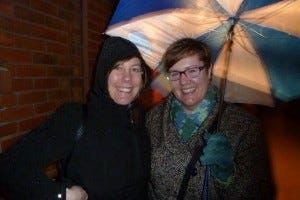
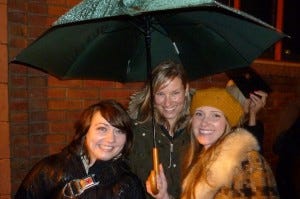
1. Vanessa and Lyzz are diehard fans of storytelling and advocate joint custody for umbrellas. 2. Anna, Mieke, and Nicole were excited to see Joy Bryant.
The Breaking the Rules edition of Back Fence PDX, produced by B. Frayn Masters, featured ten-minute, never-been-told stories by Joy Bryant, Ted Douglass, Brian Finkelstein, Lauren Goche, Vin Shambry and Peter Zuckerman. It’s kind of like The Moth, except they also pick three audience members to tell one-minute stories and give everyone cupcakes.
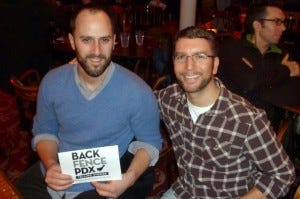
1. Colt and Jarrett were excited to support the girl who could skin a squirrel. 2. Matt Mount and Heather Hawksford of Merit Badge shared a stranger’s umbrella while in line and considered testing out Portland generosity by cutting in the food line.
If there is a sold-out show at the Mission Theater, get there by 6:30pm in order to get a decent seat. Most of the crowd will be on their second drink and first slice of pizza. If you are lucky, you’ll sit at a table with people who smuggled in a huge box of chocolate and offer to share it with you.
1. Sam Adams maybe reading my tweet, maybe texting Peter Zuckerman about it. 2. Rodrigo, Sarah, Vin Shambry, and Jake formed a friend oasis in the crowd.
I had plenty of time to take my beer for a walk before banter, led by Jason Rouse, brought a quick story by Masters to start the show. Three hundred people ended two hundred conversations and listened.
Here is a one-sentence summary of the six stories:
Ted Douglass: Indiana tried to kill him at least three times, but in the end, he marries the girl.
Vin Shambry: A football loving, Liza Minnelli straight man proves that gay before May isn’t always the AMDA way.
Lauren Goche: She cut her sister’s umbilical cord as a four-year-old and found out that broken heart cakes cannot save a marriage.
Brian Finkelstein: Eating sleep for dinner and carrying a non-suicide note will not protect anyone from taking bad friend advice.
Joy Bryant: Pulled a Naomi Campbell to get a seat on a plane to Bora Bora, then flew the damn plane while smoking cigarettes with the pilot.
Peter Zuckerman: Yasa Gumba and healer rituals cost fifty cents each, but a Russian helicopter is priceless.
1. Former Portland Mayor, Sam Adams. 2. Mindy Nettifee and B. Frayn Masters holding still for five seconds before the show.
My favorite part of the storytelling was thinking about why this particular person wanted to share this particular story. Were they surprised at a new detail or insight mid-story? Did they get more energy as they told the story?
In keeping with the Break the Rules theme, the three one-minute storytellers selected from the crowd included a miraculous fourth — a woman fresh from the gym whose name sounded like one of the names that had been selected and wasn’t going to leave the stage without her spotlit minute. Masters rightly assessed this woman probably broke the rules 80% of the time. It was both awkward and perfect.
When a story takes shape, the details get a little closer or further from the truth, depending on the teller’s relationship to the audience. Not sure which one it was for each of the Back Fence PDX storytellers, but all of them demonstrated a masterful range of intimacy and control.
***
— Judith Ossello currently lives and writes in Portland, Oregon. Find her at www.writerloop.com.
THE GIRLS ARE WORMED OUT ACROSS THE FLOOR under down comforters even though daytime is hardly over, getting a jump-start on the slumber party. “My parents both have perfect love-arms,” Genevieve tells her friends. “Both of them can write. They write love letters to each other. It’s almost sick.” No one thinks this is sick. Everyone wants this. Pheenie, Marybeth, Sara P., and Sara T. all want the proof.
Though the girls know many two-armers, even some that seem happy and in love, what they talk about are those with love-grown arms. “My mom doesn’t have anything and my dad just has fingers growing out of his chest. He can’t control them and they grab at anything that is close enough,” says Pheenie.
“My grandmother has seven, but she has always been married to my grandfather. She says she fell in love with him over and over,” Sarah T. adds. Seven is an unusual number. Two sometimes, maybe three, but past that something important must have gone wrong. And still, the girls are greeted every morning by the television news anchors, their teeth white, their hair unyielding and their single, perfect love-grown arms, offering no hint of uncertainty.
Sarah P. lowers her head. “My dad’s arm keeps growing. It drags on the floor. It is soft and he can wrap it up and tie it in a knot.”
Genevieve, putting her hand on Sarah P.’s sleepingbag-burrowed body, says, “I wonder what mine will be like. I want to have two. I think it’s better to fall in love twice, once to try it out and twice to know for sure. I want the first arm to be a stump and the second to be full grown.”
Pheenie shakes her head. “I only want one. I only want one perfect one.”
The girls go quiet and all the arms of all the loves they do not yet have beat silent beneath their skin. They thump and prepare.
After all the students have left the building for the weekend, Principal Kevin again tells the story of his love. His wife’s beauty surpasses the Louvre, the Sistine. Both his secretaries chirp. They wide-eye his love-grown arm and tilt their heads and wish for what he has.
“You might not know what it feels like, but I do,” he tells them, “and it’s terrific.”
In fact, Principal Kevin stuffs his third sleeve. He stuffs it, but no one at school knows he does. The sleeve is filled with a prosthetic, a good fake arm commissioned from the lab at the hospital. It screws onto a threaded metal disc implanted on his chest. At the writing end: a stump. The stump is sewn up to look like the hand has been amputated. Principal Kevin is smart enough to know that a fake hand looks fake and, instead of giving up the whole beautiful vision, he tells a story about a kitchen fire in which he saved his wife and daughter but his third hand, his lovely third hand, was burned to a crisp.
But Principal Kevin knows himself. He is sure that if he did have a love arm, and if he had lost the hand to it, he would have wanted a replacement. It’s the kind of man he is — everything in its place. So, attached to the very real-looking stump with big, obvious screws, is a wooden hand. It is the fakest he could find, an art class model. Against this, the arm looks especially lifelike.
When he comes to the end of the story, one he has told more than once to everyone he has ever met, he manually straightens the jointed wooden fingers and brushes them against each of his secretary’s right cheeks. “The hand burned,” he muses, “but the arm resisted. The arm did not even singe.”
Few of Principal Kevin’s students, his daughter Genevieve among them, have any love-arm development. The girls check constantly in the bathroom between classes, inviting each other to inspect the soft skin of their side-bodies for bumps. They say they are falling in love, not with the specifics of one boy, but with the idea that such a thing is possible — that they belong to a species built to snap together in everlasting pairs. They feel themselves falling in love with the entirety of the opposite gender, with their own blooming selves, but their bodies do nothing to corroborate. Their skeletons are stubborn and unchanged.
For the boys, any new protrusions would be bad for their social standing. Certain other anatomical parts have made some very favorable changes, but love can’t break the seal. After high school this changes. Older brothers are proud of their arms. They sit on thrift store couches while girlfriends rub lotion onto the new branches and kiss them and want to make love so often because there is proof that what they have is real, that something has changed because of it. They lie close in a twin bed afterward and put their extra arms side by side. They let the unfinished appendages warm each other up just by pressing.
During after-school detention, Miss C. lectures about Amelia Earhart. She zooms herself around the room like an airplane, making swooping turns between desks. She is a two-armer, but that’s not the whole story. From the waist up, she is covered in hands. Dozens. Under the cover of clothing, their fingers move and stretch and wriggle. Sixteen sixteen-year-olds keep out of her way until she drops suddenly and kneels under a desk. “Blammo,” she says in a loud whisper. “I’m gone, disappeared, just like that.” She does not move for a long moment. Chairs squeak. Students hiss. Miss C. remains disappeared at a pair of sneakered feet. The boy reaches down like it’s an accident and touches her head. He can feel her skybound heat.
When she stands up, she is rippling, the fingers twitter beneath her blouse. After the bell, in the hall, the boy sticks his chest out and imitates with his two original hands. “Oh, Amelia Earhart, I want to jump your bones,” he squawks.
Miss C. sticks her head out the door. “You’ve got a poker face now,” she tells him, “but your body will give you away soon enough.”
The high school boys keep rubber gloves in their wallets and inflate them when they want to try to win a girl over. They tuck them under their shirts and let the bulging, breath-warmed fingers reach out at their dates, indicating what could be.
Of course, the girls know the hands are stand-ins. But when the boys say, I could really develop feelings, and they have the visual aid, and when the music pumping out of the speakers has someone singing a harmony and someone singing a melody, the drapery of their clothing is easily removed, and their desperately hopeful limbs cross and twist and hold.
Even Principal Kevin’s home mail comes addressed to Principal Kevin. On this Friday, while he waits for his wife to come home and remove his arm so that he can enjoy the evening unencumbered, he spreads the envelopes out on the table until the whole surface is covered with his name. They say, Please, if you could spare some money for the children. Ask, Do you have any idea what kind of excellent interest rate you deserve? They report the therms used to keep the house warm, the wife’s desires made known by her spending on the platinum credit card. A note from his daughter: Dad, I love you and I’m at Pheenie’s for the night. — Genevieve. He is alone with the facts of his existence and it makes him tired. Just looking at the debts and balances.
His wife comes in from her exercise class and she finds him here, wilted. He looks at her and picks the prosthetic up with his good left hand like a dog’s bone, as in, Look what I found, take this from me, I have been waiting.
“You could have done it yourself,” she says.
“It’s yours. I want you to do it.”
“We have the PTA meeting tonight,” she reminds him, kissing the arm as if it were real. As if it does not whisper to her that to him, her eyes are tiny pits, her hair a strangle of ropes, her heart a flicked, rolling marble.
“Will you go in my place? Tell them it’s a headache. I just want a nap and a break.” She kneels on the floor in front of him and takes his shirt off, then twists the arm to the left. The elbow bends as she unscrews, so the arm faces in all the wrong directions.
She puts the arm down on a chair, brushing the hair so it lies in one direction like windblown wheat. She kisses his cheek and returns him to his kingdom of bills. She comes back a moment later with a cloth to wipe clean the metal threads of the attachment, both male and female. They get sweat-damp throughout the day. A shimmer of salt crusts the edges. She dries. She oils and dries again.
She does not take care of his fake love-arm with her real one. She lets that sit against her side, the fingers spread out against her, quiet and still. It is her born-on hands she tends to him with, just as he tends to her with his.
Principal Kevin’s arm needs caring for like antique furniture does. Cleaning and mink oil. While he sits with his mail, his wife takes it with her into the bathtub and lets it float there while she washes herself, her triangles and spheres and nubs, and her own third arm, this one very real. She cleans both authentic and created with extra-gentle baby shampoo. The wooden hand is heavily waxed, and water beads, then scrambles off, as if afraid. She closes her eyes and leans back against her twisted-up hair, the prosthetic floating limp on the surface of the water, a ship stuck in a tiny, unleavable sea.
“Good bath?” he asks, naked, from the bed when she comes out. The sun shoots off the metal hole in his chest and makes her squint. She tightens her robe and turns away, places his arm on a stand by his dresser, where it stretches straight, pointing out the window at the bug-buzzing evening.
“You know you are my peach,” he says to her. “Come and sit.” He strokes what she has grown for him. It is elbow length with a hand but unjointed, the fingers always carefully manicured. He chips at the polish. “My love is bigger than any limb,” he tells her.
“What is mine then?”
The boys like to watch Miss C. walk down the hall, all those hands and fingers moving together under her clothes, beckoning. This evening, when she makes a trip to her car, the football team turns from the field where the lowering winter sun skates the grass pink. They watch her search in her bag for keys, which come out glinting. Her hair picks up the light the usual way, but it is her body that receives it in waves, like she is the surface of the ocean and all the water inside is angling for a peek at the great open space of the sky.
Miss C. is really named Claribel. She goes into her office alone with the blinds down, door locked, grading papers shirtless before the PTA gets started. Her hands hold things for her: red, blue, green pens. Paper clips and sticky notes. Her breasts, surrounded by a ring of four hands each, look like lakes in a forest: calm, quiet, protected. While she scratches at the paper, the hands clean each other’s nails. They hook fingers.
Principal Kevin’s wife also has a name, which is Jan. She is a committed mother and she has excellent legs. Both are goals she has been able to meet. While the prom committee presents its plan for an Antarctic theme, Claribel leans over and whispers to Jan, “You’ve got great legs.” She is a fan of this appendage, a limb that does not sprout up but comes exclusively with the original configuration, and always in one matched pair. “Your daughter is a real contributor lately,” she adds.
Jan humbles her head but knows it is true. “I am proud of her. I think it’s hard to be the principal’s daughter.”
“He’s such an admirable man.”
“Sure.”
When the meeting is over, they go up to Claribel’s office for a coffee, look out the small window at the football field. The team practices in the dark for a game they need to win. The women talk about teaching and administration. They talk about the graduating class and where they will go to college. Jan’s extra hand peeks out of out a lavender cuff with a pearl button.
“Your nails look nice,” Claribel remarks. “I have too many hands to take that on. It would cost me thousands of dollars.”
“That would be quite a project,” Jan admits. A flock of blackbirds rushes by and they call out to one another. Jan can see her car in the parking lot waiting to take her home, where she will find her husband on the couch, devouring popcorn and laughing loudly at the commercials. The thought makes her stomach sink. “You know what? I’ll do them for you,” Jan says. “Your nails. Let’s do them.”
Claribel resists the way people do. “No, no. There are too many,” but already she is unbuttoning her shirt from the bottom up.
When it is finally dark, the girls take off their clothes and go in the pool, splash in the hot blue of that gathered liquid. Their skin is wet and slick. Their ponytails go pointy and water falls from them in straight beaded lines. “I want to love you guys forever,” they say to the half-lit faces.
The girls get into the bathtub together, all five, because it is a big one and they are small and cold. They wash one another’s backs with soap that smells like lilacs. Legs slip against legs. The names of the boys they want to love fall out of their mouths.
Dry but not yet dressed, Genevieve takes out a permanent marker. She draws parallel lines down the center of her chest and then the five loopy fingers of a hand at the end. She writes Cole P. inside the wrist. Pheenie turns away and says, “Draw one on my back.” Pretty soon they are covered in the outlines of limbs ending in digits. Some drawings are realistic, the arcs of knuckles and nails. Some are more like paws, round and imprecise. The girls sleep in a pile, the scent of the marker sharp on their skin.
In the morning, the original drawings will be printed again on whatever skin was pressed there; even their cheeks will be ghosted with imaginings of love.
As the shirt comes open, the fingers beneath stretch themselves out, crack their knuckles. Claribel lies down on her back hands.
“Who is this hand for?” Jan asks, filing the first nails.
“That’s Abe Lincoln and next to that is my father. Those were the first two. They grew when I was eighteen and I went to Washington for the summer. I sat on the steps of the Lincoln Memorial and read his biographies. I watched the lump grow to a ball, and then a wrist. The fingers started the same way, lumps and then balls.” Jan massages a jewel of lotion in the palm. “My father called to tell me he was leaving to live in Kentucky with a new woman. ‘I love you even though I don’t love your mother,’ he told me, and right then, all at once, this hand erupted out of my chest.”
They go on. Eleanor Roosevelt, Tom Sawyer. Ms. Earhart. A cousin who died in a flood. Men who she knew for weeks sometimes, hours sometimes, before an appendage began where they touched her. “Some of them did not know I loved them. Many of them were dead. I have never known which ones were real, or if all of them were. I have hands that showed up without my ever knowing who they were hoping to touch or hold.”
Jan thinks about this, about her body’s agreement to tell the same story she does: love right away, love still, love always. “I think it’s wonderful that you have loved so much,” she says. “You’ve given your whole body over to it. We award medals for much less useful acts.”
Claribel nods her head and feels the tickle of something beating beneath her skin, wanting to exist. “But I have proof all over me that no one is alone in my heart. Everyone wants to be alone in someone else’s heart. In the end, I am alone in mine.”
Genevieve knows that her father’s arm is a fake. He likes to take it off when he gets home. He likes to eat his dinner without it in his way, to hug his daughter unimpeded. She does not admit this to her friends, because they believe that what her parents have is the lucky thing everyone hopes for. But it is the lie that Genevieve loves. That he built for himself what did not come on its own. He said yes, and though his physical form stayed silent, he created a voice for it. Made it sing the notes of his song.
“My husband’s arm is plastic,” Jan says, and the painted nails wink at her.
“Oh my god. But he talks about it all the time.”
“I know.”
“He must love you though.”
“He must. But he also must not.”
Claribel lies down on the floor so that Jan can reach more hands. As Jan works, Claribel’s fingernails become red squares, like windows into the coursing, blooded tributaries beneath. As if Jan has painted her way inside.
After a moment Claribel says, “You could climb on.” The many fingers reel Jan in.
“How I used to hold the kids on my feet?” Jan asks. She climbs on, laughing and nervous. Claribel lies on the mattress of her back hands, and Jan rests like a platter on the front. Their bodies are held apart. Air travels through the tunnels. Fingers dig themselves in. Jan puts her three arms out like wings to steady herself.
Outside, boys crash into each other and land in heaps.
“Here I am, held up by everyone you’ve loved,” Jan says. “See that?”
When Jan begins to tip, Claribel tells her, “It’s only because you are looking that you can’t balance. Close your eyes. We’ve got you.”
Alone this evening, Principal Kevin takes his arm into bed. He is naked. The hand stays open, a lazy wooden cup, only holding what it is given. It is the best kind of partner, silent and reliable. He takes it into his own hands, places it over his softest parts. With the feeling of the wood on his skin, he is angry suddenly, at his wife, at his daughter, at them all. He has worked harder than anyone to create evidence of love. He moves the hand around. Real blood, real heat press out against the hinged fingers. Perhaps it is his wife who has not earned this love.
“I love you,” he says, to no one. The skin is smooth and the wood is smooth and the feeling is big and good.
Just because MTV hasn’t played a music video in at least a decade (the last one aired around the time we discovered there weren’t chicken in the sea), doesn’t mean the form is as as dead as the radio star. When Etgar Keret, the brilliant author of Suddenly a Knock at the Door, makes the “literary equivalent of a music video” he isn’t hoping to reach MTV’s Times Square studio, but Sundance and an entirely new audience.
In the “Storyvid” below, Etgar’s short story “What Do We Have in Our Pockets?” is brought to a new form by Goran Dukic, director of Wristcutters: A Love Story.
The Storyvid concept brings a “director’s visual reading to a short text,” Etgar explained over email. The videos aren’t intended to give potential readers an excuse to just-wait-for-the-movie-to-come-out, however. Etgar isn’t trying to replace reading, but trying to “remind people who don’t how great it is to read.”
“I always like new forms and mediums for storytelling,” said Etgar, who’s also written fiction, film scripts, and comics. “If I could tap dance a story, I’d do it too.”
A collection of stories exploring anxieties about youth, adulthood, and the passing of time
In “Hush Hush,” the title story of Steven Barthelme’s new collection, Tilden, a lonely middle-aged drinker typical of the men who populate these stories, is lying in his daughter’s bed, flipping through fashion magazines full of fresh faces, when suddenly he smashes the bedside clock against a wall. Later, he and his estranged daughter, a twenty-something who recently turned up at his office to accuse him of paternity, drink a bunch of bourbon, break more shit, and then screw.
A violent anxiety about getting older pervades the stories in Hush Hush. Barthelme is the brother of Donald, the madcap post-modern master, and Frederick, the less well-known but equally interesting “K-Mart realist,” and the stories in this collection often jump from one end of this stylistic spectrum to the other. However, the best stories swing somewhere in between.
“Heaven” is an example of Steven Barthelme’s more playful side, with lines like “Heaven resembles a very large Days Inn where God is always wandering around saying, ‘Have you seen Jesus? Have you seen Jesus?’” It’s a line that could have been taken from one of his older brother Donald’s stories, or even the stories of George Saunders. Another story in this mode is “Siberia,” a monologue by a troubled but precocious ten-year-old who says, “Nietzsche is some freak dead guy. I won the spelling bee.” The most successful of these stories is “The New South,” a vicious takedown of carpetbagging writers in search of Americana.
“Interview,” which reads like a typical guy-feels-like-an-existential-fraud-so-leaves-his-wife-and-suburban-life-and-flees-to-Texas-where-real-people-live story, lacks the lived-in quality of Frederick Barthelme’s best work, his feel for place and class. But what does shine in this story are the teenagers who hang around the mechanic shop where Quinn, the narrator, finds work. The dialogue between these kids sparkles in comparison to anything said between Quinn and other adults. Even Quinn seems to realize this when he equates his new line of work to “the way I felt in elementary school.” Quinn seems to long for the childish world of possibility that the narrator from “Siberia” is chafing against.
Two stories, “Claire” and “In the Rain,” pulse like the heart of the collection precisely because they combine the best of Barthelme’s competing realist and absurdist tendencies. In “Claire,” we meet Bailey, a degenerate gambler who has borrowed eight grand from his ex, which of course he immediately takes to a gulf shore casino. Miraculously, Bailey’s luck turns, and he ends up doubling his money at blackjack. On the drive back home, he sucks on ice, telling himself that “[sucking on ice] meant you were orally fixated, too, which meant something — you wanted to suck a tit, you were childish, or something. Got that right…it’s not a bad thing, being childish.” He later describes of the feeling of winning money, but not having anybody to share it with as, “like being a kid and doing something really spectacular about which no one cared, like getting all the way home through the woods without ever touching the ground.” Here, we see Barthelme’s flair for poetic one-liners paired with real emotion, and the results are breathtaking.
The same can be said for “In the Rain,” another story of first love gone sour. It is also a story that sweats with the anxiety of a once-promising life that took a wrong turn somewhere back in the foggy distance. In “In the Rain,” the narrator’s wife has left him, but she has also left behind her cat — lost and dead cats haunt the later half of the collection — telling him that maybe the cat will teach him something. Rain falls, and floods come, and Slick goes missing. At first, the narrator isn’t too concerned because “cats went out and later they came back. They’re animals. You don’t ask them where they’ve been and what they’ve been doing.” He spends days out driving in the rain, looking for Slick, but his search turns up only a different dead cat, a tabby. The narrator moves the cat to the side of the road and then drives home, “wishing I had a cigarette the way you wish for a cigarette after a few years of not smoking, wistful, wanting to be some way you used to be.” Later that night, he goes back for the tabby and then sets it on his front lawn “as a sort of sort of signal, a crooked totem. A message to my cat, about what could happen.” Slick reappears the next morning, looking “like an embryo,” and “blubbering like a baby.” This is the most hopeful ending of all the stories in Hush Hush, the only one that offers the chance to return to the innocence of childhood. However, the narrator warns us, “It just kept on raining.”
Dust off your trench coat! Chill the white wine! Bored to Death is going to HOLLYWOOD.
According to the The Hollywood Reporter, Jonathan Ames is working on a movie-length script which would pick up where season three left off. Apparently, Jonathan becomes a policeman with a “traffic-cop go-kart kind of thing” and George and Ray move in together? Whatever! THIS IS HAPPENING.
***
— Elissa Goldstein is one-half of The Outlet’s editorial team. (The other half is here.)
IT WAS A BRIGHT NIGHT, and the moon was shining on the snow, so it wasn’t hard to find her. He crossed the frozen creek and walked down to a little stand of piñon trees, and the heifer was there, lying on her side. There was frost clinging to her rust-colored fur, and her breath steamed up. She was tired. She scarcely turned her head at the sound of his approach.
He moved toward her with deliberate steps, talking above the sour crunch of the snow. “It’s okay there, girl.”
She was a new heifer, this her first calving. She’d probably been bred by a neighbor’s big bull, which had pushed through the fence that spring. Sonny walked around her and knelt down, lifting her tail, talking softly, the snow cold against his knees. He felt is pocket for lubricant, and rolled up his sleeves.
“It’s okay there, girl,” he said, pushing one hand inside her. The warmth revived his stiff fingers. He felt along the birth canal, closing his eyes to match his mind with the calf’s darkness. The heifer sighed, but didn’t move. He pushed his hand through the viscous warmth, along the outline of the calf’s body and the slick membrane that encased it. The calf was facing the right way, but one of its legs was turned back underneath it, its shoulders were caught on the cervix. It was too big. Sonny remembered having helped his father pull a calf that was similarly positioned — they’d struggled for an hour, and when the calf finally emerged it was stillborn, nothing more than a calf-shaped weight. For three days they tried to coax the cow to her feet with offerings of hay and water, but she could not stand. She wouldn’t even try. Finally, they shot her, and Sonny helped his father hitch her to the truck and drag her to the bone pile. They stood there for a while, his father breathing hard from his growing emphysema, and Sonny shifting from foot to foot, impatient. He didn’t know then that he’d run cattle himself, or that he’d irrigate the same ditches his father walked each afternoon. He thought he’d join the Navy. He wanted to see the world.
He leaned into the heifer now, his fingers working blindly to tear a hole in the amnion sac. There was a weak gush of oil-smelling fluid down his arm. He could feel it now — the slippery ears, the slick snout, the soft bulges of its closed eyes. He found its mouth and pushed two fingers inside. He waited. When he didn’t feel anything, he moved his fingers around, pushing at the calf’s tongue.
“Come on,” he whispered. “Come on, now.”
As he spoke, he felt it — a weak suckling.
He hurried, leaning until he was elbow-deep, pushing hard to turn the calf as the heifer pushed it back. She groaned and her muscles contracted around his arm. “Goddamnit,” he breathed, leaning into her, straining, his face touching her red fur. She swatted her tail in irritation.
When he got the calf turned, he reached around with his other hand to find his rope. He was sweating now, his breath coming out in gusts as he wound a half-hitch around the calf’s hooves. He pulled, but the calf wouldn’t budge. He sat on the ground and planted his boots against the heifer’s rump, pulling and grunting. The heifer was pushing too — he could see her body rocking forward, her neck stretching out. Once, she released a long bellow. Still it wouldn’t come. He’d have to use the truck.
He wiped his hands on his jeans and jogged to it. The night seemed colder in the cab, and he hunched behind the wheel in his bulky flannel coat, trying the engine once, twice, and then easing it across the shallow creek and between two little piñons.
The headlights glinted off the heifer’s eyes, and he saw that she was standing. She lowered her head and watched. The cows usually came to the sound of his truck, gathering around and craning their necks to see if there was any hay in the back, but this time the heifer looked wary. She stood in the darkness, her big sides heaving.
Sonny turned off the headlights. He’d give her a minute to lie back down, and if she didn’t, he’d pull the calf standing. It would be easier if she’d lie back down, so he sat in the dark and waited.
The moon shone yellow through the trees. It was well past midnight, and Sonny was tired. For some time, he’d had trouble sleeping. He fell asleep quickly, exhausted by a day of cows and cold, only to come awake a few hours later in some unexpected place — sitting in the hallway, or standing over the kitchen sink. Sometimes it was hard to know where he was, and he stood awed and dismayed by some common object — a door handle, a sink fixture, the floral pattern of the bathroom wallpaper. One night, his mother had found him on the utility porch, urinating into a stack of neatly folded laundry. My God, she’d said, what is wrong with you? He hadn’t come home for two days, his shame was so great. He’d parked his truck in a field and slept there, curled on the seat, waking now and again to start the engine for heat.
Even now, alone in the truck, the memory made him flush. He reached above the visor for a can of chew. He put a thick pinch behind his upper right cheek and leaned to get a soda can from the floor for a spitter. Then he sat with his hands in his lap, looking out through the windshield at the moon. Sometimes he forgot how good it was to be here, outside, and what it meant to sit alone in such quiet. Sometimes he had to remind himself.
When he turned the headlights on, she was lying down. He put his gloves on and climbed back out into the cold.
He woke after sunrise and the coffee was burned. His mother had left it heating. It didn’t taste too bad with a few spoons of sugar, and he sat at the table sipping and listening to the television going in the other room. The table was strewn with playing cards. His mother must have stayed up waiting for him. She had her back to him now, doing dishes.
“I heard from your brother last night,” she said over the sound of the faucet. “He said Deanette is going to play in a concert at Carnegie Hall.”
“Wow,” he said. “That sounds like a good deal.”
“They’re worried about letting her go to New York by herself, I guess, but Deanette’s awful proud.”
Sonny stirred his coffee. He hadn’t seen his brother’s kids in several years, but he remembered his niece as a glum child with an unruly mop of dark curls. She had a way of looking at people as though they were trying to deceive her, and Sonny had wondered how such a privileged child could feel so wronged. His brother was a well-paid architect, and by the time his children were ten they’d been to ten countries, and did not hesitate to trot out their passports to show this stamp and that. Deannette had sat with her arms crossed while her father showed videos he’d taken in the Swiss Alps and the Galapagos Islands, often videos of her, standing with her arms crossed, looking with endurance at the mist or the mountains or the crashing of the sea. One Christmas, Sonny had taken it upon himself to make her smile. He’d made faces at her until she laughed and made faces of her own. But so many years had passed that he couldn’t imagine what she looked like now. She’d finished grade school and gone into junior high while he was in prison; she’d gotten braces and had her braces removed. She’d grown from a sulky child into a young woman, and in that span of time Sonny had given her very little thought.
It was hard to say what he’d thought about. In the mornings, he worked in the prison bakery, where his mind kept to the bread and the men and the machinery moving around him, and for a brief time in the afternoon he was allowed outside, where he paced back and forth along the fence, because if he didn’t exhaust his legs he’d never get to sleep, and because it seemed a shame to waste his one opportunity to walk doing anything else. He didn’t think — he just walked. And later, in his cell, his mind clung to routine things. He kept his bed straightened, his fingernails clean and clipped.
Still, there were times when he was stacking loaves of bread or trying to keep his eyes on the floor, or when he was in some jostling line of unbathed men, that his former life flooded back and he could see the green of the ranch in summer, the white of snow, the kitchen windows steamed with his mother’s cooking, red cows in the fields with their heads lowered, the trailer in the desert where he lived after high school. He could see the dusty little bars off the highway where he used to go with his friends, sunsets and rainstorms and his own legs carrying him from place to place. He saw himself driving and laughing and sitting on barstools, his arm around a tall, freckled girl. He could smell the interior of his pickup truck and her perfume. These visions were stupefying; they sent him into a kind of paralysis. He accepted no visitors. When his mother came to see him the day after his father’s funeral, Sonny refused to leave his cell. He sat at the end of his cot, blank-faced, unable to move until he knew she was gone. His mind had shrunk to fit the size of his life.
After his release, his brother’s family drove seventeen hours to see him, but Sonny had gone out to tend to the cows, and when he saw their new car parked in the drive, he found himself unable to come inside. He didn’t want to be looked at. He felt they could know it all by looking. If they didn’t cry, as his mother had, they’d be overly cheerful. It exhausted Sonny to think of it. So he walked to the north end of the ranch, irrigating and getting bit by mosquitoes, and he didn’t come back until his brother’s car was gone.
“You must have come in late,” his mother said. “I tried to wait up.”
“That red heifer calved. You should have gone to bed.”
“I know. I drank too much coffee. Was everything all right?”
“I had to pull it, but it was up and nursing by the time I left. A little bull calf.”
“Oh, good.” She dried her hands on a dishtowel and came to stand by the table. Her brown curls were plumped and sprayed in a neat orb around her head, and she wore a pearl necklace over her a high-necked blouse.
“I’m going to do some shopping in town,” she said. “You’d better ride along.”
Her voice had a manufactured cheer to it, as though she’d practiced in her head how it would sound. She began picking the cards up from the table.
“I’ll probably just stay around here,” he said.
“Oh, come. Those cows can survive a morning by themselves.”
“I’ll probably stay.”
He moved some sugar crystals around on the tablecloth with his thumb. He could feel her looking at him, so he put on his heavy flannel shirt and went to the door. His boots were there, still white with snow. He banged them together, reminding himself to get the door re-sealed so the cold air couldn’t leak underneath it. Then he opened the door and stood there, looking out across the yard at the driveway and the frozen tops of the trees beyond. The sky was clear and blue.
“You go ahead,” he said. “I’ll get your truck warmed up.”
And he shuffled out.
He was feeding when he heard his mother’s truck rumbling away. He couldn’t see it from the field, but the engine made a droning sound as it moved away down the county roads, and he listened, thinking of how far sound traveled, how on some windless nights he could hear vehicles traveling many miles away, as far as the road to the dump and the highway into New Mexico.
The cows moved among broken hay bales, and he surveyed them, wishing he’d asked his mother to buy him a new package of razor blades. And something sweet. He’d always had a sweet tooth, and there was nothing he liked more than a piece of cake for breakfast with a glass of milk. Sometimes he liked to pour the milk over the cake and eat it with a spoon. But his mother bought sensible groceries: rice, beans, pork roasts, potatoes. She went to their meat locker and picked up packages of hamburger and steaks. It was forty miles to town, so she brought home enough to last a month. They never had dessert, with the exception of some canned peaches poured into a bowl. But Sonny didn’t complain. He was a grown man who should have had a family of his own, and although he knew his mother relied on him to take care of the ranch and their finances, he didn’t feel at liberty to add to the shopping list. He ate what she ate. He watched what she watched on television. When she urged him to take one of the upstairs bedrooms, he declined. He slept in the basement, on the same twin bed he’d used as a boy, under the same quilted blanket.
Around him, the cows shouldered each other and swung their heads, grabbing mouthfuls of hay and chewing them with slow, circular motions. A few watched Sonny incuriously as he counted them. The red heifer was there, with the young calf at her flank. Its legs were still spindly; its fur was a bright and undulled red. Sonny watched it, thinking how little the world seemed to surprise a newborn. The snow, the sun, the big jostling herd. The calves looked at everything as though they’d expected it.
When he got home, the house was quiet. His mother was still in town, and without her, the place felt empty. Even the clock had ceased ticking. Sometime the week before, it had suddenly quit, and Sonny had taken it down from the wall to find that its batteries had run out. He’d forgotten the thing ran on batteries, it had ticked so reliably, and for so long.
The clock had stopped at 4:15, and the sight of it there on the kitchen table gave him a feeling of dim anxiety. Four o’clock had been count time. “Count!” they called. “La Cuenta!” Every day, inmates up and facing the bars, while guards walked the corridors, counting. Guards in heavy boots, guards with batons. The same guards who told the men to bend over and spread their cheeks, who brought the mail and told jokes and made deals for cigarettes. Their footfalls were slow and deliberate. At the end of each tier, they called out in flat voices to the guards waiting below, guards who marked a sheet to verify that every man was present, every man alive. “The count! La Cuenta!” Every man shuffling to the front of his cell. Men with bare feet. Men with wide stances and dead, contemptuous eyes. Men who raged and snarled until the hair stood up on Sonny’s arms. Men who laughed, slow and easy, as though even this was a minor nuisance in their lives.
He walked through the house and poured a cup of burned coffee, now cold. There were oily patches at the surface and he sipped, hearing himself sip. There was not another sound. He drank the coffee and filled the cup with water from the faucet, then walked across the carpet in his dirty boots and sat down, listening to the quiet.
There had been no quiet in prison. Even as he slept he’d heard clanging doors, sliding locks, shouting and laughter and groaning in the bright night. Keys jangling, guards walking up and down, up and down, boots on concrete and ringing, buzzing, bells. In the quietest part of the night, he heard his cellmate breathing and whispering in the half dark, smelled his musky sweat from the bunk below. “Baby,” he’d say. “This is reality. This ain’t no joke. We’re living in Hell’s Glory. This here is why they call it hard time.”
His laughter was a low, mirthless rumble. He liked to talk, whether Sonny was listening or not, and some nights he spoke to the bottom of Sonny’s mattress like a friend at a sleepover, moved by some imaginary night sky to confide his thoughts and observations. “How’d we end up here, Baby? I still can’t figure that one out.”
He was an older man whose offenses unfolded in the stories he told — the time he robbed a liquor store in Salt Lake, the time he took his son from his ex-wife, the third time he violated parole — until Sonny began to wonder if more than a week had passed in his life in which he hadn’t run afoul of the law. He’d been in another prison before he became Sonny’s cellmate, and would be moved to another prison before Sonny’s time was done. But he didn’t seem to comprehend it. He looked around the cellblock and shook his head in disbelief.
“How’d we end up here, Baby? That’s what I’d like to know.”
Sonny understood how he felt. He’d slept through his own crime. How, he didn’t know. He awoke only afterward, on his back in a dusty field, a confetti of broken glass all around him. There were sirens, too, and he saw them before he heard them, red lights flashing across a sagging black sky. He looked down his body and saw his right leg hanging above him, twisted so that his toe pointed off to the side. The boot he’d been wearing was gone, and his foot was bare, the skin white in the darkness. There was blood on his jeans — a dark patch that spread and grew cold as he lay there. Shadows moved around him, talking shadows. He’d killed someone. Her name was Iona Mindich, and she was fifty-nine years old.
Sonny put his hands flat against his thighs. They trembled sometimes and he had to stuff them in his pockets or put them to a task. Across the room, the blank grey screen of the television miniaturized his reflection. There was work to do, but he couldn’t recall what. It didn’t matter what. He looked at the worn fabric of the couch and remembered lying there as a small boy, watching cartoons, and the strange loneliness he felt when his mother and brother were still asleep and his father had gone out to feed. It was hard to believe he’d ever been small enough to inhabit a single cushion.
He’d tried to imagine Iona Mindich as a child, but he couldn’t. He’d never seen anything of her but a photograph of a frail woman with wiry gray hair and a mouth that looked somehow crumpled. She’d lost her teeth to a childhood ailment, and the face she was making in the photograph was as close as she would get to a smile. For fifteen years she’d worked the graveyard shift at the supermarket bakery in town, and during that time he’d probably eaten dinner rolls she’d put in the oven, though he’d never seen her face. He’d seen it only in the newspaper, her flat gray eyes and mouse-gray curls. What details he knew of her life he’d learned from her sister, a small, pious woman who stood to deliver a convoluted monologue at Sonny’s trial. She spoke of her loss, and of righteousness, and declared with a quavering voice that the Lord hated the hands that shed innocent blood, that they were abomination, and that the name of the wicked would rot.
Baby — that’s what they’d called him in prison. He’d grown a beard, but they’d made him shave it, and there was nothing he could do about the youthfulness of his face, his smooth skin and dark eyes, his eyelashes long enough to be a woman’s. Inmates in the laundry had written it on his socks in big black letters: BABY. He’d been home a week when his mother took it upon herself to launder his sack of rumpled clothes and found them. Sonny found her soaking and scrubbing, crying into the sink.
“What does this mean?” she’d asked. “What did they do to you?”
Sonny had been unable to answer. He’d walked away, wanting to hide his face, mortified that she’d asked him. He could think of nothing worse than his mother imagining him raped, if that was the word for it, and he lay awake that night trying to find a way to reassure her that he was still a man, his father’s son, the same person she’d always known, regardless of what had happened to him. But there was no way to approach it, no way he’d ever in his life speak of it.
So they’d gone on in shared silence. She’d thrown the socks away and replaced them with new white socks, and hadn’t mentioned them again. And yet Sonny still felt the weight of her question. He felt it in her eyes sometimes, and in the quiet that settled over them during the long evenings in front of the television. They sat and watched, but sometimes it felt like neither was really watching it at all.
He should get up, he thought, and shovel a pathway to the shed. But he couldn’t yet move. He sat there, eyes heavy, watching the way the walls loomed. If he stared long enough they seemed to advance toward him, and if he concentrated he could convince them to back away.
Outside, a cow bellowed from a distant field, and a cold wind rustled the naked branches of the chokecherry bush by the door. He sat there for a long time, following his thoughts down dim passageways, following slowly, with resignation, until the door opened and his mother was standing there, a brown bag of groceries in each arm, and he got up to help her.
II.
She died that summer, leaving Sonny alone. He ate poorly, and his laundry piled up in the utility porch. The kitchen developed a layer of grime he was helpless to eradicate. It was two years before he boxed her things and moved out of the basement into one of the upstairs rooms.
Each year he made a profit, if modest, at the sale barn, and put everything into savings. He bought little except food and soap, the occasional pie at the bakery, the odd pair of jeans. He celebrated his mother’s birthday when it arrived, but failed to remember his own unless his brother called for a tongue-tied conversation. He sent generous checks to his niece for her graduation, her wedding, the announcement of her first baby, announcement of the next. He grew accustomed to evenings by himself, simple dinners of meat and frozen vegetables, the radio playing faintly from its place beside the stove. And while his dinners verged half the time on inedible, he made himself eat them — he made himself cook something and put it on a plate and sit down with a napkin and a glass of milk. It would have saddened his mother to see him as he was during that first year of her absence, drinking cold soup from the can, leaning over the sink to eat a forked steak.
In the fall, he cut firewood, and in the winter he burned it. In the spring, he planted alfalfa. At an auction he purchased a little antique tractor and painted it bright red. He didn’t know why he’d bought it, or what to do with it, so he parked it in a corner of the yard. When the paint faded, he touched it up. When grass grew up around the tires, he knelt and tore it away. It was the only gardening he bothered with. The wild roses, which his mother fought so hard to contain, grew unchecked. They spread across the yard, shoulder-high, a labyrinth of perfumed brambles and bees.
When summer was gone, he divided the heifers from their calves, and for a week his ears rang with the sound of their bawling. Day and night they called to each other, the calves in the corral growing more desperate as their mothers drifted further and further afield. Their babel reassured Sonny enough that he could sleep. It was their silence that woke him — a sudden hush that came over the ranch when the calves wore out. It was then that the shadow of a flying owl or a breeze rustling across the hillside could bring them to their feet, wide-eyed in communal panic, to slam against the bars of the corral like a great wave and flow over the downed fence and across the fields to the last place they saw their mothers, to the memory of milk, and he’d have to begin all over again.
During this time, a neighbor began to visit, an old rancher from the property to the north. Sonny had known him since boyhood, when he’d been conscripted to help wrestle calves or hay bales for a few dollars a day. It had been hard work for a boy of Sonny’s size, and when it was finished, he’d follow Bob Bitts to his rattletrap house, where the old man assembled plain meat sandwiches. There was nowhere to sit. The house was choked with furniture, but all was occupied by dusty boxes, these filled with oily tools and car parts and who knew what else. Magazines were stacked and strewn about, and Sonny caught glimpses of glossy women cupping enormous, pale breasts.
If Bitts had seemed an old man then, now he seemed ancient. His thick sideburns had gone white along with his hair. He’d grown squat and bandy-legged, Leprechaunish. His rounded belly pushed his jeans down so that he was continually pulling them up. Each week, he arrived in his battered truck, bearing what news he’d overheard at the post office and a bottle of whiskey. Though Sonny resisted the whiskey at first, he found that it warmed and calmed him. It became a small, but reliable pleasure.
Sometimes, in fact, Bitts stayed late into the night, and the two of them drank until the living room swam around them. Both were accustomed to solitude, but with the right amount of whiskey they found themselves in long discussions about things like evolution, the economy, outer space. Some nights, Sonny found himself giving philosophical orations that he didn’t entirely believe or understand, but felt powerless to stop. Even when he saw the old man’s head falling forward and his eyes drooping shut, still he talked, words streaming from him of their own volition.
Other times, it was the old man who held forth, telling such long, repetitive stories that Sonny had to shake himself awake. And some nights, neither had a thing to say, and they simply sat together like mutes.
One evening, Bitts arrived carrying a letter. He didn’t mention it, but poured himself a glass of whiskey and sat with the envelope between his thick, dry fingers. Sonny looked at it, recalling that Bitts sometimes prevailed upon neighbors to help him with his mail. He claimed far-sightedness, but everyone knew he was illiterate, that he could scarcely decode his own name on the outside of the envelope, let alone write it. According to Sonny’s mother, he’d known how to read once but had forgotten it over the years, as some people learn and forget foreign tongues. Many times she had written the old man’s checks while he hovered behind her, pretending to police every stroke of the pen.
“What’ve you got there?” Sonny asked.
Bitts rearranged himself in his seat. “There’s a piece of mail here I need to read. But my eyes are just about shot, see.”
He passed the envelope over the coffee table with some reluctance.
“It’s from my daughter,” he said. “I bet you didn’t even know I had a daughter, did you?
“I might have known, but I’d forgot.”
“Well, I damned near forgot, myself,” Bitts said. “I haven’t seen her since she was small. She lives in California. At least she used to. I can’t see, is my trouble. I’ve pored over it a hundred times, and I just can’t make the words out. I don’t know why people have to write so damned small!”
Sonny looked at the envelope.
“You just want me to read it aloud?”
Bitts nodded. “If you would.”
“What if it says something you don’t want me to know about?”
Bitts laughed. “Like I said, I haven’t heard from her in years. If there’s something in there you don’t want to know about, I guess I don’t want to know about it either.”
Bitts’s smile faded. Sonny opened the envelope. Inside there was a single page of jagged blue handwriting. It was not small, as Bitts had said, but in fact large and loopy, and it switched from print to cursive and back to print.
“Looks like you’ve got the same trouble as me,” Bitts said. “I just can’t see well enough to make it out.”
“I can see it all right.” Sonny turned slightly to find the lamplight. It felt strange to read a letter written to someone else, a letter written by a woman, and he was reluctant to interject himself between the words on the page and Bitts’s evident eagerness. But after a moment, he cleared his throat.
“Dear Daddy. I know it has been a long time since I’ve written to you — years and years. But I hope this letter finds you happy and healthy. For all I know you don’t even live at the ranch anymore, I just can’t imagine you anywhere else. And Mom said I could probably find you there.”
Sonny paused, conscious of the monotone sound of his voice, the way he stumbled over the handwriting, which seemed to get worse as the letter went along. He glanced at Bitts, who was leaning forward with his elbows on his knees, frowning at carpet.
“Maybe you didn’t know I got married,” Sonny continued. “But I did, and then I got divorced. Life is strange, and that’s why I’m writing. I’m coming to see you. I’m looking for a change of scenery, and if you want to know the truth, I want to get to know my Dad.”
Here, she’d drawn a smiley face — two dots with a lazy U-shape underneath it.
“Nothing is decided yet, but I think I might have found a place not too far from you. I hope to see you in a few short weeks. Your daughter, Betty.”
Sonny lowered the letter and looked at Bitts, who was staring out over the cluttered coffee table. His face — usually a deep, weathered red — had paled. He raised his shaggy eyebrows and let out a breath that puffed his cheeks. Then he took off his hat and smoothed down his white hair.
“Well, I’ll be damned.”
Carefully, Sonny folded the letter back into the envelope.
“I’m going to have to find somebody to clean the house,” Bitts said. “A professional, or a whole team of them. Somebody who knows their way around a vacuum cleaner. Can you tell what the date is? When it was sent?”
Sonny looked at the little printed circle in the corner of the envelope.
“Looks like February twenty-seventh.”
“That’s two goddamned weeks!”
“Just about.”
“Well, I’ll be damned.”
She arrived within a week, and only a short time later moved into a doublewide by the side of the highway. On Sundays, she fried chicken, and Bitts showered and parted his hair before going to her place for dinner. He went around town as proud and moony as a man in love. “She’s the only one in the family has any brains,” he told Sonny. “Her mother raised her in California, so she’s got more culture than any of us here.”
But people formed their own impressions, owing in part to an appearance she made at the mini-mart, braless, for some milk. She asked for a fancy cigarette that the store didn’t carry, and she had a tattoo of a skull on her upper arm that she made no effort to conceal.
Her name was Elizabeth Bitts D’Amico, but she introduced herself as Betty Bitts. When Sonny suggested that she must be dismayed by the backwardness of the town, she laughed out loud.
“I guess you’ve never been to Barstow.”
He hadn’t, though he didn’t say so. He was hammering a cedar plank under the eaves of her new doublewide, trying to cover a hole where some starlings had nested. Bitts had asked him to do it, as he didn’t trust himself on a ladder and didn’t want his Betty doing any rough work.
Betty stood just below him, on the second step of the porch, shading her eyes from the sun. It made him self-conscious to have her watching him, and he focused on not dropping the hammer on her bare feet. She wore a long, shapeless dress — Sonny didn’t know if it was a housedress or what — and from where he stood, her toes were visible, small and polished pink.
When he finished, she invited him in. It was a hot afternoon and she had a pitcher of sun tea sitting there on the table. He could see it from the porch.
“I’d better not.”
“Oh come on. It’s bad enough my Dad sent you up here. At least sit down a minute.”
“I appreciate the offer,” he said, wiping the sweat from his hairline. “But I’d better get home.”
At home, he took off his overalls and hung them over a chair. He retrieved a chocolate bar from the box in the pantry and ate it while he watched the news. The channel was out of Albuquerque, where there were fires and floods and gangs, crimes so unspeakable that Sonny turned the television off. He couldn’t stand the newswoman’s relish, her lipsticked pronunciation of horrors she’d never herself have to see.
He lay in bed, not asleep, but not awake either. He tried, as he did every night, to prioritize his work for the following day. But his thoughts strayed to Betty. She caused a rising thrill in his gut, a feeling he tried to deny and ignore. He reminded himself that he was an old bachelor, content to go days without speaking a word to anyone, and that he’d darkened his teeth with chew. He’d gained twenty pounds in the last few years, and his jeans hadn’t always kept up. He lived in pair of brown coveralls except when he went into town, and then he wore one of his father’s old dress shirts. He didn’t even know what people did to polish themselves up. He had no business looking at women or thinking about their feet.
But here in the privacy of his bed, he indulged in the memory of her, and a warm feeling that he might see her again. Despite himself, he began devising excuses. He’d double-check his work on the eaves. He’d knock down some of the weeds around her place — the sunflowers were approaching waist-high. He’d bring her some firewood, though winter was months away.
It kept him up late. He lay awake, his hands clasped over his chest.
It was the sunflowers he settled on finally. He put a scythe and a shovel in the back of his truck and drove up the highway. It was early afternoon. He hesitated before turning down her drive, worried that she might not be home. Or that she was. The realization made him flush with panic — her car was parked right in front of the house, a well-used green sedan.
He drove slowly, hands shifting on the steering wheel. What if she had a man there with her. What if she was in the middle of a bath, or doing something private, and felt intruded upon. What if she was in there doing drugs — he didn’t really know her, after all, and what kind of woman would wear a tattoo of a skull on her arm? Tattoos were reminiscent of places and things a woman shouldn’t know about, of fat men sweating as they etched them, of brown men marking themselves as part of this gang or another, of men whose every movement was a threat. He shouldn’t have come. He should have brought Bitts with him. He should have waited for some kind of invitation.
But it was too late. He was idling there, in view of the doublewide, and she was looking right at him. She had one hand on her hip and the other holding a garden hose, with which she was filling a bright blue kiddie pool. There was a toddler in it, a pale-skinned blonde boy splashing. There was another kid on the porch. The screen door swung open and another peered out, a chubby-faced girl wearing a shiny dress and a pair of pink wings.
Betty smiled. She lifted her hand in greeting.
Sonny got out. Everyone watched him. He ambled over to the far side of the kiddie pool. Behind him, he could hear the truck clanking faintly as the engine cooled.
“Hey Sonny.” She was shading her eyes from the sun, and her hair looked matted from sleep.
“I was just driving by,” he said. “I thought I’d stop and offer to knock down some of these weeds.” The boy in the pool turned to look up at him, his face scrunched against the glare of the sun. He had small square teeth and wore small white briefs.
“You mean the sunflowers? I sort of like them.” Then she hollered over her shoulder: “Lacey, turn off the hose!”
The little winged girl ran noiselessly down the steps and around the side of the trailer.
Betty nodded toward the boy in the pool. “This is Stephen,” she said. “That’s Tucker and Lacey. I’ve got two more back in California, my older girls. I bet you didn’t know I’d popped out so many.”
“I didn’t know either way.”
“They’re with their Dad a lot of the time. But I’ve got them the rest of the summer.” She looked around at the dry ground and the white side of the doublewide. “Now that I’m settled, I hope I can keep them for good.”
The older boy was sitting on the porch steps, watching Sonny through two of the rails. The girl ran to Betty’s side and took a handful of her shirt, then peered around to look at Sonny’s face. Sonny thought the urgency of his heartbeat would choke him, and that his distress would be visible to all. But the boy in the pool was busy splashing, and Betty was looking down at him, looking pleased.
“I guess they miss the ocean,” Sonny said.
Betty gave a slight smile.
“I’ve never seen it,” he continued. “But they say it’s something everybody ought to see.”
“We lived in the desert.”
“Oh,” Sonny said.
He looked down at the little boy in the pool and after a moment he spoke again. “What you need is a hot tub. Something they could swim in year round.”
Betty laughed, and pushed the hair out of her eyes. “Don’t get them started nagging for one.”
“I could install it,” Sonny said. “I could put it right there, off the edge of the porch, and you could sit there and look out at your sunflowers.”
Betty’s smile hadn’t changed. She looked down at her feet.
“Do you want some tea or something?”
Sonny didn’t answer. He stood there for a long moment, hands stuffed in his pockets, and Betty didn’t ask again. She lifted the boy from the pool and toweled him off, scolding when he stomped in the soft mud. The little girl giggled at her brother’s impertinence. Sonny remained at the edge of them with a stiff half-smile, hoping they would forget him, wishing insensibly that he could remain there, unnoticed, for the rest of the afternoon.
Here is your 2013 literary forecast from Electric Literature and friends: dense text, a smattering of Alt Lit, and a 90% chance of George Saunders winning the Pulitzer. Beware of accumulated bookdrift on the floor next to your bed. And, as always, keep reading.
Enonby Paul Harding (September) — It’s no secret that Tinkers is my favorite contemporary novel. I read Harding’s debut novel when it first came out and I still can’t stop talking about it. I’m eagerly awaiting his second novel scheduled for a September pub date, and centered around the grandson of George Crosby from Tinkers.
good books. (See Glaciers by Alexis M. Smith, for instance.) I’m friends with Matthew and really respect his taste in books and his contributions as Senior Fiction Editor of the Los Angeles Review of Books. His new book is described as “the story of an iconic striver, a classic self-made man in the vein of Jay Gatsby or Augie March.”
Don’t Kiss Me by Lindsay Hunter (Summer, FSG Orignals) is one of those books that truly stands apart, even in a thriving literary culture. She has a voice unlike any other. There’s ugliness in her stories. Most of the people Hunter writes aren’t terribly pleasant, but they are real. They are the people we know and love and hate. She also makes smart, unexpected choices with syntax and language and rhythm, controlling how her stories are read. Hunter gets in your face in the most seductively antagonistic way.
A. Igoni Barrett’s Love is Power or Something Like That (May) crackles with the chaotic energy of modern Nigeria. A young boy responsible for his family while his mother flounders with addiction and bad decisions, a man who cannot open his mouth for fear of his overwhelming halitosis is on the outside looking in, a man who pretends to be a woman to lure unsuspecting men from around the world uses the human heart as a way to make money, a corrupt, abusive police officer who is also a family man tries to understand the darkness in him — the characters and circumstances they are found in reveal people’s deepest flaws, and the ways they try to overcome them.
BS: I made it through the better part of 3 decades without becoming a fanboy of anything or anyone. I’m proud to say that Scott McClanahan broke that streak. I ❤ you, Scott. (You can read excerpts at Oxford American)
HM: Hypothetically, if Scott asked me to run away and join the circus with him, I’d say yes. [Editors note: this happened.]
BS: This one combines two things I’m not very good at but keep attempting anyway: relationships and carpentry. If you haven’t read Ben Greenman’s work, check out his story in Electric Literature no. 5 or follow his impossibly prolific twitter feed.
HM: I’ll read anything by the man who (allegedly) coined the term “cyclopath” re: Lance Armstrong.
HM: I loved Fiona’s first novel, Last Last Chance, about family, drug addiction and a global pandemic, so I trust her to handle a story about a cult that cures modern loneliness. An excerpt from Woke Up Lonely(which has since been drastically altered, I’m told) was recommended by The Common in issue 2.4 of Recommended Reading.
BS: In grad school, Fiona once told my class that careless writing contributed to the dumbification of America and that’s how the fascists would win. Not only do I believe her, but I’d read anything written by someone with so much respect for the power of literature (and hatred for fascists).
BS: I’ve read this already, so it might be cheating, but it’s absolutely brilliant and definitely worth cheating for. Plus, it’s so good his sales rep is willing to eat the galley.
HM: The Unchangeable Spots of Leopards is a celebration of literature the way Singing in the Rain is a celebration of cinema; thrilling and joyous, full of microcosm and homage. (Although no Gene Kelly.) Or, if you don’t like musicals: The Great Gatsby meets The Secret History.
BS: This may also be cheating, since we’re publishing the eBook on Valentine’s Day. But I have to include it because this book will disrupt how you view the world and your conceptions of contemporary literature. You can read an excerpt here. Also, did I mention that we’re publishing the eBook next month?
HM: It’s difficult to describe how funny this book is without saying “fucking.” Special someone or no, you’re better off staying home and reading Rontel on Valentines Day rather than going on a date that is sure to disappoint. Sam Pink will not disappoint!
A Questionable Shapeby Bennett Sims (May): “White Dialogues” by Bennett Sims is perhaps the most ambitious story we’ve published in Recommended Reading, full of philosophy, film criticism, and scholarly angst, and, because we’re Electric Literature and couldn’t resist, Jimmy Stewart gifs. Two of his other stories — “The Bookcase” (an invented episode of This American Life published in Zoetrope) and “House-sitting” (man alone in a cabin goes crazy, published by Tin House) show that what Bennett does is more than writing, it’s method acting with a pen.
Helen Terndrup, reviews editor, The Outlet:
I missed Tessa Hadley’s new collection, Married Love, when it came out in November, but after reading Bonnie Altucher’s review, I’ll be remedying that mistake as soon as possible. And I’m looking forward to Richard Pevear and Larissa Volokhonsky’s new translation of The Enchanted Wanderer and Other Stories, by Nikolai Leskov, which comes out in March.
Night Filmby Marisha Pessl (August) — I didn’t judge Pessl’s stellar debut novel by its cover, but by the stunning author picture gracing the flaps of the book. When I read the novel — in one sitting through the night, by the way — I felt a strange intimacy towards this young writer who then just vanished from the literary world. Seven years later, after some delay and fuss, we hopefully will finally get to read her second novel.
The Bridge Over Neroch: And Other Works by Leonid Tsypkin (March) — I first read Tsypkin’s masterpiece Summer in Baden-Baden as an assignment and found it pretentious, purposefully dense, and prohibitive. On the fourth reading I still cannot figure out the magic mastery of his prose and imagery. Maybe this new collection of a novella and stories will provide some clarity; regardless it will prove beautiful and important.
There are so many great books by Sackett Street writers coming out in 2013 (too many to mention!) so I’ve kept my list focused on writers not affiliated with SSWW.
The genre-bending “literary horror” novel, Red Moon by Benjamin Percy (May) — Werewolves live among us, colonized and drugged by the government. Nothing excites me more than literary writers taking on genre and, in the words of literary horror great Peter Straub, using it’s “power to thrill and transport” while delivering urgent meaning and message.
The Still Point of the Turning World by Emily Rapp (March) — Rapp’s writing never fails to move me, as a mother, as a reader, and as a writer. Her gift for tackling the unthinkably sad, and often tragic, while leaving room for a glimmer of redemption, is incomparable. I know her memoir about life with her son Ronan, about the love of a mother for a son who will soon die from Tay-Sachs, will be my most meaningful read of 2013.
Big Brother by Lionel Shriver (June, Harper Collins) — I’m still reeling from We Need To Talk About Kevin and I can’t wait to see how Shriver, the queen of dark literary psychological realism and complex women characters, tackles the topic of obesity. Shriver doesn’t give a damn if you don’t “like” her characters and I love watching her work to make them redeemable and sympathetic despite their flaws.
The Dinner, Herman Koch’s sixth novel (February), is set entirely over one dinner in a swank Amsterdam restaurant. Gillian Flynn calls it “chilling, nasty, smart, shocking and unputdownable,” and after Gone Girl, I’ll sink my teeth into anything she throws my way. I’m hoping for a Who’s Afraid of Virginia Woolf-ish escalating tension and my gut tells me I won’t be disappointed.
George Saunders’ Tenth of December (January), because I love his unique sensibility and I’m a firm believer in the short story as a vital literary form.
Andrew Solomon’s Far From the Tree(out now), because I’m fascinated by psychology, and the question of nature versus nurture.
J.M. Sidorova’s debut novel The Age of Ice (July), because I’m interested in Russian history and the novel includes a magical element — the protagonist is immune to the cold.
Lisa O’Donnell’s debut novel The Death of Bees (January), because the fourth line is “Today I buried my parents in the backyard.” Yikes! No really, I’m drawn to narratives about families and family secrets.
Tenth of December by George Saunders — Several stories in this collection are written in the classic Saunders style — there are fantastical elements (human lawn décor and convict guinea pigs implanted with mood stabilizers), neologisms (de-elfify and the social lubricant Verbaluce) and otherworldly settings (a futuristic prison and a Renaissance Fair). Saunders is also one of the only writers (others are Michael Kimball and Scott McClanahan) who can hook me with tender realism, seen here in resonant stories about a terminally ill man and a traumatized vet.
Fame Shark by Royal Young (June) — I was in a writing group with Royal for a couple of years when he was working on this insightful, compelling memoir about his quest for celebrity and coming-of-age as the son of bohemian parents in the Lower East Side of the late 80s and early 90s. When he read from his work in progress at Franklin Park three years ago, he received a rock star reception. I’m really looking forward to Fame Shark’s release and Royal’s return appearance.
Vampires in the Lemon Grove by Karen Russell (February) — When I started brainstorming about a reading series in 2008, Karen Russell was on top of my author wish list, so I’ve been eagerly anticipating her new collection. Blending startling imagery, lyrical prose and macabre scenarios, her mesmerizing stories bring fresh insight to familiar rites of passage. Her characters may be werewolves, ghosts or vampires, but they’re full-bodied and vivid. Here’s her description of a high school music class in “The Graveless Doll of Eric Mutis”: “Mrs. Verazain put on old records where the dead violinists seemed to saw through Time, to let a soft green light flood out of the past and into the voices of my friends — back then I would have said that Music calmed me down better than pot and I didn’t like to miss it.” I can’t wait till she comes back to FP this spring.
Clare of the Sea Light by Edwidge Danticat (August) — I love Edwidge Danticat’s thought-provoking and poignant stories of Haitian families and immigrants, and I’m inspired by her advocacy for earthquake victims, disadvantaged women and struggling expatriates. I also feel a strong attachment to her work since she lived as a teenager and has set some of her fiction in Crown Heights, our home base. I’m excited about this long-awaited collection.
The Zelmenyanersby Moshe Kulbak (December 31, 2012) — This classic Yiddish novel was published in two parts in the 1930s and has just now been translated into English by Hillel Halkin, who describes it as “one of the finest narrative works in any language to come out of Soviet Russia.” Here’s an excerpt: “In summer, Bubbe Basha steps outside. She sits on a stoop and basks in the sight of little Reb Zelmeles spilling from every doorway like black poppy seeds.” How can you read such a sentence and not be utterly delighted?
The Interestings by Meg Wolitzer (April) — I’m Australian, so I’m fascinated by American cultural institutions, especially those of the privileged upper-middle-class, like the suburbs, the New York Times, private universities, and summer camp — which is where this novel begins. Plus, Wolitzer is a bitchin’ feminist.
The Swan Bookby Alexis Wright (September) — Wright’s second novel, Carpentaria, is one of the greatest Australian novels of all time. It’s a long, sprawling and often discomforting story about racism and segregation in the country’s remote far north. It’s also lyrical and bawdy and imaginative and engrossing, which is why it won pretty much every major Australian literary prize. I’m really looking forward to her follow-up, The Swan Book, which is also set in northern Australia, and (to quote the scarce press/info I could find online) “looks at changes in people’s worlds through the movements of the black swan.”
My Life in the Bush of Ghosts by Amos Tutotla — An attractive Grove First edition of this came in the other day. I was thinking it was just the first English translation, but it is the fact that the young Tutuola, from West Africa, insisted on writing in English that gives this book much of its appeal. The English is simple and slightly off, and it gives the surreal, nightmarish stories a more vernacular, folk-tale vibe. As the jacket says, “The slimy or electric movements of nightmare, its sickening logic, its hypnotizing visual quality, its dreadful meaningfulness, are put down by an earnest and ingenious story-teller.”
The Street of Crocodiles by Bruno Schulz — This collection of short stories, originally titled something like Cinnamon Shop, is one of the few works from the Polish writer Bruno Schulz. This avant-garde collection is linguistically playful, metaphor heavy and narratively fanciful. While he didn’t produce much work, Schulz is considered “one of the great Polish-language prose stylists of the 20th century.” He was killed by a Nazi officer; The Street of Crocodiles was translated into English in 1963.
The Smart Oneby Jennifer Close (April) because obviously, because I am super-predictable and so intoher last book that her father printed out my Millions rec and asked her how she knew me (she doesn’t.) Girls in White Dresses was about friends, which I have, and The Smart One is about siblings, which I don’t, so I’m curious if I’ll feel the same intensity of recognition.
The Interestings by Meg Wolitzer, because she writes great books about gender and sex and family and art and ambition, and because this one is about alumni of an artsy summer camp, and I am a showtune-singing Jewess who grew up in New York in the 80s, so.
The Working Class Foodies Cookbook, because I love their webshow, about cheap, easy ways to make the food you love in restaurants. I submitted a recipe and I don’t know if it made the book, but I know I’m going to read it cover to cover either way.
New books by beloved authors often get described as “long-awaited,” and I always wonder who’s out there waiting for authors to write. But in the case of The Fun Parts (March), Sam Lipsyte’s first short story collection since his knockout debut Venus Drive, I am the mythical reader who has nothing better to do than wait and wonder what Lipsyte has done to the short story now, to see all the new ways he’s found to make me laugh and break my heart, often in the same line.
I’ve been looking forward to reading George Saunders’ new story collection Tenth of December so much that I accidentally pre-ordered two copies from Amazon. Both of the books arrived this week, and now I can’t decide which copy to keep and which one to send back. I open Copy #1 and read page 149: “Think: Life is Beautiful. So Glad Am Not Dead” and think it’s the keeper. But then Copy #2, page 74 makes a play for me with a line like, “Reading that made me feel a little funny that we’d fucked and I’d loved her. But I still didn’t want to kill her.” Saunders makes me want to write sentences, he makes me want to keep both copies, he makes me so glad am not dead.
Happy Punks 1 2 3 (March) by John & Jana — Is it illegal to put picture books on this list? Maybe I’m just trying to remind my own kids that I was once cool, or maybe it’s because I have my own picture book coming out this summer (an adaptation of Kafka stories for children), but the illustrations in Happy Punks 1 2 3 make me want to thrust it in front of my kids — not merely to show them that I once had hair that glowed in the dark, but because it voices a belief that you can rebel, not merely for the sake of rebellion, but for its own constructive, creative purpose.
Happy Talk by Richard Melo (May) — Soft Skull Press used to be my favorite publisher in the world. They were new and wild and they constantly did things that forced you to doubletake, and felt like a clubhouse of people who would be my best friends — and Richard Melo, whose debut novel Jokerman 8 was about wise, insane, and sexy enviro-terrorists, was like the crown prince of the group. His long-delayed follow-up takes place in Haiti in 1955, and it’s about a love affair and government conspiracies, and apparently there’s also stuff about Skylab and Jim Jones and the Nation of Islam — but I want to ignore the details and just settle in for the ride.
Kristopher Jansma, Electric Literature columnist and author of The Unchangeable Spots of Leopards:
His Wife Leaves Himby Stephen Dixon (June) — No one writes quite like Stephen Dixon and there’s no one I’d trust more than him to write about the loss of a loved one. He’s claimed it is not only the most emotional writing he’s ever done, but also his funniest and most adventurous. After fifteen books and over 500 stories, Dixon always leaves me thinking he’s only just getting started.
Vampires in the Lemon Grove by Karen Russell (February) — I’ve never been quite the same since reading Karen’s first story collection. She’s more than just a storyteller, although she is certainly that; Karen builds worlds and characters you’ve never seen before and you’ll never forget again. And you can’t help but think as you read along that she’s having ten kinds of fun doing it. These stories allegedly travel down darker paths, but readers can always trust in the guiding lantern of Karen’s lightness.
Woke Up Lonely by Fiona Maazel (April) — Not only do I love Maazel’s writing, and not only am I intrigued by this story about the leader of a cult which claims to cure loneliness, but there’s a character in it named Esme, so that gets my vote almost automatically.
A Constellation of Vital Phenomenon by Anthony Marra (May) — Last year I heard Whiting Award winner Anthony Marra talk a little bit about the research he did for this debut novel, including traveling all around Chechnya, and I’ve been dying to read it ever since.
***
— Elissa Goldstein is one-half of The Outlet’s editorial team. (The other half is here.)
DON’T MISS OUT
Sign up for our newsletter to get submission announcements and stay on top of our best work.
YOUR INBOX IS LIT
Enjoy absorbing fiction from Recommended Reading on Mondays, strange, diverting work from The Commuter on Wednesdays, and a roundup of our best work of the week on Fridays. Personalize your subscription preferences here.