Fifteen years ago, Electric Literature started as a print and digital quarterly journal during the glory days of the print magazine era. Our very first issue surpassed 10,000 copies in sales, we were stocked in newsstands and bookstores, and as an e-book. We were one of the first to publish literary fiction using an online platform, winning the 2011 National Book Foundation Prize for Innovations in Reading. In that decade and a half, we’ve published over 10,000 articles on our website, including fiction, poetry, cultural criticism, personal essays, literary news, reviews, reading lists, author interviews, flash prose, and graphic narratives. The work we’ve published is taught in schools across the world and have won prizes (Best American Series, the Pushcart Prize, Best Canadian Short Stories, The Best of the Small Presses, and the O. Henry Prize). In 2022, we were awarded the Whiting Foundation’s Digital Literary Magazine Prize. Call us overachievers. A lot has changed in 15 years, but the one constant is our dedication to publishing writing that is intelligent and unpretentious.
To celebrate 15 years of Electric Literature, we’re throwing a masquerade for you, our readers, in Brooklyn on October 18th. It’s not a birthday party without cake and we’ll have a photo booth, free books, free masks, complimentary drinks, and some of our favorite authors in attendance.
In honor of our achievements, we’re spotlighting our 15 most popular posts of all time. Whether it’s a first look or a second glance, dive into our most popular articles, starting with number 15:
Peek between your fingers. Check underneath your bed. Open the closet doors and peer into the dark. This list examines the monsters of classic literature that don’t often make it to the forefront of our nightmares. From the featureless man in Poe’s “The Man of the Crowd” to Čapek’s aquatic newts in his political fantasy War with the Newts, these monsters are quieter on the literary landscape than the vampires and werewolves, but that makes them all the scarier when you find them lurking in the shadows.
“Sea Monsters” by Chloe Aridjis; introduction by Garth Greenwell
This Recommended Reading story is an excerpt from Sea Monsters by Chloe Aridjis, an adventurous and lyrical coming-of-age narrative about a teenage girl named Luisa, who’s run away with a boy she barely knows. She wants to track down a troupe of traveling dwarves who’ve escaped a Soviet circus while touring through Mexico. This surreal and strange novel will have you hooked from the very first page.
In an interview between authors Adrienne Celt and Sarah Weinman, they discuss Weinman’s book The Real Lolita, which details the true story of Sally Horner, the inspiration for Nabokov’s controversial Lolita. Weinman explains her interests in true crime and socio- and psychopathic tendencies. Why do people commit the monstrous crimes that they do? This fascinating and eye-opening conversation analyzes The Real Lolita, true crime, Nabokov, and the ways that real horrors can influence literature.
Written by Black Mississippian, Exodus Oktavia Brownlow, this essay calls for happy Black endings in the face of a country and culture deadset on representing only Black trauma. To love, embrace, and celebrate one’s own Blackness is an act of rebellion. To find joy, to win, and to make it to the end alive, as a Black person, is to turn away from the cliché narrative that tells us there is no alternative to losing.
These love letters range from steamy to heart-wrenching, but what ties them all together are the throes of passion and longing. As Dani Spencer notes, love letters carry with them a vulnerability that makes a reader, who the words are not meant for, feel somewhat of an intruder on a private intimacy. But what more beautiful consumption is there than that of the love between two strangers?
In this short story, Ted Chiang addresses the Fermi paradox, which understands that humans being the only intelligent species in the universe is nearly impossible, but, despite our technological advances, we have heard from the universe only silence. Chiang’s story asks why our focus is not on earth and the creatures here who are able to communicate in our language. Told from the perspective of an endangered Puerto Rican parrot, the story proposes a refocusing of resources and attention to our earthly creatures, before we listen to the forests and hear only silence here too.
An informative article on the business of publishing—the how and why to book sales and the basics to understanding the publishing industry. Why is it considered such a taboo conversation? Competition? Too many options? Too much math? This guide explains the ins and outs of the literary market in an accessible format. Keep this one bookmarked if you’re an author in need of a quick reference!
This personal narrative essay asks how we reckon with the media that shaped us turning out to be created by an abuser. For Jernigan, this book is The Mists of Avalon, a foundational novel for her feminism in the face of a patriarchal system and one that influenced her scholarly and personal interests in religion, folklore, and spirituality. But in 2014, Marion Zimmer Bradley’s daughter reported that the author sexually abused her and other children. How, and should we, separate the art from the artist? How do we move forward from the creator’s betrayal while still holding on to what the art has done for us?
This essay about Carmen Maria Machado’s first story in her 2017 collection Her Body and Other Parties is not about the husband stitch, as the story’s title evokes, but “about believing and being believed.” Jane Dykema interrogates truth, [un]reliability, perception, and memory. She asks why women are so often not believed—a historically perpetuated skepticism—and what are the consequences of that disbelief?
This essay asks us why must we provide justification for the evil actions of our villainesses. In a culture where women are supposed to be our moral compasses and virtuous bodies, warm and ready to provide love and care, we simply cannot let them be evil. We must get their side of the story and context for their egregious behaviors. But are we actually stripping our villainesses of agency by tricking or manipulating them toward evil? Can we not just let our women be bad?
This excerpt by Wendy Wimmer, from her 2022 collection Entry Level, follows Grace, who is caring for her aging mother who suffers from acute dementia. This story is an exploration of bodies—the frustrations with them, the ways they age, the ways they fail, the ways they take up space and then cease to. Funny and heartbreaking and smart, this is a story about tending to loss, grief, and the decade-long tensions of being a mother’s daughter.
In this interview about Indigenous identity, Melissa Michal talks with Brandon Hobson about his novel Where the Dead Sit Talking. The book follows a teenage Cherokee boy navigating the foster care system. The two Native writers discuss themes of displacement, of intergenerational trauma, the horrors of the foster care system, and the disconnect of cultural ancestry in the face of perceived necessary assimilation.
It’s a running joke in the literary world how historically bad cishet male authors are at writing women. But what about sex? Yep, they’re bad at writing that too. This essay explores the ways men have attempted to enter the erotic sphere and failed to create anything remotely intimate or sexy, and Nighthawk examines the deeper issues here. The lack of understanding of the female body, the aggressive language, the odd metaphors, as well as the overconfidence of the cishet man approaching sex scenes. Bad Sex Award goes to…?
The key word here is brief. These seven flash fiction pieces are gut-punches—you’’ll laugh, you’ll cry, you’ll remember them far beyond the mere minutes it’ll take you to read them. This list exemplifies the many facets of a flash piece, depicting this seemingly constrictive form as expansive as longer prose forms.
Our most popular article of all time quashes the stereotype of uptight librarians. From riffing on Old Spice ads at a Mormon University to hosting literary costume dance parties, here are seven videos (plus a bonus SNL skit) that prove librarians are funnier than the rest of us.
I watched Bad Boys: Ride or Die on a long summer Sunday night in Malmö, Sweden, halfway between Midsommar and the Fourth of July. I was on vacation, visiting family and friends, but took advantage of a free night to see what summer blockbuster season felt like in another country. The theater was packed for the 9:00 PM showing. Packed and rowdy, truth be told, in a way that cut against every stereotype of self-conscious Nordic reserve.
The family next to me were all blond. The teenage son wore Yeezy sneakers and shared a big bag of pick-a-mix gummy candies with his siblings. Black salt licorice and those chewy cola bottle things. Swedish classics. There were a few times when Will Smith yelled something to the effect of “oh hell naw!” The blond family couldn’t get enough, every time. Neither could I. It didn’t matter that we all knew that Will Smith would shout “oh hell naw!” at us, that we had purchased tickets with the specific anticipation of being “oh hell naw”-ed. It’s the kind of joke-adjacent outburst whose function is less to make audiences laugh than to welcome them into a knowing fraternity. We get it, Will. This Swedish teenager with a taste for gummy candies and controversial sneakers and me, a middle-aged White man from Montana. We both get it.
Will Smith knows that we want to hear him yell “oh hell naw.” He’s known it ever since he was an elementary schooler navigating the cultural distance between the Black neighborhood in West Philadelphia where he grew up and the majority White Catholic school where he spent his elementary years. He was a charismatic star in both spaces, capable of eliciting gales of laughter from kids and grown-ups alike, but not with the same material. As Smith relates in his 2021 autobiography Will, the jokes his buddies on the block loved were grounded in reality, with a sharp, satirical edge. The students and staff at Our Lady of Lourdes didn’t want reality, though. They wanted a show. Funny voices. Big movements. Smith doesn’t talk about shucking and jiving, but the insinuation is there.
In 1993, bell hooks published Eating the Other: Desire and Resistance, a cautiously hopeful commentary on White commodification of Black Otherness. Its core assertion is that, while White fascination with Blackness has typically “occur[ed] in a matter that reinscribes and maintains the status quo,” the generation then coming of age in the nineties had an opportunity to break the long cycle of distanced White gawkery. Per hooks, young White America’s continued fascination with Blackness reveals a degree of longing, for both connection and liberatory pleasure. She argues that those impulses could, if harnessed appropriately, offer tools for solidarity and resistance to White supremacy and consumer culture. hooks doesn’t over-promise liberation for all, but she dares wonder out loud if my generation might finally chart a new course.
Will Smith knows that we want to hear him yell ‘oh hell naw.’
I was twelve when hooks wrote Eating the Other, which meant I was fully unaware that a venerable Black scholar looked at my nascent generation of White pop culture consumers with any degree of optimism. I had, at that point in my life, done very little to earn her esteem. Like so many other White children of liberal parents, I abhorred racism because my parents taught me to do so, but in the progressive, church-y White Montana communities in which I was raised, that mostly amounted to expressions of solidarity and sloganeering. My family attended anti-apartheid dinners and talked in hushed voices about our guilt for how the West was won. What more could we do? We were out in cowboy country. If the Civil Rights movement was alive anywhere, it wasn’t here.
What I knew damn well, though, was that Will Smith was cool. He was cool and silly on The Fresh Prince of Bel-Air, where he wore loud shirts and performed exaggerated dance moves. He was cool in a distinctly different way, less goofy and more grown-up (which is to say, more frequently shirtless), on the big screen. I grew up in the golden era of Will Smith, ascendent. Like clockwork, every summer meant a new Smith-led blockbuster, which in turn meant that every teenager in Missoula made an annual pilgrimage to cheer on our Hollywood hero/Black best friend at our aging box of a movie theater out by the K-Mart.
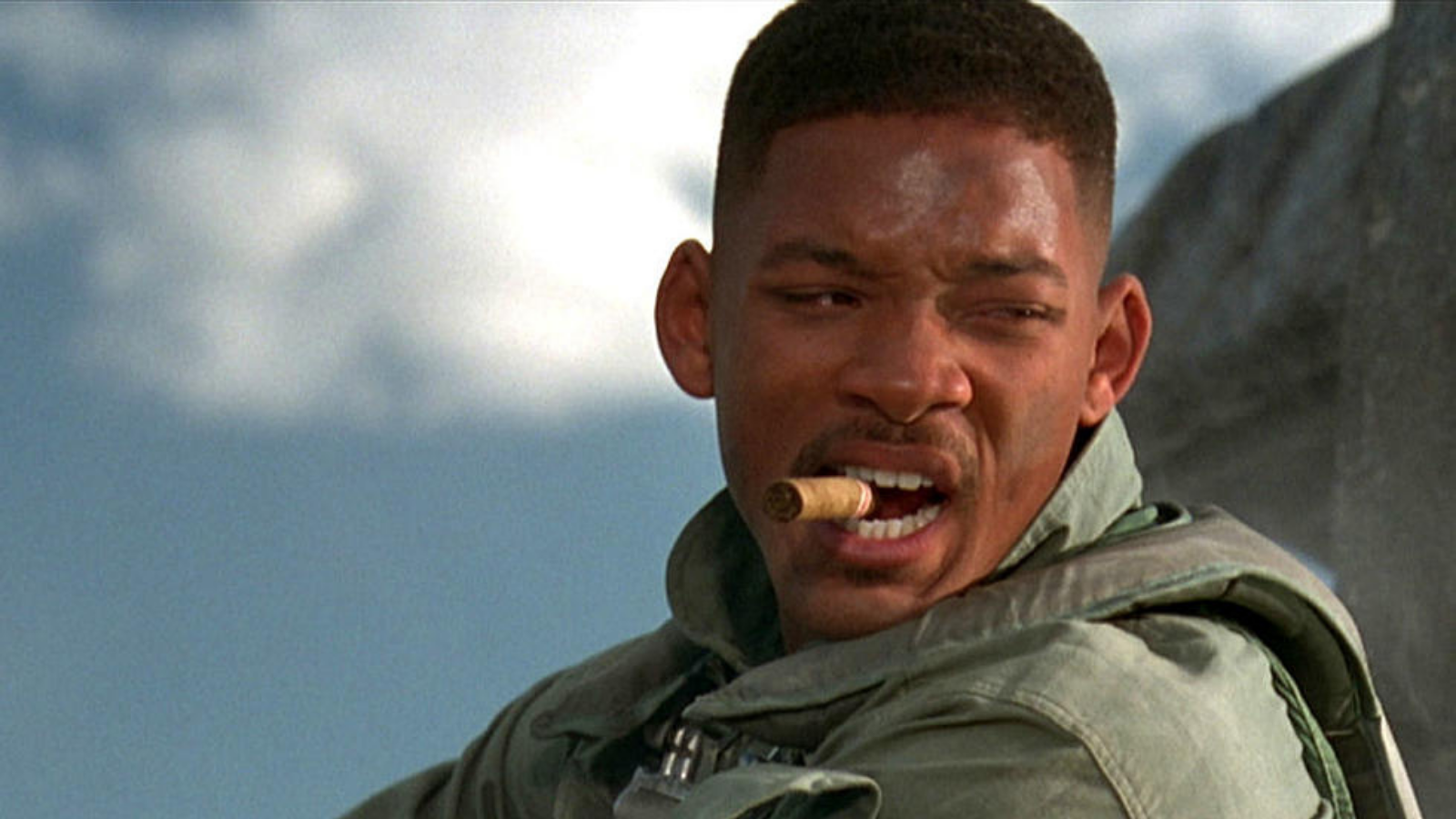
We cheered Will Smith when he chased South Floridian drug dealers while his uptight White boss admonished him to play by the rules. We cheered at Independence Day when he punched an actual alien rightin its face tentacles (“Welcome to Earth!” he shouted! Is there any cooler phrase to yell at an alien?). And we cheered somehow even more loudly when, in a whole different alien movie, he put on sunglasses and a sharp suit and reminded an identically dressed Tommy Lee Jones that the difference between them was that “he [Smith] makes this look good.” We’d cheer and then walk outside into the Montana dusk, huddling next to the payphone in our board shorts and oversized tees, waiting for our parents to pick us up. We weren’t stupid. We knew Will Smith wasn’t really our best friend. But we weren’t seeking a relationship. All we needed was ninety minutes of competently delivered wish fulfillment. The hands down coolest guy in the movie? The Black guy with the well-toned but still non-threatening abs and the PG-13 one-liners? He smiled at us.
We had no idea how hard Will Smith was working for our adulation. We didn’t know that, during his star-making career as a rapper, he made a distinct choice to abstain from curse words and to solely rap about safe-for-youth-group topics like girls (they’re nothing but trouble), parents (they don’t understand) and summertime (the absolute best, especially for unwinding). We didn’t know the fastidiousness with which he chose parts that would make him, a Black man, the biggest movie star in the world. He had to be tough but never scary. He almost always played cops and soldiers, but never in a stodgy uniform. He’d crack wise and drive his cars fast, but always stand up for the rule of law. He’d talk like how we imagined Black people talked (the birth of the distinctly Smithian “oh HELL naw”), but crucially he’d say it directly to us, the fraternity of the suddenly knowing, a megawatt movie star grin on his face.
There were always White people in Will Smith movies. Often, they’d be on his team– co-stars, allies, old friends. They were never cool, though. They were either too loud and corny, like his fighter pilot buddy in Independence Day, or too old and stodgy, like Jones, his Men in Black foil. White people would occasionally help Will Smith save the day, but usually only by doing something boring on a computer. The White sidekicks were never our favorite characters, but we needed them. Will Smith made the suit look good. Tommy Lee Jones didn’t. Which means that we, too, wouldn’t have made the suit look good, but that distinction didn’t matter. We didn’t have to like the sidekick. He could be a safe vessel for our own projected insecurities, because in the end what was most important was that he (and therefore we) still got to hang with the Black guy.
A decade after hooks’ hopeful treatise on how my generation of White progressive youth might break the cycle of non-liberatory consumption of Blackness, another essay, Bill Yousman’s essay, “Blackophilia and Blackphobia,”offered a sober but predictable analysis of how well we succeeded in practice. No, the revolution was never televised. Of course it wasn’t. In the decades during which I came of age, White Americans consumed increasing amounts of Black culture – on TV, in movies and especially in music, as hip hop became the dominant soundtrack to American teenage life. We were buying what was being sold to us, but we weren’t subverting anything in the process.
We were buying what was being sold to us, but we weren’t subverting anything in the process.
Contrasting millennial consumption of Black art to the crowds that cheered for the racist minstrel shows of the Jim Crow era, Yousman arguedthat my teenage peers and I were still engaged in a performance, this one designed “to contain [our] fears and animosities toward Blacks through rituals not of ridicule, as in previous eras, but of adoration.” The same story, essentially, just updated for a new ear. Per Yousman, our consumption of a particular version of Blackness was still “a manifestation of White supremacy, albeit a White supremacy that is in crisis and disarray, rife with confusion and contradiction.”
The version of myself that cheered on Will Smith between mouthfuls of popcorn and fountain pop would have vehemently denied participating in a “manifestation of White supremacy,” but catch me at the right moment and I would have admitted confusion and contradiction. One of the many truisms in twenty-first century anti-racist discourse is that White people “love Black culture but not Black people.” It’s a statement that has always struck me as being both accurate and incomplete. White people tell ourselves we love Black people, but our general pattern of interaction reveals that our professed love isn’t strong enough for us to actually challenge America’s racial hierarchies. I’d offer, though, that refrain is incomplete without an addendum, one most famously repeated by Toni Morrison in a series of late-career interviews. Of course White people aren’t capable of loving Black people, Morrison argued, how could we if we hated ourselves so much.
I left Montana in 1999 for a liberal arts college in the Midwest, the kind of school that promised kids like me, children of hippie parents, a safe haven for our pristine political opinions and angst about the state of the world. Like a good liberal arts college snob, I didn’t get out to the multiplex all that frequently in those days. Instead I’d huddle with buddies in a dorm room around a cult VHS movie. Office Space, Mike Judge’s send-up of corporate America, was on heavy rotation. We loved the opening credits scene, where one of the uncool White office drones is stuck in traffic, aggressively rapping along to a hard-edged Geto Boys song before seeing an actual Black person, a genial man selling flowers in the median. The White rap fan immediately turns down his music and locks his door, his face temporarily flush with shame and fear. As soon as the flower vendor passes him by, the White man’s bravado returns. The White commuter and the Black rapper shout in unison again… “I’ve got this killer up inside of me…”
We’d rewind that scene over and over, just losing it at that corny, overcompensating White guy on screen. What a geek, we’d assure ourselves, pleased once again that we got it. The joke only worked, though, if not for layers of shared recognition and truths unspoken. Ours was not a post-racial America. There was something about our position as White people in that non-post-racial America that still filled us with guilt and shame. We knew enough to not admit it out loud, but we still associated Black people, especially Black men, with danger and misanthropy. We didn’t have the language to wrestle with that, let alone any clue about how to subvert it, though, so all we had left were punchlines about aesthetics. Oh man, White people were sooooo lame. We were soooo uncool. We couldn’t dance. We couldn’t rap. We couldn’t punch the alien. But we could admit it, at least. That was the only subversion asked of us. We could nod knowingly at jokes about how we were a bunch of corny ass honkeys, how we didn’t have rhythm, how we couldn’t handle flavor in our food. And then we’d graduate and take our rightful places in socioeconomic pecking orders and the circles would remain unbroken. What were we if we weren’t cool? Smart, confident, worthy of positions of authority.
In the decades after I graduated college, everything and nothing changed, many times over. Will Smith stopped being the coolest movie star on the planet. He traded his big, brash matinee idol roles for quieter, more self-consciously grown-up ones, just as I left aside the simultaneous stridency and frivolity of liberal arts college life for buzzword-filled nonprofit office jobs. Both of us became doting, uncool middle-aged dads. Some years, his movies would attract more attention and win awards, other years they wouldn’t. He rode the waves of fandom.
Meanwhile, my generation of progressive White people went through our own waves. We’d oscillate between fleeting moments of racial awareness and longer stretches of resigned myopia. We patted ourselves on the back for electing the first Black President and dutifully pursed our lips when yet another cop. We learned the rituals of periodic racial reckoning. Just as we once went to the multiplex for a Black friend who could assure us that he loved us, we were now just as eager to show that we could conspicuously consume Black art that told it like it is. By the time the summer of 2020 came around, we had learned to show off that we had read Between the World and Me and watched The 13th and that we still loved Kendrick and Beyonce but now because of their roles as truth tellers rather than party starters.
Ours was not a post-racial America.
In our better moments, some of that conspicuous reading and watching and listening may have brought some of us closer to bell hooks’ dream for us. Perhaps we were actually trying to connect, rather than just seek our own absolution through content. Perhaps we were interested in learning somebody else’s story rather than merely crafting a story about ourselves. Perhaps we dreamed more of collective liberation rather than the quickest path to make our own racialized discomfort disappear.
What I do know is that, in aggregate, we’ve proven ourselves far more skilled at performing racial reckonings than making racial progress, that a year after the summer of 2020 there was a backlash and then a general weariness about all that “woke nonsense.” And then, in 2022, Will Smith – one of Hollywood’s most impeccable cultivators of public image – let his guard down for a minute. He slapped Chris Rock at the Oscars, right on our TV screens. It wasn’t the kind of thing that our Black best friend did. It was the kind of behavior that confirmed stereotypes, which is to say that it was the kind of behavior that White liberals didn’t like watching, lest it reveal we still held those stereotypes. It was a mess.
Sometimes when you’re stuck, you move forward. Far more often, though, you slink backwards, into something more comfortable. Will Smith can never be young again. He will never be the coolest guy in Hollywood. He can never take away the slap. But he knows what his audience – or at least, his White audience – will always need from him. We want that smile. We want those one-liners. We want those fast cars, but only when they’re driven to protect us. We want the promise in the “oh hell nah.”
When I sat down in that Swedish cineplex a month ago, I expected to be more interested in watching the Swedes experience Bad Boys than in the film itself. Who would win in the battle between Scandinavian silence and American spectacle? Either way, I assumed, a sight to behold.
But then Will Smith weaved his sports car through Miami traffic, parked on a dime and stepped out like he’d just tamed a bucking bronco. He tossed off a couple lines that weren’t technically “oh hell naw” but hit the same pleasure centers. And sure, he looked decades removed from his early twenties, and sure I had now published a whole book wrestling with my own Whiteness. I still laughed like a banshee. I still pumped my fist. And I still let myself daydream that I was the sidekick in the back seat, that I had personally arrived in the promised land, that racial reconciliation and reparations required nothing more than the contract in a movie idol’s wink at the camera.
“You get it, right? You love me, your Black friend. Of course you do. That’s why you’re one of the good ones.”
My career as a criminal didn’t last long. I’m not proud about it (that I was a criminal at all, not the brevity and ineptitude of my reign).
But in high school, I stole CDs and records. That was my thing. Here’s what I would do:
I would take the meager bankroll I’d earned from summer jobs to the record store. I’d browse the dollar bins for used records and CDs until I found something halfway decent. Then I’d meander to the more expensive used shit, discreetly liberate disc or vinyl from sleeve, and stick it into the dollar packaging. This ruse worked longer than it should have, and I came away with some real gems, The Pharcyde’s Labcabincalifornia and a rare bootleg instrumental pressing of The Roots’ Illadelph Halflife, to name a couple.
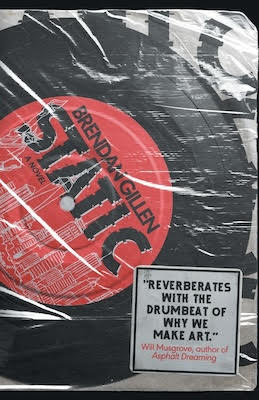
In my adult years, memories of my criminal idiocy has lingered in my subconscious like a splinter, festering and oozing into my fiction. My debut novel, Static, centers on a young NYC band, a trio in the mold of The xx or Portishead, trying to make it amidst the anxiety of the digital age. Paul, the protagonist and producer/beatmaker of the crew, not only steals valuable records to pay off his debts, but he steals (some might say samples) the voices in his life to make the music he’s sure will save his soul.
Perhaps it’s no surprise then, that a handful of my favorite books deal with stealing in some capacity, or at the very least, getting the things you want by taking them from others. Below are eight of them, all of which I wholeheartedly recommend.
Paradais by Fernanda Melchor; translated by Sophie Hughes
A novel of propulsive, sharp-edged anger from Mexican novelist, Fernanda Melchor, Paradais is told from the perspective of Polo, a teenage gardener for the wealthy gated community that gives the novel its name. Polo strikes up a co-dependent friendship with Franco, a spoiled, porn-addicted boy who lives in the community and obsesses about losing his virginity. In exchange for Polo’s companionship, and a reluctant ear for Franco’s violent, sexual fantasies centering on his neighbor, Señora Marián, Franco buys Polo booze, and eventually lures him into a demonic plot to take what he wants by violent force. I am in awe of the voice work and momentum of this novel and hardly a week goes by that I don’t think about it. Melchor’s novel trains an unflinching eye on the misogyny, violence, and precarity of her country’s social fabric.
No secret by now that NYRB does God’s work in reissuing lost classics and underappreciated works in translation. Without the press, Elliott Chaze’s hard-boiled crime noir, Black Wings Has My Angel, might have been lost to the smoking ashtray of history. Chaze’s novel follows escaped convict Tim Sunblade, who had been imprisoned for stealing cars. After a few months working on an oil rig, he settles into a Louisiana motel and hires a high-priced call girl, Virginia, a whip-smart femme fatale who quickly proves herself to be his match. As we hurtle toward the explosive conclusion, Tim and Virginia attract and repel each other like magnets of love/hate chaos, and enter a plot to rob an armored truck together. What happens when the person you want is wrong for you, and the things you want to take might kill you? Elliott Chaze knows.
An overlooked page-turner in Denis Johnson’s catalogue, lost amidst the brilliance of Jesus’ Son and Train Dreamsand Largesse of the Sea Maiden. Nobody Move is a slim, tightly-coiled heist noir, perhaps the wise-cracking grandchild of Black Wings Has My Angel. Jimmy Luntz is our knuckleheaded protagonist here, a gambling addict, inept criminal, and member of a zero-talent barbershop quartet. Luntz is in debt for a few large to Juarez, a violent gang leader who sends his hit man, Ernest “Gambol” Gambolini, out to bump him off. If that all sounds cartoonish, a sort of literary Dick Tracy comic, that’s because it is. And Johnson pulls it off, complete with all of the crime noir archetypes: the bummy loser with a good heart, the femme fatale, the ham-fisted thugs, the blue-streak dialogue, the bullets. In Johnson’s hands, this is more than a crime genre pastiche: it’s a loving ode to noir novels and a reminder of why we return to them time and time again.
By now, sampling, the production technique at the heart of much hip hop and electronic music, is a widely-accepted, laudable artform. But this wasn’t always the case. In hip hop’s infancy, critics (often white), lamented sampling as lazy charlatanism at best, stealing at worst. But scores of producers—DJ Premier, Pete Rock, Havoc, and Q-Tip, to name a personal Mount Rushmore—have proven that sampling is a beautiful recontextualization of source material, an act of love and homage that yields something fresh and unexpected.
To many, J Dilla is the Apex Sampler (his name pops up more than once in Static as the paragon of the craft). His MPC is in the Smithsonian. Dan Charnas’ meticulously researched, moving tribute to J Dilla, Dilla Time, is yet another brick in the monument to Dilla’s greatness. Dilla Time argues that with J Dilla’s off-kilter sampling techniques and ear for rhythm, he created a new musical time-feel, an accomplishment that places him on par with other musical pioneers like Louis Armstrong, Miles Davis, James Brown, and others. Whether or not you love hip hop more broadly, or J Dilla specifically, this book is more than a biography. It’s a touchstone.
It’s right there in the title. Breaking & Entering. Or so you would think. Ostensibly, this book is about a married pair of drifters—Liberty and Willie—who break into the unoccupied beach homes of wealthy families on the Gulf Coast of Florida to escape their meager lives and experience the finer things, their slice of the American Dream. They drink the owners’ booze, wear their clothes, sleep in their beds, and when danger starts to peek around the corner, they move on.
But like all of Joy Williams’ best work, the novel is difficult to categorize; masterfully off-kilter, unsettling, and beguiling, surreal surfaces hinting at a rotten, Lynchian core. Liberty and Willie have been lovers since they were teens, but as they drift around the palm-studded landscape, they begin to drift apart, and to this reader, the heart of the novel is loneliness and desolation. This is a novel about taking the life you wish you had and then realizing that it’s as cold as death without comfort and companionship. Or, as the softies among us (raises hand) might call it, love.
Gnarly cover. Great book. Like many of the iconic Vintage Contemporaries paperbacks that the cover art nods to, Jon Lindsey’s novel is off-beat, darkly funny, and by turns grimly difficult to stomach. Leland, a drug addicted burnout who has recently lost his mother to suicide, is our guide. His best friend, “FF” is a fellow addict and Lucha Libre wrestler. His aunt is 15-year-old Jolene, a fact which provides clues to Leland’s dark and rotted family tree. When Jolene, who also has a taste for drugs, experiences kidney failure, Leland hatches a plan to kidnap his own estranged daughter (you see, to finance his drug habit, Leland donates his sperm) to harvest the life-saving kidney. What ensues is a twisted odyssey through a sun-cracked Los Angeles that Lindsey clearly knows a thing or two about. Lindsey is a phenomenal writer who wraps all that trauma in a big, aching heart. Body High shows us what happens when taking the things you want unlocks parts of you that perhaps you wish you never knew were there.
Teenager is much more than a road trip novel. In some ways, it’s the adolescent cousin of Breaking & Entering. Trade a married couple and beach home B&E for a pair of Bonnie and Clyde-esque teen lovers and a healthy dose of grand theft auto, and you’re in the right area code.
Seventeen-year-old Kody Rawlee Green and his girlfriend Tella Carticelli, who he calls Teal Cartwheels, are the stars of the show. Within the first few pages, Kody escapes from juvenile detention, murders Teal’s parents to save her from abuse, steals a car and peels off with the love of his life in the passenger seat. From there, we’re off on a surreal journey across America following two teens whose trauma has forced them to grow up much too fast.
Teenager is about what it means to be an adolescent in all of its aching, yearning, idiocy and explosiveness. It’s about what happens when your heart writes checks that your brain can’t cash. The voice is unexpected, funny, full of pathos in every sentence. If you’re looking for plausible plot and hyper-real characters, look elsewhere. But if you’re looking for the truth about what it means to be young and wild and free and in love? Look no further.
This collection of ten stories from fellow Vine Leaves Press author Sara Hosey centers beautifully, relatably flawed characters. Young women who, through fits and starts and fuck-ups, seek to find their place in the world. There’s an awkward young academic who falls for a Henry David Thoreau impersonator. There’s a pair of tweens who, in a simulation of what they perceive as womanhood, tip a babysitting adventure over the line into an accidental kidnapping. In the title story, two women are in love with the same scuzzy video store clerk. When the protagonist, Sue, learns that her boyfriend, Matt, has been cheating, she plots to foil his plan to rob the video store where he works. In the process, she forms an unexpected bond with the woman who forms the third leg of the love triangle and embarks on a path to confront her own demons. It’s a vivid, original story, and I can see the short film in my head. Like many of the books on this list, the story reminds us that when we get what we want by taking it from others, we often get way more than we bargain for.
The summer after eighth grade in 2012, I began working at a mental hospital at the very top of a very tall hill in San Francisco. I had gotten the job—the internship—because my mother was, at the time, a patient of a doctor who practiced there. Being a good doctor, or specifically, being a good psychiatrist, requires a curious and rare balance of empathy and detachment, a balance this doctor did not possess.
Case in point: when your patient—in the grips of a particularly psychotic bout of mania—mentions that her daughter has no plans for the summer and an interest in psychology, it is in no one’s best interest to offer that daughter a position down the hall that you made up on the spot.
Now, from a safe distance, I say that I was terrified. In the moment, I was vengeful.
An emerging biological technique known as optogenetics sparked my psychiatric ambitions. I learned about this online while my mother was gone, which she was often between my seventh and tenth grade: a brief, self-contained, and still inexplicable period when her brain revolted against her. “Bipolar” is the closest word we have for what went wrong and the one that has dogged her since, a handful of years overriding a lifetime of general sanity. She was gone to hospitals, of course, but also to her own self-appointed missions. Mania doesn’t change a person as much as we pretend it does. It merely arms the individual with the belief that they can actually achieve everything they set their mind to, and worse, that they should.
The dreams that my mother’s amplified mind revealed were strange, tender, and ambitious. She embarked on a mission to change every street sign in the city to a font that (she presumed) would be more legible for dyslexics like herself, and me. She wanted to write poems and did. She had always wanted me to eat more—I was a skinny kid with a precocious interest in carbs and thigh gaps—but now she felt empowered to make me, leaving urgent notes in my lunch box and presenting me with afterschool PSA videos featuring dead girls with articulated ribs. She embarked on numerous missions to bring various politicians to power, good men and real people, who spoke to her and her alone through street signs, jewelry, and television static.
For the first time in her own eyes, my mother was a very important woman. Prior to her mania, she had only been very important to me. Now, from a safe distance, I say that I was terrified. In the moment, I was vengeful.
One night, after coming home to find half my closet missing and my mother nowhere to be found—the former a casualty of one of her spirited cleaning purges, the latter anyone’s guess—I sat with wet hair in the dull glow of the family computer. I typed: bipolar cure into the Google search bar.I typed: bipolar cure, experimental. I typed: electroshock therapy. My fingers hovered over the bruised keys until, finally, I asked the internet for what I really wanted. I typed: mind control— the cursor beat once, twice — scientific.
From Ed Boyden, an optogeneticist from MIT with a treasure-trove of well-animated YouTube videos, I learned that optogenetics involves harvesting genes from single-celled green algae and inserting them into mammalian neurons—usually in mice, which are small, cheap, and easy to abuse. All mammals’ brains run on electricity; this algae’s gene produces proteins that produce electricity in response to light. Scientists with transition lens glasses and TED Talks have figured out how to infect neurons with genetic codes that are not their own. These men have even figured out how to selectively deliver the light-converting gene to specific types of neurons responsible for specific types of thought patterns, behaviors, diseases, and desires. Shining blue light on brain cells infected with this green algae will release an electrical signal, mirroring a natural neural firing. With the flash of a laser and the flip of a switch, the mind bends to electrical submission.
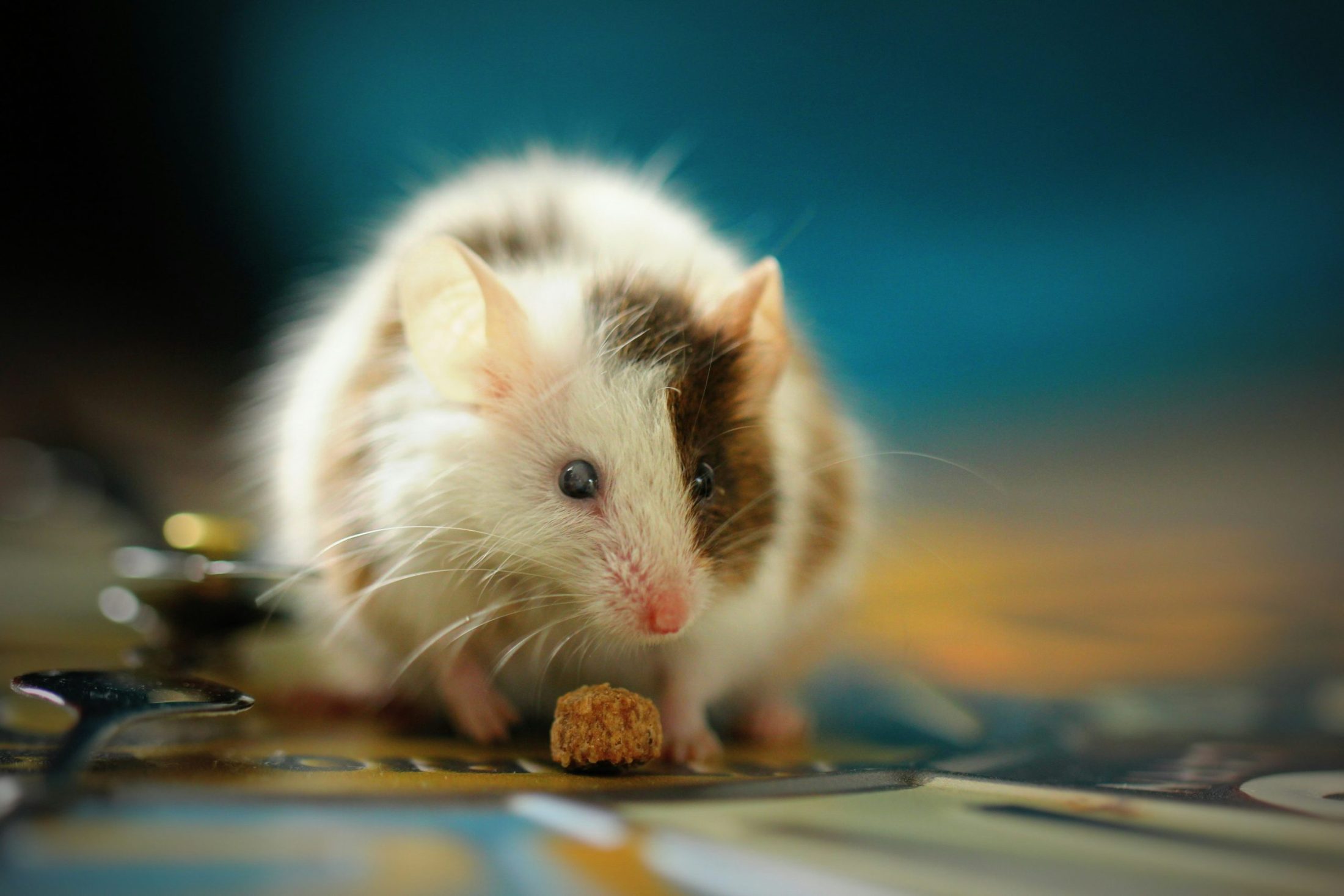
On YouTube, I watched mesmerized as mice, with tendrils of flashing fiberoptic cables growing out of furry skulls, went abruptly violent and hungry. Under the pulsing glow, the “free moving mammals” would suddenly attack other mice, attack inanimate objects, try to kill what is not alive and eat what is not food. They would forget fears they learned through pain. They would, if uninterrupted, eat themselves to death.
But when the blue-lit helmet extinguished, the mouse would drop the gnawed bottle cap or scurry away from the bowl of protein pellets and become a mouse again: sniffing and prodding according to the currents of its own genetics.
The miracle of optogenetics, the potential it offered for mothers like mine, was precise control. My internet neuroscientists spoke of the human brain as a possession, rather than the basis, of the self. I loved them for it. In their eyes, we are not victim to the whims and maladies of a rogue piece of gray meat— we are proprietors of a skull-bound computer, one that can be programmed to best suit our interests.
I watched Ed Boyden pace back and forth in his YouTube box, speaking with genuine pathos about the billions of people suffering from brain disorders: schizophrenia, Alzheimer’s, depression, addiction. While medication has offered some relief to those who tend to their damaged neural property, it merely alleviates the symptoms, leaving the defective hardware untouched. Electrical stimulation—implants and shock treatments—is the psychiatric equivalent to trying to type with oven mitts, slamming whole brain regions to get at a single misbehaving species of neuron, a single key. With optogenetics, we are finally learning how to hunt-and-peck. Control, control, control, Boyden promised, reciting the word with all the intimacy and faith of catechism.
I heard the garage door groan and my mother’s footsteps on the stairs. She flipped on the hallway light. I shut down the desktop.
My work at the hospital did not involve implanting fiberoptic cables into mouse skulls and illuminating mutated neurons to determine how those neurons impacted behavior. It involved sitting in a windowless, nine-by-nine-foot room that used to be padded and watching Mean Girls to determinehow long it took to watch Mean Girls. The doctor wanted to use the film for an outpatient educational program on post-traumatic growth and wished to know how long it would take the patient-students to watch.
“Couldn’t you just look up the run time?” I asked.
“The runtime doesn’t account for how long the movie takes to watch.” Like if you need to use the bathroom or get a glass of water or if you can’t get your TV to switch to HDMI mode or the sound isn’t working or Lindsey Lohan is talking in Mandarin or something.
So I watched the film on the ancient hospital computer with my iPhone timer running and, when it came out even with the official runtime, added fifteen minutes and sent my findings to the doctor who thanked me profusely and told me to poke around Google and read about psychological studies that I found interesting. The position was unpaid.
By my second week, the doctor began populating the intern “office” with an unsteady stream of underoccupied youths and semi-youths. There was Paul, a recent high school graduate with scampering eyes and vampiric skin. There was Max, a shy teen from the suburbs, and deeper into the summer, Natasha, a thirty-something recovering addict who was beautiful in a fully-realized-woman way that both thrilled and repulsed me.
Then there was Taylor. Taylor who always had wet hair. Taylor who had not been newly hired, but merely relocated to the unpadded room from some other fluorescent gutter of the institution, who had lurked around the hospital for years before my arrival making coffee and copies, not an official intern but a ghost of bureaucratic limbo: a family friend of the doctor, I assumed, or another child of a patient— perhaps a patient himself—for whom hospital staff scrounged up odd jobs and made allowances.
Taylor who had the square jaw and concave cheeks of a mountain lion but none of the bulk: sharp bones under a lanky frame—hungry. Taylor with his dirty blonde hair and an Adam’s apple that let you know when he swallowed. Taylor, who had grown up alongside the teenaged sons of other rich expats in Japan, spinning exhales of marijuana into tornados on their black granite countertops and posting the videos on YouTube. Taylor, who would show us the videos. Taylor who called himself twenty-five but who might have been older, the type of stalled man who was forever outraged at time for continuing to cleave him further from the golden boy he no longer was but still privately idolized. Taylor, whose body spray filled the nine-by-nine-foot room, its astringent imitation of pine tangling in the crowded air with the smell of his mother’s expensive laundry detergent, the smell of his sweat and shampoo—a smell I can still conjure now, older than he was then. Taylor, who would teach me, at fourteen, what it meant to own a body.
We took lunch in the hospital food court on Parnassus. While my motley, rotating, cohort of unpaid interns ate Italian BMTs I gorged myself on optogenetic factoids, with an orange opaque Jamba Juice straw in my mouth, sucking the same sip of Mango-a-Go-Go up and down, unswallowing, until lunch was over and my smoothie was a melted sludge of saliva and sugar.
I had starved myself, casually and intermittently, throughout my childhood, but a few weeks before starting work at the mental hospital—with high school waxing, my prepubescent metabolism waning, and my body rapidly growing—I made the decision to cultivate my hunger into a proper disorder. I stood, naked in June, before my parents’ full-length mirror and ran a diagnostic assessment. I wanted to be popular my freshman year, which meant that I had to be beautiful which meant I had to be, in some way, exceptional. I had brown hair that my mother called chestnut, adored, and forbade me from dyeing the buttery blonde of Wiley Wadsworth, who sat at the back of the school bus, each day, on a different eighth-grade boy’s lap. According to a Seventeen magazine quiz, my body type was “carrot.” Though I spent evenings feverishly humping the air under the tutelage of Kardashian-assed blogilates instructors, dousing my chest in stimulating tea tree oil, and feasting on Luna Bars (rumored to contain enough soy-based estrogen to turn me into a tweenaged Jessica Rabbit), I was making no marked progress towards “peanut.” Surgery was not an option as my body was not yet legally mine. Thinness was the only path to physical extremity within my jurisdiction. I wanted to make myself small enough that strangers would look at the space between my thighs with fear and desire. I wanted to make myself small enough to be seen.
Online, there were plenty of guides: The ABC (Anorexia BootCamp) diet provided a fifty-day calendar and daily calorie limit, ranging from zero to eight hundred. The Celery Diet was a diet of only celery. The Rainbow Diet assigned colors to days of the week. You were to only eat foods that shared a color with the day: peeled apples for lunch on Monday (white), a banana for breakfast on Tuesday (yellow), a quartered orange on Thursday (self-explanatory), a half cup of strawberries and a bell pepper for dinner on Friday (red) and a weekend of green beans and blueberries. Wednesdays were fast days. You could, in theory, eat any food as long as it matched the assigned color of the day.
I remember how Taylor told me the first day we met that I looked ‘legal.’
Between cracks in my iPhone screen and over the food court din of nurse clogs and iced beverages, I learned that the scientists were not content with their blue-lit algae-infused, electrically-operated mouse brains. They wanted a whole spectrum of influence. And they had found it— in the soda lakes of Egypt and Kenya, in the brackish ponds that gnaw at the rind of San Francisco’s Bay, in the human digestive system: various species of Archaea, salt hungry, single-celled, and responsive to new colors. While blue light could turn on neurons, these Archaean genes, sliced and fed into foreign brains, could, under strobes of green and yellow, turn neurons off. The scientists were thrilled. I was thrilled with them. We no longer had to guess at the function of vast swaths of the mind by waiting for strokes or impalements. We could silence individual neurons ourselves. With these targeted, systemic deprivations, the brain became suddenly visible, suddenly captive.
I remember how Taylor told me the first day we met that I looked “legal,” though I can’t imagine he used that word until later, until we were friends.
And we were friends. Shortly after the doctor shuffled him into the intern office and instructed him to shake hands with me and the other interns, Taylor had an idea. The doctor had left, and the four of us veteran interns had relaxed back into our numb scrolling of Psychology Today. ButTaylor, who had brought his own Macbook, pounded a metronome with the spacebar, bored. When this elicited no response, he snapped his laptop shut, clambered up from the ground (there weren’t enough chairs for all of us at once) and began unpinning the detritus from the office corkboard: a three-year-old pizza receipt with the subtotal circled thrice in red, glossy brochures on self-harm and bulimia, a handwritten note defining the emergency loudspeaker codes (code gray for patient “elopement,” code yellow for bomb threat and so on), expired coupons. He told us to fill the board with caricature drawings of each other, doling out cheap pens and printer paper.
Natasha drew Paul as a block head balanced on a penguin suit, while I drew her in the porny style of Bratz dolls, with feline eyes and puffed lips. And Taylor drew me: his eyes washing over my form, crook by crook. Every so often, he would glance up from his paper and meet my gaze before flashing back down to his work, grinning privately as he rubbed with the pink nub of his eraser— disappearing a body I hadn’t had the chance, yet, to see.
The rest of us had already tacked each other to the board and embarked on a collective BuzzFeed personality quiz when Taylor finally dropped his pencil to the desk. I looked up at the sound of wood on plastic.
“Let me see!”
“No,” he told me grinning, “this one’s for me.”
He folded the drawing carefully, smaller than it needed to be, and slid it into his pants pocket.
Midway through the summer, the blur of alien energy that had taken up residence in my mother’s familiar body suddenly went still. While manic, she had seemed to feel the whole world belonged to her, was her responsibility. I would wake up to find the contents of my school bag rearranged according to her organizational preference, every inch of the attic scrubbed at predawn, my bathroom papered with dozens of copies of newly printed “house rules” and duct tape. She confided in strangers. She confided secrets that were not her own. She was borderless. She owned the house. Then, the house owned her. My mother’s room became a tomb, door closed, shades drawn.
Taylor wasn’t the first adult to notice my disordered eating, but he was the first person whose noticing I coveted.
A hideous relief washed over me, knowing that she was still and contained—that my life was once again mine. I no longer bothered to rub mayo over a clean plate, rumple a new paper towel, and leave evidence of a meal uneaten in her kitchen sink. I did not trouble myself with cooking up stories of crispy Japanese crepes purchased and consumed on my way back from the bus stop, quesadillas wet with fat and devoured in the early evening with friends she had never heard of, friends, I told her, I had made at work. In my mother’s chemical absence, I indulged in unmediated starvation. And I texted Taylor.
To Taylor, I was dangerous; he told me so. It was dangerous how old I looked, how cute I was, how thin I was getting. It was a good thing I didn’t know how to flirt, otherwise, I would be too dangerous. Actually, he might have said, “too powerful,” but to me, danger was power and power was control and I was starving for it.
Taylor wasn’t the first adult to notice my disordered eating, but he was the first person whose noticing I coveted. Prior to meeting him, I had understood my systematized hunger as an ugly, necessary route towards beauty. Reflected in his pupils, the route itself became beautiful. My skipped lunches captured his attention, made him call me pretty and plead. I would wake up and fall asleep to my phone buzzing with concern—promise me you’ll eat dinner 2nite?—his attention turning himself into a savior and me into something worth saving. His eyes, caught on my clavicle, were huge, anxious, and aroused.
I began to see the outline of lessons that I came to learn later, through age and repetition: that deprivation could be its own type of extraordinary. That self-destruction could turn a girl into a spectacle. That some men will always want a spectacle more than a woman.
I knew he was dangerous too. When he texted me: come over on weekends, I texted: no. I texted: u could be a cereal killer lol. I met him in public.
After blue, yellow, and green, my neuroscientists made a fresh discovery: red. A single artificial gene, a Frankenstein’s monster made from bits of over one hundred different species of algae, can force mice to submit to crimson light. Red has the longest wavelength on the visible spectrum; it can penetrate skin, fat, bone, and blood better than any other color. So well, in fact, that it can pass through an intact skull, free of fiberoptic cables. Researchers at Columbia filled a tube with a mutated mouse and a red glow, turning off and on its neurons with external LEDs. They proved that they could arouse the brain and amplify behaviors from the outside.
On weekends, I spent hours in these internet rabbit holes with my phone on my lap, willing an incoming text for which my answer was always, automatically yes: u free?
Getting ready to see Taylor, to be seen by Taylor, took hours. I preened before the mirror, shaved my legs even when I planned to wear jeans, avoided water for fear of bloating. In some ways, I was constantly getting ready for him. I conjured his camo-green eyes as I jogged through the Presidio each evening, my vision going staticky at the edges with dizziness and exertion. I imagined his mouth around the words, “you’ve lost more weight” as I sucked on an ice cube for breakfast. I imagined him waiting four years for me, us getting married on my eighteenth birthday, me wearing white and meaning it.
We hung out mostly on playgrounds. He smoked and told me he would kill me if I ever started, that I would gain back whatever weight they might help me lose but I would never gain back my healthy lungs or my mind, unpossessed by craving.
Once, as we sat on a moored swing set, my toe digging a whirlpool into the woodchips, he told me plainly and without preamble that he knew I was insecure about my boobs. I don’t know how he knew this. I knew I had never mentioned them to him or anyone else. But he told me not to worry, “you’ll be grateful for them when you’re older and everyone else is saggy.”
I turned crimson, I’m sure, but I also swelled with an ambivalent awe. How had he penetrated so deep into the pink folds of my brain without my permission? How had he seen so much of my body through my clothes?
My mother abandoned her missions, but she did not abandon me. Though she rarely had the energy to feed herself, she kept our fridge stocked with pudding cups and Newman’s Own lemonade—treats that I begged for in childhood and would toss, expired and unopened when she was out of sight, resting off a grocery store visit that left her trembling with anxiety and depleted for days. As my body shrank, her terror grew—compounded, no doubt, by her own powerlessness and my frightful will. She missed birthday parties and funerals of people she loved, but kept monthly appointments for me to be weighed at my pediatrician and pursued expert referrals. If she had been a different mother, I might have put up a fight, but she had so little fight left to give that it didn’t seem worth it.
In late July, my mother picked me up from Eleanor James’ slumber birthday party and drove me to the mental hospital on the very top of a very tall hill. We entered through a door I didn’t enter through for work, a whole separate building. Still, I was scared I might see the doctor. Still, I hoped Taylor would see me.
A peppy nurse made me step on the scale backward—“we’re taking blind weight today”—and answer a series of questions with gloating lies. No, I had never stuck my fingers down my throat, counted my calories, felt out of control when I ate. What’s a laxative? Why would I want to make myself poop? My mother cradled her forehead. I was having fun.
“I know I’m thin,” I explained, eyes widened in faux confusion, “but I’m growing fast. I’m sure my body will catch up soon.”
“Do you think you’re beautiful?”
The question felt irrelevant, subjective, Hallmark-ian, and cruel. I looked at my mother for help. She was looking at the Styrofoam paneled ceiling, unseeing, her neck slack as a shot swan. She was sick and looked it: gray-skinned and mournfully thin.
“No,” I told the nurse, “I do not think I am beautiful. But that is not the same thing as thinking I am fat.”
I had meant it as a slap, directed, generally, at my mirror of a mother—insulting her appearance and undermining her perception of my disorder in one stroke. It cut my own ears with an unnoticed shard of truth. The nurse checked my answer as a box, but I couldn’t see which one.
After Ed Boyden finished his TED Talk, “A Light Switch for Neurons,” a taller, older man rose from the audience to the spotlight. He had the same Caucasian-colored microphone floating on a wire before his face, so I assume he was an official part of the production. “Some of this stuff is a little dense,” he told the crowd he had just separated himself from. The crowd laughed.
The man heard Ed Boyden explain that we could now control the brain in two colors, blue for on, yellow for off. (The presentation took place in 2011; we hadn’t yet made it to red). This makes every impulse going through the brain a binary code, is that correct? That is correct, Boyden nodded. Blue light is a one, yellow light is more or less a zero.
“And in theory, that means that everything a mouse feels, smells, hears, touches—you can model it out as a string of ones and zeros.” Sure. We are hoping to use this as a way of testing what neural codes drive which behaviors, thoughts, and feelings and use that to understand more about the brain.
“Does that mean that someday you could download memories and maybe upload them?” Well, that’s something we’re starting to work on very hard. We’re in the process of tiling the brain with recording elements so we can record the information and compute what the brain needs, augmenting its information processing.
The man thanked the scientist. The crowd cheered again. The lights dimmed. In the dark of the auditorium, neurons crackled, yet unpossessed.
Every time I watch this video, I am struck by the articles: the brain, not our brain. Augmenting its information, not ourselves. Every time, I think of a snake eating its tail and what’s left, behind and full, after the meal is complete.
A week before I started high school, Taylor and I took a walk. I wore a waffle-knit Hollister t-shirt—so thin, tight, and gray you could see the rattle of my sternum with each inhale. We met at Alta Plaza Park, in the belly of a play structure. Taylor asked if I had told any of my friends about him. I told him no. He nodded and called me smart. It felt different than when he called me beautiful, but it also felt the same.
We walked down the hill of Pacific Avenue, past the mansions, towards the Bay. He brought me to an ice cream shop and watched me molest my cuticles bloody as we waited in line.
He asked me,please. He told me to do it for him.
I recognized something that I would come to know in the boys that followed, although I did not yet recognize that there would be boys to follow him. I recognized that giving people who wanted you things that they wanted and you didn’t gave you a strange, precise, and incomplete control. I ordered the dessert.
I ordered a medium. I did not order a sorbet. I got something with uncooked pastries and fudge swirled in it. I asked for additional chocolate chips and one spoon. He came after me, ordering nothing and paying. We left together, under the trilling customer bell and into the fog. We walked until we could not walk any further, until land gave way to sea and we sat, our legs dangling off the wharf, his hand on my back. I stirred my ice cream to soup and wondered what my spine felt like from the outside. I stirred more.
Soon, his hand had crept under the back of my shirt—skin against skin but still low enough to be safe. Soon, my hands were sticky and brown. I’m not totally sure how I made such a mess. I felt like a child, a loose toddler at a birthday party. I felt fat, dumb, insane, and innocent in a way that was a long way from sexy. Taylor noticed immediately and peeled off his sweater.
“Here, you can wipe them on this,” he held out the white cashmere. I had never worn cashmere, but I knew the word. I had never seen anything that looked so soft.
“I’m not going to wipe chocolate on your sweater,” I giggled. He did not giggle. He insisted.
“Don’t be stubborn. Wipe your hands.” I tried to imagine what it would feel like to reach into those downy folds, still warm from his body, and pull the fabric over each of my ice-creamed fingers until I was clean, and it was ruined.
“No,” I said, firmer. He laughed and grabbed my wrist. I jolted to my feet and pulled myself free of his grasp. He looked up at me, standing taller than him for the first time. His smile froze, then melted.
I walked alone back up the wharf and down onto the shore, balancing on rows of algae-mossed rocks struck through with miscellaneous poles of rusted steel. They reminded me of unbrushed teeth under braces, a mouth in ruins. I reached the water and submerged my fists. The bay was shocking, but I kept my hands under until all the chocolate had lapped out to sea. Then I returned to Taylor.
He had lit a cigarette and did not turn to face me when I sat back beside him. Finally, he told me he was cold, he was going home, I should come with him. For a few blocks, I did, trailing him back up the mammoth hill we had just descended. But I stopped before I went too far. I told him that I had forgotten an appointment. I walked back the way I had come. Watching the sea expand, I became aware of how chilled I was and weak I felt; walking was work for me then. When I was sure I was out of Taylor’ sight, I called my mom. She answered. She drove me home.
*Note: Names in this essay have been changed to maintain privacy.
Taiwan is having a moment these days: in the headlines, in the culinary landscape, in the history books, and in our global literary imagination. Gone are the days (we hope) of mistaking Taiwan for Thailand, or automatically responding, “Oh, do you mean China?” No, we mean Taiwan!
Taiwan is a beautiful island whose identity has been co-opted, contested, appropriated, re-appropriated, and re-defined since the days of the Dutch traders dubbing it Ilha Formosa in the 1600s. Now, it is a self-sufficient, democratic nation with free elections and the leading manufacturer of the world’s semiconductors—yet still, Taiwan remains dwarfed by threats from China, with questions about its nationhood and future, and contentions about ethnicity, history, and memory.
A number of recent books by Taiwanese women and Taiwanese American women highlight questions of identity, hybridity, legacy, boundary crossing, remembering, and how to celebrate and preserve a culture that has been marginalized for centuries and primarily defined by others.
This resonates for me personally, since my memoirWhere Every Ghost Has a Namerecounts an important lost chapter in Taiwanese history: the Taiwanese Independence Movement led by grandfather, Thomas (Wen-yi) Liao. More than just a historical account, however, the book also excavates my search for family, truth, and belonging, and the tension between what can be known and what has been forever lost and erased. I’m honored for my book to join the ranks of works on Taiwan with the company of authors below.
Below are some wonderful fictional and nonfictional reads, along with a few forthcoming books to keep an eye out for!
This compelling memoir-in-essays tackles feeling like an outsider, forced migration, belonging, and most prominently, the language barriers that build walls around us, separating Taiwanese Americans from family, culture, understanding, and fluent navigation through different spaces. There is a longing and wistfulness in Prasad’s writing, as well as a wry ironic appreciation of some of the absurdities during her misadventures and revelations traveling back through Taiwan as an adult. I was gripped by the tension—in her first moments in Taiwan, Prasad faces expulsion back to the U.S. due to an expired passport—as well as the compassionate humanity of moments when Prasad connects with her family, island of origin, and identity, especially through language. One of the most compelling instances of this is through obtaining the perfect chop of her Mandarin name from a former schoolmate of her father’s older sister, which serves as a talisman of identity for Prasad and also adorns the cover of her book.
This contemporary novel delves into a troubling and violent period in Taiwanese history that was dramatic, captivating, and suspenseful—not pedantic. It illuminates one man’s experience being imprisoned on Green Island, and its rippling effects over the next 50 years on his family members in both Taiwan and America, shining an important light on the White Terror period in Taiwan. Over four decades, more than 20,000 political prisoners were incarcerated on this tiny island off the east coast of Taiwan, so Ryan’s novel evokes the haunting legacy of these sentences, and shows their reverberations in Berkeley, California, several decades later.
This novel in dual perspectives was a pleasurable and even craveable read–I devoured it. Reminiscent in some ways of Hua Hsu’sStay True, Ho explores the ambivalent identities of two Taiwanese American friends growing up in Los Angeles, delving into questions of identity, queerness, boundary crossing, family secrets, and what it means to be Taiwanese and Taiwanese American.
In this beautifully written, searing, lyrical novel, Tsai embarks on a retelling of Frankenstein from the perspective of biracial, queer female scientists in the American south. From the first page, questions of identity, queerness, and the corporeal state of bodies come to the fore, as do questions of family, legacy, and parentage. Tsai interrogates what it means to be biracial, Taiwanese, and how one might redefine gender, as well as questions of creation and what happens when ambition or the desire to escape one’s origins goes too far.
How did the Taiwanese Kuomintang (KMT) government spy on pro-independence activists in America? Why through student spies who they paid to be informants, of course! This meticulously researched work of history relies heavily on oral history to cut through propaganda, hearsay, and supposition to get to the truth of how totalitarian governments exert control through manipulation of information and misinformation. In so doing, Cheng reveals an important portrait of a previously overlooked generation in Taiwanese and Taiwanese American history, and spins a captivating true-life tale of the difficulties many Taiwanese student migrants encountered on university campuses between the 1960s-1980s.
While Made in Taiwan is ostensibly a cookbook, it is so much more than that: really, it’s a culinary adventure through culture and history, focusing on Taiwan’s unique cultural and global role through an exploration of the origins of its cuisine. Wei is a beautiful writer and thoughtful journalist, and her essays pair perfectly with recipes that strive for authenticity as they depict the unique and often subtle flavors of Taiwanese cuisine.
Reading this collection, I could tell Chang was a poet. Her stories pulse with imagery, surreal magic, strange haunting lyrical moments, and flirt with the uncanny and unsettling emotions that all of us foster. For example, in her story, “The Chorus of Dead Cousins,” we feel the greedy mouths of hungry ghosts who permeate the life of the main character, taking on a monstrous life beyond the corporeal, swallowing her up in a tornado. In all of her prose, characters become larger than life, haunting each other and casting long shadows of legacy and trauma, while narrative drama becomes symbolic imagery, prompting us to consider how the banal can become mystical and mythic.
In this tender and lyrical historical novel, we open on a snapshot of life in Taiwan as a Japanese colony during World War II, and move through Taiwanese history through the eyes of a third son in a Taiwanese family, Saburo, who witnesses the retrocession of the country to China, as well as the disenchantment of Taiwanese people with the exploitative KMT Chinese Government, the 2/28 Incident and aftermath that precipitated martial law, and the White Terror period in Taiwan. Through this story, based in part on the coming of age stories of Wu’s parents, we see the obstacles faced by someone in this generation of Taiwanese immigrants coming to America for education and a brighter future, but constrained by the ghosts and shackles of family, history, and loyalty to cultural values. It’s a book that tackles a little known era of Taiwanese history, and does so with compelling drama and poignant, vivid writing.
This award-winning novel published in 1994 by Qui Miaojin, a prominent queer voice in Taiwanese literature, was translated into English in 2017, offering American audiences access to this truly unique voice of a generation. Qiu narrates the first-person novel through diary entries, short scenes and vignettes, with a compelling, addictive voice not unlike that of Dostoyevsky’s Notes from Underground or Salinger’s Catcher in the Rye. The narrator, Lazi, has just enrolled in college and finds herself consumed with longing for her female friend—the kind of longing that can animate whole months or years when you are young, and these emotions are all consuming. This one line sums up that joyful anguish: “It was a clandestine form of dating–the kind where the person you’re going out with doesn’t know it’s a date.” Ultimately, this book is a gem, and captures a particular moment of actualizing queer identities in the Taiwanese community in the late 20th century. The real tragedy is that Qiu took her own life in 1995 (just after completing Last Words from Montmartre), so we’ll never know what else she might have written about our contemporary world now.
This is a sweeping, generations spanning novel, from former Taiwan Fulbright Fellow Karissa Chen, that traces the lives of lovers separated by war and diaspora—recounting the flight of many from mainland China to Taiwan during the Chinese Communist Revolution and the causes of this migration eventually landing in the United States.
The novel Taiwan Travelogue won Taiwan’s Golden Tripod Award in 2021. Framed as a rediscovered historical text from a Japanese traveler, the book explores forbidden queer love and the impact of colonialism through culinary adventures in pre-WWII Japanese-occupied Taiwan.
It’s Saturday, which means Greg and I are house hunting. We’ve done this every weekend for the past four years and it’s a miracle we’ve lasted this long. Of the other couples we know, only a few have managed to get an offer on the table; fewer have had them accepted. The rest—those who are still together—have decided no house is worth the physical and emotional toll the buying process takes. We were ready to give up, too, but then our dream house came on the market, so we’re giving it one last shot.
We’re dressed in our best house-hunting attire: smart khakis and crisp button-downs, comfortable sneakers and Kevlar vests—something that says “serious homebuyer” while also keeping us safe. Once, all you needed was an offer over asking and a thoughtful letter to the seller. Now you need good reflexes and great aim.
New places hit the market on Thursdays, so on Fridays we pick a few we’re interested in and study the photos and digital walkthroughs so we know what to expect—the size of the bathrooms and state of the kitchen, best rooms to attack from and places to hide.
Today, we’re only viewing the dream house: a blue Victorian on Magazine Street that’s been in same family for a century. The most recent owners, a childless couple in their sixties, died trying to get a winter condo in Florida. Lucky us. We’ve been renting a one-bedroom around the corner for eight years and often stop to peek through the hedges imagining walk-in closets, his-and-hers sinks, an office for each of us and space for children, should we decide to have them. Once, we spotted the couple on the front porch sipping dark cocktails from crystal glasses and wondered if they’d ever had to work for anything, feeling, even then, we deserved their home more than they did.
I like to get to these things early so I can feel out the competition, but Greg forgot to iron his shirt last night and made us late leaving the apartment. Now we’re walking up that same porch with less than five minutes to spare, and I’m trying not to be annoyed. But when I push through the front door and see the height of the ceilings—the listing didn’t do them justice—all is forgiven. I grab Greg’s hand and squeeze it three times. This. Is. It.
We enter the living room, still hand-in-hand. There are twenty-odd people gathered in front of a bay window where, every December, we see a glowing Christmas tree from the street. The realtor, a middle-aged blonde in a white linen suit—bold choice—welcomes us with a smile and glass of prosecco and tells us to sign in, select a weapon, let her know if we have any questions. She means about the house, but one woman, who’s holding a lance like it’s a walking stick asks how, exactly, it all works, and the seasoned among us cringe. First-timer, surely. Doubtful she’ll make it out of the room before she’s eliminated.
The realtor explains: Tour at your leisure; only target people inside the house; those still standing at the end of the hour will have the opportunity to make an offer. And keep it civil, she says.
I’ve missed out on the crossbow, my usual weapon of choice, so I go for the stave sling while Greg grabs a club, then we step back to sip our drinks and take stock of our competitors. Most are couples like us: mid-thirties professionals; the kind of people, under different circumstances, we might invite over for drinks. Then there’s a sweet-looking older gentleman, a redheaded woman we’ve seen before, and a couple in camouflage I rule out immediately. Even if they make it to the end, it’s unlikely the estate managers will accept their offer. Their attire does not scream, “We care about maintaining the historical integrity of the property.”
A clock strikes noon, and the open house begins. While the others hesitate, Greg and I seize the opportunity to slip away from the crowd and up the stairs. Primary bedroom, first door on the left. It’s as big as our current living room and kitchen combined, with parquet flooring, built-in wardrobes, and a four-poster bed we hope comes with the house. In the corner, there’s a window seat where Greg says he expects to find me every morning. I take the uncracked copy of Don Quixote from the bedside table and pose on the yellow cushion. Greg snaps a picture and hands me the phone. This house is your perfect lighting, he says, and we laugh.
We’re admiring the chrome fixtures in the adjoining bathroom when we hear the first scream. I run back to the window to see a dozen people fleeing the house, the last of them bleeding from his head. You can always count on half the prospective homebuyers to give up at the first sight of blood. Greg darts to the bedroom doorway and I crouch behind him, gripping my weapon in both hands, the stone in its sling bouncing against my back.
There’s a creak on the stairs, the flash of a camouflage arm. Greg takes the man out at the knees; I nail the woman in the right shoulder. They tumble down the stairs and I run after to check for a pulse—we never kill—and am satisfied they’ll recover for the next open house.
End of the hall, the library. Greg narrowly misses a swinging battle axe and takes out the redhead. She joins five others bleeding into the plush carpet—maroon, thank God. The room smells of polished oak, metal, and must, and has floor-to-ceiling cabinets stacked with leather-bound books. I run my fingers along the spines imagining nightcaps by the fire, sex on the desk.
At the sound of a tightening bowstring, I whip around to see the tip of an arrow slide between the door and the frame, and launch a stone just as Greg raises his club, knocking my arm. The stone sails past the door, hitting the bookcase to the right of it. I wince as glass shatters and falls to the floor. When I look up again, the archer is gone and the arrow is resting at my feet. I inhale deeply, trying to forgive, again, Greg’s wrinkled shirt, our late arrival, getting stuck with a weapon I don’t know how to use.
Two doors down, the dining room. Here, we find the realtor lying on a velvet chaise lounge with a spike in her calf, red blooming on her white suit. We ask her if she’s okay, then how many are left. Not sure, she groans, but the person who did this won’t be buying a house anytime soon. My money’s on the first-timer. Anyone else would know to use extra caution around realtors, who are there only to answer questions and prevent people from stealing. I note the size of the table we’ll need, thank the realtor, and leave.
We always save the kitchen, our favorite room in any house, for last. Here, it’s the central room, the heart of the home. Though renovated two years ago, it hasn’t lost its late-1800s charm. The floor is original checkerboard terra cotta, and a wide chimney serves as the backsplash to a polished brass La Cornue oven. There are arrows stuck in the solid oak cabinets, dents in the Subzero fridge. A shame, really, but you can’t buy a house these days without expecting to do a little work.
The only other people in the room are heaped at the base of an island, an arrow in each of their backs. It’s the woman with the lance and her partner, who made it further than I thought they would. Greg scans the room, gives a thumbs-up. All clear. Quietly, I test the weight of the cupboard doors, feel the gentle pull of soft-close drawers, take a hanging copper pot from its hook and see that it’s never been used. I wonder if we could negotiate those into the price, offer an extra thousand for the pots, the knives, the bone-white place settings.
I’m inspecting a second oven—Thermador—when I see movement in its glass door, hear an oomph, and turn to see Greg drop to the floor, his shirt still perfectly crisp. An arrow that should have been mine to shoot flies from a butler pantry and hits me in the left breast. I feel the blunt edge of Carrera marble split my head open as I fall back.
It’s over, I think, but then Greg’s face appears, haloed by a Tiffany chandelier. He’s taken off his shirt and ripped it in two. He ties one half around my head and the other around his thigh. We’re so close, he whispers, pointing to the time on the Thermador—12:58. He props me up against the island.
In darker moments, when it’s felt like we’d be renters forever, I’ve tried to visualize getting the house, like my therapist taught me. I’ve pictured receiving the call that our offer was accepted, the realtor handing us a set of keys, me and Greg walking through the front door of our new home for the very first time. What I’ve never dared picture is what it would actually take to own.
Now, I’m watching it all unfold in the reflection of the oven door: the older gentleman emerging from the pantry, crossbow raised in victory, a minute too soon. Greg leaping out from behind the island and clubbing him hard, again and again, until the clock strikes one and the realtor limps through the swinging door. She asks if we’re the only ones left. Greg, panting, nods. Makes my job easy, she says, slapping a thick stack of paperwork onto the island and sliding onto a stool. Greg sits beside her and signs his name everywhere she points.
The paramedics arrive. I hear their stretchers rumbling across the hardwood floors as I close my eyes. Already, the carnage of the last hour is fading, and the only thing I see is coffee brewing in the mornings, the Christmas dinners we’ll cook in here, the wine Greg will pour while we make his grandmother’s Bolognese—something tannic and ashy, dark red as blood seeping through terra cotta cracks.
Don’t die wondering, the old yellow button told me, but of course this only made me wonder more: Who wore this pin? Who made it? Who said it first? The pin is from the Lesbian Herstory Archives. There’s three of them, two yellow and one pink, all in big commanding capitals, no metadata provided to satisfy my curiosity. According to a book review on the Wellesley Centers for Women website, the phrase was originally “an old bar pick-up line.”
I anticipate I will die wondering, not if I’m a lesbian, but about everything else. Lately, I’ve been wondering about lesbian experiments. There’s the defining what-if—“what if I’m a lesbian?”—one of those questions that tends to answer itself in the asking. After that, there are more questions. Coming out creates a new, strange world; you can’t know it until you’re in it. It exists alongside the consensus reality of everyone else, your straight family and friends and teachers and coworkers and bosses and landlords, but sometimes you’ll describe your reality and they’ll look at you as if you’re speaking sideways.
Evidently this is not only true for lesbians. But then, the irresistible charge, DON’T DIE WONDERING, could apply to all sorts of things. It is at once general and specific. If you know you know, and if you’re wondering, you know.
Myriam Lacroix’s recently released debut, How It Works Out, conjures a world literally defined by what-ifs. What if the central couple, Myriam and Allison, found a baby in an alley? What if Myriam could only muster the will to live by eating Allison’s flesh? What if they were married lesbian celebrities who hated each other? What if Myriam was a praying mantis and Allison the dog who killed her? What if Myriam was Allison’s evil boss and Allison dominated her sexually?
There’s been a glut of media about multiple universes in the past five or so years, some of them queer. The reason seems obvious: people have been joking that we’re in “the darkest timeline” since at least 2011, when the Community episode “Remedial Chaos Theory” aired. It’s nice to think that somewhere out there, things are going better. Or, that when our world feels most fractured, repair is possible. That’s not the point of How It Works Out, which may not have a point, which may just be the point. How It Works Out is not linear, not directional, and not reparative. By posing and then pursuing these hypotheticals to their sometimes funny, often painful conclusions, Lacroix creates a set of parallel possibilities in an attempt to better know this relationship from the inside out.
She has locked something away, and in order to discover what happened, she must first live what did not.
Two other popular queer titles from the past five years have used similar constructs of parallel possibilities to similar ends-that-are-not-ends. Carmen Maria Machado’s memoir, In The Dream House, follows an abusive relationship Machado survived while completing her MFA. Machado uses a fragmented form in order to explore how domestic violence between queers has been left out or vanished from our collective history, the archive which defines what is thinkable or speakable. In order to speak on her experiences, Machado must “break them and reposition them and unravel them and remove their gears … to access their truths in a way [she] couldn’t before.” In Harrow the Ninth, from Tamsyn Muir’s bestselling Locked Tomb series, Harrow, the last necromancer of her House, has only three reasons to live: she must save her people, serve the Emperor, and figure out what exactly she doesn’t remember she doesn’t remember. She has locked something away, and in order to discover what happened, she must first live what did not. In these books, the what-if serves as a lesbian move—like a knight on a board—to uncover, as Machado writes, “something very large [that] is irrevocably missing.” In other words, they are wondering in order to not die wondering.
In another universe, How It Works Out was probably published as a collection of short stories, not a novel. (Indeed, several chapters were first published as short stories, sometimes using different names, universes upon universes: Leah and Sarah find the baby in the alley in Issue 35 of Blue Mesa Review; Jessica the dog eats the praying mantis in Litro Magazine.) How It Works Out does not move forward in any particular way; the universes do not collide; each chapter has its own discrete beginning, middle, and end; and the end is more of a beginning, anyway.
The novel proffers a few explanations for its shape. In the baby ‘verse, one of the few that works out happily, Myriam notes that,
“They were so in love it felt like living inside a dream, only some nights Myriam got nervous. She’d grown up with her single mom, moving every time her father made a new threat. She couldn’t turn love into a story that made sense, and would get into these existential spirals.”
How It Works Out could be read as one such existential spiral, dreamy yet catastrophic, staring up at the ceiling asking yourself what-if after what-if. In another chapter, the one where Myriam can’t stop eating Allison’s flesh, her thesis on trauma and the cycle of abuse might suggest to us that, like any trauma, the relationship is being “restaged repeatedly through bodily performances until it has been turned into a complete, coherent narrative.” Elsewhere, Allison discovers, but does not understand, that Myriam is writing the life they are living, the chapter we are reading. We are watching an iterative performance, the point of which often seems to be: what if I was terrible, awful, so bad, worse?
Like any existential spiral, so many what-ifs can lull you into abstraction, numb and meaningless. Allison the nihilist tells us that, “if there was a meaning to life, it’d be love.” This is a nice sentiment, but not very useful for what-ifs such as: what if I hurt you, what if you hurt me? If there are infinite universes, surely in some of them it’s one, and in some it’s the other. That’s more or less the mechanism of How It Works Out’s multiverse. Questions such as “what if I were a bug” and “what if you wanted to top” and “what if I hurt you” are levers of equal force pulled variably from ‘verse to ‘verse.
There are other theories about universes. In The Dream House moves more or less forward in the same narrative plane, the mode changing rather than the material, until the end of Part III. Then, a series of violent escalations shatters the narrative like a hydraulic press. We are in a new genre: Dream House as Choose Your Own Adventure®. Machado breaks one terrible morning into multiple potential paths. “If you apologize profusely, go to page 163,” she directs us, or, “If you tell her to wake you up next time your elbows touch her in your sleep, go to page 164.” Each choice makes a new universe—but each universe ends in the same place. Abuse turns choice into a trap you spring on yourself. There is only ever one way that In The Dream House works out.
Still, we try. The reader can “cheat,” as Machado puts it, flipping against the textual directions to “a page where [they] shouldn’t be.” The reader can attempt to refuse the cycle, tell the woman in the Dream House to calm down or do her own dishes, though they will be chastised: “Are you kidding? You’d never do this.” In other words, amidst the abuse, we are still empowered to imagine impossible what-ifs.
An impossible experiment is what Harrow Nonagesimus undertakes under the fracturing weight of her grief at the loss of her cavalier. She erases her history and rewrites her own brain to construct a wholly new universe built on a single what-if: what if Gideon Nav had not died at Canaan House, because Harrow never knew her at all? But the break isn’t clean. Harrow is seeing things that aren’t there, throwing up and passing out, she is haunted. In her memories, scenes from the first book play out differently, and Harrow’s friends and enemies ask her, “Is this really how it happens?”
Yes and no. It isn’t, and yet, it is inarguably happening. As one ghost tells her, much of Harrow the Ninth is “a play [Harrow is] directing.” It is a restaging, like one of Myriam’s. Playing out these alternatives is what unlocks the tomb in Harrow’s mind where she has hidden away her dead cavalier. As her own death looms, she triggers a new set of possibilities: what if Harrow were the cavalier and not the necromantic heir, what if the deadly competition in Canaan House was actually the Bachelor in space, what if she met a really hot barista, and to each of these questions the answer is Gideon.
“This isn’t how it happens,” a dead ally tells her each time, like Machado tells her reader, who has chosen an act of resistance that would have been impossible, “That’s not how it happened, but okay. We can pretend.” Yet it’s not a thought experiment, not a hallucination. Because if it didn’t happen, where did this scab come from, and why can’t you stop picking at it?
Formally speaking, if the what-if is a narrative move as well as a lesbian one, the move should be describable. How we arrive at parallel worlds should tell us something about how it works out. These books are as slippery as lesbians, moving not only between universes but between perspectives and identities. They are nesting dolls of narrators, not unreliable but unfixed, shifting and splitting from what-if to what-if. And these books are as hungry as lesbians, too. What’s gayer than wanting your lover inside of you?
These books are as slippery as lesbians, moving not only between universes but between perspectives and identities.
There’s some understandable concerns over who-eats-who and what-does-that-mean. Myriam’s stomach problems recur across universes; the only time she is truly satisfied is with Allison’s flesh in her mouth. Harrow has stomach problems of her own. In order to ascend to Lyctorhood, the highest power a necromancer can achieve, she was supposed to eat her cavalier’s soul, but she doesn’t seem to have done it right. And she is trapped in a system that consumes, mired in the endless violence of an Empire that cannot stop colonizing and expanding and killing in order to survive. Gideon and Harrow promised each other, “one flesh, one end,” which means something different than “my flesh, your end.” Is there a way we can eat each other equally? The question feels dated, the sort of thing lesbian feminists in the seventies might have thrown a conference about. In the universe where Myriam and Allison are minor gay celebrities, their first book together is titled How It Works Out: Building a Healthy Lesbian Relationship in the Patriarchy. This might be the universe where they hurt each other the most. Perhaps hunger is just a justification for possession. The woman in the Dream House fills her fridge with produce to let it rot; in a parable, Machado writes that she wants Carmen “nestled in [her] stomach for all eternity.”
But Carmen is hungry, too. The archival silence is an empty pit inside her. At the beginning of In The Dream House, she asks, “What is the topography of these holes [in the archive]? … How do we move toward wholeness?” Wholeness is just another word for fullness, which seems to me fundamentally impossible, but the hunger keeps us moving, never lets us forget that something is gone. Or, that something else is possible. Stuck in the loop of her own choices, chasing her own tail, Machado tells herself, “There’s a way out. Are you listening to me? You can’t forget when you wake up. You can’t—”
There’s a way out of the Dream House, there’s a way out of the silence. The final chapter of How It Works Out follows FF, face de fœtus, an actor, so called because of the watery, bloated, changeable quality of her features. When FF is cast as Myriam in the new TV show Love Bun, she has a series of erotic, unsettling encounters with the actress playing Allison which bring something secret to the surface. The role of Myriam is elusive, incomprehensible. Why does she want to eat her girlfriend? “It was hunger that moved her, that moved the story,” FF knows, and so she tries connecting with that hunger. When she touches her co-star, or herself, she finds herself “almost really remembering” the woods, laughing college boys, her father’s anger: “in the dark part of her brain, black bars were bubbling and lifting off of pages.” She wonders, what has been left out of this script? Of this book? What might she recover, and at what cost?
FF’s fetal face got me thinking about Lee Edelman’s theory about children and queers. In No Future: Queer Theory and the Death Drive, Edelman argues that “what about the children?”-type concerns are the foundation for white, straight society to reproduce itself. Any and everything can be justified, so long as it is for “the children” (notably, not actual children with real needs like safe housing, free from violence, et cetera). To do otherwise, to act against the interests of “the children,” is unthinkable. It is queer. The queer fails to be appropriately reproductive, so (s)he becomes the enemy of “the children”, a threat to “the children,” and to the future. As queers, Edelman argues, we have the radical possibility of asking, “If not this, what?” Or, in other words, how else could this work out?
There must be a world in which we do not have to be good, we do not have to walk on our knees.
If this seems unduly optimistic—after all, climate catastrophe means no future for real—don’t forget that Edelman first made this charge against the future in 1997, in the wake of the most fatal years of the AIDS crisis in America. The world is always ending somewhere, for someone. Edelman does not promise us some brighter, gayer future. A promised future draws a moral line: It requires “the stigmatization and exclusion (in other words, the queering) of those who put [the promised future] at risk.” There must be some other way to live, together and with ourselves. There must be a world in which we do not have to be good, we do not have to walk on our knees.
Perhaps it seems counterintuitive that all three of the books I’ve discussed are preoccupied with lineage, heredity, children. There are a lot of sons named Jonah in How It Works Out; Carmen and the woman in the Dream House talk about having a daughter, and at one point Carmen experiences symptoms of a hysterical pregnancy. Harrow is the last of her line, the only hope for the Ninth House’s future, and in order to ensure her conception, her parents killed every child on Drearburh. “I came into this world a necromancer at the expense of Drearburh’s future,” she tells her cavalier in Gideon the Ninth, “because there is no future without me.” Ultimately, she chooses no future over a future without Gideon—and creates something new, unimaginable and unforeseen.
What if, what if, what if each what-if is an act of creation, the lesbian creation that supplants and replaces and refuses birth, if by birth we mean heterosexual futures? I am riffing, I am wondering. These are lesbian experiments: questions that answer themselves in the asking, hypotheses that are functionally never hypothetical. What if we kissed just to see? There’s two outcomes in theory. It’s supposed to be possible for an experiment to reveal something isn’t true—but by acting on it, it becomes true. You can’t un-kiss or un-see. Potential energy (the thing that could happen) becomes kinetic energy (the thing that does) when an external force (lesbianism) is applied.
This is how it works out. You keep wondering, and then you die. But at least you died wondering. Because how else will you know? What if you fuck your ex? What if you fuck your gender? What if your face bursts open and there’s another face underneath that’s been waiting, hungry for love, but if not love, blood will do? What if you delete the worst thing that ever happened from your brain, until the day the worst version of you is ready to go to war for the you that couldn’t? What if you touch another woman and your skin peels off? What if you think about touching another woman and you might as well have, for how irreparably it changes you?
And the “unnamed thing, the shadow thing, the thing written between the lines of the book, the thing that tied everything together,” the thing you’ve been seeking all along—what if you find it? What if it’s you?
The Lebanese civil war was a series of conflicts that lasted from 1975 until 1990, claiming an estimated 150,000 lives. Although it assumed a sectarian face, there were a number of underlying causes, including economic and political inequality, a power-sharing structure that privileged Christian elites, and a widening rift between those who supported the Palestinian resistance in Lebanon and those who opposed it.
I was twelve years old when the war broke out, old enough to remember what it was like to be alive at the time. Beirut, where I lived, was divided between East and West Beirut, codes for predominantly Christian and Muslim Beirut, respectively. Living in East Beirut was like living inside a bubble, where people banded together and dissent was uncommon and mostly veiled. My parents rejected sectarianism, and I knew I was missing half the story.
My novel We Walked On is about the experience of living in wartime: the daily violence, the way in which war determines the course of each day, and the pockets of relative normalcy during the lulls when people try to rebuild their lives, only to watch them fall apart when the fighting resumes. I wanted to show the war’s devastating mental effects, how enmities grow and fear drives even seemingly decent people to commit acts of cruelty. Despite resisting the sectarianism that swept the country, 14-year-old Rita and her Arabic teacher, Hisham, who live in East Beirut, find themselves occasionally expressing their allegiance to the tribe: Rita betrays a friend, and Hisham pressures his brother to leave West Beirut, where he lives with his family. Both of these characters have ties that fall outside of the clan paradigm—Rita’s father grew up in Palestine, and Hisham’s brother joins the leftist militia—making them insiders/outsiders in their community and complicating their understanding of the exclusionary ideologies that fuel war.
The books featured below depict characters who cross lines and form affiliations across the divided city. While the majority take place during the war, Alameddine’s and Ghoussoub’s works are set after the war but remain shaped by it. Here are 8 books about the Lebanese civil war:
Sitt Marie-Rose by Etel Adnan; Translated by Georgina Kleege
Sitt Marie Rose is based on the real-life kidnapping, torture, and murder of Marie-Rose Boulos, a Christian Syrian-Lebanese woman who worked with Palestinian refugees. The novel, written in the first-person, describes her trial and execution. Etel Adnan’s titular protagonist crosses multiple lines. She defies her community by frequently traveling between Beirut’s Christian East and Muslim West. She lives in a Palestinian refugee camp in the West with her three children and her Palestinian lover, and runs a school for the deaf-mute in the East, where she is eventually kidnapped and killed for refusing to change her ways. Her insistent refusal to choose between two camps and give in to prescriptions of gender, class, and ethnicity is a heroic act of resistance that results in her tragic death.
Aaliya, Alameddine’s brilliant protagonist, is 72 years old and has been living alone in her Beirut apartment for years, ruminating about literature, her tumultuous past, and memories of the civil war. Once a bookshop manager, divorced, alienated from her family, prickly and erudite, she spends her time secretly translating beloved classics (War and Peace, Austerlitz…) into Arabic. Her estrangement from her family and voluntary seclusion in a society centered around community ties, her self-sufficiency and proud “spinsterhood” (she was briefly and unhappily married), her intellectual pursuits and rich and often hilarious inner world (she refers to her ex-husband as “the impotent insect”) make her an unconventional character who always strives to live by her own rules.
Hakawatis, Arabic for oral storytellers, are a dying breed in the Middle East. They typically perform in coffee houses, dragging their stories out over weeks or months, captivating their audiences and keeping them coming back for more. Various adjectives have been used to describe Alameddine’s novel: spellbinding, inventive, captivating, exuberant …. It’s prodigious, a riot of a book, and I’m a fan.
The year is 2003. Osama al-Kharrat returns from Los Angeles, where he has lived for years, to his native Lebanon to visit his dying father. The civil war has been over for years, but the city still bears its scars. Osama’s grandfather was a hakawati. The family name, al-Kharrat, translates to fibber, teller of tall tales, a fiction writer of sorts. Soon, Osama finds himself entertaining the family with his storytelling, twining stories within stories—djinns, demons, imps, the Crusaders, al-Mutannabi, Fatima, and myriad others. The Hakawati is a testament to the power of storytelling to entertain, distract from the difficult world, and bring the past back to life while freely embroidering and rewriting it. It might be a sly nod to fiction’s seductive powers and its ability to uncover truths that touch our hearts. The civil war lurks in the background, and the visible wounds it has left on the city, along with the father’s impending death, may be the impetus for the storytelling as a kind of reconstruction and balm. Alameddine’s hakawati, even as he references the war in his tales, situates it within a broader context, making it one of the many chapters in the history of a rich and vibrant Middle East.
The Tiller of Waters by Hoda Barakat; Translated by Marilyn Booth
Barakat’s novel about a lone man living in war-torn Beirut during the civil war is both an elegy to the city and a tribute to human endurance in the face of calamity. Niqula Mitri has lost both of his parents to death; his beloved Kurdish maid, Shamsa, has disappeared; and refugees now live in his Beirut apartment. He takes refuge in his father’s bombed-out fabric store, where he discovers that the whole inventory has miraculously survived intact in the basement. He forages for food in the ruins of the deserted city while dodging a pack of wild dogs and alternating between past and present, reality and delusion.Through his ramblings, he summons back the lost Shamsa (who intones, “Come back to me, and teach me velvet”), describes to her the science and history of textiles, and delves into Kurdish mythology, Arabic and Armenian civilizations, and more. Fabric represents the weaving of stories as a means of survival in a shattered world. Mitri’s wanderings across familiar landmarks of the bombed-out city are haunting and achingly beautiful for anyone who has known and loved Beirut.
In Hassan Daoud’s The Penguin’s Song, a family of three displaced by war spirals into decline. Forced to flee their home in embattled Beirut, they spend their days longing for their old life while struggling to find a meaningful anchor in their new one.The mother regularly leaves the apartment to wander around in frustration, the father stops working due to failing health, depleting their savings, and the twenty-one-year-old son, whose physical deformity causes him to walk like a penguin, narrates the family’s demise while pining for a young neighbor. The omission of proper names reduces the family members to near-anonymity, underlining their growing dehumanization. Their cramped new apartment reflects the war-torn world they inhabit, with ever-increasing walls and barriers erected in the name of kinship to the clan.Their only way out is to turn to their memories and fantasies, as losses pile up around them. Although the family lives in relative physical safety in their sheltered apartment, their mental state deteriorates rapidly. Daoud’s novel is a scathing critique of war, depicting it as an insidious sickness that causes devastating damage in its wake.
Multilingual, multi-talented (author, artist, and playwright), globetrotter, human rights activist, and co-founder of Saqi Books, Mai Ghoussoub, who died in 2007, eschewed boundaries. Her book is a creative blend of memoir, fiction, and personal reflections on war and its consequences.
The reflections are presented in the book as “letters” addressed to Mrs. Nomy, her childhood French teacher at the Lycee in Beirut. When Ghoussoub was twelve, she wrote an essay for Mrs. Nomy, using her best writing skills to express her wish to get even with friends who had wronged her. Instead of being impressed, Mrs. Nomy gave her a low grade and condemned her behavior, claiming that “revenge was the meanest of human sentiments.” Back in Beirut after a stay in Europe, the narrator in Ghoussoub’s nuanced book grapples with the problems facing post-war Beirut, focusing on the notion of revenge juxtaposed with the general amnesia that the Lebanese have readily adopted. What unfolds is a series of fascinating vignettes about real or imagined people from wartime Beirut that she uses to raise complex questions about the challenges of reconstruction, as well as the temptations of forgetting and avoiding the painful job of reckoning with the past.
“They called it Little Mountain. And we called it Little Mountain” begins Elias Khoury’s first-person short novel set around the outbreak of the Lebanese Civil War. But the mountain is not a mountain: “One hill, several hills, I no longer remember and no one remembers anymore.” This, combined with other examples of elusive narration, such as shifts in tense and pronouns, creates a destabilizing effect, accentuated by the repetitive, dreamlike style that loops and fractures across the pages. The novel begins with the narrator recalling his childhood in the “little mountain,” the Christian neighborhood of Ashrafiyya east of Beirut. Later chapters focus on the conversations and ramblings of fighters, before concluding with a sequence of disjointed memories in a Paris metro. Khoury’s use of repetition and fragmentation creates gaps in the narrative, allowing boundaries to dissolve and breaches to emerge. The novel’s fragmentary structure allows meaning to arise in the intervals between ideas, enabling a reality that is too fluid to be forced into the black-and-white imperatives of war.
Beirut Fragments: A War Memoir by Jean Said Makdisi
Makdisi was born in Jerusalem and grew up in Cairo before attending college in the United States. In 1972, she moved to Beirut with her Lebanese husband. Three years later, the civil war erupted. Her memoir offers an intimate account of those years, capturing the horrors of war and its impact on both personal lives and the fabric of the city. Makdisi vividly describes the challenges of raising a family and recreating life amidst relentless violence. Residing in Ras Beirut, a neighborhood in West Beirut known for its peaceful coexistence of people from different religions, she mourns the religious intolerance that consumed the country. However, she finds solace in the fact that some of West Beirut’s tolerance and diversity has managed to endure, even as it suffered a similar fate. One chapter delves into the devastating consequences of the 1982 Israeli invasion and the subsequent siege of West Beirut, resulting in the deaths and injuries of nearly 50,000 people. Through her memoir, Makdisi offers a valuable perspective on life during times of war, the resilience of human connections, and her unwavering love for a city that has persevered through the harshest of conditions.
Horror novels function as a way of controlling our fears and the unknown, transforming it into something tangible and… temporary. There’s something comforting about picking up a book, feeling terrified and setting it back down, the fear always contained in the pages.
During Covid, while some people turned to baking, I sought out Latina writers from across the Americas who are bringing on a new renaissance in dark thrillers in both familiar and innovative ways.
Inspired by these disturbing works, I ventured to write my own horror novel rooted in fashion: Tiny Threads.In the industrial city of Vernon California, Samara Martín will do anything to excel at her new job at the legendary House of Mota, including ignoring the increasingly disturbing apparitions “welcoming” her to her new home.
It’s an exciting time to be writing in this genre especially with these authors leading the way. There’s a no-holds-bar to the way they tackle capitalism, patriarchy, and the unrepentant violence of colonialism. It’s also the perfect time to read horror as the news keeps pouring in with increasing bleakness. These books can offer a relief from our current reality with a surprising, exorcism-like, quality. Instead of the usual suspects (the Stephen Kings and the Shirley Jacksons), expand your literary repertoire and read these scary and boundary-pushing works of terror by Latina writers around the world:
Hurricane Season by Fernanda Melchor, translated by Sophie Hughes
Longlisted for the National Book Award, Hurricane Season is a ruthlessly dark fairytale set in a poverty-ridden Mexican village with four unreliable narrators circling around a death. In the same school as Bolaños, Hurricane Season’s denseness is brutal, unforgiving, and full of rage, evoking the slow suffocation of each character.
Argentinian author Samanta Schweblin is a master in unsettling the reader. Fever Dream is an eco-horror novel set where a child and a dying woman are in a room exchanging stories of how they came to be. What first begins as a child’s game with strange rules shifts into a terrifying examination of corporations poisoning whole swathes of people.
The first Puerto Rican to win a Bram Stoker award, author Cynthia Pelayo sets her horror in Chicago with two sisters who are tied to their historic family home even in the midst of strange noises and apparitions. The novel is part procedural story and part good old fashioned ghost story with Pelayo enlisting the city to bring forth the terror front and center.
Debut Uruguayan novelist Fernanda Trías delves into a near-future where poisonous air has contaminated the world while a corporation serves gross pink food to those who can afford it. Navigating this ecological disaster is a woman tasked to take care of a child. Pink Slime shows what it looks like to be a caretaker at the end of days.
Mona: A Novelby Pola Oloixarac, translated by Adam Morris
If you want a novel that takes on the international book awards industry and spins it on its demonic head, then this is the novel for you. Writer Mona travels to Sweden for an award she’s nominated for and encounters surreal characters that become more and more disturbing all the while denying a dark secret hidden within her. Pola Oloixarac’s story gets weirder and darker with each chapter.
Jawbone by Monica Ojeda, translated by Sarah Booker
Ecuadorian writer Monica Ojeda novel incorporates terrifying youth driven pop culture horrors like creepypastas and the strange dynamic within childhood cliques. Set in an elite private school, best friends Fernanda and Annelise become increasingly more violent as their secret rituals take a life of its own. Are the privileged teenagers to blame for their brutality or is their mother-obsessed teacher Miss Clara who kidnaps one of them guilty?
Cannibalism you say? Why not! Argentinian author Agustina Bazterrica is not afraid to get gory in this dystopian novel. Similar to Pink Slime, Tender is the Flesh features a society in which a virus contaminates all meat and cannibalism is legal. Marco, a worker at a human slaughterhouse, questions his role when he becomes close to a specimen meant for consumption.
Electric Literature is pleased to reveal the cover of Awakened by A.E. Osworth, which will be published by Grand Central Publishing on April 29, 2025. You can pre-order your copy here.
A coven of trans witches battles an evil AI in the magical coming-of-middle-age romp about love, loss, drag shows, and late capitalism.
On a morning much like any other, 30-something queer Brooklynite Wilder makes the miraculous discovery: suddenly, as if by magic, they can understand every language in the world. Dazed and disconnected, Wilder is found and taken in by a small coven of trans witches who have all become Awakened with mystical powers of their own. Quibble, a handsome portal traveler, Artemis, the group’s caretaker and seer, and Mary Margaret, a smart-ass teen with telekinetic powers all work to make the cagey and suspicious Wilder feel comfortable, both within their group and with the knowledge that magic is, in fact, real.
Just as Wilder is finding their footing, a malicious AI threatens to dismantle the delicate balance of the coven and the world as they know it. Newly assembled and tenuously bound, the group scrambles to stay united as they parse the difference between difficult and dangerous, asking themselves continuously: is any consciousness—be it artificial, material, or magical—too dangerous to exist? Awakened is an exhilarating, hilarious and thought-provoking reflection on the ways that we are responsible for creating our own realities , a story of finding community, and a meditation on what it means to have a body (and if it might be far worse never to have had one at all).
Here is the cover, designed by Caitlin Sacks, Illustration by Andreea Dumuta:
Designer Caitlin Sacks: “Awakened is a wildly fun novel about a coven of trans witches who face off against an evil AI. Given the rich variety of themes and elements in this book, I aimed to incorporate as many symbolic icons as possible on the cover. The prominent eyes, for instance, carry a dual meaning. On one hand, they represent the idea of a ‘seer’—someone who possesses strong spiritual intuition. On the other hand, the eyes symbolize the ever-watchful AI, constantly monitoring the witches by infiltrating phones, cameras, and other electronic devices to gain power.
The color palette is inspired by the trans flag, with the pink and blue deliberately evoking a binary contrast. This choice was intentional, as the novel is fundamentally about rejecting that binary. I was particularly drawn to how every main character in this story, including the AI, is trans, and how the narrative beautifully highlights queer identities, the importance of community, and the feeling of connection.”
Author A.E. Osworth: “I squealed out loud in my office when I received this cover in three different colors. I ran door to door showing my colleagues—all of whom are authors, I work at University of British Columbia’s School of Creative Writing—because I was so amped up on the cover and I knew that they’d all cheer on my enthusiasm. And like—maybe I wasn’t supposed to do that and my editor is going to give me a stern talking to now that I’ve said it? I was just so excited. My closest creative friend, Nat Mesnard, once pointed out to me that in every single thing that I write, someone destroys a cell phone. When I saw a cracked cell screen front and center, it felt like the cover designer and the illustrator really got something, not just about Awakened, but about my body of work. About my simultaneous love of and criticism of the role of technology in our daily lives. Furthermore, the cover just felt—trans. Awakened is a trans book for trans people. Don’t get me wrong, everyone else can enjoy it too—it’s still going to be a fun book about magic no matter who you are. But when it comes to who I center as my audience, I center me and mine. The texture and bright colors feel akin to what I’m doing with the prose, who it’s for, what we like. I want a giant print of this cover on my wall and not just because I am proud of this book; I want one because this cover feels like it’s for me. And if you’re one of us (whatever ‘us’ means to you—trans, witch, a lover of magic and what it means to be a human)? I hope it feels like it’s for you, too.”
DON’T MISS OUT
Sign up for our newsletter to get submission announcements and stay on top of our best work.
YOUR INBOX IS LIT
Enjoy strange, diverting work from The Commuter on Mondays, absorbing fiction from Recommended Reading on Wednesdays, and a roundup of our best work of the week on Fridays. Personalize your subscription preferences here.