essays
What It Means to Be a Writing Teacher in the Age of School Shootings
The new vigilance
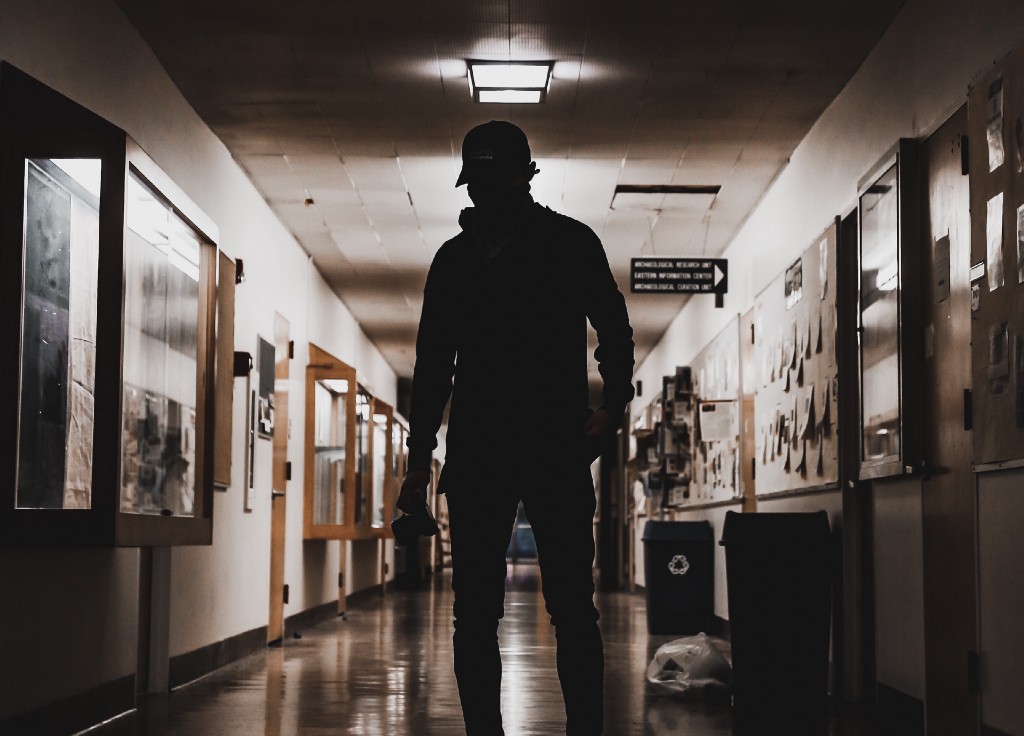
I’m teaching on a Monday morning when a young guy — distressed denim jacket, headphones — walks past our room. My students and I are seated around a long table, made of three tables pushed together. “Workshop-style,” we call it. It’s an introductory fiction writing course, held in an Art Education classroom — at the University of the Arts, it’s not uncommon for rooms to double as other things. This one has a sink and paper towel dispenser in one corner, and the walls are papered with second-graders’ self-portraits. The classroom is long and rectangular, tucked in the back corner of the tenth floor. On the wall facing the street stand four tall windows with heavy metallic blinds that rattle when it’s breezy. It’s a cold day, but the room is warm, so the windows are cracked. Even ten floors up, the sounds of downtown Philadelphia blow in from the street: impatient honking, throbbing bass, an ambulance’s long wail. The opposite wall faces the hallway. The top half is a window, through which anyone walking by is visible to us, and we to them.
When I arrive, my students are awake, engaged at ten in the morning. I love these students. I hear their chatter from down the hall. This morning, Jaymie is telling us she’s been experimenting with drawing freckles on her face — life hack, she says. Tyra is scraping the inside of a yogurt with a plastic spoon. I flick on the lights, leave the door propped open. Today we’re discussing Miyuki’s draft, which is quite good, and everyone is excited for her. They have taken careful, plentiful notes; their hands are in the air. The story features an unreliable narrator, and we talk about how details can reveal the character indirectly. The tabletop — Micki’s potato chips and feminist literature, Zoe’s giant water bottle — is cluttered in the way of a family’s shared dining room.
I nod, throwing out questions, listening hard to what they’re saying. I’m energized by their insights. To discuss fiction with students like these has been, for more than 20 years, one of the primary pleasures of my life. In my peripheral vision, I see movement, a person, in the hallway. Not unusual, a person in the hallway. Except that our classroom is in a back corner, and there’s very little traffic here. This person, a guy — kid? man? — is moving slowly. My eyes flick toward him: jacket, headphones, patchy beard. He pauses, chin down, and I feel something leap in my chest — a lousy description. We’ve talked in class about how to describe familiar feelings in original ways, but that’s what it is: a leap in the chest. I’m trying to focus on what Liz is saying, but my attention is diverted — I don’t believe my students notice him, or if they do, they’re not alarmed. Of course not. A teenager in a distressed jacket, scruff, headphones. A UArts student, almost certainly. Edgy-looking but probably, like so many UArts students, enormously sweet. He’s pausing because he’s late for class, adjusting his iPod or checking his phone. I watch out of the corner of my eye until he keeps going.
This is new, this vigilance. Or it’s vigilance of a different sort.
When I began teaching college, at the University of New Hampshire, I was 22 and getting my Master’s in writing. It was 1995. Email was relatively new. Flavored things — coffees, bagels — were trendy, popping up along the main street in Durham. Grunge was popular. Bill Clinton was President. The shooting at Columbine would occur three years later, in the spring.
Four months before, I had been a college student, a senior at Bowdoin. Now I was teaching college students. Each semester, as part of my graduate assistantship, I would teach one section of First Year Writing: English 401. I’d spent the entire summer preparing, reading the assigned anthology and tabbing pages, taking notes, drafting schedules — I had no idea, really, what I was doing. Assign a theme, my grandmother had suggested. She’d gone to school in a one-room schoolhouse in northern Maine.
My cousin Jimmy, in fourth grade, asked: What will you do if they ask you something and you don’t know the answer?
An innocent question, but it hit a nerve. I guess I’ll tell them I don’t know the answer, I said.
It was hard for me to believe I would be teaching actual students, which was surprising — or, perhaps, totally unsurprising — since I had been practicing to be a teacher all my life. As a child, I’d had an imaginary class. I stood at the chalkboard that hung in our living room, just to the right of the front door next to the record player, lecturing effusively to the empty room. In real life, I was very shy (I never spoke in class unless called on, not even in college) and beset with fears, both everyday and imagined — robbers, kidnappers, fires, nuclear war — around which I built elaborately detailed narratives in my head. In front of my imaginary class, though, I was confident, articulate and impassioned. I typed up alphabetical lists of my students. Ola Bass, Lester Cable, Cleo Cottsworth, Sidney Douse. I listed their daily activities, scheduled their parent-teacher conferences, assigned them instruments in the school band. Some of them I enrolled in an extracurricular called “Afterschool Adventure Course.” I instructed them to write essays, then wrote said essays, in different handwritings and at different ability levels, grading and commenting on them with a red felt-tip pen — Wonderful true-to-life account or, more often, Highly disappointing effort or Please see me. I was far more harsh than any teacher I’d encountered in real life; it was as if I was playing a part, similar to the brassy, fearless girls I wrote about in my short stories, embodying characters unlike myself.
Now, at 22, these students were real people. I recall staring at the roster of twenty-four names in disbelief. I bought a pale blue spiral binder — TEACHER’S PLAN BOOK — and penned their names neatly on the red lines. I debated what to wear on the first day. I would always dress up more than the other teachers — who, this being New Hampshire, wore mostly jeans and sweaters — but I felt the need to establish my authority. I was young, still shy. Each week was a series of hills and valleys. For the 24 hours that preceded every class — it met for an hour on M/W/F — I subjected myself to mounting, almost paralyzing nervousness. After class, a brief, exhausted reprieve. The next day, it started again.
In the classroom, I was somewhat able (at least, I think) to disguise my shyness. It helped that I came in with the day’s plan more or less memorized. I hadn’t learned yet that the best classes are often the ones that go off-script, allowing for interesting digressions, and wouldn’t have had the confidence yet to let that happen if I had. I knew I could write well and help my students write better. I was diligent and prepared. And I cared — I cared. Whatever I lacked in classroom presence, I believe I made up for in the intense attention I gave every student. I still have all my old teaching notebooks and am astonished by the pages upon pages I devoted to every one: notes on the students, their essays, our meetings about their essays. A wonder I was doing any writing of my own.
In 401, the emphasis was on writing from personal experience. Recreate a moment or experience from your life that was significant, went the instructions. Watch out: don’t just tack the meaning of the event onto the ending but try revising so that meaning is revealed. Naturally, such an assignment elicited deeply personal stories. Deaths of relatives. Near-fatal car accidents. Abortions. Addictions, friends with addictions. As I read those essays, then and for the next four years, I felt concern, and amazement, and also, I suspect, a touch of pride in their openness, even the gravity of their subjects, as if this somehow reflected well on me.
Looking back, there were things my students wrote about that — 22 years old, no prior teaching experience, relatively little life experience — I was not qualified to be dealing with. Often they were revealed explicitly: the students were telling me on purpose. This could be difficult, but was at least clear-cut. Other times, it was more complicated — the unreliable narrator, the accidental subtext, the truth that stormed suddenly, seemingly inadvertently, to the top. Like the essay about a father’s drinking that gradually revealed itself to be about the student’s drinking. By the end of the paper, my notes in the margins dwindled down to nothing. What a powerful piece, I wrote. I made a few suggestions but I had trouble treating this as just a writing assignment because I was — am — concerned.
“What a powerful piece,” I wrote. “I made a few suggestions but I had trouble treating this as just a writing assignment because I was — am — concerned.”
Or the essay about the eating disorder (there were many essays about eating disorders) that was alarming not only in its details but its note of forced resolution, of “meaning.” After our conference, in my notebook, I scribbled for two pages: The paper was difficult to discuss because I believe she is still quite ill. I asked her if she wanted a counseling number — she said no, she liked handling it on her own.
For all my worries, I only actually suggested counseling to students a handful of times. Maybe I was wary of overreacting, overstepping. Maybe therapy felt like a bigger deal to me then. Maybe it was my old shyness kicking in. When I did, I followed the advice we had been given: write down the phone number so they can turn to it later, prevent our conversation from evaporating as soon as they open my office door.
Those first years in New Hampshire were a crash course in teaching, but also in discovering that teaching is about much more than I understood when writing stern notes to my imaginary students: not just a responsibility to the material on the syllabus, but to everything else. Of course this is true for all teachers, but perhaps uniquely writing teachers, who read so much about their students’ lives.
In 2000, I moved back home to Philadelphia and began teaching at the University of the Arts and, in 2004, at the New School in New York. I was now teaching only fiction writing — which was, in some ways, simpler. We never assume fiction is autobiographical, I tell my students early in the semester, establishing the ground rules for our discussions. We refer to “the narrator,” not “you.” Fiction: let’s treat it as such.
But this doesn’t apply to me — how could it? Naturally, over the years, there have been stories that worried me. Or, if not the story itself, then the feeling of the story. The obsessive, digressive references to eating. The description of a murder that is, yes, somewhat cartoonish, but also overly elaborate, gruesome — gleeful. (Is this something? Is it nothing? Is it generational, the by-product of violent movies and video games?) Or the boyfriend character who hits the girlfriend character with no remorse, no seeming awareness that it is even wrong, and — here’s where it gets more complicated — not just awareness by the character but awareness by the story, by the student. (How to navigate these fine points? When to break the wall and step in?)
Rarely is it clear what to do. Fiction is subtle, half-invented, safe. A kind of pact. Usually, unless a story truly alarms me, I don’t address these things outright. I might make an observation in class about the profound sadness of the character, the moral ambiguity of what he does or doesn’t do. Submit a CARE report. Watch my student with a closer eye.
Usually, unless a story truly alarms me, I don’t address these things outright. I might make an observation in class about the profound sadness of the character, the moral ambiguity of what he does or doesn’t do.
Are there times I didn’t intervene, over the past 22 years, when perhaps I should have? Maybe. Probably. I still remember an essay for 401, one of my first semesters, in which a student described how her mother punished her if the bathroom towel was not centered precisely on the towel bar, equidistant from each end. Not the most concerning detail, on the face of it. But I still remember it, and I remember her, and the sense that it was just a sliver of the whole and troubling story. But I didn’t say anything. I probably praised the detail for being so specific.
10/4. UArts Alert: FBI Security Advisory. Violence threat against unspecified Philly area college on 10/5. Be alert for suspicious activity. UArts security increased.
The text message, directed to all faculty and staff, comes in late on a Sunday afternoon. It is October 2015. It’s been almost 20 years since I taught my first college writing class and I am now the director of the undergraduate creative writing program at the University of the Arts. The world is a different place. Filled with new fears, fraught in new ways. The week before, there was a shooting at a community college in Oregon; nine people are dead.
The Columbine shooting was in April 1999. This was before cell phones were ubiquitous or Facebook existed and one heard about news the instant after it occurred. I’d been holed up all day marking papers and hadn’t heard what happened until that evening, from one of the students in my class.
It was at school too (UArts, April 2007) that I heard about Virginia Tech. I was standing by the copy machine outside the door to the dean’s office, heard him suck in his breath. Later, I watched the news, feeling incredulous, nauseous. An interview with the shooter’s creative writing teacher ran on CNN.
Later, I watched the news, feeling incredulous, nauseous. An interview with the shooter’s creative writing teacher ran on CNN.
December 2012. CNN again: this time my husband and I are in a hospital waiting room. I’m having a fertility test; we’ve been trying to have a baby. I was told the test is painful, was instructed to take eight Motrin before coming. The news about the shooting at Sandy Hook is playing on the TV bolted to the ceiling. The waiting room is full but silent, all eyes pointed at the screen. We’re finally ushered into a room, where I’m injected with dye, my Fallopian tubes swimming with ink. The doctor says, If you ask me, they should stop putting these things on the news.
Sunday afternoon, seven minutes after the text, a more detailed email is sent to all faculty and students.
Subject: FBI Safety Alert.
The FBI and Alcohol, Tobacco and Firearms (ATF) have notified all universities and colleges in and around Philadelphia of a threat of violence against an unnamed university or college that was posted on social media. The post alleged that such a threat would take place Monday, October 5 at 1 p.m. Central/2 p.m. Eastern time.
I teach at 10:00 on Monday morning. When I wake up, feeling tense, it’s still dark. I check email and find a note from Glorious, one of my students. The subject line is empty. It had been sent late the night before. It says only: I’m terrified to come to school tomorrow.
I understand, I dash back. If you feel uncomfortable, stay home.
Because who am I to reassure her? I’d like to stay home too. I’d like to not leave my house for a week. But I get ready for work and nurse my son, who just turned one. At 7 a.m., my mother arrives to babysit. She is worried. On her drive over, she heard a report about the threat on the news.
On the subway, another email appears. It reiterates what we know — the threat, the timing — with additional details about increased campus security, patrols by federal law enforcement, Philadelphia police. It is unknown whether the threat is a hoax, so increased safety measures are being taken, the email says. Students who believe it best not to go to class today will not be penalized.
Twenty-three minutes later, a clarification. Faculty and staff, in addition to students, should use their own best judgment re: their comfort level in coming to campus today.
I forward both emails to my husband. Jesus, I write.
Be careful, he writes back.
When I arrive at my building, there are extra security guards at the doorways, standing on the sidewalk instead of sitting in the lobby behind the desk. There’s a cop too, as well as the director of the music program. He is greeting students warmly, trying to inject the familiar into the unsettling and strange.
I arrive at my classroom early, a little before 10:00. Some students are absent. Understood. The ones who are there, I’m impressed by their courage, as impressed as I am sympathetic to the ones who were too nervous to come. Our class feels fairly normal, which doesn’t feel normal. At 11:20, class is done.
If I could, I would head home then, but it so happens that at 1:00, I’m scheduled to visit a Contemporary Novel course. My friend Rahul assigned my book; at the beginning of the semester, we’d planned I would come that day to discuss it. If you don’t want to stay, I totally get it, Rahul tells me kindly. But, I think, if these students have read my book and are showing up to discuss it between the fraught hours of one and four, I should too.
We meet on the sixth floor, in a large classroom near some acting studios. About half the class is absent. Understood. The other half is there, participating generously. We talk about structure and symbolism, about drawing on one’s own life in fiction. Then we hear a loud noise from the hallway — conversation stops. We glance around the room. A shout, we think. At UArts, a shout in the hallway is not so unusual — a vocal major warming up, theater major rehearsing. And that’s likely all it was. The moment passes. Nothing happens, not on our campus and not on any campus. We share a nervous laugh, move on.
This new vigilance is more layered. In 2018, I still worry about my students — what they may or may not be going through, may or may not be alluding to in their writing, accidentally or on purpose. I worry about things they confide to me in my office. They are depressed. Anxious. The whole world is anxious. Anxiety has become the norm. I submit CARE reports; I check in with them, check in again. I commute to school, alert for some unseen catastrophic event lurking around the corner. I realize my reaction is probably somewhat outsized, the by-product of my old fearfulness. I also know that ten years ago, even five, I wouldn’t have stopped to notice someone walking slowly by my classroom, but now I do.
They are depressed. Anxious. The whole world is anxious. Anxiety has become the norm.
11/1. UArts Alert: Threat against UArts staff discovered on social media. Security increased. Philadelphia PD investigating.
It is November 2015, another Sunday, when this text appears on my phone. The previous threat was five weeks ago. The Paris attack was two days ago. This time, my immediate response is fury — is this what it means to be a college professor now? Because I didn’t sign up for this. Neither did my students. Maybe I should hold class in my living room, like my professor in grad school. Or teach online. Write full-time. I weigh what’s most important to me. My family. My husband, my little boy.
My husband, too, is less diplomatic this time. Screw it, he says. Cancel class and stay home.
But I go, because that’s what we do. What we’re doing. By Monday morning, the police suspect this threat is related to a domestic dispute. There’s still extra security on campus. My students, all but one, are in class at 10:00. They seem to shrug this one off, an annoyance, roll a collective eye at the kind of losers who post threats online. Maybe they’re so accustomed to social media that they’re inured to it. Maybe this is just the world they know.
It’s no surprise to me that my son, now three, has his own imaginary class. His students are a motley crew of stuffed pigs and ducks, musical instruments, plastic tools, a wind-up snowman. I love to watch him teach his class, the simplicity of what it means to him. “O-kay,” he says, perched on a makeshift stool made of wooden blocks. He speaks with a funny emphasis that he must associate with adults sounding authoritative. “We’ll eat a snack,” he says, addressing his students, laying out his lesson plan. “We’ll dance. We’ll play with our friends. We’ll build. We’ll think about things.”
Another Monday morning. I’m on my way to school. Lately, my commute feels like one long held breath: the ten-minute ride on the commuter train, apprehensively scrolling through the latest headlines, hoping some new horror hasn’t transpired during the night. The transfer at 69th Street, the twenty-minute subway ride into Center City. The subway feels relatively safe in the morning, less so in the afternoon. A few weeks earlier, midday, I was walking down the stairs to the platform when two guys approached me and asked: Are you nervous? You look nervous. They spoke quietly, smiled slightly. I walked back upstairs (nervous, yes, now of course I’m fucking nervous) and waited until they were gone, until my panic had hardened into anger, not wanting to walk back down to the platform but wanting to just get home. Last week, on the train, there was an altercation in the next car over; we were held at the station until police arrived. A few months prior, the subway was stopped at 56th Street because a Penn undergraduate had jumped onto the tracks. I take a seat now, watching the stations blow past the window, punctuated by stretches of flickering dark. Across the aisle, a guy is playing a video game on his cell phone. It sounds like the spattering of gunfire. I open up Tyra’s story to read again before class. It’s speculative fiction, a love story set in the midst of an imagined global disaster. The government has collapsed. The ocean has risen three feet. When I get off the subway, I quickly walk the eight blocks to my building — coffee, bagel, good morning to the security guards — where I take the elevator to the eighth floor and am glad to reach my office, turn on my computer, shut the door, exhausted. The day has just begun.