Lit Mags
There Is More Than One Way to Read Tarot in the French Quarter
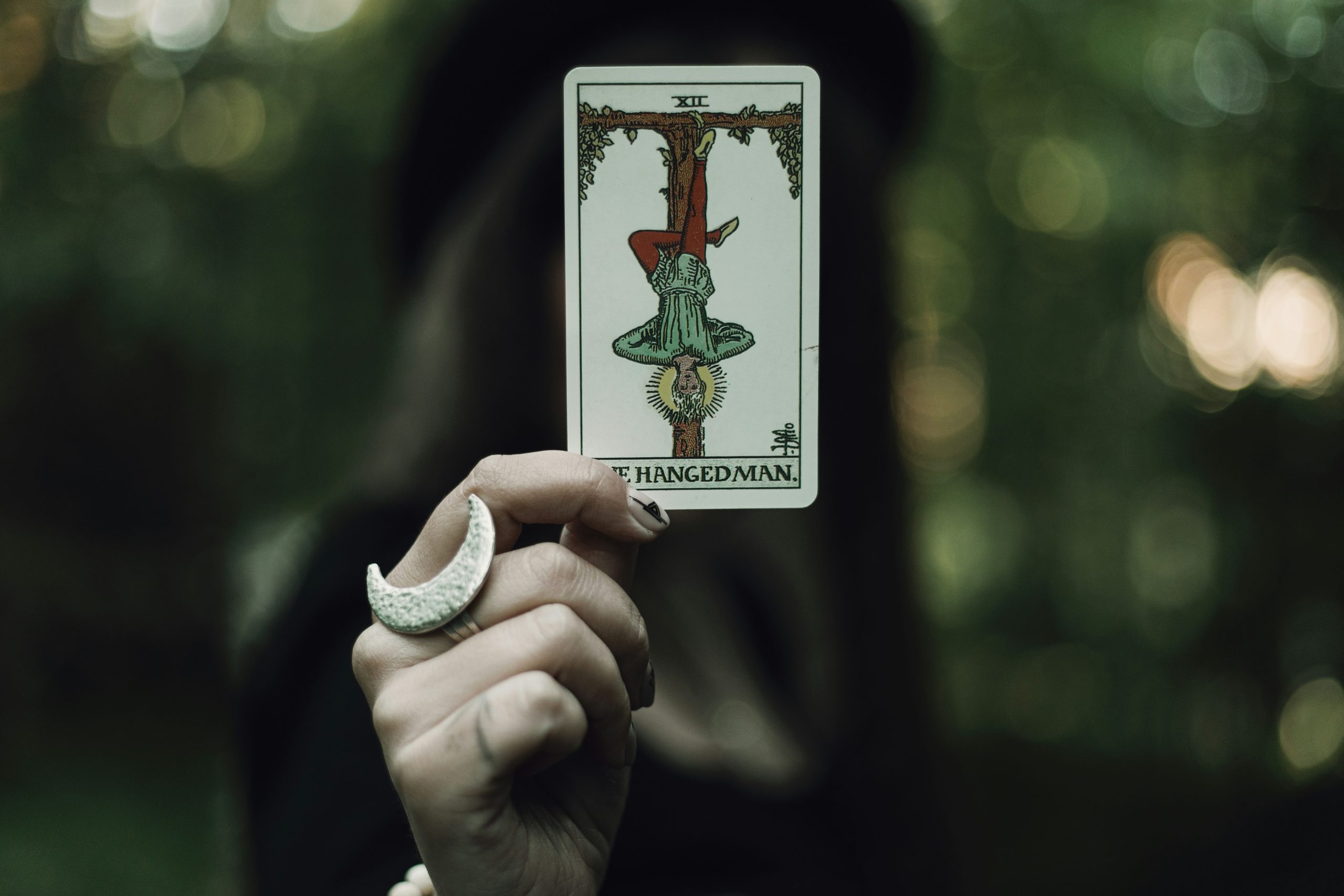
“The Hanged Man” by Katherine Conner, recommended by Jacob M Appel
Introduction by Jacob M Appel
Missing women in various guises have haunted Western literature since Persephone disappeared into the underworld. From Wilkie Collins’ Laura Fairlie to Mary Elizabeth Braddon’s Lady Audley, they roam the landscapes of early mystery novels and, like the vanished girls in Joan Lindsay’s Picnic at Hanging Rock, cast enigmatic shadows in their wake. Into this uncanny world of female phantoms, Katherine Conner conjures 16-year-old Camilla Guidry, whose solemn face appears on flyers plastered across New Orleans. Her dark eyes follow fraudulent fortune teller Roman from the windows of coffee and costume shops, as he wends his way across the French Quarter to Jackson Square, her likeness fluttering from a lamppost into his soul.

Roman is an all too familiar figure for anyone who has ever lingered in the underbelly of the Big Easy: the charismatic clairvoyant whose talent lies in reading people rather than palms. But Roman is too clever by half a Tarot deck. After warning Camilla’s councilman father during a private session that he fears for the man’s daughter, Roman finds himself grappling with the possibility that he has caused the girl’s disappearance, and more broadly, that the false comfort he sells to others is not without consequences. Like the governess in James’ The Turn of the Screw or Nicholas Urfe in Fowles’ The Magus, Roman is trapped inside a false narrative that gradually transmutes into reality. Only in his case, his own moral transgressions are responsible for that narrative. Like the ripples spreading from a stone dropped into a dark pool, Camilla’s absence radiates outward through Roman’s life, undermining his belief that his cons are victimless.
Like the figure suspended on the Tarot card from which the story and Conner’s debut collection take their titles, Roman finds himself hanging between worlds: between fraud and faith, guilt and redemption, coincidence and revelation. Conner is no more interested in resolving these tensions than she is in solving Camilla’s disappearance. Rather, “The Hanged Man” leaves its readers in that same twilight inhabited by the missing girl, where every shadow hints at an unsolved mystery and every unsolved mystery conceals yet another, and where we all live with the unsettling possibility that the stories we invent may one day drift into truth.
– Jacob M Appel
Author of The School of Anecdotal Medicine
There Is More Than One Way to Read Tarot in the French Quarter
Katherine Conner
Share article
“The Hanged Man” by Katherine Conner
Roman spots the flyer on his way to read palms in Jackson Square. Taped to the window of a coffee shop, Have You Seen Me? above a photo of a dark-haired girl, maybe fifteen, sixteen. He can’t tell, doesn’t have time to stop because it’s almost dark and he has to catch Anna before she leaves the square. She’ll be packing up by now, all her palm readings and aura readings and scrying done for the day. He imagines her, bent over her table in profile, a dark toss of hair over her shoulder. Backlit in the setting sun, a sliver of pale cheek, a hint of upturned nose.
He picks up his pace, hurries past the bookstores and boutiques and shuttered townhouses. A block down the street, there’s the flyer again, this time in the window of a costume shop. The missing girl, solemn-eyed and silent among bright pink wigs and spangled feather boas. And when he rounds a corner, she’s there again, right in his face, fluttering from a lamppost. So close that for a second she seems to hover off the page, seems to gaze right at him with eyes as dark as two tiny sinkholes, bottomless black.
A memory comes to him, a vague, shapeless thing, thin as a shadow. He can’t catch hold of it, can’t pin down where and when, but he could swear he’s seen this girl, this very photo, before. Slowly, with the tips of his fingers, he peels the flyer from the post. He smooths her face with his palm and slips it into his bag.
He reaches Jackson Square just as the lingering summer light fades to a silvery glow. He’s one of the night crowd, the bolder, more flamboyant fortune-tellers who hover over glowing candles and call to passers-by. But it’s early for that yet, the day psychics still packing up their tables, and right away he finds Anna in her usual place beside the iron gate. He watches as she wraps her crystal ball in a white towel embroidered with faded pink roses and tucks it into her bag. Watches as she folds up her sign: Palm, Tarot, and Crystal by Anna in light blue letters and, beneath, a drawing of a hand—her hand; Roman sketched it himself—palm out.
He makes his way to her from across the square. Above, in dark silhouette, looms the St. Louis Cathedral, its jutting steeples like the towers of some ancient castle. A medieval backdrop to the street artists and vendors, the colorful umbrellas and fruit-laden carts, the fortune-tellers and musicians and painted performers. But the crowd is thinner at this hour, the gray period between night and day, that brief mingling of light and dark. His favorite time, dusk, when he knows he will see Anna, if only for a moment.
Lately, he’s been coming up with things to catch her attention. Reasons to strike up conversation with the woman he used to share a bed with, the woman whose small, soft body he coiled himself around, whose hair he spread across his pillow so he could fall asleep to its soapy-incense scent. But that was before, and for two months now, he’s been trying to get back there. Trying anything he can think of, and today, he wears a turban on his head, kitschy fortune-teller garb he hopes will get her talking. But he’s got something else now too; he’s got the missing girl’s flyer, tucked in his bag.
“That’s new,” she says when he reaches her.
“This?” He touches the turban. It’s light purple, a color she once told him looks good against his olive skin. “Found it in a junk shop on Decatur.” He swivels his head side to side. “Shit,” he says, “anything to get their attention, you know?”
She won’t like that; she doesn’t cater to the crowd. Time and again she’s told him reading palms, telling futures, is serious business, and she refuses to deck herself out like a dime store fortune-teller from a carnival. But he’s hoping she’ll scold him, like she used to do. Hoping she still cares enough to disapprove. It’s a tactic, a sales technique he learned from his mother. “Keep them interested,” she used to say, “even if you have to piss them off to do it.”
But it doesn’t work on Anna. She says nothing, only looks up at him for a moment, her greenish-brown eyes, the color of the bayou, slit against the setting sun. Then she busies herself over her table.
“How’d you do today?” Roman says because he has to say something, has to keep her here, if only for a moment longer.
“Same as usual,” she says, without looking up. “Six readings. Mostly Tarot and palm.”
Roman unfolds his table, sets it up beside hers. They shared a table before—she’d carry it out here during the day, and he’d bring it back home at night. Now he has his own, a small TV tray on folding legs. During readings, he covers it with a dark blue cloth.
By the time he’s got his candles lit, she has her table folded up and her bag slung over her arm. “See you, Roman,” she says, and turns to go.
“Hey,” Roman says. “You seen this?” He pulls the flyer from his bag, waves it at her.
Now he’s got her attention. She takes the flyer from him, turns to study it. He bends over her shoulder, breathing in the spicy, incense smell of her hair, and looks with her at the photo he could swear he’s seen before: a candid shot of the girl sitting on a front stoop. Curly dark hair, brownish skin. Those black eyes. She’s hunched over her knees, hands pressed to her heart, her bottom lip sucked in, as if she’s chewing on it.
Missing since June 4th, the flyer reads beneath the photo. Age: 16, Height: 5’4; Eyes: Dark Brown; Hair: Dark Brown. Last seen on Magnolia Street. And her name: Camilla Guidry. He says it out loud, “Camilla,” testing the shape of it on his tongue, his lips. And it too seems familiar, a name he has said before.
“You ever seen her around here?” he says.
“I don’t think so.” Anna runs her finger over the photo, pauses on the girl’s face as if waiting for something—a glimpse into her past, or a flash of her future, a vision of some kind. She’s clairvoyant, or claims to be. Claims she can actually see. And whatever she sees now makes her face go slack. Her pert little mouth, cupid’s bow lips he kissed so often, hangs open, her eyes gone glassy and gray.
“What is it?” he says. “You see something?”
She called him a fraud before she kicked him out, a scam artist. She saw him swindle an old lady out of a hundred bucks during a palm reading. He thought she’d left the square already, but she’d turned back, had forgotten her scarf—a sheer little lacy thing he later told her she must have lost but keeps tucked away at the bottom of his bag. And she crept right up on him as he told that old lady he could see her dead child, hovering behind her. “Jamie?” the woman said. “What’s he want? What’s he saying?” She was frantic, right up in his face.
“Visions are a hundred dollars,” he told her, hanging his head, as if ashamed. “I wish I could tell you for less. But the spirit world drains me. A vision like this one—” He paused for a moment, glanced up at the woman, her filmy bright eyes narrowed at him. “I’ll be wiped out for the rest of the night.”
And Anna, who knows he’s not a clairvoyant, knows he’s never had visions, overheard the whole thing. She confronted him that night when he got home. He was no true psychic, she said, and it was crooks like him who gave the rest a bad name. And he didn’t deny it; he’s a salesman, not a psychic. But, honestly, he doesn’t see much difference between the two. He can read people better than Anna, knows exactly what they want to hear. And that old woman wanted to hear about her son. Wanted to believe her son was still around, in some form or another. All Roman did was give her what she wanted—what she paid for. But Anna wouldn’t see it that way.
He leans closer—just a little, just enough to graze the top of her head with his chin—and she tenses, takes a step away. She turns, holds the flyer out to him. “I don’t see anything,” she says. “It’s all just dark.”
Later, hours after midnight when the crowd in the Quarter has tapered off to the lone drunk or bleary-eyed tourist, the night psychics pack up their tables, as if in tacit agreement that their shifts have ended. Roman did well enough for the night, about fifteen readings, a couple hundred bucks including tips. He’s better than Anna at making money, a talented salesman, trained almost from birth. His mother sold Mary Kay beauty products around their south Mississippi neighborhood when he was a child, and she would take Roman with her on house calls. He wasn’t Roman back then, just Charlie, a small, dark-eyed boy who looked too much like the father he never knew. But he was “good for business,” his mother told him, and he’d peer up from behind his mother’s legs at her customers, as if too shy to speak. Just as his mother taught him to do.
“Charlie!” his mother would say, taking him by the hand. “Say hello.” Then, lowering her voice, “He’s just a little clingy, you know, since his father left.”
“Well, bless his heart,” the women would say. Sometimes crouching before him, touching his hair. And he would gaze up at them, his eyes wide, his lower lip just barely poked out, the saddest child in the world. That’s how he thought of it—his saddest child in the world face, like the starving orphans in those commercials on TV.
“It’s just me and him, right, Charlie?” his mother would say. “Me and him against the world.”
It didn’t work all the time. But when it did, when the women invited them in, nine times out of ten his mother would sell something. A lipstick in a smooth pink tube, a little pink compact, a bottle of perfume.
He’s as good at sales now as his mother ever was, and she was so good she won the pink Cadillac in 1989, a gaudy, Pepto-Bismol nightmare of a car that Roman, nine years old at the time, should have hated. But he didn’t, despite the looks they got as they rolled down the street. Despite the jeers from his classmates because, unlike them, he’d seen firsthand how hard his mother had worked for that reward.
She had to give the car back when the lease ran out two years later. She didn’t have the money to buy it, despite how many creams and lipsticks she sold. And Roman, who’d thought the car was already hers, couldn’t understand. Where did all the money go? She tried to explain to him about working for a company—commission, consulting, percentages—but all he ever understood was what he saw: his mother, leading private sales parties or going door to door in her pastel pantsuit worn thin at the knees, the pink case tucked under her arm, her face all made up and her hair sprayed so stiff not even a ride in the Cadillac with the windows down would blow it out of place.
He likes to think she’d approve because, like her, he can figure out a customer in a matter of seconds.
She was dead of ovarian cancer by the time he started fortune-telling, three years ago now. But he likes to think she’d approve because, like her, he can figure out a customer in a matter of seconds. The tipsy college girls who want to be told they’re special. The elderly tourists looking for financial advice. The middle-aged women desperate for some kind of meaning. He knows how to play them all, how to lead them on, upsell them. “Your palm can only reveal so much,” he will say, and then offer them face readings, aura readings, crystal ball readings—all at a special, one-time discount. He can sell up to twenty voodoo dolls in one night, can get even the most determined skeptic to buy one of his gris-gris bags. On a good night, he makes enough to live on for a week, and if every night was like tonight, he could quit his service job, bartending at Da Bar, a dive joint a few blocks from his apartment. But not every night is good, and sometimes he goes home with just a couple of twenties stuffed in the pocket of his bag.
By 4:00 AM he’s back at the tiny, upstairs apartment he rents in the Irish Channel, sipping a beer and scrolling through the news on his laptop. He types her name into the search engine—Camilla Guidry—and several results appear. More than he expected, in fact, because people go missing all the time in New Orleans. Most of them are never found. Rumor has it some of them end up in the river, their bodies making their slow, bloated way down to the Gulf. But Roman always imagines them swallowed up whole by the city itself, not a bone or shred of clothing or strand of hair left to prove they ever existed in the first place.
He clicks on a video of the story posted by a local station. “I’ve served this city for twenty years,” a man being interviewed says. “And now I’m asking for your help.” He stands on the front porch of one of those shotgun camelbacks found all over the city, green filigreed brackets beneath the porch roof, scrolled lattice work, a limp Saints flag dangling from the awning. A middle-aged man, pale and worn, his eyes bloodshot, a little unfocused behind his glasses. And again, a feeling comes over Roman, a coolness, like a stream of air against the back of his neck. The strangeness of déjà vu. Because he’s seen this man, his pale face and nervous, twisting hands. He’s seen this man hunched over his table in the square.
It comes to him then, all at once, in full-blown detail: the man—Ed Guidry, Camilla’s father, a caption at the bottom of the screen says—sliding her photo across the table. He kept darting looks all over the square, as if afraid someone might recognize him. It was very late, Roman remembers, a slow night, and he’d been about to pack up when the man came quick around a corner, his thin little arms crossed over his chest, almost running to Roman’s table.
This was—what?—maybe a month ago? Before the girl disappeared. And whatever it was the man had asked him, Roman pretended to know the answer. He held that photo in his hand and made a show of it, closing his eyes, placing two fingers against his forehead as if deep in concentration. When he was finished, the man shoved a wad of twenties at him and slipped away, as quick as he came.
The reporter in the video pops back on screen and says Ed Guidry is a member of the city council. No wonder the case is getting so much attention.
Roman closes his laptop, carries his beer out to the balcony. He sits on the plastic lawn chair with his feet propped on the railing, lights a clove cigarette, and watches the lit-up barges glide down the river. Beyond the rows of warehouses, he can just make them out, long and flat, their lights shimmering against the dark water so there’s two of them, like split-headed beasts from some forgotten fairy tale, the sea monsters of legends. A fog horn blows in the distance, somewhere far up the river, a long, low note, oddly mournful. I’m here, it seems to say, even though you can’t see me.
Roman works the afternoon shift at Da Bar the next day, wiping down the damp wood counter, filling beer glasses. The place is dark, nearly windowless, and smells of sweat and mildew. Cracks run across the vinyl barstool cushions, foam exposed, and the wood floor buckles in several places. During the many lulls between pouring drinks, he flips through a paperback about Tarot readings, practices a few tricks with his deck.
One of the TVs—tuned to the local news station—plays a story about Camilla Guidry. They’re airing the same clip he watched last night, but the girl’s father sounds different, his voice weaker, muffled. Roman knows it’s just the blown TV speakers, but the effect is unnerving. As he listens to the man’s tinny, far-off voice, he can’t help but picture him dimming out, his pale face fading feature by feature until he’s no more than blurred edges. A hazy outline of a head, the curve of a shoulder. A slow dissolve into a silver-white sky the color of dusk.
If only Roman hadn’t recognized him. He sat up a long time last night, watching the dark shimmer of the river and playing it over in his mind—how the man slid that photo across the table, blinked up at him with watery pink eyes. For a while, that’s all he could remember. But finally, at some point near dawn, he recalled the man had said his daughter seemed “hollowed out.” Like she wasn’t really in there, he said. And then he’d leaned across the table, lowered his voice. “Truth is, I’m getting a little scared of her. It’s like she looks right through me to whatever’s on the other side.”
He wanted to know what was wrong with her. “I don’t know what to do,” he said. And Roman, plucking up the photo and closing his eyes, had told him some bullshit about planes of existence, energy, auras. That’s all he can remember, that he’d spouted some nonsense straight off the back of a book from an occult shop. And, for whatever reason, the man had bought it.
A regular named Lyle sits at the bar, his head tipped back, watching the clip. “Only reason they care is cause of her daddy,” he says.
“Come on, man,” Eddie says from down the bar. He’s another regular, an old black man who wears the same Saints jersey—McAllister, number 26, the letters cracked and peeling—every time he’s here. “Looks like he pretty tore up.”
“Shit, Eddie,” Lyle says. “She probably just run off.”
“What you mean?
“I mean,” Lyle says, “she probably got bored and run off somewhere.” His slicked-back hair, so black Roman suspects he dyes it, gleams even in the dull light of the bar, as if emitting its own light. “Got sick of daddy’s rules. Bet she’s shacking up with some guy.” He waves a hand at Roman. “Let me get one more, Roman,” he says.
“Hey, Roman,” Eddie says. “What you think happened to that girl?”
Roman dog-ears a page in his book to mark his place and reaches for Lyle’s empty glass.
“Yeah,” Lyle says. “You supposed to be psychic, right?” He snorts a laugh through his nose, fingers a cigarette out of his shirt pocket. “Guess you know all about it, huh?”
Roman slides the full glass across the counter to him. “That’s not how it works, Lyle,” he says. “I told you that before.”
“Well,” Lyle says, “that’s mighty convenient, ain’t it?”
Roman clenches his jaw, fights the urge to snap at the man. Lyle’s been giving him shit for the past three years, as long as Roman has worked here. He’s used to a little scorn—drunks teasing him in Jackson Square, muttering in put-on accents, “Give me a quarter and I’ll tell you your fortune”—and Lyle’s jabs usually don’t bother him much.
But the truth is he’s felt more and more like a fraud since Anna left him. Like a snake oil salesmen, working one of those traveling medicine shows. A Peg Leg Sam, hawking fortunes like cure-all elixirs. He tells himself selling fortunes is no worse than all those beauty creams and fad diets and other shit people sell. Certainly no worse than the makeup his mother pushed on the neighborhood ladies. Because, really, it boils down to the same thing: a sense, however tenuous and unreal, that they’re in control—of their appearance, their future. Their existence.
But the thing he can’t shake now is that he’s maybe—just a little, the tiniest bit—responsible for the girl’s disappearance. He tells himself, as he told himself over and over last night, it’s not his fault. The man should have taken his daughter to a psychiatrist, not a fortune-teller. All Roman did was what any salesman would do—make the sale. But still, it bothers him. In the few hours he slept, he dreamed of her—those too-dark eyes and her little pale face, right there. Hovering over his bed, so close he could reach out and run his fingers through her dark hair. But when he tried, she faded back into shadow, and he woke up like that, his hand suspended there. Grabbing at the dark.
“Hey,” Lyle says. “Let’s ask the cards where the girl is.” He nods at the Tarot deck Roman left by the register.
The deck is brand new. Roman’s specialty is palmistry, and he can pull off a pretty convincing aura or crystal read too. But he’s never read Tarot cards, never taken the time to learn, never cared. Until now, because he plans to ask Anna to give him tips next time he sees her. He’ll pull the deck out right in front of her, shuffle through it, maybe spill the cards all over the table for good measure. A bumbling fool, in need of assistance.
“I don’t think so, Lyle,” he says.
“What,” Lyle says, “you want me to pay? I’ll pay.” He whips his wallet from his pocket and tosses it on the counter. “What’s the rate for card tricks? Ten bucks?”
Roman gazes down at the wallet, black leather as dark and shiny as Lyle’s hair. He doesn’t know the cards well enough yet. He should say no, say he’s not a performing monkey. But he can’t turn down money. Force of habit, maybe, or instinct, a behavior learned so early its roots reach all the way down to the core of him, a place as black and bottomless as the girl’s eyes. Whatever it is, it won’t let him say no. “If they’re willing to pay,” his mother used to say, “you find something to sell.”
‘If they’re willing to pay,’ his mother used to say, ‘you find something to sell.’
“The rate?” Roman says, glancing up at Lyle. “For a professional? Thirty bucks. But I can knock five off.” He winks. “Special one-time discount.”
Lyle cocks his head to one side, as if weighing the possibilities. Then waves a hand at Roman. “Go on,” he says.
So Roman does. He splits the deck—the cards stiff and slippery, too new—and shuffles once, twice, taps the deck on the counter. He presses his palm over the deck, closes his eyes for a moment. It’s just for show, but the girl’s face comes to him anyway, those black eyes, the strained expression, like a clenched fist, a wire pulled taut, ready to snap. He deals a card from the stack and places it face down on the table. One-card spreads are best for yes or no questions, but he’s not ready for anything more complicated just yet. A couple of men have drifted over from the video poker machines. They lean against the bar beside Lyle, watching.
“Can I get another round?” one of the men says.
“Shut the fuck up,” the other says. “You interrupting shit.”
“I’ll be right with you.” Sweat pricks the back of Roman’s neck, his scalp. He has never been nervous during readings, not even at the beginning, when he first started. It’s all about confidence, he told Anna once. You look like you know what you’re doing, and people buy it. “Buy what?” Anna asked. They sat side-by-side on the prim little couch in her living room, sandalwood candles burning on her mantle. “Whatever you’re selling,” Roman said. She looked over at him, her eyes a swampy green in the low light. “And what are you selling me?” He can’t remember now what he’d answered. All he recalls is the baby soft skin at the nape of her neck, the overwhelming scent of sandalwood, soapy sweet.
He could swear his hands tremble—just barely, the faintest flutter—as he flips the card over. He recognizes it, a man hanging by one ankle from a tree, both hands tied behind his back. “The hanged man,” he says, pressing a fingertip against the man’s smooth, unformed face. He looks more like he’s levitating than hanging, his free leg bent behind the other in a half lotus position.
“The hell does that mean?” Lyle says.
Roman stares down at the card, tries to remember what he read. Something about a crossroads and waiting, maybe, but the answer always depends on the question. He pauses, looks up at Lyle, at the men beside him, at Eddie down the bar. All of them gazing at him, waiting for some big reveal. As if the answer is really there, in a card from a deck he bought at Divinity, an occult shop in the Quarter run by a middle-aged woman with three yippy little dogs and a Cajun accent so thick he almost couldn’t understand her. “You going read these for y’all customers?” she asked. “These cards,” she hovered her hand over the deck, wiggled her fingers, bright nail polish flashing, “they not for games.”
And yet, here he is, playing games with Lyle. Proving he knows what he’s doing when he doesn’t know a goddamn thing. But he has to say something, has to earn that thirty bucks, so he closes his eyes, tries to picture the hanged man’s page in the book, the list of meanings. “Suspension,” he says, as soon as it pops in his head. “The hanged man is suspended between worlds.”
“What worlds?” Eddie says. He’s staring hard down at the card, his voice low, hushed. As if he’s afraid.
“Our world and the spirit world,” Roman says, warming to it now, as he always does when his customers are like Eddie, hanging on his every word. “Living and dead.”
“So she’s a zombie?” Lyle tips his stool back and laughs, nudging one of the men with his elbow. “We got a zombie on the loose,” he says. “Get y’all guns ready.”
But Roman barely hears him because suddenly his scalp tingles, a pricking along the nape of his neck to the crown of his head. Like static electricity, as if someone has rubbed a balloon over his hair. He plucks the card from the counter and holds it up to his eyes, as if the hanged man might hover right off the glossy surface. As if, for the first time, he might actually experience something—divination or premonition or clairvoyance or any of the phenomena he so often fakes. He squints at the card, then lets his eyes glaze over. Waits for a moment. But nothing happens.
“So if she ain’t dead,” Eddie says, “what’s she doing?”
“Waiting,” Roman says, because it’s the only thing he can think of.
“Waiting for what?”
But Roman shakes his head. “That’s all I got.” For once, it’s the truth.
Later, he carries his laptop out to his balcony and reads about the hanged man on a few different sites. They all say the same thing—the card represents suspension, waiting. The Hanged Man is a willing victim, one site says, someone who has chosen the path of sacrifice to accomplish a higher goal. He’s scrolling down the page to read more when a sudden movement, the flicker of a shadow across a streetlamp, catches his eye. He sits up, gazes through the bars of the iron railing at the street below. It’s dark, lit here and there by only a few weak streetlamps, all the front stoops and porches and gates blended together in one long spill of shadow. And then, as Roman watches, a shadow darker than the rest, blacker than the oily black of the river, darts across the brick front of a warehouse across the street. So fast, he might have imagined it.
He closes his laptop, moves up close to the railing. Clutching it with both hands, he stares hard into the darkness, waiting for the shadow to reappear. And then, the streetlamp just beneath his balcony flickers—once, twice—and standing there, beneath its dull yellow light, is a slender, dark figure. Upturned face, small and round, pitted eyes, hands clenched together right over her heart. The girl, in the exact same posture as her photo.
His pulse beats hard in his ears, a hot, relentless pounding. “Hey,” he says, and he can barely hear his own voice. “Hey!” Louder now; down the street, a neighbor’s dog barks. But still, the girl doesn’t move, doesn’t respond. Just clutches her hands together and gazes up at him, as flat and dimensionless as her photo. He closes his eyes, as he has seen Anna do, presses his fingers to his temples, and when he looks again, the girl is gone.
“It was her,” he tells Anna the next night. “I know it was her.”
Anna stares up at him—one of her sad, silent stares, as if she’s contemplating profound truths she’d rather not know. “Okay, Roman,” she says. “But why?”
“What do you mean?” They stand together beside the iron gate in Jackson Square, Anna’s folded-up table propped against the bars. All around them the night psychics set up shop, the sky turning purple with dusk.
“I mean,” Anna says, drawing out the words, as if he’s an idiot, “why you? Why would she show herself to you? What does she want?”
“I don’t know. How the hell would I know?” He has to make her understand, has to convince her. He hardly slept last night after the girl vanished. He tried, forced himself to go back inside, to stretch out on his couch. But he just lay there, staring up at the dark, trying to make sense of what he’d seen. He decided it must have been a vision. But he’d always imagined visions as hazy, shimmering, half-lit as dreams. Not like the girl, in so much detail, just standing down there under the streetlamp. Waiting, just like the card told him. Waiting for him to see her. “I did see her,” he says to Anna. “I did.”
“Then you should tell the police.”
“The police?”
“A child goes missing, you see her, you tell the police, Roman.”
“But it wasn’t her,” he says. “I mean, it wasn’t the real her. It was a vision of her. I know the difference.” He doesn’t, though, and technically it could’ve been the real Camilla he saw. He considered this possibility last night as he lay sleepless on his couch. Thought it over and dismissed it within a matter of moments because what were the chances the girl would end up right in front of his balcony? What were the chances that he—of all the thousands of people in the city—would be the one to spot her?
“Even so,” Anna says. “You should tell them. Or at least call her father. The man’s been on news every night asking for information.”
But Roman doesn’t want to think about her father—his bloodshot eyes and haggard face, the utter despair that wafted off him like a smell. No way in hell is he going to contact the man unless he knows for sure what he saw.
“You ever tell the police about your visions?” he says.
She throws her bag over her shoulder, stoops to grab her table, all her long, dark hair falling over her face. “Yes,” she says. “And don’t expect them to pay you. That’s not how it works.” Then, tucking her table under her arm, she turns to go.
“Hey,” Roman says. “What do you know about the hanged man?”
She stops, glances back at him. “You’re doing Tarot now too?”
“Maybe.”
“Tarot is ancient,” she says. “You shouldn’t be messing around with it, Roman.” She shifts her bag from one shoulder to the other. He fights the urge to take it from her, to offer to help. She would just tell him no.
“I’m not messing around,” he says. “I swear.”
She looks at him for a moment, then shakes her head. “If you’re seeing the hanged man,” she says, “it’s probably a sign you need to let go of something.” And then she turns, rounds the corner of the gate, and is gone.
When customers turn up that night, he has trouble focusing. One woman even asks him what’s wrong. An older lady with a drawling Southern accent, face heavily made-up. “You okay, honey?” she says, right in the middle of a palm reading, and he realizes he’s been silent for several seconds, holding her palm limply in his hand, staring over her shoulder at every dark-haired girl who passes on the street. “Sorry,” he says, “I thought I saw something.”
“What?”
But he just shrugs. If only he knew.
He packs up early that night, even though it’s a Saturday, and the square is crowded with potential customers. He stashes his table and his bag in his apartment, grabs a flashlight, and heads outside. He starts with the warehouse across the street, shining his light along the dirty bricks. He doesn’t know what he’s looking for, exactly—evidence of some kind. A strand of curly black hair, a scrap of her clothing. A small footprint. Anything to prove she was or wasn’t there. That she was the girl herself, in the flesh, or a vision of some kind, an actual clairvoyant experience.
He moves on, searches the narrow alleyway between two shotgun houses, sweeps his beam along the broken concrete and through the weeds. Tiny moths flutter up, like pixie dust glittering in the light. A rustle behind him makes him turn quick on his heels in time to spot a cat slink under the porch. He crouches, shines his light there, as if the girl might be flat on her belly in the hard-packed dirt, hiding with a pack of feral cats. Her eyes, caught in the beam, sucking up the light instead of reflecting it back.
Mosquitos whine in his ears, and he’s sweating now, the back of his neck sticky. Something big and winged buzzes over his head, and he jerks up, brushes himself off. Still, he goes on. He walks another block or two down the street, searching the sidewalk, the alleyways, the empty front stoops. Near Da Bar, he stops, waves at a couple of men gathered out front. Eddie is among them, wearing his Saints jersey and smoking a cigar.
“Hey, Roman,” he calls to him. “Come have a drink. What you doing with that flashlight?”
For a second, Roman considers telling him about his vision. Sipping a beer on Da Bar’s stoop, describing to Eddie what he saw. Unlike Anna, Eddie would believe it. Eddie would buy every word that comes out of his mouth. He’d pay too, if Roman asked—for card tricks, a palm reading, maybe even a gris-gris bag or two, and his hand moves to his side, where his bag would be, already reaching for something to sell. He stops when he realizes there’s nothing there, his hand grabbing at air.
And all at once, he’s struck with a memory, so old it’s curled up around the edges like a brittle photograph—his mother, sitting with a friend on the plaid couch in their cramped living room. The friend, a woman who lived down the street, was upset about something—crying, he remembers—and his mother tried to soothe her in her low, gentle voice, the one she used on him when he was sick. Roman, who must have been around seven or eight at the time, sprawled on the floor at their feet, playing with one of his toys. His mother reached her hand down, right beside him, and fumbled around on the floor.
“What are you looking for?” the friend said.
His mother’s hand froze against the carpet. She peered down at Charlie for a second, then swept her hand over to him, rumpled his hair. “Charlie dropped one of his toys,” she said. But Charlie hadn’t, and he knew right off that she’d been reaching for the case of cosmetics she would set at her feet on house calls or during sales parties. He knew right off she was reaching for something to sell to the friend crying on her couch.
Roman stares down at his empty hand, something skittering around in his gut, a feeling like—what? Shame? And then he raises his arm and waves at Eddie and turns back down the street.
When he reaches his apartment, he stops beneath the streetlamp where the girl stood the night before. He tucks the flashlight under his arm and clutches his hands together over his heart, just as she did, and stares up at his empty balcony. He imagines himself there, a tensed figure, poised at the railing even long after she has vanished. Moonlight throwing him half in shadow, his face dark and featureless, a solid black silhouette. Suspended there, as still as a photo, a painting. Staring long and hard into the shadows, as if waiting for something, anything, to creep its way out from the dark.