essays
These Middle-Grade Novels Are Some of the Most Formally Innovative Works of Our Time
Lemony Snicket's "A Series of Unfortunate Events" is the true spiritual successor to Laurence Sterne's "Tristram Shandy"
When I took my copy of Lemony Snicket’s The Carnivorous Carnival up to the check-out line at Barnes and Noble, the cashier flipped through the book and paused.
She was sorry, she said, after a couple more puzzled page flips. There appeared to be a misprint. She called an employee in the kid’s section to bring me another copy of the book.
But almost immediately, the coworker called back—with the alarming news that all the copies had the same misprint. The bookseller became flustered. Was her colleague sure? Which page? The bookseller began reading it out loud.
“If you have ever experienced something that feels strangely familiar, as if the exact same thing has happened to you before,” Daniel Handler— or rather, Lemony Snicket— wrote, at the start of chapter five, “then you are experiencing what the French call ‘déja vu.’ Like most French expressions— ‘ennui,’ which is a fancy term for severe boredom, or ‘la petite mort,’ which describes a feeling that part of you has died— ‘déja vu’ refers to something that is usually not very pleasant, because it is curious to feel as if you have heard or seen something that you have heard or seen before.”
The page after that begins with, “If you have ever experienced something that feels strangely familiar, as if the exact same thing has happened to you before, then you are experiencing what the French call ‘déja vu.’”
I was thirteen and hadn’t known authors could use the form of a book itself to convey meaning.
Once she finished the line, the bookseller snorted. She got the joke, and I was privately delighted. I was thirteen and hadn’t known authors could do that—that they could use more than just the text, but the form of a book itself to convey meaning.
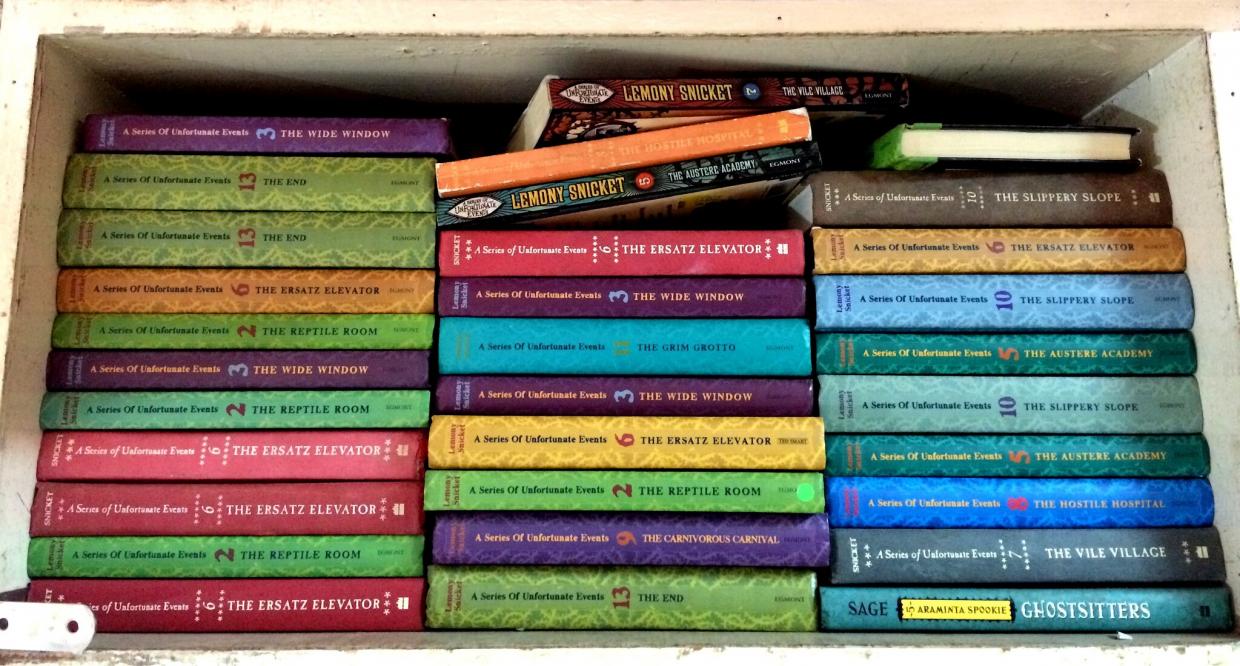
A Series of Unfortunate Events offers the kind of gloriously literate, intertextual experience that is a siren song to Nature’s Rare Book Librarians in their infancy. (Or at least to me— but my interest in rare books tends to be the weirdness of the object itself, and how the physical form of the book assisted in, or played with its function. Back when I worked at a rare books library, I used any excuse to send friends, colleagues, or Twitter followers pictures of a hunting manual bound in deerskin.) As objects, the books of A Series of Unfortunate Events seem primed to inculcate a love of the codex. Unlike say, the Goosebumps books, with their flimsy covers, they are substantial enough to bear up being shoved into backpacks, dropped onto asphalt, and loaned to friends, while still being a delight to look at and handle. The hard covers and ragged pages perfectly reflected my childish understanding of “old books” (one that, in my case, owed more to the Dear America book series than any interactions with actual old books). Each book ended with a letter, telegram, or other piece of ephemera from Lemony Snicket to his editors, hinting at the setting and plot of the next book in the series. For an added touch of verisimilitude, Snicket’s letters often list items, photographs, and other artifacts from the Baudelaires’ journeys, which he promises to send to illustrator Brett Helquist, so Helquist can study them for his quirky pencil drawings.
Helquist’s illustrations often creep into the text, or change it. In The Carnivorous Carnival, the book whose déja vu page caused such confusion, the unfortunate Baudelaire children nearly get thrown into a lion pit. These ferocious felines are menacing enough in the text, but Helquist adds another layer of danger that climbs right out of the page. His lions swipe at the text itself, ripping off the “Ch” of “Chapter Ten,” and causing the two letters to tumble down the bottom of the page, and towards the huge gouges another lion’s paw has made through “Caligari”— the name of titular carnival. It’s a moment of delightfully absurdist extratextuality, echoing the precipitous drop awaiting the Baudelaires, and making the threat to our heroes all the more inescapable.
The books play around with the knowledge that they are books, in a sort of Barthesian jouissance, exploring and exploding literary codes. They are writerly texts. By far the most ingenious moment of inter- and extratextuality comes in The Ersatz Elevator.
“We’ll take the elevator,” says the Baudelaire children’s terrible guardian du jour (or du livre) Esmé Squalor. And they do. Sort of. As Snickett narrates, Esmé “swept her arm forward and pushed the Baudelaire orphans into the darkness of the elevator shaft.”
And then…

These two pages are, I believe, the cleverest cliffhanger in children’s literature. As with the illustrated lions tearing at the chapter titles, the events of the novel are too grand to be confined by the text block. They leap from text to paratext. It’s a delightful innovation within the codex space— and also an allusion to perhaps the novel most aware of being a novel, Laurence Sterne’s Tristram Shandy.
“Alas, poor YORICK!” exclaims the narrator of Tristram Shandy, two lines separate from the rest of the text block, when the character of Yorick dies. The next page is coated in black ink. The text itself is in mourning… quite literally.

The black page, one of the most famous visuals from this precociously postmodern 18th-century novel (which also includes, in Volume III, an inserted sheet of marbled paper), plays with the reader’s expectations of what a codex ought to be and look like. It defies the expectation of continued text while, at the same time, revisiting historical print conventions. The mourning page, though unusual to a set of 21st-century eyes, is a literary tradition deeply rooted in the history of English printing. As Whitney Trettien writes in her blog post, “Tristram Shandy & the art of black mourning pages,” “mourning pages or all-black prints, sometimes with a coat of arms or other insignia etched out,” could be found “in printed funeral sermons and memorial verse” from the seventeenth century onward. It is a printing convention that calls attention to the book as object, sometimes even when the book itself has been digitized and put online. And, like Snicket’s déja vu page, Sterne’s contemporaries did not always understand the black page. Professor Whittney Trettien found this anecdote about the printing history of Tristram Shandy in William Coombe’s The Philosopher in Bristol (1775):
“The author of that celebrated work at the close of his matchless description of Yorick’s death, introduced a black or mourning page.— I cannot conceive, how it was possible for his design to be mistaken’ — but so it was:— and such whimsical and idle conjectures were made concerning it, — that he resolved, since the leaf of one dead color, with a moral meaning, was so little understood, to exercise the ingenuity of his readers inventions and try how they would receive a fanciful page of various colours, which was inserted in a succeeding volume without any meaning at all.”
The latter is in reference to the marbled page, which, in the text, Sterne refers to as “the motly emblem of my work,” and which the Sterne Trust interprets as “a visual confirmation that his work is endlessly variable, endlessly open to chance.” No two hand-marbled pages are exactly alike, creating a unique page and thus making visible the subjective experience of the reader, making it an active part of the text. (Sterne does this even more specifically with a blank page, where he asks his reader to imagine an illustration in the blank spot, “as like your mistress as you can—as unlike your wife as your conscience will let you— ‘tis all one to me— please but your own fancy in it.”)
For me, marbled paper conjures up images of endpapers, the papers fixed to the inside cover of a book to hide all the strings and glue keeping the cover and the paper block together. That wouldn’t be the first association for Sterne’s contemporary readers—the marbled endpaper is a characteristic of 19th rather than 18th-century volumes, and in fact Sterne relied on the very unfamiliarity of marbling to catch his readers’ attention. But the marbled page has taken on even more extratextual significance in the 250 years since it first appeared, now seeming to end the volume in the middle. Where does the story end, one wonders when encountering this misplaced endpaper, and where does it begin? Purely with the written word, or with the codex, the book-as-object itself?
What should we make of the fact that some of the most formally interesting books of the 20th and 21st centuries are meant for children?
Snicket posits the same question—but for children. What should we make of the fact that some of the most formally interesting books of the 20th and 21st centuries are meant for middle-grade readers? I personally think it’s a reflection of the modern notion that imagination, that playfulness, is for children, and that adults have more serious concerns. We adults, it is assumed, know what books are and how they should operate; our attention is supposed to be directed to the grim realities they contain. The interesting (and profitable) way of experimenting with the codex for adults is turning books into e-books. We still test the limitations of text blocks on pages, but it’s no longer a question of the physical object, but a question of translation: ink into pixels.
I also find it fascinating that Snicket, like Sterne, does not allow the reader to be a passive subject. Middle school is about the age when one discovers the first limits of one’s personal subjectivity, when one begins to understand the rich and variegated nature of human experience, and that there may not be one right answer to a situation. It’s the time you begin to question if what you read in books is true, when before the fact that the books were books gave them all necessary authority. By calling attention to the book as object, and pulling his young readers into the text, Snicket furthers that subjective development. The last book of A Series of Unfortunate Events ends not with a bang, nor a whimper, or even a line, but an illustration of a giant question mark floating in the sea. When you turn the page you see another illustration, possibly of the same sea, with a man rowing away.
Perhaps this is the fictional Snicket, leaving the reader to guess as to the real meaning, the real lesson of the series. After all, the reader has all they need to make a judgement. They have the books— and they have themselves.