Interviews
TAKE WHAT YOU CAN Tests the Limits of Chosen Family
Naima Coster discusses friendship at the fragile intersections of postpartum identity, class disparity, and maternal grief
Somewhere in France, two girls launch a boat into the sea. So begins Naima Coster’s latest novel, Take What You Can. We follow the girls—Milly and Val—as they navigate the waves and, as the novel unfolds further, become successful women, continuously pulled against the uneven terrain of their marriages, babies, careers, and the unfettered love that exists between them.
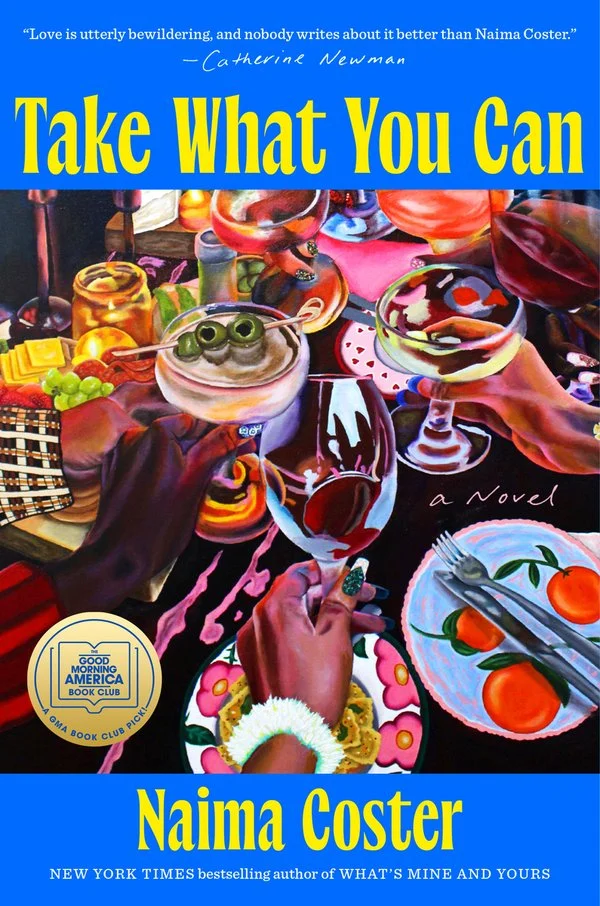
In adulthood, after years of long-distance friendship, Milly and Val’s relationship takes a new form when Val and her husband uproot themselves at Milly’s suggestion, and the women decide to raise their children together in New York. There, they give birth to daughters, their families intertwining, but the years that passed while they led separate lives bubble up and push them to a precipice. The memory of a woman who became a motherly and guiding figure in their lives beginning on that long ago trip to France threatens to unspool them. Who are they to each other? What lives in the margins of their love?
Take What You Can is a complex portrait of female friendship that pries at the intimacy threading through chosen family, and asks what the boundaries are—if any—between two women who are tethered to each other. Class divides and the strain of the past force Milly and Val to confront what they really want—for themselves, and from each other—and sift through their desires, lingering grief, and the unruly vault of motherhood.
Coster writes with shimmering precision, unfurling the tumultuous and spirited depths of female friendship amidst stunning backdrops. Out at sea, the girls reach a spot where they can stand on stones: “The water was clear, and silver fish glinted like blades below the surface.” The prose opens, bends, immersing us in the scene as they climb “in their flimsy sandals onto a jagged outcrop strewn with the remnants of other visits: goggles, a tube of sunscreen, an empty wine bottle.” Each image leaves an undeniable imprint.
I first met Naima while we were both MFA candidates at Columbia, and I can remember sensing an authenticity and kindness in her that was often hard to find in a competitive writing cohort. In the years since, Naima’s impressive literary career has spanned three novels: Halsey Street, What’s Mine and Yours, and now, Take What You Can. It was a joy to speak with her over Zoom in early April about the evolution of her writing and the many facets of her stunning new novel.
Yasmin Roshanian: The way we tell stories reshapes with time, and this is your third novel—what a feat! How did writing Take What You Can differ from writing Halsey Street? I’m curious what you struggled with here, and what has lingered from each novel.
I thought I was emotionally ready to write about a lot of the things that came up for me in becoming a mother. Once I started, I realized that I hadn’t gotten past anything.
Naima Coster: I’ll start with what I intended. I wanted to write something that paid really close attention to just two characters, which is similar to Halsey Street, but different from my last novel, What’s Mine and Yours. I wanted to sink into their psychology and their emotions—even more than I had previously. I also wanted to write about love, and the love that exists between these two best friends, Milly and Val. It’s a love that sustains, that isn’t lost, and that was new for me.
It was difficult to write this book because it was the first time I wrote a novel where the emotional material was really close to me. I thought about writing about new motherhood, class envy, and estrangement when my daughter was two-years-old. I thought I knew what it was to be an unmothered mother, and to have questions and strong feelings about class—what I had, what I didn’t have. I thought I was emotionally ready to write about a lot of the things that came up for me in becoming a mother. Once I started, of course, I realized that I hadn’t gotten past anything. Everything was so fresh and raw for me, which wasn’t true for Halsey Street and What’s Mine and Yours. They’re not autobiographical novels, but they are very personal. This novel is not autobiographical, either, but it was the first time I found myself writing about open wounds and really unresolved feelings. It made the writing difficult. It took a lot longer than I thought. It wasn’t straightforward to wrestle with the themes and emotions.
YR: The intricacies of female friendship is a central theme. For many women, friendships rather than romantic loves are their longest and most enduring connections. Milly and Val are such forces, their love feels almost unconditional, but it’s also volatile, nearly splintering them both. What is it about this form of intimacy that’s so consuming?
NC: I knew I wanted to write about how hard it is to love someone when you’re truly close. Their friendship is more than occasionally catching up, or even unconditional support for each other. They tell each other everything—or at least that’s the expectation. They turn to each other when times are hard and count on each other to show up. It’s like many of the ideas that people impose on marriage—somebody who’s there for you no matter what, who has made a kind of vow. Milly and Val have a version of their own vows. There’s an implicit understanding around the ways they’ll show up. But the problem with an implicit understanding is that as life changes, there’s a lot to negotiate.
Milly and Val live in a world where so much matters more than female friendship and is supposed to take precedence: their careers, their children once they have them, their marriages. And for a time, they’re living apart. Once they live near each other, all of the unspoken expectations cause a lot of friction between them. They have to find a new way of being with one another that requires more open negotiation of their needs, desires, and expectations.
I wanted to write about this relationship because my friendships have been so deep and important to me, and because I don’t have strong family ties to my nuclear family. That creates a special kind of pressure on the relationship, too. It exists in a life where there are big gaps, and big pains, and I wanted to explore how friends manage that.
YR: The financial disparities between the women also leads to tension and resentment. While Milly is generous with her wealth, their circumstances beg the question of who deserves what, and why. I was thinking a lot about how a friendship can function when there are such clear imbalances.
NC: I hope one of the things that the book pushes readers toward is being more honest about themselves and their class position. It’s a problem between Milly and Val. There is a big class disparity between them, but they both have really significant privileges and advantages that they’ve accrued over the course of their lives. Their story is a story of social mobility, and they’re both aware of how much other people have. It produces a kind of dishonesty in both of them. Val might be renting an apartment in Park Slope, but she has access to that apartment and that neighborhood with all of its advantages and privileges—which is the neighborhood I live in—because of her social network. The book is really about how the desire for more and the belief that one deserves more can obscure a clearer view of inequality and one’s advantages.
YR: The artistry surrounding food—and the pleasure it brings—feels palpable throughout. We see “pork belly tamales, spring vegetable paella, arepas with black lentils and shaved radish, braised chicken with chimichurri, and ceviche, of course ceviche.” How do you see this kind of gratification operating here? What does it mean to indulge?
Becoming a mother can produce even greater desire for self-actualization and self-determination and power.
NC: I wanted to write about Milly and Val having travel experiences. They first become friends when they go to Europe, and it becomes a way to be a tourist—not just to another country and culture, but into another kind of class experience. And they experience it through food. They can have a bottle of white wine and a bottle of red wine, they can savor these foods that make them feel they’ve reached a certain position in life, because of the ways that the food is coded. It’s better than other kinds of food, or experiences, and that carries over to their life in New York. It becomes a way that Milly and her wealth—and Val, who I don’t think is rich, but has lots of privileges—can have access to a kind of finer life, an indulgent life. Although the food is expensive, it is more accessible than a trust fund, or real estate. It’s a way that Val can experience what it’s like to be rich for a night, or at a party. The indulgence there is at once about pleasure and taste—the food is truly delicious—but it’s also about the pleasure of slipping into another life through consumption.
YR: There are no constraints when it comes to sex, either. I was hoping you could speak to what it means to take ownership of your sexuality here, especially for two women who are postpartum.
NC: I knew I wanted to write about their sex lives postpartum, because the experience of giving birth for both of them transforms their bodies in different ways, and their relationship to themselves. It felt like sex was an important way to explore how they are reconstituting their identity after this big shift.
One of the big questions around sex has to do with a sort of entitlement, and what these women feel entitled to. How much pleasure do they feel entitled to? What kinds of power dynamics do they feel entitled to have in their respective relationships? What do they feel they deserve is the question that keeps coming up around everything, including sex. Milly and Val have different answers at the beginning of the book, and they have different answers at the end. But I think they move closer together.
I also wanted to explore how becoming a mother and giving birth doesn’t produce the end of desire—in some ways, it can produce even greater desire for self-actualization and self-determination and power. These women grow to feel that they need more and deserve more after their lives change.
YR: Milly and her husband, Harris, quietly have an open marriage. Even with looser rules around sex, Milly craves more. Her appetites are unrestrained in a way we don’t often see with women—there’s usually so much shame equated with want. It felt liberating to see her so unabashedly pursue her desires.
NC: The public conversation around non-monogamy has really changed since I started the book. And still, Milly in this moment would occupy a precarious position as a high-profile, highly visible woman of color. Having an open marriage and having this sexual freedom opens up all kinds of trouble for her in terms of the way she’s regarded—and how she might be viewed already—because Black women are hyper-sexualized, and seen as lascivious, as salacious. Milly’s already seen as somebody who has a life she doesn’t deserve. She’s very wary of having that aspect of her marriage be public.
Dialogue is an interesting way to reveal what characters haven’t looked at. It reflects the ways they’ve been formed by the world, and the ways they form the world around them.
She also knows what she wants, and isn’t afraid to seek it—which I admire about her—but she isn’t always sensitive to the needs of others. She isn’t always emotionally open and available to her partners, or to Val. So although her non-monogamy remains a site of freedom, it also becomes a site for her to explore responsibility, and what she owes to people. It’s not just about what she should get.
YR: The pain of mothering when you are without a mother is something both Milly and Val reckon with. Milly is still grappling with her mother’s death, while the abuse Val endured has formed its own loss. All forms of mothers haunt the page.
NC: Their motherlessness is both a point of connection and alienation for them. They both know what it is to long for care and presence that you can’t get—and to feel that absence at a time when you’re so vulnerable, and becoming a mother yourself. But they have really different wells to draw from, different kinds of pain, and they have trouble understanding each other’s pain. That becomes a block to their intimacy as well. They don’t openly engage in a question of whose pain is worse, but they both feel that the other doesn’t really understand the kinds of hurt they’re carrying. I think for both of them the pain of motherlessness is ongoing.
YR: As Milly carries the ongoing weight surrounding her mother’s death and her miscarriage, she writes, “I didn’t want to be the only one here, everyone else in our lineage blotted out, erased. But I went on living.” It’s a beautiful testament to loss, to lineage, and ultimately, to how grief is a form of love left without a latch. What did it mean for you to give her this vulnerability?
NC: I think that letter is really interesting, because Milly is upset that so many people in her life expect her to be over these pains. She writes about how no one really checks in on how she’s doing about her grief with her mother, because her mother has been gone for over 10 years. And no one really checks in about her grief about her miscarriage, because she has a new baby. She has this anger at the way that her pain isn’t seen, and it’s assumed that it’s over or smaller or no longer present. And yet, Milly sort of participates in this idea, too, because in her determination to keep on living, she also buries the pain that is always with her. I wanted that irony to be there in the letter. It’s the challenge of navigating grief when one wants to enjoy one’s life, and everyone else wants you to move on, too.
YR: When we spoke for BOMB in 2021, we discussed your use of dialogue, and what vulnerabilities it revealed. At one point, you said, “…a conversation is rarely about just one thing. It’s about how those characters relate in the world they live in, and what they’re carrying; what they’re afraid of; what they desire. We’re always speaking from our set of politics, and dreams, and hopes, even if we’re just commenting on brunch, or a painting.” This is especially striking to me now given the divide on BookTok. There’s a cry that books shouldn’t be political, but this feels impossible. To your point, we are a constant reflection of our politics, our beliefs, our hopes—they seep through in our transactions with each other, exchanged through the most mundane moments. Dialogue—in all of its forms—is the mirror between people.
NC: I don’t know what it would mean for books to not be political—to not be meaningfully engaged with the world, what’s happening in the world, what’s happening in communities. Or even to come back to this idea of honesty, and being honest about character’s identities and the many ways that they’re formed—by ethnicity, race, sex, geography, history. I don’t even know what that would mean, or be.
Dialogue is interesting because so many of our conversations are charged by politics, even in conversations that seem apolitical—it’s just a conversation about who’s invited to a party, or what you’re going to wear, or your budget, your money. But there are conversations we have that are of course layered with politics. That’s partially what I like to tease out in fiction. There’s a scene in the book where they’re talking about what it means to live in Park Slope, and there’s one character talking about the politics of the decision, and another character who essentially says, what are you talking about? It’s just a nice neighborhood! Dialogue is an interesting way to reveal what characters haven’t looked at, what they won’t look at. It reflects something about their politics, and the ways they’ve been formed by the world, and the ways they form the world around them.