Interviews
“Whidbey” Confronts the Fantasy of Revenge
Beneath a murder mystery, T Kira Madden forges a story of survival and resilience

This article is free to read. So is every article Electric Literature publishes. No limits, no paywalls—now or ever. But we rely on your support to keep it that way.
We need to raise $35,000 by April 15 to keep the lights on, and time is running out.
Help us reach the next milestone—$10,000 by Monday—by donating now.
—————
The book begins on a boat to an island: a woman running from the man who abused her as a child, a chance meeting with a stranger who promises to kill him—and then, days later, the murder. Whidbey’s opening pages offer spare information and a heightened sense of threat, evoking the everyday experience of people pursued by sexual predators. “You want to know who did it,” T Kira Madden writes, “but that was never the question. Or, it was never the right one.”
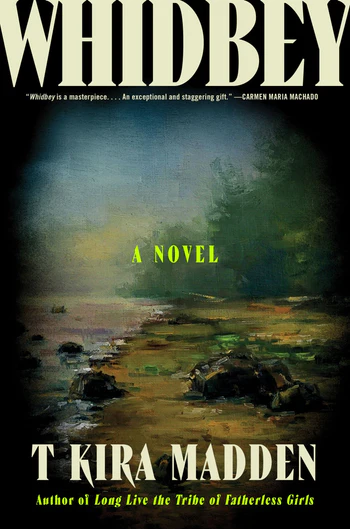
In Madden’s hands, this noir revenge story is full of so much more than blood. Like her memoir, Long Live the Tribe of Fatherless Girls, Madden’s debut novel subverts notions of power and powerlessness, particularly regarding women’s bodies, while asking complex questions about honesty and culpability. At the heart of the narrative is Birdie. Hiding from Calvin, the felon who has recently been released, she is fighting to take back not only her life, but her idea of a future. There is also Linzie, a former reality TV star who publishes a memoir in order to tell her story. But perhaps it is Mary-Beth, mother of the convicted sex offender who molested Birdie, who surprises us most. Despite acerbic dialogue like, “Why are you wetter than a tramp?” and a worldview best captured by the assertion that “Cola passed off as Pepsi would never fool anybody,” we read that Mary-Beth is a mother in pain, having failed either to protect or change her son. Florida, too, is rendered like a misunderstood character, beneath a façade of Winn-Dixies, Mystys, and, memorably, The North Pole Florida Gas & Save, where every day is Christmas. (“In the air: smoke sparkling from constant sugar burn and the always-smell of dead fish.”).
Madden is unflinching in her critique of a justice system that perpetually fails girls and women, and she sets that same sharp gaze on the media and how it defines cultural narratives about rape and molestation. But mostly, we feel her tenderness towards her characters, these women who are searching, hopeful, tough, flawed, ingenious. Whidbey, then, is perhaps less a novel about vengeance, and more about how women survive and go on to tell their stories.
D/AL: As you tell not only Birdie’s story, but Mary Beth’s—and even Linzie’s—there is such a generosity of spirit that seems to arise from years of living with certain questions. What did it mean to you to write this book? Who are you writing for?
TKM: With Long Live, I knew I was writing for a younger version of myself, because that was the only way to get it out. Whidbey is for survivors, but I also wanted to teach people who might be outside of this world about how the system works. There’s nothing in this book that isn’t rooted in fact. So called “Pervert Parks” in Florida are real. People having their address moved to under the Julia Tuttle Bridge after Ron Book’s legislation is real. What defines an explicit threat in the court of law is surprising to people. I wanted the focus not on the perpetrator, as we see in media, like our cultural obsession with True Crime and Ted Bundy, but on the women. To honor these people who are not perfect victims or survivors . . . they’re unreliable, they’re women who lie, abuse substances, who are messy.
D/AL: In “The Feels of Love,” from your memoir Long Live the Tribe of Fatherless Girls, you write about sexual assault. It’s a piece that I often teach, because it resonates so deeply with students, particularly young women. What did immersing yourself in a novel demand that the memoir didn’t, and vice versa? How are you thinking about a work that is fiction but driven by truth?
TKM: I believe, as silly as it might sound, that work continues to speak to you if it’s not over—the way people have dreams and feel their loved ones are visiting with unfinished business. I was editing “The Feels of Love” in the final draft of the memoir when my case went from a state order of protection to a federal trial. I thought I was done with that story, but it kept opening. I kept leaving those courtrooms feeling like there was so much more I didn’t understand and wanted to explore, all these feelings of disquiet and unease. I was thinking about a parent’s allegiance or loyalty to a child. I wanted to better understand the victim-survivor hierarchy that had been made in trial and in court systems where I was called the “credible witness” because I’m a professor, an author, [and] I was able to write my own victim impact statement. Whereas other victims and survivors are not always credited in the same way.
I knew my limitations, that nonfiction would be too limiting to dig deeper, that I wouldn’t be able to step outside of my own rage and confusion and sadness. For me, all fiction is driven by truth—true questions. By opening the scope in a work of fiction, I was able to create characters that animate these different questions and doubts and shadows of that system, the things that have stayed with me, haunted me.
D/AL: I notice that even as Birdie is well loved, she is very much alone. Can you talk about her isolation, and who she might have been had she not experienced such violation at age nine?
TKM: I do think that a question many of us have is, Who could I have been? Who would I have been? It’s a question that really gnaws at me. Like, would I be the same? I don’t know. For every single character, I had a list of questions, all questions that I’ve had for myself: Should someone care about this pain? How do I make them care about this? With the characters of Birdie and Linzie, I’m interested in obsession versus repression. What does it mean when you’re obsessed with what happened to you, versus when you can’t see what has happened to you at all?
I wanted the focus not on the perpetrator, but on the women.
I often get the question, “Why is it called Whidbey when it takes place in Florida?” For me, Whidbey is a symbol, a hope many of us have felt—if only I could go to this place or if only I could do this thing, seek this treatment, this kind of healing, then I could see who I really am. And yet Birdie never arrives at this place because she spends the whole time there living in the past. Birdie, who is obsessed with what’s happened, can’t move forward or live in the present at all. I don’t think Birdie sees a way yet.
D/AL: Birdie is not the only woman looking for resolution. What does it suggest that the women in these pages resort to revenge after justice has failed them and continues to?
TKM: The Science of Revenge, a book that came out last year, is about how acts of revenge—not only the act, but the imagining of it—creates this flood of dopamine. And I think that’s really seductive for a lot of people. Some people do move forward with revenge, and others just live in the fantasy of it, like some of these characters in the book. Like Birdie, I was posed a question by a stranger on a boat: “Would you like me to kill this person for you?” My immediate response was, no, of course. But in the days after I thought, God, what would it have felt like to say yes? Revenge can offer an illusion of control. Or the illusion of confrontation when there’s such a lack of confrontation or accountability within these systems.
I’m obsessed with the show Catfish. It’s kind of embarrassing, but I always have been! And I’ve really started questioning that this year—Why is this my comfort show? Why do I watch this almost every day? Even the repeats. And I think it’s the repetition of seeing someone having to face a consequence, having to face a truth. In almost every episode, there is a confrontation and someone has to look into the camera and look into the person’s eyes and say, “I did this.” They don’t have to be sorry, but they have to be confronted. And in life, that rarely happens. In the courtrooms, that person never turns to face you.
There’s the fantasy, a very rightful fantasy, of just wanting that moment.
D/AL: You’ve alluded to living through your own trial. What has the weight of that been like?
TKM: It’s a really isolating experience. This person has been in my life since I was a middle schooler, and I’m turning 38. In some ways, I’ve spent my life attached to this person, because the system keeps people attached. It’s an impossible thing to describe.
There is this weightiness that just follows you every year of your life. Sometimes it’s the person following you—my abuser was convicted of stalking—but sometimes it’s just the facts following you. The courts, the trials, there is an ongoingness that I think is hard to understand if you haven’t been through it. You think you sign off on a paper and something is fixed, something is healed, someone is punished. But it’s not like that. You go through one injunction, then you have to renew it each year. That weight, that tether, remains.
D/AL: Birdie lies not only out of self-protection, but possibly to recreate herself. Hal, one of your delightful secondary characters, lies because he can’t help it. Mary Beth, Calvin’s mother, lies to cope with the truth. How do fictions hurt and save people in these pages?
TKM: I’m really interested in honesty and dishonesty. I grew up in a house of people with severe substance abuse issues. There’s an old joke: You know when an addict is lying because their mouth is moving. I think it’s fair to say that was certainly the case in my childhood. I had siblings that I was never told about. There is dishonesty that comes with protecting one’s addictions. I’d like to think I’m a very honest person, and sometimes I wish I could be more withholding or dishonest or come up with a new identity, but as a shy, reserved person, everything stays bottled up, and then if I have a little outlet, it all comes out. That’s what the page does for me. And also, I did tell that man on the boat what had happened to me, a stranger, and that’s not a safe thing to do. It’s not a wise thing to do.
For me, all fiction is driven by truth—true questions.
With Birdie, I wanted to know what it would mean to totally step outside of oneself, to be able to change who you are at any given moment. I was really interested in the power of denial, which is also rooted in being a child of addicts. What I’ve noticed, not only in my case but in other cases, is the power of denial in the friends and loved ones of perpetrators of violent crimes. I’ve looked it in the eye. So what is the power of denial? How potent is it, and how does it hold? Where does it break and crack?
D/AL: After appearing on The Dating Show, Linzie writes a memoir, one that appropriates others’ stories even as the media exploits her own. Her handler tells her, “If you overcome one trauma, you’re a hero, but two or three make you a tragedy.” Late in the book, we come to understand just how badly Linzie has been hurt. What does Linzie offer to the reader that we might not otherwise understand or appreciate? What would this book be without her?
TKM: Unpopular opinion perhaps, but I love Linzie. It took me the longest to figure out how to love her, because in the original version she was just a punchline. Because I was writing a memoir at the same time that I was starting this book, and publicizing and talking about that memoir in the years after, I started to feel really guilty. What does it mean that I am doing this media and talking to NPR, and I have this platform where people are like, “This is so brave, I’m so grateful to you,” while these other people who have suffered immeasurably don’t have that at all. They’re living under different names. They’re unable to talk about what happened to them for myriad reasons. I felt this weird guilt or disgust that I was capitalizing on bad things that had happened to me.
My early readers gave me the challenge: What would it take for you to love this memoirist character, or understand her a little bit more? Then, without spoiling it, I understood how Linzie was just another chess piece in this system.
Since Linzie appears on reality TV in the book, I read a lot about reality television and how some of the tactics for the “ITM” (in the moment) interviews are actually very similar to other interrogation tactics. You’re being interviewed for an extensive period of time, with alcohol, without food. There are parallels between memoir, reality TV, the court system—the way victims are presented, how we’re packaged in villain/hero narratives, how we’re directed and media-trained to tell a certain story.
D/AL: Some of the most poignant moments in the book are in the point-of-view of Calvin’s mother. How do you understand someone like Mary Beth? What did it take to get close to her?
TKM: Mary-Beth was always [the] biggest voice in the room when I was writing Whidbey. That voice came first, it came the easiest. I knew her immediately, knew she worked in a Christmas-themed gas station. I knew she drank warm sodas. In earlier drafts, I also wrote her through a whole love story.
My first book investigates how one might love parents who are deeply imperfect and who make the wrong decisions, and maybe Mary-Beth was a way of writing that story in reverse. How do you love a child who has not only ruined the lives of others, but your own? The carceral system has completely disenfranchised Mary-Beth, which is the case for so many family members of those incarcerated, especially the parents and family members of those one the SA registry who have to live within certain city limits. What does it mean to love this person so much and to think about them as a boy, as someone who never grew up or into the person who committed these crimes, despite what they’ve done?
I think about how poverty and trauma can easily trap someone like Mary-Beth. She can’t think about the past. There is no future. She’s too busy trying to survive. All of these characters represent the past, present, and future. I really wanted these three to represent a triptych of traumatic timekeeping.
D/AL: In many ways, this book is one of queer reclamation. You write sex and desire with such complexity. What was it like to write these scenes between Birdie and Trace?
TKM: There was a lot more sex in this book when it was 500, 600 pages.
I want to hold what’s true, hold the suffering, ask a reader to stare at it. I think we’re owed that consideration.
As a queer woman, something that I’ve heard a lot or something that I’ve internalized at certain points in my life is you’re gay because you’ve been abused by a man. We hear things like that often, this idea that after trauma, one is sexually stunted, incapable of sexual desire or freedom. It was important to me that none of these characters would be defined sexually or in terms of their sexuality by the abuse that they endured. I was really curious about a character who’s been harmed like Birdie also being really interested in being a sub, finding safety there—and it’s actually her partner saying, No we have to exist in this kingdom of safety. We must be gentle. Birdie harbors a lot of biphobia because she was abused by a man, and it was important for me to see a character wrestling with that while also feeling all kinds of desires—she’s been harmed but she still wants to fuck, and the most exciting, joyful sex we see in the book is when she is completely submissive.
I wanted to have a book about sexual assault also be a book about sex. I wanted sex and harm to live side-by-side; they need not be connected.
D/AL: Your sentences, in their richness and rawness, resist the genre of noir and actually get us closer to your characters and their vulnerabilities. Can you talk about style?
TKM: A book’s shape—thinking about where it fits in terms of noir or thriller or genre—comes later and is usually influenced by other people, like smart editors. All I can do is try to make the best sentences. Tell the best story.
A major part of this book is perspective—it has first person, third person, and omniscience, because I’m trying to ask the reader, What makes you believe one perspective more than the other? Do you feel closest to Birdie because she’s the only one in first person? And what does it mean to have the free indirect speech of third person POV, and then a conflicting omniscience in part three—what does that do to a reader’s beliefs? What does one then take to be true, or of record? Perspective is its own character in Whidbey.
D/AL: What are you hoping that this book might offer young girls and women?
TKM: The true crime phenomenon tends to center on perpetrators. It’s more palatable or entertaining to read their stories, to populate the minds and bodies and psyches of people committing these crimes. What made them this way? And I think that’s easier than looking directly at the suffering, looking at the people who are impacted, staying with them for the long haul. It feels important to me that I challenge this. I want to hold what’s true, hold the suffering, ask a reader to stare at it. I think we’re owed that consideration.