Interviews
For Marlon James, Being Incurious Is a Writer’s Biggest Sin
The Booker Prize-winning author on reading his way through writer's block, and why every sentence has to risk going too far
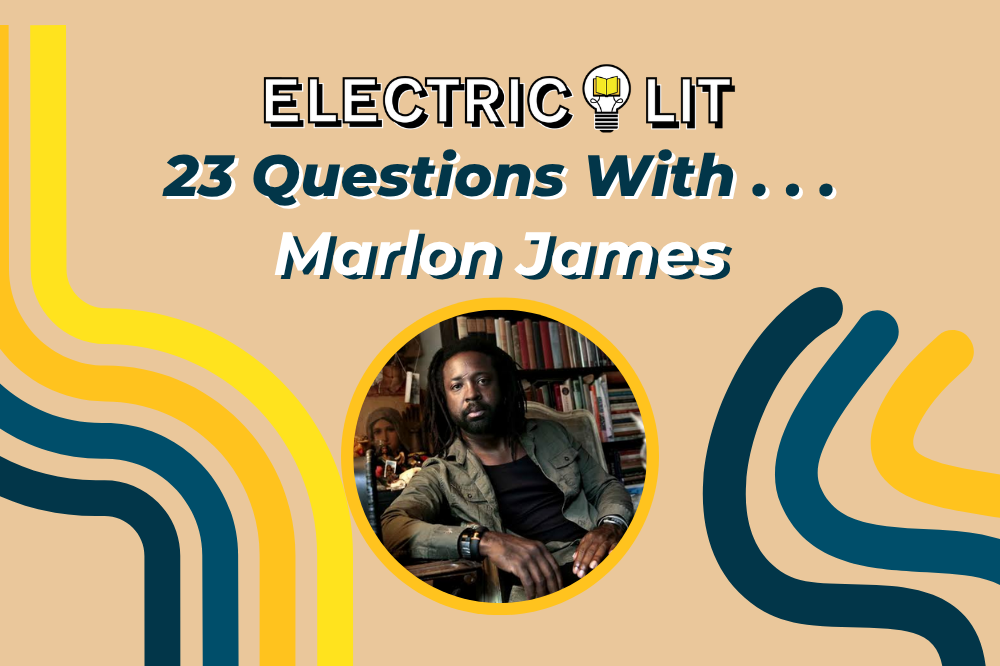
When I entered the Zoom call with Marlon James, he had just put rice on the stove—cooking for a niece and nephew who are, by his own account, “totally unimpressed” by whatever their uncle does. Booker Prize, Time 100, American Book Award, doesn’t matter, they just want to be fed. So 30 seconds into our call, he set a timer for 12 minutes, warned me he’d need to go check the pot partway through, and as I promised I would not keep him long, he told me, with total sincerity, that they could wait: “They’re getting food for free!” He later confessed to making his own version of honey-roasted pistachios, browning the sugar and all, and called himself “secretly a trad-wife.” His niece and nephew may remain unmoved. I will say this once and mean it forever: I am deeply, permanently impressed.
It was a funny way into a conversation with a writer whose work has always resisted the expected. James has written colonial-era horror, a nine-hundred-page political epic that won him the 2015 Booker Prize, a fantasy trilogy soaked in West African mythology, and now The Disappearers, which follows a group of men in Jamaica in the years after a moment of brutal, homophobic violence upends their lives. Some of them try to outrun the past, others try to find out what happened to the ones who never resurfaced. It is, like most of his work, unwilling to sit still.
That restlessness showed up in how he talked about writing itself. He has no concern for “write what you know,” and said so almost reflexively; he’d rather take the risk of getting it wrong, and let research and curiosity pull him somewhere unfamiliar. He reads his way through writer’s block instead of waiting on it to lift. And when I asked how he knows a book is finished, he admitted he never quite does. He’ll write pages past the actual ending before the reader in his head starts telling him, politely, that this relationship is over.
I was thrilled for the opportunity to talk to Marlon about all of this, plus Coltrane, Adventures of Huckleberry Finn, and the bell-bottoms he’s been wearing for decades out of pure, vindicated patience.
— Shandela Contreras
Editorial Intern
1. Describe your publication week in a six-word story.
Marlon James: It was mine, now it’s theirs.
2. What book should everyone read growing up?
MJ: Because I’m Gen X, we’re used to disturbing books. They should read Lord of the Flies. That’s disturbing enough. They should know that they’re little savages.
3. How do you start from scratch?
MJ: Man, if I knew that, I wouldn’t start at all. I usually start by reading, by research. Pretty much every novel I’ve written has come out of something I read and I went, man, that’s interesting. So usually I start reading and by almost like—this sounds weird—interviewing my characters, because I don’t know what the story is yet. They come before the story comes.
4. Three presses you’ll read anything from:
MJ: I’ll read anything from Graywolf. I’ll read anything from Fitzcarraldo Editions. And anything from New York Review of Books.
5. Hardcover, paperback, or e-reader?
MJ: Hardcover. Well, if I’m gonna make notes, I’d rather paperback. I feel like marking up a hardcover is kind of desecration. And I get all the practical reasons why hardcovers make no sense, but I still love hardcovers.
- EL: Me too. I have all my hardcovers on the shelf, and then the paperback is the one that I prefer to take on the go.
- MJ: I use paperbacks to lend out because I got tired of people returning my books in bad condition or not returning them at all. So when they go, “Oh, I love that.” I go, “Wait a minute. Here’s the paperback—you don’t even have to return it.”
6. If you were a novel, what novel would you be?
MJ: Woo, in all my favorite novels, things end badly. I don’t want to be in tragedy. Oh my God. Man, I wanted to say Huck Finn, but I got issues race-wise with that novel. So, if I were a novel, I would say . . . Sula.
7. Describe your ideal writing day.
MJ: It is basically a work day. I get up, I make lots and lots of tea, I stretch, I sit down at my desk at 11:00, and I write until 6:00. And even if I’m in the middle of a sentence, I stop writing.
8. Typing or longhand?
MJ: Typing. I write slow. I need to write as fast as I think, because I will forget the end of a sentence. And I type very fast.
9. What’s a piece of writing advice you think everyone needs to hear?
MJ: Risk it. You got to risk sentimentality, you got to risk saying too much. Risk going too far.
10. Realism or surrealism?
MJ: Damn, in the Trump era. I mean, Parable of the Sower was sci-fi up to 10 years ago—now it’s not. Idiocracy was a comedy 20 years ago, I—wow. I’m going to say realism because realism is no wilder than sci-fi. And hopefully we’re a more rational world in 50 years where nobody will believe the realistic novels, they’re only going to believe the comedy, and the satire, and the sci-fi. They’re not going to believe realism at all.
11. Favorite and least favorite film adaptation of a book:
MJ: Die Hard. People are shocked that that comes from a book. And for my least favorite adaptation, nobody seems to be able to get Dracula or Frankenstein right, and I’m not quite sure why. There is no good Frankenstein. The Bride of Frankenstein is perfect. Nosferatu is a masterpiece, but it’s not Dracula. It’s a vampire, but it’s not Dracula.
12. Edit as you go or shitty first draft?
MJ: Shitty first drafts, and I go right to the end. Because I know people who edit as they go. My problem with editing as you go is that you’re not writing, you’re correcting. Which is fine for some people. But it’s almost as if you stop a car before knowing where it was going. And fine, you stop the car and send it west, but it might have been going east.
13. Best advice for pushing through writer’s block?
MJ: Read. Read a way through writer’s block. This is something my students don’t understand, that there are certain things about creative writing I cannot teach you. It’s different for everybody. For me, it was writing women. Nobody could teach me. I had to read Toni Morrison. I had to read Alice Walker. I had to read Iris Murdoch, Muriel Spark. I had to read, hell, even old stuff like Saint Teresa of Avila. I had to read especially how women write women.
14. What’s your relationship to being edited?
MJ: I love being edited if I think my editor is smarter than me. And I have a very, very, very smart editor, and the thing is, I listen, I trust. I rarely fight an editor on something because the thing about a good editor is that they don’t actually tell you what to write. They can recognize that a sentence, a paragraph, a story needs fixing, but the good editors don’t tell you how to fix it. But they won’t let it go until it’s fixed.
15. Write every day or write when inspired?
MJ: I write every day. When people say they write when they’re inspired, I’m like, oh my God, I haven’t been inspired to write something since 1988. I sit down and do the work because I got to eat. If I were to wait for inspiration, I don’t know what would happen. I will say this though. I think if you set a practice or a routine or a work ethic, whatever you call it, the muses will show up. I think muses have to be convinced that you’re serious. Because they don’t got time to waste; they have more talented artists to spend time with. They have more talented artists than me to spend time with, so I don’t have time to waste.
16. What other art forms and literary genres inspire you?
MJ: I’m hugely inspired by jazz. I listen to jazz every day. I was just listening to jazz. I write to jazz. Alice Coltrane is as important to me as Toni Morrison. Jazz sets the scene so I can enter the writing space. God bless people who like quiet. Quietness sounds like deafness to me. Some people won’t understand, but it’s just not Black, it’s not Indian either, and it is not Chinese, and you want to know something, it’s not Italian, and I need to prepare the room with jazz. I’m not even gonna sage it because I quite like the demons in the room, but I set the stage. Usually it’s Alice Coltrane—any Coltrane, honestly. Alice or John, Miles Davis, Charles Mingus, and I step into the room. And I’m always inspired by crime, by detective fiction. I am always inspired by sci-fi and fantasy. Usually it’s those, the genre stuff.
17. The writer who made you want to write:
MJ: Lots of them. Jessica Hagedorn, Toni Morrison, Salman Rushdie. Paule Marshall, Chris Claremont who writes X-Men. V.S. Naipaul. Nabokov made me not want to write though, because I read Pale Fire. I’m like, I can’t do this. No one can do this, I’m gonna become a stock investor. Like, no.
18. How do you know when you’ve reached the end?
MJ: I never know. I would go on for 30 pages until I realized this book ended 30 pages ago. I fall hard for the people I write for. I write and I don’t want to let go. I have never written the last word and known it was the last word. I’ll keep going until it’s like the readers are saying, dude this relationship ended. Move on.
19. Describe your writing space.
MJ: My writing space is a bedroom, was a bedroom in another life. Actually, it’s covered in drawing stuff because I’m also trying to get back to being an illustrator. So my writing space right now is covered with pictures of naked men from my figure drawing class. There are two easels. My writing place does not look like a writing space. It looks like I’m borrowing a room from an artist space. My desk is actually pretty small. And it’s covered in books, usually the usual suspects. Toni Morrison, who I’ve already mentioned five times in this interview. Hilary Mantel. Love and Death in an American Novel, which is the one book of literary criticism that I think is maybe essential, and people are going to come for me for saying that. I have many pencils, paints, and art stuff as I do writing stuff. I also like looking up and seeing butt.
20. How do you keep your favorite writers close to you?
MJ: I re-read them a lot. I used to dread reaching the re-reading era. I’m like, does this mean I’m old? But yeah, I reread them a lot. I reread Lord of the Flies last year. Every year I read a Toni Morrison, is that the sixth time I’m mentioning her now? This year’s reading is going to be Tar Baby.
I’ve been reading a lot of Solzhenitsyn just to prove that I can do it. Cause them books hard. And if it’s a good autobiography, I read it. And I’m biased because, you know, I’m engaged to somebody who wrote a really great biography of James Baldwin. So it’s funny. Reading it, all I could think about were the parts that stuck to me the most, which were the parts about the writing process, because I’m still trying to figure out how people write. Because it must be more efficient than how I write. I still write like 200 pages just to get to one page. There must be a more efficient way to write than that.
21. What’s the last indie bookstore you went to?
MJ: Representing my neighborhood, the last bookstore I went to was Spoonbill and Sugartown Books in Brooklyn.
22. What does evolving as a writer mean to you?
MJ: Always being curious. It’s my one unforgivable sin—one thing I cannot forgive in a writer [is] if you’re incurious. And there are a few of them out there who I won’t name. But I always stay curious. One of the reasons why I’m always in awe of Jamaica Kincaid, who’s a very good friend of mine, is that she never stops being curious. That’s such a great thing to have as a writer, and I hope I never stop being curious.
23. Outside of literature, what are you obsessed with?
MJ: I am obsessed with getting Japanese fashion at a bargain price, so I’m always on websites, trying to find cheap Yamamoto. I am obsessed with chili crisp sauce. I put it on everything. I’m a Black man in America, there’s some bland ass food I have to eat every day. I am obsessed with waiting for the new Beyonce record because I am absolutely in the Beyhive. I’m also obsessed with waiting for Rihanna’s record, but you know, we’ll see. I’m obsessed with bell-bottom pants. All my bell-bottom pants are from the late 90s, early 2000s, because I knew they would come back. Nobody believed me. One, I knew that they’d come back, and two, they still fit. I’m more proud about that than having released a book. It’s like, I’m walking in my 20-year-old pants. What are you doing?