Interviews
Lydia Millet’s Writerly Evolution Is All About Being More Shameless
The prolific Pulitzer Prize finalist discusses writing outdoors, being brutally honest about writer’s block, and saying no to line edits
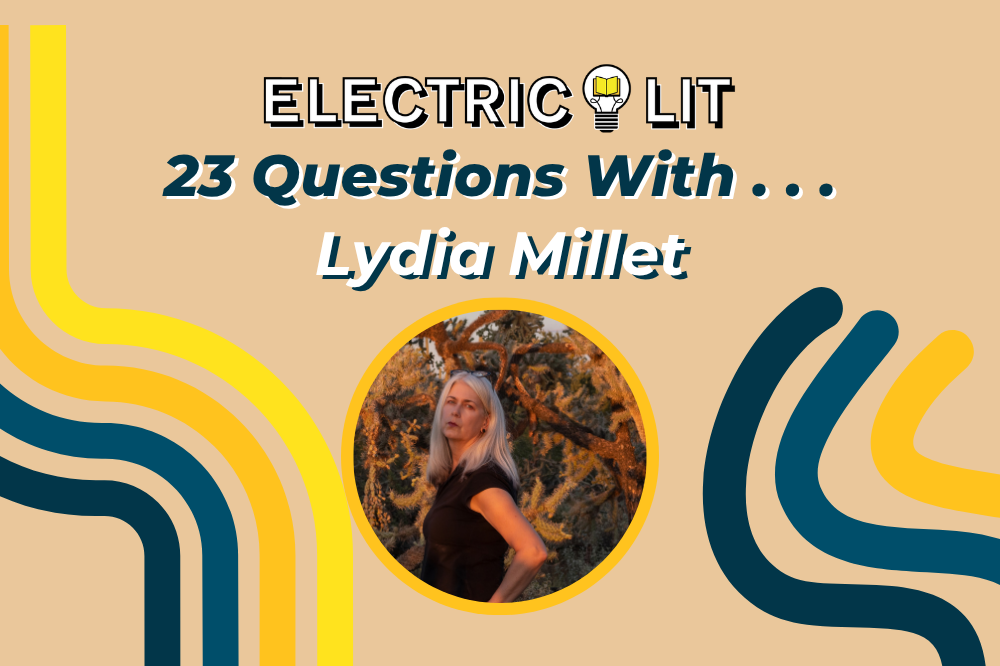
If you haven’t already read at least one of Lydia Millet’s books, the prospect might be daunting. By my count, there are 22 to choose from. Where to start? Do you go back to the madcap beginnings of her career and read the satirical George Bush, Dark Prince of Love? Or do you look to Dinosaurs, a quiet meditation on ecology, community, and loneliness—a book that, for all the disaster it engages with, actually made me happier at the end than I was at the beginning?
In true EL fashion, I have to say both, and. Millet has an astounding ability to write good book after good book after good book. Her concerns with human destruction, fallibility, consciousness, and the limits or limitlessness of our communication become ever more refined, ever more trenchant, ever more beautiful. One woman’s ceaseless interior dialogue, locked alone in a room in My Happy Life seems transmuted into the figure of a boy sleeping joyful and tentless in communion with the great outdoors in her latest book.
It was a great pleasure to sit down and talk with Millet via Zoom in the run up to the publication of Fair Ones, a “double novel” that traverses romance, crime noir, coming-of-age, and honest to god social realism. There she was in her Walmart pavilion, nestled on the edge of a forest in Maine, reciting scraps of French poems she’d memorized in high school and holding forth on the importance of dancing even if it’s not pretty. The boundless energy it takes to write 22 books is on full display in our conversation. And if you’re still wondering where to start reading Millet after this interview, check out her many appearances in Recommended Reading
—Willem Marx
Associate Editor
1. What book should everyone read growing up?
Lydia Millet: The Lorax. That’s a given though. It’s so obvious I shouldn’t even say it. I would also say the Narnia books. I adore them to this day. Or—it’s hard to just have one answer—Philip Pullman. His Dark Materials.
2. Write alone or in community?
LM: Alone. When I was younger, I loved to write in coffee shops and bars. But I no longer do. Here in Maine, I sit in a hut, like a hundred dollar tent-pavilion thing from Walmart. We put it in the corner of our meadow, and I just sit out there. And in Arizona, I have a sort of guest house that belongs to my mother where I go and sit. So that’s my thing, outside and alone. It used to be bars, but I have no tolerance anymore. So what am I going to do at a bar? Just order water? I don’t think so.
3. Three presses that you’ll read anything from.
LM: I’m not trying to be a kiss up, but I would honestly say Norton—which is obviously my own publisher. Once upon a time, I would have said Dalkey Archive. And Wave, which is poetry. That’s not to say that I love every book, but I will read every book and I will love many of them.
4. Hardcover, paperback, or e-reader?
LM: Opportunistic. I’ll read anything, but paperback is number one for me. Number two would be hardback, because I like paper better. But most frequently, I probably read on my tablet. I do all my library borrowing on the tablet because of distance and driving and all that stuff. So all the library books I read are digital. I love the digital library thing. I was always more of a library person. I’m not a collector.
5. If you were a novel, what novel would you be?
LM: A Confederacy of Dunces? [Laughs] No, no. I guess the closest would be one of my own books, truthfully. Probably Ghost Lights. The main character, Hal, is a guy who works for the IRS, and has discovered that his wife has been unfaithful. He’s quite a gentle, quiet person, which I’m not, but I think that I identify with that character most closely. What novel you would be is not the same as what character you would be, but that’s probably the closest I could come. I feel like comparing myself to someone else’s novel is arrogant.
6. Is there a genre you never want to write?
LM: Romance. But also, you could go ultra specific, you know, those genres that are like quilting-pet-psychic-mysteries or something? Some really odd confabulation of genres.
Self-help would be tough. Although I once wrote a book called Self Help when I was in college. It was terrible. Of course, the title was ironic. I wasn’t actually purporting to help others help themselves.
When we were really young, my friends and I—a couple of friends who are also writers—used to fantasize about writing mass market fiction to make a quick buck. In particular, harlequin romances. Maybe it’s different now in the age of AI or in the age of cynicism or something, but I couldn’t write in some sort of weird gesture of mimicry or condescension or whatever. It’s actually quite hard to do that. Your heart’s gotta be in it in some way.
7. Describe your ideal writing day.
LM: I’m fortunate because my ideal writing day is almost like the day I always have—if you take away the worries of life and things that happen, and there are many of those. But just in terms of its structure, it’s the day I get to have most often. I write for an hour and a half in the morning in a private place. And I do the same in the evening. Sort of in the cocktail hour before dinner. And that’s about it. That’s all I ask. And I do that every day I’m not dealing with a crisis or traveling or being sick.
That wasn’t always the case. I used to just have to write during my workday, and I still have a 30-hour-a-week day job, but it’s sort of bracketed by those writing periods. I love my day job, but it doesn’t leave a lot of time for writing if you don’t have someone to help you with stuff like children and dogs and all that. I do have such a person now, so I’m fortunate to be able to write like that. It used to just be 15 minute snatches in between my day job until about 10 years ago.
- EL: What is your day job?
- LM: Since 1999, I’ve worked for the Center for Biological Diversity, which is a conservation and environmental organization. We do a lot of litigation for endangered species, climate change, and public lands. So a lot of scientists and lawyers that I work with every day. I’m like a language gatekeeper. I’m a copy editor and a general editor and I do some writing. I’ve done that 30 hours a week since my younger child was born, so almost 20 years. Wow, I had no idea.
8. Typing or longhand.
LM: Typing. 100 percent. If I write longhand . . . I don’t even know. I’m just a mad woman, just completely insane. My brain is no longer calibrated to write longhand. I know writers who swear by it to this day, at least two of them. But I couldn’t. It would take a lot of work. If I were to be deprived of tech, it would take months and months of work, and then I would probably be a different writer. Not only in terms of measurable things, but qualitatively. It would be a different structure, a different idiom.
- EL: Did you always type?
- LM: No, I didn’t always type, although I always preferred it. As a teenager, I asked for a manual typewriter. I had this Olivetti. Then in college, I had a Tandy laptop. So I remember all these moments of having different things to type on over the years. But I also remember writing longhand while I was at jobs in my early 20s. Most of the writing I did longhand was playful. I didn’t write whole novels that way.
9. What’s a piece of writing advice you never want to hear again?
LM: I mean, write what you know is the classic. Absolutely don’t write what you know, because you’ll be boring and you’ll never learn anything.
Show don’t tell is another one. Of course, there’s a certain truth to all these. They’re meant to be reductive, but I actively disagree with them. It is accurate that you have to have the authority to tell something, and you have to produce that authority, and usually the best way to produce it is by showing in some places so you have the license to tell in others. It’s a partial truth.
10. What is a piece of writing advice that you think everyone needs to hear?
LM: Read a lot. That’s all. Read a lot and read outside what you already know you like.
It is also useful when I teach—which is rare—for suggesting to some students that they might not want to be writers, because if you’re not interested in reading, that should be a signal that writing is not the way to go.
11. Favorite and least favorite film adaptation of a book.
LM: I would say the best film to book ratio, quality-wise, would be The Shining. Clearly. Quality of movie: Excellent. Quality of book: in my view, not . . . you know. Stephen King would disagree, and all due respect, but it’s a great movie.
Going the other direction is obviously more commonplace. Most egregious movie made out of a book? That one I’ll have to think about.
12. Favorite comfort snack?
LM: It’s very specific and right now I’m really in its grips, because it only exists in Maine. It’s coffee toffee crunch frozen yogurt by Shane’s of Maine. I can eat like an entire, what is it, half gallon? It’s bad. It’s not a snack so much as a dessert, but it functions as a snack in my life. It’s a good thing I don’t live in Maine all year round.
13. Edit as you go or shitty first draft?
LM: Edit as I go. I used to be shitty first draft, but now edit as I go. It’s like a compulsive combing through of previous sentences. You have to reinsert yourself into the book every day, and in the process of reinsertion, you notice, like, the coffee stains and smears of egg from the day before, and you have to clean them off.
14. Best advice for pushing through writer’s block?
LM: Any answer to this sounds potentially douchey, so I’m going to take writer’s block to mean something a little different than what it sometimes is construed to mean. I’m gonna take it to mean: a lack of confidence in the work that you’re doing, not an inability to work at all.
I had an instance a couple of years ago where a dear friend read a book of mine and told me it was terrible. And this was a book that I’d been working on for three years. And I just deep-sixed it and I haven’t done anything with it since. Because I believed him, and I still do. As I wrote this book, I was just going along thinking, God, you know, I can’t put my finger on it, but there’s something wrong here. And when he told me what he thought of it, I was like, Oh, yeah, that’s what it was. It’s bad. The book’s actually just bad.
Honestly, ever since then, I have felt less confident in, not all the work that I’m doing, but some of the work. And all I can do is either push through it or put something aside, as I did with that book, and start something new. I think that’s actually a harder thing than just being unable to write.
I feel like the whole construct of writer’s block is a bit silly. Why doesn’t anyone else get that? Musician’s block. What’s that? Filmmaker’s block? Plumber’s block? Well, okay, plumber’s block. But why are we so full of ourselves that we have a special name for our own inability to work at times? Truly, if you are facing tremendous writer’s block, then do something else for a living. It sounds a bit douchey, but that’s what I would say in terms of not being able to do a thing at all. In terms of a crisis of confidence, maybe do a different kind of work for a while.
15. What is your relationship to being edited?
LM: It depends on what the material is. When I wrote a nonfiction book recently called We Loved It All, I was really receptive and incredibly grateful for all the edits I received. And there were many. I just really wanted the help, and I really feel the book is better for it. I feel it was more of a communal effort. With my novels, I’m very open to criticism, but not so open to line editing. You can say to me, “It’s boring for this whole 50 pages.” And I’ll be like, “Oh God, thank you. Yes, you’re right.” And I’ll act accordingly. But in terms of someone suggesting alternate language to me . . . I don’t take well to that. [Laughs] You can tell me something’s bad, but don’t suggest a replacement, because that’s my job.
16. What other art forms and literary genres inspire you?
LM: I love music, eclectically. I love much visual art. I have very strong opinions on all of these things, but not expertise. Poetry, I also love and hate. I think, at its best, it’s the perfect literary form, by which I also mean prose poetry. If I were to place things in a hierarchy, music would be at the top, the zenith, the best incarnation of the human soul. But for the written word, poetry approaches that. It also can be repulsive [laughs], like everything. It is the rare poem that I like and think is excellent.
17. Book club or writing group?
LM: Neither. I think they’re both great, but I’m just not in any. I really enjoy them when I’m invited. Usually you can have a glass of wine at a book club, as you have read in Fair Ones. And I wish I had more readers. More friend readers. It’s just that I would have to really screen, because if you’re looking for someone to weigh in on a draft of something, they need to already like your project and be able to say, This works within your constraints or This doesn’t.
- EL: Does anyone read your drafts?
- LM: Yeah, but not very many people. There’s Jenny Offill, who’s a very close friend of mine. But I write too much, and I hate to always be handing her a manuscript to read. It’s really burdensome. No one reads each of my books. There’s no one I want to burden that way except for my agent and eventually Tom, who I love, my editor. But also, I would never go to him with a first draft. Because you don’t also want to exhaust someone. I can be easily exhausted as a reader and I don’t want to read multiple drafts of something. I don’t know that anyone loves that.
18. How do you know when you’ve reached the end?
LM: Fatigue. I have a pretty short attention span, sadly. I would be a more meticulous writer if I had more patience, but it’s a character flaw—impatience, restlessness. I hate to stand in lines.
19. Writing with music or in silence?
LM: I write in silence now because I’m writing outdoors and I listen for critters and to the breeze. I like to hear all that. But if I had to write inside, I would listen to music with no words.
20. Describe your writing space.
LM: So most of the year, when I’m in Arizona, I’m outside a small, caving-in frame house that’s about 200 or 300 feet square. It’s in the desert, so it’s surrounded by tall saguaro cacti and all kinds of wildlife, including rattlesnakes that sometimes crawl right in front of my feet on the patio and create a situation. They’ll lie in front of the door to the guest house and I’ll be like, “Okay, buddy. I guess I’m not going into the bathroom.”
Anyway, it’s a cement block porch and an old indoor-outdoor table that has a glass top. It’s pretty ugly. And there’s a corrugated roof on the little house. I mean, there are holes in the roof, there are pack rats living throughout the walls. So it’s not luxurious, but it’s really private and lovely. A lot of woodpeckers making loud noises, roadrunners running by, coyotes around, all our critters. So I sit out on the patio at the ugly table on an equally ugly chair.
And when I’m here in Maine, it’s the Walmart pavilion. The reason I have a pavilion is because of mosquitoes and ticks. So I need some screening from them. But I do get frogs in there—frogs and little voles and moles sometimes.
21. How do you keep your favorite writers close?
LM: Probably by constantly stealing from them without even knowing it. I mean, isn’t that what we do? I don’t even know what I’ve lifted. Sometimes I have a horrible feeling of deja vu as I’m writing something. Like, Who am I stealing from today?
22. What does evolving as a writer mean to you?
LM: I guess trying things that I’m not good at. Having the strength to, well, it’s a cliche, but fail sometimes. Or, not even strength but shamelessness.
23. Outside of literature what are you obsessed with?
LM: Obviously, I’m obsessed with animals and also plants and trees and the other elements of nature. I’m obsessed, but not in a way that I like to describe them. I’m just invested in their charisma, and feel sad often. I feel like there are martyrs all around me in the natural world, you know? Like I’m surrounded by martyrs.