Craft
Lessons on Writing and Life from an Elder
As a result of aging, your ego should get smaller, whether you want it to or not. That allows you to see the world through a very different lens
The earliest essay in this book was published in 1992, when I was 40. Back then, my wife and I had only one child, Samantha, three years old. I am finishing this book at 71. My son Tomo is 28, my son Nikko, 30, and Sam, 35, is a Representative in the Minnesota legislature, and mother of Tadashi Sencermura-Witzig, my two-year old grandson.
A year and a half ago, my mother Terry (ne Teruko) died at 91; two months ago my father Tom (ne Katsuji Uyemura) died at 97. In the past few years, all my Nisei relatives, my parents’ generation, have passed. I am now the oldest in my extended family. The elder.
Unlike in traditional Asian culture, I’ve resisted this appellation till now. My friend the novelist, Alexs Pate, still resists it. And yet, at dinner a few nights ago, even he admitted that over the past five years, with the isolation that came on with Covid-19, he’s been feeling a certain diminishment of his energies. He’s still heading Innocent Technologies, an educational business which now has programs all over the country, and they’re about to make a leap into online programs for educators, but he too understands that he and I are in what most consider old age.
In so many ways, though, I don’t feel old. I still do my runs and weight training four or five days a week, though the speed of my runs has become tortoise-like. On the road along the Mississippi, every runner passes me and younger joggers speed by at a brisk clip. I am still able to beat my sons at golf by 10 strokes or more, and I’m dreading the days when they’ll begin to beat me (which I tell them is a long way off). But it’s been many years since they first beat me one on one in basketball.
I don’t think I look as old as my age; like many Asians, I can take 10 or 15 years off and people would believe it. I often jokingly refer to that saying, Black don’t crack, brown don’t frown, and yellow stays mellow. Lately, I’ve taken heart from the late career successes of Michelle Yeoh, who seems more famous than ever and finally duly recognized for her immense talent. She certainly now is a respected elder, whose beauty is acknowledged and who has received her due.
But if I share Michelle’s younger Asian looks, there’s a difference between us: Unlike Michelle, I still feel significantly under recognized. Of course, in this I share the ressentiment of most authors, whatever their age.
Still, I try not to dwell on such feelings. I don’t have a lot of time left. I have a goal of at least 15 books, and this one is my 12th. I’m aware Philip Roth publicly quit writing at 78. Alexs and I have talked about a Black male novelist who was an integral part of the Black Arts movement, but when Alexs interviewed him in later life, that novelist was profoundly bitter and biting about his lack of recognition. As a great admirer of this writer’s work, Alexs understood the man’s bitterness; Alexs could taste it on his own tongue. But Alexs said he never wanted to become that full of rancor. It discourages the writing impulse rather than helps it, and he’s steeled himself against such resentment.
I’ve been shaped by a psychology of scarcity.
And so have I. That’s not always been an easy task. If you come from a marginalized community, in order to evaluate and address that marginalization, you have to focus in many ways on scarcity, on what your community does not receive—resources, privileges, power, psychic safety; you have to address the forces of oppression, aggression and insult. But this can induce in either you or the community a psychology which makes it harder to address progress or plenty, to acknowledge ways in which you are now less marginalized. You think if you admit there’s been progress or improvement or any sort of bounty, that means that you or the community hasn’t suffered in the past or that you are no longer marginalized. Moreover, inveighing on the injustices of the past feels more empowering than admitting those injustices no longer occur or occur with less frequency. On an individual level, your group’s marginalization can, in certain ways, foster a personal psychology where you focus on what you don’t get rather than what you have received. Such a psychology can indeed become a block to your own personal happiness or prevent you from being properly grateful for what you have. I speak here from a personal knowledge of how I’ve been shaped by a psychology of scarcity.
That said, I know I’ve led a privileged and fortunate life, and in so many ways I do feel lucky and grateful. I’ve been able to publish my work, if often at smaller presses. While the couples on either side of our house have gone through divorce, I’ve been with the same woman for over 50 years. I have a close-knit family; my children, their partners and Susie and I get together every week for dinner. Susie and I have our grandson Dash (Tadashi) overnight once a week and I tell people, “It’s so much easier and fun being a grandparent” (admittedly, I’ve had to get used to referring to myself as a grandfather). Summers, I go golfing with my two sons and my daughter Sam’s partner, Lance, and it’s great fun to watch them razz and trash talk each other. As for the rest of my social life, I have fewer literary contacts than I used to, but I live in a marvelously diverse and supportive community of BIPOC artists in the Twin Cities, where I’m considered, as they say, a “respected elder.”
In short, I have been multiply blessed.
Despite all this, this past summer, I fell into a three month long depression. Some of it had to do with my disappointment that my last book hadn’t broken through in the ways I’d hoped, though it garnered strongly positive reviews. Given that the book challenged the fallacious premises of white narratives and the dismissed truths of Black narratives in nonfiction and fiction, perhaps I was still guilty of being disappointed by a lack of white acceptance; but I had also thought the book might have been picked up by a larger portion of BIPOC readers.
Still, my depression also involved more directly personal causes than my literary career. My mother’s death in 2022 had been both expected given her age, 91, and yet not expected—at the time she was more spry and mentally alert than my dad and the cause of her death, bleeding ulcers, was not one we’d expected given her and her family’s medical histories. As a pediatric oncologist, my wife Susie has been present at a significant number of deaths, most of them children; both her parents are gone. In contrast, until my mother passed, I had only been present at one death bed. The ugliness and pain of my mother’s death from her ulcers’ perforations, the blood that was being sucked up and foaming on her lips through a tube in her mouth from her stomach, her whispering to me, “I want to die”—all that struck me in a way that nothing in my life has ever hit me.
After my late 20s and the years of therapy when I was breaking from my family system, my mother and I had gotten along fairly well. I had long ago forgiven her for any of the things that bothered me about my childhood and the ways my parents raised me. But beneath the surface, buried for the most part, was an underground vein of resentment and disapproval on her part, mainly because she hated my writing, hated that I had written of private matters in my family.
I see this disapproval as stemming from my mother’s particularly private sense surrounding family matters and partly as cultural. When talking about my mother’s disapproval of my writing with the Japanese American writers Garrett Hongo and Karen Tei Yamashita a few years ago at the AWP conference, Karen told us of the time in her 20s when she was living in Brazil and her short story was accepted in the annual Rafu Shimpo Christmas literary supplement (Rafu Shimpo is a bi-lingual Japanese American paper that has been publishing since the 1920s). When Karen’s mother learned of this in a letter, she had her father drive her to the Rafu Shimpo office and her mother went in and demanded that the story be retracted, even if it was already in the presses. “Geez,” I replied to Karen, “My mother may have disapproved of my writing, but she never actually went down to the press and tried to stop my work from being published.”
You keep family matters private; that’s a rule of Japanese culture. Having a writer in the family? How could my mother—or Karen’s mother—support that? In my mother’s viewpoint, my refusal of silence or discretion came in part out of arrogance and selfishness, and so my writing was another mark against my character, a judgement she occasionally voiced in indirect and direct ways: “David, you think too much of yourself,” was a frequent refrain from her from high school on.
So this past summer I was also mourning my mother and I guess I am still being affected by her disapproval, which made my mourning less than clean. Then too I had begun writing about her death and my reaction to it, something she would have severely disapproved of. I was upset and saddened and thrown by the abruptness of her passing; I missed her, and broke down several times afterwards. But none of this dissipated my mixed feelings about our relationship or how I felt she regarded me.
Then too I realized in writing about her death, I was also writing about my own mortality, my own coming death. My predicted end seems much more imminent now that I am the oldest in my family.
Of course, my unfamiliarity and lack of attention to death is part of my privileged first-world life. I’m a baby boomer, the generation who proclaimed, “Don’t trust anyone over 30.” We never imagined our later years, despite that Beatles tune “When I’m 64 . . . ” In the past few years, I would sing to my wife that Bebe Rexha chorus, “We are never growing older, we are never growing older . . . .” Susie and I still go out to clubs, still go out dancing with crowds of young people at the Gay ‘90s. But no matter how many years I’ve insisted I wasn’t growing older, I’ve come to a point where the knowledge of my age can’t be denied. And so, like Hopkin’s poem to Margaret, it wasn’t just the leaves passing or in this case, my mother’s passing that I was mourning—it was my life.
Looking over my depression last summer, I feel now that I had to, in some hard way, come to terms with the fact that I was 71, I didn’t have several decades left. Yes, my health is good. But I could drop any time in the future—a month, a year, five years, certainly 10 years—and no one would say it was a surprise; people would regard my passing as inevitable and unremarkable.
With my father’s death two months ago, my sense of my mortality hit even deeper, even if I had come out of the depression from last summer. During the time just before my father passed, I’d take dictation from him about his life. His and my mother’s deaths have spurred me back into writing about our family’s past and Japanese American history. Though my parents tended to avoid speaking about their childhoods and their incarceration by the US government, in their last couple years something shifted in them, and they began to speak more about their past.
I realized in writing about her death, I was also writing about my own mortality, my own coming death.
As the oldest member now in my extended family, I realize I am now a keeper of our history, its vessel and voice. Watching over my sleeping father, a couple days before his death, I was reading Lament in the Night, a novel by Shoson Nagahara, a Japanese immigrant of his father’s generation, which tells the tale of a poor Issei worker who is trying to scrape out a living in Little Tokyo around 1925, a year before my father was born. I looked across the room at a photo of his mother and father, probably when they were married, and I thought of them making love in that year to make my father. Suddenly I felt I could see the streets of Little Tokyo and my grandparents in a way I’ve never been able to, as living vividly in history, as palpable to me in the way they’ve never been. I could acknowledge their importance not just to my history but to American history. I could see them as the center of the screen, not restricted to the peripheries.
Recently, at the Associated Writing Programs conference, I had an inspiring conversation with the brilliant Black Minnesota writer Shannon Gibney about the Black poet Robin Coste Lewis’ To the Realization of Perfect Helplessness, which pairs poetic texts with her grandmother’s photographs. Looking at that book, I realized the family photos that I and my sibling perused after my father’s death are now historical documents. Here’s what Shannon wrote on her FB about our conversation:
David and I were talking about artifacts you find of your family(ies) as you age (if you’re lucky), and then you realize those stories and experiences will die unless you, the writer, decide to work with them in some way. I was also reminded of Bao Phi’s observation that creative writers from historically marginalized communities are often the first historians our people have, as mainstream dominant culture usually has little interest or investment in our stories. And will approach them with a different, often problematic perspective.
I’ve been writing for many years about my family and their past, but I realize that this next book will probably be the last time I do so. Because of this, because of my age, the task is different now. I don’t know what exactly this difference will be; I’ll have to discover it in the writing. But I know it entails the vantage point I’m telling it from—my parents are gone, and soon I will be too.
My friend Garrett Hongo has suggested that part of this next book needs to be about love—the complicated and sometimes difficult love between my parents and me, the five decades long love between my wife and me, my love for my kids and now my grandchild, Tadashi. And I realize this means somehow I must become a different sort of writer, one willing to address more directly feelings and emotions in ways I’ve kept at bay, perhaps through the political, perhaps through the theoretical or through some preconceived notion of literary rigor.
In what ways do I love my parents differently now that they are passed? In what ways does that love help me to see them differently, perhaps in a more forgiving light? Is there a deeper love I’m now allowing myself to feel for them and as I do, does love become for me something greater? Do I love the world more now that I’m more aware I will soon leave it? Is it love which will help me to see my parents and their parents more palpably, more truly, to inhabit or imagine their psyches and lives in ways I haven’t allowed or enabled myself to before? And what part of those barriers were the forces of cultural marginalization and race and what barriers were those in my own psyche and my refusal to more deeply love or find a greater love for them?
That I find myself asking these questions is surprising to me. Just this week I sat on a panel of BIPOC grandfathers. On the panel, one of the things I said is that at my age, your position in the world has drastically changed. You’re no longer the most important generation, you’re not at the center of things. Your kids and your grandkids are the center stage now. You know even more viscerally, new pain by new pain, new med by new med, that you’re not immortal. As Philip Roth observed, “Old age isn’t a battle, it’s a massacre.” You’re on the losing side of time. And so you have to redefine yourself as a man. Young men are always ready to fight, but contrary to Dylan Thomas, it’s ridiculous for an old man to think like a fighter, to always be ready to put up your fists and strike a blow. You have to find another place to stand, another way of regarding yourself. As a result of aging, your ego should get smaller, whether you want it to or not. That allows you to see the world through a very different lens.
I’ve been a writer for almost 50 years. For most, when you’re in your 20s or early 30s as a writer, it’s hard. You don’t know if you have it. You haven’t published much. You’re consumed with doubt, which you often mask with arrogance or self-promotion. But at this stage of my life, I’ve done my work, the work I wanted to write, and I think I have a reasonable sense of what I’ve achieved.
In an article in The Atlantic, “You Might Be a Late Bloomer,” David Brooks looks at the careers of late blooming artists like Cezanne, Grandma Moses, or Morgan Freeman or those late successes from others fields like Copernicus or Darwin, and how they are different from those who flourish early in their careers. Where the younger successes like Picasso or Sylvia Plath make revolutionary and groundbreaking conceptual innovations in their 20s or early 30s, the late blooming artists must take a more seemingly indirect and wandering journey. They’re less motivated by external rewards, and less likely to fit into hierarchies or gather mentors and benefactors (hence in part their longer path to success and recognition). They’re more likely to stray into other fields: “Nobel Prize winners are 22 times more likely to spend large chunks of time as an amateur actor, musician, magician, or other type of performer than non-Nobel-winning scientists are”; when I read this I thought, Oh, I play the piano, I’ve acted, I’ve done performance work. Late bloomers are often mainly self-taught learners with great curiosity and at the same time characterized by “epistemic humility” (There’s a lot I don’t know). After years at their craft or field, they’re at a point of mastery of their skills where they can push in new directions, where they can attack the canvas with boldness and confidence. They find themselves suddenly penetrating through veils of doubt; insights can occur to them that clarify and simplify, that come after years of experience and seem what some would call wisdom.
I see something of myself in Brooks’ description of late bloomers. But who knows? Inevitably, I and my writings will eventually, if not quickly, descend into a deeper obscurity that comes with time passing. I have to recognize now that this is simply how things are, how things have always been. You are not important, you are dust—or as Joni Mitchell sang, “star dust”—but in any sense, you’re not immortal, you’re not going to live forever. Yes, people close to you may be sad at your passing, but to the rest of the world, it will mean nothing, you won’t be remembered, and in that you’re no different than anyone else, despite whatever fame or immortality you hoped to attain with your writing.
But Sam, Nikko, and Tomo will remember me. Dash and yet to come grandchildren will remember me. My paternal grandfather was born in 1880, came to the States in 1898, and Dash will hopefully see the year 2100. I am now a bridge between three centuries, between five generations, and that is where I write from.
Susie, whose grandmothers lived past 100, will probably survive me. And there will be my books, somewhere out there in the digital world, even if libraries eventually vanish.
I’ve been writing for many years about my family and their past, but I realize that this next book will probably be the last time I do so.
And Asian Americans? Certainly the center of Asian American has moved in part from the East Asian Japanese and Chinese to Koreans, Filipinos, Southeast Asians, and South Asians (now the largest group). But eventually perhaps they too will diminish, or at least the stories of those Asian Americans alive now, mostly immigrants and the children of immigrants. By the third or fourth generations, they’ll have intermarried, they’ll be less and less distinguishable from other Americans, though whether that will be in a democracy or an autocracy is still a question to be decided. Whether a significant number of new Asian immigrants will be arriving here in the future is still a question.
Despite my age, I’m not done with writing by any means. As I’ve said, I’m working now on a memoir about my parents, their lives and their passing. Although my father had disapproved of my career choice when I was in college, he eventually came around. He himself had wanted to be a writer when he was younger, and he made a living writing speeches and public relations. Eventually, unlike my mother, he grew proud of my accomplishments, and while my mother never read anything I wrote after my first memoir, my father read all of my work, even my last, fairly difficult book, The Stories Whiteness Tells Itself, not necessarily a book meant to delight an elderly Republican. Perhaps that’s why my loss of him and the pain of his last days—in all his limbs and back—and his suffering with the indignities of incontinence have so affected me (in the span of a few days I changed my grandson’s diaper and my father’s diaper, the smell of his urine will stay with me forever). My mourning for him feels clearer and cleaner than my mourning for my mother.
Then too my father’s death process was less chaotic and sudden than my mother’s. I and my siblings were all able to be present at his passing, and he got to say goodbye to all his grandchildren on Facetime and even to Dash, his great grandson. My father had decided he wanted to die; he said he was in too much pain, he wasn’t going to get better and he had thought long and hard about it. It was a profound and sacred lesson to all of us about facing mortality and death. Before he began taking the morphine and tramadol, on his last day he was calm, accepting his end. One of his last sentences was, “I’m going to see my beautiful wife.”
In his calls to his grandkids, I was impressed with how he talked to each one slightly differently, adjusting his conversation to who they were as individuals. I didn’t know my grandparents and I did not speak to them on their deathbeds. I think of my children talking that day to their grandfather, knowing he was going to die, and I realize we are always talking to loved ones who are one day going to die. Mortality is built into our existence; we just don’t always sense its bones inside us or feel it pumping through our veins. We are all passing through.
And so, I too am preparing to go. Word by word. I look out my window, from my office where I’ve been writing for these 30 years, and the air is unseasonable warm for March in Minnesota, even if the trees are still bare and won’t sprout leaves for several weeks. It’s a day of mild sun, a little overcast. I’ll go running out there along the river road in an hour or so, trying to stave off time and the body’s decay. I’ll think of this piece and this book I’m finishing. I’ll be thinking of the next book, and the next. It’s what writers do. I’ll feel this pain in the soles of my feet that’s more frequent now, I’ll be aching a bit in the knees and afterwards, with tingling in my calves and feet. I’ll worry about the neuropathy that’s only gotten worse in the past few years or my recent A-fib diagnosis. My body is signaling me—your warranty’s over, nothing more guaranteed. You’ve racked up the miles, only a few left. But I love the fact that I can still run and still write and I feel lucky I’m still here. And as she has for decades, she will be waiting for me when I return from my run, as will the next page on my computer.
Once, years ago, I became a race man. Others made different choices. Indeed, most Asian Americans don’t think about race as much as I do; it doesn’t occupy their consciousness in the ways it does mine. Part of this stems from my being a writer, but part stems from something stubborn and inquisitive in me, something uncompromising or, some might say, a too judgmental streak. So be it.
The Manicheans believed that if the world were not evil, every choice would not constitute a loss. But that’s not the whole story. The choices I’ve made are my own, for the life I was meant to live.
It’s been a good, no, a great life.
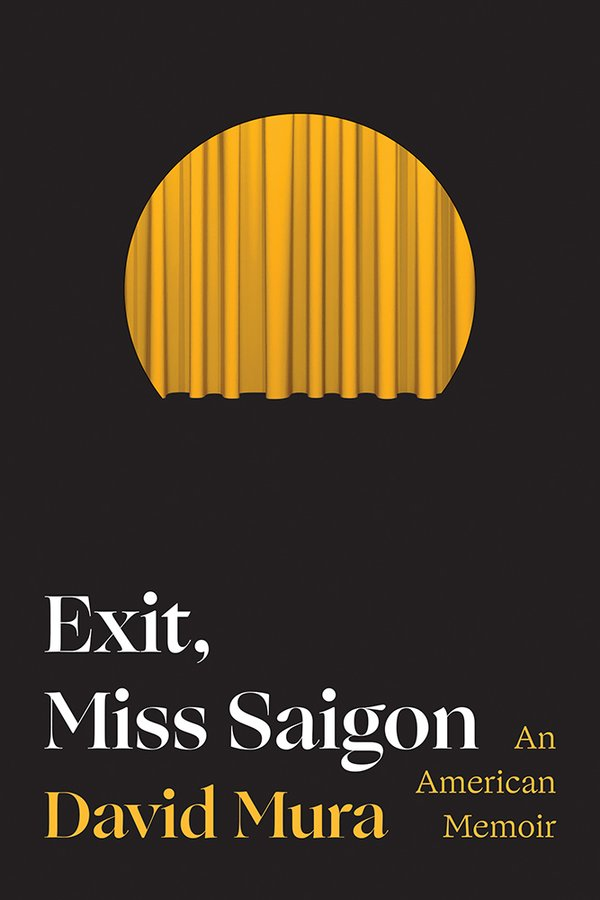
“Writing and the Long Game” is excerpted from Exit, Miss Saigon by David Mura. Published by the University of Minnesota Press. Used by permission. Copyright 2026 by David Mura. All rights reserved.