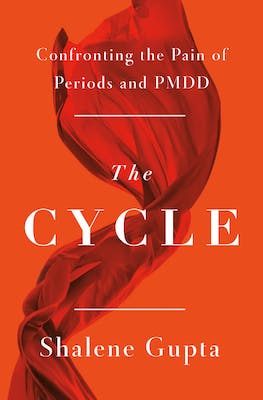
When I started writing my memoir,The Cycle, about being diagnosed with Premenstrual dysphoric disorder (PMDD), I had rarely seen periods in literature, much less PMDD, with the exception of some health textbooks. In fact, my entire understanding of what a period was supposed to be like was shaped by a resounding silence. Periods happen off of the page, out of sight, and out of mind. If I went solely by literature, it’d be easy to believe most people didn’t have periods.
I only realized I had a debilitating condition when I was in my thirties, because I had no idea what a normal period was like. Normal was what my body was going through—I had no idea what other people’s bodies went through. Still, I shied away from reading up on periods and PMDD. I wasn’t sure I wanted to dive into books assuring me that my body was nature’s blessing, or medical tomes that lulled me to sleep. When I finally took the plunge, I found a small but excellent ecosystem of books—and I realized, they had to be. Breaking through the stone walls of stigma, doesn’t just require getting past gatekeepers, it also means being compelling enough to keep audiences turning the page even if they shy away from the subject material. All of these books on this list have broken through the stone walls of stigma. They are explosive in their originality and jewel-like in their brilliance.
Dr. Tang is the gynecologist we all deserve. It’s Not Hysteria is an easy-to-understand guide to gynecology, written in witty, accessible language. (For instance, fallopian tubes are described as “corridors from the ovaries to the uterus.”) She writes from an inclusive lens, covering gender identities, with care and threading BIPOC history and studies through her narrative. Tang walks the reader through the most common reproductive health issues and treatment options, while providing tips for how to discuss them with your doctor. If you’ve ever had a question about your cycle or how your plumbing works, the answer is probably in It’s Not Hysteria.
Periods Gone Public is a thoroughly researched history of menstrual stigma and the ways in which this stigma punishes menstruators. Children end up missing class, adults end up missing work, and the incarcerated struggle to stay clean and thus healthy. Weiss-Wolf managed to combine a strident call to action with a bubbly upbeat tone that simultaneously convinces the reader there’s a huge problem, but we’re all going to get up and do something to fix it.
Okamoto wrote Period Power as an undergraduate Harvard. She shines the spotlight on period poverty, showing how our reluctance to talk about menstruation leads to a reluctance to provide solutions for managing them. This, of course, hits people at the bottom of the economic pyramid the hardest. In clear, chatty prose, Okamoto combines a socioeconomic overview of periods with her own experience of dealing with her period while her family struggled with homelessness. Period Power will make you rage over the tampon tax, and ask the questions we don’t ask in society: What happens to people who can’t afford period products? What do we need to do create a better world for menstruators?
When 16-year-old Bisou gets her first period, she runs into the woods and is attacked by a wolf. Desperate, she breaks its neck. The next morning, the body of one of her classmates is found in the woods. In this dark retelling of Little Red Riding Hood, sexual predators turn into wolves, and menstruation gives Bisou power to kill them. Red Hood is more than a new take on an old fairytale, it lays out a vision of the world where puberty and female friendship allow women to fight back against the patriarchy instead of become prey.
Chloe Caldwell’s period has always been painful and inconvenient, but it reaches a fever pitch when she falls for musician Tony. With spare prose and off-the-wall structure, Caldwell’s memoir recounts the fights, the break downs, and the break ups that punctuate life with PMDD. She layers in a collage of other voices reflecting on first periods, their own PMDD battles, and what it’s like to find community at a PMDD conference. Chloe Caldwell manages to make PMDD, an epically uncool disorder, seem glamorous and chic. The Red Zone combines a period memoir with a meditation on divorce, marriage, and the perils of love.
When Kathleen Held discovers her husband is cheating, she’s not sure which is worse—his betrayal, or being photographed with a giant period stain on her pants. Kathleen is catapulted into internet fame that she did not ask for and did not want. She finds the society for shame, a group of people who have been cancelled online, and decides to “steer into the swerve” and make her new fame work for her. But Katheen discovers that fame can be a double-edged sword, and the fame that made her a household name might also cost her everything she holds dear. The Society for Shame goes down as easy as a beach read, while being a searing commentary on period stigma, and the pitfalls of social media fame.
The Female Malady by Elaine Showalter
Showalter’s classic feminist analysis isn’t strictly about periods, it’s about how superstitions around periods throughout history shaped the modern perception of women being “crazy”. She traces the major trends in psychiatry, sexist policy reforms that barred women from providing mental health care, and the stifling restrictions placed upon women after the onset of menarche. The Female Malady shows how these factors converged to create a society that assumed women were mad because they bled, while simultaneously fostering an environment that incubated depression and anxiety.
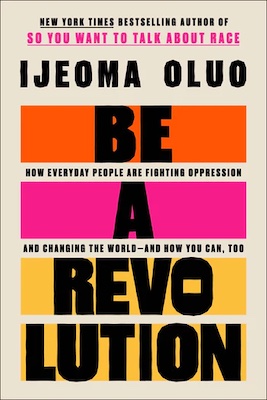
To recover, Oluo began spending time with activists like Tarana Burke, Alice Wong, and Feminista Jones, an experience Oluo found to be “really beautiful. It helped me remember the lineage I’m a part of. We live in a system that really does seek to exterminate us, to take everything it can from us, and then kill us, yet we’re here, which means every day, for generation after generation, we’ve been winning on some level.”
As Oluo navigated her healing journey, she realized that she wanted to share the stories and insights of activists. “It reminded me of how many tools we have at our disposal,” she explains. “How creative we are as people, how loving we are, how fierce we are, and also how much we have to care for each other and ourselves in this work. It really centered me in a way that nothing else I’ve done so far in my writing career has been able to.”
Oluo and I spoke recently by phone. We discussed how racial fears are driving the current wave of book banning, the connections between reproductive justice and racial justice, and why everyone should pay attention to what’s happening with Atlanta’s proposed Cop City.
Deirdre Sugiuchi: You had a conversation with Manny Thomas of Success Stories, a workshop series which aims to help incarcerated men heal from violent patriarchy. Thomas was incarcerated at a young age and discussed how growing up, he didn’t feel he’d live past his teenage years. It’s a sentiment which, unfortunately due to a myriad of reasons, is common to generations of Black children. Can you discuss the implications of generations of Black children believing they will not live past their teenage years?
Ijeoma Oluo: When you’re living under constant threat, there are physical and mental effects to your physical and mental health that are very real. It impacts how you build for a future. How can you build for a future when you’re in survival mode all of the time? What we often have in our community are young people who never get to be young people. You don’t have space for adventure. You don’t have space for learning and growth. You don’t have time to imagine when you’re just trying to survive. What that means then, is we have people who when they are lucky enough to become adults, have never had a childhood, and have never been able to plan and grow through adulthood, and are deeply traumatized. Not only are people robbed of childhood, but they’re not able to fully step into adulthood either. It’s deeply harmful on an individual level, on a community level, and on a worldwide level. Those are years you can’t get back.
DS:Last month marked the anniversary of Roe vs. Wade, the landmark decision that ensured all people had the right to abortion, which was overturned in 2022. Removing access to abortion disproportionately harms people of color. Can you discuss how reproductive justice is also a racial justice issue?
IO: A main tool of oppression that we don’t talk about, of populations of color, in particular, has been the control of reproductive rights and the rights to raise children. Not only looking at times of enslavement, and the rape of Black people, the theft of their children, the forced sterilization of Black, Brown, and especially native peoples and the widespread theft of Native children and of Black children through our child protective services, but also medical racism that prevents, especially Black people seeking reproductive care, from getting the contraception that works for them.
How can you build for a future when you’re in survival mode all of the time?
All of this combined with the fact that even if you do have your child, there’s a good chance that child will be taken from you due to systemic violence and racism, that economic violence and economic racism can stop you from being able to care for your children. There are so many ways with which the rights to have or not have and raise children have been not only stolen from populations of color, but have been a prime tool of our oppression and exploitation. But it’s also important to recognize that this is where these thefts of bodily autonomy are built and protected.
Everything right now that people are up in arms about as far as reproductive choice and freedom has already been done to populations of color and not only has it been tested for effectiveness, it’s been tested for tolerance. They’ve been able to do these things to Black and Brown populations and to trans populations, to directly attack bodily autonomy, especially of those born identified as female at birth or people with uteruses. Once they know the tolerance is there, once they know the groundwork is there, then it’s really easy to expand it across the population.
DS: I’m sure you know this, but 53 percent of the kids in child protective services are Black. Many of those kids are now getting funneled into the troubled teen industry. The way Black and Brown kids are treated in those facilities, due to inherent racist practices, is horrifying.
IO: Right, and it’s a system stealing resources from our communities in order to actively harm our most vulnerable children. Resources that could be going to family reunification, towards support services and treatment programs for parents who are struggling with addiction. Money that could be going to housing for parents struggling with homelessness. Money that could be going to effective contraceptive choices. All of these things that could keep families and communities whole and healthy and keep our children whole and healthy. Instead, those resources are taken and funneled into a white supremacist system that only seeks to harm our kids and destroys our families and multiple generations of our communities.
DS:Can you discuss the different labor movement that emerged in the wake of Covid? What happened to make that change?
IO: With the pandemic, it was very clear whose safety was going to be prioritized and whose wasn’t. It fell upon class and race. Workers were realizing that their lives were on the line and that their employers did not care if they made it through this pandemic, so long as profits continued to be high, and profits were at record highs for a lot of companies. It was really amazing to watch how that mobilized a young labor movement that is more intersectional in nature, that understands race, class, patriarchy, ableism— because that was fundamental to this. It was people fighting disability from and people who were disabled from Covid. It’s a movement that had been long dormant. If anything can save the labor movement that’s been gasping its last breaths in the United States, it will be these young people.
DS: It’s so interesting, seeing the beauty that’s come with the reemergence of the labor movement, but then there’s also the negative, seeing how the pandemic radicalized attacks on public education when teachers were trying to protect themselves.
It’s easier to motivate people with fear than with love.
IO: I would say that even shows in many ways this difference between old labor and new labor, in unions like the teachers’ unions, where leadership is older and predominantly white. They’ve been under severe attack for decades by conservative politicians and pro-business politicians. I have talked with teachers of color who are increasingly telling me that actually their union is one of the biggest barriers they have, to not only their own personal safety at work, but their ability to effectively teach their students, especially their Black and brown students, and fighting off these attacks on education, on what we can and cannot teach our kids, what books are in our libraries. It’s hard to be effective in that battle when you’ve been, as a union, protecting whiteness and patriarchy for a very long time.
DS: Can you discuss how the recent push to ban books and the teaching of history in schools is tied to racism?
IO: Honestly, at its base, it’s more about having a target to rile up fear and outrage amongst the white populace. I would say a lot of these politicians don’t care what’s being taught in their schools, but they do know that this kind of dormant fear, that a lot of white America, across political spectrums, has, that their children will learn something that will expose their part in white supremacy, in patriarchy, in exploitative capitalism, that their children will be turned against them, that fear that they won’t be able to understand their children, is deep and easily activated. It is a way of securing power for a political party that knows it does not represent the best interests of the future generations and is trying to buy time before a rapidly diversifying population understands this.
That fear is really easy to activate. It is a very effective political tool. It’s easier to motivate people with fear than with love. So what we have is a small vocal minority that is able to be activated to end up at our school boards to be making these changes, because even if the vast majority of parents want accurate teaching of history, want children to be able to go to a library and find books that reflect their lived experiences, they’re not as motivated to take it into action because they can’t see the repercussions of how this will impact the children on the other side. When we see these takeovers of school boards, these changes state laws, and county laws, around education, and we don’t see angry parents showing up and saying, “How dare you do this?—it’s because they don’t actually know the real ramifications. The parents who are most impacted, who do know, often have the least amount of disposable time and access to be able to show up at a school board meeting, or at a PTA meeting, or at the capitol.
DS:I live close to Atlanta, where Cop City, the controversial proposed site for a police training center, is located. 70 percent of people in the area are against it. You argue environmental injustice, racism, capitalism, and colonialism all are hand in hand in the development of this project. Can you discuss?
IO: What is happening in Atlanta is very important as its own singular issue, but also as a symbol for patterns we’re seeing across the country. What we have is an area that’s predominantly Black that is trying to invest in business, and is feeding into the idea that local Black populations are a threat to business and profit. The promises made to the future that Atlanta wants to build, which is a white, hyper-capitalist space, is something that even moneyed Black people are buying into. That idea does not have poor Black and Brown people, so it is being sold with the promise that these populations will be controlled, and this massive, heavily militarized training center is that promise. They do not care that 70% of the population does not want this because they don’t see any value in that population. It’s important to recognize this, that the environment will be destroyed, that they don’t care how that impacts the population there, that the people there will be made unsafe on multiple levels, because the idea is to control them or push them out.
These sorts of facilities are being built in multiple places around the country. The way in which they are targeting protesters is a threat to populations everywhere. We have multiple protesters right now facing RICO charges for peacefully trying to stop the building of Cop City, and that is being expanded to all of the other ways in which Black, Brown, Indigenous, and disabled populations mobilize to try to protect ourselves and our communities. This is a threat across the board— the continued cooperation between Israeli military forces and the U. S. police forces that we are also seeing in Cop City, to be able to continue to terrorize and control Black and Brown and Indigenous populations around the world, and then we have the destruction of the environments that would allow our populations to be able to care for ourselves. It matters because Atlanta matters and the people of Atlanta matter, but it also matters because precedents set in Atlanta will be used to further harm communities across the country.
DS:During the pandemic, my husband and I ran a face shield factory in our house, which helped us get through the early stages when people were losing their minds. You and your partner did a similar thing— you created a collective to support Black artists. Can you discuss the empowerment you get by taking direct action in times of overwhelming hopelessness?
IO: What was interesting is I actually did see this as a very racialized phenomenon, because we saw a lot of hoarding of resources by traditional nonprofits and funders of nonprofits during the pandemic, where they were really tight-fisted and said “now’s not the time,” when it absolutely was the time to be giving as much as you could. We saw Black, Brown, Indigenous, disabled, queer and trans populations that always knew that our survival was collectively turning to each other and leaning on each other, when we knew that the systems would choose to not support us in these times. As hard as it was, and frustrating as it is to be a taxpayer and know that that money did not go back into supporting our communities, it was beautiful to remember what is honestly in our blood, which is our collective natures. The way in which people instinctively turned towards the thing that we know gets us through, while so many other communities and entities shaped by white supremacist capitalism were doing the opposite, it was a really illuminating contrast to me.
It was soempowering and connecting. We came out of that feeling personally, much more a part of this beautiful community. No one was turned away. If you filled out your application properly, you were sent funds. Then for us personally after our house fire (Oluo’s house burned down before the pandemic), to see many of the same people that we knew we had sent checks out to rally around us with so much love, was a reminder of how full circle this comes, of how there’s no way you could give to community and not get ten times as much in return if you know how to measure it. That was a beautiful experience in the face of a lot of hardship and trauma.
It was ironic that Zhenia and Ben would come home from spending time with people who had kids and be so giddy with relief and self-righteousness over their decision not to have any that it would make them want to fuck.
They had just gotten back from seeing a high school friend of Ben’s who was in town to fundraise for the Obama campaign and had brought along his whole family. It was watching this friend try to hold a conversation while also wrangling his toddler and switching off with his tense wife on something ominously called “The Baby’s Bedtime Routine” that made Zhenia and Ben, now in their empty, quiet apartment, feel engorged with smugness.
“You can’t really go anywhere,” Zhenia said, leaning out of the bathroom midfloss to continue the shit-talking they’d started in the car. “You can’t even have a conversation. Having kids makes people so rude. Can you imagine just letting your kid stand in front of your face, yelling and interrupting like that?”
Ben was naked in bed already, absentmindedly stroking his nipples.
“It’s true. What did we even talk about? He’d ask me about work, and then as soon as I’d start to answer, he would shift his attention to his screaming child, and I didn’t know what I was supposed to do in that situation. Like, am I supposed to wait? Am I supposed to answer over the screaming child?”
Zhenia spat in the sink and dried her mouth with a towel, laughing. “I would have loved to see you yell over that kid like you were in a loud bar or something.”
When she stepped out of the bathroom, Ben was using the sheet to fan at his erection.
“What are you going to do with that mouth?” he said in a funny voice.
“I cleaned it just for you.” She bared her teeth.
Then they had sex freely, with all their fluids sterilized.
A strange image appeared to Zhenia right after she came, of her grandmother boiling the drinking water—vivid and metaphorical. She thought her grandmother could visit her like this only if she were dead, so even though it was late, and even later on the East Coast, she called to make sure that her grandmother was still alive.
Zhenia thought about that visitation again a few weeks later when she noticed that her period was late. Ben had gotten a vasectomy as soon as the union gave him health insurance, and she’d been on the pill for years, so she wasn’t really worried. She took a pregnancy test just to confirm what she knew—that pregnancy was impossible—but the test was positive. She’d gotten the first pregnancy test from the dollar store, so she got three more from CVS, in case the first one was defective.
Why was it so cheap? It must have been wrong, she assured herself, as she peed on the more expensive ones in the pharmacy bathroom. It wasn’t wrong. She was pregnant. The nausea started almost immediately.
That day during her shift at the hospital where she was working as a translator she had frozen several times, mid-sentence, hand up, eyes closed, waiting for the wave of nausea to pass over her.
She knew that she would need to have an abortion. What other option was there? She’d had one before, and unlike in the dramatic way it was portrayed in movies and on TV, it wasn’t a difficult choice, she wasn’t traumatized afterward, and no part of her regretted that decision. Yet now, somehow, it did not feel like a possibility at all. Why was that? Ben had always been clear about not wanting children. Forcing a child on someone who didn’t want one was barbaric. But hadn’t she also been sure that she didn’t want one until, suddenly, she did?
She called her grandmother to tell her the news. Her grandmother had stopped being able to outwardly understand things, but it was still possible, Zhenia thought, that she was at least partially in there. Anyway, she was the only person whom Zhenia wanted to tell.
She called the house and her mother answered.
Zhenia had been hoping that it would be Nathaniel, her stepdad, because he lacked curiosity and never asked questions. He’d married her mom when Zhenia was six years old and was the only father figure Zhenia had ever known, and yet she never thought of him as “dad.” But, he was a reliable presence. He could be counted on to shuffle up the stairs with the cordless phone and hold it to her grandmother’s ear and not think anything of it afterward.
Her mother, though, was a different story.
What gibberish. Don’t use your grandmother’s dying body as your confessor.
“Zhenichka.” Her mother, Marina, was already sighing. “What gibberish. Don’t use your grandmother’s dying body as your confessor. You want to help your grandmother, come back here once in a while and help me take care of her. Change her sheets. Brush her hair. Massage her legs with lotion so she doesn’t get sores. Do something practical for once. Don’t whisper bullshit into the phone while I hold it to her unhearing, unseeing, unthinking, but still somehow living, head. It’s grotesque.” Then she hung up.
But what did her mother know about what Baba Vera could or couldn’t hear? And if her grandmother had been able to speak, she would have surely disdained the “practical.” She would’ve wanted exactly what Zhenia was offering, the contents of her heart.
A few days later, Zhenia and Ben went out to dinner at the Thai place in the strip mall across the street. She thought she would tell Ben then, but she didn’t. She felt instinctually protective of what was growing in her. Telling him, she sensed, would let the air out. Or, in. Wasn’t that how Hemingway described an abortion in “Hills Like White Elephants”? “It’s an awfully simple operation. Just let the air in!” The characters never talked about it directly. She’d read that story in a high school English class after having her first abortion and laughed at the melodrama of it, laughed hysterically enough to be sent out into the hallway. Part of why she couldn’t stop laughing was because the boy in her class who’d impregnated her had thought the story was about a lobotomy.
And now, what? She could at least feel the pain of the woman who was being strong-armed into something she didn’t want.
Ben was telling her about the reality show he edited—how one of the women was on a weird citrus diet and was eating oranges with the skin on. He’d edited a reel of her spitting seeds constantly into her hand. That woman’s husband was rumored to be a psycho, maybe even a murderer or serial predator. What if there was footage of him in the background of a scene they’d shot at their house, holding a murder weapon?
“It’s funny,” Zhenia found herself saying, as though it related to what he’d just been talking about, “that something can be nothing or everything depending on what value you assign it.” She was thinking about how the last time she’d been pregnant, she had definitely thought of what was growing inside of her as cells, and this time, already she’d begun thinking of it as a baby.
Ben stared at her, waiting for her to follow up that vague statement with an example or an explanation, but she didn’t. Instead she lurched across the small restaurant to the bathroom and vomited up shrimp.
Zhenia had met Ben at NYU, six years ago, when she was a sophomore and he was a grad student—they’d met in her dormitory cafeteria a year after the Twin Towers had collapsed. Their first date was to Kim’s Video and then to his grad housing, where he kissed her, finally, on the couch in the common room in the blue glow of the DVD menu. A few months later, halfway into the spring semester, they dropped out of school and moved to LA for pilot season together with their friend Naomi, imagining a life in which they would all become successful actors.
Zhenia’s mother had not taken the news well. “You’re not even in the acting program!”
Marina was a biologist who studied how bacteria communicated. As for how humans communicated or searched for what was in their hearts—this did not interest her. Any academic discipline without a clear and direct path after graduation was questionable. That Zhenia was an English major had already seemed stupid but not nearly as illogical and arbitrary as this decision to pursue acting in Los Angeles.
“I don’t need the school’s permission to be an actress,” Zhenia had said, though whether she believed this or not, she wasn’t sure.
“Marina, let her go.” Zhenia’s grandmother had picked up the phone in the other room and interceded on Zhenia’s behalf. She’d blow into Zhenia’s sails herself if she had to. “Let her become an actress, that’s a great idea,” she’d said.
The fact that Zhenia had never acted or expressed a real interest in acting, that she hadn’t even made it past the first rounds of auditions for her high school plays—were these not valid points to make?
“Mama, you know that’s just because I have a quiet voice.”
“In Hollywood they’ll have microphones,” her grandmother agreed, “and in movies the acting is different, it’s not even acting. That is the point, I think. You can talk quietly, but with intensity.”
Who knows what her grandmother had actually believed. Anything would have been a great idea, to just get her away, to protect her from Marina and from herself. She knew that her health was failing, that her mind was failing, and she did not want her little Zhenichka to bear witness to any of that. Whether Zhenia wanted to bear witness to that was beside the point. “Let her get to LA and if not acting, she’ll find something else.”
“Idiocy,” Zhenia’s mother exclaimed, finally angry enough to switch over to Russian. “Total idiocy! What have I been paying for the last two years? You and Babushka plotting and scheming . . . Take her with you. You two headless dodos. Nothing she has done in my entire life has made any sense, and all of it has been with the end goal of irritating and hurting me because she knows that as much as I would like, I can never be rid of her!”
After she moved to Los Angeles, Zhenia would call every week—she’d save up funny stories about Hollywood ladies with dogs in baby strollers and men with misspelled tattoos—but as the months went on, her grandmother grew vaguer and quieter, hiding her confusion as much as she could, missing and postponing their calls more and more frequently until eventually she became indisposed. Zhenia tried to get information from Greg, her little brother, really half brother, if she could catch him between his cello lessons and soccer games. Her mother did not like them to have an unmediated relationship because she worried Zhenia would contaminate him with her impractical and poorly thought-out worldview.
“Wouldn’t it be cool if you went to the Chestnut Hill Cinema and there I’d be on the screen, my face the size of a house?” Zhenia would ask.
“That would be cool,” Greg would say uncertainly. “Did you get a part in a movie?”
“Not yet. How’s Babushka?”
“I’m not allowed in her room. She doesn’t like me in there.”
“Is she in her room right now? Mom said she went out.”
“She’s in the hospital.”
Which is how Zhenia found out that it was serious. The hospital didn’t keep her long. There was not much they could do for her. Instead, she deteriorated slowly at home, and Zhenia stayed away, diligently going to auditions, using her mom’s credit card to take improv classes and get headshots. Zhenia got a job, first at a coffee shop and then, putting her Russian skills to use, as a medical translator. Zhenia’s Russian had been a huge point of pride for her grandmother—it was their private language. Vera would brag to anyone who would listen about how unusual it was for someone who immigrated at the age of five to hold on to their mother tongue so well, especially since Zhenia’s mother spoke English exclusively at home to Nathaniel and Greg.
In her first and second years in LA, Zhenia had flown home to visit a few times, but she could see that it put too much of a strain on her grandmother to make things look normal, to try to hide from her beloved granddaughter the truth of her condition. And when Zhenia had said something about moving back, her grandmother had howled—“I don’t want you taking care of me. No! What gibberish. This is the last thing I want!” Zhenia understood then that she was being banished, and when she didn’t come back for Christmas she could tell that everyone was relieved, maybe herself included.
Zhenia and Ben auditioned for things endlessly until Zhenia eventually gave up and then they married each other.
Everything felt temporary, and since there were no seasons in Los Angeles to track time, you could avoid accounting for its passage. Five years went by in this way. Naomi got a part on a TV show that went to series pretty soon after they’d moved, and Zhenia and Ben auditioned for things endlessly until Zhenia eventually gave up and then they married each other.
The next night, Zhenia was lucky because her mother wasn’t home, and Nathaniel was bland but helpful. She lay in bed next to Ben, talking to her grandmother in Russian, about the thing she wanted to talk about with Ben but was too scared.
“You’re disappearing and this baby is appearing,” she said to her grandmother, “and the two feel connected to me. I can’t afford any of this, that is definitely true, but poorer people have had babies. Mom had me under much worse circumstances. But, she had you to help take care of me. To love me. There’s also the fact that my husband doesn’t want a baby. He has always been completely certain about this.”
Her grandmother’s breathing was an even whistle. Zhenia heard Nathaniel clear his throat. The phone must have been on speaker, and though Nathaniel’s Russian wasn’t great, he’d taken enough evening classes early on in his relationship with Marina that he must have been able to understand the gist of what Zhenia was saying.
He cleared his throat again, this time in order to speak. “We could help you,” Nathaniel said, “if you moved back here. I’m sure your mother would be happy to—”
Zhenia hung up. The broken fourth wall. She could see how in his eavesdropping, it must have felt to him like she was making a confession. Laying herself before him for the saving. And her grandmother was just a pretext. A bearskin rug to lie on top of.
Ben turned the page of the script and looked up at her. He pulled the cap to the highlighter out of his mouth. “What’s up?” he said.
Take a picture in your head, she thought, this is the face of the person you are about to betray. The thin strand of saliva connecting his lip to the neon pink cap.
“Do you believe in reincarnation?”
“What?”
He obviously didn’t, so she didn’t know why she was framing it like this. She was wondering whether the baby growing inside of her could be the reincarnation of her grandmother. This felt both irrefutably true and completely irrational.
“Like, say you did,” she went on. “How would it work, do you think? Does one person need to die and the other need to be born at the same exact moment? What if someone was half-dead, their body still on earth? And what about the whole question of new souls, and the population growing? Do souls split, and in the process do they deteriorate? Or do they split and grow the way cells do, multiplying continuously?”
Ben wiped his chin and put the cap back on the pen. “And by soul you mean . . . ?”
She felt absurd, because she didn’t really believe in souls, or maybe she did, but she still realized that it was absurd.
“You’re so Russian.” Ben laughed, looking down at his script. He flipped a few pages back, then smacked his chest with his fist. “My Russian soul!” he said emphatically, with a thick accent.
She stared at him, until he stopped snickering. He had an audition the next day for a prestige series about Nikola Tesla. He still went on auditions occasionally, even though his career as an editor for reality television was thriving. She picked his hand up, lifted it high, and let it drop limply onto his lap, knocking the script off the bed. He looked at her, still smiling but with a building sense of dread. The dread was catching up.
Maybe she could wait until she began showing to tell him. She should at least wait until after his audition because it could be a big break for him. He didn’t get auditions like this very often, and the role—hairy, large nosed, wiry—it was basically written for him. This news could sabotage him. It might distract him and get his head out of the game.
“We’re pregnant,” she said, which sounded weird as soon as she said it. The “we” a little try-hard.
He nodded like he understood the joke. She was getting back at him for the Russian-soul stuff. They nodded at each other like two bobbleheads until she got up and brought him the four pregnancy tests. They were a week old now and yellowed, but the blue plus signs in the second windows were still visible against the discolored backgrounds. She kneeled before him with the plastic sticks and put her head sideways on the bed, so she wouldn’t have to look at him.
I’ve lived in Alabama my entire life, and if I’m being honest, I doubt I’ll ever leave. It’s my home—my beautiful, strange, complicated home.
My new speculative/magical realism short story collection, Crocodile Tears Didn’t Cause the Flood, has a particular fascination with the American South. In my latest batch of stories, there is an enormous pond monster captivating crowds in rural Tennessee, a vampire family, also in rural Tennessee, trying to keep its organic garlic farm going, and a young test-taker challenging an Alabama monster she knows quite closely. Even when the stories aren’t explicitly set in my part of the world, readers will still find quilt makers, Mason jars, and front porches. To me, these are images of the South I know.
I don’t think the phrase “Speculative South” is a thing, but maybe it should be. I began thinking about how folks from my neck of the woods—meaning writers with ties to the American South—are putting out some of the weirdest, coolest, and most thoughtful speculative fiction and magical realism there is.
Here are seven stories to get you started with exploring the contemporary Speculative South:
“The Acts of Velmajean Swearington Hoyt and the New City of God” by Randall Kenan from If I Had Two Wings
One of the greatest magical realism writers to ever do it, North Carolina’s Randall Kenan sadly passed in 2020, but his incredible legacy lives on. His last collection contains one of his best short works, and it’s a story about faith—and miracles. The titular protagonist gives the impossible. She cures. She brings back the dead. The perfect ending of “The Acts of Velmajean Swearington Hoyt and the New City of God” further proves the story’s brilliance.
Kentucky author Whitney Collins begins her fantastic—and fantastical—story “Lonelyhearts” like this: “Lenora’s first heart arrived in a box of Rice Krispies. It fell into her cereal bowl with a damp thud, and for a brief moment she mistook it for a hunk of roast beef.” And the story only gets better. Collins’ story, full of literal hearts, is full of tenderness, loneliness, and love.
Originally from Georgia, author David Lawrence Morse gave us one of the best magical realism collections of 2023 with The Book of Disbelieving. The book’s opening story, “The Great Fish,” is probably my favorite. In it, Ceta, a whale, holds an entire village on her back. The villagers know little of what is beyond their immediacy. What unfolds is a wonderfully sharp story about belief and truth.
Becky Hagenston, Professor of English at Mississippi State University, is one of the best magical realists around. Read her latest collection, and you’ll see all the proof you need. “Hi Ho Cherry-O” is the Hagenston story I most recommend. All you’ll want to know going in is that there is a board game researcher, her lost-in-virtual-reality husband, and a “Service Robot” named Wendell. It also doesn’t hurt for me to tell you that the story is about connection (and disconnection) and the relationship between humans and technology.
South Carolina author Dan Leach delivers some excellent magical realism in “Fixers.” Early on, the narrator tells us, “My abdomen, which had previously been flat and muscular, now consisted of a bubble of flesh the size of a summer melon.” Soon, a television wizard enters the picture, and more bodily chaos ensues. The story, which looks at the power of love and curses, is a stunner.
In “Tiny Bones,” Arkansas-based writer Jen Fawkes takes a wildly imaginative and equally tragic look at the witch from the classic Hansel and Gretel fairytale. Fawkes story, brimming with pathos, guilt, and self, showcases hunger most of all. From a collection that reimagines some of the most memorable villains to ever be on the page, “Tiny Bones” is a standout.
“Decomposition: A Primer for Promiscuous Housewives” by Jamie Quatro from I Want to Show You More
Tennessee writer and teacher Jamie Quatro takes on fabulism beautifully in several of her stories, but it’s “Decomposition: A Primer for Promiscuous Housewives” that I find myself returning to the most. In this story, a corpse rots away in a couple’s bed. The husband doesn’t believe the corpse is real. The wife dreams of possibilities. The story is so layered, too. Yes, it’s about a slowly rotting (almost magical) corpse, but it’s also about adultery, grief, faith, and sin.
Hey, girl, it’s me. The book at the bottom of your “To Be Read” pile. I thought maybe tonight we could hang out. You can slip me out from under this stack, slide between my pages, and get to know me better.
We deserve some quality time, just you and me, away from the eight books you heaped on top of me. And those four next to the lamp.
I’ve been on this bedside table for two years, and I want to take this relationship to the next level. Girl, I’m ready to open up for you.
It feels like just yesterday you were at the bookstore with your friend Ainsley and she was like, “Have you read this? You HAVE to get it!” I felt the thrill of your fingers stroking my spine. In a flash, I was at the cash register, then in your bag, then your bedroom.
My diction will thrill you but I need to be on top.
You didn’t touch me that night, which was surprising given our whirlwind courtship at Books Are Magic, but I respect your pacing.
I figured I’d get picked up in a day or two. But then you put that Sally Rooney novel on top of me and I was like, hmmm. Okay. You’re reading other people. That’s cool.
Then The Nickel Boys showed up. Then aJohn Grisham book you bought while stuck at Newark airport. Then Do-It-Yourself Basic Home Repair. No idea where that one came from. The point is, my diction will thrill you but I need to be on top.
I’m beginning to show signs of age. A coffee stain on my cover. Some dust. A splotch from when you used me to kill a spider. I noticed your Toni Morrison book doesn’t have a splotch.
But let’s not talk about that. Let’s talk about us. I understand a fine reader such as yourself can’t be tied down. I’ve watched you read many others. But even though we both consented, it doesn’t mean I don’t get jealous.
I just wish you’d commit because I know how to satisfy you. And not just my skillful foreshadowing and extensive wordplay. Once you see my strong character development and grasp my firm plot, you’ll be turning my pages faster and faster.
I know you like to see what else is out there. I’ve watched you scroll through BookTok. I saw you updating your profile on Goodreads. We both know you aren’t “currently reading” 103 titles but hey, everyone’s playing the same game, right?
I can’t ignore the nights you get dressed up and go out to the local bookstore. Ainsley will text about some hot author with a write-up in the Times doing a reading and sure enough, you stumble home with another book, sometimes two.
It’s a lot for me to bear. Literally. You seem to have a thing for hardcovers.
I don’t mean to pressure you. I don’t want to be like your Book Club books. You get halfway through and then start rushing because you’re afraid you won’t finish in time. Skimming leaves everyone unsatisfied.
We’ll take it slow. First, we’ll start with an epigraph. Then Part One. It might take a while to get immersed in my smooth rhythm, but by Part Six, I will have touched you in ways you won’t forget. I promise my climax will make you cry.
Girl, sometimes I wonder if you’re just a tease, gathering up books but not going any further. There’s a word for that: tsundoku, the art of buying books and never reading them. Is that all I am, an object to be collected then ignored?
Babe, I know you. The real you. I remember the poetry phase. The World War II historical novel phase. The “I should learn more about philosophy” phase. And now the latest Pulitzer and Booker winners. No disrespect, but I was out in paperback before they were glints in a publisher’s eye.
So let me thrill you with my free indirect discourse. If you’re feeling curious, we can dabble in intertextuality.
I’m in medias res but if you’re not ready, I’ll wait. Just don’t forget that I’m here and drunkenly order another one of me on Amazon. I’m pretty sure that’s how we got two copies of Atomic Habits.
Wait, what’s happening? You’re moving things around. Taking books off me one by one. Is this my moment? Girl, get ready for my unconventional narrative structure to rock your world.
Oh, whoops. Okay, sure, just put that wine glass on top of me. No worries! Maybe some other time.
Electric Literature is pleased to reveal the cover for the book Unsex Me Here by Aurora Mattia, which will be published by Coffee House Press on September 24, 2024. Preorder the book here.
“These are stories about attempting to outrun time; about trying to remember transfemme pasts; about magic touching everything except the possibility of lasting love.”
From a shapeshifting garden somewhere in Michigan to a West Texas town with a supernatural past, from a stalactite cavern in the birthplace of Aphrodite to a secret waterfall in Texarkana: from nowhere to anywhere, Aurora Mattia chases glimpses of paradise. Her gemstone prose shatters into starbursts of heartbreak and rapture, gossip and holy babble, bringing together a cast of spiders, sibyls, angels, mermaids, girlfriends, and goddesses in vain pursuit of their unnameable selves. Their perils are as dense with symbolism as they are refined by desire—if beauty is the labyrinth, it is also the light.
Tied together by the strings of a corset, Unsex Me Here is a dazzling showcase of other worlds near and distant, and the high femme ramblers who’ve found and lost their way through them.
Here is the cover, designed by Tree Abraham.
Author Aurora Mattia: “My family is from East Texas, but the Texas-of-my-mind, the Texas that pulls my dreams across towns and timezones—the Texas where my great-grandmother Bobby was sent to live in a single mothers’ home after a lowlife boyfriend got her pregnant—is across the Pecos, among ghost town ruins, beneath the high auburn walls of mesas like immemorial clouds calcified by heat and slow time, and come to rest. So it makes sense for the cover of Unsex Me Here to reflect that supernatural place where I first saw the moon rise; and it only makes sense, since all life began within hydrothermal heat vents—enormous cracks—in the ocean floor, for an infinite ravine to split the desert in two, because that very desert, where anyone can happen upon an ammonite fossil, was once itself an ocean floor, the Permian Basin. And so it only makes sense, in that northern corner of the Chihuahuan Desert, for iridescent forms—bubbles, blobs, mutating globules—to wobble and rise from such a ravine, on the verge of shapeshifting into something known, or at least something knowable, because, as the women in Unsex Me Here believe, iridescence is:
the oldest force in the universe, its most fundamental expression, i.e.,
the antimatter nectar of nothing, i.e.,
the precondition of all life.
And what could be more transsexual than that?”
Designer Tree Abraham: “Mattia’s decadent surrealist language is a designer’s dream. There was so much description of an Empyreal world made of luminescent surfaces and mythological collisions. The initial cover concept was inspired by a passage in the book:
‘To let loose a swarm of butterflies from the cracked earth, but I am not made to show you butterflies, I am made to show you trampled wings and the uselessness of beauty. I want so much to give you paradise, I am trying my hardest, I promise. I have at last exhumed my phrases and though they are damp and humid and many are rotted like wet leaves I speak them anyway.’
The cover had butterflies escaping from the crack. The author wanted something other than butterflies. I pulled the orbs from another concept, feeling these vessels of watery air offered similar optimism as they floated up from the hot dry earth. Taking notes from Mattia on color and type ultimately made this cover better than I could have imagined, but not nearly as fantastical as what lies inside.”
Several months before my short story collection Sex Romp Gone Wrong was published, I started joking that my new book was already banned in Florida and Iowa. It wasn’t entirely a joke. Both states had recently passed legislation requiring any materials depicting sex to be removed from school libraries. The laws also said schools couldn’t teach younger students about sexual orientation or gender identity.
In the 2022-23 school year, according to Pen America, “over 40% of all book bans occurred in school districts in Florida.” But districts in plenty of other states have also been facing challenges, usually over books that feature characters of color, discuss race or racism, have LGBTQ+ themes, depict or mention sex, or include language the challengers deem offensive.
Often, the folks involved in trying to ban books (who, it should be noted, are a vocal minority) admit they haven’t actually read them. In August 2023, harried administrators in one Iowa school district used AI to try to figure out which of the books under review depicted sex. They didn’t think they could actually read all the books by the new law’s required deadline for removing restricted materials, so they turned to algorithms for help. It would be laughable if it weren’t so terrible.
Sex Romp Gone Wrong is about women and girls at different stages of life, navigating relationships, desire, love, marriage, and motherhood. Yes, there’s sex, some of it queer, and while I wouldn’t go so far as to say my book contains a fuck-ton of cussing, there is a fair bit. I didn’t write the stories for children, and I’ve never expected the book to appear on school library shelves. However, book bans aren’t only affecting school libraries. Last fall the New York Times reported that the American Library Association had noted an increase of challenges to materials in public libraries as well.
Given this surge in anti-book activity, I’m wondering if book challengers will soon be too time-crunched even to run titles through Chat GPT. Will they have to start targeting volumes based on title alone? If so, then I reckon Sex Romp Gone Wrong could be off the shelves, along with a lot of others. Here are 6 literary fiction titles and two memoirs book banners are liable to point their judgey fingers at:
An artist mothering a two-year-old finds herself transforming into a dog at night. A fractured fairy tale about a stressed-out woman, this novel is also a funny, smart exploration of the difficulties of trying to be an artist while also being a mother. As the story unfolds, the unnamed woman finds powerful new ways of being that are pretty alarming, as well as some that are pretty wonderful. Yoder’s depictions of the joyous, tedious, and highly time-consuming processes of raising children and making art—and the difficulty of summoning the energy to do both at the same time—had me alternately laughing and cringing in recognition.
Lamya H is a queer Muslim woman who wears hijab and wrote this memoir under a pseudonym for reasons she explains near the book’s end. Born in South Asia, Lamya moved with her family to the Middle East when she was a small child. There she struggled to fit in with the wealthier, lighter-skinned Arab girls at her school, whose parents told them not to play with her and looked down on her for being brown. At fourteen, she discovered that she could read the Quran in ways that affirmed rather than denied her burgeoning realization that she was queer. This discovery sparked a years-long process in which Lamya’s religion consoled and strengthened her as she immigrated to the United States and searched for a community that welcomed her as a queer person, a brown person, and a person of faith. Her memoir recounts key moments of realizing her queerness, coming out to friends, and making a joyful queer life with her partner and found family. Each of these moments is interwoven with a story from the Quran, illustrating how Lamya’s awakenings resonated with foundational stories of Islam, and how these stories helped shape who she has become.
This collection is one of my favorites. Shit Cassandra Saw is full of stories that delight in playing with form, narrative conventions, and reader expectations. Kirby’s imagination seems boundless; her wild, strange, funny tales range through the centuries, lighting on women and girls of today and yesterday who have run out of patience with patriarchal bullshit. Virgins, witches, whores, teachers, moms, adolescent friends—whoever they are, they push back, refusing to accept the fates that men have tried to determine for them. As “Boudicca, Mighty Queen of the Britains” says, “it is not fair that I should change to suit the desires of others.”
This novel, which came out in 1992 and was a finalist for the National Book Award, has already been the target of many a book ban for its depiction of violence and sexual abuse. Yet it has also been widely celebrated for Allison’s raw and knowing depiction of poor white southerners in Greenville County, South Carolina, where she was born and raised. A lesbian who grew up working class, Allison’s searing work refuses to let women like herself and the women who raised her remain invisible.
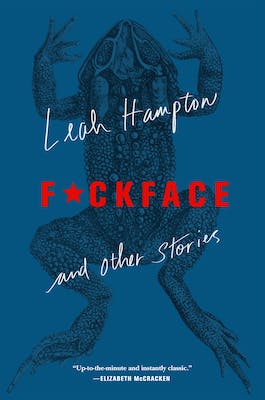
F*ckface by Leah Hampton
A young lesbian working in a rural grocery store in the North Carolina mountains longs to escape. A park ranger grows weary of finding dead bodies in the woods where she once longed to roam. Set in contemporary Appalachia, Hampton’s stories follow working-class characters whose lives are interdependent with the land in ways city dwellers often don’t think about. Their homeplaces, livelihoods, and health have been devastated by industries like coal mining and hog farming. Some itch to leave, while others stay, aching for what they’ve lost.
Carolyn Hays (the writer’s pseudonym) was the mother of four children, and pregnant with another, when a knock on her front door changed everything. An investigator from the Department of Children and Families was following up on an anonymous tip about Hays and her husband. The complaint was that their fourth child was trans, and that her parents were “making” her that way by using her preferred pronouns and allowing her to choose the clothing she wanted to wear.
Hays recounts how she, an academic and writer, and her husband, a soccer coach, learned how to give their daughter what she needed to thrive, as well as what their family did to try to keep her safe. The book offers plenty of scientific and historical research, and talks about recent progress in trans visibility and representation; it also addresses the current climate of growing anti-trans legislation and persistent violence against trans people. Mostly, though, this memoir is an intimate portrait of a large, loving family, written by a mother dazzled and strengthened by her daughter’s joyous certainty about who she is.
Kathleen Collins was a Black writer, filmmaker, playwright, and activist who died of breast cancer in 1988 at the tragically early age of 46. Nearly 30 years later, Ecco Press published her short fiction in this slim but powerful volume. Collins portrays intellectual Black artists, professors, and professionals in New York during the 1960s through the 1980s, yet the voices feel fresh, in large part because she drops us so quickly and surely inside each character’s consciousness. Voice-driven and economical, her stories waste no time on unnecessary backstory or connective tissue. It’s as though Collins knew she didn’t have much time.
This devastating surreal novel about a famous Black author on book tour who finds himself talking with a figure called The Kid (who may or may not be real) is by turns satirical, horrifying, and thoughtful. It won many awards, including the National Book Award, and is sure to infuriate anyone who doesn’t want to think about our country’s history of racial violence and police brutality.
This Is How the Story Changes, This Is How the Body Remembers by Raennah Lorne
One day, when I tell my story, I will remember how my body led me to believe it. I will say I slept with you the second time we met, seeking a force strong enough to break the physical magnetism between me and my loving ex. I will not fear being called a slut or worry I’ll be told I got exactly what I deserved. I will describe your eyes, always bloodshot slits, and the long-sleeve collared shirts you wore with the top buttons undone, revealing your chest, and your favorite one that summer: a rich forest green, the sleeves cuffed to the elbows. I will call it what it was when, during the second time in bed, you asked to try something different and I said No but you tried anyway and I said Please stop, and you said Relax and it won’t hurt. I will tell how I shifted on my knees, preparing to spring, but you growled over my shoulder and I froze and you did not stop. I will call it rape.
I will admit I can’t recall whether it happened before or after I learned you were in anger management. I will remember that a half-formed fear about how our social circle might break under the pressure of my No bubbled to the surface of my brain. I will describe how afterward I went into the bathroom and wiped away blood, and how when I returned, it was obvious, no matter how drunk you were, you knew you had done something wrong. I laid myself down, having already left my twenty-three-year-old body, and you lifted me up, all one hundred and thirty-five pounds, and cradled me against your chest. Then you put me back down and fell asleep, and I turned away from you, eyes open in the dark.
I will remember that in the morning you said I hope you had fun last night, as I sat on the edge of the bed, my arms around my knees, my tongue pressing swollen words like marbles to the roof of my mouth. And then you left.
When I tell my friend Sylvie, I preface it by saying, It wasn’t rape. She is uneasy but takes me at my word. I am convincing enough, casting it as a night of bad sex, and later she shakes her finger at you and tells you not to hurt me again. I didn’t know it was her first time, you say, your hands in the air, her finger aimed at your heart. We all laugh it off. You drive me to a park where we have sex in the backseat. We undress ourselves and move mechanically. You try to be gentle but seek, as ever, only to satisfy yourself. My bare skin is pale in the moonlight, and this is what I will remember most. Not your body—mine.
I first meet you in the basement apartment of our mutual friend, Steve. You are sitting on the couch, slumped over, too stoned to raise your head, and Sylvie points you out as the one I’ll like because of your curly hair. Our group heads to the karaoke bar and you stumble your way through “Sex and Candy,” Sylvie shaming you for not knowing the words by heart.
The second time we meet is at a Mexican restaurant. It must be after Cinco de Mayo because I recount my recent disastrous date on that day with a man who arrived at my house wearing a huge sombrero and a black felt mustache stuck to his Caucasian upper lip, whose hands were cold and smaller than mine. At the mention of my long fingers, you set down your wine and reach your hand, palm up, across the table saying, Now I’m curious. We press our hands together longer than necessary. Your hands are not smaller than mine.
The raspberry margarita goes to my head and I grin over your attention. This time when we reach the karaoke bar, you are alert, premeditating. You buy me a Woodchuck and as I drink it, you read all the signs: my flushed face, my loose posture, my growing inhibitions. Are you a lightweight? you tease, and then buy me another.
When you go to the restroom, Steve tells me you’re moving to another state. My spirits fall. I ask if you’re a good guy. Yeah, he says, but then tilts his head from side to side, weighing your bad against your good. Yeah, he bobs finally.
I am already so enamored by our shared love of Suzan-Lori Parks and the fact that you’re an actor like my ex that I don’t think to mind when you put your hand on my ass. We dance close together, your hands everywhere, until you ask, Do you still need that walk home? and I say Yes.
On the walk, under the sobering street lamps and headlights, I ask you not to touch my ass. You take your hand away, but slide it back again to cup my jeans under the shadows of the magnolia and gingko trees. You make a joke and as I turn to you and laugh, your mouth falls hard on mine. I kiss you back. At the door of the house I share with three other people, I turn to you and say, I suppose you want to come in.
If you don’t mind, you say. We climb the stairs to my bedroom tucked above the old garage and make out on my mattress on the floor until you say, Not to sound like a total skeeze, but I have a condom. I consent.
You are quick and pant a lot. Jackrabbit is all I can think. The next thing I know, you pull out and my stomach is wet in the dark and in a panic I say, Did the condom stay on? And you say, Not exactly. You apologize that the sex wasn’t better.
In the morning, you lift the sheet to appraise my body in the filtered sunlight and smile your approval. When you catch me looking back at yours, you kick your startled legs and pin the sheet down, but not before I see you are as hairless as a porn star. On your way out you say you had fun and we should do it again sometime.
By midday at work, I’m anxious about the condom mishap and my friend and co-worker walks with me to CVS to buy Plan B for forty dollars. The old pharmacist is kind, judgment absent from his face. I swallow the first pill and hope it won’t make me sick.
A week passes before I see you again. Sylvie invites me, you, and Steve to her apartment for drinks. You arrive last, wearing that same green shirt. When they leave us alone on the patio you knot up your eyes, press your cigarette between your lips and exhale a smoky, controlled How you been? I want to laugh. Steve has already told me you asked for my number. I tell you about taking Plan B, still thinking it was an accident, that we’re in this together. You say you’re sorry but don’t ask how much it cost or offer to pay. As we all walk downtown, Sylvie jams our hands together and runs away. It’s too soon, you say, extracting your hand and putting it in your pocket, and I want to laugh at this too. But then you tell me about your recent heartbreak, a woman who, in the middle of sex, said I don’t love you anymore.
I savor a single drink and talk to Sylvie and Steve while you play pool. Then you walk me back to my car and kiss me in the shadows against a truck that isn’t yours.
I think maybe the second time will be better.
The house is dark, my roommates asleep when we arrive. You have trouble getting it up and say, This isn’t really doing it for me.
That’s when you ask.
That’s when I say No. But you do not listen.
That’s when I say, Please stop, and you say, Relax and it won’t hurt.
Once, when my ex and I were having sex, I felt a sudden sharp pain. Ow, I said. He didn’t stop. Ow, I said again. He didn’t stop. In a fraction of a nanosecond, I shut my eyes in shock, turned my head and thought, This is what it’s like to be raped. He stopped. What’s wrong? he asked, his eyes full of concern. When I couldn’t speak, he lifted himself off of me and laid down beside me. I told him what was wrong. He said he hadn’t heard me. He kissed me and apologized.
That is my only frame of reference: if words fail, body language—its movement, expression, stillness—will communicate all there is to know.
I am not a person to you. I am a means to an end.
So, I shift my body under you, ready to spring. Then you growl over my shoulder and I realize I don’t know you at all. I freeze. But you refuse to read my body. I am not a person to you. I am a means to an end.
A month later I sit in a thin smock on an examination table and tell the nurse I may have contracted an STD when she asks the reason for my visit. I’m reminded just how legible my face must be when I hear her say outside the closed door, She’s very nervous, and then my nurse practitioner enters the room and asks softly, What’s up, babe?
I only tell her about the missing condom. The tests come back negative, which seems like dumb luck, especially when I hear third hand that one of the women you slept with before me called you to report symptoms.
Before you move away, I say I have something to give you. Steve and I have been dating for a month by then. We’re at the goodbye party your theatre friends throw for you in the country when I walk you to my car and hand you Peter Shaffer’s Amadeus, August Wilson’s Joe Turner’s Come and Gone, and Venus by Suzan-Lori Parks. Maybe it’s because we’d talked about them, and now I don’t want their spines on my shelf reminding me of you. Maybe it’s because I want to remind you of this thing we shared outside your violence.
Early in the evening, the party gathers around a fire pit and someone asks us each to share the story of our worst lay. I keep quiet and notice the silence of another woman, whom I know you’ve also slept with. After dark, she and I sprawl out on the trampoline, stare at the stars, and laugh about how bad in bed you are. Later I will wonder if she is also laughing to balance an unacknowledged pain.
A month after you leave, your body far removed from mine, the marbled words I held against my tongue that morning appear in my journal. In your absence, I am ready to own them: date, acquaintance, rape. Until then, I had believed I was in control of my life, that I was able to keep myself safe. Naming what you did meant admitting neither was true. It meant admitting it could happen again.
This admission, even to myself, has a price. I develop quirks that are hard to hide. I’m newly afraid of heights, balconies, flying, bridges, and tunnels; a generalized fear of structural collapse. I sit on the second-story balcony of a bistro and try to have a conversation with a friend while I imagine the supports crumbling and the floor tilting, tables, chairs, plates, silverware clattering to the street below as I dangle from the iron railing. Crossing bridges, I lift my palms to the sky in supplication to be upheld; I suspend my breath inside tunnels.
From another state you send me a friend request on Facebook, which I delete. When I’m packing to move to a new apartment, I find the missing condom crumpled behind my bed and admit to myself that you must have pulled it off. I discuss my suspicion with a friend who knows other women you’ve slept with, and she confirms this is something you’ve done before.
Four months later, you return for a visit. Steve and I are still together, but he doesn’t know about the rape and I am not ready to tell him. There is a blizzard. Steve, another friend, and you, all drive to my apartment to borrow a snow shovel. The sun has already set as I sit at my desk with all the lights on, the indoor shutters open. You don’t come inside.
In the dark you might have seen me, but I couldn’t see you—as if I were on a stage; you, the uninvited audience.
Later, I join everyone at the bar to face you in the light, to see you see me, my body intact in spite of you. We do not speak. Your ex shows up and I watch your eyes flare and your jaw lock in place. Her betrayal stirs you more than your own. I have proven nothing to you, only to myself. I can survive your presence, your gaze, you—and walk away unshattered.
I tell Steve during the second blizzard that winter. I’m falling for him but won’t say so until I know whether he will believe me or call it a misunderstanding. We lie down on his futon, and with my eyes on the ceiling and my hand gripping his, I ditch my prepared script and tell it simply: It was date rape. It was anal. It was your friend. And I cry. He holds me, angry and dumbfounded, asks if he should confront you, warns me it won’t be quiet, and I say No, that if anyone should, it should be me. I am conscious that my body froze, didn’t fight you off, and I tell Steve I’ll have to explain myself for the rest of my life. You don’t have to explain yourself to anyone, he says.
The culturally inherent shame is so entrenched it takes a while to believe him. When I do, I realize that what we find so uncomfortable, so disturbing, about acquaintance rape is not that the line is blurred, but that the line is so easily crossed. When I start to think that things were blurred, that the night was grey, I remember the clarity of my No. I remember that I bled, though not all assaults draw blood. And I remember your words: Relax and it won’t hurt. These are not words spoken to someone who consents. These are words spoken to someone who resists. Couched in your command was an admission. You knew you were hurting me.
What we find so disturbing about acquaintance rape is not that the line is blurred, but that the line is so easily crossed.
After dark, Steve and I tramp through the snow-plowed streets with friends to the one open bar downtown. It has floor-to-ceiling windows and the light from the street lamps gives everything, even the slanting snow, an orange tinge. After we down a couple vodka citrus highballs, Steve leans in and whispers he can’t wait to get me home and kiss every inch of me. In his room my body is lit with kisses and I want to lift myself but can’t, suddenly a cinderblock. I can’t put myself on display and feel safe. He chokes up and says it’s all his fault. Why? I ask in surprise. Because I introduced you, he says.
In the new year, I begin telling the women closest to me and their responses vary.
One assumes, He held you down?
Another says, My ex used to rape me repeatedly, and when I ask why she didn’t tell me, she says, I didn’t want it to define me.
An older woman says, Something like that happened to me. But she does not name it.
Another says, I was raped. It was the sixties—men just assumed you wanted it.
Still another says, What R-word? when I speak in code and shushes me when I say anal in a public garden as we walk in search of a new art installation, something made of sand.
I tell my mother in the car so that I don’t have to face her as I speak. After I’ve used the fewest words possible and cry, she parks the car, turns to me, and says, Can I kill him? I laugh out a mouthful of air in relief that there is no need to clarify, to recount in detail your assault on this body she made.
Steve and I have been dating for over a year and have just moved in together when we receive an invitation to a wedding we know you will attend. This is the nature of acquaintance rape, even after you’ve moved hundreds of miles away. People say your name around me, not knowing what you did, and my face learns not to grimace at the sound of it. I want to attend the wedding, refuse to alter my decisions because of you. But as the date approaches, when I shut my eyes, I think of sliding a razor across my wrist. It doesn’t feel suicidal. It feels primal, exorcistic. As if bloodletting could drain the demons. It takes me weeks to tell Steve. I stand in the shower, my arms around myself, and tell him I keep seeing the image of the blade on my skin. He stands outside listening, the curtain drawn between us.
I recognize the danger and finally tell my doctor what you did. She recommends a therapist whose office is beside the train tracks, which forces us to suspend conversations mid-sentence over the roar of the engines. I don’t have much money or time, so I get to the point. When I say, I was raped, she hands me a box of tissues and asks if I was a virgin and I am annoyed this woman twice my age seems to subscribe to the myth that only the pure and untouched can be raped.
In the months leading up to the wedding I see her weekly and she gives me permission to hate you, which I do until I don’t need to anymore. I indulge my bloodlust in my mind, punt your ribs, scratch your eyes and break your nose, but it always ends with you cracking my head open on the walnut dresser my great-grandmother brought with her from Zurich. My therapist says you’ve given me a violence that doesn’t belong to me and when I ask her, How do I know where his rage ends and mine begins? she has no answer other than to suggest punching pillows or screaming in the woods. The first and only time I try beating and shouting into a pillow, I become more enraged and might laugh at the absurdity, except the anger inspires such terror in me.
As the wedding nears, my therapist asks me to write you a letter I might never send. I punch the keys of my laptop and imagine that when I’m finished, my keyboard will look like my mother’s, her strong nails impressing crescent moons above the most common letters in the English alphabet (i, r, a, t, e, s, h, n, o). In the letter, I tell you what you did and how it changed me. I tell you that you engendered in me a hatred unlike any I have ever known, much of it self-directed, some of it not. I hated you for assaulting my humanity, my dignity. I hated your audacity, your sense of entitlement. I hated the mistrust stirred by your violence, which inevitably impacted my relationship with Steve. When I read the letter aloud in my therapist’s office above the grinding gears of the train braking below, she says, I think you should send it. I consider it as I select a shiny dress to wear to the wedding, a disguise intended to present me as unchanged, unaffected.
Two years and five months after the rape, I see you for what I hope will be the last time. Our first encounter that wedding weekend is mercifully easy, two cars passing in the hotel parking lot, Steve and the groom speaking through open car windows, you and I silent. The day of the wedding, I do yoga to calm my nerves, shower, dress, and catch the shuttle to the ceremony site. A friend takes my arm and walks me down the stone path to the lawn where the men are gathered. As I move toward Steve, I catch sight of your eyes on my body and wonder if you have always looked so lecherous.
At dinner you sit across the table, diagonal from me, and ask about my writing. Steve runs his hand frenetically over the top of my thigh, his fingertips saying, It’s going to be okay babe, it’s going to be okay, as I answer carefully. I do not tell you my latest work is an unsent letter addressed to you.
The next morning, Steve and I arrange things so I won’t have to see you again before we leave. I will check us out of the room, he will say goodbye to you at the elevators. But instead of getting on the elevator, you walk Steve to the door where I stand. You shake his hand and then reach your arms around me. My whole body retracts internally. But then the touch is over, and it doesn’t sear like I thought it would.
Ten days later, I mail you the letter. In it, I remind you of your words, Relax and it won’t hurt, and ask, Who the fuck did you think you were, trying to talk me out of my pain? I tell you I know you pulled the condom off without my consent our first time together and that it, too, was a violation—of trust, sexual health, and my reproductive rights. I tell you about my denial and dissociation from the rape, and how I couldn’t name what you’d done until after you left town.
I don’t tell you I ordered a book called I Never Called It Rape by Robin Warshaw. I don’t tell you that it helped me understand why I pursued you afterward, plied myself with vodka, and kissed you that night under the porch. Warshaw explains this behavior is a way of normalizing violence, shrinking its terror by embedding it within the context of a relationship. It was my unconscious attempt at repair. But when a knife cuts, one doesn’t seek the blade to heal the wound. Eventually, I recognized my denial as a force of self-preservation, a suspension of truth that allowed me to be unafraid and fall in love with Steve.
After I send the letter, you unfriend Steve on Facebook and begin to fade from my story.
Gradually, I allow my body to thicken, to push back against Steve’s beautiful hands. Expansion makes me a smaller target in a culture that reveres thinness. (I read somewhere that the tissue of the traumatized vagina thickens too, and I wonder: Is it the same for other traumatized tissue, the body remembering its trespasses and reinforcing its defenses?) I build a barrier between me and the version of me that could be hurt. Because if I blame the rape on my alignment then with conventional standards of beauty, I regain control, increasing my girth and transcending the size parameters of someone who can be raped. Of course, this is folly. People of all sizes are raped.
Some days, when strange men turn from me, the excess pounds are a comfort. Some days, I am anxious to dig myself out from under this unburned energy, to reclaim an ease of movement and strength.
Three years after the rape, Steve and I visit Sylvie in her hometown, where she has returned to live. Steve’s friend Daniel attends the university there and we agree Steve will stay the weekend at Daniel’s and I will stay with Sylvie.
We all meet up at a bar and then go back to Daniel’s house, where everyone—Sylvie and I, Daniel and Steve, and Daniel’s two male roommates—continue drinking in his basement. The big and tall roommate points to the steel column in the middle of the room and says to me and Sylvie, Stripper pole. I glare at him but it doesn’t seem to register in his alcohol-sopped eyes. His perceptions aren’t so dimmed, however, that he can’t see, an hour later, that Sylvie prefers Daniel. In that moment he lifts up the loveseat she is sitting on and pours her onto the floor. She lands on her knees and spills her beer as she yells, What the hell? He is embarrassed then and says, I might’ve gone too far. Daniel laughs and agrees.
Meanwhile, the other roommate and I are locked in a grammatical argument. I can’t remember what point I am trying to articulate, but my nuanced construction irritates him and he interrupts to say, Well now you’re just trying to fuck an ant in the ass.
My body goes limp.
The scene is too familiar. Testosterone and alcohol. The men outnumbering the women—violence in the language and actions of the two men. My head falls onto Steve’s shoulder and I tell him I want to leave. But Sylvie is hitting it off with Daniel and doesn’t want to go. I tell her I am leaving without her, and swipe her car keys from her purse. Steve walks me out and as we ascend the stairs from the basement, my anger rises, strengthened by my movement, my agency. Steve sobers some as he tries to calm me. We reach the driveway when my rage catches and snakes through my body to my mouth and I scream in the quiet neighborhood, I fucking hate them! and slash the air with Sylvie’s keys. Only I’ve misgauged the distance between us, or Steve has taken a step toward me, and the keys rip through his t-shirt and the skin of his chest, but I don’t realize it as he wraps his arms around me and whispers, It’s okay, it’s okay. I let him hold me and breathe into the warmth of his body. Only when we pull apart does he rub his chest and check for blood; there is none, but apology still runs from my mouth.
As I drive in the dark alone to Sylvie’s house, I am suddenly seized by fear. I have, essentially, stolen her car and I keep checking the rearview mirror for police lights. When I reach her house in the woods and unlock the door, her large black dog, the only dog I’ve ever feared, barks his alarm. I extend my hand past his massive jaw, the one Sylvie has to muzzle for the first ten minutes of my every arrival, and hook a leash on his collar. He stops barking, surprised, and I walk him out into the night—brazen and unafraid.
Years later, Sylvie and I will laugh about the night I stole her car. But I will also see it for what it was: trauma response. This is how the body remembers.
Five years after the rape, I see a second therapist whose office is across from the graffitied mailbox you pressed me up against once, your clumsy paw between my legs. I tell her my frustrations, desires, and fears about returning to my previous size.
I’ve done it before, I can do it again, I tell her.
When was the last time you did it? she asks.
When I wanted to show him that he hadn’t changed me.
But that was a lie.
Yes, that was a lie.
And because of this, returning to a smaller size feels like regression.
I have grown so much.
Maybe the next time you see me I will be too large for you to wrap your arms around.
Maybe
I
will
be
monstrous.
A word that grew out of danger, rising up from the Latin monstrum, meaning portent, threatening disquiet.
I sit on my therapist’s loveseat and she instructs me to plant my feet on the floor, close my eyes, and remember a time when I felt connected to my body. My brain takes an adolescent second to smirk over sex (consensual, mind-blowing, with Steve), but then my eyes swell and the smirk is replaced by a memory. I am twenty-one again and running along a sandy path before the boardwalk carries me over the marshes of the peninsula. I inhale the scent of pine and feel the strength and warmth of my muscles with each step of the nine-mile run. And suddenly, there it is, the lost thing that I am still mourning: my body. I inhabit it and it is mine and I am free, unburdened by you.
One morning after you assaulted me, I was out for a run when I saw you up ahead. My gut tightened and I slowed my pace. You didn’t see me as you bounded through traffic, probably late for work. I kept moving and by the time I reached the graveyard you were gone. When winter came that first year, I didn’t need much convincing to stop running and stay warm in bed with Steve. My knees lost strength and shifted, my patella pinching my ligaments every few steps.
With my second therapist’s encouragement, I begin physical therapy. On the first day, I can only lift two pounds with the left leg, only press a quarter of my body weight with both. If I were to fall while running, I wouldn’t be able to support my own weight. I do the exercises, sign up for my first race in ten years, and start running again. My breathing is labored, my lungs untrained, but I am slowly stitching back together the threads of connection to my body. My knees don’t hurt while running, but at night my bones wake me—they feel hollow inside me, unequipped to push back against the pain.
I am slowly stitching back together the threads of connection to my body.
That same year, I learn that meditation can help those diagnosed with PTSD and I sign up for a class. On the first day, the teacher asks us to pick a partner and tell them why we’re there. I tell an older woman with bleached hair that I’ve experienced a trauma that has separated me from my body. Then, unexpectedly, the teacher announces we’ll share our reasons with the whole class. Because I cry when it’s my turn, the older woman faces me at the end of class and says, I don’t know what you’ve been through but I can tell you I was raped with a gun to my head, and if I can survive that, you can survive this. Later, when I think of sitting quietly with myself, resistance presses like a metal beam on my sternum. I do not return to class. Instead, I force myself to do yoga, my shoulders shaking in downward-facing dog, all my joints weak—a woman unhinged.
And then, one day, something shifts. The voice in my head no longer says, You should, assuming it will meet resistance, and instead says, I will. I will feel better if I do yoga. In the movement from second person to first I am no longer outside myself looking in. I inhabit my body, take up residence inside myself.
Seven years after the rape, I read Bessel van der Kolk’s book, The Body Keeps the Score, and learn that bilateral stimulation of the body in Eye Movement Desensitization and Reprocessing (EMDR) therapy can help the brain process traumatic experiences. I seek out a trauma specialist who practices EMDR. Her office is in a converted old house on a half-numbered street, squeezed between two whole numbered streets—which seems like a metaphor for something, like the place where trauma lives, in the half-space between a remembered past and a lived present, my body, the time traveler, slipping back and forth between the two.
After the introductory session, the specialist hands me two hard plastic pads the shape of worry stones, connected by electrical cords to a control device. While EMDR is named for bilateral stimulation of the eyes, the reprocessing of memories can also occur through stimulation of the hands with vibration, or of the ears through tonal sounds. As I hold one plastic pad in each hand, she adjusts the control buttons to demonstrate the vibrations I can expect to feel. There are at least three variations of intensity and three settings for speed. On the mildest setting, the gray pads quiver lightly in my palms, alternating from one hand to the other. The electrical current is strung between us, she in her chair and me on the couch. It feels both woo-woo and scientific as we work on “resourcing,” which involves constructing a peaceful place I can go to in my mind to rest between revisiting memories.
We spend several sessions exploring memories that cause light to medium discomfort. It’s awkward initially, as I’m unsure of the “right” answers in these structureless explorations of my own mind and emotional responses. But she reminds me that the only instruction is to react to what comes up as the bilateral stimulation of my body shakes things loose in my brain and we draw nearer to the white-hot pain. We practice visiting childhood memories and work our way up to the memory of meeting you. After six sessions, I tell her I’m ready to get it over with, to confront the rape itself. Seven years is so long and I am so tired, I tell her. Yes, she says, her voice gentle and measured, Let’s get it the fuck over with. I laugh and agree.
I am already holding the vibrating worry stones when she asks me to stand. She explains that as I recall your violence, I should feel free to respond in any way I want, to punch and kick, to scream. I am nervous and shut my eyes as I reenter the scene in my head. I am angry as I punch and kick without moving my arms or legs. Then suddenly I am crying and she asks me, What do you need right now? What do you need to do, what do you need to say? And one word rises up through my throat that has never once occurred to me in seven years. Not that night or any night after.
Help, I croak.
And for the first time, I think of my three roommates asleep in their beds, the British man well over six feet tall who lived across the hall and with whom I shared a bathroom, the woman in the bedroom below with her two protective dogs, and the other man downstairs by the kitchen who worked late and might even have been awake.
The novelty of the word astounds me, its size and shape expanding to fill the hollow space carved out in my brain by years of its absence.
Help, I repeat aloud in my therapist’s office to the roommates who aren’t there. In my head I scream it, and the power of my voice shakes my roommates from their sleep. The British man pounds on my door, the weak hook-and-eye latch wrenching apart. The woman below opens her door, and her dogs climb the stairs, snapping and snarling as they storm into my room.
You shrink from me then, naked, hands in the air, claiming innocence as infantile and inauthentic as your hairless body.
I don’t know what happens next and it doesn’t matter. What matters is the shattering in my brain. No longer catatonic, I have broken free from my freeze response.
My body remembers, and enacts a new ending. This is how the story changes.
Latin American literature—translated into English, authored by members of diasporic communities, unpacked by scholars, or written by next generation children of immigrants—has never experienced such widespread, mainstream popularity.* More easily than ever, readers can encounter writers and artists from so many Latin American countries, including Mexico, Puerto Rico, the Dominican Republic, Cuba, Colombia, Argentina, El Salvador, Guatemala, Peru, Ecuador, Honduras, Venezuela, et alia.
A notable exception, if you grew up flying to Asunción (then driving to Villarrica) for a month every few years to visit your father’s family—as I did—is the tiny, landlocked nation of Paraguay. Frequently overlooked, Paraguay hasn’t caught the attention of its larger, more prosperous, or more popular neighbors. And yet, the demographic maths suggest that the country isn’t underrepresented, with only a tiny percentage of the 63 million Latine inhabitants of the U.S. claiming Paraguayan heritage. But it still stings to find my people absent from anthologies, missing from print media, and all but omitted from the canon altogether.
In my own way, I hope to help elevate Paraguay’s status within literatures of the Americas. My debut book of poetry, Yaguareté White, explores themes of identity, heritage, history, and legacy, and it’s my hope that other Paraguayan Americans will recognize themselves in my poems.
Of course, it’s important to acknowledge the many writers, scholars, and artists who have already figured Paraguay into literature before me. To that end, I share ten books to embark on a literary journey through Paraguay.
*For what it’s worth, I regard the United States as part of “Latin America,” due to its overlapping legacies of colonialism, undeniable cultural influence over, record of political interference in, and increasingly similar demographic makeup to countries traditionally considered “Latin” throughout the Caribbean, North, South, and Central Americas.
Yo El Supremo by Augusto Roa Bastos, translated by Helen Lane
“Shouts and peals of laughter, cheers and hurrahs for El Supremo! The crowd grows more and more excited. Leaps and cavorts round the immense candle, which has done its humble best to bow its head to the multitude in this unprecedented celebration. The women writhe frenetically in the red dust of the plaza. The more ecstatic of the vatic Bacchae fling themselves upon the softened tip. Their hair stands on end. Tunics rent to pieces, eyes bulging from their sockets. They scrape off bits of hot wax. Gather the burning-hot drops in the hollow of their hands. Rub their bellies, their breasts, their mouths with chunks of warm wax. Howl in mad maenadic rapture:
Oé…oé…yekó raka’é
ñande Karai-Guasú o nacé vaekué…“
Inarguably the foremost work of fiction produced by a Paraguayan writer, this doorstop of a novel is a fictionalized account of the rule of José Gaspar Rodríguez de Francia, the first dictator of Paraguay (officially, “Supreme and Perpetual Dictator of Paraguay”), installed shortly after national liberation in 1811. Defined by human rights abuses, a paranoid police state, and threats and implementations of violence against citizens, Francia’s rule nevertheless preserved Paraguayan independence, upended the Casta system imposed by Spain, and kept the needle of Paraguay’s national compass pointed ostensibly in the direction of progress.
Published in 1974, during the reign of murderous dictator, Nazi sympathizer and child rapist Alfredo Stroessner, Yo el Supremo triggered Paraguay’s censors, who were especially sensitive to anything that could be construed as critical of the Stronato regime and its “infallible” leader. Subsequently banished from his country, Roa Bastos waited out Stroessner’s rule, only to return upon the despicable despot’s downfall in 1989.
Yo el Supremo stands alone among Paraguayan literature as a virtuosic interrogation into unchecked ambition, absurd megalomania, and the collective psyche of a country that continues to wrestle with memories of unquestioned complicity and the ongoing pursuit of independence.
Dream Pattering Soles by Miguelángel Meza, translated into Spanish by Carlos Villagra Marsal, Jacobo Ruskin, and the author; translated into English by Elisa Taber
“Mainumby,
fleck of forest
fluttering vertiginously by opening buds,
wearing out ornaments:
you originate afar in time.
Your long sipping beak
pierces
the forest,
and traversing the wind
you seal my sighs.”
Paraguayan poetry has only recently begun to emerge on the U.S. literary scene, most recently via an illuminating feature at Words Without Borders and this unprecedented, trilingual chapbook, which preserves the consonantal forests and firecracker diacritics of Paraguay’s native Guaraní, an indigenous language that serves as an official tongue of the country, together with Spanish.
In English translation, Meza’s lyrics range from mortal and mournful lamentations (“Lost my grandfather. My mother. My father. My flesh.”), to piercing depictions of petrified, anthropomorphized nature (“Water’s breath foams and hardens. […] Water’s breath is hard and sharp.”), to inextricable tangles of nature, technology, and humans’ built environment: “Palm wall / sifts moon’s wild honey.” The result is a stirring snapshot of poetry that lives inside and beyond the borders of country, culture, and language.
Besides his decades-long career as a poet and cultural promoter, Meza is the founder of Mburukujarami Kartonéra, a cartonera press, which recycles cardboard to construct handcrafted chapbooks and broadsides. With luck, we’ll see more of Meza’s poems translated into English, as well as that of his fellow countrypeople.
“I was conceived in Neuland in 1990. I do not remember the bush Frieda planted when I was conceived, or the peach tinged roses I received when I was born. I remember Dolores Ayerza’s Reserva Campo Alegre, my mother’s painting. The baby in the forefront and the title scrawled at the bottom. He is limp but rigid in his mother’s arms. Her lips and nose are swollen but severe. In the background there is a man with mouth agape, a squalid dog, and a wooden chair. When I was older, I was told the baby was dead. In January 2013, I returned to Neiland on my own. I lived with Frida Müller for three months. She is a self-described Mennonite and Chaqueña. In July 2016, my mother and I return together to Frieda’s unoccupied home for a month.”
Described as a “lyric ethnography,” this hybrid text blends observation, ekphrasis, fiction, and myth to portray populations of Paraguayans residing in decidedly different environments: a settlement of Nivaklé, native people of the Chaco; and a Mennonite colony.
The book’s three sections are not designed to be read sequentially. Instead, writer, translator, and anthropologist Taber invites readers to jump between vivid descriptions of short films shot in Paraguay, a collection of short stories that take inspiration from Nivaklé folklore, and a novella that embellishes the life of a Mennonite woman.
Taber’s intimate, experimental treatment of such disparate topics yields a fascinating kind of hypertext, one that must be navigated in way that perhaps recreates the disjointed experiences shared by many people of Paraguayan descent, as we seek to make sense of our cultural, linguistic, and national heritages.
In addition to her own writings, Taber has translated work by a number of Paraguayan writers, including Miguelángel Meza (noted above) and Damián Cabrera, and she advocates for greater recognition of indigenous peoples across South America, such as the Mapuche.
One of the first Paraguayan-born writers currently residing in the U.S. to publish a book of poetry, Wallace’s lyrics are playful and flirtatious, as they explore the vocales and consonantes of español.
The title of Wallace’s debut translates literally to “game of words,” but it can be understood also to mean “puns,” as the poems riff on everything from monstruos and rostros, to ñanduti (traditional Paraguayan lacework) and rohayhu, the Guaraní word for, “I love you.” My favorite entries include those for búho (“owl”) and fases (“phases”), as they assume the shapes of gentle crescents wedged neatly on the page.
Available in Spanish from Valparaíso Ediciones, Wallace’s work will no doubt appear in English translation sooner rather than later, as the author continues to emerge as an important voice in U.S. poetics.
“I was with my grandfather when we met some valay, some Paraguayan soldiers that were on their way back from fighting against the yaamvalay, the Bolivians. They stopped in the lengko—the Mennonite’s—village. There they saw my grandfather. They called him a Bolivian and then they murdered him.”
For three years, from 1932 to 1935, Paraguay engaged in a bloody war with neighboring Bolivia over the vast, semi-arid plains that comprise the Gran Chaco, thought to be rich in oil. (It is not.) Called the Chaco War, or the War of Thirst, the conflict is now widely recognized as a proxy war between Royal Dutch Shell (Paraguay) and Standard Oil (Bolivia), one that resulted in the deaths of anywhere from 80,000 – 150,000 combatants. In the end, Paraguay won a majority of the disputed land, which turned out to be bereft of any oil, minerals, or natural resources other than timber, most of it situated deep on the periphery.
The Chaco War also upended the lives of many indigenous peoples caught in the crossfire, including the Enlhet (sometimes conflated with the Enxet into one group, the Lengua), who had resisted colonization well into the 20th century, until the Mennonites arrived with proselytism and smallpox in 1927. Due to the Chaco’s remote geography, linguistic differences, and scholarly disinterest in the region until recently, Enlhet perspectives have remained largely silenced. This book salvages their untold stories to share with the wider world.
Divided into four parts, Don’t Cry offers a brief history of the Chaco War, recounts witness testimonies by Enlhet victims, contextualizes the firsthand accounts with additional materials, and suggests paths for progress that center the lives and experiences of the Enlhet people.
It’s a novel approach to storytelling, an engaging and heartbreaking history from below. I highly recommend Don’t Cry for anyone interested in learning about Paraguay from one sampling of its often overlooked native communities.
“Environmental racism predicated on histories of land dispossession and resource control has long threatened Indigenous and Afro-descendant well-being across [Latin America]. From early colonization to the present, land, water, and resource grabs undermine preexisting social-environmental relations. […] Thus, in thinking with recent provocations to decolonize environmental justice studies, this book attends to place-based struggles of Enxet and Sanapaná peoples while centering my interlocutors’ theorizations of justice and visions for the future. In so doing, I seek to advance a notion of environmental justice otherwise, enriched by hemispheric conversations about Indigenous politics in the Americas but always sensitive to the lived experience of land struggles in Paraguay’s Bajo Chaco.”
A bit dense, sure. But Correia’s intervention intersects at the bleeding edge of environmental justice and racial geography, two fields with a great deal to offer theorists in academia and activists on the ground in equal measure. Like Don’t Cry, Correia prioritizes the perspectives of native peoples in the legal and extralegal battles the Enxet and Sanapaná wage in order to not only return land back to its aboriginal inhabitants, but also to restore their collective and individual agencies. As an academic ethnography, Disrupting the Patrón is admittedly designed for a narrower audience than many titles on this list. But the book is available to read as an open access text, which is surely the modality of the future for academic publishing, if anyone besides eggheads and pencil-necks (Yours Truly included) will ever read it.
“While African languages may have predominated on the Jesuits’ haciendas and ranches, Africans throughout the rest of Paraguay quickly adopted the Guaraní language. Many blacks who appeared in litigation proceedings could only speak the Guaraní language. […] While the population of Africans in Paraguay was modest compared to other regions, it was substantial, especially in Asunción. Further research will surely reveal the myriad manifestations of African cultural influence on Paraguayan colonial and postcolonial society.”
The topic of African influence in Paraguay is an especially difficult one to confront, since the devastating legacies of slavery and racism underscore every conversation. Long regarded as isolated populations within the city of Emboscada (meaning “ambush,” so named for frequent skirmishes between native Guaicurú and Carios tribes) and villages like Kamba Cuá (outside Asunción) and Kamba Kokué (outside Paraguarí), Afro-Paraguayans deserve more recognition, attention, and respect than has been traditionally accorded for their contributions to the country’s history and culture. Historian Austin’s close look at colonial relations between and among native peoples, enslaved Africans, and colonizing Spaniards also problematizes preconceived notions of kinship relations and their impacts on the colonial apparatuses of early Paraguay.
“Elizabeth Nietzsche was not just bigoted, ambitious and bloody-minded (although she was all of these things and more), she was also a woman of extraordinary courage, character and (she would have been gratifyingly annoyed by the word) chutzpah. Through sheer willpower she founded one New Germany in the middle of Paraguay and then helped to found another, half a century later, in the shape of the Third Reich. She was awful, in both senses of the word.”
MacIntyre’s riveting, unsettling account of the founding of Nueva Germania follows Elisabeth Förster-Nietzsche (sister of the [in]famous philosopher Friedrich) and her husband, the anti-semite teacher Bernhard Förster, as they establish, and quickly abandon, the colony in 1888. Convinced of their naturally superior Aryan blood, the Germans arrived unprepared and quickly succumbed to the harsh landscape due to a lack of supplies, deteriorating morale, and brutal disease.
But MacIntryre’s chronicle doesn’t end with Elisabeth’s departure in 1893. Instead, the book details further developments among the languishing colonists, including the circulation of Nazi propaganda in the 1930s, the eventual arrival of Nazi war criminals (including Joseph Mengele) in the 1940s and ‘50s, and the threadbare legacy of lingering descendants until the date of publication (1992). Bolstered by photographs spanning the 1880s to the 1990s, comprehensive notes, and copious suggestions for further reading, this entry narrates a crucially important, if often forgotten, element of Paraguay’s complicated history.
Paraguayan Sea by Wilson Bueno, translated by Erín Moure
“And now I’d like to tell you just one big hairy secret: all my energy goes into pulling myself up by the bootstraps and into the immense armies of ants, all those sounds silencieux murmured by ants, the harmless insectes that are Guaraní as it rises in me, ant-like, tahiĩ, tahiĩguaicurú, araririi, aracutí, pucú. Ants of divinity blazing up in this dusk of verbs and nouns, in my tangle-web webtangle—capable in me, blessed lady, of deciding, with sudden verdict, my fate here among all you antediluvian beings.”
“Brilliant” is too understated an adjective to describe Brazilian writer Bueno’s audacious, shape-shifting celebration of fluidity in many forms. Called a “poetic seduction,” a “polylingual monologue,” and a “homage to life, to being embodied, to border crossing,” Paraguayan Sea can best be described as a book-length prose poem, composed in Portunhol (a combination of Portuguese and Spanish) and Guaraní that explodes conventions of language, gender, and narrative.
So far as Mar Paraguayo concerns a plot: its narrator has loved an older man and a younger man, alternating masculine and feminine pronouns, as they navigate a Brazilian beach town. The loose narrative structure drapes itself over Bueno’s dazzling lexical range and dynamic lyrical phrasings, as the text sings its otherness electric.
Erín Moure’s dextrous, freewheeling translation retains the wonderfully discombobulating shifts in language and outbursts of Guaraní, even as it constructs a totally new text in “Frenglish” (English punctured by French). The slim volume also includes an “elucidictionary” of Guaraní terms, a “mixelated Portunholçaisupí postface” by Chilean poet and essayist Andrés Ajens, an etymological incantation by contemporary Paraguayan poet Christian Kent, a revealing interview with Wilison Bueno, and a fascinating essay by Moure herself.
Absolutely read this book. It won’t teach you much about Paraguay, per se. But perhaps, through its acrobatic dance of language and culture-bending, it might.
“A dead monkey, still whole, still undecomposed, drifted back and forth with a certain precision upon those ripples and eddies without exit. All his life the water at forest’s edge had beckoned him to a journey, a journey he did not take until he was no longer a monkey but only a monkey’s corpse. The water that bore him up tried to bear him away, but he was caught among the posts of the decrepit wharf and there he was, ready to go and not going. And there we were.
There we were: Ready to go and not going.”
Published in 1956, Argentine writer Di Benedetto’s rediscovered classic unfolds in three installments during the 1790s, a strange era in Paraguay: the native Guaraní had warred with neighboring Inca for centuries; by 1556, Spanish conquistadors had enslaved native peoples via the encomienda system; enterprising Jesuits hungry for souls had arrived in the 1580s and established a network of missions called reducciones, but were rebuked and expelled by the Spanish Crown by 1767; with national independence yet another decade away. Such incursions, upheavals, and abandonments are emblematic of Paraguay’s tumultuous history.
Di Benedetto’s stirring, discomfiting story centers around Don Diego de Zama, a high-ranking official of Spain, relegated to a remote outpost in Asunción, the capital city of frontier Paraguay. As Zama’s backwater tenure drags on, his hopes for reassignment in desirable Buenos Aires diminish and his dwindling visions of eventual escape are subsumed by desperate resignation as the last decade of the 18th century concludes.
As translator Lane points out in her preface, the novel was translated into several languages and earned the author acclaim across the globe. But for all his recognition later in life, Di Benedetto’s name doesn’t appear once in 1,664 pages of Jorge Luis Borges’ correspondence, signaling an absence of serious consideration by renowned Argentine writers of the time. And yet, no less a talent than Roberto Bolaño appears to have modeled the title character in his short story “Sensini” after Di Benedetto’s Zama, cementing the latter author’s place as an influential figure in Latin American letters.
One of the first in a long line of Argentine writers who use Paraguay for their own ends, Di Benedetto didn’t actually visit Asunción until many years after the novel’s publication, complicating this book’s place in a pantheon of literature that purports to teach readers about a country the author inhabits only by proximity. Nevertheless, Di Benedetto’s sparse depictions and acute sense of frustration faithfully conjure a unique historical moment.
From one girl’s aspiration to Olympic gymnastics glory, to a boy’s stint living in the Idaho wilderness in hopes of fixing his unruly behavior, something that remains a guiding principle in Black storytelling is the breadth of our lives. These stories, a collection of some of EL’s most-loved fiction by Black writers, all published in our weekly fiction verticalRecommended Reading, affirm something we know to be true: that Black people are everywhere. The landscape of our lives is vast, ever-evolving, and no matter where we go and who we are, we always leave a mark.
Below are 12 brilliant short stories by Black writers to read year-round, one for each month of the year.—Denne Michele Norris
“A New World” by Kristen Gentry, recommended by Deesha Philyaw
In Kristen Gentry’s “A New World,” from her collection Mama Said, Parker is balancing caring for many women in his life: his ex-wife Claudia, who is recovering from addiction, his 16-year-old niece Zaria, who is giving birth to her first child, and his 15-year-old daughter JayLynn, who has recently started having sex with her boyfriend. While Parker attempts to “make things work” and protect JayLynn from the same fate as Zaria, JayLynn is desperately trying to save her own mother. Most of all, Parker doesn’t want to fail them in their moment of need: “He could live with the discomfort of knowing he’s still the same coward, but he knows he’s worse than that.”
“Live Today Always” by Jade Jones begins with a work emergency: “The wellness influencer has said the n-word again, but this time there’s evidence.” The narrator, Lee, is a remote copywriter for a public relations firm. During the pandemic, she’s the only Black person in an endless stream of Zoom meetings. Tianah, Lee’s girlfriend, urges Lee to quit because of the toxic, exploitative nature of this specific workplace, but there’s something holding her back. When Lee is the one tasked with writing the influencer’s apology, she confronts a decision on whether ethical compromise is worth it to make a living, or if there’s something greater at risk.
“The First Virginity of Gigi Kaisara” by Gothataone Moeng’s collection Call and Response is about fifteen-year-old Sadi, a girl coming of age in a private boarding school in Serowe, Botswana who sees womanhood as an exciting experiment. Sadi tries on gold hoops, wooden bangles, and various names that may suit her more, like “Gigi.” Curious about men and romance, she chooses a boy from her class to fall in love with, “knowing that love could confer newness upon her, that it could slough from her her origins, which were unmistakably small and rural.” She and the boy, Tabona, save enough of their allowance for a night’s stay at a budget motel and gardens in Mogoditshane. After a disappointing, underwhelming, and “hysterical” night with Tabona, Gigi reckons with what it means to now “be a woman.” This is a sharp, funny, and stunningly sincere exploration of girlhood and tradition.
“The Cape” by Dionne Irving, recommended by CJ Hauser
Dionne Irving’s “The Cape,” from her collection The Islands, is about a married couple in limbo. Mina and Neel try to escape their problems by hiding out in a summer house on Cape Cod. Except, it’s winter, Neel is in recovery after a tragic accident involving fireworks on the Fourth of July, and the problems seem to be clearer than ever. “He always told her that he loved the sound of her voice and she had loved his. But now words sounded unfamiliar, as if each of their voices had gone up an octave, the house filled with helium instead of oxygen.” Things have changed, and Mina has a decision to make, one which will irrevocably twist both of their fates, and distort the person she thought she was as much as the person she still hopes to become.
“Tumble” by Sidik Fofana, recommended by Deesha Philyaw
Sidik Fofana’s “Tumble,” from the debut collection Stories from the Tenants Downstairs, follows Neisha Miles, an apartment building liaison tasked to assist a large list of tenants facing eviction. On that list is her childhood friend Kya, who she hasn’t seen in over two years. A former gymnast, Neisha spent her youth honing her skill—striving to become an Olympian. After an abrupt falling out, tensions rise between the two girls when Neisha learns she’s invited to compete at Nationals. Kya and her friends assault Neisha, injuring her with a muscle contusion and fractured wrist and forcing her to withdraw from the competition. Years later, Neisha struggles to let go of her resentment and questions whether she will allow this grudge to keep “consuming her life,” or if she will help an old friend about to lose everything.
“Flip Lady” by Ladee Hubbard, recommended by Alice Randall
“Flip Lady,” from The Last Suspicious Holdout by Ladee Hubbard, is an amalgamation of multiple distinct narratives within one southern suburban neighborhood. The Flip Lady gives homemade popsicles—frozen Kool-aid in Dixie cups—to the school kids nearby, but she feels disconnected from the neighborhood and that her watchful eye and generosity is no longer needed. Raymond, her nineteen-year-old son, sees the flips as “unnatural distractions from grief” after his brother Sam’s funeral, though his friend Tony wonders if Raymond is distracting from his own life by living back home. At the same time, a young girl is humiliated after dropping her popsicle. Her classmates ridicule her and dent her new bike, so she seeks comfort in the Flip Lady’s house, only to meet Raymond, who buckles under his need to fix everything. Each perspective shifts seamlessly into the next, creating a richer, complex thread about one hot summer day.
“Filthy Animals” by Brandon Taylor, recommended by Calvert Morgan
The title story from former Recommended Reading editor-at-large Brandon Taylor’s short story collection Filthy Animals follows Milton, a teenage boy who is about to be sent away to the Idaho wilderness in a last-ditch attempt by his parents to fix his unruly behavior. On his birthday, he meets his friends Nolan, Abe and Tate on Glad Hill, where he is quickly drawn into a complicated tangle of intimacy and violence. Taylor’s searing prose depicts the unflinching nature of boyhood cruelty and violence: “If there was any merciful part of his childhood, it was that, the cleanness of it, how the act didn’t taint them, how the violence seemed to leave no trace at all.”
Vera is twenty-one years old and on her way to New York. After dropping out of school and working at a record store in Chicago, she’s ready for change. But she gets a little more than she bargained for when a woman on the Greyhound bus leaves her two-year-old son with Vera, then disappears. Over the next few days, Vera grows fond of the boy and begins taking care of him in Brooklyn while working at a shady delivery company that’s not entirely legal. “She liked the pattern of her life now, the domestic monotony tempered with the rush of feeling always close to the edge of something, the sensation of having the thing she loved and valuing it all the more because she knew it could all go wrong at any minute.” In the end, Vera has some choices to make, and in this story from the collection The Office of Historical Corrections, Danielle Evans masterfully balances the tightrope of how to be a good human being, how to carry loss, how to measure the weight of absence, and finally how to let it go.
In “When Eddie Levert Comes” from The Secret Lives of Church Ladies, a woman known only as Daughter cares for her mother who suffers from dementia. Mama insists every day that the soul singer Eddie Levert, whom she idolizes, will be arriving to take her out, a fantasy Daughter indulges even though it reminds her of her mother’s neglect. Daughter’s entire identity has been subsumed into taking care of her mother since her childhood, while Mama prioritized her relationships with men, her sons, and religion over Daughter. This is a moving, tender portrait of a deeply complex mother-daughter relationship.
“Lot” by Bryan Washington, recommended by Aja Gabel
Bryan Washington’s tender story collection Lotpaints a vibrant multicultural portrait of Houston, Texas in its all complexities. It’s a side of Houston that we so rarely see in popular culture: the city of working-class restaurant workers hustling to make rent, the city where queer people of color come of age, the city of drug dealers rebranding themselves as “equal opportunity pharmacists.” In this excerpt, the title story of Lot, a young man narrates his memories about his brother in the army as he struggles to keep the family restaurant afloat in the East End amidst rapid gentrification.
“The Mine” by Nathan Harris, recommended by Halimah Marcus
“The Mine” centers on Nicholas, the first African captain of Tibor Holdings gold mine in South Africa. His father was a surveyor of the mine until Nicholas’s brother died under rock-fall. Overcome with grief, his father never stepped into the mine again and reproached Nicholas for refusing to quit his job. But another boy has died in the mine while foreign investors for Tibor Holdings are visiting. Nicholas struggles to convince the other miners, who fear the monstrous Grootslang lurking in the crypt, to retrieve the body. Harris’s visceral prose is a sharp examination of the harshness of working in the gold mines and the relentless presence of guilt in grief.
“These Golden Cities” follows a college freshman home for spring break and struggling to find his place between his college life at NYU and old friends in his hometown of Washington, Pennsylvania. Michael envisions new avenues of opportunity opening up for him in New York and abroad in Florence, but also feels compulsively drawn back to familiar faces from high school. Over the course of one chaotic night tripping on acid, Michael attempts to meet up with his ex-girlfriend Grace, deciding that “Tonight… she’d either forgive or condemn me for good.”
DON’T MISS OUT
Sign up for our newsletter to get submission announcements and stay on top of our best work.
YOUR INBOX IS LIT
Enjoy strange, diverting work from The Commuter on Mondays, absorbing fiction from Recommended Reading on Wednesdays, and a roundup of our best work of the week on Fridays. Personalize your subscription preferences here.