Requiem for the Most Famous Drag King of Our Lifetimes
Despite the urban legends
she lived to a ripe old age of 15—
a comfortable retirement in Santa Clarita,
long walks on the beach, lazing in the sun,
beloved, after traversing two star-studded decades
with the likes of Reese Witherspoon
and digitally lipsyncing to ethnic stereotypes
of which she had no real means to understand.
Cast as Taco Bell Chihuahua’s Girlfriend
she quickly proved herself too butch, usurping the starring role
with her action hero stunts and monster movie one-liners,
cheap spanglish catch-phrases oft repeated by snot nosed kids,
dressed up as a bandido in a sombrero or a Che Guevara beret,
eagerly chasing tail—not just pink bedazzled collared pups
but supermodels with indulgent, charmed smiles.
Gidget the chihuahua, the inspiration for a civil rights boycott,
whose performance lost Taco Bell over $30 million
in an intellectual property lawsuit, was born an Aquarius
the self same night latent lesbian icon Whitney Houston swept at the AMAs
belting I Have Nothing with sweat shining on her brow,
in a glistening desert city a beast was born with stars in her eyes,
slouching toward Hollywood, the most famous drag king of our lifetimes.
It was a stormy summer day, dead in the middle of August, with lightning sheeting the sky and a deep underwater gloom pervading the parking deck. My three-year-old had fallen asleep in his car seat on our way to the children’s museum, and I could hardly believe my luck: a whole hour to spend on my dumb internet routines.
My publisher’s sales portal updates in massive tranches every few (or two) weeks, so naturally I check it every day. And here was an update—in fact, a huge leap, with total unit sales topping 10,000 for the very first time. I fumbled around in my Gmail, found my book contract, punched the numbers into my phone calculator, did the math. Then, to be 100 percent sure, I had a Wall-Street-whiz friend check my homework.
All it had cost me was incalculable time and energy, weekends with my family, the opportunity to finesse and sell another book.
I’d done it. I’d earned out. In less than two years, if barely.
And all it had cost me was incalculable time and energy, weekends with my family, the opportunity to finesse and sell another book. Truly, I’d busted my ass. Hustled. Worked every connection. Taken what I learned during 12 years’ hard labor in corporate marketing and applied it. Hired a PR person, too. When my nonfiction debut came out in September of 2021, I did dozens of podcast interviews on shows large and small, popular and obscure, and placed excerpts or companion pieces everywhere from Literary Hub to the Wall Street Journal to this website right here. I also gave talks anywhere they’d have me: major museums, universities, writers’ conferences, fan cons, Zoom-based book clubs, libraries—even the reception hall of a pretty country church where, nibbling cookies after the event, a sweet older woman squeezed my hand and told me God had worked through me to write this book, making me wonder ever since if she’s read it and still thinks so. Likewise, I experimented with Amazon ads, and worked with my publisher to arrange e-book promotions. One Kindle Daily Deal that my editor spearheaded led to over 300 sales. Deeply discounted, they nonetheless counted, and even better, the promo spiked hardcover sales.
This was how I beat the odds to sell circa 11,000 books in 23 months, “earning out” my modest $20,000 advance. Depending on the stats you’re looking at, 98 percent of traditionally published books don’t sell more than 5,000 copies their first year in print. Much less their second year in print. Much less their third—you get the idea. By the same token, depending on your stats, only 25 or 30 percent of traditionally published books ever earn out, moving into the black for the publisher and ensuring you, the author, will begin receiving royalties.
Here’s what happens when you earn out: Nothing. No one even notices.
It’s possible to earn out lots of different ways, with a mix of foreign-rights sales, e-book sales, audiobook sales, yada yada, but hardcovers tend to get you there quickest. At least this was true with my situation and my sales breakdown. Via all that hustling I scooped up a grim $1.80 of income per book, rising to $2.25 per book after the first 5,000. A breadcrumb trail, if that—Alexa, what’s smaller than a breadcrumb?—I’d been going down for nearly two years.
The pall of the parking deck was nothing compared to these realizations, to the mood that came over me in my milk-spattered, stroller-choked SUV, hands sweating as I cupped my phone and stared until the numbers blurred together, a black soup of digital digits. Could it really be true that absolutely nothing happens when you earn out? That you in fact have to figure it out for yourself that you have earned out? I mean, isn’t earning out like a way bigger deal than that?
Yes, yes, and no.
Here’s what happens when you earn out: Nothing. No one throws beads, confetti, nada. No one even notices. They’re busy. They’ve moved on. They’re not neurotically checking the sales portal or pathologically over-working to try to make those figures tick up, up, up. Which only makes sense, of course. My little book was everything to me, and a blip, a rounding error to everyone else. Which is why I cried that humid, gloomy afternoon in my car, realizing that, hard as I tried, I’d gotten it all wrong.
I didn’t go on late-night television shows. I didn’t become a household name.
It may be rare to earn out, but that doesn’t mean earning out should be the goal. I sought to move copies obsessively, nigh compulsively, because I don’t like feeling as if I owe anyone money. That I haven’t earned my keep. What I missed was, given the modest nature of my advance, the sales number required to earn out was modest, too.
Had I really worked so hard for such an irrelevant result? Had I really sacrificed all that time—time I could’ve dedicated to my family, to writing, or to, I don’t know, some new and theoretically more rewarding pursuit—to appease a misguided sense of guilt? Or worse, my ego?
Yeah.
The still more devastating reality—the one that’s even harder to face, which is saying something—is how everything’s just as difficult as it always was during those naïve early days when I was a young, hungry, ambitious, unpublished author lusting after the dream. Writing is not easier. Publishing is not easier. No one’s chasing me down for book #2. Readers, friends, and frenemies ask, but it’s not as if the Big 5 have circled me, barking. I’d thought, hoped, that if I showed I could make a fairly niche title successful, then I’d look better when shopping the next idea, something grander and splashier. But earning out hasn’t made finishing new proposals any easier, which I assume is why I haven’t actually finished a new one, not really finished, not to a salable level. Earning out hasn’t refined the drafts of a novel (labeled, variously and nonsensically, “V1,” “Not_final,” and “Sept23”) that litter my desktop, either. And the commercial realities of the marketplace remain just as difficult. Ditto my pitiful perch within it.
I didn’t shatter my advance with record-breaking sales. I didn’t go on late-night television shows. I didn’t become a household name. I just became one of the 25 to 30 percent of authors who do earn out their advances, and who still remain nobodies, midlist maybes, yesterday’s “some personal news” tweets. Of all the hardships that characterize the writing life, I’m not ashamed to say this one has hit me the hardest. I’d always thought writers were full of shit when they said publishing a book doesn’t change your life. Now I know what they mean. It feels so great to publish a book—it was the crack-high I’d heard about—and that joy doesn’t go away, but it does fade, receding in the rearview. Whereas the shitty part of being an artist thing does not. Like Geoff Dyer said, being an artist means struggling to be an artist. Forever. I’m learning this lesson the hard way because, hahaha, it turns out the hard way is all there is! And man, I hate that, too.
That we always look to the next thing is a given. Ink drying on our first book deal, we start scanning for the second. Receiving one prize, we plunk right down by the mental phone to await the next, necessarily a bigger one. This is natural and uncontroversial and a sign of our perennially flowering hopes for our work. Earning out or not won’t change it. Hell, even becoming a household name probably wouldn’t change it.
In the end, we’re all still struggling artists, whether pros or amateurs, overwriters or underwriters, stoics or self-dramatizers: beating on, pursuing the impossible dream, starting from scratch every time, goddamn it.
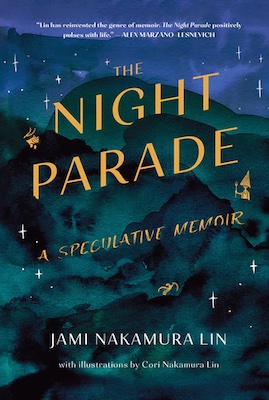
Jami Nakamura Lin begins with a warning: “In the presence of a story—if the story is a good one—time collapses.” This is precisely what she achieves in a genre-bending memoir that collapses past and present, personal and mythical. The Night Parade begins with her attempts to trace the origins of her bipolar disorder that first manifested in her inexplicable childhood rage. Despite her teacher’s suggestion of therapy, her father insists she is not depressed, until she experiences a major depressive episode at 17. But it’s not until Lin’s suicide attempt soon after—an event that amplifies the ripple effects of her mental illness on her family, including her younger sisters—that she is properly diagnosed and given medication.
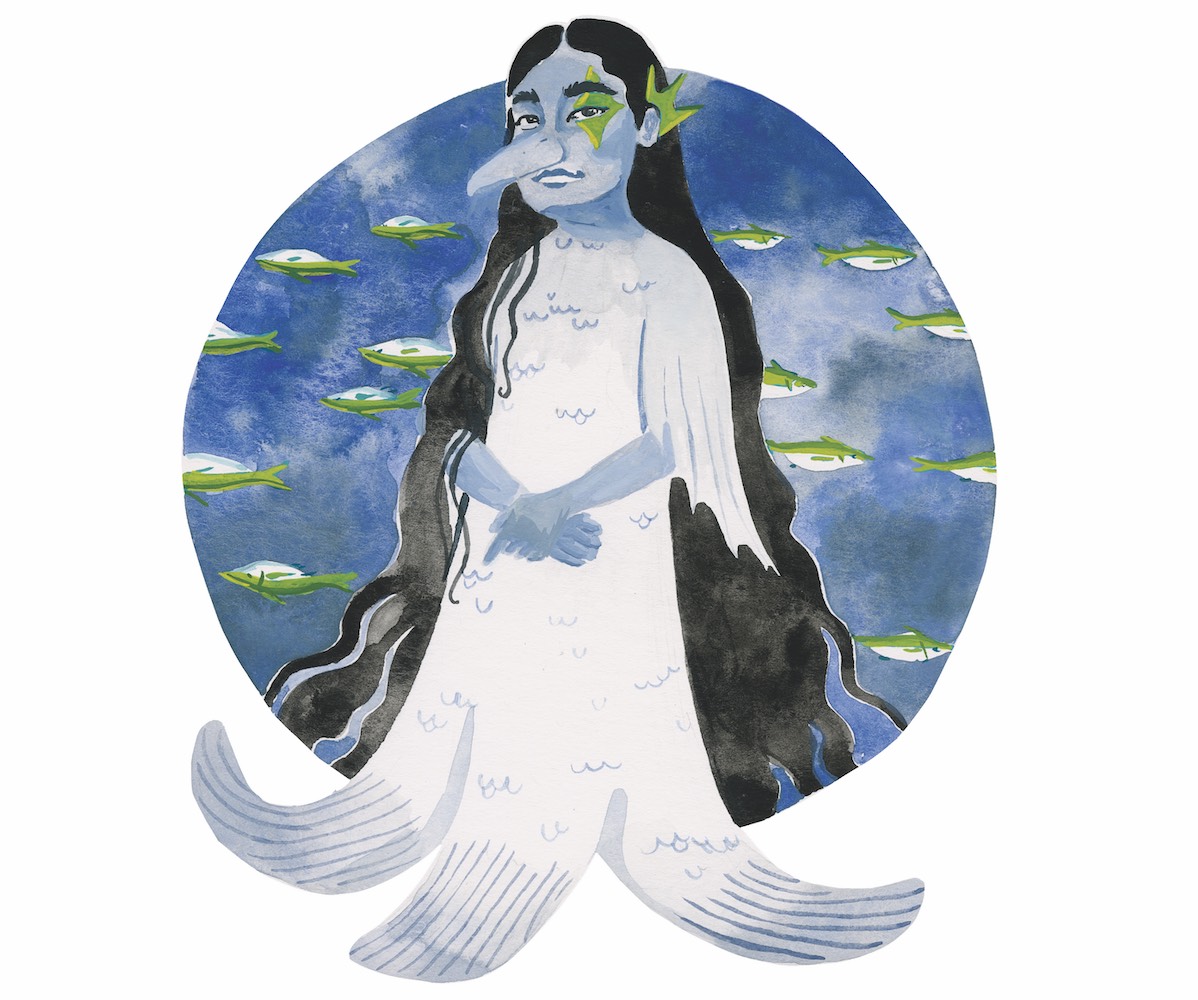
With illustration by her sister Cori, Lin weaves her own tale of coming of age, navigating love, a miscarriage, motherhood, and grief with those of yokai—or supernatural entities—from the Japanese, Taiwanese and Okinawan folklore of her heritage to shine a light on the monstrous and mysterious forces among us. Through the rokurokubi, a yokai whose head is able to detach from their body, she explores her teenage affinity for dissociation; through the baku, a nightmare-swallowing chimera, Lin writes about her father appearing in her dreams as she grieves his death.
I spoke with Lin over Zoom about how folklore and myth can help us better tell a truth, the volatility of truth and reality itself, and the state of mental health narratives today in a time of “therapy speak” and TikTok therapists.
Nicole Zhao: The use of folklore is interesting as a way to frame the stories of your life. What do you think folklore unlocks in understanding and telling the story of your life?
Jami Nakamura Lin: When I just try to write about myself, it just feels like tunneling towards the center of the earth and I can’t find my way back to air. Having context and seeing myself as part of a cultural lineage, having not just metaphors, but grounded examples of these legends and myths and monstrous figures really helps me see my stories in perspective, as part of a tradition, even though obviously they’re not exactly the same.
NZ: The first chapter in the book references “The Dragon King” and you cast your father in parallel to a mythical character. What inspired that chapter?
JNL: I was just thinking about this character, Urashimoto, who goes down under the sea, thinks it’s been three days, and comes back and centuries have passed. His world is completely changed and his parents are dead.
This idea of returning and everything changing was really resonant to me, especially since I’d gone to Japan for four months and when I came home, my father was dying. For me, the delineation in my life was not between when my father died and after, but between when I found out he was going to die and after. I thought, “Oh, this really feels like what I’m trying to express about my experience right now.”
My father’s death is one of my main reasons for writing this book. A couple years after someone dies, often people don’t know what to say about it or don’t wanna bring it up in case it’s upsetting. So writing the book is just a way for him to be amongst us and to keep us remembering him.
I could write this book again and in 10 years, it’d be completely different, because I’d have a different perspective on grief and motherhood and mental illness. It doesn’t necessarily negate the stuff that came before, but it’s just a different truth, a different type of excavation.
NZ: I feel like the book is as much about storytelling and the nature of truth as it is about your life and grief. I really enjoyed the chapter on how the story of Momotaro evolved over time to propagandize Japan’s nationalism and imperialism. There are also moments in the memoir where you write one thing and then a few pages later, you write that it actually wasn’t true. Why was it important for you to name the contradictions in stories and the ways that stories can evolve based on context and who’s telling it, especially in a memoir where the genre is based so much in fact?
JNL: I’ve always been interested in the difference between myth and history being who holds power at the time: who is naming something as history and who is naming something as myth. There’s this idea of the written historical record being the true thing. The things that are being told by communities, by families, by the people not in power are often given this legend aura. But truth is so subject to the context. I was trying to think about this project in a multiverse way. There’s so many different perspectives of what actually happened. There’s my sister’s story, my father’s, my mother’s—all of us could tell stories of our childhood and they all would be so different. We remember it slightly differently, because we’re different narrators. Our memory is fallible. But they are all equally important truths, and they all can happen at the same time, like Everything, Everywhere, All at Once, right?
People have always been writing speculative nonfiction work, it just hasn’t been labeled as this genre. Like Maxine Hong Kingston’s Woman Warrior. It’s very interesting to me to think about the nature of truth, how things can be true and not true at the same time.
NZ: How would you define speculative memoir?
JNL: Jaquira Diaz had a really interesting talk about speculative nonfiction at Sewanee this year. She said that the speculative is involving the theoretical rather than the demonstrable, the figurative over the literal, ambiguity over knowing, and marked by questioning curiosity, but it’s all purposeful. It’s not making up for the sake of making it up, but rather to interrogate memory.
The word “speculative” is also fraught because so many religions, traditions, cultures have in their versions of reality things that would be considered speculative in Western culture.
Our monsters transform and we transform with them.
There’s always going to be those negotiations between whose version of speculation, whose version of reality is it. By writing speculative memoir, I am trying to put pressure on the idea of what reality is and whose reality it is.
Thinking about my episodes when I was younger, I was very uncertain about what reality actually was. I remember telling my psychiatrist, “I don’t know what’s actually happening.” My psychiatrist told me, ”Just don’t worry about that right now.” He was just trying to adjust my medication. And I wrote in my journal—I was 17—“How can I not be worried that I don’t know what’s actually going on?” Because it was all so confused in my mind at that time, hearing things that I wasn’t sure if I was actually hearing, stuff like that.
NZ: You write that your experience of being bipolar is feeling like you’re constantly doubting yourself. I was wondering if myth and legend felt like a way for you to legitimize your experiences of grief, or mental illness, or rage, even to yourself. Because people don’t question a myth or legend, in the way they might question mental illness.
JNL: It’s interesting you pulled out this idea of doubt ‘cause I didn’t even think about that. I do feel that, fundamentally, so much of my life is trying to figure out if my reaction to something lines up with reality.
What I love about the yokai is that people believe them. A yokai emerges out of the unknowable, the question of, “Why is this happening?”
Maybe trying to put my stories in the same parlance as folklore is trying to see them in this realm where reality or unreality is besides the point—belief is.
Grappling with Christianity also has a lot to do with that for me. Can I logically explain what I believe? No, I can’t. For me, it’s more emotive. I believe it’s true, but it also exists in this world of speculation to me.
I went to this fundamentalist high school for my sophomore and junior years. In our history class, we’d learn about Bible stories. So sometimes I wonder why I don’t know much about X, Y or Z historical event, and I was like, “Oh, because in my world history class, we spent six weeks talking about like Noah’s Ark. Right.”
This framework of faith undergirds a lot of how I think about other things, even though it might be unrelated. I have to accept for myself that I just won’t know.
NZ: You write in the book that most of the yokai you encountered through research rather than through your family and oral storytelling. You also write that you feel a nagging feeling that filling in the gaps with the research is somehow false or inauthentic. Similarly, I also don’t speak my ancestors’ native language, and I feel a lot of self-imposed shame and anxiety around reclaiming stories from Chinese mythology since I didn’t necessarily hear them passed down through my parents. How did you reckon with those feelings and get over that hump of thinking, “these mythologies or these stories are not mine to tell”?
JNL: This idea of authenticity can trap us. We have this idea that these stories that existed way back when in the old country are separated from us, now. One of the things I really wanted to do in this book is to ask, “How are these stories situated in Japanese America now?”
Cori, my sister who illustrated the book, also very much wanted to see these yokai, the way she illustrated them, as not happening in old Japan. They’re happening to Japanese America, to Taiwanese America, to Okinawan America, to us. That’s why the oni, the mallet-wielding ogre figure is drawn in front of the landscape of Amache, the incarceration camp that my grandparents were in.
Because of the normalization of mental illness and the invisibility of it, it’s easy for us to not think of ourselves as disabled or have solidarity with people who are disabled.
Japan is not this pure, authentic world that we are separate and distinct from, but rather this mutable, flawed and ever-changing culture that we descend from. People love this idea of cool Japanese cultural stuff from way back when, but then have no idea how much of Japanese America is so shaped by incarceration.
Research is important, like talking to people as much as you can. But a lot of people don’t have access to their families or communities because of forces of oppression. Whichever way people find out about stuff is a valid thing to do while also acknowledging our own positionality.
Researching yokai helped because yokai change so much. People are constantly inventing new yokai, they are constantly transforming. This idea of chosen transformation and change is important. Our monsters transform and we transform with them.
I’m trying to put aside the idea of authenticity and embrace the idea of transformation while also not pretending that I’m something that I’m not. So I resonate so much with what you’re saying about feeling that conflict. It is a complicated and difficult question. It’s different for different people and different situations. It’s something I’m still thinking about.
Why it’s so hard for a lot of us to write about these things and why white people write about us so easily is because they don’t have these fraught, emotional dynamics we all think about so deeply.
And then when white people write about our communities, it’s just like, “oh, I’ll do this research or not do this research and we’ll just write really easily” versus we’re like, “oh, but like my grandparents!”
NZ: With mental illness, there’s a lot more popularity around the topic now and especially with social media and TikTok, there’s “therapy speak” and vocabulary around trauma entering the mainstream. I’m curious about what you think of the public’s understanding of mental illness today and what’s still missing or off?
JNL: One thing that I’ve been thinking about more is how it fits into disability justice. For me, my mental illness is not visible because a) I have a lot of privileges and b) it’s managed right now. Unless I divulge to you, you would not necessarily know.
I’m not myself if I were not bipolar. I’m not myself without the loss of my father.
Because of the normalization of mental illness and the invisibility of it in some cases, it’s easy for us to not think of ourselves as disabled or have solidarity with people who are disabled. So I think some of that normalization does come at that cost of not working politically or in community with these other groups with whom we have a lot of overlapping interests; we are being oppressed by the same factors. And yet, because ableist society can accept us in certain ways, it’s easy to try to just want to slide into that.
And that’s only just speaking from myself and my own position in mental illness, because obviously for people who are more visibly mentally ill or mad with a capital M, that is not a choice that they get to make in the same way.
NZ: I appreciated that you were very explicit about the privilege of your family, your parents and finances. In some chapters, you acknowledge that what you’re going through is not as severe as what others have gone through, in regards to both your mental illness or your miscarriage. How did you reckon with that?
JNL: That’s something that I’ve always struggled with when reading other people’s books where they don’t talk about the money. Clearly, money is there. It was something that I did want to acknowledge because especially for mental illness, how much money you have makes the most difference. I feel like not talking about it is a disservice.
NZ: In the chapter where you’re under the Hello Kitty comforter and refusing to get out of bed, you address the readers as an audience and tell them that this is not the most important moment, but you know they need this in order to understand, otherwise the narrative is not going to be coherent. Why was it important for you to name that?
JNL: When I was growing up and reading these memoirs about mental illness, it was always based on this trajectory towards wellness, towards getting better, and then it’s over.
Whereas I feel like being bipolar and also ADHD, which I don’t talk about in the book since I wasn’t diagnosed until I was deep into the writing process, affects me in all these little ways in my day-to-day life.
The very extreme situations, like my hospitalizations, affect me much less than different dynamics with my family and stuff that we’re in family therapy for. It’s all these more minor, but daily situations that I feel make up so much more of the story than these crisis moments. And yet because of the salaciousness of those episodes, I feel like that is what gets a lot of the attention in the way that we talk about it in society.
It’s hard for other people to understand that kind of negotiation or to understand that perspective of difficult, but daily struggle versus crisis episodes. ‘Cause, a lot of people are really good in a crisis, right? Like Americans, we are good in a very short-term crisis. When it was like, COVID is going to be more than two weeks, then it’s like, “oh, we can’t deal with this anymore.”
NZ: I was trying to think about the link between your father’s death and your mental illness journey, and why you wove the narratives into one book. I feel like a big moment was during your major depressive episode, when your dad was like, “Do you need help?” And you were like, “Yes.” Also when he said, back when you were younger, “I don’t think she’s depressed,” and then admitting he was wrong later. Do you feel like that is why those things are so intertwined in your mind?
JNL: I think so. Also because my dad was a doctor, I deferred to my father so much in my life because he was the decision maker of our family. If dad thinks this, then this is right and I must be wrong. I knew he was wrong about me not being depressed, and I was very angry about that, but I didn’t know how to talk to him about it. So my dad shaped the trajectory of that in a way.
I have a lot of grief over my mental illness too. Not even my current iteration of my bipolar, but of what happened to me when I was in high school. I have a lot of grief over how difficult things were for me back then.
By writing speculative memoir, I am trying to put pressure on the idea of what reality is and whose reality it is.
I’m not myself if I were not bipolar. I’m not myself without the loss of my father. I don’t think of bipolar as a loss in the same way my father’s death is a loss. But all the effects of it when I was a teenager, that was a loss—having to lose a lot of friends or having to be hospitalized so many times or like having such hard fraught relationships with my family. Those things feel like losses because we didn’t know what was happening to me. It’s the loss of the life I could have had if I’d been treated properly when I first started exhibiting signs when I was 12.
NZ: I have a favorite yokai, but I have to ask, which yokai is your favorite and why?
JNL: Mine is the rokurokubi.
NZ: Oh my gosh, same! How did I know?
JNL: I’m getting her tattooed down the center of my arm this summer ‘cause her neck is so stretchy. My book is done, so I’m going to get a tattoo to commemorate her.
NZ: That’s an awesome tattoo.
JNL: I think about how some people think these stories started because they didn’t understand women’s illnesses or women’s mental illnesses. And just from the stories of rokurokubi themselves—this idea of being able to escape and separate from your body, always being hungry and looking for something, has always been very interesting to me, as someone who struggles with mind-body duality. She’s my fave.
An excerpt from A Nearby Country Called Love by Salar Abdoh
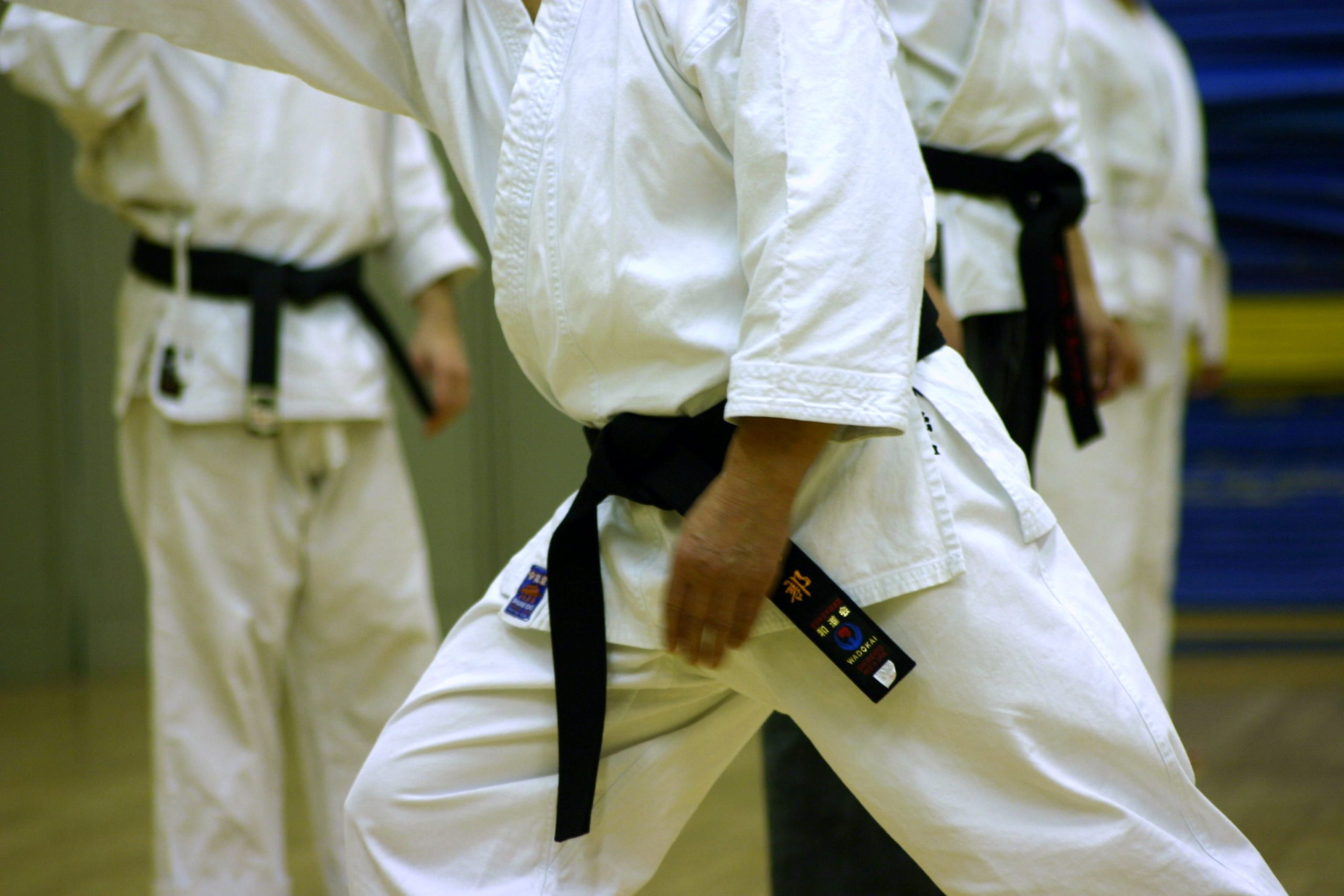
He couldn’t bear going back to the apartment just yet. The apartment of the dead. When they’d been much younger he had shared the big bedroom with his older brother while their father took the small one in the back for himself. Issa recalled the bouts of barely controlled rage and weeping that ensued each time their old man thought his firstborn was not manly enough. It was a dance of endless humiliation between the two of them, starting in sixth grade for Hashem, when he came home from school one day and asked if he could take violin lessons. The old man, busy making a banana shake for Issa after having just taught an advanced karate class, raised his head and looked at Hashem, dumbstruck. Issa was almost two years younger and even then he understood something was not quite right with this picture. Within minutes they were downstairs at the dojo, where a few of the higher belts were still practicing. Hashem was made to punch the heavy bag until he was out of breath. Then the old man made him do the chicken walk a half dozen times around the dojo before putting him to spar with a teenage purple belt.
Hashem, who had always found excuses to avoid the dojo, stands there with a nervous smile on his face. Their father telling the other boy to attack. Attack what? Issa thinks to himself even then. Attack Hashem’s desire to learn the fucking violin? He is nine years old and has been going to the dojo religiously for about half a year and wants to protect his brother but has no idea where his loyalty lies. He worships the old man and imagines what their father is doing will somehow cure Hashem of something. He does not know what that something is yet, but when he sees the other boy throwing a halfhearted mawashigeri roundhouse kick to the side of Hashem’s face and pulling back at the last moment he wants to go out there and rip the boy’s face apart, even though the other boy is twice his size. Suddenly, the old man’s anger washes over them like wildfire. There are several other students in the dojo, standing mesmerized at this display of wrath by a sensei who has never before shown a lack of control in their presence. No one understands it. No one says a word. And then their father is raising his voice and warning the purple belt to either fight with his eldest son or never come back to the dojo again.
This time the boy attacks with a low maegeri front kick that catches Hashem in the inside thigh. The boy closes the distance and throws a lunge punch just above Hashem’s right eye. He does not follow through with more punches, though. He looks embarrassed. And then Issa is running at him. The moves he has learned in the last half year at the dojo are out the window, and all he knows to do is to try to wrestle the kid by going for his legs.
The teenage boy shoos him off.
“Touch my brother again I’ll kill you,” he hears himself shouting ineffectively.
Hashem is rolled into a ball on the floor, holding his face, crying softly. Their father stands there with glass eyes, surely astounded at the wickedness he has just caused and looking as if he has just woken up from a bad dream. The purple belt bows and retreats.
The image stopped cold for Issa right there. He could not recall what had happened next. There was no talk of violin lessons ever again. Nor did their father ever lose his cool at the dojo like that again. But this was the last time Hashem stepped into that space. Something had been broken. And something had been built—a tall wall between them, for the remainder of the abbreviated lives of these two men, both of whom Issa had adored and who hated each other.
Then came the change in their bedroom arrangements. Issa had to move into the small bedroom by himself, and their father took the big bedroom and made Hashem his roommate. It was, in a way, the absolute worst punishment he could have inflicted on the two boys, taking away Hashem’s privacy and at the same time forcing Issa, the younger brother, to have his. And the next few years turned into a cold war punctuated with bouts of seasonal brutality that ended in Hashem crying in one corner of the apartment and their father feeling remorse in another. At school, Hashem was beloved and, unlike Issa, a perfect student. The more their father heard praise from school about Hashem and his grades, the angrier he seemed to get, and he devised yet more tests of manhood, which Hashem failed at spectacularly. One day, the old man decided Hashem had to learn how to ride a motorcycle; it ended in the bike falling over Hashem and the hot exhaust scalding half his leg. More than once, the three of them had to go hiking in the mountains north of the city and learn to stake tents and shoot bows and arrows. Another failure. If Hashem didn’t like karate, how about learning to box or wrestle or do judo? It was one thing after another, a desperate quicksand of man-making that always ended in disappointment and heartache. As time went by, Issa moved up through the ranks at the dojo and his belt colors changed. During the silent mokuso meditation intervals at the beginning and end of practice, he’d often wonder what their father was thinking. Did he think about Hashem then? Was his mind completely blank? Did he ever think about the men who still thought him an enemy of the revolution?
It was one thing after another, a desperate quicksand of man-making that always ended in disappointment and heartache.
He had loved this man. And sometimes he hadn’t. More than anything, he had wanted his father to love Hashem. Or at the very least cease trying to turn the older son into a version of himself. The wash of bad memories didn’t fade with age but rather lingered and just grew more stale. Like the time after the old man put Hashem in a vicious chokehold up there in the mountains. Back at the apartment Issa had taken the small picture of the old man from his military days and ripped it in half. For days he’d hidden the photograph, ridden with guilt and fear that their father would find it. He did find it, years later. It was taped together but still showed the rip down the middle. The old man put the photo away and didn’t ask about it, no doubt thinking it was Hashem who had wanted to destroy his mug and not the younger son.
What a relief when Hashem finally left home. As if a huge boulder that the three of them had been carrying was at last lifted. From his second year of high school, Hashem had refused to cohabit in the same room with the old man. To make peace, Issa had given him the small bedroom back and took to the sofa in the living room. Many nights he’d just go to the dojo and sleep there, leaving the old man and his brother to their silent revulsions. The stale scent of sweaty gi uniforms would always linger on his skin from those nights at the dojo. He had imagined even back then that the sourness was that of men’s odium of one another. All men. It permeated everything, unwashable.
He walked aimlessly for a long time. The fasting month, Ramadan, would be coming around, and soon it would be summer. The previous summer had been unbearably hot, and tiny, white airborne creatures had invaded the city in swarms. They got into your mouth and hair and eyes, they stuck to car windshields and hung from trees. No one was sure what they were or where they had come from. It was a version of the day of the locusts but lasting an entire season in scorching heat. Sometimes he wondered if Hashem and their old man weren’t better off gone from this world, or at least this city. Some of the old man’s best martial arts students had eventually ended up running their own dojos. A few were famous now. Others notorious. But times had changed; nowadays it was the full-contact competitions that drew crowds. Few were interested in the old discipline of a traditional karateka. And who could blame them?
He sat for a while on the benches at Hasanabad Square until weekend crowds started emerging from the metro. Then he followed them to the junction of 30-Tir Street and Imam Khomeini Boulevard. They had recently cobblestoned this part of the city and set out food kiosks. Street musicians jammed the sidewalks, and a huge i <3 tehran neon sign shone off a wall of the Malek National Library. Hashem had loved going to all sorts of libraries when they were kids. He was also an avid book thief. For a long time the books he read went completely past Issa. One time Hashem’s desk he’d seen a book titled Of Mice and Men. He was still in elementary school, and the title in Persian—Moosh-haa va Adam-haa—had really repulsed him. It seemed sinister to his young mind, even if he did not yet know what sinister was. He questioned the rationality of his brother’s universe on these occasions. But he was also a soldier, there to defend Hashem, even if he did not quite know from whom and why. But as the years passed and Hashem’s library expanded, he began to take a new interest in his brother’s books, and their variety eventually became his own entry point into literature. By now theater had taken over Hashem’s world. He was about to finish high school with dazzling grades, and their father could no longer force him into the dojo to humiliate him for loving an art form, as he had done with the violin. There was one book, Issa recalled, that never left his backpack: Shakespeare Our Contemporary. Issa thinking: I know who Shakespeare is. We read about him in some class. But why “our contemporary”? It seemed Hashem might always be trying to provoke their father with books out of the range of the old military man’s understanding, and frankly Issa’s understanding as well. It would take several years of studying at the university and fully catching up to Hashem’s reading list before he began to get an inkling—a library with a shelf full of thin books by a man with hair like an eraser, Samuel Beckett; a book of poems by W. H. Auden, with the deeply lined face of a man whose gaze was a mixture of defiance and wisdom; and of course Hashem’s film heroes with exotic, sexy, and excessively beautiful European names: Bresson, Pasolini, Fassbinder. “Look after my books,” Hashem had asked him when he was finally leaving home. And he had, religiously, even getting a shelf built for them by hand. These were the very books that their father often thought of as the culprits stirring his firstborn toward that unreachable place where only shame lay.
It seemed Hashem might always be trying to provoke their father with books out of the range of the old military man’s understanding.
One day he’d come home to see the old man boxing all the books.
“Pedar, what are you doing?”
“I’m taking them to the bookshops along the university and selling them or giving them away. Maybe I’ll throw them in the sewer. I don’t know yet.”
“But they’re not yours to do that with.”
The old man had looked up at Issa. “What did you say?”
“Those books are my amanat. They are in my care. A man has a duty not to betray an amanat. You know that.”
“These books turned your brother kooni. You understand, son?”
“Books don’t turn a person into one thing or another. And so what if they did? I’ve read most of those books by now. They’re really mine.”
“Yes, and I can tell you’re turning into a homo like your brother.”
It was the first time, and last, that in so many words he’d told his father to go fuck himself.
They remained there like two combatants. Issa stood his ground. “I’m not betraying my brother like you betrayed your son.”
The old man came at him then. His yokogeri side-thrust kick purposefully missing him by barely an inch but denting the wall with a loud boom. The old man could have crushed him. But Issa still did not budge. And the old man did not pursue the subject again. The books stayed.
Who is responsible for maintaining family lore? In Company, Shannon Sanders introduces—and repeatedly reintroduces—readers to the Collinses, a Black family with roots in D.C. and Atlantic City. Sanders, a master of character, makes every individual distinctive and recognizable even as they clearly belong to a whole, bound by shared history, values, and challenges.
In “The Good, Good Men,” two adult sons try, for better or worse, to fulfill their presumed filial duties; in “La Belle Hottentote,” four nieces fill in for an absentee daughter; and in “Company,” an aunt struggles to live up to family standards of hospitality. By presenting characters across different perspectives, at different ages, and under different circumstances, Sanders forces readers to reckon with them in their full, complicated, beautiful humanity. And though certain characters believe otherwise, we gradually discover that they’re all custodians of their lore, and of each other.
I spoke with Sanders over Zoom, where we discussed the many forms of inheritance, the importance of aunties, and the intense pressures of having—and being—a guest.
Emily Mirengoff: Many of the stories revolve around the Collins family, but not all of them. How did you determine whose stories you wanted to tell outside of the central cast?
Shannon Sanders: Three stories in the collection aren’t explicitly focused on Collins family members, though we do see all their protagonists, if briefly, in other stories. I wish I could say I always had a firm idea of how many stories would branch away from the family, but I didn’t. I wanted to show that some of the pressures facing the Collins family—microaggressions, respectability politics—are things that their broader community would also have to contend with. These aren’t just issues that are carried through the generations of a single family. They exist across the different communities depicted in the book: the Black community of D.C., Black people in academia, Black people in the professional workforce.
EM: You describe characters with such vivid, memorable efficiency. I think my favorite is when a man thinks of his mother as “a woman with air between her ears. Who lived by the word of her daily horoscope and always kept a tambourine handy to punctuate moments of spontaneous group laughter.” How do you come up with these kinds of details? Will your friends and family recognize themselves in your characters’ foibles?
SS: I could talk for hours about family and friends recognizing themselves in fiction! To begin with, none of these characters are real people. As a newer writer, I did start with prototypes of people I knew, people I felt conveyed certain elements of the human experience. For example—and he knows this!—the character of Theo is based on my brother in a specific phase of his life, when he’d recently moved to New York, and was trying to do a Mark Zuckerberg kind of thing.
Even now, as a more confident writer, real people still help provide details that create authenticity and verisimilitude, without corresponding one-to-one with characters. For example, my mom has a tambourine that she loves to play! But she is not that character; I just thought it made a great sensory detail. When characters do correspond more directly to real-life figures, I made them minor characters, who would just peek into the story.
When loved ones read our fiction, they’re looking for themselves, they’re sometimes nervous about how they’ll be portrayed, and they’re quick to recognize themselves where they are not. Writers are often eavesdroppers, people-watchers, and we’re collecting little bits of data to help form a cohesive person. The trick is to plagiarize the people in our lives without them realizing it. But I think it’s a compliment when people are sure that they recognize someone in a character, because that means that they’re seeing a person, as opposed to an assemblage of sentences.
EM: All these stories center around visitors—or company, per the title. We learn a lot about characters from how they prepare for, and receive, guests; the impressions they’re trying to make. What does company mean to you—and how does it overlap with family?
SS: This connective thread throughout the stories actually took me by surprise—someone else pointed it out to me. But I think it’s a literary obsession for me because it overlaps with the ideas of performance, code-switching, respectability politics, and self-presentation. There are so many decisions that go into how we self-present in different spaces, and that’s especially intense when we have guests, or are guests. When I was in my twenties, I did so much guesting and hosting for bridal showers, baby showers, weddings, and church events. Some of the most stressful moments of my life involved this expectation of putting myself on display, or doing my hosting job. I’m an introvert, so I had to pull on real reserves of strength to get through some of these interactions. On top of that, so much conflict comes not just from the event, but its preparations, all the freight attached to the event.
It overlaps deeply with family, because the way someone hosts doesn’t just implicate them, it implicates their upbringing, and I think mothers and grandmothers feel this especially acutely. I was most interested in how different generations of this one family would tackle these issues, particularly because of different generational expectations. Also, aunties are a huge motif in this book. The auntie is a figure in your life who knows what your upbringing looked like, who knows your freight and expectations, but her investment is different. She can bear witness to it, or nudge you in the ribs if your mom’s getting on your nerves. She can even be a maternal stand-in. She can see when your own preparation has failed, or when she thinks you’re absconding from it. I didn’t necessarily plan to set all the stories around these encounters, but they’re such momentous moments for women, and women of color, when we really take stock of who we are, what matters to us, and how we want the world to relate to us.
EM: Speaking of aunties, in the titular story, one of my favorite characters, Fay, complains about “curating the goddamned Collins family museum,” when her niece visits. At the same time, it’s clear that she also cherishes her role in keeping the family memory alive. How did you think about that ambivalence?
Writers are often eavesdroppers, people-watchers, and we’re collecting little bits of data to help form a cohesive person.
SS: It’s such a big responsibility—to feel like you’re the custodian of family history, and to feel responsible for passing it on to the next generation. But when people are challenged on it, they tend to cling to it. Within our families, we are empowered by our understanding of that history; everyone has their own lens on it, and sometimes those different understandings end up competing. In that story, Fay is riled up that her sisters have created a certain impression of their childhood, their parents, and their values to this new generation without consulting her. One of the most interesting aspects of the aunt figure is that she knows your parents in a way that you never will. But you, as the child, know your parent in a way that she never will, and sometimes those come into tension.
EM: The theme of inheritance appears on almost every page of this collection: inheriting money, looks, personality traits, lessons, talent, names, and memories. What do you think is the most important legacy that the Collins grandparents—these much-mythologized figures—leave their descendants?
SS: I agree—inheritance is a good way to sum up one of the major concerns of the book. I’ll also add, in addition to those positive inheritances: hang-ups, self-consciousness, and some real tensions! I think the grandparents’ major legacies are work ethic, concern with education and self-presentation, and self-reliance. What’s fun about writing multigenerational stories is that you build this family tree, and then you see how a legacy gets fractured and reinterpreted across generations. All four of their daughters have a strong work ethic, though how that looks in practice is a bit different for each one. They also engendered a real communal responsibility—asking the daughters to look out for each other, which we see play out in the next two generations.
And they passed along the ability to turn lemons into lemonade—to take a negative circumstance and bring out its most positive aspect. The grandparents owned a nightclub: they took a segregated Atlantic City and turned it into a fertile place to run a business. They took drunk patrons and turned them into friends, in many cases. It’s resilience, but a step beyond as well: the ability to not just survive, but thrive, in difficult circumstances. That’s a legacy that we see in all the youngest generation.
EM: In the stories “Birds of Paradise” and “La Belle Hottentote,” we see the same evening—the same events, the same sartorial choices—through two different sets of characters. Some impressions overlap, and many contradict each other. As a reader, you never get the impression that either narrator is lying or mistaken; they’re just experiencing different truths. As the author, how did you imbue both stories with equal credibility?
SS: That’s another reason I really wanted to write a multi-generational book. I didn’t want to tie the reader to a single protagonist. As millennials, I think we have a little bit of a superpower—and maybe this is a phase that every generation passes through—which is the ability to empathize with our parents, with our generation, and the slightly younger, next generation. As an observer of my mom and my many aunties, I’ve observed a lot of their concerns, the tensions between them and their children, their worries about the next generation’s values. I’ve also observed some of their misunderstandings about the pressures that we face. A basic example is the perpetual question, “When are you going to buy a house?” We’re like, “We would love to! Sell them to us at a price we can afford.” I have so much empathy for them because I’ve listened so closely to them throughout my life. But I also know that we, coming of age now, have a point too, in many cases. I wanted to really explore that intergenerational tension from both sides.
In the two stories about the party, there’s a character who has been built by a certain patriarchal workplace environment, who invested her life and career in it and fully bought into it. But I also wanted to show these young people, on the cusp of entering their own adulthood, reacting to that same environment. When we’re handed the mantle and told, “this is what you’ll have to do to survive a workplace,” many of us just took that mantle and said, “Okay, this doesn’t sound great, but I’ll give it a shot.” Others rejected it wholesale, and that’s why we see such progress in the ways that women and people of color are able to participate in those spaces. Within my own family, I have a corporate job, while my brother is a creator; he’s entirely rejected it. Intergenerational tension is not between one generation that knows what it’s talking about and one that doesn’t. It’s about two generations that both have completely reasonable understandings of the world based on how they were built, and then have to figure out how to deal with each other. All the terrible events of the last twenty years—they’re so much richer if we see them through the eyes of fully formed adults, who came of age in the ’70s, as well as later generations, who are still learning about the world as they experience it.
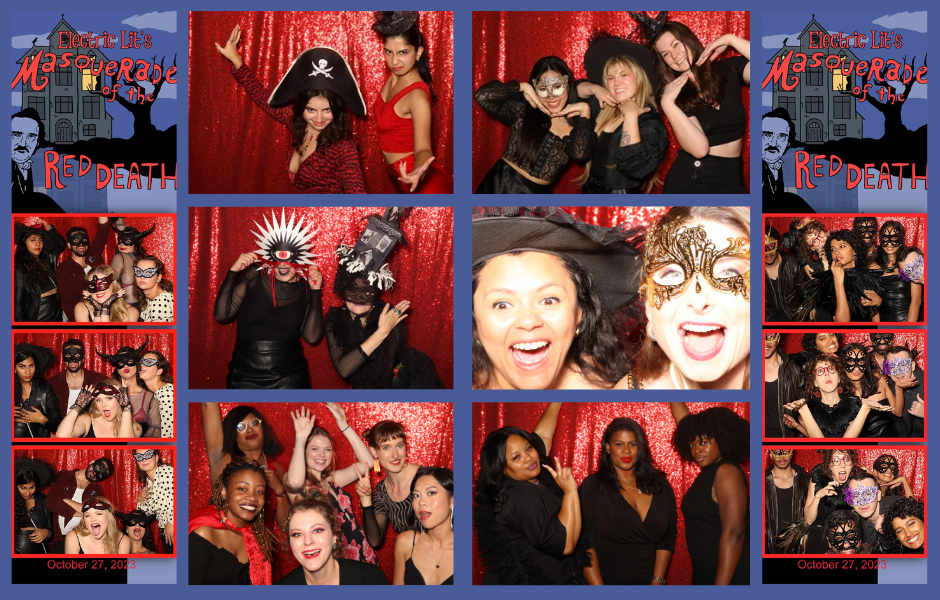
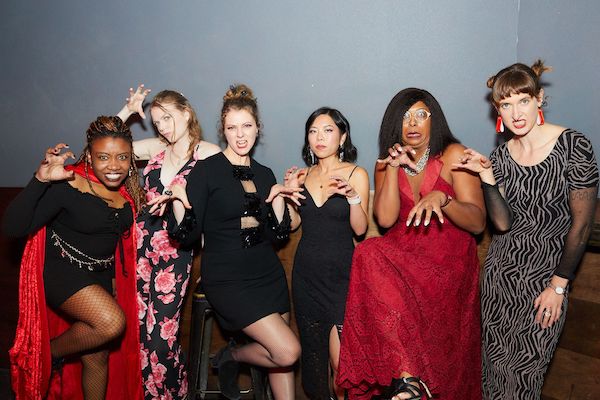
The Masquerade of the Red Death is the one night every year where we gather in Brooklyn, celebrate with our community, and raise funds to support our work. It is also the night the spirit of our party patron saint Edgar Allan Poe is strongest, and the spooky vibes reach their peak! This year, our friends, readers, writers, and beloved colleagues from the literary sphere showed up and showed out, fabulously decked in horns, feathers, and most thematically, many stunning and creative masks. Themed cocktails were sipped, tail-feathers were shaken, and party-goers ended the night with an armload of free books! Here is a recap of the red-soaked revelry of this most spooky night, captured by photographer Jasmina Tomic.
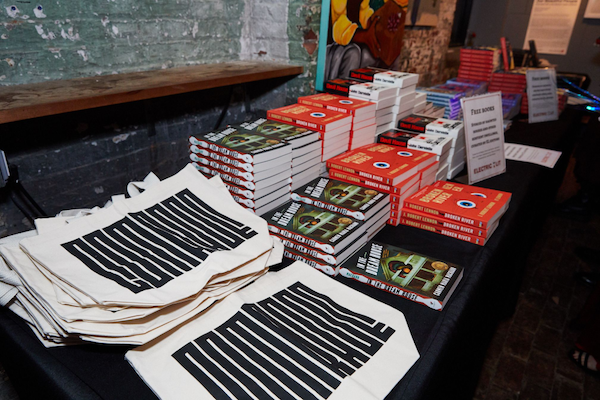
Our party favor is a Verso tote bag overflowing with free haunted house novels!
Inspired by Edgar Allan Poe’s story “The Fall of the House of Usher,” EL editors curated a giveaway table of novels and short story collections that feature houses—haunted, alive, or just plain creepy—as characters. The offerings include well-loved classics—The Shining, We Have Always Lived in the Castle, The Haunting of Hill House—and exciting newer titles—Devil House, In the Dream House, Broken River, Terrace Story, Caul Baby, Out There, and Bluebeard’s Castle.
Bring your own mask, or take one of ours!
Thanks to to our beverage partner Interboro Spirits, the open bar included a Poe-themed cocktail hour: The Gold Bug, The Black Cat, and The Tell-Tale Heart.
It was a full house! And we just love seeing people mingling with books in hand.
This year, our honored guests are authors Morgan Jerkins, author of Caul Baby and Hilary Leichter, author of Terrace Story.
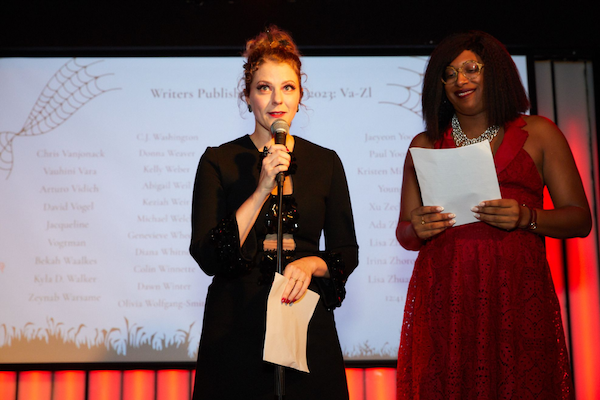
It’s been a banner year for Electric Literature, after winning the Whiting Literary Magazine Prize in 2022. Executive Director Halimah Marcus announced that this year, Electric Literature had three stories in Best American Short Stories and two stories in Best American Mystery and Suspense, the first online literary magazine ever to do so.
In her speech, Editor-in-Chief Denne Michele Norris said: “Last year we announced the success of the Both/And fundraising campaign, our groundbreaking essay series centering trans and gender nonconforming writers that published this spring. Earlier this year we designed and launched a new creative nonfiction program. I’m really thrilled to announce that we’ll begin to publish these essays, weekly, on Thursdays, in mid-January.” Marcus added: “And as if we didn’t have enough going on this year, we partnered on the launch of Banned Books USA, an initiative to giveaway banned and challenged books to readers in Florida, for only the cost of shipping.”
After remarks, it was time to hit the dancefloor!
The DJ, novelist Ryan Chapman, had us all sweating and screaming on the dancefloor. In other words—he knows his tunes. And did we mention he has a new novel coming out this next spring?
Click to enlarge
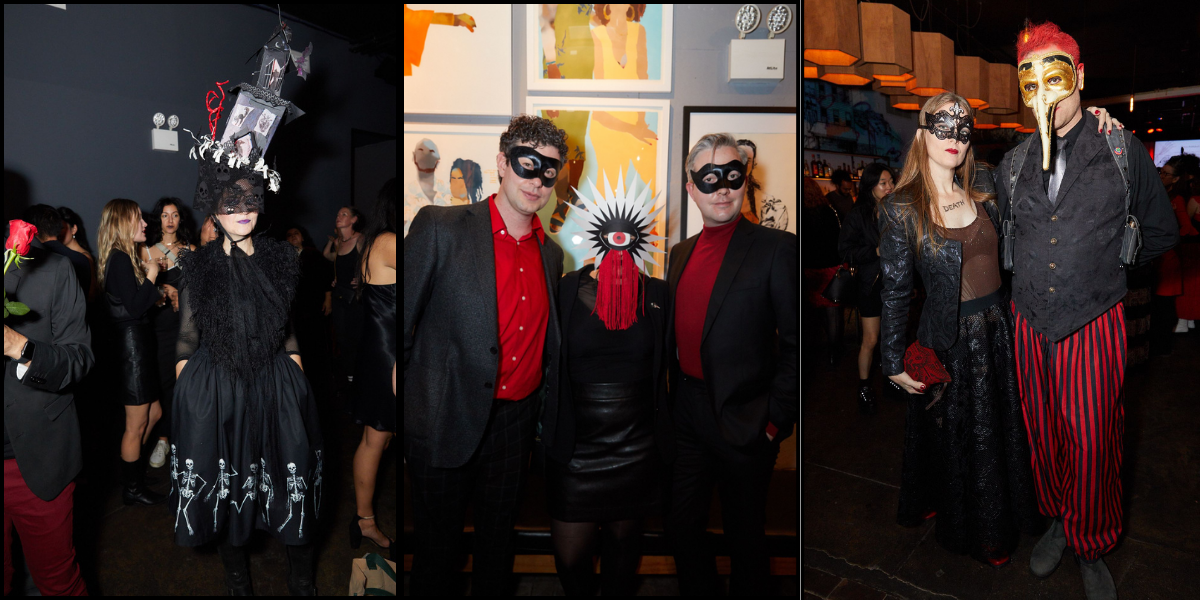
Some guests did not deign to unearth themselves from beneath their haunted dwellings—they brought them along to party! (Could it be One Story founder Hannah Tinti andmanaging editor Lena Valencia? They’ll never tell.) The deadliest couple of the night for the second year running goes to Catherine LaSota, founder of The Resort, and Karl Jacob.
Can we have a little commotion for the masks??
The turnout was deadly, mysterious, and stylish. (We promise the photographer has not been turned to stone!)
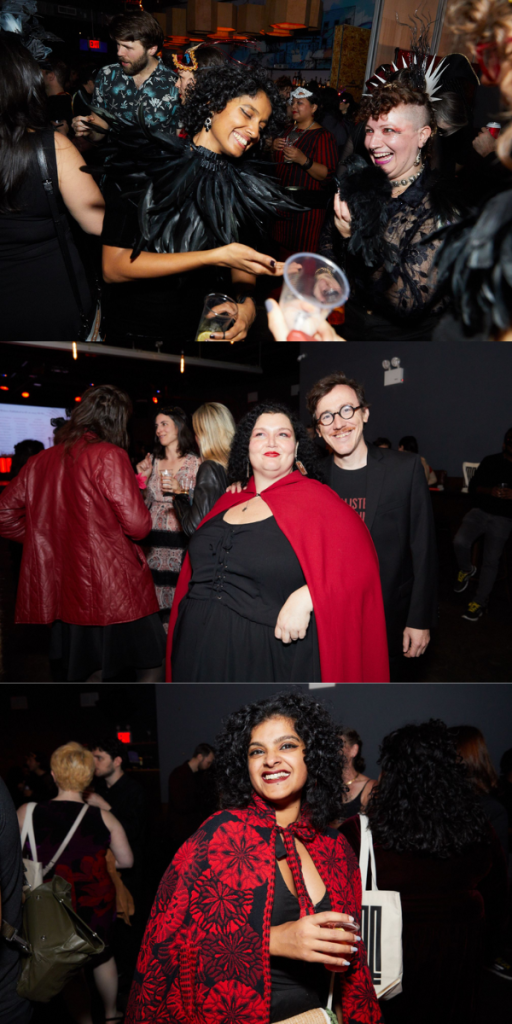
We love a good cape and this fabulous flock of crows, having a murder of a time (crow pun intended!).
We spotted so many book authors getting their grove on at the party. Picture here—from top to bottom, left to right—is Isle McElroy (People Collide), Greg Mania(Born to Be Public), John Manuel Arias (Where There Was Fire), Jennifer Baker (Forgive Me Not), and honoree Morgan Jerkins.
Click to enlarge
Say boo for the photobooth!
And that’s a wrap from Electric Literature team. Left to right: Former interns Nzinga Temu and Lauren Hutton, Halimah Marcus, Books Editor Jo Lou, Denne Michele Norris, Recommended Reading reader Maddy Adams.
Thank you to our sponsors for making this gathering of incredible and vibrant book people possible! See you all next year!
Venezuela, my home country, was once one of the richest countries in Latin America due to the discovery of oil at the start of the last century. Today, Venezuela is in political and economic turmoil with a mass exodus of more than 7 million.
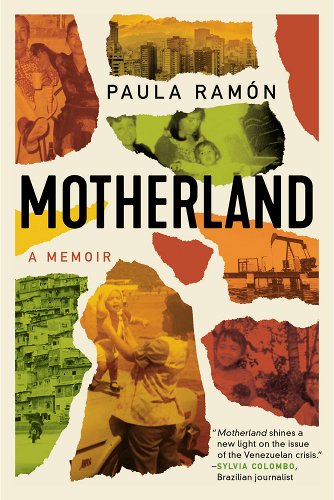
As I wrote my new memoir, Motherland about the fragile concept of home and my complicated relationship to my family and to Venezuela, there were several books that took me back on a quest to understand where we came from as a country. The horrific conditions in Venezuela over the last several years sometimes made us forget what happened before Hugo Chávez.
The list that follows includes some of the essential books about Venezuela. These are not only for people who may know little about the country, but also for Venezuelans who are interested in our past and how, after decades of abundance, we got to where we are today, where families are dismantled and millions of people leave the country in search of a better life.
Taking some inspiration from Venezuelan playwright José Ignacio Cabrujas and his analysis of the providential quality of the State and the social impact of the sudden wealth that oil brought to the country, Coronil, an anthropologist, addresses the transformation of the Venezuelan State in the last century as the country became an oil nation. From the dictatorship of Juan Vicente Gómez to democracy, marked by the spectacular first presidency of Carlos Andrés Pérez (1974-1979), Coronil explains the relationship of Venezuelans to the State and its presidents. I first read this book when Chávez, thanks to a new oil boom, magnified and personified the notion of a generous and almighty State. It was no longer the State, now it was Chávez. That is why this book, first published in 1997, was also prophetic. Overall, it is key to understanding the Venezuela that preceded Hugo Chávez’s “revolution.”
William Neuman understands Venezuela as few outsiders do and opens a window into the country with this exceptional compilation of stories. Neuman, who arrived in Caracas to work as a correspondent for The New York Times in 2012, shortly before Chávez died, gathers testimonies and anecdotes that allow readers to understand the social complexities of a divided nation. One of this book’s great contributions is that its characters are those who live and suffer in the country, and the wealth of perspectives Neuman presents is only possible thanks to the years he spent traveling throughout Venezuela.
While working as The Guardian’s correspondent in Caracas, Rory Carroll was once the target of one of Hugo Chávez’s typical verbal attacks during his weekly Sunday television program. In this book, Carroll shows the seams of the political project of the man who ruled Venezuela for more than a decade under an eternal promise of utopia that never materialized. In a series of vignettes, Carroll incorporates interviews with people in the presidential entourage and figures who influenced the definition of the so-called “Socialism of the 21st century.”
Simon Bolivar is similar to a founding father for us. We hear about him almost from the time we learn to read, and there is no shortage of literature about him. However, Marie Arana’s biography excels in capturing the intensity of the Liberator’s dramatic life and does it in an almost cinematic portrayal that matches the grandeur of the man who waged countless wars against Spanish rule to liberate what is today the countries of Colombia, Venezuela, Ecuador, Peru, Panama and Bolivia. Arana also brings in the forces and influences that shaped Bolivar and expands on his ideas about politics, race and government in a narrative that transpires passion, but without caricaturing or mythologizing him, a frequent practice in Venezuelan politics. Bolivar has been quoted by countless regional leaders, but Hugo Chavez, who claimed to be his spiritual heir, took the fanfare to another extreme. Chavez, who drew parallels between himself and the Liberator and nurtured conspiracy theories of assassination attempts, went so far as to order a national broadcast of the exhumation of Bolivar’s remains by a team of professional investigators to determine whether the father of the nation had been assassinated. The conclusion is that he was not, nor would Chávez be.
This book offers a different perspective because it approaches political transformations in Venezuela from an urban and popular point of view. “Over the years, Venezuelans – more and more concentrated in urban spaces – developed an expansive understanding of democracy that combined institutional and noninstitutional, formal and informal, legal and illegal practices in their dealings with the state,” writes Velasco. Barrio Rising reviews the decades leading up to Chávez’s arrival, describes how the concept of democracy was shaped in the working class and how years of exclusion impacted the notion of democracy. It focuses specifically on the changes experienced in the neighborhood 23 de enero, or January 23. Designed as part of the dictator Marcos Pérez Jiménez’s ideal of modernity, this barrio became a symbol of democracy when the military was overthrown in 1958. Decades later, when democracy was teetering, the neighborhood became a bastion of resistance. Close to the government palace, its symbolism is such that it was in this neighborhood where Hugo Chávez voted in every election. The ballot became a popular televised show, with hundreds of people cheering for the president, who never lived there but was received with devotion as one of their own.
Hugo Chávez by Cristina Marcano and Alberto Barrera Tyszka
Much has been written about Hugo Chavez, the charismatic leader who first appeared on the scene in 1992 when he assumed the leadership of a failed coup d’état in Caracas. But one of the first efforts to portray the man behind the myth was this biography written by Cristina Marcano and Alberto Barrera Tyszka during Chavez’s first term, just when his popularity continued to rise, and he became a divisive and polarizing figure. Marcano and Barrera Tyszka assembled a personal and intimate portrait of the President by interviewing people who were very close to him during his childhood and early years in the Army and by using Chavez’s valuable personal diary. The biography discusses his influences, his family relationships, and how his political ideals were shaped.
Not many Venezuelan novels have been translated into English, but one of them is Iphigenia, which caused a stir when it was published in 1924 for giving a dissonant voice to a young woman who tries to rebel against the local machista elite into which she was born. It is the most famous work of Teresa de la Parra, a Venezuelan writer who, despite spending most of her life outside the country, focuses part of her work on portraying the Caracas society of the early 20th century. Iphigenia is notable for addressing the non-conformity of a woman and the veiled criticism of the elite.
Considered the quintessential Venezuelan novel and commonly summarized as the struggle between civilization and barbarism, Doña Bárbara narrates the dispute between the feisty protagonist and a landowner who after a time in the city returns to the countryside. Published in 1929 by Gallegos, who years later would become the first president of the Venezuelan democracy, the novel is an ode to the Venezuelan llanos, the region where Hugo Chavez was born. Besides bringing the exuberance of the plains in which fierce llaneros only fear the implacable ‘Doña Barbara’ and the spirits, the novel shows the richness of a region that is rarely discussed in our literature and which Chavez claimed had culturally molded him.
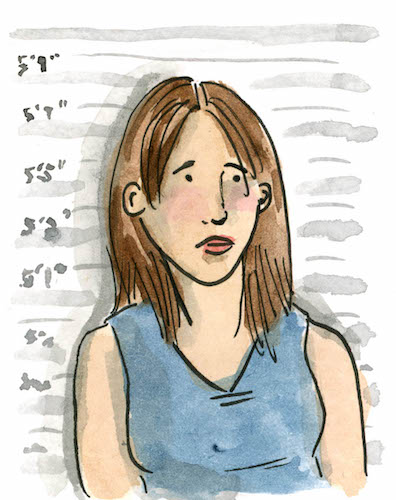
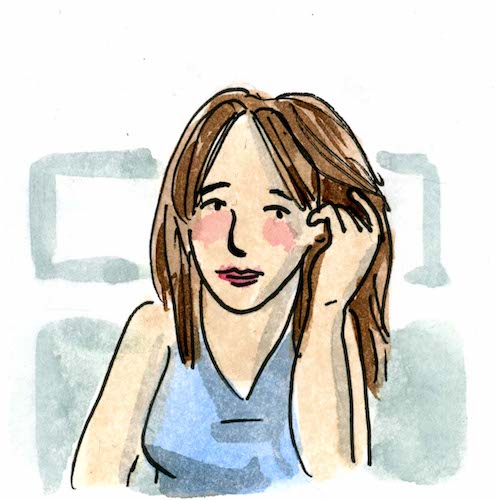
Look straight ahead and contemplate the lousy Kirkus review you’re sure to get.
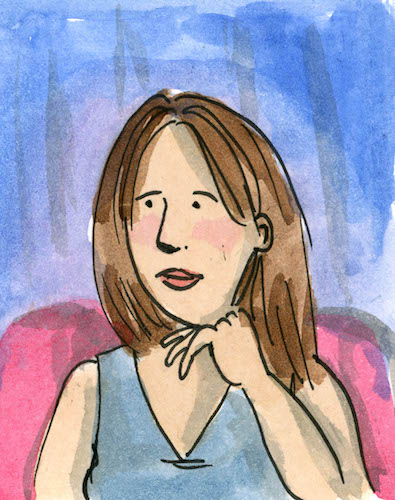
The Talk Show Host:
Place one hand under your chin and imagine listening to someone else, something you rarely do as a writer.
The Orgasm:
Throw your head back and grin ecstatically after ordering a box of your favorite gel pens.
The West Nile:
Sit at a scenic outdoor table at dusk, notebook open in front of you. If you contract the virus at least your mother will never have to read your memoir.
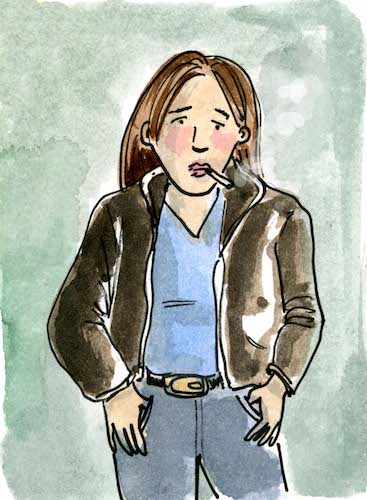
The James Dean:
Turn up the collar on your leather jacket and give a small smile knowing your arch rival’s book was remaindered.
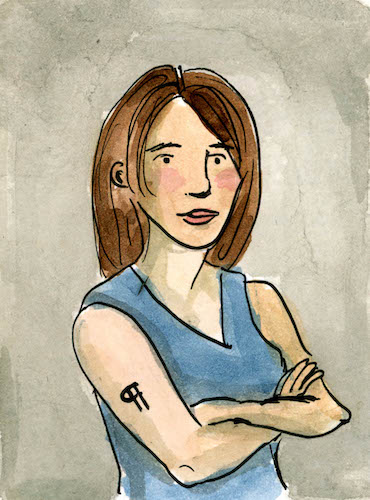
The Corrections Officer:
Cross your arms while wearing something stark. Remember to showcase your proofreading symbol tattoo.
The Barrette:
Push your hair behind your ear with one finger while considering what it would be like to have a job that’s actually useful, like firefighter, or accountant, or… hair clip.
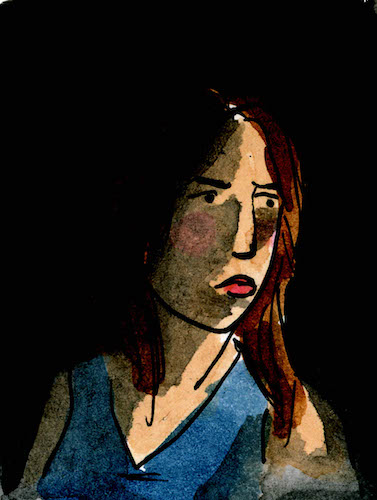
The Watergate:
Arrange the lighting so your face is bathed in shadow. Maybe you committed a murder like the one described in your novel, maybe you didn’t.
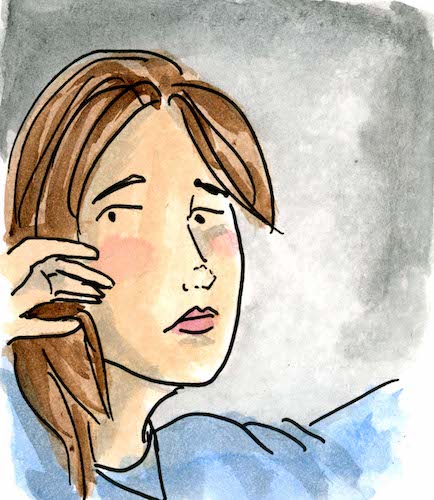
The Curious Dog:
Tilt your head and wonder, how does The Times really compile its best seller list?
The Cat Attractant:
Sit at an indoor table, laptop open in front of you. Stare pensively at the screen as you realize the timeline of your cozy mystery is horribly flawed.
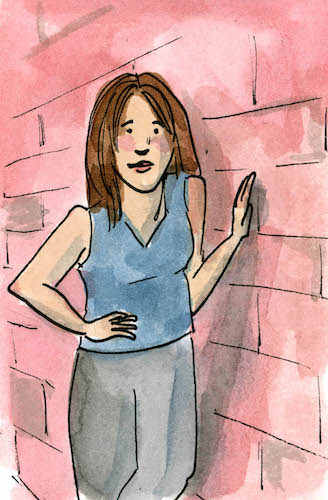
The Load-Bearing Wall:
Lean sideways against a brick wall as if you are needed for support, as if you could actually provide support to anyone on a writer’s income.
The TV Commentator:
Pose in front of your built-in bookshelves after replacing the dog-eared copy of Fifty Shades of Grey with a pristine copy of Proust.
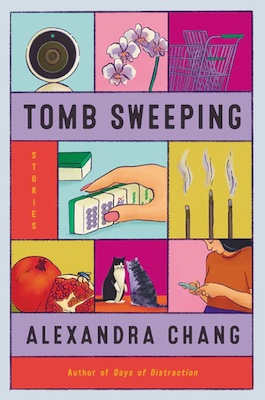
“The world here beats faster than a hummingbird’s wings,” writes Alexandra Chang in her new collection Tomb Sweeping. Chang, the author of Days of Distraction and a National Book Foundation 5 Under 35 recipient, writes poignantly about tenuous connection.
In these stories, a wealthy housewife runs a gambling ring in Zheijiang, a young woman attends the living funeral of a family friend, someone “drinks himself into a dedicated madness,” two friends become further alienated despite attempts to reunite, a brother disappears during Japanese occupation and the Sook Ching. Chang is curious about “the power of angry women” among “men of manageable dreams.” Fathers, fumbling, try especially hard to overcome their blindness; women, taught to behave, speak up and act up, or quit. People create new, impossible lives for themselves despite the risks and resistance, and the oppressive sociopolitical forces against them. There are incidents of misidentification, mistaken identity, doubling, doppelgängers, past selves. Couples uncouple themselves even when they remain together. Work arises as a torture of moral incongruity. Technology is rarely to be trusted. People, bound to one another through obligation, are so mystified by those they’re closest to, they often mislead or fail each other. It is unbearable for many of Chang’s characters to be alone—too often, existential dread overtakes them. The anxiety reverberates through the generations. Yet, undeniably, Chang’s characters harness power from feelings of disquiet. They travel the distance between obedience and the imagination to live a life of one’s choosing despite the weight of history, family, law, and prior selves. In the collection’s first story, aptly titled, “Unknown by Unknown,” a young woman, despite her very real fears, confides that she is “disoriented… in a way that makes me happy to be alive.” We feel that as a great truth of Tomb Sweeping, and of our own lives.
Annie Liontas: Are the characters in Tomb Sweeping lost or wandering souls? What allows them to find themselves or their place in the world?
AC: I do think of a lot of them as lost or in transition or going through some sort of growing pains. Some do find their place in the world, or at least find a sense of peace from that turmoil of feeling lost. For example, Adrienne, the protagonist in “Farewell Hank.” She’s definitely in a long transition: she’s young, she’s cynical, she doesn’t really have much of a connection to people around her. She hasn’t grappled with a central grief in her life. The events of the story allow her to at least face that grief a little bit more, and to find a sense of connection, at least with her mother. That connection gives her, I think, a little bit more stability than she had in the beginning of the story. Other characters are very lost. In the first story, “Unknown by Unknown,” the main character gets laid off from her job. She really has no sense of what she’s supposed to be doing, and then she gets this house sitting gig. That doesn’t give her any sort of long-term stability or a sense of having found a place in the world, but it’s an alluring temporary space where she can imagine herself into another life. But even that gets pretty quickly taken away from her and she’s back in a place of confusion—not the exact same place of confusion, though. And in that story, too, there’s a moment of fleeting connection between her and another character that grounds her.
I’m interested in writing characters who are going through it in some way, and don’t necessarily experience transformation where they transcend into a better being. They move through one phase into another, from transition to transition. If anything, connection with others helps them find themselves and their place in the world, but most of these connections are temporary, too. That’s how I see the world and experience life myself. I don’t think growing pains really ever stop. Transition seems constant, ideal even.
AL: Characters such as the narrator in “Klara” and the father in “Flies” can’t quite get out of their own way. They suffer, as do those closest to them. How would they define happiness? How far out of reach is it?
I wanted to combine the most painful friend breakup I’ve had… and condense them into the story.
AC: The narrator in “Klara” is so consumed by the loss of this friendship that she can’t really think beyond that pain. She’s experiencing it even though that friendship is long gone. Klara isn’t in the narrator’s actual day-to-day life anymore, but she takes up so much space in the narrator’s head because of how important she’d once been to the narrator. She’s in her own way because she can’t let go of this past. That’s true of a lot of my characters. But I do think at the end, she gets a glimpse outside of her pain. She wonders, what would Klara think of me right now? And that’s a tiny step into someone else’s perspective and outside of her own, and she’s able to let go a little bit. Is happiness within reach for her? Happiness for her in that story would likely be a return to their past friendship, which she knows is an impossibility. That’s not to say she’ll never be happy, but what she truly wants is definitely out of reach. Friendship breakups are so hard! It sometimes takes years to get over or let go of the pain of having lost someone who you knew and knew you so intimately.
AL: So that feels very close to your experience?
AC: Yes. In “Klara,” I wanted to combine the most painful friend breakup/friendship loss feelings I’ve had over many years and condense them into the story. I’ve woken up in the middle of the night thinking about conversations that I’ve had with friends who I haven’t been as close with anymore and been overwhelmed with sadness and anxiety, like, what happened? Why were we like this? What could I have done differently? What could they have done differently? That kind of obsessive, often nonproductive thinking is in reaction to grief.
AL: I think about the loss of a friendship as being an open wound, because culturally, we don’t have the language or the framework to define it.
AC: It’s not as simple as those romantic relationship breakups where it’s like, OK, we’re going to talk about it and now we’re over. Obviously it’s not always that clean cut with romantic relationships either, but with a friendship breakup, there really are no guidelines. In “Klara,” these two kind of fizzle apart and there’s no sense of closure for the narrator, which is why, as you say, it feels like an open wound. It’s very hard for her to understand what happened between them, and the narrative of their friendship is always shifting in her head. I’ve been there.
AL: You define culture in these stories as the accumulation of small ubiquitous gestures over time. What are the forces shaping these characters’ lives, whether they realize it or not? What happens when they do realize it?
Sometimes you just really do need to just be in this profound sadness instead of resisting it.
AC: The biggest forces affecting my character’s lives are those that tend to be outside of their control—societal forces like capitalism, class, racism, sexism, xenophobia. A lot of my characters are immigrants or children of immigrants. And a couple stories are set in China, one is set in Singapore. These characters are facing historical forces, the impacts of war, or of governmental policy. And oftentimes they don’t realize that’s what’s making their life difficult, or they’re not always thinking about why it is that they’re running into problems or challenges. They’re often just trying to survive their day to day. A few of them do realize. Like in “To Get Riches Glorious,” I’d say FuFu at some point does understand why she is having such a hard time achieving what she wants in life. She primarily blames it on sexism and the inability for her, as a woman in China, to actually fulfill her ambitions, ambitions that seem more readily available to the men around her. FuFu also comes from a poorer village background, and like a lot of the characters in this book, much of her struggles have to do with the desires for upward mobility. FuFu then has to find a route that’s outside of social norms to get what she wants. And what she does unfortunately lands her in prison.
AL: FuFu is one of my favorite characters! Despite the consequences, she is proud of her independence and the money she made through illegal gambling, and seems to have no regrets. Patricia, in “Persona Development,” likewise turns away from a life of security, in preference for one more aligned with her true self. How do you understand these women’s choices and brazenness?
AC: FuFu and Patricia are such different people, they’re almost on the opposite ends of the spectrum in terms of what they want. But both of them have to have the courage to go for something they want, even though they struggle along the way. FuFu became more clear to me as I lived in that story. I knew that I wanted to write a woman who would end up in prison. I had been reading this dissertation about Chinese women in prison, and I wondered, what leads up to this moment? The more I wrote her, line by line, she became this very confident and very defiant character. In a way, she develops these traits because of the very constraints and expectations placed on her. A lot of her choices are about pushing against the constraints, and I think FuFu makes a great effort to throw off what’s placed upon her. She’s compelling to me, too, because she’s not a character who I relate to closely. I wouldn’t be capable of going the lengths that she does to get what she wants. In many ways, I admire her abilities and her sense of self, even if they are misguided at times. She really doesn’t backtrack on her decisions. That story also zooms out and shows many women who are going against societal norms.
Patricia’s defiance in “Persona Development” is more personal. It’s also culturally based, just in a very different world. She’s this successful Director of Marketing at an agency in the States who has embraced these working-woman vibes, girl bossing her way up, but finds herself unsatisfied. So her defiance is more about turning away from that world and trying to figure out what she truly wants.
AL: In “Tomb Sweeping,” a medium meets an unexpected and chilling end, one which haunts the narrator. What questions is this story asking about guilt, inheritance, and the past?
AC: That story is about trying to understand what we owe one another in the aftermath of mistakes and intentional harms that have been committed in the past. The story is told through the perspective of a twelve-year-old girl who’s grandfather lived through the Japanese occupation of Singapore during World War II. Her grandfather’s brother was murdered by Japanese soldiers, and her grandfather is very adamant about her understanding this history. But he does so from a very wounded place and is holding onto a lot of hatred. This comes to a head when they encounter a medium who is half Chinese and half Japanese. The medium represents something very upsetting and disturbing for the grandfather. But this young girl, who has not lived through that pain and who only knows it secondhand through her family, is trying to grapple with what she inherits from this past. What do I do with this legacy? How do I navigate it? Who is at fault and who carries the guilt for what has happened in the past? How can people today right these wrongs? She doesn’t necessarily come to any answers, and neither does the story. I don’t really feel like I have answers either. That’s what draws me to stories, having questions that I don’t have answers to and still don’t have answers to after writing them. It’s more about trying to wade into the questions and see if anything can be uncovered—not an answer so much as a feeling for how to live.
AL: You wrote this collection before the novel, but decided to keep working on the stories. What went into that decision?
AC: Cumulatively, I’ve been working on these stories for nine years and I sold them at the same time as the novel. If the collection had been on schedule, it would have been published a year or so earlier. But at that time in my life, when I should have been working on the stories in order to meet my deadlines, it was deep pandemic and I had just moved to a new city. The state of the world was terrible, I was consumed by the news, consumed by what was happening around me. And then, on a personal level, I was feeling very helpless and distant from loved ones. I was, to be honest, very depressed. I just did not see the importance of these stories. I understood on a logical level that this book was under contract and that it wasn’t a huge deal whether I finished them or not, so why not finish them? But on an emotional level, I just wasn’t in a place where I could do it. I didn’t feel a connection to the stories or to writing fiction at all. I thought, Maybe I’ll never write again. It was pretty devastating. I don’t think I wrote anything for over a year. Sometimes you just really do need to just be in this profound sadness instead of resisting it. I guess that was the way that I was able to come out of it.
Over time, the stories began to feel new to me again, and I became a little bit more interested in what they were doing, maybe because the stakes felt lower. I told myself, I don’t have to be a writer, I can actually walk off that path. It’s not life or death for me, I can step away from it. Teaching helped with continuing with the stories, too. Going into a classroom where there are young people who are like, “I love books and I love reading!” I was reminded, “Oh yeah, me too. I do love that!” Eventually I got to the point where I thought, I can do this. I want to return to these stories renewed.
AL: Most of these stories resist neat or definitive endings. How is resistance to closure true for you?
AC: I just don’t believe that there are super clear-cut answers in life, or very clear-cut ways to live. Maybe one day I’ll turn a certain age and think, actually, this is the way to live, but I haven’t experienced that yet. A lot of my characters, like me, struggle with what is morally right and wrong in certain situations. They often land in ambivalence, that things are not so black and white. What might seem right thing to do could cause harm… There is nuance in every situation. There are times when I worry I lean a little too much into nuance or into this gray area. Obviously, there are times in life when I feel very strongly about something being evil and clearly harmful in the world. But that’s not really what I’m interested in exploring in fiction. When I’m writing, I want to feel like I could discover something new. I don’t want to have an answer already in my head and then write towards the answer. That’s boring for me as a writer. These stories don’t have neat, tidy endings because I want to leave the door open for possibility.
“It’s brave of us to die!” writes Melissa Broder in Death Valley, a desert survival story. The woman in Broder’s third very funny novel, like Broder’s other characters, is recognizable by her need to “control the uncontrollable,” as well as her wit, occasional panic, deep and unrelenting introspection, and love affair with Best Westerns (“Where the wood can be fake, make it fake. Where linoleum can be used, use linoleum. If a geometric shape can be incorporated into any wall, rug or floor tile, it’s going in”).
The woman’s father has recently come out of a coma after a very close call, and no one can say how much time he has left; her husband is nine years into a debilitating condition that becomes inescapable for both of them. “I love you,” something the woman says multiple times a day, “can mean anything from I’m sorry you’re suffering to Please stop talking.” She escapes to the desert, she believes, to finish her novel. In actuality, she is here to reckon with her own powerlessness and unlikely resilience. On an ill-advised hike through the desert, the woman stumbles upon a strange cactus—a cactus can be a portal and “every door can be a trap door”—and is met both with her father when he was young and her own unexpected feelings about seeing him in such a childish state. Then, when she thinks she is ready to go home, she goes back to the desert and really gets lost. No food, no water, no bars on her cell, not a soul who knows where she is or that she is hurt.
The reader might feel they are wandering the desert with heat stroke before heat stroke actually sets in: rocks talk, rabbits have a party—and then things get weird. There is an obvious metaphor here about how times of grief are days spent wandering a desert—except there is nothing obvious about Broder’s searching, or the tenderness she visits on characters who fail to save those they love from pain and death, not even able to give them hotdogs when they ask for hotdogs. Seek and ye shall seek becomes a refrain in the novel, and a portal that leads to a higher self.
Annie Liontas:How would the protagonist in Death Valley define courage?
Melissa Broder: I think she thinks that courage is something that comes naturally to a person, that it’s an inborn trait rather than something that we need to muster or a resource that can come out of weakness or out of fear. I would say that she does not believe she is courageous, she does not believe that she has strength. She believes those who are not fearful don’t need courage. She doesn’t want to be having to face what she is facing. She doesn’t want her husband to be sick. She doesn’t want her father to be in the ICU. She doesn’t want to be lost in the desert. I think she’s a very fearful person, and yet there’s a will there. On some level, it’s about acceptance and seeing.
AL: So it seems like courage is something she feels is beyond her, at least in the beginning?
MB: She is forced to discover that she has inner resources in order to survive. She’s not a wilderness-y person, but she knows how to do things. I read some desert survival manuals in writing this book, so she actually knows to do things I would have never known to do. For example, looking to see what animals eat. There’s that moment where she’s going to eat one of the wild flowers and is surprised by the thought “Oh, I must really want to live.” And that parallels her father, who always seemed kind of “meh” about life until he’s in the ICU and really wants to live. By the end of the book, courage is a resource that she summoned. And she’s surprised by the will and surprised by her own fortitude.
AL: The novel—and the character—makes sure that she is very quickly stranded in the high desert. Why was this isolation essential for her awakening?
MB: It would have been a totally different book if she’d been stranded with others. But I was actually very conscious of that isolation when I was writing the book. I didn’t want to write a COVID narrative, but my father was in the ICU during COVID and the first couple of months we weren’t allowed to go see him. My dad had been in an accident in December of 2020, and he died in May 2021. We would FaceTime my dad every day, and sometimes he was conscious, and sometimes he wasn’t and the nurse would just put the phone on his pillow. And so, for me, the book could not have been another way. I needed to create that isolation for her. It’s in part about all the ways that we find connection, even in isolation. It can happen with the earth or with the rocks or with the rabbits. In a way, her isolation brings her closer to others.
AL: How is loss as much a portal as the cactus?
Grief brings a depth to life and a connection with the sacred when we face it.
MB: I see loss and grief as very akin to being lost in the desert. It can seem endless. We’re not in control. Nature or the nature of the emotional landscape is in control. We have to keep going, but there’s also a certain degree of surrender to the elements. We can’t fight against it. A desert animal is nocturnal—most of them are nocturnal, right? They’re working with the elements. They’re working with the terrain. And I think of grief in that sense. There are oases, there are these rich, beautiful steppes or springs. I think grief brings a depth to life and a connection with the sacred when we face it. A cactus is thorny. It’s not easy. A cactus is rugged. Grief is a portal to really having to ask oneself, What means something to me? And it can often completely reshape what we value.
AL: Your character, though very much like other Broder protagonists, seems somehow more grounded—if not accepting of her present state and consciousness, she seems open to a higher self. At one point, she asks her husband, “How did you do it? How do you stay kind?” Does grief create this possibility in her?
MB: They say that pain is a touchstone of spiritual progress. We don’t seek those deep resources when everything is going swimmingly and we’re in a state of peace. There can be gratitude, but we don’t always have to marshal that reliance on a higher power. We don’t have to surrender. It’s that balance between the surrender and the fight, which is a hard one to navigate. The marshaling of a higher self in a fictional character is always interesting because it’s often informed by that struggle. Our characters are often wiser than we are. One of the themes of the book is that difference between empathy and compassion. She’s able to have more empathy for her father’s thirst and not take it so personally because she experiences her own thirst in the desert. But compassion is very hard—a difficult trait for a human being—when we don’t identify or we can’t even understand the feelings of someone. Not even the experience, but the feelings. To have that sympathy, that takes muscle. So for her, lost in the desert becomes a bit of a foxhole prayer—“G. O. D., gift of desperation.”
AL: Tell us about Best Westerns.
MB: I love the Best Western! I love celebrating something that’s sort of a little bit low brow, a little bit Americana. I love American Kitsch and I love American desert Kitsch. I always stay at the Best Western in Vegas where my sister lives, and I stayed there a lot while my Dad was in the ICU on the East Coast. Since we couldn’t go see him for long stretches due to Covid, I drove back and forth between my house in LA and Vegas to be with her. Like the protagonist, I was trying to escape a feeling.
AL: What calls to you about the desert?
They say that pain is a touchstone of spiritual progress. We don’t seek those deep resources when we’re in a state of peace.
MB: The light, the foliage, the gorgeous, Joshua trees. That things can grow and survive and that there’s beauty even in the really, really rugged terrain. That to me is amazing. The resourcefulness of the animals and plants that live there. And the concealed nature of things. There’s a lot of life going on, even though it may not appear that way on the surface.
AL: Was there anything that surprised you about writing this book?
MB: I didn’t know she was going to get lost in the desert. And then I was out doing a desert recon trip. I took this hike in Death Valley where nobody gets lost, and I got extremely lost. It was only for thirty minutes, but I panicked. I had thought, “Zabriskie Point’s a very touristy area, I’m just gonna take a walk.” It wasn’t even going to be a hike. I didn’t have water with me—like, I had Coke Zero. And I panicked and climbed up this rock face trying to get back and got all cut up. And when I got back to my car and had finished crying, I realized, Oh, she’s gonna get lost in the desert and it’s gonna be for more than 45 minutes.
AL: What did it mean to dedicate this to your father?
MB: Just tonight, someone who has read the book said to me, “What a beautiful gift you’ve given to your father. You’ve immortalized him.” And I wondered, despite the fact that it is fiction, whether my dad would have liked the father character—who is deeply inspired by him. I wondered too how he would feel about having this part of his life immortalized. There’s never an easy answer to that. But I will always be grateful, and I believe that he would like this too, that I have had the opportunity to immortalize his mustache.
DON’T MISS OUT
Sign up for our newsletter to get submission announcements and stay on top of our best work.
YOUR INBOX IS LIT
Enjoy strange, diverting work from The Commuter on Mondays, absorbing fiction from Recommended Reading on Wednesdays, and a roundup of our best work of the week on Fridays. Personalize your subscription preferences here.