When I was 16, a teacher handed me a copy of The Joy Luck Club because it was a book about “people like me.” At night, in parking lots, guys like me rattled four-bangers, hoping to leave Hangul-like skid marks on blacktops while trying to decipher the art of donuts. Guys like me tried to work up the courage to ask someone to hang, hoping to tie tongues as the sun dropped behind the evergreens. Guys like me played football, hoping to get a shot at the guy who liked to whisper chink in the hallways as he passed our lockers.
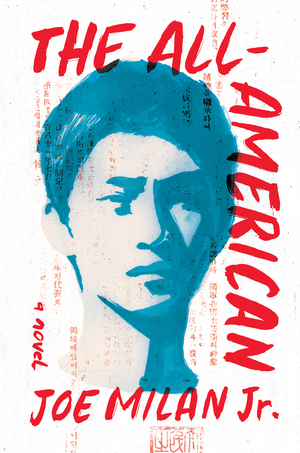
The Joy Luck Club is a fine book, but it wasn’t for a 16-year-old guy like me. No one I knew could point me to a book that was. And I, like so many other young Asian guys who couldn’t see ourselves in the posturing Holden Caufield or ever in an estate in East Egg, simply didn’t read. This is one reason I wrote The All-American. It’s a book about a Korean American high-schooler raised in a Western Washington trailer park who dreams of playing American football. However, he gets deported to South Korea and is conscripted into its army. He isn’t worldly. He has no superpowers and no advantages. He’s no Yellow Peril.
The second reason was that I was tired of being told by others who I was or ought to be—like that teacher. At the core of The All-American is the question of how much control, how many choices do we really have in defining our identities?
Fortunately, there were, and are, novels that ask this question, too.
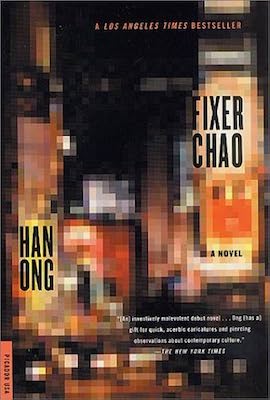
Fixer Chao by Han Ong
A street hustler, William Paulina, aims to turn his life around when he meets a writer who is interested in burning down the system: payback against the literati who don’t like his work. With their powers combined, this Filipino street hustler becomes “Master Chao,” the elite Feng Shui master who supposedly can redecorate rich New Yorkers’ homes to bring “peace and prosperity” and other fortune cookie sentiments.
Hustling to wealth is the American dream. Playing on the prejudices and giving the upper class a comeuppance is a fantasy for anyone cast down to the lower decks. The opportunity to parody what everyone says you are for profit is the joke, but for William, who he really is, and wants to be, as a queer Asian man in America, is the question that propels this redemption tale.
Ed Lin’s debut, Waylaid, is a darkly funny coming-of-age novel about a Chinese American boy on the cusp of his teens trying to lose his virginity. He works in his parents’ motel, a pay-by-the-hour kind of place in New Jersey, where he gets insights about the world from Johns and sex workers, families recently made homeless, the lonely, and the rest of the desperate underbelly of America. “I read enough to know that some of your own kind treat you worse than anyone else,” is one insight. “If you’re a girl, you’ve only got the television, and you keep it on because when you turn it off, you see your reflection in the black screen,” is another.
Waylaid is a book about coming of age while exposed to the bawdy side of our society and how sex is used to distract us from the working-class problems all around us.
Two half-Filipino and half-white brothers, Tomas and Gabe, are coming up in LA in the early ’90s. Dad abandoned the family. Mom works hard, and Tomas is a burgeoning hardman and gangbanger who has gotten thrown out of high school. Gabe is doing the work of the good younger brother, being quiet, doing chores, going to school, and helping his brother breed guard dogs (that Gabe, our narrator, tells us are actually “attack dogs”). After Gabe steals Tomas’s car and his prized breeding dog, Gabe runs away north, exploring the isolation he’s always felt in an American where he sometimes passes as white or Mexican. The novel starts raw and gets grittier as it grapples with the challenges of being an immigrant and an Asian American man.
Arjun Mehta is a quiet computer geek from India who comes to America for the dream: money, celebrities, and women. But, when he gets here, nothing works as it should. Upon arrival, rather than the job he was promised, he’s left unemployed in a sort of halfway house. Once he gets his computer job and his shot at his American love, it doesn’t go how he wants, just as the computer world collapses into a recession. His Asian-American dream seems lost. Then, out of loneliness and the faint hope of holding onto his job, Arjun creates the virus that will infect computers worldwide with the image of his dream girl: Bollywood star Leela Zahir.
Kunzru’s satire of the Silicon Valley dreamscape is funny. It subverts the geeky Asian guy stereotype by plumbing into the depths of modern corporate slavery and how colonialism is something we haven’t yet shrugged off (embodied by Guy Swift, a young entrepreneur, and wannabe suave Richard Branson) and connects the Asian American experience to those across the oceans.
One of the great wounds in Asian American history is the internment of Japanese Americans (and other Asian Americans) during World War Two. No-No Boy is about Ichiro, who was released after the War from the internment camps and prison for refusing to be drafted into the US Army (hence a “No-No” boy). But this book isn’t about the internment camps: it’s about the world after where Asian Americans struggle to find their place not only in America but within their own communities. For many in the Japanese American community, a No-No Boy was a disgrace, a cowardly man to be ostracized. Yet, many said no, for reasons such as, Why should I justify my loyalty when I was already born a citizen and plucked from streets and imprisoned? Ichiro navigates society’s prejudice outside of and inside of the Japanese American community. Add in a family relationship where a mother believes that the defeat of Japan was a hoax and the stories of many forms of wounded people returning after the war, and you get a classic Asian American novel that ought to be on any reading list.
Edinburgh is about the poison of childhood abuse and how that trauma can linger well into adulthood. It’s about a young Korean American boy, Fee, who is a talented singer and is selected for a boys’ choir. The choir director molests Fee and others in the choir, and even after the director is imprisoned, the poison of trauma remains in his victims.
Stories about trauma to young men weren’t plentiful, or at least not available, when I was growing up. Without those books, many young men believe that they are stories never to be discussed. This book is about what happens to who we are when we lack the knowledge to grapple with that poison and the hope of learning to confront and heal from those traumas.
The protagonist of The Sympathizer is a communist spy who comes to the U.S. after the fall of Saigon to spy on South Vietnamese immigrants in exile. The book is a letter addressing the “Commandant” of whatever prison he’s being held in Vietnam after his return. While a spy novel, it is less John le Carré and more Ralph Ellison in how it grapples with who we’re taught to be and what we find ourselves shaping to be. It’s darkly funny (I can’t imagine someone not laughing when reading the thinly veiled parody of the filming Apocolypse Now, the narrator takes part in) and justifiably won many awards including the Pulitzer.
Satirizing Hollywood’s depiction of Asian Americans, Interior Chinatown wears the look and structure of a screenplay. It’s about Willis Wu, a second-generation Asian American actor who is climbing the Asian typecast pyramid from “Generic Asian Man” to “Kung Fu Guy” on the show Black and White. (A show, Willis muses, that uses the racial dichotomy of Black and white because anything more would be too racially complicated for mainstream culture). Being raised in Chinatown, he dreams of leaving the stereotypical roles of Asians both in Hollywood and American culture but is unable to see beyond the limitations that have surrounded him his whole life. Willis’s pursuit of the elusive role of “Kung Fu Guy” at the expense of love and family leads the story deep into questions of identity and self-definition. It’s funny, and it’s a winner of the National Book Award.
Once at a party, I met an anesthesiologist. I’ve always been horrified and fascinated by anesthesiology, and I was a few wines in, so I cornered him.
“Where do we go?” I demanded. “When we go under, where do we go?”
He didn’t seem surprised to be accosted with this question. Instead, he moved closer to me. “Well, you are like a computer,” he said. He lifted an index finger and pressed it to the center of my forehead. “I’m just turning you OFF. I’m flipping a switch.”
I was furious. The answer was clever, but it meant nothing. It didn’t address my issue. It didn’t help me understand how he did what he did, or whether I was dying every time I went under.
Obviously, anesthesiology and writing are not the same. But novelists are also asked a similar question at every event, family gathering, therapy session, good date, or party: How did you write your novel? Over and over again. Writing a novel is wrapped in the same mystery, for most people, as going to the moon or going under anesthesia.
It’s not a question I can answer once or in one way—my relationship to writing changes as I get older, as I write more books. Some technical advice stays the same (i.e., the practices I cling to in order to finish the damn thing), but other, more existential questions fluctuate with time, my life experiences, and the political environment that encroaches on my existence. Still, here is my best crack at it: five easy steps for turning your suffering into a novel.
First You Must Suffer
It would help, for example, if your father has just died. Or, perhaps, you’ve just undergone an incredibly painful and traumatic spinal surgery. Both of my novels were directly fed by these two critical moments in life, times during which my understanding of the world around me was proven entirely wrong.
My new novel, Ripe, was written after my father died suddenly, an event that was followed shortly thereafter by the COVID-19 lockdown. My father was always telling me to write this novel—a novel about working in tech with lunatics. During the year I spent working in Silicon Valley, at the end of our phone calls, he would often say: Take notes on everything that is happening to you. One day you’re going to write a book about it and sell a million copies.
After he died, during lockdown, I was entirely alone with my grief. There was no looking away from it, there were no distractions, it was only me and the grief, which was six-foot-three, the height of my father, following me around, getting in my way, forcing guttural cries out of my body at all times of day. After a few weeks, I sat down and wrote the book he asked me to write. Ripe, even more so than my first novel, was born of grief and isolation, made in a moment in time that I’m not sure will ever happen again. But it was fuel inside of me, an agony I wanted to comprehend, make sense of, catalyze into something else, something useful, something he would be proud of.
Perhaps for some writers, like romance novelists, “Suffer” can be exchanged for “Fall in Love.” If you can write a novel without suffering, my hat is off to you. For me, the work is deeply driven by a desperation to understand the world around me.
Be Ruthless, Be Rude
We are raised (at least, I was) to be polite, kind, presentable. Often, the writing we want to do is the opposite. To write a great novel, you must be ruthless—ruthlessly honest about the people around you, the characters in your book, your perception of the world, your family, your coworkers, and, most of all, yourself.
Humanity is shown clearest in its ugliness. A character that is behaving terribly becomes suddenly understandable when you realize she is trying to have a child but cannot conceive. A depressed character might seem annoying on page one, until you realize she is pregnant and impoverished.
The writer Vidjis Hjorth has an excellent bit about this in one of her novels. Her character, who has herself just written a novel, is asked if the novel is real. The character responds that she is not interested in reality, but in the truth.
That distinction is an important way of securing freedom from the confines of what’s expected of us in our work. We have to be unconcerned about whether reality is reflected in the novel, and dedicated to ensuring our work is dealing in the sometimes beautiful, sometimes ugly truth of being human.
Outline, Outline, Outline
I believe strongly in two things at this stage in my career: plot and outlines. Early on, when I was young and stupid, I believed the artistic impulse that shot down from the heavens and into my body was all I needed. At the time, it felt true because when I was overtaken by that impulse, I would often write whole-cloth first drafts that only needed minor polishing. It felt like a higher power was driving the work. And that was beautiful. I thought that was the only way it was done.
As I got older, I realized that those flashes of brilliance cannot and will not sustain a career. Throughout my life as an artist, I’ve always had a full-time job. Almost all of my drafts have been written on nights and weekends, or during two-week vacations from work when I holed up in a cheap condo somewhere and wrote like an unshowered demented demon in yoga pants.
My point here is that my time for writing is limited. I do not have time to burn on work that I will ultimately throw out. Of course, during the editing process, pages will be cut and re-shaped, but I cannot make huge mistakes that will require gigantic rewrites—not without tanking both of my careers or spending the rest of my life on a book that will never see the light of day.
So, I have to plot. I’m experimental by nature; at first, I resisted plotting and thought I could just wing it. But the reality is, since the literal dawn of mankind, humans have been drawn to plot. From cave drawings to the Bible, we’ve been hungry for a story where something happens. The most basic plot structures are successful because they entertain their audiences.
Whenever I set out to write a novel, I grab a basic plot structure and mess with it a little bit. I love a good plot remix. I often point to “Parasite” as a great example of a movie that took a traditional plot structure and then put one part of it—the Rising Action—on steroids. Most of the movie is just an exercise in raising the stakes higher and higher and higher until the tension is near unbearable for the audience. And then the movie resolves.
I break each part of my outline down into specific scenes. This is important for me because if I had to figure out what I was writing every day that I sat down to write, I would lose my mind. Instead, once I’ve distilled the outline into scenes, I put each scene on an index card and add some details on the back.
At the end of all of this, I have a giant stack of index cards. Each day, I sit down and pull a card. That’s the scene I write for the day, and typically that gets me to between 1,000 and 3,000 words. The method works for me because my task is crystal clear, and focusing on individual scenes drives me to both compress them and make sure they end with a gut punch. (If you want more technical advice here, I write the scenes individually in Scrivener so I can move them around in their respective sections as needed. Scrivener gives me the flexibility to change things without an entire rewrite, especially between the first and second drafts.)
Let the Baby Be Ugly
Another reason people give me for being unable to finish their novels is that their first drafts suck. Well surprise! All of our first drafts suck.
When a baby is born, it comes out disgusting. It’s hideous, something right out of a nightmare: bloody, screaming, covered in goo and attached to its mother by a hideous cord. If it looked that way forever, I believe most of us would stop having children. But then the nurses take the baby away and get rid of the blood and put it in that white cloth, which suggests it is an angel and everyone coos (even if the baby actually remains very ugly).
My point is this: Your first draft is the ugly, bloody, screaming baby attached to you by a disgusting cord. And you’re sitting there, all torn up and crying and on drugs, waiting to come back to a reality in which the baby isn’t an ugly, bloody, screaming mess.
Your job, therefore, is to get the first draft out as quickly as possible—for a few reasons. The first is that while you are writing your first draft, your brain is opening up in a way that will not last forever. I had a friend who once told me that whenever you write a novel, a portal opens in your brain and once you get the first draft out, the portal closes and you can never get back to that place again. That’s been true in my experience—I fundamentally believe it is impossible to write the same book twice because I could never get back to where I was mentally when I wrote The Book of X and Ripe.
So getting the first draft out is like capturing lightning. During the first draft, I write almost every day. It typically takes one month if I’m not working my other job, and six months if I am working my other job. Here is where the discipline comes in: I write for one hour at night after work every day, and from nine to five on Saturday and Sunday, no exceptions. There is no special secret or trick here. There is only dedicating your time to your work and giving yourself permission to make an ugly first draft.
Too often, I hear writers asking about which publisher they should get or what their cover should look like when they don’t even have a first draft. And I always say this: If you don’t have a first draft, you don’t have shit. An idea for a novel without a first draft is just vaporware.
Edit Until Your Fingers Fall Off
The bulk of my work is in editing, or what I call “wiping the blood off of the ugly baby.” The reason it is so important to vomit up the first draft, no matter how bad it is, is that you can fix almost anything after it’s written. With a bad first draft, at least you have something to edit, refine, fix. With no first draft, you’re just a guy in a bar telling a woman about the book you almost wrote once. Sad.
Most of my first drafts take a few months to get down on paper. But the editing takes years. For both novels, I spent between three and five years editing them constantly, either by myself or with an agent, editor, or publisher. This part requires a totally different type of endurance from writing the first draft. It’s more mathematical, more methodical, more technical. Editing is another way of asking the question: How many times can you stare at the same page before you fire your friend/editor/agent/publisher? And the answer is: a shit-ton.
When you get worn down, when you want to give up, I’ve found it helpful to ask myself whether my favorite author would have stopped now. That’s usually enough to get me back at it—it’s hard to keep moping when you know Joan Didion and Sylvia Plath and Deborah Levy and Diane Williams kept going until it was right. It reminds you that this is part of the gauntlet.
And it is a gauntlet. The process of coming up with an idea and turning it into a first draft requires one type of endurance. The process of editing that work requires an entirely different type of endurance. And when it’s time for your novel to be sold and published . . . well, that’s a different essay. You’d have to ask that question at a different party altogether, because I don’t have the patience to answer both at once.
Writing a novel is impossible. I never thought I would do it. It is tantamount to building and solving a puzzle by yourself. It’s endlessly fascinating and humbling. It’s a process I will never master and that’s why I love it. If I’m lucky, I’ll have written five or six books by the time I’m dead. If I’m extremely lucky, two or three of those will be decent.
Maybe, like the anesthesiologist, my answers here aren’t good enough or clear enough. Maybe my thoughts here don’t entirely solve the mystery of writing. Maybe, when you ask me this annoying question at a party, I should lean over and tap your forehead: “Your brain is a computer. Just turn it on.”
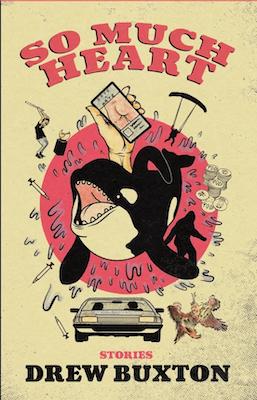
During a workshop for one of the stories in my new collection, So Much Heart, my professor said, “And now, from Drew, we have another wacky couple adventure.” I laughed, but on the inside, I suddenly felt self-conscious, thinking my stories were too similar to each other. He was right. There are a lot of duos in the book—a Tulsa couple caught in the crosshairs of the ghost of a killer whale, siblings trying to escape their dying Nevada hometown, two guys who bond at an OCD treatment center over their mutual struggle with the disorder.
After class, my friend (and beloved former EL intern) Chris Vanjonack said having a lot of buddy stories isn’t necessarily a bad thing. It’s an accepted trope in movies—a rich tradition, even. Examples include Sideways, Thelma and Louise, A Simple Favor, and 48 Hours. We thought maybe I could just lean into it. I even briefly considered titling the collection “Buddy Stories”.
For as established a trope the duo is in film, you don’t often hear books described in these terms. I wanted to shine a light on some great books about duos—odd couple books; buddy books, if you will.
Two detectives from the Mississippi Bureau of Investigation are sent to the tiny town of Money, where the local sheriff appears to have bungled a murder investigation. They figure it will be simple to sort out and they’ll be out of there in a few days, and as Black men in rural Mississippi, they can’t wrap the case up soon enough. But as they dig deeper into the evidence, the less clear things become as a supernatural force seems to be at work. Everett has fun here playing with buddy-cop tropes—ball-busting partners who are paired because they can’t work with anyone else; the big-time state police coming in and thumbing their noses at the local squad. In Everett’s deft hands, though, these genre elements add up to much more than a typical action plot. He takes these cliches and turns them on their head in this brilliant exploration of the South’s legacy of lynching.
Troy Augustus Loudermilk is accepted to the country’s most elite creative writing program, but the thing is, he didn’t write the poems in his application packet. His best friend Harry did. The scheme is to combine Harry’s brilliance with Troy’s beauty and charisma to take over the academic literary world. This is a true odd-couple buddy comedy in the tradition of Twins, a fitting framework with which to take on the absurdity and pretension of the MFA world.
When their mother is hospitalized after a suicide attempt, sisters Edith and Mae are sent to live with their father. Mae is excited to reunite with him, while the older Edith is resentful and wants to return home to Louisiana to be by their mother’s side. The only constant the sisters have is each other, but as the dark truth of their parents’ relationship is unveiled, their conflicting loyalties threaten to tear them apart. The opening half of this book, more than any I’ve ever read, perfectly captures that feeling of powerlessness that comes with childhood. We have little say in or understanding of the circumstances of our lives—moves, divorces, parents’ mental states. The story told is from various perspectives and points in time through letters, diary entries, and short passages. Expertly paced, Apekina doles out information little by little to gradually build a sense of dread in the reader.
As Louis enters old age, his life crumbles around him. His father dies, his wife leaves him, and his financial situation becomes unstable. He goes to great lengths to avoid running into people he knows and generally prefers to be alone in his house, watching reality TV. A literal wrong turn somehow leads to him taking in Layla, an overweight mutt of indeterminate age. A bond slowly forms between man and dog, and Louis’ outlook on life begins to brighten. Written in the first person, Miller perfectly taps into the voice of an old curmudgeon and takes advantage of all the comedic potential that comes with that. In lesser hands, this story could’ve easily been sappy, but with Miller, it is touching but at the same time gritty and raw.
Kody and Tella decide to leave it all behind—the stints in juvie, their abusive pasts. They’re teenagers and they’re in love. Using stolen cars, they travel from the East Coast to the West and get in various misadventures along the way. This is a modern-day Bonnie and Clyde story—Badlands set in the 21st century—but Smith’s vision of America, told in tight, spare prose, makes it feel wildly original. A road trip is such a perfect tool to explore intimacy between two characters, a tool which Smith wields flawlessly. Like the best road trip stories, Teenager feels alive and free. As the reader, you’re along for the ride, and anything could happen.
Growing up, Willa always looked after her brother, Justin, while they endured their difficult childhood. As an adult, she’s created a steady life for herself as a nurse, but Justin is lost after his toxic boyfriend commits an unspeakable act. When he suddenly shows up at her doorstep, she is torn between wanting to help and not wanting to disrupt the peace she’s worked so hard to build for herself. In Justin, Mirabella has rendered a fully dimensional character. Justin has suffered, but he is not a perfect victim—flawed, human. Mirabella precisely captures the complex feeling of loving someone but struggling to deal with some of their traits, the loss felt when a loved one no longer resembles your memory of them from childhood.
Jawboneby Mónica Ojeda, translated by Sarah Booker
Fernanda and Annelise are as close as friends can get, intimate in a way that only adolescent friends can be. They lead a clique of girls at an exclusive prep school in Ecuador who spend most of their free time hanging out in an abandoned building. Driven by boredom, they dare each other to perform dangerous feats like jumping from high places and getting choked unconscious. Ojeda gradually cranks up the psychological horror when the sinister teacher Miss Clara decides to abduct Fernanda. The book is a fascinating mix of old and new. Though there are many nods to horror legends like Poe and Lovecraft, the details of the story are incredibly modern, like Annelise’s obsession with creepypastas. This combination, along with Ojeda’s flair for arresting imagery, results in a truly unique novel.
Half-brother and I grew up without much
hair on our heads. Anthony was the boy
and I was a girl, mistaken for a boy, we shared
a barber. Mom said my hair was not right for
ponytails, pigtails. With a barber’s help, I believed
mom would help me look pretty, whiter. She never tried
her brush on my nappy roots, only fingertips to comb.
Nine months after my 40th birthday, I texted my breast
cancer diagnosis. I was a near-bald preschooler, so I am
not afraid of chemotherapy taking my hair.
-Anth I need to tell you something.-Hearing it’s bad news. Love u more than anything sis. Please don’t be dying.
Christmas Eve, Anthony started growing my gift. Eight months later
on the day of my breast reconstruction I received a selfie.
-Haven’t cut my hair since u texted me about ur cancer diagnosis
in case u got chemo & needed a wig. Hair’s almost down to my ass for u
-Love you, brother.
I cry and smile because Anthony grew up and I don’t need chemo.
-This was meant to be urs lol and it’s even kinda curly for ur head
I laugh out loud because I want to wear some of my brother’s hair.
Boardwalk Ambassadors
I want to know how much there is to scream about
in a city this small? I cannot call police on the brown

girls below my window with no names
they call each other bitch. Maybe they scream

in the dark because they know what is coming at 10 p.m.
after the curfew alarm sounds. Are they 9th graders?

Nah, not yet. July afternoons they push the boys away
with no facial hair. They hold hands like kindergartners,

pull each other across sidewalks like they’re going somewhere.
An alley behind Dollar General is more adventurous than the boardwalk.

They would find the oceanfront if they just held onto one another,
and crossed the wide, uptown intersection at Baltic & Atlantic Avenues.
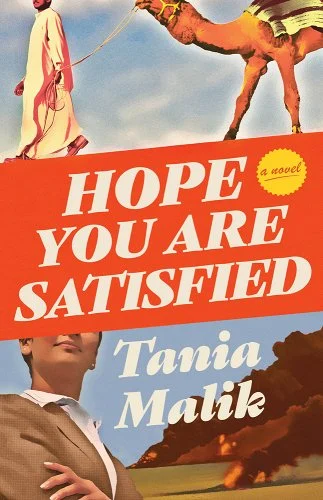
Tania Malik’s new coming-of-age novel, Hope You Are Satisfied, takes place in 1990s Dubai, during the lead-up to Operation Desert Storm. The story follows Riya, a twenty-something Indian immigrant sending money home to her family while working as a guide for “rinky-dink” tour company Discover Arabia. Riya has a fraught relationship with Dubai: she’s making money but has limited control over her circumstances. Her passport is kept in a safe in Discover Arabia’s office, “assurance against their sponsorship of [her] work visa.”
“There was no future here,” Riya says. “Wherever in the world we hailed from, our time in Dubai lasted only as long as our work visas remained active. There was no possibility of citizenship, no impetus to form lasting ties to the city… At the end of our time here, we were to return to our countries with buttressed bank accounts, back into the arms of the families we’d supported and the glorious houses we’d built with our Gulf money. Such was the pact.”
Riya’s coworkers comprise young people from various countries, “guest workers” trying to send money home, all trying to figure out their next landing place. While supporting their families and waiting to find out whether war will break out, the characters persevere in the traditions of young adulthood: they get drunk, get laid, and maintain difficult friendships. Riya’s best friend and roommate, Grace, has her sights set on Canadian citizenship. Riya, however, dreams of the U.S., and what a future for herself and her family could look like there.
When Riya’s boss’ boss—an import/export magnate named César Rodriguez who “harbored no ideology when it came to the sourcing and selling of any kind of merchandise”—offers her a dangerous opportunity she can’t financially refuse, she must decide how much she’s willing to risk, and for what she’s willing to risk it.
I spoke with Tania Malik over the phone about class disparity, the concept of “home,” and finding absurdity in times of violence.
Deirdre Coyle: Early in the novel, Riya says, “Everyone was speaking about ‘the events,’ but what I wanted to ask was how these events would affect me. While the residents of the city were overrunning the banks converting dirhams to US dollars, I didn’t have enough in my bank account to change into any useful currency.” Riya’s external circumstances are quite specific to Dubai in 1990, but I felt that her internal experiences—coming of age, her relationships, her family struggles—felt really universal. Could you say more about how you found that balance?
Tania Malik: When I was thinking about writing Riya’s character, personally, I wanted her to be a guide because people are not that familiar with Dubai. They’re familiar with Dubai now—this kind of Disneyland, über-Vegas, or whatever you want to call it. But that was not the Dubai I knew. I found out that not a lot of people were familiar with that Dubai. I wanted [Riya] to be this person made from that place. She’s kind of a hustler; she’s shouldering a big responsibility, but she feels very deeply. At the same time, she’s in her mid-twenties, you know? It’s a time of self-doubt and fears. You’ve just left home and you are having intense relationships, whether romantic or otherwise. You’re at that certain time of your life where you know you have to do the right thing, but you don’t always do the right thing. So my thought was, how could I write this character who is kind of in a double-bind in that what she needs to do for her family doesn’t necessarily reconcile with her wishes for herself? Maybe she’s not a very self-reflective person, but she is self-aware. She has no time for your bullshit. That also comes from the situation she is in. Then of course, there’s the war, and that gives her the chance to make choices she didn’t feel she had before or get the wherewithal to make before.
DC: What inspired you to write about 1990s Dubai now? How would you connect that moment in history—if you would—to “the events” today?
TM: It kind of slowly happened, thinking about whether to write about Dubai. I lived there around that time. My family lived there. My parents were there during the war, and in the lead-up to it, I was still going to school and going back and forth. I did work there for a few years for a couple of different tour operators. But when I came to the U.S. in the mid-’90s, I would say Dubai and people would just glaze over. They had no idea where Dubai was. And then a couple of events happened. 9/11 happened. Some of the terrorists came through [Dubai] and had a lot of funding through there. There was another scandal with the Dubai ports. Then everyone started hearing about all this construction happening, about these islands being built in the shape of palm trees and the world’s tallest building and the black diamond ski slope in the middle of this desert. Everyone started paying attention to Dubai, and they had an impression of this “money-can-do-anything” kind of place. It almost subverts nature over there. Literally, they’re subverting nature. But I thought, “Oh, well, no one knows about the Dubai that I knew.” That Dubai doesn’t really exist anymore. It’s been superseded by this whole new city. I just knew this feisty little place where there were these people from all over the world, and they were just there to make money. You couldn’t have citizenship so they were making money for a future that was very uncertain. They didn’t know where they were going to go, but they needed to make money. Everyone had this certain bravado that was very poignant and compelling. It was full of all these interesting characters, it had very loosey-goosey rules, which all changed after 9/11. But people could come and go; there were all these arms traffickers based there. You would run into people like that all the time. It lent itself to this landscape that you can set all these characters in.
Then, of course, the war was very interesting because the war itself only lasted like a month. It was so short, but the whole lead-up to it was so long and so tense. No one knew what was happening. Will Saddam Hussein bomb us? He had Scud missiles, he had biological weapons. What was going to happen? If you’re talking about how it connects, it’s that life has always been a struggle. There always seems to be a war in some place.
I’m going to see this Ukrainian author [Andrey Kurkov] who’s written a book called Diary of an Invasion. He’s like, ‘We knew the war was going to start and yet we were dealing with the coronavirus.’ There’s this huge thing happening at the back, but you’re going on with your regular life. It was the same then—the war was like a continuous scream in the background, it was impending, it was coming, yet you were going along with your life. You still had bills to pay, like we all did during the pandemic. People rise to the challenge and they manage to find happiness and joy in small situations. I feel that relevance still holds.
DC: There’s a lot of dark humor in the book, especially in reference to characters’ lack of control. Some of my favorite lines were, when Grace says, “Shut up and be serious,” and [another character] says, “Why? We’re screwed either way.” Or the scene when Mrs. Wehner is telling Riya that she alone is responsible for her own happiness and Riya says, “It’d be more helpful if Mrs. Wehner gave her advice to Saddam Hussein. There was a man who needed to seek contentment within himself.” How did you manage to perfect that tone?
TM: This is kind of a war novel, but it’s not a war novel in the typical sense. No one is being bombed; people are not being dragged off the roads and executed. Yet there is an absurdity to violence. When someone decides to commit violence, there’s some absurdity in that, whether it’s a small act or a big act.I kept that in mind while writing these characters, because they were in an absurd situation. People were still coming [to Dubai] for vacation. They still were drinking cocktails and lying by the beach.
Money makes so much delineation between people and also gives people power over you.
A country away, U.S. forces were amassing, taking over huge buildings and moving in, and there were all these huge ships in our ports. These poor young boys who probably had only heard about war, like Vietnam, from their grandparents and probably never thought they would go to war were suddenly in this strange land where the laws were so weird—can I talk to someone, can I not talk to someone? I can’t drink here? Putting all these elements together was so comical in a way that I couldn’t help but bring [humor] in.
I also did see the two people who were controlling these events, George Bush and Saddam Hussein. Bush was kind of known as a wimp because he was coming after Reagan, so he wanted to fight that perception. Saddam Hussein was very capricious and had this odd mixture being very rash and calculated at the same time. You never knew what he was going to do next.
DC: Riya seems to have a very clear sense of familial duty; she’s always sending money back to her family. But she’s pretty lax about the social strictures of living in Dubai at that time. How do you see her moral compass? What does it point to?
TM: I think [Riya] is self-aware, even though she’s not very reflective about what she does. She does know when something feels wrong, and maybe she still has to do it because that’s just her life. She doesn’t always have a choice. I also wanted to take this whole thing about “luck”—like, luck is something you make. It’s such an American thing, rather than a choice. It’s very arrogant. That’s something I understood when I moved to the U.S., whereas in the East, it’s “fate” that’s paramount. [Riya] wants to come to the States, which many people find very hard to articulate—why do they want to come? It’s just that it’s been sold to everyone as this whole cliché of opportunity, and that is correct. Whether that affects her moral compass or not, I think it goes with each situation. So I think she is ready to do things if it can get her what she wants—to a certain extent. I don’t think she will commit certain acts of violence. In that way Dubai was also very much a place of double standards. The tourists could drink, and we could drink in hotels, but the Muslims couldn’t drink. Muslims can’t buy pork. There’s a separate place in the grocery store for pork products that only fully non-Muslims can go in. It was very much a place of dichotomy. That’s why I like the cover, because I think it shows the “exoticness” of that Arabia that we were selling everyone, and then on top of that the violent landscape.
DC: Why did you decide to have Riya pin her hopes on the U.S.? Would you describe that as just this vision, or version, of the U.S. that’s been sold to people overseas?
if you were from the East, you were called a ‘guest worker’ or a ‘laborer’; if you were from the West you were called an ‘expat.’
TM: I think so. When I was [in Dubai], a lot of people didn’t want to go back home, because home would be the same opportunities. India is much more developed now; at that time, it hadn’t had this big economic boom and all these changes. So the only option was to go West. Some people did go to the U.K., some people did go to Australia, but Canada was number one because it was so easy. That was where they could build a future. Dubai was very much a transit point. You couldn’t get citizenship. That’s changed, too, now some people can. But basically, you earned your money and you left. The U.S. was absolutely this land of opportunity. There was still this idea that you can do what you want; it didn’t matter where you came from. It’s hard to come to the U.S. legally. The U.S. immigration code is, I think, only second in complexity to the tax code. But because this idea was sold to [people], they were ready to jump through those hoops to get here.
DC: Class disparity plays a huge part in what the characters are or aren’t able to do. Riya can’t leave Dubai on her own because her passport is in a safe at her workplace. And I was interested in the difference between Riya’s encounters with the wealthy tourists and her encounters with wealthy residents of Dubai, like her big boss, César. It felt like a different kind of disparity.
TM: Money makes so much delineation between people and also gives people power over you, especially in that situation where they hold your freedom in their hand, like that passport can help you go somewhere. It is a way of control. I also think, being a woman in that situation, there is this attitude among men—it wouldn’t even occur to [Riya’s bosses] that she would question them.They would just expect her to fall into place. If she had questions, she would keep them to herself; she wouldn’t mess up; she would tow the line.
People who had money didn’t have to have their passport. It was only the low-level staff. If you were the C.E.O. and you were a foreigner, your passport was with you. I think also there was a little bit of racism—if you were from the East, you were called a “guest worker” or a “laborer”; if you were from the West you were called an “expat.” That’s why I thought characters like Hannah, or the German guys, were interesting because they straddled both. They were there because they needed money, but they did have a little bit of leeway because of the color of their skin. They were a little bolder in how they approached everything. Money brings power, and that power skews in a very different way in a place like Dubai where there are all these rules and regulations that are particular to the place. There’s no other place in the Middle East that they’ll take your passport and keep it as a protection against you doing anything wrong. Even the tourists who came in had to be sponsored, so the hotels would sponsor them, or the travel agents would sponsor them. Everyone had to be sponsored at that time to get to the country.That is the kind of control that we can’t even imagine over here.
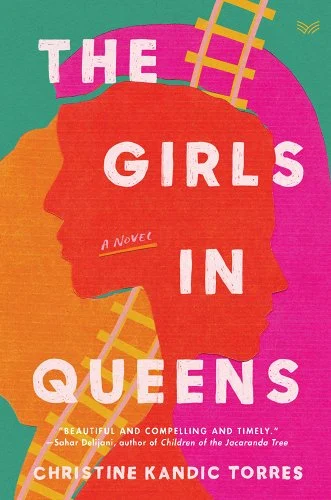
As I prepare for the paperback launch of my debut novel The Girls in Queens, I share with a group of writers and artists that I’m putting together a Book Club Kit. This has become a fairly common digital offering; a colorful PDF of brief insights from the author, a recipe or two related to the book, discussion questions, and even a playlist of music inspired by the novel that book clubs across the country can utilize. One of the artists I share this with suggests I create a food tour list of the best places to eat in Queens, “since that is what attracts so many people to Queens, anyway.”
“Yes. Yes,” I say, “that could be a great idea.”
But in fact, the idea gnaws at me over the next few weeks, burning a nervous hole through my organs to the solar plexus of my identity. Yes, for so many people Queens means food, and not just delicious, attraction-worthy food, but exotic food. Queens is the most diverse county in the entire world. Walking its alternatingly bustling and sprawling streets, one can hear over 160 languages spoken in the borough. Yet something prevents me from making a food tour; something about it feels urgently wrong to me, like a pot boiling on high, its glass lid fitfully threatening to crack. I don’t want to serve my home on a platter, the bones to be picked clean and forgotten about until it’s burped back up a bit later. My novel is titled The Girls in Queens, but I can’t offer up my culture to be consumed without context. After all, food might attract a certain segment of the population to Queens, but “the food” is certainly not what attracted our immigrant families to settle down here.
How can I explain that growing up in Queens, we didn’t go to dumpling houses in Flushing or on Queens Boulevard; that there had to be a special occasion to even agree to spend money at a restaurant. That empanadas were purchased under a tin-foiled heat lamp at the corner Colombian bakery, not argued over beneath a cartoon anthropomorphic empanada at late night take-out spots. How one of my earliest memories is in fact sitting beneath a stained-glass lamp inside an old Pizza Hut and eating a slice with green bell peppers on it—an exotic American delicacy to me. How one of the first times my mother brought me to eat a meal outside of our house that wasn’t a fast food restaurant, she brought me to the vaguely Greek, Georgia Diner for my fifth grade graduation, and that to be honest, she’s still not entirely comfortable ordering off a menu to this day.
As first and second-generation immigrants, often our connections to and experiences with restaurants were not from the side of the patrons. Our parents, our uncles, our aunts—so many worked in these restaurants in Queens and in Manhattan, or in relation to them. My mother worked close to minimum wage for a uniform store that sold garments and linens to restaurants for waitstaff to wear. Eating out for us meant bringing home greasy Chinese take-out from Hunan K, a pound of spicy chicken wings from Merit Kabab, or a McDonald’s Arch Deluxe to be consumed in front of the television while watching the T.G.I.F. lineup on ABC.
Often our connections to and experiences with restaurants were not from the side of the patrons.
How can I explain that in high school after class, $2 could get us 4 dumplings or an entire kebab meal from nondescript silver carts on the corner of Broadway and Elmhurstway before The Halal Guys started franchising and Yelp encouraged tourists to discover the ecstasy of white sauce? That this wasn’t just a frugal deal, but necessary.
How do I explain that yes, our neighborhoods were filled with families from Pakistan, Korea, Mexico, the Caribbean, Ecuador, Taiwan, and more. How I learned the best convenience stores to pick up $3 pre-packaged kimbap to bring home to my ninety-year-old Puerto Rican grandmother who could at least respect the rice, if not eventually come to nibble on the pickled daikon. How together, over hours of piecemealed conversations in various languages with fellow patients carrying Tupperware lunches in the waiting rooms at Elmhurst Hospital, we learned all the different ways Latin American countries interpreted the word arepa from our humble version of a dinner roll, to a gut-bomb of a Venezuelan sandwich?
How can I explain that we were more versed in the smorgasbord offerings of the bodega instead of the culinary odysseys of restaurants? The purple Wise bag of potato chips with its neon yellow haze; the sprinkled blue bag of pretzel nuggets, and all the different heat varieties of Cheetos. How we were taught to cobble together a meal out of a can of Vienna sausages and dusty bags of rice, a trick passed down from the island already colonized by the U.S. That there were Indian delis, Mexican delis, Korean delis, and Jewish delis that were, actually, a whole different thing.
The Queens of consumption, of Food Network specials and the New York Times Real Estate section, is not the Queens in my novel. Brisma and Kelly, the girls of The Girls in Queens, sneak Funyuns into Shea Stadium, split a package of Devil Dogs while cutting school, shoplift Sour Patch Kids and toss green Chiffles platanitos bags at leering men. As so many under-resourced families and neighborhoods are forced to, they made do with what they had. We made do with what we had. Sometimes that meant rice dishes from our homelands; sometimes that meant 25-cent bags of popcorn. Nowhere in that spectrum is a tour stop I’d want to curate for a quick bite on the way to Arthur Ashe stadium. The struggles of our families are not for voyeuristic entertainment—and neither is our sacred joy.
In the last several years, we have seen movements to include and uplift more voices from marginalized and underrepresented groups in the publishing industry, but there is still much more work to be done, especially in meeting our readership where they are. It is imperative, too, for us as authors to never lose sight of who it is we are writing for. I am grateful for the diverse makeup of the neighborhoods I grew up in, and the schools I went to, and know my community, which has influenced me deeply as a human and as a writer, is with whom I am in conversation. But as I find myself more often in the position of having to explain the beauty and joy of it to people who’ve never experienced it, as promoting this novel has compelled me to do, it feels more and more like fighting a losing battle, like the ways our parents and grandparents rhapsodize about their home countries, and the quiet, resigned heartbreak when met with blank, if not a little bit curious, stares from their own children who can’t see past all they think it lacked.
In Queens, diversity is not exposure therapy, but participation.
When we talk about diversity as a need to “be exposed to” other cultures, what we are doing is centering whiteness. In Queens, diversity is not exposure therapy, but participation. We participate in the rich diversity of immigrant cultures in Queens by eating in each other’s family homes, sharing food in the school cafeteria, at cookouts at Flushing Meadows-Corona Park, at Rye Playland. To be clear, this was and is a privilege and an intimacy. One cannot buy your way into community by simply eating a torta off a Roosevelt Avenue taco truck.
I welcome anyone from any type of background to read The Girls in Queens and trust that they will find some resonance for their own life. The book deals with sexual assault, and how women sometimes internalize the pain and rage of the experience against themselves—and against other women—and how that manifests in specific and unique ways in communities of color. It asks readers to reflect on the ways they’ve perpetuated rape culture and not put a foot down against toxic masculinity. It explores the complexity of female friendship under the weight of the patriarchy: all of its powerful and unspoken intimacy, its unbridled, infectious joy, and yes, even its heartache, bitterness, and competition. But I wrote this book for working class children of immigrants. And they already know the best dumpling spots.
While we may have been steeped in or pulled between the cultures of our families, we ultimately found our home, our roots, baked within the asphalt of New York City. For Brisma and Kelly, for me, and the friends I grew up with, Queens is our true patria, our home and our pride. Our reverence for the tajin-dusted mango bags under the 7 Train is akin to the way my mother’s eyes mist over when she talks about quenepas, or my father’s delight at biting into the flesh of a freshly-picked fig. I will never truly know these intimacies the way each of my parents did, but then—they would never be able to appreciate the intoxicating rubber scent of a box of blue handballs lining the bodega counter, the thrill of scoring an underage loosie at a magazine stand, the Pavlovian elation that hearing the coco-cherry-piña song of the icie lady elicits as she rings her bell through a concrete park.
No simple food tour can conjure all that. But maybe a book can.
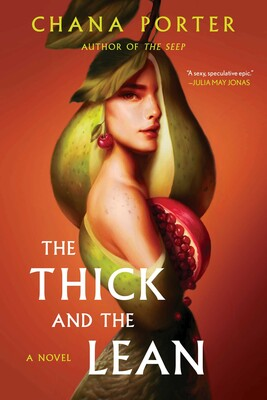
Chana Porter’s new speculative novel The Thick and the Leanapplies American sexual taboos to food and hunger, and gives the results some chilling terminology: Food Modesty and Flesh Martyrdom. Early parts of the story take place in the cult of Seagate, a planned community where members eat in the privacy of their own homes, and only calories that are nutritionally necessary. There is no pleasure to be had in the vitamin-heavy mush of a meal, though a few scenes later, the cult’s church youth group hosts a routine, sanctioned sleepover. The minister reminds adolescent Seagaters how to respectfully (but joyously) engage in heavy petting—“outercourse” before “innercourse,” please. Consensual sex is so commonplace in Seagate, and in this world’s middle- and upper-classes, it takes place in public parks and social gatherings, in extramarital acquaintanceships and social media feeds. But some desires are still forbidden: when two teens are discovered sharing a grilled cheese sandwich in the church kitchen, the result is shame and exile.
The book’s premise is not totally speculative: diet culture in America goes to many extremes to bring its followers to a given, sanctified status of being thin and being seen as attractive and socially desirable. But Porter takes it further—instead of the earthy moral purity of organic cuisine or the discipline of carb-restricted cooking, the wealthy of The Thick and the Lean remove themselves, literally, from the earth’s surface and what might grow there. Porter uses this aversion to shape the economic, cultural, and colonial forces of her two-mooned planet, only to disrupt them with an apocryphal (cook)book-within-a-book. This text brings two contemporary but counterpoised heroines to share a single, clandestine meal. From there, each woman must reach her own conclusions about how to move forward in a compromised, and possibly dying, world.
I spoke with Chana Porter on a warm morning in May about flipping taboos, writing about sex, and women’s hunger as a source of power and pain.
Charlotte Wyatt: The last time we spoke was about your first novel, The Seep, which started with a dinner party. Your new book starts with an empty plate. Can you talk about the role appetite or appetites play in your desire to write fiction?
Chana Porter: I think I’m always going to write from the perspective of having a body. My animal self is always present. I’m a sci-fi fan, and if I’m watching a show that takes place on a spaceship, and no one ever has a meal or talks about a craving, or about the food they miss at home, that seems to me to be a very large part of what it means to have a body left out. These basic needs that we all have to sleep, to eat, for touch, these things occupy me. I think, in a way, our desire is our most common experience.
CW: Yes! I definitely see that in the book. In terms of desire, sex is very present in the novel, but it’s rarely treated as the obstacle or obsession sex can become in narratives about appetite. And so when it’s treated as casually as having a conversation or sharing a meal would be in our world, it’s not front and center—despite the fact that one character insists sex for pleasure is the most human act possible. Did writing about sex in this way reveal something to you about your own attitudes towards sex or sexuality you hadn’t articulated before?
It’s very hard to be sexually free in capitalism and rape culture.
CP: I was very conscious that I wanted it to feel like when sex was happening, it was commonplace. And then, when a character was having a sensual encounter through food, the “gaze of the camera” reflected hunger. I consciously wrote the early sex scenes in the book as something very normal. I’m not trying to pathologize people who have sex in a way that’s friendly and casual. But in showing this taboo flip, and trying to talk about our arbitrary moral scaffolding placed around different kinds of natural desire—well, there’s definitely some things about the cult, about the way they talk about sex and the way they teach their teenagers, that I find really cool. I would have liked it if someone told me when I was a teenager the only way to get good at intercourse is if you stick to doing hands-only stuff for a long time. And then you get good at knowing your body and knowing how to have an orgasm. I think that’s so sweet and such good, practical sex advice. There’s another line where I think the pastor or maybe the nun says, your bodies are divine vessels, so we’re not treating one another like we’re trampolines, right? We’re not just going to bounce on one another for joy. This is contrasted with how, in more secular parts of the novel, sex is treated like a commodity or a power trade.
I don’t think I have a very judgmental attitude towards sexuality. It’s very hard to be sexually free in capitalism and rape culture. I don’t think the act of having a kind of whimsical or casual or abundant approach to sexuality, if that’s what you want, that there’s anything wrong with that. I think when you layer all of the ways women are not safe in our current reality—like, it’s a very difficult thing for me to go out and take someone home. It was fun for me to write about a world where no one in the novel is thinking about that. Which I found really relieving. Plenty of other problems [in the world of the novel], but no one’s going to get murdered if they sleep with someone they don’t know.
CW: I think the way you phrased it with “the gaze” of the narration captures what I was trying to ask. Beauty comes up often in the book, too, and is named as a burden by multiple characters, but beauty is never ultimately confused with thinness. And Beatrice, after she leaves the cult of Seagate, becomes conscious she’s no longer thin. This gives her a chance to reject the values around beauty she was raised with. Reiko has a similar opportunity, though to very different ends. As your characters reject these values, they seem to learn new things about their own desire. Could you expand on your interest in writing about those discoveries?
CP: I actually read a Camille Roy quote about this today, that made me think about what you’re asking. Let me see if I can find it …
But, to answer your question, I developed an eating disorder as a young, beautiful teenager. And when I got thinner, there was this summer where I realized that everything I thought of myself as having—my hair being too curly, or my nose being too big, or me being too short, or having too much body hair—I could do something to modify that. I started wearing shoes that always had heels and I lightened my hair and I straightened it. I started putting makeup on the sides of my nose to make it appear thinner. And then I lost a significant amount of weight, and it was like a key turning in a lock. The world of being a beautiful girl unlocked. It was very strange. I felt like there was fanfare everywhere I went. I would just go into a store and people would give me things. Boys would come up to me at pizza shops and say, do you have a boyfriend? Can I have your phone number? It was just this wild thing. And I was slowly starving. I mean, it was getting so extreme. I was living off a mocha from Starbucks for eight hours until I could move dinner around on my plate. I was constantly hungry. I also felt so powerful. I went shopping for a prom dress with my mother and the woman at the store was like you’re too small. We don’t have any dresses [that will fit you]. And I felt so proud. I was like well, I’ve done it. I felt so incredibly powerful, and it was also miserable, and it was killing me. It was really taking over my mind.
Here it is, the quote:
“Mostly it’s boring being a girl. You are a prisoner of your girlish appearance. You can’t get outside. You are either with all the other girls studying themselves in mirrors as they dream of devouring meat, their own excess flesh, anything to get rid of it permanently, or someone is trying to stuff something weird between your legs. It’s either one or the other.”
CW: Wow! What a perfect quote for the book! I think something really interesting happens as these characters reckon with being beautiful, or not, but also with what kind of person they want to be in a world set up to take advantage of anyone who isn’t powerful. And of course, having beauty is only one kind of power in the book. You have three heroines who, in turn, attempt to poison their boss, or routinely steal, or cultivate culturally deviant habits in secret. Reiko particularly moves in circles with characters who make intentionally harmful, selfish choices, but she doesn’t remove herself from those choices and their consequences. I’m curious if you were concerned about how readers would receive these heroines.
CP: In Reiko’s case, she turns to crime because she understands essentially that she’s being robbed. She’s being set up. And just because it’s a legal way doesn’t mean that it’s just. I’m very interested as a writer when you step outside cultural norms or the cultures’ laws or social taboos, then what else in your life, in your mindset, becomes flexible? Because [Reiko’s] journey is really one about moral relativism, where things get so flexible she loses the center of what she actually does care about and does believe in. Or does she? It’s kind of the question.
CW: Right! And you bring so many forces to bear on them. There’s elements of religion and colonization and systemic racism and environmental degradation and corporate exploitation. Was it easier to explore these forces in a world you created, despite so many of those forces having clear parallels to what’s happening in the real world?
This book is very much about the ways that a really nice idea, a good idea, can be wielded as a tool of suppression and harm.
CP: The book is a mirror to our reality, but a funhouse mirror. Or a distorted mirror. I hope by seeing our own world reflected back in a way that catches our eye, catches us off guard, it can feel a little destabilizing and grotesque. I hope it helps us see things in our reality with kind of a fresh perspective.
CW: Approaches similar to yours (in both novels) are sometimes referred to as “soft” science fiction, where the writer’s emphasis is less on world-building or science, and more on what those things allow a book to explore thematically. One of your main characters in the new book is “Free-Wah,” which is an indigenous culture that shows up in every storyline of the novel, despite the Free-Wah having been colonized and in many ways condemned by the followers of Food Modesty. Can you talk about why you chose to explore indigenous culture and indigeneity in the world of the book, especially around these themes of hunger and human relationships to food?
CP: Devising a book that had this kind of classic sci-fi trope taboo switch, where something in our reality is viewed as normal there, so our normal is suddenly taboo, I knew I wanted to write a very beautiful food culture. There needed to be people who were cooking. There needed to be people who were cultivating things like chocolate, who knew how to make cheese. Some of my favorite scenes in the book are when Beatrice is foraging, where the veil is being lifted off her eyes, when she starts to glimpse that there’s actually food everywhere. Like there’s food growing up between the cracks in the sidewalk.
But part of why sci-fi is important to me is that it’s a good tool to understand the way things are in our current reality is not because it’s the most natural, but because these are choices we’ve made historically, collectively, that we still agree to now. With the [Free-Wah] having a lush food tradition that’s not encumbered by shame, which connects them to their bodies and to their lineage and to the land from an agricultural perspective, it seems very right to me that the backbone of the story is so much about conquest. It’s so much about land rights, and colonization, about a dominant culture coming and suppressing people that were already there. Part of how they’re taking away the colonized people’s power is they’re saying that there’s something wrong with the way you’re living on the planet. And we should be in control. In a very “holier than thou, we’re coming to save your souls and take your lands” way. If you read things like William Penn’s letter to the Lenni-Lenape people, the patriarchal language in that strain of colonization, where it’s saying things like my children, my friends, I love you, I’m going to take care of you. Part of how I’m going to do that is I’m going to show you how to believe in God.
It is a fantastical story that I’ve made, but also a version of that did happen in our reality that was very, very connected to food and to agriculture. The way that Europeans introduced things just as simple as monocrops, right? Monocrops are so damaging for the environment. And it’s this attitude of, we are separate from the world and we’re going to put our own framework on top of it. And we’re going to order it to give us certain things instead of what had been happening for thousands of years in our country, the form of permaculture, of knowing that when you plant one plant next to another plant next to another plant, they all help one another grow. That’s a very simplified way of talking about something a lot of scholars, who are a lot more learned than I am, have written about. My hope is that if I do write more books in the world of The Thick and the Lean, that I get to explore these topics further.
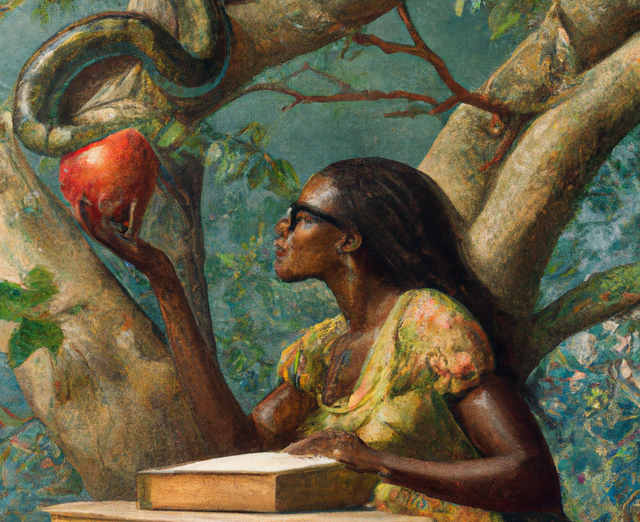
CW: I was so disappointed we didn’t get to follow Beatrice at the end of the novel to her new life in a Free-Wah farming community! But even without that, gardens and gardening play a big role in her story, and come up in other parts of the book. It was hard not to think of the Garden of Eden story from the Christian Bible and the pomegranate seeds in the Greek myth of Hades and Persephone. And then, you had the very straightforward scenes around religion in the cult of Seagate. Did you plan to bring religion into the world of this book from the beginning?
CP: I’m not a religious person, but I’m a very spiritual person, and I’m fascinated by religious certainty. People trying to concretize a relationship to the invisible—which I think you can do for your own person, but doing that for a whole group of people and perhaps for the world seems like the most wild hubris in my mind. So many big and small violences and atrocities and little soul deaths have been caused in the name of what I think is a very benevolent God. So, this book is very much about the ways that a really nice idea, a good idea, can be wielded as a tool of suppression and harm.
CW: It’s so lovely that Beatrice’s liberation at the end goes in the face of that. And I know it’s a spoiler, but: the book ends with the final revelation of The Kitchen Girl, which could reasonably be called apocrypha for the people of Seagate and the upper classes. So much of the world of the novel is about controlling appetites, how people consume goods and services, and the power dynamics around these cultural values. But the book’s epigraph is from the memoir A Gentle Plea for Chaos by the gardener Mirabel Osler. What do you hope readers come away with having followed Reiko and Beatrice and Ito as they resist being controlled by the world of the book?
CP: It’s really about not knowing what the fruits of our actions will be. And there’s such powerful hope in this, that we plant into the unknown, and maybe we are not the people who receive the bounty. I don’t know how our lives affect people and what the ripples of those effects are—something that you say to someone that seems very small to you, you don’t even remember them, but they might remember for the rest of their lives. So there’s something about that in terms of what we cannot quantify, what we cannot plan. I really do feel like living in a way that feels necessary and joyous ripples out way farther than we could ever anticipate. I hope people leave the book a little more empowered to live their most unapologetic and embodied truth.
People say that we don’t really know each other and that’s why we’re still together, but what everyone doesn’t see is that we understand each other perfectly fine. It’s true he’s Korean and I’m not. It’s also true that I’m an undergrad in the same lab where he’s a grad student. Yes, he TA’d my cell bio class, but that was before, so I deserved my A. The age difference isn’t as much as it looks. My parents are orthodontists. I have a lot of jaw issues, so I’ve worn braces since freshman year of high school. He’s never had braces. He doesn’t believe in cosmetic alterations. He says he’s traditional in that way, not like most Koreans these days. His teeth are small, tinged yellow, and crooked.
“I bet her parents keep her in braces to keep the boys away,” a grad student says.
“Oh, God, like a chastity belt in her mouth,” says a post-doc.
“Didn’t work on KJ. Guess he’s into it. Or girls who look like they’re still in high school.”
“Or any mediocre white girl.”
The two of them burst into heinous laughter.
Another thing people don’t know is that I hear a lot in lab. They think because I’m quiet that means I’m also deaf. Here I am, taking photos of mutated yeast, having to listen to them talk about me.
“Oh. Hi, Judith,” says the grad student when she walks into the microscope room.
“How’s it going?” says the post-doc.
I look up at them and smile to show off all my braces, rubber-banded in gold.
It didn’t take me long to figure out that not everyone who gets a PhD is a genius. KJ is not a genius. He’s in his sixth year, and the mean time for completing a doctorate in this department is 5.4 years, which makes KJ about average among his peers. This isn’t even the best graduate biology program in the country. Last I checked, it was ranked eleventh. I’m as smart as, or smarter than, any of the grad students and post-docs in the lab, including KJ and maybe even my PI. I haven’t reached my full potential yet.
My plan is to become a real doctor. Not like my parents and not like KJ will be eventually, when he graduates. I will be an MD, a doctor of medicine. My other plan is to get far away from this town, maybe even to another country, like Korea. I was born and grew up here, and because the university is one of the best in the country for undergrads, not the worst Ivy League, I stayed. I lived at home. I took the bus to classes. I took the bus back home. I ate dinners with my parents every night.
Until KJ.
I joined the lab last year, my junior year. It is in the newest building on campus, a sterile white and metal structure that looks like it’s made of giant kitchen tile. At first I didn’t notice KJ. He sat in a distant bay. All the grad students seemed the same back then. Overworked and undernourished adults plodding around in sneakers and blue gloves. I work for one named Drew. After months of having me grow yeast cells and wash dishes, Drew let me do real experiments, and the PI invited me to attend lab meetings. I sat there at the first one with my mouth closed and back straight, trying very hard to look deserving as the grad student of the day stumbled over their PowerPoint slides. I don’t remember anything anybody said because I was so worried about my mouth opening and making me look dumb. It has a tendency to hang open when I’m not paying attention.
KJ approached me after that meeting and asked if I liked to eat Korean food. Those were his first words: “Do you like to eat Korean food?” I’d never had any, but I said yes. When he walked away, I noticed he waddled because of his thick, stocky legs. He is not a small person; he is shaped like a brick.
The next day he brought me a Tupperware of pork and rice, and we ate it together in the fourth-floor lunchroom. I didn’t know what to say as I sat across from him, so I didn’t say anything. KJ was quiet, too. We sat there eating in silence for a long time, and I remembered an article I once read that said silence between people indicates that the people are comfortable with each other. Most people like to talk a lot when they’re in front of you. I preferred the quiet. It was how I ate with my parents at home.
KJ had a deliberate way of putting each bite of food in his mouth and chewing, like he was thinking really hard about it. I was studying his forearms, hairless and bronze, when he said, “I’m a very good cook.”
He did not say it like a question. I took another bite to show that I agreed.
“You are very smart,” KJ said. “Top five percent in cell bio.”
I knew this, but it felt different, special, to hear it from somebody else.
“Did you grade my tests?” I asked.
“Yes,” he said. “I enjoy your handwriting. It is crisp and excellent.”
We sat in silence for a moment, chewing the food he’d made.
Then he pointed at my mouth.
“Your hair,” he said. “You’re eating it.”
“Oh.” I yanked the strands out of my mouth, unsure how they’d gotten there.
“Has anyone ever told you that you have pretty hair?” said KJ.
Nobody had ever told me that. My hair is limp and dry and the color of wet sand. In fact, in elementary school, the kids used to call me Scarecrow. I always think of my hair as one of my worst features. That and my fingernails, which are short and stubby from when I bit them down in high school.
I blushed.
Hearing his compliments felt like stepping into the lab’s cold room on a humid summer day. It felt great.
That’s when we started dating. We didn’t tell anybody, and we limited our interactions in front of others. KJ said it should be kept a secret, at least for a while, and I agreed. We did not want people to think we were a stereotypical grad-undergrad couple. We also did not want the PI to know until we were sure he wouldn’t flip out and kick one of us out, most likely me. KJ said he cared about my future. Our PI is fairly unpredictable, which KJ attributes to his being from Argentina. I’d never met anybody from Argentina before joining this lab, and now I know seven Argentinians: the PI, his wife, his two daughters, the one graduate student who is an idiot, and the two post-docs, who are too depressed most of the time to notice anything around them. Before KJ, I did not know anybody from Korea, either.
It is difficult to have a secret relationship, especially when one person lives at home with their parents and the other lives with grad school classmates. The only times I could see KJ were during intramural soccer and in lab. Since both of those spaces were occupied by our labmates, we had to be careful, always watching ourselves, sneaking time for quick lunch walks (always leaving the lab staggered), and hanging around after soccer until everyone else had gone. He would send me texts that said, You are good at science and You are pretty today. I didn’t read into the syntax (am I pretty today but not yesterday or tomorrow?) because he’s ESL. I have met a lot more foreigners working in the lab and have gotten very good at understanding ESL people.
What I loved was going to soccer and watching KJ get into fights. I still love it. He’s quiet and calm in lab, but on the field, he is frightening. He rams into people. They yell at him. He yells back and pushes. Other people on the team have to pull him away. Sometimes he runs off and pushes somebody again. It is fascinating. It is like watching a nature show about my boyfriend. I think it has to do with him having been ranked very high up in the South Korean military before he came to graduate school. He says everybody smoked cigarettes there, which is why his teeth are yellow. He went from two packs a day to quitting completely when he came to the United States.
“I have incredible willpower,” he said when he told me this thrilling detail of his life.
In those early months, when he wasn’t overwhelmed with work, we’d meet at the far end of the parking lot outside our building, and he’d drive us to a restaurant for dinner. He chose places far from campus, places we didn’t think anybody else would go, like the Arby’s on the outskirts of town. I had to tell my parents that I was busy running experiments in lab. Yes, I lied to them, too, at first. It was the biggest secret I’d ever kept.
Our first kiss—my first kiss ever—happened in the Arby’s parking lot, before one of our meals. KJ is very conscientious about his breath and hygiene in general, and that first time, he handed me a piece of gum when I got in the car. We both chewed and chewed. The minty scent filled the cold car. When we arrived in the parking lot, he leaned over and held out a napkin for my gum. I spat it out. Then he put his mouth on my mouth. His lips were softer than I’d expected. The whole time, I thought about my braces and my tongue. Was one of them poking him in a bad way? KJ pulled back.
Our first kiss—my first kiss ever—happened in the Arby’s parking lot, before one of our meals.
“You’ll get better with practice,” he said.
He ordered two Arby’s roast beef sandwiches, and we ate them at a sticky linoleum table inside. The only other customer was a middle-aged man wearing a tank top with a graphic of a smiling cartoon hot dog wrapped in an American flag. I thought he looked like my uncle Robbie, who lives in Horseheads. The man stared at us the entire time he ate, sauce dripping down the corners of his mouth. I wiped my mouth furiously.
KJ stared back at the man. They went on like this for a few minutes. I waited for a fight, like KJ was on the soccer field. Instead, KJ eventually said, “Let’s go.”
“You have something in your teeth,” he said once we were back in the car.
I flipped open the passenger’s-side mirror and saw clumps of wet bread stuck behind my braces. Mortified, I dug the stuff out with my finger and tongue. “Don’t worry,” KJ said. His tone was matter-of-fact. He was not disgusted or ashamed. He rested his hand on my knee to let me know it was okay. That’s when I knew he accepted me as I was.
The parking-lot intimacy progressed. KJ was right. I did get better at kissing. I didn’t think about my braces the whole time. I thought about other stuff, like sex. He started to ask, “How much today?” meaning, how far did I want to go. He was very considerate. “Second base, okay? That’s what Americans say.” I said, “Yes.”
I wasn’t an expert. I didn’t know anything about baseball, and he was a huge fan. KJ said Koreans love baseball, which surprised me. I was always learning new things about his culture. I let him reach under my shirt and into my bra. I kept my hands in my lap. He seemed satisfied. When the occasional car drove in or out of the lot, we shot apart and stared out the front window, then laughed into our hands. Outside, small birds hopped around, pecking at crumbs and garbage. It was not a romantic setting from the movies, but it felt special to me.
After three months of this, KJ decided it was time to tell the people in our lives. He said he was very serious about me. Also, someone had figured out about us. Another Korean PhD student named Jun-ho always wanted to know about KJ’s love life. Question after question at our soccer games. KJ avoided answering until, finally, he conceded that he was dating me. KJ said that the Koreans in America find each other wherever they go, and they are obligated to spend time together. That’s why he and Jun- ho were friends, even though KJ said he hated Jun-ho’s nosiness.
These days KJ says he doesn’t want to associate with the Koreans on campus anymore. He wants to be more than just another Korean graduate student. He says he has me now.
Still, he invited Jun-ho to the announcement party. KJ said it was very important that we tell everyone at the same time and place. The message would be consistent and clear. He invited people over to his apartment complex for a barbecue, but somebody else suggested the park, and KJ complied. He confirmed everyone’s attendance. He told people six-thirty p.m. sharp. I didn’t care much about anybody, but I liked to see KJ in this meticulous mode. I overheard him talking to a grad student on the floor below ours.
“Oh, Cassandra’s barbecue thing? Yeah, I’ll be there,” the guy said.
“No. My barbecue,” said KJ. “Be on time, please.” “Uh, okay. Sure,” the guy replied.
We arrived at the park a half hour early and laid out everything we’d bought on one of the picnic tables by the lake. A tablecloth, chicken breasts, water, soda, napkins, plastic utensils, paper plates, coal, ice, and a cooler. KJ did not know how to start the grill, so we waited for somebody who did to arrive.
KJ took my hands in his. “We will surprise them with the announcement,” he whispered. I hated surprises, but I liked KJ, and this was for us. I wasn’t going to be the one surprised.
Many of our labmates had been invited but had texted KJ minutes before, saying they couldn’t make it. They had too much work. They were tired. They weren’t feeling well. KJ tried very hard not to look disappointed. Finally, Jun-ho arrived five minutes late. My supervisor, Drew, showed up with his girlfriend, Cassandra, who plays soccer with us. She’s also a grad student, except in a social science department. There were some others, but I knew them only in passing. These people meant nothing to me, and I wasn’t sure they meant much to KJ, either. But as I said, we do understand each other. And that evening, I understood that to KJ this was more symbolic than anything else. The we and the us would be more real after an announcement.
The picnic table became crowded with other people’s snacks, even though KJ had bought enough for everybody. People busied themselves with activities. I stayed put, sitting there picking a brownie bite into smaller pieces—pieces that wouldn’t get stuck in my braces.
“Judith, want to come hit a Wiffle ball?” Drew yelled, and waved his arms to indicate I should go over to a grassy area where people had gathered.
I had been watching them, happily remembering a fight KJ had on the soccer field the previous week, when he’d ripped an opponent’s shirt at the collar and gotten kicked out of the game. Wiffle ball, however, was a children’s game. I looked around for KJ, trying to see if I could get out of this. He wasn’t paying attention. He was still standing beside Jun-ho at the grill.
“Judith? Did you hear me?” Drew yelled.
I nodded.
“Well? Do you want to come hit the Wiffle ball? It’s not much harder than soccer!”
I shook my head.
Cassandra laughed loudly, and the sound hurt my ears. “She doesn’t want to,” she said. “Leave her alone!”
I hated Cassandra. She came into lab with Drew in the evenings and on weekends, even though she wasn’t part of the lab. She just sat there on her computer, “working,” she said, but it looked to me like she only watched videos and chatted with friends. I couldn’t even remember what department she was in, what she was researching, not that it mattered. Social scientists aren’t real scientists. The worst part was that she talked a lot and she sat at my bench, even when I was doing experiments in lab. I tried to leave my stuff on the desk to hint that she shouldn’t sit there, but every day she moved my things aside and sat there again. Now she was walking up to me at the table.
“I’m so hungry! We should tell them to grill faster,” she said.
“Heh heh, yeah,” I said.
“KJ! Jun-ho! Hurry up! We’re starving over here!”
KJ walked over and stood opposite me. “There is so much food here,” he said.
“We need protein!” said Cassandra. “So when is this girlfriend getting here? Is that why we’re still waiting to eat? Because she’s late?”
KJ made a small smile and looked at me. “She will be here,” he said. “The food is ready soon.”
“How rude to come late to your party, where all your friends are waiting to meet her,” Cassandra said.
KJ let out a little laugh, like a little bell, and walked back to the grill. I tried to give him a look to tell him not to leave me alone with Cassandra, but he had already turned around. Cassandra looked at me. My heartbeat picked up a little bit.
“What a weirdo,” she said. “I told him I could help with food, but he kept saying, No, it’s my event, it’s my event. It’s a barbecue!”
“I— ”
She cut me off and called out to everyone that the food was almost ready. Soon everybody was sitting at the table with a paper plate in front of them. KJ walked over with the chicken breasts.
“Interesting. Did you season or marinade this in anything?” asked the guy who worked downstairs.
“There is ketchup,” said KJ.
“So, where’s your girlfriend?” Cassandra asked again, in front of everybody.
“What girlfriend?” the guy downstairs asked.
“That’s why we’re here! Because KJ has a girlfriend and wants to show her off to everybody.”
Drew slapped KJ on the back. “Finally got one to go out with you, huh, buddy?”
As KJ was doling out the chicken to everyone, he said, “She’s here.”
“What? Where?”
“What did he say? Talk louder, KJ.”
“He said she’s here.”
I was staring at the chicken on my plate, determining how many pieces I’d have to cut it into so that it wouldn’t get stuck in my braces, when KJ said, “It’s Judith.”
“Ha. Ha. Good one,” said Drew. “Judith, can you pass me those brownies?”
“What did he say?”
“Speak up! Why do you talk so quietly? I can’t hear anything!”
“Judith is my girlfriend,” KJ said again, louder.
I looked up and was about to smile to everyone, the smile of a girlfriend. I was relieved and satisfied that this was finally over. But then Cassandra started ferociously slapping KJ’s arm while yelling, “No, she isn’t! Stop saying that! She’s an undergrad! It’s not funny!” On the third slap, the chicken on KJ’s plate flew onto the table and knocked a beer over into Jun-ho’s lap. People jumped from their seats. They all started handing napkins to Jun-ho.
“I’m fine, I’m fine,” he said, dabbing at his shirt and pants.
“Look what you made me do,” said Cassandra.
KJ looked over at me. I felt my mouth opening a little and a heat rising up my neck into my face. I put a small piece of cut-up chicken in my mouth. I didn’t want to say anything anymore. I wanted everybody to understand what was happening, but nobody understood us. I wanted everyone to go away. They all stared at me with confused faces. KJ repeated what he’d already said.
“Are you serious? Judith. Are you really KJ’s girlfriend?” Cassandra said.
I nodded.
“I’m sure this is just a prank or something,” said Drew.
At this point, Jun-ho got up and said something about grilling more chicken. KJ gave me a thumbs-up before heading to monitor the grill as well. Everybody was silent for a while. We all ate our chicken peacefully. I thought that was the end of it, that everybody finally understood, but then one of them said, “So, I don’t really know KJ that well. What was that about?”
I’ve noticed that once one person starts talking, it’s as though their voice opens the doors for everyone else to start pushing words out, too, even if they’re useless.
“He just said he’s dating Judith,” said another person.
And another: “Okay, so, what does that mean?”
Drew: “Judith, this is a joke, right?”
I shook my head. I was starting to feel a heavy weight behind my eyes, like I was going to fall asleep from being so tired.
Someone else: “Stop bothering her.”
And another: “Of course it’s real, why would they joke about this?”
I was searching for words that might communicate everything more clearly but realized there weren’t any for me to use that would work. I worried KJ and I might have to kiss in front of them for them to believe. It was a terrifying thought. The publicness of our relationship now felt so wrong.
“So how long have you been dating?” Drew asked. “Like, a couple weeks?”
“A few months,” I managed to answer.
“Wow. Okay, wow. Congrats.” He started tapping his fingers incessantly on the table. “I need to use the bathroom. Cassandra, will you help me find it?”
The two of them got up and left. The others followed suit, getting up to go back to their pre-eating activities, leaving me alone. Finally.
I looked around for KJ, but he was nowhere in sight. I started to panic that he, too, had left, embarrassed by our relationship. Then I felt hands on my shoulders. It was KJ. I looked up to see him holding a single pink flower.
“I got you this,” he said. “To match your teeth.”
“Thank you,” I said. I had pink rubber bands on my brackets that week.
“Now everybody knows. We are official. I am so happy.”
Nobody really spoke to us after that. They hit the Wiffle ball around and talked to each other. As we packed up to leave, KJ told people how much they owed him for the food. They said, Congrats. Great barbecue. See you later. Cassandra looked me in the face and apologized for her earlier “explosion.”
“I’m happy for you,” she said.
“Yeah. Anyway, see you two in lab tomorrow,” said Drew.
Back in the car, KJ said, “That went very well. A great success.”
I agreed with KJ. Nothing else mattered.
For days, I overheard people whispering in the halls and in lab about the barbecue. They told people who had canceled last-minute what had happened. They told people who weren’t even invited. They went over the details with each other. They complained and rejoiced and wondered.
“God, it was painfully awkward. Most awkward thing I’ve ever had to go to.”
“I can’t believe he made us pay him ten dollars for that shitty-ass chicken.”
“Why did they do that? Why did they want to make an announcement that they were dating, like it’s an engagement party or something?”
“Definitely a top-five grad school experience right there. Remembering that forever.”
“Is this even allowed? What is she, eighteen? Isn’t this against school policy?”
“Have you ever seen them talk? I’ve never seen them interact.”
“They just stand real close and whisper at each other in lab, like they don’t want anybody to hear what they’re saying.”
“KJ should know better than to date an undergrad. I mean, she’s so naive. I feel bad for her.”
Nobody needed to feel bad for me. I felt bad for them. I appreciated what KJ had done. They didn’t understand that I’d fallen in love with KJ that day. I didn’t care about anybody else.
Having KJ changed my worldview. It was as if a tiny but incredibly important piece of my genetics had been changed, and the phenotypic result was a shiny new me. I told my parents I wanted to move to the dorms. I wanted to have independence. I had a boyfriend after all. I wasn’t a kid anymore. They invited KJ over for dinner, and afterward, my dad said he was happy I’d found somebody polite and mature. And surprisingly handsome, my mom added. I’m not sure what was surprising about how KJ looked, if it was that a Korean man could be handsome or if it was that somebody as handsome as KJ would date somebody like me. It didn’t matter either way, because KJ is handsome, and he is with me.
It was as if a tiny but incredibly important piece of my genetics had been changed, and the phenotypic result was a shiny new me.
My parents gave me a card the next evening. There was a freckled little girl who looked like me on the front cover. She was smiling with all her teeth. I opened the card and saw one of the familiar office stamps. It read, Hooray! Time to take off your braces! in the shape of a circumzenithal arc. My parents said my jaw was finally fixed.
“You’re a woman now,” my mom said, her voice shaky.
“I’ve been a woman for a while now,” I said, feeling confident.
“Yes. Now you’ll look the part, too.”
“How about we keep the bottom braces on, just in case you need another round of headgear?” my dad said when I sat in the patient’s chair the next day. My dad never got emotional, so I was surprised to see his eyes watering. He cleared his throat. “It’s up to you now, of course.”
I told him to take them off. I was a new person, and I could make decisions of my own. After nine years, all the braces would go. When they came off, my teeth felt slick and slimy, like wet rocks along the lake.
I moved into the dorms soon after. I got a single room a third of the size of my room at home, furnished with a skinny bed, a short dresser, a small desk with a weird rocking desk chair upholstered in scratchy green fabric, all made of the same pine. Short gray carpet speckled with white covered the floor. It was perfect. On the first day, I lay down on the floor and imagined all the geniuses who had come through, people who had become doctors, like I would. I wanted whatever leftover particles of these people to seep up into me and make me brilliant.
Now I am totally free. KJ lives alone, too, and even though my parents said living with a man is only for marriage, I started to spend every night at his apartment. We stopped going to the Arby’s parking lot after the barbecue event. We go to nicer restaurants in the center of town and close to the university, places where we can sit at tables with cloth napkins and a flower or candle between us, places where people can see us, though we have yet to run into anyone we know. When we sit in booths, KJ sits beside me because he says he saw it in a movie, where the man put his arm around his girlfriend as they ate. Sometimes people look at us strangely, but neither of us cares. We care only about each other.
Back at his apartment, we kiss and touch, and every night he asks if we can go to home base. To be honest, I would have had sex with him a long time ago. It’s mostly what I think about when around him. What his thick, stocky legs will feel like rubbing up against mine. The problem is, I don’t know what will happen. I don’t know how much I will bleed, and the unpredictability makes me tense. What if I bleed all over his mattress and he needs to replace it? But he doesn’t have the money for another nice mattress on his grad student stipend and has to sleep on a futon? What if blood gets all over him and he throws me out? What would I do afterward? Run away, leaving a bloody trail behind me? I don’t know how to tell him, so I shake my head each time he asks. I wait for him to understand. He stares at me with his small eyes, looking like a hungry cat. Then he pats me on the cheek, turns away, and falls asleep. I stare at his ceiling, trying to figure out a way to have sex that will not be embarrassing.
I finally come up with an idea and feel light-headed about not having thought of it earlier. My dorm room. It is not romantic, but it is functional. I don’t care about the university’s mattress. If it gets stained, we can flip it and nobody will know for a year or more, hopefully after another person moves in and can be blamed. The amount my parents are paying for the room should cover these kinds of damages.
Hours on Google looking up articles on how much girls bleed their first time turns up many answers. It seems too huge a range, from no blood (hymen broken at an early age on a bike or in some sport) to streams of blood. One girl commented on an article, Im bleeding alot! Im freaking out and don’t know that to do! Im worried im dying! What was she thinking, seeking medical help in the comments section? She might have gone crazy from blood loss, then died. I did not want to be that girl.
Soon KJ calls and asks to be let in.
“This room is sad,” he says when he walks in. “It has no life.”
He hands me a bouquet of flowers. There is nowhere to put them, so I empty out the pencil holder on my desk and stick them in there.
We sit at the edge of the bed and start kissing. Then we lie down and he gets on top of me. For a moment I think his face looks like a giant saucer looking down at me from an alien world. I push the thought away and we undress. He sits up briefly to take his socks off, roll them into each other, and places the sock ball gently at the foot of the bed.
“My favorite socks,” he explains.
I consider grabbing a towel to put beneath us, which I read about online. Then I realize a towel would do nothing good. Blood would only ruin the towel. KJ returns to crouch above me. From the long distance between my eyes and my vagina, I look at his hanging penis, nearly touching me, the sprout of black hair surrounding it, and this time I see it as a branch wanting to reach into and grow inside me, but my body is on a different track than my mind, because KJ looks up at me and smiles. He’s stuck a finger inside me and pulled it back out, slick. I try not to think about my teeth.
“Good,” he says. “You’re ready?” I nod and brace myself.
It hurts only a little, then it feels good for a little. I think it lasts around a minute. I don’t feel any differently afterward. KJ apologizes. “It has been a long time,” he says, then gets up, takes the condom off, brings it to eye level to examine its contents, ties the top off, then places it gently into the small trash bin beneath my desk, in the same loving motion as he had with his socks. I hope he is thinking, My favorite condom. I take the time to glance at my bed and am relieved to see no blood at all. KJ catches me looking around, then looks around as well.
“Hmm,” he says, frowning.
I realize I now have a different problem, remembering another comment from an article online. A girl hadn’t bled, then her boyfriend had accused her of lying, then he’d started crying. KJ stops looking on the bed and stares straight at me. Are those tears forming in his eyes?
“It must have been a bike or something,” I say after thinking for a moment.
“A bike?”
I wonder how to put it. KJ’s face is vibrating. He looks like he did in the photo he once showed me, him in his green military uniform, no glasses, black serious eyes pointed straight at me.
“I must have ridden my bike very roughly one day, and that’s why there’s no blood now,” I say. This is what a commentor had told the girl to say. It is a valid and believable reason. Most bike seats are not engineered for women and are very painful to ride.
KJ looks at the ground. He is processing. His face vibrates some more, and I can almost see the gears turning behind his eyebrows.
“Okay,” he says. He does not cry. He lies down on the bed, then motions for me to lie next to him. He wraps his arm around my naked body. We are both slightly sticky, but he doesn’t let go. I don’t want him to let go, either. “I was worried I would hurt you,” he says. “I wouldn’t want to hurt you. I love you.”
I am so relieved, I start giggling. He asks what’s so funny. I think about telling him all of my fears, my dreams, my ambitions for my—no, our—future, seeing what will happen if I let all of the words pour out of me, and how much they will make us understand more or less about each other. But then I don’t. There is nothing to say, except one thing: “I love you, too.”
We don’t talk, and soon his breath deepens into the sound of sleep. When I’m certain he is not going to wake up, I slowly lift myself up to a sitting position. He doesn’t stir. I look over at his crotch, where his penis lies soft and shriveled in its nest, unassuming and harmless, a tiny baby animal. I bend over so that my face is an inch away from the thing, then I sniff. It smells of sweat and dust and like the yeast we use in lab. This is what we smell like mixed together, two foreign elements in one, and it is not an unpleasant smell at all.
At a time when attacks against queer and Jewish identities are often trending on Twitter, I find myself wanting to dive deep and spend book-long time with these stories, digesting them, letting them into my DNA, allowing them to help me articulate my identity and my avenue through the world.
What is a Jewish book? What is a queer book? What is a woman’s book? Does the protagonist have to be searching for or struggling with their identity? Is there some uber-Jewishness that comes out in a narrative or a tell that signifies that something is a queer book? It’s like the what’s something that’s not Jewish but feels Jewish TikToks. Naturally, there is overlap with Jewish and queer identities and women’s identities and other identities that often find themselves scribbled in the marginalia and not as protagonists.
My short story collection As If She Had a Sayuses absurdism to examine the societal roles we’re forced into based on our identities. Though I did not set out to do so, I write about abuse of women frequently. It is a recurring theme in my book. In fact, the first sentence of the first story is, “What is your gender?” My gender as a woman means I’ve been subordinated without me having a say.
Below are books by Jewish authors, like me, who grapple with the crossroads of identity and gender:
The title of Nicole Krauss’s short story collection says it all, really: what is it to be a man in this world? For Krauss, and for anyone else who isn’t a man, it can only be left to the imagination and she’s done so deftly in this collection.
Many stories include women who have separated from husbands, are single, spinsters, mothers. A woman on her own was once practically a heresy. In the book, she talks of the “quiet euphoria” of no longer being with a man – for even this realization, should be a quiet one. It would be unladylike to exalt it from rooftops.
The collection is also alive in Jewish identity. “Because I was a Jew, and there was no room left to be anything else…” The idea that one’s Jewish identity is to be the overarching identity, is a question many Jews grapple with (this is, of course, not exclusive to Jews). I am often faced with the question: “what are you? No, but what are you really? I typically respond: First, I am a Jew, then… But this will not be the same for everyone, and To Be a Man makes the reader question prioritization of identity and whether it’s even necessary to rank, when so many of us live at intersections of many different identities.
In Zusya on the Roof, you can imagine being told by an old Jewish man on the upper west side, talking of body ailments and in a cadence that could be from either Fiddler on the Roof and/or Seinfeld. Storytelling is an integral part of Jewish identity, when historically often, Jews escaped only with their bodies and their stories.
Anyone reading – Jew or not – will understand that one of the tells of identity is language, and not only what language, but how one uses that language.
In Novey’s newest novel, Take What You Need, Leah is a city-dweller returning to her rural childhood home in rural Pennsylvania. We follow Leah’s storyline as mother, daughter, country mouse-turned-urbanite, Jew. But the star of the story, to me, is Jean. Leah’s stepmother is an artist and welds metal into monstrous contraptions that literally take up too much space in her small home. Her house becomes a gallery of metal and danger, of upending expectations.
Jews in the United States tend to congregate in and near cities. There are many reasons for this, and a lack of welcome in rural areas that are mostly populated by Christians, is one of them. Therefore there isn’t much by way of stories about rural American Jews. Jewish identity seems to be comingled with an urban one. Novey shows us otherwise. In a brilliant and propulsive read, Take What You Need depicts a not-often seen Jewish identity, one that isn’t less real than its Jewish urban identity counterpart.
Novey does not tell this story in a typical person-stands-out-like-a-sore-thumb way. The characters live a natural life with the beauty and challenges of being Jewish in Appalachia.
In An Unkindness of Ghosts, Solomon, a Black, queer, Jewish writer gives us Aster, a queer- neuroatypical character in this sci-fi meets literary novel. Identity is central to the story. Aster lives aboard a spaceship, where the landscape is familiar. It is based on a plantation-like system of lowdeckers and upperdeckers, organized on lines of whiteness and religion, something that mirrors how whiteness and Christianity go hand in hand in our world.
On the HSS Matilda, Aster is an outsider among outsiders; she’s called an ogre and a freak. Her gender is a bit ambiguous. (Solomon has given her she/her pronouns.) “Tarlander bodies did not always present as clearly male and female as the Guard supposed they ought.”
Aster discovers the power source of the ship is compromised, reads through her late mother’s diaries to learn how to help the ship and help herself. Help her come into her own regarding her identity at all its intersections: queerness, gender, religion, race, neuro-ability.
In the podcast, The Deviant’s World, Solomon says “That’s how she came off the page and came out of my brain. I’m trying to write myself into books, into the cultural landscapes.”
In Savran Kelly’s Endpapers, it is 2003 and artist Dawn Levit discovers a torn-off cover of a 1950s lesbian pulp novel. On the front is a campy illustration of a woman looking into a handheld mirror and seeing a man’s face and on the back is a love letter. This comes at a time when Dawn is questioning her own gender identity. As Dawn searches for the letter’s author, she is also looking for herself. When she meets the letter writer, Gertrude, a Jewish and queer Holocaust survivor, Dawn is able to put together pieces of her own identity. These are intersecting identities that we don’t often think about, but they are and were present during WWII, and deserve to be told.
Savran Kelly, gives us a nesting doll of identities: Dawn as an artist, as someone who is nonbinary before the term was widely used, and as a Jew. Gertrude as a closeted lesbian, an old woman, a Jew, a Holocaust survivor.
In an interview between me and the author at The Rumpus, Savran Kelly says “As a person who’s queer and presents as female, I’ve spent my life trying to get comfortable taking up space. Art has been the arena in which I’ve been able to do it most successfully.”
In Paper is White, gay marriage is not yet legal. Zaid places her protagonist, Ellen in the midst of this time. Ellen decides she wants to move forward anyway to marry Francine. Her role as bride, Jew, and lesbian all factor into her experiences throughout the novel. How these identities are fraught and how they dovetail.
Through her job recording the testimony of Holocaust survivors, Ellen becomes close with one survivor, Anya. A common and powerful recurring theme in many Jewish books are modern characters connecting with Jews who have firsthand experience with the Holocaust. This is so powerful, because it’s rather easy to become complacent in our comparative safety today in the United States. How can a genocide within living memory not factor into one’s identity?
The Jewish community as a whole, like many others, has not always been very welcoming of queerness. It still has a lot of work to do and some communities are better at it than others. This is another aspect of identity; when they’re at odds – do you have to choose? Do you have to prioritize one identity over the other?
Cohen’s collection uses voice, pop culture, humor and intellect to construct and then destruct expectations around Jewish identities. All the protagonists are Sarahs, which probably not coincidentally, is basically the foremother of Jews, the Ur-woman, if you will.
In addition to using famous Sarahs (Silverman, Jessica Parker, Michelle Geller), Cohen gets at the Sarah-archetype: the Jewish American Princess.
I have witnessed the flat-ironing of ethnic curls and seen many birdlike Sarahs subsist on I Can’t Believe it’s Not Butter spray. I have intimately, life-shapingly experienced the bully-end of this certain subset of Sarahs at camp and in college. I had yet to really see this Jewish archetype in literature and the familiarity and humor (whereas in the past, for me, it was familiarity and fear) is something I absolutely loved about Sarahland. Beyond that, Cohen adds a queer element, something held deeply closeted, albeit in a fashionable and expensive closet, among these girls and later women. In those circles, queerness is whispered like the word cancer. In fact, I remember clearly when I was sixteen and someone once whisperer-asked me “are you, are you a…lesbian? <insert horrified expression here.>”
I was absolutely delighted – and there was a sense of relief – to read this mashup of these particular identities and handled in such a deft way. The book is funny. But it’s layered with the nuance of having to hide identities, of being in a pressure cooker of homogeneity, of being a woman, and the pain that is often pushed down along with those things.
As Cohen says in an interview with Split Lip Magazine, “I knew very early on writing “Sarahland” that it was a story about the ways girls are raised to surrender their agency at every turn, about the way some girls start to actually think of their bodies as public property.”
Dorit Rabinyan is a Iranian Israeli Jew. In the novel All the Rivers, she’s written a literary love story between Iranian Israeli grad student, Liat, and Palestinian artist, Hilmi in New York City. Bringing them together initially is the identity of being an immigrant in the United States, one where, if you are of certain descent or look a certain way, you are never fully welcome to the table.
And, of course, it’s been controversial, a love story between an Israeli and a Palestinian.
All the Rivers was banned by Israel’s Minister of Education, Naftali Bennett. Rabinyan says in an essay for Time, “The book tries to address the Jewish fear of losing our identity in the Middle East. And yet that very fear condemned it to official rejection.”
Where does our identity come from and who defines it? I think the only way for us to even begin to form the answers to this question is to read about those relationships, to read about the people living it and from the people living it. Our identities do not exist in a silo, and this book offers an opportunity to parse and reconcile our Jewish identity with what’s happening in the world outside our own.
Identity is self-formed, environmentally-formed, and pre-determined. In Kalotay’s titular story, she talks of epigenetics in Holocaust survivors. The trauma in one’s DNA. This identity is one made up in your bodily threads. If that’s the case, can you shirk this identity?
While talking of a dance, but metaphorically more, “Dances long forgotten…will exist once again, recalled, performed, and shared into perpetuity.” Can you forge an identity entirely free of genetically determined factors? Surely you can build upon it.
In one story, Three Times Two, in the mountains of Germany, amidst a bevy of named characters who each get a background, a voice, choices, an innkeeper’s wife cleans up in the background, getting things done invisibly, as women do. Later, she is named “nervous wife.” She never gets a name, constantly keeping up the setting invisibly, as is a woman’s work. Throughout The Archivist, we are given women doing women’s work and then shucking that suffocating blanket.
As we know and see in many of the books listed here, a large part of identity is often formed from things passed down through generations. This can be via DNA, family lore, or via material possessions. Living in a world created by those who came before us, we are always walking on the desire lines of others. Using humor to talk about Jewish trauma, Courtney Sender sets several stories in WWII concentration camps. Her own grandparents were Holocaust survivors and undoubtedly this identity has imprinted on the author.
Womanhood and Jewish identity are side-by-side and intertwined throughout Sender’s excellent collection. Menstruation is a recurrence throughout, arguably, one of the most definitive aspects of womanhood. In one story, To Do With the Body, we see a museum of period-stained clothing. In real life, this is something we both never see – those stained belongings must be hidden away – and also something almost everyone who has menstruated recognizes immediately.
For women imprisoned in camps, they both had to contend with forced labor and genocide as well as the everyday occurrence of getting their period (at least until their bodies stopped menstruating due to malnutrition and disease). As her narrator says in her titular story, while imagining the possibility of her past loves returning to her, taking her on varying paths in life: “In all worlds I’d have stayed Jewish, and a daughter, and a writer.”
“This is one of those stories that begins with a female body,” opens EricaBerry’s evocative exploration of wolves, fear, and the female experience, Wolfish: Wolf, Self, and the Stories We Tell About Fear. Though the body Berry speaks of is not the human one we conjure in our minds, but that of a two-year-old wolf, OR-106, whose corpse was discovered on the side of the road in a small Oregon town. “Her body is the same palette as the snow beneath her,” Berry writes, suggesting that OR-106’s body could be easily missed or mistaken for a part of the landscape, echoing the way violence against women is often overlooked in our culture, normalized as natural to the environment. Subtly and immediately, Berry puts her story in conversation with the wolf’s, illuminating a surprising kinship in their shared fight to survive—a kinship that begins to erode the binary of predator and prey.
By challenging the limits of our perception in this opening scenario, Berry sets the stage for Wolfish’s central idea: that much of the way we see ourselves, others, and the world around us is shaped by cultural narratives, not ontological truth. Tracking her own coming-of-age story alongside the wandering of her home state’s most infamous wolf, OR-7, Berry grapples with how fluid the roles of predator and prey can be for both humans and animals, and all the complexity and ambiguity this binary obscures from view. Weaving together threads of memoir, historical data, Internet dialogue, and more, she searches for the root of her own unshakable fear while analyzing wolves—both real and figurative—to unpack our understanding of who is feared and who is feared for. In many ways, Wolfish becomes a kind of map, a guide. One that makes space for the truth Berry finds in conflicting ideologies; one where she is not simply the prey and the wolf predator, but where they can be recognized as both, and fear can be seen as a precursor to discovery, not only as a sign of danger.
I was first introduced to Erica Berry and an earlier iteration of this book during the Tin House Summer Workshop in 2020. After all we’ve endured in these last few fear-ridden years, Wolfish feels particularly necessary. A both/and approach that carves a clearing through decades of overgrown ideas, exposing the hope and possibility of uncharted terrain. A path forward, into the wild unknown.
Nicholl Paratore: I was so fascinated by the structure of Wolfish and its chapters, which are titled like fighters in a ring (ex.“Girl v. Wolf”), and the surprising ways in which each chapter subverts the simplicity of that opposition. Can you speak a bit about the book’s structure?
Erica Berry: My agent Marya Spence pointed out early on that part of the project was grappling with the wolf across a binary, trying to subvert the simplicity of the narrative I had inherited in this Western Biblical tradition of wolf as “other.” “Girl v. Wolf” was one of the original chapters I was working on, and it felt like the most intimate way my body and the wolf’s body were tied. Part of my decision to include myself in the book came from realizing how important “Little Red Riding Hood” was not only to popular conceptions of the wolf, but the young human woman. I wanted to reveal the absurdity of these oppositional binaries, as when I write about “girl” wolves in “Girl v. Wolf.”
Each of the chapter titles—which zoom outward as the book progresses, from “girl” to “town” and then into headier themes, like “Truth v. Wolf” and “Self v. Wolf”—becomes a bucket for research and personal stories. I’d often Tetris a certain anecdote from one chapter to another, working to honor both chronology and theme. It felt a bit like tuning at a mixing board. This chapter needs a little more real wolf biology, that chapter needs more personal stakes.
Ultimately the wolf and I aren’t facing each other in opposition; as I say at the end of the book, it’s more like we’re all on a dance floor, our steps overlapping. I think that decenters both us and the wolf in an interesting way. We’re not two fighters in a ring, we’re just two animals meeting each other in the world.
NP: Wolfish complicates the binary of predator and prey by illuminating the ways in which we can be—at different times or in different contexts—both. It forgoes a kind of analogous read of the lives of wolves and women and instead illustrates a connection between the two. I’m thinking in particular of the parallels drawn between your experience of womanhood within the confines of our patriarchal society and the wolf’s own existence—the ways in which both lived experiences are shaped by the social constructions that precede them. It feels like one way of asking: where does the self begin and the society end? Can you share more about this line of thinking?
It’s a thing humans and wolves have in common—we can be both feared and feared for.
EB: At first I felt uncomfortable thinking of myself as prey, which was a label, like “victim,” I had not wanted to claim for myself. I think part of the discomfort came from the fact that many of the personal anecdotes I share in the book are “events,” to use Melissa Febos’ language in Girlhood, not headline-worthy violence. They occur on a “Cat Person”-like spectrum of patriarchy. I remember a teacher responding to an early draft by writing that a thing I’d included was a “pretty standard assault,” suggesting it didn’t belong. The language was so jarring. How does an assault become standard? Isn’t the assumed quotidianness of that worth writing into? As soon as I decided to write into those moments of feeling like prey, I knew I had to consider being predator too. I want readers to consider how they can exist as both, or cycle from one to the other,however unintentionally. It’s a thing humans and wolves have in common—we can be both feared and feared for. The binary collapses. To go back to your question: what is a “self” but the story we tell about our body in our head? I wanted to imagine new stories for my own body, but also for it in relation to other (human and non-human) ones.
NP: In Wolfish, language is used as a lens to analyze existing binaries and known tropes—which often define both how we see ourselves and the world around us—revealing how porous those boundaries actually are. We see this illustrated in more literal terms in the landscape as well, as OR-7 doesn’t realize he has crossed a border into Oregon. Can you talk about your exploration of language or any surprising moments in your research that led you along this path?
EB: That’s beautifully said. I think part of why I’m a writer is that I have this tremendous faith in language—the belief that the right words can repair or liberate. The inverse of this is that I’m very aware of its failures, too, and squeamish about the violence encoded in etymologies and subconscious associations. The word “wolf” has so often meant more than itself; in Ancient Norse, Sanskrit, and Slavik traditions, words for “wolf” are also words for “robber” or “evil-doer.” I was very aware that when someone says “wolf,” their brain might be visualizing the biological animal, but also maybe clocking the storybook one, or the “lone wolf shooter.” It’s why this book had to be so interdisciplinary—because to deny the associations between how people are animalized and animals are personified, for example, is to deny the way language clangs through our brain.
NP: I’d love to talk about the coming-of-age story threaded through Wolfish. Throughout the book, you’re exploring a kind of amorphous fear, trying to both map its shape and understand its origin. But I was also moved by your tenacity and curiosity. In many ways, it feels like naming this fear is also an attempt to protect that sensibility, which seems so rooted in your sense of self, and inherently at the mercy of growing up. Can you elaborate more on that?
EB: I love that summation, and I think recognizing one’s fear as a part of one’s selfhood is really important. I didn’t set out to write a memoir, but rather to take a core-sample of my relationship with fear, which got more intense in my early 20s. I became very worried for my own body and the bodies of people around me. I now see that part of that was just the growth of my investment in the world. I was learning who and what I was in love with. The measure of that love was my fear for its loss. In that sense this is a book about coming into an awareness of mortality.
Fear is taught to us, sold to us. But we choose when to carry it, and at what cost we bear it.
We often think about fear as shutting us down, but there’s also a way that it can open us up, too. If you hear something in the bushes, you go investigate. That curiosity and inquiry can be beautiful. It made me realize I don’t want to live a life without fear, I just wanted to learn how to “dose” it for myself. It’s also important to remember that bravery and fear are not mutually exclusive. Some of the bravery I think about in this book is not just putting your body in certain spaces, but asking certain questions about stories you’ve inherited or norms of coexistence. How do we think outside those forms of dependence? So much of growing up is learning to think for ourselves—to question the stories we’ve metabolized—but also to accept that fear can never be eradicated. How do we walk beside the things that scare us? I was trying to answer that for myself.
NP: There were so many encounters throughout Wolfish that felt both appalling and all too familiar, like the interaction with the man on the Amtrak train, or the man at your door. But it’s the encounter with the drunken man who throws his arms around you as you’re leaving a bar that I can’t stop thinking about, and in particular, your response to the men on the street who ultimately intervene: “Help would be great.” Even during that breach of safety, gendered expectations rise to the surface. Can you talk about this scene and what it crystalized for you in the narrative?
EB: Growing up, I encountered horror movies and true crime and fairy tales as almost out-of-body rehearsals for potential violence in my own life. I loved Nancy Drew books, and I was always imagining that with an assailant I would be a certain sort of superhero-version of myself. That encounter you mention was my first altercation with a stranger where, with his hands on me, I realized I was not acting in any of the ways I thought I would. I thought I’d been preparing my whole life via stories and movies to defend myself, yet when it happened, my mind went blank.
Understanding that the script I was adhering to in that moment was one of compulsive people-pleasing, not self-defense, was really upsetting. I not only felt betrayed because I’d been grabbed by a stranger, but betrayed by my reaction. It was very weird to experience self-disappointment alongside extreme adrenaline and fear. This guy was wasted, but also intimidating, and also sad. The crying existing beside the violence. And those two parallels, of not being sure whether to comfort or punch him, was such a strange feeling that I struggled to put it on the page. Would readers “buy” my clash of emotions? It felt really important to try and honor the complexity of that memory, which, as with so many encounters, does not slot cleanly into one emotional registrar.
NP:At one point in Wolfish, you reference a list of environmental nonfiction books a professor recommended to you ahead of a research trip—each one written by a man. I’d love to touch on this gap in nature writing, not in the writing itself, but what has been celebrated and canonized, and how your story gives a voice to that gap. It feels central to the why of this book and the why now, too. Can you talk about this discrepancy and any of the ways this gendered imbalance impacted the information that was available to you when researching or reading about wolves and the natural world?
EB: My senior year of college, around the time I was starting the wolf thesis, I started writing a grant proposal to go to Bhutan and do a big interview project. When I told an advisor about my plan, he laughed it off, basically saying: “Don’t be naïve. You’re a woman. It won’t be safe. Don’t even pitch it. It won’t get accepted.” To be told, by this male professor, that I couldn’t pursue what I wanted to because I was a woman, enraged me. It was the first time it occurred to me that the stories I wanted to tell would be influenced by my gender, whether I wanted them to or not.
So much of the outdoor literature I’d grown up with was about “finding yourself” amidst natural splendor, but I began to realize that growing into my own body had created the opposite of that feeling—more often it was a shrinking inward. I felt a tension between wanting to propel myself into the unknown and protect myself. The stories I was pursuing involved me going out into the wilderness, or down these long dirt roads, away from service, alone with or without sources. It seemed I could either write in a way that repressed my awareness of potential violence, or make it very obvious—as much a part of the emotional landscape as, say, my awe at a mountain or bird.
Acknowledging the slippage between real and symbolic animals felt like a similar imperative. I didn’t want to pursue a story that pretended one of those two things didn’t exist. The fact that the media called the Central Park Five a wolf pack felt very germane to the stories I wanted to tell about real wolves, too. My decision to weave my own life in the narrative, and to think about myself as just another animal with both physical and symbolic forms—an animal shaped by stories and expectations, a body misread just as the wolf is misread—felt critical.
NP: As we grapple with the feelings of our fear-defined pandemic years and learn how to cautiously move forward, Wolfish feels particularly important. How has writing this book changed your relationship with fear?
EB: I used to think the best way to live beside fear was to try and grow out of it, but I now feel like learning how we grow into it is just as helpful. My therapist in grad school told me she thought I should stop writing about fear, because I was dwelling on it. Bad advice! And there’s research on writing about trauma that backs that up. I do think examining the nature of fear in my body helped to defang it. Part of that was understanding that I do not create nor bear my fear alone. It’s taught to us, it’s sold to us. But we choose when to carry it, and at what cost we bear it.
DON’T MISS OUT
Sign up for our newsletter to get submission announcements and stay on top of our best work.
YOUR INBOX IS LIT
Enjoy strange, diverting work from The Commuter on Mondays, absorbing fiction from Recommended Reading on Wednesdays, and a roundup of our best work of the week on Fridays. Personalize your subscription preferences here.