Bullshitting Our Way Through a Long Beijing Summer

“On the Rooftop” by Xu Zechen, translated by Jeremy Tiang

My head throbbed and I felt a bright bird bursting from it. Having broken its metallic body free, it flapped its wings harder and harder, gleaming silver in the late afternoon sun. If it flew to the west, it would see private homes, undeveloped land, the stark fifth and sixth ring roads, the western hills, over whose peaks it would disappear. If it headed east, there’d be nothing but apartments and streets, buildings like mountains and avenues like valleys, people and vehicles flowing thickly down them. To the bird, Beijing must have seemed infinitely vast, so enormous you couldn’t catch your breath. Glinting in the light, it flew on and on. 

“Hey, play a card!” 

I tossed one down. “Bird.” 

They stared at me, eyes wide. 

I hastily corrected myself. “Six of clubs, I mean.” 

“Yeah, maybe that looks like a cock, not a bird.” 

We were on the rooftop playing Ace of Spades, shrouded by the shade of the pagoda tree. In our basic single-story pingfang on the outskirts of Haidian District on the western edge of Beijing, from summer to fall, we spent our days playing cards on that roof. Since moving in, on warm days I followed my friends’ protruding asses up to the roof, and somehow the ace of spades always ended up with Baolai. Round after round, at least ninety-five out of a hundred times. It got to the point that as soon as the cards were dealt, one of us would say, “Go on, Baolai, show us the ace.” 

And he’d obediently produce it. “Here.” 

It was never surprising when it was another loss for him. When he’d give me my winnings—a Zhongnanhai cigarette and a glass of Yanjing beer—I’d push them back at him. “Let the others have this, Baolai.” 

I felt a bit sorry for him. I neither smoked nor drank, and I felt awkward with a cigarette between my lips and a beer in my hand. I’d moved to Beijing at the start of the summer after dropping out of school from what the doctor told me were “weak nerves.” He’d written me a prescription without much fuss: nerve and brain tonic, a solution of vitamins and sodium phosphate. Every time I felt my brain tighten or my head throb, I’d take a swig. It came in a can that looked like DDT, and every time I pulled off the lid, I’d imagine it was poison. Its therapeutic effects were negligible. Around four or five every afternoon, I stood atop the second-year school block, facing the sun, still feeling that inexplicable panic, as if the whole world were filled with the violent thudding of my heart, and my every vein would thrum. The doctor called them “palpitations.” Fine, but why was I palpitating? The Monkey King’s cursed metal band tightened around my head whenever I tried to read. The headaches meant I couldn’t sleep, and then I wouldn’t wake up on time the next morning. Even if I did manage to drift off, I only wafted along the surface of sleep and would jolt awake at so much as a mosquito’s sneeze. I often saw another me standing by my bedside staring, while the other seven guys in my dorm happily snored, ground their teeth, talked in their sleep, and farted. The doctor had said, “Go jogging; that’ll help stimulate your nerves. Did you know that when your nerves are too tense, they lose their elasticity? Like a worn-out rubber band. You have to train and train and train, until your nerves regain their resilience.” But it wasn’t like I could climb out of bed in the middle of the night and go running. 

The doctor kept saying, “Run.” So I packed up my stuff and headed home, abandoning my studies. I told my parents they could beat me to death, but I wasn’t going back. They were perplexed by my strange illness. My baba circled me, right hand raised, thumb and index finger poised to find and pluck the gleaming metal thread from my head. Don’t let it get away. Where are you, you son of a bitch? He found nothing, nothing at all. Eventually he slumped on the old rattan chair whose legs were all different lengths and said dejectedly to Ma, “Well, he’s got nothing better to do; why don’t we send him to Beijing with Thirty Thou?

If he’s lucky, he might earn a bit of beer money.” 

“He’s only seventeen,” said Ma. 

“So what? My baba was seventeen when I was born!” 

So that’s how I ended up going to Beijing with Thirty Thou Hong, my uncle who sold fake IDs in the city. From the way he dressed and the cigarette clamped between his lips, you knew he’d made it big. He only smoked Zhongnanhai Point-Eights. He generously gave a whole carton to his relatives, and we all got to try them. The leaders of our nation smoked that brand. My baba took two: one to smoke and one to tuck behind his ear. He took it out from time to time just to sniff at. So now here I was, living with Xingjian, Miluo, and Baolai in this pingfang, paying two-forty-a-month rent. We slept in two bunk beds in one room, and all four of us did the same work: going out at night and putting up small ads. You took a Sharpie, found an empty bit of wall somewhere eye catching, and wrote Seals and Documents Please Contact (510) 9391493. Xingjian and Miluo worked for Chen Xingduo, while Baolai and I worked for my uncle. Sometimes we didn’t use a pen or paste up ads, but dabbed a carved yam onto an ink-soaked sponge as a stamp. Much faster than writing. I was in charge of carving the words into the root vegetable. You wouldn’t call it pretty, but it was legible at a glance. 

We worked only at night, to avoid getting arrested. The squinty, watchful eyes of security guards and police officers were everywhere, and they’d nab whomever they could. They’d all be asleep by the small hours, though, even in the wealthy district of Zhongguancun. The two of us boldly wrote and stamped our message on walls, bus stops, overhead bridges, stairs, even on the street itself. Sanitation workers would wash away our words, and we’d rewrite them. Let wildfires burn them down; spring breezes would raise them again. People who wanted seals carved or documents sorted out would obediently follow the trail of breadcrumbs to Thirty Thou Hong, and he’d pass the job on to his forgers. I wasn’t sure how much he actually earned doing this, but he paid us five hundred a month. Baolai said, “This isn’t bad, bro. We go out after midnight and make our rounds, like taking a nighttime stroll. And we get paid for it!” He was content, and

I was too. Not because of the money, but because I liked the night. It was quiet in the early hours, when Beijing’s dust had settled. The roads were like dry riverbeds, and the city felt much larger. Nighttime Beijing seemed more spacious, a vast and empty landscape beneath gentle streetlights. Ever since my nerves weakened, my dreams had grown to be as jostling and fragmented as daytime Beijing. If I could have dreamed such a scene of capacious peace as the night, I’d probably have woken out of sheer joy. 

 We slept from dawn till the afternoon. To make sure I was tired enough, I forced myself to jump around in my spare time and jogged every chance I got. If you happened to be wandering around Beijing back then in the small hours of the night, you might have seen a tall, skinny teenager with spiky hair hyperactively haunting the streets and alleyways of the capital. Yup, that was me. And the guy next to me, a little stockier, a little shorter, was Baolai. He was sluggish, and you might have thought he was slow, but I swear on my weak nerves that my friend Baolai wasn’t slow at all. He was a solid guy, and he was kind. The best of all the good people I met in Beijing. 

 Xingjian and Miluo insisted that he was useless and refused to address him with respect, even though he was older than them. He was left to do all the chores around the house: sweeping the floor, taking out the trash, slicing watermelons, opening beer bottles. If he could have eaten their dinner for them, they’d have ordered him to do that too. Not that they ever had to order him around—Baolai did it all of his own accord. He felt that, as the oldest, he ought to take care of us three. At this moment, for instance, we’re still sleeping soundly while he lugs the small dining table and four little stools onto the roof. It’s some time before sunset. Our only entertainment is Ace of Spades. 


Before I arrived, the other three would climb onto the roof not to play cards, but to gawk at women. From up there, you could clearly see their faces and chests as they walked down the alley. As they passed by, the boys would swivel to stare at their legs and asses. It was cooler on the rooftop, with the wind blowing and the old pagoda tree’s expansive shade. When I moved in, four was just the right number for a game of cards. I liked being on the rooftop because you could see farther. The doctor had said standing high up and looking into the distance would be good for my nerves. I felt claustrophobic crammed into our little house. Besides, there were skyscrapers nearby, and even taller skyscrapers beyond them. Even just a little higher, it improved my spirits a tiny bit. Though no matter how I stood on tiptoe and craned my neck, I was still low.

I kept quiet while we played cards—talking too much made my head ache. Baolai didn’t say much either, just wrinkled his brow like a philosopher deep in thought. All that thinking didn’t do him any good, though; the ace of spades kept finding its way into his hand. He never tried to hide it, and Xingjian and Miluo could tell at a glance who had it anyway. I couldn’t bluff either—whenever I was unlucky enough to be it, I’d feel the bands of pressure tighten and would have to tap my head with my middle knuckle. Baolai was always slow to throw out a card, and while they waited, Miluo and Xingjian would talk about women.

They were one and two years older than me, respectively, but from the way they behaved, I could tell they were old hands at sex. Their familiarity with every part of a woman’s body was so detailed, they could have been scientists. If they happened to have a night off from pasting ads, they would go to some underground screening room to watch a late show. Before I met them, I thought the dirtiest films in the world were Category Three. They told me I hadn’t seen anything yet—it was all about “A” films! Did I know what that meant? Porn! To be honest, I had no idea then what they were talking about. They laughed at me, and even harder at Baolai. They said they’d get a bit of money together to pay some vegetable-selling auntie to take our virginities. 

I kept my head down, my temples throbbing, and I thought about the girl I’d liked in my last year of school. She’d transferred into our class from some southern town. She had a sharp nose and talked with the tip of her tongue poking out between her teeth. The Mandarin she spoke was different from how any of us sounded, even if we put our tongues between our teeth. One day, around this time of the year, she rolled up the sleeves of her T-shirt, stuck her hands in her pockets, and swaggered through the late-afternoon sunlight behind the school, mimicking me. Her hands pulled her pants taut, and I could clearly see the curves of her butt. Standing there in the classroom, I watched through the window as she turned to smile at me. The sun gilded her ass. That’s my earliest romantic memory. After that, whenever the subject of women or love came up, two images flashed through my mind: a sharp nose and a gilded ass not yet at its full roundness. Then I’d feel a searing pain in my heart, my temples would ache, and I’d have to lower my head. 


One afternoon last month, after we’d watched from the rooftop as a girl in a short skirt walked through the alley, Miluo ordered me to talk about what I knew of “women.” I didn’t know what else to say, so I told them about my classmate from two years ago. We’d lost touch. Xingjian and Miluo laughed so hard, they almost fell off the roof. 

Women, we said!” they chortled. 

The way they saw it, if you weren’t talking about sex, you weren’t really talking about women. I knew I’d strayed from the subject, but I was fine having some distance between me and women. I was only hoping to get closer to my brain, but it seemed determined to stay far away—hurting so much it didn’t feel like it was mine. 

The way they saw it, if you weren’t talking about sex, you weren’t really talking about women.

“What’s your favorite part of a woman, Baolai?” Xingjian asked. 

“The face,” said Baolai, holding a card. Once he had the ace of spades, the other three of us would barricade him so he couldn’t discard it. “I need to see a woman’s face before I can trust her.” 

This made no sense. Seeing someone’s face didn’t mean you could trust them, did it? Baolai didn’t explain, and we assumed he was talking nonsense. When someone’s lost that many games, you have to let them be a little illogical from time to time. Baolai was clearly going to lose this round too. I couldn’t have given him a chance even if I’d wanted to. Miluo went before me, and Xingjian went after, so they were able to squeeze Baolai. He lost eight cards. Including the four rounds from earlier, and not counting the three empty bottles at our feet, he still had to fork over three more bottles of Yanjing beer and a whole pack of Zhongnanhai Eights.  

“I’ll go get more beer.” Baolai said, putting down his cards. 

“No hurry, we can settle up when we’re done playing.” Xingjian didn’t want to stop. 

“Xingjian, real talk.” Miluo said, bringing a beer to his lips. “If you woke up tomorrow afternoon with money, what would you do?” 

“Fuck it. Buy a big house, marry a wife nine years older than me, lounge around in bed all day.”  

“Why nine years older?” I was confused. 

“So she’ll have experience,” said Miluo. “Little girls don’t know anything. You need a woman who knows what she wants.” 

“Twenty-eight is a good age. I’m getting hard just thinking about it. Twenty-eight, oh god, yeah,” Xingjian said.

“If I had money, obviously I’d get a house and wife. Also, I’d take taxis everywhere, even to the toilet. Then I’d get a bunch of people, like you guys, to put up ads for me in the middle of the night. Fuck it, I’d be richer than Chen Xingduo!” 

“If you had that much money, why not buy a car?” I asked. 

“Don’t you know I have no sense of direction? I get dizzy going around the third ring road. If I set off for Fangshan, I might head in the totally opposite direction and end up in Pinggu instead.” Tapping Baolai’s knee with the beer bottle, Miluo said, “What about you, Baolai?” 

 “Me?” Baolai’s lips compressed into a smile. He stood, hitching up his trousers. “I should go get some beer.” 

“Let’s finish talking first.” 

“I’ll be quick.” Baolai glanced at his watch. “I’ll be back before you’ve smoked a cigarette.” 

“What about you, kid?” Xingjian jabbed a finger at me. “Say you had five hundred grand.” 

Five hundred thousand yuan was an astronomical sum to me. I couldn’t think how I would spend it. Build a house for my sixty-year-old grandpa and grandma to live out their twilight years? Buy my ba a truckload of Zhongnanhai Eights? Pay to replace my ma’s decayed teeth with porcelain crowns, then dye every strand of her prematurely white hair black again? For myself, if anyone could treat my weak nerves, I’d give him all of it. 

“Hey, say something,” the two of them badgered me. “Would you try to get that classmate of yours?” 

Sharp nose, curvy ass. My heart twinged. “I’ll help Baolai with the beer.” I clambered down after him. 

Xingjian and Miluo chorused, “Fun-sucking motherfucker.” 

They’d gotten to Beijing half a year before me and picked up a few more Beijing swears. 


The closest convenience store was to our west, but Baolai was heading east. I asked if he was going the wrong way, and he told me to hurry up—we’d jog, which would be good for my nerves. I ran alongside him, down an alley, around a corner. He slowed down in front of Blossoms Bar. The bar couldn’t seem to make up its mind about its décor: a bit Tibetan, a bit European, with some cartoon characters and scarecrows thrown in. A rotating pole by the entrance made it look like a barber shop. I’d been inside once, when my uncle Thirty Thou Hong was buying. He ordered me a glass of beer and told me if I didn’t step into a bar at least once, I haven’t really been to the big city, and if I didn’t have a drink, I hadn’t really been inside a bar. The beer had tasted so-so, and I didn’t see what was so great about drinking it in a bar. When we’d left, Thirty Thou Hong had called my aunt and then my ba, loudly braying that we’d just been to a bar for a drink, and wasn’t that something . . . .  

Baolai looked at his watch, asking, “Is it six o’clock yet?” 

“One minute to.” 

“Let’s keep running.” 

I followed him another block, then we turned back. Jogging always helped my head feel less painfully tight. We were back outside Blossoms Bar. 

“And now?”        

“Nine minutes past six.” 

“Let me catch my breath.” 

Baolai sat on some rubble at the foot of a utility pole kitty corner to the bar. Bigger people often sweat a lot, even if they’re just a little fat. Baolai fanned his chin. The pole was covered with ads that promised to cure sexually transmitted diseases, body odor, vitiligo, sleepwalking, and prostate cancer, all from unlicensed doctors claiming to be descended from imperial court physicians. I read all the ones I could see, then it was twenty past and I said we should go get the beer. Baolai said “Fine,” and then insisted on going to the supermarket to our west, since we were now nearby. He was talking complete garbage—it was at least three hundred and fifty meters away. When we were done, we left the supermarket and walked past the bar yet again.

I snapped. “Man, why’re we just going round and round in circles? Like a couple of beetles or something.” 

“I just want to look.” Baolai’s face was blazing red. “Guess what I’d do if I made big money?” 

 I shook my head. For years now, I’d given no thought to any goal other than getting into college.  

“I’d open a bar. A place like Blossoms. People would be able to write anything they like on the walls.” 

I remembered that the walls of Blossoms Bar were complete chaos, covered in words and pictures in all colors. It was the only bar I’d ever set foot in, but I’d seen quite a few in TV shows and films. They were all neat and clean, their walls adorned with paintings and designs. Thirty Thou Hong and I had sat with our backs to a wall, and when I’d turned to the side I could read, Hey, Old H, give me back my money or I’ll fuck your wife! Then, in a different handwriting: Feel free, I just married a Big White Pig from Changbai Mountain. Above and to the side: Brothers and sisters, come find me if you want mutton soup, I’m at the little table. All kinds of messages, sketches of genitals smushed together, the sort of thing you saw in public toilets. I hadn’t liked that wall covered in scribbled-over paper. 


Back on the roof, I told Xingjian and Miluo about Baolai’s dream, and they burst out laughing. 

“All right, Baolai,” said Xingjian. “Now you’re ready to live life in the capital!” 

Miluo said, “You’ve got two legs up on me. But make sure we drink for free. Oh, and I’m going to draw a whole row of big white asses on the wall.” 

“And the kuai! Don’t forget the money! Just the old man’s head, 10,000 each.” 

We picked up our game again, and surprise surprise, Baolai got the ace of spades every single round. Afterward he had to pour us more beer and offer us cigarettes, and while we smoked and drank, we chatted about Baolai’s bar as if it was all a done deal. The more we talked, the more we admired Baolai’s vision and how elegantly he’d set up the whole place. How quickly we got used to spending that imaginary money. 

Suddenly, Xingjian said, “Hey, Baolai, how come you want to open a bar anyway?” 

“I like being around lots of people. It’s lively. Fun.” 

“That still doesn’t mean you have to let people draw on your walls,” Miluo said.

“If you’re waiting for someone and they don’t come, just leave your number. A sort of message board, that’s all. I think it’ll be good.” 

So that was it. Beijing’s too big, and it’s far too easy to lose people—it’s important to leave your number. He was actually onto something there. It didn’t feel like an idea Baolai would have come up with on his own, unless we’d all underestimated him. Certainly it made the tone of our conversation more serious.

Xingjian and Miluo were no longer talking about women and money. Holding the beers they’d won, they paced the roof, their gaze reaching into the distance. The sun had almost set, and light was draining from the sky. Far from us, the tall buildings darkened and then quickly lit up again. One by one, the lights of the city rippled on. As night arrived in Beijing and the city seemed even richer, the two of them grew anxious. They wanted something other than glimpsing women’s thighs and the abstract notion of wealth. I completely understood. Deep down, they thought of a “career” as that “something else.” Of course, career is a weighty word, and they were embarrassed to say it out loud. As far as I could tell, for all of Xingjian and Miluo’s cunning plans, they had no idea what their futures might hold. All they had was a vague feeling of aspiration and the desire to “achieve something big.” They’d only finished middle school and didn’t know any more than I did. Even so, the idea of transforming their lives and “achieving something big” was serious. Just like they were now, hands on their hips, holding their beers, cigarettes drooping from their lips, looking melancholy. 

“Fuck it, sooner or later I’m going to own a whole floor of that building, the one where the lights just came on,” said Miluo. It was impossible to tell which distant skyscraper he was pointing at. He sounded like the Secretary General of the UN addressing the entire world.  

“Even if it doesn’t work out, it’ll still be worth it if we get to die in this place.” That was Xingjian. It seemed to me Xingjian wasn’t quite as sharp as Miluo, and Miluo only conceded to him because he was bigger. Perhaps those broad shoulders provided cover. 

It was completely dark now. The glow from the alley wasn’t enough for us to make out the cards. Flocks of pigeons began coming home, a ring of coos all around us. The sluggish night air was suddenly made clear and deep by the pigeons’ cries. We needed to grab some food and get ready for work. 


I held the stamps made from yams and carrots, and Baolai carried the ink and sponge. Once again, we passed by Blossoms Bar. Only when I saw the fake barber pole did I realize I’d been seeing it every day for a month now. Our previous route had taken us past the donkey-burger shop and a lamb stew place, and when we were done eating, any bus from the stop just a few steps away would take us back into town. Baolai remained quiet, apparently deep in thought, and I decided not to question him about it out of respect.  

A little before six o’clock, he once again climbed down from the roof to go buy beer. I volunteered to go with him to exercise my weak nerves. Out of necessity, I’d become addicted to running. Breathing hard, we reached Blossoms. Baolai slowed down as we passed, and his head swiveled until it had twisted almost all the way round as he peered inside. On our way back with the beer, he stared into the bar again, stopping once we got past it. Wiping his brow, he asked, “Did you see the person by the window? Did they have long or short hair?” 

“Who?” 

“Sitting by the plate glass window to the right of the door.” 

I had no memory of this, but then I hadn’t really been looking. 

“Help me see. Just check whether her hair’s long or short.” 

I doubled back, and sure enough a girl was slumped over with her head on the table. I couldn’t see her face, and it wasn’t easy to tell the length of her hair. Amid the chaos of the bar, all I could hear was the loud thumping music and screeching voices. She was so still, I thought she might have fallen asleep. I picked up a pebble from the rubble around the utility pole and lobbed it at the glass, being careful not to use too much force. Her head moved a little. Long hair, or at least you wouldn’t call it short. I went back and told Baolai. He said “oh,” and his face drooped with disappointment. 

“Were you looking for someone?” I asked. 

“She has short hair.” 

“Who is she?” 

“I don’t know.” 

“If you don’t know, why are you looking for her?” 

Even with my weak nerves, I could see that Baolai was in trouble—he’d fallen in love with a girl he didn’t know. I tried to hold it back, but my laughter forced its way out. “Do you want to open your bar just to serve one person?” 

“Don’t make fun of me.” Baolai’s face was bright red. “And don’t tell Xingjian and Miluo. Not one word.” 

“Tell me the truth, then.” 

Baolai blabbered a bit longer, insisting I had to keep it a secret. He wasn’t sure of his own feelings; all he knew was the first time he saw her, he felt a soft bone somewhere in his body click, like a tiny dagger slotting into its sheath. “Have you ever seen someone just staring into space, and suddenly your heart hurts and you feel sad?” Baolai asked, coming to a halt again. I swung the beer bottles a little to indicate he should go on. One afternoon, about a month ago, he’d been making a phone call to my uncle from the newsstand diagonally across from the bar. Then he turned, and in the seat by the window was a short-haired girl. She was sitting very upright, her chin a little sharp, and she was staring into space. A bottle of beer sat on the table in front of her, and next to it was a red drink with a straw—possibly watermelon juice, possibly not. She was so still she could have been a statue, and her blank stare made it clear that she saw nothing. Just sitting there, like a daydreaming student in class. For no reason, Baolai decided she must be very sad, and her posture proved this. Her skin was pale and looked fragile. That’s when Baolai heard that click deep in his body, the tiny dagger sliding home. A surge of pain through his heart. That was all: a little heartache, a scolding from my uncle for getting distracted and losing the thread of their conversation. Nothing more.  

All he knew was the first time he saw her, he felt a soft bone somewhere in his body click, like a tiny dagger slotting into its sheath.

He saw her again the next day while making another phone call. It would have meant nothing, but the tiny dagger slipped farther into its sheath. The third time he saw her, he’d just been to the supermarket to buy us umbrellas because it was raining. I remembered that time—we’d been at home and wanted to go out for some food after we got tired of playing cards, but we had no umbrellas. We were always losing our umbrellas while out pasting ads. Xingjian and Miluo said to forget the cigarettes and beer; that day’s penalty would be umbrellas. So Baolai set off to get them, and as he passed by the bar, he saw the girl sitting in the same place, this time in a golden yellow outfit. For some strange reason, he felt sad again. A gold dress against such delicate skin ought to have made him feel joyful and invigorated, yet on her it felt sorrowful somehow. Her back wasn’t as straight as before. She was staring into space again but this time was twisted around to look out the window at the rain. Through the downpour and steamed glass, Baolai could see a slim, white cigarette between her index and middle fingers. She’d wiped the moisture from a patch of window, and Baolai was able to meet her eyes as he walked by. It felt the same as when he was pasting ads and caught sight of a police officer: His legs trembled and he almost fell into a puddle. 

After that, Baolai began noticing that for whatever reason, at six o’clock each day, a dagger in his body needed a sheath, just like my panic attacks arrived punctually between four and five each day. He’d climb down from the roof and find some excuse to jog by to look, just to look. The girl was a regular. Every day around six, she’d be there sitting by the window, all alone, going through the same actions in turn: staring into space, smoking, sipping a beer or soft drink. Her posture would be either perfectly upright or a tiny bit slouched, though occasionally she’d slump right over onto the table and it would be hard to tell if she’d fallen asleep. 

No wonder Baolai brought me out for a run whenever my head ached—it wasn’t purely for my sake. Counting back using my fingers, I must have jogged by here with him at least ten times. Clearly I wasn’t the brightest bulb. 

“What happened next?” 

“You know what. She hasn’t been here for three days now.” 

“Do you think she knows who you are?” 

“I don’t know.” 

I laughed again. He’d be better off fantasizing about some twenty-eight-year-old woman like Xingjian. If I’d told the other two, they’d probably have thought he wasn’t just an idiot, but a full-on lunatic. I’d heard of love at first sight, but never through a pane of glass. Oh my god, Baolai. 

“I’m not going to do anything,” said Baolai, his face tense. “I’m just worried about her.”  

“Okay, then, if you have nothing better to do, feel free to worry about her. That’s the closest you’ll get to her, though.” I did want to get a look at that girl myself. She must have been very gloomy and sad indeed for Baolai to get so hung up on her. 


For the next ten days, driven by weak nerves and enormous curiosity, I went on long runs with Baolai that took us past Blossoms Bar. Jogging alleviated my headaches and tension but did nothing to alleviate my curiosity—the girl never showed. If a young woman happened to be in that seat, even if Baolai was certain it wasn’t her, he still had me go check. He couldn’t let it go. One day, when I’d gotten all sweaty from running and my brain felt exceptionally clear, I began to suspect that the woman Baolai was so concerned about might not exist at all. 

“No, she really does exist. She was sitting right there.” Baolai was very insistent, but the seat he was pointing at happened to be occupied by a long-haired guy. “Y . . . you don’t b . . . believe me?” 

Now he’d started stammering, I felt I had to keep going with him at least for a few more days. Anyway, whether or not she showed up, the jogging was good. 

Another five days passed with no luck. I decided I would run only for the sake of my weak nerves— I shouldn’t bother having any curiosity about this world. Baolai was losing weight from all the exercise, and his face looked somewhat deflated, which made him seem even more despairing with each passing day. Trying to comfort himself as much as me, he said no news was good news; no sign of her meant everything was fine. Out of habit, I argued back: “Why couldn’t it be bad news?” He seemed confused for a moment, then grabbed his fleshy earlobes and tugged frantically at them. Those earlobes were the envy of my parents. My ma kept saying, “If only your earlobes were as big as Baolai’s. Big earlobes mean good fortune. The Buddha’s are so large they touch his shoulders.” I wondered if Baolai’s ears were like that because he was always tugging at them. If I did the same, mine would probably be elongated too. He spent ten minutes leaning against the utility pole and pulling his ears, then he gritted his teeth, stamped his feet, and said, “Bro, do me a favor. Go in and ask if anything happened to that girl.” 

Me? Just wandering in like a dumbass? Who would I even be asking about? People would think there was something wrong with me! 

“Come on, brother, just this once. I’ll buy your train ticket for when you go home for New Year, even if I have to get in line at midnight!” 

That wasn’t a bad offer. Buying a ticket from Beijing Train Station as New Year approached was as difficult as getting a postgraduate spot at Peking University… I’d heard that from a guy who’d wanted a fake Peking U degree cert. I pushed open the door and went up to the bar. The bartender asked what I wanted to drink, and I said I was looking for someone. Pointing at the seat by the window, I asked what happened to the short-haired girl who often sat there. 

“Oh, her? No idea. She hasn’t been here for a while. Are you her friend?” 

“Mm, thanks anyway.” 

I went back outside. Baolai said, “Did you find out her name?” 

“You didn’t tell me to.” 

“Go ask. I’ll treat you to KFC later.” 

I went back in. The bartender didn’t know her name either. They didn’t ask customers for their names. As I turned to leave, she suggested I check the wallpaper near that seat, to see if there were any clues. I went over, and between the beefy shoulder of a thirty-something bald man and the window, I saw a couple of lines in a slender, feminine scrawl: If it’s dark and you still don’t want to go home, just let me know. The famous “Sitting Upright Girl.” Followed by a pager number. I asked the server if the girl was “Sitting Upright Girl,” and she said maybe. I asked for pen and paper to take down the number. 

Baolai stared at the paper and swore it had to be her. Because she always sat with her back straight, and didn’t leave till almost dark? Either Baolai’s intuition was superb, or he was confused. Either way, time for KFC. 


Baolai carried Sitting Upright Girl’s pager number around all day but never used it. He didn’t dare. I tried several times to persuade him. “All you have to do is say it’s dark but you don’t want to go home either.” He still didn’t dare. He actually picked up the phone once but started trembling and hung up after only dialing a couple of digits. He’d begun sweating immediately. Another time, I offered to make the call myself, and though he eventually agreed after a lot of persuading, he grabbed the receiver and hung up before I could get through. It was torture for Baolai, not seeing her and being too scared to get in touch. We were still passing by the bar each day, but there was no sign of her. It was as if she’d evaporated into thin air. 

If things went on like this, Baolai would get even crazier, or maybe snap altogether. I switched tactics and tried to shock him out of his obsession. For all we knew, she might be a Beijing girl, I told him, and what Beijinger would marry a penniless migrant worker like him? Let alone if she heard what he did for a living. Forget her. Baolai hung his head as if he’d been caught doing something wrong and said he didn’t expect anything to happen; he was just worried—he sensed something was wrong. I said, “You don’t know anything about her life. I sense something’s wrong with you.” He responded that I was young and didn’t understand. Well, fine. I couldn’t be bothered to understand that dogshit logic of his. 

Life went on. We pasted up ads, played cards, and jogged. Like beetles, we circled round and round the bar. Another month passed. Baolai got even thinner, while my nerves slowly gained strength. As we ran past the bar one evening, he abruptly said, “I paged her.” 

I didn’t understand.

“I called her pager.”

I waited. 

“It’s a dead number.” 

 I stopped running and leaned against the utility pole, breathing hard. This unexpected development caught me off guard. Even though we hadn’t spoken about Sitting Upright Girl in a while, and even though it was Baolai who had the piece of paper with her number, I felt my pockets getting heavier. They seemed to weigh even more as we made another lap past the bar, until I thought my back would give out. Our lives were so monotonous. Apart from the cops, money, abstract ideas of struggle and ambition, and the steadily growing homesickness, Sitting Upright Girl was the most important thing in our lives, Baolai and me. I’d watched as anxiety, yearning, and vigorous exercise had transformed Baolai from a pudgy man to a trim figure. This kind man, who’d run the streets and alleys of Beijing with me, now had sadness written all over his face. I felt as if Sitting Upright Girl, who no longer existed, was clinging to him as tight as a shadow. Could someone I’d never seen, and whom Baolai had only glimpsed a few times through glass, be this important? It would seem so. Holding on to the utility pole to keep upright, I said, “Baolai . . . .” 

His lips parted a little. Why even bother smiling? “It’s fine. Let’s go another round. Is your headache better?” 

I didn’t mention it again. My nerves were still weak. Baolai was still a moron. We worked, slept, played cards, talked in theoretical terms about women and our dreams. We ran faster and faster. 


One afternoon in late autumn, with a chill in the air and the city covered in fallen yellow leaves, we got out of bed and climbed up to the roof. Just as we’d started playing cards, my pager went off. It was Home. Ma paged every time she thought of me. I dropped my cards and went off to the newsstand across from Blossoms, where the public phone was. Halfway through talking with my mother, I suddenly hung up. A short-haired girl with a very straight back was sitting by the plate glass window, smoking. That seat. Her face was tilted out, and her eyes were as cloudy as the smoke coming from her lips. I was sure this was Sitting Upright Girl. Without even waiting for my change from the newsstand guy, I dashed back to the pingfang, shouting as I got close, “Baolai! Come down here! Quick!” 

Baolai didn’t dare believe I’d seen the right girl, but he ran back to the bar with me. As we got closer, I saw three men dressed head to toe in denim hauling her out of the bar. One of them had a shaved head, one a crew cut, and the third the sort of center-part that villains have in TV dramas. The girl was clearly unwilling—she was rearing back with all her strength and clinging to the door frame. Shaved Head wasn’t very tall, but he was strong. He squeezed her wrist until the pain made her let go. By the time we got there, she was being dragged out, legs trailing on the ground, toes scrabbling to find purchase. Her legs left no mark on the damaged asphalt as she was pulled along. 

She screamed, “I won’t go! Let me go! Please, I’m begging you! I don’t want to go!” 

No one paid any attention. After the door of the bar closed behind her, nothing could be heard from inside, and no one came out. Baolai shouted, “Let go of her! Let go!” He wasn’t as fast a runner, but he still managed to pass me. He grabbed Crew Cut’s arm. “Let her go! You can’t do that to a woman!” I caught hold of TV Villain’s arm, but his elbow smashed into my chin, and I fell to the ground. Baolai managed to get Crew Cut to let go of the girl, but they outnumbered us. The girl was crouched down, sobbing in terror, too shocked to even run. By the time I’d gotten to my feet, Crew Cut and Shaved Head had flung Baolai to the ground. 

“Run! Quick!” he shouted. 

The girl didn’t move, and neither did I. It was all too fast for me. I’d never been in a fight like this.

“Quick! Go!” Baolai shouted again. “Get Xingjian and Miluo!” His voice strangled at the end, because the two of them were kicking him in his back. I tried to go help him, but TV Villain tripped me and the next thing I knew, I’d cut my lip on the road. 

“Run!” 

The autumn wind swept under my arms like a pair of wings.

I climbed to my feet and started sprinting. TV Villain couldn’t catch up. I felt myself going faster and faster. The autumn wind swept under my arms like a pair of wings. I felt a sort of satisfaction as I ran, faster and faster, faster and faster, faster and faster, only my toes touching the ground, my body as light as if I were doing the tiny water steps from Demi-Gods and Semi-Devils. It may have been the fastest I ever ran in my life. Quick as I could, I called up to Xingjian and Miluo. They ran back with me, each holding a stool, cursing all the way. We might be broke, we might be struggling to survive, but we would not be bullied. Even though it felt as if we’d flown there, we were too late. We found Baolai alone, slumped against the utility pole. No sign of the girl or the three guys. He was bleeding from his forehead. They must have bashed his head against the pole. There was a bloodstain on an ad for treating stomach ulcers. 

I cradled Baolai’s head and called his name, weeping. Xingjian and Miluo were frustrated that they hadn’t gotten to fight. They sat on either side of us, on their stools, just staring. I yelled, “Call an ambulance, you idiots!” 

They stared at me, eyes wide. “An ambulance? How can we do that?” 

“Dial 120!” 

The street was empty. The door to the bar remained shut. I couldn’t see how many people were inside, but not one of them came out. 

Baolai’s eyes drifted open and his lips moved. “Was it her?” he asked, then his eyes shut again. 

That was the last coherent thing he said, and maybe would be for the rest of his life. 


At the hospital, they said he had a severe concussion—something had come unstuck in his brain. Perhaps he could be cured, but it would cost a lot of money, a bottomless pit. Baolai’s parents came to Beijing. They said even if they sold everything they had, including themselves, they still wouldn’t be able to raise the sum the doctor had quoted. My uncle Thirty Thou Hong contributed ten thou, which was a huge sum at the time. He wept as he left the room, sadness digging at his heart. Do you think it was easy for me to earn that money? he said to anyone who would listen. It’s not like it was a workplace injury. That ten thousand yuan was the most money Baolai’s parents had ever seen in their lives. They had nothing to say about it. The three men were never caught, and we never found the girl. All in all, I gave four statements, and each time I told the cops every last detail I could remember. One young officer seemed very curious about the girl. He asked if I was sure she was the woman who called herself Sitting Upright Girl. I recalled the last thing Baolai said to me by the utility pole and ruefully shook my head. For many years after that, I would wish, even in my dreams, that I could have been sure it was her. 

Without being able to track down the culprits, there was pretty much no way the crime would ever be solved. After a period of convalescence, Baolai returned to Huajie. He spent each day drifting in and out of consciousness. Even at his most lucid, he still needed to wear a towel around his neck, because his drooping mouth could not stop dribbling. 

We were sad for a very long time about what happened to Baolai. One afternoon, when the trees had lost their leaves, there wasn’t a whisper of wind, and the early winter sunlight felt infinite, Miluo got up and had a sudden impulse. Climbing up and down from the roof quite a few times, he swept it clean and moved the table and stools up there, all ready to play Ace of Spades with Xingjian and me. We all wanted to lighten the mood, but after a bit of chat, we just played in silence. Our hands full of cards, putting them down one at a time, no one knowing where the ace might be. It was impossible to guess with Baolai gone. Then all the cards were played, but we still hadn’t seen it. 

“That’s impossible,” Miluo mumbled. “I counted the cards—they were all there. I definitely saw the ace of spades.” 

The three of us searched under the table, under our stools, in our pockets, all over the roof, everywhere. The ace of spades was nowhere to be found. Spooky. Xingjian and Miluo looked suspiciously at me. I spread my hands, and just like that my face was all wet. I felt as if I’d waited a long time for those tears to come.
9 Love Stories for Every Decade of Life

Romance blooms and ages alongside us, developing crow’s feet and laugh lines to mark the time spent in love, as well as muscle aches and twinges as tokens of time spent unrequited. As a romantic, I live for all the stages throughout this evolution of young romance to seasoned.

There are the first times as teens and young adults, where two characters are still yet unused to the pull of attraction beginning to form. Then, there is love that has lasted to life’s sunset, battle-tested and reminiscent, where all that is left to do is bask in the vast pool of memories that have accumulated over many years. Yet, even as we age, perhaps believing ourselves more impervious to crush-induced blushing and stuttering, there can still be a romance that will be just as flustered and sweaty as asking someone to the freshman formal. That spark of feeling is precious no matter the age, so here are nine love stories, each in a different decade of life. 

The Teenage Years: The Lesbiana’s Guide to Catholic School by Sonora Reyes

Yamilet Flores is a Mexican American teen at Slayton Catholic, a school for the rich and white. Seeing as much of her identity will be defined by her conspicuous name and brown skin, she hopes to distinguish herself in ways that are more meaningful to her sense of self—with her killer winged eyeliner for example. As a new student, she makes it a priority to not stick out in the same way that she had in her previous school: as the lesbian. After revealing her crush on her best friend and being subsequently outed by that friend, she resolves to give herself a fresh start, and keep her sexuality a secret. Her resolve is weakened by an openly gay student at the school named Bo, who manages to be a devastating trifecta of talented, intelligent, and cute. So, despite Yami’s plans, The Lesbiana’s Guide to Catholic School develops into a heart-wrenchingly sweet sapphic romance about self-love and acceptance.

20s: Honey Girl by Morgan Rogers

Grace Porter, a 28-year-old PhD student in astronomy, goes to Las Vegas on a girl’s trip and drunkenly marries a stranger. This is out of character for Grace; she’s used to following her father’s strict expectations of a perfect life. When she returns home to Portland, she is faced with the suffocating reality of being educated but unemployed in a job market that undervalues her Blackness and her womanhood. In an attempt to escape her existential dread and job-hunting burnout, she decides to visit her mysterious new wife, of whom Grace can only remember the distinct smell of flowers and sea salt. Morgan Rogers’ debut novel explores the feeling of loneliness, and the whirlwind of expectations that all twenty-somethings feel when finding their way into the world.

30s: Crescent by Diana Abu-Jaber

Sirene is 39 and remains blithely unmarried. Despite the consternation of her loving uncle, she is happy enough working as a chef at her Lebanese restaurant, and letting male attention come and go as it will. But she finds herself drawn to a returning customer, a well-known Arab Literature professor with a deep appreciation for her food. As she begins to fall for him, Sirene slowly unravels the professor’s story—of his family, and of his tragic exile from Iraq. 

The novel delves into issues surrounding Arab identity in America, particularly in academics and politics. Professor Hanif and Chef Sirene’s romance simmers alongside rich descriptions of Levantine cuisine. Similarly to Like Water for Chocolate, Diana Abu-Jaber has enriched Crescent with recipes to invoke the scents and smells of Arab American food.

Yellow and pink book cover with flower details

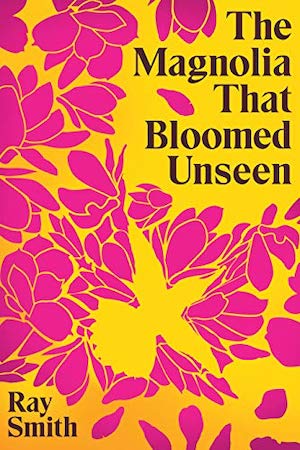
40s: The Magnolia that Bloomed Unseen by Ray Smith

At the age of 48, Molly Valle believes that she will no longer fall under the gaze of male suitors. She is a school teacher and a divorcee, and in her experience, women like herself are not desired by men. She dismisses herself from the dating pool so she wouldn’t have to subject herself to the scorn of men in search of younger women. But then, John Pressman, an ambitious activist, moves into her Mississippi hometown. The two fall in love within the backdrop of the Civil Rights era, finding in each other a certain magic that neither was expecting.

50s: Royal Holiday by Jasmine Guillory

54 year-old Vivian Forest tags along on her daughter’s business trip to England, excited to vacation abroad at the grand royal estate. She unexpectedly meets Malcolm, the Queen’s private secretary, and their attraction to each other is immediate. Their flirting quickly becomes a steamy fling, one that is set to end on New Year’s Day, when Vivian will return home to California. Despite their differences, they find themselves quickly building a deeper relationship than a short trip would ordinarily allow. Royal Holiday is a sweet and lighthearted romance between two mature adults who are in danger of falling into the youthful impulsivity of their heart’s desires.

60s: Major Pettigrew’s Last Stand by Helen Simonson

Retired Major Ernest Pettigrew is a proper English gentleman living in the countryside, unlikely to diverge from the values of duty and decorum that he has lived by throughout his 68 years of life. However, the unexpected death of his brother places 58-year-old Jasmina Ali, a Pakistani bookkeeper, in his path. Mrs. Ali is widowed, a booklover who stands out to the locals with her saris and overall rejection of cultural assimilation. A friendship blooms, but their bond is threatened by disapproving villagers and the ladies who have had the Major in their romantic sights. Major Pettigrew’s Last Stand boldly tackles interracial relationships, and does not sugarcoat England’s colonial past.

70s: Second Wind by Ceillie Simkiss

The book opens with the unexpected death of Martha Appleby’s husband. The 71-year-old books herself a flight to Glasgow, where she plans to scatter her beloved husband’s ashes in his home country from the top of Glasgow Tower. On this flight, she happens to run into Pamela Thornton, a dog trainer and Martha’s childhood sweetheart. They have not seen each other in 50 years, but quickly come to realize that they each still hold a special place in the other’s heart. In one hundred brisk pages, we see Martha and Pamela’s second chance at companionship as they rediscover their love for one another. 

80s: John and Jackie by T.J. Klune

At the age of eighty, it is rare and beautiful to love the person that you met at age twelve. In the last hours of John’s life, he and his husband Jackie recount their 70 years together within five stories, through hardships and happy times. John and Jackie by T.J. Klune is a window into a deep, meaningful, and long lasting relationship between two people who have become each other’s world.

90s: The Switch by Beth O’Leary

Leena Cotton is sick of her fast paced life in London. She is in her twenties, and has already had a nervous breakdown caused by the demands of her career. So, she escapes to her grandmother, Eileen’s, home in the countryside for some rest. Eileen is nearly 90-years-old, and is meeting her ninth decade with vigor and hope for new romance. Yet, she is frustrated in her search for love within the small Yorkshire village’s dating pool. Realizing that their problems may have similar solutions, Eileen proposes to Leena that they swap homes for two months. Leena can relax and find herself in the countryside, while Eileen can mingle among a large pool of interesting Londoners. For the two women in vastly different stages of their lives, their trade is an invaluable learning experience for both of them.

The (Mis)Translation of Filipino History

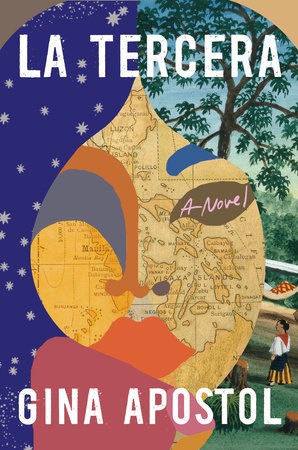
To say that Gina Apostol’s prose is pyrotechnical is to state the obvious: juggling an immense cast of characters, decades of political entanglements, and Apostol’s trademark brand of humor, La Tercera dazzles. I was floored by how the novel somersaulted between multiple languages, the personal and the national, overacted tragedy to heartbreaking history, the U.S. and the Philippines.

In Apostol’s latest book, a grieving diasporic daughter tries to make sense of her mother’s life, as well as a mysterious stack of papers that she has inherited—which seems to tell not just the story of her ancestors, but also a kaleidoscopic narrative of Filipino history. La Tercera nestles text within text, making the reader piece together the fragments of history alongside the narrator.

Alongside childhood anecdotes and laughter, Apostol spoke to me over Zoom about the playfulness of (mis)translation, her aversion to linear historical novels, and the question of complicity.


Jaeyeon Yoo: What was the origin point of La Tercera

Gina Apostol: There seem to be two books in La Tercera, at the very least. So there’s the story of the mother, then there’s the story of the text within the text (within the text!). I foregrounded the mother story, but I had long been writing the background historical story. I liked the historical story, but I needed it to be more charged with something for me. Then, I went home to the Philippines for a book festival. On the plane, I was thinking, “You know, I could really change my novel.” I was already in a type of weird mourning for my mother, because of a comment my sister had made. She said, “You didn’t come home when mommy died.” There was something about going home, and I knew that the story of my mother was somehow related to the work that I was doing. So, I added that pandemic world of grieving. La Tercera became a pandemic novel that became personal, in a way that I actually never do. I don’t consciously put my personal life in my stories. But this one is very conscious; if it was something I could remember, or someone had told me, that seemed to be true—I put it in. I create constraints for myself, in order to get me working; the constraint, in this case, was that it had to be somehow true in some way. I may have remembered wrong, but that’s still my memory. 

The novel ended up trying to think through the relationship between that earlier [Filipino] history and my mom’s ideology, her way of being. Almost all of the storytelling is about grief, but it’s also trying to respond to the question of why: Why do people believe these things—believe in the dictator, believe in state corruption? Why is she so attached to the dictator? Why are we so attached to certain kinds of figures and not others? La Tercera became a historical reckoning that was also a personal one. 

JY: Along those lines, what does meta-fiction and referentiality do for you, as a writer? 

The way we understand our parents is through gaps and holes.

GA: I keep wondering about it myself, to be honest, because it would be much easier to tell the story straight. There might be even more of an impact, if you had a singular dramatic story, like the basic realist storytelling, with limited third, et cetera et cetera. That might be nice. But my problem is, I don’t believe it. I don’t really believe it when I’m doing that story or reading those kinds of stories. So, I’m just going with what makes sense to me, which is that everything that we understand is actually filtered. For me, the referentiality is not about it’s not that kind of postmodern thing. It’s about telling the story in a way that responds to the truth: of how we experience the world, which is through reflexivity and mediation. We’re mediated by our teachers or parents. Obviously, history is hugely mediated, as is power and media—it’s kind of fucked over American history, for instance. And definitely fucked over Philippine history, where we end up honoring our colonizer and forgetting the actual rebel. At the same time, I do believe that, from reflexivity, we can get to a more just way of looking at this history and even a more compassionate way of viewing ourselves. 

JY: Given your aversion to “straight” history, I was fascinated by how you laid out this linear idea of “A, B, and C” throughout (the “tercera” form), yet you break it for yourself. Nothing is ever quite completed in this novel; there’s instead an emphasis on the incomplete—the bricolage, the collage, the archipelago. What does the fragment form mean to you?

GA: The fragment form is put together by what I think of as the issue of translation. The coherence of the fragment form is a theory of translation, nationhood, and identity. But on a very simple level, the fragment form is how I learned about this history: through fragments, through fractures, through a sense of “Why was that guy in Indiana in 1903? It doesn’t make any sense!” It’s also because the fragments of my mom’s story, how I heard her life, was very striking to me. The way we understand our parents is through gaps and holes. It’s very hard; we want them to be a fixed thing, but they’re not. Being a child is always like being in a mystery, if you’re thinking about your relationship to your parents! Especially if your worlds are fractured by different political beliefs. So, the fragments have to do with how I came to understand both the national and personal history. 

JY: I’d love for you to expand on your point about a theory of translation that glues fragmentation together.

GA: Just my own experience, being Filipino, [means] having multiple languages. I was very clear in the novel that a central language is Waray, the language of the mother. At the same time, you have all these other languages. So you’re constantly in the space of being able to switch from one tongue to the next. If I’m thinking about the fragments of the historical texts (within the novel), the only way you could understand why they’re together would be from the recognition that there are multiple languages within it. You’re just bearing the multiplicity. You’re always confronted with it, you’re always with it. Once you understand that this is a translation, that there is another way to read and there’s another language in there—and there are historical and geographical reasons for the multiple languages—the fragmentation and the sense of confusion actually makes sense. 

JY: Right, because confusion is kind of the basic level of being. Translation lets us live with this confusion, I think, without needing it to cohere.

Misreadings are really potent in a colonized history, because the heroes that you love, of course, are the ones actually created by your enemies.

GA: Yes. That ability to sit with it. In terms of colonization, that becomes an interesting thing to bear. Because there’s so much that we’ll be angry and frustrated with—the lack of knowledge and power plays with our sense of identity. But there’s a weird kind of stability once you recognize, “Oh, I don’t understand that. I don’t get it or I misread that.” Because of this condition of translation, you know.

That experience when the narrator can only speak English, not Waray, as a child—I remember being so angry when that happened to me. It was so stupid, I didn’t know my mother’s language. I was truly writing down a list of words, listening, listening, listening [like the narrator]. Then there was that moment: one of the maids and house boys were talking to one another. They were talking about me. They were saying I was a bitch. It was the best. I finally understood Waray. I didn’t put that in the novel, that experience of suddenly understanding, and the great position of being a listener (and they think you don’t understand them). 

JY: It’s an incredible feeling, I agree. Whereas the translator is typically regarded as an “invisible” figure, as Lawrence Venuti theorizes, she is made hyper-visible in your novels. What made you foreground the figure of the translator in this way?

GA: Even to understand the plot, you have to see that the translator is there. For me, the act of writing becomes more interesting when I can figure out there’s a manipulation I need to do for the plot. Discover-discover. [A childhood game that the narrator plays in La Tercera.] Everything is discover-discover in the text. The mother. Discover-discover. The papers. Discover-discover. The translator is the ultimate discover-discover, because they own the text. 

JY: I was struck by how La Tercera placed translation at forefront, yet, but mistranslation was at its core. Like the slip of the tongue between “rebel” and “rebeal” (reveal); there are misspellings, mishearings. 

GA: And there are also misreadings, like the readings that are kind of wrong. That’s not the hero, this is the hero! Misreadings are really potent in a colonized history, because the heroes that you love, of course, are the ones actually created by your enemies.

JY: Connected to mistranslation and “rebel/rebeal,” La Tercera did an incredible job of blurring the line between the rebel and the collaborator. Could you talk more about the relationship between these two, and how they are documented in history?

GA: I’m going to be honest: I am very judgmental. There’s something about me, that’s not even like that will just say, “No, that’s a collaborator. That’s not good.” When you think about history, the ways in which people have to live in that condition of indeterminacy, you don’t know actually what’s going to happen with the revolution that you started. You don’t know actually what it means to side. As a Filipino, I recognize that the history that we’ve been given makes our loyalties so multiple—even from the Marcos years to the revolutionary years. I find collaboration interesting as a writer and, at the same time, I have a sense of compassion for the colonized, which doesn’t happen a lot of times. We tend to judge ourselves for being colonized, but our choices were not necessarily made by us in many ways—it was made through violence, through the hegemonic power of the colonizer, [through] the language of the group that had the guns. I think we need to see that. And if I were going to go with the compassion for the collaborator, it’s good as long as you simultaneously have judgment. It’s hard, with Filipinos. Of course, our heroes are all of the collaborators. They have to be, in order to survive. 

JY: Yes, there’s a lot of internal self-tension built in for the colonized. And we don’t live in a world free of collaboration either. 

GA: Right, we’re complicit with our late capitalist world. How do you live with that, how do you live in it? At the very least, my novel is trying to open up to that very material condition of complicity. 

JY: The complicity question makes me think about your use of mirrors throughout the novel, like the Self-Other complex that you talked about with the mirror neuron syndrome. I’ve never heard of this condition before.

GA: I did that in Insurrecto too, but in a different way, with the double vision. Paul [Nadal] is going to tease me, because he has always said, “Do you know, Gina, there’s always some kind of psychological problem in your books.” This one has the mirror neuron syndrome. There’s something about the organic that I find interesting: the embodied aspect of history. The violence upon the body is being reiterated in whatever psychological condition. In this case, it’s the mirror touch synesthesia problem, when the boy is so engrossed with the other. He can’t separate himself from that other. It’s a problem, and also what happens under the violence of colonization; the violence of that history is that you’re not really clear about why your body responds to whiteness, to Americanness and the Western space. But it’s not actually your fault. The thing about the body is that there’s no blame to it. We tend to blame the victim, but it’s really the structure of imperialism and colonization that is the problem. 

JY: Right? We don’t choose what bodies or genetic conditions we’re born into. Genetic here as not just biological DNA, but also the historical genes—inheriting these histories of violence and imperialism. 

GA: That’s what I’m trying to say: the truth of violence becomes embodied in the psychological condition.

JY: Psychological conditions, and also hairstyles! At one point, you explicitly talk about how “[War] takes a role on your hair”. There are so many great descriptions of hair in La Tercera, especially as types of language and punctuation marks. 

We should remember the people who are fighting for the land, fighting to keep indigenous communities alive. They’re being killed right now.

GA: You know why? The Filipino postcards of women from the ’70s, they’re just amazing. The bouffants of the women are crazy; they’re like commas. I don’t know how they do it, but I really appreciate it. I mean, it’s the problem that the Filipinos have, they really love that era. They still do. They love the glamor—and can I blame them for it? No. I mean, I can. It’s a desire, but I can also reflect back how that desire has been harmful.

For a very long time, I was angry with my mother for loving [Fernando, the dictator], but, at the same time, it makes sense to them. This was a beautiful figure who was theirs, who gave them a sense of power and representation that was really, really damaging. [This type of] simultaneity is constant. I grew up with it. My experience of Filipino culture and history is that it is simultaneous. They’re both crying over something and then it becomes a parody of whatever it is that they’re doing. If you go to a funeral, it’s really tragic—and then they’re playing mahjong at the same time and overacting! OA! It’s everywhere!

JY: We keep coming back to this idea of holding “doubleness” (Self-Other) or simultaneity. Both things are true: you’re genuinely sad and performing the sadness at the same time. I think La Tercera is so good at questioning this binary we’ve set up between the “true” and “false,” “authentic” and “fake.” 

GA: Questioning it, yes, and always recognizing what you have to figure out: when you are being manipulated and being violated. You know, it could be both—you can be violated by the authentic. 

JY: Any last thoughts you’d like to share with your readers?

GA: One thing I was trying to work out [with La Tercera] was that it takes us Filipinos a very long time to figure out who to remember in history. I think that’s sad, especially with the violent history that is present in the Philippines now, there are all these people being killed. What we remember is the name of the Marcoses. We should remember the people who are fighting for the land, fighting to keep indigenous communities alive. They’re being killed right now. That concept of how we remember, and trying to remember better. I actually have cousins, and when I ask them, “Hey, your Lolo was a revolutionary, can you tell me any stories?” They have no stories. He is prominent in the histories I was reading about Leyte. I didn’t know about him and definitely wasn’t taught in school, but even his family didn’t know. That’s the power of genocide, that type of forgetting. It was so violent that you were not allowed to remember. Forgetting is an aspect of genocide. For an American audience, this novel is also their history. They are a part—if I’m going to talk about the complicity and collaboration of the Filipinos, what about the complicity of the Americans in this history they don’t even know?

9 Poetry Collections About Illnesses That We Don’t Talk About

When I was very sick, using the bathroom 17 times a day and buckled over with abdominal pain, I never would have imagined writing a poem about my illness—much less an entire book.

As a teenager I was so embarrassed and afraid of my body that I couldn’t even speak to my closest friends about my Crohn’s disease. I am reminded of this isolation nearly every day as a psychiatrist when I work with patients who struggle to share their experiences of psychosis, suicidality, or dementia with their loved ones. I see the same hushed phenomenon around patients who are approaching death; sometimes even when patients are ready to speak about their imminent passing, their family is unable to receive it. Our suffering is only doubled by this silence. 

In a world designed for healthy bodies and brains, writing my first book of poems felt like a subversive act. Radium Girl explores my experiences surviving both medical illness as a young patient with Crohn’s disease and medical training as a physician. This reading list features other poetry collections that confront difficult-to-discuss medical diagnoses: mental illness, blood-related diseases, and the end of life. I wish I could have shared all of these books with my teenage self.

Black Aperture by Matt Rasmussen 

The poems in Black Aperture are as precise and devastating as the bullets that careen through this book into trees, deer, and ultimately into the head of Rasmussen’s brother, who kills himself when the poet is a teenager. Often language is used to obscure suicide, as in a young person’s obituary who “died unexpectedly.” In this book the suicide of Rasmussen’s brother is a movie he cannot stop replaying, in slow motion and then in fast forward. In “Reverse Suicide” Rasmussen even imagines the event unfolding backwards: “each snowflake stirs before lifting into the sky as I/learn you won’t be dead.” Black Aperture is an accessible collection with short poems in plain language. But its simplicity is shot through with dark humor and surreal metaphors that feel emotionally accurate to the grief, shame, and anger of a loved one left behind. 

BigEyed Afraid by Erica Dawson 

Reading Erica Dawson’s first book of poems is like riding a roller coaster in the dark: we can enjoy the terrifying up-and-down journey knowing we are in good hands and in no real danger. In Big-Eyed Afraid Dawson’s identities as a black woman, daughter, and writer complicate her experiences of bipolar disorder and obsessive-compulsive disorder. Dawson’s mania is mirrored in her frenetic, sensual language; her OCD in the poems’ exacting, repetitive shapes; and her depression in her near-constant ruminations about her own death. “The voice inside my head is talking smack,” she writes in “Bees in the Attic,” before wandering her childhood home, considering the various places she could end her life, but doesn’t. 

Blue Sonoma by Jane Munro 

“He is not a person I knew in life,” writes Jane Munro, describing a man from a dream but also her husband, passing deeper and deeper into Alzheimer’s dementia. In this meditative collection Munro walks the difficult tightrope of honoring and mourning her husband, Robert, as his memory becomes “a sieve.” His illness washes away his understanding of time, his ability to use a phone, and his license to drive—a loss referenced in the book’s title and eponymous first poem, in which Robert crashes his blue Sonoma truck into a guard rail. For all this loss, Munro stuns us with moments of natural beauty and unsentimental intimacy, urging us to remember: “surely, surely, he wasn’t empty of himself. Not yet.” 

We Mad Climb Shaky Ladders by Pamela Spiro Wagner 

Psychosis remains a highly stigmatized illness in part because there are so few stories of people who have experienced it. Paranoia, hallucinations, and disorganized thoughts can destroy our ability to tell a coherent narrative; luckily Pamela Spiro Wagner has given us a window into schizophrenia in We Mad Climb Shaky Ladders. In startlingly honest and clear language Wagner describes paranoia overtaking her as she attempts to grocery shop or play croquet: “I knew then all the sharp vowels of fear.” Each of Wagner’s poems are placed in conversation with commentary by her longtime psychiatrist, with room for Wagner to respond with even further insight and humor (“this poem had nothing whatsoever to do with my own mother”). 

The Hemophiliac’s Motorcycle by Tom Andrews 

Tom Andrews’ life was cut short by complications related to the clotting disorder hemophilia, but not before he managed to publish this brilliant book of poems, race motorcross, and earn a place in the Guinness World Records for clapping for 14 hours and 31 minutes straight—an experience he details in his long poem “Codeine Diary.” Even when Andrews is not speaking directly to his hemophilia, his metaphors do: “The river twisted like a wrist in its socket” and “sparrows clot the fence posts.” The inevitability of another fall, another bleed, another long hospital visit casts a long shadow over Andrew’s collection. Still, he wonders about other possibilities for his life: “Surprise me, Lord,” he writes, “as a seed/surprises itself.” 

Deluge by Leila Chatti 

I bled,” Leila Chatti writes, and “God didn’t want to hear about it.” Neither apparently did Chatti’s doctors, who insist on clarifying her symptoms with her boyfriend before agreeing to admit her to the hospital for heavy uterine bleeding that has gone on for hours. As the book unfolds, Chatti chronologically details the drudgery of clinic waiting rooms, painful gynecological exams, and eventually the surgery that provides her a diagnosis. The individual poems in Deluge are beautiful and smart. But it is Chatti’s exploration of the expectations of women in both medical and religious settings (Chatti is Tunisian American, raised in a Muslim-Catholic household) that makes this book so dazzlingly defiant.

The Tradition by Jericho Brown 

It would be easy to skim the poems in Jericho Brown’s The Tradition and not identify the current of illness running underneath. Brown writes powerfully about the trauma of school shootings, police killings, sexual assault, and living in a Black body. But he waits to speak directly to the trauma of his HIV diagnosis until the latter third of the collection. When Brown embodies the voice of HIV in “The Virus,” he becomes not only the illness attempting to ravage his body but every entity trying to cancel his existence as gay black man. With vulnerability (“Now I worry/No one will ever love me”) and humor (“my man swears his HIV is better than mine”), Brown sets forth a new tradition of survival despite the ways in which our bodies attempt to harm us.

Impossible Bottle by Claudia Emerson 

Dedicated to her beloved husband and the doctors who cared for her, Claudia Emerson’s posthumous collection of poems feels like a gift from the beyond. Written as Emerson is dying of cancer, Impossible Bottle is grounded in the unbearable grief of the present. But Emerson also turns backwards toward her childhood and ahead toward her death, describing with great generosity and imagination a group of medical students dissecting her body in an anatomy lab. In the beautiful series “Infusion Suite,” Emerson faces an endless series of chemotherapy appointments; distracting herself with a round of Scrabble, she surveys the few options that remain both on the gameboard and in her life: “all my words small/but costly, and my accounting of them perfect.”  

Still Life by Jay Hopler 

The day Jay Hopler was diagnosed with metastatic prostate cancer he began writing the poems in Still Life; he died just one week after the book’s publication. In this darkly comic collection, Hopler rehearses his own death. He imagines his students write an obituary in which his name is increasingly misspelled. He bats around a series of titles for a possible memoir (“Nothing Rhymes with Dead: The Jay Hopler Story”). But moments of elegance and anguish break through his self-depreciation, as in the short poem “The Vacation Over”: “see from the train/who remains on the beach playing, bathing in the waves;/is this how it’s going to be/is this how it’s going to be/to leave this life?” 

Booktails from the Potions Library, with Mixologist Lindsay Merbaum

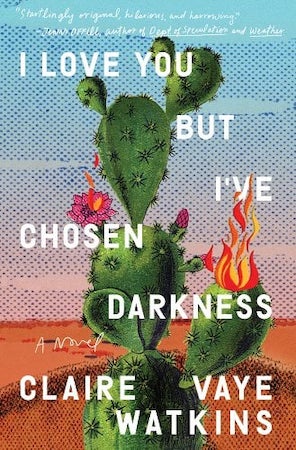
In Claire Vaye Watkins’ novel I Love You But I’ve Chosen Darkness, an author likewise named Claire Vaye Watkins has a new baby, a successful writing career, and a kind husband. She is also desperately and dangerously depressed. When Claire books a speaking engagement in Reno, the visit turns into a reckless, rollicking escape from her life in Michigan: “I am not choosing darkness,” she narrates, “but darkness is choosing me.” As Claire wanders a sometimes literal, sometimes metaphoric desert landscape populated with lovers and ghosts, drugs, living corpses, Bitcoin bros, animals, eccentric artists, and her own infamous father who was part of Manson’s Family, parallels between the dysfunction of the present and past appear. Ultimately, walking away might be Claire’s only path back to herself:  “[…] I like it in the mountains, I like it on the coast. I like it in the wild, and if not the wild then at least near water, at least under a tree, at least smelling of campfire, of whiskey, of weed.” 

A book cover with a cactus in a desert

Given the addictions many characters in this novel face, this booktail is a mocktail, made with tart pomegranate juice for “the pomegranates that remind me of home.” The juice’s color matches the menstrual blood Claire’s mother Martha feeds her garden in Tecopa, where they cultivate grapevines, dates, figs, palms, bamboo, and mint from cuttings. Later, they move in with Martha’s boyfriend in Trout Canyon where there are “wild juniper, cherry and apricot trees, blackberry brambles climbing the chain-link.” For this abundant desert wilderness that provides some of Claire’s earliest homes, the pomegranate juice is mixed with blackberry shrub. The shrub is made with blackberries, white vinegar, agave for the agave plants Martha steals, and lime for the Amy’s brand pad thai, which Claire microwaves in the faculty kitchen at work, while yearning desperately for a rush and reality escape with “her biologist.” The drink is served on the rocks and garnished with mint for the animals, cattails, mint, and aspirin bark living along the Amargosa River. 

This booktail is presented against a bright, cheerfully trippy backdrop that reflects shades of pink and blue. The book and booktail stand in peach and aquamarine sugar sand, amethyst and rose quartz framing the book’s left side for “desert basin splashed with turquoise, aquamarine, smears of amethyst, rose quartz, folds of charcoal and onyx sparkling above dry lake beds of bleached bones dust.” Beside the faceted glass filled with deep red-purple liquid lies a small tooth in honor of the ring of vagina teeth (yes this is a real thing, it’s called vaginal dermoid cysts) Claire cuts after giving birth. 

I LOVE YOU BUT I’VE CHOSEN DARKNESS

Ingredients

  • 3 oz pomegranate 
  • 1 oz blackberry shrub (see recipe)
  • Mint

Instructions

Prepare the shrub in advance. Once ready, fill a rocks glass with ice and add the shrub and juice. Gently stir as needed. Garnish with fresh mint.  

Blackberry Shrub

Ingredients

  • 6 oz ripe blackberries
  • ½ c agave 
  • ¼ c white vinegar
  • Zest and juice of 1 lime 

Instructions

Mash the berries (a fork will work) and stir in the zest, juice, agave, and vinegar. Seal in  a leak-tight container and shake. Let sit for 5 days in the fridge, agitating once per day. Then strain and discard solids. Keep refrigerated. 

I’m a Nonbinary Chinese American Who Co-Parents With My Trans Partner

It was a hot day on our first leg of the journey which would end in the kid switch-off ritual we participated in each summer and winter break. C and M were in the back seat, shoving the cooler back and forth, trying to bother the sibling in the other seat. When we finally pulled into Lake Catherine State Park Campground in Arkansas to end a full day of driving, we rushed to put our swimming gear on and get in the refreshing water. 

A white family was floating on tubes in the water already. I was apprehensive in the way that you are when you occupy a new place and scan the room, checking out the danger meter. I was nervous traveling through rural parts of the South as a queer- and trans mixed-race couple with two kids in tow. I always took note of our surroundings and whether or not we saw anyone else who looked like our kinds of people. 

I often avoided going swimming or to the beach unless I was going to a Trans and Nonbinary Beach Day where I felt safety in numbers. As a parent, though, this swimming hole had been a carrot we’d held out for the car ride. I didn’t want to keep the kids from a swim at the end of a long day of driving.

I made slow and steady moves to get us out of the water because I didn’t want to scare our kids.

I tried not to look at the white family staring at us, thinking that I would mind my own business and keep to our own section of the lake – and hoping they would do the same. But my partner whispered to me: “That man has a swastika tattoo over his heart on his chest,” and I felt my neck muscles, holding all my stress in my body, pulling for the exit. 

I didn’t want to stare, but tried to see out of the corner of my eyes. A large white man and, presumably, his wife stared at us as if we had intruded on their lake. Their kids, carefree, splashed around them. I made slow and steady moves to get us out of the water because I didn’t want to scare our kids. We started moving them towards the lake bank, despite their protests that they had just gotten into the water. I felt the man’s eyes on us as we rinsed off lake grit at the showering station, his gaze following us all the way out of the beach area. I wondered how many other people we would encounter who would wish harm on our family.


I am a nonbinary Chinese American in a relationship with a white trans woman and have been co-parenting my partner’s children since they were 3 and 6 years old. Both children, now 13 and 16 years old, have come out as nonbinary and trans in the last few years. As a new co-parent navigating raising children moving between two households with very different cultural understandings, I first searched for community and cultural resources for trans parents and found little which was helpful or applied to our experience.

I was never sure I wanted to create a child from my body, continue my bloodline, bear a child. I was raised to bear children, but only in proper ways. I have a clear memory of my mother calmly telling me that she would disown me if I ever came home pregnant. As a child, I remember the gossiping of my aunts when my cousin fell in love with a Vietnamese woman (face like a horse!) and my other cousin a model (loose woman!). I rejected the clear trajectory (virgin to wife to mother) when I brought home someone of the wrong race (white, black or Latinx), wrong educational background (community college) or wrong gender (trans). 

I’ve always thought that if I made the decision to parent that I would adopt or foster someone who needed me. In high school, I was horrified to read about Chinese girls abandoned at orphanages by parents who only wanted a son, exacerbated by China’s one-child law – and imagined that if I were to become a parent, I could support someone who had been thrown away by family or society, like an outlaw. 


I wasn’t quite prepared when C (3 years old) and M (6 years old) came into my life. I had never thought I’d be parenting into adulthood what I thought were two white boys, wanting them to be racially sensitive and queer and trans positive.

When I met Cassie, I didn’t expect much either.

In my early 20s, I had a white boyfriend who was obsessed with Japan. I wasn’t Japanese, but I was the closest thing he had in proximity. When we ate using chopsticks, he would tell me what he thought were proper ways to use chopsticks even though I had grown up using them. I never told him that I had grown up listening to the elders in my family express contempt and resentment for the Japanese because of Japan’s invasion of China during World War II. When we split, I vowed to never date a white person ever again and I didn’t for the next twenty years.


I first became aware of Cassie at a local meeting for a support group where we discussed relationships. The meeting took place in an overly crowded room – she heard my voice and my thoughts about gender and relationships and wanted to meet me. I heard others gossiping about her as a trans woman – and knew that I had yet to meet her because I had never before met a trans woman in that very white, heterosexual space.

You never knew who you were going to encounter in the tubs…

We met when I arrived at the tail end of the group’s four-year anniversary party at the local bowling alley/arcade bar. My friend wanted an invite to the underground local hot tub collective, a local word-of-mouth fixture in Milwaukee, where I survived the winter by going for soaks on cold nights. I asked who else wanted to come and Cassie came along. 

You never knew who you were going to encounter in the tubs, but I hadn’t seen anybody at the tubs who was out as trans. It was in the basement of a multi-use building which housed a local yoga studio and across the street from a bookstore. There was a key to open the outer door into a small yard area and a code to enter. There was a hot tub, cold tub, sauna and room off to the side where people stored their belongings. There was a slot in an inner wall for visitors to pay the $5 guest fee. 

Since I didn’t know Cassie well, I just watched and observed both how she was moving in the space and how others in the space reacted to her. She told me about leaving her marriage and I learned that she was newly coming out as trans. She kept her underwear on and kept following me in and out of the hot water. I wasn’t dating white people or interested in getting into serious relationships with them, but I became heated and brash.

‘You like me,” I said flatly. She was a bit flustered, but didn’t deny it. I was toying with the idea of being bossy and in control. It felt important to be the one to set parameters and tone for how we were going to interact.

We started cooking together and sampled grocery stores in lieu of dates as we got to know each other.

I told her to write me a letter that detailed out all her significant relationships with other people of color. I was surprised when a thoughtful and detailed personal letter arrived in my inbox. 

I asked her if she knew who Bayard Rustin was. She didn’t. I proposed seeing Brother Outsider: The Life of Bayard Rustin because I wanted to see how open she’d be at learning about something outside of what she knew. I also wanted to know how she would react to activities centering queer people of color as a white person. She agreed so I kept hanging out with her.


Much of our early relationship was built around first sharing food and then making food. A week after we met, I invited Cassie to an annual dumpling-making party I hosted for my birthday. She was one of the first to show up to help chop vegetables. In the middle of the party, we ran out of dumpling wrappers and she ran out to acquire them. At one moment in the midst of chaos, I looked over and saw Cassie happily chatting away with someone she had just met, engrossed in conversation like the rest of the room. She looked like she belonged in the stream of my multiple networks of acquaintances, friends and housemates.
When my housemate decided to celebrate her birthday (and entryway into cronehood) by shaving her head down to the nub, she threw a party where she asked a few of us to shave our heads in solidarity, including me. I didn’t invite Cassie to that gathering because it felt intimate and I wasn’t sure how she would react to such a ritual. In the middle of that party though, Cassie dropped by because she had brought me goat milk in courtship. I stored the goat milk in our fridge and took small sips throughout the week, savoring the fresh milk. 

When I was sick, as an act of care, she brought me three different kinds of cough drops because she didn’t know what I liked. We started cooking together and sampled grocery stores in lieu of dates as we got to know each other. Going to the grocery store became a ritual we shared together. 

Cassie and I slowly progressed to sharing more and more of our dinner table, which included C and M when they were in Cassie’s care. 

The first night I met Cassie’s two kids, C and M, she had them for the night so she invited me over to her place. I hadn’t had too many kids in my life except cousins and my little brother so I was nervous about what to expect. It was late and the kids were in bed. We had just gone back to Cassie’s place to make out on the couch and snuggle because it was convenient. We were still on the couch when M woke up upset about something. I wondered if I was supposed to be there. Cassie held M with her full body as M tantrumed, struggling to hit something. I wondered what I had gotten myself into.


One of the first things I noticed was the food. C and M both wanted Mac and Cheese, pizza, hot dogs or hamburgers and not much else. They were picky about food and I was too.

When Cassie and I introduced the kids to stirfry or other food that they were not used to, they often rejected what was on the menu. They would beg and moan for something else even after the thank you helping that was customary and inherited from Cassie’s ex’s family that became a practice adopted for the kids – to respect the person who made the meal.


I grew up in a Chinese American immigrant family where much of the care in our family was expressed with food. My favorite meals were dumplings and hotpot — meals that everyone made together. We ate family style – sharing several different kinds of dishes in the center of the table.

Growing up, my mother made the majority of our family meals. I was used to eating what was placed in front of us. Though I had preferences, I cannot imagine wholesale rejecting what was placed in front of me and demanding something else from her.

Cassie’s kids would scream ‘Daddy’ in crowded public spaces…

M had a distaste for family-style meals, always preferring individualized meals. In the early days of living together, we often accommodated C and M’s demands. It created a situation where two separate meals were prepared and eaten and highlighted the differences in the kinds of food that the kids were used to and the kinds of food that Cassie and I made together as part of our relationship. When we went out to eat as a family, Cassie and I often ordered family-style over M’s objections.

I viewed C and M’s reactions as a white, privileged way to approach food and meal-making, often making meal times feel like a tense showdown. I worried that I wouldn’t be on the same page as Cassie because I hadn’t been there in the very beginning years. I also didn’t want to complicate her relationship with the kids.

Cassie eventually agreed with me that she catered to the children out of a sense of guilt. She also told me that there might be other reasons for M’s orientation around food. I slowly learned that M’s autism made her extremely sensitive to textures in food and grass and that she would hyperfocus on that to the exclusion of everything else. 


We were navigating our relationship as a newly out trans woman and a nonbinary person. Cassie’s kids would scream “Daddy” in crowded public spaces and we would worry about what would happen if strangers objected to our presence in the space. We tried to warn them that there might be people who would judge and try to hurt us because they didn’t understand us (and Cassie being especially vulnerable as a trans woman).

Neither of us had any models of what a family like ours could look like and didn’t know of any other families, even in the queer and trans support groups we belonged to. Many of those who came didn’t have children and the ones who did had often come out much older. There didn’t seem to be any others who had young children shared across multiple households. 

I looked up kids’ books that included trans protagonists and/or families. There wasn’t a lot out there, but I tried to get my hold on everything published and we started reading together. We wanted to show them that there were other models out there other than families with a heteronormative father and mother. We didn’t find too much that we loved (some were okay representationally speaking but lacked in terms of storytelling, and others had the opposite problem), but at least there was a place we could start together. 

We chose to read as much as we could so that there could be a variety of representation – from books spotlighting gender creative kids to even rarer books which featured a trans parent. We also read books featuring kids of other kinds of queer families such as families with two moms or two dads or even queer penguins. I worried that the kids would rebel against what we were trying to teach them – to be gender-inclusive and to understand that there were many different ways of making and being family – and ours was just one of the variations.


When I got a new job in Texas, I asked Cassie to move with me – and she made the challenging decision to leave her kids behind. By that time, we had switched to seeing them every other weekend and sometimes longer on breaks. Once we moved to Texas, we saw them for part of their winter break and part of their summer break – with long stretches of time when we were not able to see them. We became the traveling, queer and trans, mixed-race family – often driving across the country to pick them up and drop them back – and their other family was the white and straight suburban family who had them during most of the school year. 

HERO’s defeat confirmed that there were many in the area who saw trans people as not deserving of protection…

We had to navigate transphobic and sexist expectations of Cassie as a “father” because Cassie was the one who had always worked outside the home to support her family. Even when her job proved to be too stressful, causing debilitating bouts of anxiety, and she chose to move with me to Texas, she was stuck in the childcare agreement that she had made based on the snapshot of her life from the time when she had separated from her ex. This arrangement was then reinforced by the state regarding when we were allowed to have time with the kids and the level of support that Cassie was expected to give to her ex.
We learned about the transition period between households and how that would impact the kids – when we were in the same city and switching five days on and five days off, it would get hard in transition days leading up to switching households with more tantrums and mood swings. The same happened on a different scale in the week which led to the switch.

It was also an intense transition for us – from no kids to full-on parenting with no ramp-up. Because months passed since the time we had seen them in person, it also felt like we were getting acquainted again.


Until recently, we were an always migrating household – moving for jobs and circumstance — and the children were constantly migrating back and forth between different households. This made it challenging for them to make friends with others their own age. We became our own little insular household when the kids were with us.

When we first moved to Houston, the Hero Equal Rights Ordinance (HERO) campaign to pass HERO, an ordnance which would ban discrimination on sexual orientation, gender identity, sex, race, color, ethnicity, national origin, age, religion, disability, pregnancy, genetic information, family, marital or military status, was underway. As has happened before, the anti-HERO campaign used trans women as the focal point around whom to organize, increasing fear. 

Traveling between Houston and Huntsville, where I worked and Cassie attended school, felt like shuttling between two different universes. Houston was a large city which felt very international, where we weren’t the only mixed-race couple and often weren’t the only queer and trans people around. In contrast, Huntsville was a small city which ran on the prison system which dominated the city. However, HERO’s defeat confirmed that there were many in the area who saw trans people as not deserving of protection – and it increased my sense of foreboding that harm was coming to us.  

I wondered how her larger extended family would receive the information…

When I agreed to teach a Honors-level Black Lives Matter class with two other queer colleagues, a false news article was published in the conservative news about how the Honors College was pressuring students to take a politicized class on the Black Lives Matter movement. I got a voicemail on my office phone offering de-transition support from my sinful lifestyle. We all got hostile emails telling us that the sender hoped we would lose all our funding, as we deserved. 

I was navigating being an out trans-identified faculty member on a campus where the LGBT group was semi-closeted and where I seemed to be the first trans/non-binary faculty member (and person) many of my students had ever met. I was often thankful that the kids were with us in summertime or winter break when we had more breathing room. Even though I loved the culture and big sun of Houston, I started making plans to escape to a place where I didn’t feel an impending sense of disaster and doom, which ultimately ended up with moving to the Pacific Northwest.


As we entered the tween years, our household was rocked by big emotional mood swings when the kids were with us. Each day, I would ask C and M to walk with me to get exercise and food in the neighborhood. Early in the summer, we caught C sneaking sugar in the form of a bag of Dum-Dums, which continued throughout the whole summer. Cassie had bought and put up a yoga body sling in the doorway and C started hiding out in it. We noticed that C often couldn’t answer our questions about what was going on and couldn’t tell us what they needed and often withdrew from family conversation or interaction. 

The next summer, Cassie got a new job and I became the one who spent time during the daytime with C and M at home. That summer, M spent much of the time in her room sleeping or with the door closed. When I asked M about how she was doing, she admitted to me that she was depressed. C spent much of the summer in their room and wouldn’t eat. I started asking C and M to help out with household chores – to get them circulating in the house and to encourage them to get vertical and off their screens. All they wanted to do was hide out in their rooms and play Minecraft.


At the end of the summer, right after she said goodbye to us, M released a video of her playing Minecraft, with the main character ripping up floorboards at the end of the quest to reveal a trans flag. I wondered how her larger extended family would receive the information since Cassie had not been supported in her gender transition. I was pleasantly surprised to hear that M received a lot of support and care. A few days later, we heard that M had chosen a new name for herself – Myra. 

Myra’s coming out as a trans girl (and later Clover coming out as nonbinary a year later) forced me to re-calibrate my sense of the family that I was in since all of us now identified as trans and non-binary.

I worry about how she will do on her own without knowing anybody first.

Looking back, we had often referred to both kids as a collective: “the boys.” We asked them to use the boys or men’s restroom and assumed that they were male. Even though we were both trans, we didn’t give space for them to choose how they wanted to identify and present to the world. I was so concerned to make sure they knew how to address Cassie properly as a trans woman and understand what it was like to be the kid of a trans woman – and secondarily, that they knew that I was genderqueer and nonbinary – that I didn’t consider the possibility that they were trans and nonbinary themselves.

The kids reminded me of how binary my worldview still was regarding gender. Myra, for instance, grumbled about how we would say “Good girl” to our dog Pepper and “Good boy” to our dog Benny. “Why can’t you just say Good dogs?,” she grumbled. And we had persistently gendered her as male without giving space for her to choose, until she told us otherwise, despite both of us identifying as trans.


Another hot summer day. We’re nearing the end of C and M’s time in the Pacific Northwest. I’m in the car on parent duty, Myra in the front seat and Clover in the back seat. It’s the first summer that Myra has lived with us since coming out and she’s beginning to shine. Cassie recently took her thrift shopping for her birthday. She modeled the clothes in the living room, twirling around and smiling. Now she’s wearing one of her thrifted skirts paired with black combat boots, ready for the LGBTQIA* youth social. 

I wonder what my life would have been like if I had attended an event like this as a young person. Cassie and I talk about what we want this next generation to experience that we didn’t.

In the parking lot of the zoo, we see a line of young people queued up to enter the zoo. Many of them look like they’re already friends or have come together and I worry about how she will do on her own without knowing anybody first. It hasn’t always been easy to make lasting connections with other kids their age because they move between two households and we are  often moving. 

“Make sure your phone is fully charged and call me if you need to be picked up,” I say. Or rescued, I think. “Actually, make sure that you write down our phone numbers somewhere in case you phone dies.” 

Myra rolls her eyes and grumbles – a hint of that old contrarian gritting her teeth at the dinner table – but does what I say and copies down my number.

It is hard not to worry about what impact it would have if Myra is denied access to trans-competent health care…

I ask Clover what they want for dinner and we decide on burgers. When we first drive off, I’m alert for any notification that Myra needs to be picked up and is not having a good time. I remember my own awkward pre-teen and teen years where I felt excluded and ostracized socially and hid in the band locker during lunch so I wouldn’t have to publicly eat my lunch alone. But she doesn’t call. Clover and I eat our burgers in the car while watching the locals order shakes, burgers and fries in summer heat at Dick’s Drive-In. We’re not staring at them the way we were stared at in Arkansas six years earlier and they don’t pay us any mind. Instead, we’re enjoying the summer air through the open windows and just spending time together.

We finally get a call that Myra is ready to be picked up.

“So, how was it? Did you have fun and meet anyone cool?” I prompt.

“Yes, I made a friend!,” Myra says. I see a hint of jealousy from Clover that they aren’t yet old enough to attend the social.

I feel relief and excitement for Myra about the possibility of growing a new friendship and Clover who can attend the social the following year. 


It is hard not to worry about how the kids will navigate this world which increasingly targets them. It is hard not to worry about what impact it would have if Myra is denied access to trans-competent health care or the ability to use the bathroom she chooses in school. It is hard not to worry about the high rate of teen trans suicides or the battle for trans youth and their families to be treated with dignity and respect. 

A few weeks ago, Clover decided to move across the country to live with us full-time. I felt proud of them for deciding that they wanted something different in their life, naming what they needed and working to make that vision materialize. I remember that this is how trans people have always survived. We take care of each other. We build our own networks of support. We choose our own family and kin.


Notes: C/Clover and M/Myra are pseudonyms. I first met C/Clover when they were 3 years old. They changed their name in the last year to reflect their gender identity. I refer to Clover as they/them to reflect their pronouns at the time of this publication.

I first met M/Myra when she was 6 years old. She changed her name in the last year to reflect her gender identity. I refer to Myra as she/her to reflect her pronouns at the time of this publication.

8 Books Set in Hawai’i by Local Authors

Hawai’i has served as a backdrop to many a romance, comedy, and even a few thrillers, but most of these stories depict Hawai’i as a brief pit stop: a beachy honeymoon for an adventurous couple, or an instagrammable hotspot for some soul-searching college grad to eat-pray-love. It’s harder to find the local voices of Hawai’i—authors who have lived on the islands for some time and know both the stunning and harsher faces of their home. The following are novels, short stories and poetry collections set in Hawai’i and written by local authors. 

Remembering Our Intimacies: Mo’olelo, Aloha ‘Aina Ea by Jamaica Heolimeleikalani Osorio

Jamaica Heolimeleikalani Osorio’s poetry collection takes commonly misinterpreted terms, such as aloha ‘aina, and strips them of their colonial shadows, recentering them in a personal, Native narrative. Colonialism is not forgotten, but neither are the traditions and history of the Hawaiian people. Poems recall Hawaiian wisdom, queer theory, and feminism which existed in the land long before colonial occupation. Remembering Our Intimacies is an act of recovery, recontextualizing, and, of course, remembering. 

Local by Jessica Machado

Lilo & Stitch has all but beaten “‘ohana means family” into the backs of our skulls, lending us a glorified, warm picture of Hawaiian families, but the reality is, sometimes family gets left behind. Jessica Machado’s Local contends with the author’s difficult relationships with her parents from her childhood in Honolulu to her adulthood in Los Angeles. Though she hoped to leave her family behind, Machado’s dying mother eventually follows her to LA, where Machado is involved with her mother’s healthcare until her mother’s death. In the face of her loneliness and trauma, Machado spirals. Both a personal, vulnerable narrative and a carefully researched exploration into Hawaiian history, Local is a stunning memoir on leaving home and re-finding it. 

Nuclear Family by Joseph Han

Set in Hawai’i, 2018 in the months leading up to the false nuclear missile alarm, “Nuclear Family” follows Mr. and Mrs. Cho, a Korean couple who run a successful plate-lunch restaurant. After a visit from Guy Fieri, the couple’s dream of franchising their restaurant seems more attainable than ever, until they receive news that their son Jacob, an English teacher in South Korea, has attempted to cross the demilitarized zone. What follows is a bizarre, ghostly tale of generational trauma, as Jacob’s grandfather possesses Jacob’s body to find his lost family back in North Korea. 

Hula by Jasmin Iolani Hakes

When Laka Naupaka, a former Miss Aloha Hula, returns to Hilo with her white-skinned, red haired daughter Hi’i, Laka’s mother Hulali disowns her. Caught in the rifts of her family, Hi’i begins to practice hula, with the hopes that if she dances until her bones ache, then she can mend the scars of her family. But the Naupaka family trauma goes back farther than Hi’i realizes, all the way to the 1880s, when Hawai’i was forcibly taken from King Kalākaua and given to the United States. Hi’i’s great grandmother Ulu watched as countless families were evicted, and her protective anger has since passed down to her children and grandchildren. Hula is a multigenerational story about hidden history and family trauma. 

Sharks in the Time of Saviors by Kawai Strong Washburn

Kawai Strong Washburn’s debut contemplates the consequences of miracles. The novel begins with Nainoa Flores falling off a cruise ship during a family vacation, only to be saved by a group of sharks. Since the incident, Nainoa has been gifted otherworldly powers, including the ability to heal with his touch. For the Flores family, Nainoa’s powers are both a source of wonder and income–and eventually, strife. Years later in Portland, Oregon, Nainoa struggles to understand the full extent of his powers; brother Dean who has always been overshadowed by Nainoa chases fame in athletics; sister Kaui burdens herself with insurmountable academic work in order to forge her own name independent from the family. Only when supernatural events strike again does the Flores family finally confront the burden of their miracle. 

Every Drop Is a Man’s Nightmare by Megan Kamalei Kakimoto

In Megan Kamalei Kakimoto’s debut short story collection, superstitions come alive and turn into truths. Night Marchers wander the lands. Pele’s wrath is not to be trifled with. Characters refuse to whistle at night and do not sleep with their toes pointed towards the door. Though the ghosts of colonialism haunt the land, the cast of women in Kakimoto’s stories survive and thrive on generations of shared wisdom.

This is Paradise by Kristiana Kahakauwila

Kristiana Kahakauwila’s short story collection This is Paradise has become something of a classic in Hawaiian literature. The stories trespass the lush, polite images of postcard photos and delve into the true beauty and brutality of modern Hawai’i. In “Wanle,” a young woman attempts to avenge her late father via cockfighting. “The Old Paniolo Way” follows a gay man who falls for his dying father’s hospice nurse. Of the six stories, only the titular story, “This is Paradise,” puts tourism front and center, but even then, the story is narrated by locals under the collective “we.” Kahakauwila’s This is Paradise confronts the relationship between tourist and local and recalls our common desire to call some place home. 

Shark Dialogues by Kiana Davenport

In 1834, a New York sailor falls in love with a runaway Tahitian princess, thus kickstarting a multi-generational narrative spanning more than a century. At the center of this story is Pono, a seer who wakes from a shark dream to see her future husband Duke riding the surf. Together, Pono and Duke have four daughters, who grow to have daughters of their own. Years later, the grand daughters meet in Pono’s home with the hopes of unraveling their complicated ancestries. Shark Dialogues offers deep, personal insight into Hawaiian history and stands as one of the first novels to do it so beautifully.

My Boredom Has a Fish Mouth

The Perimeter

My excitement hurts, my daughter sulks
at Columcille Megalith Park, where stones stack
on stones upon a great big stone circling
the sun. It’s mid-July, muggy, and my excitement
hurts too, though somewhere along the line
I lost the right to say so. Or the nerve. Or the family
we’ve traveled with are too damn nice and who are we
to knock anyone’s excitement with glazed over
eyeballs, our disinterest in rocks? Instead I tug
my kid to a nearby pond where sorbet-colored koi
curl the perimeter. I once heard koi can live
for two centuries, and so imagine their excitement
must be hurting about now. Then suddenly,
amid the heat and koi and our friends snapping selfies
between some basic-looking archways, my daughter
starts singing. I mean really singing, at the top
of her lungs. All the trees seem to steady
in Bangor, Pennsylvania, until I can feel the soft arc
of our planet in orbit, and dark space like muscle
behind the sky’s blue face. And it’s true, experience
can be so peculiar—the way it rises like a fish
in still waters, its alien lips agape, gasping
at the air. And here I am, beside myself, gasping.

All This Gold

Do not confuse what is valuable with what is sought after — a fortune cookie fortune

Do not confuse public with pubic
like my comp student did
in her otherwise strong essay
which argued for
“more security cameras
in pubic spaces.” And do not confuse
allergic with addicted, like I did
soon after my throat swelled shut.
ADDICTED TO PENICILLIN! I wrote
then displayed in the window
of my chain-wallet
till a baffled grocery clerk clued
me in. I am not above
confusing pity for affection,
affection for love. I’ve mixed impulse
and free will like gin and tonics—
mistaken my tolerance
for what others can’t bear. Oops,
I heard somewhere
should be the anthem
of our age. Oops, like a chorus
of misdirected rage over the pinging
bass line of an errant text.
Bless us. Or don’t. But rest assured
there is value in our hapless
seeking: in every trap door and aimless
detour and in the moment
before the moment
the solarium goes boom, a bridge
gives way, and the ground
far below looks like a painting
my son made and called—
“All this gold and then
a little bit of blue.”

If You Want to Change Your Life, Start by Changing Your Outfit

The pattern first appeared to me in the school uniforms of my cousins: crisp, clean lines of navy and evergreen intersecting at perfect right angles. These uniforms, like everything else about my cousins’ lives, I envied desperately. First and foremost, I envied the fact that there were three of them and only one of me, my parents’ boring prized jewel. Furthermore, the cousins had a rotating cast of nannies that their parents—busy with a secret-clearance government job, the Army Reserve, and law school—found by posting ads at the local laundromat. The nannies never lasted long, and my three cousins once outsmarted the worst one, an old German woman named Ana, with an elaborate ruse to lock her out of their house.

Onlookers might have found it sad, but I found it fascinating: how utterly Dickensian my cousins’ childhoods were. Their lives under the reign of these strange babysitters reminded me of my favorite child protagonists, like orphan Annie or Matilda. How magnificent to be united against a terrible adult! I spent as much time at their house as my parents would allow.

When they returned home from school at 3:30 PM, they ran upstairs to their rooms. Which room belonged to whom and which siblings had to share was constantly up for debate and it seemed to fluctuate monthly. They shed their uniforms for the T-shirts and jeans they’d been aching to wear all day—regular clothes, boring clothes, clothes I could wear whenever I wanted. Their shirts and pants and jumpers lay crumpled on the floor, the patterns no less stately, zigzags still elegant in their dormancy.

I wanted to be them. I wanted the uniform.

I wanted to be them. I wanted the uniform. But the closest I ever came was a hand-me-down from my oldest girl cousin. It was a white and light blue check button-down dress with a tie waist, a cast-off from her regular wardrobe. If anything, it looked more grunge-inspired than school uniform—after all, it was 1995. But still, it was the best I could do. With no authority figure forcing me to wear it every day, I still put it on as often as I could. At least once a week, I arrived at my public elementary school in clean, intersecting lines: my own personal uniform.


Most people can vaguely identify plaid as originating from Scottish tartans, but I was surprised to find out that the pattern is over three thousand years old. The earliest example was found with human remains in a desert in China, though DNA tests later confirmed the man’s Scottish heritage. Researchers have also discovered that tartans were historically used to identify one’s hometown. Similar to the way my cousins might spot their classmates out and about after school by their uniforms, Scots strategically wore plaid patterns to indicate their region. Weavers used the local vegetable dyes available to them, and in remote parts of Scotland, most residents went to the same weaver. Dark threads dyed with regional tree bark could intersect lighter threads tinged with regional berries, creating a truly unique and local fabric.

With modern synthetic dyes offering infinite color permutations, a plaid pattern can be designed with extreme specificity. To this day, Scottish tartans are recognized as family symbols, and, for a price, anyone can register their pattern with the Scottish Register of Tartans. Doing so confirms that a tartan meets the criteria outlined in the Scottish Register of Tartans Act of 2008, and it provides evidence of the creation and date of the design. It also prevents future applicants from registering the design as their own. Beyond that, it’s mostly a symbolic practice—it does not trigger copyright protection, and a person cannot sue a clothing company for using their registered plaid design. Even so, I deeply understand its appeal. It can feel amazing to belong to something. And if there isn’t already a space where you belong, £70 doesn’t seem that steep for a pattern you can call your own.


As I got older, I grew to respect plaid not just for its connection to my cousins, but for its timelessness and ubiquity. In a divided world, it seemed a uniting force. At my high school, the punk rockers often showed up in plaid skirts or pants with Converse All-Stars. They sported Easter-egg-colored hair, stuck rows of safety pins through the straps of their backpacks, and seemed to have an endless supply of red and black plaid. Vivienne Westwood, who died in December 2022 at eighty-one, is often credited with the association of plaid with punk rock. She and her husband Malcolm McLaren outfitted Johnny Rotten of the Sex Pistols, and their shop in London (at one point called SEX) was a known hangout for many of the British punk movement greats. Taking the revered tartan and shredding it, ripping it, doing something “punk rock” to it, was an obvious middle finger to the establishment. When the Sex Pistols’ “God Save the Queen” was banned from British radio, Westwood’s status as a punk icon only ascended further. I didn’t know any of this back in high school, and I don’t think the punk kids did either—but a lot of them nonetheless wore Sex Pistols T-shirts because whether you knew the history or not, sex was a fun thing to invoke at school. It implied you were having it. (I wasn’t.)

On the other hand, my preppy classmates were equally inspired by their own plaid-clad glamor icons. They wore it as long-sleeve button-downs from Abercrombie and American Eagle, no doubt finding confidence in the pattern after watching Clueless with their older sisters. Cher and Dionne look unstoppable in their matching plaid sets, even with mundane lockers and mundane people behind them. 

While I wasn’t friendless, I didn’t fit in—but plaid did. And with its help, I eventually figured out I didn’t need to.

As for me, I felt confused by the social hierarchy of my high school. I was too much of a try-hard to be punk and too eccentric to be popular. The preppy kids were nice to my face but laughed at me behind my back. The punk kids, who I earnestly admired, laughed at me (to my face) and called me a poser. While I wasn’t friendless, I didn’t fit in—but plaid did. And, with its help, I eventually figured out I didn’t need to. By living in neither world, I could live in both.

My sophomore year, I went to the thrift store and purchased three old-school wool skirts. They looked similar and they were all my size, so it’s likely that they all came from the same (possibly deceased) person. My favorite featured a turquoise, black, and navy plaid pattern. Though it was decades old, I felt timeless and powerful in it. I could be disliked, I could be taken unseriously, but I simply could not be fucked with when I was in plaid.

By my junior year, despite my parents’ wishes, I had declared myself a writer and signed up for all of the writing electives, including journalism. The week before school started, I found a black-and white-houndstooth blazer at the mall and thought: this is it. This is the blazer I would wear to smile at adults and get an A, but then turn my back and write a story that upended everything. Full now of blazered confidence, I set out to do just that.


There is, in fact, some science behind the way I felt in high school. In 2015, a research paper in Social Psychological and Personality Science revealed a real connection between “dressing for success” and performance on cognitive tests. In studies, participants who wore formal clothing exhibited advanced processing skills, which researchers attributed to “felt power”—i.e., the well-dressed superstars felt powerful in their outfits. More humorously, in an earlier study called “The Swimsuit Becomes Us All,” people performed worse, across the board, on math tests while wearing a swimsuit than while wearing a sweater. The alternative to my blazer certainly wasn’t anything like a swimsuit. But still, I saw plaid as an alternative to vulnerable objectification. I was covered up and protected in plaid armor. Instead of curves, I projected myself to the world in straight lines and right angles. 

Dressing the part, I actually began to feel smarter. In the spring of my junior year, I tagged along with friends on their college visits. One school—an enthusiastic favorite of my parents and school counselor for its attainability (given my modest test scores)—boasted about its cutting-edge technology as I sat in a computer chair in a decidedly twenty-first-century room. Out on the lawn, the unofficial uniform seemed to be black North Face jackets, jeans, and Ugg boots. Girls tucked their straightened hair behind their ears, and checked their reflections in brand-new buildings with floor-to-ceiling windows.

“Yeah, no,” I thought, praying my writing sample would somehow make up for what my SAT lacked. I wanted old. I wanted historic. I wanted my professor to be a guy on his deathbed with patches on his elbows, and I didn’t want him to know how to email. I wanted to read something and write all over the margins, clad in my studious plaid. I wanted to fall in love with someone’s brain. I didn’t care if my college lover was ugly. In fact, it would be better if they were.

What I wanted was to go to the most revered public school in my state, the one referred to as a “public Ivy,” the most college-y college my family could afford. And by some sort of divine intervention, I was accepted.

The school was founded by a Founding Father, and, at my orientation, students and faculty referred to him frequently in conversation with a cutesy nickname, like he was an old friend. I was full of outsized expectations. I made a playlist called “collegiate,” and it was as lush as a quad lawn (and as stuffy as a columned portico). Against a soundtrack of Ben Folds Five’s “Philosophy” and Death Cab for Cutie’s “Scientist Studies,” I packed my trio of plaid wool skirts and a black and turquoise herringbone coat. When I closed my eyes, I saw myself as stately, like a senator. Future me was thumbing through a centuries-old book for textual evidence and raising her hand at exactly the right time. 

Unsurprisingly, I was about to be knocked on my ass.


At Commencement, the Dean of Students proudly declared that our first-year class had a record number of perfect 1600s. I looked around and tried to find these perfect people, but all I saw were Rainbow flip flops. It didn’t matter, though. The perfect scorers presented themselves to me one by one over the next four years, pretending their 1600s were an embarrassing secret while casually working it into conversation.

Every single person I met seemed to not only be smarter than me, but also to take college more seriously than me. I started pulling all-nighters in the library just because it was what all my friends were doing. I spent all of my Flex Dollars on saccharine cans of Starbucks Doubleshots. My ugly lover was nowhere to be found. My dreams of chatting on the quad about philosophy disappeared in the smoke of references I didn’t get and vocabulary I didn’t know. But people did seem to appreciate one thing about me: I was always down for a party.

The college me wasn’t the plaid-infused sophisticate I had imagined, but she was my best option at the time, so I embraced her. “Who wants to go out?” I’d say, popping my head into my suitemate’s rooms on a Thursday. I was extremely persistent in my pursuit of partying. I’d troll random strangers’ Facebook events and wander around fratty neighborhoods until I heard music. If there was a place in town where people were sitting outside on a dirty couch drinking Natty Light, I was there.

In my new setting, my precious high-waisted plaid skirt just didn’t feel like my style anymore. I cut off the top and gave it a lower waist, folding it over and hemming it into a miniskirt. With a small strip of leftover fabric, I made an asymmetrical epaulet across the top, traversing my hip line, and fastened it with a big wooden button. It was my fantasy collegiate experience repurposed to fit reality. I wore it with a sheer black off-the-shoulder top, hot pink bra straps showing. Tall black boots with buckles and a side ponytail completed my look. When I walked into rooms, I heard The Strokes’ Julian Casablancas singing: “Tell us a story, I know you’re not boring.”

The pattern I had looked to for strength and confidence as a child had become something else entirely.

I had come a long way from where it all started. The pattern I had looked to for strength and confidence as a child had become something else entirely. But in its own way, plaid continued to instill confidence. On a loom of inferiority, I still found a way to weave an unapologetic version of myself. I’ll always picture college me with a hand on her plaid-covered hip, head cocked to the side as some supposed genius flirted with me and my group of friends.

But even with my newfound miniskirted bravado, imposter syndrome weighed heavily in the back of my mind. As I leaned cooly on the edge of beer pong tables, I still feared someone from my past would expose me at any minute as a fraudulent loser. Exactly eight other kids from my high school attended my college, and I avoided them all like an 8 AM class. At one point, against my will, an almost-valedictorian who proudly broke curves back in our AP days ended up at a house party I was hosting. He raided our top drawer for aluminum foil, which he fashioned around his front teeth in the style of Lil Wayne. In retrospect, he was probably worried about the same exact thing I was, and I granted him no mercy. As soon as he left, I delighted in telling my housemates that he was the biggest dork in my graduating class.

Over time, my nighttime persona began to inform my daytime one as well. None of it went the way I’d expected, but with each passing semester, I understood my worth a little better. A 1600 showed the potential of a sixteen-year-old, but then what? There were other things I had to offer this world. Better things. I could raise my hand without fear and articulate a point more clearly than anyone in the room. In group projects, I was always the one with a plan. More intelligent people could wax poetic about a topic, but they often never did anything beyond that. I could concede that I didn’t know everything—it was the ability to lead, follow through, and finish that helped my professors view me as a strong thread, a standout thread, someone preventing the class from unraveling.

By junior year, the stack of books on my desk grew taller, sticky notes protruding from the sides. My favorite thing about the English building became the circle of smokers gathered outside it, freezing in their flannels, desperately inhaling toxic fumes. Their self-seriousness was something I relished. These were my people. We read and wrote and revised until we tore our hair out. We did it in our signature plaid. Inside that building, we intersected for a moment in time, weaving an earnest new pattern before going our separate ways.


We intersected for a moment in time, weaving an earnest new pattern before going our separate ways.

My childhood dreams of private school never came to fruition, but when I was twenty-two, I finally did enter those halls I’d spent so long imagining—as a teacher. I was aware of how absurdly young I looked, and even though I was teaching English to small classes of supposedly well-mannered twelve-year-olds, I feared they’d chew me up and spit me out. Still, I arrived on the first day of my first-ever teaching gig armed with a new haircut and a buffalo check button-down dress. The moment was immortalized in the staff ID hanging around my neck, the plastic still fresh and shiny from the printer.

In four lines of four, the uniformed students sat up straight, not only wearing plaid but for the moment, being plaid. I looked out my new classroom window into a beautiful courtyard, at once catching my reflection and my breath.

The intersecting lines of my dress gave me an orderly sense of calm. It was strong enough that when I said “Hello students, I’m your new English teacher,” I believed it.

There’s More Than One Kind of Loneliness

A profound and deeply funny examination of loneliness in many of its forms—romantic, familial, artistic—Courtney Sender’s book, In Other Lifetimes All I’ve Lost Comes Back to Me, explores feminist millennial rage and the ways the trauma of the Holocaust has been passed-down through Jewish American families. Sender’s debut collection of linked short stories uses magic, myth, and divine intervention as well as a sophisticated three-part structure to create the sense of a narrative more unified than a classic short story collection often achieves. 

I spoke with Courtney Sender in person on an unseasonably warm spring day in a classroom at Connecticut College, where Sender is Visiting Assistant Professor of Fiction. We discussed the role of the spiritual in fiction, how story collections might do better justice to the knotted experience of being lonely in love than a novel, and how making a reader laugh creates an embodied response that’s essential to the impact of the sad things that come next.


Emma Copley Eisenberg: Tell me about longing and return in this book.

Courtney Sender: Most of the stories in the first half of the book have some kind of sequel or match in the second, I was in a place in my life where I had experienced some longed-for returns. The book’s title breaks into three parts, which are kind of the three parts of the book and the three themes of the books. So it’s the “in other lifetime,” the “all I’ve lost,” and the “comes back to me.” So the the first part is about longing and the last part is about return. If you live long enough, certain desires you put out into the world do come to you—and the ones that you deeply want don’t, of course. And for some of them it’s too late or you’ve changed too much. So I was really interested in what happens when the thing you long to come back does come back, but by the time it does there’s a question of whether it’s wanted anymore. Longing is in some ways very simple. Like you just want the thing. You can’t get it. Getting the thing you long for is much more complicated. In other words the getting can be more complex than the longing.

ECE: How is the book approaching loneliness? 

CE: The characters in this book are struggling with being alone and not having romantic love. In a novel that’s struggling with that problem, your character winds up either alone or with someone. 

I don’t subscribe to the idea that if you’re alone and you’re not happy about it, then you have some self work to do.

You can have a foil character or a second main character who winds up the other way, you can have the protagonist get love and then lose it, you can have them imagine what it would be like to go the other way, but ultimately the narrative of your main character is that they are alone or they are not alone. And that just did not feel good enough for what I was trying to do. I did not want to privilege any of the potential options because loneliness has been the great struggle of my own life and the resolution to it, the medicine for it, is sometimes someone else coming back and sometimes finding you don’t want anyone else at all. And both of those are really valid. 

I don’t subscribe to the idea that if you’re alone and you’re not happy about it, then you have some self work to do. I don’t think humans are meant to be alone, but I also think there’s something very beautiful about being truly comfortable and whole by yourself. So I just didn’t want to privilege either of these in a book, and that’s why I ultimately had to make it a collection.

ECE: What does the spiritual mean to you? 

CS: Openness to not knowing. I went to divinity school, and that’s what I took out of it the most. In my stories, the characters are feeling this unbearable accumulation of loss and that the things that they wanted don’t exist in this timeline, and that the desired outcome must, it must exist somewhere else. 

So they turn to something bigger than themselves, something that can see the longed-for other lives, and to me that’s kind of a God question. I’m Jewish, but I don’t mean any particular religion’s God. I mean: in the throes of a certain extreme longing for a life that you simply cannot have, because the path to it has already been foreclosed, you’re seeking anything for comfort and solace. But you’re also seeking anything to blame. And I think that God, the characters’ own personal conceptions of God, can be both of those things.

An example: my story “Epistles” has a tongue-in-cheek God giving the character a note that says basically, sorry, I forgot to make you a soul mate, my bad. And the character winds up rejecting the idea that he has no soul mate. So maybe that note was God in the first place, but maybe it was the character being like, why am I so alone? 

In other words, maybe God was created from the character as the epitome of a pure howl, a pure longing, a pure desire. Those emotions feel so much bigger than ourselves.. I think that’s when we go to a God, a thing that can contain the bigness of those feelings in ways that we cannot.

ECE: No particular religious point of view is assumed in the book. It’s just like another level of meaning that the characters can bring to their experience or not, depending on the story. But bringing in the Holocaust element, does that feel like the “all I’ve lost”? There’s a lot of intergenerational stuff that the characters can’t quite name, which from reading some of your essays and knowing a little bit about your family makes a lot of sense. How did you understand the role of that intergenerational stuff? 

CS: The Holocaust to me is very linked to the question of which lines get cut off and which remain. My grandparents on my father’s side were survivors. So like, I am a line that didn’t get cut off. That was my grandmother’s conception of it too—essentially the other lines got chopped and shouldn’t have. So maybe I’m giving voice to those other phantom lines. I see the Holocaust elements as the “in other lifetimes.” 

When you make someone laugh, their belly is exposed and then you can stab them with the harsh thing afterwards.

I think that some of my characters feel a very strong burden and responsibility from being in this line of the living. They feel the presence of the souls that were all set to come into the world, but the people who were meant to be their parents died in Auschwitz instead. The characters are picturing those ghosts in the world. The characters are haunted by the dead, so they recognize how lucky they are, that they get to be in the line of the living. And I think there’s a recognition of that. No matter how bad things get for my characters—and things get bad—they are glad to be alive. 

But it’s also a massive responsibility to be carrying the dead. I think the characters are often speaking with those other voices in their minds, that the conversation with those ghosts becomes part of their own consciousness.

ECE: I also found this book to be very funny. For a book that you’re describing as a lot about loneliness, I just want readers to know that it’s very funny. So, how do you approach humor?  

CS: It’s all sort of hilarious to me. Like when things get so dark, there’s a humor to it. And maybe that’s a defense mechanism, right? Because what is humor? It’s distance, basically. Up close, many things are pure trauma or tragedy but if you go distant enough, there’s humor. It’s funny to imagine my dad’s ancestors from the Holocaust being like, oh poor you, you’re lonely. We’re dead.

So the humor in the book is part psychology, a coping mechanism; and part recognition of the truth that everything is most palpable with its shadow-self around the corner. This idea is right there in the language of the belly laugh, right? When you make someone laugh, their belly is exposed and then you can stab them with the harsh thing afterwards. Laughter is vulnerable. You’re laughing together, and then you get in there with the knife that says, like, and here’s the serious side of it.

ECE: Did you think about emotional modulations as you move through the collection? Like, did you want readers to feel a certain way in each of the three sections? And this is also a selfish question because I’m going to be putting together a short story collection, how did you think about the order of the stories?

CS: A lot of this book comes from deep empathy for people who are lonely. I spent a lot of my life very lonely in ways that seemed like this unsolvable problem. These stories are a real expression of what people do in response to that sadness, so if I’m putting something like this out into the world, I think it’s my responsibility to offer some light out of that darkness, too. 

So I thought a lot about: where does hope come into it? And to me, like, there’s two big places where hope happens in the book. One is the story “An Angel on Stilts,” which ends with  aspirations to belief in goodness. It’s a hope ending. And then immediately afterward, the next story is in the concentration camps. 

That was a really intentional choice because it’s exactly like the laughter, the big openness of hope. Like your body is open to hope and then it’s the stab of the camp. 

And the stories after that are questioning what is the function of hope. One of the characters explicitly says, Nana said that hope is not what got her through the camps. And just morally, ethically, with various friends I’ve had who essentially lost hope that life can be different—I think it’s important to recognize that it’s not just hope that keeps us going. The book thinks it’s life. Just life alone is a blessing, even when it’s when it’s a curse. 

ECE: I love that. It kind of reminds me of Angels in America: “more life.”

CS: Yes, more life. More. Yes. That’s where hope is.

ECE: And where do you feel like that leaves the characters with their longing and their loneliness?

CS: The last line of the book is: believe, believe, believe. Like kadosh, kadosh, kadosh. It’s said three times, like magic. It’s an incantation. Maybe the narrator doesn’t fully believe it. If you truly believed it, you could just say it once. But they want to believe it. It’s a wanting for belief, a longing for belief.

ECE: All of us are millennial writers because we are millennial humans, but there’s certainly, I think, longing around permanence and stability and around a sense of home in here for me. Do you feel like the concerns of labor and millennials were important for you here?

CS: Oh, totally. I feel like I was promised a certain version of feminism, which had really noble aspirations but has proved disappointing. The idea that we can “have it all”—the domestic, the romantic, the reproductive, the creative, the professional, the financial—belies that each of these things is profoundly difficult labor and all of them at once is maybe impossible. I’ve become especially sensitive lately to the financial side, the fact that “spouse or parents” is basically the answer to the question of how a lot of artists and writers are affording good lives.

All this to me is very similar to the promise, spoken or unspoken, that you’ll find love, it’ll work out. We recognize that some people will not find love, some people will want it and not get it. But like, it’s not going to be you. Like you’ll be fine. And that’s what society has said to us writ large–capitalism, feminism, the ziggurat structure of a publishing career, all these things have difficulties, but we’ll just push them off and it’ll be fine and we won’t have to hear from those for whom it wasn’t fine. And I think a lot of people our age are feeling like the promises that we were fed are just not what’s coming to pass. And for my characters, this is all playing out on a very personal, interpersonal, small level, in their love lives.

ECE: For me, that’s another “all I’ve lost” in here. In addition to all those losses that you described, I did feel the sense in your book of just like, institutions are not to be trusted and institutions are crumbling. How should a person be now is another subtitle of this book.

CS: Yes. For many of the characters who have a Holocaust background, that’s an event that very strongly told the characters no, you can’t trust authority. Civility can crumble in a moment. I don’t think that’s the American ethos that I grew up with, though it did feel like the ethos I picked up from my grandmother’s experiences.

ECE: Is there anything that does feel solid for your characters? 

CS: Life is a blessing. That is solid for my characters. Not that life is easy or enjoyable, or happy or without suffering, but it’s a blessing regardless of how bad things get. I couldn’t really write this book until I was able to enter a headspace where I felt solid in that, too.