When I was 15, my family moved to a new city, and I transferred to a new high school. It was our second move in three years, and I was not handling the change well. Depressed, anxious, and terribly lonely, I did what most emotionally unstable teenagers do: devoted myself to a niche of pop culture that only a select few could ever truly understand. In my case, the niche interest was a genre of pop music from South Korea, a country I had no familial or cultural heritage to, yet was entranced by nonetheless. Fans of this music lovingly called it K-pop.
This was in 2012, a year before the global K-pop stars BTS debuted and still a few years before they’d achieve worldwide recognition. At the time, the genre was mainly seen as a cultural oddity in the west, a kind of pop music that could never achieve global popularity because it was too perfect in its performances, too feminine in its dress and makeup style, too foreign because of its Korean lyrics. Yet these were the aspects I loved about K-pop: its drive for perfection in performance and image portrayed a sense of realness to me, knowing how hard idol singers were working to bring sharp, synchronized choreography and well-timed smiles to my eager eyes. When I read English translations along with the music I was listening to, it seemed as though my soul was being filled with true understanding.
That these gorgeous, impeccably made up humans could be so friendly, sweet, and humble to their fan bases was a balm for my stinging loneliness in a new city. With my favorite artists, I sometimes felt like I knew their deepest thoughts and desires solely through the way they spoke on reality programs, or the interactions they had with their fans both online and off. I often felt comforted by the fact that I lived so far away from them—it meant that before I went to sleep in the US, I could imagine them out and about in their busy lives in South Korea. There was something comforting in knowing how alive we were at the same time, how close we felt in our shared love for not only music, but each other.
I sometimes felt like I knew their deepest thoughts and desires solely through the way they spoke on reality programs.
It might seem like an invasive sort of idea: the belief that a famous person loves you despite having never met you. But in K-pop, this belief is central to the genre’s success. In Y/N, the debut literary novel by Esther Yi about a woman obsessed with a K-pop star, this belief propels both fan and artist toward a disturbing climax.
Yi’s unnamed narrator starts the novel as a bored copywriter in Berlin, uninterested in communal worship and content with serious self-reflection: “What I feared most wasn’t death or global cataclysm but the everyday capitulations that chipped away at the monument of seriousness that was a soul,” she says. However, at the urging of her roommate, the narrator reluctantly attends a concert for a massively popular K-pop band (humorously referred to as “the pack of boys”), curious as to whether she would be able to find love for them. As soon as the concert begins, she finds herself captivated by the boys’ youngest member and best dancer, Moon. At first, she seems to resist the surge of affection that comes over her, describing Moon as a bother with a “disturbing neck.” But after seeing him dance with such magical precision and fluidity on stage, her heart is made up: “Confronted by the tetanic twitching of his individuality under the smooth skin of teamwork, I saw all the more clearly what was different about him, and I knew I loved him because I liked him better than the others.”
The narrator’s love, in this case, starts deceptively simple. But when you love someone who, in K-pop parlance, is called an “idol singer,” that love can so quickly turn into utter devotion. Yi mentioned this in an interview with Publishers Weekly last year: “K-pop is a symbol that, in my opinion, traffics in displaced spirituality…That’s how I view [my narrator’s] obsession. It’s not just a delusional exercise. To me, it’s a natural consequence of the sort of conditions under which she’s living.” Watching Moon perform, Yi’s lonely and disinterested narrator realizes she can find meaning through devoting herself to the movement of his body: “I could never predict his next move, but once it came along I experienced it as an absolute necessity.” After the concert, Yi’s narrator loops recordings of Moon’s voice. She admonishes her boyfriend, claiming that Moon is a better partner than he’ll ever be. And when her boyfriend breaks things off, she starts writing and sending him chapters of a genre of fan-fiction called “Y/N.”
“Y/N” stories are a type of reader insert—the letters stand for “your / name,” and are placed in the story rather than the name of an original protagonist. Instead of reading the letters “Y” and “N,” you’re meant to put in your own name as you read. This type of fan-fiction “can be a way for fans to see themselves and their experiences in scenarios that they don’t have access to in their online lives,” as noted by fandom analyst Stitch. I remember encountering my first Y/N story about a K-pop group I loved on Tumblr when I was a teenager. The story was short, poorly written, but intimate and romantic; I remember feeling disgusted after I finished it, not because the content of the story was bad, but because I had been so excited by it.
However grossed out you or I might feel about this type of fanfiction, the truth is that we still find ways to insert ourselves in our made-up projections of the lives of celebrities that we love. K-pop fans perform dance covers of their favorite groups and organize streaming campaigns for an upcoming album—they may even work on behalf of an artist in the name of social justice. Ultimately, whatever form of fandom one engages in is largely in service to the artist they love, and who they’ve convinced themselves loves them back. Early in Yi’s novel, her narrator attends a celebration for the pack of boys and is asked by the local fandom president to dress up as Moon and sign autographs; the fans have no problem ignoring the fakeness of the narrator’s Moon: “‘I love you,’ everyone said. ‘I love you more,’ I said, meaning it. I had to if I wanted to believe that Moon would say the same to me.”
The Y/N story Yi’s narrator writes is indeed a fantastical scenario: Y/N meets Moon—not a K-pop star, but a best-selling philosopher—at a bus stop. They instantly fall in love. Moon leaves his longtime girlfriend. They move to Seoul where Moon begins taking dance lessons, moving in a way that Y/N describes as a “rapidly expanding vocabulary of his body.” Dance—and the stardom that Moon will eventually follow with it—is key to this narrative, and it’s here that Yi’s protagonist takes a view that moves past devotion and into projection. Writing this fictional story, she weaves alongside it another tale that is rooted in pure faith, a knowledge that only she knows the real Moon and what he is capable of. When Moon mysteriously drops out of the pack of boys and from the entertainment industry at large, she books a one-way flight to Seoul in search of him, believing she alone can coax him out of retirement.
The truth is that we still find ways to insert ourselves in our made-up projections of the lives of celebrities that we love.
There’s no doubt that these are obsessive, unhealthy behaviors. Yet in my time as a K-pop fan, I’ve caught myself falling into those exact thought patterns, in part because of how reciprocal fan/idol relationships are. Fandom names in K-pop often reference love or adoration; the full name of the BTS ARMY is “Adorable Representative M.C. for Youth.” The group I loved most as a teenager, B1A4, has a fandom name which translates to “we have fallen for each other.” Y/N’s pack of boys has a darkly humorous fandom name that highlights this reciprocity quite well: “The pack of boys called their fans ‘livers’ because we weren’t just ‘expensive handbags’ they carried around. We kept them alive, like critical organs.’”
Idols will write songs dedicated to their fans, profusely thank their fans whenever they win an award, and communicate constantly with fans through social media, message boards, and live-streaming apps. They are in awe of fandom to an almost distressing degree; in the K-pop documentary K-pop Evolution, idol singer Kino from the group Pentagon paints them as if they are a close family member or lover: “Even if you want to quit, you end up getting back on your feet because you know they’re waiting for you. You don’t want to show them your weak side. That’s how they motivate you.” The idol/fan relationship is one of reciprocity—fans worship the idol’s dedication to work, and the idol responds with the divine gift of attention and devotion, not only to their fans, but to the labor that is exerted for them.
Even when idols work past their physical limits on stage, there is an unspoken expectation—from themselves, from fans, and from their company—that they continue to portray themselves as unstoppable performers. In the BTS documentary Burn the Stage, which follows the group on a 2017 world tour, lead vocalist and main dancer Jungkook suffers from extreme fatigue near the end of their second day of shows in Chile. Collapsed backstage, visible exhaustion on his face, he chooses to walk back on stage and sing with his bandmates as if nothing is wrong with him. At the end of the concert, he’s saddled with ice bags, a fan in his face and breathing through a respirator, drunkenly mumbling to staff members not to take his socks off.
Collapsed backstage, visible exhaustion on his face, he chooses to walk back on stage and sing with his bandmates.
“We only had two days of shows,” Jungkook reflected in an interview. “So I worked myself until my body couldn’t take it anymore… I knew my body wasn’t in a good shape before we started. My body knew it and I knew it. But I sang with only this thought in my mind: that I won’t be able to see [our fans] again for a long time.” On the YouTube page where this episode aired, fan comments are littered with words and phrases like “motivation,” “hard work,” and “effort.” One fan praises how BTS “work themselves to the bone and put everything into their job, into living to our expectation in order to not disappoint us.”
In Y/N, the narrator says this of watching Moon in concert for the first time: “he was a gift forever in the moment of being handed over.” But what happens when that gift wants to be recognized not as an object, but a human being? If working until one’s body can’t keep up with itself isn’t enough to stop, then what is?
Maybe it involves changing the companies that enforce this system. In Seoul, through a number of fortuitous encounters, Yi’s narrator ends up at the doors of Polygon Plaza, the entertainment company that once housed Moon. There, she meets Sun, who leads the pack of boys, and learns more about the philosophy that the company instilled in them by its CEO, the Music Professor. “She liked to compare Polygon Plaza to a monastery: a place where the dissolution of the self produced moments of astonishing self-expression,” Sun explains. The value that is instilled in him and the other boys is an extreme form of self-erosion, but one that is apparently necessary to achieve the devotion needed from a fanbase: “He took the dense yet limited substance of his lived experience and charged it—through sacrifice, through discipline—with breathless latitude. His work was thus capable of setting the souls of others on fire.”
The Music Professor champions how Polygon Plaza is apparently cordoned away from capitalist exploitation by allowing the artist to focus solely on himself. Yet it’s that intense focus on the self that causes both Moon’s retirement and his fan’s infatuation with him. Y/N’s narrator can only love Moon if he gives up control of his body entirely. In her eyes, Moon’s craft is God-given, and thus his labor is everflowing. If she receives anything less than that, even from Moon himself—when the climax of the novel puts the two together face to face—she is still inclined to believe it is not the real Moon.
In her eyes, Moon’s craft is God-given, and thus his labor is everflowing.
I’m reminded of when two members of my favorite K-pop group left their entertainment company a few years ago. I was 21, and fulfilled in enough real life relationships to not be devastated by the news of a K-pop band splitting up. But in the coming weeks, years even, I found myself deleting my cell phone wallpaper—a photo of the group. I stopped putting up the posters I had collected over the years. And whenever their music came up on shuffle, I felt a pang in my chest; I’d immediately skip to another song to prevent that pang from opening into a cavity of loss.
The three remaining members eventually released their own album a few years later, and I willingly devoted myself to that release, eager to love the boys that had soundtracked much of my teenage life. But even now, I skip over their older, five-member songs. I suppose, like Y/N’s narrator, I’m living in my own world of a Y/N fanfiction, one where I know the members so well that I venture to Seoul and convince them not to break up, to stay together and work hard for my own sake. Until that story is realized, maybe I’m better off not remembering their past.
“A disconsolate brown man in an unabashedly gentrified neighborhood is the beginning of a below-the-fold news item,” thinks Eduardo, the central character in Alejandro Varela’s new collection of interconnected stories, The People Who Report More Stress. He is sitting on a park bench, just moments after an emotionally devastating hookup, when he delivers this blunt observation about the world.
It’s this sharp, pithy commentary that permeates each story in The People Who Report More Stress. In “The Great Potato Famine,” Eduardo, sick and broken down by the state of healthcare in the United States, struggles to catch a cab back to Brooklyn. “The Six Times of Alan” looks at Eduardo’s love-hate patient-client relationship with a sometimes brilliant, mostly frustrating therapist. These stories are built like pressure cookers, all the tension roiling beneath every social interaction. Here, Varela uses his humor and wit to expose how people behave and react to one another, the biases they carry as well as the ones weaponized against them, as they navigate their lives with anxieties that are inextricable from an unkind and unjust history.
Varela and I chatted over email about overthinking in social situations, stress tied to class anxiety, and the possible difference between “queer” and “gay” fiction.
Christopher Gonzalez: You’ve spoken before about using fiction as a “conduit for public health”. Do you see any differences in how you incorporate public health advocacy in shorter fiction versus a novel? And, what do you hope The People Who Report More Stress could change about current policy?
Alejandro Varela: My public health curiosities dovetail with my own experiences on this planet: working class roots, Latine/x, immigrant parents, queer. What life has taught me is that differences are beautiful, but hierarchies are bad for our health. Whether based on race, class, gender, sexuality, ability, or nationality, they foster distrust and stress, both of which are detrimental to a cohesive society and to corporal health. I’ve never felt so unambiguous about anything in my life. And I am quite fortunate to have a background in public health to underpin these assertions. The research exists, and it’s become a bit of my life’s mission to make these sometimes abstract and esoteric ideas accessible to as many people as possible.
The American project has fooled us into believing that hard work and accountability are all one needs to succeed in this life. I know that to be untrue. People can bust their asses for a lifetime and fare much worse than their parents. They can do almost nothing and somehow leverage their parents’ wealth and skin color into billions. In both my short and long fiction, I’m trying to illustrate the fallacy of social mobility. I typically begin with an idea (a plot point, a scene, a location, a conversation) for a story I want to tell, sometimes vague, sometimes very specific. The public health content, both explicit and not, is secondary, but since I have a public health lens in life, it’s difficult not to apply it to my writing.
I can’t say my work rises to the point of political influence—¡Ojalá!—but I’d love for it to contribute to a larger conversation, one that elucidates how capitalism, individualism, and ladder climbing have negative consequences for humans. I hope readers set down my work and are happy to have read it, and feel it was worth their time. I also hope they think, Huh, eliminating the levels and barriers between us is the only remedy to our collective ills.
CG: The second story in the collection, “She and Her Kid and Me and Mine,” has stuck with me as a classic Varela story: Eduardo hosts a playdate with a white mom in his neighborhood whose name he can’t remember, and we’re given this thorough breakdown of race, gender and class dynamics in gentrified Brooklyn. By comparison, “Carlitos in Charge” is operatic in scale—it’s this erotic, political thriller, where we see the ramifications of colonialism and American intervention in El Salvador. Whether writing a more intimate story or something larger in scope, how do you find those moments for your protagonists and narrators to recall history, statistics, and data about systemic issues in a way that feels organic for the narrative?
What life has taught me is that differences are beautiful, but hierarchies are bad for our health.
AV: This inability to not overthink things is the trait I most share with my protagonists. The difference between me and Eduardo or Carlitos, however, is that I tend to keep my views and opinions to myself, which is to say, I don’t walk around telling people how to think or feel or draw the connections between their diabetes and settler colonialism. But I could! It would, in fact, be easy to do. The problem is humans, in particular the U.S. variety, don’t want to hear that the solutions to our problems are collective. We want the immediate individual fix. Who can blame us? Who doesn’t want succor in times of need? But this approach only kicks the can down the road. This is all made worse by the weakness of our political leaders and the Potemkin nature of our democratic institutions, never mind the lack of truth, reconciliation, or reparation for our history. And yet, I have hope. I write with hope and anger in equal measure. And I have found that neurotic and anxious protagonists allow me to say a lot without being too overbearing. Humorous didacticism can be entertaining, and it makes my protagonists necessarily imperfect.
CG: Class-jumping and class anxiety, more generally, are a shared source of stress for your characters. They’re never at ease, always in survival mode. There is stress even in other facets of their lives: relationships and dating, health, familial obligation. Even then, is their stress always tied to class?
AV: Absolutely. Humans are social animals above all things. The notion that we should excel economically at all costs implies a separation from the collective. We are choosing the individual over the community. The ramifications of that have been catastrophic for our society. As well as for the individual. Not only do the few of us who get to climb out of dire circumstances leave people behind, which is in itself devastating, we also end up in places where we are usually unwanted. To complicate matters, the early childhood and maternal stress that often accompanies lower socioeconomic status finds a permanent home inside of us, which is probably why those of us who do make the class jumps go to yoga and why we buy hot tubs, namely, to cope with the sadness and stress of conformity at the cost of dislocation. It’s a kick in the pants to have the resources to cope with stress but not be able to eliminate it for yourself or alleviate it for others. We’re simply left to report it.
CG: On the matter of the individual vs. a collective, do you see a collective as necessary to writing better fiction?
Gay sex isn’t enough—although it certainly was once, and still is in other contexts, but not so much in the American context—to qualify as queer.
AV: I hesitate to say better, but I tend to enjoy fiction that considers the social context for the individual(s). What experiences or conditions, for example, have shaped the protagonists or the worlds in which they operate? I will always gravitate toward a novel or collection full of upstream causes, sociological asides, and economic consequences. When I see workers striking for fair pay (here or halfway around the world), I cheer. I feel a visceral solidarity with anyone fighting for justice. I feel similarly when I see that struggle or like-mindedness in art. It’s akin to attending a march or rally and realizing you’re not alone. Yes! There are more of us who feel this way!
Since we’re talking about art and the collective, I’d be remiss not to acknowledge Hip Hop as the pinnacle of community-based art. One of its most beautiful attributes is its collectivism: the block, the cipher, the community, where the success of one often translates to the success of many. I can’t think of any other art forms that consistently function in this way. Maybe the “schools of… [insert visual art or philosophy era here]”, but I tend to think of those movements as comprised of competitors (even if friendly), not as fellow artists trying to elevate one another.
CG: While many of these stories revolve around Eduardo, in “Waiting,” we’re following Gus, his white immigrant husband after their separation. In Eduardo’s stories Gus always appears quite steadfast, but this is the first time we get to click into him on a deeper level. Did you always imagine there would be a story about Gus when you set out on writing the collection? And how did you approach capturing a tone that fit with the larger collection but didn’t sound like a story following Eduardo?
AV: Early feedback from friends about my stories almost always included questions about Gus. After a while, I realized his lack of perspective and dimension were missing enough to entice or distract the reader. And yet, I resisted. I had set out to write a collection that centered a brown, queer, class-jumping mestizo. We don’t have enough of those protagonists, but there’s no shortage of bourgeois white men. I also resisted developing Gus because one-dimensional non-white characters have always existed to serve the development or to bolster the arc of white characters. Why couldn’t Gus be that for Eduardo?
Truth is, I like Gus, and I like for all of my characters to be three-dimensional. I also wanted to explore the complications of “Latinidad,” the fallacy that we Latine/x folks are a monolith. Gus is an immigrant from Latin America, but he’s white. He’s white when he walks down the street; he’s white when he applies for a job; he’s white at the gay bar. His story was an opportunity to explore the racial hierarchy in the context of a marriage.
CG: In the first story, “An Other Man,” we see Eduardo and Gus opening their marriage for the first time, a thread we return to in “Grand Openings” and “Comrades.” It doesn’t seem to work for them, even in a multiverse, but there is a glimmer of hope for their child who, in one thread, comes out as trans and has hopes for a polyamorous commune. Do you see Eduardo’s anxieties about opening up his relationship as a generational one that perhaps is at odds with his queer politics?
AV: I have a very rudimentary understanding of what queer means. I’ve always believed it to be a questioning and an abrogation of institutions and norms that prevent the fullness of humanity. For example, I identify as a queer gay cis man, as do most of my protagonists. They are men who desire and have sex with men, but they also question the ways in which their desires conflict with social norms, how their sexuality forms crucibles with their other political identities. They have an awareness of how political categories are used by the powers that be to divide and conquer. Queer to me is a man who both enjoys rimming men and understands that reparations for slavery is racial, economic, gender, and LGTBQIA policy. My characters are of the multitasking guilt-ridden sort who cruise the halls of power and simultaneously simmer about the weakness of the minimum wage.
Gay sex isn’t enough—although it certainly was once, and still is in other contexts, but not so much in the American context—to qualify as queer. In some ways this is a semantic point, but it’s important to my work because I grapple with the road toward conformity. Eduardo, Gus, Carlitos, etc. have all strived to be gay men in good standing in society, but it’s their queerness that helps them to see the matrix—or maybe it’s because they see the matrix that they’re queer. What little they do to break free from what’s expected and accepted makes it easier for their children to live freely. Chronicling these battles with the internalized -isms is a way for the reader to take that journey too, to accelerate their own journey, or to witness the journey for the first time.
CG: What are examples of fiction you have read that include political analysis alongside its bourgeois gayness? Specifically, is there anything that influenced how you approached writing the stories in The People Who Report More Stress?
AV: I don’t have many examples to point to. I can think of gay fiction and queer fiction, but not much that breaks the wall to fully analyze the political underpinnings of the scene. (Nb: there’s plenty I haven’t read.) A stylized sort of pontification exists in the voices of Holden Caulfield, Harry Angstrom, the narrator of Middlemarch, Yunior. But in this regard, I’ve been much more influenced by film than literature. And very specifically, I can point to my experiences watching Annie Hall and Do the Right Thing for the first time. In the case of the latter, I think I was 17. And when the characters suddenly looked into the camera and delivered their race rants, I took notice. I hadn’t seen that sort of unvarnished editorializing in narrative form. The honesty of the moment inspired me on a creative level. Could it be? Was there a place for more pronounced telling in the sphere of showing? I’ve spent the last ten years trying to craft work that finds the right balance between my desire to tell and the artistry of showing. My hope is to develop a neurotic, self-effacing, intelligent, and hopefully endearing voice that can interrupt the showing to tell it like it is.
CG: Finally, what do you do personally to alleviate stress?
AV: First and foremost, host dinner parties. I have a great group of friends who make me laugh, who like to hug, and who tolerate the most insufferable similarities I share with my narrators. I also watch award acceptance speeches on YouTube because I’m fascinated by the silliness of artistic competition and the unbridled emotion it produces. And of course, I have sex whenever time permits.
First it was frogs, then locusts, then remote aerial drone strikes. Clearly God was punishing us. God was punishing us but we were happy because at least we knew that God existed.
All the liquid turned to blood. The water in our Brita filters and the fountain at the mall—all blood. The bartenders balked as the gin and vodka ran red through their shakers. The men wouldn’t stand for it. They blamed the women for the blood. The men blamed the women and the women blamed the horses and the horses blamed the babies and the babies cried for their milk which was blood, breast or bottle.
The frogs were getting out of hand. We dissected them in science class. The underserved communities were disproportionately affected by the frogs. If you were to kiss the frogs, they would not become princes. They’d chastise you for non-consensual touching. It was a disaster with PETA. Then the frogs started organizing. They formed an autonomous zone. They developed seasonal depression.
Everyone had a feeling that God had forsaken us. All the babies had colic. All the livestock had yeast infections. The rumor that God had forsaken us spread through our friends and neighbors and Priests. God’s forsaken us, pass it on. In God’s absence the girls rolled up their skirts. In God’s absence we pierced our ears and sullied the purity of our flesh and bought crypto and wrote autofiction. We played truth or dare. Never have we ever. Mary fuck kill: Father, Son, and Holy Spirit. We abolished homosexual marriage and then heterosexual marriage and then marriage in general. The nuns, who were of course married to God, filed for divorce. They hired Jewish lawyers.
Madeline brought the lice. That one wasn’t God. Madeline brought the lice from a boarding school in Vermont. Madeline passed the lice to Elijah who gave them to Anika who passed them to Jake Willner. Anika loved Jake Willner but Jake Willner could take it or leave it with Anika though Jake Willner would walk through hot coals for Katja who more or less hated Luca but loved Elijah who hung the moon for Abigail who passed the lice to Blake while giving him head in his parents’ basement so we all had lice—though Blake only had genital lice. “The future is uncertain,” said Elijah, “but we must keep on living so perhaps we should all make love in Blake’s parents’ basement.” So we took shots of blood and scratched our collective hair and had group sex in the basement while frogs pelted the roof.
One day the sun went down and did not come back up. We used our phone flashlights to open our doors and put on our makeup and file our taxes and read our newspapers though luckily the newspapers were on our phones/ flashlights. “Things have changed,” said my mother, “since I was a girl.” But we were happy. Because God existed. “Now sleep, sweet child, as we lie in wait for what horror tomorrow may bring.”
At a certain point while I was writing the stories in my short story collection, The Disappeared, I began to notice that all of the stories I was writing were set in either San Antonio, where I currently live, or in Austin, which is the next closest major city to me, about an hour and a half away. I didn’t set out to write a collection of geographically linked stories, but the more stories I found myself writing, the more I began to embrace this idea of using a common backdrop or setting—an urban world in this particular part of Texas—as a core element in the collection with many of the conflicts my characters were facing specific to these two cities.
I’ve been living in San Antonio for close to nineteen years now and I’ve felt that the world of my imagination has become increasingly urban. Not in the New York City sense, but in the sense of a more quietly paced city, a city that despite its population size still has a low-key, manageable feel to it.
In any event, around the same time I was working on these stories, I also started thinking about other short story collections that were set in major American cities and linked by that common backdrop, if not by other elements. I’m sure there are many collections that I’m overlooking here (as well as many cities), but these are a few that immediately came to mind:
In the case of TheCoast of Chicago, the short vignettes that fall in between the longer stories give little glimpses into corners of the city, specifically neighborhood life, often through the lenses of older narrators looking back on childhood. These pieces, which at times almost feel like prose poems, provide little accents that reinforce the setting of Chicago and that also resonate with the longer stories that follow and precede them. Dybek started out as a poet, and in many ways this book feels like his most poetic, not only in its organization and structure, but also in its approach to the short story form, the lyrical descriptions, the variety of story types and styles, the movement between realism and magical realism, the way some of the stories almost seem to create new forms of their own, and of course all of them paying tribute to Dybek’s beloved Chicago, reinventing the city at the same time they’re celebrating it.
There are a number of great collections set in L.A. I was tempted, for example, to choose Kate Braverman’s Squandering the Blue or Emma Cline’s Daddy, which is set primarily in different L.A. enclaves, but Marisa Silver’s Babe in Paradise, published in 2002, was the first one that came to mind. There’s just something so distinct and visceral about Silver’s descriptions of L.A., something incredibly atmospheric and haunting. All of the stories in this affecting debut focus on characters grappling with the broken promise of L.A., with various disappointments and disillusionments, dashed hopes and unrealized potentials: a young midwestern couple struggling to break into the film industry, a daughter who does voice over work in the movies trying to reconnect with her father, another young couple trying to move forward in their lives in the aftermath of a carjacking. The LA of these stories is hardly the paradise the title suggests, and yet even in these stories’ darkest moments there are glimpses of profound hope and beauty, of genuine compassion and love, the characters never abandoning each other completely, even in the face of great adversity, never giving up entirely on the fleeting and elusive promise of the city.
When I lived in Houston, Texas, years ago, my friends and I often lamented the fact that nobody had ever written a collection of short stories set in Houston. A number of Rick Bass’s stories from The Watch were set in Houston, but there wasn’t a whole collection of them. Bryan Washington changed all of that, of course, with the publication of his brilliant collection Lot, a series of extraordinarily moving stories all set in various neighborhoods of Houston. The characters in these interconnected tales are often marginalized and struggling, many of them contending with the ever-changing landscape of the city, with advancing gentrification and with the after effects of the hurricane that uprooted and displaced so many. This is truly a stunning collection, a book that feels as much a celebration of the city as it is a critique of it. And, as a side note, I love that each story in this book is named after a different Houston street or neighborhood (Navigation, Shepherd, Bayside, Waugh). For readers familiar with the city, it’s a really nice touch.
It’s hard not to think of Amy Tan, and specifically this book, when you think about literary depictions of San Francisco. In many ways, The Joy Luck Club is a kind of love song to the city, and, specifically, to the Chinatown neighborhood within the city, a neighborhood that Tan portrays in this book as a sort of city within a city, with its own pressures, and traditions, and rites of passage, its own rhythms and delights. Narrated by four Chinese immigrant mothers and their American-raised daughters, these sixteen interwoven stories play off each other in interesting and often surprising ways, especially as the book progresses and our connections to the characters deepen. A truly timeless collection—or, perhaps “novel in stories” is more accurate—one that’s just as resonant today as when it was first published.
A National Book Award finalist, Kali Fajardo-Anstine’s beautiful and heartbreaking debut collection focuses on Latinx women of Indigenous descent living in and around a rapidly changing Denver. The women in these starkly realistic, yet hopeful stories struggle to move forward in their lives as they contend with poverty and drug addiction, with unexpected violence and generations of social injustice.
Edward P. Jones’s Lost in the City is one of the great short story collections published in the past forty years. His novel The Known World won him the Pulitzer and the National Book Critics Circle Award, but for many readers, like me, Lost in the City, was their first introduction to Jones’s singular fictional vision and extraordinary storytelling gifts. Set against our nation’s capital, these unforgettable stories are about complex, often quiet lives—a teenage girl who cares for pigeons on the roof of her apartment building, a man who works in a neighborhood grocery, a woman who leads a hymn-singing group—but the way that Jones evokes the feel of the city in them—the ordinary rhythms and struggles of everyday life—is just masterful. As Jones himself remarked in the Washington Post, “I had read James Joyce’s Dubliners, and I was quite taken with what he had done and I set out to give a better picture of what the city is like—the other city.”
In some ways, it’s bold to put the word “Manhattan” in your book’s title, just as it feels bold to write a series of linked stories all set in a city that has been written about by so many literary luminaries of the past; but one of the ways that David Schickler makes this task manageable is by linking all of the stories in this hilarious debut to a fictional apartment building called The Preemption, a kind of surreal world inside the often surreal world of Manhattan itself. Some of the eccentric residents of this Gothic apartment building include a perfume heiress, a heartless lawyer, a strangely ageless doorman, and a woman who bathes her husband nightly. This double linking element, though—the fact that all of the stories are set in both Manhattan and The Preemption, or at least connected to these two settings in some way—gives the book a very intimate and unique feel, one as memorable and strange as the charming characters that occupy these tales.
I woke up earlier than usual on the Sunday morning Princess Diana’s death was splashed across the news. I knew my mom would want me to wake her up for this. When I told her what happened overnight in Paris, she leapt out of bed and hurried to the television, where she sat in silent attention, still in her nightgown. At the time I knew it would be deeply uncool to betray an interest in European nobility, but I couldn’t look away either.
While my mom’s affection for the princess was hardly unique among midwestern mothers of the 1990’s, I suspect her fascination ran deeper. Like Diana, my mother had married at 19, and she gave birth to her first and only child the same year Diana emerged from the Lindo Wing with a young William cradled in her arms. For any stay-at-home mom, it must have been ennobling to see traditional womanhood celebrated at Diana’s level of fame while working moms in powersuits simultaneously dominated American pop culture. But my mom knew better than others what it was like to live within a rigid system like the royal family—except there were no adoring crowds cheering her on as she struggled.
Both my parents had been raised as Jehovah’s Witnesses. They accepted that their most important duty as parents was to raise their child in the faith—to teach them about the Bible, yes, but even more importantly, to teach them to live their lives as Jehovah’s Witnesses, which had less to do with the Bible than they wanted to believe. No birthdays, no Halloween, no Christmas of course, but that’s just the beginning. This way of life was all my parents had ever known, so they didn’t think to question it.
This way of life was all my parents had ever known, so they didn’t think to question it.
My mom, who sewed her own modest clothes in the 60’s when only miniskirts were available in stores, thought I was lucky that maxi skirts were in style when we went shopping for meeting clothes. My dad would tell me stories about congregation elders spying on him and his friends through binoculars when they were teens, as if to say I should just be happy I wasn’t being actively surveilled by middle-aged men.
As head of the family, my father tried to drum up enthusiasm for the monotonous routine of Witness life, which included three meetings a week—Tuesday night, Thursday night, Sunday morning—and Saturday mornings spent preaching door to door while other kids watched cartoons in their pajamas. I would sit at the end of my parents bed while my dad tied his tie for meetings and he’d lead me in a duet of an old Marty Robbins song.
“A white-”
“Sportcoat!”
“And a pink-”
“Carnation!”
“I’m all dressed up for the dance,” we sang together.
The song was from the ’50s, when my dad was just a kid himself. I imagined his father singing it with him and his brothers before meetings to get them excited—or at least willing—to sit quietly in uncomfortable formalwear on a weeknight.
The dictionary definition of a cult is so broad that almost any group of people aligned around a belief system or leader could qualify.
My mom, on the other hand, hated getting up early for Sunday Meetings, and preaching to disinterested strangers added to her sometimes crippling anxiety, yet staying at home was out of the question. Elders paid close attention to meeting attendance and hours spent preaching, and if we were absent too often we would be labeled “spiritually weak.”
There were large assemblies and summer conventions, too, where we would pack our lunches and roast in an un-airconditioned stadium alongside 40,000 other Witnesses for three straight days. On the hottest days, my mom would take an ice pack from the cooler and tuck it under her skirt while no one was looking to stay cool. We dreaded the summer convention every year, but they were nothing, my parents would say, compared to the eight-day outdoor conventions they attended as children, and it was unthinkable not to go. When it was over we would agree with the rest of the congregation that we had found it so encouraging, that we couldn’t do without this wonderful “spiritual food.”
Watching television coverage of the Windsors alongside my mom, the tiresome schedule and strict rules of royal life started to resemble life under our religion: modest dress was required, personalities were stifled to uphold an organizational image, and service to the institution was to be top priority at all times. We even had the same bizarre aversion to facial hair, and we were never to complain publicly. The Princess seemed to be chafing against the same kind of strictures with which my mother and I were painfully familiar.
Decades later, I would watch coverage of Prince Harry and Meghan’s separation from the royal family while I navigated my escape from the religion I was raised in and really begin to understand my mother’s royal fascination.
In his memoir Spare, Harry says of his family “outsiders called us a cult,” seemingly unable to leverage the claim directly. It took me a while to use the word, too. The dictionary definition of a cult is so broad that almost any group of people aligned around a belief system or leader could qualify, but the dangerous kinds of cults share common traits: They’re governed by authoritarian control, believing the leadership is always right and the only source of truth. Followers are taught that they’re never good enough. Criticism or questions are forbidden. And, most importantly, cults believe there is no legitimate reason to leave the group, that former followers are always wrong to go.
Like life in the royal family, Witness life was full of ever-shifting rules that often made little sense, but obedience to the men God had chosen to lead his organization was mandatory. In Spare, Harry is often as mystified by the arbitrary rules that dictated his life as I had been. Obedience, it seemed, was the only point for both of us.
Harry opens his memoir with a frustrating scene between himself and his brother, who can’t seem to understand why he’s left royal life behind.
“I couldn’t believe what I was hearing,” he writes. “It was one thing to disagree about who was at fault or how things might have been different,” he concedes, but he cannot understand how his brother pleads ignorance of how he’s suffered. They’re having the conversation I avoided for as long as I could.
When I told my parents in an email that I was leaving the faith behind, my dad admitted that he understood why I was unhappy.
“Things haven’t always been done the best way,” he said vaguely. “But in order to accomplish Jehovah’s will there simply has to be an organization.”
Not unlike a royal justifying the existence of the monarchy, I thought. Both systems of rule ordained by God.
I’d been taught that what we believed was absolute fact.
If there’s one thing the royal family and a cult have in common, it’s the indoctrination. As Witnesses we simply referred to our beliefs as “the truth,” as if our interpretation of the Bible was beyond questioning. Growing up, I didn’t even refer to our way of life as religion, since religion could be false, and I’d been taught that what we believed was absolute fact, like it or not.
The worst thing you can do in a cult is admit it’s a cult, so for a long time I used the gentler term “high-control religion.” Even as an active Jehovah’s Witness, I couldn’t deny that the words fit, and I still worry that calling a group a cult will close more eyes than it opens. I want a better term for myself than “cult survivor” too. Cults can be life or death business, but compared to some, I didn’t have it so bad. Some didn’t survive at all.
Harry seems to have decided the name fits his family, too.
“Maybe we were a death cult,” Harry dares to suggest. “And wasn’t that a little bit more depraved?”
He describes his father pointing to the Duke of Edinburgh as an example of someone who was tormented by the press in his young years, but hailed as a national treasure at the end of his life.
“So that’s it then?” Harry asks. “Just wait till we’re dead and all will be sorted?”
“If you could just endure it, darling boy, for a little while, in a funny way they’d respect you for it,” Prince Charles replies.
The reward deferred is essential to keeping an otherwise independent adult in a system of control, and I knew those kinds of promises well. Witnesses are expected to sacrifice their own desires to earn passage through Armageddon and entry into a paradise earth. Better to die faithful and be resurrected in paradise than to seek happiness now and miss out on this glorious hope.
“Consider the Israelites,” my father urged me. “They complained about how things were being done, and they witnessed miracles…and some lost out.”
I no longer had to feign interest in the latest Watchtower article when my parents called, because they weren’t calling.
Leaving the royal family, it seemed, was a lot like leaving a cult, too. That is—unthinkable and punishable by social and familial exclusion. Witnesses can leave the faith three ways: against their will by being disfellowshipped and shunned, of their own volition by disassociating and being shunned, or by avoiding the decision as long as possible and “fading”—gradually doing less and less in the faith and hoping no one will notice.
For me—and for Harry, it seemed—the pandemic made a slow fade from our responsibilities impossible. When my parents invited me to watch the annual convention with them on Zoom, I could no longer pretend I had any interest left in the religion, or that I hadn’t been weathering lockdown with a boyfriend who didn’t share the faith. On some level, lockdown was the perfect time to be shunned—there were no parties to be disinvited from, no one was hanging out without me. I streamed coverage of Harry and Meghan’s move to California while I cut off contact with devout family members and watched friends unfollow me on Instagram.
At first, it was an immense relief. I no longer had to feign interest in the latest Watchtower article when my parents called, because they weren’t calling. I could post a picture of my boyfriend on Instagram for the first time. I could be myself.
It wasn’t until life began to return to normal that I felt what I had lost in a more visceral, even physical, way. One Saturday, before Witnesses had resumed door-to-door preaching, I passed a group of former friends eating brunch outside a restaurant near my apartment and we pretended not to see each other. I had understood that relationships within the religion were conditional, but I had also always been the one sheepishly turning my head when passing a former Witness on the sidewalk. I had been trained to treat defectors as if they were dead, but this was my first time as the ghost. I didn’t know how much these friends had heard about my decision to leave, or what stories they were telling themselves to make sense of it.
“I think deep down he knows it’s the truth,” we would often say of a disfellowshipped friend. “He just didn’t want to follow the rules.”
We told ourselves our missing friends would come back once the shunning process had worked its magic on them, and some did. But I wouldn’t, and they would never understand why.
Harry’s memoir may have set sales records, but both the book and the Prince’s post-royal publicity tour received its share of criticism.
“Even in the United States, which has a soft spot for royals in exile and a generally higher tolerance than Britain does for redemptive stories about overcoming trauma and family dysfunction,” Sarah Lyall wrote in the New York Times, “there is a sense that there are only so many revelations the public can stomach.”
Someone better versed in TikTok therapy-speak might accuse Harry of “trauma dumping.” But what they may not understand is the desire, after a lifetime of indoctrination into a bizarre way of life, to have strangers confirm what you always suspected—that you’re not the crazy one, they are. I wore out the patience of at least one friend seeking exactly this kind of reassurance, but the satisfaction of having your instincts confirmed at last is hard to resist. Finally, someone is telling you you’re right and it’s intoxicating.
When Harry told Anderson Cooper he and his wife would apologize if only his family would tell him what he and his wife had done wrong, an article in Newsweek was more than happy to provide an answer. But the question was rhetorical. If his family realized they had no answer, maybe it would open their eyes, bring them around to his side. That result was optimistic, and unlikely.
Leaving a cult requires you to let go of being right. The only way to garner sympathy from the people you leave behind is to shatter their faith, and for most of them, the cost is too high. They simply mustbelieve in the fact of the institution they’ve sacrificed their freedom for. It’s easier to see the faults of a system that doesn’t benefit you, so the second-born son doomed to bad press coverage, or the single woman in a patriarchal religion, is better able to see the dark side of the institution that raised them. If you’re next in line for the throne, there’s so much more to lose by acknowledging the harm your beliefs do.
“I’m not interested in debating,” is all I would say to my father when he attempted to understand why I left or tried to convince me to change my mind. My parents have already made all their sacrifices for their faith and they’re waiting for their reward. To take that from them now would only hurt them.
The only way to garner sympathy from the people you leave behind is to shatter their faith.
One reviewer called the Prince “deaf to his privilege” in The Guardian, and I couldn’t help but think that perhaps our definition of privilege is too small. The privilege of leaving a palace for a mansion is undeniable. If I’d been able to afford my own apartment when my parents threatened to kick me out of the house if I stopped attending meetings, I could have left earlier. I wouldn’t have doubled-down on trying to convince myself I believed what I had been taught so I didn’t have to leave my entire life and all my loved ones behind to start over with nothing. But if I didn’t get to choose to be a Witness, certainly Harry didn’t get to choose to be a prince. And self-determination is more valuable than any trust fund. No palace or royal title could be more valuable than freedom. In that sense, Harry is only now enjoying the privilege of an ordinary person in an ordinary family.
In interviews Harry often says he hopes to reconcile with his family, that his issues are only with the press and the royal system, but I’ve learned it’s impossible to separate family from the institutions that rule them. My family and their religion are so intertwined they have become one and the same. Leaving one means leaving the other. I hope Harry makes peace with the fact that his family is the monarchy, and the monarchy is the press. And that in leaving any one of those things, he loses them all.
In the ex-Jehovah’s Witness community there are acronyms for people along the process of leaving: PIMI (physically in, mentally in), PIMQ (physically in, mentally questioning) PIMO (physically in, mentally out) POMO (physically out, mentally out) and perhaps the worst stage: POMI (physically out, mentally in). The POMI stage can be the most dangerous: it’s where ex-Witnesses, often disfellowshipped against their wishes, still believe, but find themselves unable to meet the demands of their faith. At best, POMIs languish, believing themselves disapproved by God and doomed to destruction. At worst, they resort to violence or commit suicide, hoping for forgiveness of their sins and a resurrection, a shortcut to a paradise they won’t get into otherwise.
For Harry, physically leaving could be as easy as making a phone call to Tyler Perry, but mentally leaving is the real work. Whether he makes amends with his family or not, I hope Harry can make peace with the fact that they may never understand why he wanted to be free. And I hope he can watch his father’s coronation and be happy for him—he’s finally getting the reward he was promised.
A neighbor once told me that a woman died in my house. From then I was constantly looking in my house for signs—every creak was a footstep, every sound was a whisper, a loud scream. My mother says that the way Americans see death as a horror only tells half the story. The other half of death is called memory, fantasy, ancestor.
My novel, The Human Origins of Beatrice Porter and Other Essential Ghosts, is filled with—you guessed it—ghosts. Some come from the Caribbean folklore I grew up with: the Rolling Calf, Mama Dglo, and Ol’ Higue. But my book also features other ghosts: the physical presence of colonization haunting the island of Trinidad and Jamaica, and the haunting that comes from grief and regret. But more than that, there’s the family of Black women that I see as my novel’s heartbeat that tell stories of their characters’ histories, their deepest secrets, their wildest dreams.
Throughout time, Black women have told ghost stories as a way to record the histories we were often left out of. Stories of trickster spirits have been used to explore the small ways we take back our power from our oppressors through trickery. Like the story of Anansi tricking Tiger and Lion into becoming the god of storytelling. Like the story of replacing the master’s sugar with cyanide. In literature, we have used ghost stories to tell the things we are sometimes too scared to hear about: like what happens when we become possessed by the traumas of our ancestors, or the terror in becoming a mother during slavery, or the complicated grief that comes from losing the person who raised you. With that said, here is a list of seven contemporary Black women authors who have continued this long tradition of Black ghost storytelling.
Unlike other haunted houses, this one speaks. The house warns its readers as well as its guests what may happen if we step out of line. A mannequin pushes a poisonous apple into the mouth of a Nigerian housekeeper. An elevator traps the child of an undocumented housekeeper and gardener all night long. In the background of these hauntings, there are other horrors happening: The fourth Kosovan refugee has just been stabbed, another detainee at the Immigration Removal Center hangs themself.
The house, like the family that lives there, develops a paranoia of everything outside their four walls, showing us that what lies beneath liberal white politeness may only be the sinister fear of the unknown—the same fear that erupted into Brexit eleven years after this book was published. The white and wealthy owners of this house decide to convert their home into a bed and breakfast, only to find that it is not kind to outsiders—specifically the Black immigrants that pass through its walls. Author Helen Oyeyemi, who was born in Nigeria, but raised in London, creates a ghost story that holds us hostage in its terrifying splendor.
The Jumbies is one of those books I wish I had as a Caribbean girl growing up in America. Trinidadian author Tracy Baptiste is a former teacher who writes in her author’s note that she, like myself, grew up not seeing Caribbean folklore represented in children’s books and fairy tales. It is one of the few books on this list that can be enjoyed by children and adults alike.
The novel is inspired by the Haitian folktale, “The Magic Orange Tree,” and takes place on an unnamed island where townsfolk are growing afraid of the jumbies who they see as coming to take over the island. Yet if you asked the jumbies, they are the ones who originally inhabited this place and are, in fact, the ones who emancipated everyone else from slavery. Through this imagined history, Baptiste demonstrates that the history of the Caribbean is wrapped up not only in slavery and colonization, but also in emancipation and ghosts.
In Zinzi Clemmons’ novel, Thandi and her father grieve their mother, who has died of cancer. Clemmons weaves seamlessly between moving anecdotes of grieving her dead mother, meditations on racism, and original chartings of the seven stages of grief.
At one point, Thandi tells us that “The most important aspect of the ghost is the need that creates it.” The protagonist makes the decision to create a ghost out of her mother in order to help herself grieve, showing us that loneliness can create the feeling of haunting, whether it physically exists or not.
The Ghost as Your Deepest Regret
“Old Habits” in Uncanny Magazine by Nalo Hopkinson
Ghosts wander a Toronto mall for all eternity, forced to relive their deaths each day. The unnamed protagonist thinks about the stupidity of his death, having been caught in an escalator due to a newly bought silk tie. These ghosts are hungry for life, and for the smells, tastes, and sensations they no longer possess. One teenage girl who died by hitting her head in the mall bathroom can still remember the smells of food and perfume. This girl gets literally devoured by the other ghosts who wish to consume her memory. When they are finished in their consumption, the teen ghost vanishes into nothing.
This short story, originally published in the Science Fiction & Fantasy anthology, Eclipse, is written by the first Caribbean fantasy and sci-fi writer I was ever exposed to, Jamaican-Canadian author Nalo Hopkinson. Hopkinson, known for re-telling Caribbean ghost stories, wrote something about the ways ghosts can be used to explore regret and the small pleasures we take for granted in being alive.
Sometimes we think that if that one special person came back from the dead, we would be able to say the things we never could when they were alive. Not is the case in Lesley Nneka Arimah’s short story where Uche wakes to find her mother has stepped out of a family photograph after having died eight years earlier. The incredible absurd humor of Uche’s father and sister’s nonchalance at seeing their mother and wife return from the dead, mixed with Uche’s unexpressed anger and grief was, in fact, one of the many inspirations for my book. Despite this unusual and, perhaps, miraculous opportunity, Uche finds she is still unable to let go of the hurt she’s held onto towards her mother. It is a meditation on the grief of losing someone, but also of the grief a daughter experiences in not feeling good enough.
In the Paisley family, every character has its own ghost. Abel Paisley takes on the identity of a dead man, becoming, in effect, somebody else’s ghost. His life becomes a haunting absence in the lives of his children, his ex-wife, and the family of the ghost he replaces. His daughter, Irene, is possessed by her abusive dead mother, Vera, and winds up running into the rain naked to relive a painful childhood memory. His son’s white wife, Debbie is haunted by her slave owning ancestor that causes her to have increasingly disturbing nightmares and drown his priceless journal in the river. Abandoned daughters in Jamaica begin to shift into Ol’ Higue, the spirit who drinks the blood of babies and takes off her skin at night. Jamaican American author, Maisy Card beautifully weaves these ghost stories together to create an extraordinary narrative on forgiveness, past trauma, and what it truly means to be family.
What else is there to say about one of the most famous ghost novels of all time? Also known as the foremost historical fiction text on U.S slavery, Beloved actually takes place seven years after U.S emancipation. As a reader, you do not always know whether you are in the past or present of these characters’ lives. The memory of haunting (or what Toni Morrison calls rememory) becomes its own terror, perhaps even more powerful than the thing itself.
The haunting begins as many ghost stories do—through the house. The house, described as spiteful, shakes and screams all the pain that it absorbs. At some point the characters believe they have cast the spirits out, but what enters their home next is even more frightening. For in Beloved, the thing you most want to forget will always be the things that comes back to haunt you—the scar in the shape of a tree you received from an angry slave master, the iron bit they fastened to your mouth as punishment, your daughter’s corpse after you slaughtered her. Or perhaps what haunts these characters most of all is the shame of American history we most want to forget.
This essay, by Logan Hoffman-Smith, is the third in Electric Literature’s new limited essay series, Both/And, which centers the voices of trans and gender nonconforming writers of color. For the next thirteen weeks, on Thursday, EL will publish an installment of Both/And, with the series running through spring and into Pride Month. At a time when my community (the trans community) is a political target for the far-right, I am incredibly proud to have the opportunity to elevate the voices of those most marginalized—and most often silenced—in our community so that we can tell our own stories. Both/And is the first series of its kind, and you’re in for a treat: stories of invisibility and hypervisibility, sexy stories, dreams and love and grief. But what ties them together is the fearlessness and honesty with which they are told. And the volume—because when it comes to our lives, it’s time our voices be the loudest in the conversation.
—Denne Michele Norris, Editor-in-Chief
If you dive across the rocky shores of the Korean Peninsula, you may find a shy, hump-headed fish staring back at you. The Kobudai, also known as the Asian Sheepshead Wrasse, is a thick, large-jawed fish that can shift gender based upon its needs and, hopefully, how it feels on a given day. The average Kobudai will live as an estrogen-based fish during its early years but transition to a testosterone-based body once it is older and larger. Not all of these fish transition, but they all have access to free hormones if they want to, without any concern for health insurance, because they are fish. As I plan for my own second puberty, videos of divers with Kobudai comfort me.
Perhaps the most well-known Kobudai video was published in June of 2017 by Great Big Story and documents the relationship between Hiroyuki Arakawa, a scuba diver, and Yoriko, an Asian Sheepshead Wrasse. It’s early morning and the waters of Tateyama, Japan are calm, a cool, deep blue. Each wave carries the taste of sea vegetation, of iron and salt. Arakawa and his team take a small motorboat out several miles from the shoreline, and when they stop, Arakawa, clad in his black diving suit, tastes the air on his tongue and jumps in.
It was only when the construct of gender was superimposed onto my being that I felt dysphoric.
I was born in 1996, which makes me of the Pokemon Emerald generation, and grew up abroad as a Chinese American adoptee in Tokyo and Singapore. These formative years were texturized by an unutterable but nonetheless embodied feeling of loss–of boyhood, of homeland, of language, of the texture and smell of my biological parents. Though I never had words for how I felt, was bereft of any notion that life outside of girlhood was possible, I felt truly as if I wanted to live a life outside gender. Whenever I was set free to roam outside, to sift through sand or comb through the tall grass for rare beetles, I felt embodied most fully in myself. Each of my actions brought joy and carried resonance beyond categorical life. It was only when the construct of gender was superimposed onto my being that I felt dysphoric. Like when I was eight, for example, and coming home in my cargo shorts full of BBs from the park near my house, I ran into a disheveled, professorly British man in a Barbour jacket outside of my apartment complex.
“Say, kid. Do you know the password?” he asked. He adjusted his briefcase on his shoulder and cocked his head towards the electronic doorman where we punched in our lobby access codes.
I told him I wasn’t supposed to give the code out.
“Good lad.” He punched in his door code and ruffled my squid-like bowl cut into a silly mess. I felt a rush of pleasure at the man’s assumption of my boyness, but also a wrongness, as if I’d gotten away with something not quite true. Still, for years, I remember coming back to this memory and holding it to my ear like a seashell, as if a portal within myself to a place of deeper resonance, one I could feel but never name.
It wasn’t until my sophomore year of high school that I obtained access to the language of transness, albeit in a time when the word was whispered dangerously around nooks and corridors, an unwelcome intrusion into the liberal, cishet mechanics of the all-girls boarding school I attended. For months, a white day student in my year had been embroiled in negotiations with school administration regarding his use of he/him pronouns and outspoken acceptance of his transness, a notion the school seemed to worry would destabilize the cishet tenets of gender they’d structured their business around. If this day student would simply use she/her pronouns and revoke his “claims of being trans” until graduation, the school would sweep the whole situation under the rug. How easy it was for them to ask him to delegitimize himself, to attempt to steal his language like some sort of deranged pronoun Ursula, as if that would change anything within us trans-students-in-hiding. As if there hadn’t been some refrain, even before I had language for it gaping through me all that time, some searing knowledge of difference, here, here.
Now, I imagine my two selves—older and younger—meeting knee-deep in a muddy creek, my older self a refracted mirror.
It’s interesting to think about how directly the microcosm of my boarding school mirrors modern anti-trans discourse in the United States. Through abundant anti-trans legislature, especially regarding trans-affirming praxes in schools, sports, and, in the case of Greg Abbott, even within the home, the United States government believes that trans people will cease to exist if pushed out of public spaces, if they are refused live-giving medical care via gender-affirming surgeries and hormones. Simultaneously, through the creation of new anti-trans campaigns and media, these claims circulate a reductive, ideological chokehold on what transness is. Through the lens of empire, transness is only able to be seen as in opposition to cis identity–a deviation both dialectically tethered to, and defined by, its negative. It is therefore ideally constrained by dominant structures, absorbed into systems of domination rather than allowing an alternate way of being.
Arakawa and Yoriko are very good friends. You can tell because Yoriko swims right up to him and sometimes even requests a kiss on her lumpy head. Cute!!! She lives at a depth of 56 feet next to a red, underwater Tori gate built by human friends. Coral is abundant in her domain–purple Bubble Coral and orange Elkhorn–where she has lived and spent time with Arakawa for 30 years. Arakawa mentions that one day, a few years ago, he noticed Yoriko was moving slowly, lethargically, unable to catch her own food, and so he fed her five crabs every day for about 10 days. That’s 50 loving crab meals!!! He notes that now, after this act of tenderness and care, she’s feeling a lot better.
I think of friends who I’ve lost due to systemic violence, friends who should have been allowed to thrive.
70 percent of our planet is covered by the ocean, which contains 97 percent of all the world’s water. One might think this could mean that the Kobudai has endless spots to scope out and enjoy, but as trash, chemicals, and global warming increasingly threaten our global marine environment, the Kobudai are left with fewer and fewer places to go. Rising ocean temperatures and rising acidification levels have caused mass coral bleaching and lower oxygen levels within the water for the ocean’s billions of creatures. Within the past few months, the Bering Sea’s shift from an arctic state to a sub-arctic state has caused a mass migration of billions of snow crabs towards colder waters. Additionally, shifts in PH levels can cause mass death for sea life, as well as toxic algae blooms that cut off large swaths of sea from the sun. Fish like the Kobudai rely on coral and crustaceans for food and shelter–once one of these elements is threatened, all of them are. While it is unknown if Kobudai populations are low enough to technically render them endangered, they are certainly at risk due to the impacts of climate change brought on by global capitalism, and I worry because there is still so much I think we can learn from these fish and their ocean friends: about gender, about symbiosis, about what it means to be a living thing.
My little self and my grandmother who passed away in November of last year. She was a real one who I think about all the time. This one’s for you, grammy.
Like other aspects of identity, transness is clearly influenced by its intersections. Even when talk of transness was omnipresent at my boarding school, transness was implicitly framed as a white identity group by community members. Examples of trans people were tall, lanky white trans guys who dominated Youtube and search engines. Though I’d always felt uncomfortable with my gender as a formerly unathletic femme Chinese American, I was genuinely convinced I couldn’t be trans. It reminds me of the time I didn’t think I could be both Asian and a lesbian until I watched Pretty Little Liars, which was revolutionary in the way it portrayed a romantic relationship between Emily Fields and Maya St. Germain, two femmes of color in different phases of outness. I still watch those Youtube compilations all the time! While silly when I think about it now, I also was unable to conceptualize myself as trans until I enrolled in undergraduate school and met other trans people of color for the first time. Oh, I thought. Well, duh. A few years later, though, after joking with my peers, I heard a few of them say, quietly, me neither. I didn’t know I could be both trans and a person of color too.
I am resistant to categorizing the experience of transness as “natural” or “unnatural” and using the Kobudai’s experience as evidence for either simply because I don’t think it’s a useful organizing principle, nor do I particularly care. Systemic notions of what is “natural” are constantly in flux and codified to the benefit of oppressors, police, and lawmakers–by this, I mean that “unnatural” is a weaponized blanket label given to those who the state is intent on controlling and/or erasing from public life. If my being is unnatural, so be it . I am too busy living each day as a person who is soooooo stylish and cute.
What I do find interesting about the Kobudai’s experience of transness is that the species’ experience as a testosterone-based fish is informed by its experience of girlhood. Kobudai will only transition once they’ve reached a certain size and use their larger bodies to protect younger Kobudai. Girlhood, care, and transition are inherent parts of their identity, and learning this tickled me in a butch way. Knowing this has texturized my own memories of my girlhood with feelings of bravery, and purpose–mended the gaping hole of longing within me for a stolen boyhood. This has been a big theme in my life: finding wholeness through reimaging loss. Now, I imagine my two selves—older and younger—meeting knee-deep in a muddy creek, my older self a refracted mirror. I give thanks. Our memory smells like springtime. We orbit each other like a frog and tadpole, like changing seasons, like ghosts.
The other day, I was scrolling through my friends’ Instagram stories–because I self-ID as wizened and don’t use Tiktok–to find that Iowa had enacted a transgender bathroom ban and a ban on gender-affirming care for minors. Though I feel like this is the product of long-time lobbying, I still feel gutted about the anti-trans laws sweeping our country, the unprecedented escalation to codify “unnatural others” through legislative attacks on bodily autonomy. I think of friends who I’ve lost due to systemic violence, friends who should have been allowed to thrive. “We take care of us” has been a trans resistance slogan for a long time, and this was the message my Post-Apocalyptic Fiction Writing class passed around to each other that day. I dwell on these two words often, what it means to feed a sick friend of a different species five crabs a day, to serve as cover for younger and more vulnerable members of trans community, to take care.
Right now, I’m looking for an outfit to wear to a “rave” at Dave’s Foxhead Tavern. I’ll probably Facetime my friends to see if any of my fits make sense. On my birthday last year, my very best friends here in Iowa threw me an Under the Sea-themed birthday party and I felt very, very loved. Sometimes, being a trans fish means having a great time with queer and trans friends and trying a “designer drug that is somewhat like ketamine” together, and dancing, and tonight I will think of Hiroyuki and Yoriko and all the versions of myself who I had to swim through to feel alive like this, at this exact moment, with so much love, and I will think of all of my courageous, brilliant friends, all of us diving under the fog lights, all of us now and here, here, here.
All too often, we find ourselves wishing we had said or done more when we lose someone, no matter the circumstance. That is the very nature of grief: It leaves us feeling robbed, of time, of memories that will remain unmade. But while all of us have known or will come to know grief at one point or another, calling it—or death—the great equalizer is imprecise. Because even though we all reel from loss, the catalyst of that loss is, more often than not, a primary texture of the grief we feel as a result.
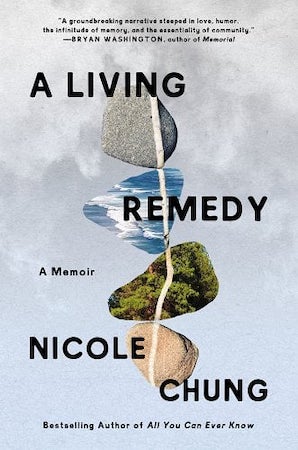
In A Living Remedy, Nicole Chung parses her grief in an effort to identify what remains out of her control, and what she can reconcile in her own world, all in an effort to find a way to co-exist with it. Her father was only 67 when he passed away from diabetes and kidney disease. She barely begins to contend with the grief and rage she feels as a result of his death, knowing that inaccessibility to healthcare largely contributed to it, when her mother is diagnosed with cancer less than a year later, right before the COVID-19 pandemic. Grappling with distance has always occupied Chung’s mind ever since leaving her primarily white Oregon hometown for life and study at a private university on the East Coast, but as the pandemic descends upon the world, forcing much of it into isolation, she must also face being unable to be at her mother’s side as she dies.
In this tenderly crafted, powerfully deployed memoir overflowing with heart and humor, Chung tries to navigate grief without punishing herself for the things she has no control over. These are the same things millions of Americans have had to confront when caring for sick loved ones, and will continue to do so for as long as healthcare is seen as a privilege, and not a basic human right. As she learns, and teaches us, grief—in all its forms—is not something to push away. While it’s not something we welcome, it’s not an enemy either.
Greg Mania: I can’t help but think of this memoir as not one of grief, but one of memory, of living with grief and filling the seemingly endless chasm it leaves in us with echoes of life lived, even beyond death. You even write, “It’s not a presence, exactly. But not an absence, either.”
Nicole Chung: I remember being so afraid that losing my mother would feel like losing my father again, too. That they would both feel far away, forever unreachable. As deep as my grief was, and is, that hasn’t happened.
It still surprises me how close they feel. I don’t mean that I picture them drifting above or behind me, my personal ghosts, always tuned into the Nicole Channel—but I can say that I feel their love like a living thing, still with me, in the present tense. I love what you say about the book being one of memory, not grief. I might add that, for me, memory is the part of grief that feels most alive, and has proved to have the most staying power. It’s always with me, and so, in that sense, they are, too.
GM: I don’t think one is ever truly “ready” to write about grief, loss. If not the “right” time, what would you describe the time leading up to writing this book? What did you feel called by?
NC: I shouldn’t say “my book contract,” should I? LOL!
First, I should say that I didn’t know whether I could write this book. I sold it a year before my mother died and several months before she received a terminal cancer diagnosis. I’d imagined that the story would focus on my grief for my father and the injustice of when and how he died, and that my mother would be here to talk with me about it and read it when it was done. I never thought I would be writing about losing both my adoptive parents in a two-year span.
After she died, I put the manuscript down for a while. I knew the entire project would have to be reimagined, I would have to start over from the beginning, and I just did not have the energy for that kind of endeavor in the days or weeks following her death. There were days when I didn’t know if I’d ever feel right going back to it. I wrote in my journal, I started taking on freelance assignments again, sometimes I took notes or did some research for the book, but I didn’t touch the manuscript.
We are living with so much unacknowledged grief, personal and collective. I don’t think we can, or should, look away from that pain so many have experienced.
In late 2020, I took what I could from chapters I’d already drafted and started over. I wrote a brand-new first chapter. I realized that I knew where I wanted to end the book, but had no idea how I would write my way there. I wasn’t happy with my writing progress throughout much of 2021. The turning point was probably when I quit my full-time publishing job in October 2021. I’d finally accepted a truth I had been resisting: I couldn’t work that particular job and write this particular book. Editing and managing a team took up all my time and most of my creative and mental energy as well, and the pandemic did not help. Another opportunity came along—one that would prove to be a lot of work, too, but it left me with more space for writing, and things finally started coming together (although I did not believe this until trusted readers began telling me so). I wrote the last third of the book over two weeks of marathon writing sessions during my holiday break.
I got to a point where I felt a kind of wonder and curiosity about this story, as hard as it was to write. I was living through some of the events in this book, writing about my grief in real time. It was all new to me. With my first book, I knew everything that would be in it when I sat down to write, even if it changed a lot in the writing. With A Living Remedy, I had some pieces set, but I truly didn’t know where it was going for a long time. That was really scary, and then, finally, the fear was joined by these questions that consumed me: What was I learning, about myself and about my writing? What was most important to me in the aftermath of my parents’ deaths? Could I write a book about grief, about my family, that would matter to or help other people? It was a leap of not-quite-faith, and I had to learn to trust myself as a writer in a way I hadn’t before. In the end, I felt really free in the writing of this book—and that’s why I say that it’s my whole heart. That’s what it required.
GM: You also write about the collective grief the world has come to know in some way, shape or form in the early days of the COVID-19 pandemic—when knowledge was limited, testing was scarce, and no vaccine was in sight. Has this period helped you usher your story onto the page in some way?
NC: I’m not sure I know the answer. I know that when my mother was dying in March, April 2020, no one in my life had to stretch terribly far to understand my sadness and fear. I did not want to write a pandemic book; it only comes into the story in a couple of chapters. But it felt important to try to capture those feelings, to document what it was to lose someone you love in the early days of the pandemic. We are living with so much unacknowledged grief, personal and collective. I don’t think we can, or should, look away from that pain so many have experienced—are still experiencing. I don’t think we should forget it.
GM: You masterfully illustrate the anxiety I think a vast majority of our generation is grappling with when it comes to wanting to take care of our parents when they get older, but might not be able to—at least now in the way we would like—because of financial instability. How were you able to reconcile what you could do, and what you were unable to? Asking for me and literally all of my friends who are kept up at night because of this.
NC: It’s so hard. Intellectually, you can know that you are not to blame for your family’s circumstances, but a part of you still feels responsible for them—you always want to support and protect and help the people you love. I don’t know if I’ll ever be able to fully reconcile what I could and couldn’t do for my parents. I do know that they never thought of our relationship as a ledger, and weren’t keeping track of my failures or holding anything against me. Until the end, my mother, especially, thought of taking care of me, and resisted the inverse for as long as she could. I don’t know how she did it—I guess it was just the steady love she had for me—but after she died, I understood that she didn’t blame me, and wouldn’t have wanted me to blame myself. I was able to learn how to grieve for her without punishing myself.
Telling the story of my adoptive family and the story of my grief meant naming and confronting these injustices.
With my father, who fell through the safety net, whose death was sped up by a lack of healthcare, it was harder to come to terms with all that I couldn’t do. I grew up thinking of my parents’ future needs and care as my responsibility, part of what I owed them as their child. I think a lot of people feel this way. And that might work—if you’re privileged enough, wealthy enough, live or can move near your parents or have space in your home for them, don’t need to work all the time, don’t have children with significant needs of their own, and you all have health coverage. Even then, it’s hard; it’s expensive; it takes time and energy and the kind of planning that is really hard to do without knowing the future. We leave people without the resources and support they need, making them feel that it’s all on them to provide and pay for their loved ones’ care, even when the need far outstrips their capacity. There’s this focus on personal obligation or responsibility that doesn’t acknowledge the reality. I still have to remind myself that this is a lie—that I was not responsible for structural failings, or the systems that failed my parents. That my dad’s loss was tragic, and unfair, and also one of too many like it in this country.
GM: You write about the last time you saw your mother, and the exchange you two had about forgiveness. You mention how that brought you something akin to peace, if not closure. But I feel like when we lose someone, there will always be something left unsaid of some varying degree. Do you agree, and if so, how do you make space for those things we wish we could have said, or expressed, in your heart?
NC: There is much I would change about my final months with my mom, but I’m very fortunate in that I don’t have to wonder about or regret the things I didn’t say to her; I really tried to say everything I needed to at that time, and I think she did as well. But I know what you’re talking about, and I do think it’s quite common. When my dad died, there were definitely things I wished I had been able to do, or say.
I don’t know if this will be of any use to anyone else, but occasionally I will write a letter to one or both my parents. No one sees it but me. It’s just a way of telling them something I want to tell them, releasing that on the page.
GM: I think many, if not most, of us, myself included, share your rage at how appalling our healthcare system is. Anything but universal just comes with a death sentence for many, because so many of us literally cannot afford to get sick. How have you channeled your anger over a healthcare system that is basically an obstacle course that offers a fast pass to those who can afford it?
NC: Americans, even insured Americans, spend so much money on healthcare. It’s one of the most expensive systems in the world. And it’s a case of not getting what you pay for: many people don’t have enough coverage, struggle to navigate an overwhelming health bureaucracy, and then still don’t get the care they really need. We have to keep talking about this, advocating and voting for better policies and systems that won’t leave millions behind.
Grief is not something I feel a need to avoid, to push away, any longer. The closer it is, actually, the better I can live with it.
Though this book doesn’t represent any personal catharsis for me, I did channel a lot of my fury into the writing of it. Telling the story of my adoptive family and the story of my grief meant naming and confronting these injustices. I generally don’t believe in prescribing lessons to readers; I want people to take what they will, what they may need, from this book. But from my own experience as a reader, I know that stories can help us reconsider things we already know, as well as things we may not know how to confront. The personal can show us a new way into a much larger issue or problem. If this book helps some readers do that, or helps those who have gone through similar experiences feel less alone, I will be glad.
GM: I love what you said about channeling a lot of your fury into writing this book. I think anger is—and I’m sorry, but this is the first phrase that came to my mind—a great lubricant for releasing the things that sit heavy on our hearts and minds. Do you feel like now you can hold space for your anger in a way that doesn’t feel like it’s bearing down on you?
NC: For me, writing didn’t do that. It was mostly time, and seeing a therapist to talk about my grief. And I think I really had to do that before I wrote, rewrote, whatever, much of the book, because if I hadn’t my guess is that it would have been impossible to complete it.
Early on, before my mother got sick, I’d drafted some pieces about my dad’s death and showed them to an editor friend, who told me, essentially, “I think you’re being too hard on yourself.” She was right—in that case, it was my anger at myself surfacing in ways I hadn’t noticed in the text. Not that there can’t be a place for that in your writing, but at that time, for me, most of it wasn’t conscious or controlled. It made the writing suffer, and I believe was a sign that I needed to do some more work and take some more time.
I’m not sure that writing allowed me to hold space for my anger. That required other, personal, deliberate effort. I had to give myself permission to be angry in my grief for both my parents, and at the same time stop blaming myself for things I couldn’t have changed. As for my rage with the systems that failed them, I could channel some of that into my writing, but had to do so in an intentional, controlled way—you know where water in a channel is going; the destination isn’t a surprise to you. I had to know what the anger was in service of, what part it had in the narrative, in order to write about it in a way that would translate to readers and bring them along.
GM: How has your relationship to grief changed since writing this book, if at all?
NC: I’d like to be able to say that I know everything about my grief now, its weight and its dimensions, and that it won’t sneak up or surprise me again. Of course, that’s not true. It’s less because of the writing, and more because of the time I spent doing the active memory work a story like this requires, but I think I’ve grown more used to living with memory, as you put it earlier. Grief is not something I feel a need to avoid, to push away, any longer. The closer it is, actually, the better I can live with it.
The first time it happened—though she didn’t exactly take note—was when the plumber reemerged from the basement to report that the water was back on. He wore the kind of mask that protruded like a snout and kept to the border of the kitchen, directing his comments only to Leland, though Marlo had been the one to make the appointment and usher him inside. As though Leland really were the man of the (rented) house and not a lover arrived just days ago. Marlo watched from the heavy oak dining table that had become her office, wearing knit fingerless gloves to compensate for the feeble heating. Something fluttered just beyond her knee. But when she looked, there were only the scratched wooden floorboards, with dark knots like misshapen eyes.
“I’ll see if we’ve got the part in stock,” the plumber said. “With shipping delays, orders are taking some time.”
From behind his own mask—of wrinkled fabric—Leland asked about using that bathroom. He had a habit of hunching his shoulders to accommodate those shorter than himself, and against the persistent chill wore the padded jacket a friend had given him—apparently retrieved from a dumpster, washed, and, failing to fit his friend, handed off to Leland. It was deep blue like his eyes, with sleeves a half inch too short. His wrists poked from the cuffs, making him look as much a child as his true age of thirty-six. While the plumber delivered what to Marlo seemed a preposterously lengthy response to a simple question, Leland nodded along, pausing to tug the cotton mask back up to the bridge of his nose. In their weeks apart, Marlo had often pictured him—the tousled hair, the violet flecks in his eyes—and the word that came to her was dreamy. But with the mask, his eyes looked severe rather than a frankly penetrating blue.
It was as he again reached up to adjust the mask, hiking the somehow ludicrous jacket above his waist, that she saw another shadow. More like a flicker. The moment Marlo sought it, it disappeared. She glanced at the overhead light. The house possessed many quirks. Marlo had found it online, through a real estate agent, after everywhere she could afford had been snatched up. She had waited too long to leave the city, hesitated even as provisions dwindled and hospitals filled—had put off her decision because of Leland.
They had been dating only a few weeks before the lockdown and when Marlo finally left had slept together only twice. The first time was the night before the email from Marlo’s company directing employees to bring home all they needed to work remotely. And as Marlo filled a cart with cans of soup, sacks of rice, and dried beans precious as ancient beads, her next thought, beyond panic, had been, Will I ever see Leland again? He lived with roommates in a fifth-floor walk-up on a grim street down by the Manhattan Bridge. With fears of even a shared subway car, the distance between their apartments became a vast and perilous gulf.
Now, she watched him show the plumber out and checked the time. Marlo was director of marketing for a company that designed office furniture, and endured daily meetings with her boss (a mildly infuriating man who had already contracted the virus and survived). Leland ran his own nonprofit, the Community Project. In normal times he spent his weekends documenting whatever activity he had organized (pop-up tuba concert; barbering classes; painting murals on a stretch of city street), to post clips on his social media accounts. Marlo usually found such look-at-me behavior cloying—but this was to bring in donations. Leland’s posts garnered hundreds of hearts. He also belonged to an online network of people who recycled their belongings not simply to reduce waste but also to avoid spending money. If someone needed a new cellphone, say, they asked if anyone had an old one to give away. Same for sofa beds, wrapping paper, wart remover. No request was too large, small, or strange. Marlo knew this because Leland had invited her to join the network, where she saw people posting photographs of trash on a street corner: Found this free armchair, just missing one foot! with the geographical coordinates, no seeming worries of bedbugs or otherwise. Leland and his roommates had furnished their entire apartment via the network—perfectly nicely, though Leland had no mirror or desk. Marlo couldn’t help wondering, if he were ever to give her a gift, if it would come from this list. But four years had passed since her divorce and she was tired of the dating apps, the disappointments. She liked Leland’s energy, his keen mouth and hands that even the first time knew just how to touch her, and wanted to do things differently.
“Here, fuel to get you going.” Leland had removed his mask and slid a bacon-cheddar scone before her.
She was supposed to curb her salt intake due to high blood pressure, but she didn’t want to sound defective; she took a bite. “Mmm, delicious.”
Yawning, Leland took a seat across from her. Marlo reached over to wipe the residue of sleep from his lashes. “Trouble sleeping again?”
“Yes, but it doesn’t bother me.” An edge to his voice. Apparently, he had experienced insomnia for years.
“I was hoping the country air would be a soporific.” She said this even though she herself found the bedroom somehow unnerving. She wondered if Leland had noticed the strange feeling in the room but hated to mention it if he hadn’t.
He said, “The key is not to stay in bed if you can’t sleep. That way you don’t associate the bed with lying awake.”
Marlo had been aware of Leland leaving in the night. “What do you do when you get up?” She had been wondering this since his arrival two days earlier.
“Read, or stretch, wait until I feel sleepy again. Last night I did some tai chi.” He took a sip from his coffee mug. Like Marlo’s, it was glazed a morose shade of green and chipped at the brim. “In the past, some women I was with weren’t able to deal with it.”
The mention of previous women had her sitting up straighter. “You mean—your insomnia bothered them?” (It bothered her, too, but she was determined to acclimate.)
“I don’t know exactly. They decided they weren’t comfortable with it. You know how some people are.”
Some people. Informing Leland about the rental, Marlo had been ashamed—at her desperation to escape her sleek building (especially the elevator), and at how easily she had shelled out no small amount of cash for a scrappy cottage three hours from the city. She once heard a friend say of her that she threw money at problems. Marlo was single, childless, and made a good salary—not to mention the divorce payout, after Reggie’s affair with a paralegal from his firm. The staggering shock, after six years of what she thought to be a happy marriage, was worth something after all. Marlo did not live grandly, but if something broke, she paid someone else to fix it. If disaster struck, she bought a ticket out of it.
Yet money could not mitigate the fundamental awkwardness of being thirty-nine years old and dating during a plague. It was hard enough getting to know someone new. Frightening, even. Marlo’s friend C.J. had already told her she was moving too fast with Leland.
She said the virus was a perfect excuse to slow things down.
“But I’m afraid of losing him.”
“Lose him—where’s he going to go? The entire planet is on lockdown.”
“We’re just getting to know each other. If we don’t stay close, he could lose interest.”
“Shouldn’t you be focusing on figuring out how you feel about him?”
C.J. was such a killjoy. No wonder she was still single.
It was Marlo’s main partner at work, Pamela, who convinced her to invite him—not that Marlo would have admitted it to anyone. People thought Pamela was batty because she did things like claim to be mildly psychic and, if a coworker ever did something obnoxious, sent the person a forgiveness memo stating why the behavior had been hurtful and that this memo is meant to be open and forgiving because she believed that failing to be truthful about one’s feelings caused them to manifest in other, harmful ways, drawing out residual emotions lingering in the atmosphere—to say nothing of the fact that, upon receiving the company email about the building closing due to the virus, she had used Reply-All to urge everyone to rinse their sinuses with a mixture of salt and lukewarm water. She had also, once, refused outright to work with an employee she claimed had conducted himself deceitfully. Actually, Marlo privately admired her for that. Another time, Pamela declared herself unable to work on a textiles partnership because she had a bad feeling—and, sure enough, the textile company’s owner was accused of embezzlement. In her late forties or early fifties, Pamela was VP of communications and had an enviable aura of calm about her, plus she was brilliant when it came to marketing campaigns; probably her uncanny ability to read people was what she meant by psychic. She was the person who, during team brainstorms, would serenely watch everyone work themselves into a corner, and then suggest, Or we could just . . . Always something simple yet right—which, Marlo supposed, was how she got away with all the nutty stuff.
Marlo and Pamela worked in tandem and often chatted together before and after meetings. Soon after Marlo had bought the used Honda to relocate to the farmhouse, she found herself telling Pamela, at the end of one of their calls, about Leland. Was it too soon to invite him along? Friends told stories of boyfriends who turned out to be nightmares, or simply annoying. Either way, it scared her.
Pamela said, “Listen to your intuition, not your fear. Intuition allows us to take action. Fear paralyzes us. Let it be you deciding—not your fear.”
Taking another bite of scone, Marlo decided she would simply tell Leland she liked less salt. Easy enough. Problem solved.
The shadow-flickers returned a day later while she was on a call for work. On-screen her coworkers appeared less polished, some with unmade beds in the background, some with pets, small children, sulky teens sidling up, to be briefly indulged then swatted away. Her sales strategist (huddled in a laundry nook to escape household noise and her children) was constantly having to tell her youngest, Not now, sweetie, I’m on a call. And each time Marlo glimpsed his little head entering the frame, a pang went through her, at not having her own child to sweetly bat away.
She hadn’t dared tell Leland she hoped to have children, for fear of scaring him off. She hadn’t told him about the painful, expensive process she had undergone to have her eggs extracted and frozen.
You know Marlo: throwing money at a problem . . .
What would frugal Leland make of an extravagant medical procedure for a purely hypothetical possibility?
Her friends found it incredible that Marlo had yet to hold the do-you-want-kids conversation with Leland. Was it the fact that Leland had yet to ask her? She hated to sound like one of those women simply looking for someone—anyone—to father a child. There was also the matter of her true age, which Leland did not yet know. On the dating app she had entered her age as five years younger, since everyone told her men wanted younger women. And it turned out to be true, the men who chose to meet her uniformly believed themselves older than Marlo. She had intended to tell Leland her real age the night she met him—but by the time she remembered, that fact, too, felt like something she needed to introduce at the right moment.
On the dating app she had entered her age as five years younger, since everyone told her men wanted younger women.
“For the semi-opaque ones, I’m thinking something like ‘Refuge’?” her marketing manager said. He wore his signature bolero hat with a blousy silk shirt unbuttoned to mid-sternum, so that some wispy chest hairs were visible. Though still in his twenties and possessing no great talent, he had been prematurely promoted, apparently because he reminded their boss of the younger version of himself.
From the laundry nook, her sales strategist said they needed something less literal. “What about ‘Aura’? Like a cloud, rather than a divider.”
Because of the virus, they were having to reconceive their entire product line. Community spread meant no more shared office spaces, no more hot desks. When people returned to work, it would be in cubicles, as if it were the nineties again. Today they were naming a line of plexiglass partitions easily erected between desks.
Marlo watched as the marketing manager pontificated in front of what looked to be a professionally stocked bar. The sales strategist had turned her screen off, which meant she had at least one child seated on her lap. Pamela sat in calm solitude before a bed on which posed a subtly shifting black cat.
“Mar?” Leland poked his head in, hair mussed in his youthful way. “Have you seen my jacket?”
Marlo smiled, gave a little shake of her head; he would understand she was in a meeting. Leland whispered, “Sorry!” and disappeared from her view.
Something flickered at Marlo’s elbow. She kept her eyes on her monitor. “Okay, how about these ones with storage?”
As possible names were tossed back and forth, Marlo involuntarily checked her hair in her little box on screen. (There was only so much longer that she could keep touching up her roots; soon she would have to re-dye, risking Leland noticing.) She swept a stray lock behind her ear. Though she no longer wore her sleek jackets or sharp-heeled boots, she still used a hair iron and eye makeup before her meetings. She could not imagine attempting her role without them.
Meanwhile, these men with their five-o’clock shadows and unmade beds . . . and the marketing manager with his stupid hat and bare chest . . . When he turned off his video, his black box was replaced with a photograph of him in semi-profile, wearing sunglasses (though the photo was clearly taken indoors) and the flat-topped hat but with a different—tapered—shirt, also unbuttoned to the level of his nipples, his chin angled dramatically toward his shoulder, his one visible eye peeking over the rim of his shades. If Marlo used a picture like that—if she wore a bolero to work with her blouse unbuttoned down to her bra—she would be laughed out of town!
The sight of the photo, like the hat and unbuttoned shirt, brought on the same low-grade resentment she could not help feeling at Leland’s ill-fitting jacket—that he could wear a coat found in the trash and be taken seriously, while she had to iron her hair and swipe on eyeshadow. On his video calls Leland rotated the same two faded button-down shirts, plus the scrappy padded jacket, without being mistaken as destitute or insane.
What about the young men his program helped? she wanted to point out. Would he send them to an interview in threadbare shirts and too-small jackets and expect anyone to give them the time of day?
“File-r-upper . . .” the marketing manager was saying.
“Smorgasbord,” said her sales strategist, hunkered in the laundry nook.
From the hallway, Leland pantomimed: Could he borrow the car? Adding, in a half-whisper, “Must’ve left my jacket at the post office.”
Marlo pointed to where her purse (which held the car key) hung from the doorknob, as something flitted past her hip and a notification popped up on her screen. The network, someone in her neighborhood in the city asking if anyone had a spare desk. Even with the nation wiping down groceries with antiseptic cloths, leaving mail to sit for forty-eight hours, people were still exchanging items.
Marlo clicked the notification away, trying to focus, as Leland thanked her and left.
When at last her meeting ended, she and Pamela purposely lingered. Pamela looked tired. She asked Marlo about life in the country and, when just the two of them remained on-screen, “How’s it going with Leland?”
“Great—really well!” Marlo told her how it felt to have his help shopping at the grocery store, Leland keeping a place in the long, slow queue while Marlo foraged for flour, bouillon cubes, boxes of pasta in strange shapes that were all that was left on the shelves. Back at the house, lathering their hands under the rushing spout as hurriedly as if they had touched a corpse, Marlo felt, she half-joked to Pamela, like a real couple!
But something on Pamela’s face looked—what? Disappointed? As if she didn’t quite believe it? Perhaps Pamela was envious. After all, she was a good decade older, not to mention still single. Marlo asked, “How are you holding up?”
“It’s been hard. Home alone, day in and day out.”
This was something else Marlo liked about Pamela. Never the reflexive Fine, and you? Marlo wished she could be like that.
Pamela said, “You know, I’m used to a balance of solitude and socializing. I had the perfect life. I sang in a choir, I swam on Mondays, took a blacksmithing class on Wednesdays—”
“Blacksmithing!”
“—and Friday was Lindy Hop night. Now all that has evaporated. Sometimes I’m just . . . sad.”
Her voice through the computer audio was hollow. As if her voice, too, were caught in a square black box. Marlo wanted to reach out and hug her. She felt herself about to invite her to join her and Leland in the country house. But no, that would be crazy. She said, “That sounds tough.”
Pamela said, “You were smart to invite Leland to come out. Everyone who has someone with them right now is lucky.”
“Well, except for people stuck with people they can’t stand.”
“True,” Pamela said. “The grass is always greener.”
For a horrible moment Marlo imagined herself alone in her own apartment, without Leland to accompany her through the torrent of emails, the online meetings that managed to bleed into every hour of the day. With everyone working from home, she now found herself scheduled for meetings at all hours, five in the morning with a London distributor, seven thirty in the evening with the Seattle sales team . . . To go through this alone, no one else in her box of an apartment to turn to, would be hell.
“I do feel lucky,” she told Pamela. And though not usually superstitious, Marlo rapped on the wooden chair, just in case.
She asked Leland about children on a suddenly warm afternoon on the south patio. While the north side hadn’t yet shaken the bleakness of winter, here one could feel the sun and watch bumblebees dawdle in the bushes.
She was glad to be outdoors. To escape the eeriness that lately seemed to have spread throughout the house. Something not quite right . . . Though she tried to tell herself it was nothing, the sensation affected her concentration—just when she needed to prove herself, with the consolidations at work. Yet she hesitated to mention it to Leland, wanting to preserve the even rhythm they had created. Also, it was the kind of thing some eccentric spinster like Pamela would say.
In the sunshine, her unease floated away. Marlo felt less burdened. Reclining in the wicker chaise, laptop balanced on her thighs, she was mid- email when a shadow-flicker swept through her periphery.
This time she took full note. “Did you see that?” she asked Leland, who was working at the wrought-iron table, munching on a cider donut from an orchard he had stopped at on one of his drives.
“No, what?” He wore the pale blue sweatshirt she loved, that made his eyes twinkle. In just over two weeks, his hair had reached his ears, thicker and lightly mussed, like a teenager’s.
Marlo indicated the area by her leg. “I thought I saw something.”
“Chipmunk? I think they’re planning a coup.”
It was true the chipmunks were hard at it. Each seemed to have its own fiefdom; interlopers were chased away in what looked like adorable skirmishes but were probably incisive territorial battles.
Leland held the bag of donuts out to her. She waived the grease-stained thing away. She couldn’t eat baked goods as he could, without repercussions. Leland was always bringing home bread products, having taken over most of the errands now that Marlo headed her company’s digital division, too. While Leland’s patronage of small-town grocers near and far was sweet, he had somehow managed, so far, to always let Marlo be the one to fill the gas tank.
Another shadow-flicker—quicker this time. Marlo knew it wasn’t a chipmunk. She was about to say, “There, see”—but stopped herself. She didn’t want to sound insane. She told herself it had to do with the way the sun was passing through the clouds. She looked up. There were no clouds.
Please don’t let it be eye trouble. Not now, when all the doctors’ offices were closed. Probably it was from too much screen time. The consolidations meant Marlo spent even longer hours on her computer. Not to mention that her boss had made her do the layoffs.
She tried to remember what the eye doctor had told her about torn retinas, or was it macular degeneration? Something about “floaters” or dark spots. Was that what these flickering shadows were? She couldn’t ask Leland. That sort of thing was an old-person problem.
She was suddenly terrified that there was something really wrong.
Leland yawned. “Time for my post-prandial nap.”
Marlo tried not to show annoyance. She had begun to suspect that his naps contributed to his insomnia. But the one time she suggested he try to push through, Leland had looked at her with affront, as if her insensitivity to his malady were a sign of hard-heartedness.
He also checked his cellphone in bed, though the light from such devices was known to interfere with sleep. He was always posting on his various social media feeds, to keep people engaged in the foundation while its activities were stalled, since he had lost some large donors. He called it the Keep Connected Campaign. Marlo had seen some posts: the gothic-looking turkeys, the solitary deer that liked to nibble placidly on one unfortunate tree, a garter snake peeking out from a rock . . . Leland did not feel the need to hide his abandonment of the city. He came up with comical tag lines for his photographs (for the turkeys: Sure, it’s beautiful, but I miss the city—here no one ever seems excited to see us) always with a link to the Donate button. Apparently, each brought in a slew of small donations.
Was that what he worked on in the wee hours?
A chipmunk, cheeks bulging, ran right across Marlo’s foot. They really were cute. Marlo watched it scurry to the stone wall to fit itself into a dark little hole, its perky tail upright like a flag. And in that moment, Marlo managed to blurt out, “Have you ever thought about having kids?”
“Yeah!” Leland said it brightly, as though recalling a fun leisure activity. “I’ve always thought it’ll happen however it’s meant to happen.”
Men could do that, wait and see. Her ex—six years older than Marlo—had done that. He and the paralegal (whom he had gone ahead and married) now had twin daughters they dressed in absurd matching outfits. Never mind that the paralegal had been a subordinate; Reggie’s indiscretion had not prevented him from making partner at the firm. He got the whole enchilada, as C.J. had put it.
C.J. always knew how to make Marlo feel a blow.
Pamela had told Marlo she needed to rid herself of her resentment. That if internalized, it would warp how Marlo viewed the world. Of course, Marlo would be the one whose attitude had to change. Not cheating, paralegal-poking Reggie. (While Pamela could outright refuse to work with that guy she no longer trusted, and completely remove herself from a project based on a negative feeling!)
Marlo was prepared for Leland to ask if she wanted children of her own, but his phone pinged. Though his projects were stalled, he still fielded plenty of calls.
He reached over to give Marlo’s hand a squeeze. “Sorry, Mar, I have to take this.”
His phone was a small, refurbished one acquired through the network. As he spoke, Marlo secretly congratulated herself: she had asked the dreaded question. The answer wasn’t anything other than what she ought to have expected. She needn’t worry anymore.
When she and Leland went walking together, they rarely saw a car, let alone another human, just the occasional fleeing deer, or a hawk lifting with the wind, or cows whose tails spun like dials. If they did cross paths with someone, it was usually the old man at the farm down the hill, standing at the opposite side of the road to chat while his three dogs barked ferociously from behind an invisible electric fence.
Leland asked the man about the house they were renting, where the owners had gone.
“Been empty a good year now. Guy had a landscaping business, but must’ve had trouble. One day he up and left. Wife and kids, too.”
When she and Leland continued on their way, Marlo wondered aloud if the couple still owned the house, whom exactly her rent went to.
“I wonder if they’re still a couple,” Leland said. “Maybe they were splitting up.” He slung his arm around her. “A few of my friends are going through that now. Relationships I thought were rock solid. But I guess after a certain amount of time . . . who knows. Must be rough.” He let go to pick up a bright rose-colored stone from the road, examined it, tossed it aside. “What about you? Know anyone who’s been through a divorce?”
Marlo kept her eyes on the pebbly road before her. The problem was that when your husband left you for another woman, it sounded as if you were insufficient—a reject. She said, “No—well, maybe I should say not yet.” She tried to laugh.
“Yeah, well, you’re a few years younger than me. Give it some time.” Leland took her hand in his. She held tight, as noisy birds clamored in the trees, and said nothing more.
Later, at home, Marlo thought about what the man down the road had told them. It made sense that the family’s finances hadn’t been good, when she considered the state of the house—the weak plumbing (the part for the toilet had arrived only last week), constant draft, whole place needing a fresh coat of paint. She always emphasized these facts in her phone catch-ups with C.J., who had gone to take care of aging parents in a house in Vermont and sounded cold and lonely. Bitter, too; her brother wasn’t helping one bit. Marlo had told C.J. about searching for a plunger in the basement and discovering a stash of empty vodka bottles—twenty, thirty of them—behind a panel near the washing machine. Dusty, some covered in cobwebs. Was this why the landscaping business had gone under? “Someone was hiding their drinking problem.”
“Drinking while laundering,” C.J. joked. “Depressing.”
“Leland brought them to the dump. He says the important thing is to take action, not get emotional. When I’m heartbroken over the news, he talks me down. It’s such a breath of fresh air compared to what I’m dealing with at work. They just furloughed another fifteen percent of the company. Leland makes everything seem manageable.”
“He’s your knight in shining armor.”
Marlo couldn’t tell if C.J. was being sarcastic. She decided to keep the tender moments for herself. The (loving?) way Leland held a buttermilk biscuit to her lips on one of her now nonstop days. Eyes lighting up when she emerged from her shower, as if she were an odalisque and not a nearly forty-year-old in a fuzzy blue bathrobe. Dancing around together to old rockabilly songs when they cooked dinner, how he paused to brush her hair from her face and kiss her.
She wondered what small, unconscious actions she might have taken that pleased him without her knowing it.
“How’s his insomnia?”
Of course C.J. would go there. Marlo explained that though he still had some trouble, after nearly five weeks of this, it no longer disturbed her. “I mean, half the time the coyotes wake me up.” There was a wolf in the pack now, she had noticed. A lower, deeper howling than the others.
Sometimes, seeing the empty spot in the bed, the void seemed to chide her—for all she still did not know, did not understand, about this person she wanted to be close to. As if it were some error on her part. That if it weren’t for the lurking unpleasantness of this room, of this house, Leland would be here in bed beside her.
Sometimes, seeing the empty spot in the bed, the void seemed to chide her—for all she still did not know, did not understand, about this person she wanted to be close to.
One day, Marlo noted something to perhaps support this notion. It happened during a work meeting, the morning after Leland’s question about divorce. A shadow flickered near her elbow. And on-screen she saw—was certain she saw—Pamela’s eyes dart to where the shadow-flicker had been.
She saw it, Marlo thought with a jolt. Saw, and then couldn’t see—just like me.
There was no time to chat after the meeting, and Pamela didn’t mention it. But Marlo had seen her eyes. This gave her confidence to say something to Leland.
She waited until dinnertime—Leland’s spaghetti, steam rising into the chill air. “Don’t you think this house has a weird energy?”
He was twirling his noodles around his fork, a miniature hay bale. “What do you mean?”
Marlo felt a small deflation, that he had not picked up on the strangeness. “I think something happened here.”
Leland seemed to really be thinking. “You mean—because of what the plumber said?”
The plumber. When he at last returned with the missing part, Marlo had noticed the way he paused in the entryway to glance around the combined living-dining room, as if looking for something. She had ventured: “Did you know them?”
“Family that lived here? Nah. Must’ve been doing their own plumbing. Or trying to.”
“Did something happen to them?”
“Other than the business failing? Not that I know of. Small enough town, I’d hear about it. Cops had to come here a couple times. Wife was a screamer.”
Marlo stared at him. “What do you mean?” She asked even though she wasn’t sure she cared to hear his answer.
“Guess they liked to bring the local brass into their marital spats. Some folks like an audience.”
She didn’t like the plumber at all, then.
To Leland she said, “Maybe that’s what I’m thinking of.”
Because anything else would just make her sound like a madwoman, and she didn’t want him to think of her that way.
By mid-May, peonies were blooming on the east side of the house, heavy wadded pink clumps. Marlo cut stalks to bring inside. Despite the signs of spring, the air still nipped at them; Leland wrapped himself in a wool blanket (he never had found his padded jacket), and Marlo still wore her fingerless gloves. The peonies leaned in a tall vase near her desk so that their sweetness infiltrated her meetings. The petals crawled with shiny black ants.
Today’s meeting was just Marlo, the marketing manager, and Pamela; to Marlo’s dismay, her sales strategist had been furloughed. Worse, it seemed she did not intend to return. With her children home, and summer camp likely to be canceled, and who knew about school come fall, she said she could no longer do two jobs at once.
She was probably right about school. Today’s meeting was for the company’s “At School At Home” campaign—office furniture repackaged for domestic use. Secretly Marlo wished the marketing manager had been furloughed instead. If you told him (twenties, single, childless) you needed him at a sales conference in Grand Rapids, he would make a wincing sound and say, “You know, I just don’t think I can fit it in.” Whereas her sales strategist (thirty-seven, three children) would take a long deep breath, pause, and say, “Okay, I’ll see what I can do.”
Marlo’s favorite graphic designer, too, had been let go. She was a single mother with two young sons, one of whom had some severe condition that required him to live in a residential facility, which had closed due to the virus. Marlo had no idea how she was managing.
On small calls like this, Marlo liked to arrange her screen so that she could view everyone at once. Through the open dining room window came a robin’s expert whistling, and the cute interrogative whine of goldfinches.
Not now, sweetie.
Even in the warmer weather, the marketing manager wore his bolero hat, with a shiny blue shirt unbuttoned to mid-chest. Marlo adjusted her earbuds as Pamela said, “We want to sound upbeat but not false. None of these kids want to be home.” Behind her the cat, regal, eyed the camera distrustfully.
Marlo heard the door open. Leland must have woken from his nap. He asked if she had the car key.
She turned to give him a quick wave and indicate her earbuds. Her purse, in which her keys were buried, hung from her chair, but something stopped her.
“Sorry to interrupt,” Leland whispered. He pointed to her purse as he approached her, made a key-like gesture. Pamela said, “Is that Leland? Handsome!”
“Yes!” How proud it made her, to be able to say, Yes, he’s mine!
As he hovered behind her, Marlo reached into her bag for the keys, tossed them to him. A pillow-crease marked his cheek. He thanked her and ambled out.
“So that’s what lured you out to the country,” the marketing manager teased.
But something was happening to Pamela. She was no longer smiling. Her eyes were blinking. Her mouth was open. She seemed to be staring at something.
“Pamela?” the marketing manager asked.
Marlo looked behind her. There was nothing there. “Pamela,” Marlo asked, “what do you see?”
Pamela rolled her chair backward, as far from her desk as possible. The chair bumped the bed, startling the cat. It leaped away, off-camera.
The marketing manager said, “Is there something happening on the news? Is that what you’re watching? Marlo, are you on Facebook? I’ll check Twitter.”
“No, I’m not,” Marlo snapped. “Pamela, what’s wrong?” But Pamela’s little on-screen box disappeared.
“I’m messaging her,” Marlo said, as her marketing manager, scrolling through his phone, said, “I’m checking my feed, there’s nothing happening.”
“Let me call her.”
There was no answer. No one was able to reach Pamela for the rest of the day.
It was like she was hallucinating, they explained on their group call the next day, when Pamela still hadn’t returned any messages. Though one of the designers who lived in her neighborhood had tried to check on her (at Marlo’s urging), Pamela hadn’t answered the intercom. When Marlo suggested contacting the police, their boss said it was Friday, “let’s give her the weekend—you know how Pamela can be. She logged off on her own, so she hasn’t had a stroke or anything. Maybe she just needs some time.”
The fact was, everyone seemed to have expected this. Hadn’t Pamela always been crazy? Clearly pandemic isolation had driven her over the edge.
Meanwhile, ever since that day, Marlo had been seeing, all around her, the flickering shadows. They gathered round in swarms.
She never had spoken to Pamela about the shadow-flickers. Since Pamela hadn’t mentioned them, Marlo hadn’t dared ask what she had seen that one time. Now she tried to recall if those circumstances had been similar. This time Pamela had seen Leland walk in, and then: what?
She tried texting Pamela again.
I’m worried about you. Do you need help?
Silence.
There was no sign of Pamela on Monday. But when Marlo asked about contacting the police, her boss said he had managed to reach Pamela and not to worry—then refused to say more. Marlo forced herself not to dwell on it. But by Friday, when Pamela still hadn’t returned, Marlo, desperate, called her boss to ask, “What’s going on?”
“Oh, I meant to tell you. Pamela got in touch a few days ago. She decided to take the severance package.”
The early retirement package being offered to more senior employees, to help reduce overhead.
“You mean, she’s not coming back?”
“No, she said she’s done here.”
It was a slap—a punch. “But—”
“She said she’s been wanting to start her own consultancy. That this way she could take a break first. Have a rest.”
It was true Pamela had mentioned wanting to go out on her own—but now surely was not the time!
Marlo immediately texted her.
Are you okay? Know that you can share with me what happened.
And hours later, when Pamela had not responded:
Pamela, you can tell me what you saw.
All week, the flickering shadows had grown so frequent, so teeming, it seemed impossible Leland didn’t see them. But he sat peacefully at the other end of the dining table, typing into his laptop, the fuzzy wool blanket wrapped around him.
When she could no longer stand the shadow-flickers darting round, Marlo typed:
Pamela, if what you saw has to do with me or Leland, I beg you to tell me.
The reply came within minutes.
You haven’t been forthright with him
Marlo stared at the message. She was considering how to respond when Pamela wrote again.
Rage attracts past rage
Lies breed & proliferate
Marlo turned off her phone. This was no time for that kind of crazy talk.
“You okay?” Leland placed his palm on her forehead as if taking her temperature, then leaned down to kiss her before taking a seat next to her.
“Pamela quit.” She could hear her voice shaking.
Leland gave a tsk. “She have kids at home, too?”
“No, she’s not—”
“Oh, right, the kooky one.”
They were Marlo’s words, yet they sounded wrong. “She wasn’t just kooky.”
“I meant . . . isn’t she the one who, like that time someone was dishonest—” Leland stopped himself. He leaned back, away from her.
Marlo felt herself stiffen. “Yes,” she said, “all of that nutty stuff.”
Leland slid his chair back. The violet flecks in his eyes looked like sparks. For the briefest moment, Marlo was afraid of him.
“She took the early retirement package,” Marlo said quickly.
Leland said nothing. Marlo could not look at him. She looked down at her phone with its darkened screen.
At last Leland said, “Well, I guess that would explain it.”
“Yes. I suppose I’d take it, too.”
She dared to look up. Leland’s gaze pinned her to the chair. Marlo said, “More work for me. Yippee.”
Leland gave a quizzical look. When Marlo looked away, he said, “Just don’t burn yourself out.”
That night in bed, the coyotes woke her. It always happened this way, a single coyote’s cry, then another’s excited yapping, and another, as if the yowling were contagious. In her half-sleep, she envisioned the house’s former owners out there, somewhere among them, howling.
Wife was a screamer.
She could hear the wolf now, too, its deeper howl. Rolling to her side, she saw that Leland had left the bed.
The skirling outside was wild, pagan. What had they killed out there?
“Do you hear that?” she called to Leland.
She threw back the covers. The floorboards were cool and rough, and she hastily pulled on her socks before stepping out to the dark hallway. A dim light issued from around the corner. She followed it, to the door that led to the basement. “Lee?”
The bulb above the basement stairs had gone out. The only light came from below, a dull amber glow. Marlo waited for her vision to adjust before finding her way down the steps—wooden slabs that gave small groans under her feet.
A single yellowish lightbulb left most of the basement in shadow. Across the room, past the washing machine, a figure hunched over something.
In the dusky shadow the figure became Leland. He was kneeling, crouched in a posture that at first confused her. His shoulders sloped, his head bowed over what seemed in the haze to be a torso.
Leland looked up. In a pained voice he asked, “Why did you hide my jacket?”
For a moment, Marlo could not speak. She found she could barely breathe. How could he not see why—though she struggled, now, to find words to respond to his question. Even in the dark she could not look at the jacket. She asked, “How did you know where to find it?”
He gestured at the crawl space where she had found the vodka bottles those weeks ago. “Isn’t this the hiding place?”
The shameful place. Everything she hadn’t dared say aloud. Her resentment, her lies. He had sniffed them out.
“I’m sorry, Lee. I don’t know what I was thinking.” She realized she was whispering.
He was still crouched on the floor, shoulders drooping. Calmly, he said, “I’d like to try to understand. But right now I just need to figure out what I want to do.”
She felt her heart racing, chasing after him. “Please don’t leave me here.”
“I just need to borrow the car and take a drive or something. Clear my head.” He placed the plywood cutout back over the crawl space. Stood and brushed the dust from his pajama pants. Tenderly, he draped the jacket over his arm. Then he walked past Marlo, toward the stairs, without looking at her.
In the amber darkness, she watched him make his way across the room. With his long limbs, his pajama pants exposed his knobby ankles, visible only as he passed close enough to the light, before darkness hid them again.
She watched him retreat back up the steps. The squeak of each wooden board was like a tiny cry. Around her, the shadow-flickers gathered, flitting frantically back and forth. She stroked them, and caressed the tops of their heads, before swatting them away.
It’s no coincidence that wellness has become a trillion-dollar industry at the same time that most people have been affected by failing public health systems and government agencies. Self-care has become a best-selling product, a buzzword that anyone can use to increase their bottom line. Because of this, it can be impossible to parse what wellness is, and to imagine methods of self-care that don’t come with a staggering cost.
In my novel Natural Beauty, a talented pianist is forced to give up a promising career in order to care for her ailing parents. She stumbles upon an opportunity to work at Holistik, a high-end wellness and clean beauty store, and finds herself seduced by the promise of becoming her best self. She slathers on products, ingests pills, and submits to procedures, all in the name of endless self-optimization. But something sinister lies beneath Holistik’s glossy veneer, an ugly truth that threatens to consume her. Natural Beauty is ultimately a journey of self-love through the horrors of a commodified wellness industry.
Below, I present a list of books that, together, begin to form a clear picture of what wellness is and what it isn’t, who it currently serves, and who it excludes. The illness of wellness lies in wellness that tries to exist within capitalism, participating and becoming an extension of it. All of these books have also informed me, one way or another, in my own journey with self-care.
Hu moves to Seoul as the first-ever Korea and Japan bureau chief for NPR correspondent and takes a deep dive into South Korea’s beauty industry and how it impacts society and women at large. In this astonishingly researched and unputdownable book about topics like the prolific plastic surgery procedures being invented everyday to burgeoning feminist movement, she dissects the myriad ways beauty ideals intersect with geopolitical tensions, class, and societal issues, as well as articulating technology’s part in enabling and accelerating beauty culture. Among the many pressing questions Hu asks: How does beauty intersect with sexist power structures? Who benefits when women expend so much energy enhancing themselves? Where is unchecked consumer beauty culture leading us to? Nowhere in the world are there such clear lines drawn between beauty and social and economic success than in South Korea. Flawless manages to provide an in-depth look at the history of Korea, which very well may be the future for the rest of the world.
Devin and Maren are two female co-founders of a wellness start-up, Richual, who try their hand at helping women in their quest for self-care. They genuinely want to heal the world with their new venture, but even the best intentions are ultimately waylaid by the market economy. Not only are they unable to deliver on their promises of a self-care community for women, but they struggle to achieve any kind of work-life balance because start-ups are so enmeshed with ideals of productivity that are the antithesis of wellness. This book provides an interesting counterpoint to the others on this list because it’s a look at how our insecurities are co-opted from the POV of those doing the co-opting. Maren and Devin learn the hard way that it’s impossible to truly serve people in the labyrinthine capitalist system, and while that may sound brutal, Stein kept me guessing and thoroughly entertained the entire time.
Former influencer Anna Wrey seeks to undo all of her previous surgeries with a new procedure, Aesthetica, which promises to restore your natural face. Scenes of her readying for the procedure in the present are cut with flashbacks that show the harrowing history that brought her to this point. She has spent her life learning to read the desires of men, ignoring her own, and surgically adapting to exterior preferences. It’s a deeply powerful and sad depiction of influencer culture, the pursuit of beauty and youth as leverage for power, and the choices women make, which are limited and designed to make us believe we are in control. Rowbottom is so effective at showing the absolute hollowness of getting all the things we’ve been conditioned to want, it’s frightening. This anti-fairy tale cautions us: be careful what you wish for, because your wishes are not your own.
Part heartbreaking memoir, part analysis of the cultural ills in service of the wellness industrial complex, this book is a necessary tool for understanding the co-opting of wellness, which should be available for everyone, not just people who are able to afford it. My heart broke for Róisín, who has had to interrogate wellness because of her own highly traumatic adolescence. The bravery and wisdom with which she shares her journey and wisdom is remarkable. This book pinpoints the current hoarding of wellness that perpetuates the violence of colonization and epistemicide and asks the question, how can we be individually well if we aren’t well collectively?
The world is constantly telling us that our bodies are not good enough. We learn bodily shame from the media, from companies who stand to gain from our insecurities, and from each other. That shame leads us to value our exteriors more than our feelings. In order to reconnect with our bodies, and to begin seeing ourselves as subjects rather than objects, Chambers introduces a thought that is becoming evermore radical in this day and age: the body is good enough exactly as it is. Chambers believes that refusing to modify our bodies is an act of rebellion and an assertion of autonomy. Intact has profoundly changed my relationship with my body in addition to introducing me to the concept of collective bodily liberation.
An absolutely vital book that addresses and provides a real antidote to many of the ills of wellness. As a society, we’ve normalized and internalized exhaustion as a necessity. We are praised when we work ourselves to the bone. Hersey, the Nap Bishop, shares the small personal moments, the histories of her family and people, that led her to the solution and the gift of napping. She addresses the importance of resisting the frenzied pace of our culture and provides exercises and meditations for liberation practice so that we can “no longer be ravaged by this culture’s incessant need to keep going up matter what, to produce at all costs.”
This is a book about self-care that uses the term in the way Audre Lorde initially meant it. As someone who fully participates in so-called grind culture, this book was often difficult for me to read. I am thankful for the ways it has disrupted previous ways of thinking, pushing me to consider myself as someone who has value even when I am not producing, creating, or consuming.
The Gospel of Wellness is about the big business of selling health, and it is full of ugly truths about the way our fears and needs are being exploited. To read this book is to receive an education on the importance of marketing copy and how it’s used to scare us into opening our wallets, which leads to more anxiety, more open wallets and into a cycle that feeds itself.
Wellness simultaneously “empowers and enslaves women,” and Raphael helpfully gives us the tools to distinguish between the two. Brilliantly and scientifically researched, this book is neither sanctimonious or overly cynical: Raphael is a fantastic guide through the many hidden traps awaiting women, in particular, who want to be well in a world that consistently fails us.
DON’T MISS OUT
Sign up for our newsletter to get submission announcements and stay on top of our best work.
YOUR INBOX IS LIT
Enjoy strange, diverting work from The Commuter on Mondays, absorbing fiction from Recommended Reading on Wednesdays, and a roundup of our best work of the week on Fridays. Personalize your subscription preferences here.









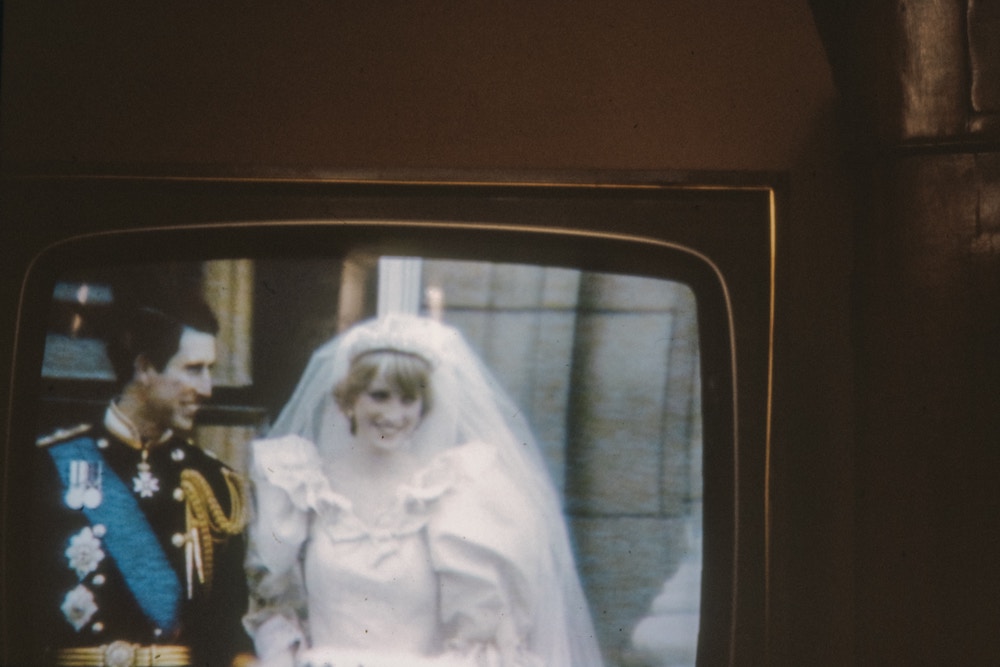




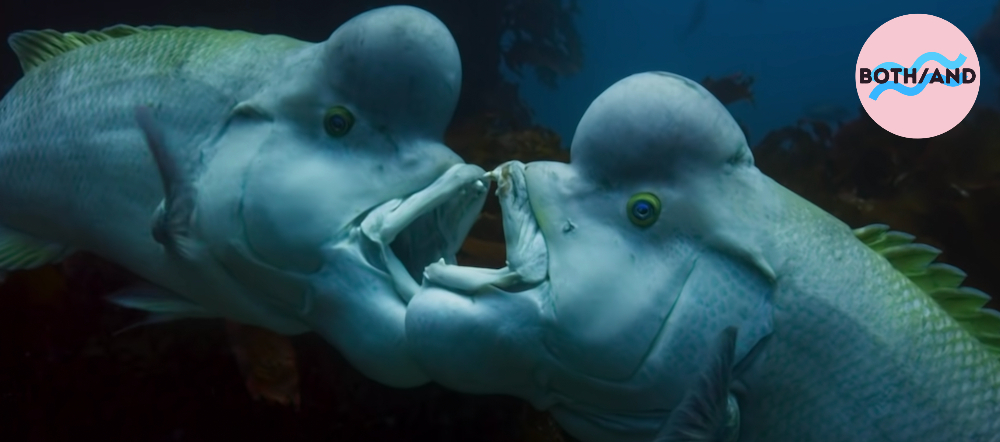
 . I am too busy living each day as a person who is soooooo stylish and cute.